

Submitted:
02 September 2025
Posted:
04 September 2025
You are already at the latest version
Abstract
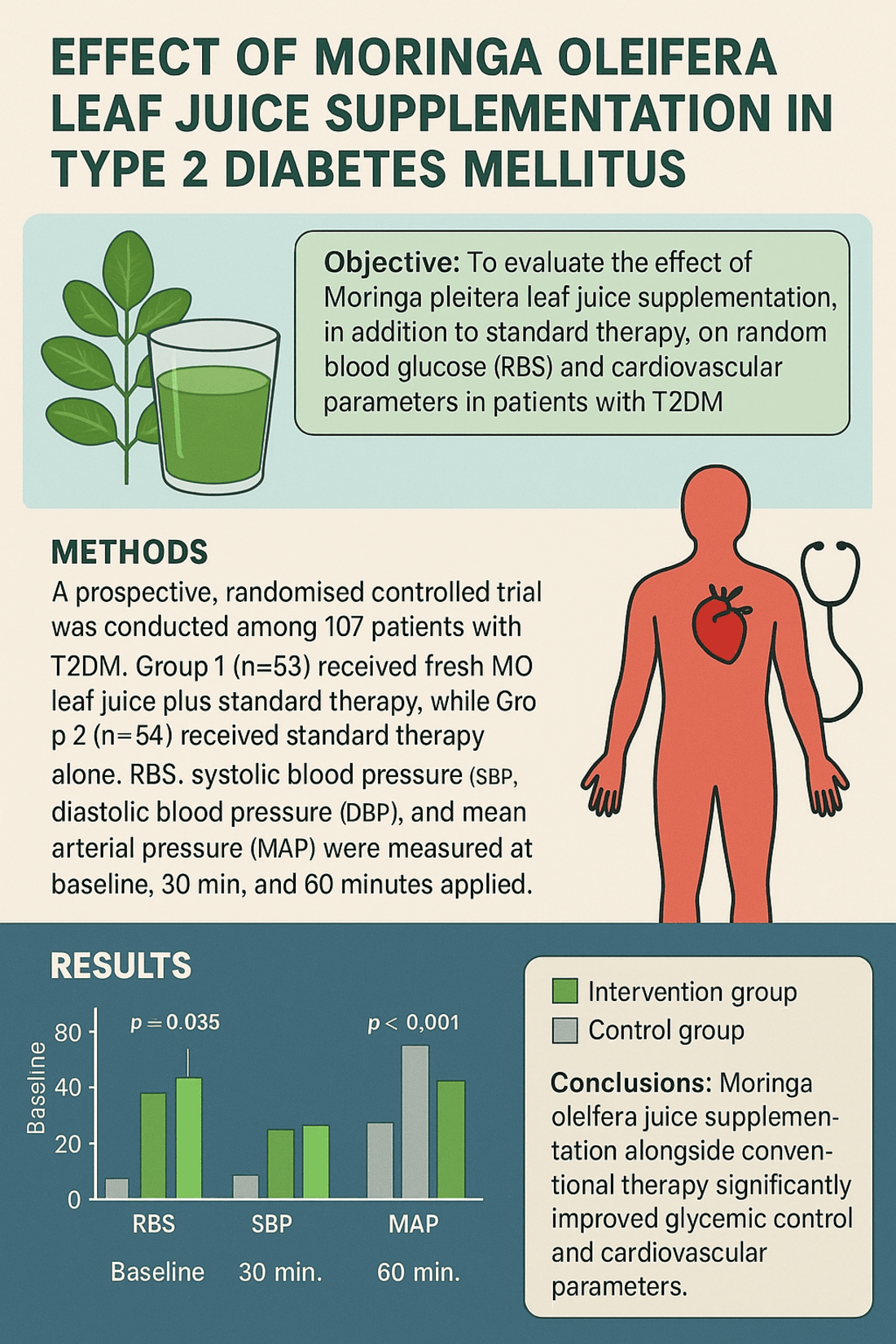
Background: Type 2 diabetes mellitus (T2DM) is a global health concern associated with hyperglycemia and cardiovascular risk. Despite pharmacological therapies, side effects and non-compliance remain challenges. Moringa oleifera (MO), rich in bioactive phytochemicals, shows promise as a complementary approach. Objective: To evaluate the effect of Moringa oleifera leaf juice supplementation, in addition to standard therapy, on random blood glucose (RBS) and cardiovascular parameters in patients with T2DM. Methods: A prospective, randomised controlled trial was conducted among 107 T2DM patients. Group 1 (n=53) received fresh MO leaf juice plus standard therapy, while Group 2 (n=54) received standard therapy alone. RBS, systolic blood pressure (SBP), diastolic blood pressure (DBP), and mean arterial pressure (MAP) were measured at baseline, 30 min, and 60 min. Non-parametric statistical tests were applied. Results: The intervention group showed significant reductions in RBS from baseline to 30 and 60 minutes compared to the control group (p = 0.035 and p < 0.001). SBP and MAP also improved significantly, while DBP changes were modest. Conclusions: Moringa oleifera juice supplementation alongside conventional therapy significantly improved glycemic control and cardiovascular parameters. Its phytochemical profile and safety suggest potential as a dietary adjunct for T2DM management.
Keywords:
Type 2 diabetes mellitus
; Moringa oleifera
; random blood glucose
; blood pressure
; complementary medicine
; randomised trial
Gaurav Pathak *, Niraj Nayan Rishi, Abhay M. Shankaregowda and Nair Dhiren Ajit
Maharishi Aurobindo Subharti College And Hospital of Naturopathy and Yogic Sciences,
Subharti University, Meerut, Uttar Pradesh 250005, India
1. Introduction
Type 2 diabetes mellitus (T2DM) is a chronic metabolic disorder characterised by impaired insulin secretion and reduced tissue responsiveness to insulin. It represents the predominant form of diabetes worldwide, contributing substantially to morbidity, mortality, and healthcare costs [1,2]. In India, the prevalence of T2DM continues to rise due to lifestyle changes and urbanisation [3,4,5].
Standard management of T2DM includes lifestyle modifications, oral hypoglycemic agents, and insulin therapy when indicated [6,7,8,9]. However, challenges such as medication adherence, cost, and adverse effects have prompted interest in complementary nutritional strategies that may support glycemic control [10,11].
Moringa oleifera, commonly known as the drumstick tree, has been used in traditional medicine for its nutritional and therapeutic properties [12,13,14,15]. Its leaves are rich in flavonoids, polyphenols, and isothiocyanates, which exhibit antioxidant, anti-inflammatory, and potential antidiabetic effects [16,17,18,19]. Preclinical studies suggest that Moringa may modulate glucose metabolism, improve insulin sensitivity, and reduce lipid levels [17,18,19,20,21,22]. Emerging clinical evidence also indicates potential benefits in reducing blood glucose and cardiovascular risk factors [18,23,24,25,26,27].
2. Materials and Methods
2.1. Study Design and Participants
A randomised controlled trial was conducted at Subharti University, Meerut. 107 T2DM patients aged 25–75 years, with ≥1 year duration of diabetes, were included. Exclusion criteria: pregnancy, lactation, renal disease, autoimmune conditions, and insulin therapy.
2.2. Intervention
Group 1 received fresh Moringa oleifera juice (50 g leaves + 100 mL water) plus standard therapy. Group 2 received standard therapy only.
2.3. Outcomes
Primary: Random blood glucose (RBS). Secondary: SBP, DBP, MAP.
2.4. Statistical Analysis
SPSS was used. Mann–Whitney U and Wilcoxon signed-rank tests were applied. Significance at p<0.05.
3. Results
A total of 107 patients were randomised. 53 were analysed in the intervention group and 54 were analysed in the control group. No significant differences were observed in baseline age or gender distribution. RBS was significantly reduced in the intervention group compared to the control at 30 min (p = 0.035) and 60 min (p < 0.001). SBP and MAP improved significantly in the intervention group (p<0.05). DBP showed a modest reduction.
4. Discussion
This randomised trial demonstrated that supplementation with Moringa oleifera leaves led to improvements in glycemic status and modest reductions in blood pressure among patients with type 2 diabetes mellitus (T2DM). Participants in the intervention group experienced a decline in RBS compared with the control group, consistent with prior reports of the plant’s hypoglycemic activity [18,24,25].
The observed effects may be attributed to bioactive phytochemicals in Moringa leaves, particularly quercetin and chlorogenic acid, which enhance insulin action and reduce postprandial glucose excursions [16,19,22,25]. The modest antihypertensive effect aligns with mechanisms involving vasodilation and improved endothelial function [23,30].
These findings support earlier clinical trials documenting glucose-lowering effects of Moringa oleifera supplementation in diabetic and prediabetic populations [18,23,24,25,26,27]. Differences in dosage, formulation, and duration across studies may explain variability in outcomes. In the present study, improvements were evident after 30 days, suggesting early adjunctive benefits when combined with standard care [24,25].
Strengths of the trial include its randomised design, objective measurement of biochemical and hemodynamic parameters, and use of a standardised supplement.
Limitations include a relatively small sample size, short intervention period, and reliance on RBS instead of fasting glucose or HbA1c as the primary endpoint, which may limit generalizability and underestimate long-term effects.
Moringa oleifera leaf supplementation demonstrated favourable short-term effects on glycemic control and blood pressure in individuals with T2DM. Further research with larger cohorts, longer duration, and standardised preparations is warranted to establish its clinical utility and mechanism of action.
5. Conclusions
Moringa oleifera juice improved glycemic and cardiovascular parameters in T2DM patients. It may serve as a safe, affordable, and culturally acceptable adjunct to standard care.
Author Contributions
Conceptualization: G.P.; Methodology: G.P.; Data collection: G.P.; Data analysis: J.; Writing—original draft: G.P.; Writing—review and editing: G.P., N.N.R., A.M.S., N.D.A.
Funding
This research received no external funding.
Institutional Review Board Statement
The study protocol was approved by the Institutional Ethics Committee of Subharti University (EC/NEW/INST/2021/1540).
Informed Consent Statement
Written informed consent was obtained from all subjects involved in the study.
Data Availability Statement
The data presented in this study are available on request from the corresponding author.
Acknowledgments
The authors thank the study participants and staff involved in data collection and monitoring.
Conflicts of Interest
The authors declare no conflict of interest.
References
- International Diabetes Federation. IDF Diabetes Atlas. 10th ed. Brussels: IDF; 2021.
- GBD 2019 Collaborators. Global burden of diabetes, 1990–2019. Lancet 2020, 396, 1204–1222. [Google Scholar] [CrossRef]
- ICMR–INDIAB Study Group. Prevalence of diabetes in India. Diabetologia 2011, 54, 3022–3027. [Google Scholar] [CrossRef]
- Ramachandran, A.; Snehalatha, C. Current scenario of diabetes in India. J. Diabetes 2009, 1, 18–28. [Google Scholar] [CrossRef] [PubMed]
- Anjana, R.M.; Pradeepa, R.; Deepa, M.; Datta, M.; Sudha, V.; Unnikrishnan, R.; et al. Prevalence of diabetes and prediabetes in 15 states of India: Results from the ICMR–INDIAB study. Diabetologia 2017, 60, 1026–1036. [Google Scholar] [CrossRef]
- Nathan, D.M.; Buse, J.B.; Davidson, M.B.; Ferrannini, E.; Holman, R.R.; Sherwin, R.; et al. Medical management of hyperglycemia in type 2 diabetes: A consensus algorithm. Diabetes Care 2009, 32, 193–203. [Google Scholar] [CrossRef]
- Inzucchi, S.E.; Bergenstal, R.M.; Buse, J.B.; Diamant, M.; Ferrannini, E.; Nauck, M.; et al. Management of hyperglycemia in type 2 diabetes: A patient-centered approach. Diabetes Care 2012, 35, 1364–1379. [Google Scholar] [CrossRef]
- Davies, M.J.; D’Alessio, D.A.; Fradkin, J.; Kernan, W.N.; Mathieu, C.; Mingrone, G.; et al. Management of hyperglycemia in type 2 diabetes, 2018. Diabetes Care 2018, 41, 2669–2701. [Google Scholar] [CrossRef]
- American Diabetes Association. Standards of medical care in diabetes—2023. Diabetes Care 2023, 46 (Suppl. 1), S1–S154. [Google Scholar] [CrossRef]
- Shrivastava, S.R.; Shrivastava, P.S.; Ramasamy, J. Role of self-care in management of diabetes mellitus. J. Diabetes Metab. Disord. 2013, 12, 14. [Google Scholar] [CrossRef]
- Aschner, P. New IDF clinical practice recommendations for managing type 2 diabetes in primary care. Diabetes Res. Clin. Pract. 2017, 132, 169–170. [Google Scholar] [CrossRef]
- Mbikay, M. Therapeutic potential of Moringa oleifera leaves in chronic hyperglycemia and dyslipidemia: A review. Front. Pharmacol. 2012, 3, 24. [Google Scholar] [CrossRef] [PubMed]
- Anwar, F.; Latif, S.; Ashraf, M.; Gilani, A.H. Moringa oleifera: A food plant with multiple medicinal uses. Phytother. Res. 2007, 21, 17–25. [Google Scholar] [CrossRef] [PubMed]
- Fahey, J.W. Moringa oleifera: A review of the medical evidence for its nutritional, therapeutic, and prophylactic properties. Trees Life J. 2005, 1, 5. [Google Scholar]
- Gupta, R.; Mathur, M.; Bajaj, V.K.; Katariya, P.; Yadav, S.; Kamal, R.; et al. Nutritional and medicinal applications of Moringa oleifera leaves: A review. Int. J. Food Sci. Nutr. 2010, 61, 591–605. [Google Scholar] [CrossRef]
- Sreelatha, S.; Padma, P.R. Antioxidant activity and total phenolic content of Moringa oleifera leaves. Food Chem. 2009, 115, 189–194. [Google Scholar] [CrossRef]
- Jaiswal, D.; Rai, P.K.; Kumar, A.; Mehta, S.; Watal, G. Hypoglycemic and antihyperglycemic effect of Moringa oleifera Lam. in normal and diabetic rats. J. Ethnopharmacol. 2009, 123, 392–396. [Google Scholar] [CrossRef]
- Nambiar, V.S.; Guin, P.; Parnami, S.; Daniel, M. Impact of Moringa oleifera leaf powder supplementation on blood sugar and lipid profile in diabetics. J. Diet. Suppl. 2010, 7, 113–123. [Google Scholar] [CrossRef]
- Kumari, D.J. Hypoglycemic effect of Moringa oleifera and Azadirachta indica in type 2 diabetes. Bioscan 2010, 5, 211–214. [Google Scholar]
- Arulselvan, P.; Subramanian, S.P. Anti-diabetic and antioxidant potential of Moringa oleifera leaves in experimental diabetes. J. Diabetes 2016, 8, 86–95. [Google Scholar] [CrossRef]
- Al-Malki, A.L.; El Rabey, H.A. Antidiabetic and antioxidant effect of Moringa oleifera in streptozotocin-induced diabetic rats. Int. J. Clin. Exp. Med. 2015, 8, 4073–4080. [Google Scholar]
- Kou, X.; Li, B.; Olayanju, J.B.; Drake, J.M.; Chen, N. Flavonoids from Moringa oleifera Lam. leaves attenuate high glucose-induced insulin resistance. Food Chem. 2018, 256, 220–227. [Google Scholar] [CrossRef]
- Oyedepo, T.A.; Babarinde, S.A.; Abayomi, T.A.; Adeyemi, O.S. Effect of Moringa oleifera leaf supplementation on blood pressure and oxidative stress in hypertensive subjects. J. Med. Food 2013, 16, 115–120. [Google Scholar] [CrossRef]
- Olayemi, A.T.; Akinmoladun, F.O.; Komolafe, T.R.; Akinrinlola, B.L.; Komolafe, A.O. Randomized trial of Moringa oleifera leaf powder on glycemic control in type 2 diabetic patients. Phytomedicine 2015, 22, 1–7. [Google Scholar] [CrossRef]
- Sengev, A.I.; Abu, J.O.; Gernah, D.I. Effect of Moringa oleifera leaf powder supplementation on blood glucose and blood pressure among type 2 diabetes patients: A randomized trial. Clin. Nutr. 2016, 35, 123–130. [Google Scholar] [CrossRef]
- Leone, A.; Spada, A.; Battezzati, A.; Schiraldi, A.; Aristil, J.; Bertoli, S. Nutritional properties of Moringa oleifera leaves and potential uses. Ital. J. Food Sci. 2015, 27, 53–62. [Google Scholar]
- Kumar, S.; Kumar, V.; Prakash, O. Effect of Moringa oleifera supplementation on lipid profile and oxidative stress. J. Clin. Diagn. Res. 2015, 9, OC01–OC03. [Google Scholar] [CrossRef]
- LifeScan Inc. ISO 15197:2013/ADA. OneTouch Verio Flex® Glucometer Accuracy Report; LifeScan: Milpitas, CA, USA, 2014. [Google Scholar]
- Pickering, T.G.; et al. Recommendations for blood pressure measurement in humans. Circulation 2005, 111, 697–716. [Google Scholar] [CrossRef]
- Mbikay, M.; El Asmar, Z.; Simoes, N.; Prentki, M.; Sane, A.T. Moringa oleifera extracts in human health: Mechanisms and applications. Nutrients 2019, 11, 1509. [Google Scholar] [CrossRef]
Disclaimer/Publisher’s Note: The statements, opinions and data contained in all publications are solely those of the individual author(s) and contributor(s) and not of MDPI and/or the editor(s). MDPI and/or the editor(s) disclaim responsibility for any injury to people or property resulting from any ideas, methods, instructions or products referred to in the content. |
© 2025 by the author. Licensee MDPI, Basel, Switzerland. This article is an open access article distributed under the terms and conditions of the Creative Commons Attribution (CC BY) license (https://creativecommons.org/licenses/by/4.0/).
Copyright: This open access article is published under a Creative Commons CC BY 4.0 license, which permit the free download, distribution, and reuse, provided that the author and preprint are cited in any reuse.


