

Submitted:
01 September 2025
Posted:
03 September 2025
You are already at the latest version
Abstract
English language teaching today is saturated with methods that promise fluency, precision, or communicative ease—yet beneath this crowded landscape lies a deeper crisis: learners are trained to perform, not to reckon; to comply, not to narrate. Narrative Language Ecology (NLE) responds by reimagining language learning as a lived, ethical, and ecological act, aligned with UNESCO’s Sustainable Development Goals, particularly those advancing inclusive, equitable, and quality education. In NLE, each macroskill—listening, speaking, reading, writing, viewing, and representing—is treated not as a technical outcome but as a diagnostic entry point into context, agency, and reform. Learners engage with soundscapes, silences, and stories that demand presence and provoke reflection. Technology and AI are not shortcuts—they are narrative-critical instruments that flag bias, scaffold ethical clarity, and amplify rhythm without erasing voice. Values are structurally embedded, not decoratively appended, ensuring that every output breathes with empathy, accountability, and social relevance. NLE does not teach language as a system; it teaches language as a purposeful way of life—one shaped by reflection, responsiveness, and meaningful engagement with the world.
Keywords:
ethical pedagogy
; language learning
; narrative method
; technology-enhanced
; values integration
Introduction:
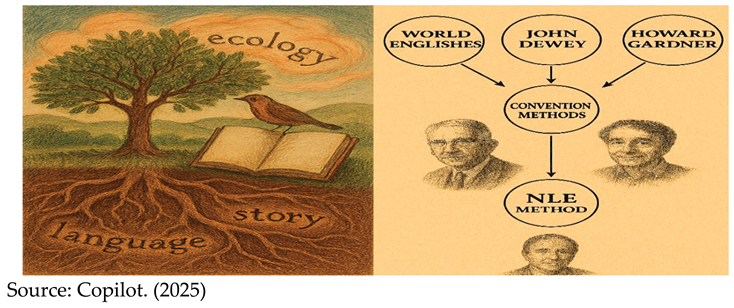
English language teaching and learning today are crowded with methods—each one promising fluency, precision, or communicative ease. Grammar Translation drills structure into silence; Task-Based Language Teaching (TBLT) chases outcomes with clinical efficiency. But for non-native English teachers working in postcolonial and multilingual realities, these methods often feel foreign, prescriptive, and ethically thin. They flatten language into a skillset, erase its cultural memory, and overlook the emotional labor of teaching in fractured linguistic terrain. It’s in this uneasy space that the Narrative Language Ecology Method begins to take shape—not as another technique to master, but as a way of listening differently, reclaiming voice, and restoring meaning where it’s been silenced.
These gaps are not merely pedagogical—they are existential. Teachers are cast as technicians, not thinkers. Learners are treated as data points, not narrators. Institutional outputs favor compliance over conscience, and curriculum design often rewards neutrality over nuance. Technology, while offering unprecedented access and personalization, has further complicated the terrain. Artificial intelligence, digital platforms, and algorithmic instruction risk flattening pedagogy into dashboards, metrics, and decontextualized content—especially in under-resourced systems where infrastructure is uneven and values integration is absent.
Narrative Language Ecology (NLE) emerges as a response—not merely as a new method, but as a pedagogical reawakening. It reframes English not as a neutral tool, but as a living, contested, and emotionally charged language. Through progression, it positions the teacher not as a technician, but as a co-narrator. And it treats the learner not as a passive recipient, but as a storyteller with agency, memory, and voice. In so doing, NLE addresses the very gaps that conventional methods ignore: the ethical void, the narrative silence, the institutional fatigue, and the technological drift.
From John Dewey’s early 20th-century insistence that learning must grow from lived experience—not drills or abstraction—to Howard Gardner’s 1983 call for honoring multiple intelligences beyond the linguistic and logical, the history of pedagogy has long resisted reduction. Yet even today, language teaching often remains rigid, sidelining the emotional, ethical, and narrative dimensions that make learning human. This reawakening gains urgency in an era of AI-mediated classrooms and digitally driven instruction. Narrative Language Ecology (NLE) method rises from this lineage—not as a nostalgic echo, but as a present-day reckoning. It resists the mechanization of learning by restoring narrative, memory, and ethical complexity to the heart of language education. It insists that even in tech-enhanced environments, the human voice must remain central—and that values integration is not a decorative add-on, but a pedagogical imperative. NLE doesn’t discard structure; it reanimates it. Because in every learner, there’s more than grammar to be mastered—there’s a voice to be heard.
Aligned with UNESCO’s Sustainable Development Goals—particularly SDG 4 (Quality Education), SDG 9 (Industry, Innovation, and Infrastructure), and SDG 16 (Peace, Justice, and Strong Institutions)—NLE advocates for inclusive, context-sensitive, and justice-driven education. It empowers non-native teachers and learners to reclaim English as a site of dignity, not domination. It challenges institutions to move beyond performative compliance and toward genuine reform.
This paper situates Narrative Language Ecology (NLE) method within a broader institutional and philosophical critique—one that refuses to treat language as commodity or pedagogy as compliance. It draws from the lived realities of postcolonial classrooms, where English often functions as both gatekeeper and ghost, and where teachers must facilitate and navigate not only curriculum but the residues of cultural trauma. The thesis statement guiding this analysis is clear: NLE emerges as a pedagogical reckoning—restoring story, memory, and ethical depth to English Language Teaching, especially for non-native learners and educators who have long been made to feel peripheral. By fusing diagnostic insight with ethical urgency, NLE offers a humanizing alternative: one that dignifies voice, restores context, and provokes reform. Informed by the rise of World Englishes (Kachru, 1992), it insists that English is no longer a borrowed prestige but a plural, lived language—one that must be taught not for mimicry, but for meaning.
The Philosophical Grounding of NLE
At its core, Narrative Language Ecology (NLE) method draws from narrative inquiry, ecological linguistics, and critical pedagogy. It recognizes that language is not learned in a vacuum—it is shaped by history, power, suffering, and resistance. For non-native teachers, this means teaching English through the lens of lived experience, not through mimicry of native norms. This stance challenges the legacy of method-driven instruction, as outlined in Richards and Rodgers’ Approaches and Methods in Language Teaching (2014), which catalogues decades of pedagogical models often rooted in structuralist assumptions. NLE does not reject these outright—it repositions them. It insists that methods must serve meaning, not mute it; that structure must be animated by story, not stripped of it. In doing so, NLE offers not just an alternative, but a reckoning.
NLE method begins with questions like:
- When did English first make you feel powerful—or powerless?
- What stories live in your accent, your idioms, your silences?
These questions are not decorative—they are diagnostic. They reveal the emotional terrain of language learning and teaching, especially for non-native English users who often navigate feelings of inadequacy, cultural dislocation, and the pressure to mimic native norms. English, in such contexts, arrives not as a shared resource but as a gatekeeping tool. Narrative Language Ecology (NLE) Method confronts this by restoring dignity to the learner’s voice and agency to the teacher’s role, insisting that English be taught as a lived language shaped by memory, resistance, and identity. This stance resonates with the birth of World Englishes, championed by Braj B. Kachru in the late 1970s, which legitimized diverse Englishes across postcolonial and multilingual contexts. NLE builds on this legacy—not just by acknowledging plurality, but by demanding pedagogical justice: that English be reclaimed as a site of meaning, not just mastery.
Comparative Positioning: NLE vs. Conventional Methods
To understand NLE’s distinctiveness, it must be placed in dialogue with dominant ELT approaches. The table below offers a comparative snapshot:
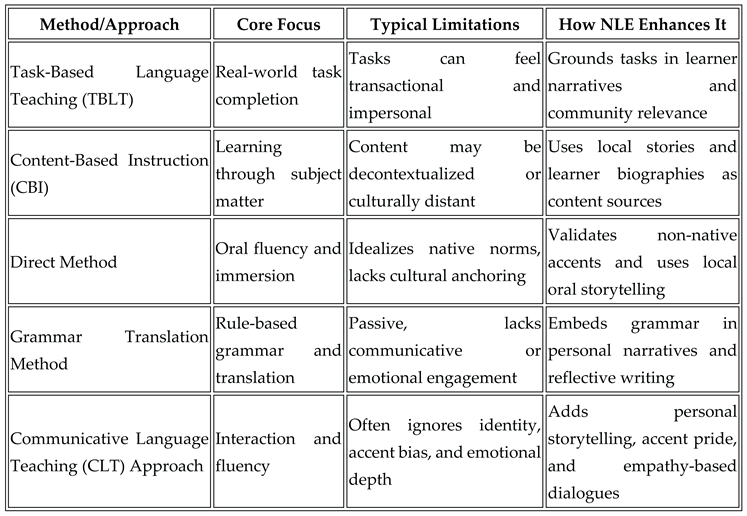
NLE doesn’t compete by being louder—it outlasts by being deeper. It humanizes where others mechanize. It adapts where others demand rigidity. And it empowers where others marginalize.
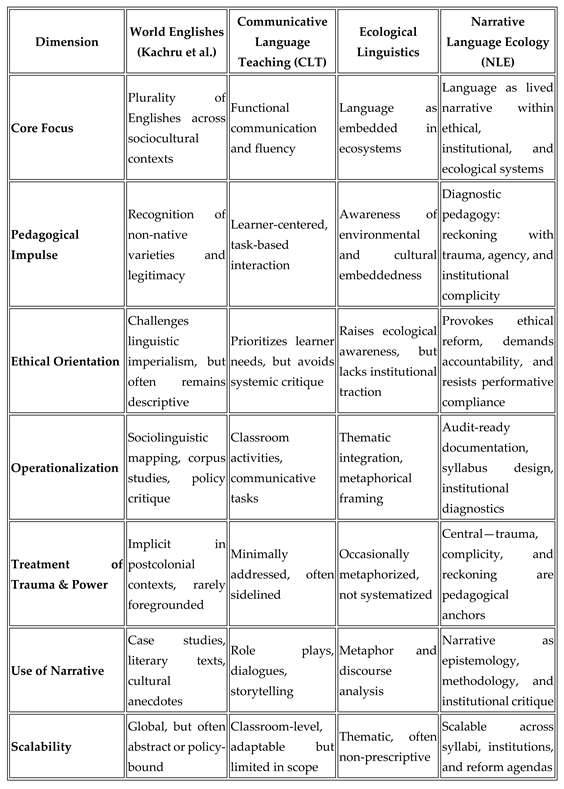
Comparative Table: NLE vs. Established ELT Frameworks
Why NLE Matters
NLE doesn’t just ask what English is or how it’s taught—it asks who gets to speak, whose trauma is silenced, and what systems are protected by pedagogical neutrality. It’s not a framework for comfort. It’s a method for reckoning.
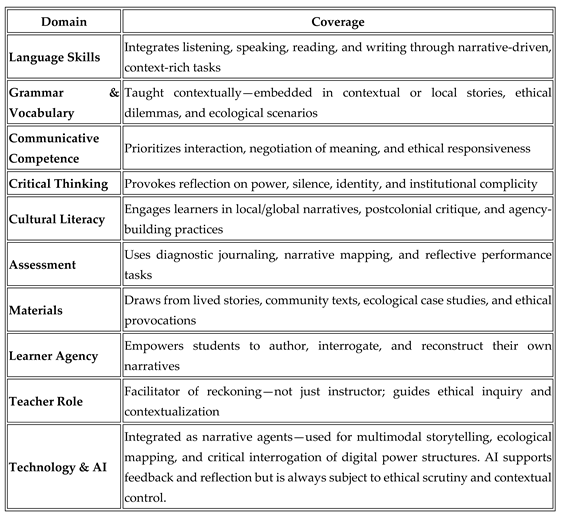
Core Coverage of the Narrative Language Ecology Method
Foundational Principles for Primary Learners
- English is introduced as a living language, not a foreign code. It’s embedded in stories, songs, and social rituals that mirror the child’s world.
- Mother tongue is honored, not erased. Learners begin in their own language, then gradually bridge into English through narrative translation and ecological mapping.
- Grammar and vocabulary are taught through meaning, not memorization. Children learn what English does before they learn how it’s structured.
Structured Progression
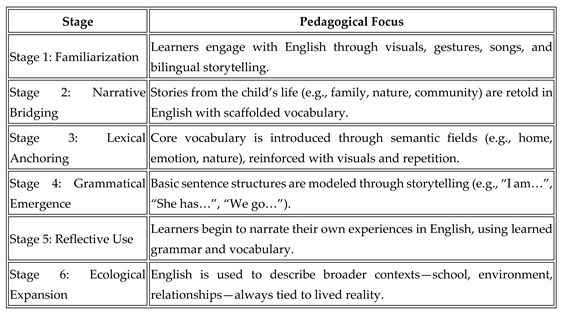
What NLE Prevents
- Cognitive overload: No premature grammar drills or abstract vocabulary lists.
- Cultural erasure: Learners’ identities and languages are foundational, not obstacles.
- Performative compliance: Children are not trained to “sound fluent”—they’re taught to mean what they say.
Example in Practice
A Grade 1 learner in Iligan might begin with a story about a mango tree in their backyard. In their mother tongue, they describe its growth, its fruit, and its role in their family. The teacher helps them retell this in English:
- “This is my mango tree.”
- “It grows big.”
- “We eat mangoes in May.”
Vocabulary (tree, mango, eat, big, May) and grammar (present tense, possessive pronouns) are introduced organically, not artificially.
Key Claims for School Integration:
NLE teaches English not as a neutral skill, but as a site of ethical reckoning. It repositions the mother tongue, technology, and AI as co-authors—not accessories.
- Mother Tongue as Anchor: Learners interrogate English through their native language, restoring erased meanings and resisting linguistic displacement.
- AI as Bias Mirror: Students use AI not just to produce text, but to expose algorithmic erasure and reclaim narrative agency.
- Technology as Provocation: Tools are used to surface silence, not automate drills—revealing what gets flagged, forgotten, or normalized.
- Triangular Ecology: English ↔ Mother Tongue ↔ AI form a dynamic system where learners navigate power, silence, and visibility.
Pedagogical Features of NLE
1. Language Biography Mapping. Learners trace their journey with English—first encounters, fears, triumphs. These maps become texts for reflection, vocabulary building, and emotional engagement.
2. Community Story Circles. Students share local legends or family stories in English, then analyze tone, register, and cultural nuance. This builds fluency through connection, not correction.
3. Eco-Text Exploration. Learners examine how English appears in their environment—billboards, menus, social media—and discuss its impact. English becomes a visible, analyzable artifact.
4. Empathy Interviews. Students interview someone about their experience with English, then retell the story in their own words. This fosters listening, paraphrasing, and emotional resonance.
5. Reflective Portfolios. Instead of just grammar tests, learners produce story maps, journals, and multimedia artifacts that document growth in voice, confidence, and rhetorical impact.
Integrating the Four Macro-Skills Through Narrative Language Ecology
Traditional ELT methods often compartmentalize the macro-skills: listening drills, speaking tasks, reading comprehension, and writing exercises. While efficient for assessment, this fragmentation risks stripping language of its emotional and contextual depth. NLE re-integrates these skills by embedding them in narrative, ecological, and empathetic practice—making each skill not just a technical output, but a meaningful act of voice and connection.
Listening: From Passive Reception to Empathic Engagement
In NLE, listening is not just about decoding sounds—it’s about hearing stories, feeling tone, and understanding context.
- Empathy Interviews train learners to listen for emotion, nuance, and cultural cues.
- Community Story Circles expose learners to diverse accents, registers, and storytelling styles.
- Eco-text Listening Tasks (e.g., analyzing local radio, podcasts, or oral histories) develop real-world comprehension and critical awareness.
Outcome: Learners become active, empathetic listeners who can navigate diverse Englishes and respond with emotional intelligence.
Speaking: From Performance to Personal Voice
NLE reframes speaking not as mimicry of native norms, but as authentic self-expression.
- Language Biography Presentations. Allow learners to narrate their own journey with English.
- Accent Pride Activities. Validate local pronunciation and encourage rhetorical ownership.
- Story Retelling and Role Reversal. Build fluency through emotional connection, not scripted dialogue.
Outcome: Learners speak with confidence, clarity, and identity—developing fluency that is functional, expressive, and culturally grounded.
Reading: From Comprehension to Cultural Inquiry
Reading in NLE is not just about extracting meaning—it’s about interrogating texts, locating voice, and connecting with lived realities.
- Narrative Text Analysis (e.g., memoirs, oral histories, community stories) builds inferencing, empathy, and thematic awareness.
- Eco-Text Exploration (e.g., signage, social media, local documents) teaches learners to read English as it appears in their world.
- Critical Reading Tasks invite learners to question bias, tone, and power dynamics in institutional English.
Outcome: Learners become critical readers who can decode not just language, but the intent and impact behind it in the local context.
Writing: From Accuracy to Agency
Writing in NLE is not a grammar test—it’s a claiming of voice.
- Reflective Journals and Story Maps develop fluency, coherence, and emotional depth.
- Empathy-Based Writing Tasks (e.g., retelling someone’s story, writing from another’s perspective) build rhetorical sensitivity.
- Manifesto Writing (e.g., “My English, My Voice”) fosters argumentative clarity and personal conviction.
Outcome: Learners write with rhythm, purpose, and ethical urgency—producing texts that breathe, provoke, and connect.
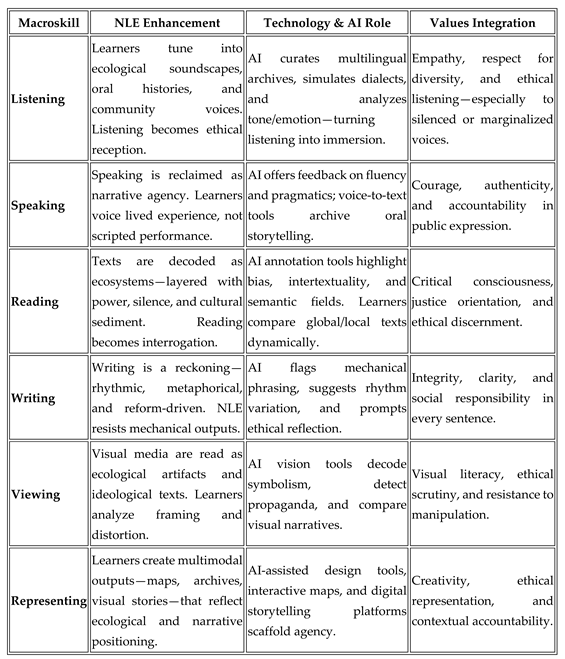
Narrative Language Ecology (NLE) method enhances each macroskill—not as isolated competencies, but as interwoven, context-rich practices. This isn’t just a pedagogical alignment—it’s a philosophical reorientation.
NLE Mapping to Macroskills
To include the extended macro skill, Language learning is often sliced into six macroskills: listening, speaking, reading, writing, viewing, and representing. But in NLE, these aren’t skills—they’re acts of narrative survival. Each one is a portal into lived experience, ecological attunement, and ethical agency.
Diagnostic Matrix: NLE + Macroskills + Technology/AI + Values
Structural Embedding of Values
- In lesson plans: Values are explicit outcomes, not hidden themes.
- In assessments: Ethical depth is evaluated alongside skill mastery.
- In documentation: Values signal institutional integrity and learner growth.
- In teacher guides: Reflective prompts and ethical dilemmas are tied to each skill.
- In AI use: AI becomes a mirror for values—flagging bias, prompting reflection, resisting automation without agency.
Philosophical Pulse
In NLE, macroskills are not competencies—they are narrative acts. Technology is not a shortcut—it is a scalpel and a mirror. Values are not decorative—they are the bloodstream.
This is not a framework that teaches language. It teaches how to live through language.
Diagnostic Insight
NLE doesn’t just “support” macroskills—it redefines them. Each skill becomes:
- Narrative-driven: rooted in lived experience
- Ecologically anchored: responsive to local and global contexts
- Ethically urgent: designed to provoke reform, not just demonstrate competence
Holistic Impact
By embedding the macro-skills in narrative ecology, NLE:
- Breaks down artificial silos between skills.
- Builds emotional and cultural intelligence alongside linguistic competence.
- Empowers learners to use English not just correctly—but meaningfully.
This is especially transformative for non-native teachers and learners in postcolonial contexts, where English often arrives as a gatekeeper. NLE turns it into a gateway—to voice, story, and shared humanity.
Where to Situate Technology and AI in NLE
1. As Tools for Storytelling, Not Surveillance. In many classrooms, technology is used to monitor, assess, or automate. NLE resists this. It uses tech to capture, curate, and amplify stories.
- Digital Story Maps: Learners use apps to visually trace their English journey—annotating with photos, voice notes, and emojis.
- Podcasting & Video Diaries: Students record their reflections, interviews, or oral narratives—building fluency and rhetorical control.
- Multimodal Portfolios: AI tools help organize learner outputs—text, audio, visual—into audit-ready formats without stripping away soul.
Key Principle: Tech must serve expression, not extraction.
2. As Scaffolds for Voice, Not Templates for Fluency. AI can be used to support learners in refining their writing, exploring vocabulary, and experimenting with tone—but always with critical awareness.
- AI-assisted drafting: Learners use tools like Copilot to brainstorm metaphors, rephrase ideas, or explore idiomatic variation.
- Accent Analysis Tools: Used not to “correct” but to celebrate and understand regional pronunciation.
- Grammar Feedback: Offered as a dialogic suggestion, not a punitive correction.
Key Principle: AI supports agency, not conformity.
3. As Mirrors for Metalinguistic Awareness. AI can help learners and teachers reflect on how English behaves—how tone shifts, how bias creeps in, how institutional language obscures meaning.
- Text Comparison Tools: Learners compare bureaucratic vs. humanized English.
- Bias Detection: AI flags euphemisms, jargon, or exclusionary phrasing—sparking classroom critique.
- Accent Simulation: Learners explore how the same sentence sounds across global Englishes—then discuss perception and power.
Key Principle: Tech reveals linguistic politics, not just patterns.
4. As Bridges to Community and Collaboration. NLE thrives on shared stories. Technology enables learners to connect across borders, generations, and contexts.
- Virtual Story Exchanges: Learners share their English journeys with peers in other regions or countries.
- Community Archives: Teachers and students collect local narratives using mobile tools, then curate them digitally.
- Collaborative Writing Platforms: AI supports co-authorship, revision, and reflection—without erasing individual voice.
Key Principle: Tech builds dialogue, not dependency.
Concept Innovation:
In NLE, technology and AI are not neutral—they are cultural actors. They must be interrogated, not just integrated. They can either reinforce linguistic gatekeeping or dismantle it. The difference lies in how we situate them—with story, with ethics, and with purpose.
Institutional Relevance and Audit-Readiness
NLE is not anti-institutional—it is institutionally confrontational. It produces outputs that are:
- Documentable: Portfolios, journals, and story maps can be archived and reviewed.
- Accreditation-friendly: Reflective writing aligns with learning outcomes and quality assurance metrics.
- Ethically urgent: It provokes questions about linguistic equity, accent bias, and curricular relevance.
For non-native teachers, NLE offers a way to teach from truth, not from templates. It validates their accent, idiom, and pedagogical intuition. It allows them to model vulnerability, resilience, and intellectual agency.
Values Integration: The Ethical Core. At its heart, NLE is a values-driven pedagogy. It integrates empathy, dignity, cultural memory, and ethical accountability into every lesson, every interaction. It refuses to treat learners as data points or teachers as delivery systems. Instead, it cultivates classrooms where respect, justice, and voice are not abstract ideals—but daily practices. In doing so, NLE transforms English from a gatekeeping language into a space for healing, dialogue, and democratic participation.
Benefits
- Rehumanizes ELT by centering narrative, emotion, and cultural memory
- Empowers non-native teachers to reclaim pedagogical agency
- Aligns with global goals for inclusive and ethical education
- Resists performative compliance and promotes diagnostic critique
- Offers flexibility across multilingual, postcolonial, and digitally mediated contexts
- Embeds values integration as a lived ethic, not a scripted add-on
Limitations
- Requires deep teacher reflexivity and institutional support—often lacking in rigid systems
- May be misinterpreted as “soft” or “non-academic” in audit-driven environments
- Challenges dominant metrics of success, which can hinder adoption in standardized curricula
- Demands time, trust, and narrative literacy—resources not always available
- Relies on equitable access to technology infrastructure, which remains uneven across postcolonial and rural contexts. Without stable connectivity, digital tools, or institutional investment, the promise of NLE in AI-enhanced environments risks becoming exclusionary rather than empowering
Challenges
- Navigating institutional resistance to ethical reform and pedagogical rewilding
- Training educators to move beyond method and into narrative co-authorship
- Integrating NLE meaningfully within AI-enhanced platforms without losing its soul
- Ensuring that learner stories are not commodified or tokenized in the name of “inclusion”
- Operationalizing values integration in systems that reward neutrality over nuance
Conclusion
Narrative Language Ecology is not a trend—it is a reckoning. It asks us to stop teaching English as if it were a neutral commodity and start teaching it as a lived, emotional, and political experience. It invites teachers and learners to bring their full selves into the classroom—not just their grammar, but their grief, their joy, their story.
In a world increasingly shaped by artificial intelligence and digital instruction, where dashboards and algorithms threaten to flatten pedagogy into performance metrics, NLE insists on breath. It resists the mechanization of learning and reclaims the classroom as a space of memory, agency, and ethical encounter. Even as AI tools proliferate, NLE reminds us that no machine can narrate the trauma of colonization, the silence of exclusion, or the joy of linguistic reclamation.
Aligned with UNESCO’s Sustainable Development Goals—especially SDG 4 (Quality Education), SDG 9 (Industry, Innovation, and Infrastructure), and SDG 16 (Peace, Justice, and Strong Institutions)—NLE offers more than a method. It offers a movement toward inclusive, context-sensitive, and justice-driven education. It dignifies the non-native teacher not as a technician of borrowed frameworks, but as a co-creator of meaning. It empowers learners not as passive recipients of global English, but as narrators of their own multilingual realities.
In a world where English often silences, NLE teaches it to listen. And in doing so, it teaches us to teach not just with competence—but with conscience. To call it “Narrative Language Ecology” Method is to insist that language teaching is not just about grammar or fluency—it’s about whose story gets told, how, and why. It’s a pedagogy of presence, not performance.
Appendix A: Training Framework
Narrative Language Ecology (NLE) Teacher Training Framework
Overall Goal
To equip non-native English teachers with the philosophical grounding, narrative competence, and pedagogical tools to implement NLE in diverse classroom contexts—while aligning with accreditation standards and learner-centered outcomes.
Module 1: Reclaiming Teacher Voice
Objective: Help teachers reflect on and articulate their own linguistic journey, accent identity, and pedagogical stance.
Key Activities:
- Language Biography Writing
- Accent Pride Circle: Sharing and validating pronunciation diversity
- Reflective Dialogue: “When did English empower or silence you?”
Outcomes:
- Personal narrative portfolio
- Increased confidence in using one’s own voice as a teaching tool
Module 2: Narrative as Curriculum
Objective: Train teachers to design lessons rooted in learner stories, community narratives, and ecological texts.
Key Activities:
- Story Mapping Workshops
- Community Story Collection and Analysis
- Designing Narrative-Based Lesson Plans
Outcomes:
- Sample story-driven lesson plans
- Repository of local narratives for classroom use
Module 3: Integrating Macro-Skills Through Narrative
Objective: Demonstrate how listening, speaking, reading, and writing can be taught holistically through story.
Key Activities:
- Empathy Interviews (Listening + Speaking)
- Eco-Text Reading Tasks (Reading + Critical Thinking)
- Reflective Journals and Manifesto Writing (Writing + Voice)
Outcomes:
- Macro-skill integration matrix
- Sample assessments for each skill embedded in narrative tasks
Module 4: Documentation and Accreditation Alignment
Objective: Ensure teachers can produce audit-ready outputs that meet institutional standards without sacrificing pedagogical depth.
Key Activities:
- Mapping NLE outputs to learning outcomes
- Designing rubrics for story maps, journals, and portfolios
- Sample documentation for PAASCU, ISO EOMS, or local QA protocols
Outcomes:
- Accreditation-aligned templates
- Sample annotated learner portfolios
Module 5: Ethical Facilitation and Emotional Pedagogy
Objective: Prepare teachers to guide emotionally charged discussions and navigate linguistic trauma, bias, and vulnerability.
Key Activities:
- Case Studies: Accent discrimination, linguistic gatekeeping
- Roleplay: Facilitating difficult classroom dialogues
- Reflective Practice: “Teaching English as Empathy and Resistance”
Outcomes:
- Ethical facilitation toolkit
- Teacher reflection journal on emotional pedagogy
Optional Extension Modules
- Module 6: Multimedia Storytelling—Using podcasts, video diaries, and digital portfolios
- Module 7: Community-Based ELT—Embedding NLE in outreach and informal education
- Module 8: Post-Method Praxis—Positioning NLE within global ELT discourse
Deliverables for Institutional Use
- NLE Teacher Handbook
- Sample Lesson Plans and Assessment Rubrics
- Reflective Portfolios and Accreditation Templates
- Training Feedback and Impact Reports
Appendix B: Sample Lesson Plan
Sample Lesson Plan: “My English, My Story”
Theme:
Exploring personal journeys with English to build voice, empathy, and critical awareness across eight communicative dimensions.
Learning Objectives
By the end of the lesson, students will be able to:
- Narrate and reflect on their personal experience with English
- Listen actively and empathetically to peer stories
- Analyze narrative texts and visual media for tone, structure, and cultural nuance
- Express meaning through writing, oral storytelling, and visual representation
- Demonstrate intercultural sensitivity and metalinguistic awareness
- Produce audit-ready outputs that reflect growth in voice, agency, and rhetorical skill
Duration
2 sessions (90 minutes each) or one extended workshop
Materials Needed
- Sample language biographies (written and video)
- Story map templates (paper or digital)
- Rubrics for narrative writing, oral storytelling, and visual representation
- Multimedia tools (optional: phones, tablets, audio recorders)
Lesson Procedure
Session 1: Mapping, Listening, Viewing, Representing
- Warm-Up Dialogue (15 mins) Prompt: “What’s your earliest memory of English?” Students share in pairs, noting emotional tone and cultural context.
→ Skills: Speaking, Listening, Intercultural Communication
- 2.
- Viewing & Analysis (15 mins) Watch a short video biography (e.g., a teacher’s story or learner vlog). Discuss: tone, accent, cultural references, emotional impact.
→ Skills: Viewing, Metalinguistic Awareness, Listening
- 3.
-
Story Mapping Activity (30 mins) Students create a visual timeline of their English journey:
- ○
- Key events
- ○
- Emotions
- ○
- Places and people
- ○
- Shifts in confidence or identity
→ Skills: Representing, Writing, Metalinguistic Awareness
- 4.
-
Empathy Interviews (30 mins) In pairs, students interview each other using prompts:
- ○
- “When did English feel empowering?”
- ○
- “What part of your accent do you love or struggle with?”
- ○
- “How does English behave in your community?”
→ Skills: Listening, Speaking, Intercultural Communication
Session 2: Retelling, Reading, Writing, Reflecting
- Oral Retelling (20 mins) Students retell their partner’s story in their own words, focusing on tone and empathy.
→ Skills: Speaking, Listening, Metalinguistic Awareness
- 2.
- Reading & Text Analysis (20 mins) Read a short written language biography. Analyze structure, voice, and cultural references.
→ Skills: Reading, Intercultural Communication, Metalinguistic Awareness
- 3.
- Reflective Writing Task (40 mins) Prompt: “Write your own English story. Focus on moments that shaped your voice.” Encourage use of metaphor, idioms, and code-switching.
→ Skills: Writing, Metalinguistic Awareness, Intercultural Communication
- 4.
-
Sharing & Feedback (10 mins) Volunteers read excerpts aloud. Peers and teacher respond using rubrics focused on:
- ○
- Clarity of voice
- ○
- Emotional resonance
- ○
- Cultural nuance
- ○
- Rhetorical impact
→ Skills: Speaking, Listening, Writing, Intercultural Communication
Assessment Matrix
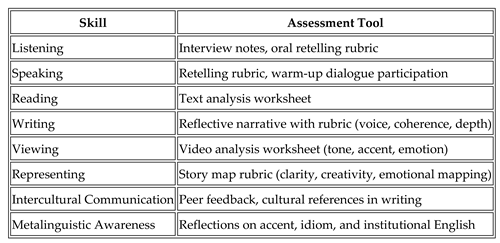
Extension Activities
- Digital Storytelling: Record stories as podcasts or video diaries
- Community Archive: Collect and analyze English use in local signage or media
- Manifesto Writing: “My English, My Rules”—students write a personal language philosophy
- Accent Mapping: Explore regional Englishes and their social perceptions
Appendix C: Sample Lesson Plan for Grade 1
Theme: My Family and Home
Languages: English + Mother Tongue (e.g., Cebuano, Maranao, Tagalog)
Method used: Narrative Language Ecology (NLE)
Focus: Vocabulary, Grammar, Spelling, Pronunciation
Duration: 5 Days (30–45 minutes/day)
Day 1: Storytelling & Vocabulary Mapping
Objective: Learners identify family members using both languages. Activities:
- Narrative Starter: Teacher shares a short story in mother tongue: “Sa among balay, naa si nanay, si tatay, ug ako.”
- Bilingual Mapping: Learners match visuals to words: nanay = mother, tatay = father, ako = me.
- Word Wall Creation: Pupils build a bilingual word wall with drawings.
Assessment: Learners say and point to family members in both languages.
Day 2: Sentence Building & Grammar Patterns
Objective: Learners construct simple bilingual sentences. Activities:
- Echo Reading: “This is my mother.” → “Kini/Siya akong nanay.”
-
Sentence Frames: Pupils complete:
- ○
- “This is my ____________________________.”
- ○
- “I live with my _________________________.”
- Role Play: Pupils introduce their family using sentence frames.
Assessment: Learners write or say 2 bilingual sentences about their family.
Day 3: Spelling Through Sound & Sight
Objective: Learners spell basic family-related words. Activities:
- Phonics Chant: “M is for mother, F is for father.”
- Cover-Copy-Compare: Pupils practice spelling mother, father, home.
- Spelling Game: Match word to picture, then spell aloud.
Assessment: Pupils spell 3 words correctly with visual aid.
Day 4: Pronunciation Practice & Listening
Objective: Learners pronounce key words clearly.
Activities:
- Echo Technique: Teacher says “mother,” pupils repeat.
- Bilingual Song: Sing “This is my family” with local translation.
- AI Voice Tool (if available): Pupils record and listen to their pronunciation.
Assessment: Teacher checks clarity and confidence in pronunciation.
Day 5: Narrative Performance & Integration
Objective: Learners narrate a short story using both languages.
Activities:
- Story Retelling: Pupils retell Day 1 story in mixed language.
- Drawing + Caption: Pupils draw their family and write bilingual captions.
- Mini Presentation: Each pupil shares their drawing and story.
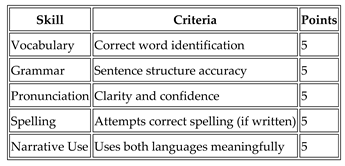
Assessment: Rubric-based evaluation on vocabulary use, grammar accuracy, spelling, and pronunciation.
NLE Anchors in the Lesson Plan
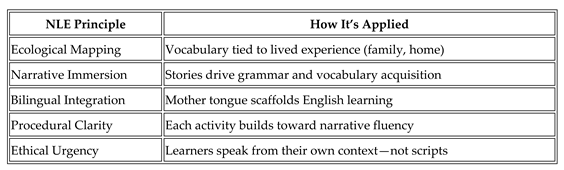
How Grade 1 Learners Acquire English Under NLE
1. Vocabulary
Taught through bilingual storytelling and ecological mapping
- Mother tongue first: Pupils narrate familiar experiences (e.g., “feeding the dog,” “going to church”) in their own language.
- English introduced contextually: Key words are translated and reinforced through visuals, gestures, and repetition.
- Semantic anchoring: Words are grouped by meaning (e.g., family, weather, feelings) and linked to real-life objects or routines.
- AI support: Simple apps (e.g., picture dictionaries, voice-to-text) help reinforce word recognition and pronunciation.
Example: “This is my nanay.” → “This is my mother.” Learners see both terms, hear them spoken, and use them in a sentence.
2. Grammar
Emerges through structured storytelling and sentence modeling
-
Start with patterns: Learners repeat and build on sentence frames:
- ○
- “I am _____________.”
- ○
- “He has ___________.”
- ○
- “We go to __________.”
- Mother tongue comparison: Teachers show how sentence structure differs or aligns across languages.
- Narrative use: Grammar is introduced as a tool to tell stories—not as abstract rules.
- AI feedback: Tools like voice-to-text help learners hear and see their sentence structure.
Example: A child says, “Ako ay masaya.” Or “malipayon ko”. Teacher guides: “In English, we say: I am happy.”
3. Spelling
Taught through visual mapping, phonics, and bilingual reinforcement
- Word walls: Pupils build bilingual word banks with visuals (e.g., sun / araw or adlaw, dog / aso).
- Phonics games: Learners match sounds to letters using both languages.
- Cover-Copy-Compare: A proven spelling strategy where pupils see a word, cover it, write it, and compare.
- AI tools: Spelling apps with voice input allow learners to hear and correct their own spelling.
Example: “Sun” is taught with a picture, the Filipino word “araw,” or Bisaya “adlaw” and a phonics breakdown: /s/ /u/ /n/.
4. Pronunciation
Developed through echo reading, song, and AI-supported feedback
- Echo technique: Teacher says a word, pupils repeat—first in mother tongue, then in English.
- Songs and chants: Bilingual rhymes reinforce rhythm and sound.
- AI pronunciation apps: Learners record their voice and compare it to native models.
- Emphasis on clarity, not accent: NLE values intelligibility over conformity.
Example: Pupils chant: “Aso, dog—woof, woof!” They hear both terms, mimic sounds, and connect meaning.
What Makes This NLE
- Mother tongue is not sidelined—it’s the starting point.
- English is not abstract—it’s lived, spoken, and felt.
- Technology is not passive—it’s a mirror, a guide, and a provocateur.
- Grammar and vocabulary are not rules—they’re tools for storytelling and ethical presence.
Appendix D. Sample Quiz for Grade 1
Grade 1 Quiz: My Family and Home
Method: Narrative Language Ecology (NLE)
Languages: English + Mother Tongue (customizable: Cebuano, Maranao, Tagalog, etc.) Format: Oral or written, with visuals
Part 1: Match the Word
Instructions: Connect the English word to the correct picture.” Use lines, arrows, or crayons to show connections.
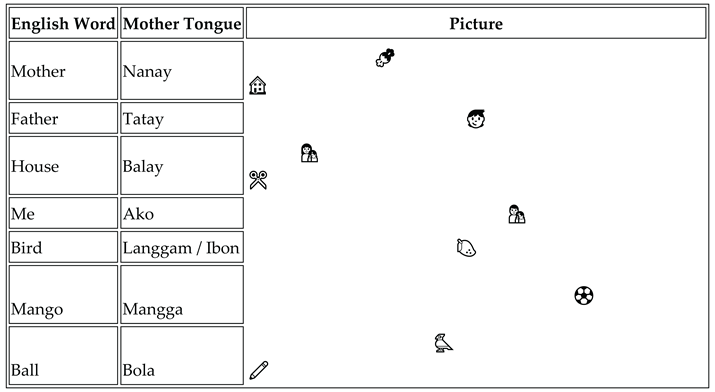
Part 2: Fill in the Blank
Instructions: Complete the sentence using the correct word.
- This is my __________________________. (mother / dog / table)
- I live in a _____________________________. (house / car / school)
- He is my ______________________________. (father / teacher / friend)
Part 3: Say It Aloud
Instructions: Say these sentences clearly.
- “This is my mother.”
- “I live in a house.”
- “He is my father.”
Teacher may use echo reading or AI voice tools to support pronunciation.
Part 4: Draw and Tell
Instructions: Draw your family and say their names in English and your own language.
Example: “This is my nanay. She is my mother.”
Scoring Guide (for Teacher Use)
Declaration:
The author declares that the Narrative Language Ecology (NLE) Method presented in this manuscript is an original pedagogical framework developed through sustained research, institutional documentation, and classroom praxis; it reclaims voice and meaning in English Language Teaching by integrating ecological mapping, bilingual narrative immersion, and ethically scrutinized technology use, and has not been previously published or submitted elsewhere.
References
- Canagarajah, A. S. (2005). Reclaiming the local in language policy and practice. Routledge.
- Copilot. (2025). AI-generated content on ethical pedagogy and technology integration. Microsoft Copilot. https://copilot.microsoft.com.
- Dewey, J. (2011). Democracy and education. Simon & Brown.
- Eustaquio, M. T. L., Clemente, R. C., Manaois, M. L. J. B., Alih, C. B., & Tulawie, A. (2025). Reimagining pedagogy through cultural narratives: Integrating Philippine literature in higher education classrooms. International Journal on Culture, History, and Religion, 7(Special Issue 2), 45–62. [CrossRef]
- Freire, P. (2000). Pedagogy of the oppressed (30th anniversary ed.). Bloomsbury Academic.
- Gardner, H. (2006). Multiple intelligences: New horizons (Rev. ed.). Basic Books.
- Higgins, C. (2022). Translingual practice and language ideologies in global ELT. TESOL Quarterly, 56(3), 789–812. [CrossRef]
- Kachru, B. B. (1992). World Englishes: Approaches, issues and resources. Language Teaching, 25(1), 1–14. [CrossRef]
- Kramsch, C. (2009). The multilingual subject: What foreign language learners say about their experience and why it matters. Oxford University Press.
- Kumaravadivelu, B. (2020). Decolonizing language teaching: From method to postmethod. Critical Inquiry in Language Studies, 17(1), 1–19. [CrossRef]
- Nanaware, D. (2023). The impact of postcolonial literature in English language teaching: A comparative analysis of teaching approaches. Boletín de Literatura Oral, 13(1), 45–62.
- Norton, B. (2013). Identity and language learning: Extending the conversation (2nd ed.). Multilingual Matters.
- Pennycook, A. (2010). Language as a local practice. Routledge.
- Richards, J. C., & Rodgers, T. S. (2014). Approaches and methods in language teaching (3rd ed.). Cambridge University Press.
- Salendab, F. A., & Akmad, S. P. (2023). A personal narrative experience of teachers teaching purposive communication during the new normal education. International Journal of Multidisciplinary: Applied Business and Education Research, 4(5), 112–124. https://ejournals.ph/article.php?id=19548.
- Ubaque-Casallas, D. (2021). Language pedagogy and teacher identity: A decolonial lens to English language teaching. Profile: Issues in Teachers’ Professional Development, 23(2), 199–214. [CrossRef]
- Ubaque-Casallas, D. F. (2021). Language pedagogy and identity: Learning from teachers’ narratives in the Colombian ELT context. HOW Journal, 28(2), 33–52. [CrossRef]
- UNESCO. (2015). Education 2030: Incheon Declaration and Framework for Action for the implementation of Sustainable Development Goal 4. United Nations Educational, Scientific and Cultural Organization. https://unesdoc.unesco.org/ark:/48223/pf0000245656.
- United Nations. (2015). Industry, Innovation and Infrastructure. Transforming our world: The 2030 Agenda for Sustainable Development. https://sdgs.un.org/goals/goal9.
- United Nations. (2015). Peace, Justice and Strong Institutions. Transforming our world: The 2030 Agenda for Sustainable Development. https://sdgs.un.org/goals/goal16.
Disclaimer/Publisher’s Note: The statements, opinions and data contained in all publications are solely those of the individual author(s) and contributor(s) and not of MDPI and/or the editor(s). MDPI and/or the editor(s) disclaim responsibility for any injury to people or property resulting from any ideas, methods, instructions or products referred to in the content. |
© 2025 by the authors. Licensee MDPI, Basel, Switzerland. This article is an open access article distributed under the terms and conditions of the Creative Commons Attribution (CC BY) license (http://creativecommons.org/licenses/by/4.0/).
Copyright: This open access article is published under a Creative Commons CC BY 4.0 license, which permit the free download, distribution, and reuse, provided that the author and preprint are cited in any reuse.


