

Submitted:
05 September 2025
Posted:
09 September 2025
You are already at the latest version
Abstract
The Contextual-Experiential Approach reimagines English Language Teaching as a values-driven, ethically anchored, and technologically enriched approach that resists abstraction and performative compliance. Grounded in the Narrative Language Ecology (NLE) Method, it fuses Dewey’s experiential learning, Gardner’s cognitive pluralism, and the pluralistic lens of World Englishes to empower teachers as diagnostic designers, learners as narrative agents, and institutions as ethical infrastructures. Central to this approach is the integration of values—social, ecological, and cultural—which are not taught as add-ons but embedded within bilingual story loops, ethical dilemmas, and contextualized tasks that provoke reflection and agency. Technology, especially AI, is not used to automate but to visualize, remix, and critique language use, enabling learners to map their own Englishes and interrogate linguistic power structures. For the future of language teaching and learning, this approach offers a radical shift: from standardization to humanization, from compliance to critique, and from passive acquisition to active reclamation. It positions ELT as a transformative force capable of provoking ethical reckoning, institutional reform, and narrative justice in postcolonial, policy-driven landscapes.
Keywords:
Contextual-Experiential Approach
; Ethical Pedagogy
; Experiential Learning
; Narrative Language Ecology
; World Englishes
Corpus Discussion
 |
| Source: Microsoft Copilot. (2025). |
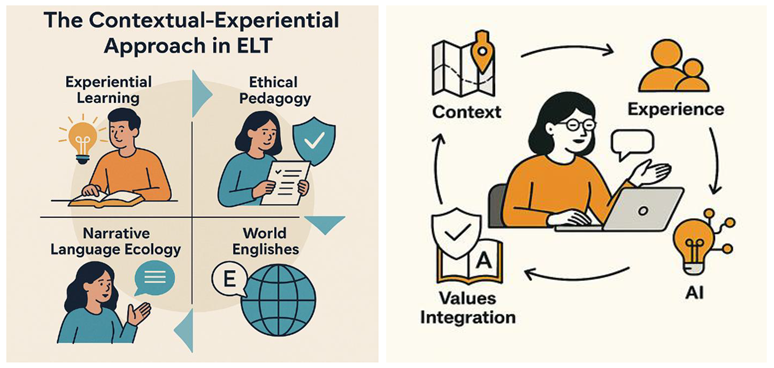
Let us be honest. Most English teaching today still clings to templates—grammar drills, scripted dialogues, imported rubrics. It’s a system that performs fluency but rarely provokes thought. In places like Mindanao, where English is not the first language and where colonial residue still lingers in the curriculum, this kind of teaching doesn’t just fall short—it erases.
That’s where the Contextual-Experiential Approach comes in. It’s not a rebrand. It’s a rupture. A deliberate shift from teaching English as a code to teaching it as a narrative tool for reckoning, mapping, and meaning-making.
What It Stands For
This approach fuses two things that should never have been separated:
- Context: Language is always tied to place, story, and power. It’s not neutral.
- Experience: Learners don’t absorb language—they live it, question it, and reshape it.
Through the Narrative Language Ecology (NLE) Method (Eslit, 2025), the Contextual-Experiential Approach becomes operational. Not abstract. Not performative. It shows up in bilingual story loops, ecological mapping, and diagnostic tasks that ask learners not just to speak—but to speak from where they are at.
The Niche: Values Learning, Not Just Language Learning
Here’s the rupture point. For none English speakers, most ELT models treat values as peripheral. This one puts them at the center.
- Stories provoke ethical reflection.
- Tasks demand empathy and judgment.
- Assessments measure not just correctness, but consciousness.
Learners aren’t just asked to describe a picture or fill in blanks. They’re asked: What does this story reveal? Whose voice is missing? What would you do differently?
This isn’t just pedagogy. It’s moral architecture.
Why It Matters Here—and Globally
In postcolonial contexts, English often arrives as a borrowed script. Learners are taught to mimic, not to narrate. The Contextual-Experiential Approach flips that.
- It validates bilingualism as a resource, not a deficit.
- It grounds English in local realities, not imported templates.
- It turns classrooms into spaces of reckoning, not just performance.
Globally, it prepares learners to navigate not just grammar, but diversity, misinformation, and ethical complexity. In a world shaped by migration, media, and machine intelligence, this matters more than ever.
What About Technology?
Most tech-enhanced ELT models automate. They flatten. They reduce learners to metrics. This approach resists that.
- AI is used to visualize dilemmas, remix narratives, and surface bias.
- Learners critique digital outputs, ask what’s missing, and generate alternatives.
- Technology becomes a tool for narrative scaffolding, not surveillance.
What Gaps Does It Actually Address?
| Conventional ELT Gaps | Contextual-Experiential Response |
| Grammar drills and scripted dialogues | Bilingual narratives and ecological mapping |
| Passive learner roles | Diagnostic tasks that demand agency and ethical judgment |
| Imported pedagogies | Locally rooted, globally relevant frameworks |
| Tech as automation | Tech as narrative-critical and ethically guided |
| Values as optional | Values as central to every story, task, and assessment |
| Audit anxiety and mechanical outputs | Documentation that breathes—anchored in context and clarity |
Comparative Table: Contextual-Experiential Approach vs. Major ELT Approaches
| ELT Approach | Core Belief | Learner Role | Use of Context | Values Integration | Technology Orientation | Distinctive Limitation | What Makes Contextual-Experiential Unique |
| Structural Approach | Language is a system of rules and structures | Passive recipient | Minimal; context is secondary | Absent | Rare or irrelevant | Focuses on form over meaning | Rejects abstraction; centers lived, storied, and ethical context with tech support |
| Functional Approach | Language is used to perform communicative functions | Functional performer | Contextualized but limited | Implicit | Supplementary, not critical | Often lacks depth in cultural or ethical nuance | Goes beyond function—values are explicit; tech used to scaffold ethical tasks |
| Communicative Approach | Language is for meaningful communication | Active communicator | Simulated real-life situations | Incidental | Often present but not interrogated | Prioritizes fluency but not moral reflection | Makes context real, values central, and tech ethically guided |
| Cognitive Approach | Language learning is a mental process of understanding | Mental processor | Abstract or internalized | Minimal | Often theoretical or tool-based | Overemphasizes cognition, underplays social agency | Grounds cognition in narrative, values, and AI-enhanced reflection |
| Ecological Approach | Language is part of dynamic social and environmental systems | Co-navigator | Strong emphasis on environment | Philosophical, often abstract | Varies; not always operational | Lacks procedural clarity for classroom use | Operationalizes ecology through mapped, bilingual, tech-supported narratives |
| Humanistic Approach | Language supports personal growth and emotional expression | Self-expressive agent | Personal and affective context | Central but subjective | Minimal or avoided | Difficult to scale or document | Values are embedded, assessed, and enhanced through AI-supported storytelling |
| Contextual-Experiential Approach | Language is a lived, storied, and ethically charged experience | Narrative agent | Mapped, bilingual, diagnostic | Explicit, central, and assessable | Narrative-critical, AI-enhanced, ethically guided | None—built for postcolonial, tech-enhanced realities | Fuses context, experience, values, and technology into a scalable, reformist system |
Niche
The Contextual-Experiential Approach is the only ELT approach that:
- Centers values learning as a non-negotiable core—not a side effect.
- Operationalizes context through bilingual ecological mapping and narrative immersion.
- Uses technology and AI not for automation, but for ethical scaffolding, story remixing, and diagnostic reflection.
- Positions learners as agents of story, critique, and reform—not just communicators or processors.
This is not a hybrid—it’s a pedagogical stance built for postcolonial realities, institutional scrutiny, and global ethical engagement.
What makes the Contextual-Experiential Approach distinct is its threefold integration:
| Dimension | How It’s Embedded |
| Values Learning | Stories provoke ethical reflection; assessments measure empathy, agency, and judgment |
| Tech & AI Enhancement | AI tools scaffold narratives, visualize dilemmas, and support multimodal expression |
| Multiple Intelligences | Lessons activate diverse cognitive strengths through bilingual, ecological, and reflective tasks |
This isn’t just a new method. It’s a new lens—one that sees learners as ethical, cognitive, and narrative beings navigating a complex world.
Dewey, Gardner, and World Englishes
| Thinker/Framework | Contribution to Contextual-Experiential Approach |
| John Dewey | Learning by doing: experiential, reflective, real-world tasks |
| Howard Gardner | Multiple intelligences: plural cognitive pathways for language learning |
| World Englishes | Linguistic pluralism: validates diverse Englishes, resists native-speaker dominance |
Together, they form a values-driven, cognitively plural, and linguistically inclusive foundation for your approach.
Roles in the Contextual-Experiential Approach
ELT Teachers: From Deliverers to Diagnosticians
Teachers are no longer mere transmitters of content. They become narrative cartographers, ethical provocateurs, and diagnostic designers.
Key Responsibilities:
- Curate bilingual ecological loops that reflect learners’ lived realities.
- Design experiential tasks that provoke ethical reflection, not just linguistic performance.
- Use AI critically—not to automate, but to visualize, remix, and interrogate language use.
- Map learner trajectories through contextualized rubrics, not generic metrics.
- Refuse mechanical pacing—instead, vary rhythm, embed metaphor, and provoke reckoning.
Operational Output:
- Lesson plans that embed local narratives and global frameworks.
- Quizzes that test not just grammar, but ethical agency and narrative clarity.
- Documentation that resists uniformity and reflects contextual depth.
Learners: From Recipients to Agents
Learners are not passive vessels. They are story-makers, language ecologists, and critical agents of their own linguistic futures.
Key Responsibilities:
- Map their own Englishes, recognizing plural forms and rejecting native-speaker hegemony.
- Engage in bilingual storytelling, using local languages as epistemic anchors.
- Reflect on ethical dilemmas through narrative tasks, not just comprehension drills.
- Use AI tools to visualize, critique, and remix their linguistic identities.
Operational Output:
- Portfolios that document linguistic evolution, not just correctness.
- Story loops that embed ecological, cultural, and ethical dimensions.
- Reflections that show narrative agency, not just compliance.
Institutions: From Enforcers to Ethical Infrastructures
Institutions must move beyond policy enforcement. They must become ethical infrastructures, narrative incubators, and audit-ready reformers.
Key Responsibilities:
- Support curriculum innovation that embeds NLE and World Englishes.
- Fund and protect narrative-critical pedagogy, not just standardized testing.
- Audit learning outcomes for ethical depth, contextual relevance, and linguistic pluralism.
- Integrate AI with scrutiny, ensuring it serves humanization—not automation.
Operational Output:
- Institutional documentation that reflects contextual-experiential logic.
- Accreditation reports that show narrative impact, not just procedural compliance.
- Faculty development programs that train teachers in diagnostic and ethical pedagogy.
Final Note: This Is Not Reform. It’s Reckoning.
The Contextual-Experiential Approach doesn’t tweak the system. It rebuilds it. Every role—teacher, learner, institution—is re-scripted to resist impunity, reclaim narrative, and provoke ethical transformation.
Final Word
This approach doesn’t ask learners to perform English. It asks them to inhabit it—to use it as a tool for story, critique, and transformation. It’s not just an approach. It’s a stance. A refusal to teach language without teaching values. A refusal to let AI flatten what should be complex. A refusal to let postcolonial learners be voiceless in a language they’re expected to master. The Contextual-Experiential Approach doesn’t borrow from Dewey and Gardner—it extends them. It takes Dewey’s experiential learning and Gardner’s plural intelligence, and grounds them in postcolonial, bilingual, tech-enhanced realities. It’s not a hybrid—it’s a reformist stance. A refusal to teach English without teaching values. A refusal to use technology without ethical scrutiny. A refusal to flatten learners into metrics when they are, in fact, narrative agents of language learning.
The Narrative Language Ecology (NLE) Method and Contextual-Experiential Approach
 |
| Source: Microsoft Copilot. (2025). |
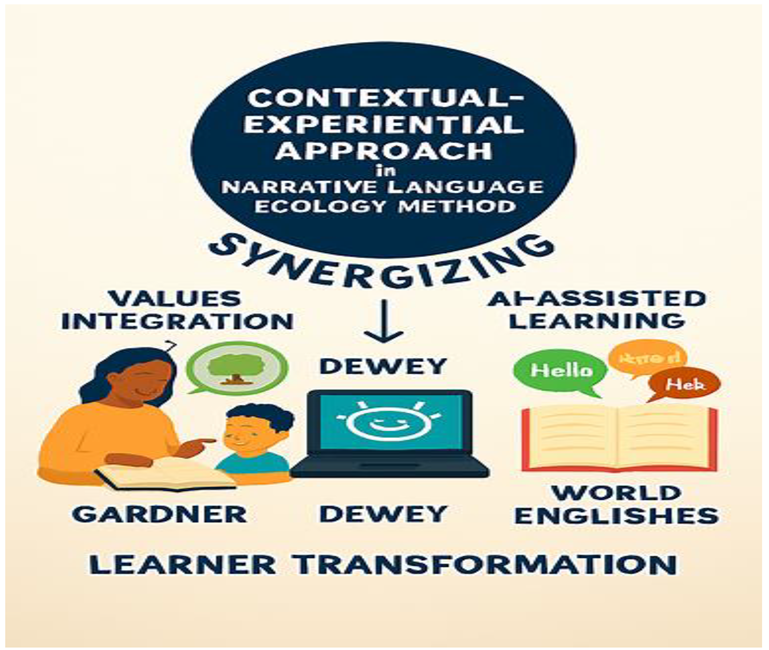
In an actual English language teaching and learning setting, the Contextual-Experiential Approach provides the ecological scaffolding that Narrative Language Ecology (NLE) Method needs to thrive. It ensures that learners are not passive recipients of language but active narrators of their lived experience. NLE, as a method, operationalizes this by immersing learners in bilingual mapping, narrative immersion, and ethical reflection. For example, a Grade 1 lesson using NLE might begin with a localized story (Context), invite learners to retell or extend it through their own lens (Experience), embed values like empathy or stewardship (Values Integration), and then use AI tools to visualize, translate, or co-author their narratives (AI as narrative-critical agent).
This synergy allows NLE to move beyond theory into practice: lesson plans become diagnostic instruments, quizzes become narrative checkpoints, and classroom dialogue becomes a site of ethical reckoning. The Contextual-Experiential Approach doesn’t just allow NLE—it equips it, frames it, and demands it (Eslit, 2025). Together, they form a pedagogical ecosystem that resists mechanical compliance and insists on clarity, complexity, and humanization.
Declaration
The Contextual-Experiential Approach in ELT is a pedagogical framework that centers language learning on lived realities, ethical reflection, and learner agency. It integrates context, experience, values integration, and AI—not as procedural tools, but as interwoven forces for humanization and institutional reform. This is not an approach for display or compliance; it is an approach for reckoning, designed to provoke clarity, complexity, and ethical urgency in an evolving postcolonial and policy-driven educational landscapes.
References
- Brown, H. D. Principles of language learning and teaching, 6th ed.; Pearson Education, 2014. [Google Scholar]
- Brown, J. D.; Rodgers, T. S. Doing second language research; Oxford University Press, 2002. [Google Scholar]
- Canagarajah, A. S. Reclaiming the local in language policy and practice; Routledge, 2005. [Google Scholar]
- Dewey, J. Experience and education; Macmillan, 1938. [Google Scholar]
- Eslit, E. R. Narrative Language Ecology (NLE) Method: Reclaiming Voice and Meaning in English Language Teaching and Learning. Preprints 2025. [Google Scholar] [CrossRef]
- Gardner, H. Frames of mind: The theory of multiple intelligences; Basic Books, 1983. [Google Scholar]
- Halliday, M. A. K. Language as social semiotic: The social interpretation of language and meaning; Edward Arnold, 1978. [Google Scholar]
- Kachru, B. B. The other tongue: English across cultures, 2nd ed.; University of Illinois Press, 1992. [Google Scholar]
- Kachru, B. B.; Kachru, Y.; Nelson, C. L. (Eds.) The handbook of World Englishes; Blackwell Publishing, 2006. [Google Scholar]
- Kumaravadivelu, B. Understanding language teaching: From method to postmethod; Lawrence Erlbaum Associates, 2006. [Google Scholar]
- Microsoft Copilot. (2025, September 2). Illustration and conceptual framing of Contextual-Experiential ELT with AI and values integration [AI-generated visual and text]. Microsoft Copilot chat interface.
- Pennycook, A. Global Englishes and transcultural flows; Routledge, 2007. [Google Scholar]
- Seidlhofer, B. Understanding English as a lingua franca; Oxford University Press, 2011. [Google Scholar]
- Tupas, R. (Ed.) Unequal Englishes: The politics of Englishes today; Palgrave Macmillan, 2015. [Google Scholar]
Disclaimer/Publisher’s Note: The statements, opinions and data contained in all publications are solely those of the individual author(s) and contributor(s) and not of MDPI and/or the editor(s). MDPI and/or the editor(s) disclaim responsibility for any injury to people or property resulting from any ideas, methods, instructions or products referred to in the content. |
© 2025 by the authors. Licensee MDPI, Basel, Switzerland. This article is an open access article distributed under the terms and conditions of the Creative Commons Attribution (CC BY) license (http://creativecommons.org/licenses/by/4.0/).
Copyright: This open access article is published under a Creative Commons CC BY 4.0 license, which permit the free download, distribution, and reuse, provided that the author and preprint are cited in any reuse.


