
Submitted:
17 November 2025
Posted:
18 November 2025
You are already at the latest version
Abstract
This article presents a unified theoretical framework where the geometry of spacetime, the inertia of matter, and quantum non-locality emerge from a single fundamental substrate: a vibrational network. We model space as a dynamic network of vibrating nodes, its elastic properties calibrated by the fundamental constants \( \hbar \) and \( c \). Mass is not a primitive property but is identified with the energy stored in the deformation of this network. The non-linearity of this medium at high energy allows for the self-trapping of waves into stable structures identified as particles. A reflection-based IN/OUT wave mechanism confers upon these particles an inherently non-local character, providing a mechanical explanation for the violation of Bell's inequalities and the holographic principle. A key result is the formal derivation of the Planck scale \( \ell_P \) and the quantum of action \( \hbar \) from the network's properties. Crucially, we demonstrate how General Relativity emerges from the dynamics of this network as a refractive effect, where energy density variations determine the effective "refractive index" of space, naturally leading to geodesic deviation and curvature. In this model, inertial mass \( (m_i) \) and gravitational mass (\( m_g \)) are distinct emergent properties of a shared underlying deformation, linked by the gravitational constant \( G \), which quantifies the network's susceptibility to deformation.
Keywords:
emergent spacetime
; emergent gravity
; quantum foundations
; IN/OUT wave mechanism
; mass-energy equivalence
; non-locality
; holographic principle
; planck scale
; cosmological constant problem
; quantum-classical bridge
1. Introduction: Beyond the Continuum/Quantum Dichotomy
The landscape of modern theoretical physics is dominated by a profound dichotomy. On one hand, General Relativity (GR) describes spacetime as a dynamic, curved continuum, where gravity is a manifestation of geometry. On the other, Quantum Mechanics (QM) describes a world of probabilities and particles whose states are intrinsically non-local and entangled. Reconciling these two visions is the holy grail of fundamental physics.
Our approach posits that this dichotomy is illusory because it describes two different manifestations of a single underlying reality, a perspective shared with thermodynamic [4] and induced gravity [1] approaches. We propose that spacetime is not a passive background but emerges from a discrete, elastic, and vibratory substrate. In this model, what we perceive as a massive particle is not a foreign point inserted into space but a coherent, self-sustaining excitation of space itself.
The ultimate goal is to demonstrate that GR and QM are not incompatible but are complementary, emergent descriptions of a single, coherent physical reality. This work culminates in showing how the Einstein field equations themselves can be understood as the thermodynamic equilibrium conditions of this vibrating spacetime substrate.
2. Architecture of the Fundamental Substrate
2.1. The Network of Coupled Oscillators
The model is based on the hypothesis that the primordial structure of space is a network of interconnected nodes. Each link between neighboring nodes behaves like a linear spring. The equilibrium distance between two nodes is denoted . The crucial property of this network is the stiffness k of its springs, which is not an arbitrary constant but is fixed by universal constants:
This choice is fundamental. It ensures that the speed of propagation of elastic waves (the vibrations of the network) is exactly equal to c, the speed of light in a vacuum. Thus, the constant c is no longer a mysterious property of the electromagnetic vacuum but the speed of compression waves of the spatial substrate itself.
2.2. Vibrational Origin of the Network
The network is not a primitive "solid" structure. It emerges from the interference of fundamental standing waves in the three dimensions of space. This view offers a dynamic origin for granularity:
- A node of the network corresponds to a point where the amplitude of the fundamental standing wave is minimal (a vibration node).
- A link between nodes corresponds to the region between two nodes, where the amplitude vibrates to its maximum (an antinode).
The distance is thus directly related to the wavelength of this fundamental wave: . The Planck scale emerges naturally as the minimum possible scale for , the limit beyond which the concept of a vibratory network becomes self-referential.
2.3. Emergence of the Quantum of Action and the Planck Scale
The proposed framework naturally gives rise to the quantum of action ℏ and the Planck scale as fundamental properties of the spacetime network, rather than imposed parameters. The minimal energy exchange in the network is governed by the harmonic oscillator energy quantum . For a nodal oscillation with characteristic frequency and stiffness , the ground state energy is:
This energy corresponds to the minimal deformation energy stored in a spring:
Equating these expressions yields the minimal measurable length deformation:
Thus, , indicating that the quantum of action emerges naturally from the discrete structure of the network. Furthermore, the Planck length arises as the natural scale where the gravitational self-energy of a nodal deformation becomes significant. Equating the deformation energy with the gravitational self-energy of the equivalent mass yields:
Solving for L gives:
... Solving for L gives:
This derivation demonstrates that both the quantum of action and the Planck scale are emergent properties. The gravitational constant G appears naturally because the energy of a nodal deformation E must also be the source of curvature for the network itself (, with ). The Planck length therefore represents the unique scale where the quantum elastic properties of the network and its gravitational response are equally dominant, marking the transition to a regime of quantum spacetime.
3. The Emergence of Matter: Non-Linearity and Self-Trapping
3.1. The Problem of Linear Dispersion
A perfectly linear elastic medium is dispersive; wave packets of different frequencies travel at different phase velocities, causing them to spread out over time. This is contradicted by the observation that starlight (comprising a broad spectrum) reaches us without significant chromatic dispersion. The resolution lies in the intrinsic non-linearity of the substrate. We postulate that the medium is effectively linear only for low-energy disturbances (long wavelengths, e.g., visible light, radio waves). At high energies (short wavelengths, approaching the Compton scale and beyond), the medium’s response becomes strongly non-linear.
3.2. Self-Trapping and Particle Formation
This high-energy non-linearity enables the phenomenon of self-trapping. A wave packet of sufficient energy density (e.g., corresponding to the Compton wavelength of the electron ) does not simply disperse. Instead, it locally modifies the properties of the network itself—effectively changing the local "index of refraction." This creates a potential well or waveguide that confines the wave packet, preventing its dispersion.
- The wave’s energy density causes a local deformation of the network, increasing its energy density further in that region.
- This deformation alters the local wave speed, creating a gradient that curves the paths of the wave components back inward.
- A stable, dynamic equilibrium is reached: the wave creates the deformation that traps itself. This self-trapped, circulating wave packet is what we identify as a massive particle.
An electron is thus not a point particle but an extended, stable, and dynamic excitation of the network, vibrating at a specific frequency.
3.3. The IN/OUT Wave Mechanism: Stability and Non-Locality
A purely localized vibration would radiate its energy away as outgoing waves, leading to dissipation. The stability of the particle requires a non-local energy replenishment mechanism.
- The central vibrating structure (the particle’s core) continuously emits outgoing spherical waves (OUT waves).
- These OUT waves propagate through the network. They are not lost; instead, they are continuously and partially reflected by the inhomogeneities and implicit boundaries created by other particles, distant matter, and the overall curvature of the network itself.
- The sum of all these reflections generates incoming spherical waves (IN waves) that converge back towards the source.
- At dynamic equilibrium, the IN and OUT waves interfere constructively to perpetually reconstruct and reinforce the stable standing wave pattern that is the particle. The particle’s energy is maintained through this continuous feedback loop.
- The remarkable stability of this structure arises because the partial reflection mechanism, though its efficiency (and thus the wave amplitude) may vary along the path, ensures that the IN and OUT waves share the same frequency and maintain equal amplitude at every point in space where the standing wave is established. This precise balance is what defines and maintains the stationary state of the particle across its entire non-local structure.
Energy Balance and Self-Sustaining Loop: A crucial aspect of this mechanism is the precise energy balance that maintains particle stability. The OUT waves carry energy away from the particle’s core at a rate precisely matched by the energy returned via the IN waves. This creates a self-sustaining loop where:
- The energy radiated outward equals the energy reflected back inward
- The constructive interference at the core perpetually reconstructs the particle
- The system reaches a dynamic equilibrium where no net energy is lost
This energy conservation mechanism ensures particle stability over indefinite timescales. More details in Appendix A. The detailed mathematical formulation of this energy balance and its implications for quantum guidance are developed comprehensively in our subsequent work [9].
Consequently, the particle cannot be localized to a mere point. It is the central nexus of a vast, dynamic wave structure extending throughout space. Its existence and stability depend on a permanent interaction with its global environment. This is the foundational mechanism for the non-local features of quantum mechanics.
4. The Particle in Motion: Internal Geometry and Dynamic Inertia
4.1. The Internal State of a Particle: More Than a Point
A particle in this model is not a simple point mass. It is a complex dynamic structure, defined by the specific configuration of its "internal loops" – the pattern of coherent circulation of the IN/OUT waves that constitute and stabilize it. This internal configuration is not static; it is characterized by relative amplitudes and phases along the three axes that define its fundamental vibrational state.
4.2. Velocity as a Deformation of the Internal Configuration
The state of motion of the particle is not an independent property. The translation velocity of the particle relative to the fundamental network is directly encoded in the geometry of its internal configuration.
For a particle to translate at a velocity , the configuration of its internal circulations must deform in a precise manner specific to . Imposing a velocity on the particle amounts to imposing a geometric constraint on its internal vibratory structure. Each possible velocity thus corresponds to a unique internal deformation state of the particle.
4.3. Inertia as the Energetic Cost of Reconfiguration
Inertia, the resistance to acceleration, finds a direct and quantitative mechanical explanation here:
- To accelerate a particle (to change ) is to force it to change its internal deformation state.
- Transitioning from one internal configuration (corresponding to ) to another (corresponding to ) requires modifying the amplitudes and phases of oscillations along the three spatial axes. This reconfiguration work must occur in parallel with the internal circulations that define the particle.
- This reconfiguration requires work against the elastic restoring forces of the network that "lock" the particle into its current vibrational state. The network’s "springs" resist this dynamic deformation.
The kinetic energy communicated to a particle to accelerate it is precisely the energy spent performing this work of internal reconfiguration against the rigidity of the network. We therefore have the direct correspondence:
The inertial mass is the quantitative measure of this resistance: a particle with a large inertial mass is a structure whose internal configuration is "rigid" and costly to modify. The rest energy represents the internal deformation energy of the configuration at rest ().
5. Synthesis: Emergence of the Dual Concept of Mass
5.1. The Fundamental Reality: Deformation and Its Dynamics
The fundamental property is the state of dynamic deformation of the network. A particle is a coherent, self-sustaining state of deformation.
5.2. The Dual Emergence of "Mass"
The term "mass" describes two emergent manifestations of this deformation:
- Inertial Mass (): This is the measure of the resistance to internal reconfiguration. It emerges directly from the rigidity k of the network. Its origin is dynamic and local (related to the internal structure of the particle).
- Gravitational Mass (): This is the measure of the intensity of the static environmental deformation that the particle imprints on the network via its extended IN/OUT wave field. Its origin is static and non-local.
5.3. The Proportionality Between Gravitational and Inertial Mass and the Role of G
The energy E stored in the central deformation is the common source that determines both the "internal rigidity" () and the "extent of the environmental deformation field" (). It is therefore natural that is proportional to .
The gravitational constant G is the universal proportionality factor linking these two quantities. It quantifies the efficiency with which a localized deformation energy () translates into a large-scale curvature of the network (). It is a fundamental property of the spatial substrate, characterizing its gravitational "susceptibility" or "softness".
6. The Emergence of General Relativity
In this framework, General Relativity does not need to be postulated separately; it emerges naturally as the effective large-scale description of the dynamics of the elastic spacetime network. The connection is achieved through the following mechanism:
6.1. Gravity as a Refractive Effect
A fundamental postulate of the model is that the stiffness constant k of the network springs is not a global constant but depends on the local energy density. From Equation (1), , which implies that a change in the local energy density affects the equilibrium spacing L, and consequently, the stiffness k.
This variable stiffness directly influences the speed of wave propagation in the network. The speed of a wave v is given by , where is a mass density. For waves propagating in the network, this leads to:
where is the equilibrium spacing in a vacuum. Thus, regions of higher energy density (where ) exhibit a slower effective wave speed, analogous to a medium with a higher refractive index.
6.2. From Refraction to Curvature
The paths of waves (both light waves and matter waves) propagating through this inhomogeneous network are bent toward regions of higher energy density, following Fermat’s principle of least time. This bending is mathematically equivalent to the geodesic deviation in a curved spacetime described by General Relativity.
The Einstein field equations emerge as the effective description of how energy-momentum distribution (modeled as persistent deformations and wave patterns in the network) determines the local "refractive properties" of the network, which we perceive as spacetime curvature. This perspective aligns with thermodynamic approaches to gravity [4,7], where gravity is seen as an emergent phenomenon rather than a fundamental force.
6.3. Metric from Network Configuration
The metric tensor of General Relativity finds a natural interpretation in this model:
- The spatial components relate to the actual physical deformation of the network links from their equilibrium positions.
- The temporal component relates to the local effective wave speed v, and thus to the energy density deformation.
- The off-diagonal components could emerge from shearing deformations or persistent flow patterns in the network.
In this view, solving the Einstein equations corresponds to finding the equilibrium configuration of the spacetime network under a given energy-momentum distribution.
7. Implications and Reinterpretations of Quantum Phenomena
7.1. Violation of Bell’s Inequalities and Entanglement
Bell’s inequalities are derived assuming two premises: realism (a particle’s properties exist before measurement) and locality (an action at one point cannot influence a distant point faster than c). Their experimental violations (e.g., in Alain Aspect’s experiments) show that nature violates at least one of these hypotheses.
Our model specificially invalidates the premise of strict locality and redefines realism. In our framework, a particle is not an object with properties well-defined and localized at a point. It is an extended vibrational state, whose "central part" that we detect is inextricably linked to its IN/OUT wave field that extends to infinity.
Quantum entanglement therefore does not imply "spooky action at a distance." Two entangled particles are better understood as being part of one single, extended vibrational structure. Their states are correlated not because they communicate instantaneously, but because they share the same wave substrate from their creation. They form an inseparable whole. Aspect’s experiments do not prove superluminal communication; they confirm the profoundly non-localized and interconnected nature of quantum states, which our model explains mechanically through the IN/OUT mechanism.
7.2. Holographic Principle
The principle states that all information contained in a volume of space is encoded on its boundary surface. Our model offers a natural interpretation of this principle [2,3]:
- The information about the internal state of a volume V is carried by the vibrations of its nodes and the waves passing through it.
- The OUT waves leaving volume V through its surface carry with them the complete information about the interior they traversed.
- The IN waves entering volume V are, by definition, the OUT waves from other regions that have been reflected or modified. They "bring" information from the outside.
The vibrational state on the surface of V (the place of passage and interference of all these waves) therefore dynamically encodes all the information necessary to reconstruct the physics inside V, much like a hologram where interference patterns encode a 3D image.
8. Conclusion and Perspectives
We have outlined a unifying framework where space, matter, and their interactions emerge from the vibrations of a single substrate. This model provides plausible mechanical interpretations for some of the most counterintuitive phenomena in modern physics:
- Mass as elastic deformation energy.
- Spacetime curvature and General Relativity as emergent properties of the network’s dynamics and variable effective refractive index.
- Non-locality and entanglement as consequences of the extended IN/OUT wave mechanism.
- The Holographic Principle as a dynamic property of vibrational information propagation.
- The distinction and proportionality between inertial and gravitational mass.
- The formal emergence of the Planck scale and the quantum of action ℏ from the elastic properties of the spacetime network.
This framework represents a paradigm shift that reinterprets rather than contradicts established physics. The Special and General Theory of Relativity remain essential operational theories for calculations and predictions, but find their physical interpretation within this substrate-based approach where space itself is the medium for light propagation.
8.1. The Research Program
This article serves as the foundation for an extensive research program developed across multiple publications:
- Reinterpretation of foundational experiments: Detailed analysis showing that the Michelson-Morley experiment does not preclude a physical propagation medium, and that Special Relativity is an essential observational theory for relative velocity calculations.
- Quantum foundations: Complete derivation of quantum mechanics from the substrate dynamics, including wavefunction collapse and quantum superposition.
- Particle modeling: Conceptualization and detailed description of electrons, protons, and neutrons as specific stable configurations of IN/OUT waves within the spatial network. This framework provides mechanical explanations for their stability, mass ratios, and quantum properties.
- Astrophysical and cosmological implications: Explanations for dark matter, dark energy, the Big Bang, and quark confinement as emergent phenomena.
- Standard model emergence: Derivation of the complete particle spectrum and gauge interactions from vibrational modes of the network.
8.2. Computational Approach and Future Directions
Given the fundamental nature of this paradigm, traditional analytical methods may be insufficient for deriving all emergent properties. We propose that massively parallel computational simulations of the spatial network will ultimately provide the most powerful tool for:
- Observing the spontaneous emergence of physical laws from network dynamics
- Identifying the specific conditions for particle creation at various energy scales
- Verifying the derivation of General Relativity and Quantum Mechanics as limiting cases
- Exploring novel phenomena at the intersection of quantum and gravitational regimes
The normalization of network stiffness reflects the fundamental insight that in an emergent spacetime framework, all physical quantities derive their values from relational properties within the network itself. Subsequent articles in this series detail how this model intuitively describes the double-slit experiment, the nature of fundamental fields as specific vibrational modes, and the mechanism of cosmic expansion as a dynamic relaxation of the network. We hope this conceptual framework will inspire further development to formally derive the effective laws of physics from the network’s dynamics.
Appendix A. Energy Confinement Mechanism
Establishment of the Stationary Regime in 1D. Energy Confinement Mechanism through Evanescent Standing Waves
Consider a one-dimensional model consisting of a chain of coupled points, representing a discrete space. A localized source at emits a compression wave. The process unfolds as follows:
Step 1: Transient Regime (Progressive Establishment) At : the source emits a wave of amplitude 6 to the right ().
At : the wave reaches with amplitude (part of it being reflected), and a reflected wave appears.
The following table shows the temporal evolution:
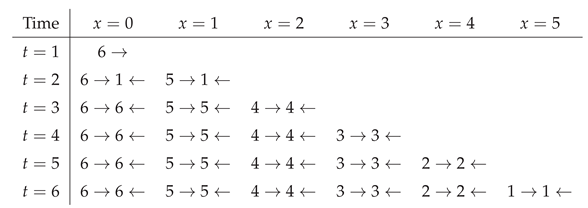
Step 2: Stationary Regime (Self-Sustaining) From onwards, at each point x of the wave:
The amplitude decreases exponentially with x, cutting off when it becomes insufficient:
where is the spatial attenuation coefficient. The net energy flux becomes zero: the energy emitted by the source is entirely restored by multiple reflections. This example only considers positive X. On the negative X side, the same phenomenon occurs, and the In waves from the positive X become the Out waves for the negative X, and vice versa. The system becomes self-sustaining and no longer requires additional energy input.
Step 3: Generalization to 2D and 3D — Mode Coupling In 2D, each point on the x-axis emits transversely along y, but this wave, "transverse" with respect to x, becomes a longitudinal wave along y. There is thus continuous coupling between compression and expansion energies along the two directions. At each point of the lattice, energy oscillates between a state of compression along x and a state of compression along y.
Mathematically, this is described by:
In 3D, each point becomes a site of dynamic exchange between compression states along the three perpendicular directions. The three modes are coupled, and each point vibrates simultaneously along x, y, and z, constantly maintaining energy circulation within the network:
Step 4: Emergence of Granular Space and Vibrational Hierarchy It is postulated that the discrete spatial lattice itself emerges from a network of very high-energy standing waves, perfectly self-synchronized, whose fundamental wavelength defines the granularity scale ℓ. These fundamental waves form the basic structure of spacetime via:
Crucially, this fundamental discreteness creates the necessary conditions for the partial reflections that enable the IN/OUT wave mechanism. At each node of the network, the discrete nature of the substrate naturally generates partial reflections of propagating waves, much like in any discrete lattice or crystal structure. This intrinsic reflection property is what allows the formation of evanescent standing waves and prevents the complete radiative dissipation of energy.
This vibrational hierarchy provides a physical interpretation for the well-known cosmological constant problem - the many-orders-of-magnitude discrepancy between theoretical vacuum energy calculations and cosmological observations. Rather than an inexplicable fine-tuning, this discrepancy naturally arises from the separation between the energy of high-frequency waves constituting the spatial lattice itself and that of the low-frequency excitations we detect as propagating fields.
Step 5: Application to the Photon and Resolution of a Paradox
A photon is mathematically described as a packet of transverse electromagnetic waves. Mathematically, this description corresponds exactly to the propagation of energy along a quasi-stationary wave in this model. However, the standard representation of the photon solely by transverse components creates a paradox: when the electric and magnetic fields pass through zero simultaneously:
the energy seems to momentarily disappear.
The resolution of this paradox lies in the existence of a longitudinal component that has been neglected in standard theories. If we model the electromagnetic field as emerging from couplings between deformations in a 3D granular network—with the electric field representing a coupling between deformations along X and Y, and the magnetic field representing a coupling between deformations along X and Z—then the X direction plays an essential mediating role. When and vanish simultaneously in the transverse description, the energy is temporarily stored in purely longitudinal deformations along X:
where represents the longitudinal deformation along the propagation axis.
This longitudinal component is "invisible" because our instruments only detect couplings between different directions (X-Y for E, X-Z for B), never pure deformations along a single direction. This approach naturally resolves the energy paradox without resorting to an ad hoc propagation vector.
In this model, the particle appears as a localized excitation whose energy circulates in a closed loop between the three directions of granular space, in the form of ’photons’ along quasi-stationary waves, explaining both its stability and the absence of energy loss through radiation.
References
- A. D. Sakharov. Vacuum quantum fluctuations in curved space and the theory of gravitation. Sov. Phys. Dokl., 12:1040–1041, 1968.
- J. D. Bekenstein. Black holes and entropy. Phys. Rev. D, 7:2333–2346, 1973.
- G. ’t Hooft. Dimensional reduction in quantum gravity. In A. Ali, J. Ellis, and S. Randjbar-Daemi, editors, Salamfestschrift, volume 4, pages 284–296. World Scientific, 1993. arXiv:gr-qc/9310026.
- T. Padmanabhan. Thermodynamical aspects of gravity: new insights. Rep. Prog. Phys., 73(4):046901, 2010. arXiv:0911.5004 [gr-qc].
- G. E. Volovik. The Universe in a Helium Droplet. International Series of Monographs on Physics. Oxford University Press, 2003. 2003.
- B.-L. Hu. Can spacetime be a condensate? Int. J. Theor. Phys., 44:1785–1806, 2005. arXiv:gr-qc/0503067.
- T. Jacobson. Thermodynamics of spacetime: The Einstein equation of state. Phys. Rev. Lett., 75:1260–1263, 1995. arXiv:gr-qc/9504004.
- S. Lloyd. Ultimate physical limits to computation. Nature, 406:1047–1054, 2000. arXiv:quant-ph/9908043.
- G. Furne Gouveia. The IN/OUT Wave Mechanism: A Non-Local Foundation for Quantum Behavior and the Double-Slit Experiment. Preprints 2025, 2025090184. [CrossRef]
Disclaimer/Publisher’s Note: The statements, opinions and data contained in all publications are solely those of the individual author(s) and contributor(s) and not of MDPI and/or the editor(s). MDPI and/or the editor(s) disclaim responsibility for any injury to people or property resulting from any ideas, methods, instructions or products referred to in the content. |
© 2025 by the authors. Licensee MDPI, Basel, Switzerland. This article is an open access article distributed under the terms and conditions of the Creative Commons Attribution (CC BY) license (http://creativecommons.org/licenses/by/4.0/).
Copyright: This open access article is published under a Creative Commons CC BY 4.0 license, which permit the free download, distribution, and reuse, provided that the author and preprint are cited in any reuse.


