

Submitted:
26 August 2025
Posted:
27 August 2025
You are already at the latest version
Abstract
Sohodol Gorges has become a location of interest for tourists looking for ecological experiences and outdoor activities. The main purpose of the present study is to evaluate the attitudes of Romanian tourists toward the development of geotourism in this region following the COVID-19 pandemic. In conjunction with the research questions, hypotheses, variables, and research methodology, the following research objectives were emphasized in this study of the Oltenia region: (1) to investigate how certain socio-demographic variables, such as age, gender, level of education, and occupation, influence tourists' perceptions of the various aspects of geotourism development in the Sohodol Gorges; (2) to analyze the different dimensions of geotourism, including its economic, ecological, and socio-cultural impacts, thus contributing to a deeper understanding of how geotourism is perceived in the study area in the post-pandemic context. For data processing and analysis, EViews software version 12.0 was used, enabling complex statistical analyses such as multiple regressions and correlation coefficient determination. These techniques were essential for identifying and interpreting the relationships between demographic variables and tourist perceptions. The results of this research provide a detailed picture of the influence of demographic and behavioral factors on tourists' perceptions in the context of post-COVID-19 geotourism development in the Sohodol Gorges of the Romania. Education level and age play a significant role in shaping economic and environmental perceptions, indicating that tourists with higher education levels are more aware of the economic and ecological impact of tourism.
Keywords:
geotourism
; protected area
; geoparks
; economic impacts
; impact on the environment
; socio-cultural impacts
; forms of sustainable tourism
1. Introduction
Sustainable tourism represents a post-pandemic development model in which geotourism, natural resources, and the human living environment [1] are brought together through fruitful collaboration. Tourism represents one of the sustainable alternatives and functions in the shaping and development of local economies for the development of tourist destinations, UNESCO International Geoparks, and ecotourism destinations [2,3,4]. Tourism is considered a tool for promoting resources within a territory, and, in this post-COVID-19 context, natural resources contribute to the creation of new spaces for various recreational activities [5,6].
As a form of post-COVID-19 sustainable tourism, geotourism is primarily focused on experiencing the geological, geomorphological, and landscape features of a territory or tourist areas in a way that motivates knowledge, evaluation, and protection conservation of the natural and cultural environment, being favorable for development at the local level [7,8,9,10]. Secondly, the creation of a post-pandemic geotourism product protects cultural geoheritage, helps strengthen local communities, and introduces or informs and promotes geological heritage for future generations [11].
The importance of geotourism as a field of tourism has grown over time, leading to the strategic development of geopark networks [12]. The best examples of geopark networks are represented by the European Geopark Network (EGN) and the Global Network of Geopark (GGN), established in 2004 in collaboration with the United Nations Educational, Scientific and Cultural Organization (UNESCO) [13,14]. According to Farsani et al. (2014), these geopark networks aim to encourage cooperation and support between geoparks, raise awareness, and promote these significant areas [15].
At the regional, national, and international levels, the role of geoparks is to properly design a strategic plan for the post-pandemic development of an area with significant geological and geomorphological tourism heritage that must be permanently preserved and evaluated with other natural and cultural values, with a well-defined purpose, such as supporting the sustainable economic development of the local population through the support of geotourism, awareness, and education [16]. Geoparks represent a sustainable post-COVID-19 product of young and modern geotourism, introducing innovative methods and alternatives for transmitting information and presenting geological and geomorphological heritage. The main objective of geoparks is education; specifically, they promote actions for conserving the natural environment and ecosystems with new knowledge, thereby increasing society’s interest in these geoparks, creating pertinent opinions, and facilitating decision-making [17,18]. The research also emphasizes the importance of conducting campaigns to promote geotourist destinations.
The development of post-COVID-19 geotourism in the Sohodol Gorges in the Oltenia region can provide visitors with information on geological elements, spectacular landscapes, and the history of tourists visiting this geotourism destination. Thus, geotourism is the foundation for transforming a locality into a geopark [19]. The geodiversity of the Sohodol Gorges reflects the geological actions and events that have occurred throughout its history [20]. Geotourism is a growing branch of nature-based tourism [21,22,23,24,25,26] and tourism based on ecotourism and green (ecological) tourism, with an appreciable and significant potential to promote and educate on the geological and geomorphological elements of the natural landscape [27,28,29]. This study specifically focuses on geotourism in the Sohodol Gorges, Romania.
Previous studies have dealt with the development and investigation of geotourism in Romania [30,31,32,33,34,35,36,37] as well as sustainable development in the Oltenia region, including rural tourism, glamping, ecotourism [38,39,40], agrotourism [41,42,43], religious and pilgrimage tourism [44], regional green tourism [45], and oenological tourism [46,47]; nevertheless, the development of post-COVID-19 geotourism in the potential geotourism destination of the Sohodol Gorges has not been considered until now.
The first cases of SARS-CoV-2 infection, marking the COVID-19 outbreak, were detected in Wuhan (China) at the end of December 2019 [48,49]. This highly contagious virus rapidly transformed into a global pandemic, with long-term repercussions for humanity. The biggest challenge, extremely serious for the 21st century and for public health, was the unexpected nature of the outbreak. Measures for mitigating SARS-CoV-2 infection included limiting road transport; travel bans; border closure restrictions; closing restaurants, schools, offices, and businesses; wearing protective masks; suspending flights to tourist destinations outside Romania; and canceling events such as Christmas fairs [50,51,52,53,54,55,56,57,58,59,60,61]. The repercussions of COVID-19 on the tourism industry, and implicitly on global geoparks, were evident through the decrease in the number of foreign tourists; the decrease in the income of the geopark employees; the coercion of the managers of hotel units to reduce the number of employees, resulting in an increase in unemployment and reduced working hours; and the cancellation of events such as tourism fairs, gastronomic fairs, and international conferences, etc.
Among those hardest hit by the consequences or effects of the COVID-19 pandemic in the tourism industry are the UNESCO Global Geoparks (UGGps), which are necessarily dependent on geotourism for their sustainable development post-COVID-19 [62]. By restricting visits to geoparks and tourist and geotourist destinations in Romania and globally, most of the activities and services in the geoparks were obligatorily frozen or partially stopped, thus reducing the income of hotel tourist reception structures (hotels, tourist guesthouses, motels, cabins, tourist villas, etc.), public catering structures (restaurants, bars, terraces, confectionery), management structures, and local communities. The indispensable relationship between geoparks, tourists, and their stakeholders has been threatened by the emergence of COVID-19.
The rural environment specific to each village or commune in the Oltenia region offers tourists, with every step they take along the paths, a diversity of traditional activities as well as new opportunities for relaxation and rejuvenation [63]. The natural characteristics of an area tend to be valuable resources that, through their physical and cultural attributes, shape the entire identity of a specific community [64,65,66,67,68]. In this context, geoparks serve as an attractive alternative to urban destinations. The rural landscape specific to the Oltenia region has experienced various structural problems requiring special attention from the local community, public authorities at the local, regional, and national levels, tourists, and researchers making field visits for the preservation of the natural environment [69].
The originality of the research consists both in offering a conceptual model of the development of geotourism, the repercussions of SARS-CoV-2 on Global Geoparks, and in presenting a practical model, allowing for the investigation of specific relationships between demographic variables and tourists’ perceptions of the different dimensions of geotourism, namely, economic, ecological, and socio-cultural dimensions. In addition, this practical model provides a solid basis for the analysis of scientific research results, contributing at the same time to a deeper understanding of how geotourism is perceived in the Sohodol Gorges in the context of the post-pandemic shock induced by SARS-CoV-2 (COVID-19).
This research aims to analyze the attitudes and perceptions of Romanian tourists on the development of post-pandemic geotourism in the Sohodol Gorges protected area in the South-West Oltenia region, Romania. Understanding the preferences and attitudes of Romanian tourists is essential for the development of effective geotourism promotion strategies in the post-pandemic context and for the improvement of the tourist experience after visiting the Sohodol Gorges and the two UNESCO International Geoparks in Romania.
In conjunction with the research questions, hypotheses, variables, and research methodology, the following research objectives were emphasized in this study of the Oltenia region: (1) to investigate how certain socio-demographic variables, such as age, gender, level of education, and occupation, influence tourists’ perceptions of the various aspects of geotourism development in the Sohodol Gorges; (2) to analyze the different dimensions of geotourism, including its economic, ecological, and socio-cultural impacts, thus contributing to a deeper understanding of how geotourism is perceived in the study area in the post-pandemic context.
2. Materials and Methods
2.1. Study Area
The Sohodol Gorges (Figure 1) is a protected area of national interest that corresponds to the IVth category of the International Union for Conservation of Nature (IUCN) (mixed nature reserve). It is located in Gorj County, in the administrative territory of the Runcu commune, with steep walls dug into the mountain by the valley of the same name. It is one of the most spectacular natural tourist attractions, full of charm thanks to the varied limestone formations.
The nature reserve covers an area of 350 hectares [70]. It represents an area of quays excavated in Cretaceous limestone by the waters of the Sohodol River, with spectacular landforms, including sinkholes, canyons, lapis lazuli, caves, and rocky cliffs, and flora and fauna specific to the Southern Carpathians. Areas in category IV aim to protect species of fauna and flora, which, as a rule, are of international, national, or local importance, contributing to the protection of habitats/species.
The modernization of access roads contributed to the development of geotourism, mountain tourism, and winter sports. The advantage of this spectacular and diverse natural setting, which the region benefits from, gives it that element of attraction, determining an increasingly intense tourist circulation in this area. The mountainous area of the Sohodol Gorges captivates visitors with the beauty of its landscapes, the picturesqueness of the forests and meadows that cover the slopes of the mountains, and the relief forms created over time.
Analyzing data provided by the NIS [71] on the total number of tourists in the Runcu commune (Figure 2) shows a change over the analyzed period (2010–2024). What is noteworthy is that this change in the total number of tourists was not affected by the emergence of the SARS-CoV-2 (COVID-19) pandemic; on the contrary, the number of tourists increased from 3256 in 2019 to 7309 in 2021. This situation reveals that, as a result of the emergence of the COVID-19 pandemic, the locality in the analyzed area benefited from the considerable number of tourists who visited the Sohodol Gorges, where the tourists had numerous opportunities for relaxation and rest in the rural area in this geotourist destination (Sohodol Gorges, Oltenia region).
The number of tourists is one of the most representative indicators of tourist traffic. The total number of tourists in the agritourism guesthouses in the administrative territory of the Runcu commune—where the Sohodol Gorges are located—increased from 2010 to 2023: according to the NIS [71], there were 548 tourists in 2010, while in 2023, the total number of tourists in the agritourism guesthouses was 8427 (Figure 3).
Sohodol Valley features unique gorges that stretch for 2 km in the Oltenia region. This landscape is characterized by tunnels carved by water in the walls of “Boilers” and “Nostrils”, colorful waterfalls that fall from the slopes only during rainy periods, as well as the curious and only remaining suspended karst form known as “Lady’s Ring” (Figure 4) [72], [p. 205].
2.2. Data Sources
The authors used a questionnaire to achieve the objectives of this study on the development of post-COVID-19 geotourism in Sohodol Gorges, Oltenia region. The questionnaire was used to obtain information on tourists’ perceptions of the impact of geotourism on the Sohodol Gorge, considering the post-pandemic context and how tourists and locals interact in this tourism setting.
To ensure the opinion survey data were accurate and reliable, the survey respondents recruited for this research were all Sohodol Gorges tourists. The questionnaire consisted of two sections: the first was dedicated to the collection of socio-demographic data on the tourists, and the second was for the collection of data on the main research objectives. The questionnaire collected several types of data (Appendix A): dichotomous, semantic scale, closed, demographic (sex, age, and profession), semi-open, and opinion.
The data collection phase took place between July and September 2024. The data were collected by administering the questionnaire face to face and on the ground in the Sohodol Gorges, southwest Oltenia region. In total, 457 questionnaires were completed, and 400 valid questionnaires remained after cleaning up the data. This sample size was considered sufficient to obtain meaningful results and to confidently assess the relationships between the research variables. The participants were randomly sampled to minimize the potential influence of selection bias on the research outcomes, ensuring the collected data were objective and representative. We also included the following preamble in the questionnaire: “All data collected is confidential and will be used strictly for academic purposes.”
The data cleaning process involved removing questionnaires that were partially completed, contained inconsistent or uniform responses (indicating low engagement), or were submitted by individuals not belonging to the target population (e.g., minors under the age of 18). All tourists present in the area were invited to participate voluntarily, and only adults (18 years and older) were included in the final sample. Respondents were selected at various points along the tourist route using a random sampling technique to ensure demographic diversity and reduce potential selection bias. These measures were taken to ensure the validity and reliability of the data and to provide a representative foundation for analyzing the relationships between the study variables.
EViews version 12 software was used for data processing. This software allows for complex statistical analyses, such as multiple regressions and calculation of correlation coefficients. These techniques were essential for identifying and interpreting relationships between demographic variables and tourists’ perceptions.
EViews is an easy-to-use and innovative software for analysis, modeling, interpretation, previewing and statistical forecasting. This software package allows the transfer of statistical data from other software such as Excel or R.
The data were organized and presented using Microsoft Office 2010, facilitating the creation of the tables and graphs necessary to clearly illustrate the results. Through this methodological approach, the research aimed to provide a detailed understanding of how geotourism contributes to the development of the region, reflecting on the needs of tourists and local requirements in the post-COVID-19 period.
Statistical methods used in the research:
Pearson correlation coefficient
The Pearson correlation coefficient is used to measure the degree of linear association between two numerical variables. This coefficient, denoted by “r”, varies between -1 and 1, where,
r = 1 indicates a perfect positive correlation;
r = -1 indicates a perfect negative correlation;
r = 0 indicates no linear correlation.
According to Schober, Boer, and Schwarte (2018), the Pearson correlation coefficient is frequently used in statistical analysis to assess linear relationships between numerical variables. The formula for the correlation coefficient is as follows [73]:
where represent the values of each observation for the variables X and Y, and and are the averages of the variables X and Y.
The Pearson correlation coefficient was used to analyze the association between the variables age, occupation, and various perceptions on the impact of geotourism. Results showed positive or negative linear relationships between variables, indicating the direction and strength of these relationships.
The use of Pearson’s correlation coefficient is common in quantitative data analysis and provides a simple but powerful measure of the linear association between variables. According to the literature, the coefficient “r” is often used to identify whether there is a relationship between two numerical variables and the extent to which the relationship can be considered statistically significant [74,75].
Multiple regression analysis
Multiple regression analysis is used to assess the simultaneous effects of several independent variables on a dependent variable. In this case, the aim was to determine how the variables gender, level of education, and mode of travel influence perceptions of dependent variables, such as destination recommendation and perception of traffic congestion. According to Field (2013) and Tabachnick and Fidell (2019), multiple regression is commonly used in social research for analyzing complex relationships between variables [76,77].
The multiple regression model follows the general formula:
where represent the values of each observation for variables X and Y, and and are the means of the variables X and Y; Y is the dependent variable; is the intercept; are the regression coefficients that indicate the expected change in Y when the independent variables change by one unit; are the independent variables; and ϵ is the prediction error (residuals).
We used the least squares method to calculate the regression coefficients and evaluate their statistical significance. According to Wooldridge (2020), this minimizes the sum of the squares of the prediction errors [78].
Each β\betaβ coefficient has an associated p-value indicating its statistical significance. If p < 0.05, then the coefficient is considered statistically significant, suggesting that the independent variable has an effect on the dependent variable [79].
These two complementary methods allowed a detailed and objective analysis of how demographic variables and tourist behaviors influence perceptions of the impact of geotourism, providing a solid basis for interpreting the results and testing the hypotheses proposed in the research.
To enable quantitative analysis, all qualitative variables (such as gender, education level, occupation, origin, etc.) were numerically coded; for instance, each education level was assigned a specific numeric value (e.g., 1 = secondary school, 2 = high school, 3 = post-secondary, 4 = higher education), and each age category was also represented numerically. Although variables like “perception” are inherently subjective, they were measured using a 5-point Likert scale ranging from “strongly disagree” (1) to “strongly agree” (5), making them suitable for regression analysis. This numerical transformation is a standard practice in social science research, allowing for the application of statistical models such as regression and correlation. The interpretation of coefficients in the results refers to these numerical representations.
2.3. Analyzing Research Questions and Formulating Research Hypotheses
The research hypothesis is the most important tool in scientific research as it is a hypothetical statement that predicts the existence of concurrent relationships between certain variables (at least two or more).
This set of hypotheses highlights the correlations between and influences of different demographic variables and tourists’ perceptions on the impact of geotourism in the Sohodol Gorges. Each hypothesis proposes a relationship between variables, which is tested to verify whether factors such as age, education level, gender, background, or occupation influence geotourism perceptions.
The formulation of hypotheses facilitates the establishment of clear objectives for statistical analysis, allowing investigation of specific relationships between demographic variables and perceptions on the different dimensions of geotourism: economic, ecological, and socio-cultural impact. They provide a solid basis for analyzing and interpreting the research results, thus contributing to a deeper understanding of how geotourism is perceived in the Sohodol Gorges in the post-pandemic context.
H1.
Tourists who are younger and have a higher level of education are more likely to perceive geotourism as generating positive economic opportunities and promoting local business diversification in the Sohodol Gorges
Research question: Do younger and more educated tourists perceive the economic impact of geotourism more positively, particularly in terms of opportunities and local business diversification?
Previous research indicates that demographic factors such as age and education can significantly shape tourists’ perceptions of the economic benefits of tourism. Ryan and Glendon (1998) found that younger tourists tend to be more economically active and open to diversification initiatives [80]. Similarly, Pearce (1988) showed that age and education levels influence how tourists perceive the tourism economy [81].
More educated individuals are often more aware of the broader economic implications of tourism, including its potential for job creation and sustainable development. Younger tourists, being generally more receptive to innovation, may recognize emerging benefits more quickly.
Geotourism offers tangible opportunities for community development, especially through local entrepreneurship and business growth. This hypothesis aims to test whether such perceptions are indeed influenced by tourists’ age and education, helping to identify key demographic segments that support or drive sustainable tourism development in the Sohodol Gorges.
H2.
Female tourists and those from rural areas are more likely to perceive geotourism as a factor that increases the prices of accommodation and traditional local products in the Sohodol Gorges
Research question: Do female tourists and tourists from rural areas perceive price increases for accommodation and local products as a negative effect of geotourism?
Demographic characteristics such as gender and environment of origin can significantly shape how tourists perceive economic changes brought by tourism. Cohen (1972) found that tourists from rural environments are more sensitive to price increases, while urban tourists tend to be more accustomed to higher costs [82]. Mattila (1999) also showed that women tend to be more price-conscious and concerned with economic value when assessing services [83].
In the context of geotourism, perceived increases in the cost of accommodation and local traditional products (such as handmade crafts, local food, or souvenirs representative of the region) may vary based on these demographic factors. This hypothesis aims to identify whether gender and background influence how tourists interpret the affordability and accessibility of geotourism services and products in the Sohodol Gorges.
H3.
Younger tourists and those working in environmental or tourism-related fields are more likely to perceive geotourism as harmful to the natural environment and to emphasize the need for environmentally responsible and balanced development in the Sohodol Gorges
Research question: Do younger tourists and those working in tourism or environmental fields perceive the environmental impact of geotourism more critically, and do they place greater importance on sustainable development practices?
Research shows that age and professional background significantly influence environmental awareness. Stern (2000) and Dunlap et al. (2008) demonstrated that younger individuals, often recently exposed to environmental education, are more concerned about sustainability and ecological impacts [84,85]. Likewise, Inglehart (1997) emphasized that environmental concern is more prevalent among younger generations [86].
In terms of occupation, those employed in tourism or environmental fields tend to be more sensitive to the effects of tourism on ecosystems and more supportive of sustainable practices. In this context, the concept of “harmonious development” refers to geotourism initiatives that integrate environmental protection with local development, ensuring minimal ecological damage while supporting the local economy and cultural heritage.
This hypothesis tests whether perceptions of environmental impact and the demand for sustainability are more pronounced among younger and environmentally involved tourists, offering insights into targeted awareness and education strategies.
H4.
Tourists from urban areas and with higher education levels are more likely to perceive biodiversity protection as essential in geotourism development within protected areas such as the Sohodol Gorges
Research question: Are urban and highly educated tourists more likely to support biodiversity protection in geotourism destinations compared to rural and less educated tourists?
Previous studies show that tourists with higher education and urban backgrounds generally have greater access to ecological information and a stronger concern for environmental protection. Stern (2000) and Dunlap et al. (2008) found that people with higher levels of education are more likely to engage in environmental behaviors and support biodiversity conservation initiatives [84,85].
Inglehart (1997) further emphasized that urban environments foster greater exposure to environmental awareness campaigns and conservation practices [86]. In contrast, tourists from rural areas or with lower education levels may have limited access to such resources, resulting in weaker perceptions of the need for biodiversity protection.
This hypothesis aims to explore whether these differences are reflected in the way tourists value biodiversity in protected areas like the Sohodol Gorges, and to inform environmental education strategies targeting broader visitor groups.
H5.
Female tourists and those with higher levels of education are more likely to perceive road traffic congestion caused by geotourism in the Sohodol Gorges as negatively impacting the quality of the tourist experience
Research question: Are women and highly educated tourists more likely to perceive road traffic congestion as a negative consequence of geotourism in the Sohodol Gorges?
Research suggests that demographic characteristics influence the way tourists perceive infrastructure-related challenges. Mattila (1999) found that female tourists tend to prioritize comfort and safety during travel experiences [83], which may lead to increased sensitivity to road congestion. Similarly, Stern (2000) and Dunlap et al. (2008) observed that individuals with higher education levels tend to be more aware of the broader environmental and infrastructural impacts of tourism [84,85].
Road traffic congestion is a common concern in nature-based tourist destinations. While some tourists may overlook it as a minor inconvenience, others—especially women and more educated individuals—may associate it with poor planning and diminished quality of experience. This hypothesis aims to explore whether such demographic differences shape perceptions of congestion and, indirectly, visitor satisfaction in the Sohodol Gorges.
H6.
Older tourists are more likely to perceive overcrowding in public spaces and inadequate infrastructure as negative impacts of geotourism in the Sohodol Gorges compared to younger tourists, who are generally more tolerant of these issues
Research question: Are older tourists more sensitive to issues of overcrowding and infrastructure quality in geotourism areas like the Sohodol Gorges compared to younger tourists?
Age plays an important role in shaping tourist perceptions of crowding and infrastructure development. Pearce (1988) and Ryan & Glendon (1998) suggest that older tourists place higher importance on comfort, organization, and personal space during their travel experiences [80,81]. Younger tourists, on the other hand, are generally more adaptable and less bothered by crowded environments or underdeveloped facilities.
In geotourism destinations such as the Sohodol Gorges, where visitor numbers can create pressure on local infrastructure, these generational differences may lead to contrasting perceptions. This hypothesis explores whether age-related expectations influence how tourists assess the negative effects of overcrowding and the adequacy of infrastructure, contributing to the planning of more inclusive and responsive tourism strategies.
H7.
Tourists from urban areas and those with higher levels of education are more likely to perceive geotourism as having a positive impact on the preservation and promotion of local cultural identity in the Sohodol Gorges
Research question: Do urban and highly educated tourists perceive geotourism as contributing more positively to the preservation of local cultural identity compared to rural and less educated tourists?
Studies on cultural tourism highlight that individuals with higher education and urban backgrounds are generally more sensitive to cultural authenticity and the preservation of local heritage. Cohen (1972) and McKercher & du Cros (2002) found that such tourists tend to critically evaluate cultural transformations and support efforts to maintain cultural identity [82,87].
In contrast, rural or less educated tourists may have different frames of reference and may not perceive tourism’s cultural influence with the same intensity or nuance. This hypothesis aims to identify whether these demographic factors significantly shape tourists’ cultural perceptions in geotourism contexts like the Sohodol Gorges.
H8.
Tourists working in professions that involve frequent social interaction are more likely to perceive geotourism as intensifying meaningful socio-cultural interactions with locals in the Sohodol Gorges
Research question: Are tourists with socially interactive professions more likely to perceive geotourism as enhancing socio-cultural exchanges with local communities in the Sohodol Gorges?
Geotourism fosters interaction between visitors and host communities, but the way tourists perceive these exchanges often depends on their professional background. Research by Cohen (1972) and Pearce (1982) suggests that tourists from communication-oriented fields are more open to and value cultural interaction [82,88].
Individuals in education, social work, or healthcare may be more receptive to interpersonal experiences and more likely to perceive cultural exchange as enriching. In contrast, tourists from technical or administrative fields may engage less with locals or place less importance on such experiences.
This hypothesis aims to identify whether the nature of one’s occupation influences how tourists value socio-cultural interactions, which are a core component of authentic geotourism experiences in the Sohodol Gorges.
H9.
Older tourists are slightly more likely to visit the Sohodol Gorges more frequently, while younger tourists tend to prefer more independent modes of travel in the post-pandemic context
Research question: How does tourist age influence the frequency of visits and the preferred mode of travel to the Sohodol Gorges in the post-pandemic context?
Although previous research Pearce (1988) and Ryan & Glendon (1998) suggests that younger tourists tend to be more spontaneous, adventurous, and inclined toward frequent and independent travel [80,81], the data from this study revealed a different trend: older tourists visit the Sohodol Gorges slightly more frequently. This may be due to factors such as increased free time, greater attachment to nature-based destinations, or routine travel preferences developed over time.
However, the expected pattern regarding travel mode remains valid: younger tourists continue to prefer independent travel styles, such as solo or group travel with friends, whereas older tourists show a greater preference for organized trips.
This hypothesis aims to clarify how age shapes both the frequency and manner of travel to geotourism destinations in the post-COVID-19 era, providing useful insights for tailoring tourism services to different age groups.
H10.
Female tourists are more likely to choose safe and well-documented post-pandemic destinations based on official online sources, while male tourists tend to prefer adventure-oriented destinations and rely more on informal sources such as recommendations from friends
Research Question: Do women rely more on official online sources and choose safer destinations, while men prefer informal recommendations and more adventurous travel options in the post-pandemic context?
Gender and information sources are two major factors influencing post-pandemic travel decision-making. Mattila (1999) and Cohen (1972) highlighted that women prioritize safety and comfort, often seeking detailed information through official or curated digital platforms [82,83]. In contrast, men tend to prefer risk, novelty, and informal decision-making tools like peer recommendations.
The COVID-19 pandemic intensified the role of digital media and risk perception in tourism. Ryan & Glendon (1998) emphasize that the type of information source (formal vs. informal) strongly shapes destination choice, especially when health, safety, and mobility are factors of concern [80].
This hypothesis investigates whether gender-related travel motivations align with distinct types of information sources, providing insight into how travel marketing and geotourism communication strategies can be better tailored post-pandemic.
H11.
Tourists with higher levels of education are more likely to engage in educational geotourism activities such as geological exploration, especially during spring and autumn, while less educated tourists prefer recreational or adventure-based activities that are more common in the summer season
Research question: Are highly educated tourists more likely to choose educational geotourism activities in moderate seasons, while less educated tourists prefer recreational activities during summer?
Previous research has shown that both seasonality and education level play key roles in shaping geotourism behavior. According to Ryan & Glendon (1998), tourists with higher education levels tend to favor cultural and educational activities, particularly in spring or autumn, when weather conditions are more favorable for interpretation-focused experiences [80].
On the other hand, tourists with a lower level of education may be more inclined toward leisure or adventure-based activities such as hiking or caving, which are often associated with summer. Cohen (1972) supports this distinction by noting that less educated tourists prioritize entertainment and relaxation, whereas more educated individuals seek knowledge-based travel [82].
This hypothesis tests whether these patterns are observable in the Sohodol Gorges and how seasonality and education level interact to shape tourist activity preferences.
H12.
Tourists working in liberal or creative professions and those traveling with family or organized groups are more likely to recommend the Sohodol Gorges to others compared to tourists traveling alone or from more technical occupational fields
Research Question: Are tourists from liberal professions and those traveling in groups more likely to recommend the Sohodol Gorges compared to solo travelers or those from technical occupations?
Tourist recommendation behavior is closely linked to overall satisfaction and how well the travel experience matches personal values and expectations. Cohen (1972) and Ryan & Glendon (1998) observed that tourists from different occupational backgrounds evaluate destinations differently, with liberal or creative professionals being more engaged by authentic and unique experiences [80,82].
Travel mode also matters: those who travel with organized groups or family often report smoother and more positive experiences, while solo travelers may notice more flaws and be more critical in post-visit evaluations. Tourists traveling with partners or families place greater value on social bonding and shared satisfaction, which increases their likelihood of recommending a destination [83,89,90,91,92].
This hypothesis seeks to understand how occupation and travel mode interact with perceived satisfaction and the resulting word-of-mouth recommendation behavior for the Sohodol Gorges.
This table provides a clear structure of the variables used for each hypothesis in the research (Table 1). Here, the relevant variables for each hypothesis are assigned, facilitating the statistical analysis of the relationships between the demographic characteristics of the respondents and their perceptions of the impact of geotourism. This organization allows the application of appropriate statistical analysis methods for each hypothesis so that the correlations and influences between the variables can be evaluated.
Source: elaboration by authors.
Table 2 assigns the statistical methods used to test each research hypothesis. Multiple regression analysis was used for most of the hypotheses (H1–H5, H7, H10–H12), given that this method allows for the assessment of relationships between several independent variables and a dependent variable. In the case of hypotheses H6, H8, and H9, the Pearson correlation coefficient was used to measure the linear association between two numerical variables, being a suitable method for evaluating simpler associations between the analyzed variables.
Source: data processed by the authors in Microsoft Excel 2010.
2.4. Variables Used in the Research
A research variable is any characteristic, measurable entity that exhibits variability, differing in level among members of a particular group, and thus possesses more than one level or value. In order to answer the research objectives, each question in the questionnaire was associated with a specific variable used in the analysis to test the formulated hypotheses.
These variables were organized to cover different aspects of the impact of geotourism in the Sohodol Gorges, including demographic, economic, environmental, and socio-cultural variables (Table 3).
Table 3 presents the allocation of variables for each question in the questionnaire, structured according to the main themes: demography, economic impacts, environmental impacts, and socio-cultural impacts. For each question, a specific variable used in the statistical analysis was assigned to test the hypotheses formulated in the research.
Correlations between the selected variables were expected based on findings from previous studies on geotourism and sustainable tourism, which indicate that demographic factors such as age, education, and occupation often shape tourists’ perceptions and behaviors. For instance, more educated individuals are generally more environmentally aware, and younger tourists may perceive tourism impacts differently than older ones. Therefore, the hypotheses were formulated to reflect potential associations between socio-demographic profiles and attitudes toward geotourism development.
3. Results
3.1. Socio-Demographic Characteristics
The data presented in the research study indicate that 177 (44.25%) male and 223 (55.75%) female respondents were surveyed.
According to the distribution of respondents, 167 people, i.e., 41.75%, fell into the 31-45-year-old category. The 46-65-year-old category included 120 respondents (30%), and the 18-30-year-old category contained 75 people (18.75%). Those over 65 years of age were the least represented, with 38 respondents (9.5%). A total of 153 (38.25%) of the respondents came from rural areas, while 247 respondents (61.75%) came from urban areas.
Regarding the level of education completed, the majority of respondents (325 people, i.e., 81.25%) were highly educated (bachelor’s degree, master’s degree, doctorate). The number of people with secondary, high school, or post-secondary education was much smaller, with only eight respondents (2%) having a secondary-school education, 45 respondents (11.25%) having a high-school education, and 22 respondents (5.5%) having a post-secondary education.
The majority of respondents were employed (243 people, i.e., 60.75%), followed by students (64 people, 16%) and pensioners (45 people, 11.25%). A smaller number of respondents were self-employed (37 people, 9.25%) or unemployed (11 people, 2.75%). This suggests that the majority of the sample is professionally active, either as employees or students.
3.2. Questionnaire Results
This research was conducted to assess whether the relationships identified between the variables are statistically significant and to draw conclusions on how demographic factors influence tourists’ perceptions in the context of geotourism in the Sohodol Gorges.
Hypothesis 1.
Tourists who are younger and have a higher level of education are more likely to perceive geotourism as generating positive economic opportunities and promoting local business diversification in the Sohodol Gorges.
The regression results partially confirm this hypothesis. The level of education and the perception of local business diversification both significantly influence tourists’ perceptions of the economic opportunities generated by geotourism.
The coefficient for education level is 0.568877 and statistically significant (p = 0.0000), indicating that tourists with higher education are more likely to perceive geotourism as a generator of economic opportunities. Similarly, the perception of the economic impact of local business diversification is also significant (coefficient = 0.228818, p = 0.0000), showing a positive relationship between recognizing business diversification and perceiving broader economic benefits.
However, age does not have a statistically significant influence (coefficient = -0.115688, p = 0.1539), which suggests that younger tourists do not differ significantly from older ones in how they perceive the economic potential of geotourism.
The model’s performance is modest, with an R-squared value of 0.153663, meaning that around 15.37% of the variance in perceived economic opportunities can be explained by education level and perception of business diversification. Although age was included as a variable, its influence was not statistically significant in this case (Appendix B).
Hypothesis 2.
. Female tourists and those from rural areas are more likely to perceive geotourism as a factor that increases the prices of accommodation and traditional local products in the Sohodol Gorges.
The regression analysis results do not fully support this hypothesis. While the model is statistically significant overall (Prob(F) = 0.0043), the individual variables—gender and environment of origin—do not have a significant effect on tourists’ perceptions regarding price increases caused by geotourism.
More specifically, the gender variable has a negative coefficient (-0.737659) and a p-value of 0.0560, which, although close to the conventional 0.05 threshold, does not reach statistical significance. This suggests that female tourists are not significantly more likely than males to perceive price increases as a negative consequence of geotourism.
Similarly, the environment of origin (urban vs. rural) shows no significant effect (coefficient = 0.151587, p = 0.3167), indicating that rural tourists are not more sensitive to perceived price increases than urban tourists. Furthermore, the interaction effect between gender and the environment of origin is also not significant (coefficient = 0.294410, p = 0.1969), meaning that the combined influence of these two demographic variables does not significantly affect the perception of increased prices.
The R-squared value of the model is 0.0326, meaning that only 3.26% of the variation in perceived price increases is explained by the included variables. This indicates that other factors not captured in the current model likely play a more important role in shaping tourists’ perceptions about pricing (Appendix C).
Overall, although the model as a whole is statistically valid, the hypothesis is not supported by the data, as neither gender nor environment of origin significantly influences perceptions of price increases due to geotourism in the Sohodol Gorges.
Hypothesis 3.
Younger tourists and those working in environmental or tourism-related fields are more likely to perceive geotourism as harmful to the natural environment and to emphasize the need for environmentally responsible and balanced development in the Sohodol Gorges.
The regression analysis does not confirm this hypothesis. The results indicate that neither age nor occupation significantly influences tourists’ perception of environmental damage caused by geotourism.
The age variable has a negative coefficient (-0.047056) and a p-value of 0.5532, suggesting no statistically significant relationship between tourist age and perception of environmental harm. This means that younger tourists are not necessarily more critical of the environmental effects of geotourism than older ones.
Similarly, occupation—specifically working in environmental or tourism-related fields—does not significantly affect these perceptions (coefficient = 0.091445, p = 0.1126). This indicates that professionals in these areas do not show stronger concern than those from unrelated fields.
However, the model highlights a strong and significant influence of one factor: the perception of harmonious development with the environment (coefficient = 0.314804, p = 0.0000). Tourists who believe in the importance of environmentally responsible development are significantly more likely to perceive geotourism as causing environmental damage—suggesting that environmental values and awareness, rather than age or occupation alone, are the key drivers of concern.
The overall model is statistically significant (Prob(F) = 0.0000), but with a moderate explanatory power (R-squared = 0.1622), showing that only 16.22% of the variation in perceptions of environmental damage can be explained by the included variables. Other psychological or experiential factors may contribute more meaningfully to shaping these views (Appendix D).
In summary, the hypothesis is not supported by the data, as neither younger tourists nor those employed in relevant sectors perceive geotourism as significantly more harmful to the environment compared to other groups. Instead, perceptions are more closely tied to tourists’ environmental attitudes.
Hypothesis 4.
Tourists from urban areas and with higher education levels are more likely to perceive biodiversity protection as essential in geotourism development within protected areas such as the Sohodol Gorges.
The regression analysis partially confirms this hypothesis. Among the two demographic factors analyzed, only the level of education was found to have a significant influence on the perception of the importance of protecting biodiversity.
More precisely, the education level has a positive and statistically significant coefficient (0.534794, p = 0.0000), which indicates that tourists with a higher level of education are more likely to consider biodiversity protection essential in geotourism development. This aligns with prior studies suggesting that educated individuals tend to be more aware of ecological values and conservation priorities.
By contrast, the environment of origin (urban vs. rural) does not significantly influence tourists’ perception regarding biodiversity protection (coefficient = 0.100527, p = 0.3549). This result challenges the common assumption that urban tourists are more environmentally conscious than those from rural areas.
The model is statistically significant overall (Prob(F) = 0.0000), which confirms that the independent variables collectively influence perceptions. However, the model’s explanatory power is modest, with an R-squared value of 0.1424, meaning that only 14.24% of the variation in the perception of biodiversity protection is explained by the variables included. This suggests that additional factors—such as personal environmental values, travel experience, or exposure to conservation education—may further shape tourists’ views on biodiversity in protected areas (Appendix E).
Hypothesis 5.
Female tourists and those with higher levels of education are more likely to perceive road traffic congestion caused by geotourism in the Sohodol Gorges as negatively impacting the quality of the tourist experience.
The regression analysis partially supports this hypothesis. Of the two variables analyzed, only the level of education was found to significantly influence tourists’ perception of road traffic congestion as a negative impact of geotourism.
The results show that education level has a positive and statistically significant coefficient (p = 0.0000). This suggests that tourists with higher education levels are more aware of or sensitive to the issue of road congestion, likely due to their broader understanding of infrastructure challenges and their effect on the overall tourist experience. This finding supports the idea that education enhances tourists’ critical evaluation of environmental and infrastructural issues in geotourism areas.
In contrast, gender does not significantly influence the perception of traffic congestion (p = 0.2986), indicating that both men and women perceive this issue similarly. This result contrasts with previous assumptions that female tourists may be more concerned with comfort and safety, particularly in transportation-related contexts.
The model is statistically significant (Prob(F) = 0.0000), confirming that the explanatory variables have an overall effect on the dependent variable. However, the model’s predictive power remains modest, with an R-squared value of 0.1166, meaning that only 11.66% of the variation in perceived traffic congestion is explained by gender and education. This indicates that other unobserved variables—such as time of visit, personal tolerance to crowds, or travel experience—may also contribute to shaping these perceptions (Appendix F).
Hypothesis 6.
Older tourists are more likely to perceive overcrowding in public spaces and inadequate infrastructure as negative impacts of geotourism in the Sohodol Gorges compared to younger tourists, who are generally more tolerant of these issues.
The results of the covariance analysis offer limited support for this hypothesis. The correlation between age and the perception of overcrowding in public spaces is positive but weak (coefficient = 0.2211), suggesting that older tourists are somewhat more likely to notice and be affected by crowding. However, the strength of this relationship is not statistically significant, which limits the extent to which this trend can be generalized.
In terms of the perception of infrastructure improvement, the correlation with age is very weak (coefficient = 0.1022), indicating that age does not play a substantial role in shaping how tourists evaluate improvements in tourism infrastructure. This result contrasts with previous research that has shown older tourists often place more value on comfort and well-developed infrastructure.
Therefore, although a slight tendency exists for older tourists to be more sensitive to overcrowding, the data do not provide strong statistical evidence to support a significant association between age and the perception of either overcrowding or infrastructure adequacy (Appendix G).
Hypothesis 7.
Tourists from urban areas and those with higher levels of education are more likely to perceive geotourism as having a positive impact on the preservation and promotion of local cultural identity in the Sohodol Gorges.
The results support this hypothesis, showing that both the environment of origin and the level of education significantly influence how tourists perceive the cultural impact of geotourism. Specifically, tourists from urban areas tend to perceive geotourism as having a more positive effect on the preservation and promotion of local cultural identity (coefficient = 0.3952, p = 0.0098). Likewise, a higher level of education is associated with increased awareness of geotourism’s role in sustaining cultural heritage (coefficient = 0.3389, p = 0.0006).
Although both variables are statistically significant, the explanatory power of the model remains limited. The R-squared value is only 0.0568, indicating that just 5.68% of the variation in tourists’ perceptions can be explained by the model, and that other factors likely contribute to shaping these views (Appendix H).
Hypothesis 8.
Tourists working in professions that involve frequent social interaction are more likely to perceive geotourism as intensifying meaningful socio-cultural interactions with locals in the Sohodol Gorges.
The results do not provide statistical support for this hypothesis. The correlation coefficient between occupation and the perception of socio-cultural interactions is negative and weak (coefficient = -0.1204), indicating that tourists working in socially interactive professions are not significantly more likely to perceive enhanced interactions with locals.
This weak and statistically insignificant association suggests that occupation, as defined in this study, does not play a major role in shaping tourists’ views on the intensity or value of socio-cultural exchanges fostered by geotourism (Appendix I).
Hypothesis 9.
Older tourists are slightly more likely to visit the Sohodol Gorges more frequently, while younger tourists tend to prefer more independent modes of travel in the post-pandemic context.
The results provide only partial support for this hypothesis. A weak positive correlation (coefficient = 0.1916) was observed between age and visit frequency, suggesting that older tourists tend to visit the Sohodol Gorges slightly more often. While this trend aligns with the hypothesis, the strength of the relationship is limited, and the association is not strong enough to indicate a definitive behavioral pattern.
In contrast, the correlation between age and travel mode is almost negligible (coefficient = 0.0159), showing that age has little or no impact on how tourists choose to travel. However, the moderate positive correlation between travel mode and visit frequency (coefficient = 0.4944) indicates that tourists who travel in organized groups are more likely to be repeat visitors.
These findings suggest that while older tourists may visit more frequently, age alone does not meaningfully influence travel preferences. Instead, the way tourists choose to travel appears to be a stronger factor in determining visit frequency (Appendix Î).
Hypothesis 10.
Female tourists are more likely to choose safe and well-documented post-pandemic destinations based on official online sources, while male tourists tend to prefer adventure-oriented destinations and rely more on informal sources such as recommendations from friends.
The results of the regression analysis do not provide statistical support for this hypothesis. Although the coefficient for gender is positive (+0.0189), the associated p-value (p = 0.3800) indicates that this effect is not statistically significant. Similarly, the influence of information sources on destination choice is negative (coefficient = -0.0109), but this effect is also not significant (p = 0.1484).
The R-squared value of 0.0067 suggests that only 0.67% of the variation in post-pandemic destination choice is explained by the variables gender and information sources. Furthermore, the model itself is not statistically significant (Prob(F) = 0.2650), indicating that these factors have minimal explanatory power in this context.
In conclusion, the data do not confirm a meaningful influence of either gender or information source on tourists’ destination choices following the COVID-19 pandemic (Appendix J).
Hypothesis 11.
Tourists with higher levels of education are more likely to engage in educational geotourism activities such as geological exploration, especially during spring and autumn, while less educated tourists prefer recreational or adventure-based activities that are more common in the summer season.
The regression analysis provides partial support for this hypothesis. The season of the visit has a statistically significant effect on tourists’ perception of geotourism activities (p = 0.0056), indicating that seasonal factors influence how geotourism experiences are perceived in the Sohodol Gorges. This may reflect the preference for educational or interpretive activities in spring and autumn, when conditions are more favorable.
However, the level of education does not significantly influence tourists’ perceptions of the geotourism activities undertaken (p = 0.2073), suggesting that educational attainment is not a key determinant in this context.
Although the model is statistically significant overall (Prob(F) = 0.0080), the explanatory power is low (R-squared = 0.0240), indicating that only 2.4% of the variation in perceived geotourism activities is explained by season and education level. This points to the need to consider additional variables to better understand what shapes tourists’ engagement in different types of geotourism activities (Appendix K).
Hypothesis 12.
Tourists working in liberal or creative professions and those traveling with family or organized groups are more likely to recommend the Sohodol Gorges to others compared to tourists traveling alone or from more technical occupational fields.
The regression results partially support this hypothesis. Occupation has a statistically significant effect on the likelihood of recommending the Sohodol Gorges (p = 0.0195), indicating that tourists from certain professional categories—likely those in liberal or people-oriented fields—are more inclined to share positive word-of-mouth recommendations.
In contrast, travel mode does not significantly influence the likelihood of recommendation (p = 0.8787). This suggests that whether a tourist travels alone, with family, or in an organized group does not have a measurable impact on their decision to recommend the destination.
While the overall regression model approaches significance (Prob(F) = 0.0648), its explanatory power remains low, with an R-squared value of only 0.0137. This implies that just 1.37% of the variance in recommendation behavior can be attributed to occupation and travel mode, and that other factors—possibly related to satisfaction, personal values, or previous experience—may better explain tourists’ willingness to recommend the Sohodol Gorges (Appendix L).
4. Discussion
Although these results provide significant insights into how tourism can be managed in the Sohodol Gorges, it is clear that there are other factors, such as individual preferences or cultural context, that could influence these perceptions. Finally, we believe that this protected area has huge opportunities to become a geoheritage attraction, as it could attract a considerable flow of foreign geotourists due to its geological, cultural, and natural features. Additionally, the presented results indicate that the methods used in the research investigation can serve as a cornerstone for the development of geotourism in any area of Romania.
Protected areas—in our case, the Sohodol Gorges—are a fundamental aspect of geotourism, which is based on economic, natural, and cultural values. However, the development of post-COVID-19 geotourism requires proactive efforts. The identification of geotourism destinations and GIS mapping of UNESCO Global Geoparks should not only be based on natural factors, but also on activities that promote and provide geoheritage, geoconservation, and environmental education for local, regional, and national development. The main geotourism activities carried out by post-COVID-19-pandemic tourists in the Sohodol Gorges include walking in nature and hiking, followed by nature and wildlife activities such as camping in the wild, bird watching, wildlife watching, caving, climbing, photography, and hunting.
Given that the tourism industry is in a recovery phase after the COVID-19 pandemic, it is very important for tourism marketers to effectively advertise these measures and efforts to provide information to tourists and reduce their perceived risks in order to return tourism to normality [93]. A measure for addressing tourists’ perceived risk that can be promoted by tourism marketing agencies to return tourism to normal is non-physical (virtual) travel, which is intended to help tourists familiarize themselves with a destination and thus minimize the number of situations in which they might be upset by their chosen destination [94]. In the recovery phase of tourism, the role of social networks in travel and leisure decision-making can be effectively exploited to advertise tourism recovery policies, thereby affecting more than just tourism risk perception [95,96].
To mitigate the challenges arising during the pandemic, geoparks started to develop and establish digital services to dialogue with the local population, promote geotourism practice areas, and support traditional products and local producers. The implementation of digital technologies or services within geoparks was triggered before the start of the COVID-19 pandemic [97]. The article by Hoblea et al. (2014) provides an overview of the various digital tools, such as optical monitoring, Geographic Information Systems (GIS), laser scanning, and 3D modeling, used and developed to analyze and promote a range of karst geosites from the southeast of France [98]. Another digital tool developed relatively recently and used for high-resolution mapping of the infrastructure, terrain, vegetation, and landscape of the Sohodol Gorges, Oltenia region, is the Terrestrial Laser Scanner (TLS) [99] and Digital Elevation Model (DEM) [100,101].
Cayla (2014), Zakharovskyi & Németh (2022) and Zakharovskyi & Németh (2023) analyzed georeferencing, geovisualization, geoheritage mapping, laser scanning, and, last but not least, observations inside geoparks of natural phenomena with the help of a web camera [102,103,104]. Tiago et al. (2021), in the study “Geotourism Destinations Online Branding Co-creation”, examined the online communication of tourism destinations and compared the differences in brand personality traits and attributes conveyed online by three destination marketing organizations (DMOs), site, commercial, and editorial [105]. Moreover, various forms of social media (SM) may represent the most relevant sources of promoting post-COVID-19 geotourism, as they can provide relevant information: web technologies such as blogs, wikis, online social networks, and virtual networks [106].
5. Conclusions
This study reveals that demographic and behavioral factors influence tourists’ perceptions of geotourism in the Sohodol Gorges. Education level consistently shaped positive perceptions of economic opportunities and environmental responsibility, while age and occupation had mixed but notable effects on sustainability, crowding, and cultural identity. Gender and environment of origin were not significant in most models. These results highlight the importance of integrating environmental education, tailoring experiences by tourist profile, and strengthening conservation policies. For broader impact, future research should include comparative studies with other geoparks and adopt mixed methods to deepen understanding of post-pandemic geotourism behaviors. In the context of developing geotourism following the COVID-19 pandemic, protected areas can be true mechanisms of sustainability and lifestyle transformation at the local (Runcu commune), regional (South-West Oltenia region), and national (Romania) levels.
This research is subject to limitations. First, there is a need for future research that integrates qualitative methods and explores tourism motivations and experiences in depth. Secondly, since the sample is based only on geotourists from Romania, the geographical area represents a second limitation. Future research should focus on investigating the intentions of geotourism development tourists in other countries, such as those on the European continent. Third, the study was limited to the sample of respondents who chose to answer the survey. This study provides basic statistical data for future studies to be carried out by the author’s team. To obtain more exhaustive findings, the scope of research and investigation of future studies could be expanded to include more areas in the Oltenia region that have the potential for geotourism and the exploitation of natural resources. Another direction of research would be to focus on exploring a comparative analysis between a geopark in Romania and one in Europe, Asia, or America in order to come up with post-pandemic development strategies and policies adapted to the specific characteristics of UNESCO Global Geoparks in each location. Finally, future research could consider using partial least squares structural equation modeling (PLS-SEM) to create path analysis diagrams or a conceptual modeling framework to explicitly link demographic variables, tourist perceptions, and the different factors influencing geotourism, thus increasing the clarity and comprehensiveness of the geotourism development model post-COVID-19 pandemic.
Author Contributions
Conceptualization, A.N., I.-A.D., E.C., and D.B.; methodology, A.N., I.-A.D., E.C., and D.B.; software, A.N., and I.-A.D.; validation, A.N., I.-A.D., D.B., and E.C.; formal analysis, A.N., and I.-A.D.; investigation, A.N., I.-A.D., and D.B.; resources, A.N., and I.-A.D.; data curation, A.N., I.-A.D., and E.C.; writing—original draft preparation, A.N., and I.-A.D.; writing—review and editing, A.N., and I.-A.D.; visualization, A.N., I.-A.D., D.B., and E.C.; supervision, A.N., I.-A.D., E.C., and D.B.; project administration, A.N., and I.-A.D. All authors have read and agreed to the published version of the manuscript.
Funding
This study was supported by the research fund of the University of Craiova, Romania.
Institutional Review Board Statement
Institutional Review Board (IRB) approval was not required for this study, in accordance with the University of Craiova’s institutional guidelines. The research involved an anonymous, minimal-risk survey, which does not fall under the category of studies requiring review by the university’s Ethics Committee.
Informed Consent Statement
The study involved voluntary participation in an anonymous online survey. Participants were informed about the purpose of the study, and consent was implied through their completion of the survey. No personal or identifiable information was collected.
Data Availability Statement
Data are contained within the article.
Acknowledgments
The authors would like to thank the guest editors and academic editors for their constant support during the various stages of writing this article, as well as the anonymous reviewers for their constructive comments and helpful suggestions, which greatly contributed to improving its quality over the several review rounds.
Conflicts of Interest
The authors declare no conflicts of interest. The funders had no role in the design of the study; in the collection, analysis, or interpretation of data; in the writing of the manuscript; or the decision to publish.
Abbreviations
The following abbreviations have been used throughout this paper:
| UNESCO | United Nations Educational, Scientific and Cultural Organization |
| UGGps | UNESCO Global Geoparks |
| GIS | Geographic Information System (Software) |
| DMOs | Destination Marketing Organization |
| SM | Social media |
| GGN | Global Network of Geoparks |
| EGN | European Geoparks Network |
| IUCN | International Union for Conservation of Nature |
| EViews | Statistical analysis software package |
| NIS | National Institute of Statistics |
| PLS-SEM | Partial least squares structural equation modeling |
| TLS | Terrestrial Laser Scanner |
| DEM | Digital Elevation Model |
Appendix A
Structure of the questionnaire:
Male Female 2. Which age category do you fit into? 18–30 years 31–45 years 46–65 years Over 65 years 3. Your residence? Rural Urban 4. Level of education? Secondary school studies High school studies Post-secondary studies Higher education (Bachelor’s degree, Master’s degree, doctorate) 5. Your occupation? Student Employee Unemployed Self-employed Retiree
| ||||||
| Item. No. | Research Variable | Totally disagree | Partially disagree | Neutral | Partially agree |
Totally agree |
| 1. 2. 3. |
Geoturism increases opportunities in the development of the local economy (employment and investment). Geoturism stimulates the increase of prices in accommodation units and traditional products. Geotourism diversifies businesses for locals. |
|||||
| ||||||
| Item. No. | Research Variable | Totally disagree | Partially disagree | Neutral | Partially agree |
Totally agree |
| 1. 2. 3. |
Geotourism causes damage to the natural environment of ecosystem development and the rural environment. The natural diversity of the protected area must be exploited and protected to reduce the impact on the environment. Geotourism must be developed in harmony with the natural and cultural environment of the protected area. |
|||||
| ||||||
| Item. No. | Research Variable | Totally disagree | Partially disagree | Neutral | Partial agreement |
Totally agree |
| 1. 2. 3. 4. 5. |
The development of geotourism in Sohodol Gorges increases road traffic congestion. Geotourism in the Sohodol Gorges causes overcrowding of public and leisure spaces. The development of geotourism in the Sohodol Gorges would improve the quality of the roads and the agreement spaces. Geotourism in the Sohodol Gorges has a positive impact on the cultural identity of the local population. Geotourism intensifies social-cultural interactions between tourists and locals and between hotel managers and tourists. |
|||||
Outside the country
2-3 times More than 3 times
Adventure (Caving, Climbing) Walking and hiking (hiking, nature walk) Other-------------------------
| ||||||
| Certainly not | 1 | 2 | 3 | 4 |
5 |
Very likely |
Appendix B. The Results of the Regression Analysis for Hypothesis 1
| Dependent Variable: IMPACT_ECONOMIC_OPPORTUNIES | ||||
| Method: Least Squares | ||||
| Date: 09/27/24 | ||||
| Time: 18:15 | ||||
| Sample: 1 400 | ||||
| Included observations: 400 | ||||
| Variable | Coefficient | Error Standard |
t-Statistic | Probability (Prob.) |
| C | 1.172782 | 0.362161 | 3.23829 | 0.0013 |
| AGE_CATEGORY | -0.115688 | 0.080973 | -1.42873 | 0.1539 |
| STUDY_LEVEL | 0.568877 | 0.095113 | 5.98103 | 0.0000 |
| BUSINESS_ECONOMIC_IMPACT | 0.228818 | 0.044190 | 5.17807 | 0.0000 |
| R-squared | 0.153663 | Mean dependent var | 3.850000 | |
| Adjusted R-squared | 0.147251 | S.D. dependent var | 1.462137 | |
| S.E. of regression | 1.350202 | Akaike info criterion | 3.448335 | |
| Sum squared resid | 721.9256 | Schwarz criterion | 3.488249 | |
| Log-likelihood | -685.6669 | Hannan–Quinn criterion | 3.464141 | |
| F-statistic | 23.96620 | Durbin–Watson stat | 1.667800 | |
| Prob (F-statistic) | 0.000000 | |||
| Source: data processed by the authors using EViews statistical software version 12.0. | ||||
Appendix C. The Results of the Regression Analysis for Hypothesis 2
| Dependent Variable: IMPACT_ECONOMIC_INCREASE_PRICES | ||||
| Method: Least Squares | ||||
| Date: 09/27/24 | ||||
| Time: 18:23 | ||||
| Sample: 1 400 | ||||
| Included observations: 400 | ||||
| Variable | Coefficient | Error Standard | t-Statistic | Probability |
| C | 4.127483 | 0.254953 | 16.18916 | 0.0000 |
| SEX | -0.737659 | 0.384837 | -1.916808 | 0.0560 |
| ENVIRONMENT_PROVENIENCE | 0.151587 | 0.151206 | 1.002521 | 0.3167 |
| SEX*ENVIRONMENT_ORIGIN | 0.29441 | 0.227758 | 1.292642 | 0.1969 |
| R-squared | 0.032613 | Mean dependent var | 4.2575 | |
| Adjusted R-squared | 0.025284 | S.D. dependent var | 1.113235 | |
| S.E. of regression | 1.099071 | Akaike info criterion | 3.036758 | |
| Sum squared resid | 478.3512 | Schwarz criterion | 3.076672 | |
| Log-likelihood | -603.3516 | Hannan–Quinn criterion | 3.052564 | |
| F-statistic | 4.450009 | Durbin–Watson stat | 1.537746 | |
| Prob (F-statistic) | 0.00433 | |||
| Source: data processed by the authors using EViews statistical software version 12.0. | ||||
Appendix D. The Results of the Regression Analysis for Hypothesis 3
| Dependent Variable: IMPACT_ENVIRONMENT_DAMAGE | ||||
| Method: Least Squares | ||||
| Date: 09/27/24 | ||||
| Time: 18:47 | ||||
| Sample: 1 400 | ||||
| Included observations: 400 | ||||
| Variable | Coefficient | Error Standard | t-Statistic | Probability |
| C | 2.797111 | 0.199719 | 14.00525 | 0.0000 |
| AGE_CATEGORY | -0.047056 | 0.079297 | -0.593412 | 0.5532 |
| OCCUPATION | 0.091445 | 0.057501 | 1.590315 | 0.1126 |
| IMPACT_ENVIRONMENT_HARMONY | 0.314804 | 0.038487 | 8.179547 | 0.0000 |
| R-squared | 0.162231 | Mean dependent var | 4.3375 | |
| Adjusted R-squared | 0.155884 | S.D. dependent var | 0.990478 | |
| S.E. of regression | 0.910009 | Akaike info criterion | 2.659226 | |
| Sum squared resid | 327.9343 | Schwarz criterion | 2.699104 | |
| Log-likelihood | -527.8452 | Hannan–Quinn criterion | 2.675032 | |
| F-statistic | 25.56129 | Durbin–Watson stat | 1.630223 | |
| Prob (F-statistic) | 0.000000 | |||
| Source: data processed by the authors using EViews statistical software version 12.0. | ||||
Appendix E. The Results of the Regression Analysis for Hypothesis 4
| Dependent Variable: IMPACT_ENVIRONMENT_PROTECT_DIVERSITY | ||||
| Method: Least Squares | ||||
| Date: 09/27/24 | ||||
| Time: 19:02 | ||||
| Sample: 1 400 | ||||
| Included observations: 400 | ||||
| Variable | Coefficient | Error Standard | t-Statistic | Probability |
| C | 2.175053 | 0.28059 | 7.751705 | 0.0000 |
| ENVIRONMENT_PROVENIENCE | 0.100527 | 0.108541 | 0.92616 | 0.3549 |
| EDUCATION_LEVEL | 0.534794 | 0.069907 | 7.650077 | 0.0000 |
| R-squared | 0.14236 | Mean dependent var | 4.295 | |
| Adjusted R-squared | 0.13804 | S.D. dependent var | 1.107267 | |
| S.E. of regression | 1.028007 | Akaike info criterion | 2.900592 | |
| Sum squared resid | 419.5488 | Schwarz criterion | 2.930528 | |
| Log-likelihood | -577.1185 | Hannan–Quinn criterion | 2.912447 | |
| F-statistic | 32.94915 | Durbin–Watson stat | 1.626902 | |
| Prob (F-statistic) | 0.00000 | |||
| Source: data processed by the authors using EViews statistical software version 12.0. | ||||
Appendix F. The Results of the Regression Analysis for Hypothesis 5
| Dependent Variable: SOCIO_CULTURAL_TRAFFIC_IMPACT | ||||
| Method: Least Squares | ||||
| Date: 09/27/24 | ||||
| Time: 19:05 | ||||
| Sample: 1 400 | ||||
| Included observations: 400 | ||||
| Variable | Coefficient | Error Standard | t-Statistic | Probability |
| C | 2.906420 | 0.230304 | 12.61995 | 0.0000 |
| SEX | -0.094251 | 0.090553 | -1.040844 | 0.2986 |
| STUDY_LEVEL | 0.418111 | 0.059604 | 7.014863 | 0.0000 |
| R-squared | 0.116632 | Mean dependent var | 4.395000 | |
| Adjusted R-squared | 0.112182 | S.D. dependent var | 0.949330 | |
| S.E. of regression | 0.894498 | Akaike info criterion | 2.622364 | |
| Sum squared resid | 317.6503 | Schwarz criterion | 2.652300 | |
| Log-likelihood | -521.4727 | Hannan–Quinn criterion | 2.634219 | |
| F-statistic | 26.20816 | Durbin–Watson stat | 1.618870 | |
| Prob (F-statistic) | 0.000000 | |||
| Source: data processed by the authors using EViews statistical software version 12.0. | ||||
Appendix G. The Results of the Regression Analysis for Hypothesis 6
| Covariance Analysis: Ordinary | ||||
| Date: 09/27/24 | ||||
| Time: 19:34 | ||||
| Sample: 1 400 | ||||
| Included observations: 400 | ||||
| Covariance | CATEGORY_ AGE |
IMPACT_SOCIO _CULTURAL_ INFRASTRUCTURE |
IMPACT_SOCIO _OVERAGGREGATION |
OCCUPATION |
| Correlation | ||||
| CATEGORY_AGE | 0.775994 | |||
| 1.000000 | ||||
| IMPACT_SOCIO_ CULTURAL_ INFRASTRUCTURE |
0.221056 | 1.320494 | ||
| 0.218376 | 1.000000 | |||
| IMPACT_SOCIO _OVERAGGREGATION |
0.102194 | 0.397756 | 0.858994 | |
| 0.125170 | 0.373468 | 1.000000 | ||
| OCCUPATION | 0.815788 | 0.395412 | 0.132587 | 1.489775 |
| 0.758731 | 0.281917 | 0.117205 | 1.000000 | |
| Source: data processed by the authors using EViews statistical software version 12.0. | ||||
Appendix H. The Results of the Regression Analysis for Hypothesis 7
| Dependent Variable: SOCIO_CULTURAL_IMPACT_CULTURAL_IDENTITY | ||||
| Method: Least Squares | ||||
| Date: 09/27/24 | ||||
| Time: 22:35 | ||||
| Sample: 1 400 | ||||
| Included observations: 400 | ||||
| Variable | Coefficient | Error Standard | t-Statistic | Probability |
| C | 1.960059 | 0.393704 | 4.978508 | 0.0000 |
| ENVIRONMENT_PROVENIENCE | 0.395232 | 0.152297 | 2.595136 | 0.0098 |
| STUDY_LEVEL | 0.338976 | 0.098088 | 3.455823 | 0.0006 |
| R-squared | 0.056826 | Mean dependent var | 3.840000 | |
| Adjusted R-squared | 0.052074 | S.D. dependent var | 1.481515 | |
| S.E. of regression | 1.442425 | Akaike info criterion | 3.578000 | |
| Sum squared resid | 825.9941 | Schwarz criterion | 3.607957 | |
| Log-likelihood | -712.6000 | Hannan–Quinn criterion | 3.589535 | |
| F-statistic | 11.95956 | Durbin–Watson stat | 1.645415 | |
| Prob (F-statistic) | 0.000009 | |||
| Source: data processed by the authors using EViews statistical software version 12.0. | ||||
Appendix I. The Results of the Regression Analysis for Hypothesis 8
| Covariance Analysis: Ordinary | ||
| Date: 09/27/24 | ||
| Time: 22:40 | ||
| Sample: 1 400 | ||
| Included observations: 400 | ||
| Covariance | IMPACT_SOCIO_CULTURAL _INTERACTIONS |
OCCUPATION |
| Correlation | ||
| IMPACT_SOCIO_ CULTURAL_INTERACTIONS |
1.192344 | |
| 1.000000 | ||
| OCCUPATION | -0.120437 | 1.489775 |
| -0.090365 | 1.000000 | |
| Source: data processed by the authors using EViews statistical software version 12.0. | ||
Appendix Î. The Results of the Regression Analysis for Hypothesis 9
| Covariance Analysis: Ordinary | |||
| Date: 09/27/24 | |||
| Time: 22:44 | |||
| Sample: 1 400 | |||
| Included observations: 400 | |||
| Covariance | AGE_CATEGORY | FREQUENCY_ SOHODOL_ GORGES |
TRAVEL_MODE |
| Correlation | |||
| AGE_CATEGORY | 0.775994 | ||
| 1.000000 | |||
| FREQUENCY_ SOHODOL_GORGES |
0.191600 | 0.494400 | |
| 0.309334 | 1.000000 | ||
| TRAVEL_MODE | 0.015906 | 0.055500 | 0.893594 |
| 0.019102 | 0.083499 | 1.000000 | |
| Source: data processed by the authors using EViews statistical software version 12.0. | |||
Appendix J. The Results of the Regression Analysis for Hypothesis 10
| Dependent Variable: POST_PANDEMIC_DESTINATIONS | ||||
| Method: Least Squares | ||||
| Date: 09/27/24 | ||||
| Time: 22:46 | ||||
| Sample: 1 400 | ||||
| Included observations: 400 | ||||
| Variable | Coefficient | Error Standard | t-Statistic | Probability |
| C | 1.093413 | 0.039309 | 27.81605 | 0.0000 |
| SEX | 0.018869 | 0.021504 | 0.877426 | 0.3808 |
| INFORMATION_SOURCES | -0.010934 | 0.00755 | -1.44819 | 0.1484 |
| R-squared | 0.006668 | Mean dependent var | 1.047500 | |
| Adjusted R-squared | 0.001663 | S.D. dependent var | 0.212972 | |
| S.E. of regression | 0.212795 | Akaike info criterion | -0.249504 | |
| Sum squared resid | 17.97683 | Schwarz criterion | -0.219568 | |
| Log-likelihood | 52.90073 | Hannan–Quinn criterion | -0.237649 | |
| F-statistic | 1.332411 | Durbin–Watson stat | 1.103095 | |
| Prob (F-statistic) | 0.265018 | |||
| Source: data processed by the authors using EViews statistical software version 12.0. | ||||
Appendix K. The Results of the Regression Analysis for Hypothesis 11
| Dependent Variable: GEOTOURISTIC_ACTIVITIES | ||||
| Method: Least Squares | ||||
| Date: 09/27/24 | ||||
| Time: 22:48 | ||||
| Sample: 1 400 | ||||
| Included observations: 400 | ||||
| Variable | Coefficient | Error Standard | t-Statistic | Probability |
| C | 2.139280 | 0.294078 | 7.274542 | 0.0000 |
| SEASON | 0.231376 | 0.082983 | 2.788254 | 0.0056 |
| STUDY_LEVEL | 0.081910 | 0.064853 | 1.263018 | 0.2073 |
| R-squared | 0.024020 | Mean dependent var | 2.940000 | |
| Adjusted R-squared | 0.019103 | S.D. dependent var | 0.986831 | |
| S.E. of regression | 0.977359 | Akaike info criterion | 2.799547 | |
| Sum squared resid | 379.2268 | Schwarz criterion | 2.829483 | |
| Log-likelihood | -556.9094 | Hannan–Quinn criterion | 2.811402 | |
| F-statistic | 4.885293 | Durbin–Watson stat | 1.540314 | |
| Prob (F-statistic) | 0.008017 | |||
| Source: data processed by the authors using EViews statistical software version 12.0. | ||||
Appendix L. The Results of the Regression Analysis for Hypothesis 12
| Dependent Variable: RECOMMEND_DESTINATION | ||||
| Method: Least Squares | ||||
| Date: 09/27/24 | ||||
| Time: 22:52 | ||||
| Sample: 1 400 | ||||
| Included observations: 400 | ||||
| Variable | Coefficient | Error Standard | t-Statistic | Probability |
| C | 4.129074 | 0.178917 | 23.07815 | 0.0000 |
| OCCUPATION | 0.075608 | 0.032228 | 2.346054 | 0.0195 |
| TRAVEL_MODE | 0.006353 | 0.041612 | 0.152674 | 0.8787 |
| R-squared | 0.013693 | Mean dependent var | 4.4125 | |
| Adjusted R-squared | 0.008725 | S.D. dependent var | 0.789876 | |
| S.E. of regression | 0.786422 | Akaike info criterion | 2.364826 | |
| Sum squared resid | 245.5287 | Schwarz criterion | 2.394762 | |
| Log-likelihood | -469.9653 | Hannan–Quinn criterion | 2.376681 | |
| F-statistic | 2.755881 | Durbin–Watson stat | 1.665161 | |
| Prob (F-statistic) | 0.064769 | |||
| Source: data processed by the authors using EViews statistical software version 12.0. | ||||
References
- Guo, Y.; Jiang, J.; Li, S. A sustainable tourism policy research review. Sustainability 2019, 11, 3187. [Google Scholar] [CrossRef]
- Herman, G. V.; Grama, V.; Sonko, S. M.; Boc, E.; Băican, D.; Garai, L. D.; Blaga, L.; Josan, I.; Caciora, T.; Gruia, K. A.; Grecu, A.; Peptenatu, D. Online information premise in the development of Bihor tourist destination, Romania. Folia Geographica 2020, 62, 21–34. [Google Scholar]
- Aluculesei, A.-C.; Nistoreanu, P.; Avram, D.; Nistoreanu, B.G. Past and Future Trends in Medical Spas: A Co-Word Analysis. Sustainability 2021, 13. [Google Scholar] [CrossRef]
- Herman, G. V.; Banto, N.; Herman, L. M.; Ungureanu, M.; Kostilníková, K.; Josan, I. Perception, reality and intent in Bihorean tourism, Romania. Folia Geographica 2022, 64, 86–103. [Google Scholar]
- Petrişor, A.-I.; Hamma, W.; Nguyen, H. D.; Randazzo, G.; Muzirafuti, A.; Stan, M.-I.; Tran, V. T.; Aştefănoaiei, R.; Bui, Q.-T.; Vintilă, D.-F.; Truong, Q. H.; Lixăndroiu, C.; Ţenea, D.-D.; Sîrodoev, I.; Ianoş, I. Degradation of Coastlines under the Pressure of Urbanization and Tourism: Evidence on the Change of Land Systems from Europe, Asia and Africa. Land 2020, 9, 275. [Google Scholar] [CrossRef]
- Schvab, A.; Văidianu, N.; Sîrodoev, I.; Ratkajec, H.; Skolka, M.; Tudor, M.; Cracu, G.; Paraschiv, M.; Sava, D.; Florea-Saghin, I.; Starc-Peceny, U.; Ilijaš, T.; Căluianu, C. Tourism impact models as sustainable development planning tools for local and regional authorities. Journal of Urban & Regional Analysis 2022, 14, 211–241. [Google Scholar] [CrossRef]
- Dowling, R.; Newsome, D. Geotourism: definition, characteristics and international perspectives. Handbook of geotourism 2018, 1–22. [Google Scholar] [CrossRef]
- Marjanović, M.; Tomić, N.; Antić, A.; Tomić, T. Travel Behaviour Insights among Geotourists in Serbia—Case Study of Zaječar District. Sustainability 2023, 15, 15969. [Google Scholar] [CrossRef]
- Carrillo-Hernández, Y. M.; Ríos-Reyes, C. A.; Villarreal-Jaimes, C. A. Geotourism and Geoeducation: A Holistic Approach for Socioeconomic Development in Rural Areas of Los Santos Municipality, Santander, Colombia. Geoheritage 2024, 16, 1–26. [Google Scholar] [CrossRef]
- Kornecká, E.; Molokáč, M.; Gregorová, B.; Čech, V.; Hronček, P.; Javorská, M. Structure of Sustainable Management of Geoparks through Multi-Criteria Methods. Sustainability 2024, 16, 983. [Google Scholar] [CrossRef]
- Dowling, R. K. Global geotourism–an emerging form of sustainable tourism. Czech journal of tourism 2013, 2, 59–79. [Google Scholar] [CrossRef]
- Tometzová, D.; Jesenský, M.; Molokáč, M.; Kornecká, E. Nostalgic Geotourism as a New Form of Landscape Presentation: An Application to the Carphatian Mountains. Land 2024, 13. [Google Scholar] [CrossRef]
- McKeever, P.J.; Zouros, N.C.; Patzak, M. The UNESCO global network of national geoparks. In Geotourism. The Tourism of Geology and Landscape; Newsome, D., Dowling, R.K., Eds.; Good Fellow Publishers Limited: Oxford, UK, 2010; pp. 221–230. [Google Scholar]
- Henriques, M.H.; Brilha, J. UNESCO Global Geoparks: A strategy towards global understanding and sustainability. Episodes 2017, 40, 349–355. [Google Scholar] [CrossRef]
- Farsani, N.T.; Coelho, C.O.A.; Costa, C.M.M.; Amrikazemi, A. Geo-knowledge management and geoconservation via geoparks and geotourism. Geoheritage 2014, 6, 185–192. [Google Scholar] [CrossRef]
- Molokáč, M.; Babicová, Z.; Pachinger, P.; Kornecká, E. Evaluation of geosites from the perspective of geopark management: the example of proposed Zemplín Geopark. Geoheritage 2023, 15, 129. [Google Scholar] [CrossRef]
- Molokáč, M.; Alexandrová, G.; Kobylanska, M.; Hlavňová, B.; Hronček, P.; Tometzová, D. Virtual Mine—Educational model for Wider Society. In Proceedings of the 2017 15th International Conference on Emerging eLearning Technologies and Applications (ICETA), Košice, Slovenia, 26–27 October 2017; pp. 307–9. [Google Scholar]
- Molokáč, M., Tometzová, D., Alexandrová, G., Kobylanska, M., & Babicová, Z. Virtual Mine–successful story of education in raw materials. In 2019 17th International Conference on Emerging eLearning Technologies and Applications: Information and communication technologies in learning (ICETA) (pp. 536-539). IEEE, Starý Smokovec, Slovakia, November 21-22, 2019, ISBN 978-1-7281-4967-7.
- Newsome, D.; Dowling, R. Geoheritage and geoturism. În Geoheritage; Elsevier: Amsterdam, Olanda, 2018; pp. 305–321. [Google Scholar] [CrossRef]
- Morante-Carballo, F.; Gurumendi-Noriega, M.; Cumbe-Vásquez, J.; Bravo-Montero, L.; Carrión-Mero, P. Georesources as an alternative for sustainable development in COVID-19 times—A study case in Ecuador. Sustainability 2022, 14, 7856. [Google Scholar] [CrossRef]
- Newsome, D.; Dowling, R.K. (Eds.). Geotourism: The tourism of geology and landscape. 2010. Oxford, UK: Goodfellow Publishers.
- Telbisz, T.; Gruber, P.; Mari, L.; Kőszegi, M.; Bottlik, Z.; Standovár, T. Geological heritage, geotourism and local development in Aggtelek National Park (NE Hungary). Geoheritage 2020, 12, 1–18. [Google Scholar] [CrossRef]
- Marjanović, M.; Tomić, N.; Radivojević, A. R.; Marković, S. B. Assessing the geotourism potential of the Niš city area (Southeast Serbia). Geoheritage 2021, 13, 1–18. [Google Scholar] [CrossRef]
- Tomić, N.; Antić, A.; Tešić, D.; Đorđević, T.; Momčilović, O. Canyoning and geotourism: Assessing geosites for canyoning activities in Western Serbia. Turizam 2021, 25, 161–177. [Google Scholar] [CrossRef]
- Sumanapala, D.; Wolf, I. D. Introducing Geotourism to Diversify the Visitor Experience in Protected Areas and Reduce Impacts on Overused Attractions. Land 2022, 11, 2118. [Google Scholar] [CrossRef]
- Brđanin, E.; Milanović, M.; Malinović-Milićević, S.; Tomić, N.; Vujović, F.; Ćulafić, G. Geosite assessment as the first step for the development of canyoning activities in North Montenegro. Open Geosciences 2024, 16, 20220698. [Google Scholar] [CrossRef]
- Ólafsdóttir, R.; Tverijonaite, E. Geotourism: a systematic literature review. Geosciences 2018, 8, 234. [Google Scholar] [CrossRef]
- Antić, A.; Vujičić, M. D.; Dragović, N.; Cimbaljević, M.; Stankov, U.; Tomić, N. Show cave visitors: An analytical scale for visitor motivation and travel constraints. Geoheritage 2022, 14, 53. [Google Scholar] [CrossRef]
- Xu, K.; Wu, W. Geoparks and geotourism in China: A sustainable approach to geoheritage conservation and local development—A review. Land 2022, 11, 1493. [Google Scholar] [CrossRef]
- Comănescu, L.; Nedelea, A. The assessment of geodiversity–a premise for declaring the geopark Buzăului County (Romania). Journal of Earth System Science 2012, 121, 1493–1500. [Google Scholar] [CrossRef]
- Necheş, I. M.; Erdeli, G. Geolandscapes and geotourism: integrating nature and culture in the Bucegi Mountains of Romania. Landscape Research 2015, 40, 486–509. [Google Scholar] [CrossRef]
- Ovreiu, A. B.; Bărsoianu, I. A.; Comănescu, L.; Nedelea, A. Capitalizing of the geotourism potential and its impact on relief. Case study: Cozia massif, Romania. Geo Journal of Tourism and Geosites 2019, 24, 212–236. [Google Scholar] [CrossRef]
- Comănescu, L.; Nedelea, A. Geoheritage and geodiversity education in Romania: Formal and non-formal analysis based on questionnaires. Sustainability 2020, 12, 9180. [Google Scholar] [CrossRef]
- Milu, V. Preliminary Assessment of the Geological and Mining Heritage of the Golden Quadrilateral (Metaliferi Mountains, Romania) as a Potential Geotourism Destination. Sustainability 2021, 13, 10114. [Google Scholar] [CrossRef]
- Toma, C.; Seghedi, A.; Popa, R. G. Salt is the Seed of Life: a Geotourism Potential Analysis of Salt Areas in Buzău Land, Romania. Geoheritage 2022, 14, 1–15. [Google Scholar] [CrossRef]
- Ilie, G. C.; Grecu, F. Analysis of the Scientific Importance and Vulnerability of the Sarea lui Buzău Geosite Within the Buzău Land UNESCO Global Geopark, Romania. Geoheritage 2023, 15, 35. [Google Scholar] [CrossRef]
- Desculțu Grigore, M.-I.; Niță, A.; Drăguleasa, I.-A.; Mazilu, M. Geotourism, a New Perspective of Post-COVID-19-Pandemic Relaunch through Travel Agencies—Case Study: Bucegi Natural Park, Romania. Sustainability 2024, 16, 985. [Google Scholar] [CrossRef]
- Niță, A.; Drăguleasa, I.-A. Perception and development of rural tourism in Vâlcea county. Annals of the University of Craiova. Series: Geography. 2022, 23, 73–87. [Google Scholar] [CrossRef]
- Drăguleasa, I.-A.; Niță, A.; Mazilu, M. Capitalization of Tourist Resources in the Post-COVID-19 Period—Developing the Chorematic Method for Oltenia Tourist Destination, Romania. Sustainability 2023, 15, 2018. [Google Scholar] [CrossRef]
- Drăguleasa, I.-A.; Popescu, A. A.; Constantinescu, E.; Mazilu, M. Rural Tourism-Realistic Solution for Sustainable Socio-Economic Development: Case Study of Vâlcea County, Oltenia Region. Management & Marketing Journal 2024, 22, 68–80. [Google Scholar] [CrossRef]
- Călina, A.; Călina, J.; Stan, I. Research regarding the sustainable development of agritourism in the neighbouring area of Cozia national park, Romania. AgroLife scientific journal 2017, 6. Available online: https://agrolifejournal.usamv.ro/index.php/agrolife/article/view/185 (accessed on 25 June 2025).
- Călina, J.; Călina, A. Analysis of the indicators characterizing the activity of rural tourism and agritourism in Vâlcea county from the perspective of the total quality. Scientific Papers: Management, Economic Engineering in Agriculture & Rural Development 2021, 21, 101–110. [Google Scholar]
- Călina, J.; Călina, A. Study on the development and evolution of the sustainable agritourism activity at a boarding house in Crasna Municipality - Gorj, Romania. Scientific Papers: Management, Economic Engineering in Agriculture & Rural Development 2024, 24, 249–258. [Google Scholar]
- Drăguleasa, I.-A.; Niță, A.; Mazilu, M.; Constantinescu, E. Religious Tourism and Pilgrimage in Vâlcea County, South-West Oltenia Region: Motivations, Belief and Tourists’ Perceptions. Religions 2024, 15, 294. [Google Scholar] [CrossRef]
- Drăguleasa, I. A.; Bănuț, M. M.; Vasile, M. D. Turismul verde regional–un concept de conservare a zonei Oltenești. In Instruire prin cercetare pentru o societate prosper 2023, 66-71. Ed. 10, 18-19 martie 2023, Chişinău. Republica Moldova. [CrossRef]
- Călugăru, I. V.; Giugea, N.; Mărăcineanu, L. Oenotourism-a new form of manifestation of tourism in Oltenia, Annals of the University of Craiova, Series: Biology, Horticulture, Food produce processing technology, Environmental engineering 2016, 21(LVII), 31-36.
- Vlăduț, A. Ș.; Licurici, M.; Burada, C. D. Viticulture in Oltenia region (Romania) in the new climatic context. Theoretical and Applied Climatology 2023, 154, 179–199. [Google Scholar] [CrossRef]
- Maturkanič, P.; Čergeťová, I.T.; Králik, R.; Hlad, Ľ.; Roubalová, M.; Martin, J.G.; Judák, V.; Akimjak, A.; Petrikovičová, L. The Phenomenon of Social and Pastoral Service in Eastern Slovakia and Northwestern Czech Republic during the COVID-19 Pandemic: Comparison of Two Selected Units of Former Czechoslovakia in the Context of the Perspective of Positive Solutions. International Journal of Environmental Research and Public Health 2022, 19, 2480. [Google Scholar] [CrossRef] [PubMed]
- Pröbstl-Haider, U.; Gugerell, K.; Maruthaveeran, S. Covid-19 and outdoor recreation–lessons learned? Introduction to the special issue on “outdoor recreation and Covid-19: its effects on people, parks and landscapes”. Journal of Outdoor Recreation and Tourism 2023, 41, 100583. [Google Scholar] [CrossRef]
- Ferhati, K.; Chouguiat Belmallem, S.; Burlea-Schiopoiu, A. The Role of the COVID-19 Crisis in Shaping Urban Planning for Improved Public Health: A Triangulated Study. International Journal of Environmental Research and Public Health 2023, 20, 3804. [Google Scholar] [CrossRef]
- Doiciar, C.; Cretan, R. Pandemic populism: COVID-19 and the rise of the nationalist AUR party in Romania. Geographica Pannonica 2021, 25, 243–259. [Google Scholar] [CrossRef]
- Dumitrache, L.; Stănculescu, E.; Nae, M.; Dumbrăveanu, D.; Simion, G.; Taloș, A.M.; Mareci, A. Post-Lockdown Effects on Students’ Mental Health in Romania: Perceived Stress, Missing Daily Social Interactions, and Boredom Proneness. International Journal of Environmental Research Public Health 2021, 18, 8599. [Google Scholar] [CrossRef] [PubMed]
- Nemteanu, M.-S.; Dabija, D.-C. The Influence of Internal Marketing and Job Satisfaction on Task Performance and Counterproductive Work Behavior in an Emerging Market during the COVID-19 Pandemic. International Journal of Environmental Research and Public Health 2021, 18, 3670. [Google Scholar] [CrossRef]
- Popescu, L.; Vîlcea, C. General population perceptions of risk in the COVID-19 pandemic: A Romanian case study. Moravian Geographical Reports 2021, 29, 113–124. [Google Scholar] [CrossRef]
- Vătămănescu, E.M.; Dabija, D.C.; Gazzola, P.; Cegarro-Navarro, J.G.; Buzzi, T. Before and after the outbreak of COVID-19: Linking fashion companies’ corporate social responsibility approach to consumers’ demand for sustainable products. Journal of Cleaner Production 2021, 321, 128945. [Google Scholar] [CrossRef]
- Nemțeanu, S.-M.; Dabija, D.-C.; Gazzola, P.; Vătămănescu, E.-M. Social Reporting Impact on Non-Profit Stakeholder Satisfaction and Trust during the COVID-19 Pandemic in an Emerging Market. Sustainability 2022, 14, 13153. [Google Scholar] [CrossRef]
- Pripoaie, R.; Cretu, C.-M.; Turtureanu, A.-G.; Sirbu, C.-G.; Marinescu, E.Ş.; Talaghir, L.-G.; Chițu, F.; Robu, D.M. A Statistical Analysis of the Migration Process: A Case Study—Romania. Sustainability 2022, 14, 2784. [Google Scholar] [CrossRef]
- Vinerean, S.; Budac, C.; Baltador, L.A.; Dabija, D.-C. Assessing the Effects of the COVID-19 Pandemic on M-Commerce Adoption: An Adapted UTAUT2 Approach. Electronics 2022, 11, 1269. [Google Scholar] [CrossRef]
- Cehan, A.; Iațu, C. Government policies for tourism in Romania during the COVID-19 pandemic: A stakeholders’ perspective. Eastern Journal of European Studies 2023, 14, 121–142. [Google Scholar] [CrossRef]
- Nemțeanu, M.-S.; Dabija, D.-C. Negative Impact of Telework, Job Insecurity, and Work–Life Conflict on Employee Behaviour. International Journal of Environmental Research and Public Health 2023, 20, 4182. [Google Scholar] [CrossRef] [PubMed]
- Yao, Y.; Zhao, X.; Ren, L.; Jia, G. Compensatory travel in the post COVID-19 pandemic era: How does boredom stimulate intentions? Journal of Hospitality and Tourism Management 2023, 54, 56–64. [Google Scholar] [CrossRef]
- Martini, G.; Zouros, N.; Zhang, J.; Jin, X.; Komoo, I.; Border, M.; Watanabe, M.; Frey, M.L.; Rangnes, K.; Van, T.T.; et al. UNESCO Global Geoparks in the “World after”: A multiple-goals roadmap proposal for future discussion. Episodes 2021, 45, 29–35. [Google Scholar] [CrossRef]
- Dragan, A.; Crețan, R.; Lungu, M. A. Neglected and peripheral spaces: Challenges of Socioeconomic Marginalization in a south Carpathian area. Land 2024, 13, 1086. [Google Scholar] [CrossRef]
- Nistoreanu, P.; Dorobanţu, M. R.; Ţuclea, C. E. The trilateral relationship ecotourism–sustainable tourism–slow travel among nature in the line with authentic tourism lovers. Revista de turism-studii si cercetari in turism 2011, (11), 34-37.
- Tănase, M.O.; Dina, R.; Isac, F.-L.; Rusu, S.; Nistoreanu, P.; Mirea, C.N. Romanian Wine Tourism—A Paved Road or a Footpath in Rural Tourism? Sustainability 2022, 14, 4026. [Google Scholar] [CrossRef]
- Tănase, M.O.; Nistoreanu, P.; Dina, R.; Georgescu, B.; Nicula, V.; Mirea, C.N. Generation Z Romanian Students’ Relation with Rural Tourism—An Exploratory Study. Sustainability 2023, 15, 8166. [Google Scholar] [CrossRef]
- Nistoreanu, P.; Aluculesei, A.-C.; Dumitrescu, G.-C. A Bibliometric Study of the Importance of Tourism in Salt Landscapes for the Sustainable Development of Rural Areas. Land 2024, 13, 1703. [Google Scholar] [CrossRef]
- Dragan, A.; Creţan, R.; Jucu, I. S.; Oancea, O. A. Rural Landscapes as Cultural Heritage and Identity along a Romanian River. Heritage 2024, 7, 4354–4373. [Google Scholar] [CrossRef]
- Petrovič, F.; Maturkanič, P. Urban-Rural Dichotomy of Quality of Life. Sustainability 2022, 14, 8658. [Google Scholar] [CrossRef]
- Agenția Națională pentru Protecția Mediului. Available online: http://apmgj.anpm.ro/ (accessed on 27 June 2025).
- National Institute of Statistics, TEMPO. Available online: http://statistici.insse.ro:8077/tempo-online/#/pages/tables/insse-table (accessed on 24 June 2025).
- Harisiad, E.; Brînzan, N.; Mocioi, I. (coordonatori).Adam, I.; Bădescu, N.; Băleanu, C-tin.; Brînzan, N.; Ciobanu, I.; Ciobanu, R.; Corlan, I.; Gheorghițoiu, I.; Hortopan, V.; Iacob, X.; Mocioi, I.; Panduru, C-tin.; Popescu, E.; Raita, R.; Romanescu, V.; Sanda, I.; Seceleanu, P.; Smeu, V.; Tănăsescu, D.; Toader, L.; Udriște, E.; Ungureanu, O. Gorj. Monografie, Editura Sport - Turism, 1980, Bucharest, Romania.
- Schober, P.; Boer, C.; Schwarte, L. A. Correlation coefficients: appropriate use and interpretation. Anesthesia & analgesia 2018, 126, 1763–1768. [Google Scholar] [CrossRef]
- Taylor, R. Interpretation of the correlation coefficient: a basic review. Journal of diagnostic medical sonography 1990, 6, 35–39. [Google Scholar] [CrossRef]
- Ratner, B. The correlation coefficient: Its values range between+ 1/− 1, or do they? Journal of targeting, measurement and analysis for marketing 2009, 17, 139–142. [Google Scholar] [CrossRef]
- Field, A. Discovering Statistics Using IBM SPSS Statistics: And Sex and Drugs and Rock “N” Roll, 4th Edition, 2013. Sage, Los Angeles, London, New Delhi.
- Tabachnick, B. G.; Fidell, L. S. Using multivariate statistics (7th ed.). Pearson. 2019. Available online: https://www.pearson.com/en-us/subject-catalog/p/using-multivariate statistics/P200000003097/9780137526543 (accessed on 27 June 2025).
- Wooldridge, J. M. Introductory econometrics: A modern approach (7th ed.). 2020. Available online: https://www.cengage.uk/c/introductory-econometrics-a-modern-approach-7e-wooldridge/9781337558860/ (accessed on 27 June 2025).
- Aiken, L. S.; West, S. G. Multiple regression: Testing and interpreting interactions. 1991. Sage Publications. https://psycnet.apa.org/record/1991-97932-000.
- Ryan, C.; Glendon, I. Tourism management. 1998. Available online: https://www.scirp.org/reference/referencespapers?referenceid=1901609 (accessed on 27 June 2025).
- Pearce, P. L. The Ulysses factor: Evaluating visitors in tourist settings. 1988. Available online: https://link.springer.com/book/10.1007/978-1-4612-3924-6 (accessed on 27 June 2025).
- Cohen, E. Towards a sociology of international tourism. Social Research 1972, 39, 164-189. http://www.jstor.org/stable/40970087.
- Mattila, A. S. The role of culture and purchase motivation in service encounter evaluations. Journal of Services Marketing 1999, 13, 376–389. [Google Scholar] [CrossRef]
- Stern, P. C. Toward a coherent theory of environmentally significant behavior. Journal of Social Issues 2000, 56, 407–424. [Google Scholar] [CrossRef]
- Dunlap, R. E.; Van Liere, K. D.; Mertig, A. G.; Jones, R. E. Measuring endorsement of the new ecological paradigm: A revised NEP scale. Journal of Social Issues 2008, 56, 425–442. [Google Scholar] [CrossRef]
- Inglehart, R. Modernization and postmodernization: Cultural, economic, and political change in 43 societies. 1977. Available online: http://www.harryganzeboom.nl/Teaching/SocPart/Readings/Inglehart%20-%201997%20-%20Chapter%201.pdf (accessed on 27 June 2025).
- McKercher, B.; du Cros, H. Cultural tourism: The partnership between tourism and cultural heritage management. 2002. Available online: https://perpus.univpancasila.ac.id/repository/EBUPT190791.pdf (accessed on 27 June 2025).
- Pearce, P. L. Perceived changes in holiday destinations. Annals of Tourism Research 1982, 9, 145–164. [Google Scholar] [CrossRef]
- Crețan, R.; Light, D.; Richards, S.; Dunca, A. M. Encountering the victims of Romanian communism: Young people and empathy in a memorial museum. Eurasian Geography and Economics 2018, 59, 632–656. [Google Scholar] [CrossRef]
- Light, D.; Creţan, R.; Dunca, A. M. Education and post-communist transitional justice: Negotiating the communist past in a memorial museum. Southeast European and Black Sea Studies 2019, 19, 565–584. [Google Scholar] [CrossRef]
- Light, D.; Creţan, R.; Dunca, A.-M. Museums and Transitional Justice: Assessing the Impact of a Memorial Museum on Young People in Post-Communist Romania. Societies 2021, 11, 43. [Google Scholar] [CrossRef]
- Niță, A.; Drăguleasa, I.-A. Empirical Investigation of the Motivation and Perceptions of Tourists Visiting Spa Resorts in the Vâlcea Subcarpathians, Romania. Sustainability 2025, 17, 6590. [Google Scholar] [CrossRef]
- Zhang, S.; Sun, T.; Lu, Y. The COVID-19 Pandemic and Tourists’ Risk Perceptions: Tourism Policies’ Mediating Role in Sustainable and Resilient Recovery in the New Normal. Sustainability 2023, 15, 1323. [Google Scholar] [CrossRef]
- Caciora, T.; Herman, G.V.; Ilieș, A.; Baias, Ș.; Ilieș, D.C.; Josan, I.; Hodor, N. The Use of Virtual Reality to Promote Sustainable Tourism: A Case Study of Wooden Churches Historical Monuments from Romania. Remote Sensing 2021, 13, 1758. [Google Scholar] [CrossRef]
- Bhati, A.S.; Mohammadi, Z.; Agarwal, M.; Kamble, Z.; Donough-Tan, G. Motivating or manipulating: The influence of health protective behaviour and media engagement on post-COVID-19 travel. Current Issues in Tourism 2020, 24, 2088–2092. [Google Scholar] [CrossRef]
- Hassan, S.B.; Soliman, M. COVID-19 and repeat visitation: Assessing the role of destination social responsibility, destination reputation, holidaymakers’ trust and fear arousal. Journal of Destination Marketing & Management 2020, 19, 100495. [Google Scholar] [CrossRef]
- Fassoulas, C.; Nikolakakis, E.; Staridas, S. Digital Tools to Serve Geotourism and Sustainable Development at Psiloritis UNESCO Global Geopark in COVID Times and Beyond. Geosciences 2022, 12, 78. [Google Scholar] [CrossRef]
- Hoblea, F.; Delannoy, J.-J.; Jaillet, S.; Ployon, E.; Sadier, B. Digital Tools for Managing and Promoting Karst Geosites in Southeast France. Geoheritage 2014, 6, 113–127. [Google Scholar] [CrossRef]
- Grama, V.; Ilies, G.; Safarov, B.; Ilies, A.; Caciora, T.; Hodor, N.; Ilies, D.C.; Kieti, D.; Berdenov, Z.; Josan, I.; et al. Digital Technologies Role in the Preservation of Jewish Cultural Heritage: Case Study Heyman House, Oradea, Romania. Buildings 2022, 12, 1617. [Google Scholar] [CrossRef]
- Zakharovskyi, V.; Németh, K. Scale Influence on Qualitative–Quantitative Geodiversity Assessments for the Geosite Recognition of Western Samoa. Geographies 2022, 2, 476–490. [Google Scholar] [CrossRef]
- Zakharovskyi, V.; Németh, K. Qualitative-Quantitative Assessment of Geodiversity of Western Samoa (SW Pacific) to Identify Places of Interest for Further Geoconservation, Geoeducation, and Geotourism Development. Geographies 2021, 1, 362–380. [Google Scholar] [CrossRef]
- Cayla, N. An Overview of New Technologies Applied to the Management of Geoheritage. Geoheritage 2014, 6, 91–102. [Google Scholar] [CrossRef]
- Zakharovskyi, V.; Németh, K. Recognition of Potential Geosites Utilizing a Hydrological Model within Qualitative–Quantitative Assessment of Geodiversity in the Manawatu River Catchment, New Zealand. Geographies 2023, 3, 178–196. [Google Scholar] [CrossRef]
- Zakharovskyi, V.; Németh, K. Geomorphological Model Comparison for Geosites, Utilizing Qualitative–Quantitative Assessment of Geodiversity, Coromandel Peninsula, New Zealand. Geographies 2022, 2, 609–628. [Google Scholar] [CrossRef]
- Tiago, F.; Correia, P.; Briciu, V.-A.; Borges-Tiago, T. Geotourism Destinations Online Branding Co-Creation. Sustainability 2021, 13, 8874. [Google Scholar] [CrossRef]
- Tkáčová, H.; Pavlíková, M.; Jenisová, Z.; Maturkanič, P.; Králik, R. Social Media and Students’ Wellbeing: An Empirical Analysis during the Covid-19 Pandemic. Sustainability 2021, 13, 10442. [Google Scholar] [CrossRef]
Figure 1.
Sohodol Gorges location in Romania. Source: Author projection (Drăguleasa Ionuț-Adrian). Data processed in ArcGIS, version 10.7.2.
Figure 1.
Sohodol Gorges location in Romania. Source: Author projection (Drăguleasa Ionuț-Adrian). Data processed in ArcGIS, version 10.7.2.
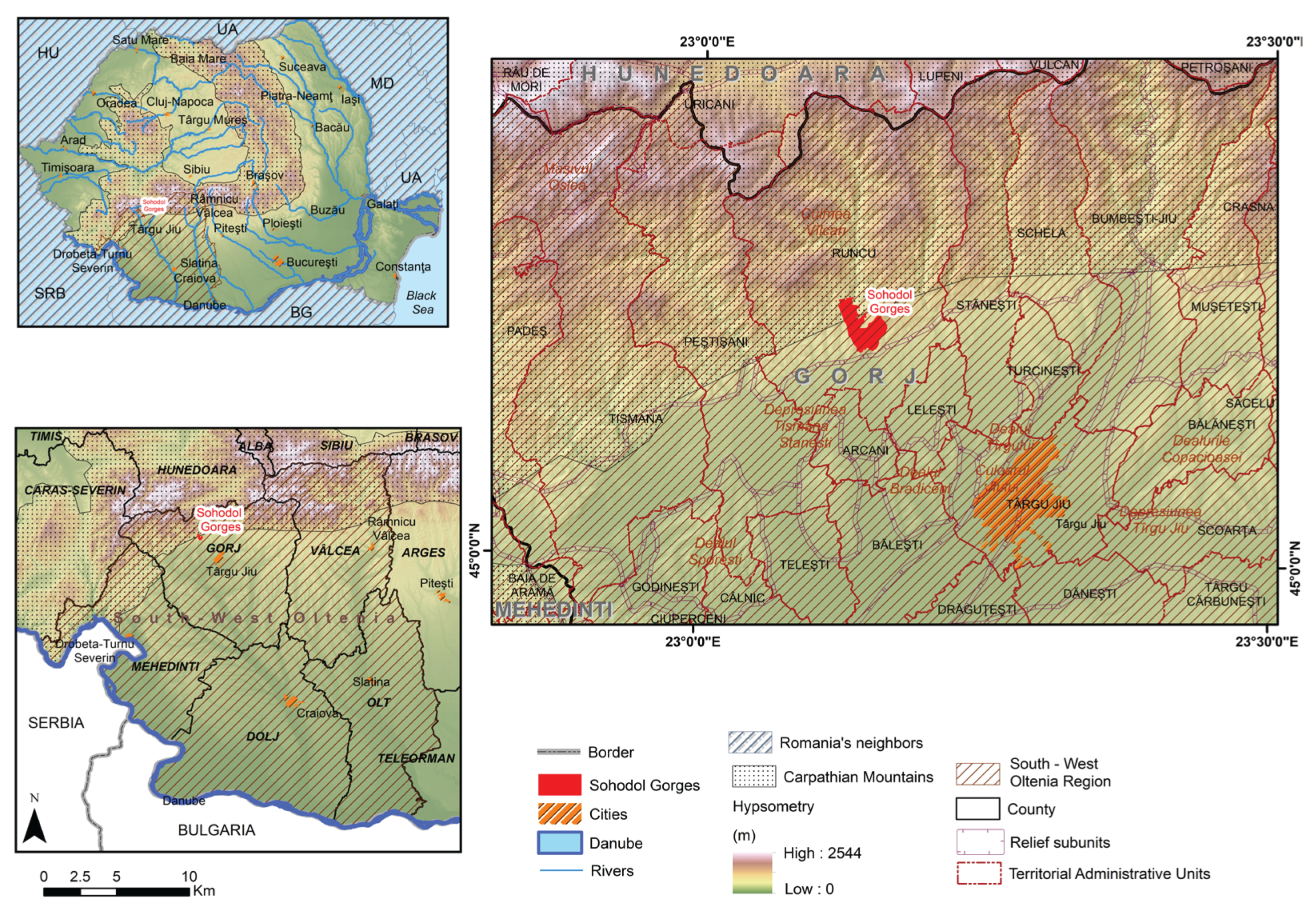
Figure 2.
The total number of tourists in the Runcu commune. Source: data processed by the authors based on information from NIS [71].
Figure 2.
The total number of tourists in the Runcu commune. Source: data processed by the authors based on information from NIS [71].
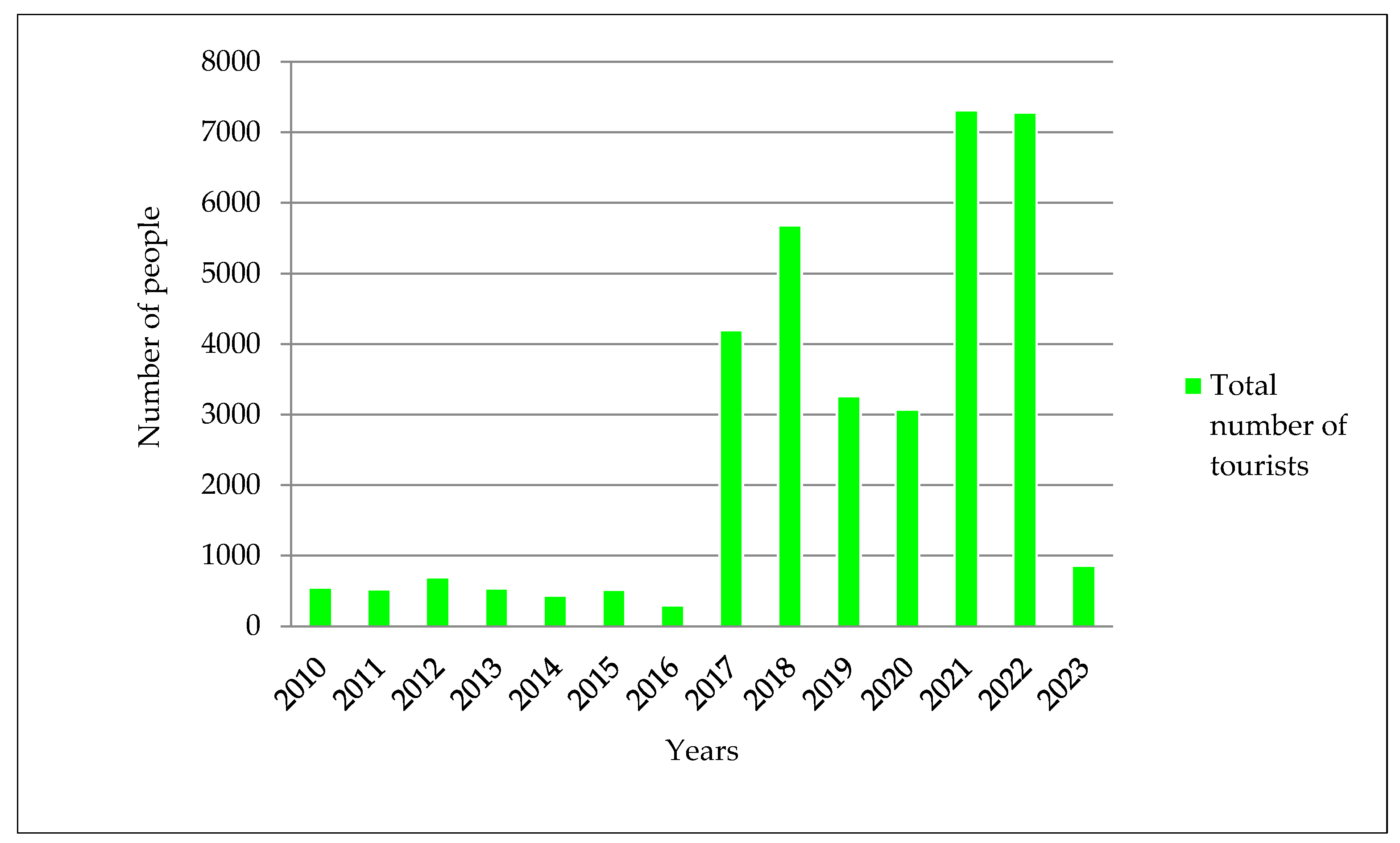
Figure 3.
Total number of tourists in agritourism guesthouses. Source: data processed by the authors based on information from the NIS [71].
Figure 3.
Total number of tourists in agritourism guesthouses. Source: data processed by the authors based on information from the NIS [71].
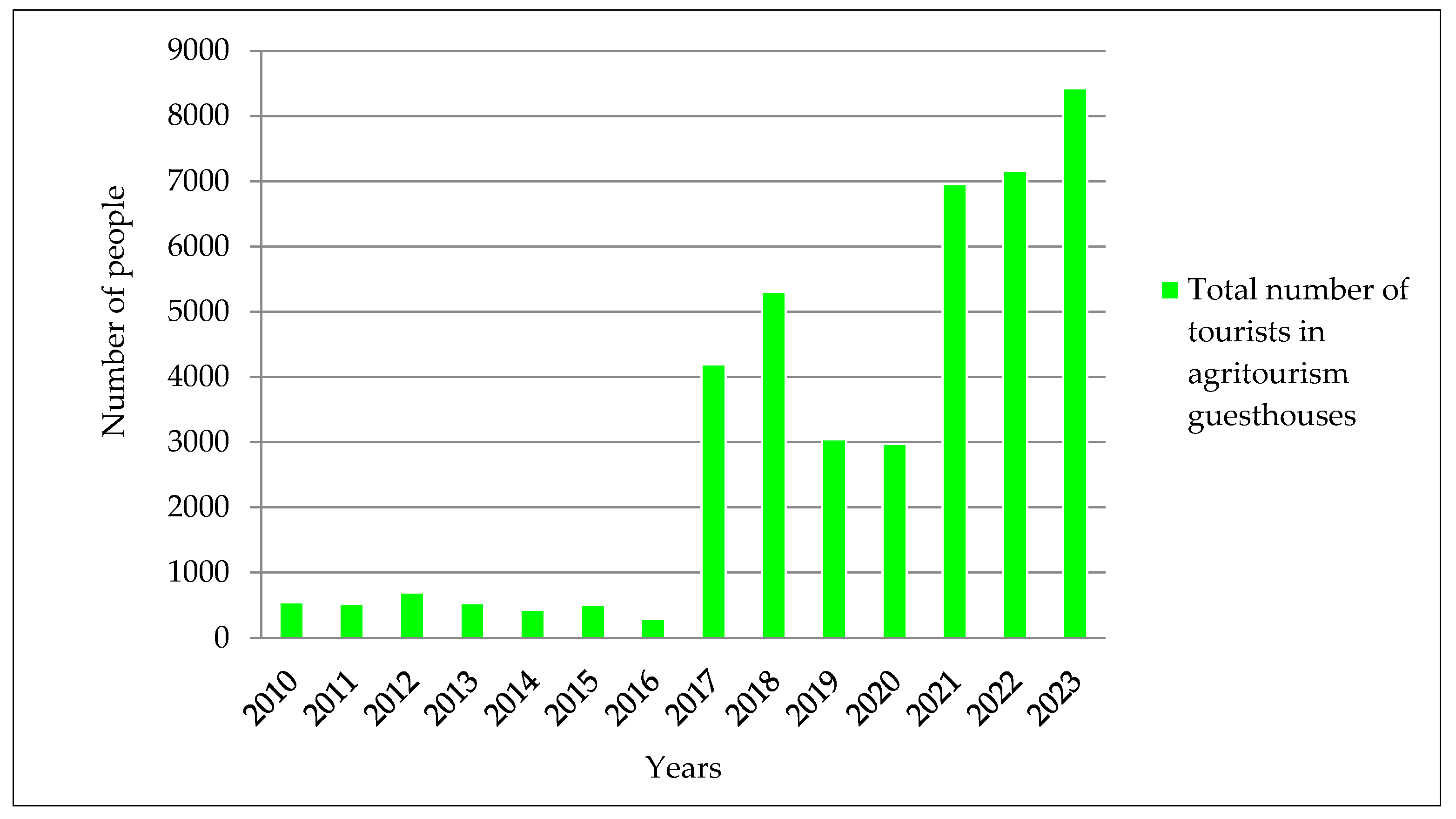
Figure 4.
“Lady’s Ring” tourist attraction in Sohodol Gorges. Source: author archive (Drăguleasa Ionuț-Adrian).
Figure 4.
“Lady’s Ring” tourist attraction in Sohodol Gorges. Source: author archive (Drăguleasa Ionuț-Adrian).
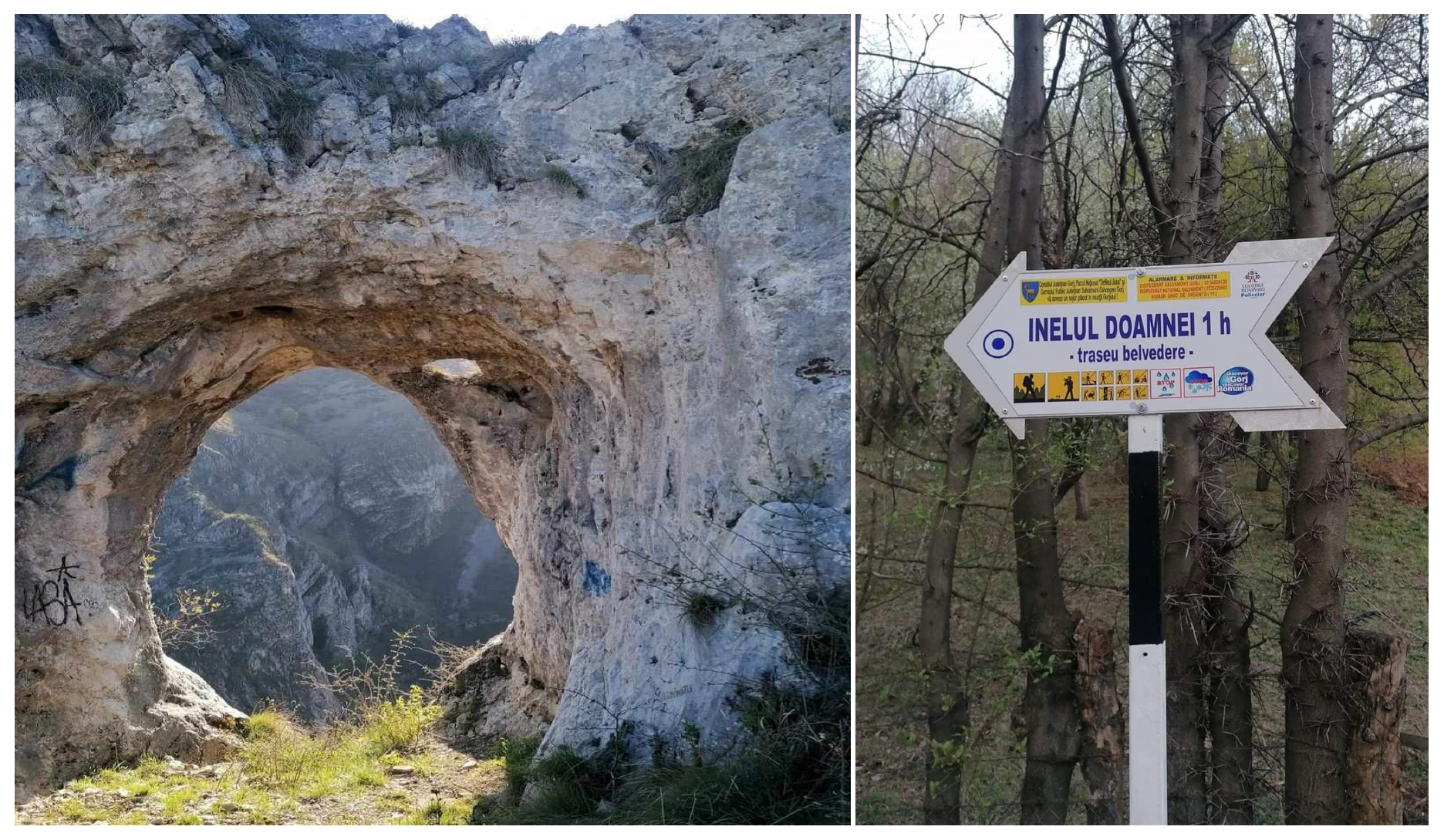

Table 1.
Assigning variables for each hypothesis.
| Number | Variables |
| H1 | Age_category Study_level Economic_impact_opportunities Business_economic_impact |
| H2 | Sex Economic_impact_price_increase Provenance_environment |
| H3 | Age_category Occupation Environmental_impact_damage Impact_environment_harmony |
| H4 | Provenance_environment Study_level Impact_environment_protection_diversity |
| H5 | Sex Study_level Impact_socio_cultural_traffic |
| H6 | Occupation Age_category Impact_socio_cultural_infrastructure Impact_socio_overcrowding |
| H7 | Socio_cultural_impact_cultural_identity Provenance_environment Study_level |
| H8 | Sex Occupation Impact_socio_cultural_interactions |
| H9 | Age_category Travel_mode Sohodol_Gorges_frequency |
| H10 | Sex Information_sources Post_pandemic_destinations |
| H11 | Season Education_level Geotourism_activities |
| H12 | Occupation Travel_mode Destination_recommendation |
Table 2.
Assigning a statistical method for testing each hypothesis.
| Hypothesis | Statistical Method Used |
| H1. Younger and more educated tourists are more likely to perceive geotourism as generating positive economic opportunities and promoting local business diversification in the Sohodol Gorges. | Multiple regression analysis |
| H2. Female tourists and those from rural areas are more likely to perceive geotourism as increasing prices for accommodation and traditional local products. | Multiple regression analysis |
| H3. Younger tourists and those working in environmental or tourism-related fields are more likely to perceive geotourism as harmful to the natural environment and emphasize the need for sustainable development. | Multiple regression analysis |
| H4. Urban tourists and those with higher levels of education are more likely to support biodiversity protection in geotourism development within protected areas. | Multiple regression analysis |
| H5. Female tourists and those with higher levels of education are more likely to perceive road traffic congestion caused by geotourism as negatively impacting the quality of the tourist experience. | Multiple regression analysis |
| H6. Older tourists are more likely to perceive overcrowding in public spaces and inadequate infrastructure as negative impacts of geotourism compared to younger tourists, who are more tolerant of these issues. | Pearson correlation coefficient |
| H7. Urban tourists and those with higher education are more likely to perceive geotourism as positively contributing to the preservation and promotion of local cultural identity. | Multiple regression analysis |
| H8. Tourists working in professions that involve frequent social interaction are more likely to perceive geotourism as intensifying meaningful socio-cultural interactions with locals. | Pearson correlation coefficient |
| H9. Older tourists are slightly more likely to visit the Sohodol Gorges more frequently, while younger tourists tend to prefer more independent modes of travel in the post-pandemic context. | Pearson correlation coefficient |
| H10. Female tourists are more likely to choose safe, well-documented post-pandemic destinations using official online sources, while male tourists prefer adventurous destinations and rely more on informal sources. | Multiple correlation coefficient |
| H11. Tourists with higher levels of education are more likely to engage in educational geotourism activities in spring and autumn, while less educated tourists prefer recreational or adventure activities in summer. | Multiple correlation coefficient |
| H12. Tourists in liberal or creative professions and those traveling with family or in organized groups are more likely to recommend the Sohodol Gorges compared to solo travelers or those from technical fields. | Multiple correlation coefficient |
Table 3.
Assigning variables for each question in the questionnaire.
| Ref. No. | Question | Variable |
| 1. | Your gender? | Sex |
| 2. | What age group do you fall into? | Age_category |
| 3. | Where are you from? | Medium_provenance |
| 4. | Level of completed studies? | Study_level |
| 5. | Your occupation? | Occupation |
| Economic impacts | ||
| 6. | Economic impacts [geotourism increases opportunities in the development of the local economy (employment and investment)] | Economic_impact_opportunities |
| 7. | Economic impacts [geotourism stimulates the increase in prices in accommodation units and traditional products] | Economic_impact_price_increase |
| 8. | Economic impacts [geotourism diversifies businesses for locals] | Business_economic_impact |
| Impacts on the environment | ||
| 9. | Environmental impacts [geotourism causes damage to the natural environment of ecosystem development and rural environment] | Environmental_impact_damage |
| 10. | Environmental impacts [the natural diversity of the protected area must be exploited and protected to reduce environmental impacts] | Impact_environment_protection_diversity |
| 11. | Impacts on the environment [geotourism must be developed in harmony with the natural and cultural environments of the protected area] | Impact_environment_harmony |
| Socio-cultural impacts | ||
| 12. | Socio-cultural impacts [the development of geotourism in the Sohodol Gorges increases road traffic congestion] | Impact_socio_cultural_traffic |
| 13. | Socio-cultural impacts [geotourism in Sohodol Gorges causes overcrowding of public and leisure spaces] | Impact_socio_supraaglomerarr |
| 14. | Socio-cultural impacts [the development of geotourism in the Sohodol Gorges would improve the quality of roads and recreational spaces] | Impact_socio_cultural_infrastructure |
| 15. | Socio-cultural impacts [geotourism in the Sohodol Gorges has a positive impact on the cultural identity of the local population] |
Impact_socio_cultural_identity_cultural |
| 16. | Socio-cultural impacts [geotourism intensifies socio-cultural interactions between tourists and locals and between hotel managers and tourists] | Impact_socio_cultural_interactions |
| 17. | Where have you traveled post-COVID-19 pandemic? | Post_pandemic_destinations |
| 18. | How often have you traveled to Sohodol Gorges post-COVID-19 pandemic? |
Frequency_Sohodol_Gorges |
| 19. | How did you most commonly travel in the Sohodol Gorges following the COVID-19 pandemic? | Travel_mode |
| 20. | What is the season to visit the Sohodol Gorges? | Season |
| 21. | What sources of information do you use to document yourself about the Sohodol Gorges? | Information_sources |
| 22. | What geotourism activities have you carried out post-COVID-19 pandemic in Sohodol Gorges? | Geotourism_activities |
| 23. | On a scale of 1 to 5, how likely are you to recommend Sohodol Gorges to others? | Recommend_destination |
Source: data processed by the authors in Microsoft Excel 2010.
Disclaimer/Publisher’s Note: The statements, opinions and data contained in all publications are solely those of the individual author(s) and contributor(s) and not of MDPI and/or the editor(s). MDPI and/or the editor(s) disclaim responsibility for any injury to people or property resulting from any ideas, methods, instructions or products referred to in the content. |
© 2025 by the authors. Licensee MDPI, Basel, Switzerland. This article is an open access article distributed under the terms and conditions of the Creative Commons Attribution (CC BY) license (http://creativecommons.org/licenses/by/4.0/).
Copyright: This open access article is published under a Creative Commons CC BY 4.0 license, which permit the free download, distribution, and reuse, provided that the author and preprint are cited in any reuse.


