

Submitted:
13 March 2025
Posted:
14 March 2025
You are already at the latest version
Abstract
Rural tourism in Bucovina, Romania thrives due to its unspoiled natural landscapes, preserved rural traditions, and rich ethnographic heritage, including folk architecture, crafts, and festivals. The region is renowned for its uniquely painted monasteries, part of the UNESCO World Heritage, blending history, tradition, and spirituality. This study analyzes Bucovina as a rural tourism destination, focusing on three key areas: Gura Humorului, Câmpulung Moldovenesc, and Dorna. It evaluates the region’s appeal through tourism market indicators over a 10-year period (2014-2023). Findings highlight the sector’s strong development potential, evidenced by a significant increase in accommodation facilities, lodging capacity, tourist arrivals and overnights. Rural tourism positively impacts sustainable development by preserving traditions, enhancing social life, and supporting local crafts. Despite the increase in arrivals and overnight stays, the average length of stay remains relatively low. However, Bucovina’s rural tourism continues to expand, offering a sustainable model that balances cultural heritage with economic growth. This study is crucial for understanding the region’s tourism dynamics and informing future strategies for sustainable rural development.
Keywords:
rural tourism
; sustainability
; tourist offer
; tourist demand
1. Introduction
At a global level, tourism has become one of the fastest-growing sectors of the economy, being closely linked to the socio-economic development process, with the capacity and potential to create new jobs [1]. According to Romania’s National Tourism Development Strategy 2023-2035 [2], the analysis of the tourism offer, the core market, and national marketing programs shows that Romania possesses a rich mix of unique natural, cultural, and medical/wellness attractions of global stature that are ready to be leveraged. Significant efforts to develop tourism in Romania have spanned several decades, during which a series of guides, policies, and strategic documents have been created. However, these strategies have mostly targeted niche segments of tourism, such as ecotourism, medical and spa tourism, and regional strategies or those dedicated to city-break type tourism. To serve as a guide for the sustainable development of tourism in Romania, further strengthening the country as a well-known, year-round global tourism destination, as well as a destination that meets EU standards for product and service delivery, Romania’s National Tourism Development Strategy focuses on aspects such as: valuing people, traditions, places, and Romania’s natural and cultural heritage, and increasing Romania’s visibility and reputation in top international tourism markets [2].
By its nature, tourism is an economic activity situated at the intersection of other branches, and thus, the development of this activity is influenced by other sectors with an impact on tourism (culture, transport, agriculture, regional development, environment) [3]. Rural communities can perceive the development of tourism as a positive support for new job opportunities, improved well-being and living standards, improved rural infrastructure, and the offering of new entertainment possibilities [4,5,6,7,8]. Rural areas can be considered an important factor for tourism development due to their capacity to preserve traditional culture and ethno-cultural heritage, and local community support has a direct impact on the development, quality, and sustainability of a tourist destination [9,10,11]. The economic impact of rural tourism is not considered significant, but even on a small scale; it has good potential to be used as a means of rural development [12].
Sustainable tourism is one of the sectors with significant growth potential, due to the need to develop a sustainable economic model capable of offering future generations at least the same living conditions as those of the present [13,14]. While in Western European countries, it represents a developed sector, clearly defined within the structure of the tourism industry, in Romania the field is still emerging, despite its potential in terms of tourism experience and very good potential. In the development process, rural areas face a wide range of economic, environmental, and social challenges [15].
Current development challenges impose new criteria for evaluating national performance, with the concept of well-being tending to be measured not only in terms of economic and social dimensions but also in relation to the environment [16]. Sustainable development aims to balance the performance of economic, social, and environmental sectors, with a key question remaining whether progress has been made [17,18]. Rural material deprivation and the means available to reach a certain standard of living lead to an appreciation of the ability to meet the sustainable development goal related to poverty [19].
As society develops, pressure on the environment tends to shift from the need to meet basic human needs to those related to the higher needs of society. While the least developed nations must pay special attention to population growth, sanitation, and health as main channels for better environmental protection, the most developed countries’ main directions for environmental improvement may be education and good governance. Thus, in the development process, a great concern for the environment must be cultivated, regardless of its stage, but with distinct directions for action [20]. In one of the wealthiest areas of Romania in terms of public goods, the valleys of Dorna region in northeastern Romania, we encounter both local and external consumers who have different perspectives on the utility of public goods. The region is characterized by extensive activities, especially in agriculture and forestry, and many of the public goods are linked to environmental dimensions, which is why many consumers are both tourists and consumers of local private goods [21].
Tourism is an important sector of the European Union economy, supporting economic growth and employment. However, one of the biggest challenges lies in strengthening and improving the evolution of sustainable tourism to ensure the industry’s long-term competitiveness [22].
In Romania, rural tourism has an excellent development environment, for a simple reason: approximately half of the country’s population lives in rural areas. According to the National Institute of Statistics of Romania, as of July 1, 2024, the proportion of residents in rural areas was 44.38% [23]. Analyzing the external tourism market for rural tourism and comparing the strengths of the Romanian offer in the field, it is characterized by: a high proportion of unspoiled natural mountain landscapes, untouched by human modification; the preservation of old rural civilization elements and their application in daily life; the presence of representative ethno-folkloric traditions and values (traditional architecture, handicrafts, folklore, folk costumes, folk festivals, and customs, etc.); Romanian hospitality with Latin influences, gastronomic customs from major Orthodox Christian religious holidays; fruit therapies and other forest products, the consumption of fresh, organic, and ecological foods at very low prices, the practice of occupational therapy, and initiation into the secrets of traditional Romanian natural medicine; integration into very old rural communities and experiencing their specific atmosphere; a large number of speakers of widely spoken international languages; the ease of understanding and speaking foreign languages [24].
The return to nature is increasingly manifesting in all countries, with multiple causes, and the trend is more pronounced in areas where post-industrial civilizations have triggered a desire to retreat from cities. All the resources in rural areas can be used to create attractive tourist offers with multiple beneficial perspectives, both for tourists, who will receive natural, original, and authentic products, and for the villagers, who will earn additional income. A well-known “secret/effect” of this type of rural activity is that, in addition to relaxing in a clean natural environment, the consumer who comes to rest in the rural environment gladly participates in local customs, traditions, and handicrafts, which give the “specifics of rural life” and pays for these aspects [25].
Rural tourism has been the subject of intensive research in recent years, as its importance for the sustainability of rural communities has long been recognized [26], as well as its potential to diversify from the declining mass tourism destinations [27]. Grouping the attractions, services, and activities of a destination during a national promotional event directs attention to less frequented and unexplored tourist resources in rural areas [28]. Rural tourism is generally seen as a collection of a wide variety of activities, events, accommodation services, public catering, and entertainment, developed in an area defined as rural [29]. This form of tourism, which is well suited without involving very large investments, can lead to financial benefits for local tourism structure owners, with the money being reinvested to improve the tourist offer. Where there are localities with “a large repository of real/sustainable resources,” their involvement in tourism [30,31] is not only desirable but also necessary, with the possibility of preserving and perpetuating representative elements (in suitable forms).
Bucovina is considered a picturesque area of Romania because it surprises tourists with a mixed landscape, consisting of hills, sub-Carpathians, and massive mountains. Thus, guests can discover stunning views with varying and unique horizons. Due to the beauty of the places, the purity of the air with a sedative effect, the crystal-clear waters, as well as the priceless cultural and religious heritage, Bucovina, also known as the Land of Monasteries, has a very high tourism potential, which can be compared to other tourist regions in the country and abroad. Along with the picturesque nature of the region, the well-known Bucovinian hospitality, popular traditions, and the specific Bucovinian cuisine add local color to attract tourists. Bucovina, or the Land of Beech Trees, also known as the “Land of Monasteries,” is a historic region of great value in Romania, known for the monasteries built by former rulers and boyars of Moldavia. Eight of these monasteries are part of the UNESCO World Heritage, namely: the Church of Tree, the Monasteries of Voroneț, Humor, Probota, Moldovița, Sucevița, Pătrăuți, and “St. John the New” from Suceava. It is a region located in the north of Romania, famous for its beautiful landscapes and heritage [32].
The development of rural tourism as an element of diversification of the rural economy, amid the diminishing central role of agriculture and forestry, has been successful in many European countries [33,34,35,36,37,38,39], and in this field as well. By combining several specific factors [40,41,42] of rural areas, including the Bucovina region (small guesthouses and stunning landscapes), multiple effects [43,44,45] can manifest, potentially bringing changes to the lifestyle of the local population (some beneficial and others negative). The direct and lasting impact of the development of rural tourism on the village [46,47,48], particularly on the discussed area, can be quantified in improving general infrastructure through the establishment of farms, guesthouses, and tourist households as models [49], organizing activities while respecting local architecture and traditions. To remain a sustainable form of tourism for rural areas, certain principles must be respected: the tourism activity must be initiated with the local community’s own resources, the community must maintain control over the tourism development, tourism must provide employment for locals that improves the quality of life for the local communities, a balance must be maintained between existing economic activities in the area and tourism activities, and educational and training programs must be developed to improve management in the field of protection of natural and cultural resources. Therefore, tourism represents a viable alternative for economic activities in rural areas and improves the living standards of local communities [3].
The rural areas of Europe, including Romania and Bucovina, are undergoing profound changes, with many issues that will most likely accelerate in the coming years, placing increasing importance on achieving sustainable development and thus responding to the demand for ecological services. In most countries undergoing economic development, the rural economy is predominantly primary, with agriculture accounting for approximately 60% of its structure (compared to around 14-15% in developed EU countries), leading to negative effects regarding the employment of the rural active population, the low level of processing agricultural raw materials, and consequently, the creation of added value and minimal taxation of agricultural and food production [50]. These aspects are further compounded by the decline of traditional activities, rural exodus, population aging, the remote position of certain areas, poor infrastructure quality, and the relatively poor quality of services offered. To address these issues, the European Union has focused on implementing its rural development policy [51,52,53].
The structural changes in the economy are causing severe constraints in rural areas, especially those heavily dependent on agriculture. Such areas exist in most European countries. In these areas, farm profits [54,55] are declining, rising unemployment leads to an exodus of the productive workforce, and thus to demographic imbalance. Local leaders and authorities are seeking innovative actions to solve the problems of these areas and thus support the well-being of the rural population [25]. In the case of Bucovina, the good part is that the area has excellent tourist resources, thus offering the possibility of turning towards tourism activities.
In contemporary society, under increasingly stressful living conditions, attention has shifted towards an alternative way of spending free time, leading to a form of tourism known as “rural tourism,” which harmoniously combines natural resources (geographical location, relief, climate, hydrology, landscape, hunting and fishing grounds, vineyards, and orchards) with social resources (cultural-historical objectives, monuments, museums, hospitality, language, mentality, customs and traditions, ethnography and folklore, art and culture, etc.), all of which are found in the rural environment of Bucovina.
At the global tourism economy level, rural tourism activities generally involve capitalizing on extraordinary natural resources, essential cultural heritage, buildings with local architecture, rural traditions, or agricultural products, and use specific products that illustrate the unique identity of the rural area, covering the needs of consumers regarding three elements of tourist products: accommodation, food, and leisure. The aim of rural tourism activities is thus to ensure sustainable local development, providing a new modern vision on this form of tourism [56,57].
The capitalization of resources specific to rural areas can thus support their sustainability over time by conducting tourism activities in an environment with unique characteristics, and the interrelation with the local society leads to the development of a special tourist-host relationship and participation in the local community life [58,59,60,61,62]. Through rural tourism activities, one can understand the valorization of the “specific rural way of life” and its resources, applying specific management that could sustain future benefits for small local communities, thus ensuring sustainability [63,64,65].
In general, rural tourism forms should capitalize on authentic rural households, and by introducing them and other resources into the tourist circuit, they should ensure socio-economic development. However, rural tourism does not always guarantee the sustainability of an area, as destructive actions such as the brutal intervention of humans on the landscape and natural resources, physical pollution, noise, visual pollution, architectural damage, etc., can have negative effects. In our research area, the three regions in Bucovina (the Humor area and the Câmpulung Moldovenesc area from the Moldova Depression and the Vatra Dornei area from the Dorna Depression) stand out due to the uniqueness of rural tourism, the existing conditions, the culture, and the purity of the people, coupled with hospitality, interest, motivation, and aspiration towards improvement, can establish rural tourism and contribute to sustainable and responsible development of the Bucovina village [66,67], and the rural area as a whole [68]. Rural tourism has a long history in this area, where types of structures such as rural guesthouses have the largest number among the types of tourist reception structures with accommodation functions. If this type of activity is carried out responsibly, as a well-managed process, it will lead to the long-term sustainability of the Bucovina rural area. This possible sustainability could be assessed through economic and social benefits [69,70,71,72].
The positive action of rural tourism on the rural environment means the perspective of long-term development for the rural community, with the possibility of becoming a support for new businesses and jobs that will drive local development. Thus, it acts on the economic development of the locality by increasing the population’s income, which leads to changes in expenditure structure, a significant increase in investments, the development and improvement of transport and communications, and the expansion of economic activity through the emergence of new sectors complementary to rural tourism activities [73,74,75,76].
Rural tourism also influences the social factors in the rural environment by reducing rural exodus and stabilizing the rural population. This phenomenon occurs by offering decent living opportunities in this environment, through occupational diversification for the population, especially for young people, who are usually the most vulnerable on the job market and the most affected by crises and economic recessions [77,78].
Rural tourism has a positive influence on the rural environment through educational and cultural factors by establishing relationships of knowledge between those who come to experience the rural area and the locals. Tourists will also benefit from the opportunity to learn about local customs and traditions, the history, and the authenticity of the respective people. It can be appreciated that a favorable image of the respective country is created globally, with rural tourism being the most effective and pacifist ambassador of a country [68,69,70,71,72,73,74,75,76,77,78,79]. Rural tourism can also influence the management system of the respective locality, the local organizational factors, mobilizing them and increasing their concerns for arranging the rural space in terms of infrastructure, indirectly forcing them to find funding sources for the achievement of modernization goals, such as: access roads, restoration of tourist objectives, repair of functional buildings, etc. [65,80,81,82,83,84].
The rural space creates various possibilities and forms of tourism, such as rural tourism itself, but also agrotourism, which combines agricultural activities with tourism activities, with the main goal of obtaining additional income; ecotourism, which targets natural resources and their use through tourism activities, highlighting the ecological benefits for local communities; and cultural tourism, which establishes a connection and a special relationship between the local cultural and tourist heritage, focusing on historical resources and community values [85,86].
The purpose of this paper is to study the Bucovina region and the exceptional tourism potential of the rural areas in this region, such as the Gura Humorului, Câmpulung Moldovenesc, and Dorna areas in Suceava County. Since the tourist is the consumer of the product “rural tourism in Bucovina,” the aim of the paper is to identify the level of appreciation for this area, the suitability of the Bucovina region for rural tourism activities by analyzing the tourism market, which consists of supply indicators (the number of tourist accommodation structures, the operating accommodation capacity, and the net utilization rate of the operating accommodation capacity), and demand indicators (arrivals, overnight stays, average length of stay) over a 10-year period (2014-2023). Additionally, it aims to estimate the accommodation capacity, arrivals, overnight stays, and average length of stay for the next 5 years of the analyzed period.
Argumentation of the Study
The area of focus for this research is the rural region of Bucovina, specifically the Humor Area, Câmpulung Moldovenesc Area, and Dorna Area, located in the northeastern part of Romania, in Suceava County. The analysis of the tourism market, consisting of supply and demand indicators, was carried out for a period of 10 years, between 2014 and 2023. The processed data was downloaded from the website of the National Institute of Statistics of Romania [23]. These three regions represent the most important tourist areas of Suceava County, hosting the county’s major tourist resorts, namely, the Vatra Dornei Resort, a nationally recognized treatment resort with permanent operations, included in the international tourist circuit, known for its therapeutic springs and a natural climate favorable to restoring health; the Câmpulung Moldovenesc Resort, a climatic resort offering excellent conditions for winter sports enthusiasts, as well as a rich offering in cultural and religious tourism; and the Gura Humorului Resort, another important climatic resort offering great conditions for winter sports lovers. However, tourists are particularly attracted to the famous Voroneț Monastery, dubbed the “Sistine Chapel of the East,” a historical and religious monument dating from 1488. These areas have succeeded in gaining national and international recognition for their specific resources and activities related to rural tourism.
Due to its history and special geographical location, which has witnessed the peaceful coexistence of several ethnic groups, Bucovina is a region of cultural intersections, situated “between East and West” [87].
By belonging to different geographical, cultural, and geopolitical areas, and through the frequent change of the dominant political nation, the historical and cultural destiny of this region is exceptional.
From a geographical point of view, Bucovina is part of Eastern Europe. Culturally, due to its inclusion in the Austrian state (Austro-Hungarian Empire), this region was part of the Central European cultural area between 1775 and 1918. Belonging to the Central European cultural area facilitated the introduction and consolidation of German culture in Buchenland (“The Land of Beech Trees”). This extensive and complex process was largely carried out through the German and Jewish Kulturträger (“carriers of culture”), who were German or Yiddish speakers.
From a geopolitical perspective, Bucovina was, during the Middle Ages, a region at the intersection of the spheres of influence of Hungary, Poland, and the Ottoman Empire. Starting with the 18th century, Bucovina came under the influence of three empires: the Ottoman, the Austrian, and the Russian empires. Over time, this region could not form a real political identity, as it was successively part of Medieval Moldova (second half of the 14th century – 1774), the Austrian Empire (1774/1775-1918), and the Kingdom of Romania (1918-1940; 1941-1944). The northern part of the province was part of the Soviet Union (1940-1941; 1944-1991). Today, the historic province of Bucovina is divided into two parts: the southern part is part of Suceava County (8,555 km²) in Romania, while the northern part has been integrated into the Chernivtsi Region (8,100 km²) in Ukraine since 1991 [88].
The entry of this area into history began in the second half of the 14th century, a period in which this territory became the core around which the medieval state of Moldova was formed. During this time, a vibrant spiritual life developed, focused around famous monasteries (Putna, Moldovița, Sucevița, Voroneț, Arbore, Solca, Dragomirna, etc.), which continue to attract many tourists to the area. The northern part of Romania experienced strong economic development both due to the establishment of the capital of Moldova in Suceava (starting in 1387) and the articulation of an internal and international trade route network and defense points (the Suceava and Hotin fortresses). The Byzantine tradition and influences from Western Europe are evident in the splendid medieval architecture, most of which was built in the 15th and 16th centuries with the financial contributions of the Moldovan rulers and boyars, as well as the efforts of the local population [89].
The reason for choosing this area stems from its long history of religious tourism and rural tourism activities, as well as its favorable geographical location (close to famous monasteries and at the confluence of mountain tourist routes). Tourist traffic in this area is high, especially during peak season, and the tourism potential is significant, making it a good candidate for applying the study. Achieving the correct balance between the needs of tourists, host communities, and the environment, as well as recognizing the interdependence between them, requires a special approach to destination management.
According to the European Tourism Indicators System [90], a destination can be defined as a tourist area that represents or could represent an attraction for visitors/tourists; a place or area that is easily recognized and defined as a destination for visitors, with a range of facilities and products for tourism purposes; a place or area promoted as a destination; a place or area where the demand and supply of tourism services can be measured, i.e., the visitor economy; a place or area where the visitor management process usually involves various stakeholders from the public and private sectors, as well as the host community.
Thus, in accordance with this system [90], by managing rural tourism in a sustainable manner, we aim to ensure that we recognize the limits and capacity of the tourism resources available in the three analyzed tourist areas (Gura Humorului, Câmpulung Moldovenesc, and Dorna), and encourage a way of tourism development that creates a balance between optimizing the immediate economic, ecological, and socio-cultural benefits and guaranteeing a long-term future for the Romanian tourism industry within the European context. The tourism industry in Romania, and implicitly in the EU, needs to significantly improve its competitiveness and sustainability, taking into account aspects such as the quality of products and services, social and environmental responsibility, natural resources, and the diversity of cultural heritage and local identities—all of which are part of the heritage of the analyzed region, Bucovina, Romania.
In this work, the first objective pursued was the theoretical argumentation for the existence of valuable heritage for tourism within the three studied areas (Humor, Câmpulung Moldovenesc, Dorna). The next objective was related to the analysis of the rural tourism market through its two components (supply and demand), and the final objective was to draw conclusions based on the findings of this study (Table 1).
2. Materials and Methods
In this study, the components characterizing the tourism market were analyzed, namely the tourism supply through accommodation structures, the operational accommodation capacity, as well as the calculation of the net utilization index of the operational accommodation capacity. Additionally, tourism demand was examined by analyzing arrivals and overnight stays and calculating the average length of stay.
The tourism reception structure with accommodation functions refers to any construction or facility that permanently or seasonally provides accommodation services and other specific services for tourists [23]. The statistical research did not include tourism reception structures with accommodation functions that had an installed accommodation capacity of fewer than five places.
The operational tourist accommodation capacity represents the number of accommodation places made available to tourists by accommodation units, taking into account the number of days the units are open during the considered period. It is expressed in place-days. Accommodation places in rooms or units temporarily closed due to a lack of tourists, repairs, or other reasons are excluded [23].
The utilization index of the operational tourist accommodation capacity is calculated by comparing the number of overnight stays with the operational tourist accommodation capacity during the respective period [23].
In = (N/Cf) × 100, where: In – the index of utilization of the operational tourist accommodation capacity; N – the number of overnight stays recorded in a given period; Cf – the operational tourist accommodation capacity.
The number of tourists accommodated in tourist lodging units includes all individuals (both Romanian and foreign) who travel outside the localities where they have their permanent residence, for a period of less than 12 months, and stay at least one night in a tourist accommodation unit in the visited areas of the country. The primary reason for the trip is different from engaging in a paid activity in the places visited [23].
A tourist overnight stay is the 24-hour period, starting from the check-in time, during which a person is registered in the records of the tourist accommodation and receives lodging for the corresponding room rate, even if the actual stay is shorter than the specified period. This also includes overnight stays for any additional beds installed (paid for by the guests) [23].
The average length of stay is determined by the ratio between the number of tourist days (NTZ) and the number of tourists (T). It reflects the ability of the tourism offering to retain a tourist in a specific area, region, or country [91,92].
Ds = , where: Ds - mean duration of sojourn; NZT - numbers of days/tourist; NT - tourists number.
For the operational accommodation capacity, arrivals, overnight stays, and the average length of stay, the absolute and relative changes (the dynamic index and the dynamic rate) were calculated using both a fixed base and a chain base.
Absolute indicators represent a basic form of dynamic series, based on which could be obtained general indicators. Level indicators are the terms of a series formed by absolute indicators (y … yt … yt-1). Total level of terms , only for time interval series with absolute measures.
The absolute modifications: with fixed base = yt-y1 where, ; with in chain base (mobile or variable base) where, .
Relative indicators, it is a presentation way, mainly percentage. In this situation is mandatory that in title or outside the table to be mentioned the rating based so the data interpretation to be correctly done.
Dynamic index: with fixed base with in chain base Dynamic rhythm: with fixed base ; with in chain base , .
Average indicators: – the average level of the interval time series , – the average level of the absolute change (increase or decrease) , – the average index of dynamics , – the average growth rate .
To adjust the number of tourists, the method of trends adjusted according to the linear trend, for the time period 2014-2028 was used: linear model: y = a + bt. R is the correlation between the values predicted by the equation and the current values. The square R is used to indicate the variation of the values from the trend line [93,94].
3. Results
3.1. Theoretical Justification of the Possibilities for Utilizing Local Resources Through Rural Tourism Activities
Description of the Humor Area, Câmpulung Moldovenesc Area, and Vatra Dornei Area as research locations and significant holders of important resources for Romanian rural tourism [95,96].
The Humor Area (Figure 1) is located in the central part of Suceava County, with a temperate continental climate specific to mountainous and plateau regions (cold air, with blizzards and frost in winter, and dry, warm air in summer). The Humor Area is crossed by the Moldova River and its tributaries, and is composed of types of relief such as obcinis (Obcina Mare-Large Ridge, Humor Obcina-Humor Ridge), plateaus, intramontane depressions, hills, and valleys (Valley of Moldovia, part of the Suceava Plateau, Liteni-Mill Depression). The settlements in the Humor Area are scattered villages, which show a tendency to spread out towards the periphery (in the obcinis) and a tendency to concentrate or form clustered settlements in the plateau area. The population of this region is an “ethnic” and confessional mosaic made up of Romanians, Germans, Poles, Ukrainians, Hungarians, and Roma of Orthodox, Roman Catholic, Greek Catholic, Pentecostal, Adventist, Baptist, and Evangelical Christian confessions.
The traditional architecture of the Humor Area is characterized by households entirely made of wood, typical of mountainous areas, with spaces designated for housing animals and storing feed, as well as households built from wood and other materials (burnt and unburnt clay, stone, wicker, etc.), with annexes for housing animals, storing tools, and preserving agricultural products, characteristic of plateau areas. A distinctive architectural element of this area is the porch (cerdac), which serves to protect the entrances of older houses from the elements, while also being a place for domestic activities or a resting place for the household members.
The main cultural landmarks in this area include the Humor Monastery, the Roman Catholic Church “Assumption of the Virgin Mary” (Basilica Minor) in Cacica, the Cacica Salt Mine, and the Memorial House and Museum “Ciprian Porumbescu”.
Humor Monastery – located in the village of the same name, it was founded by Toader Bubuiog and his wife Anastasia in 1530. It is notable for its frescoes, both inside and outside the monastery, (the exterior frescoes are characterized by the predominance of red colors).
Roman Catholic Church “Assumption of the Virgin Mary” (Basilica Minor) in Cacica – built in Neo-Gothic style from raw brick between 1903-1904, it has a 50-meter-high spire and impresses with the stained-glass windows of the five windows in the presbytery and the two side windows made of colored glass from the transverse naves. The church was declared a national sanctuary in 1997 and was elevated to the rank of Basilica Minor three years later by Pope John Paul II.
Cacica Salt Mine – located in the village of Cacica, it was built based on the plan of the famous Wieliczka Salt Mine (Poland). The Cacica Salt Mine includes the old mine, which has been transformed into a true underground museum at a depth of 50 meters, St. Barbara’s Chapel, built in 1904 and arranged 21 meters underground, the bas-relief room, the underground salty water lake, 38 meters deep (unique in Romania), and the festive hall where balls used to be held, located 44 meters underground.
Memorial House and Museum “Ciprian Porumbescu” – located in the village of Ciprian Porumbescu, it houses significant monuments from the life and activity of the famous Romanian composer Ciprian Porumbescu, such as authentic exhibits (the piano, cello, conductor’s baton, and violin case), photographs, prints, posters, numismatic or philatelic items.
The main occupations of the locals in the Humor Area include crop cultivation (wheat, barley, oats, flax, hemp) in the plateau area, animal husbandry (sheep, goats, cattle, pigs, poultry) in the mountainous area, and forestry or silviculture in the mountain and plateau regions.
The Câmpulung Moldovenesc Area (Figure 2) is located in the central-western part of Suceava County, with a moderate temperate continental climate, characterized by long winters with heavy snowfalls and humid, cool summers. Câmpulung Moldovenesc is situated in a mountainous area, with landforms such as mountains, ridges, intramontane depressions, valleys, terraces, and floodplains, and is crossed by the Moldova and Moldovița rivers and their tributaries.
The Câmpulung Moldovenesc settlements are in the form of scattered villages (dispersed, separated, along the valleys), with a tendency to gather (along the Moldova Valley). The population of this region is an “ethnic” and confessional mosaic made up of Romanians, Ukrainians, Germans, and Roma of Orthodox, Roman Catholic, Greek Catholic, Pentecostal, Adventist, and Baptist confessions. The traditional architecture of the Câmpulung Moldovenesc area is represented by households entirely made of wood, with annexes for housing animals, tools, carts, and firewood, for storing food and preparing meals. A distinctive architectural element is the porch, which highlights the entrance, with pillars richly decorated on all surfaces.
The main cultural landmarks of interest in the Câmpulung Moldovenesc Area include the Moldovița Monastery, the “Lucia Condrea” Painted Eggs Museum in Moldovița, and the Bucovina Village in Breaza.
Moldovița Monastery – located in the village of Hearth of Moldovița, it was founded by Petru Rareș in 1532 (son of Stephen the Great) and painted in 1537. It is a UNESCO World Heritage site. The monastery is painted on the outside as well and is considered a fortress, with walls 6 meters high and 1.2 meters thick, with towers at both corners of the facade and a gate tower.
“Lucia Condrea” Painted Eggs Museum in Moldovița – contains an impressive number of over 5,000 exhibits, arranged on various themes. The museum is named after the artist who adopted and developed the art of egg painting. The painted eggs, created using different techniques, place the artist among the leading artists in the world. Her works can be found in major museums worldwide as well as in various private collections.
Bucovina Village in Breaza – even in 2025, this village consists of traditional houses that are over 100 years old, and some of the buildings that make up the village date back more than two centuries in those lands. This village offers tourists optimal accommodation and dining conditions.
The traditional occupations of the locals in the Câmpulung Moldovenesc Area include animal husbandry (sheep, horned cattle, horses), crop cultivation (corn, potatoes, rye, barley, beet, etc.), and forestry/silviculture.
The Dorna Area (Figure 3) is located in the southwest of Suceava County, in the mountainous and depression areas, with relief consisting of mountains, intramontane depressions, and valleys. It has a temperate continental mountain climate, with frequent temperature inversions and heavy precipitation in the winter. The region’s hydrography consists of surface waters represented by the Bistrița River, with its tributaries, and the Dorna River, with its main tributaries, as well as underground waters from mineral springs, including carbonated, ferruginous, chlorinated, sulphated, and sulphurous waters in Șaru Dornei, Coșna, Poiana Negri, Dorna Candreni, and Meadow Stampa.
The Dorna settlements are in the form of scattered villages (lined along the valleys), some with a tendency to gather (grouped on terraces). The population of this region is an “ethnic” and confessional mosaic made up of Romanians, Germans, Ukrainians, Hungarians, and Roma of Orthodox, Roman Catholic, Pentecostal, Adventist, Baptist, Old Rite Christian, and Evangelical Christian confessions. The traditional architecture of the Dorna Area is represented by agro-pastoral households, entirely made of wood, with spaces for housing animals and storing feed; households specialized in crafts, with annexes for carrying out activities, storing work materials, and finished products. The distinctive architectural element is the porch (cerdac), which protects the entrance of older houses from the weather and serves as a place for household activities or as a resting spot for the householders.
The main cultural landmarks of interest in the Dorna Area include the Village Museum in Dorna Candreni, the Ethnographic Museum in Stampa Meadow, and the Painted Eggs Museum in Ciocănești.
The Village Museum in Dorna Candreni – contains over 2,000 exhibits, mostly ethnographic (chests, sewing looms, folk costumes, and traditional means of transport).
The Ethnographic Museum in Stampa Meadow – this museum reproduces the atmosphere of a typical home from the region, highlighting the hearth and porch, wooden objects, wall hangings, bedspreads, and blankets, as well as the frames used by housewives to work on clothing and decorative pieces.
The Painted Eggs Museum in Ciocănești – the museum holds a collection of over 2,000 painted or decorated eggs created by local artisans. Household items made of wood and ceramics, pastoral inventory, and tools used by carpenters, weaving looms, and decorative and folk clothing pieces evoke the way of life and occupations of the locals. The traditional occupations of the local population in the Dorna Area mainly focus on animal husbandry (cattle, sheep, goats, pigs, horses, birds), which is characteristic of the mountain area, forestry/silviculture, and crop cultivation (millet, rye, barley, oats, potatoes, wheat, corn, etc.).
The traditional crafts of the three studied areas (Humor Area, Câmpulung Moldovenesc Area, and Dorna Area) are largely shared due to their geographical proximity (Suceava County, Romania) and the common historical developments through which all three areas evolved over time. These crafts are highly appreciated by tourists who visit the rural museums where craft objects are displayed. Many of these crafts are still practiced by the inhabitants of these regions, who strive to pass on the village professions to younger generations.
The traditional crafts of the three studied areas (Humor Area, Câmpulung Moldovenesc Area, and Dorna Area) include:
- Carpentry – (common to all three areas) – involves the construction of houses and household annexes using only wood;
- Joinery (specific to Humor and Dorna Areas) – involves making door and window frames as well as furniture using wood;
- Cooperage – (common to all three areas) – involves the making of wooden containers to store liquids, cheese, and preserved fruits;
- Blacksmithing (specific to Humor and Dorna Areas) – involves the processing of iron to produce various objects and tools;
- Pottery (specific to Humor Area only) – involves processing clay (especially clay) to make household items;
- Spinning and Weaving – (common to all three areas) – involves making fabrics for clothing and decorative textile items, using flax, hemp, and wool;
- Sewing (specific to Humor and Dorna Areas) – the traditional technique is still preserved in 2025;
- Leatherwork or processing of skins and furs (common to all three areas) – involves using sheep and cattle skins to create clothing items known as “cojoace”;
- Roofing (specific to Humor and Dorna Areas) – involves covering houses, generally using spruce wood;
- Rope-making (specific to Humor Area) – the craft of making ropes from hemp, which were later used to tie cattle;
- Egg Decorating or Dyeing (common to all three areas) – this craft is especially practiced in the Câmpulung Moldovenesc Area in Romania;
- Folk Musical Instruments (specific to Câmpulung Moldovenesc and Dorna Areas) – involves the making of folk musical instruments mostly from resonant wood such as fir and spruce;
- Making of traditional shoes and boots (common to all three areas) – involves creating footwear typical of the 20th century rural Romania, using pig or calf leather;
- Belt-making (specific to Câmpulung Moldovenesc Area) – involves mounting leather ornaments made by specialized women, as well as making and repairing harnesses for horses, bridles, and whips;
- Vegetable Dyeing (specific to Dorna Area) – involves dyeing flax, hemp, and wool threads using plant-based dyes extracted from plant roots, rhizomes, stems, leaves, or flowers;
- Horn Processing (specific to Dorna Area) – involves making objects from deer or cattle horns, which was once practiced in the Bistrița Gold Valley (especially in Cârlibaba), and belonged to the Huțul horse people settled there in the 18th century. The objects, whether decorated or not, had various uses, such as horns for blowing, measuring, or storing gunpowder.
The traditional customs of the three studied areas (Humor Area, Câmpulung Moldovenesc Area, and Dorna Area) are represented by fixed-date holidays (and movable ones for Easter) and the specific customs and traditions associated with each holiday. The main holidays that reflect the most important traditional customs of the three studied areas include: Saint Basil’s Day (January 1) – children practice the custom of “seeding” (throwing cereal grains through homes and offering wishes of health, prosperity, and abundance to the hosts); Epiphany (January 6) – the procession of water blessing, the making of the ice cross, and sprinkling households, people, and animals with holy water (called aghiasmă); The 40 Martyrs’ Day (March 9) – considered the Agricultural New Year; Alexii (March 17) – considered the Beekeeping New Year; Blagovishenia (March 25); Saint George’s Day (April 23) – considered the Pastoral New Year; Easter (painting eggs, preparing traditional meals, attending the Resurrection service, blessing the Easter basket, festive meal, bell ringing, egg tapping, watering from the second day of Easter, village dances, etc.); Pentecost (celebrated 50 days after Easter); Saint John’s Day (June 24); Saint Elijah’s Day (July 20); Village Feast (related to a religious holiday patronizing the locality); Assumption of Mary (August 15); Nativity of the Virgin Mary (September 8); Holy Cross Day (September 14); Good Friday (October 14 – also known as “The Wedding of the Sheep,” which Christianity later overlapped with the celebration of Saint Parascheva); Samedi (or “Autumn Ancestors,” October 26); Saint Andrew’s Day (November 30) – the night before is known as the night of the spirits, with magical customs such as spells, prophecies, etc.; Saint Nicholas (December 6) – Saint Nicholas is a kind, wise figure who helps widows and orphans, facilitates marriages for poor girls, and brings gifts to children; Pig Slaughtering Day (December 20) – the day when pigs are slaughtered; Christmas Eve (December 24) – preparing the Christmas Eve meal, caroling (a tradition initially started by children, continued by groups of young people, and supported by the elderly and even very old people until Epiphany); Christmas Day (December 25) – going caroling with the star and the Christmas carolers, a form of folk-religious theater performed by small groups of young people dressed as biblical characters; New Year’s Eve – one of the richest moments in traditions and customs: mask games (bears, goats, deer, “bunghieri”, “moșii și babele,” traders, doctors, devils) and the “plugușorul” (a traditional carol for the new year).
Cultural events in all three areas studied (Humor, Câmpulung Moldovenesc, and Dorna) are numerous and attract many tourists. Many of them are associated with religious holidays and represented by various artistic performances, such as festivals and concerts (e.g., “Pilgrim in Bucovina” on August 14-15 in Humor, the religious music festival “Buna Vestire” in March in Fundu Moldovei, the National Trout Festival in August in Ciocănești, and Winter traditions and customs in December and January in all three studied areas).
3.2. Analysis of the Tourist Offer in the Humor Area, Câmpulung Moldovenesc Area, and Dorna Area
The number of tourist accommodation facilities in the 12 rural localities of the Humor Area (Berchisești, Cacica, Capu Câmpului, Ciprian Porumbescu, Ilișești, Mănăstirea Humorului, Ostra, Păltinoasa, Pârteștii de Jos, Poieni Solca, Stulpicani, Todirești) varied over the 10 years analyzed (2014-2023), ranging from 20 to 69 facilities (Table 2), with the number being 245% higher in 2023 compared to 2014.
The number of tourist accommodation facilities in the 9 rural localities of the Câmpulung Moldovenesc Area (Breaza, Frumosu, Fundu Moldovei, Moldova Sulița, Moldovița, Pojorâta, Sadova, Vama, Vatra Moldoviței) varied over the 10 years analyzed (2014-2023), between 43 and 136 facilities (Table 3), with the number in 2023 being 211.62% higher compared to 2014.
The number of tourist accommodation facilities in the 10 rural localities of the Dorna Area (Cârlibaba, Ciocănești, Coșna, Crucea, Dorna Candreni, Dorna Arini, Iacobeni, Panaci, Poiana Stampa Meadow, Șaru Dornei) varied over the 10 years analyzed (2014-2023), ranging from 34 to 134 facilities (Table 4), with the number in 2023 being 294.11% higher compared to 2014.
The operating tourist accommodation capacity, which represents the number of accommodation places provided to tourists by the accommodation units, taking into account the number of days the units are open during the considered period, is expressed in bed-days [23] and is analyzed both in terms of structure and dynamics in Table 5, Table 6 and Table 7.
3.3. Analysis of Tourist Demand in the Humor, Câmpulung Moldovenesc, and Dorna Areas
The level and dynamics of arrivals for the three analyzed areas are presented in Table 10, Table 11 and Table 12, while their dynamics and estimates are shown in Figure 5 and Table 13.
The level and dynamics of overnight stays for the three analyzed areas are presented in Table 14, Table 15 and Table 16, while their dynamics and estimation are shown in Figure 6 and Table 17.
The average length of stay, as an indicator that shows the average time (in days) tourists spend in accommodation facilities and thus reflects the ability of the offer to retain tourists in a specific area or region, according to the National Institute of Statistics [23], during the analyzed period (2014-2023), in the rural localities of the Gura Humorului area, ranged between 2.06 and 2.48 days, in the rural localities of the Câmpulung Moldovenesc area, it ranged between 1.95 and 2.63 days, and in the rural localities of the Dorna area, it ranged between 2.21 and 2.68 days (Table 18).
4. Discussion
Tourist accommodation structures with accommodation functions, which represent any building or arrangement providing accommodation services and other specific services for tourists in the analyzed areas, are predominantly from the category of structures with low accommodation capacity, namely tourist and agritourism guesthouses (80-90%, according to insse.ro) [23]. The number of tourist accommodation structures in the three analyzed areas (Humor, Câmpulung Moldovenesc, and Dorna) registered significant increases of over 200% in all three areas by the end of the analyzed period (2023), compared to the base year (2014).
By examining the absolute and relative dynamics of the operational accommodation capacity in the tourist accommodation structures in the rural localities of the Humor area during the period 2014-2023 (Table 5), it was found that by the end of the analyzed period (2023), there was a significant increase in the number of bed-nights, by 200.1% compared to the base year (2014). However, a significant decrease in the number of bed-nights was recorded in 2020 compared to 2019, by 14.53%, due to the temporary closure of accommodation units caused by a lack of tourists (2020 being a pandemic year), or for repairs (as these were even suitable in the absence of tourists). Compared to the previous year, the most significant increase in the number of bed-nights occurred in 2021, with 87.61%. Overall, the average level of operational accommodation capacity in the tourist accommodation structures in the rural localities of the area was 158,585.9 bed-nights, with an average absolute increase of 21,150.11 bed-nights and a relative increase of 12.98%.
In the tourist accommodation structures in the rural localities of the Câmpulung Moldovenesc area (Table 6), the operational accommodation capacity shows that the number of bed-nights increased similarly to the number of bed-nights in the tourist accommodation structures in the rural localities of the Humor area. By the end of the analyzed period (2023), there was an increase of 183.08% compared to the base year (2014). A significant decrease in the number of bed-nights was also recorded in 2020 compared to 2019, by 26.97%, due to the temporary closure of accommodation units caused by a lack of tourists (2020 being a pandemic year), or for repairs (as these were even suitable in the absence of tourists). Compared to the previous year, a significant increase in the number of bed-nights was recorded in 2021, with 95.18%, indicating that the accommodation structures were ready to welcome tourists after a difficult year such as 2020, marked by severe travel restrictions due to the COVID-19 pandemic. Overall, the average level of operational accommodation capacity in the tourist accommodation structures in the rural localities of the Câmpulung Moldovenesc area was 2,486,467 bed-nights, with an average absolute increase of 29,638.33 bed-nights and a good relative increase of 22.25%.
In the tourist accommodation structures in the rural localities of the Dorna area (Table 7), it is observed that the operational accommodation capacity saw a somewhat lower increase compared to the number of bed-nights in the tourist accommodation structures in the rural localities of the Humor and Câmpulung Moldovenesc areas. By the end of the analyzed period (2023), there was an increase of only 130.91% compared to the base year (2014). A significant decrease in the number of bed-nights was also recorded in 2020 compared to 2019, by 28.42%, due to the temporary closure of accommodation units caused by a lack of tourists (2020 being a pandemic year), or for repairs (as these were even suitable in the absence of tourists). Compared to the previous year, a significant increase in the number of bed-nights was recorded in 2021, with 81.04%, indicating that the accommodation structures were ready to welcome tourists after a difficult year like 2020 for tourism. Overall, the average level of operational accommodation capacity in the tourist accommodation structures in the rural localities of the Dorna area was 2,550,617 bed-nights, with an average absolute increase of 24,153.67 bed-nights and a relative increase lower than in the other two analyzed regions, of only 9.74%.
Among the three analyzed rural regions, the most significant increase in the number of bed-nights (operational accommodation capacity) by the end of the analyzed period (2023) compared to the base year (2014) was recorded in the Humor area, with an increase of approximately 200%, followed closely by the Câmpulung Moldovenesc area with an increase of about 180%. These figures indicate that in these two regions, the number of structures has increased, and consequently, the number of available accommodation places has risen due to the high demand for tourism in these areas, compared to the Dorna area, where the accommodation capacity increased by only about 130%. This is because in this area, the number of available bed-nights is quite good and sufficient to meet the tourism demand. Given that the influencing factors on tourism activity in the rural localities of the analyzed regions will maintain the same pace in the next five years of the analyzed period (2014-2023) (Figure 4, Table 8), by 2028, the number of bed-nights could reach approximately 380,000 in the rural localities of the Humor area, around 550,000 in the rural localities of the Câmpulung Moldovenesc area, and approximately 505,000 in the rural localities of the Dorna area.
The net occupancy rate of the operational accommodation capacity in the tourist accommodation structures in the rural localities of the Humor area (Table 9) varied during the analyzed period (2014-2023) between 14.62% (in 2014) and 38.98% (in 2019). In 2020 (a pandemic year), the efficiency of accommodation space usage decreased significantly compared to 2019, by 34.22%. By the end of the analyzed period (2023), the net occupancy rate of the operational accommodation capacity in the tourist accommodation structures in the rural localities of the Humor area was 26.11%, representing an increase of approximately 78.59% compared to 2014 (14.62%), but still lower than the national value of this indicator for 2023 (30.02%), according to the National Institute of Statistics [23].
The net occupancy rate of the operational accommodation capacity in the tourist accommodation structures in the rural localities of the Câmpulung Moldovenesc area (Table 9) varied during the analyzed period (2014-2023) between 18.45% (in 2017) and 22.78% (in 2022). In 2020 (a pandemic year), the efficiency of accommodation space usage decreased compared to the previous year (2019), by 10.11%. By the end of the analyzed period (2023), the net occupancy rate of the operational accommodation capacity in the tourist accommodation structures in the rural localities of the Câmpulung Moldovenesc region was 25.68%, representing a 33.26% increase compared to 2014 (19.27%), but still lower than the national value of this indicator for 2023 (30.02%), according to the National Institute of Statistics [23].
The net occupancy rate of the operational accommodation capacity in the tourist accommodation structures in the rural localities of the Dorna area (Table 9) varied during the analyzed period (2014-2023) between 19.82% (in 2014) and 29.25% (in 2019). In 2020 (a pandemic year), the efficiency of accommodation space usage decreased compared to 2019, by 13.98%. By the end of the analyzed period (2023), the net occupancy rate of the operational accommodation capacity in the tourist accommodation structures in the rural localities of the Dorna area was 25.53%, representing a 28.80% increase compared to 2014 (19.82%), but still lower than the national value of this indicator for 2023 (30.02%), according to the National Institute of Statistics [23].
Among the three analyzed rural regions, the most significant increase in the net occupancy rate of the operational accommodation capacity by the end of the analyzed period (2023) compared to the base year (2014) was recorded in the Humor area, with an increase of 78.59%. This indicator, which shows how efficiently the accommodation spaces were utilized, recorded similar values by the end of the analyzed period across the three rural regions and, at the same time, lower values in all three cases compared to the national average of Romania by approximately 13-14%. Thus, it results that in the three analyzed rural regions (Humor, Câmpulung Moldovenesc, and Dorna), there is no immediate need for the construction of new tourist accommodation units, considering that the operational accommodation capacity has not been used in the most efficient way.
Analyzing the absolute and relative dynamics of arrivals from the tourist accommodation structures in the rural localities of the Humor area, for the period 2014-2023 (Table 10), it was found that by the end of the analyzed period (2023), there was a significant increase in the number of tourists arriving, by 412.38% compared to the base year (2014). However, a significant decrease in the number of tourist arrivals was recorded in 2020 compared to 2019, by 36.9%, due to the pandemic. Compared to the previous year, the most significant increase in the number of tourists arriving occurred in 2021, with a rise of 98.5%, as tourists were eager to go on vacation and mostly chose rural areas, which were less exposed to the Covid-19 pandemic. Overall, the average number of arrivals reached 19,378.4 people, with an average absolute increase of 2,970.11 people and a relative increase of 19.9%.
Analyzing the absolute and relative dynamics of arrivals from the tourist accommodation structures in the rural localities of the Câmpulung Moldovenesc area, for the period 2014-2023 (Table 11), it was found that by the end of the analyzed period (2023), there was a significant increase in the number of tourists arriving, by 363.6% compared to the base year (2014). However, a significant decrease in the number of tourist arrivals was recorded in 2020 compared to 2019, by 37.93%, due to the pandemic. Compared to the previous year, the most significant increase in the number of tourists arriving occurred in 2021, with a rise of 116.34%, as tourists also wanted to go on vacation and chose rural regions, which were less exposed to the COVID-19 pandemic, as was the case with the Câmpulung Moldovenesc area. Overall, the average number of arrivals reached 25,042 people, with an average absolute increase of 4,308.67 people and a relative increase of 18.58%.
Analyzing the absolute and relative dynamics of arrivals from the tourist accommodation structures in the rural localities of the Dorna area, for the period 2014-2023 (Table 12), it was found that by the end of the analyzed period (2023), there was also a significant increase in the number of tourists arriving, by 227.91% compared to the base year (2014). A significant decrease in the number of tourist arrivals was also recorded in 2020 compared to 2019, by 28.71%, due to the pandemic. Compared to the previous year, the most important increase in the number of tourists arriving occurred in 2021, with an increase of 81.23%, as tourists chose rural areas, which were less exposed to the COVID-19 pandemic, such as the Dorna area. Overall, the average number of arrivals reached 42,409 people, with an average absolute increase of 3,275.11 people and a relative increase of 14.1%.
Among the three rural regions (Humor, Câmpulung Moldovenesc Region, and Dorna), significant relative increases in the number of tourist arrivals were recorded in the analyzed period (2014-2023). The most important relative increase in arrivals was recorded in the Humor area, by 19.9%. If the influencing factors in the tourism activity in the rural localities of the analyzed regions maintain the same pace over the next five years of the analyzed period (2014-2023) (Figure 5, Table 13), in 2028, the number of tourists arriving could reach approximately 45 thousand in the rural localities of the Humor area, 62 thousand in the rural localities of the Câmpulung Moldovenesc area, and 59 thousand in the rural localities of the Dorna area.
Analyzing the absolute and relative dynamics of overnight stays from the tourist accommodation structures in the rural localities of the Humor area, for the period 2014-2023 (Table 14), it was found that by the end of the analyzed period (2023), there was a significant increase in the number of overnight stays, by 436.06% compared to the base year (2014). A significant decrease in the number of overnight stays was recorded in 2020 compared to 2019, by 43.79%, due to the pandemic. Compared to the previous year, the most important increase in the number of overnight stays occurred in 2021, with an increase of 97.86%, as tourists were eager to go on vacation and predominantly chose rural areas, which were less exposed to the COVID-19 pandemic. Overall, the average number of overnight stays reached 44,045.9, with an average absolute increase of 6,736.67 overnight stays and a relative increase of 20.5%.
Analyzing the absolute and relative dynamics of overnight stays from the tourist accommodation structures in the rural localities of the Câmpulung Moldovenesc area, for the period 2014-2023 (Table 15), it was found that by the end of the analyzed period (2023), there was a significant increase in the number of overnight stays, by 277.22% compared to the base year (2014). A significant decrease in the number of overnight stays was recorded in 2020 compared to 2019, by 34.35%, due to the pandemic. Compared to the previous year, the most important increase in the number of overnight stays occurred in 2021, with an increase of 117.49%, as tourists also wanted to go on vacation and chose rural regions, which were less exposed to the COVID-19 pandemic, as was the case with the Câmpulung Moldovenesc area. Overall, the average number of overnight stays reached 54,503, with an average absolute increase of 77,832 overnight stays and a relative increase of 15.89%.
Analyzing the absolute and relative dynamics of overnight stays from the tourist accommodation structures in the rural localities of the Dorna area, for the period 2014-2023 (Table 16), it was found that by the end of the analyzed period (2023), there was also a significant increase in the number of overnight stays, by 197.32% compared to the base year (2014). A significant decrease in the number of overnight stays was also recorded in 2020 compared to 2019, by 38.44%, due to the pandemic. Compared to the previous year, the most significant increase in the number of overnight stays occurred in 2021, with an increase of 85.64%, as tourists chose rural areas, which were less exposed to the COVID-19 pandemic, such as the Dorna area. Overall, the average number of overnight stays reached 64,423.8, with an average absolute increase of 7,217.44 and a relative increase of 12.87%.
Between the three rural regions (Humor, Câmpulung Moldovenesc, and Dorna), during the analyzed period (2014-2023), significant relative increases in overnight stays in tourist accommodation structures were recorded. The most important relative increase was also recorded in the Humor area, with 20.5%, a region closer to tourist-generating centers (Suceava City, Iași City) compared to the other analyzed regions. Given that the influencing factors in the tourist activity in the rural localities of the analyzed regions will maintain the same pace in the next five years of the analyzed period (2014-2023) (Figure 6, Table 17), by 2028, the number of overnight stays could reach approximately 102,000 in the rural localities of the Humor area, approximately 139,000 in the rural localities of the Câmpulung Moldovenesc area, and approximately 124,000 in the rural localities of the Dorna area.
Analyzing the absolute and relative dynamics of the average length of stay in tourist accommodation structures in the rural localities of the Humor area, for the period 2014-2023 (Table 19), it was found that by the end of the analyzed period (2023), there was an increase of only 4.19% compared to the base year (2014). However, a significant decrease in the average length of stay was recorded in 2020 compared to 2019, by 10.89%, due to the pandemic. Overall, the average length of stay recorded was 2.25 days, with an average absolute increase of only 0.01 days and a relative increase of 0.45%.
Analyzing the absolute and relative dynamics of the average length of stay in tourist accommodation structures in the rural localities of the Câmpulung Moldovenesc area for the period 2014-2023 (Table 20), it was found that by the end of the analyzed period (2023), there was a decrease of 18.63% compared to the base year (2014). However, decreases were observed throughout the entire analyzed period, most likely due to the economic development level of Romania and the relatively low incomes of those who vacation in these regions, predominantly Romanian tourists. The most significant increase in the average length of stay occurred in 2020 (5.66%) compared to 2019, as tourists chose to stay longer in tourist and agritourism guesthouses, which are the most common types of structures in rural areas and have limited accommodation capacity, especially due to isolation rules imposed by the pandemic. Overall, the average length of stay recorded was 2.2 days, with an average absolute decrease of 0.05 days and a relative decrease of 2.27%.
Analyzing the absolute and relative dynamics of the average length of stay in tourist accommodation structures in the rural localities of the Dorna area, for the period 2014-2023 (Table 21), it was found that by the end of the analyzed period (2023), there was a decrease in the average length of stay by 9.41% compared to the base year (2014). However, the most significant decrease occurred in 2020 (a pandemic year), with a 13.33% decrease compared to both the base year (2014) and the previous year (2019), most likely also due to the greater distance of the rural localities in the Dorna area from the tourist-emitting centers (Municipality of Suceava, Municipality of Iași). Overall, the average length of stay recorded was 2.43 days, with an average absolute increase of only 0.03 days and a relative decrease of 1.1%.
Among the three analyzed rural regions (Humor, Câmpulung Moldovenesc, and Dorna), during the analyzed period (2014-2023), rural localities in the Gura Humorului area recorded a slight relative increase in the average length of stay, most likely due to the fact that it is the region closest to the tourist-emitting centers (Municipality of Suceava, Municipality of Iași), while rural localities in the other two regions (Câmpulung Moldovenesc and Dorna) recorded relative decreases of 2.27% and 1.1%, respectively, in the average length of stay. If the influencing factors on tourism activity in the rural localities of the analyzed regions maintain the same pace over the next five years of the analyzed period (2014-2023) (Figure 7, Table 22), in 2028, the average length of stay could be: 2.31 days in rural localities in the Humor area, 2.28 days in rural localities in the Câmpulung Moldovenesc area, and 2.04 days in rural localities in the Dorna area.
5. Conclusions
The three analyzed regions (Humor, Câmpulung Moldovenesc, and Dorna) have a high tourism potential due to the exceptional natural landscape, characterized by mountainous relief forms, stunning intramontane depressions, and rural settlements typical of the mountain area, with predominant traditional architecture. These regions also boast numerous cultural tourist attractions, including the famous monasteries with exterior paintings, built in the 15th-16th centuries, which are part of the UNESCO World Heritage, such as Humor Monastery and Moldovița Monastery, along with six other monasteries that make up the group of Painted Churches of Northern Moldova, located in other localities of Suceava County (Arbore, Pătrăuți, Probota, “St. John the New” in Suceava, Sucevița, and Voroneț Monasteries). The three areas stand out due to the existence of traditional occupations practiced since ancient times, such as animal husbandry, forestry, and the preservation and transmission of traditional crafts, which are highly appreciated by tourists visiting rural museums where these crafted objects are displayed, as well as by the locals’ households. This represents a good model for managing tourism in a sustainable manner. Traditional customs in these three areas are also greatly appreciated by tourists. The large number of traditional events demonstrates the increased interest of tourists in these practices, and all of this once again proves that traditional crafts, customs, and events specific to the Romanian village in Bucovina are examples of preservation and alignment with Romania’s National Tourism Development Strategy, which focuses on the sustainable development of tourism. This strategy aims to further strengthen Bucovina as a well-known, world-class year-round tourist destination, meeting EU standards for providing products and services, valuing people, tradition, places, and cultural and natural heritage.
The exploitation of resources specific to the analyzed Bucovina rural areas can, therefore, support their sustainability over time by carrying out tourism activities in a distinctive environment, and the interaction with the local community can lead to the development of a special tourist-host relationship, as well as active participation in local community life. The environmental component of sustainable development is the most important, which can be explained by the high natural tourism potential and the local inhabitants’ awareness of the importance of natural conservation for sustainable development.
The analysis of the number of tourist accommodation structures in the three analyzed regions shows that the Humor region has fewer structures compared to the other two. However, in all three regions, during the analyzed period (2014-2023), there has been an increase of over 200% in the number of structures, indicating a growing interest among locals to strengthen tourism in the area and contribute to the economic growth of rural areas by building new tourist accommodation units. The operational accommodation capacity, which represents the number of accommodation places available to tourists by tourism units, taking into account the number of days they are open, shows that the highest growth in the number of bed-nights (over 180%) was recorded in the Humor and Câmpulung Moldovenesc areas by the end of the analyzed period (2023) compared to the base year (2014). These figures indicate that in these two regions, the number of bed-nights has significantly increased due to high tourism demand, with slightly lower increases in the Dorna area, where accommodation capacity increased by approximately 130%. In this area, the existing number of bed-nights is quite good and sufficient to meet the tourist demand.
The estimated operational accommodation capacity for the next five years of the analyzed period (2024-2028) in the tourist accommodation structures of rural localities in the analyzed regions shows that, if the influencing factors remain unchanged, the number of bed-nights could be approximately 380,000 in rural localities in the Humor area, and over 500,000 in rural localities in the Câmpulung Moldovenesc and Dorna areas.
The analysis of the net occupancy rate of operational accommodation capacity, which shows how efficiently the accommodation spaces in the existing tourist accommodation units in rural localities of the analyzed regions were used, recorded values at the end of the analyzed period that were similar across the three rural regions. However, these values recorded differentiated increases compared to the reference year (2014), ranging from about 29% for the Dorna area and 33% for the Câmpulung Moldovenesc area to about 79% for the Humor region. This indicates that the smaller number of tourist accommodation structures and, consequently, fewer accommodation places led to a more efficient use of the accommodation spaces in the Humor area.
Between the three analyzed rural regions, during the analyzed period (2014-2023), there were significant relative increases in both the number of tourist arrivals and the number of overnight stays, with the most significant relative increase in arrivals and overnight stays (19.9% and 20.5%, respectively) recorded in the Humor area, which is the closest to the tourist-emitting centers (Municipality of Suceava, Municipality of Iași) compared to the other regions analyzed. The estimated arrivals and overnight stays for the next five years of the analyzed period (2024-2028) in tourist accommodation structures in rural localities of the analyzed regions show that, assuming the influencing factors remain the same, the number of tourist arrivals could be approximately 45,000 in rural localities in the Humor area, 62,000 in rural localities in the Câmpulung Moldovenesc area, and 59,000 in rural localities in the Dorna area. The number of overnight stays could be approximately 102,000 in rural localities in the Humor area, approximately 139,000 in rural localities in the Câmpulung Moldovenesc area, and approximately 124,000 in rural localities in the Dorna area.
The average length of stay in tourist accommodation units in rural localities in the Gura Humorului area recorded a slight relative increase (0.45%), while in tourist accommodation units in rural localities in the other two areas (Câmpulung Moldovenesc and Dorna), there were relative decreases of 2.27% and 1.1%, respectively, indicating that although the number of tourists visiting these areas is higher, they stay for a shorter time. This aspect should lead to increased concern among entrepreneurs about ways to encourage tourists to stay longer in accommodation units to enjoy all the opportunities these regions offer for exploration, rest, and relaxation.
Given that the influencing factors in tourism activity in accommodation units in rural localities in the analyzed regions maintain the same pace in the next five years of the analyzed period (2014-2023), the average length of stay in 2028 could be: 2.31 days in rural localities in the Humor area, 2.28 days in rural localities in the Câmpulung Moldovenesc area, and 2.04 days in rural localities in the Dorna area.
Thus, the development of rural tourism improves the quality of life for residents of the analyzed rural regions (Humor, Câmpulung Moldovenesc, and Dorna) due to its direct effect on the economic development of the area. Tourism development can be viewed positively because tourism is a definite driver of sustainable development in a rural community. Therefore, the sustainable development of tourism is highly beneficial for these areas by improving socio-cultural aspects, preserving and transmitting customs, crafts, and enhancing social life. The analysis of the tourist market, through the indicators it encompasses (tourism supply and demand), shows that rural tourism in the three analyzed regions has good development potential, demonstrated by the significant increase in the number of tourist accommodation structures and operational accommodation capacity, as well as the efficient and growing use of accommodation spaces. Additionally, there has been a significant increase in tourist arrivals and overnight stays, even though the average length of stay is still not optimal. In the future, entrepreneurs should focus on offering tourists sufficient reasons to stay longer in these regions and enjoy all the opportunities for exploration, relaxation, and rejuvenation that the magnificent Bucovina area provides.
Author Contributions
Conceptualization, C.S. and V.-C. A.; methodology, A.U.; software, V.-C.A.; validation, C.S., M.-A.D. and O.-S.M.; formal analysis, G.-V. H.; investigation, D.S..; resources, A.U.; data curation, M.-A.D.; writing—original draft preparation, C.S.; writing—review and editing, M.-A.D.; visualization, V.-C.A.; supervision, C.S. All authors have read and agreed to the published version of the manuscript.
Funding
This research received no external funding.
Conflicts of Interest
The authors declare no conflicts of interest.
References
- McGehee, N.G.; Andereck, K.L. Factors Predicting Rural Residents’ Support of Tourism. J. Travel Res. 2004, 43, 131–140. [CrossRef]
- Available online: https://www.mmediu.ro/app/webroot/uploads/files/Strategia%20Nationala%20de%20Dezvoltare%20%20a%20Turismului%202023-2035%281%29.pdf (accessed on 14 December 2024).
- Muresan, I.C.; Oroian, C.F.; Harun, R.; Arion, F.H.; Porutiu, A.; Chiciudean, G.O.; Todea, A.; Lile, R. Local residents’ attitude toward sustainable rural tourism development. Sustainability 2016, 8, 100. [CrossRef]
- Mitchell, R.E.; Reid, D.G. Community integration: Island tourism in Peru. Ann. Tour. Res. 2001, 28, 113–139.
- Andriotis, K. Local authorities in Crete and the development of tourism. J. Tour. Stud. 2002, 13, 53–62.
- Brida, J.G.; Osti, L.; Faccioli, M. Residents’ perception and attitudes towards tourism impacts, a case study of the small rural community of Folgaria (Trentino–Italy). Benchmarking Int. J. 2011, 18, 359–385.
- Hanafiah, M.H.; Jamaluddin, M.R.; Zulkifly, M.I. Local Community Attitude and Support towards Tourism Development in Tioman Island, Malaysia. Proc. Soc. Behav. Sci. 2013, 105, 792–800. [CrossRef]
- Jafari, M.; Pour, S.A. Effects of economic, social and environmental factors of tourism on improvement of Perceptions of local population about tourism: Kashan touristic city, Iran. Int. J. AYER. 2014, 4, 72–84.
- Aguiló, E.; Roselló, J. Host Community perceptions. A cluster analysis. Ann. Tour. Res. 2005, 32, 925–941.
- Vargas-Sánchez, A.; Porras-Bueno, N.; de los Ángeles Plaza-Mejía, M. Explaining residents’ attitudes to tourism. Is a universal model possible? Ann. Tour. Res. 2011, 38, 460–480.
- Stetic, S. Specific features of rural tourism destinations management. J. Settl. Spat. Plan. Spec. Issue 2012, 1, 131–137.
- Neumeier, S.; Pollermann, K. Rural Tourism as Promoter of Rural Development—Prospects and Limitations: Case Study Findings From A Pilot Projectpromoting Village Tourism. Eur. Countrys. 2014, 6, 270–296. [CrossRef]
- He, Y.; Wang, J.; Gao, X.; Wang, Y.; Choi, B.R. Rural Tourism: Does It Matter for Sustainable Farmers’ Income? Sustainability 2021, 13, 10440.
- He, Y.; Gao, X.; Wu, R.; Wang, Y.; Choi, B.-R. How Does Sustainable Rural Tourism Cause Rural Community Development? Sustainability 2021, 13, 13516.
- Mihai, C.; Ulman, S.-R.; David, M. New Assessment of Development Status among the People Living in Rural Areas: an Alternative Approach for Rural Vitality. Sci. Ann. Econ. Bus. 2019, 66(2). 167-192.
- Ulman, S.-R.; Mihai, C.; Cautisanu, C.; Bruma, I.-S.; Coca, O.; Stefan, G. Environmental Performance in EU Countries from the Perspective of Its Relation to Human and Economic Wellbeing. Int. J. Environ. Res. Public Health 2021, 18(23). [CrossRef]
- Ulman, S.-R.; Mihai, C.; Cautisanu, C. Original Inconsistencies in the Dynamics of Sustainable Development Dimensions in Central and Eastern European Countries. Pol. J. Environ. Stud. 2021, 30(3), 2779-2798. [CrossRef]
- Iacobuta, A.-O.; Mursa, G.-C.; Mihai, C.; Cautisanu, C.; Cismas, L.-M. Institutions and sustainable development: a cross-country analysis. Transform. Bus. Econ. 2019, 18(2A), 628-646. WOS:000498305700015.
- Ulman, S.-R.; Isan, V.; Mihai, C.; Ifrim, M. The responsiveness of the rural area to the related-decreasing poverty measures of the sustainable development policy: the case of north-east region of Romania. Transform. Bus. Econ. 2018, 17(2B), 780-805. WOS:000450699300014.
- Ulman, S.-R.; Mihai, C.; Cautisanu, C. Peculiarities of the Relation between Human and Environmental Wellbeing in Different Stages of National Development. Sustainability 2020, 12(19). [CrossRef]
- Mihai, C.; Hatmanu, M. Particular Aspects Of Consumer Profile Of The Public Goods Generated In A Region With Extensive Agricultural Activities: The Case Of Dorna Valley Area Of Romania. EURINT, Centre for European Studies, Al. I. Cuza University 2018, 5, 272-288. WOS:000459250600016.
- Available online: https://op.europa.eu/ro/publication-detail/-/publication/6f6546d4-a9a9-458d-8878-b7232e3a6b78 (accessed on 10 December 2024).
- Available online: http://statistici.insse.ro:8077/tempo-online/#/pages/tables/insse-table (accessed on 12 October 2024).
- Available online: https://www.usab-tm.ro/utilizatori/universitate/file/doctorat/sustinere_td/2019/isac%20ecaterina/Rezumatul%20tezei.pdf (accessed on 14 December 2024).
- Popescu, G.; Popescu, C.A.; Iancu, T.; Brad, I.; Pet, E.; Adamov, T.; Ciolac, R. Sustainability through Rural Tourism in Moieciu Area-Development Analysis and Future Proposals. Sustainability 2022, 14, 4221. [CrossRef]
- Frochot, I. A benefit segmentation of tourists in rural areas: A Scottish perspective. Tour. Manag. 2005, 26, 335–346. [CrossRef]
- Sharpley R. Rural tourism and the challenge of tourism diversification: The case of Cyprus, Tour. Management. 2002, 23, 233-244. [CrossRef]
- Panyik, E.; Costa, C.; Ratz, T. Implementing integrated rural tourism: An event-based approach. Tour. Manag. 2011, 32, 1352–1363. [CrossRef]
- Gogonea, R.-M.; Baltalunga, A.A.; Nedelcu, A.; Dumitrescu, D. Tourism Pressure at the Regional Level in the Context of Sustainable Development in Romania. Sustainability 2017, 9, 698. [CrossRef]
- Wang, Y.; Pfister, R.E. Residents attitudes toward tourism and perceived personal benefits in a rural community. J. Travel Res. 2008, 47, 84–93. [CrossRef]
- Popescu, C. A.; Iancu, T.; Popescu, G.; Croitoru, I.M.; Adamov, T.; Ciolac, R. Rural Tourism in Mountain Rural Comunities-Possible Direction/Strategies: Case Study Mountain Area from Bihor County. Sustainability 2024, 16(3), 1127. [CrossRef]
- Available online: https://www.adrnordest.ro/regiunea-nord-est/localizare-istorica-si-geografica/ (accessed on 10 January 2025).
- Lupi, C.; Giaccio, V.; Mastronardi, L.; Giannelli, A.; Scardera, A. Exploring the features of agritourism and its contribution to rural development in Italy. Land Use Policy 2017, 64, 383–390. [CrossRef]
- Marin, D. Study on the economic impact of tourism and of agrotourism on local communities. Res. J. Agric. Sci. 2015, 47, 160–163.
- Adamowicz, M.; Zwoli’ nska-Ligaj, M. The “Smart Village” as a Way to Achieve Sustainable Development in Rural Areas of Poland. Sustainability 2020, 12, 6503. [CrossRef]
- Su, L., & Swanson, S. R. The effect of personal benefits from, and support of, tourism development: The role of relational quality and quality-of-life. J. Sustain. Tour. 2020, 28(3), 433–454. [CrossRef]
- Saghin, D., Lăzărescu, L.-M., Diacon, L. D., & Grosu, M. Residents’ Perceptions of Tourism: A Decisive Variable in Stimulating Entrepreneurial Intentions and Activities in Tourism in the Mountainous Rural Area of the North-East Region of Romania. Sustainability 2022, 14(16), 10282. [CrossRef]
- Calina, A.; Calina, J.; Iancu, T. Research regarding the implementation, development and impact of Agritourism on Romania’s rural areas between 1990 and 2015. Environ. Eng. Manag. J. 2017, 16, 157–168. [CrossRef]
- Karabati, S.; Dogan, E.; Pinar, M.; Celik, M.L. Socio-Economic Effects of Agri-Tourism on Local Communities in Turkey: The Case of Aglasun. Intl. J. Hosp. Tour. Adm. 2009, 10, 129–142. [CrossRef]
- Stucki, E. Le developpement équilibré du monde rurale en Europe occidentale. Sauvegarde Nat. 1992, 58, 1–64.
- Ciolac, R.; Iancu, T.; Brad, I.; Adamov, T.; Mateoc-Sîrb, N. Agritourism—A Business Reality of the Moment for Romanian Rural Area’s Sustainability. Sustainability 2021, 13, 6313. [CrossRef]
- Wilson, S.; Fesenmaier, D.R.; Fesenmaier, J.; van Es, J.C. Factors for success in rural tourism development. J. Travel Res. 2001, 40, 132–138. [CrossRef]
- Lee, T.H.; Jan, F.H. Can community-based tourism contribute to sustainable development? Evidence from residents’ perceptions of the sustainability. Tour. Manag. 2019, 70, 368–380. [CrossRef]
- Nemirschi, N.; Craciun, A. Entrepreneurship and tourism development in rural areas: Case of Romania. Rom. Econ. Bus. Rev. 2014, 5, 138–143.
- Ammirato, S.; Felicetti, A. The agritourism as a means of sustainable development for rural communities: A research from the field. Int. J. Interdiscip. Environ. Stud. 2014, 8, 17–29. [CrossRef]
- Hunter, C. Sustainable tourism as an adaptive paradigm. Ann. Tour. Res. 1997, 24, 850–867. [CrossRef]
- Bramwell, B. Rural tourism and sustainable rural tourism. J. Sustain. Tour. 1994, 2, 1–6. [CrossRef]
- Nunkoo, R.; Ramkissoon, H. Developing a community support model for tourism. Ann. Tour. Res. 2011, 38, 964–988. [CrossRef]
- MADR. Analiza Socio-Economica în Perspectiva Dezvoltarii Rurale 2014–2020; MADR: Bucharest, Romania, 2012; p. 67. Availeble online: https://www.madr.ro/docs/dezvoltare-rurala/Descrierea_generala_a_situatiei_economice_actuale_4_11_2013.pdf (accessed on 10 December 2024).
- Leki’c, O.Z.; Gadži’c, N.; Milovanovi’c, A. Sustainability of rural areas—Exploring values, challenges and socio-cultural role. In Sustainability and Resilience—Socio-Spatial Perspective; Fikfak, A., Kosanovi’c, S., Konjar, M., Anguillari, E., Eds.; TU Delft Open: Delft, The Netherlands, 2018; pp. 171–184.
- Adamowicz, M.; Zwoli’nska-Ligaj, M. New concept for rural development in the strategies and policies of the European Union. Econ. Reg. Stud. 2018, 11, 7–31. [CrossRef]
- European Commission. Europa 2020, A Strategy for Smart, Sustainable and Inclusive Growth, Communication from the Commission; European Commission: Brussels, Belgium, 2010. Available online: https://eur-lex.europa.eu/LexUriServ/LexUriServ.do?uri=COM:2010:2020:FIN:en:PDF (accessed on 10 January 2025).
- Jurnalul Oficial al Uniunii Europene. Aviz-Sustenabilitatea Zonelor Rurale. 2013. Available online: https://eur-lex.europa.eu/ LexUriServ/LexUriServ.do?uri=OJ:C:2013:356:0080:0085:RO:PDF (accessed on 5 August 2024).
- Feher, A.; Sorin, S.; Tiberiu, I.; Tabita, C.; Ramona, M.; Raul, P.; Banes, A.; Miroslav, R.; Gosa, V. Design of the macroeconomic evolution of Romania’s agriculture 2020–2040. Land Use Policy 2022, 112, 105815. [CrossRef]
- Feher, A.; Goșa, V.; Raicov, M.; Harangus, D.; Condea, B.V. Convergence of Romanian and Europe Union agriculture–evolution and prospective assessment. Land Use Policy 2017, 67, 670–678. [CrossRef]
- Lane, B.; Kastenholz, E. Rural tourism: The evolution of practice and research approaches–Towards a new generation concept? J. Sustain. Tour. 2015, 23, 1133–1156. [CrossRef]
- Paresishvili, O.; Kvaratskhelia, L.; Mirzaeva, V. Rural tourism as a promising trend of small business in Georgia: Topicality, capabilities, peculiarities. Ann. Agrar. Sci. 2017, 15, 344–348. [CrossRef]
- Sharpley, R.; Jepson, D. Rural tourism a spiritual experience? Ann. Tour. Res., 2011, 38(1), 52-71. [CrossRef]
- Polo-Peña, A.I.; Frías-Jamilena, D.; Rodríguez-Molina, M.A. The perceived value of the rural tourism stay and its effect on rural tourist behaviour. J. Sustain. Tour. 2012, 20, 1045–1065. [CrossRef]
- Kim, K.; Uysal, M.; Sirgy, M.J. How does tourism in a community impacts the quality of life of community ersidents? Tour. Manag. 2013, 36, 527–540. [CrossRef]
- Berry, S.; Ladkin, A. Sustainable tourism: A regional perspective. Tour. Manag. 1997, 18, 430–440. [CrossRef]
- McGregor, S.; Thompson-Fawcett, M. Tourism in a small town: Impacts on community solidarity. Int. J. Sustain. Soc. 2011, 3,174–189. [CrossRef]
- Adamov, T.; Ciolac, R.; Iancu, T.; Brad, I.; Peț, E.; Popescu, G.; Șmuleac, L. Sustainability of Agritourism Activity. Initiatives and Challenges in Romanian Mountain Rural Regions. Sustainability 2020, 12, 2502. [CrossRef]
- Roberts, S.; Tribe, J. Sustainability indicators for small tourism enterprises—An exploratory perspective. J. Sustain. Tour. 2008, 16, 575–594. [CrossRef]
- Carlsen, J.; Getz, D.; Ali-Knight, J. The environmental attitudes and practices of family businesses in the rural tourism and hospitality sectors. J. Sustain. Tour. 2001, 9, 281–297. [CrossRef]
- Farrell, B.; Twining-Ward, L. Seven steps towards sustainability: Tourism in the context of new knowledge. J. Sustain. Tour. 2005, 13, 109–122. [CrossRef]
- Coroș, M.M.; Privitera, D.; Paunescu, L.M.; Nedelcu, A.; Lupu, C.; Ganușceac, A Marginimea Sibiului Tells Its Story: Sustainability, Cultural Heritage and Rural Tourism—A Supply-Side Perspective. Sustainability 2021, 13, 5309. [CrossRef]
- Villanueva-Álvaro, J.-J.; Mondéjar-Jiménez, J.; Sáez-Martínez, F.-J. Rural Tourism: Development, Management and Sustainability in Rural Establishments. Sustainability 2017, 9, 818. [CrossRef]
- Ivona, A. Sustainability of Rural Tourism and Promotion of Local Development. Sustainability 2021, 13, 8854. [CrossRef]
- Ciolac, R.; Adamov, T.; Iancu, T.; Popescu, G.; Lile, R.; Rujescu, C.; Marin, D. Agritourism-A Sustainable Development Factor for Improving the ‘Health’ of Rural Settlements. Case Study Apuseni Mountains Area. Sustainability 2019, 11, 1467. [CrossRef]
- Roman, M.; Roman, M.; Prus, P. Innovations in Agritourism: Evidence from a Region in Poland. Sustainability 2020, 12, 4858. [CrossRef]
- Daye, M.; Gill, K. Social Enterprise Evaluation: Implications for Tourism Development. In Social Entrepreneurship and Tourism; Sheldon, P., Daniele, R., Eds.; Springer: Berlin/Heidelberg, Germany, 2017; pp. 173–192. [CrossRef]
- Anisiewicz, R. Conditions for Development of the Entrepreneurial Ecosystem in Tourism in the Border Area of the European Union: The Example of the Tri-Border Area of Poland–Belarus–Ukraine. Sustainability 2021, 13, 13595. [CrossRef]
- Muresan, I. C., Harun, R., Arion, F. H., Oroian, C. F., Dumitras, D. E., Mihai, V. C., Ilea, M., Chiciudean, D. I., Gliga, I. D., & Chiciudean, G. O. Residents’ Perception of Destination Quality: Key Factors for Sustainable Rural Development. Sustainability 2019, 11(9), 2594. [CrossRef]
- Demirovic Bajrami, D.; Radosavac, A.; Cimbaljevic, M.; Tretiakova, T.N.; Syromiatnikova, Y.A. Determinants of Residents’ Support for Sustainable Tourism Development: Implications for Rural Communities. Sustainability 2020, 12, 9438. [CrossRef]
- Kummitha, H.R.; Kolloju, N.; Jancsik, A.; Szalók, Z.C. Can Tourism Social Entrepreneurship Organizations Contribute to the Development of Ecotourism and Local Communities: Understanding the Perception of Local Communities. Sustainability 2021, 13, 11031. [CrossRef]
- Lundberg, E. The importance of tourism impacts for different local resident groups: A case study of a Swedish seaside destination. J. Destin. Mark. Manag. 2017, 6, 46–55. [CrossRef]
- Uysal, M.; Sirgy, M.J.; Woo, E.; Kim, H.L. Quality of life (QOL) and well-being research in tourism. Tour. Manag. 2016, 53, 244–261. [CrossRef]
- Euromontana. Background paper on sustainable mountain tourism. In Proceedings of the Conference Sustainable Active Tourism-Mountain Communities Leading Europe in Finding Innovative Solutions, Inverness, UK, 27–28 September 2011; Available online: https://www.euromontana.org/ (accessed on 24 June 2021).
- Dax, T.; Zhang, D.; Chen, Y. Agritourism Initiatives in the Context of Continuous Out-Migration: Comparative Perspectives for the Alps and Chinese Mountain Regions. Sustainability 2019, 11, 4418. [CrossRef]
- Ibanescu, B.-C.; Stoleriu, O.; Munteanu, A.; Iațu, C. The Impact of Tourism on Sustainable Development of Rural Areas: Evidence from Romania. Sustainability 2018, 10, 3529. [CrossRef]
- Giannakis, E. The role of rural tourism on the development of rural areas: The case of Cyprus. Rom. J. Reg. Sci. 2014, 8(1), 38–53.
- Ivona, A.; Rinella, A.; Rinella, F.; Epifani, F.; Nocco, S. Resilient Rural Areas and Tourism Development Paths: A Comparison of Case Studies. Sustainability 2021, 13, 3022. [CrossRef]
- Panyik, E.; Costa, C.; Ratz, T. Implementing integrated rural tourism: An event-based approach. Tour. Manag. 2011, 32, 1352–1363. [CrossRef]
- Kim, K.; Uysal, M.; Sirgy, J. How does tourism in a community impacts the quality of life of community residents? Tour. Manag. 2013, 36, 527–540. [CrossRef]
- Khan, A.; Bibi, S.; Lorenzo, A.; Lyu, J.; Babar, Z.U. Tourism and development in developing economies: A policy implication perspective. Sustainability 2020, 12, 1618. [CrossRef]
- Satco E.; Niculică A. Enciclopedia Bucovinei: Personalităţi, localităţi, societăţi, presă, instituţii. Vol. 3/ (colaboratori principali) Beck, Erich; Chindriş, Adriana; Pintilei, Elena; Niculică, Bogdan Petru - Suceava: Karl A. Romstorfer, 2018, 912. ISBN 9786068698250.
- Available online: https://usv.ro/despre-noi/istoria-locului/bucovina-trecut-prezent-si-perspective/ (accessed on 20 November 2024).
- Iacobescu, M. Din istoria Bucovinei. Vol.I (1774-1862). București, Ed. Academiei Române, p.113. 1993. ISBN 973-27-0449-7, ISBN 973-27-0448-9.
- European Tourism Indicator System, Luxembourg: Publications Office of the European Union, 2013. ISBN 978-92-79-29339-9. Available online: https://op.europa.eu/en/publication-detail/-/publication/6f6546d4-a9a9-458d-8878-b7232e3a6b78 (accessed on 20 January 2025). [CrossRef]
- Simeanu, C.; Păsărin, B.; Simeanu, D.; Bodescu, D.; Moraru, R.-A. Evolution of demand for tourism services on the territory of Suceava County, Romania, in the period 2010-2019. Sci. Papers, Ser. Manag. Econom. Eng. Agric. Rural Dev. 2022, 22(1). WOS:000798307300066.
- Simeanu, C.; Moraru, R.A.; Pasarin, B.; Simeanu, D.; Bodescu, D. The market dynamics of the tourism demand in Botosani County during the period 2009-2018. Sci. Papers, Ser. Manag. Econom. Eng. Agric. Rural Dev. 2019, 19(4). WOS: 000503074300042.
- Nedelea A.-M.; Mironiuc M.; Huian M.-C.; Bȋrsan, M. and Bedrule-Grigoruţă, M.- V. Modeled Interdependencies between Intellectual Capital, Circular Economy and Economic Growth in the Context of Bioeconomy. Amfiteatru Economic 2018, 20(49). https://doi.org/10.24818/EA/2018/49/616.
- Bodescu, D.; Stefan, G.; Panzaru, R.-L.; Moraru, R.-A. Perception of the beekeepers regarding the principles of sustainable development in the North-Eastern Region of Romania. Sci. Papers, Ser. Manag. Econom. Eng. Agric. Rural Dev. 2019, 19(1). WOS:000466139000009.
- Ursu L. Turism rural în Bucovina / Consiliul Judeţean Suceava, Centrul Naţional de Informare şi Promovare Turistică, Suceava: Muşatinii, 2013. ISBN 978-606-656-025-2 0. Available online: http://visitingbucovina.ro/wp-includes-fisiere/2019/07/Brosura-turism-rural-romana.pdf (accessed on 20 December 2024).
- Nedelea A.; Nedelea M. – O. Strategii de promovare a brandului turistic Bucovina - Turism activ în Bucovina, Volum conferință, Suceava, pag. 36-49, 2009. Available online: http://www.turismactiv.ro/attachments/Vol_Ro.pdf (accessed on 20 December 2024).
- Available online: https://www.google.com/maps/@47.5521184,25.8514227,11z?entry=ttu&g_ep=EgoyMDI1MDIwOS4wIKXMDSoASAFQAw%3D%3D (accessed 12 February 2025).
- Available online: https://www.google.com/maps/@47.5661531,25.490321,11z?entry=ttu&g_ep=EgoyMDI1MDIwOS4wIKXMDSoASAFQAw%3D%3D (accessed 12 February 2025).
- Available online: https://www.google.com/maps/@47.3685392,25.2948762,11z?entry=ttu&g_ep=EgoyMDI1MDIwOS4wIKXMDSoASAFQAw%3D%3D (accessed 12 February 2025).
Figure 1.
Humor Area – place on the map Source: processing after [97].
Figure 1.
Humor Area – place on the map Source: processing after [97].
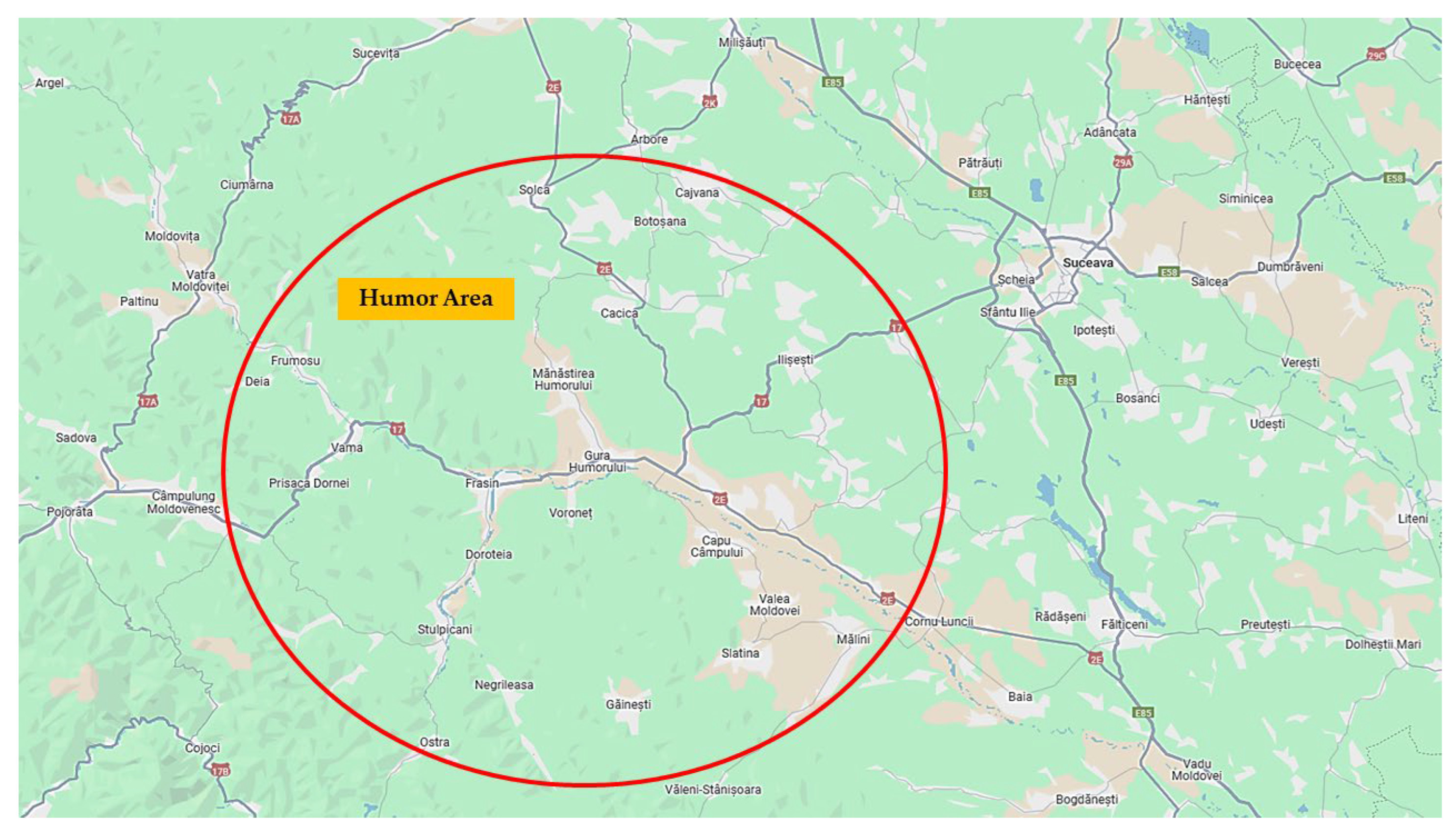
Figure 2.
Câmpulung Moldovenesc Area – place on the map Source: processing after [98].
Figure 2.
Câmpulung Moldovenesc Area – place on the map Source: processing after [98].
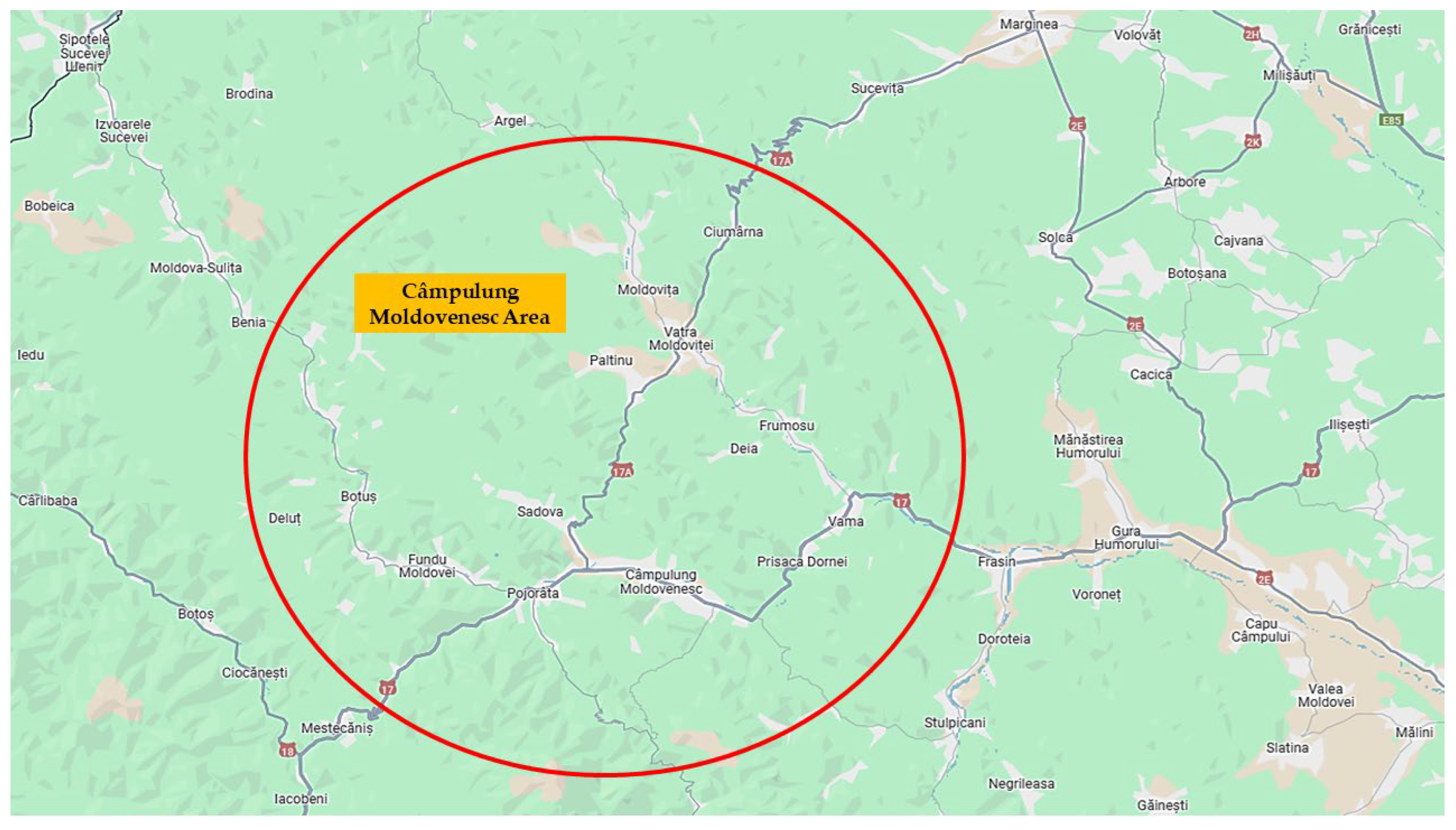
Figure 3.
Dorna Area – place on the map Source: processing after [99].
Figure 3.
Dorna Area – place on the map Source: processing after [99].
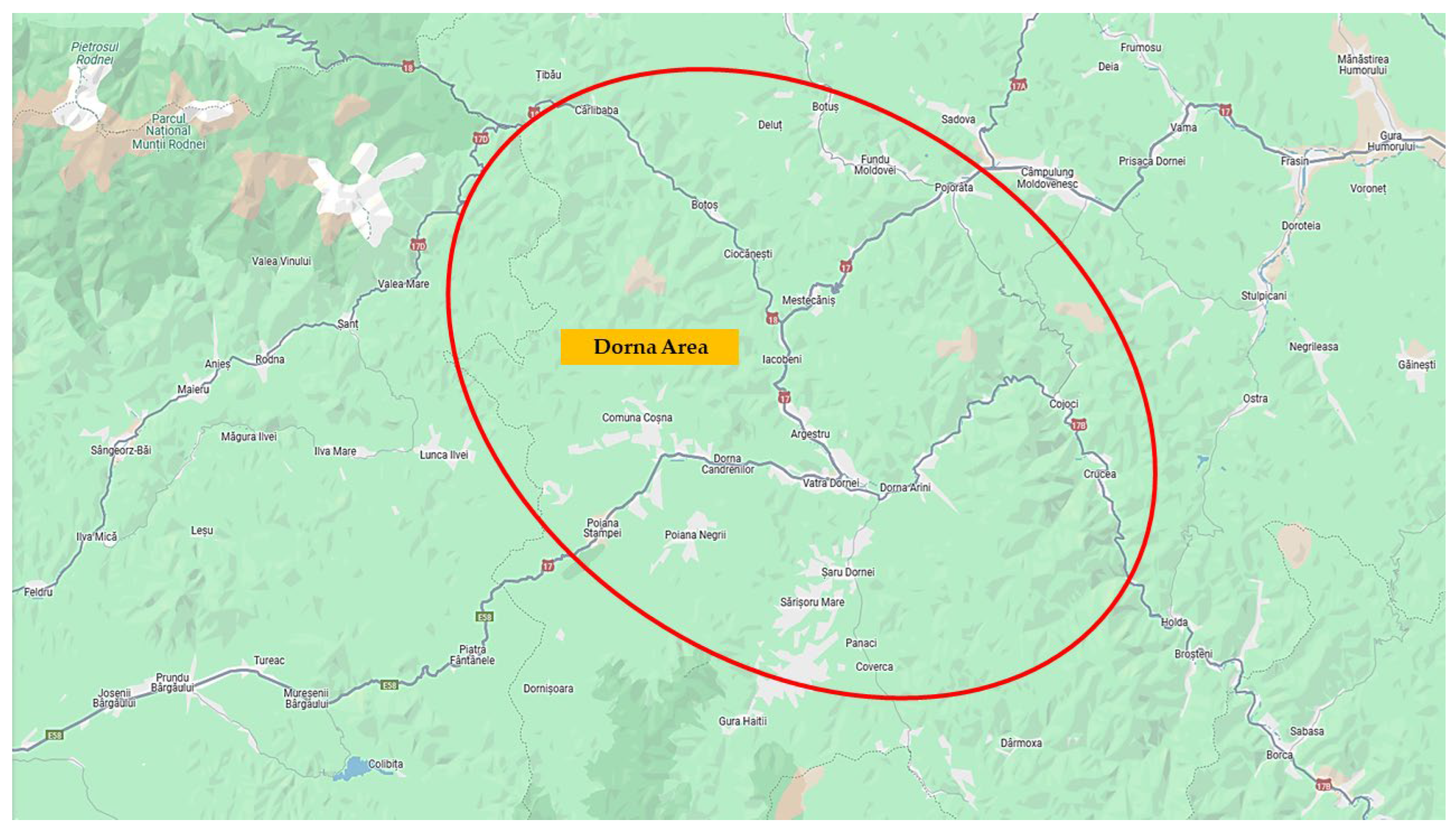
Figure 4.
The dynamics and estimation of the operating accommodation capacity during the period 2014-2028, in the tourist reception structures of the rural localities in the Humor, Câmpulung Moldovenesc, and Dorna Areas, in Suceava County.
Figure 4.
The dynamics and estimation of the operating accommodation capacity during the period 2014-2028, in the tourist reception structures of the rural localities in the Humor, Câmpulung Moldovenesc, and Dorna Areas, in Suceava County.
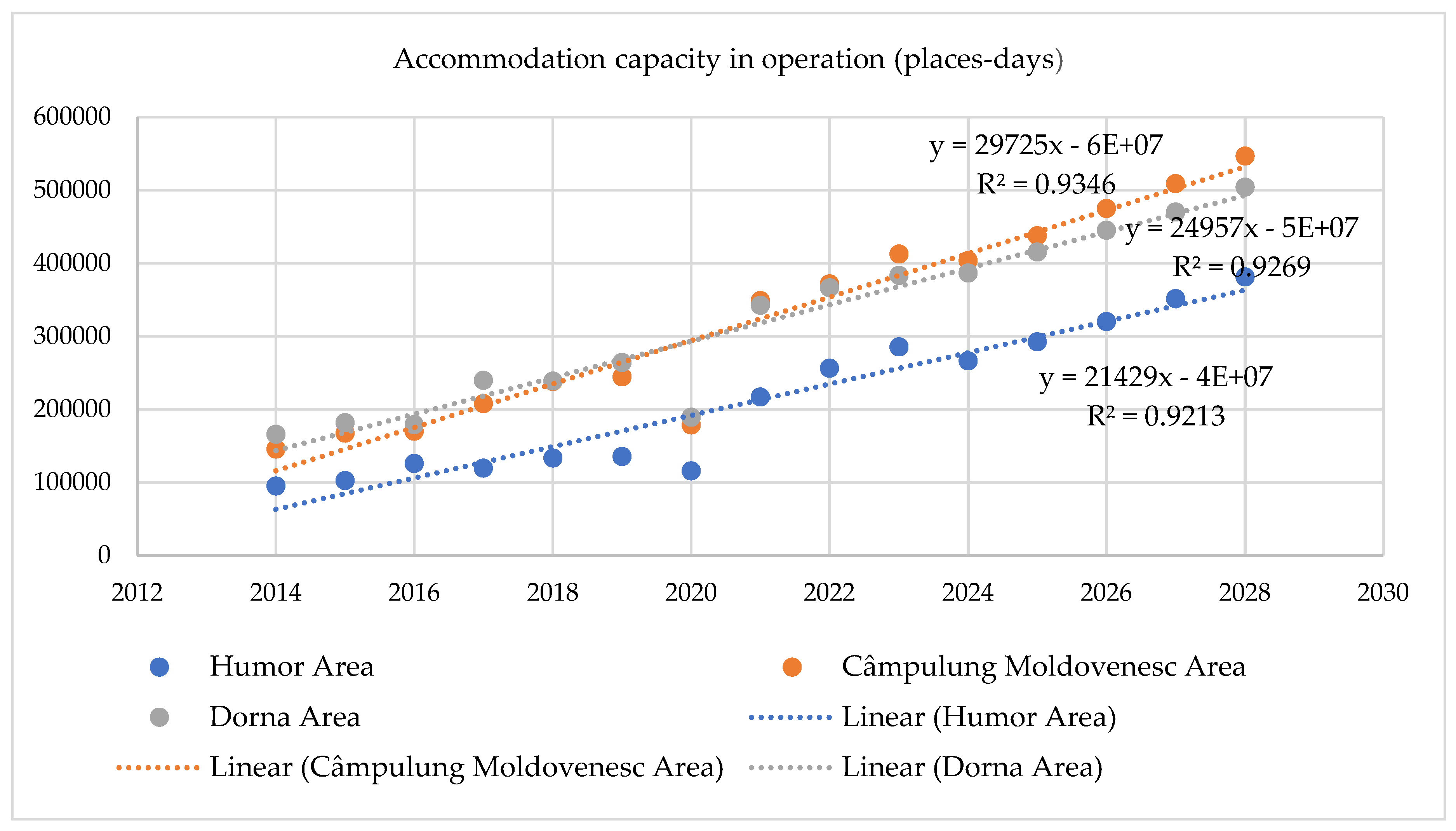
Figure 5.
The dynamics and estimation of arrivals during the period 2014-2028 in the tourist accommodation structures of the rural localities in the Humor, Câmpulung Moldovenesc, and Dorna areas of Suceava County.
Figure 5.
The dynamics and estimation of arrivals during the period 2014-2028 in the tourist accommodation structures of the rural localities in the Humor, Câmpulung Moldovenesc, and Dorna areas of Suceava County.
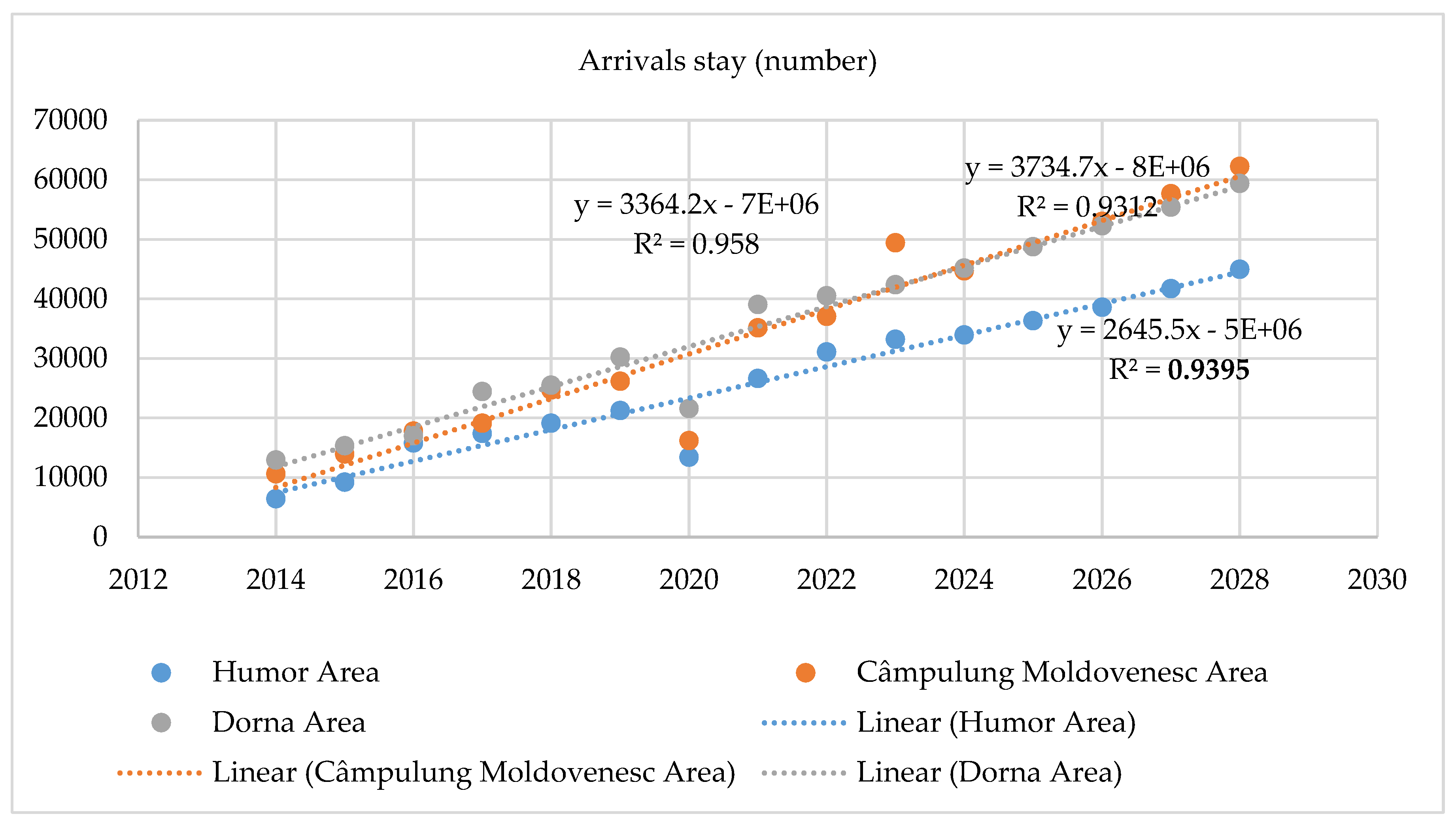
Figure 6.
The dynamics and estimation of overnight stays during the period 2014-2028 in the tourist accommodation structures of the rural localities in the Humor, Câmpulung Moldovenesc, and Dorna areas of Suceava County.
Figure 6.
The dynamics and estimation of overnight stays during the period 2014-2028 in the tourist accommodation structures of the rural localities in the Humor, Câmpulung Moldovenesc, and Dorna areas of Suceava County.
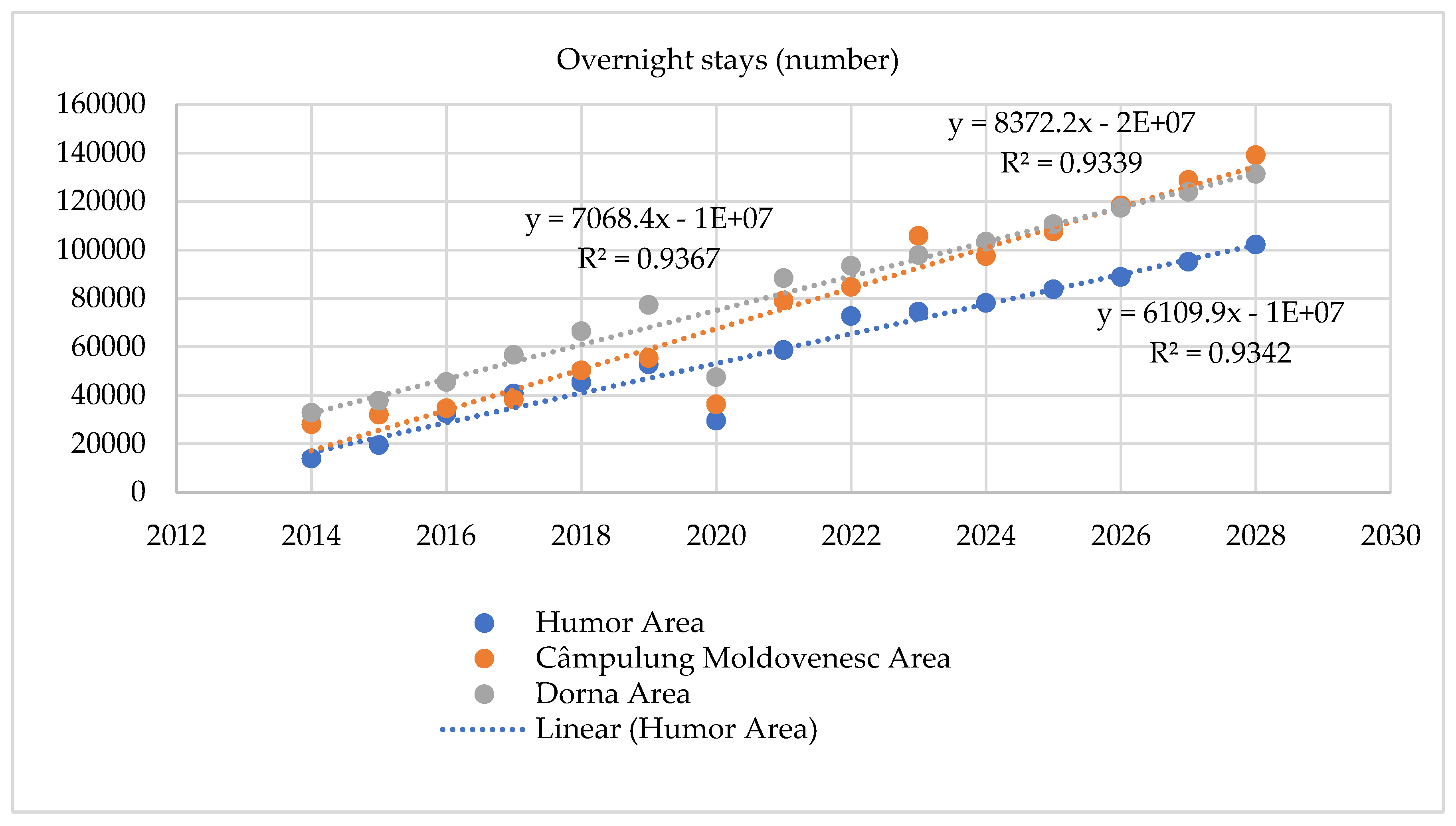
Figure 7.
The dynamics and estimation of the average length of stay during the period 2014-2028 in the tourist accommodation structures of the rural localities in the Humor, Câmpulung Moldovenesc, and Dorna areas of Suceava County.
Figure 7.
The dynamics and estimation of the average length of stay during the period 2014-2028 in the tourist accommodation structures of the rural localities in the Humor, Câmpulung Moldovenesc, and Dorna areas of Suceava County.
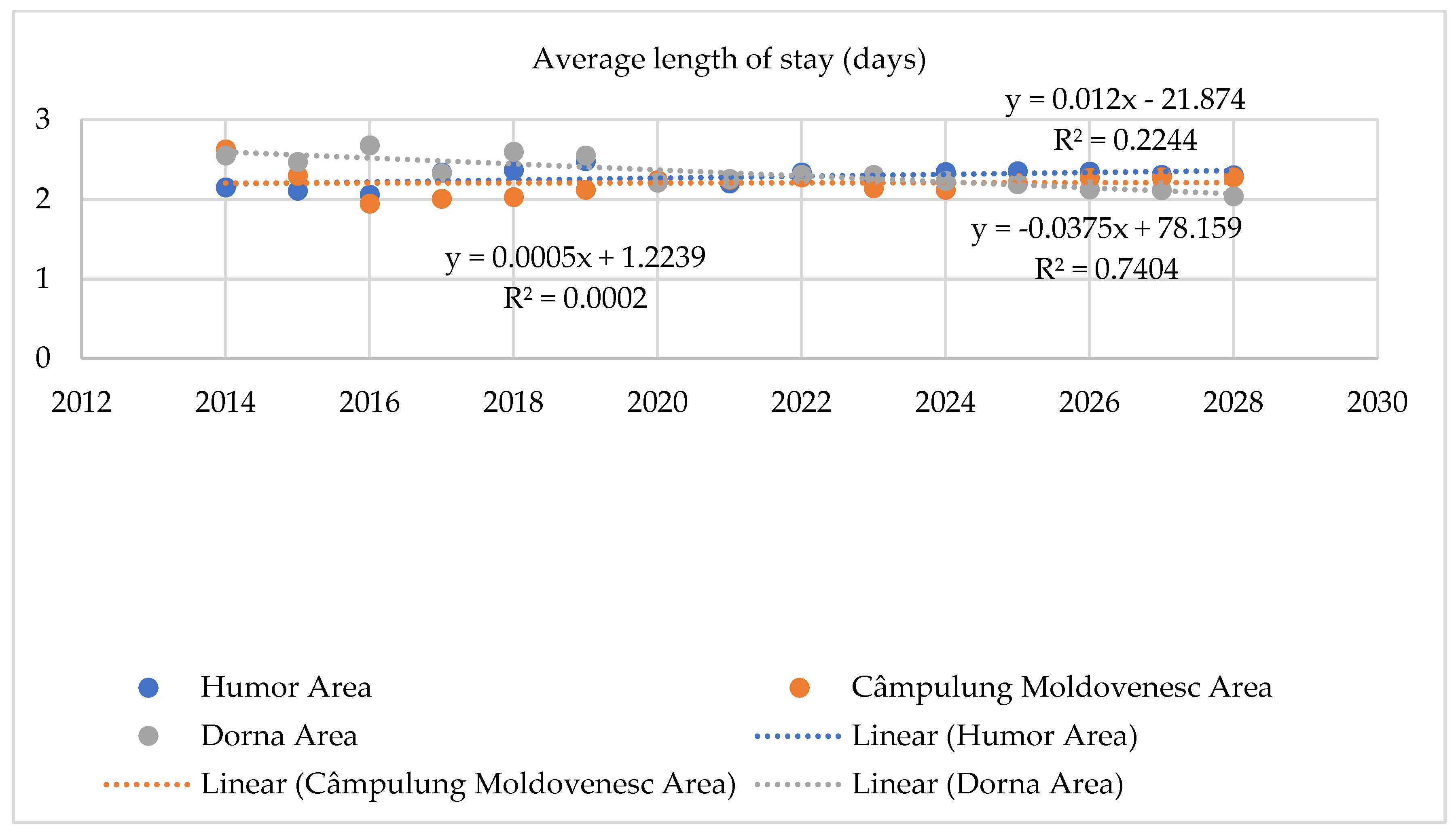

Table 1.
Research steps and objectives of this study.
| Research steps and objectives |
|
|
|
|
|
| ||
Table 2.
The number of tourist accommodation facilities in the rural localities of the Humor Area during the period 2014-2023.
Table 2.
The number of tourist accommodation facilities in the rural localities of the Humor Area during the period 2014-2023.
| Places | Years UM: Number |
|||||||||
|---|---|---|---|---|---|---|---|---|---|---|
| 2014 | 2015 | 2016 | 2017 | 2018 | 2019 | 2020 | 2021 | 2022 | 2023 | |
| Berchisești | : | : | 1 | 1 | 1 | 1 | 1 | 1 | 1 | 1 |
| Cacica | 3 | 3 | 7 | 9 | 8 | 8 | 8 | 14 | 15 | 15 |
| Capu Câmpului | : | : | : | : | : | : | : | 1 | 1 | 1 |
| Ciprian Porumbescu | : | : | : | : | : | : | 1 | 1 | 1 | 1 |
| Ilișești | 1 | 1 | 1 | 1 | 1 | : | : | : | : | : |
| Mănăstirea Humorului | 12 | 14 | 18 | 21 | 20 | 20 | 22 | 30 | 33 | 42 |
| Ostra | 1 | 1 | 1 | 1 | 1 | 1 | 1 | 1 | 1 | 1 |
| Păltinoasa | : | : | : | : | : | : | : | 2 | 2 | 2 |
| Pârtestii de Jos | 2 | 2 | 2 | 2 | 2 | 2 | 3 | 2 | 3 | 4 |
| Poieni-Solca | : | : | : | 1 | 1 | 1 | 1 | 1 | 1 | : |
| Stulpicani | : | : | : | : | : | : | : | 1 | 1 | 2 |
| Todirești | 1 | : | : | : | : | : | : | 1 | : | : |
| Total | 20 | 21 | 30 | 36 | 34 | 33 | 37 | 55 | 59 | 69 |
‘:’ – missing data; Source: insse.ro.
Table 3.
The number of tourist accommodation facilities in the rural localities of the Câmpulung Moldovenesc Area during the period 2014-2023.
Table 3.
The number of tourist accommodation facilities in the rural localities of the Câmpulung Moldovenesc Area during the period 2014-2023.
| Places | Years UM: Number |
|||||||||
|---|---|---|---|---|---|---|---|---|---|---|
| 2014 | 2015 | 2016 | 2017 | 2018 | 2019 | 2020 | 2021 | 2022 | 2023 | |
| Breaza | 1 | 1 | 1 | 2 | 2 | 2 | 2 | 5 | 5 | 3 |
| Frumosu | 1 | 1 | 2 | 2 | 2 | 2 | 2 | 4 | 5 | 6 |
| Fundu Moldovei | 2 | 6 | 6 | 10 | 11 | 12 | 10 | 16 | 17 | 19 |
| Moldova Sulița | : | : | : | 1 | 3 | 2 | 3 | 4 | 4 | 2 |
| Moldovița | 1 | 1 | 2 | 3 | 3 | 2 | 2 | 9 | 7 | 8 |
| Pojorâta | 10 | 8 | 9 | 13 | 13 | 13 | 16 | 30 | 34 | 31 |
| Sadova | 7 | 6 | 7 | 7 | 7 | 7 | 7 | 17 | 17 | 19 |
| Vama | 19 | 18 | 18 | 22 | 24 | 23 | 24 | 31 | 32 | 31 |
| Vatra Moldoviței | 2 | 3 | 3 | 10 | 10 | 11 | 14 | 14 | 15 | 15 |
| Total | 43 | 44 | 48 | 70 | 75 | 74 | 80 | 130 | 136 | 134 |
‘:’ – missing data; Source: insse.ro.
Table 4.
The number of tourist accommodation facilities in the rural localities of the Dorna Area during the period 2014-2023.
Table 4.
The number of tourist accommodation facilities in the rural localities of the Dorna Area during the period 2014-2023.
| Places | Years UM: Number |
|||||||||
|---|---|---|---|---|---|---|---|---|---|---|
| 2014 | 2015 | 2016 | 2017 | 2018 | 2019 | 2020 | 2021 | 2022 | 2023 | |
| Cârlibaba | 2 | 2 | 2 | 2 | 2 | 2 | 1 | 1 | 1 | 1 |
| Ciocănești | 3 | 3 | 5 | 7 | 7 | 8 | 8 | 11 | 11 | 11 |
| Coșna | 1 | 1 | 2 | 3 | 3 | 3 | 3 | 3 | 4 | 4 |
| Crucea | 1 | 2 | 2 | 2 | 2 | 2 | 2 | 3 | 4 | 5 |
| Dorna Candreni | 5 | 5 | 6 | 8 | 8 | 8 | 12 | 16 | 16 | 18 |
| Dorna Arini | 12 | 12 | 13 | 21 | 22 | 22 | 22 | 32 | 35 | 44 |
| Iacobeni | 1 | 1 | 1 | 1 | 1 | 1 | 1 | 1 | 1 | 2 |
| Panaci | 2 | 2 | 3 | 5 | 6 | 6 | 6 | 11 | 12 | 12 |
| Stampa Meadow | 2 | 2 | 2 | 2 | 2 | 2 | 3 | 4 | 3 | 4 |
| Șaru Dornei | 5 | 5 | 7 | 14 | 16 | 16 | 18 | 25 | 27 | 33 |
| Total | 34 | 35 | 43 | 65 | 69 | 70 | 76 | 107 | 114 | 134 |
‘:’ – missing data; Source: insse.ro.
Table 5.
The absolute and relative changes in the operating accommodation capacity in the tourist reception structures of the rural localities in the Humor Area, during the period 2014-2023.
Table 5.
The absolute and relative changes in the operating accommodation capacity in the tourist reception structures of the rural localities in the Humor Area, during the period 2014-2023.
| Years | Accommodation capacity in operation (places-days) |
Absolute changes | Dynamics index (%) |
The rhythm of dynamics (%) |
|||
|---|---|---|---|---|---|---|---|
| ∆t/1 | ∆t/t-1 | It/1 | It/t-1 | Rt/1 | Rt/t-1 | ||
| 2014 | 95128 | - | - | - | - | - | - |
| 2015 | 102594 | 7466 | 7466 | 107.85 | 107.85 | 7.85 | 7.85 |
| 2016 | 125711 | 30583 | 23117 | 132.15 | 122.53 | 32.15 | 22.53 |
| 2017 | 119636 | 24508 | -6075 | 125.76 | 95.17 | 25.76 | -4.83 |
| 2018 | 133109 | 37981 | 13473 | 139.93 | 111.26 | 39.93 | 11.26 |
| 2019 | 135371 | 40243 | 2262 | 142.30 | 101.70 | 42.30 | 1.70 |
| 2020 | 115696 | 20568 | -19675 | 121.62 | 85.47 | 21.62 | -14.53 |
| 2021 | 217053 | 121925 | 101357 | 228.17 | 187.61 | 128.17 | 87.61 |
| 2022 | 256082 | 160954 | 39029 | 269.20 | 117.98 | 169.20 | 17.98 |
| 2023 | 285479 | 190351 | 29397 | 300.10 | 111.48 | 200.10 | 11.48 |
| 158585.9 | 21150.11 | 1.1298 (112.98%) | 12.98% | ||||
∆t/1 – Absolute changes with fixed base; ∆t/t-1 – Absolute changes with chain base; It/1 – Fixed base dynamic index; It/t-1 – Chain base dynamic index; Rt/1 – Fixed base dynamic rate; Rt/t-1 – Chain base dynamic rate; – Average level of the series; – Average level of absolute increase/decrease; – Average dynamic index; – Average rate of increase/decrease; Source: Calculated based on insse.ro.
Table 6.
The absolute and relative changes in the operating accommodation capacity in the tourist reception structures of the rural localities in the Câmpulung Moldovenesc Area, during the period 2014-2023.
Table 6.
The absolute and relative changes in the operating accommodation capacity in the tourist reception structures of the rural localities in the Câmpulung Moldovenesc Area, during the period 2014-2023.
| Years | Accommodation capacity in operation (places-days) |
Absolute changes | Dynamics index (%) |
The rhythm of dynamics (%) |
|||
|---|---|---|---|---|---|---|---|
| ∆t/1 | ∆t/t-1 | It/1 | It/t-1 | Rt/1 | Rt/t-1 | ||
| 2014 | 145702 | - | - | - | - | - | - |
| 2015 | 167473 | 21771 | 21771 | 114.94 | 114.94 | 14.94 | 14.94 |
| 2016 | 170307 | 24605 | 2834 | 116.89 | 101.69 | 16.89 | 1.69 |
| 2017 | 208059 | 62357 | 37752 | 142.80 | 122.17 | 42.80 | 22.17 |
| 2018 | 238184 | 92482 | 30125 | 163.47 | 114.48 | 63.47 | 14.48 |
| 2019 | 244792 | 99090 | 6608 | 168.01 | 102.77 | 68.01 | 2.77 |
| 2020 | 178769 | 33067 | -66023 | 122.69 | 73.03 | 22.69 | -26.97 |
| 2021 | 348930 | 203228 | 170161 | 239.48 | 195.18 | 139.48 | 95.18 |
| 2022 | 371804 | 226102 | 22874 | 255.18 | 106.56 | 155.18 | 6.56 |
| 2023 | 412447 | 266745 | 40643 | 283.08 | 110.93 | 183.08 | 10.93 |
| 2486467 | 29638.33 | 1.1225 (122.25%) | 22.25% | ||||
∆t/1 – Absolute changes with fixed base; ∆t/t-1 – Absolute changes with chain base; It/1 – Fixed base dynamic index; It/t-1 – Chain base dynamic index; Rt/1 – Fixed base dynamic rate; Rt/t-1 – Chain base dynamic rate; – Average level of the series; – Average level of absolute increase/decrease; – Average dynamic index; – Average rate of increase/decrease; Source: Calculated based on insse.ro.
Table 7.
The absolute and relative changes in the operating accommodation capacity in the tourist reception structures of the rural localities in the Dorna Area, during the period 2014-2023.
Table 7.
The absolute and relative changes in the operating accommodation capacity in the tourist reception structures of the rural localities in the Dorna Area, during the period 2014-2023.
| Years | Accommodation capacity in operation (places-days) |
Absolute changes | Dynamics index (%) |
The rhythm of dynamics (%) |
|||
|---|---|---|---|---|---|---|---|
| ∆t/1 | ∆t/t-1 | It/1 | It/t-1 | Rt/1 | Rt/t-1 | ||
| 2014 | 166061 | - | - | - | - | - | - |
| 2015 | 181578 | 15517 | 15517 | 109.34 | 109.34 | 9.34 | 9.34 |
| 2016 | 179047 | 12986 | -2531 | 107.82 | 98.61 | 7.82 | -1.39 |
| 2017 | 239753 | 73692 | 60706 | 144.38 | 133.91 | 44.38 | 33.91 |
| 2018 | 238882 | 72821 | -871 | 143.85 | 99.64 | 43.85 | -0.36 |
| 2019 | 264206 | 98145 | 25324 | 159.10 | 110.60 | 59.10 | 10.60 |
| 2020 | 189129 | 23068 | -75077 | 113.89 | 71.58 | 13.89 | -28.42 |
| 2021 | 342400 | 176339 | 153271 | 206.19 | 181.04 | 106.19 | 81.04 |
| 2022 | 366117 | 200056 | 23717 | 220.47 | 106.93 | 120.47 | 6.93 |
| 2023 | 383444 | 217383 | 17327 | 230.91 | 104.73 | 130.91 | 4.73 |
| 2550617 | 24153.67 | 1.0974 (109.74%) | 9.74% | ||||
∆t/1 – Absolute changes with fixed base; ∆t/t-1 – Absolute changes with chain base; It/1 – Fixed base dynamic index; It/t-1 – Chain base dynamic index; Rt/1 – Fixed base dynamic rate; Rt/t-1 – Chain base dynamic rate; – Average level of the series; Average level of absolute increase/decrease; – Average dynamic index; – Average rate of increase/decrease; Source: Calculated based on insse.ro.
Table 8.
The estimation of the operating accommodation capacity during the period 2024–2028, in the tourist reception structures of the rural localities in the Humor, Câmpulung Moldovenesc, and Dorna Areas, in Suceava County.
Table 8.
The estimation of the operating accommodation capacity during the period 2024–2028, in the tourist reception structures of the rural localities in the Humor, Câmpulung Moldovenesc, and Dorna Areas, in Suceava County.
| Years | T(x) | Humor Area y = 21429x - 4E + 07 |
Câmpulung Moldovenesc Area y = 29725x - 6E + 06 |
Dorna Area y = 24957x - 5E + 07 |
|---|---|---|---|---|
| 2024 | 11 | 266410.13 | 403409.2 | 386342.93 |
| 2025 | 12 | 292617.72 | 437862.3 | 415121.90 |
| 2026 | 13 | 319880.46 | 474721.7 | 444864.87 |
| 2027 | 14 | 351544.60 | 509054.7 | 470260.50 |
| 2028 | 15 | 381309.75 | 546893.8 | 504281.45 |
Table 9.
The net utilization rate of the operating accommodation capacity in the tourist reception structures of the rural localities in the Humor, Câmpulung Moldovenesc, and Dorna areas of Suceava County, during the period 2014-2023.
Table 9.
The net utilization rate of the operating accommodation capacity in the tourist reception structures of the rural localities in the Humor, Câmpulung Moldovenesc, and Dorna areas of Suceava County, during the period 2014-2023.
| Years | Index of net utilization of accommodation capacity (%) | ||
|---|---|---|---|
| Humor Area | Câmpulung Moldovenesc Area | Dorna Area | |
| 2014 | 14.62 | 19.27 | 19.82 |
| 2015 | 18.99 | 19.11 | 20.87 |
| 2016 | 25.89 | 20.41 | 25.44 |
| 2017 | 34.05 | 18.45 | 23.71 |
| 2018 | 34.11 | 21.11 | 27.81 |
| 2019 | 38.98 | 22.64 | 29.25 |
| 2020 | 25.64 | 20.35 | 25.16 |
| 2021 | 27.04 | 22.68 | 25.80 |
| 2022 | 28.40 | 22.78 | 25.55 |
| 2023 | 26.11 | 25.68 | 25.53 |
Source: Calculated based on insse.ro.
Table 10.
The absolute and relative changes in arrivals at tourist accommodation structures in the rural localities of the Humor area during the period 2014-2023.
Table 10.
The absolute and relative changes in arrivals at tourist accommodation structures in the rural localities of the Humor area during the period 2014-2023.
| Years | Arrivals (number of persons) |
Absolute changes | Dynamics index (%) | The rhythm of dynamics (%) | |||
|---|---|---|---|---|---|---|---|
| ∆t/1 | ∆t/t-1 | It/1 | It/t-1 | Rt/1 | Rt/t-1 | ||
| 2014 | 6482 | - | - | - | - | - | - |
| 2015 | 9224 | 2742 | 2742 | 142.30 | 142.30 | 42.30 | 42.30 |
| 2016 | 15823 | 9341 | 6599 | 244.10 | 171.54 | 144.10 | 71.54 |
| 2017 | 17434 | 10952 | 1611 | 268.96 | 110.18 | 168.96 | 10.18 |
| 2018 | 19162 | 12680 | 1728 | 295.61 | 109.91 | 195.61 | 9.91 |
| 2019 | 21271 | 14789 | 2109 | 328.15 | 111.00 | 228.15 | 11.00 |
| 2020 | 13420 | 6938 | -7851 | 207.03 | 63.09 | 107.03 | -36.90 |
| 2021 | 26640 | 20158 | 13220 | 410.98 | 198.50 | 310.98 | 98.50 |
| 2022 | 31115 | 24633 | 4475 | 480.02 | 116.79 | 380.02 | 16.79 |
| 2023 | 33213 | 26731 | 2098 | 512.38 | 106.74 | 412.38 | 6.74 |
| 19378.4 | 2970.11 | 1.1990 (119.90%) | 19.90% | ||||
∆t/1 – Absolute changes with fixed base; ∆t/t-1 – Absolute changes with chain base; It/1 – Fixed base dynamic index; It/t-1 – Chain base dynamic index; Rt/1 – Fixed base dynamic rate; Rt/t-1 – Chain base dynamic rate; – Average level of the series; – Average level of absolute increase/decrease; – Average dynamic index; –Average rate of increase/decrease; Source: Calculated based on insse.ro.
Table 11.
The absolute and relative changes in arrivals at tourist accommodation structures in the rural localities of the Câmpulung Moldovenesc area during the period 2014-2023.
Table 11.
The absolute and relative changes in arrivals at tourist accommodation structures in the rural localities of the Câmpulung Moldovenesc area during the period 2014-2023.
| Years | Arrivals (number of persons) |
Absolute changes | Dynamics index (%) | The rhythm of dynamics (%) | |||
|---|---|---|---|---|---|---|---|
| ∆t/1 | ∆t/t-1 | It/1 | It/t-1 | Rt/1 | Rt/t-1 | ||
| 2014 | 10665 | - | - | - | - | - | - |
| 2015 | 13946 | 3281 | 3281 | 130.76 | 130.76 | 30.76 | 30.76 |
| 2016 | 17829 | 7164 | 3883 | 167.17 | 127.84 | 67.17 | 27.84 |
| 2017 | 19143 | 8478 | 1314 | 179.49 | 107.37 | 79.49 | 7.37 |
| 2018 | 24706 | 14041 | 5563 | 231.65 | 129.06 | 131.65 | 29.06 |
| 2019 | 26176 | 15511 | 1470 | 245.44 | 105.95 | 145.44 | 5.95 |
| 2020 | 16247 | 5582 | -9929 | 152.34 | 62.07 | 52.34 | -37.93 |
| 2021 | 35149 | 24484 | 18902 | 329.57 | 216.34 | 229.57 | 116.34 |
| 2022 | 37116 | 26451 | 1967 | 348.02 | 105.60 | 248.02 | 5.60 |
| 2023 | 49443 | 38778 | 12327 | 463.60 | 133.21 | 363.60 | 33.21 |
| 25042 | 4308.67 | 1.1858 (118.58%) | 18.58% | ||||
∆t/1 – Absolute changes with fixed base; ∆t/t-1 – Absolute changes with chain base; It/1 – Fixed base dynamic index; It/t-1 – Chain base dynamic index; Rt/1 – Fixed base dynamic rate; Rt/t-1 – Chain base dynamic rate; – Average level of the series;– Average level of absolute increase/decrease; – Average dynamic index; – Average rate of increase/decrease; Source: Calculated based on insse.ro.
Table 12.
The absolute and relative changes in arrivals at tourist accommodation structures in the rural localities of the Dorna area during the period 2014-2023.
Table 12.
The absolute and relative changes in arrivals at tourist accommodation structures in the rural localities of the Dorna area during the period 2014-2023.
| Years | Arrivals (number of persons) |
Absolute changes | Dynamics index (%) | The rhythm of dynamics (%) | |||
|---|---|---|---|---|---|---|---|
| ∆t/1 | ∆t/t-1 | It/1 | It/t-1 | Rt/1 | Rt/t-1 | ||
| 2014 | 12933 | - | - | - | - | - | - |
| 2015 | 15337 | 2404 | 2404 | 118.59 | 118.59 | 18.59 | 18.59 |
| 2016 | 17011 | 4078 | 1674 | 131.53 | 110.91 | 31.53 | 10.91 |
| 2017 | 24428 | 11495 | 7417 | 188.88 | 143.60 | 88.88 | 43.60 |
| 2018 | 25508 | 12575 | 1080 | 197.23 | 104.42 | 97.23 | 4.42 |
| 2019 | 30259 | 17326 | 4751 | 233.97 | 118.63 | 133.97 | 18.63 |
| 2020 | 21573 | 8640 | -8686 | 166.81 | 71.29 | 66.81 | -28.71 |
| 2021 | 39096 | 26163 | 17523 | 302.30 | 181.23 | 202.30 | 81.23 |
| 2022 | 40553 | 27620 | 1457 | 313.56 | 103.73 | 213.56 | 3.73 |
| 2023 | 42409 | 29476 | 1856 | 327.91 | 104.58 | 227.91 | 4.58 |
| 26910.7 | 3275.11 | 1.1410 (114.10%) | 14.10% | ||||
∆t/1 – Absolute changes with fixed base; ∆t/t-1 – Absolute changes with chain base; It/1 – Fixed base dynamic index; It/t-1 – Chain base dynamic index; Rt/1 – Fixed base dynamic rate; Rt/t-1 – Chain base dynamic rate; – Average level of the series; – Average level of absolute increase/decrease; – Average dynamic index; – Average rate of increase/decrease; Source: Calculated based on insse.ro.
Table 13.
The estimation of arrivals during the period 2024-2028 in the tourist accommodation structures of the rural localities in the Humor, Câmpulung Moldovenesc, and Dorna areas of Suceava County.
Table 13.
The estimation of arrivals during the period 2024-2028 in the tourist accommodation structures of the rural localities in the Humor, Câmpulung Moldovenesc, and Dorna areas of Suceava County.
| Years | T(x) | Humor Area y = 0.012x – 21.874 |
Câmpulung Moldovenesc Area y = 0.0005x + 1.2239 |
Dorna Area y = -0.0375x + 78.159 |
|---|---|---|---|---|
| 2024 | 11 | 33977.33 | 44727.80 | 45190.93 |
| 2025 | 12 | 36377.87 | 48768.25 | 48775.64 |
| 2026 | 13 | 38636.79 | 53028.97 | 52284.77 |
| 2027 | 14 | 41748.76 | 57707.95 | 55414.7 |
| 2028 | 15 | 45014.20 | 62262.26 | 59422.89 |
Table 14.
The absolute and relative changes in overnight stays at tourist accommodation structures in the rural localities of the Humor area during the period 2014-2023.
Table 14.
The absolute and relative changes in overnight stays at tourist accommodation structures in the rural localities of the Humor area during the period 2014-2023.
| Years | Overnight stays (number) |
Absolute changes | Dynamics index (%) | The rhythm of dynamics (%) | |||
|---|---|---|---|---|---|---|---|
| ∆t/1 | ∆t/t-1 | It/1 | It/t-1 | Rt/1 | Rt/t-1 | ||
| 2014 | 13904 | - | - | - | - | - | - |
| 2015 | 19482 | 5578 | 5578 | 140.12 | 140.12 | 40.12 | 40.12 |
| 2016 | 32545 | 18641 | 13063 | 234.07 | 167.05 | 134.07 | 67.05 |
| 2017 | 40731 | 26827 | 8186 | 292.94 | 125.15 | 192.94 | 25.15 |
| 2018 | 45401 | 31497 | 4670 | 326.53 | 111.47 | 226.53 | 11.47 |
| 2019 | 52771 | 38867 | 7370 | 379.54 | 116.23 | 279.54 | 16.23 |
| 2020 | 29665 | 15761 | -23106 | 213.36 | 56.21 | 113.36 | -43.79 |
| 2021 | 58696 | 44792 | 29031 | 422.15 | 197.86 | 322.15 | 97.86 |
| 2022 | 72730 | 58826 | 14034 | 523.09 | 123.91 | 423.09 | 23.91 |
| 2023 | 74534 | 60630 | 1804 | 536.06 | 102.48 | 436.06 | 2.48 |
| 44045.9 | 6736.67 | 1.2050 (120.50%) | 20.50% | ||||
∆t/1 – Absolute changes with fixed base; ∆t/t-1 – Absolute changes with chain base; It/1 – Fixed base dynamic index; It/t-1 – Chain base dynamic index; Rt/1 – Fixed base dynamic rate; Rt/t-1 – Chain base dynamic rate; – Average level of the series; – Average level of absolute increase/decrease; – Average dynamic index; – Average rate of increase/decrease Source: Calculated based on insse.ro.
Table 15.
The absolute and relative changes in overnight stays at tourist accommodation structures in the rural localities of the Câmpulung Moldovenesc area during the period 2014-2023.
Table 15.
The absolute and relative changes in overnight stays at tourist accommodation structures in the rural localities of the Câmpulung Moldovenesc area during the period 2014-2023.
| Years | Overnight stays (number) |
Absolute changes | Dynamics index (%) | The rhythm of dynamics (%) | |||
|---|---|---|---|---|---|---|---|
| ∆t/1 | ∆t/t-1 | It/1 | It/t-1 | Rt/1 | Rt/t-1 | ||
| 2014 | 28076 | - | - | - | - | - | - |
| 2015 | 32012 | 3936 | 3936 | 114.02 | 114.02 | 14.02 | 14.02 |
| 2016 | 34761 | 6685 | 2749 | 123.81 | 108.59 | 23.81 | 8.59 |
| 2017 | 38389 | 10313 | 3628 | 136.73 | 110.44 | 36.73 | 10.44 |
| 2018 | 50272 | 22196 | 11883 | 179.06 | 130.95 | 79.06 | 30.95 |
| 2019 | 55417 | 27341 | 5145 | 197.38 | 110.23 | 97.38 | 10.23 |
| 2020 | 36379 | 8303 | -19038 | 129.57 | 65.65 | 29.57 | -34.35 |
| 2021 | 79122 | 51046 | 42743 | 281.81 | 217.49 | 181.81 | 117.49 |
| 2022 | 84694 | 56618 | 5572 | 301.66 | 107.04 | 201.66 | 7.04 |
| 2023 | 105908 | 77832 | 21214 | 377.22 | 125.05 | 277.22 | 25.05 |
| 54503 | 77832 | 1.1589 (115.89%) | 15.89% | ||||
∆t/1 – Absolute changes with fixed base; ∆t/t-1 – Absolute changes with chain base; It/1 – Fixed base dynamic index; It/t-1 – Chain base dynamic index; Rt/1 – Fixed base dynamic rate; Rt/t-1 – Chain base dynamic rate; – Average level of the series; – Average level of absolute increase/decrease; – Average dynamic index; – Average rate of increase/decrease; Source: Calculated based on insse.ro.
Table 16.
The absolute and relative changes in overnight stays at tourist accommodation structures in the rural localities of the Dorna area during the period 2014-2023.
Table 16.
The absolute and relative changes in overnight stays at tourist accommodation structures in the rural localities of the Dorna area during the period 2014-2023.
| Years | Overnight stays (number) |
Absolute changes | Dynamics index (%) | The rhythm of dynamics (%) | |||
|---|---|---|---|---|---|---|---|
| ∆t/1 | ∆t/t-1 | It/1 | It/t-1 | Rt/1 | Rt/t-1 | ||
| 2014 | 32920 | - | - | - | - | - | - |
| 2015 | 37892 | 4972 | 4972 | 115.10 | 115.10 | 15.10 | 15.10 |
| 2016 | 45544 | 12624 | 7652 | 138.35 | 120.19 | 38.35 | 20.19 |
| 2017 | 56846 | 23926 | 11302 | 172.68 | 124.82 | 72.68 | 24.82 |
| 2018 | 66434 | 33514 | 9588 | 201.80 | 116.87 | 101.80 | 16.87 |
| 2019 | 77286 | 44366 | 10852 | 234.77 | 116.34 | 134.77 | 16.34 |
| 2020 | 47579 | 14659 | -29707 | 144.53 | 61.56 | 44.53 | -38.44 |
| 2021 | 88324 | 55404 | 40745 | 268.30 | 185.64 | 168.30 | 85.64 |
| 2022 | 93536 | 60616 | 5212 | 284.13 | 105.90 | 184.13 | 5.90 |
| 2023 | 97877 | 64957 | 4341 | 297.32 | 104.64 | 197.32 | 4.64 |
| 64423.8 | 7217.44 | 1.1287 (112.87%) | 12.87% | ||||
∆t/1 – Absolute changes with fixed base; ∆t/t-1 – Absolute changes with chain base; It/1 – Fixed base dynamic index; It/t-1 – Chain base dynamic index; Rt/1 – Fixed base dynamic rate; Rt/t-1 – Chain base dynamic rate; – Average level of the series; – Average level of absolute increase/decrease; – Average dynamic index; – Average rate of increase/decrease; Source: Calculated based on insse.ro.
Table 17.
The estimation of overnight stays during the period 2024-2028 in the tourist accommodation structures of the rural localities in the Humor, Câmpulung Moldovenesc, and Dorna areas of Suceava County.
Table 17.
The estimation of overnight stays during the period 2024-2028 in the tourist accommodation structures of the rural localities in the Humor, Câmpulung Moldovenesc, and Dorna areas of Suceava County.
| Years | T(x) | Humor Area y = 6109.9x – 1E + 07 |
Câmpulung Moldovenesc Area y = 8372.2x - 2E + 07 |
Dorna Area y = 7068.4x - 1E + 07 |
|---|---|---|---|---|
| 2024 | 11 | 78157 | 97509.07 | 103459.53 |
| 2025 | 12 | 83763.6 | 107664.3 | 110672.81 |
| 2026 | 13 | 88816.77 | 118302.3 | 117394.64 |
| 2027 | 14 | 95089.24 | 128885.2 | 123993.67 |
| 2028 | 15 | 102302.18 | 139099.2 | 131456.13 |
Table 18.
The average length of stay, during the period 2014-2023, in the tourist accommodation structures of the rural localities in the Humor, Câmpulung Moldovenesc, and Dorna areas of Suceava County.
Table 18.
The average length of stay, during the period 2014-2023, in the tourist accommodation structures of the rural localities in the Humor, Câmpulung Moldovenesc, and Dorna areas of Suceava County.
| Years | DMS (days) | ||
|---|---|---|---|
| Humor Area | Câmpulung Moldovenesc Area | Dorna Area | |
| 2014 | 2.15 | 2.63 | 2.55 |
| 2015 | 2.11 | 2.30 | 2.47 |
| 2016 | 2.06 | 1.95 | 2.68 |
| 2017 | 2.34 | 2.01 | 2.33 |
| 2018 | 2.37 | 2.03 | 2.60 |
| 2019 | 2.48 | 2.12 | 2.55 |
| 2020 | 2.21 | 2.24 | 2.21 |
| 2021 | 2.20 | 2.25 | 2.26 |
| 2022 | 2.34 | 2.28 | 2.31 |
| 2023 | 2.24 | 2.14 | 2.31 |
DMS – Average length of stay; Source: Calculated based on insse.ro.
Table 19.
The absolute and relative changes in the average length of stay at tourist accommodation structures in the rural localities of the Humor area during the period 2014-2023.
Table 19.
The absolute and relative changes in the average length of stay at tourist accommodation structures in the rural localities of the Humor area during the period 2014-2023.
| Years | DMS (days) |
Absolute changes | Dynamics index (%) | The rhythm of dynamics (%) | |||
|---|---|---|---|---|---|---|---|
| ∆t/1 | ∆t/t-1 | It/1 | It/t-1 | Rt/1 | Rt/t-1 | ||
| 2014 | 2.15 | - | - | - | - | - | - |
| 2015 | 2.11 | -0.04 | -0.04 | 98.14 | 98.14 | -1.86 | -1.86 |
| 2016 | 2.06 | -0.09 | -0.05 | 95.81 | 97.63 | -4.19 | -2.37 |
| 2017 | 2.34 | 0.19 | 0.28 | 108.84 | 113.59 | 8.84 | 13.59 |
| 2018 | 2.37 | 0.22 | 0.03 | 110.23 | 101.28 | 10.23 | 1.28 |
| 2019 | 2.48 | 0.33 | 0.11 | 115.35 | 104.64 | 15.35 | 4.64 |
| 2020 | 2.21 | 0.06 | -0.27 | 102.79 | 89.11 | 2.79 | -10.89 |
| 2021 | 2.20 | 0.05 | -0.01 | 102.33 | 99.55 | 2.33 | -0.45 |
| 2022 | 2.34 | 0.19 | 0.14 | 108.84 | 106.36 | 8.84 | 6.36 |
| 2023 | 2.24 | 0.09 | -0.1 | 104.19 | 95.73 | 4.19 | -4.27 |
| 2.25 | 0.01 | 1.0045 (100.45%) | 0.45% | ||||
DMS – Average length of stay; ∆t/1 – Absolute changes with fixed base; ∆t/t-1 – Absolute changes with chain base; It/1 – Fixed base dynamic index; It/t-1 – Chain base dynamic index; Rt/1 – Fixed base dynamic rate; Rt/t-1 – Chain base dynamic rate; – Average level of the series; – Average level of absolute increase/decrease; – Average dynamic index; – Average rate of increase/decrease.
Table 20.
The absolute and relative changes in the average length of stay at tourist accommodation structures in the rural localities of the Câmpulung Moldovenesc area during the period 2014-2023.
Table 20.
The absolute and relative changes in the average length of stay at tourist accommodation structures in the rural localities of the Câmpulung Moldovenesc area during the period 2014-2023.
| Years | DMS (days) |
Absolute changes | Dynamics index (%) | The rhythm of dynamics (%) | |||
|---|---|---|---|---|---|---|---|
| ∆t/1 | ∆t/t-1 | It/1 | It/t-1 | Rt/1 | Rt/t-1 | ||
| 2014 | 2.63 | - | - | - | - | - | - |
| 2015 | 2.30 | -0.33 | -0.33 | 87.45 | 87.45 | -12.55 | -12.55 |
| 2016 | 1.95 | -0.68 | -0.35 | 74.14 | 84.78 | -25.86 | -15.22 |
| 2017 | 2.01 | -0.62 | 0.06 | 76.43 | 103.08 | -23.57 | 3.08 |
| 2018 | 2.03 | -0.6 | 0.02 | 77.19 | 101.00 | -22.81 | 1.00 |
| 2019 | 2.12 | -0.51 | 0.09 | 80.61 | 104.43 | -19.39 | 4.43 |
| 2020 | 2.24 | -0.39 | 0.12 | 85.17 | 105.66 | -14.83 | 5.66 |
| 2021 | 2.25 | -0.38 | 0.01 | 85.55 | 100.45 | -14.45 | 0.45 |
| 2022 | 2.28 | -0.35 | 0.03 | 86.69 | 101.33 | -13.31 | 1.33 |
| 2023 | 2.14 | -0.49 | -0.14 | 81.37 | 93.86 | -18.63 | -6.14 |
| 2.20 | -0.05 | 0.9773 (97.73%) | -2.27% | ||||
DMS – Average length of stay; ∆t/1 – Absolute changes with fixed base; ∆t/t-1 – Absolute changes with chain base; It/1 – Fixed base dynamic index; It/t-1 – Chain base dynamic index; Rt/1 – Fixed base dynamic rate; Rt/t-1 – Chain base dynamic rate; – Average level of the series; – Average level of absolute increase/decrease; – Average dynamic index; – Average rate of increase/decrease.
Table 21.
The absolute and relative changes in the average length of stay at tourist accommodation structures in the rural localities of the Dorna area during the period 2014-2023.
Table 21.
The absolute and relative changes in the average length of stay at tourist accommodation structures in the rural localities of the Dorna area during the period 2014-2023.
| Years | DMS (days) |
Absolute changes | Dynamics index (%) | The rhythm of dynamics (%) | |||
|---|---|---|---|---|---|---|---|
| ∆t/1 | ∆t/t-1 | It/1 | It/t-1 | Rt/1 | Rt/t-1 | ||
| 2014 | 2.55 | - | - | - | - | - | - |
| 2015 | 2.47 | -0.08 | -0.08 | 96.86 | 96.86 | -3.14 | -3.14 |
| 2016 | 2.68 | 0.13 | 0.21 | 105.10 | 108.50 | 5.10 | 8.50 |
| 2017 | 2.33 | -0.22 | -0.35 | 91.37 | 86.94 | -8.63 | -13.06 |
| 2018 | 2.60 | 0.05 | 0.27 | 101.96 | 111.59 | 1.96 | 11.59 |
| 2019 | 2.55 | 0 | -0.05 | 100.00 | 98.08 | 0.00 | -1.92 |
| 2020 | 2.21 | -0.34 | -0.34 | 86.67 | 86.67 | -13.33 | -13.33 |
| 2021 | 2.26 | -0.29 | 0.05 | 88.63 | 102.26 | -11.37 | 2.26 |
| 2022 | 2.31 | -0.24 | 0.05 | 90.59 | 102.21 | -9.41 | 2.21 |
| 2023 | 2.31 | -0.24 | 0 | 90.59 | 100.00 | -9.41 | 0.00 |
| 2.43 | 0.03 | 0.9890 (98.90%) | -1.1% | ||||
DMS – Average length of stay; ∆t/1 – Absolute changes with fixed base; ∆t/t-1 – Absolute changes with chain base; It/1 – Fixed base dynamic index; It/t-1 – Chain base dynamic index; Rt/1 – Fixed base dynamic rate; Rt/t-1 – Chain base dynamic rate; – Average level of the series; – Average level of absolute increase/decrease; – Average dynamic index; – Average rate of increase/decrease.
Table 22.
The estimation of the average length of stay during the period 2024-2028 in the tourist accommodation structures of the rural localities in the Humor, Câmpulung Moldovenesc, and Dorna areas of Suceava County.
Table 22.
The estimation of the average length of stay during the period 2024-2028 in the tourist accommodation structures of the rural localities in the Humor, Câmpulung Moldovenesc, and Dorna areas of Suceava County.
| Years | T(x) | Humor Area y = 6109.9x – 1E + 07 |
Câmpulung Moldovenesc Area y = 8372.2x - 2E + 07 |
Dorna Area y = 7068.4x - 1E + 07 |
|---|---|---|---|---|
| 2024 | 11 | 2.34 | 2.12 | 2.23 |
| 2025 | 12 | 2.36 | 2.21 | 2.19 |
| 2026 | 13 | 2.35 | 2.27 | 2.13 |
| 2027 | 14 | 2.31 | 2.28 | 2.11 |
| 2028 | 15 | 2.31 | 2.28 | 2.04 |
Disclaimer/Publisher’s Note: The statements, opinions and data contained in all publications are solely those of the individual author(s) and contributor(s) and not of MDPI and/or the editor(s). MDPI and/or the editor(s) disclaim responsibility for any injury to people or property resulting from any ideas, methods, instructions or products referred to in the content. |
© 2025 by the authors. Licensee MDPI, Basel, Switzerland. This article is an open access article distributed under the terms and conditions of the Creative Commons Attribution (CC BY) license (http://creativecommons.org/licenses/by/4.0/).
Copyright: This open access article is published under a Creative Commons CC BY 4.0 license, which permit the free download, distribution, and reuse, provided that the author and preprint are cited in any reuse.


