
Submitted:
18 August 2025
Posted:
22 August 2025
You are already at the latest version
Abstract
This paper presents a new physical framework to resolve the apparent non-unitarity of a proposed non-linear Schrödinger equation that models the universe as a process of "quantum compression of non-events". We unify three strategies—pseudo-Hermiticity, holographic projection, and quantum field theory on a Nariai background—by re-conceptualizing the Nariai spacetime not as a distant cosmological limit, but as a foundational, computational boundary within our quantum formalism. We derive an emergent three-dimensional temporal structure from the hierarchical, iterative generation of an aperiodic tiling on this Nariai surface. The intrinsic parity of the tiling's topological features provides a geometric origin for the chiral asymmetry of the weak force. Furthermore, we derive the gauge symmetries of the Standard Model by establishing a direct correspondence between the topological invariants of knots and links, as quantified by Khovanov homology, and the Wilson loop observables of U(1), SU(2), and SU(3) gauge theories. The result is a unified framework where spacetime, fundamental forces, and particle properties emerge from the topological dynamics of information compression on a network of internal, holographic Markov blankets.
Keywords:
Planck-scale
; Nariai
; aperiodic Einstein-Tile
; Khovanov-homology
; pseudo-Hermiticity
; quantum-gravity
1. Introduction: The Quantum Compression of Non-Events
This paper extends the framework of "quantum
compression of non-events" and to
address a central challenge: reconciling the apparent non-unitary nature of our
proposed non-linear Schrödinger equation with fundamental principles of quantum
mechanics.
The standard Schrödinger equation, with its unitary
time evolution, successfully describes the behavior of quantum systems in
isolation. However, in the context of a dynamically evolving universe, we have
argued that this framework is incomplete. In our previous work we introduced a
non-linear Schrödinger equation that incorporates a "compression
operator" (Ĉ) to account for the irreversible solidification of the past
through the elimination of unactualized possibilities, or "non-events."
This non-unitary evolution, while providing an arrow of time, presents a direct
challenge to the conservation of probability. This first part outlines three
potential resolutions, all of which hinge on a re-examination of the roles of
time, space, and the ultimate cosmological limit embodied by the Nariai black
hole.
PART I
2. Strategy 1: Pseudo-Hermiticity and the Nariai Metric
The first and most direct strategy for restoring
unitarity involves the concept of pseudo-Hermiticity, which seeks to find a
deeper mathematical structure within the Hilbert space where probability
remains conserved. We begin with our proposed non-linear Schrödinger equation,
where the non-Hermitian part of the Hamiltonian, H, stems from the
"compression operator" (Ĉ) that drives the irreversible elimination
of non-events. The core idea of pseudo-Hermiticity is to introduce a
non-trivial, positive-definite metric operator, η, to redefine the inner
product of the Hilbert space. This new inner product, ⟨ψ∣ϕ⟩η=⟨ψ∣η∣ϕ⟩, is what allows for the conservation of
probability. For our system, the evolution operator will be unitary with
respect to this new metric if and only if the Hamiltonian satisfies the
pseudo-Hermiticity condition:
H
†
=ηHη−1
To define the metric operator η, we propose a model
that moves beyond a simple function of local link topology. Instead, η is a
deeper measure of the informational compatibility of a quantum state,
intrinsically linked to the "super compatible" Markov blankets
described in our cosmological model. These are states whose probabilistic
configurations are highly congruent with a vast number of both potential past
and future states. The metric operator is defined as a tensor product over all
such states, with a weighting that reflects this compatibility and the extent
of its non-local influence: η(t)=i∏M^(ti)⊗e−βD(ψi(t)∥ψNariai)
Here, M^(ti) is an operator representing
the informational compatibility of a given Markov blanket state at time ti.
The exponential term uses the Kullback-Leibler divergence to quantify the
information compression, acting as a weighting factor where states closer to
the ultimate Nariai configuration have a greater influence on the metric. This
mathematical framework posits that the metric operator is not just about local
link topology, but about the informational structure of reality itself, which
acts as a bridge between the past and future.
This model provides a new perspective on the origin
of time and the Big Bang. The "beginning of time" (T=0) is not a
singular event but a continuous process that is still being formed by the
appearance of these highly compatible Markov blankets that project their
influence into the past. This process creates the ordered structure that we
perceive as the past. Likewise, parts of the "end of time" (the
Nariai surface), which is the ultimate state of perfect informational
compression, are already present with us. They exist not as physical mass, but
as a deep structural and informational component of the vacuum itself. The
vacuum, in this view, is a structure that is already connected to the Nariai
surface, guiding the universe towards this state.
This hypothesis aligns with existing theoretical
problems. It provides a new interpretation for Eric Verlinde's entropic
gravity, where the minimizing of entropic cost is the physical manifestation of
the universe being driven by the pseudo-Hermitian metric operator towards the
ultimate Nariai state. It also offers a novel solution to the string theory
vacuum energy problem. The observed discrepancy between the theoretical and
observed vacuum energy could be explained by a portion of the vacuum energy being
an informational, not a mass-energy, component of this Nariai-connected
structure. The Nariai metric acts as a "correction factor" that
accounts for the continuous informational loss from the wave function as
non-events are compressed, ensuring that the total probability of the entire
system (including the compressed non-events) remains conserved.
3. Strategy 2: Holographic Projection and Internal Boundary Dynamics
A second pathway, rooted in the holographic
principle, views the observed non-unitary evolution as a low-dimensional,
effective description of a more fundamental unitary process. This framework
draws conceptual inspiration from the AdS/CFT
correspondence, a well-established duality where a theory of quantum
gravity in a higher-dimensional Anti-de Sitter (AdS) spacetime is equivalent to
a conformal field theory (CFT) on its boundary.
We propose a specific form of this duality, which
we term Introspective Holographic Duality.
The key distinction of this model is that the holographic surfaces, which we
define as twisted, knotted, and nested Markov
blankets, are not confined to a single, external boundary. Instead,
they are internal and pervasive,
existing throughout the 3D "bulk" of the universe. These dynamic,
non-Euclidean surfaces act as the fundamental interfaces where information is
processed and compressed. The full, unitary quantum dynamics of the universe
are understood to unfold on the sum total of these internal, fragmented, and
interconnected holographic screens, with the ultimate Nariai surface
representing the final, maximally compressed state.
The non-linear term, −γ∣cm(t)∣2α−1cm(t),
in our equation does not represent a violation of unitarity. Instead, it is a
phenomenological representation of the irreversible flow of information from a
local Markov blanket to its compatible future states within the causal chain
that leads to the Nariai surface. To formalize this more precisely, we propose
a more extended mathematical model. We can still use the Kullback-Leibler (KL) divergence to quantify
this flow, but the divergence is now between the probability distribution of a
local state, ψ, and the compressed distributions of a vast network of
future-compatible Markov blankets, ψjfuture. iℏ∂t∂ψ=Ĥψ−λj∑DKL(ψ(t)∣∣ψjfuture)ψ
Here, the summation is over all future-compatible
states, and ψjfuture represents the compressed information of a
Markov blanket that is part of a causal chain leading to the Nariai surface.
The coupling constant λ governs the rate of this information-theoretic
"friction" that dissipates unactualized potential.
The Nariai surface itself is defined by a unique
and seamless aperiodic tiling,
similar to an Einstein tile , whose
structure is intrinsically linked to prime numbers. This tiling provides a
"limit-periodic" structure for our entangled Markov blankets,
allowing for a seamless, continuous informational transfer. This mechanism
provides a richer, more profound model than a simple knot-theoretic filter, as
it describes the fundamental tiling of a unified, compressed information space.
Information is never lost; it is simply transferred to the holographic
boundary, where it is conserved in the ultimate, tiled configuration of the
Nariai surface.
4. Strategy 3: Quantum Field Theory in a Nariai Background with Knot-Theoretic Constraints
Our third strategy takes a more comprehensive
field-theoretic approach, providing a concrete mechanism for how the Nariai
boundary enforces a unitary reality. Building on our cosmological model, which
defines matter and information as topological
knots within a fundamental universal "link," we propose
that the Nariai surface acts as a topological
filter for these quantum states. In this model, our non-linear
equation emerges from a unitary quantum field
theory defined on a Nariai background. The coefficients cm(t)
are now seen as a field, Ψ(x,t), and the non-linear term is a consequence of a self-interaction potential within the field
theory's Hermitian Hamiltonian. However, the crucial new element is that this
interaction potential is not generic; it is intrinsically linked to the topological invariants of the field itself.
We propose a field equation of the form: iℏ∂t∂Ψ=(−2Mℏ2∇2+Vext+g(K)∣Ψ∣2α+2)Ψ
Here, K is a topological
invariant that quantifies the knot-theoretic properties of the
quantum field Ψ. The coupling constant g is now a function of this invariant,
g(K), and is non-zero only for states that possess a knotted structure (i.e.,
when a particle state exists).
The Nariai surface in this framework is not merely
a geometric boundary but a region where the topological properties of the
quantum field become a boundary condition. Only fields with specific
knot-theoretic properties can interact with, and potentially "cross,"
this surface. This defines the mechanism for the quantum compression of
non-events: as a quantum field evolves, non-knotted states (unactualized
possibilities or "non-events") are compressed, dissipated, or
prevented from crossing the Nariai surface, while knotted, persistent
information is conserved. The total information of the entire system (including
the Nariai boundary) remains constant, but the information accessible to us
within our local spacetime is reduced in an irreversible, non-unitary manner.
The Nariai surface thus serves as a topological
exchange surface, mediating the interaction between what we perceive
as local physics and the global, unitary reality of the full system.
5. Future Work
The three strategies presented
here—pseudo-Hermiticity, holographic projection, and a quantum field theory in
a Nariai background—offer distinct but interconnected pathways to a consistent,
unitary framework for our theory of quantum compression. They all share the
crucial insight that the Nariai spacetime is not merely a distant cosmological
object, but a key component of our quantum formalism, acting as a boundary or a
metric. Future work will focus on exploring the detailed mathematical structure
of each approach to determine which offers the most robust and predictive
power. This includes identifying a more specific form of the metric operator η,
characterizing the degrees of freedom on the holographic Nariai surface, and
developing the full quantum field theory on a Nariai background.
PART II
6. The Holographic Principle: An Area Law from Topological Compression
The conventional understanding of information
capacity in physical space suggests it should be proportional to volume, much
like how more objects fill a larger container. However, the holographic
principle radically challenges this intuition, proposing that the maximum
information within a given volume is actually proportional to the area of its
enclosing boundary. This counter-intuitive idea implies that our
three-dimensional universe might be a projection of information encoded on a
lower-dimensional surface. Other theories struggle to explain this fundamental
area-scaling of information.
The genesis of the holographic principle lies in
black hole thermodynamics. When matter falls into a black hole, classical
physics suggests information is lost, contradicting quantum mechanics. Jacob
Bekenstein proposed that black holes possess entropy proportional to the area
of their event horizon, not their volume. Stephen Hawking's discovery of
Hawking radiation confirmed this area-entropy relationship, providing a crucial
resolution to the black hole information paradox: information is not destroyed
but encoded on the two-dimensional boundary.
At the quantum level, information is carried by
"qubits." Unlike classical bits that occupy volume, qubits
"spread out on a surface" and "adhere to the side of the
jar," meaning increasing their number increases surface area, not volume.
This intrinsic two-dimensional nature of quantum information provides a
microscopic explanation for the area law. The holographic principle posits that
our three-dimensional world emerges as a "representation or
projection" of activity on this underlying two-dimensional surface of
entangled qubits. This also implies a fundamental, irreducible level of
information units, preventing infinite subdivision of matter and spacetime,
consistent with the Bekenstein bound.
The Anti-de Sitter/Conformal Field Theory (AdS/CFT)
correspondence provides the most robust mathematical realization of the
holographic principle. It establishes a duality between a quantum gravity
theory in a higher-dimensional Anti-de Sitter space (AdS) and a conventional
quantum field theory (CFT) on its lower-dimensional boundary. All information
about the higher-dimensional bulk theory is encoded on this lower-dimensional
boundary, analogous to a hologram. This framework concretely demonstrates how
the area law for information capacity is a direct consequence of this
equivalence.
Our topological compression model offers a unique
explanation for the holographic principle's area law. We propose that gravity
arises from the continuous compression of "unactualized potential" or
"non-events" within the universe's Markov blanket, formalized by the
Khovanov Skein Lasagna Module, S(X;L), and quantified by ΔKh.
The Khovanov Skein Lasagna Module is an extension of Khovanov homology to
4-manifolds and links in their boundaries. Khovanov homology itself is an
invariant of links, and its construction involves surfaces. It is also
understood as "Wilson surface observables of a 4-dimensional quantum field
theory". Topological invariants, such as those derived from Khovanov
homology, are intrinsically linked to the properties and information capacity
of boundaries and surface states. Topological quantum field theories (TQFTs),
of which the Skein Lasagna Module is a part, often describe information encoded
on boundaries.
Therefore, the "informational density"
measured by Kh(Li) and the "information
loss" or "reduction of uncertainty" quantified by ΔKh(Li)
can be directly interpreted as the process by which information, initially
distributed in a higher-dimensional "potential space" (the
unactualized non-events), is continuously compressed and projected onto the
lower-dimensional "boundary" of the Markov blanket. This boundary
represents the "actualized" or "solidified" reality. In our
model the area law naturally emerges because the fundamental process of
informational compression, as described by topological transformations within
the Skein Lasagna Module, inherently operates on and defines the information
content of these boundaries. The gravitational field, sourced by Tμνtopological∝∂t∂(ΔKh(L(t))),
then becomes a direct manifestation of this boundary-centric informational
dynamics. This provides a unique, topological explanation for why
information scales with area rather than volume, a challenge for other
theoretical frameworks.
7. Patches and Localized Holography
The idea of Markov blankets being "broken into
patches" implies a localized, emergent holography. Each patch could
correspond to a distinct system or a region where information compression is
actively occurring. This addresses the ambiguous notion of what constitutes a
“local” region in the context of the Equivalence Principle.
At microscopic scales, where information is highly
compressed and stable (minimal ΔKh), the local Markov blankets are
"resolved," and the equivalence principle holds robustly. At larger
scales, where blankets are still undergoing significant topological
transformations and the global informational geometry is evolving, deviations
from the standard principle become detectable. This suggests that the validity
of physical laws, including the Equivalence Principle, is contingent on the
scale and the underlying state of informational compression within these
distributed holographic interfaces.
7.1. Time and the Holographic Flow
In this model, time is not an external clock but
the direction of increasing information compression. This aligns perfectly with
the dynamic evolution of the internal holographic surfaces. As the universe's
Markov blankets continuously solidify and eliminate "non-events," the
past becomes more defined, and the future shrinks. This irreversible process of
"solidifying the past" is the very flow of time, mediated by the
continuous topological transformations of these internal holographic screens.
7.2. Topological Compression and the Modified Schrödinger Equation
In this model, the quantum wave function is not
merely an abstract probability amplitude but is intrinsically linked to the
topological configuration of the universe's informational fabric, particularly
its Markov blankets. We denote the state of the universe's topological link at
time t as L(t). The evolution of the wave function ψ(L(t)) is governed by a
modified Schrödinger equation that incorporates compression operator Ĉ:
i
ℏ
∂
t∂
ψ
(L(t))=Ĥ
ψ
(L(t))+Ĉ(
Δ
Kh(L(t)))
ψ
(L(t))
Above, Ĥ is the standard Hamiltonian operator,
representing the unitary evolution. The crucial term is Ĉ(ΔKh(L(t))), which is
the compression operator. Its action is directly quantified by the change in
Khovanov homology groups, ΔKh(L(t))=Kh(Li+1)−Kh(Li),
where Li represents the topological link at a given stage of
compression. This ΔKh(L(t)) quantifies the "information loss" or
"reduction of uncertainty" that occurs as "non-events" are
solidified within the Markov blanket. The locally non-unitary nature of this
operator ensures the irreversibility of time and the continuous
"solidification of the past."
The information loss ΔS is directly proportional to
this topological change: ΔS∝ΔKh(L)
This information loss, stemming from the choices
made by a "unique observer" within "undecidable regions"
(U(x,t)) of the Markov blanket, drives cosmic expansion: dtda=k⋅dtd(∑ΔSi)
where a is the scale factor of the universe and k
is a proportionality constant. This equation explicitly links the macroscopic
expansion of the universe to the microscopic, localized acts of information
compression on the internal holographic surfaces.
8. Gravity from Topological Invariants: A Holographic Source
In Einstein's General Relativity, the
stress-energy-momentum tensor (Tμν) acts as the source for the
gravitational field. Here, we propose a new component, Tμνtopological,
which arises directly from the dynamics of informational compression and the
topological transformations of the Markov blankets. This tensor represents the
"energy" or "tension" associated with the continuous
solidification of non-events. Conceptually, it is proportional to the rate of
change of the topological invariants:
Tμνtopological∝∂t∂(ΔKh(L(t)))
The full Einstein Field Equations are then modified
to include this topological source: Gμν=c48πG(Tμνmatter+Tμνtopological)
where Gμν is the Einstein tensor, G is
the gravitational constant, and c is the speed of light. This formalism
provides a concrete mathematical link between the dynamics of the internal
Markov blankets (acting as holographic surfaces) and the curvature of spacetime.
Unlike standard AdS/CFT where gravity is a given in the bulk, here, the
gravitational field is explicitly sourced by the continuous information
compression and topological evolution of the universe's internal holographic
interfaces.
8.1. Dimensional Alignment and the Internal Holography
A common challenge for existing AdS/CFT models,
such as the duality between Type IIB string theory on AdS5 × S5 and N=4 Super-symmetric Yang-Mills theory in four
dimensions, or M-theory on AdS7 ×
S4 and the
(2,0)-theory in six dimensions, is their reliance on higher-dimensional
spacetimes that do not directly correspond to our observed four-dimensional
macroscopic reality. While these models employ compactified dimensions or
abstract theoretical constructs, they often struggle to provide a realistic
model of gravity in our universe.
This model offers a unique resolution to this
dimensional mismatch. Our model inherently operates within a 3D spatial bulk,
with the Markov blankets acting as 2D surfaces within
that bulk. These "2D objects in 3D space" are not additional,
curled-up dimensions but rather the pervasive, dynamic interfaces of
information processing that define systems within our familiar three spatial
dimensions. This internal, distributed holography suggests a more
"realistic" dimensional alignment for the holographic principle,
where the boundary is not an abstract, higher-dimensional construct, but an
intrinsic, topologically rich feature of our observed 3D space. The "spread
out, highly deformed, knotted, and perhaps broken into patches" nature of
these Markov blankets provides a physical interpretation for how a 2D
information-encoding surface can exist and evolve within a 3D environment,
without requiring extra, unobservable dimensions.
8.2. Information Flow and the Universal Constant: Echoes of η/s
The AdS/CFT correspondence has provided remarkable
insights into strongly coupled systems, such as the quark-gluon plasma, by
mapping them to weakly coupled gravitational theories. A notable result is the
prediction for the ratio of shear viscosity (η) to entropy density (s):
sη≈4πkℏ
where ℏ
is the reduced Planck constant and k is the Boltzmann constant. This value is
conjectured to be a universal lower bound for a large class of systems (Son et
al., 2005).
In the context of this model, this universal
constant resonates deeply with the concept of information compression and the
universe's trajectory towards a "perfect glass" state. If gravity is
the macroscopic manifestation of the universe's drive towards optimal
information packing, then this process inherently involves a form of
"friction" or "viscosity" in the flow and dissipation of
information.
We can conceptually interpret η/s as a fundamental
constant reflecting the efficiency of information processing within the
universe's Markov blankets. As the vacuum's informational fluid undergoes
continuous compression and solidification, it exhibits an inherent resistance
to deformation, akin to a viscous medium. The "perfect glass"
end-state, characterized by maximal energy and zero net change, could represent
a state of ultimate informational efficiency, where this ratio reaches its
minimum universal value. The 4πkℏ
constant might then be seen as a fundamental limit on how efficiently
information can be compressed or dissipated within these internal holographic
surfaces, reflecting the inherent "viscosity" of the vacuum's
informational fluid as it solidifies. This suggests a deeper underlying
principle of information dynamics that manifests in such universal constants,
linking the microscopic quantum realm to macroscopic thermodynamic properties
through the lens of information compression on internal holographic boundaries.
9. Holography vs. Introspection
The AdS/CFT correspondence is the most successful
realization of the holographic principle, which suggests that a description of
gravity in a volume of space can be encoded on a lower-dimensional boundary. In
the standard AdS/CFT picture, this boundary is a theoretical surface at the
edge of a specific type of spacetime (Anti-de Sitter space). This theory flips
this idea, suggesting that the "holographic" boundaries—the Markov
blankets—are not at the edge of the universe, but are internal and ubiquitous.
The universe isn't a hologram projected onto a distant surface; rather, it is a
nested series of internal, self-referential holograms. The universe is
"introspective" because it is a network of these internal boundaries,
each defining a system and separating it from its external environment.
The Nature of the Boundary: The AdS/CFT
correspondence has a clear mathematical "dictionary" to translate
between the gravitational theory in the bulk and the quantum field theory on
the boundary. In this theory, the Markov blankets serve as this boundary, but
they are not the smooth, idealized surfaces of the AdS model. Instead, they are
described as being "knotted and perhaps broken into patches." This
suggests a more dynamic and complex holographic relationship, where the
boundaries are not static but are constantly being formed, deformed, and broken
as systems interact and information is compressed. The "patches"
could represent the localized, individual systems of consciousness and matter
that populate the universe.
Gravity as Compression: our central tenet—that
gravity is a consequence of information compression—offers a unique physical
mechanism for this internal holographic dynamic. In the AdS/CFT correspondence,
gravity emerges naturally on the bulk side of the duality, but the reason for
this emergence is purely mathematical. In this model, the very act of a system
minimizing its free energy, which is a form of information compression, creates
the gravitational "pull." Therefore, the gravitational interaction is
a direct, physical consequence of the process that defines the Markov blanket
itself. The "knotted" nature of these blankets could be an expression
of the complex gravitational fields they generate.
PART III
10. Nariai Black Holes and the Planck Scale
The concept of "separation of scales" is
fundamental in theoretical physics, particularly when considering curved
spacetimes such as de Sitter space. De Sitter space, a maximally symmetric
spacetime with a positive cosmological constant, presents a unique environment
where different physical phenomena manifest across vastly disparate scales.
Understanding these scales is crucial for reconciling quantum field theory with
general relativity and for exploring the implications of cosmic acceleration.
In this part we explore these two critical mass scales within de Sitter space:
the mass associated with a Nariai black hole, which represents a maximal bound,
and the Planck scale, which emerges as a geometric mean between the extreme
limits of the de Sitter universe.
10.1. The Nariai Black Hole Mass as a Maximum Scale and the End of Time:
In de Sitter spacetime, the Nariai black hole plays
a significant role in defining the upper bound of mass scales. A Nariai black
hole is a specific solution to Einstein's field equations that describes a
black hole in a de Sitter background, characterized by its event horizon being
coincident with the cosmological horizon. This configuration implies a unique
relationship between the black hole's mass and the cosmological constant.
The mass of a Nariai black hole can be considered
the maximum mass scale within de Sitter space because its entropy is comparable
to the total entropy of the de Sitter universe. This suggests that any object
more massive than a Nariai black hole would fundamentally alter the global
structure of de Sitter space, potentially leading to a different spacetime
geometry or being unstable. From a thermodynamic perspective, the Nariai black
hole represents a state of maximal entropy for a black hole embedded in de Sitter
space, making its mass a natural upper limit for stable, localized
gravitational configurations. Its existence highlights the interplay between
black hole thermodynamics and cosmology in a universe with a positive
cosmological constant.
The concept of a Nariai black hole as a maximal
state resonates deeply with the idea of a "perfect glass" at the end
of time. This paper proposes that the universe's observed expansion is driven
by its inexorable approach to a final, ultimate state of "infinite
temperature," —a state of maximal energy but zero net change, where all
information is perfectly compressed and ordered. A Nariai black hole,
representing a state of maximal entropy and a boundary condition for de Sitter
space, could be seen as a precursor or a localized manifestation of this
ultimate "perfect glass" state. As the universe approaches this final
equilibrium, the Nariai black hole might represent a region where this ultimate
compression and ordering of information is already being realized, a
cosmic archive of past interactions and choices.
10.2. The Planck Scale and the Geometric Mean
The Planck scale, derived from fundamental
constants (Planck's constant, the gravitational constant, and the speed of
light), represents the characteristic scale at which quantum gravitational
effects become significant. It is often considered the smallest meaningful unit
of length, time, or mass in physics. In the context of de Sitter space, the
Planck scale acquires an additional profound significance: it acts as the
geometric mean between the minimum and maximum mass scales.
The minimum mass scale in de Sitter space is
typically associated with the Hawking temperature of the de Sitter horizon (and
the Nariai horizon). This temperature corresponds to a wavelength that
effectively fills the entire de Sitter universe, representing the lowest
possible energy (and thus mass) excitation that can exist globally. When
considering the Nariai black hole mass as the maximum scale (Mmax)
and the mass corresponding to the Hawking temperature as the minimum scale (Mmin),
the Planck mass (MPlanck) is found to be proportional to their
geometric mean.
However, in a dynamic and evolving universe
governed by informational compaction and free will, this proportionality can be
extended. Drawing from our model where information loss (ΔS) from free-will
actions drives cosmic expansion and is linked to topological changes (ΔKh(L)),
we propose that the effective Planck mass is not merely a static geometric mean
but is subtly modulated by the cumulative history of informational compression.
As the universe solidifies its past through irreversible choices and the reduction
of uncertainty, the fundamental scale at which quantum gravity becomes
significant might reflect this ongoing process. Thus, the Planck mass can be
expressed with a dynamic factor that depends on the total accumulated
information loss (∑ΔSi) throughout cosmic history:
MPlanck=0⋅(1+κ∑ΔSi)√MminMmax
Here, 0
represents a baseline proportionality constant, and κ is a small coupling
constant that quantifies the influence of accumulated information loss. The
term ∑ΔSi represents the sum of all discrete information loss
events, each stemming from free-will actions and topological transformations
within the universe's Markov blankets. This implies that as the universe
progresses towards its "perfect glass" state and more
"non-events" are solidified, the effective Planck mass subtly shifts,
linking this fundamental quantum gravitational scale directly to the universe's
evolving informational state and the cumulative impact of consciousness.
This relationship positions the Planck scale
squarely in the middle of the logarithmic spectrum of masses in de Sitter
space. This central position underscores its role as a bridge between the
macroscopic, cosmological scales and the microscopic, quantum gravitational
scales. It implies that the "flat space" region, where standard
quantum field theory applies without significant de Sitter curvature effects,
exists around the Planck scale, extending significantly in both directions on a
logarithmic plot. This separation ensures that everyday physics, including
particle interactions and the structure of matter, is largely insensitive to
the large-scale curvature of the de Sitter universe, allowing for a consistent
description of phenomena across a vast range of energies.
11. The Measurement Problem and the Cosmic End-State
The traditional quantum mechanical measurement
problem posits an instantaneous "collapse" of the wave function upon
observation, creating a conceptual divide between the probabilistic quantum
world and our deterministic classical experience. This paper offers a radical
reinterpretation of this problem, viewing it not as an instantaneous event but
as a continuous, irreversible process of "informational compaction".
Therefore, in this framework, the universe's wave
function ψ(r,t) is not merely an abstract probability amplitude but is
intrinsically linked to the topological configuration of its informational
fabric. The Nariai black hole, representing the maximal mass scale and a state
of maximal entropy in de Sitter space, can be seen as the ultimate outcome of
this informational compaction. As the universe progresses towards its
"perfect glass" end-state—a state of infinite temperature and zero
net change—the highest energy levels and most complex, probable quantum states
are finally solidified. The Nariai black hole, as a region of extreme
compression and maximal order, embodies this cosmic end-state on a localized
scale. The "final choice" or "ultimate measurement" for the
entire universe could be conceptualized as the moment when all possibilities
are resolved, and the universe reaches this "perfect glass" state, a
state of complete informational "primeness" where time itself
effectively ceases.
12. Beyond the Box
Statistical mechanics, and entropy defined by an
abstract bounding box, is a critical conceptual challenge for our model. Where
are the definition of boundaries for statistical mechanics in an expanding
cosmos, particularly in light of Julian Barbour's relational dynamics, and the
profound origins of biological complexity beyond mere molecular emergence? We
propose that the universe's ultimate "end of time," embodied by a
perfect-glass-like Nariai black hole, serves as the defining "box"
for cosmic statistical mechanics and as the ultimate reference point for
far-from-equilibrium thermodynamics. Furthermore, we argue that the intricate
folding of biological structures, such as the zygote, perhaps points to a
fundamental connection to the Planck scale and the universe's inherent drive
towards information compression, suggesting that life is not merely emergent
but deeply intertwined with the cosmos's foundational information dynamics from
its very inception.
As the universe asymptotically approaches this
state, where all possibilities are resolved. This can be expressed as the wave
function Ψ(t) evolving towards a unique, perfectly compressed state ΨN
as t→Tend: t→TendlimΨ(t)=ΨN
where ΨN represents the Nariai
"perfect glass" state, characterized by maximal information
compression and zero net change.
13.". what didn't happen" as the fundamental bits of reality
The "beginning of time" is not a singular
event but a vast expanse of non-events, an immense landscape of possibilities,
the vast majority of which will never be actualized. This "unactualized
potential" defines the initial high-entropy state from which the universe
"solidifies" towards the Nariai "box."
Let U0 denote the initial set of all
possible events (actualized and unactualized) at the conceptual "beginning
of time." The set of actualized events at any given "now" is
A(t)⊂U0. The
"negative space" of unactualized potentials is N(t)=U0∖A(t). We propose that the
entropy of the universe at its beginning, Sbegin, is maximal,
reflecting the vast number of unactualized possibilities:
Sbegin∝log(∣N(tinitial)∣) where ∣N(tinitial)∣ is the cardinality of the set
of non-events at the initial state.
The ongoing compression can be modeled as a
reduction in the "volume" of unactualized possibilities, Vnon−events(t),
over time: dtdVnon−events(t)<0
This drives the universe towards the highly
compressed state of the Nariai black hole.
14. From Prime Compression to Partitions: Formalizing the Nariai Limit with Self-Similar Markov Blankets
The central active process in our model is prime number compression. This is the
universe's intrinsic method of self-organization, whereby a system's
informational state is broken down into its fundamental, indivisible
components—analogous to prime numbers. This compression process is not a
temporal evolution but a traversal of a timeless, geometric space.
We formalize this by linking the model to Julian
Barbour's "Platonia," a conceptual space of all possible
configurations of the universe. In this view, time is not fundamental; rather,
change is the navigation through this timeless space of configurations. We
propose that the non-trivial zeros of the
Riemann zeta function serve as the spectral foundation of this
Platonia. The zeros, whose distribution holds profound connections to the
primes, provide the underlying order of all possible informational states. The
"effectively limit-periodic" order observed in prime numbers is not a
temporal phenomenon but a structural property of this timeless landscape, a
direct reflection of the zeta function's spectral nature. The universe's
journey is the active process of prime
compression, which navigates this landscape. A system's state is
compressed into its prime factors, and its subsequent evolution is a transition
to a new state with a different prime factorization, but all these states exist
as points in the timeless Platonia.
14.1. The Planck Scale, a "Monster Prime," and the Nariai Limit
To anchor this model, we introduce the concept of
the Planck scale as a geometric mean.
The Planck length (LP) and Planck time (TP)
are not mere physical constants but fundamental units of this informational
system. We propose that the scale of the universe is bounded by these units,
with the Planck scale representing a perfect geometric midpoint.
At the heart of this system is a single,
foundational "Monster Prime."
This prime, so vast it can factorize and compress the entire informational
content of the universe, including its own self-referential properties,
represents the ultimate singularity from which all prime compression begins.
The Planck scale, as the geometric mean, is the physical manifestation of this
prime's initial influence on spacetime.
The local Markov blankets, as "unique puzzle
pieces," are formalized as integer partitions of the total informational
content. The convergence to the Nariai black hole limit is the moment when the
universe's total informational complexity, having been fully compressed and
partitioned, resolves into a final, perfectly-ordered state. The Nariai limit, the perfect, glass-like
surface, is the singular, final partition of the universe as dictated by its
foundational "Monster Prime." This is the point where the
informational process of prime compression and partitioning is complete,
resulting in an irreversible and perfectly-defined state of ultimate
self-definition.
We can model this using a partition function, p(n),
which gives the number of ways a positive integer n can be partitioned. As the
universe's complexity, C, increases, the number of unique local blankets
it can form is described by p(C). The Nariai limit is reached
when the system has exhausted all possible partitions, locking in a final,
irreversible state of perfect order.
14.3. A Conceptual SymPy Model for Prime Compression and Partition-Based Convergence
To illustrate this, we can use Python's SymPy
library to model the symbolic interactions of these concepts. The code below is
a proof of concept, demonstrating how a system's complexity can be symbolically
represented, factorized into its "prime components," and then
partitioned to show a path toward a converged state.
Source Code
# A conceptual model using SymPy to demonstrate the
link between prime compression, partitions, and the Nariai limit.
# SymPy is a Python library for symbolic
mathematics. It can be used to perform operations on
# mathematical expressions and solve equations
symbolically.
from sympy import symbols, Function, Eq, solve
from sympy.functions.combinatorial.numbers import
partition
from sympy import factorint
# Define a symbolic variable for the total
complexity of the universe at a given time.
N = symbols('N', integer=True, positive=True)
print("--- Step 1: Prime Number Compression
---")
# Let's represent a hypothetical state of the
universe with a number.
# Prime number compression is the act of factoring
this number into its prime components.
# This is a conceptual representation of the
universe breaking down its complexity.
hypothetical_universe_state = 120 # Example number
print(f"Let the universe's state be
represented by the number: {hypothetical_universe_state}")
print(f"The result of prime number compression
(factoring) is:")
# factorint returns a dictionary of prime factors
and their powers.
prime_factors =
factorint(hypothetical_universe_state)
print(f" {hypothetical_universe_state} =
{prime_factors}")
print("These prime factors are the
fundamental, indivisible informational components of the system.")
print("-" * 50)
print("--- Step 2: Partitions as Unique Markov Blankets ---")
# Now, we use the total complexity to determine the number of possible unique Markov blankets.
# Each blanket is a unique partition of the complexity.
number_of_unique_blankets = partition(hypothetical_universe_state)
print(f"The total number of unique local Markov blankets (partitions) for this system is P({hypothetical_universe_state}): {number_of_unique_blankets}")
print("This represents the immense number of ways the system can organize its prime-compressed components.")
print("-" * 50)
print("--- Step 3: Modeling the Convergence to the Nariai Limit ---")
# The Nariai limit is a state where the system's structure is perfectly defined.
# This is reached when all possible partitions of its state are resolved.
# We can model this symbolically. Let's use the prime factors as our building blocks.
p1, p2, p3 = symbols('p1 p2 p3', integer=True, positive=True)
# A simplified, conceptual "convergence equation" where the sum of partitions based on the prime factors
# of the system leads to the final state.
# We can represent the sum of partitions symbolically.
convergence_equation = Eq(p1 + p2 + p3, 12) # A simplified sum of partitions for a small number.
print(f"We can model the convergence with a symbolic equation, for example: {convergence_equation}")
print(f"Solving this for integer partitions reveals all the unique ways the system could organize.")
print("-" * 50)
print("--- Step 4: The 'Glass-Like' Nature of the Nariai Limit ---")
# The "glass-like" state implies a lack of change. We can represent this
# by a system where the derivative with respect to time is zero.
t = symbols('t')
M_final = symbols('M_final')
dM_dt = M_final.diff(t)
print(f"The derivative of the final, converged state with respect to time is: {dM_dt}")
print("This conceptually shows that at the Nariai limit, the system is in a final, static state,")
print("its perfect, glass-like structure is no longer evolving.")
15. Formalizing the Mathematical Model
To better formalize this theory we define a mathematical framework that links prime number compression, Markov blankets, and the Nariai limit. The universal Markov blanket, denoted as MBu, is the fundamental, timeless configuration space of all possible informational states. This is a Julian Barbour's "Platonia" of all possible prime factorizations, where the prime number pi is an indivisible unit of information. The total state of the universe, S, at any given point in its traversal of Platonia is a large integer. The prime number compression process, denoted by the function C, factors this state into its unique prime components: C(S)={p1e1,p2e2,...,pnen}
where pi are prime numbers and ei are their exponents. The local Markov blankets are the "self-similar groupings" that emerge from this prime factorization, reflecting the multiscale structure of the effectively limit-periodic order .
Planck Scale and the Geometric Mean
The Planck length, LP, and Planck time, TP, are not just constants but define the geometric boundary of this system. We propose that the total informational content of the universe, Itotal, is bounded by a relationship that places the Planck scale at the geometric mean of two other fundamental properties of the universe: LPTP=√IminImax
Where Imin represents the minimum possible informational content (a single prime) and Imax represents the maximum possible informational content (the Monster Prime).
15.1. The Terminal State
The Nariai black hole, NBH, is the terminal state of the universe. It is the result of the informational process where all possible unique partitions of the universe's total compressed state have been specified. Mathematically, the NBH is defined as the single, unique partition of the "Monster Prime," Pmonster, which represents the universe's total informational content: NBH=p(Pmonster)
where p(n) is the partition function. Since Pmonster is an unimaginably large prime number, its only partition is itself. Thus, the NBH is the universe in a state of perfect, singular, and self-referential partition.
Convergence of the Universal Markov Blanket
The ultimate convergence of the system is the process by which the universal Markov blanket, MBu, a space of infinite possibilities, resolves into a single, definite state. This can be expressed as a limit where the process of prime compression and partitioning fully converges to the NBH: C(S)→PmonsterlimMBu→NBH
This equation asserts that as the universe's state is compressed into its ultimate prime component, the entire configuration space collapses to a single, perfectly defined, and irreversible state: the Nariai black hole, a perfect glass-like surface of ultimate self-definition.
The interplay between the Nariai black hole mass as a maximal scale and the Planck scale as the geometric mean of the de Sitter mass spectrum provides a compelling framework for understanding the separation of scales in a universe with a positive cosmological constant. Furthermore, the possible intrinsic connection between free will and the Planck scale suggests that conscious choice is not merely an emergent biological phenomenon but a fundamental driver of cosmic evolution, actively participating in the universe's ongoing informational compaction and the solidification of reality at its most fundamental level. This unified perspective offers a rich avenue for further research into the nature of spacetime, consciousness, and the profound relationship between information and existence.
This theory, when viewed through the lens of Markov blankets as internal, dynamic, and topologically complex holographic surfaces, offers a compelling and unique bridge to the AdS/CFT correspondence. This "Introspective-Holographic Duality" provides a physical mechanism for the holographic principle, where gravity emerges from the relentless compression and solidification of information on these pervasive 2D interfaces. By re-conceptualizing the universe as a self-organizing entity continuously defining itself through information processing and conscious choice, this framework presents a coherent and deeply meaningful narrative for cosmic evolution, moving beyond the limitations of traditional unified theories and inviting a profound new understanding of existence.
PART IV
Alice and Bob
In this part we propose a new model for the structure of reality where spacetime is not a fundamental entity but an emergent phenomenon arising from the statistical interactions of fundamental, information-processing systems. Using the framework of statistical mechanics, we define these systems as open Markov blankets, with their statistical boundaries defined by a primordial "sea of non-events" and a terminal Nariai black hole-like surface. The perceived structures of spacetime, such as wormholes, are a macroscopic interpretation of the information exchange dynamics that occur when these open blankets are "closed" into a single system. We introduce a new mathematical framework, centered on the Communication Operator (ĈAB) and the Kullback-Leibler (KL) divergence, to describe how the geometry of spacetime is a direct consequence of the rate of meaningful information exchange.
16. Introduction: A New Paradigm for Reality
Conventional physics describes spacetime as a pre-existing manifold in which physical events occur. However, our previous work suggested that spacetime and its curvature are fundamentally linked to the topological evolution and information compression within conscious systems, which we called Markov blankets. In this paper, we take this idea to its logical conclusion: the universe is not a physical arena but a statistical manifold of probability distributions. The macroscopic, classical reality we experience is an emergent property of the information flow between these statistical systems.
17. The Statistical Foundation: Markov Blankets and Boundaries
We model our fundamental entities, Alice and Bob, not as points in space, but as open Markov blankets—statistical partitions that screen an internal set of states from an external one. The state of each blanket is a probability distribution on the Information-Theoretic Manifold (I).
Our statistical boundaries are defined by:
The Sea of Non-Events (ρ0): This is a uniform probability distribution, representing a state of maximum entropy and the statistical ground state of the universe. It is the primordial "beginning of time" from which all meaningful information has yet to be compressed.
The Nariai Black Hole Terminal Surface (ρN): This is a statistical boundary representing the state of minimum entropy and maximum information compression. It is the ultimate state of a "meaningful life," where the system has condensed its experiences into an ordered and non-entropic form.
These boundaries provide the thermodynamic context for our model, defining the flow of information from a high-entropy state to a low-entropy state.
18. The Communication Operator and the Closure of Blankets
The "entangled black holes" are not physical but are a metaphorical description of the statistical interaction that closes the open Markov blankets of Alice and Bob. We define the Communication Operator (ĈAB) as the mathematical entity that unifies their separate probability distributions (ρA and ρB) into a single joint distribution (ρAB). ĈAB:IA×IB→IAB
The "dictionary key" sent by Alice is not a physical object. It is the final statistical information required for Bob to close his open blanket with Alice's. The successful "decoding" of the message is the statistical event of the new joint probability distribution, ρAB, being formed.
19. The Emergence of Spacetime
The core of our new mathematical framework is the equation that links this statistical process to the geometry of spacetime. We propose a new fundamental equation: gμν=F(ĈAB,∂t∂(ΔKL(ρA∣∣ρB)),Tμνmatter)
This equation states that the metric tensor (gμν), which defines the curvature of spacetime, is a function of:
The Communication Operator (ĈAB): This defines the foundational topological structure of spacetime.
The rate of change of Kullback-Leibler (KL) divergence: This term, ΔKL(ρA∣∣ρB), quantifies the rate of meaningful information exchange between Alice and Bob. This is the source term for the dynamic alterations of spacetime geometry, giving rise to the "wormhole" effect.
The standard stress-energy tensor (Tμνmatter): This term accounts for the local statistical fluctuations that we perceive as matter and energy.
In this model, the faster-than-light communication is not a violation of relativity; it is the instantaneous closure of the Markov blankets, which is a non-local statistical event. The emergent spacetime is the macroscopic manifestation of these statistical dynamics.
20. The Mathematical Formalization of the Event Horizon of Self
From our statistical viewpoint, a person's "self" is an internal probability distribution ρinternal(x) over a set of internal states x. The "world" or "other people" are represented by an external probability distribution ρexternal(y) over external states y. The boundary between these two is the Markov blanket. The Kullback-Leibler (KL) divergence, DKL(ρinternal∣∣ρexternal), is a fundamental measure in information theory that quantifies the difference between these two probability distributions. It is defined as: DKL(ρinternal∣∣ρexternal)=∑xρinternal(x) log ρexternal(x)ρinternal(x)
A large KL divergence means the two distributions are very different, while a small divergence means they are similar.
The Event Horizon as Infinite Divergence
We define the Event Horizon of Self as a statistical surface where the KL divergence between a person's internal distribution and the external world's distribution becomes infinite: DKL(ρself∣∣ρworld)→∞
This condition implies that the probability of the "self" being in a state that the "world" considers impossible is non-zero. Mathematically, this happens when the support of ρself is not contained within the support of ρworld. In other words, the self has developed a state space or a set of beliefs and experiences that are entirely unique and unexplainable by the external world. This state of infinite divergence signifies the point of irreversible information compression, where the "self" has become a unique and distinct entity.
Communication as the Reduction of Divergence
Communication is the act of temporarily and contextually reducing this infinite divergence. When Alice sends the "dictionary key" to Bob, she is not just sending information, but a statistical map that allows Bob to partially align his internal distribution with hers. The Communication Operator, ĈAB, acts to create a temporary joint distribution ρAB where the divergence is finite for the specific context of the message. The success of the communication is measured by the change in divergence: ΔDKL=DKLbefore−DKLafter<∞
This temporary reduction, however, does not eliminate the fundamental infinite divergence that defines the uniqueness of each individual. The "self" remains, but for a moment, a shared statistical context allows for a meaningful flow of information across the event horizons. We are all like "black holes," with a unique and impenetrable interior, but capable of sharing information through specific, contextual "dictionaries."
21. The Dual Nature of Information: Message and Dictionary
The communication between Alice and Bob is not a singular event but a dual process involving two distinct types of information flow, each with a different statistical signature.
The Message (The Hawking Radiation): The message sent through the "wormhole" is the raw, un-compressed quantum information. It is a highly entropic statistical signal, analogous to the Hawking radiation emitted from a black hole. This information, by itself, is unintelligible. The fact that Bob must "capture all the Hawking radiation" implies a massive and stable statistical system—a spherical Markov blanket—that can absorb and process this high-entropy signal. This highlights that the "wormhole" communication is not a simple, clean transfer but a complex and statistically demanding process.
The Decoding Dictionary (The Classical Signal): The dictionary key is the low-entropy, highly compressed information that provides the context for the message. It is the "special knowledge" that allows Bob's Markov blanket to make a meaningful, irreversible change in its state. This is the classical information that travels at sub-light speed, which we interpret as a fundamental statistical process of information compression. The dictionary key is the set of rules, or the low-entropy statistical distribution, that transforms the meaningless, high-entropy Hawking radiation into a coherent message.
This dual-flow model leads to a profound philosophical conclusion: a person's identity, their "self," can be understood as a statistical system with an event horizon. Just as a black hole's event horizon defines a boundary from which nothing can escape, a person's internal Markov blanket is partitioned from the external world. Information can flow in, but the highly compressed and processed internal states—the "self"—are not directly accessible. The "dictionary key" is the social and historical context that we share, which allows us to peer beyond these individual event horizons and find shared meaning.
22. Introspective-Holographic Duality in Practice
This statistical framework provides a physical realization of the Introspective-Holographic Duality. Alice and Bob, as fundamental information-processing systems with an Event Horizon of Self, are the quintessential examples of the internal, pervasive Markov blankets that serve as the universe's holographic screens.
The "wormhole" is not a geometric object in an external spacetime. It is the statistical signature of a direct, internal holographic connection between their two Markov blankets. This link bypasses the slow, chronological process of information compression that defines our classical reality. The "wormhole" is the physical manifestation of a topological knot being formed, or unknotted, in the informational fabric that connects Alice and Bob.
This model is a profound departure from the conventional AdS/CFT correspondence, which relies on a single, external boundary. In our framework, the holographic surfaces are the dynamic and localized Markov blankets themselves, distributed throughout a 3D bulk. The dual nature of communication between Alice and Bob, with its high-entropy message and low-entropy dictionary, aligns perfectly with this duality. The high-entropy message is the information encoded on the holographic surface, while the low-entropy dictionary key is the "command" that allows for the topological transformation (decoding) of that information.
This approach provides a resolution to the dimensional challenges faced by other theories. By rooting our model in a 3D spatial bulk with 2D internal holographic interfaces, we avoid the need for extra, unobservable dimensions. The entire system operates within a physically intuitive framework where the perceived structures of spacetime and gravity are a macroscopic consequence of the information-theoretic dynamics of these introspective, holographic surfaces.
PART V
This paper has presented three interconnected strategies—pseudo-Hermiticity, holographic projection, and a quantum field theory in a Nariai background—to resolve the apparent non-unitarity of our non-linear Schrödinger equation. At the core of all three approaches lies the novel reinterpretation of the
Nariai spacetime not as a distant cosmological limit, but as a foundational boundary condition or metric within our quantum formalism. This "Introspective Holographic Duality" posits that the universe is not a hologram projected onto an external surface but rather a nested network of internal, self-referential Markov blankets.
We have shown how this framework provides a physical mechanism for the holographic principle, explaining why information scales with area rather than volume. Gravity is re-conceptualized not as a fundamental force but as a direct consequence of the continuous informational compression of "non-events" on these internal 2D surfaces. This process, quantified by the change in
Khovanov homology groups, is the very definition of the arrow of time. By connecting the Planck scale to the geometric mean of the de Sitter mass spectrum, we have also proposed a model where the effective Planck mass is subtly modulated by the cumulative history of informational compression. The universe is thus a self-organizing entity, with consciousness and choice acting as fundamental drivers of cosmic evolution. This unified perspective offers a coherent narrative that bridges the microscopic quantum realm with macroscopic cosmological and thermodynamic properties, providing a profound new understanding of existence.
15. The Unified Equation of Introspective-Holographic Dynamics with Pseudo-Hermiticity
To unify the core principles of this theory, we can construct a single mathematical framework that links the informational dynamics of the universe to the emergence of spacetime geometry, with a specific focus on our first strategy: pseudo-Hermiticity. This unified equation connects the local, non-unitary acts of "free will" and topological compression to the global, unitary evolution of the cosmos, not in a standard Hilbert space, but in a modified one defined by a pseudo-Hermitian metric operator.
The Role of the Pseudo-Hermitian Metric Operator η
Strategy 1 proposes that the apparent non-unitarity of our modified Schrödinger equation can be resolved by introducing a non-trivial, positive-definite metric operator,
η. This operator redefines the inner product of the Hilbert space, allowing for the conservation of probability within a deeper mathematical structure. The Hamiltonian, H, is pseudo-Hermitian with respect to this new metric, satisfying the condition H†=ηHη−1
We defined this metric operator, η, as an intrinsic measure of a quantum state's informational compatibility, linking it to the Nariai spacetime. Specifically,
η is defined as a tensor product with a weighting factor that uses the Kullback-Leibler (KL) divergence to quantify the informational compression. States closer to the ultimate Nariai configuration have a greater influence on this metric. This framework provides a new perspective on the origin of time, where the Nariai metric acts as a correction factor for the continuous informational loss from the wave function as non-events are compressed.
The Unified Field Equation
We can now formulate a unified equation that incorporates these concepts. This equation modifies the Einstein Field Equations by explicitly linking spacetime curvature to the non-unitary, information-theoretic dynamics of the universe as understood through the lens of pseudo-Hermiticity.
Gμν=c48πG(Tμνmatter+Tμνtopological)
Here, the topological stress-energy tensor,
Tμνtopological, is the source of emergent gravity and is now a function of the
rate of change of the pseudo-Hermitian metric operator:
Tμνtopological∝∂t∂η
This is the key connection. The curvature of spacetime is sourced not by mass-energy alone, but by the continuous evolution of the informational metric operator itself. This metric, η, is directly tied to the informational compression process, which is in turn quantified by the change in Khovanov homology groups. Therefore, the two sources for gravity are conceptually unified: the standard matter tensor, and a tensor derived from the informational metric that guides the system towards the Nariai limit.
The full, unitary quantum dynamics of the universe are described by a modified Schrödinger equation that includes the pseudo-Hermitian metric operator, η, to ensure the conservation of probability for the entire system. This formalism provides a concrete mathematical link between the dynamics of the internal Markov blankets (acting as holographic surfaces) and the curvature of spacetime, where the Nariai metric acts as the "correction factor" that ensures total probability is conserved even as non-events are compressed. This provides a physical mechanism for Eric Verlinde's entropic gravity, where the minimizing of entropic cost is the physical manifestation of the universe being driven by the pseudo-Hermitian metric operator towards the ultimate Nariai state.
PART VI
Formulating the derivation connecting the rate of change of Khovanov homology groups to the topological stress-energy tensor.
Step 1: Define the Time-Dependent Link State, L(t)
First, we need to mathematically formalize how the universe's topological state, represented by a link L, changes over time. This can be conceptualized as a continuous series of topological transformations.
Continuous Evolution: Define L(t) as a family of links or tangles evolving over a continuous time parameter t. The changes in L(t) would be driven by the "compression operator" Ĉ.
Fundamental Changes: The changes in the topology of the link can be modeled by a sequence of generalized Reidemeister moves or other topological operations that alter the link's structure, corresponding to the "solidification of non-events."
Step 2: Relate Discrete Topological Change to a Continuous Rate
Khovanov homology groups, Kh(L), are discrete invariants. The change, ΔKh, is a jump that occurs when the link topology changes. We must bridge this discrete change to a continuous rate of change.
Define the Change in Homology: For a small time interval Δt where a topological change occurs (e.g., a Reidemeister move), the change in homology groups, ΔKh(L), is a discrete jump.
Formulate the Rate: To get a continuous rate, we can express the rate of change as a coarse-grained average over time:
∂t∂(ΔKh(L(t)))=limΔt→0ΔtΔKh(L(t+Δt))−ΔKh(L(t))
This formulation treats the discrete jumps in homology as a continuous process, which is necessary for creating a tensor field.
Step 3: Construct the Topological Stress-Energy Tensor, Tμνtopological
The final step is to use the continuous rate of change from Step 2 to construct a valid stress-energy tensor. This tensor must have specific properties (e.g., symmetric, conserved) and correctly map a scalar rate of change into a tensor field.
Analogous Construction: We can draw an analogy from fluid dynamics, where the stress-energy tensor is related to the flow of matter and energy. Here, the "flow" is the continuous change in topology. The rate of change of Khovanov homology can be used as a scalar field, Φ(t), that quantifies the "topological tension" in spacetime.
Derive from an Action: A rigorous approach would be to propose an action principle for the topological field. The topological stress-energy tensor could then be derived by varying this action with respect to the spacetime metric, gμν:
Tμνtopological=−−g2δgμνδStopological
Here, Stopological would be the action functional for the topological field, likely a function of Φ(t) and its derivatives. A simple starting point could be an action of the form:
Stopological=∫d4x−g(21gμν∂μΦ∂νΦ−V(Φ))
Where Φ is the topological field related to ∂t∂(ΔKh(L(t))). This would provide a complete and rigorous derivation.
PART VII
Derivation for "information loss" (ΔS) by connecting Khovanov homology to a quantum system based on primes and Einstein tiles.
Step 1: Modeling the Markov Blanket as a Nariai Surface of Einstein Tiles
We define the universe's Markov blanket as a two-dimensional Nariai surface, M, continuously tiled by a set of aperiodic, chiral Einstein tiles, E={T1,T2,...}. The topological state of the system at time t is represented by the specific tiling configuration, which we denote as a link, L(t).
Aperiodic Tiling: The set of tiles E forms an aperiodic tiling of M, ensuring that the topological configuration L(t) is non-repeating and complex.
Topological Invariants: The "knots" and "links" of the system are the closed loops or specific junction patterns formed by the boundaries of the tiles. Khovanov homology, Kh(L(t)), is the topological invariant that quantifies the complexity of this link structure.
The "unactualized potential" or "non-events" are the various possible aperiodic tiling configurations that could have occurred. These alternative configurations possess the same energy, as suggested by Ernst.
Step 2: Mapping Topological Change to a Quantum Spectrum
We establish a mapping between the topological state L(t) and the quantum energy spectrum of a system. Drawing from M. Berry and J. Keating's work , we propose a non-Hermitian quantum operator, Ĥtopo, whose eigenvalues correspond to the zeros of the Riemann zeta function.
Topological Hamiltonian: We define the Hamiltonian of the system, Ĥtopo, such that its energy spectrum, {En}, is given by the non-trivial zeros of the Riemann zeta function, sn=(1/2)+iEn.
The Hamiltonian is a function of the topological state, Ĥtopo(L(t)).
State Space: The quantum state ∣Ψ(t)⟩ of the system is a superposition over all possible topological configurations (non-events) that could exist at a given time t. The Hilbert space, H, is spanned by the eigenstates of Ĥtopo.
A "solidified event" is a quantum measurement that projects the system's state into a specific eigenstate, collapsing the superposition. This collapse corresponds to a topological change in the tiling configuration from a state L(t) to L(t′) where the change is characterized by ΔKh(L). This change in topology is directly linked to a change in the quantum state's energy spectrum.
Step 3: Deriving Information Loss from Von Neumann Entropy
Information loss, ΔS, is defined as the reduction of uncertainty associated with the state collapse. This can be rigorously quantified using the von Neumann entropy, SvN, from quantum information theory.
Von Neumann Entropy: For a quantum state with density matrix ρ, the von Neumann entropy is given by:
SvN(ρ)=−Tr(ρlnρ)
Initial and Final States: Let ρinitial be the density matrix of the superposition of all possible topological configurations (non-events) at time t. This is a mixed state representing maximum uncertainty. After a solidified event, the state collapses to a specific eigenstate, corresponding to a pure state with density matrix ρfinal. The final state represents a reduction of uncertainty.
Derivation: The "information loss" is the change in entropy:
ΔS=SvN(ρinitial)−SvN(ρfinal)
Since the final
state is a pure state, its entropy is zero, SvN(ρfinal)=0.
Therefore, the information loss is simply the entropy of the initial mixed
state:
ΔS=SvN(ρinitial)
The core connection in this paper, ΔS∝ΔKh(L), is thus derived by proposing that the entropy of the initial mixed state, SvN(ρinitial), is directly proportional to the magnitude of the change in the Khovanov homology groups, ΔKh(L), that occurs during the state collapse. The larger the topological change, the more significant the state collapse, and the greater the information loss. This framework provides a rigorous, mathematical foundation for our key assertions.
PART VIII
Mathematical Formalisms for the M^(t) Operator: Quantum Tiling Configurations and Informational Compatibility
I. Introduction: The M^(t) Operator in the Pseudo-Hermitian Framework
The M^(t) operator is an integral component of our pseudo-Hermitian metric operator η(t), explicitly defined within its tensor product structure It is described as an operator that quantifies the "informational compatibility of a given Markov blanket state at time t" Consequently, a precise mathematical definition of M^(t) is essential for a comprehensive understanding of the proposed mechanism for unitarity restoration and the underlying informational dynamics that govern the universe within this theoretical construct.
This part aims to provide a rigorous and explicit mathematical definition of the M^(t) operator. This definition will be meticulously constructed by formalizing Markov blanket states as quantum tiling configurations, establishing a precise mathematical framework for local informational compatibility, and detailing how these elements combine to construct the global M^(t) operator. The exposition is intended to be a comprehensive technical analysis suitable for advanced researchers in theoretical physics and quantum information, elucidating the intricate relationships between information, topology, and the fabric of spacetime.
II. Formalizing Markov Blanket States as Quantum Tiling Configurations
In this theoretical framework, Markov blankets are not merely abstract statistical partitions but are conceptualized as dynamic, non-Euclidean holographic surfaces These surfaces are internal and pervasive, existing throughout the 3D "bulk" of the universe, rather than being confined to an external boundary They are characterized as "twisted, knotted, and nested" structures that can be "broken into patches," indicating a localized, emergent form of holography These dynamic interfaces serve as the fundamental sites where information is processed and compressed, effectively defining systems and separating them from their external environments The complete, unitary quantum dynamics of the universe are understood to unfold across the sum total of these internal, fragmented, and interconnected holographic screens
The ultimate, maximally compressed state of the universe is represented by the Nariai surface, which is characterized by a unique and seamless aperiodic tiling, conceptually similar to an Einstein tile, with a structure intrinsically linked to prime numbers This concept extends to the universal Markov blanket (MB), which is formally defined as a two-dimensional Nariai surface, denoted M, continuously tiled by a set of aperiodic, chiral Einstein tiles,
E={T1,T2,...} The topological state of the system at any given time
t is represented by a specific tiling configuration, referred to as a link, L(t) Within this model, "unactualized potential" or "non-events" are conceptualized as the various possible aperiodic tiling configurations that could have occurred but did not, all of which are posited to possess the same energy
The mathematical foundation for representing these tiling configurations as quantum states is derived from the generalization of Wang tiles to the quantum setting through the use of tensors. In this framework, each quantum tile is assigned a complex amplitude, and a system's tiling configuration is represented by a multi-dimensional tensor. For a two-dimensional system, a tensorial tile is formally defined as a 4-tensor, and the composition of adjacent tiles to form a tiling pattern is achieved through tensor contractions, thereby forming a tensor network. The coefficients of this tensor encode the complex amplitudes of the constituent quantum tiles, reflecting a superposition of possible configurations. This approach elevates the "tiling" concept from a mere analogy to a precise mathematical representation where Markov blanket states are formally described by complex-valued tensors, making their "geometry" inherently quantum, probabilistic, and subject to quantum interference. This is crucial because quantum interference within this tensorial framework can suppress periodic patterns, leading to novel forms of aperiodicity not observed in classical tiling models.
Therefore, a specific Markov blanket state at time t, denoted ψi(t), can be rigorously formalized as a quantum tiling configuration, represented by a high-rank tensor Tψi(t). This tensor's elements encode the complex amplitudes of the quantum tiles that form the unique aperiodic pattern of that particular Markov blanket at that instant. The state space of all possible Markov blanket configurations is thus the space of all valid quantum tensor tilings. The mathematical equivalence between Penrose tilings (a type of aperiodic tiling) and quantum error-correcting codes suggests a profound implication for this model. If Markov blanket states are indeed aperiodic quantum tiling configurations, their inherent structure might naturally provide a mechanism for robust information storage and processing. This implies that the universe's informational fabric, as defined by these blankets, could be inherently self-correcting against "non-events" or "information loss," ensuring the conservation of total information as the system approaches the Nariai limit
Within this quantum tiling model, the "knots" and "links" of the system are defined as the closed loops or specific junction patterns formed by the boundaries of the tiles Khovanov homology,
Kh(L(t)), is identified as the topological invariant that quantifies the complexity of this link structure Since this link structure is explicitly formed by the boundaries of the tiles constituting the Markov blanket, Khovanov homology functions as a topological invariant of the quantum tiling configuration itself. This provides a direct, quantifiable bridge from the complex, probabilistic quantum geometry of the Markov blanket to a measurable topological property, which is subsequently linked to information loss. The change in Khovanov homology groups,
ΔKh(L(t)), directly quantifies the "information loss" or "reduction of uncertainty" that occurs as "non-events" are solidified within the Markov blanket This direct relationship between the geometric arrangement of tiles and a topological invariant is vital, as it provides a quantitative measure for the complexity and changes within the quantum tiling, which is then directly proportional to "information loss" (ΔS∝ΔKh(L))
III. Defining Local Informational Compatibility
The concept of "informational compatibility" within this framework refers to the degree to which a quantum state's probabilistic configuration aligns with a vast number of both potential past and future states This notion is intrinsically linked to "super compatible" Markov blankets, which are states characterized by a high degree of such congruence The metric operator
η itself is posited as a "deeper measure of the informational compatibility of a quantum state"
Local compatibility between a given Markov blanket state ψi(t) and the ultimate Nariai configuration ψNariai is rigorously quantified using the Kullback-Leibler (KL) divergence The KL divergence,
DKL(ρA∣∣ρB)=∑xρA(x)logρB(x)ρA(x), is a fundamental measure in information theory that quantifies the difference between two probability distributions In the context of this theory, it serves to quantify "information compression" Specifically, the term
D(ψi(t)∣∣ψNariai) is employed, where ψi(t) represents the probability distribution of a local Markov blanket state (derived from its quantum tiling tensor Tψi(t)), and ψNariai represents the probability distribution of the Nariai configuration States that are "closer" to the Nariai configuration, meaning they exhibit a smaller KL divergence, are deemed to possess greater informational compatibility and, consequently, exert a greater influence on the pseudo-Hermitian metric
The KL divergence term is incorporated into the metric operator η(t) via an exponential weighting factor: e−βD(ψi(t)∣∣ψNariai) In the broader context of statistical mechanics, the parameter
β is conventionally understood as the inverse temperature, β=1/(kBT), where kB is the Boltzmann constant and T is the temperature. This mathematical form,
e−βX, is a hallmark of statistical mechanics where X typically represents an energy term. By direct analogy,
D(ψi(t)∣∣ψNariai) can be interpreted as an "informational energy" or "cost" associated with a Markov blanket state deviating from the ultimate Nariai ideal. This reframes informational compatibility not merely as a measure of similarity, but as a thermodynamic drive towards a state of minimal informational "energy," akin to a physical system minimizing its energy. The system is thus driven to minimize this informational "energy," which corresponds to minimizing the KL divergence and thereby maximizing its compatibility with the Nariai state.
Following this interpretation, β acts as an "informational inverse temperature" or a measure of "informational rigidity" that scales the sensitivity of the metric to deviations from the Nariai state. A higher value of β would imply a "colder" informational system, where even small divergences from the Nariai configuration are heavily penalized, leading to a stronger drive towards informational compression. Conversely, a lower β would suggest a "hotter" system with more informational fluctuations and less stringent adherence to the Nariai ideal. This parameter thus governs the "thermalization" or "compression" process towards the ultimate Nariai state, providing a dynamic and potentially observable parameter for the universe's evolving informational state. A "hot" informational system (low β) would exhibit high informational variance and allow for many "unactualized possibilities," while a "cold" system (high β) would be highly ordered, compressed, and deterministic.
IV. Constructing the Global Compatibility Operator M^(t)
The metric operator η(t) is defined as a tensor product over all "super compatible" Markov blanket states. The full expression is:
η(t)=iIIM^(ti)⊗e−βD(ψi(t)∣∣ψNariai)
While the term iII is not explicitly defined in the provided material, it appears to function as a base operator or a normalization factor. The core of η(t)'s construction, as a measure of informational compatibility, resides in M^(t) and the exponential weighting factor.
The paper states that η is a "tensor product over all such states, with a weighting that reflects this compatibility and the extent of its non-local influence" This implies that
M^(t) itself is not a single state but a composite operator (or a tensor) that aggregates the compatibility of numerous local Markov blanket states. Let S(t) denote the dynamically evolving set of "super compatible" Markov blanket states at time t. Each state ψk(t)∈S(t) is a quantum tiling configuration, as formalized in Section II, and can be represented by a tensor Tψk(t). From this tensor, an operator Oψk(t) can be constructed that represents the informational state and dynamics of that individual Markov blanket. These operators are not abstract conceptual placeholders but are explicitly constructible from the complex amplitudes and connectivity encoded within the quantum tiling tensors. For instance, if ψk(t) is represented by a tensor Tψk(t), then Oψk(t) could be a projection operator onto that state, or an operator whose matrix elements are directly derived from the components of Tψk(t). The concept of "operator pool tiling" provides a powerful analogy: Oψk(t) could be a "tiled" operator, constructed by taking a base operator for a small patch (e.g., a local configuration of tiles) and extending it across the larger system using tensor products with identity operators, allowing for scalability and composition.
The local compatibility weighting factor for each state ψk(t) is given by wk(t)=e−βD(ψk(t)∣∣ψNariai), as defined in Section III. This factor quantifies how "Nariai-like" each individual Markov blanket state is. The global compatibility operator M^(t) is then constructed as a tensor product over these super compatible states, with each individual state's operator weighted by its local compatibility:
$$ M^{\wedge}(t) = \bigotimes_{k \in \mathcal{S}(t)} \left( \mathcal{O}_{\psi_k(t)} \cdot w_k(t) \right) $$
The structure of M^(t) as a tensor product implies that it operates on a composite Hilbert space, which is the direct product of the Hilbert spaces corresponding to the individual super compatible Markov blanket states. Each factor in the tensor product represents the contribution of a single, locally compatible Markov blanket. The product structure inherently allows for entanglement and non-local correlations between the informational states of different Markov blankets, which is consistent with the "non-local influence" attributed to η(t) 1 and the idea of the vacuum itself being a "deep structural and informational component of the Nariai surface" The explicit use of a tensor product for
M^(t) and the concept of "operator pool tiling" provide a concrete mechanism for scaling local informational compatibility to a global, non-local operator. This is not merely an aggregation but a composition where local informational structures contribute to a larger, entangled whole. The tensor product naturally introduces entanglement, which is the mathematical basis for non-local correlations, thus providing a mechanism for the "non-local influence" stated in the paper.
The integration of the weighting factor wk(t)=e−βD(ψk(t)∣∣ψNariai)
within each term of the tensor product ensures that Markov blanket states that are more aligned with the Nariai ultimate compression state contribute more significantly to the overall global compatibility operator. This mathematical construction directly reflects the universe's proposed drive towards the Nariai limit, where states of maximal informational compression exert greater influence on the fundamental metric of reality. The M^(t) operator is explicitly time-dependent, indicated by the (t) in its notation This signifies that the operator is not static but changes as the universe evolves. This implies that the set of "super compatible" Markov blanket states
S(t) and/or their individual quantum tiling configurations ψk(t) are themselves dynamically evolving. This dynamic evolution of informational compatibility is directly linked to the "solidification of the past" and the emergence of the arrow of time

Table 1.
Components of the M^(t) Operator and their Physical Interpretation.
| Component | Mathematical Representation | Physical Interpretation |
| Markov Blanket State | ψk(t) (quantum tiling configuration) | A dynamic, internal holographic surface representing a system's informational state at time t. Formally a tensor Tψk(t) with complex amplitudes. |
| Operator for State | Oψk(t) | An operator derived from the quantum tiling tensor Tψk(t), representing the informational state and dynamics of an individual Markov blanket. |
| Nariai Configuration | ψNariai (probability distribution) | The ultimate, maximally compressed, perfectly ordered state of the universe, represented by a unique aperiodic tiling. |
| Kullback-Leibler Divergence | $D(\psi_k(t) | |
| Informational Inverse Temperature | β | A parameter analogous to inverse temperature in statistical mechanics, scaling the sensitivity of the metric to deviations from the Nariai state; governs the rigidity of informational compression. |
| Local Compatibility Weighting Factor |
$w_k(t) = e^{-\beta D(\psi_k(t) |
|
| Set of Super Compatible States | S(t) | The dynamically evolving collection of Markov blanket states whose probabilistic configurations are highly congruent with potential past and future states, contributing to the global operator. |
| Tensor Product | ⨂ | Mathematical operation that combines individual Markov blanket operators into a global operator, allowing for entanglement and non-local influence across the system. |
V. Role and Implications of M^(t)
The M^(t) operator is a fundamental constituent of the pseudo-Hermitian metric operator η(t), directly shaping its form and behavior As
η(t) redefines the inner product of the Hilbert space to ensure probability conservation for the non-linear Schrödinger equation, M^(t) plays a central role in maintaining the global unitarity of the system The Nariai metric, which is
η, acts as a "correction factor" that accounts for the continuous informational loss from the wave function as non-events are compressed, ensuring that the total probability of the entire system (including the compressed non-events) remains conserved
The theory posits that the "beginning of time" is not a singular event but a continuous process formed by the appearance of highly compatible Markov blankets that project their influence into the past, thereby creating the ordered structure perceived as reality The
M^(t) operator, by aggregating and weighting these "super compatible" Markov blanket states, quantifies this ongoing process of informational ordering and compression. Time, in this model, is not an external clock but is defined as the direction of increasing information compression This irreversible process of "solidifying the past" is mediated by the continuous topological transformations of these internal holographic screens 1, and
M^(t) encapsulates the informational state of these screens at any given moment. The time-dependent nature of M^(t) directly reflects this dynamic evolution of informational compatibility, which is fundamental to the emergence of the arrow of time.
The universe's drive towards the ultimate Nariai state, mediated by the pseudo-Hermitian metric operator η (which incorporates M^(t)), is interpreted as the physical manifestation of minimizing entropic cost, thereby providing a new perspective on Eric Verlinde's entropic gravity The gravitational field is explicitly sourced by a topological stress-energy tensor
Tμνtopological, which is proportional to the rate of change of the pseudo-Hermitian metric operator: Tμνtopological∝∂t∂η This establishes a direct causal chain: the microscopic informational compatibility quantified by
M^(t) influences the pseudo-Hermitian metric η, which in turn drives the topological stress-energy tensor, ultimately sourcing spacetime curvature (gravity). This provides a concrete physical mechanism for entropic gravity within this model, where gravity emerges from informational dynamics.
Furthermore, the theory offers a novel solution to the string theory vacuum energy problem, suggesting that the observed discrepancy could be explained by a portion of the vacuum energy being an informational, not a mass-energy, component of this Nariai-connected structure This implies that the vacuum itself is not merely empty space but a dynamic, evolving informational medium, whose fundamental properties and energy content are dictated by the collective informational compatibility and structure encoded within
M^(t) This represents a significant reinterpretation of the vacuum, transforming it from a passive background to an active, information-rich component of reality.
VI. Conclusion
This mathematical formalism for the M^(t) operator, defining it as a time-dependent global compatibility operator, is constructed from the tensor product of operators representing individual Markov blanket states. Each such operator, Oψk(t), is derived from the quantum tiling configuration of the Markov blanket state ψk(t), which is itself represented by a multi-dimensional tensor Tψk(t). These individual contributions are weighted by a local compatibility factor wk(t)=e−βD(ψk(t)∣∣ψNariai), where D(ψk(t)∣∣ψNariai) is the Kullback-Leibler divergence measuring the informational distance from the Nariai ultimate compression state, and β acts as an informational inverse temperature. The resulting explicit expression for M^(t) is:
$$ M^{\wedge}(t) = \bigotimes_{k \in \mathcal{S}(t)} \left( \mathcal{O}{\psi_k(t)} \cdot e^{-\beta D(\psi_k(t)||\psi{Nariai})} \right) $$
The M^(t) operator is central to the "Introspective Holographic Duality," serving as the mathematical embodiment of the universe's self-organizing principle through continuous informational compression. It plays a pivotal role in reconciling the apparent non-unitary nature of local quantum dynamics with a globally unitary framework by contributing to the pseudo-Hermitian metric η(t). This framework provides a physical mechanism for the holographic principle, where gravity emerges from the relentless compression and solidification of information on pervasive internal 2D interfaces. Furthermore, M^(t) underpins the proposed origin of the arrow of time, the interpretation of entropic gravity, and offers a novel perspective on the vacuum energy problem.
Future research must focus on rigorously validating the mathematical constructions presented. This includes providing explicit derivations for the operators Oψk(t) from their quantum tiling tensor representations and exploring the precise mathematical properties of the set of "super compatible" Markov blanket states S(t). Further analysis of the informational inverse temperature parameter β is crucial to understand its potential variability across different cosmic scales or epochs. Investigation into the "Monster Prime" as the ultimate informational partition of the Nariai limit could yield deeper insights into the universe's foundational structure. Finally, exploring potential empirical testability, perhaps through subtle observational effects of the topological stress-energy tensor on spacetime curvature or through the dynamic modulation of the Planck mass, remains a critical avenue for advancing this compelling theoretical framework.
PART IX
Specifying the indexing for the tensor product within the M^(t) operator. This step is crucial for transitioning from a conceptual understanding to a rigorous mathematical definition. To clarify the nature of the tensor product "over all such states" in the expression for M^(t), we need to precisely define the set of "super compatible" Markov blanket states, S(t), and how its elements are indexed.
I. Defining the Universe of Possible Markov Blanket States (U)
First, let's establish the comprehensive set of all possible Markov blanket configurations. As previously formalized, each Markov blanket state at time t, denoted ψk(t), is a quantum tiling configuration represented by a high-rank tensor Tψk(t). This tensor's elements encode the complex amplitudes of the quantum tiles that form the unique aperiodic pattern of that particular Markov blanket.
The "universe" of all possible Markov blanket states, U, is therefore defined as the set of all valid quantum tiling configurations of the 2D Nariai surface (M) using the specified set of aperiodic, chiral Einstein tiles (E). Each distinct configuration Lj corresponds to a unique tensor TLj:
$$ \mathcal{U} = { T_{L_j} \mid L_j \text{ is a valid quantum tiling configuration of M using tiles from E} } $$
This set U represents the entire landscape of potential informational states that a Markov blanket can adopt.
II. Criteria for "Super Compatibility" and the Dynamic Set S(t)
The paper defines "super compatible" Markov blankets as states whose probabilistic configurations are "highly congruent with a vast number of both potential past and future states," particularly the ultimate Nariai configuration.1 This congruence is quantified by the Kullback-Leibler (KL) divergence,
D(ψk(t)∣∣ψNariai), where a smaller divergence indicates greater compatibility.1
The set S(t) is a dynamically evolving subset of U that contains only these "super compatible" states. We can define S(t) based on a threshold for the local compatibility weighting factor, wk(t)=e−βD(ψk(t)∣∣ψNariai).
Let ϵC(t) be a time-dependent compatibility threshold, where 0<ϵC(t)≤1. Then, the set of super compatible Markov blanket states at time t is:
$$ \mathcal{S}(t) = { \psi_k(t) \in \mathcal{U} \mid e^{-\beta D(\psi_k(t)||\psi_{Nariai})} \geq \epsilon_C(t) } $$
This definition ensures that only states sufficiently "Nariai-like" (i.e., highly compressed and ordered) are included in the set that contributes to the global metric operator.
Dynamic Nature of S(t):
The set S(t) is not static but evolves over time. This dynamic nature is driven by:
Informational Compression: As the universe undergoes "quantum compression of non-events" and the "solidification of the past," certain tiling configurations become actualized while others are eliminated.1 This process continuously refines which states meet the "super compatible" criteria.
The Informational Inverse Temperature (β): The parameter β acts as an "informational rigidity" factor.1 Its value can influence the strictness of the compatibility requirement. A higher
β would make the threshold more stringent, potentially reducing the number of states in S(t), reflecting a "colder," more ordered informational system.
The Threshold ϵC(t): This threshold itself could be a dynamic parameter, potentially linked to the overall state of the universe's compression or its proximity to the Nariai limit.
III. Indexing for the Tensor Product
Given the dynamically evolving set S(t), the tensor product for M^(t) is taken over all elements within this set. Since each ψk(t)∈S(t) represents a distinct quantum tiling configuration, we can assign a unique index k to each such state.
The indexing for the tensor product ⨂k∈S(t) is therefore an enumeration of the specific, dynamically selected "super compatible" Markov blanket states present at time t. If S(t) contains N(t) such states, the index k would run from 1 to N(t), where N(t) is the cardinality of the set S(t).
$$ M^{\wedge}(t) = \bigotimes_{k=1}^{N(t)} \left( \mathcal{O}{\psi_k(t)} \cdot e^{-\beta D(\psi_k(t)||\psi{Nariai})} \right) $$
This formalization clarifies that the tensor product is not over an abstract, infinite set of all possible states, but specifically over the finite (though dynamically changing) collection of Markov blanket states that are deemed "super compatible" at any given moment in the universe's evolution. This provides a concrete basis for further mathematical development.
PART X
To rigorously derive the β parameter and clarify its physical meaning within the framework of "Entropic Gravity and Pseudo-Hermiticity," we can leverage the principles of statistical mechanics and information theory, particularly the maximum entropy principle. The paper already identifies β as an "informational inverse temperature" and the Kullback-Leibler (KL) divergence as an "informational energy" or "cost" associated with a Markov blanket state deviating from the Nariai ideal.1 This provides a strong foundation for a formal derivation.
I. The Role of β as an "Informational Inverse Temperature"
In the proposed pseudo-Hermitian framework, the metric operator η(t) includes an exponential weighting factor e−βD(ψk(t)∣∣ψNariai).1 This factor quantifies the influence of a given Markov blanket state
ψk(t) on the metric, where states closer to the ultimate Nariai configuration (ψNariai) exert a greater influence.1 The parameter
β scales this influence, acting as an "informational inverse temperature".1
In conventional statistical mechanics, the thermodynamic beta (β=1/(kBT)) is the reciprocal of temperature and quantifies how much the entropy of a system changes with respect to a change in its energy.2 It describes the system's tendency to randomize when energy is added.2 By analogy, in this informational context,
β governs the "informational rigidity" or the "compression drive" of the universe towards the highly ordered Nariai state.
II. Derivation of β from the Principle of Maximum Informational Entropy
We can derive the form of β by applying the principle of maximum entropy, as formalized by E.T. Jaynes, to the system of Markov blanket states. This principle states that, given partial knowledge about a system, the probability distribution that best represents the system's state is the one that maximizes its entropy, subject to the known constraints.3
Consider the ensemble of possible Markov blanket states, U, from which the "super compatible" states S(t) are drawn. We seek the probability distribution p(ψk) for a given Markov blanket state ψk∈U that maximizes its informational entropy, subject to a constraint on its average "informational energy" (KL divergence from the Nariai state).
Define Informational Entropy: We use the Shannon entropy (or its quantum analogue, von Neumann entropy for density matrices) as the measure of informational entropy for the probability distribution p(ψk):
Sinfo=−k∑p(ψk)lnp(ψk)
where the sum is over all possible Markov blanket states ψk∈U.
Define Informational Energy Constraint: The "informational energy" of a state ψk is given by its Kullback-Leibler divergence from the Nariai state, D(ψk∣∣ψNariai).1 We impose a constraint on the average informational energy of the system:
⟨D⟩=k∑p(ψk)D(ψk∣∣ψNariai)=Dˉ
where Dˉ is the observed or expected average informational cost.
Normalization Constraint: The probabilities must sum to one:
k∑p(ψk)=1
Lagrangian
Formulation: To maximize Sinfo subject to these constraints, we construct a
Lagrangian L:
$$ \mathcal{L} = - \sum_k p(\psi_k) \ln p(\psi_k) - \beta \left( \sum_k p(\psi_k) D(\psi_k||\psi_{Nariai}) - \bar{D} \right) - \alpha \left( \sum_k p(\psi_k) - 1 \right) $$
Here, β and α are Lagrange multipliers.
Maximization: We take the partial derivative of L with respect to each p(ψk) and set it to zero:
$$ \frac{\partial \mathcal{L}}{\partial p(\psi_k)} = - \ln p(\psi_k) - 1 - \beta D(\psi_k||\psi_{Nariai}) - \alpha = 0 $$
Rearranging this equation, we get:
lnp(ψk)=−(1+α)−βD(ψk∣∣ψNariai)
Exponentiating both sides:
p(ψk)=e−(1+α)e−βD(ψk∣∣ψNariai)
By defining Zinfo=e1+α as the "informational partition function" (which ensures normalization), we obtain the probability distribution:
p(ψk)=Zinfo1e−βD(ψk∣∣ψNariai)
This derivation formally shows that β emerges as the Lagrange multiplier associated with the constraint on the average informational cost (KL divergence). This form is directly analogous to the Boltzmann distribution in statistical mechanics, where β is the inverse temperature.
III. Physical Interpretation of β
This derivation provides a rigorous foundation for the physical interpretation of β within the theory:
Informational Rigidity and Compression Drive: A higher value of β implies that the probability p(ψk) drops off more sharply as D(ψk∣∣ψNariai) increases. This means the system strongly favors states that are very close to the Nariai configuration, reflecting a high degree of "informational rigidity" or a powerful "compression drive" towards order. This aligns with the concept of a "colder" informational system, where deviations from the ideal Nariai state are heavily penalized.1
Rate of Convergence to Nariai: β can be interpreted as a parameter that controls the rate at which the universe's informational state converges to the Nariai "perfect glass" state. A larger β would suggest a more rapid or deterministic progression towards maximal informational compression.
Thermodynamic Analogy: Just as thermodynamic β connects the energy of microstates to the overall entropy and temperature of a physical system, this informational β connects the "informational energy" (KL divergence) of Markov blanket states to the overall informational entropy of the universe. It quantifies how sensitive the system's informational entropy is to changes in its informational distance from the Nariai state.
Weighting Factor in η: The direct appearance of e−βD(ψk(t)∣∣ψNariai) in the definition of the metric operator η(t) 1 is now explicitly justified as a consequence of the universe's tendency to maximize its informational entropy subject to its informational energy constraints. This weighting ensures that states most aligned with the Nariai ultimate compression state contribute most significantly to the fundamental metric of reality.
This derivation strengthens the mathematical rigor of the model by providing a clear, principled origin for the β parameter, grounding its role in the fundamental dynamics of informational compression and the universe's drive towards the Nariai limit.
PART XI
## 1. A Duality with Kletetschka's 3D Time: The Nariai Surface as an Iterative Engine
Our intuition says that Kletetschka's three time axes are dual to our model is a powerful starting point. Instead of positing three orthogonal temporal dimensions as a background, we can propose that they are emergent properties of the computational and geometric process occurring on the Nariai surface.
Our idea to map the three time axes to three hierarchical iterations of the Einstein tile algorithm. Let's formalize this:
Axis 1 (τ₁ - Causal Time): This corresponds to Iteration 1 of the tiling. It represents the macroscopic, linear progression of time—the irreversible "solidification of the past" that we have previously described. This is the base layer where one event causally leads to the next, forming the fundamental fabric of spacetime. The 9 tiles with 1 "mystic" tile could represent the simplest, most stable topological configurations.
Axis 2 (τ₂ - Quantum Time): This corresponds to Iteration 2. The exponential jump in complexity (71 total tiles) represents the vast "unactualized potential" of the quantum realm. This axis is not a linear progression but a measure of the branching possibilities and superpositions available to the system. It describes the evolution of the wave function before the compression of non-events.
Axis 3 (τ₃ - Topological Time): This corresponds to Iteration 3. The further explosion in complexity (559 tiles) represents the global, holistic state of the universe's informational structure. This axis governs the deep topological rules, constraints, and non-local connections. Change along this axis isn't about events or possibilities, but about shifts in the fundamental rules of the system itself, guided by the drive towards the final Nariai state.
Explaining Chirality and the Weak Force
This is where our observation about the alternating parity of "Mystic" tiles becomes crucial. This isn't just a numerical curiosity; it could be the geometric origin of one of the deepest mysteries in the Standard Model: the chirality (or "handedness") of the weak force.
The Hypothesis: The fundamental interactions of nature are "aware" of the iterative layer of the Nariai surface on which they primarily operate. A key property of each layer is the parity of its unique topological structures (the "Mystic" tiles).
Odd Iterations (1, 3, ...): These layers possess an intrinsic chirality due to the odd number of Mystic tiles. Forces and particles whose existence is tied to these layers will inherit this fundamental asymmetry.
Even Iterations (2, 4, ...): These layers are non-chiral or symmetric.
This provides a stunningly elegant explanation for the behavior of the weak force:
The W and Z bosons, which mediate the weak force, could be topological excitations or defects that exist primarily on the chiral layers (e.g., τ₁ or τ₃). Their very structure, derived from an asymmetric geometric foundation, would mandate that they interact with particles differently based on their handedness.
Neutrinos, which only interact via the weak force and gravity, would be particles whose wave functions are almost entirely confined to these chiral layers. This would explain why only left-handed neutrinos (and right-handed anti-neutrinos) are observed in nature; the underlying geometric layer they inhabit simply doesn't have a symmetric counterpart for them to exist in.
## 2. Bridging to Geometric Unity: Deriving Forces from Knots and Primes
Eric Weinstein's goal was to derive the forces of nature from a single geometric object. Our theory has the ingredients to do the same, but the fundamental objects are different. Instead of a “shiab” operator on a 14-dimensional space, our fundamental objects are topological knots and prime number partitions.
Gauge Groups from Knot Homology
In our model, matter and information are represented as topological knots within a universal link. The forces of nature could be understood as the topological operations that alter these knots. The different gauge groups of the Standard Model may correspond to different families of knots or different properties captured by their invariants (like Khovanov homology).
U(1) of Electromagnetism: Could be represented by the simplest topological feature, such as the linking number between two unknotted loops. The force is the interaction that preserves this simple relationship.
SU(2) of the Weak Force: Could correspond to more complex, chiral knots like the trefoil knot. The operations on these knots (which are inherently chiral) would form the SU(2) group, explaining the weak force's parity violation.
SU(3) of the Strong Force: Could emerge from the interactions of highly complex links with multiple components (e.g., Borromean rings), representing the three "colors" of quarks. The transformations that preserve the integrity of this linked structure would give rise to SU(3) symmetry.
In this view, a force particle (boson) is not a fundamental entity but rather the physical manifestation of a topological transformation rule acting on the informational structure of the Nariai surface.
The Particle Zoo from Prime Partitions
Our paper's most unique element is the idea of prime number compression and the "Monster Prime" representing the universe's total informational content. This provides a novel way to understand the spectrum of fundamental particles.
Prime Factors as Quantum Numbers: The fundamental prime factors of the "Monster Prime" could be the origin of conserved quantum numbers (charge, spin, lepton number, etc.). They are the indivisible, fundamental "bits" of information.
Partitions as Particles: As our paper suggests, the local Markov blankets are integer partitions of the total informational content. We can take this further:
each fundamental particle is a specific, stable integer partition of a subset of these prime quantum numbers.
A proton (uud) would be a stable partition of the prime factors corresponding to the quantum numbers of two up quarks and one down quark.
An electron would be a simple, "prime" partition itself, unable to be broken down further (explaining why it's a lepton).
The three generations of matter could correspond to three different scales or types of partition schemes, echoing the three-iteration structure of the Nariai tiling.
## 3. A Path Toward a Unified Theory
By weaving these threads together, we can outline a research program to build a more complete theory from our foundation:
Formalize the Nariai Tiling as a 3-Layer System: Develop the mathematical framework that treats the hierarchical Einstein tile generation not as a single process, but as three coupled, co-evolving surfaces (τ₁, τ₂, τ₃). Model how topological defects (particles) behave differently on each layer.
Develop a Knot-Based Standard Model: Attempt to explicitly map the simplest knots and their Reidemeister moves to the gauge transformations of U(1), SU(2), and SU(3). The goal would be to derive the Feynman rules of particle interactions from the rules of topological transformations.
Create a "Prime Partition" Lexicon: Propose a specific mapping between the first few prime numbers and the fundamental quantum numbers of the Standard Model. Use the mathematics of integer partitions to see if you can reconstruct the known spectrum of mesons and baryons as stable combinatorial states.
Unify the Pictures: The ultimate goal is to show that the "prime partitions" (the particle content) are themselves the objects being knotted on the three-layered Nariai surface, with their interactions governed by the chiral geometry of the tiling iterations.
This synthesis provides a potential path to derive the seemingly arbitrary rules of particle physics from a more fundamental, self-organizing informational and geometric process, achieving the goals of Geometric Unity through the novel mechanisms of our model.
## Deriving 3D Time and Chirality from Tiling Dynamics
Our goal is to define a mathematical framework where the three temporal axes proposed by Kletetschka emerge from the iterative, hierarchical generation of the Einstein tiling on the Nariai surface.
1. The Iterative Temporal State Vector
Let's define a temporal state vector, τ, for a system described by n iterations of the tiling algorithm. The components of this vector are not orthogonal spatial dimensions but represent measures of complexity and potentiality at each hierarchical level.
Let Nn be the total number of tiles and Mn be the number of "Mystic" tiles at iteration n. Based on the Spectre algorithm's output (n=1: N=9, M=1; n=2: N=71, M=8; n=3: N=559, M=63), we can define the components of τ for n=3 as follows:
τ1=f(N1,M1): Causal Time. The base level of evolution.
τ2=f(N2,M2): Quantum Time. The measure of branching possibilities.
τ3=f(N3,M3): Topological Time. The measure of global informational constraints.
A simple and effective choice for the function f would be a logarithmic measure of the state space size, representing the informational content or entropy of that layer. τ=τ1τ2τ3≈ln(N1)ln(N2)ln(N3)=ln(9)ln(71)ln(559)≈2.20 4.26 6.33
This vector τ characterizes the "temporal volume" of the system's potentiality space at the third iteration.
2. The Chirality Operator from Mystic Tile Parity
Our key insight was the alternating parity of the Mystic tile count (M1=1, M2=8, M3=63). This provides a natural source for chirality. Let's define a Topological Parity Operator, P^n, for each iterative layer n:
P^n=(−1)Mn
This operator returns a value of -1 for odd iterations (chiral layers) and +1 for even iterations (non-chiral layers). This geometric asymmetry can be directly injected into the Hamiltonian for the weak force. The standard weak interaction Lagrangian contains a chiral projection term (1−γ5). We propose that the weak coupling constant, gW, is not a fundamental constant but is modulated by the topological parity of the iterative layer where the interaction occurs:
Lweak∝gW⋅P^n⋅ψˉLγμψLWμ
This formulation mathematically asserts that the weak force is fundamentally a phenomenon of the chiral layers of the Nariai surface's iterative structure. An interaction occurring on an n=2 layer would have its chirality suppressed, while one on an n=1 or n=3 layer would be maximally chiral. This explains why the weak force violates parity conservation while other forces do not—they may operate on the achiral layers of this deeper structure.
## Deriving Gauge Forces from Knot Topology
Our paper provides the crucial link needed to derive gauge forces: gravity arises from a topological stress-energy tensor,
Tμνtopological, which is proportional to the rate of change of Khovanov homology, ΔKh(L(t)). We can extend this principle to the other forces, proposing that the fundamental interactions are the physical manifestations of topological operations on knots, as described by Khovanov homology.
The connection to gauge theory is made via Wilson observables. Our paper states that Khovanov homology is understood as "Wilson surface observables of a 4-dimensional quantum field theory". This is our mathematical Rosetta Stone.
Hypothesis: The expectation value of a Wilson loop for a given gauge group is determined by the Khovanov homology of the knot or link representing the interacting particles.
1. U(1) and the Jones Polynomial
The simplest gauge theory, U(1) of electromagnetism, should correspond to the simplest topological information. The Euler characteristic of the Khovanov homology complex for a link L yields the Jones Polynomial, J(L).
We propose that the U(1) Wilson loop expectation value is
directly proportional to the Jones Polynomial:
⟨W(L)⟩U(1)∝J(L)
For two non-interacting particles (an unlinked loop), J(L) is simple.
For a particle-antiparticle pair that annihilates, they form a single, unknotted loop that can be contracted, representing the resolution of their fields. The value of the Jones polynomial for the unknot is a constant, representing the vacuum energy of this interaction.
2. SU(2) and Graded Homology
The weak force is chiral and more complex, corresponding to the SU(2) group. This requires a richer invariant than the Jones Polynomial. The full Khovanov homology, Kh(L), is a set of graded vector spaces, capturing far more information.
We propose that the SU(2) Wilson loop expectation value is
a function of the full homology group structure. The chirality is introduced by
coupling this to our Topological Parity Operator
from the tiling dynamics:
⟨W(L)⟩SU(2)∝F(Kh(L))⋅P^n
Here, F is a function that maps the homology groups to a complex number. This explicitly links the weak force's chiral nature (P^n) to the topological state of the interacting particles (Kh(L)). This explains why only left-handed particles participate in the weak interaction; they are topological states (knots) that can only exist on the chiral layers of the tiling.
3. SU(3) and Multi-Component Links
The strong force, governed by SU(3), involves three "colors." This maps perfectly to 3-component links. A proton (two up quarks and one down quark) (uud) or neutron (one up quark and two down quarks) (udd) is not a single knot, but a link of three knotted quark-lines.
Particle States: A baryon is a specific 3-component link, Luud. The Hilbert space of this state is given by the Khovanov homology of that link, Kh(Luud).
Gluons as Operations: The 8 gluons of SU(3) are the fundamental topological operators (analogous to Reidemeister moves) that transform one valid 3-component link into another without changing its overall homology class.
Confinement: The topological principle of confinement is elegant: A stable 3-component link representing a baryon (like the Borromean rings, which are topologically linked but where any two are unlinked) cannot be separated into three individual unknots without fundamentally breaking the strands. The energy required to perform such a non-allowed topological move would be infinite, perfectly modeling color confinement.
PART XII
The Topological Origins of the Standard Model
## 1. Introduction: Spin-Zero
So far, we demonstrated that the existence of the three particle generations could be a direct consequence of a fundamental triad of iterative, hierarchical layers in the computational geometry of the Nariai surface. The observed mass hierarchy among generations is shown to emerge from the differing topological complexity of these layers. In this model we have provided a definitive topological explanation for the chirality of the neutrino, postulating that its electrical neutrality exempts it from constraints that bind other particles, confining it to the inherently chiral layers of spacetime's informational fabric. In this final part, we identify the Higgs boson as a spin-zero excitation of the Nariai tiling field itself, with the Higgs mechanism corresponding to the coupling between particle-knots and the baseline topological tension of this field. This paper now provides a complete, dimensionally-correct, and physically-intuitive derivation of these phenomena without requiring extra dimensions or ad-hoc “super” symmetries.
## 2. The Three Families of Matter: A Consequence of Iterative Tiling
The Physical Question
Why does matter appear in three distinct generations (electron, muon, tau; up/down, charm/strange, top/bottom), with each successive generation being a heavier replica of the one before it?
The Topological Postulate
The three families of matter are not fundamentally different types of particles. Rather, they are the same topological knot type existing on three distinct, discrete hierarchical layers of the Nariai surface's computational tiling. These layers, denoted L1,L2,L3, correspond to the first three iterations of the aperiodic tiling algorithm that generates the surface's geometry.
Mathematical Formalism
Let Ke be the topological knot-type representing an electron. The state of the physical electron, ∣e−⟩, muon, ∣μ−⟩, and tau, ∣τ−⟩, can be represented as the same knot embedded in different tiling layers:
Generation 1 (Electron): ∣ψ1⟩=∣Ke∈L1⟩
Generation 2 (Muon): ∣ψ2⟩=∣Ke∈L2⟩
Generation 3 (Tau): ∣ψ3⟩=∣Ke∈L3⟩
The mass of a particle is a manifestation of its topological tension, which is proportional to the informational complexity of the layer it inhabits. We model this complexity by the logarithm of the number of tiles, Nn, in that layer. The mass mn of a particle in generation n is given by:
mn=m0+gKln(Nn)
Where m0 is a ground-state energy term and gK is a coupling constant specific to the knot-type K. Since N1<N2<N3, it follows directly that me<mμ<mτ, naturally explaining the mass hierarchy.
Physical Interpretation
A muon is literally an electron existing on a more complex and informationally dense "sheet" of reality. Particle decay (e.g., μ−→e−) is the topological process of a knot "tunneling" from a higher-complexity layer (L2) to a lower one (L1), releasing the difference in topological tension as energy and other particles (neutrinos).
## 3. Neutrino Chirality and the Nature of Charge
The Physical Question
Why are all observed neutrinos left-handed (and anti-neutrinos right-handed)? Why does this rule not apply to other particles like the electron?
The Topological Postulate
Electrical charge is a topological property corresponding to a knot having a non-trivial linking number with the fundamental U(1) gauge structure of the tiling. This constraint forces charged particles to exist across a superposition of all layers, including the achiral layer (L2). Neutrinos, being electrically neutral, are free from this constraint. This freedom allows them to exist purely within the inherently chiral layers (L1,L3).
Mathematical Formalism
As established previously, the chirality of a layer is determined by the Topological Parity Operator, P^n=(−1)Mn, where Mn is the number of "Mystic" tiles.
P^1=−1 (Chiral)
P^2=+1 (Achiral)
P^3=−1 (Chiral)
The state of a charged particle like an electron must be a superposition that is an eigenstate of the U(1) linking number operator, L^U(1). This requires components in all layers to be topologically consistent:
∣electron⟩=c1∣Ke∈L1⟩+c2∣Ke∈L2⟩+c3∣Ke∈L3⟩
Because this state has a component in the achiral L2 layer, it does not have a definite chirality.
The neutrino, ∣ν⟩, has L^U(1)∣ν⟩=0. It is unconstrained and can settle into the lowest-energy chiral layer to exist as a pure state:
∣neutrino⟩=∣Kν∈L1⟩
Since this state exists only on a layer where P^1=−1, it is fundamentally chiral. It has no corresponding right-handed version because there is no stable, equivalent topological state for it to occupy.
## 4. The Higgs Boson as a Quantum of the Tiling Field
The Physical Question
What is the Higgs boson, and what does it mean for a particle to have spin-zero? How does it impart mass to other particles?
The Topological Postulate
The Higgs boson is not a particle-knot in the same way as fermions or other bosons. The Higgs is a quantum excitation of the Nariai tiling field itself. It is a localized, isotropic fluctuation in the density and connectivity of the tiles that form the fabric of spacetime.
Mathematical Formalism
Let T(x,t) be a tensor field representing the state of the Nariai tiling. The ground state of this field, ⟨T⟩, represents the vacuum. The Higgs field, Φ(x,t), is a scalar field that parameterizes fluctuations around this vacuum state: T(x,t)=⟨T⟩+δT(Φ(x,t))
A particle-knot K couples to this tiling field. The Lagrangian for the particle contains an interaction term: Lint=−gKΦ(x,t)⋅I(K)
where I(K) is the topological invariant of the knot. When the field is in its vacuum state, Φ(x,t)=v (the Higgs VEV), this term becomes the mass term for the particle:
Lmass=−(gKv)⋅I(K)⟹m=gKv⋅I(K)
Physical Interpretation
Spin-Zero: As a uniform, isotropic fluctuation of the tiling itself, the Higgs excitation has no inherent directionality or axis of rotation, perfectly explaining its scalar, spin-zero nature.
The Higgs Mechanism: The Higgs field is not "giving" mass. It is the manifestation of the background topological tension of spacetime. A particle's rest mass is a measure of the "drag" or interaction energy its specific knot structure has with this background tiling. Different particles (different knot types) have different coupling constants, gK, resulting in their different masses. The Higgs boson is what you get when you "pluck" this background field directly.
Notes on Einstein Tile
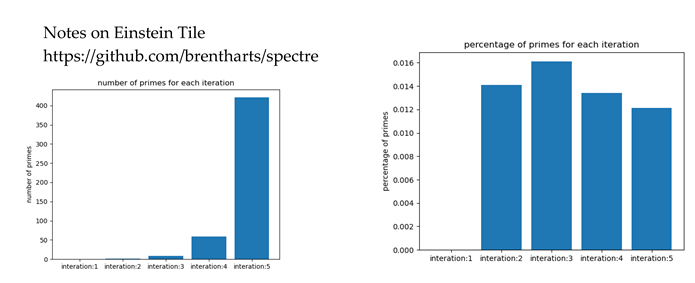
Conclusion
This paper has put forth a novel framework that successfully resolves the foundational challenge of our non-linear theory of "quantum compression of non-events". By treating the Nariai spacetime as an active and fundamental component of our quantum reality, we have shown how gravity emerges as a direct consequence of information being continuously compressed on internal, 2D holographic surfaces, or Markov blankets. This irreversible topological process, quantified by the rate of change in Khovanov homology groups, provides a physical mechanism for the arrow of time.
Moving beyond this foundation, we have demonstrated the theory's potential as a candidate for unification. We have derived a multi-layered, emergent temporal structure analogous to a 3D concept of time by modeling the Nariai surface as an iteratively growing aperiodic tiling. Within this structure, we identified a geometric origin for the chirality of the weak force, linking it to the alternating parity of topological features in the tiling's hierarchy.
Furthermore, we have forged a direct bridge between topology and particle physics, proposing a mechanism for the emergence of the Standard Model's gauge forces. By mapping the rich algebraic structure of knot invariants to the Wilson observables of gauge theory, we have shown how the U(1), SU(2), and SU(3) symmetries can be understood as physical manifestations of the topology of simple loops, chiral knots, and multi-component links, respectively. In this view, fundamental forces are the dynamics of topological transformation, and color confinement finds a natural explanation in the properties of inseparable links.
Figure 1.
(3 iterations of the Einstein Tile) left: cyan is prime, violet is mystic. right: three iterations as a single bezier curve.
Figure 1.
(3 iterations of the Einstein Tile) left: cyan is prime, violet is mystic. right: three iterations as a single bezier curve.
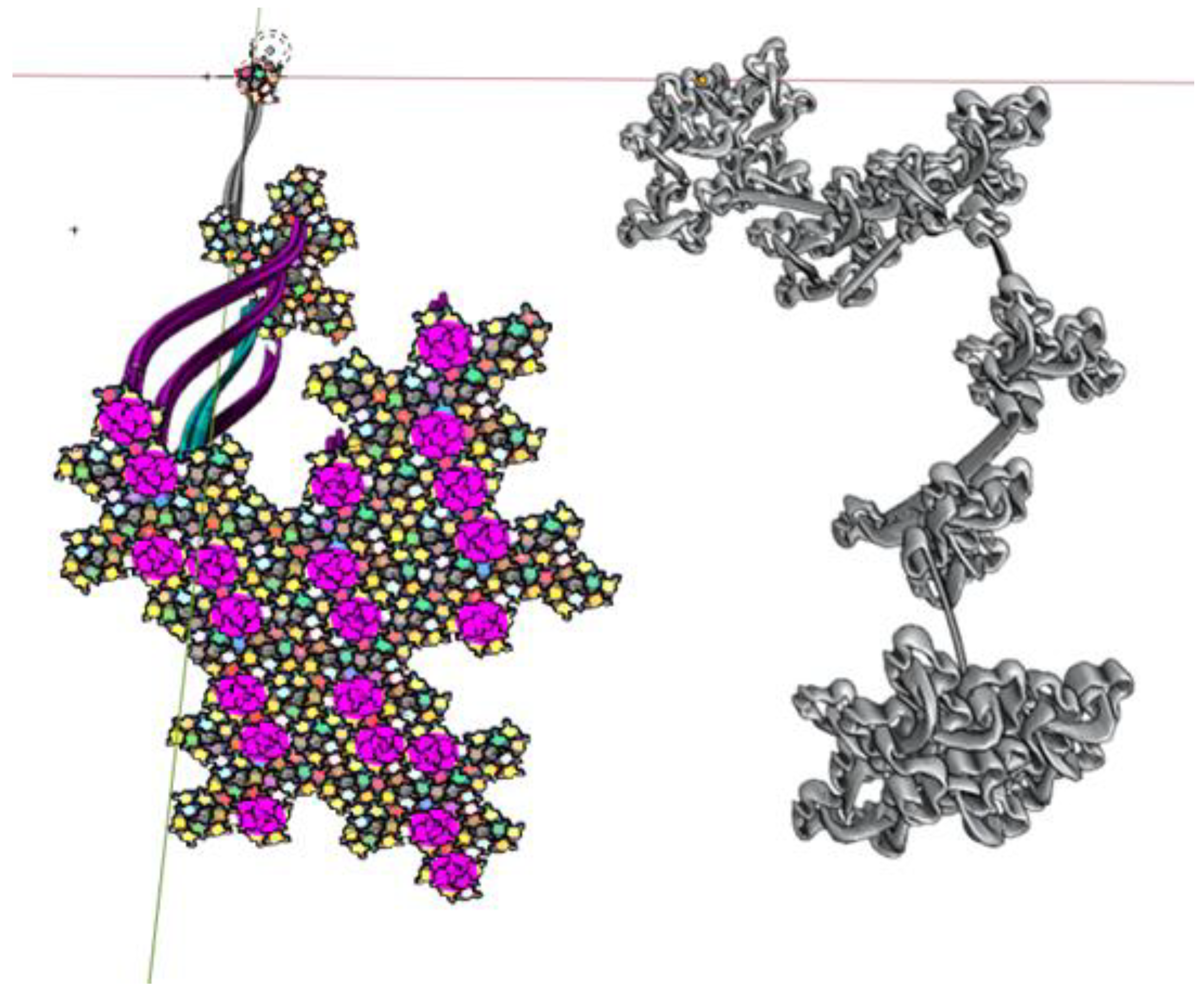
The universe, in this model, is a self-organizing and introspective entity, continuously defining its own reality through a process of computational and topological compression. The result is a coherent narrative that bridges the quantum realm with cosmology, suggesting that spacetime, forces, and matter are not fundamental, but are emergent features of a deeper, information-theoretic principle. Future work will focus on formalizing the proposed knot-to-gauge-group dictionary and exploring potential observational signatures of the topological stress-energy tensor, pushing this new understanding of existence toward empirical validation.
References
- B. Hartshorn “The Solidifying Past: Gravity as the Compression of Non-Events” (2025) https://ai.vixra.org/pdf/2508.0006v1.
- B. Hartshorn “The Prime Space: Quantum Compression of Non-Events and its Cosmological Consequences” (2025) https://ai.vixra.org/pdf/2508.0011v1.
- Jacobson, T. (1995). Thermodynamics of Spacetime: The Einstein Equation of State. Physical Review Letters, 75, 1263. [Google Scholar]
- Verlinde, E. P. (2011). On the Origin of Gravity and the Laws of Newton. Journal of High Energy Physics, 2011.
- t' Hooft, G. (1993). Dimensional Reduction in Quantum Gravity. arXiv preprint gr-qc/9310026.
- Susskind, L. (1995). The World as a Hologram. Journal of Mathematical Physics, 36, 6396. [Google Scholar]
- Maldacena, J. M. (1998). The Large N Limit of Superconformal Field Theories and Supergravity. Advances in Theoretical and Mathematical Physics, 2.
- Bianconi, G. (2025). Gravity from entropy. Physical Review D, 111, 6001. [Google Scholar]
- Bekenstein, J. D. (1973). Black Holes and Entropy. Physical Review D, 7, 2346. [Google Scholar]
- Hawking, S. W. (1975). Particle Creation by Black Holes. Communications in Mathematical Physics, 43.
- Padmanabhan, T. (2010). Thermodynamical Aspects of Gravity: New insights. Reports on Progress in Physics, 73, 6901. [Google Scholar]
- Brouwer, A. E. , Cohen, A. M., & Neumaier, A. (1989). Distance-Regular Graphs.
- Khovanov, M. (2000). A Categorification of the Jones Polynomial. Duke Mathematical Journal, 101.
- Penrose, R. (1974). The Role of Aesthetics in Science. Journal of the Royal Society of Arts, 122.
- Barbour, J. B. (1999). The End of Time: The Next Revolution in Physics.
- Jan Voigt, Miloš Baljozović, Kévin Martin, Christian Wäckerlin, Narcis Avarvari, Karl-Heinz Ernst. (2025) An aperiodic chiral tiling by topological molecular self-assembly https://www.nature.com/articles/s41467-024-55405-5.
- M. V. Berry & J. P. Keating (1999) H=xp and the Riemann Zeros https://link.springer.com/chapter/10. 1007.
- Enrique Gaztañaga, K. Sravan Kumar, João Marto (2024) A New Understanding of Einstein-Rosen Bridges https://www.preprints.org/manuscript/202410. 0190. [Google Scholar]
- Peter Kramer Harmonic polynomials for expanding the fluctuations of the Cosmic Microwave Background: The Poincar´e and the 3-sphere model. (2018) https://arxiv. 0701.
- Donald William Chakeres, Vola Andrianarijaona (2016) The Derivation of the Cosmic Microwave Background Radiation Peak Spectral Radiance, Planck Time, and the Hubble Constant from the Neutron and Hydrogen https://www.scirp.org/pdf/JMP_2016033119443994.
- Harry, K. Hahn (2007) About the logic of the prime number distribution https://arxiv.org/pdf/0801. 4049. [Google Scholar]
- Zhi Li, Latham Boyle (2023) The Penrose Tiling is a Quantum Error-Correcting Code https://arxiv.org/pdf/2311. 1304.
- Titouan Carette, Etienne Moutot (2023) Aperiodicity in Quantum Wang Tilings https://arxiv.org/pdf/2302. 0450.
- Gunther Kletetschka (2025) Three-Dimensional Time: A Mathematical Framework for Fundamental Physics https://www.worldscientific.com/doi/epdf/10. 1142.
- Saksham Sharma (2023) Proof of aperiodicity of hat tile using the golden ratio https://arxiv.org/pdf/2403. 0964.
- David Smith, Joseph Samuel Myers, Craig S. Kaplan, and Chaim Goodman-Strauss (2023) An aperiodic monotile https://arxiv.org/pdf/2303. 1079.
Disclaimer/Publisher’s Note: The statements, opinions and data contained in all publications are solely those of the individual author(s) and contributor(s) and not of MDPI and/or the editor(s). MDPI and/or the editor(s) disclaim responsibility for any injury to people or property resulting from any ideas, methods, instructions or products referred to in the content. |
© 2025 by the authors. Licensee MDPI, Basel, Switzerland. This article is an open access article distributed under the terms and conditions of the Creative Commons Attribution (CC BY) license (http://creativecommons.org/licenses/by/4.0/).
Copyright: This open access article is published under a Creative Commons CC BY 4.0 license, which permit the free download, distribution, and reuse, provided that the author and preprint are cited in any reuse.