

Submitted:
18 August 2025
Posted:
19 August 2025
You are already at the latest version
Abstract
This paper presents an idea to replace special relativity by general relativity applied to an inertial field. The equivalence principle allows us to define an inertial potential equivalent to the gravitational potential. The inertial potential will be further defined using kinetic energy, then the inertial potential will explain the kinematic effect of Hafele-Keating experiment (the experiment where atomic clocks flew around the Earth).From this study, one finding would be that there is a difference between an atomic clock and a photon clock. The photon clock is sensitive to length contraction and time dilation, while only the atomic clock would be sensitive to time-dilation. Only an atomic clock would observe a time difference such as in Hafele-Keating experiment.Also a serious problem has appeared, independent to replacing special relativity by general relativity. The time reference chosen by Hafele-Keating (above the North Pole) is correct but unjustified. There is something local about time dilation, as the rotation of the Earth around the Sun has to be ignored or this would give different results. A previous study reached a similar conclusion. If locality seems crucial, this paper presents the problem but offers no explanation why it should work that way. This question probably has to be solved to reach a better understanding of time.
Keywords:
special relativity
; general relativity
; time dilation
; time reference
; photon clock
; atomic clock
; Kaluza-Klein theory
1. Introduction
Einstein’s equivalence principle states that the inertia of a mass under the acceleration of a rocket generates a force that is equivalent to the force of gravity; it allowed him to replace gravity by mechanics, which was an important step to reach his theory of General Relativity (GR). Although the gravity side of the equivalence principle has been studied, the inertial side has been mostly ignored.
The key is a new concept, which I have called inertial potential. Gravity is associated with a gravitational potential; so inertia should be associated with an inertial potential, an idea which has been introduced in (Danis,2024). Inertial potential gave a new interpretation to redshift which should solve the Hubble’s tension (Danis,2025a). Inertial potential has the potential to explain dark matter and dark energy (Danis,2025b); a deeper analysis will be presented in this paper.
There is an apparent contradiction between (Danis,2024) and Hafele-Keating experiment (HK experiment); to clear that apparent contradiction is the original motivation of this paper. The HK experiment (1972) is the experiment where atomic clocks have been flying around the Earth; time dilation predicted with Special Relativity (SR) has been observed. This paper will show that interpreting HK experiment with GR applied to the inertial potential instead of SR leads to an identical result; removing the contradiction.
Solving this apparent contradiction will involve time dilation, time-flow and clocks. There have been many ideas about time (Barbour,1999; Smolin,2013); but time is still a mystery. The effects of SR and GR on time-flow are described in many places (Rovelli,2017; Caroll,2022). There are many observations in the quantum world which are explained with time dilation, the muons being an example [Rossi & Hall, 1941], but experiments on time in our macro-world are rare. Getting the correct interpretation of HK results may provide some new insight on time.
Weyl presented that unification is an important concept, he was the first to present the idea to add one more dimension to unify gravity with electromagnetism (Weyl,1918). But some mathematical results have proven Weyl’s idea false; this work could explain those results and put his idea back on the “possible”.
2. Background for the Study
2.1. The Hafele-Keating Experiment
Hafele and Keating (1972) installed four atomic clocks in a jet aircraft going around the world eastwards, then westwards. After each round trip they compared the clocks on the jet with a “reference” atomic clock that didn’t fly. The experiment confirmed the predictions.
Because the aircraft is flying at an altitude where gravity is less than ground level, there is a gravitational effect on time dilation that HK took into account. In this paper we are interested solely in the kinematic effect; for HK, the kinematic effect is due to SR.
The clock on the ground doesn’t represent the time of an inertial reference because of Earth’s rotation. So it couldn’t be a time reference which forced HK to use three systems with clocks. The first is far away above the North Pole and that is an inertial reference system; the clock is an imaginary clock used only for the calculations of the predictions. The second corresponds to the location of the clock on the ground, the third is the aircraft. From the North Pole, HK can now calculate the time dilation predicted by SR for the two other systems. As stated before, his prediction coincides with observations.
It seems that HK had to correct some readings of the clocks, and Lundberg (2020) suggested that the corrections have left enough margin to adjust the results to the predictions. Lundberg regrets the lack of honesty and clarity which put the results into doubt. In section 3.2 we will see why I consider HK results to be correct. The National Physical Laboratory (NPL in UK) would have reproduced the HK experiment, but the results haven’t been peer-reviewed (NPL,2005). In this paper, only one question is investigated: does HK experiment prove that SR is correct?
2.2. Special Relativity Against General Relativity
It is important to note that even if the experiment of Michelson-Morley (1887) was known (no sign of aether), the idea of an aether was still around when SR was built: the speed of light was supposed to be constant against the aether reference. As an example, during Solvay I in 1911, Lorentz contribution was still mentioning aether to explain the transfer of some energy (Kozenko Jeans,2021).
Lorentz transformation is remarkable because it fits many observations. The fact that it was developed with aether in mind was forgotten as soon as SR had been accepted. But some questions have been raised. There is an interesting review by Ronghua Cui (2024) where many references can be found; SR seems faulty, but no solid replacement is offered.
Please be aware that, despite all papers claiming that SR is wrong, I believe that SR is correct because GR is based on SR and GR’s predictions have been confirmed. I believe that, when SR seems wrong, it is because we are using SR outside the limit of its validity (Danis,2024). With HK’s experiment, I will also propose that the experiment is outside the limits of SR validity; SR should be replaced by GR.
2.3. The Inertial Potential
Let’s imagine two inertial reference systems S1 and S2 (with a speed v compared to S1). We start with an object M (of mass m) immobile compared to S1; for the object M to become immobile compared to S2, it needs energy (½mv2). This energy tells us that there is a difference of potential between S1 and S2.
Imagine a hill (S1 is the top of the hill) followed by a flat plain and no friction. S2 is represented by any object M that went down the hill and is now on the flat part at a constant speed v (no friction). An object M, immobile with S1 will go down the hill; if all the change of potential energy is in kinetic energy (no flywheel effect) the difference of gravitational potential energy has been transformed into kinetic energy. M is now immobile with S2. This is the paragraph above with gravity and gravitational potential. To immobilise the object M compared to S1, an energy is needed to stop M; energy corresponding to the kinetic energy therefore to the potential energy. Measuring that energy needed to stop M is a way to measure the difference of gravitational potential.
If there is a speed which is not due to a change of altitude (the speed of galaxies running away from us as an example), the corresponding potential is called inertial potential. If you want to immobilise an object compared to a reference, an energy corresponding to the kinetic energy is needed and that energy is working against inertia; therefore the name inertial potential. Please note that the energy needed to stop an object equals the potential energy, with both gravitational and inertial potential; that is another way to express the equivalence principle.
Let’s go back to empty space. If S1 and S2 are moving away from each other, viewed from S2, S1 is at a lower inertial potential and M has initially some kinetic energy. For M to become immobile with S2, it needs to gain the difference in potential energy which is equal to its observed kinetic energy. View from S1, S2 is at a lower inertial potential energy and M (starting immobile with S1) will be losing some potential which is transformed into kinetic energy to become immobile with S2. We can see that the inertial potential depends on the viewpoint. It also depends on the direction of S1 and S2 (moving away or towards each other).
In 1952, Einstein added appendix V to his book Relativity (Einstein,1916); he insists that GR is about acceleration, not about gravity. “For the conditions prevailing with respect to S2 are interpreted as a gravitational field, without the question of the existence of masses which produce this field being raised.”. S2 is an accelerating reference system which is compared to S1, an inertial system. Those five words “interpreted as a gravitational field” shows that Einstein wants to enlarge the idea of field further than gravity, inertial field follows this idea. I am aware that Einstein probably considered a continuously accelerating system; but in the previous paragraph, to pass from S1 to S2 an acceleration is needed albeit for a short time. GR would be the tool to calculate the geometry of space due to potential (gravitational and inertial), therefore to calculate length contraction and time dilation.
The first concrete example of the inertial potential is in the universe as presented in (Danis,2025a) where Figure 1 can be found. Potential zero (point A) is at the Milky Way and as galaxies are running away from us, the inertial potential is decreasing with a zone falling off near the edge of the visible universe (point B). But seen from the edge of the visible universe (from point B), it is the Milky Way (point A) which is falling off: the geometry of space is uniform, the correct reference is linked to the observer. We will use point A and B later on.
3. The Reference for Time
So far the time reference is given by a clock at rest and away from any mass (gravitational potential equals zero). But a clock at rest for a system S1 is not at rest for a system S2 as S2 is moving compared to S1. Somehow there is an agreement that the time reference for S2 feels identical (time-flow is the same) to the time reference of S1. Despite this, there is the twin paradox (Langevin, 1911): a twin travelling ages less than a twin at rest; but which time reference is correct? It is only when S1 observes S2 that time seems dilated for S2; and vice-versa.
3.1. Thought Experiment
The time reference is the time where potential is zero and the clock is considered at rest. An observer at point B of Figure 1 would see space as from point A in Figure 1 (with a flat zero potential around the observer) and it is the Milky Way which is falling off. So the flow of the time reference is the same at point A and at point B (as long as A and B are away from a mass).
Imagine a special quasar at point B of Figure 1 that sends a red flash every day (exactly every 86,400s of the time reference of the observer at point B). After one year of point B, the 365 flash is green, the 366 is back to red until the 730 flash which is green, etc. That quasar is at exactly 10 billion light years away from us situated at point A and because of its ‘velocity/inertial potential’ viewed from point A, its Lorentz factor is a factor 2 (so time flow is dilated by a factor 2).
Time dilation is telling us that the time interval observed at point A between two red flashes will be 2 days and the time between two green flashes will be two years. If the first green flash took 10 billion years to reach us, the second arrived 2 years later. As the second flash left point B 1 year after the first flash, it would mean that it took 10 billion plus an additional 1 year to reach us. That additional one year is the problem we will address.
3.1.1. Justification of an Approximation
The quasar will have moved during the one year between the green flashes. To have a Lorentz factor of 2, the speed is 0.87c. In one year, the quasar would have moved by 0.87ly. This tells us that the second green flash would reach us 2.87 years after the first flash: 1 year between the flashes, 1 year because of time dilation and 0.87 year because of the change of location. I believe most physicists would agree with that. The thought experiment simply ignores the 0.87ly as it is understood. The problem is the additional 1 year from time dilation.
Someone may argue that the 0.87 year is part of the 1 year for time dilation, so there is only 0.13 year to explain. The thought experiment is not an observation with measurement and uncertainty; it has to be solved with exact maths; the 0.13 light year would still need to be explained.
To avoid that 0,87ly problem, we could imagine the quasar rotating around us, staying exactly at 10 billion ly. It is impossible without many tricks but it is a thought experiment where all tricks are permitted. The distance stays at exactly 10 billion years during the whole experiment and the quasar travels in a perpendicular direction at 0.87c. The 0.87ly question has disappeared.
People may argue that the time reference is not the same at point A and point B. It would mean that the geometry of space is not uniform which doesn’t fit our current understanding of space.
So the problem is the additional 1 year from time dilation.
3.2. The Reference for Hafele-Keating Experimental
The time dilation problem above has something to do with HK reference. Why did HK choose above the North Pole and not the cosmic rest frame defined by the universe? This is not coherent with his words: “Although inertial systems are highly specialised, they have an objective physical relationship with the universe because they have no acceleration or rotation relative to the universe.” In 1972, it was already clear that the Sun was rotating around the centre of the Milky Way; but clearly, HK decided to neglect the universe (cosmic rest frame); so they neglected the fact that the Earth is rotating around the Sun and the Sun around the galaxy. The North pole is clearly not an inertial system as defined by HK themselves.
The details of the calculation are not presented; but the rotational speed of the Earth at the equator is 0.4651km/s. The reference clock was somewhere in the U.S. so the rotational speed of that clock could be around 0.4km/s. The details of the flight are unknown, but it seems the clock was in a “normal” aircraft (a Boing 707 and not in a faster Concorde as suggested in the paper). The speed of the aircraft would be 0.2km/s, so it requires about 175000s of flying time to travel around the Earth. The top part of Table 1 has been obtained with such crude figures and the results are close enough to HK’s predictions for the argument of this paper.
The bottom part of Table 1 presents results with speeds around 30km/s. Indeed, if the inertial observer has the Sun or any star as reference, the Earth is travelling at about 30km/s. This idea and similar conclusions have been presented by Lundberg (2020). A difference of speed of 0.2km/s over 175000s results in a much larger time difference as in Table 1. The total flying time is about 2 days. The average speed of all clocks would be equal so in fact the time-flow differences would roughly average. For the real experiment with the Sun as reference, timing of the flight is important as, for both directions (eastward and westward), time dilation would change with the time of the day, reaching extremes speeds of 29.4km/s or 30.6km/s. By choosing carefully the flight time, the time difference could be up to a factor 300 larger than what has been observed. With such a factor, we can guess how difficult it would be to follow a flight timing that would correspond to HK’s prediction. So I would conclude that HK’s predictions are correct and the observer above the North Pole is the correct reference. But why would an observer from the Sun observe something different?
3.3. The Oneness of Time Dilation
Let’s imagine that an observer from the Sun is sending atomic clocks on Earth. Table 1 is telling us that those Sun atomic clocks would give a different time-dilation. An atomic clock is an atomic clock and if two are side by side, they can’t give two largely different time-flow. Therefore time-dilation calculated from the Sun observer seems incorrect.
In (Danis,2024) we assumed that an observer away from the travelling photon clock was not at the right place to obtain a correct result. The conclusion was ‘don’t judge for others’. It is known that time dilation is not invariant (depending on the position of the observer). This work shows there is only one correct time dilation; the correct time dilation is the one chosen by HK and the Sun’s observer is not at the right place to determine time-dilation. The Sun observer may observe an illusion as calculated with Lorentz factor so cannot predict the reality as already stated in (Danis,2024). Back to our green flashes from the edge of the universe; similarly, the correct time dilation at point B is not the one deduced from point A. So the green flashes are separated by exactly 1 year (ignoring the 0,87year) and time dilation should be ignored.
4. Photon Clock Versus Atomic Clock
With HK experiment, a difference of time lapse has been observed which contradicts (Danis,2024) where all clocks are synchronised. The clocks in (Danis,2024) are photon clocks.
The photon clock is based on the speed of light (distance divided by time); if the distance changes, the indication of the time-flow of the clock changes. But when distance changes, there is also time dilation. For a photon clock, time dilation is compensated by the length contraction so even though there is time dilation, the clock is not showing any change, the photon clock is not showing the local time-flow but the time reference flow.
There are other clocks out there. Electrons in an atom are associated with different energy levels. Because of those discrete levels of energy, atoms will absorb or emit light at defined frequencies. We can observe light from stars or galaxies far away (light from point B) and those lights have the imprint of their special frequencies. Such imprints are red-shifted, despite the redshift, the frequency at the place of emission is identical to the frequency observed here on Earth. So the clocks are synchronised. Are they synchronised because the time reference is the same at point A and B? Are they synchronised because they are photon clocks?
Most galaxies are receding; if you accept this work, there is an inertial potential, GR is at work, there is length contraction and time dilation. With galaxies moving away from us (the x direction solely), in this case, time dilation and length contraction with GR and SR are identical; so the following reasoning will be valid for both. The frequency at the emission point is defined by a wavelength (a length) and the speed of the wave. As we are observing light, the speed is the speed of light, and the speed depends on time-flow. Here also, the effect of time dilation is compensated by the effect of length contraction. That is why the frequencies at the place of emission are equal to the frequencies observed here on Earth. Again, those clocks are synchronised; but they are not telling us what the time-dilation is. They are like photon clocks.
The atomic clock seems to be a “true” clock. What is measured is a resonant frequency. A frequency is just time; it is not a wavelength, there is no length. That frequency depends on the energy level. If the photon clocks are synchronised across the universe, (as suggested in the paragraph above) it means that the energy levels are not depending on Lorentz factor. As the energy levels are not changing, the resonant frequency which is observed shouldn’t change except if there is time dilation. From HK experiment, I would propose that an atomic clock is sensible to time dilation (length contraction has no effect).
The main difference is that an atom absorbs or emits light for which ‘length-&-time-changes’ act together; while for an atomic clock, the light is emitted somewhere else and used to measure a frequency.
The idea that an atomic clock and a photon clock would give different time-flow is new to me. The typical caesium atomic clock is to be replaced with an optical strontium clock because optical clocks are more accurate (Holliman,2022). An optical clock is not a photon clock. Optical means that the frequency is near visible light while, for a caesium clock, the frequency was in the microwave range.
Let’s build a photon clock. Nowadays, photodiodes can react in 25ps, the time for a photon to travel 30m is 100ns, a clock of that length can be made and installed in a plane. With some clever electronics (which may be sensitive to the “true” time), the result of a theoretical photon clock can be recovered. Flying the three clocks together would be ideal to check if there is a difference between the clocks. If a difference is observed, then I am probably correct. If there is no difference, it will show a mistake somewhere in this reasoning.
5. How to Explain the HK Experiment Without SR
In this section 2.1 on HK’s experiment, we stated that we are considering only the kinematic effect (SR effect for HK). In (Danis,2024;2025c) we have suggested that SR shouldn’t be used in our material world; GR should be used instead. S1 is HK’s reference above the North Pole, S2 represents the clock at the surface of the Earth and S3 represents the aircraft. S2 and S3 are reference systems. Seen from S1, they have their own inertial potential (defined by the speed observed from S1) and GR is telling us that with a non-zero inertial potential, there is time dilation, time dilation given by Lorentz factor. That is it, HK experiment can be explained with GR instead of SR. As Lorentz factor is used in SR and GR, that is why the result is identical. Some calculations are presented in the appendix of (Danis,2024) confirming that GR and SR will give the same result in this case.
There is still the question why S1 above the Pole is correct compared to a reference above the Sun, that will be addressed in the discussion.
6. Ives-Stilwell Experiment
Ives-Stilwell experiment is an experiment to show a Doppler effect with light; some excited ions are accelerated through a grid, then the ions relax and emit photons. The electric potential of the grid changes so the speed of the ions changes. The frequency of the photons is observed. Redshift and blueshift are observed depending on the direction of the photon (forwards or backwards as a mirror allows to observe the backward direction).
In (Danis,2025a) the observation has been explained as the result of SR and not a Doppler effect. The aim of that previous paper was to show that there is no Doppler effect with redshift and the SR explanation fitted the conclusion; but further analysis due to this paper shows that the explanation was incomplete.
In this section 4, we have explained that those ions are subject to time dilation and length contraction; the result is that, despite their speed, they should emit at the expected frequency without any redshift or blueshift. But redshift and blueshift are observed.
The detector is immobile (S1) and “sees” the ions (S2) moving towards it or away from it. Some energy would be needed to immobilise the ions (compare to S1), therefore there is an inertial potential (that has been presented in this section 2.3). The force to stop the ion is a push or a pull depending on the direction of the ion. A push means that the ion is at a higher potential than the detector, with a pull the ion is at a lower potential. To reach the detector some extra potential energy is giving the blueshift or potential energy is needed resulting in a redshift.
This reasoning gives the right result but seems ad hoc. I would like to remind the reader that there is a change of energy when redshift is observed; the choice is to explain the change of energy with the potential, or the change of energy is not explained. If we can imagine an inertial field in the universe as in Figure 1, we also can imagine a progressive change of frequency along that field; with the Ives-Stilwell experiment, that doesn’t happen. It seems the photon leaves the ion already redshifted (or blueshifted). This paper uses the potential (instead of Doppler effect) to explain the redshift. It is a proposal which is able to explain the conservation of energy when redshift is observed.
7. Weyl’s Unification
Herman Weyl is the father of the modern concept of unification (Smolin,2006). In 1918, by adding one dimension he was able to unify GR with electromagnetism. Unfortunately, there were some results of thought experiments that couldn’t fit with reality. A possible explanation for these unfortunate results will be presented.
Weyl’s theory contained a beautiful mathematical idea that became the core of the standard model. But it failed in our macro-world because of a thought experiment: “If you took two meter-sticks, separated them, and then brought them back together and compared them, they would in general be different in length.” (Smolin,2006). When I read that sentence, it shouted to me “do not judge for others”; in other words, the reference used is correct for one stick and not the other.
Then came Kaluza-Klein theory: a fifth dimensional theory. That fifth dimension is presented as an additional dimension to the 4D spacetime. What if that fifth dimension is solely an additional information to apply on the usual 4D spacetime? It seems that the fifth dimension is frozen (not dynamic while spacetime is dynamic). If indeed it is a fifth physical dimension, it should be dynamical, but if it is an information like the charge of an electron, does an information need to be dynamical? The corresponding field may change with gravity (for example) but the charge? If the fifth dimension represents the electromagnetic field, how can we check if an electromagnetic field changes with gravity? Can’t it be “frozen” in the sense changing with gravity?
They may be other arguments but Smolin (2006) is telling that a frozen fifth dimension is enough to reject a theory. What about SR? One dimension (x) and time are dynamical; but y and z are frozen. Should we reject SR on that ground? Or does it show that SR is a 1D theory (Danis,2024)?
Weyl’s theory and Kaluza-Klein theory are both unifying theories. Unification is what most scientists are currently looking for. It could be worth trying to resurrect Weyl’s theory with the argument: “do not judge for others”.
8. Discussion
There are already many questions in the text; section 7 is typically a discussion on its own.
Weyl is the scientist who pointed out the importance of unification. The equivalence principle is telling us that inertial potential and gravitational potential are equivalent: so with this work, we should unify the two potentials into one. GR is a field theory; to explain redshift at the scale of the universe (Danis, 2025a) or dark matter (Danis,2025b) I used an inertial field. If a gravitational potential can be described using inertia, I cannot describe an inertial potential using gravity. So inertial field/potential is unifying because it includes gravity. The fifth force and gravity should be unified as both are described with potential and obey GR.
Using the inertial potential is giving identical results to SR. By replacing SR with the inertial potential, we simplify the law of physics as only GR is needed; that is another unification. As an example, gravitational and inertial potential can be added, leading to a single time dilation while HK needed to combine both effects (Gravitational and Special Relativistic effects).
But if an inertial field makes sense in our macro-world, at quantum level, it seems there is no field: solely the inertia of each particle is considered to explain the Ives-Stilwell experiment. We know that quantum mechanics and classical mechanics are different but inertia seems to exist for both. If I dare to suggest an approach, the quantum gravity search should take a turn towards a quantum inertia search. As inertia and gravity are linked with the equivalence principle; it could make sense.
In this study, there is something missing: where does the Earth system stop? Where does the Sun system stop? Where is the calculation of time dilation from the Sun becoming an illusion as suggested in the text? “Do not judge for others” is an easy way out but we have to know when/why a calculation gives the correct prediction and when/why the next calculation gives an illusion.
That is a question I cannot answer yet but it does need to be answered. The best clue is gravity and Foucault’s pendulum.
To try to go further, I will point to a paper on Mach’s principle (Danis,2025b) where inertial mass = gravitational mass, but inertial reference could be different to gravitational reference. That paper confirms the idea behind Mach’s principle: the inertial reference would be defined by masses around. Foucault’s pendulum uses the gravitational reference and misdirected all attempts to define Mach’s principle. The gravitational reference is always Newton’s absolute space; i.e. the cosmic rest frame.
HK experiment takes place in the inertial reference formed by the Earth. The definition of the inertial reference is presented in (Danis,2025d). Please be aware that, in that work, I haven’t offered a rigorous calculation for the strength of an inertial reference and how two references combine; this is still a work to be done.
If Mach’s principle is correct, the inertial reference is rotating with the Earth. If the reference for time depends on the inertial reference, the time dilation should be identical eastwards and westwards. Somehow a “cosmic reference” is the preferred reference for the time reference, the cosmic reference of Foucault’s pendulum, which is a gravitational instrument, not an inertial instrument. Foucault’s pendulum has defined the rotational speed of HK’s experiment.
Why does a clock use the gravitational reference instead of the inertial reference? Time flow seems to be defined by the potential, including the inertial potential. To observe the inertial potential, the gravitational reference (the cosmic frame of reference) is needed. Interestingly, a pendulum is a clock, probably a clock affected by time dilation like an atomic clock.
Where to go from there? Gravity is the only clue I have at the moment. Why is it local? There must be a link with Mach’s principle which also implies locality, but I have no further understanding to present. Instinct tells me that the Lagrangian point is the limit of validity between two inertial references but I cannot justify it.
The time reference was from a clock at rest and where there is a zero potential. This paper links “at rest” to inertial potential and replaces SR. Time dilation of SR is equal to time dilation from inertial potential; therefore one can replace the other. If that is correct, it means time-flow is a direct function of potential; does it mean that time-flow is a potential? Another different example (time-flow on Earth, especially at the Equator) would confirm this conclusion (Danis,2025d).
This work would suggest that a photon clock is measuring the time-flow reference while an atomic clock is measuring the “true” time; i.e. the time-flow affected by time dilation. If that is correct, a photon clock being a reference clock, there shouldn’t be any correction with latitude or with a change in gravity. At the moment, atomic clocks that distribute the Universal Time (UT) need corrections depending on their position on Earth. A standard photon clock may help define those corrections. But first, the difference between atomic clock and photon clock has to be verified which will confirm this paper.
The twin paradox: if one twin stays in the Earth system and travels very fast eastward, then there is an age difference, age difference similar to one twin living at a higher altitude compared to the other, the difference of age is due to a difference of potential. But if the twin decides to leave the Earth system, she/he forms her/his own system. From the Earth we have the illusion that there is time dilation. The correct system is her/his own, where there is no time dilation (don’t judge for others). It is the same idea as with the flashes emitted at point B and observed at point A. The travelling twin is subject to time dilation only in the Earth system, further away there shouldn’t be any time dilation.
The paragraph above means there is a preferred time: the time reference which is the same everywhere.
Please feel free to contact me for further discussion; see the acknowledgment as an example on how criticism can be positive.
Acknowledgments
Thanks to Richard Banks who pointed out that HK’s experiment was potentially contradicting my previous work.
Abbreviations
The following abbreviations are used in this manuscript:
| Special relativity | SR |
| General relativity | GR |
| Hafele - Keating | HK |
| National Physical Laboratory | NPL |
References
- Barbour, J (1999) The end of time. Phoenix.
- Carroll, S. The biggest ideas in the Universe. Space, time and motion, Oneworld.
- Cui, R. The Incorrectness of Special Relativity and an Understanding of Time. Applied Physics Research 2024, 16, 40. [Google Scholar] [CrossRef]
- Danis, F. Limit and potentials of SR. Applied Physics Research 2024, 16, 112. [Google Scholar] [CrossRef]
- Danis, F. Note on redshift and the principle of conservation of energy. Applied Physics Research 2025, 17, 77. [Google Scholar] [CrossRef]
- Danis, F. Dark matter in Andromeda: A new alternative mechanism. Sci Set J of Physics 2025, 4, 01–07. [Google Scholar]
- Danis, F. Ehrenfest’s Paradox and General Relativity. Applied Physics Research 2025, 17, 77. [Google Scholar] [CrossRef]
- Danis, F. (2025) Einstein revisited A book awaiting for an agent.
- Einstein, A. (1916) Relativity: The Special & the General Theories. The folio society, London, 2004.
- Hafele, J. C.; Keating, R. E. "Around-the-World Atomic Clocks: Predicted/Observed Relativistic Time Gains". Science 1972, 177, 166–170. [Google Scholar] [CrossRef] [PubMed]
- Holliman, C. A.; et al. "Radium Ion Optical Clock". Physical Review Letters 2022, 128, 033202. [Google Scholar] [CrossRef] [PubMed]
- Kozenko, A.V. Jeans C.V. (2021) Sir James Jeans Cosmogonic press.
- Langevin, P. (1911). "The evolution of space and time", Scientia, X: 31–54 (translated by J. B. Sykes, 1973 from the original French: "L'évolution de l'espace et du temps").
- Lundberg, R. Velocity and absurdity in modern physics. Physics Essays 2020, 33 (2) 118-139. Section VI.
- Michelson, Albert A; Morley, Edward W. "On the Relative Motion of the Earth and the Luminiferous Ether". American Journal of Science 1887, 34, 333–345.
- NPL (2005) Metromnia, Issue 18 - Spring 2005.
- Rovelli C. (2017) The order of time Allen Lane.
- Rossi, B. , Hall, D.B. "Variation of the Rate of Decay of Mesotrons with Momentum". Physical Review 1941, 59, 223–228. [Google Scholar]
- Smolin, L. (2006) The Trouble with Physics, Allen Lane.
- Smolin, L. (2013) Time Reborn , Houghton Mifflin Harcourt.
- Weyl, H. “Gravitation und Elektrizität”, Sitzungsber. Preuss. Akad. Wiss., (26) 1918, 465–478.
Figure 3.
Inertial potential of the Universe. “A” represents where we are, “B” represents an inertial system at the “edge” of the universe. This figure is an image, not the result of any calculation.
Figure 3.
Inertial potential of the Universe. “A” represents where we are, “B” represents an inertial system at the “edge” of the universe. This figure is an image, not the result of any calculation.
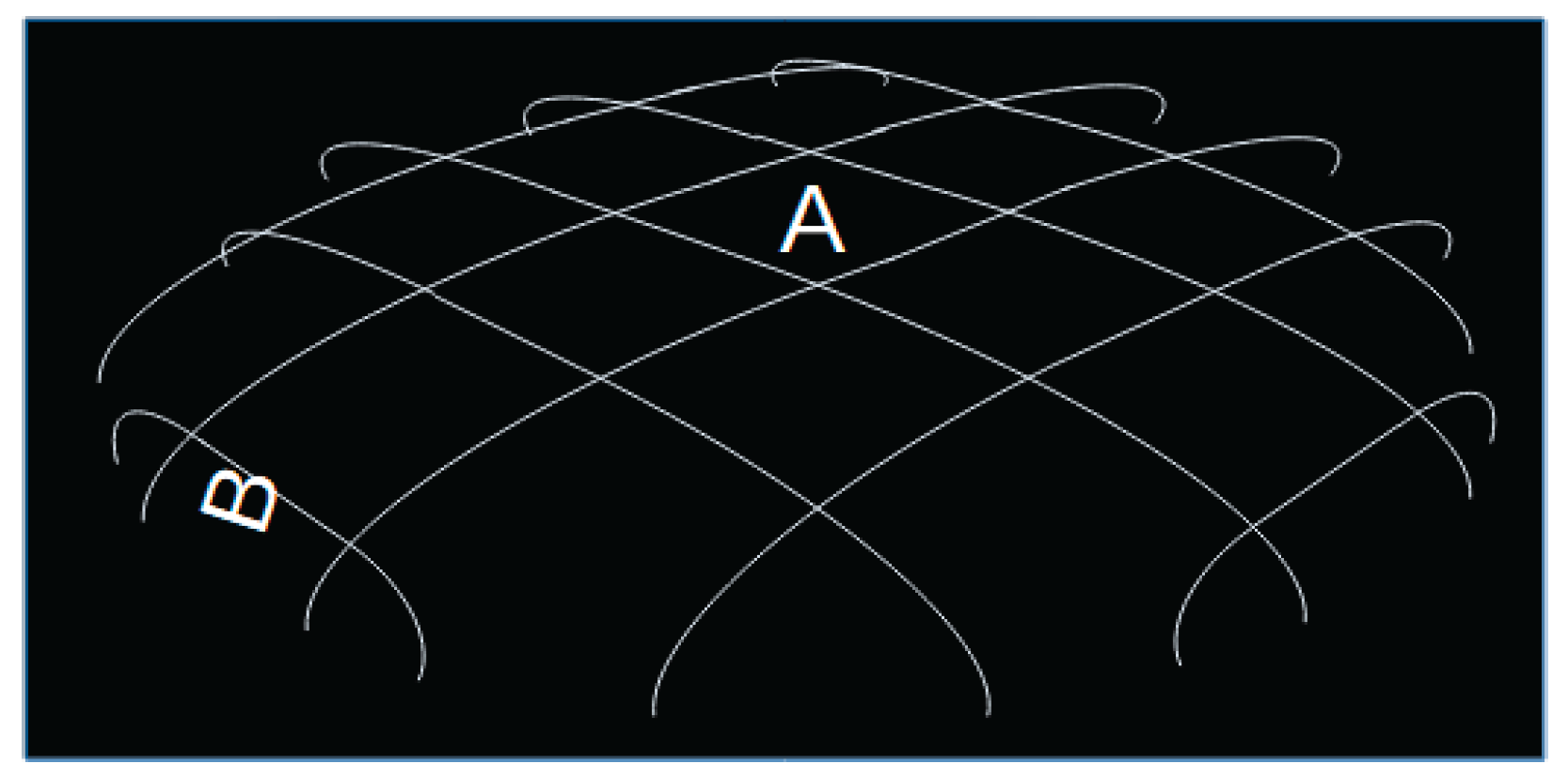

Table 1.
some calculation of special relativistic effects during HK around Earth trip.
| v in km/s | t difference in ns | Hafele’s prediction |
| 0.2 | 117 | 96 |
| 0.4 | reference | |
| 0.6 | -194 | -184 |
| 29.4 | 34650 | |
| 29.8 | 11628 | |
| 30 | reference | |
| 30.2 | -11705 | |
| 30.6 | -35350 |
Disclaimer/Publisher’s Note: The statements, opinions and data contained in all publications are solely those of the individual author(s) and contributor(s) and not of MDPI and/or the editor(s). MDPI and/or the editor(s) disclaim responsibility for any injury to people or property resulting from any ideas, methods, instructions or products referred to in the content. |
© 2025 by the authors. Licensee MDPI, Basel, Switzerland. This article is an open access article distributed under the terms and conditions of the Creative Commons Attribution (CC BY) license (http://creativecommons.org/licenses/by/4.0/).
Copyright: This open access article is published under a Creative Commons CC BY 4.0 license, which permit the free download, distribution, and reuse, provided that the author and preprint are cited in any reuse.


