

Submitted:
04 September 2025
Posted:
05 September 2025
You are already at the latest version
Abstract
The ‘genetic zipper’ method, based on CUAD (Contact Unmodified Antisense DNA) biotechnology, briefly CUADb or ‘genetic zipper’ method, represents a major breakthrough in eco-friendly pest control. This innovative approach is based on fundamentally new biological mechanism – DNA containment mechanism – and employs short, unmodified antisense DNA molecules to selectively degrade target rRNA in insect pests, disrupting protein synthesis and leading to high mortality rates. Demonstrating exceptional speed and precision, the method enables the design of effective and selective DNA pesticides for up to 10–15% of known insect pests in a single day. In this review, we highlight the simplicity and global applicability of this method using case studies involving 12 economically significant pest species, including hemipterans and one spider mite, from five continents. These oligonucleotide pesticides, generated via the DNAInsector web tool, are supposed to offer 80–90% efficacy against target pests within two weeks under laboratory conditions. Their action is primarily non-systemic, requiring direct contact, and they are environmentally safe, biodegradable, and highly specific, reducing risks to non-target organisms. The ‘genetic zipper’ method not only provides a powerful tool for researchers and practitioners but also opens a new era in pest management, where personalized, algorithm-driven pesticides can be easily created and applied for sustainable agriculture. Necessity rules the world and eco-friendly innovations are necessary for agriculture than never before.
Keywords:
‘genetic zipper’ method
; oligonucleotide pesticides
; CUAD biotechnology
; DNA-programmable plant protection
; DNAInsector
Introduction
The continued use of conventional chemical pesticides in agriculture has contributed significantly to crop productivity over the past century. However, this heavy reliance on broad-spectrum chemicals has led to serious environmental and ecological consequences, including the contamination of soil and water, the decline of beneficial insect populations, and the development of resistance in many target pest species. In recent years, global regulations and consumer demand have placed growing pressure on the agricultural sector to find more sustainable and eco-friendly alternatives to synthetic pesticides. These alternatives must ideally combine high efficacy with selectivity, safety for non-target organisms, and environmental biodegradability. Biological control agents and plant-derived compounds are among the traditional alternatives, but they often face limitations in terms of field stability, slow action, or inconsistent performance (Villavicencio-Vásquez et al. 2025; Karuppiah et al. 2025). The next generation of pest control strategies is now turning toward molecular and genetic approaches, particularly those involving nucleic acids. These biotechnological methods allow for species-specific interference with essential physiological processes in pests, offering the potential to revolutionize plant protection while reducing collateral damage to the environment. Importantly, such innovations aim not only to suppress pests effectively but also to do so in a way that aligns with integrated pest management (IPM) frameworks and global sustainability goals. Therefore, the search for innovative and efficient nucleic acid-based pesticides has emerged as a key focus of agricultural research (Kumar et al. 2025; Oberemok et al. 2025a; 2025b).
Among the most promising advances in nucleic acid-based pest control are antisense technologies, which act by targeting genes to disrupt expression in a highly specific manner. Technologies like RNA interference (RNAi), CRISPR/Cas gene editing, and more recently, the Contact Unmodified Antisense DNA biotechnology (CUADb), also known as the ‘genetic zipper’ method, are being actively explored for their pest suppression potential (Kumar et al. 2025). Because of very efficient and easy algorithm, DNA-guided ‘genetic zipper’ method (CUAD biotechnology) is a unique and very potent alternative to other approaches in plant protection based on duplexes of unmodified nucleic acids and RNA-guided nucleases: RNA interference and CRISPR/Cas9 (Figure 1).
Each of these technologies employs sequence-specific recognition, where a guide nucleic acid molecule binds to a complementary sequence in the pest, leading to insect death. While RNAi and CRISPR/Cas offer powerful gene manipulation capabilities, they often require complex delivery systems, modified molecules, or additional protein components. In contrast, CUADb stands out for its simplicity and low production costs, as it utilizes short, unmodified single-stranded DNA oligonucleotides that can be synthesized rapidly without the need for transgenic components. CUADb works by forming a DNA-rRNA duplex that halts ribosome function and triggers degradation of the target rRNA via DNA-guided rRNase, such as RNase H1 (Oberemok et al. 2025a), ultimately leading to lethal disruption of protein synthesis in the pest (Gal’chinsky et al. 2024; Oberemok et al. 2025a). This contact-based mode of action allows CUADb to be applied as a foliar spray, directly on pests, functioning effectively without needing to be taken up systemically by the plant or pest. Moreover, its rapid design, high selectivity, and minimal risk to non-target organisms make it a compelling alternative to traditional insecticides. As such, CUADb represents a unique intersection of molecular precision and practical agricultural utility. Key fundamental discoveries made by our team in 2008-2025 to make CUAD biotechnology successful innovation: 1) antisense DNA can be a contact insecticide; 2) rRNA as target for nucleic acid-based insecticides; 3) Sternorrhyncha, a group of serious pests, was found to be very susceptible to CUADb-based insecticides; 4) DNA containment, new fundamental mechanism, important for practical applications in biology was found (Kumar et al. 2025).
The ‘genetic zipper’ method has shown notable success in laboratory trials, particularly against hemipteran pests such as aphids, scale insects, mealybugs, whiteflies, and psyllids, as well as spider mites (Oberemok et al. 2024a; Gavrilova et al. 2025). Experimental evidence suggests that CUADb-based oligonucleotide pesticides can cause 80 to 90 percent mortality in larval or juvenile stages of pests within two weeks of contact exposure (Oberemok et al. 2024a; Gavrilova et al. 2025). One of the most attractive features of this method is its flexibility: using freely accessible digital tools like the DNAInsector platform (dnainsector.com), users can generate oligonucleotide pesticide sequences tailored to the rRNA of nearly any insect species within seconds (DNAInsector 2025). This capability allows for rapid and personalized pesticide design, moving pest management away from a one-size-fits-all model toward a more responsive, algorithm-driven approach. The method has also been shown to work across a wide range of economically important species, including those with diverse host plant associations and geographic distributions. Because it relies on conserved rRNA regions (Smit et al. 2007; Noller et al. 2022), it can be applied to multiple related pest species with high confidence in its efficacy. Furthermore, CUADb pesticides are biodegradable and leave no long-term chemical residues, making them ideal for use in organic and environmentally sensitive farming systems (Gal’chinsky et al. 2023; Oberemok et al. 2024b). These combined advantages place CUADb at the forefront of next-generation plant protection strategies. However, as with any emerging technology, careful evaluation of its scalability, regulatory acceptance, and delivery mechanisms in field conditions is essential for its widespread adoption.
This opinion article aims to provide a comprehensive overview of the CUADb-based ‘genetic zipper’ method and its applications in pest control. We begin by explaining the mechanistic basis of this technology and its comparison with other nucleic acid-based approaches, followed by practical aspects of oligonucleotide pesticide design and application. To demonstrate its ease of use and broad applicability, we present 12 DNA sequences with high pesticidal potential designed for insect pests and one mite species representing five continents. We also assess the unique benefits of this method in terms of safety, cost-effectiveness, and species specificity. Finally, we discuss the current limitations and challenges facing CUADb and explore its future potential within integrated pest management systems. By highlighting its scientific foundation and practical promise, this review contributes to the growing discourse on sustainable, algorithm-assisted pest management solutions.
DNA Containment Mechanism of the ‘Genetic Zipper’ Method
CUAD Biotechnology: Step-by Step Action
- Step 1: Arrest of ribosome function leading to hypercompensation of target rRNA, subsequent depletion of ATP and ‘kinase disaster’ (Oberemok et al. 2025a).
- Step 2: Enzymatic degradation of target rRNA by DNA-guided rRNases, such as RNase H1 (Gal’chinsky et al. 2024; Kumar et al. 2025; Oberemok et al. 2025a).
DNA containment mechanism (DNAc), a two-step process identified in sternorrhynchans. This process occurs primarily in the nucleus—specifically, the nucleolus—where ribosome biogenesis takes place. In the first step, the target rRNA is functionally ‘arrested,’ leading to its hypercompensation. In the second step, the target rRNA undergoes degradation mediated by DNA-guided rRNases, such as RNase H1 (Oberemok et al. 2025a). Formation of a duplex between the olinscide and rRNA mimics a zipper mechanism, effectively containing normal rRNA expression and resulting in pest death. During DNAc, oligonucleotide pesticides lead to increased expression of ribosomal proteins, promoting ribosome biogenesis along with hypercompensated rRNA. Concurrently, ATP synthesis increases in mitochondria, primarily through lipid degradation. However, this ultimately results in a ‘kinase disaster’ as ATP depletion caused by rRNA synthesis and ribosome biogenesis leads to widespread downregulation of kinases (Kumar et al. 2025; Oberemok et al. 2025a).
Comparison with RNAi and CRISPR/Cas
- CUADb is one of three antisense technologies alongside RNAi and CRISPR/Cas.
- All involve duplex formation with unmodified nucleic acids and nuclease-mediated gene silencing: RNAi: guide RNA–mRNA (Argonaute); CUADb: guide DNA–rRNA (DNA-guided rRNases); CRISPR/Cas: guide RNA–DNA (Cas proteins) (Kumar et al. 2025).
Use of DNAInsector for Oligo Design
- DNAInsector (dnainsector.com) generates target oligonucleotides in ~10 seconds (DNAInsector 2025).
- Simplifies oligo pesticide design, making it accessible even to non-specialists.
Practical Implementation and Application Strategy
Selection of Pest Targets
- 12 DNA pesticides developed for important pests (11 Sternorrhyncha and 1 spider mite), chosen due to experimental precedence (Oberemok et al. 2024a).
Oligo Pesticide Application Methods and Dosages
- Application via cold fogger or backpack sprayer using 10–20 micron droplets.
- Dosage: Trees: 10–12 g oligo in 180–200 L water per hectare (400–500 trees); Bushes/grasses: 9–10 g in 180–200 L (Oberemok et al. 2025c).
Oligo Pesticide Application Methods and Dosages
- Pesticides are primarily contact-based, not systemic. Direct contact with pest integument is required (Oberemok et al. 2025c).
Case Studies: Proposed Oligonucleotide Pesticides for Showing Robustness of DNAInsector Algorithm
Selection of Insect Pests
- 12 pests from 5 continents, including hemipterans like Myzus persicae, Diaphorina citri, Planococcus citri, and the spider mite Panonychus ulmi.
Pest-Specific Oligo Design and Targets
- Oligonucleotide pesticides target 18S, 5.8S, ITS2, 28S, and mitochondrial 16S rRNA using 11-nt antisense DNA sequences (Table 1).
Global Representation of Species
- Origin of pests illustrated in Figure 2.
- Species include those affecting apples, potatoes, citrus, coffee, and forest trees (e.g., Adelges tsugae, Paracoccus marginatus) (Soltis et al. 2014; Buzzetti et al. 2015; García Morales et al. 2016; Alba-Tercedor et al. 2021; Kar et al. 2023).
Advantages of the ‘Genetic Zipper’ Method
Cost and Ease of Synthesis
- CUADb is more cost-effective than RNAi and CRISPR/Cas technologies (Oberemok et al. 2024c; 2024d).
Safety and Environmental Benefits
- Low carbon footprint, biodegradable, safe for non-target species (Gal’chinsky et al. 2023; Oberemok et al. 2024b).
High Target Specificity
- Antisense oligos designed for specific rRNA sequences reduce off-target impacts (Gal’chinsky et al. 2024; Oberemok et al. 2025a).
Resistance Management Potential
- Novel mode of action (DNA containment mechanism) may help prevent development of target-site resistance (Oberemok et al. 2024c).
Predictive Design Using Related Species
- Effectiveness can be predicted for untested species using phylogenetic proximity (Oberemok et al. 2024a; Gavrilova et al. 2025).
Disadvantages of the ‘Genetic Zipper’ Method
Limited Pest Coverage
- Proven mainly for hemipterans, thrips and spider mites; broader validation is needed (Oberemok et al. 2024a; Gavrilova et al. 2025).
Off-Target and Specificity Concerns
- Requires careful design and consideration of pre-rRNA and mature rRNA sequences of non-target organisms to avoid unintended effects (Kumar et al. 2025).
Delivery System Limitation
- Field delivery methods are still being optimized (Oberemok et al. 2025c).
Risk of Resistance Evolution
- New resistance mechanisms may eventually emerge (Gal’chinsky et al. 2024).
Production and Cost Issue
- While cheaper than some dsRNA-based tools, it still needs specialized large-scale synthesis setups (Kumar et al. 2025).
Conclusions
The “genetic zipper” method represents a groundbreaking step toward the personalization of pesticide development, transforming the traditionally complex and resource-intensive process into a fast, rule-based system accessible even to non-specialists. Through digital tools like the DNAInsector platform (dnainsector.com), researchers and practitioners can rapidly design specific oligonucleotide pesticides, making real-time responses to emerging pest threats more feasible than ever before. This capability opens new opportunities for tailored pest control solutions in both research and agricultural settings, including localized outbreaks and resistant populations. In practical terms, the CUADb-based approach fits seamlessly into integrated pest management (IPM) strategies due to its high specificity, environmental safety, and ease of application. It complements existing pest control methods by enabling selective suppression of target pests without harming beneficial organisms, making it suitable for use in organic and ecologically sensitive farming systems. However, the successful integration of this technology into mainstream agriculture will depend heavily on clear regulatory pathways and strong public engagement. While CUADb-based pesticides are non-transgenic and biodegradable, many regulatory systems are still adapting to emerging nucleic acid technologies. Therefore, transparent scientific communication, involvement of independent research bodies, and public education will be essential to ensure both regulatory approval and societal acceptance. The future of CUAD biotechnology hinges not only on its scientific merit but also on its ability to gain trust as a safe, flexible, and sustainable tool for modern agriculture (Oberemok et al. 2024d).
Author Contributions
VO: Conceptualization, Funding acquisition, Visualization, Resources, Supervision, Validation, Writing–original draft, Writing–review and editing. KL: Writing–original draft, Writing–review and editing. JA: Writing–original draft, Writing–review and editing. NG: Supervision, Validation, Writing–original draft, Writing–review and editing.
Funding
Research results obtained within the framework of a state assignment V.I. Vernadsky Crimean Federal University for 2024 and the planning period of 2024–2026 No. FZEG-2024–0001.
Acknowledgments
We thank our many colleagues, who are too numerous to name, for the technical advances and lively discussions that prompted us to write this opinion article. We apologize to the many colleagues whose work has not been cited. We are very much indebted to all anonymous reviewers for their valuable comments. We are thankful to our colleagues from the DNA technologies, PCR analysis, and creation of DNA insecticides Lab (V.I. Vernadsky Crimean Federal University, Department of General Biology and Genetics) for their assistance and to OLINSCIDE BIOTECH LLC for their valuable comments on our manuscript.
Conflicts of Interest
The authors declare that the research was conducted in the absence of any commercial or financial relationships that could be construed as a potential conflict of interest.
References
- Abubakar M, Koul B, Chandrashekar K, Raut A, Yadav D (2022) Whitefly (Bemisia tabaci) management (WFM) strategies for sustainable agriculture. Agriculture 12(9):1317. [CrossRef]
- Alba-Tercedor J, Hunter WB, Alba-Alejandre I (2021) Using micro-computed tomography to reveal the anatomy of adult Diaphorina citri Kuwayama (Insecta: Hemiptera, Liviidae) and how it pierces and feeds within a citrus leaf. Sci Rep 11(1):1358. [CrossRef]
- Ali J, Bayram A, Mukarram M, Zhou F, Karim MF, Hafez MMA, Mahamood M, Yusuf AA, King PJH, Adil MF, Ma Z, Shamsi IH (2023) Peach–Potato Aphid Myzus persicae: Current Management Strategies, Challenges, and Proposed Solutions. Sustainability 15:11150. [CrossRef]
- Alloui-Griza R, Cherif A, Attia S, Francis F, Lognay GC, Grissa-Lebdi K (2022) Lethal Toxicity of Thymus capitatus Essential Oil Against Planococcus citri (Hemiptera: Pseudococcidae) and its Coccinellid Predator Cryptolaemus montrouzieri (Coleoptera: Coccinellidae). Journal of Entomological Science 57(3):425-435. [CrossRef]
- Assouguem A, Lahlali R, Joutei AB, Kara M, Bari A, Aberkani K, Kaur S, Mokrini F, Lazraq A (2024) Assessing Panonychus ulmi (Acari: Tetranychidae) Infestations and Their Key Predators on Malus domestica Borkh in Varied Ecological Settings. Agronomy 14:457. [CrossRef]
- Avila CA, Marconi TG, Viloria Z, Kurpis J, Del Rio SY (2019) Bactericera cockerelli resistance in the wild tomato Solanum habrochaites is polygenic and influenced by the presence of Candidatus Liberibacter solanacearum. Sci Rep 9(1):14031. [CrossRef]
- Buzzetti KA, Chorbadjian RA, Fuentes-Contreras E, Gutiérrez M, Ríos JC, Nauen R (2015) Monitoring and mechanisms of organophosphate resistance in San Jose scale, Diaspidiotus perniciosus (Hemiptera: Diaspididae). J Appl Entomol 140:507–516. [CrossRef]
- Cabrera-Asencio I, Dietrich CH, Zahniser JN (2023) A new invasive pest in the Western Hemisphere: Amrasca biguttula (Hemiptera: Cicadellidae). The Florida Entomologist. 106(4):263–266. https://www.jstor.org/stable/48763130.
- DNAInsector (2025) Available via DIALOG. https://dnainsector.com/?token=e870a6fc9abe44d18fdbbcf909805689.
- Eleftheriadou N, Lubanga UK, Lefoe GK, Seehausen ML, Kenis M, Kavallieratos NG, Avtzis DN (2023) Uncovering the Male Presence in Parthenogenetic Marchalina hellenica (Hemiptera: Marchalinidae): Insights into Its mtDNA Divergence and Reproduction Strategy. Insects 14:256. [CrossRef]
- Gal’chinsky NV, Yatskova EV, Novikov IA, Sharmagiy AK, Plugatar YV, Oberemok VV (2024) Mixed insect pest populations of Diaspididae species under control of oligonucleotide insecticides: 3′-end nucleotide matters. Pesticide Biochemistry and Physiology 200:105838. [CrossRef]
- Gal’chinsky NV, Yatskova EV, Novikov IA, Useinov RZ, Kouakou NJ, Kouame KF, Kra KD, Sharmagiy AK, Plugatar YV, Laikova KV, Oberemok VV (2023) Icerya purchasi Maskell (Hemiptera: Monophlebidae) Control Using Low Carbon Footprint Oligonucleotide Insecticides. Int J Mol Sci 24(14):11650. [CrossRef]
- García Morales M, Denno BD, Miller DR, Miller GL, Ben-Dov Y, Hardy NB (2016) ScaleNet: A literature-based model of scale insect biology and systematics. Database 2016:bav118. [CrossRef]
- Gavrilova D, Grizanova E, Novikov I, Laikova E, Zenkova A, Oberemok V, Dubovskiy I (2025). Antisense DNA acaricide targeting pre-rRNA of two-spotted spider mite Tetranychus urticae as efficacy-enhancing agent of fungus Metarhizium robertsii. Journal of Invertebrate Pathology 211:108297. [CrossRef]
- Gounari S, Zotos CE, Dafnis SD, Moschidis G, Papadopoulos GK (2021) On the impact of critical factors to honeydew honey production: The case of Marchalina hellenica and pine honey. J Apic Res 62:383–393. [CrossRef]
- Joshi NK, Phan NT, Biddinger DJ (2023) Management of Panonychus ulmi with Various Miticides and Insecticides and Their Toxicity to Predatory Mites Conserved for Biological Mite Control in Eastern U.S. Apple Orchards. Insects 14(3):228. [CrossRef]
- Kar A, Majhi D, Mishra DK (2023) First report of Coccus viridis (Green) as a pest of dragonfruit in West Bengal. Pest Management in Hort Ecosystems 29(2):304-306.
- Karuppiah P, Thayalan KJ, Thangam GS, Eswaranpillai U (2025) Bio-Control Agents: A Sustainable Approach for Enhancing Soil Nutrients Use Efficiency in Farming. In: Mitra D, de los Santos Villalobos S, Rani A, Elena Guerra Sierra B, Andjelković S (eds) Bio-control Agents for Sustainable Agriculture. Springer, Singapore. [CrossRef]
- Kumar H, Gal’chinsky N, Sweta V, Negi N, Filatov R, Chandel A, Oberemok V, Laikova K (2025) Perspectives of RNAi, CUADb and CRISPR/Cas as Innovative Antisense Technologies for Insect Pest Control: From Discovery to Practice. Insects 16(7):746. [CrossRef]
- Munyaneza JE (2015) Zebra Chip Disease, Candidatus Liberibacter, and Potato Psyllid: A Global Threat to the Potato Industry. Am J Potato Res 92:230–235. [CrossRef]
- Noller HF, Donohue JP, Gutell RR (2022) The universally conserved nucleotides of the small subunit ribosomal RNAs. RNA 28(5):623-644. [CrossRef]
- Oberemok V, Gal’chinsky N, Novikov I, Sharmagiy A, Yatskova E, et al. (2025a). Ribosomal RNA-Specific Antisense DNA and Double-Stranded DNA Trigger rRNA Biogenesis and Insecticidal Effects on the Insect Pest Coccus hesperidum. Int J Mol Sci. 26(15):7530. [CrossRef]
- Oberemok V, Laikova K, Andreeva O, Dmitrienko A, Rybareva T, Ali J, Laikova E, Plugatar Y (2025b) DNA-Programmable Oligonucleotide Insecticide Eriola-11 Targets Mitochondrial 16S rRNA and Exhibits Strong Insecticidal Activity Against Woolly Apple Aphid (Eriosoma lanigerum) Hausmann. Int J Mol Sci 26(15):7486. [CrossRef]
- Oberemok VV, Laikova EV, Andreeva OA, Gal’chisnky NV (2024c) Oligonucleotide insecticides and RNA-based insecticides: 16 years of experience in contact using of the next generation pest control agents. J Plant Dis Prot 131:1837-1852. [CrossRef]
- Oberemok VV, Laikova KV, Andreeva OA, Gal’chinsky NV (2024b) Biodegradation of insecticides: oligonucleotide insecticides and double-stranded RNA biocontrols paving the way for eco-innovation. Front Environ Sci 12:1430170. [CrossRef]
- Oberemok VV, Laikova KV, Gal’chinsky NV (2024) Contact unmodified antisense DNA (CUAD) biotechnology: list of pest species successfully targeted by oligonucleotide insecticides. Front Agron 6:1415314. [CrossRef]
- Oberemok VV, Laikova KV, Gal’chinsky NV (2025c) Toward Global Pesticide Market: Notes on Using of Innovative ’Genetic Zipper’ Method. Indian Journal of Entomology. [CrossRef]
- Oberemok VV, Puzanova YV, Gal’chinsky NV (2024d) The ‘genetic zipper’ method offers a cost-effective solution for aphid control. Front Insect Sci 4:1467221. [CrossRef]
- Shukla AK, Upadhyay SK, Mishra M, Saurabh S, Singh R, Singh H, Thakur N, Rai P, Pandey P, Hans AL, Srivastava S, Rajapure V, Yadav SK, Singh MK, Kumar J, Chandrashekar K, Verma PC, Singh AP, Nair KN, Bhadauria S, Wahajuddin M, Singh S, Sharma S, Omkar, Upadhyay RS, Ranade SA, Tuli R, Singh PK (2016) Expression of an insecticidal fern protein in cotton protects against whitefly. Nature Biotechnology 34(10):1046–1051. [CrossRef]
- Smit S, Widmann J, Knight R (2007) Evolutionary rates vary among rRNA structural elements. Nucleic Acids Res 35(10):3339-54. [CrossRef]
- Soltis NE, Gomez S, Leisk GG, Sherwood P, Preisser EL, Bonello P, Orians CM (2014) Failure under stress: the effect of the exotic herbivore Adelges tsugae on biomechanics of Tsuga canadensis. Ann Bot 113(4):721-30. [CrossRef]
- Villavicencio-Vásquez M, Espinoza-Lozano F, Espinoza-Lozano L, Coronel-León J (2025) Biological control agents: mechanisms of action, selection, formulation and challenges in agriculture. Front Agron 7:1578915. [CrossRef]
Figure 1.
Plant protection technologies (RNAi, CUADb, CRISPR/Cas9) based on formation of duplexes of unmodified nucleic acids (RNAi: guide RNA-mRNA; CUADb: guide DNA-rRNA; CRISPR/Cas9: guide RNA-genomic DNA) and action of nucleic acid-guided nucleases (Argonaute, briefly Ago; rRNase; CRISPR associated protein 9, briefly Cas9).
Figure 1.
Plant protection technologies (RNAi, CUADb, CRISPR/Cas9) based on formation of duplexes of unmodified nucleic acids (RNAi: guide RNA-mRNA; CUADb: guide DNA-rRNA; CRISPR/Cas9: guide RNA-genomic DNA) and action of nucleic acid-guided nucleases (Argonaute, briefly Ago; rRNase; CRISPR associated protein 9, briefly Cas9).
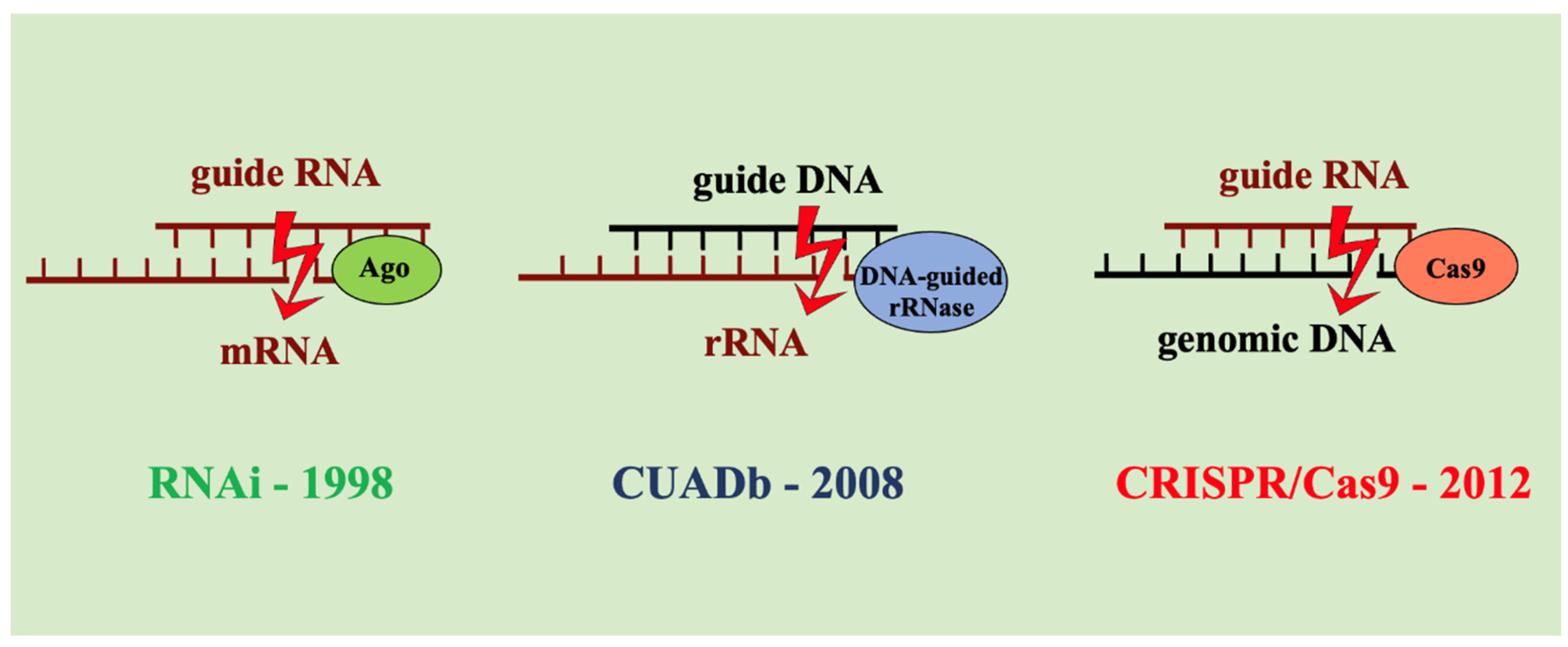
Figure 2.
Origin of 11 economically important insect pests and 1 spider mite.
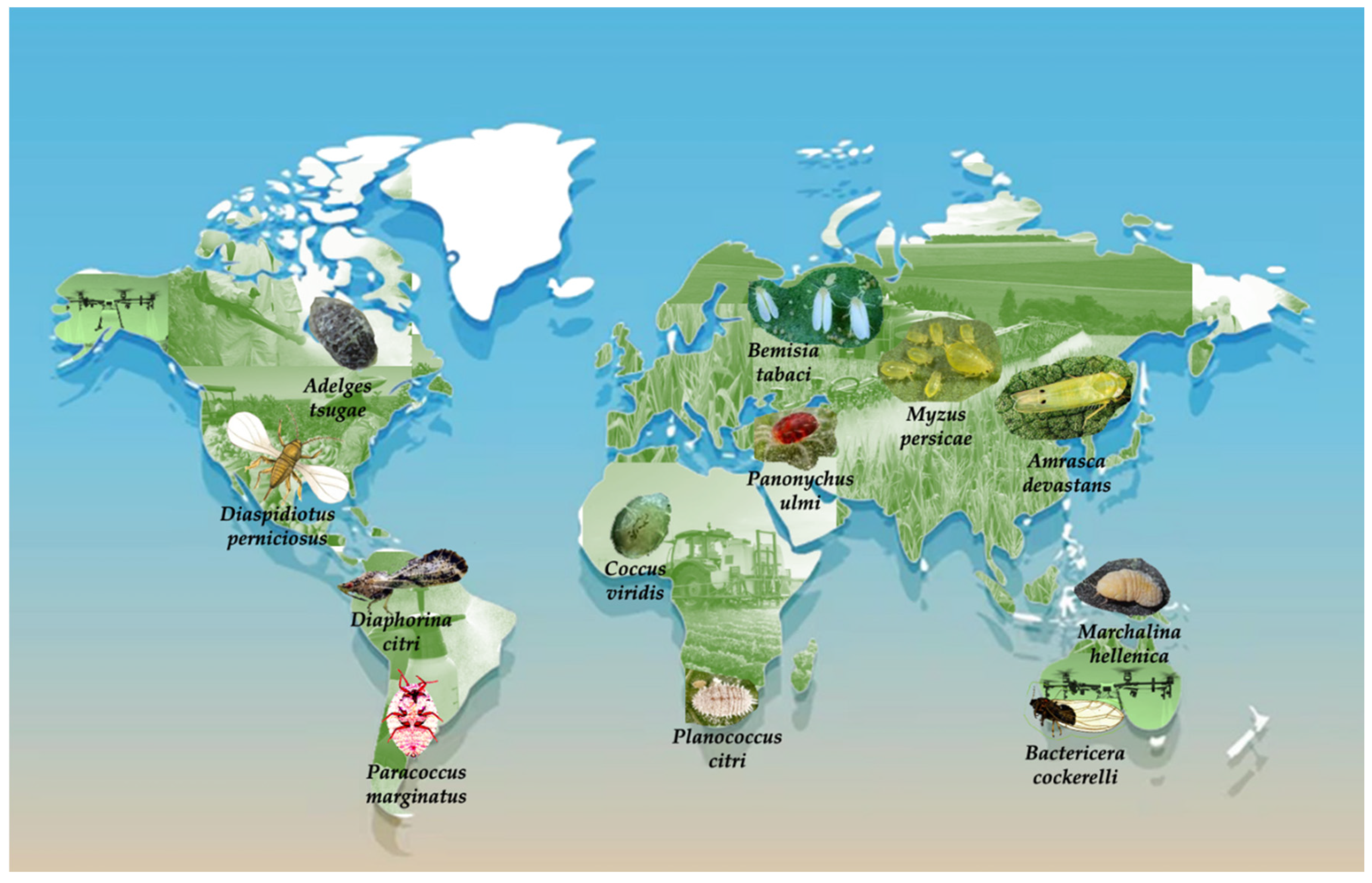

Table 1.
Characteristics of pests and sequences of oligonucleotide pesticides designed for them.
| Common name; Latin name; plant hosts | GenBank ID | Target rRNA | Sequence of oligonucleotide pesticide (5′-3′) | Reference |
| Hemlock woolly adelgid; Adelges tsugae (Annand, 1928); feeds on the long-lived conifer eastern hemlock (Tsuga canadensis) | KT199045.1 | 18S | CACCTTAATGC | (Soltis et al. 2014) |
| San Jose scale; Diaspidiotus perniciosus (Comstock, 1881); feeds on the apple, peach, nectarine, pear, plum and cherry trees | KY085528.1 | 28S | TCCGTTTACCC | (Buzzetti et al. 2015) |
| Papaya mealybug; Paracoccus marginatus (Williams and Granara de Willink, 1992); feeds on a wide variety of taxa, with host plant records for 158 genera in 51 families | AY427410.1 | 28S | TCCATTCATGC | (García Morales et al. 2016) |
| Asian citrus psyllid; Diaphorina citri (Kuwayama, 1908); feeds on the citrus trees | MT038969.1 | ITS2 | AATATTTCAGG | (Alba-Tercedor et al. 2021) |
| Indian cotton jassid; Amrasca biguttula biguttula (Ishida, 1913); feeds on the cotton, both cultivated and wild, and eggplant | ON307472.1 | 28S | TATTCTATCGG | (Cabrera-Asencio et al. 2023) |
| Soft green scale; Coccus viridis (Green, 1889); feeds on the wide range of important crop plants are attacked, including arabica and robusta coffee, citrus, tea, mango, cassava and guava | KP189543.1 |
28S | TCCTGAATTCC | (Kar et al. 2023) |
| Citrus mealybug; Planococcus citri (Risso, 1813); feeds mainly on the citrus orchards and nurseries | XR_010559592.1 | 5.8S | TTCATCGATCC | (Alloui-Griza et al. 2022) |
| Tobacco whitefly; Bemisia tabaci (Gennadius, 1889); feeds with a broad range of host plants including tomato (Solanum lycopersicum L.), eggplant (Solanum melongena L.), okra (Abelmoschus esculentus (L.) Moench), cucumber (Cucumis sativus L.), pepper (Capsicum spp.), potato (Solanum tuberosum L.), soybean (Glycine max (L.) Merr.), cauliflower (Brassica oleracea L.), cassava (Manihot esculenta Crantz), cotton (Gossypium spp.), and several other crops of great economic importance |
MH758096.1 |
28S | CTGATTGTCCC | (Shukla et al. 2016; Abubakar et al. 2022) |
| European red spider mite; Panonychus ulmi (Koch, 1836); feeds various tree and small fruit crops, including apples (Malus domestica (Suckow) Borkh.) | AB926333.1 |
28S | TATGCTACACC | (Joshi et al. 2023; Assouguem et al. 2024) |
| Green peach aphid; Myzus persicae (Sulzer, 1776); feeds on over 40 plant families including Apiaceae (carrot, Daucus carota (Hoffmann)); Asteraceae (lettuce, Lactuca sativa (Linnaeus); artichoke, Cynara cardunculus (L.)); Amaranthaceae (beet, Beta vulgaris (L.); spinach, Spinacia oleracea (L.)); Brassicaceae (broccoli, Brassica oleracea var. italica (L.); brussels sprouts, Brassica oleracea var. gemmifera; cabbage, Brassica oleracea var. capitata (L.) etc. |
LC672084.1 |
16S | TTTATAAATCC | (Ali et al. 2023) |
| Marchalina hellenica (Gennadius, 1883); feeds on the sap of pine trees (Pinus spp.) | EU087875.1 |
28S | TCTTTCCCCGC | (Gounari et al. 2021; Eleftheriadou et al. 2023) |
| Potato psyllid; Bactericera cockerelli (Šulc, 1909); feeds on the potato (Solanum tuberosum L.) and vein-greening in tomato (Solanum lycopersicum L.) | MG988582.1 | 18S |
TTTAATGAGCC | (Munyaneza 2015; Avila et al. 2019) |
Disclaimer/Publisher’s Note: The statements, opinions and data contained in all publications are solely those of the individual author(s) and contributor(s) and not of MDPI and/or the editor(s). MDPI and/or the editor(s) disclaim responsibility for any injury to people or property resulting from any ideas, methods, instructions or products referred to in the content. |
© 2025 by the authors. Licensee MDPI, Basel, Switzerland. This article is an open access article distributed under the terms and conditions of the Creative Commons Attribution (CC BY) license (http://creativecommons.org/licenses/by/4.0/).
Copyright: This open access article is published under a Creative Commons CC BY 4.0 license, which permit the free download, distribution, and reuse, provided that the author and preprint are cited in any reuse.


