

Submitted:
16 August 2025
Posted:
18 August 2025
You are already at the latest version
Abstract
Salvia fruticosa, S. officinalis, S. pomifera ssp. pomifera, S. ringens and S. tomentosa have multiple potential uses in both floriculture and the pharmaceutical industry, with an emphasis on sustainable horticulture and landscaping. Developing efficient protocols for vegetative propagation is an important step for the exploitation of the above species. Thus, research was conducted on the effect of cutting origin (either greenhouse or wild mother plants), season of cutting collection (in November, February, May and August, indicative of the four seasons) and various indole-3-butyric acid (IBA) treatments (either Rhizopon dusting powder 0.5 % w/w IBA or immersion for 1 min in 0-6000 mg L-1 IBA solution) on the rooting of shoot-tip cuttings of the abovementioned Salvias spp. After IBA treatment, cuttings were placed for rooting in a 1:1 (v/v) peat-perlite substrate, under mist, for 2 weeks and on the greenhouse bench in semi-shade for another 4 weeks. Conclusively, more efficient rooting was succeeded by cuttings: i) of S. tomentosa, followed by S. fruticosa and S. pomifera ssp. pomifera, while S. officinalis was the most difficult to root, ii) from greenhouse plants, iii) collected in autumn or spring, and iv) treated with Rhizopon dusting powder, along with some concentrations of IBA solution, depending on the species and season, with the concentration of 1500 mg L-1 being satisfactorily effective in most cases. Higher dry weight values of the rooted cuttings were found in autumn.
Keywords:
Salvia fruticosa
; Salvia officinalis
; Salvia pomifera ssp. pomifera
; Salvia ringens
; Salvia tomentosa
; Lamiaceae
; medicinal aromatic herbs
; cutting origin
; season of cutting collection
; IBA treatment
; aboveground and root weight
1. Introduction
Mediterranean sages (Salvia sp. family Lamiaceae) are medicinal and aromatic plants growing as part of the Maquis shrubland, whose botanical characteristics, adaptation to xerothermic conditions, bee-friendliness and reduced water and cultivation requirements make them suitable for wider ornamental use, in xeriscaping, greenroofs, healing gardens and therapeutic landscapes [1,2,3,4]. Many of them have medicinal, culinary and aromatic uses [5,6], due to many secondary metabolites found in different parts of the plant, which show different biological activities, such as antioxidant, antimicrobial, anticancer [6], serving urban agriculture simultaneously [1]. They are also easily manipulated in hybridization programs aiming to introduce new products to the market [1,7]. Due to their multiple uses, native-to-Greece sage species, namely, Salvia fruticosa, S. officinalis, S. pomifera ssp. pomifera, S. ringens and S. tomentosa worth to be exploited in sustainable horticulture and landscaping, in commercial floriculture, in pharmaceutical and food industry.
S. fruticosa Mill. (S. triloba L.), Greek sage (Figure 1A), is a shrub up to 1.20 m, found in Central Greece, the Peloponnese and the Aegean islands. It has white felted stems and leaves, and flowers with high color variability, pink, lilac, or sometimes white, in March-June. The leaves are used for flavoring and an herbal tea [8,9,10]. S. officinalis L. (Dalmatian sage, or common sage) (Figure 1B) is a strongly aromatic, rather grayish shrub up to 60 cm, found in Northern Greece and the Ionian islands. It has got branches spreading to erect, becoming woody below, leaves greenish above but white felted beneath, flowers violet, blue, pink or white, in May–July [8]. It is cultivated worldwide with many varieties as pharmaceutical and ornamental, as well as for food flavoring [10]. S. pomifera ssp. pomifera, apple sage or Cretan sage, (Figure 1C) is up to 1.00 m high, existing in South Greece, the Aegean islands and West Crete. It has strongly aromatic grey-green oval leaves and pink and violet flowers of intense color, with calyx often reddish-purple, in spring to early summer [8,9]. Its leaves are used in food flavoring or making tea [11,12]. S. ringens Sibth. & Sm. (Figure 1D) is up to 0.30 m high (up to 60 with the inflorescences), spreading in Central Greece, in Mount Olympus, and Northern Greece to the highlands of Macedonia and Epirus. It is woody at base, with segmented leaves, appressed-hairy and dark violet-blue flowers, during late spring through summer [13]. S. tomentosa Miller, balsamic sage (Figure 1E), is up to 0.80 m high, found in North-Eastern and Central Greece and the North-Eastern and Eastern Aegean Islands. It has strongly aromatic evergreen foliage and flowers usually light violet or pink with reddish-brown calyces, from late spring to early summer [8]. It is consumed as an herbal tea in some Mediterranean countries [14].
Apart from their ornamental value, all the above-mentioned sages have important antioxidant and medicinal properties, being used as traditional medicines, while they constitute promising plants for pharmaceutical and food industry. Essential oil and extracts of S. fruticosa show high antimicrobial and antioxidant activity [15,16,17,18,19], possess anti-inflammatory [20] and anticancer properties against melanoma cells [21,22], as well as neuroprotective potential, possibly beneficial against Alzheimer’s disease [23]. It could be considered as natural source of antioxidants, enzyme inhibitors, and antimicrobial agents in medicinal and functional food products [19]. S. officinalis L. is widely used in traditional medicine, by pharmaceutical and food industries, as well as in cosmetics [24,25]. It exhibits potential antioxidant, antimicrobial, anti-inflammatory, neuroprotective, and anti-diabetic properties, being promising in combating various diseases, such as cancer, Alzheimer’s, cardiovascular disorders and diabetes [25,26,27,28,29]. The therapeutic antimicrobial and antibacterial potential of S. officinalis compounds against bovine mastitis [30] or respiratory diseases [31] has been shown, while it is recommended for patients who suffer from hepato- and nephrotoxicity to consume sage flowers [32], as well as in aromatherapy [33]. The polyphenolic content of S. pomifera ssp. pomifera extracts was analyzed, demonstrating weak antibacterial and anticancer activity, but being promising in prevention and treatment of neurological disease, due to noticeable antioxidant and anti-neurodegenerative effects [21,34]. Essential oil and extracts of S. ringens showed strong antioxidant and cytotoxic activity and promising antimicrobial effects [15,35,36,37,38,39], due to high amount of total phenolics, flavonoids, and phenylpropanoids [38]. S. tomentosa has considerable amounts of phenolics, showing powerful antioxidant and antimicrobial activity [14,40], possessing antifungal [41] and antibacterial activity [42,43], as well as showing strong cytotoxicity to cancer cells[ 43]. Its essential oil could be considered as a potential insecticide in agricultural commodities or bacterial agent [44] or natural supplement or antioxidant in cosmetics and food products [45].
In order to explore the five above mentioned native-to-Greece sages, a research project SALVIA-BREED-GR was carried out during period 2019-2022, aiming to promote new sage products suitable for global floriculture market and xeriscaping [3,46]. They were all successfully used in a breeding program and interspecific hybrids between Greek Salvia species were produced [1,7], which were evaluated along with their parental Salvia species regarding their drought resistance in greenhouse [1,47] and green roof conditions [2,47,48,49,50]. All species and hybrids, with a reservation for S. fruticosa, proved suitable for sustainable exploitation in extensive type green roofs in hot and dry climates and generally in xeriscaping.
Effective protocols for the vegetative propagation of the above mentioned Salvia spp. by stem cuttings can be a means for their wider use, as this method of propagation is preferred over sexual propagation, in commercial horticulture, in the case of medicinal and aromatic plants, due to the reproduction fidelity of selected clones with desirable characteristics, and to the often low and unstable germination capacity of their seeds, which is evident for all five of the above Greek sage species [51,52,53]. Clonal multiplication of these species through cuttings can make their cultivation economic by providing true to type plants with optimum levels of active ingredients [54]. There are several reports on rooting cuttings of the most commercially used species S. officinalis [51,55,56,57,58,59,60] and S. fruticosa [61,62,63]. However, our research team was the first that studied propagation by cuttings of S. pomifera ssp. pomifera, S. ringens and S. tomentosa, along with the above two more commercial species [46,64,65,66]. Commercial nurseries of native plants in the Mediterranean can maintain mother plants either in the greenhouse or in the field. Therefore, rooting efficiency, apart from the appropriate rooting hormone treatment for each specific species and differences in mother plant physiology and climatic conditions during rooting, may also be affected by season, as well as by cutting origin, regarding the area of collection and the type of mother plant. The investigation of propagation by cuttings from natural populations is also needed for the successful establishment of new native clones in the nursery.
Adventitious root formation in stem cuttings, which is very useful for vegetative propagation, is controlled by several internal factors, such as genotype, the amount of stored nutrients in cuttings, the age and maturity of tissue, the formation of callus and the presence of leaves and buds on cuttings, or external factors, such as rooting media, chemical and hormone treatments, season, light, temperature, mechanical treatment, water availability and mist spray [54,67,68]. Exogenous application of auxin can improve stem rooting potential, as it causes metabolic changes during the adventitious root formation, that consist of three successive and independent phases, i.e., induction, initiation, and expression [68,69,70,71], that result to the acceleration of rooting rate, as well as the increase of final rooting percentage and the number of produced roots [69]. The type and concentration of rooting hormone depends on the species, type of cutting, growing conditions, season of the year and the cost effectiveness of the rooting hormone components. The choice of the most suitable concentration of rooting hormone is very important for the achievement of a successful plant production, especially in off season production of ornamental crops [67]. The successful rooting also depends on an optimum atmospheric environment, regarding irradiance, temperature, relative humidity, gas exchange, pathogens, and rooting environment (substrate), as it increases rooting percentages and root quality. Temperature and light are two key environmental components that determine rooting success, along with taxa as well [72].
In the present study, the aim was to develop successful propagation protocols of the abovementioned Salvia spp., under various cultivation conditions. For this, it was studied the effect of: a) cutting origin (from greenhouse-grown mother plants or from wild plants), b) the season of cutting collection (autumn, winter, spring, summer), and c) the method of application of the rooting hormone IBA (in the form of dusting powder or by immersion in IBA alcoholic solution of various concentrations), on the rooting rate and the quality characteristics of the above-ground and underground part of the produced rooted cuttings. The results were presented both comparatively for all species and per species, while they were discussed in comparison with factors such as genotype, morphological-physiological state of mother plants and climatic conditions at the collecting regions and in the greenhouses, where greenhouse mother plants were maintained or rooting of cuttings took place.
2. Materials and Methods
2.1. Rooting of Cuttings
Shoot-tip cuttings of Salvia fruticosa (Figure 1F), S. officinalis (Figure 1G), S. pomifera ssp. pomifera (Figure 1H), S. ringens (Figure 1I) and S. tomentosa (Figure 1J), 8-12 cm long, were collected either from mother plants maintained in a glass greenhouse (Greenhouse A) at the Agricultural University of Athens (AUA) (37°58’53.94” N, 23°42’25.01” E) or from wild plants growing in the following locations. The Southern Greek species, S. pomifera ssp. pomifera, was collected from Leonidio (37°11’59.7” N, 23°53’38.5” E, at an altitude of 50 m), while the Central Greek species, Salvia fruticosa, from Mount Hymettus (37°59’28.6” N, 23°49’52.0” E, at an altitude of 325 m). The Northern Greek species, S. officinalis and S. ringens, were collected from Arnissa (40°49’10.2”N, 21°44’16.3”E, at an altitude of 600 m), and S. tomentosa, from Thassos Island (40°44’95”N, 24°43’44”E, at an altitude of 130 m). The collections were made in November 2020, February, May and August 2021, for autumn, winter, spring and summer respectively, indicative of the four seasons of the year. After each collection of cuttings, greenhouse mother plants were fertilized monthly with 2 g/L (100 ml of fertilizer per pot) water soluble fertilizer (20-20-20plus, HUMOFERT, Metamorfosi, Attika, Greece). All collections were made from the same, either greenhouse grown or wild, mother plants, at three-month intervals.
Rooting of cuttings took place in another glass greenhouse (Greenhouse B), where a mist system is established and which is next to Greenhouse A. Cuttings were treated either with Rhizopon dusting powder (0.5% w/w IBA, Phytorgan, Nea Kifisia, Attika, Greece) or by immersing their base (around 1.5 cm of the bottom) for 1 min in an IBA solution (50% ethanol) of concentration 0 (control), 500, 1500, 3000, 4500 or 6000 mg L-1. Then, they were placed for rooting in plastic square plug trays (cell dimensions: 5.0 × 5.0 × 5.0 cm), containing a peat (High-more with adjusted pH up to 5.5 to 6.5, Klasmann-Delimann Gmbh, Geeste, Germany) and perlite (particles diameter 1 to 5 mm, Perloflor, ISOCON S.A., Athens, Greece) mixture 1: 1 (v/v), in a mist system for 2 weeks. The mist system was set to spray for 15 sec per 15 min from May to September and per 30 min from October to April and substrate temperature was maintained at 22°C by thermostatically controlled electric heating cable. Afterwards, the cuttings were transferred on the greenhouse bench, in a semi-shaded location for another 4 weeks.
At the end of the experiment, rooting percentage (%) of cuttings was recorded. During the seventh week from the start of each rooting experiment, a destructive experiment was performed on the rooted cuttings, in order to estimate fresh and dry weight of the aboveground and underground part of the rooted cuttings.
2.2. Climatic Data of Wild Cutting Collectionregions
The climatic conditions, i.e., average, maximum and minimum monthly air temperature (°C) and average monthly relative humidity (%), at the regions where cuttings were collected from wild plants, during the cutting collection period from October 2020 to August 2021, are presented in Figure 2. These climatic data were provided from the Hellenic National Meteorological Service and were taken from the most adjacent meteorological station to each region of cuttings collection. So, the data regarding the regions of Leonidio (Figure 2A and 2B), Hymettus (Figure 2C and 2D), Arnissa (Figure 2E and 2F) and Thassos (Figure 2G and 2H) were recorded at the meteorological stations that are established in the regions of Astros, Spata, Kozani and Kavala, respectively.
2.3. Climatic Data from the Experimental Greenhouses A and B
The climatic conditions, i.e., average, maximum and minimum monthly air temperature (°C) and average, maximum and minimum monthly relative humidity (%), inside the two glass greenhouses of the Laboratory of Floriculture and Landscape Architecture of AUA, during the experimental period from October 2020 to October 2021, were recorded using waterproof data loggers HOBO U23 Pro V2, type U23-001 (ONSET, U.S.A.) and they are presented in Figure 3. Climatic data from Greenhouse A, where mother plants were maintained, are shown in Figure 3A and 3B, while data from Greenhouse B, where rooting of cuttings took place, are presented in Figure 3C and 3D.
2.4. Statistical Analysis
The completely randomized design and three or four repetitions of ten cuttings per treatment were used, for cuttings from greenhouse plants and native plants, respectively. The significance of the results was tested by one- or two- or three- or four-way analysis of variance (ANOVA) and treatment means were compared by Student’s t-test at p≤0.05. The data on percentage were statistically analyzed after arcsine transformation.
3. Results
Investigating the effect of the four experimental factors, i.e., Salvia species, origin of cutting, season of cutting collection, and rooting hormone treatment, on rooting percentage of the cuttings, as well as on fresh and dry weight of the aboveground and underground part of the rooted cuttings, the four-way ANOVA showed significant interactions among the factors (Table 1).
From the mean values of each factor, the following were observed:
a) Regarding Salvia species, the highest rooting percentage was recorded for S. tomentosa, followed by S. fruticosa, whereas S. officinalis presented the lowest rooting percentage. Fresh and dry weight of aboveground and underground parts of rooted cuttings were all higher in S. pomifera ssp. pomifera (Table 1).
b) As regards cutting origin, cuttings from greenhouse plants rooted at higher percentage than cuttings collected from wild plants. However, fresh and dry weight of aboveground and underground parts of rooted cuttings were all higher in cuttings collected from wild plants (Table 1).
c) Regarding season of cutting collection, higher rooting percentage was achieved in autumn, followed by spring, while fresh and dry weight of aboveground and underground parts of rooted cuttings were also higher in autumn. Winter was excluded from this statistical analysis of fresh and dry weights, because of missing data, as some Salvia spp. did not root in this treatment (Table 1).
d) As regards rooting hormone treatment, the use of Rhizopon dusting powder gave the highest rooting percentage, while the concentrations of alcoholic IBA solutions from 1500 to 6000 mg L-1 were equally effective among each other, but at a little lower percentage than Rhizopon. Fresh weights of aboveground and underground parts were higher in rooted cuttings treated with Rhizopon. In corresponding dry weights, apart from Rhizopon, IBA solutions from 1500 to 4500 mg L-1 also presented high values. The control (0 mg L-1 IBA) was excluded from this statistical analysis of fresh and dry weights, because of missing data, as some Salvia sp. did not root in this treatment (Table 1).
Subsequently, the statistical processing of the results was done separately per Salvia sp., by three-way ANOVA, in order to examine the effect of cutting origin, season of cutting collection and rooting hormone treatment on recorded parameters. Rooting percentages of cuttings of each Salvia sp. were also analyzed by one-way ANOVA, in order to find the optimum rooting hormone treatment per season and cutting origin.
3.1. Rooting Cuttings of S. fruticosa
Regarding the effect of the experimental factors on rooting of S. fruticosa cuttings, higher rooting percentages were recorded: i) by cuttings from greenhouse plants than from wild mother plants, ii) in autumn and iii) after treatment with IBA, specifically with Rhizopon or IBA solution 1500-4500 mg L-1 (Table 2).
Rooting of cuttings collected from greenhouse plants in autumn was not affected by rooting hormone treatment, and cuttings rooted equally well even in the control (83-100%, Figure 4A). Similarly, in spring rooting was not affected by rooting hormone, but rooting percentages were lower compared to autumn (27-70%, Figure 4E). In the other two seasons IBA was necessary for rooting as in the control rooting was lower than 10%. The use of Rhizopon dusting powder was the best treatment, as well as IBA solutions with concentrations ≥ 1500 mg L-1 in winter (67-90%, Figure 4C) and ≥ 500 mg L-1 in summer (60-100%, Figure 4G). In cuttings from wild plants, higher rooting percentages were observed: in autumn, in solutions with IBA concentration ≥ 3000 mg L-1 (65-80%, Figure 4B); in winter, after treatment with IBA independently of type and concentration (40-65%, Figure 4D); in spring, after treatment with Rhizopon or an IBA solution of concentration ≥ 1500mg L-1 (55-85%, Figure 4F); in summer, only after treatment with Rhizopon (83%, Figure 4H).
Fresh and dry weight of the aboveground part of the rooted cuttings of S. fruticosa were higher: i) in cuttings from wild mother plants, ii) in autumn and iii) after treatment with Rhizopon or IBA solution at 1500 mg L-1, excluding the control, which was not used in statistical analysis because there was no rooting in it in the autumn (Table 2, Figure 5).
Regarding fresh and dry weight of the underground part of the rooted cuttings: i) these were also higher in cuttings from wild mother plants, ii) fresh weight was higher in autumn and winter and dry weight in winter and iii) fresh weight was higher after treatment with Rhizopon or IBA solution at 4500-6000 mg L-1 and dry weight after treatment with Rhizopon or 6000 mg L-1 IBA solution (Table 2, Figure 5).
3.2. Rooting Cuttings of S. officinalis
Regarding the effect of the experimental factors on rooting of S. officinalis cuttings, higher rooting percentages were recorded: i) by cuttings from greenhouse plants, ii) in spring and iii) after treatment with IBA as Rhizopon dusting powder or solution at the concentration of 6000 mg L-1 that was effective in all seasons (Table 3, Figure 6).
In cuttings collected from greenhouse plants, in autumn the rooting percentage (53-73%) was not affected by any treatment (Figure 6A), in contrast to the other seasons, in which higher rooting percentages were observed: in winter, after immersion in a solution of 4500 or 6000 mg L-1 IBA (85%) (Figure 6C); in spring, after treatment with Rhizopon or immersion in a solution of 1500-4500 mg L-1 IBA (74-96%, Figure 6E); in summer, after immersion in a solution with 6000 mg L-1 IBA (70%, Figure 6G). Cuttings from wild plants generally rooted at low percentages (0-43%) and their response was not affected by any treatment (Figure 6B, D, H), except in spring, when higher rooting percentages (43-65%) were observed after use of Rhizopon or immersion in an IBA solution of concentration ≥ 1500 mg L-1 (Figure 6F). Especially in winter or after treatment with the control, cuttings from wild plants presented almost zero rooting percentages (Figure 6B, D, F, H).
Regarding the fresh and dry weight of the aboveground and underground parts of rooted cuttings, these were higher in cuttings from greenhouse mother plants, as well as in autumn compared to other seasons, excluding winter that was not used in the statistical analysis. Dry weight of underground part in spring was equally high to autumn. On the other hand, there were no differences among the IBA treatments, excluding the control that was not used in the statistical analysis (Table 3, Figure 7).
3.3. Rooting Cuttings of S. pomifera ssp. Pomifera
Regarding the effect of the experimental factors on rooting of S. pomifera ssp. pomifera cuttings, higher rooting percentages were recorded: i) by cuttings from greenhouse plants, ii) in autumn and iii) after treatment with Rhizopon or IBA solution at concentrations 1500-6000 mg L-1 (Table 4).
The rooting percentages of S. pomifera ssp. pomifera cuttings collected from greenhouse plants in autumn (63-87%, Figure 8A) and summer (65-77%, Figure 8G) were not affected by the IBA treatment. On the other hand, in winter a higher rooting percentage of cuttings was observed after the use of Rhizopon powder (93%, Figure 8C), while in spring after treatment with Rhizopon or immersion in a solution with 1500-4500 mg L-1 IBA (63-87%, Figure 8E). In cuttings collected from wild plants, only in summer rooting was not affected by the ΙΒA treatment, but rooting was extremely low in that season (3-25%, Figure 8H). In the other seasons, higher rooting percentages were achieved after: i) immersion in a solution with 6000 mg L-1 IBA in autumn (93%, Figure 8B), ii) immersion in a solution with 3000-6000 mg L-1 IBA in winter (68-78%, Figure 8D) and treatment with Rhizopon or immersion in a solution with 4500 or 6000 mg L-1 IBA in spring (65-73%, Figure 8F).
Fresh and dry weight of the aboveground and underground parts of the rooted cuttings were higher in cuttings: i) from wild mother plants, ii) collected in autumn and iii) treated with Rhizopon (Table 4, Figure 9). Other IBA treatments that were equally effective to Rhizopon were solutions with 1500-4500 mg L-1 IBA in case of aboveground part and solution with 4500 mg L-1 IBA in case of underground part (Table 4, Figure 9).
3.4. Rooting Cuttings of S. ringens
As regards the effect of the experimental factors on rooting of S. ringens cuttings, higher rooting percentages were recorded: i) by cuttings from greenhouse plants, ii) in autumn and iii) after treatment with Rhizopon or IBA solution at concentrations 1500-3000 mg L-1 (Table 5).
Regarding S. ringens cuttings collected from greenhouse plants, treatment with rooting hormone was essential for their successful rooting in winter (53-87%, Figure 10C) and summer (up to 50% Figure 10G), while in autumn and spring rooting was equally good in treatment with rooting hormone (45-75% and 50-87%, respectively) and the control (70 and 50%, respectively) (Figure 10A, E). The form and concentration of IBA had no significant effect on the rooting percentage in spring (Figure 10E), while in autumn the two highest concentrations of IBA solution limited rooting to 45% (Figure 10A). Rhizopon as well as solution with 500 mg L-1 IBA showed the highest rooting percentages in all seasons, but other IBA concentrations also induced equally high rooting, with unstable results in summer (Figure 10G). In cuttings collected from wild plants, in winter (18-50%) and summer (27-63%), there was no significant effect of the IBA treatment (Figure 10D, H). In autumn, higher rooting percentages were achieved in all hormone treatments (60-75%) compared to the control (33%) (Figure 10B), while in spring higher percentages were noted in the treatments with 500 and 1500 mg L-1 IBA (48-58%) (Figure 10F).
Fresh and dry weight of aboveground part were higher in rooted cuttings from wild mother plants and in those collected in autumn, while there were no differences among IBA treatments, excluding the control that was not used in the statistical analysis (Table 5, Figure 11). Fresh weight of underground part was higher in rooted cuttings: i) from wild mother plants, ii) collected in autumn and iii) treated with Rhizopon or solution with 3000-4500 mg L-1 IBA. However, dry weight of underground part was not affected by cutting origin and IBA treatment, while it was higher in autumn compared to other seasons (Table 5, Figure 11).
3.5. Rooting Cuttings of S. tomentosa
As regards the effect of the experimental factors on rooting of S. tomentosa cuttings, rooting percentages were not affected by mother plant origin, while higher rooting percentages were recorded in autumn and spring and after treatment with Rhizopon or IBA solution at concentration 1500 mg L-1 (Table 6).
In cuttings of S. tomentosa from greenhouse plants, higher rooting percentages were achieved: in autumn, after treatment with Rhizopon, the control and after immersion in a solution with 500-3000 mg L-1 IBA (67-90%, Figure 12A); in winter, after treatment with Rhizopon or immersion in a solution with 500-4500 mg L-1 IBA (65-75%, Figure 12C); in spring, no statistically significant differences were observed (63-100%, Figure 12E); in summer, after immersion in a solution with 500 and 1500 mg L-1 IBA (73-87%, Figure 12G). In cuttings from wild plants, IBA treatment had no significant effect on the rooting percentage of cuttings (55-98%, Figure 12B, F, H), except in winter, when the treatment with Rhizopon was the best (80%, Figure 12D).
Fresh and dry weight of the aboveground and underground part were higher in rooted cuttings: i) from wild mother plants, ii) collected in autumn and iii) treated with Rhizopon or solution with 1500-3000 mg L-1 IBA (Table 6, Figure 13). Besides, dry weight of underground part in spring was equally high to that in autumn.
3.6. Comparative Evaluation of the Rooting Percentage of the Five Species and Two Types of Salvia Cuttings in the Best Treatments
A comparative evaluation of the rooting percentage of the five species and two types of origin of Salvia cuttings was carried in autumn and spring, seasons where rooting took place at higher percentages (Table 1) using IBA solution at concentration 1500 mg L-1 and the control. This IBA treatment was preferred over Rhizopon because it is easier to use in commercial floriculture and gave equally good results in most cases with higher concentration IBA solutions (Table 1). This comparison showed that the greenhouse cuttings rooted at higher rates than the wild ones, especially in autumn, where the use of IBA was not necessary to achieve high rooting, while in spring, with the exception of cuttings of both types of origin of S. tomentosa, in the other species the use of IBA was necessary to achieve high rooting (Figure 14).
4. Discussion
Of the Mediterranean Salvia spp. studied in this work, some are already used and others have the potential to be used in the pharmaceutical industry, the food industry, as aromatic and culinary species, and in floriculture, with an emphasis on sustainable gardening and landscape architecture. In view of the climate crisis, the exploitation of native species for use in urban green, resistant to high temperatures and drought, is essential for the countries of the eastern Mediterranean where water scarcity is already a major issue [73].
Propagation by cuttings is the method that facilitates the nursery production of ornamental landscape plants on a commercial scale. During our research on the rooting of stem cuttings of five Mediterranean Salvia spp., both internal (Salvia sp. and cutting origin) and external (collection season and rooting hormone treatment) factors affected their rooting efficiency, consistent with previous knowledge that adventitious root formation can be controlled by all these factors [54,67,68]. Thus, the results were discussed in comparison with factors such as genotype, climatic conditions in the periods and regions of cuttings collection, the morphological, physiological and/or biochemical state of the mother plants at the time of cuttings collection and climatic conditions during the rooting stage.
Regarding Salvia spp., S. tomentosa was the most capable of rooting, regardless of the origin of the mother plant and the season, probably because its stem-tip cuttings, even those from wild mother plants, remained soft to semi-woody throughout the year unlike other species, whose stems were gradually lignified during summer to winter period. S. fruticosa and S. pomifera ssp. pomifera presented intermediate rooting ability, while S. officinalis had the lowest rooting ability of all studied Salvia spp., especially when its cuttings were collected from wild mother plants, probably because of the higher degree of stems’ lignification. The extremely low temperatures (close to 0°C) recorded in Arnissa (the collection region of S. officinalis) during the January-February period may also be a reason for the zero rooting of wild cuttings of this species in winter (Figure 2E). In the other regions, from where the other Salvia spp. were collected, the minimum temperature was over 4 °C during winter months (Figure 2A, 2C and 2G), while in the greenhouse A, where greenhouse mother plants of all Salvia spp. were maintained, the temperature was over 10 °C during the same period (Figure 3A). Besides, winter cuttings of S. officinalis from wild mother plants were semi-defoliated and resembled shoots of deciduous shrubs, probably as an adaptation to the severe winter of the collection region. In propagation by stem-cutting, the larger photosynthetic surface area and subsequent higher carbohydrate supply likely increase the rooting success percentage until other factors, such as evapotranspiration, become limiting [74].
There is a study that showed higher rooting efficiency of greenhouse-origin cuttings of S. officinalis (72%) compared to S. fruticosa (50%) after treatment with 1000 mg L-1 IBA solution during the June-October period [55], in contrast to the results of our research, where S. fruticosa showed significantly higher rooting percentages (80-90%) compared to S. officinalis (50-70%) during the same season and under similar IBA treatments. Different clones that may have been used probably explain these conflicting results.
In our initial experiment, which aimed to obtain mother plants and plant clones with desirable characteristics for future crosses (research project SALVIA-BREED-GR) [1,46], shoot-tip cuttings of S. fruticosa, S. pomifera ssp. pomifera and S. ringens, collected from wild plants in spring, rooted at higher percentages (over 80%) after treatment with IBA dusting powder or immersion for 1 min in a solution with 2000 or 3000 mg L-1 IBA (higher concentration was not tested), than in the present study under the same conditions, while S. officinalis and S. tomentosa showed a similar response to that of the present study (50% and over 80%, respectively) [64]. This rooting instability of wild-origin cuttings of some species can be attributed to the physiology of the cutting because of the different conditions from year to year that prevail in the growth environment of the wild mother plants. Cuttings from wild plants of S. fruticosa in autumn and winter and S. pomifera ssp. pomifera in summer also presented greater difficulty in rooting, probably because of the same reasons, i.e., the lignification of the stem and the physiology of mother plants. Leonidio, the collection region of S. pomifera ssp. pomifera cuttings, was the southernmost collection region and thus during the summer the highest temperatures were recorded compared to other collection regions, while at the same time the relative humidity was the lowest compared to other seasons. So, these conditions probably led to the stress of wild mother plants of this species and the lignification of the cuttings, resulting in rooting percentages lower than 20%.
As regards cutting origin, greenhouse cuttings rooted more efficiently than wild cuttings, with the exception of S. tomentosa, in which cuttings of both origins rooted very satisfactorily (70-95% rooting). As mentioned above, this may be due to the restricted lignification of wild S. tomentosa stems. The superiority of cuttings from greenhouse mother plants in rooting could be devoted to the fact that greenhouse plants were maintained at a vegetative stage through the collection of cuttings every three months that prevented plants from flowering, the monthly fertilizations, the regular irrigation and the control of climatic conditions inside greenhouse A, that prevented the lignification of the stems. On the other hand, wild mother plants underwent greater fluctuations in temperature and relative humidity, periods of drought during summer, especially in the Southern collection regions, or frost during winter, especially in the Northern collection regions, and most importantly, they completed the physiological stages of flowering and fruiting, as well as that of the lignification of shoots. Moreover, the greenhouse mother plants were about two years old and were staying small and probably juvenile because of the successive collections of cuttings every three months. As a result, after each collection of cuttings, new shoots should sprout and elongate in order to take the following collection. On the other hand, the wild mother plants were larger, adult plants and even when cuttings were collected, many shoots were remaining. So, the cuttings that were collected in the following collection were not necessarily new sprouts, but probably older shoots that were further grown and more lignified. In general, cuttings from young plants exhibit higher rooting ability, due to the increased content of endogenous auxins and other rooting promoters, compared to those from mature plants [75,76].
However, the development of aboveground and underground parts of rooted cuttings was greater in cuttings derived from wild mother plants. This may be due to the fact that wild cuttings were more robust than the greenhouse ones, while they may have contained more starch, carbohydrates and nutrients that enabled the production of a richer root system and the development of a better above-ground part of the rooted cuttings, depending on the species and treatment. In our preliminary experiments with S. fruticosa, apart from cutting origin (greenhouse or wild), cutting position on the stem (tip or basal cutting) also affected their response [61].
Regarding the season of collection, all species rooted more efficiently in autumn, followed by spring, with the exception of S. tomentosa, whose cuttings rooted in spring equally effectively to autumn and S. officinalis, whose cuttings rooted better in spring, in verification of Nanos et al. [60], who also found higher rooting percentage of S. officinalis cuttings from wild plants in spring (63%) compared to other seasons (0-30%). The best results of rooting stem cuttings of S. officinalis and Melissa officinalis were achieved before plant flowering in spring and after flowering in August, which coincides with the beginning and end of mother plant vegetation [57], whereas according to Nikola et al. [55], the best period for rooting of S. officinalis, using greenhouse cuttings, was from spring to the end of autumn, although winter rooting was not tested in this work. Regarding our experiments, greenhouse cuttings of all species rooted more efficiently during the period from autumn to spring, excepting S. fruticosa, whose cuttings rooted at the lowest percentage in spring, probably because of insufficient lignification as they were too tender and therefore perhaps deficient in carbohydrates [65]. The rooting ability of many cuttings has been correlated with their carbohydrate content. In several case it has been indicated that carbohydrates of free reducing sugars and storage carbohydrates were important to root formation being energy and structural materials of cell for the initiation of the primordial root [77,78,79].
The rooting of wild cuttings was more affected by season than the rooting of greenhouse cuttings, probably because of the different physiological state of wild mother plants and the different lignification level of their stems among the four seasons, as also argued by Nanos et al. [60]. Cutting response may also have been affected by the greater fluctuations of climatic conditions at the collection regions compared to the greenhouse A, while climatic conditions during rooting of cuttings inside greenhouse B may also have negatively affected rooting during winter and summer, due to lower and higher temperatures and radiation, respectively. Higher values of dry weight of the underground part of rooted cuttings were found in autumn, which indicates that semi-woody cuttings formed a richer root system, probably providing higher carbohydrate content, as the amount and mobilization of carbohydrates towards the base of the cuttings are key factors influencing rooting [79].
As regards rooting hormone treatments, the use of Rhizopon dusting powder was particularly effective in most cases for all species, due to the application of a concentrated auxin dose to the cutting base that remains for a longer period compared to dipping in auxin solution, probably resulting to a more efficient auxin absorption and action. Besides, immersion for 1 min in certain concentrations of IBA alcoholic solution, from 1500 to 6000 mg L-1, was equally effective, depending on the species and the season, with the concentration of 1500 mg L-1 standing out as effective in most cases. The powder application method and the basal quick-dip method have been the most commonly used methods for applying auxin to cuttings in commercial horticulture for over 7 decades [80], increasing rooting rate and final percentage in leafy cuttings [69].
The development of aboveground and underground parts of rooted cuttings was benefited by the use of Rhizopon, as well as by immersion of cutting base in solution with 1500-4500 mg L-1 IBA. The positive effect of using rooting products on root system development of S. officinalis has already been reported [51,58], as they significantly increased the rooting percentage compared to the control [60], enhanced out-of-season rooting [81] and ensured the proper rooting of cuttings for earlier transplanting [58]. Application of auxin as a low-dose solution (up to 240 mg L-1 for IBA and NAA and 400 mg L-1 for IAA) with immersion in the solution for a long time (24 h) was also effective for rooting of S. fruticosa, with higher doses being more effective and causing a notable increase in the number and weight of roots [62].
5. Conclusions
Propagation by stem cuttings is the most common method used in the case of medicinal and aromatic herbs, due to its easy and economic application and the regeneration of selected genotypes. However, the ability of cuttings to root may depend on species, physiological state of mother plant, time of cutting collection, climatic conditions, as well as the application of auxin at the appropriate type and concentration. These factors were investigated in rooting stem cuttings of the five native-to-Greece Mediterranean Salvia spp., aiming to the development of sufficient propagation protocols that would facilitate their wider exploitation in sustainable horticulture, since they have many uses in commercial floriculture and pharmaceutical industry, in landscaping, in plant breeding, in greenroofs, in therapeutic gardens, as bee-friendly plants etc.
Although all five Salvia species were capable of rooting throughout the year, S. tomentosa was the most efficient, followed by S. fruticosa and S. pomifera ssp. pomifera, whereas S. officinalis presented difficulties, especially when cuttings were collected from wild mother plants. Cuttings from greenhouse mother plants generally rooted more efficiently than cuttings from wild plants for all species. Autumn and spring proved better seasons for cutting collection compared to winter or summer. Treatment with rooting hormone improved rooting in most cases and the use of IBA dusting powder (Rhizopon 0.5% w/w IBA) was distinguished for all species, along with immersion for 1 min in an alcoholic solution with 1500 mg L-1 IBA, although IBA concentrations up to 6000 mg L-1 were occasionally more effective, depending on the species, cutting origin and collection season. Aboveground and underground parts of rooted cuttings were increased in cuttings from wild mother plants and in those collected in autumn, as well as after the use of Rhizopon or the immersion of cutting base in a solution with 1500-4500 mg L-1 IBA.
For the unhindered production of rooted cuttings of the studied Salvia spp. throughout the year, it is recommended to keep mother plants in a heated greenhouse and treat the cuttings with IBA either as dusting powder (0.5 w/w IBA) or as an alcoholic solution (immersion time 1 min, 1500 mg L-1 the indicated IBA concentration with the need to increase this up to 6000 mg L-1 as appropriate).
Author Contributions
Conceptualization, M.P.; methodology, A.N.M., K.B., G.V. and M.P.; validation, A.N.M., K.B., G.V. and M.P.; formal analysis, A.N.M. and K.B.; investigation, A.N.M., K.B. and G.V.; resources, M.P.; data curation, A.N.M. and K.B.; writing—original draft preparation, A.N.M. and M.P.; writing—review and editing, A.N.M. and M.P.; visualization, A.N.M.; supervision, M.P.; project administration, M.P.; funding acquisition, M.P. All authors have read and agreed to the published version of the manuscript.
Funding
This research has been co-financed by the European Regional Development Fund of the European Union and Greek national funds through the Operational Program Competitiveness, Entrepreneurship and Innovation, under the call RESEARCH – CREATE – INNOVATE (Project code: T1EDK-04923, Project: SALVIA-BREED-GR).
Data Availability Statement
Not applicable.
Conflicts of Interest
The authors declare no conflict of interest. The funders had no role in the design of the study; in the collection, analyses, or interpretation of data; in the writing of the manuscript, or in the decision to publish the results.
References
- Papafotiou, M.; Martini, A.N.; Papanikolaou, E.; Stylias, E.G.; Kalantzis, A. Hybrids development between Greek Salvia species and their drought resistance evaluation along with Salvia fruticosa, under attapulgite-amended substrate. Agronomy 2021, 11, 2401. [Google Scholar] [CrossRef]
- Papafotiou, M.; Martini, A.N.; Tassoula, L.; Stylias, E.G.; Kalantzis, A.; Dariotis, E. Acclimatization of Mediterranean native sages (Salvia spp.) and interspecific hybrids in an urban green roof under regular and reduced irrigation. Sustainability 2022, 14, 4978. [Google Scholar] [CrossRef]
- Papafotiou, M.; Vlachou, G.; Martini, A.N. Investigation of the effects of the explant type and different plant growth regulators on micropropagation of five Mediterranean Salvia spp. native to Greece. Horticulturae 2023, 9, 96. [Google Scholar] [CrossRef]
- Varela-Stasinopoulou, D.S.; Nektarios, P.A.; Tsanakas, G.F.; Ntoulas, N.; Roukounakis, G.I.; Economou, A.S. Impact of substrate depth and irrigation regime on growth, flowering and physiological indices of Greek sage (Salvia fruticosa Mill.) grown on urban extensive green roof systems. Ecol. Eng. 2023, 186, 106816. [Google Scholar] [CrossRef]
- Kamatou, G.P.P.; Viljoen, A.M.; Steenkamp, P. Antioxidant, antiinflammatory activities and HPLC analysis of South African Salvia species. Food Chem. 2010, 119, 684–688. [Google Scholar] [CrossRef]
- Uysal, I.; Koçer, O.; Mohammed, F.S.; Lekesiz, Ö.; Doğan, M.; Şabik, A.E.; Sevindik, E.; Gerçeker, F.Ö.; Sevindik, M. Pharmacological and nutritional properties: Genus Salvia. Adv. Pharmacol. Pharm. 2023, 11, 140–155. [Google Scholar] [CrossRef]
- Martini, A.N.; Stylias, E.G.; Papafotiou, M.; Kalantzis, A.; Bertsouklis, K.F. Interspecific crossability as a means to improve Mediterranean sage species with ornamental value. Acta Hortic. 2022, 1345, 425–430. [Google Scholar] [CrossRef]
- Blamey, M.; Grey-Wilson, C. Mediterranean wild flowers; Publisher: Harper Collins Publishers, London, UK, 1993; pp. 401–402. [Google Scholar]
- Thanos, C.A.; Doussi, M.A. Ecophysiology of seed germination in endemic labiates of Crete. Isr. J. Plant Sci. 1995, 43, 227–237. [Google Scholar] [CrossRef]
- Schmiderer, C.; Novak, J. Salvia officinalis L. and Salvia fruticosa Mill.: Dalmatian and Three-Lobed Sage. In: Medicinal, Aromatic and Stimulant Plants. Handbook of Plant Breeding; Novak, J., Blüthner, WD., Eds;Publisher: Springer, Cham, Switzerland, 2020; Volume 12, pp. 523–537. [CrossRef]
- Karousou, R.; Vokou, D.; Kokkini, S. Distribution and essential oils of Salvia pomifera subsp. pomifera (Labiatae) on the island of Crete (S Greece). Biochem. Syst .Ecol .1998, 26(8), 889-897. [CrossRef]
- Dweck, A.C. 2000. The folklore and cosmetic use of various Salvia species. In Sage: The Genus Salvia; Kintzios, S.E., Ed.; Publisher: Harwood Academic, USA, 2000; pp. 1–26. [Google Scholar]
- Tutin, T.G.; Heywood, V.H.; Burges, N.A.; Moore, D.M.; Valentine, D.H.; Walters, S.M.; Webb, D.A. Flora Europaea, Diapenstaceae to Myoporaceae, Volume 3; Publisher: Cambridge University Press, Great Britain, UK, 1972; pp. 188–190. [Google Scholar]
- Dinçer, C.; Tontul, I.; Çam, İ.B.; Özdemir, K.S.; Topuz, A.; Nadeem, H.Ş.; AY, S.T.; Göktürk, R.S. Phenolic composition and antioxidant activity of Salvia tomentosa Miller: effects of cultivation, harvesting year, and storage. Turk. J. Agric. For. 2013, 37(5), 561–567. [Google Scholar] [CrossRef]
- Stojanović, D.; Marčetić, M.; Ušjak, D.; Milenković, M. Composition and antimicrobial activity of essential oils of Salvia fruticosa and Salvia ringens (Lamiaceae). Vojnosanitetski Pregled 2022, 79, 62–68. [Google Scholar] [CrossRef]
- Bozyel, M.E.; Canli, K.; Benek, A.; Simsek, O.; Akata, I.; Altuner, E.M. Biochemical composition, and in vitro antimicrobial and antioxidant activities of Salvia fruticosa, an ethnomedicinal plant. Appl. Ecol. Environ. Res. 2023, 21, 3243–3256. [Google Scholar] [CrossRef]
- Dawra, M.; Bouajila, J.; El Beyrouthy, M.; Abi Rizk, A.; Taillandier, P.; Nehme, N.; El Rayess, Y. Chemical characterization and antioxidant, antibacterial, antiacetylcholinesterase and antiproliferation properties of Salvia fruticosa Miller extracts. Molecules 2023, 28, 2429. [Google Scholar] [CrossRef] [PubMed]
- Karneeb, S.; Baydoun, S.; Nasser, H.; Arnold-Apostolides, N.; El-Dakdouki, M.H. Chemical composition, antioxidant and hemolytic activities of sage (Salvia fruticosa Miller) cultivated in Lebanon. BAU Journal-Science and Technology 2023, 4. [Google Scholar] [CrossRef]
- Aslan, K.; Kopar, E.E.; Kelle, K.; Karageçili, H.; Yilmaz, M.A.; Cakir, O.; Alwasel, S.; Gulcin, I. Phytochemical profile and bioactive properties of sage (Salvia fruticosa) and thyme (Thymus vulgaris) extracts. Int. J. Food Prop. 2025, 28. [Google Scholar] [CrossRef]
- Alqudah, A.; Qnais, E.; Gammoh, O.; Bseiso, Y.; Wedyan, M. Potential anti-inflammatory activity of the Salvia fruticosa Mill. essential oil. J. Pharm. Pharmacogn. Res. 2024, 12, 14–26. [Google Scholar] [CrossRef]
- Koutsoulas, A.; Čarnecká, M.; Slanina, J.; Tóth, J.; Slaninová, I. Characterization of phenolic compounds and antiproliferative effects of Salvia pomifera and Salvia fruticosa extracts. Molecules 2019, 24, 2921. [Google Scholar] [CrossRef]
- Kyriakou, S.; Tragkola, V.; Plioukas, M.; Anestopoulos, I.; Chatzopoulou, P.S.; Sarrou, E.; Trafalis, D.T.; Deligiorgi, M.V.; Franco, R.; Pappa, A.; Panayiotidis, M.I. Chemical and biological characterization of the anticancer potency of Salvia fruticosa in a model of human malignant melanoma. Plants 2021, 10, 2472. [Google Scholar] [CrossRef]
- Ververis, A.; Kyriakou, S.; Ioannou, K.; Chatzopoulou, P.S.; Panayiotidis, M.I.; Plioukas, M.; Christodoulou, K. Chemical profiling and antioxidant and anti-amyloid capacities of Salvia fruticosa extracts from Greece. Plants 2023, 12, 3191. [Google Scholar] [CrossRef]
- Grdiša, M.; Jug-Dujaković, M.; Lončarić, M.; Carović-Stanko, K.; Ninčević, T.; Liber, Z.; Radosavljević, I.; Šatović, Z. Dalmatian sage (Salvia officinalis L.): A review of biochemical contents, medical properties and genetic diversity. Agric. Conspec. Sci. 2015, 80(2), 69-78.
- Petrova, M.; Nikolova, M.; Dimitrova, L.; Zayova, E. Micropropagation and evaluation of flavonoid content and antioxidant activity of Salvia officinalis L. Genetics and Plant Physiology 2015, 5(1), 48-60. Available online at http://www.ifrg-bg.com.
- Fu, Z.; Wang, H.; Hu, X.; Sun, Z.; Han. , C. The pharmacological properties of Salvia essential oils. J. App. Pharm. Sci. 2013, 3(07), 122–127. [Google Scholar]
- Ghorbani, A.; Esmaeilizadeh, M. Pharmacological properties of Salvia officinalis and its components. J. Tradit. Complement. Med. 2017, 7(4), 433–440. [Google Scholar] [CrossRef]
- Akacha, B.B.; Kačániová, M.; Mekinić, I.G.; Kukula-Koch, W.; Koch, W.; Orhan, I.E.; Čmiková, N.; Taglieri, I.; Venturi, F.; Samartin, C.; Bouteraa, M.T.; Saad, R.B.; Mnif, W.; Garzoli, S.; Hsouna, A.B. Sage (Salvia officinalis L.): A botanical marvel with versatile pharmacological properties and sustainable applications in functional foods. South Afr. J. Bot. 2024, 169, 361–382. [Google Scholar] [CrossRef]
- Garg, D.; Kumar, V. A Review of therapeutic properties and uses of Salvia officinalis. J. Pharma Insight Res. 2024, 2, 146–154. [Google Scholar] [CrossRef]
- Purgato, G.A.; Píccolo, M.S.; Moreira, M.A.S.; Pizziolo, V.R.; Diaz-Muñoz, G.; Rossi, C.C.; Diaz, M.A.N. Isolation and identification of antimicrobial multicyclic terpenoids from the medicinal plant Salvia officinalis and development of a formulation against clinical Staphylococcus aureus strains. Lett. Appl. Microbiol. 2024, 77(8), 77–8. [Google Scholar] [CrossRef] [PubMed]
- Askari, Y.; Mohtashami, R. Evaluation of Thymus vulgaris, Salvia officinalis, Mentha piperita and Hyssopus officinalis plants with benefits on the respiratory organs. Int. J. Adv. Biol. Biomed. Res. 2022, 10, 173–184. [Google Scholar] [CrossRef]
- Jedidi, S.; Aloui, F.; Selmi, S.; Selmi, H.; Sammari, H.; Ayari, A.; Abbes, C.; Sebai, H. Antioxidant properties of Salvia officinalis decoction extract and mechanism of its protective effects on ethanol-induced liver and kidney injuries. J. Med. Food 2022, 25(5), 546–556. [Google Scholar] [CrossRef] [PubMed]
- Mot, M.-D.; Gavrilaș, S.; Lupitu, A.I.; Moisa, C.; Chambre, D.; Tit, D.M.; Bogdan, M.A.; Bodescu, A.-M.; Copolovici, L.; Copolovici, D.M.; Bungau, S.G. Salvia officinalis L. Essential oil: characterization, antioxidant properties, and the effects of aromatherapy in adult patients. Antioxidants 2022, 11, 808. [Google Scholar] [CrossRef]
- Duletić-Laušević, S.N.; Alimpić Aradski, A.Z.; Kolarević, S. M.; Vuković-Gačić, B.S.; Oalđe, M.M.; Marin, P.D. Biological activities of Cretan Salvia pomifera extracts. Bot. Serb. 2018, 42, 209–216. [Google Scholar] [CrossRef]
- Šavikin, K.P.; Ristić, M.S.; Zdunić, G.M.; Stević, T.; Menković, N.R. Chemical composition and antimicrobial activity of essential oil of Salvia ringens Sibth. et Sm. var. baldacciana Briq. J. Ess. Oil Res. 2008, 20, 363–365. [Google Scholar] [CrossRef]
- Tzakou, O.; Pitarokili, D.; Chinou, I.B.; Harvala, C. Composition and antimicrobial activity of the essential oil of Salvia ringens. Planta Med. 2001, 67, 81–83. [Google Scholar] [CrossRef]
- Janicsák, G.; Hohmann, J.; Nikolova, M.; Genova, E.; Zupkó, I.; Forgo, P.; Máthé, I. Compounds from Salvia ringens Sibth. & Sm. with cytotoxic activity. Planta Med. 2007, 73, P–371. [Google Scholar] [CrossRef]
- Tusevski, O.; Kostovska, A.; Iloska, A.; Trajkovska, L.J.; Gadzovska Simic, S. Phenolic production and antioxidant properties of some Macedonian medicinal plants. Cent. Eur. J. Biol. 2014, 9, 888–900. [Google Scholar] [CrossRef]
- Alimpić, A.; Pljevljakušić, D.; Šavikin, K.; Knežević, A.; Ćurčić, M.; Veličković, D.; Tatjana Stević, T.; Petrović, G.; Matevski, V.; Vukojević, J.; Marković, S.; Marin, P.D.; Duletić-Laušević, S. Composition and biological effects of Salvia ringens (Lamiaceae) essential oil and extracts. Ind. Crops Prod. 2015, 76, 702–709. [Google Scholar] [CrossRef]
- Balkır, Ş.; Hazman, Ö.; Aksoy, L.; Yılmaz, M.A.; Cakir, O.; Kara, R.; Erol, İ. Phytochemical profile, antioxidant and antimicrobial potency of aerial parts of Salvia tomentosa Miller. Acta Chim. Slov. 2023, 70, 218–225. [Google Scholar] [CrossRef]
- Yilar, M.; Kadioglu, I.; Telci, I. Chemical composition and antifungal activity of Salvia officinalis (L.), S. cryptantha (Montbret et Aucher ex Benth.), S. tomentosa (Mill.) plant essential oils and extracts. Fresenius Environ. Bull. 2018, 27, 1695–1706. [Google Scholar]
- Kahraman, H.A.; Usluer, M.S.; Kaya, M.M.; Tutun, S.; Tutun, H.; Demir, M.M.; Sevin, S. Antimicrobial potential and phenolic composition of Salvia tomentosa extract against some pathogenic bacteria. Fresenius Environ. Bull. 2202, 31(9), 9755–9761. [Google Scholar]
- Piątczak, E.; Kolniak-Ostek, J.; Gonciarz, W.; Lisiecki, P.; Kalinowska-Lis, U.; Szemraj, M.; Chmiela, M.; Zielińska, S. The effect of Salvia tomentosa Miller extracts, rich in rosmarinic, salvianolic and lithospermic acids, on bacteria causing opportunistic infections. Molecules 2024, 29, 590. [Google Scholar] [CrossRef]
- Ulukanli, Z.; Karabörklü, S.; Cenet, M.; Sagdic, O.; Ozturk, I.; Balcilar, M. Essential oil composition, insecticidal and antibacterial activities of Salvia tomentosa Miller. Med. Chem. Res. 2013, 22(2), 832–840. [Google Scholar] [CrossRef]
- Marchev, A.; Ivanov, I.; Denev, P.; Nikolova, M.; Gochev, V.; Stoyanova, A.; Pavlov, A.; Georgiev, V. Acetylcholinesterase inhibitory, antioxidant, and antimicrobial activities of Salvia tomentosa Mill. essential oil. J. BioSci. Biotechnol. 2015, 4, 219–229. [Google Scholar]
- Papafotiou, M.; Martini, A.N.; Bertsouklis, K.F.; Vlachou, G.; Kanellou, E.; Stylias, E.G.; Kalantzis, A.; Tassoula, L.; Dariotis, E. A first approach for evaluation, breeding and promotion of native to Greece sage species for use as landscape plants. Acta Hortic. 2022, 1345, 359–366. [Google Scholar] [CrossRef]
- Papafotiou, M.; Martini, A.N.; Tassoula, L.; Papanikolaou, E.; Stylias, E.G.; Kalantzis, A. Growth of the new Salvia officinalis × S. tomentosa hybrid under reduced irrigation in greenhouse and green roof conditions. Book of Proceedings XIII International Scientific Agriculture Symposium “AGROSYM 2022” 2022, 388-394.
- Martini, A.N.; Tassoula, L.; Papafotiou, M. Adaptation of Salvia fruticosa, S. officinalis, S. ringens and interspecific hybrids in an extensive green roof under two irrigation frequencies. Not. Bot. Horti Agrobo. Cluj-Napoca 2022, 50, 1. [Google Scholar] [CrossRef]
- Martini, A.N.; Tassoula, L.; Papafotiou, M.; Stylias, E.G.; Kalantzis, A.; Dariotis, E. Growth of Mediterranean sage species and interspecific hybrids under limited irrigation in a green roof. Book of Proceedings XIII International Scientific Agriculture Symposium “AGROSYM 2022” 2022, 361-368.
- Papafotiou, M.; Martini, A.N.; Tassoula, L.; Papanikolaou, E.; Stylias, E.G.; Kalantzis, A. Mediterranean sage hybrid Salvia officinalis × S. ringensas grown under reduced irrigation in a greenhouse and an extensive green roof. Book of Proceedings XIII International Scientific Agriculture Symposium “AGROSYM 2022” 2022, 381-387.
- Nicola, S.; Fontana, E.; Hoeberechts, J.; Saglietti, D. Rooting products and cutting timing on sage (Salvia officinalis L.) propagation. Acta Hortic. 2005, 676, 135–141. [Google Scholar] [CrossRef]
- Vlachou, G.; Martini, A.Ν.; Dariotis, Ε.; Papafotiou, Μ. Comparative evaluation of seed germination of five Mediterranean sage species (Salvia sp.) native to Greece. Acta Hortic. 2020, 1298, 593–598. [Google Scholar] [CrossRef]
- Kanellou, E.; Vlachou, G.; Martini, A.N.; Bertsouklis, K.F.; Papafotiou, M. Seed germination of five sage species (Salvia sp.) of populations native to Greece. Acta Hortic. 2022, 1345, 439–444. [Google Scholar] [CrossRef]
- Waman, A.A.; Smitha, G.R.; Bohra, P. A Review on clonal propagation of medicinal and aromatic plants through stem cuttings for promoting their cultivation and conservation. Curr. Agric. Res. J. 2019, 7, 122–138. [Google Scholar] [CrossRef]
- Nicola, S.; Fontana, E.; Hoeberechts, J.; Saglietti, D. Rooting products and cutting timing on sage (Salvia officinalis L.) propagation. Acta Hortic. 2003, 676, 135–141. [Google Scholar] [CrossRef]
- Kacar, O.; Azkan, N.; Çöplü, N. Effects of different rooting media and indole butyric acid on rooting of stem cuttings in sage (Salvia officinalis L. and Salvia triloba L.). J. Food Agric. Environ. 2009, 7, 349–352.
- Capecka, E. The effect of propagation term and method on the growth and fresh herb productivity of sage and balm cultivated in pots. Folia Hort. 2012, 24, 67–71. [Google Scholar] [CrossRef]
- Parađiković, N.; Zeljković, S.; Tkalec, M.; Vinković, T.; Dervić, I.; Marić, M. Influence of rooting powder on propagation of sage (Salvia officinalis L.) and rosemary (Rosmarinus officinalis L.) with green cuttings. Poljoprivreda 2013, 19, 10–15. [Google Scholar]
- Gudeva, L.; Trajkova, F.; Mihajlov, L.; Troicki, J. Influence of different auxins on rooting of rosemary, sage and elderberry. Annu. Res. Rev. Biol. 2017, 12, 1–8. [Google Scholar] [CrossRef]
- Nanos, C.; Tsoulpha, P.; Kostas, S.; Hatzilazarou, S.; Michail, I.; Anastasiadi, V.; Pipinis, E.; Gklavakis, E.; Kanellis, A.K.; Nianiou-Obeidat, I. Asexual propagation of Greek Salvia officinalis L. populations selected for ornamental use. Horticulturae 2023, 9, 847. [Google Scholar] [CrossRef]
- Bertsouklis, K.F.; Martini, A.N.; Papafotiou, M. Effect of cutting type and indole butyric acid on propagation of Salvia fruticosa with cuttings. Acta Hortic. 2022, 1345, 389–394. [Google Scholar] [CrossRef]
- Sağlam, A.N.; Yaver, S.; Başer, I.; Cinkiliç, L. The effects of different hormones and their doses on rooting of stem cuttings in anatolian sage (Salvia fruticosa Mill.). APCBEE Procedia 2014, 8, 348–353. [Google Scholar] [CrossRef]
- Tan, U. Application of indole-3-butyric acid (IBA) enhances agronomic, physiological and antioxidant traits of Salvia fruticosa under saline conditions: a practical approach. PeerJ 2025, 13, e18846. [Google Scholar] [CrossRef] [PubMed]
- Martini, A.N.; Bertsouklis, K.; Vlachou, G.; Dariotis, E.; Papafotiou, M. Comparative evaluation of rooting cuttings of five Mediterranean sage species (Salvia sp.) native to Greece. Acta Hortic. 2020, 1298, 587–592. [Google Scholar] [CrossRef]
- Martini, A.N.; Bertsouklis, K.; Vlachou, G.; Papafotiou, M. Effect of season in rooting stem-tip cuttings o f Mediterranean sages (Salvia spp.) native to Greece. AGROFOR International Journal 2022, 7. [Google Scholar]
- Martini, A.N.; Bertsouklis, K.; Vlachou, G.; Papafotiou, M. Effect of cutting origin, season of collection, and treatment on rooting of shoot-tip cuttings of Salvia tomentosa Mill. Acta Hortic. 2025, 1417, 163–170. [Google Scholar] [CrossRef]
- Kaushik, S.; Shukla, N. A review on effect of IBA and NAA and their combination on the rooting of stem cuttings of different ornamental crops. J. Pharmacogn. Phytochem. 2020, 9, 9–3. [Google Scholar] [CrossRef]
- Kumar, A.; Choudhary, A.; Kaur, H.; Sangeetha, K.; Mehta, S.; Husen, A. Chapter 1-Physiological and environmental control of adventitious root formation in cuttings: An overview. In Environmental, Physiological and Chemical Controls of Adventitious Rooting in Cuttings; Husen, A., Ed.; 2022, Publisher: Academic Press, London, UK, 2022; pp. 1–24. [Google Scholar] [CrossRef]
- de Klerk, GJ.; van der Krieken, W.; de Jong, J.C. Review the formation of adventitious roots: New concepts, new possibilities. In Vitro Cell. Dev. Biol.-Plant 1999, 35, 189–199. [Google Scholar] [CrossRef]
- Han, H.; Zhang, S.; Sun, X. A review on the molecular mechanism of plants rooting modulated by auxin. Afr. J. Biotechnol. 2009, 8(3), 348-353. Available online at http://www.academicjournals.org/AJB.
- Guan, L.; Murphy, A.S.; Peer, W.A.; Gan, L.; Li, Y.; Cheng, Z.M. Physiological and molecular regulation of adventitious root formation. Crit. Rev. Plant Sci. 2015, 34, 506–521. [Google Scholar] [CrossRef]
- Owen Jr, J.S.; Maynard, B.K. Environmental effects on stem-cutting propagation: a brief review. In Combined Proceedings International Plant Propagators’ Society; International Plant Propagators’, Society, Ed.; Publisher: Carlisle, PA, USA, 2007; Volume 57, pp. 558–564. [Google Scholar]
- Inga Dirks, I.; Raviva, B.; Shelefa, O.; Hilla, A.; Eppel, A.; Aidoo, M.K.; Hoefgena, B.; Rapaport, T.; Gil, H.; Geta, E.; Kochavi, A.; Cohen, I.; Rachmilevitch, S. Green roofs: what can we learn from desert plants? Isr. J. Ecol. Evol. 2016, 62 (1-2, 58-67). [CrossRef]
- Davis, T.D.; Potter, J.R. Relations between carbohydrate, water status and adventitious root formation in leafy pea cuttings rooted under various levels of atmospheric CO2 and relative humidity. Physiol. Plant. 1989, 77, 185–190. [Google Scholar] [CrossRef]
- Husen, A.; Pal, M. Variation in shoot anatomy and rooting behaviour of stem cuttings in relation to age of donor plants in teak (Tectona grandis Linn. f.). New Forest 2006, 31, 57–73. [Google Scholar] [CrossRef]
- Altamura, M.M. Root histogenesis in herbaceous and woody explants cultured in vitro. A critical review. Agronomie 1996, 16, 589–602. [Google Scholar] [CrossRef]
- Bartolini, G.; Petrucceli, R.; Pestelli, P. Preliminary study on in vivo rooting of two Olea europaea L. genotypes. Acta Hortic. 2008, 791, 191–195. [Google Scholar] [CrossRef]
- Delrio, C.; Rallo, L.; Caballero, J.M. Effects of carbohydrate content on the seasonal rooting of vegetative and reproductive cuttings of olive. J. Hortic. Sci. 1991, 66(3), 301–309. [Google Scholar] [CrossRef]
- Denaxa, N-K. ; Vemmos, S.N.; Roussos, P.A. The role of endogenous carbohydrates and seasonal variation in rooting ability of cuttings of an easy and a hard to root olive cultivars (Olea europaea L.). Sci. Hortic. 2012, 143, 19–28. [Google Scholar] [CrossRef]
- Blythe, E.K.; Sibley, J.L.; Tilt, K.M.; Ruter, J.M. Methods of auxin application in cutting propagation: A review of 70 years of scientific discovery and commercial practice. J. Environ. Hortic. 2007, 25, 166–185. [Google Scholar] [CrossRef]
- Nicola, S.; Fontana, E.; Hoeberechts, J. Effects of rooting products on medicinal and aromatic plant cuttings. Acta Hortic. 2003, 614, 273–278. [Google Scholar] [CrossRef]
Figure 1.
Plant at flowering and typical inflorescence of native to Greece Salvia ssp., i.e., S. fruticosa (A), S. officinalis (B), S. pomifera ssp. pomifera (C), S. ringens (D) and S. tomentosa (E); Typical shoot-tip cuttings, collected in August 2021, from greenhouse grown (left) and wild (right) mother plants of S. fruticosa (F), S. officinalis (G), S. pomifera ssp. pomifera (H), S. ringens (I) and S. tomentosa (J).
Figure 1.
Plant at flowering and typical inflorescence of native to Greece Salvia ssp., i.e., S. fruticosa (A), S. officinalis (B), S. pomifera ssp. pomifera (C), S. ringens (D) and S. tomentosa (E); Typical shoot-tip cuttings, collected in August 2021, from greenhouse grown (left) and wild (right) mother plants of S. fruticosa (F), S. officinalis (G), S. pomifera ssp. pomifera (H), S. ringens (I) and S. tomentosa (J).
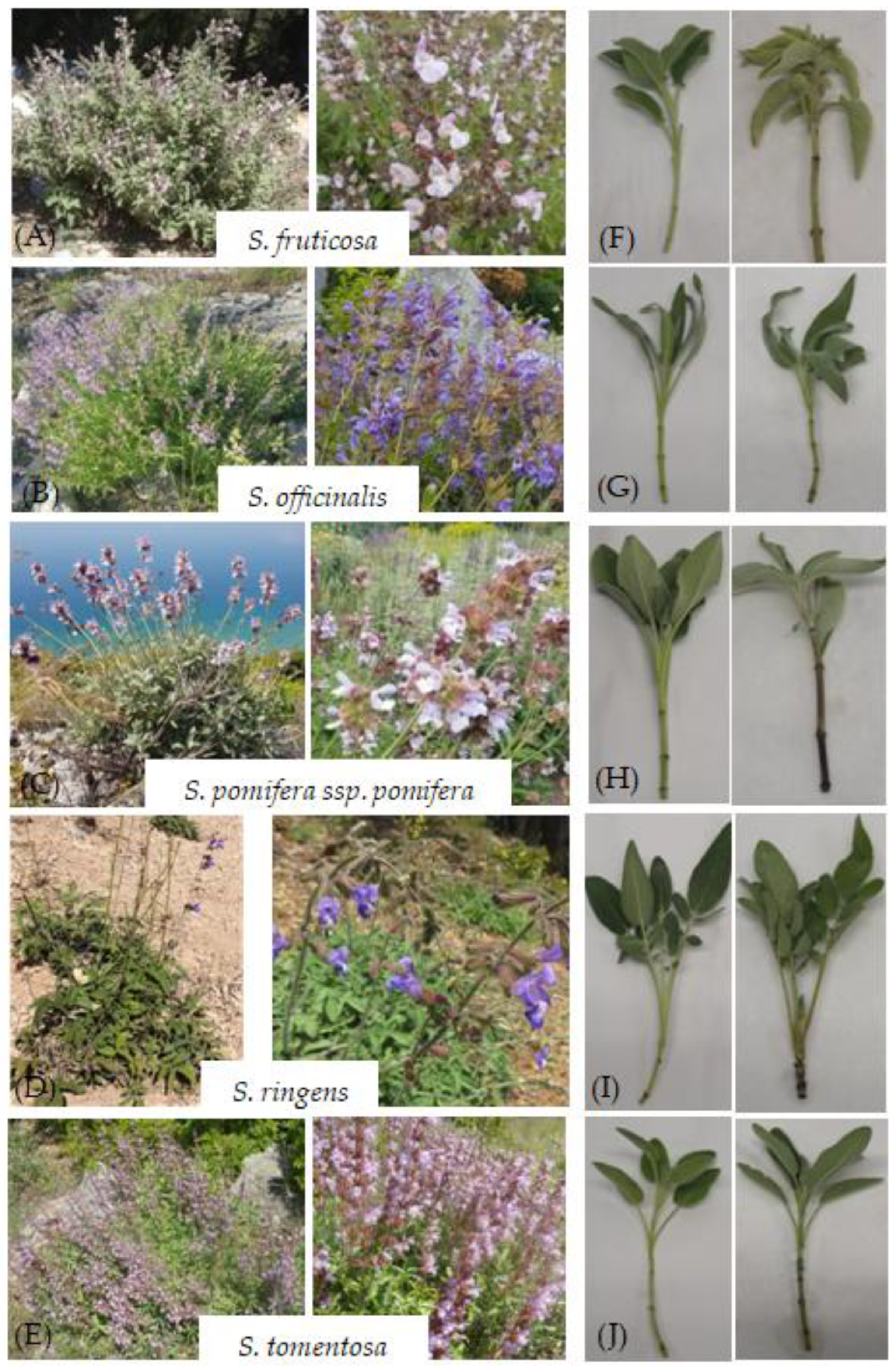
Figure 2.
Average, maximum and minimum monthly air temperature (°C) and average monthly relative humidity (%), in the regions from which cuttings from wild plants were collected: Leonidio from where S. pomifera ssp. pomifera cuttings were collected (A and B), Hymettus from where S. fruticosa cuttings were collected (C and D), Arnissa from where S. officinalis and S. ringens cuttings were collected (E and F), and Thassos from where S. tomentosa cuttings were collected (G and H), respectively, during the cutting collection period from October 2020 to August 2021.
Figure 2.
Average, maximum and minimum monthly air temperature (°C) and average monthly relative humidity (%), in the regions from which cuttings from wild plants were collected: Leonidio from where S. pomifera ssp. pomifera cuttings were collected (A and B), Hymettus from where S. fruticosa cuttings were collected (C and D), Arnissa from where S. officinalis and S. ringens cuttings were collected (E and F), and Thassos from where S. tomentosa cuttings were collected (G and H), respectively, during the cutting collection period from October 2020 to August 2021.
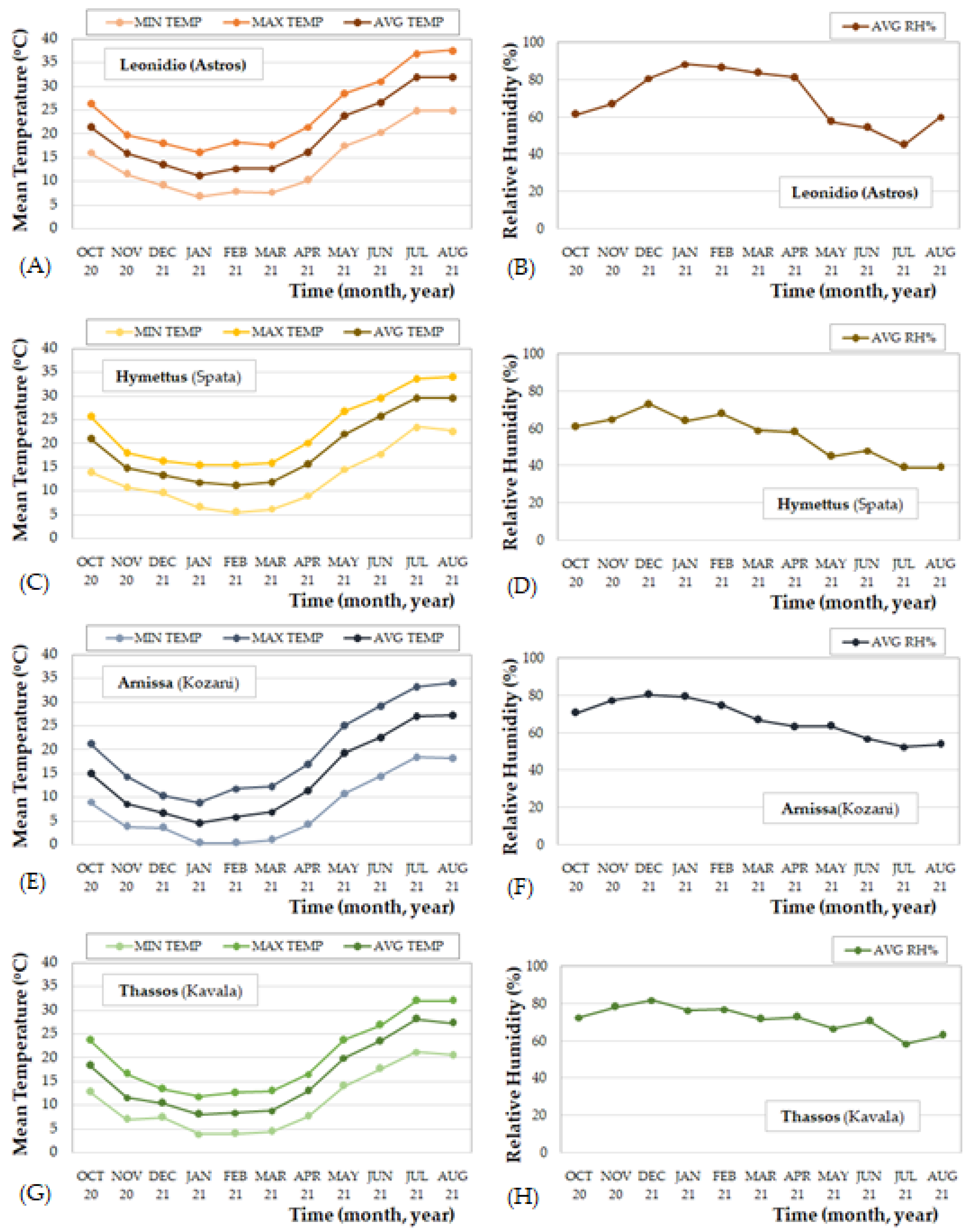
Figure 3.
Climatic conditions, i.e., average, maximum and minimum monthly air temperature (oC) and average, maximum and minimum monthly relative humidity (%), inside the two glass greenhouses, i.e., Greenhouse A, where mother plants were maintained (A and B), and Greenhouse B, where rooting of cuttings took place (C and D), respectively, during the experimental period from October 2020 to October 2021.
Figure 3.
Climatic conditions, i.e., average, maximum and minimum monthly air temperature (oC) and average, maximum and minimum monthly relative humidity (%), inside the two glass greenhouses, i.e., Greenhouse A, where mother plants were maintained (A and B), and Greenhouse B, where rooting of cuttings took place (C and D), respectively, during the experimental period from October 2020 to October 2021.
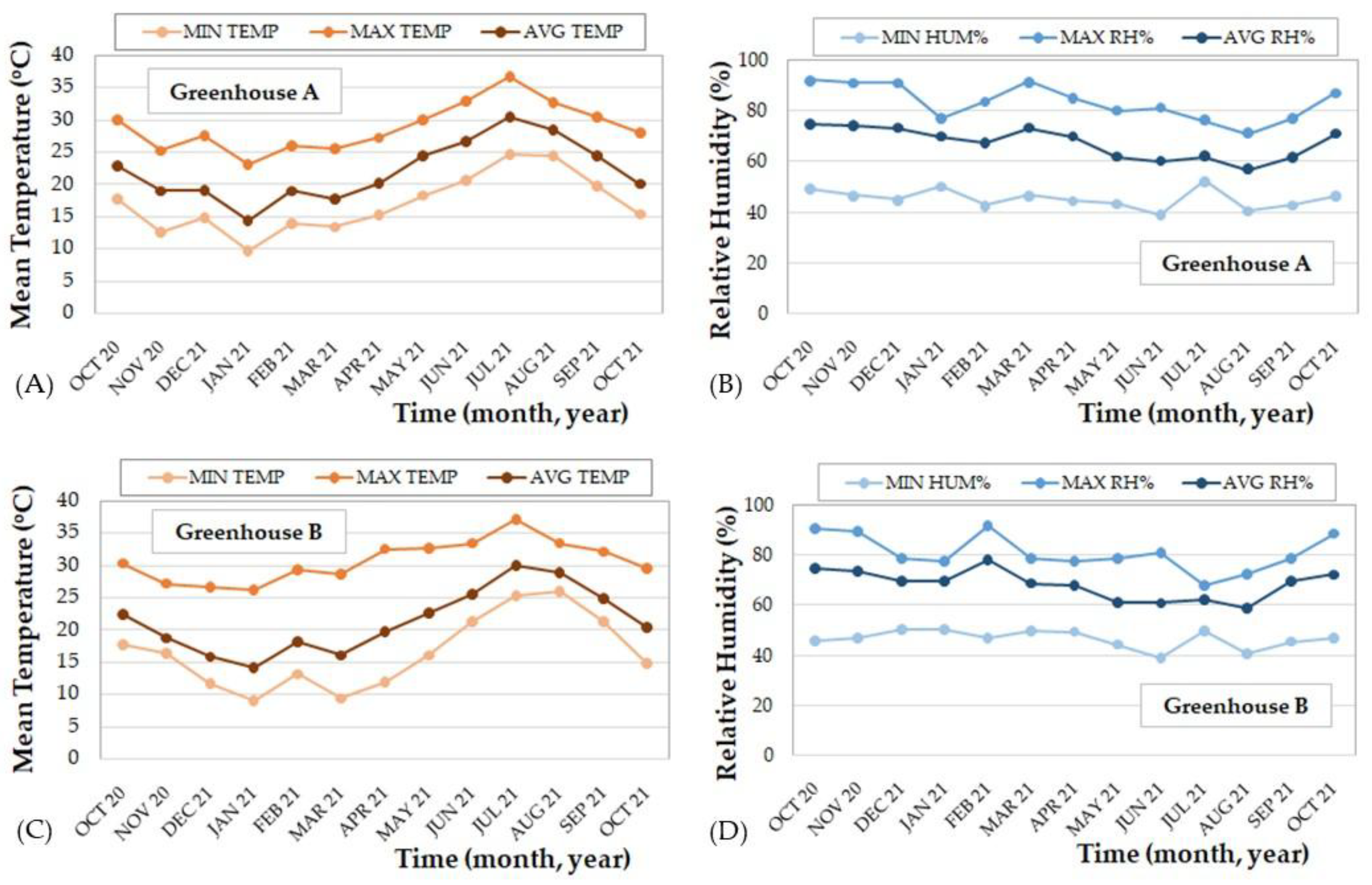
Figure 4.
Rooting percentage of S. fruticosa cuttings collected in autumn (A and B), winter (C and D), spring (E and F) and summer (G and H), from greenhouse and wild mother plants(respectively), six weeks after treatment with marked IBA treatments. Mean values in each bar followed by the same lowercase letter did not differ significantly at p≤ 0.05 by Student’s t-test. One-way ANOVA for (A): FNS; (B): F**; (C): F*; (D): F*; (E): FNS; (F): F**; (G): F**; (H): F**; NS or * or **, non-significant at p ≤ 0.05 or significant at p ≤ 0.05 or p ≤ 0.01, respectively.
Figure 4.
Rooting percentage of S. fruticosa cuttings collected in autumn (A and B), winter (C and D), spring (E and F) and summer (G and H), from greenhouse and wild mother plants(respectively), six weeks after treatment with marked IBA treatments. Mean values in each bar followed by the same lowercase letter did not differ significantly at p≤ 0.05 by Student’s t-test. One-way ANOVA for (A): FNS; (B): F**; (C): F*; (D): F*; (E): FNS; (F): F**; (G): F**; (H): F**; NS or * or **, non-significant at p ≤ 0.05 or significant at p ≤ 0.05 or p ≤ 0.01, respectively.
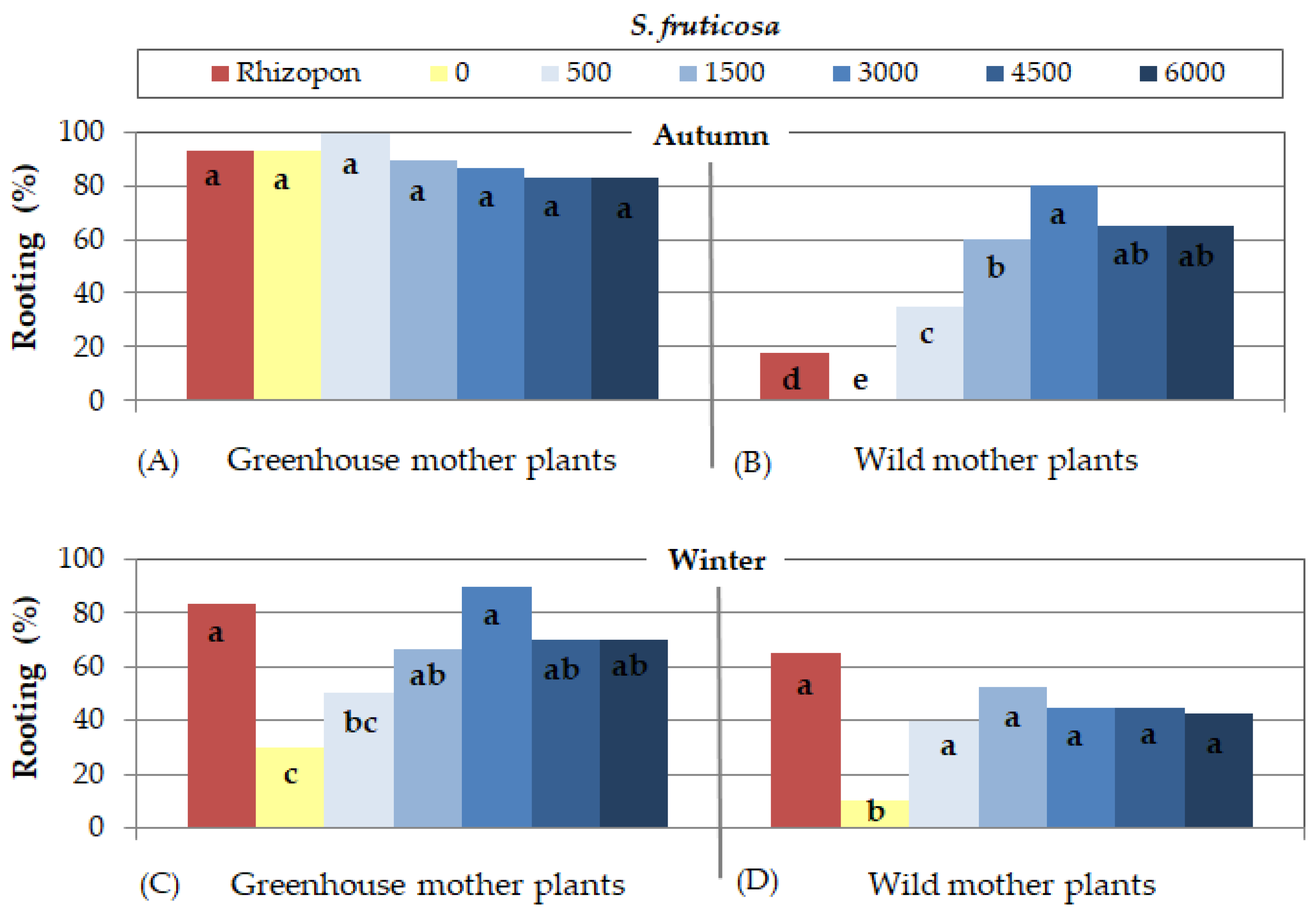
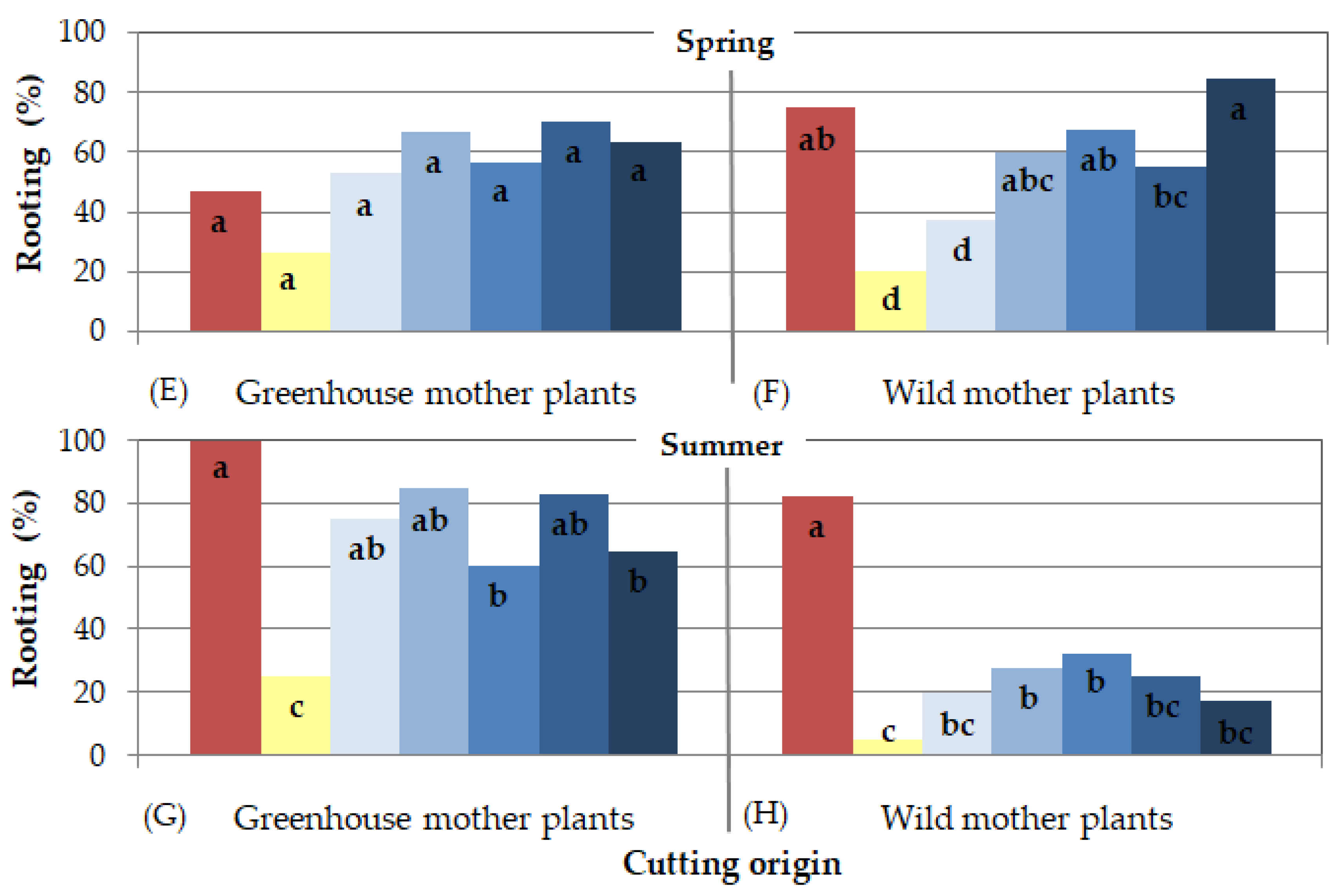
Figure 5.
Characteristic aboveground (up) and underground (down) part of rooted cuttings of S. fruticosa, collected in marked season, i.e., in autumn (A1 and B2), winter (B1 and B2), spring (C1 and C2) and summer (D1 and D2), from greenhouse and wild mother plants, respectively, six weeks after their treatment with dusting powder Rhizopon (R) or IBA solutions at marked concentrations (mg L-1), followed by placement for rooting on peat-perlite substrate 1:1 (v/v).
Figure 5.
Characteristic aboveground (up) and underground (down) part of rooted cuttings of S. fruticosa, collected in marked season, i.e., in autumn (A1 and B2), winter (B1 and B2), spring (C1 and C2) and summer (D1 and D2), from greenhouse and wild mother plants, respectively, six weeks after their treatment with dusting powder Rhizopon (R) or IBA solutions at marked concentrations (mg L-1), followed by placement for rooting on peat-perlite substrate 1:1 (v/v).
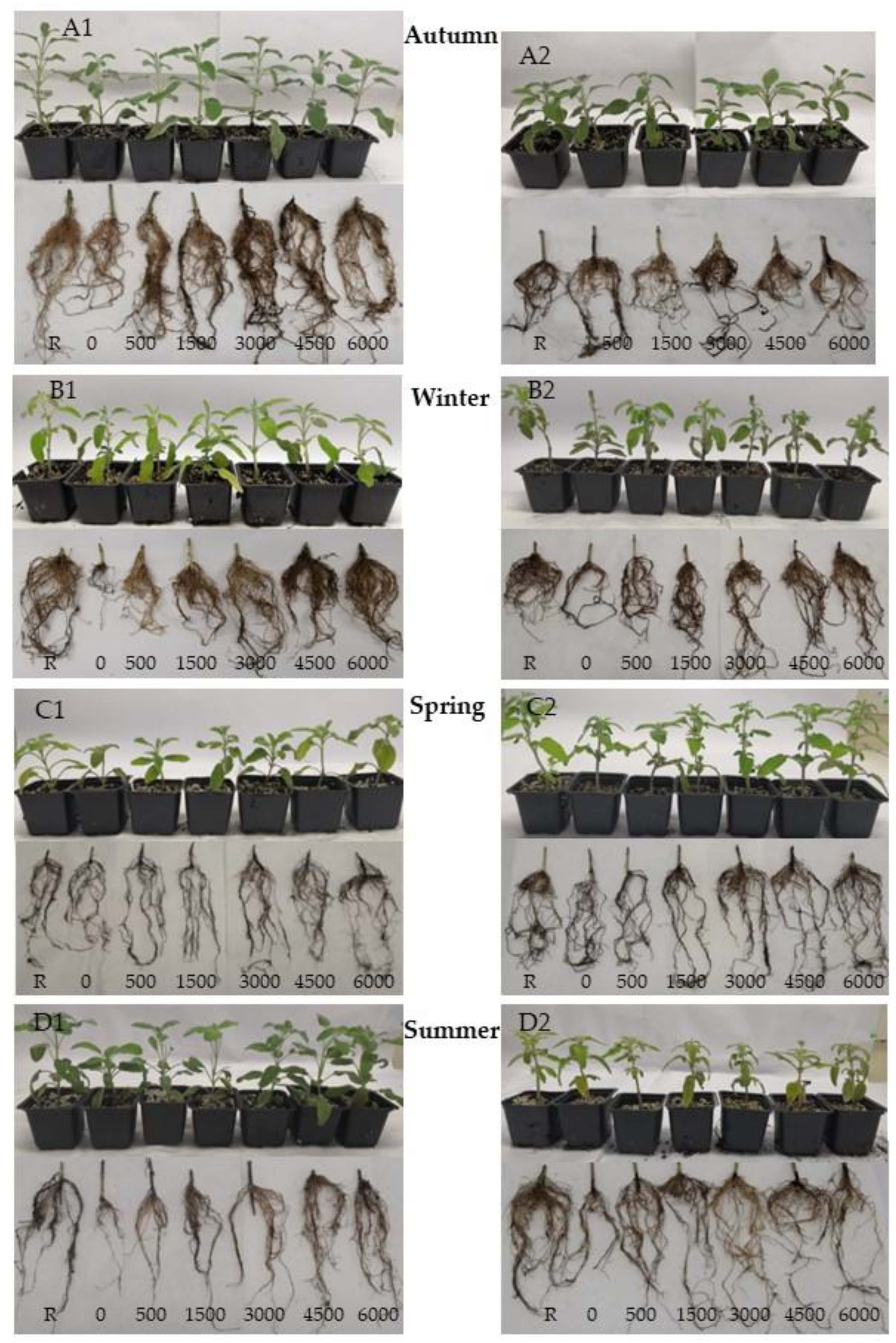
Figure 6.
Rooting percentage of S. officinalis cuttings, collected in autumn (A and B), winter (C and D), spring (E and F) and summer (G and H), from greenhouse and wild mother plants, respectively, six weeks after treatment with marked IBA treatments. Mean values in each bar followed by the same lowercase letter did not differ significantly at p≤ 0.05 by Student’s t-test. One-way ANOVA for (A): FNS; (B): FNS; (C): F**; (D): FNS; (E): F**; (F): F*; (G): F**; (H): FNS; NS or * or **, non-significant at p ≤ 0.05 or significant at p ≤ 0.05 or p ≤ 0.01, respectively.
Figure 6.
Rooting percentage of S. officinalis cuttings, collected in autumn (A and B), winter (C and D), spring (E and F) and summer (G and H), from greenhouse and wild mother plants, respectively, six weeks after treatment with marked IBA treatments. Mean values in each bar followed by the same lowercase letter did not differ significantly at p≤ 0.05 by Student’s t-test. One-way ANOVA for (A): FNS; (B): FNS; (C): F**; (D): FNS; (E): F**; (F): F*; (G): F**; (H): FNS; NS or * or **, non-significant at p ≤ 0.05 or significant at p ≤ 0.05 or p ≤ 0.01, respectively.
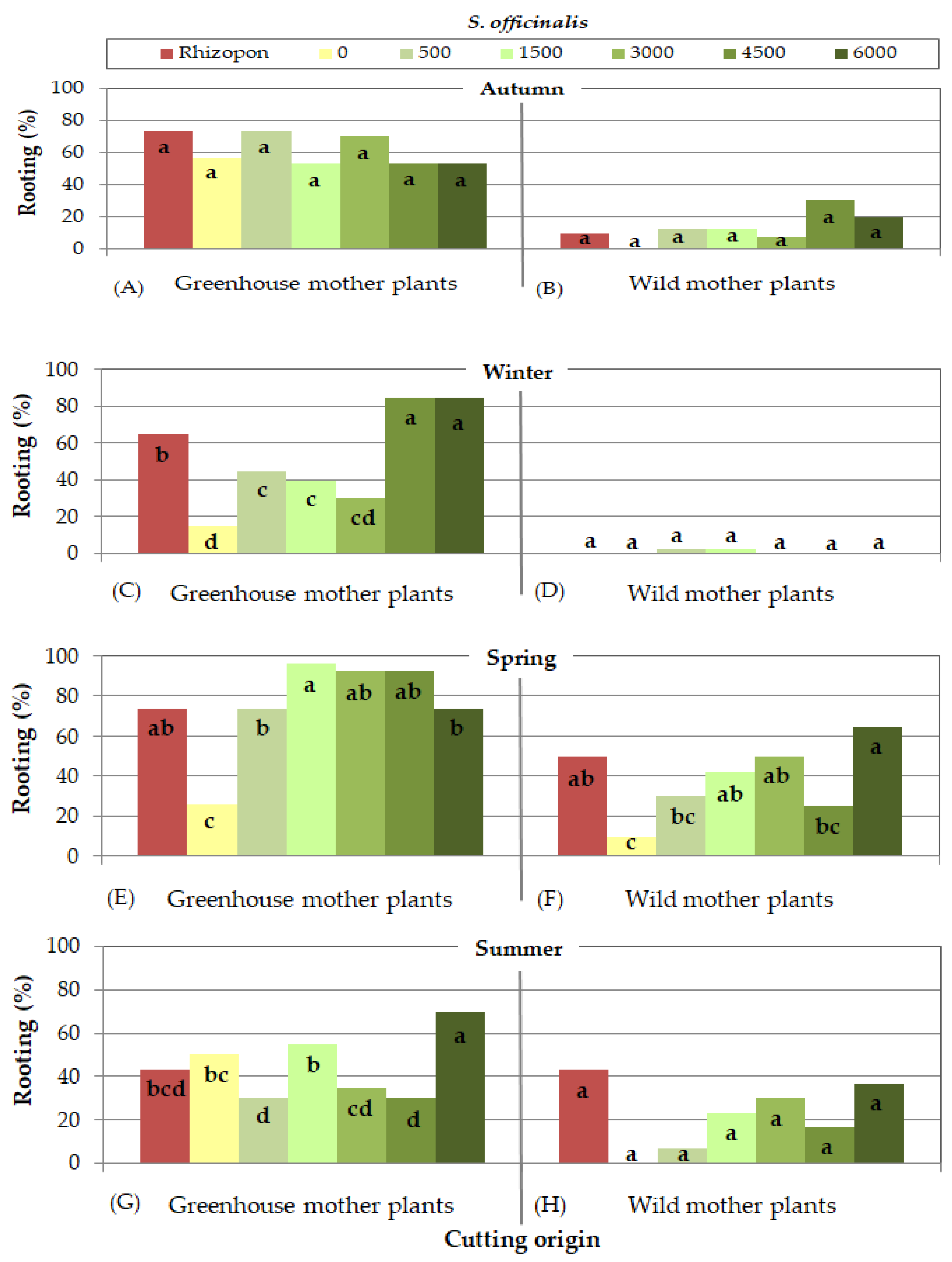
Figure 7.
Characteristic aboveground (up) and underground (down) part of rooted cuttings of S. officinalis, collected in marked season, i.e., in autumn (A1 and B2), winter (B1), spring (C1 and C2) and summer (D1 and D2), from greenhouse and wild mother plants, respectively, six weeks after their treatment with dusting powder Rhizopon (R) or IBA solutions at marked concentrations (mg L-1), followed by placement for rooting on peat-perlite substrate 1:1 (v/v).
Figure 7.
Characteristic aboveground (up) and underground (down) part of rooted cuttings of S. officinalis, collected in marked season, i.e., in autumn (A1 and B2), winter (B1), spring (C1 and C2) and summer (D1 and D2), from greenhouse and wild mother plants, respectively, six weeks after their treatment with dusting powder Rhizopon (R) or IBA solutions at marked concentrations (mg L-1), followed by placement for rooting on peat-perlite substrate 1:1 (v/v).
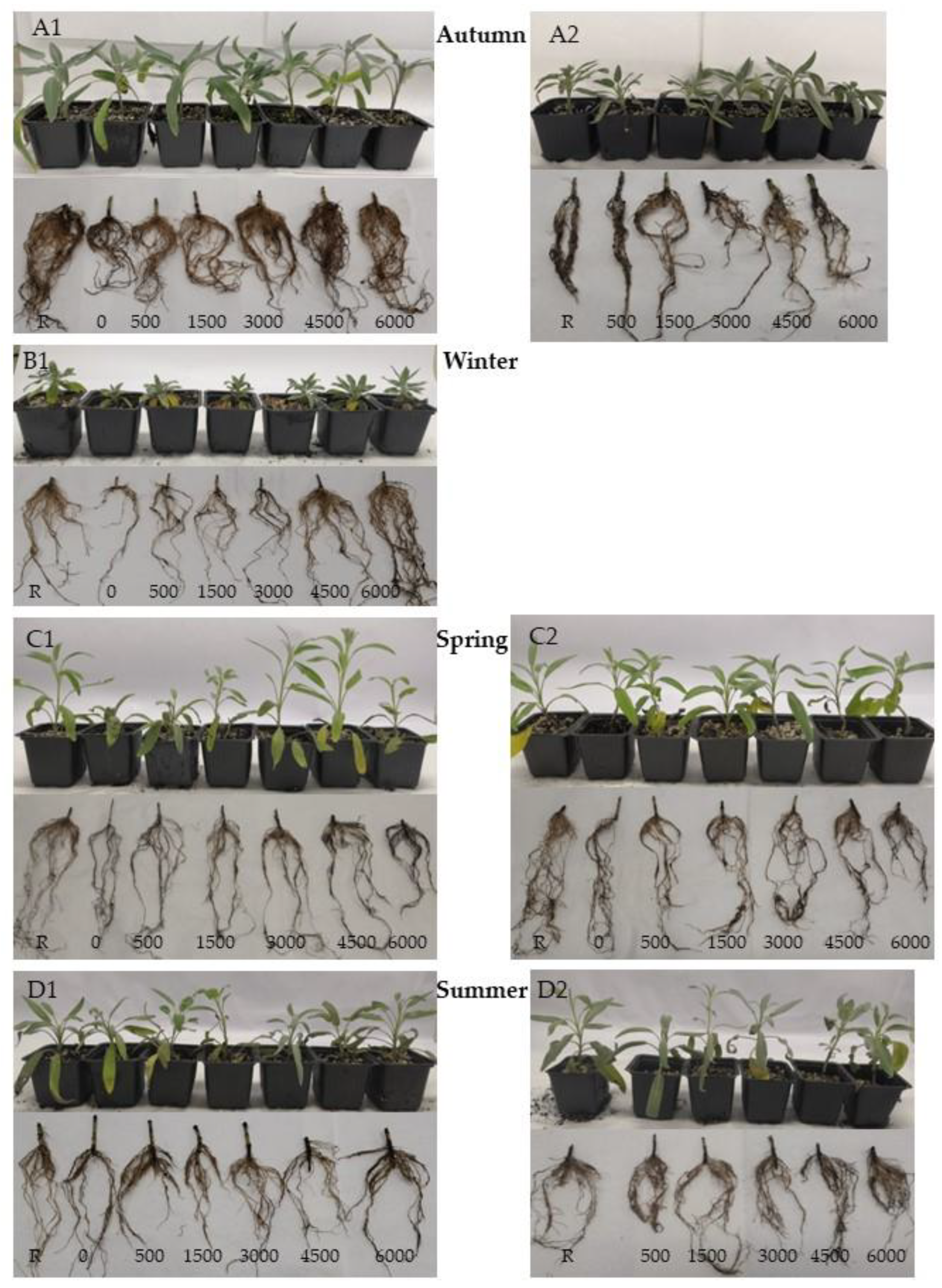
Figure 8.
Rooting percentage of S. pomifera ssp. pomifera cuttings, collected in autumn (A and B), winter (C and D), spring (E and F) and summer (G and H), from greenhouse and wild mother plants, respectively, six weeks after treatment with marked IBA treatments. Mean values in each bar followed by the same lowercase letter did not differ significantly at p≤ 0.05 by Student’s t-test. One-way ANOVA for(A): FNS; (B): F*; (C): F**; (D): F**; (E): F**; (F): F**; (G): FNS; (H): FNS; NS or * or **, non-significant at p ≤ 0.05 or significant at p ≤ 0.05 or p ≤ 0.01, respectively.
Figure 8.
Rooting percentage of S. pomifera ssp. pomifera cuttings, collected in autumn (A and B), winter (C and D), spring (E and F) and summer (G and H), from greenhouse and wild mother plants, respectively, six weeks after treatment with marked IBA treatments. Mean values in each bar followed by the same lowercase letter did not differ significantly at p≤ 0.05 by Student’s t-test. One-way ANOVA for(A): FNS; (B): F*; (C): F**; (D): F**; (E): F**; (F): F**; (G): FNS; (H): FNS; NS or * or **, non-significant at p ≤ 0.05 or significant at p ≤ 0.05 or p ≤ 0.01, respectively.
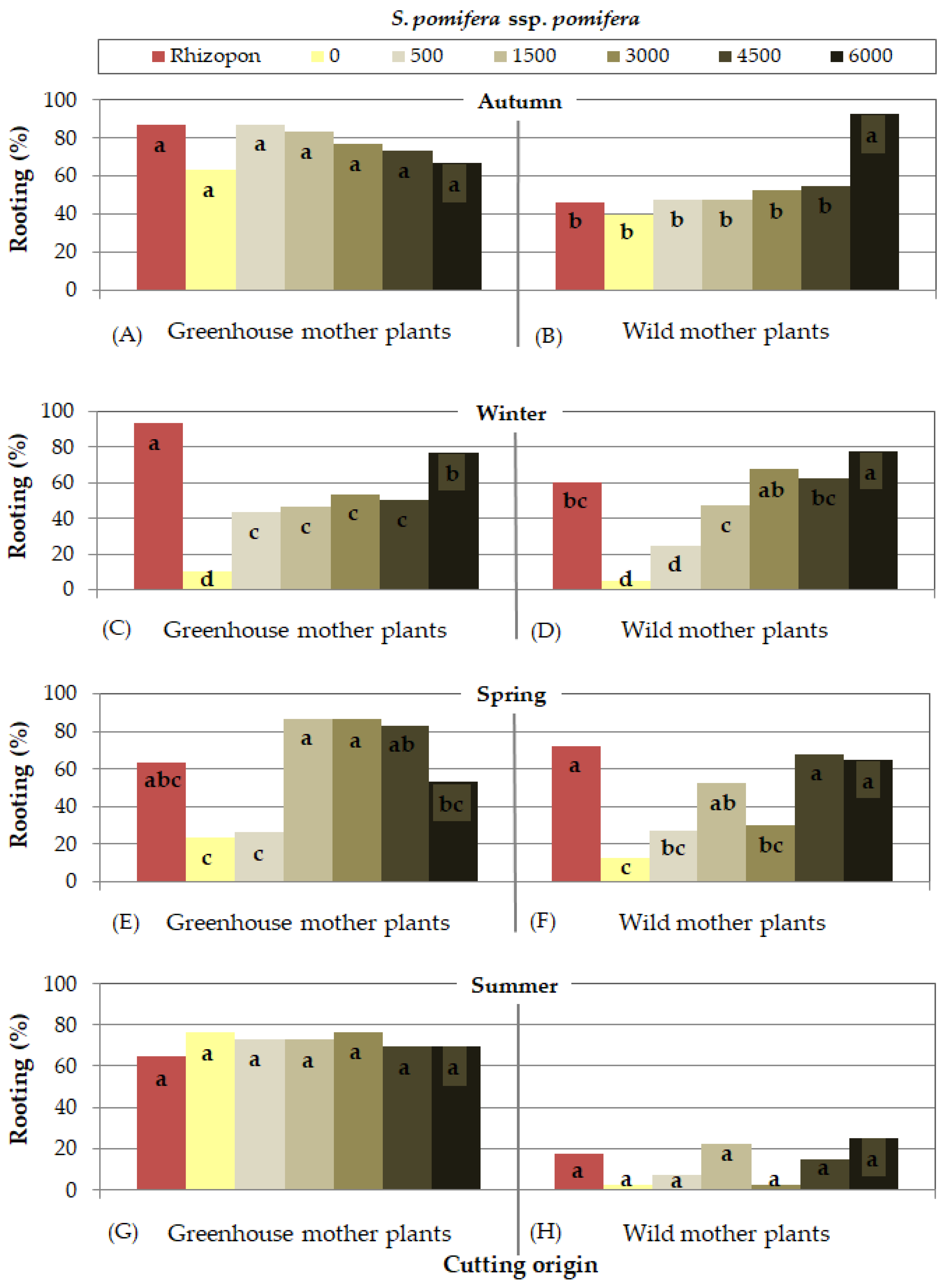
Figure 9.
Characteristic aboveground (up) and underground (down) part of rooted cuttings of S. pomifera ssp. pomifera, collected in marked season, i.e., in autumn (A1 and A2), winter (B1 and B2), spring (C1 and C2) and summer (D1 and D2), from greenhouse and wild mother plants, respectively, six weeks after their treatment with dusting powder Rhizopon (R) or IBA solutions at marked concentrations (mg L-1), followed by placement for rooting on peat-perlite substrate 1:1 (v/v).
Figure 9.
Characteristic aboveground (up) and underground (down) part of rooted cuttings of S. pomifera ssp. pomifera, collected in marked season, i.e., in autumn (A1 and A2), winter (B1 and B2), spring (C1 and C2) and summer (D1 and D2), from greenhouse and wild mother plants, respectively, six weeks after their treatment with dusting powder Rhizopon (R) or IBA solutions at marked concentrations (mg L-1), followed by placement for rooting on peat-perlite substrate 1:1 (v/v).
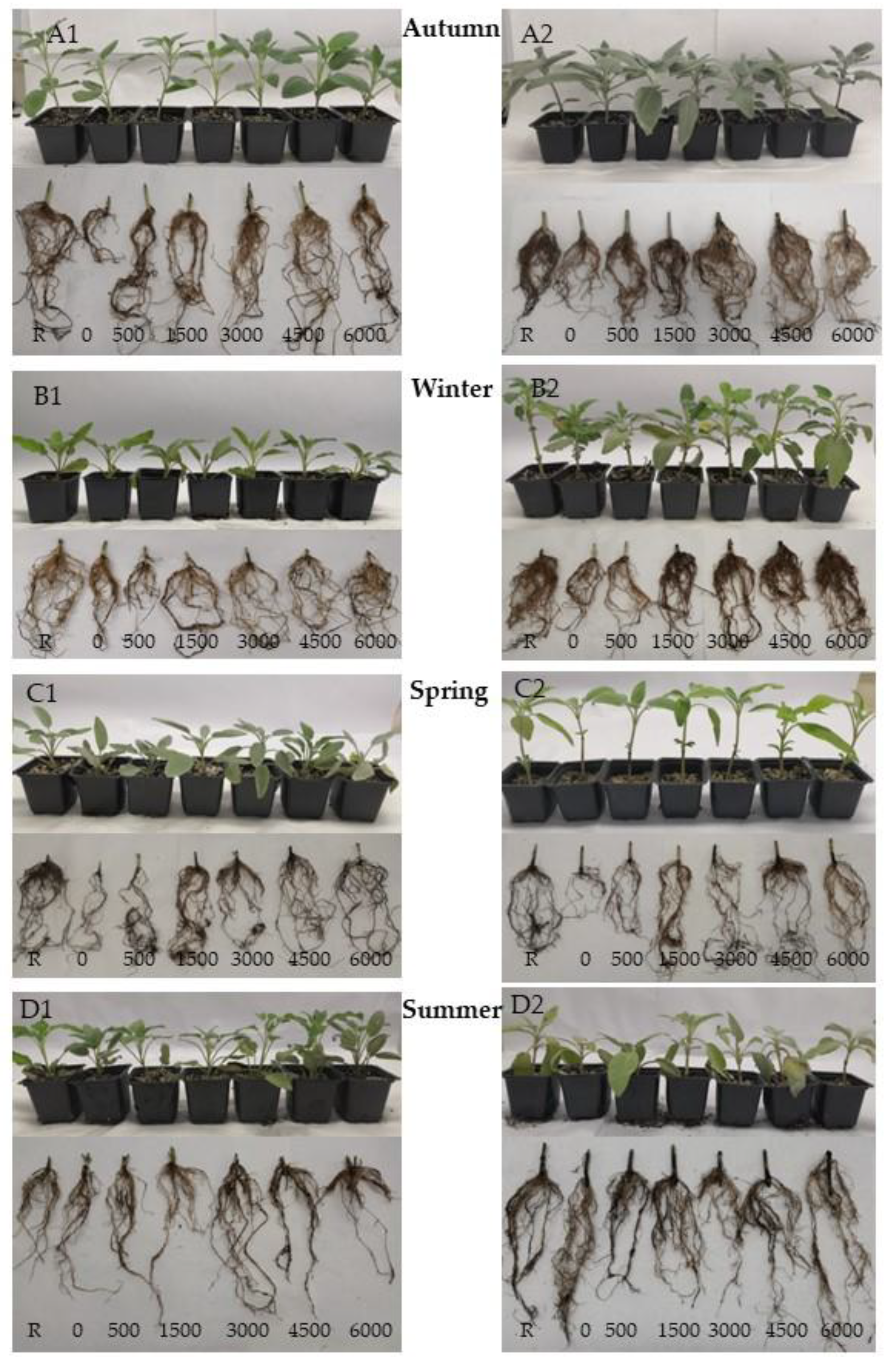
Figure 10.
Rooting percentage of S. ringens cuttings, collected in autumn (A and B), winter (C and D), spring (E and F) and summer (G and H), from greenhouse and wild mother plants, respectively, six weeks after treatment with marked IBA treatments. Mean values in each bar followed by the same lowercase letter did not differ significantly at p≤ 0.05 by Student’s t-test. One-way ANOVA for (A): F*; (B): F**; (C): F*; (D): FNS; (E): FNS; (F): F**; (G): F**; (H): FNS; NS or * or **, non-significant at p ≤ 0.05 or significant at p ≤ 0.05 or p ≤ 0.01, respectively.
Figure 10.
Rooting percentage of S. ringens cuttings, collected in autumn (A and B), winter (C and D), spring (E and F) and summer (G and H), from greenhouse and wild mother plants, respectively, six weeks after treatment with marked IBA treatments. Mean values in each bar followed by the same lowercase letter did not differ significantly at p≤ 0.05 by Student’s t-test. One-way ANOVA for (A): F*; (B): F**; (C): F*; (D): FNS; (E): FNS; (F): F**; (G): F**; (H): FNS; NS or * or **, non-significant at p ≤ 0.05 or significant at p ≤ 0.05 or p ≤ 0.01, respectively.
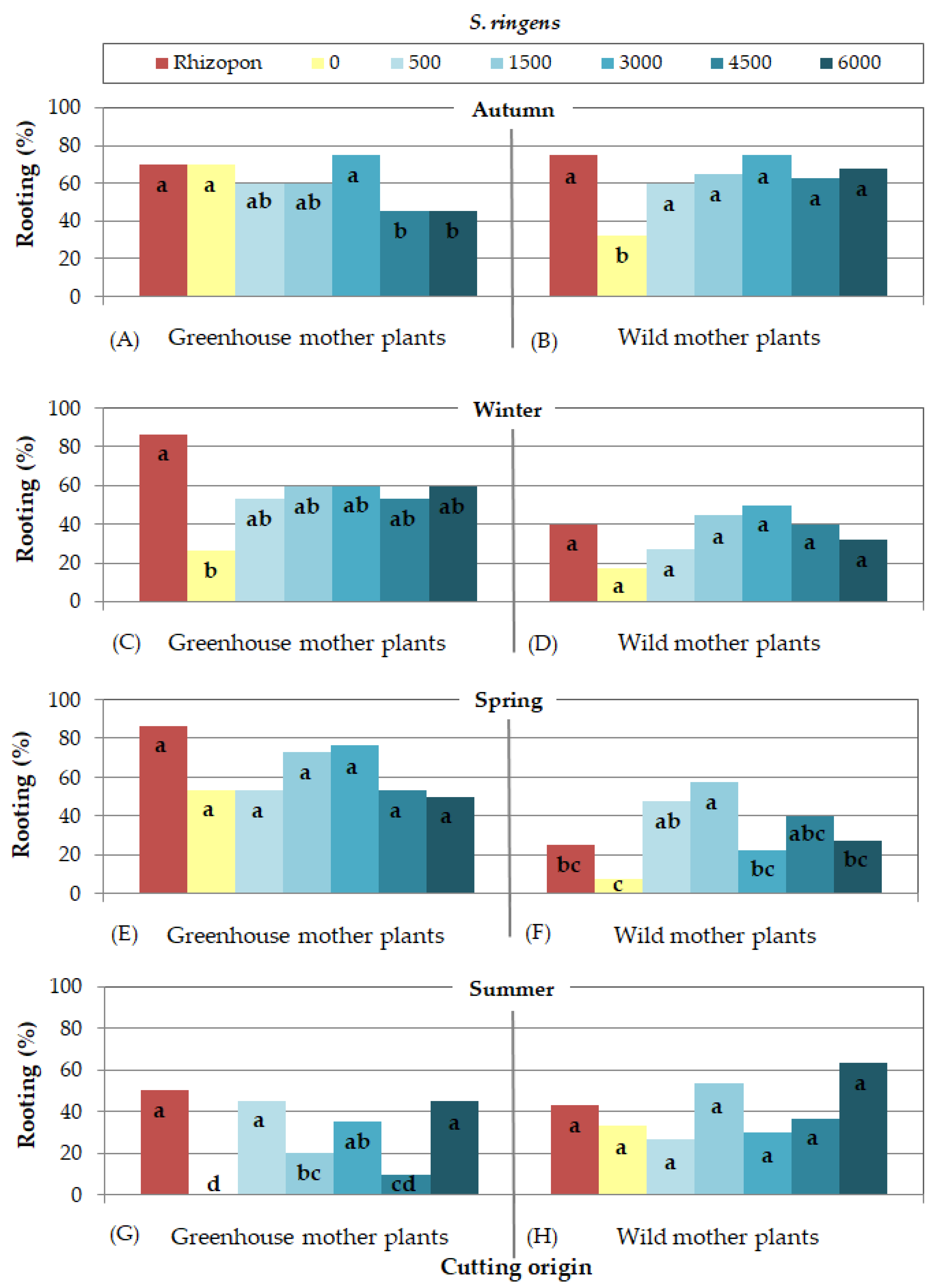
Figure 11.
Characteristic aboveground (up) and underground (down) part of rooted cuttings of S. pomifera ssp. pomifera, collected in marked season, i.e., in autumn (A1 and A2), winter (B1 and B2), spring (C1) and summer (D1 and D2), from greenhouse and wild mother plants, respectively, six weeks after their treatment with dusting powder Rhizopon (R) or IBA solutions at marked concentrations (mg L-1), followed by placement for rooting on peat-perlite substrate 1:1 (v/v).
Figure 11.
Characteristic aboveground (up) and underground (down) part of rooted cuttings of S. pomifera ssp. pomifera, collected in marked season, i.e., in autumn (A1 and A2), winter (B1 and B2), spring (C1) and summer (D1 and D2), from greenhouse and wild mother plants, respectively, six weeks after their treatment with dusting powder Rhizopon (R) or IBA solutions at marked concentrations (mg L-1), followed by placement for rooting on peat-perlite substrate 1:1 (v/v).
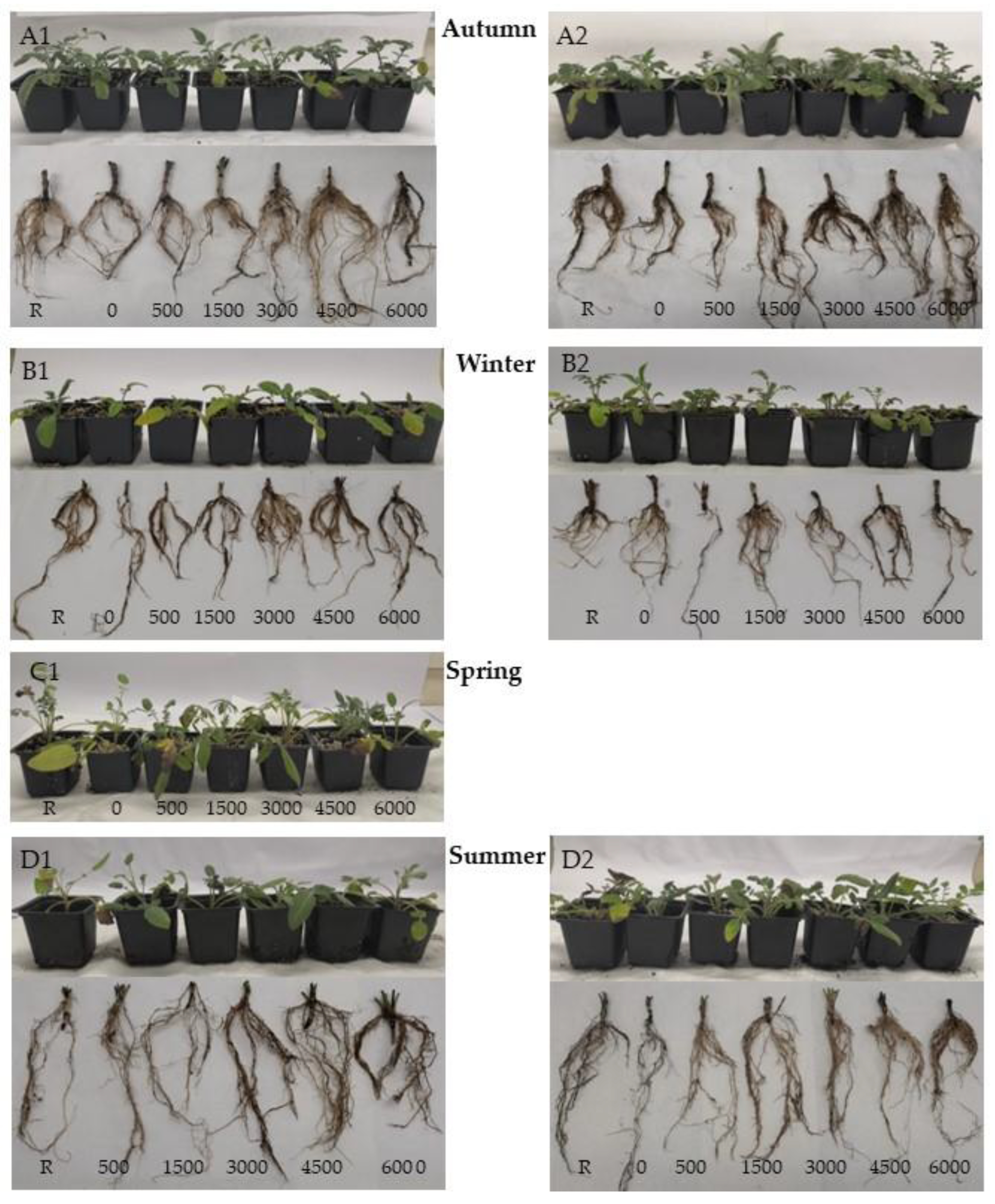
Figure 12.
Rooting percentage of S. tomentosa cuttings, collected in autumn (A and B), winter (C and D), spring (E and F) and summer (G and H), from greenhouse and wild mother plants, respectively, six weeks after treatment with marked IBA treatments. Mean values in each bar followed by the same lowercase letter did not differ significantly at p≤ 0.05 by Student’s t-test. One-way ANOVA for (A): F*; (B): FNS; (C): F**; (D): F**; (E): FNS; (F): FNS; (G): F*; (H): FNS; NS or * or **, non-significant at p ≤ 0.05 or significant at p ≤ 0.05 or p ≤ 0.01, respectively.
Figure 12.
Rooting percentage of S. tomentosa cuttings, collected in autumn (A and B), winter (C and D), spring (E and F) and summer (G and H), from greenhouse and wild mother plants, respectively, six weeks after treatment with marked IBA treatments. Mean values in each bar followed by the same lowercase letter did not differ significantly at p≤ 0.05 by Student’s t-test. One-way ANOVA for (A): F*; (B): FNS; (C): F**; (D): F**; (E): FNS; (F): FNS; (G): F*; (H): FNS; NS or * or **, non-significant at p ≤ 0.05 or significant at p ≤ 0.05 or p ≤ 0.01, respectively.
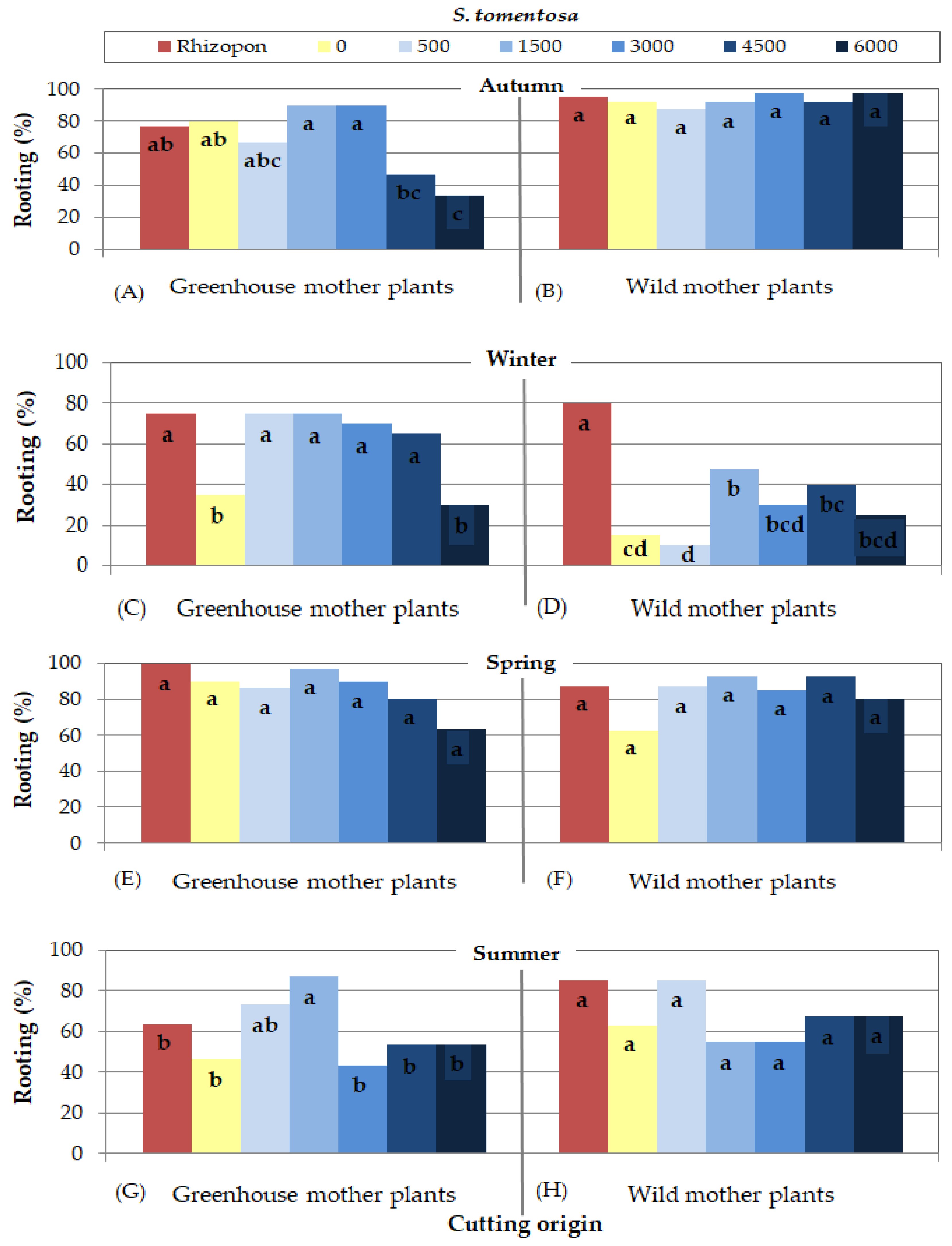
Figure 13.
Typical aboveground (up) and underground (down) part of rooted cuttings of S. tomentosa, collected in marked season, i.e., in autumn (A1 and A2), winter (B1 and B2), spring (C1 and C2) and summer (D1 and D2), from greenhouse and wild mother plants, respectively, six weeks after their treatment with dusting powder Rhizopon (R) or IBA solutions at marked concentrations (mg L-1), followed by placement for rooting on peat-perlite substrate 1:1 (v/v).
Figure 13.
Typical aboveground (up) and underground (down) part of rooted cuttings of S. tomentosa, collected in marked season, i.e., in autumn (A1 and A2), winter (B1 and B2), spring (C1 and C2) and summer (D1 and D2), from greenhouse and wild mother plants, respectively, six weeks after their treatment with dusting powder Rhizopon (R) or IBA solutions at marked concentrations (mg L-1), followed by placement for rooting on peat-perlite substrate 1:1 (v/v).
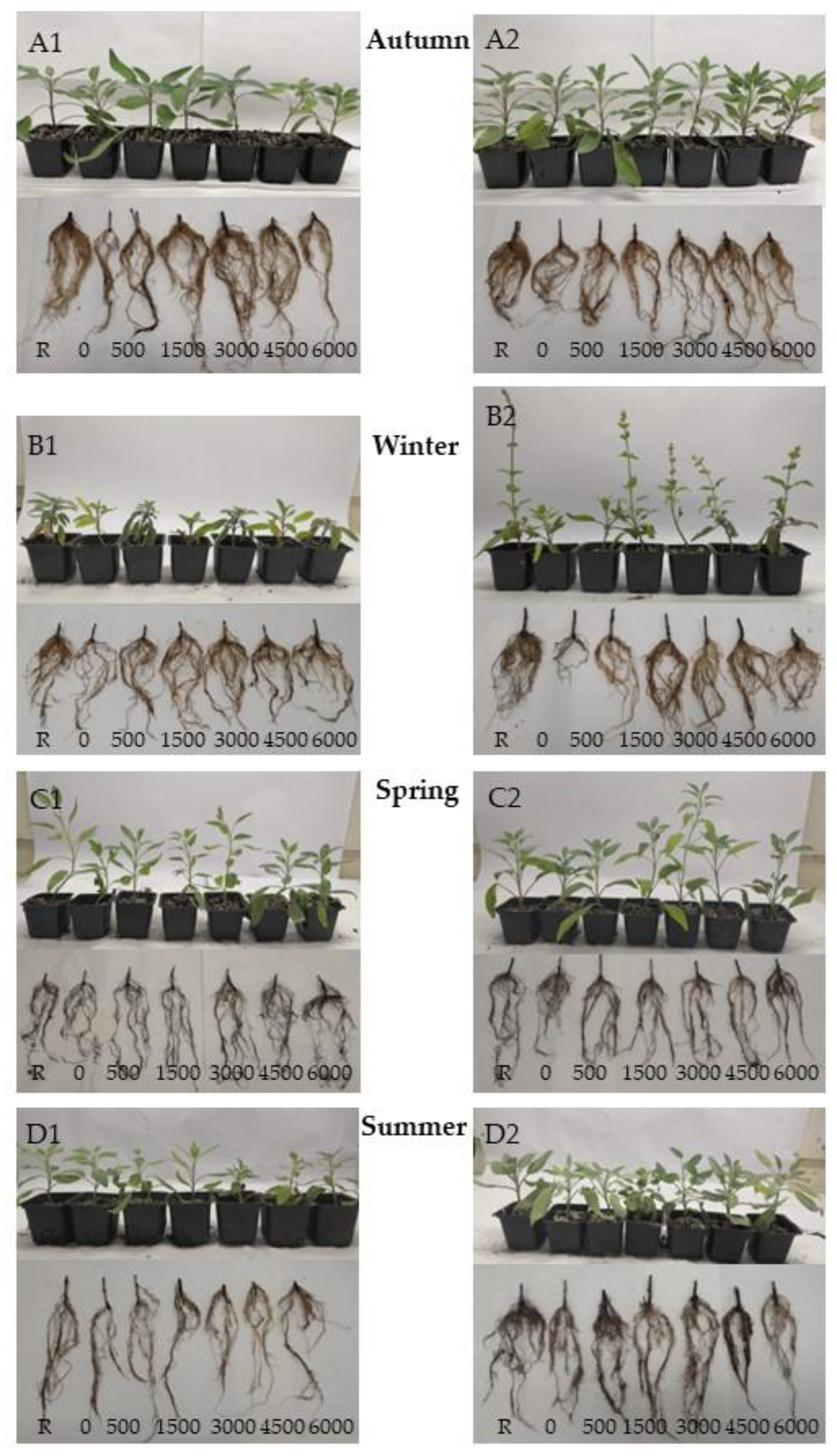
Figure 14.
Rooting percentage of Salvia spp. cuttings, collected in autumn and treated with 0 and 1500 mg L-1 IBA (A and B) or collected in spring and treated with 0 and 1500 mg L-1 IBA (C and D), respectively, from greenhouse and wild mother plants, six weeks after treatment with marked IBA treatments. Mean values in each bar followed by the same lowercase letter did not differ significantly at p≤ 0.05 by Student’s t-test. ANOVA for (A): two-way ANOVAFSalvia sp. × cutting origin**, FSalvia sp.**, Fcutting origin**; one-way ANOVA F**; ANOVA for (B): two-way ANOVAFSalvia sp. × cutting origin*, FSalvia sp.**, Fcutting origin**; one-way ANOVA F**; ANOVA for (C): two-way ANOVA: FSalvia sp. × cutting originNS; FSalvia sp.**, Fcutting origin**; one-way ANOVA F**; ANOVA for (D): two-way ANOVA: FSalvia sp. × cutting originNS; FSalvia sp.*, Fcutting origin**; one-way ANOVA F**; NS or * or **, non-significant at p≤ 0.05 or significant at p≤ 0.05 or p≤ 0.01, respectively.
Figure 14.
Rooting percentage of Salvia spp. cuttings, collected in autumn and treated with 0 and 1500 mg L-1 IBA (A and B) or collected in spring and treated with 0 and 1500 mg L-1 IBA (C and D), respectively, from greenhouse and wild mother plants, six weeks after treatment with marked IBA treatments. Mean values in each bar followed by the same lowercase letter did not differ significantly at p≤ 0.05 by Student’s t-test. ANOVA for (A): two-way ANOVAFSalvia sp. × cutting origin**, FSalvia sp.**, Fcutting origin**; one-way ANOVA F**; ANOVA for (B): two-way ANOVAFSalvia sp. × cutting origin*, FSalvia sp.**, Fcutting origin**; one-way ANOVA F**; ANOVA for (C): two-way ANOVA: FSalvia sp. × cutting originNS; FSalvia sp.**, Fcutting origin**; one-way ANOVA F**; ANOVA for (D): two-way ANOVA: FSalvia sp. × cutting originNS; FSalvia sp.*, Fcutting origin**; one-way ANOVA F**; NS or * or **, non-significant at p≤ 0.05 or significant at p≤ 0.05 or p≤ 0.01, respectively.
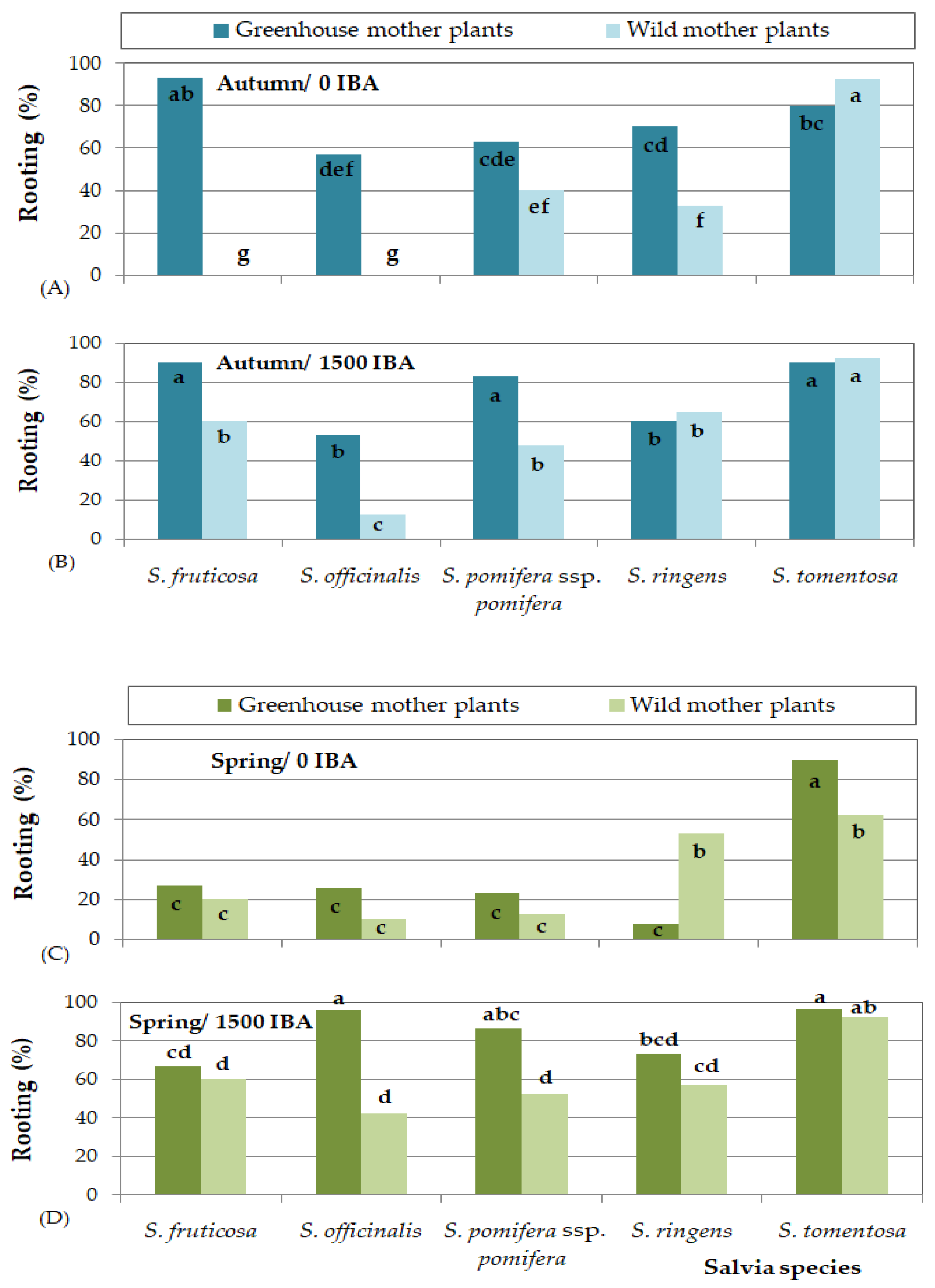

Table 1.
Effect of the main experimental factors, i.e., Salvia species, cutting origin, season of cutting collection and rooting hormone IBA treatment, on rooting percentage of cuttings, as well as on fresh (f.w.) and dry (d.w.) weight of the aboveground and underground part of 6-week old rooted cuttings of S. fruticosa, S. officinalis, S. pomifera ssp. pomifera, S. ringens and S. tomentosa, collected from greenhouse or wild mother plants, during the four seasons, and treated with the marked IBA treatments.
Table 1.
Effect of the main experimental factors, i.e., Salvia species, cutting origin, season of cutting collection and rooting hormone IBA treatment, on rooting percentage of cuttings, as well as on fresh (f.w.) and dry (d.w.) weight of the aboveground and underground part of 6-week old rooted cuttings of S. fruticosa, S. officinalis, S. pomifera ssp. pomifera, S. ringens and S. tomentosa, collected from greenhouse or wild mother plants, during the four seasons, and treated with the marked IBA treatments.
| Experimental factor | Rooting (%) | Above- ground f.w. (g) |
Under- ground f.w. (g) |
Above- ground d.w. (g) |
Under- ground d.w. (g) |
|
|---|---|---|---|---|---|---|
| Salvia sp. | S. fruticosa | 57.1 bɫ | 1.85 c | 1.22 c | 0.48 d | 0.17 c |
| S. officinalis | 38.7 e | 1.30 d | 1.08 d | 0.34 e | 0.16 c | |
|
S. pomifera ssp.pomifera |
53.5 c | 3.39 a | 1.84 a | 0.92 a | 0.29 a | |
| S. ringens | 47.9 d | 1.96 bc | 0.97 e | 0.56 c | 0.12 d | |
| S. tomentosa | 69.7 a | 2.21 b | 1.31 b | 0.60 b | 0.18 b | |
| Cutting origin | Greenhouse mother plants | 63.3 a | 1.95 b | 1.18 b | 0.45 b | 0.14 b |
| Wild mother plants |
43.5 b | 2.34 a | 1.39 a | 0.71 a | 0.23 a | |
| Collection season | Autumn | 62.9 a | 2.71 a | 1.91 a | 0.72 a | 0.22 a |
| Winter¥ | 45.3 c | - | - | - | - | |
| Spring | 60.1 b | 1.90 b | 1.05 b | 0.53 b | 0.20 b | |
| Summer | 45.1 c | 1.82 b | 0.90 c | 0.49 c | 0.13 c | |
| IBA treatmnet (mg L-1) | Rhizopon | 64.4 a | 2.57 a | 1.35 a | 0.62 a | 0.19 a |
| 0¥ | 33.1 e | - | - | - | - | |
| 500 | 49.2 d | 1.93 b | 1.11 b | 0.53 c | 0.19 a | |
| 1500 | 59.1 b | 2.17 b | 1.31 a | 0.59 ab | 0.18 ab | |
| 3000 | 56.6 bc | 2.12 b | 1.32 a | 0.58 b | 0.18 ab | |
| 4500 | 54.6 c | 2.05 b | 1.33 a | 0.62 a | 0.19 a | |
| 6000 | 56.6 bc | 2.02 b | 1.29 a | 0.53 c | 0.17 b | |
| Significance § | FSalviaspecies | ** | ** | ** | ** | ** |
| Fcutting origin | ** | * | ** | ** | ** | |
| Fcollection season | ** | ** | ** | ** | ** | |
| FIBA treatment | ** | * | ** | ** | * | |
| Fspecies × origin | ** | * | ** | ** | ** | |
| Fspecies× season | ** | NS | ** | ** | ** | |
| Forigin × season | * | ** | ** | ** | ** | |
| Fspecies× origin × season | ** | ** | ** | ** | ** | |
| Fspecies×IBA | ** | NS | NS | ** | * | |
| Forigin× IBA | ** | ΝS | NS | * | ** | |
| Fspecies× origin ×IBA | ** | NS | NS | ** | ** | |
| Fseason×IBA | ** | NS | NS | ** | ** | |
| Fspecies×season×IBA | ** | NS | ** | ** | ** | |
| Forigin ×season ×IBA | ** | NS | * | ** | * | |
| Fsp.× origin × season ×IBA | ** | NS | ** | ** | ** | |
¥ These treatments were excluded from 4-way ANOVA of fresh and dry weights, because some Salvia sp. under some treatments presented zero rooting percentage and thus data were missing.ɫ Mean values in each column and experimental factor followed by the same lowercase letter did not differ significantly at p≤ 0.05 by Student’s t-test. § NS or * or **, non-significant at p≤ 0.05 or significant at p≤ 0.05 or p≤ 0.01, respectively. n=3 repetitions of 10 cuttings for greenhouse mother plants and 4 repetitions of 10 cuttings for wild mother plants; n=14-20 rooted cuttings for the estimation of fresh and dry weights.
Table 2.
Effect of the main experimental factors, i.e., cutting origin, season of cutting collection and rooting hormone treatment, on rooting percentage of S. fruticosa cuttings, as well as on fresh (f.w.) and dry (d.w.) weight of the aboveground and underground part of rooted cuttings, six weeks after collection and treatment for rooting.
Table 2.
Effect of the main experimental factors, i.e., cutting origin, season of cutting collection and rooting hormone treatment, on rooting percentage of S. fruticosa cuttings, as well as on fresh (f.w.) and dry (d.w.) weight of the aboveground and underground part of rooted cuttings, six weeks after collection and treatment for rooting.
| Experimental factor | Rooting (%) | Above- ground f.w. (g) |
Under- ground f.w. (g) |
Above- ground d.w. (g) |
Under- ground d.w. (g) |
|
|---|---|---|---|---|---|---|
| Cutting origin | Greenhouse mother plants | 70.2 aɫ | 1.74 b | 1.34 b | 0.39 b | 0.15 b |
| Wild mother plants |
44.0 b | 1.87 a | 1.45 a | 0.56 a | 0.24 a | |
| Collection season | Autumn | 68.0 a | 2.22 a | 1.83 a | 0.50 a | 0.19 b |
| Winter | 54.3 b | 1.68 b | 1.92 a | 0.46 b | 0.28 a | |
| Spring | 56.0 b | 1.62 b | 1.03 b | 0.47 ab | 0.18 b | |
| Summer | 50.2 b | 1.71 b | 0.80 c | 0.45 b | 0.14 c | |
| IBA treatmnet (mg L-1) | Rhizopon | 70.4 a | 1.98 a | 1.52 a | 0.53 a | 0.22 ab |
| 0¥ | 26.3 d | - | - | - | - | |
| 500 | 51.4 c | 1.66 c | 1.22 c | 0.44 c | 0.17 d | |
| 1500 | 63.5 ab | 1.85 ab | 1.26 c | 0.49 ab | 0.18 cd | |
| 3000 | 64.8 ab | 1.81 b | 1.38 b | 0.44 c | 0.19 bc | |
| 4500 | 62.1 ab | 1.77 bc | 1.44 ab | 0.46 bc | 0.19 cd | |
| 6000 | 61.5 b | 1.78 bc | 1.55 a | 0.47 bc | 0.23 a | |
| Significance § | Fcutting origin | ** | * | * | ** | ** |
| Fcollection season | ** | ** | ** | * | ** | |
| FIBA treatment | ** | ** | ** | ** | ** | |
| Forigin × season | ** | ** | ** | ** | ** | |
| Forigin× IBA | NS | ΝS | * | * | * | |
| Fseason×IBA | ** | ** | ** | * | ** | |
| Forigin × season x IBA | ** | * | ** | * | ** | |
¥ This treatment was excluded from 4-way ANOVA of fresh and dry weights, because of zero rooting percentage of S. fruticosa cuttings collected from wild mother plants in autumn and missing of data. ɫ Mean values in each column and experimental treatment followed by the same lowercase letter did not differ significantly at p≤ 0.05 by Student’s t-test. § NS or * or **, non-significant at p≤ 0.05 or significant at p≤ 0.05 or p≤ 0.01, respectively. n=3 repetitions of 10 cuttings for greenhouse mother plants and 4 repetitions of 10 cuttings for wild mother plants; n=14-20 rooted cuttings for the estimation of fresh and dry weight of aboveground and underground parts.
Table 3.
Effect of the main experimental factors, i.e., cutting origin, season of cutting collection and rooting hormone treatment, on rooting percentage of cuttings, as well as on fresh (f.w.) and dry (d.w.) weight of the aboveground and underground part of rooted cuttings of S. officinalis, six weeks after collection and treatment for rooting.
Table 3.
Effect of the main experimental factors, i.e., cutting origin, season of cutting collection and rooting hormone treatment, on rooting percentage of cuttings, as well as on fresh (f.w.) and dry (d.w.) weight of the aboveground and underground part of rooted cuttings of S. officinalis, six weeks after collection and treatment for rooting.
| Experimental factor | Rooting (%) | Above- ground f.w. (g) |
Under- ground f.w. (g) |
Above- ground d.w. (g) |
Under- ground d.w. (g) |
|
|---|---|---|---|---|---|---|
| Cutting origin | Greenhouse mother plants | 59.6 aɫ | 1.46 a | 1.24 a | 0.35 a | 0.14 b |
| Wild mother plants |
18.8 b | 1.14 b | 0.93 b | 0.32 a | 0.19 a | |
| Collection season | Autumn | 37.6 b | 1.59 a | 1.64 a | 0.39 a | 0.19 a |
| Winter¥ | 26.4 c | - | - | - | - | |
| Spring | 57.3 a | 0.97 c | 0.84 b | 0.32 b | 0.20 a | |
| Summer | 33.6 b | 1.34 b | 0.77 b | 0.31 b | 0.10 b | |
| IBA treatmnet (mg L-1) | Rhizopon | 44.9 ab | 1.39 a | 1.24 a | 0.33 a | 0.15 a |
| 0¥ | 19.7 d | - | - | - | - | |
| 500 | 34.3 c | 1.10 b | 0.96 a | 0.31 a | 0.17 a | |
| 1500 | 40.7 bc | 1.36 a | 1.03 a | 0.36 a | 0.15 a | |
| 3000 | 39.4 bc | 1.42 a | 1.05 a | 0.38 a | 0.16 a | |
| 4500 | 41.6 bc | 1.24 ab | 1.07 a | 0.34 a | 0.17 a | |
| 6000 | 50.5 a | 1.28 ab | 1.14 a | 0.30 a | 0.16 a | |
| Significance § | Fcutting origin | ** | ** | ** | NS | ** |
| Fcollection season | ** | ** | ** | * | ** | |
| FIBA treatment | ** | NS | NS | NS | NS | |
| Forigin × season | ** | * | ** | ** | ** | |
| Forigin×IBA | NS | ΝS | NS | NS | NS | |
| Fseason×IBA | ** | NS | NS | NS | NS | |
| Forigin × season x IBA | ** | NS | NS | NS | NS | |
¥ These treatments were excluded from 4-way ANOVA of fresh and dry weights, because of zero rooting percentage of S. officinalis cuttings collected from wild mother plants in winter or treated with the control, leading to the missing of data. ɫ Mean values in each column and experimental treatment followed by the same lowercase letter did not differ significantly at p≤ 0.05 by Student’s t-test. § NS or * or **, non-significant at p≤ 0.05 or significant at p≤ 0.05 or p≤ 0.01, respectively. n=3 repetitions of 10 cuttings for greenhouse mother plants and 4 repetitions of 10 cuttings for wild mother plants; n=14-20 rooted cuttings for the estimation of fresh and dry weight of aboveground and underground parts.
Table 4.
Effect of the main experimental factors, i.e., cutting origin, season of cutting collection and rooting hormone treatment, on rooting percentage of cuttings, as well as on fresh (f.w.) and dry (d.w.) weight of the aboveground and underground part of rooted cuttings of S. pomifera ssp. pomifera, six weeks after collection and treatment for rooting.
Table 4.
Effect of the main experimental factors, i.e., cutting origin, season of cutting collection and rooting hormone treatment, on rooting percentage of cuttings, as well as on fresh (f.w.) and dry (d.w.) weight of the aboveground and underground part of rooted cuttings of S. pomifera ssp. pomifera, six weeks after collection and treatment for rooting.
| Experimental factor | Rooting (%) | Above- ground f.w. (g) |
Under- ground f.w. (g) |
Above- ground d.w. (g) |
Under- ground d.w. (g) |
|
|---|---|---|---|---|---|---|
| Cutting origin | Greenhouse mother plants | 65.7 aɫ | 2.17 b | 1.48 b | 0.53 b | 0.19 b |
| Wild mother plants |
41.3 b | 3.99 a | 2.27 a | 1.26 a | 0.38 a | |
| Collection season | Autumn | 66.2 a | 4.31 a | 2.63 a | 1.18 a | 0.35 a |
| Winter | 51.3 b | 3.19 b | 2.30 b | 0.92 b | 0.30 b | |
| Spring | 53.6 b | 2.25 d | 1.52 c | 0.70 c | 0.29 b | |
| Summer | 42.7 c | 2.58 c | 1.05 d | 0.78 c | 0.20 c | |
| IBA treatmnet (mg L-1) | Rhizopon | 64.2 ab | 3.38 a | 2.20 a | 1.00 a | 0.34 a |
| 0 | 29.2 d | 2.65 c | 0.99 c | 0.77 c | 0.22 c | |
| 500 | 42.2 c | 2.94 bc | 1.49 c | 0.88 bc | 0.22 c | |
| 1500 | 57.5 ab | 3.23 ab | 1.99 b | 0.93 ab | 0.28 b | |
| 3000 | 55.7 b | 3.01 ab | 2.01 ab | 0.89 abc | 0.28 b | |
| 4500 | 59.6 ab | 3.22 ab | 2.29 a | 0.92 ab | 0.33 a | |
| 6000 | 65.8 a | 3.14 ab | 2.16 ab | 0.87 bc | 0.29 b | |
| Significance § | Fcutting origin | ** | ** | ** | ** | ** |
| Fcollection season | ** | ** | ** | ** | ** | |
| FIBA treatment | ** | * | ** | * | ** | |
| Forigin × season | ** | ** | ** | ** | ** | |
| Forigin×IBA | * | ΝS | * | NS | * | |
| Fseason×IBA | ** | * | ** | NS | ** | |
| Forigin × season x IBA | * | NS | ** | NS | NS | |
ɫ Mean values in each column and experimental treatment followed by the same lowercase letter did not differ significantly at p≤ 0.05 by Student’s t-test. § NS or * or **, non-significant at p≤ 0.05 or significant at p≤ 0.05 or p≤ 0.01, respectively. n=3 repetitions of 10 cuttings for greenhouse mother plants and 4 repetitions of 10 cuttings for wild mother plants; n=14-20 rooted cuttings for the estimation of fresh and dry weight of aboveground and underground parts.
Table 5.
Effect of the main experimental factors, i.e., cutting origin, season of cutting collection and rooting hormone treatment, on rooting percentage of cuttings, as well as on fresh (f.w.) and dry (d.w.) weight of the aboveground and underground part of rooted cuttings of S. ringens, six weeks after collection and treatment for rooting.
Table 5.
Effect of the main experimental factors, i.e., cutting origin, season of cutting collection and rooting hormone treatment, on rooting percentage of cuttings, as well as on fresh (f.w.) and dry (d.w.) weight of the aboveground and underground part of rooted cuttings of S. ringens, six weeks after collection and treatment for rooting.
| Experimental factor | Rooting (%) | Above- ground f.w. (g) |
Under- ground f.w. (g) |
Above- ground d.w. (g) |
Under- ground d.w. (g) |
|
|---|---|---|---|---|---|---|
| Cutting origin | Greenhouse mother plants | 52.7 aɫ | 1.56 b | 0.82 b | 0.41 b | 0.11 a |
| Wild mother plants |
43.0 b | 2.00 a | 1.07 a | 0.64 a | 0.11 a | |
| Collection season | Autumn | 61.6 a | 2.70 a | 1.31 a | 0.75 a | 0.19 a |
| Winter | 46.6 b | 1.25 c | 0.87 b | 0.43 b | 0.08 b | |
| Spring | 48.2 b | 1.57 b | 0.71 c | 0.48 b | 0.07 b | |
| Summer | 35.1 c | 1.61 b | 0.89 b | 0.43 b | 0.09 b | |
| IBA treatmnet (mg L-1) | Rhizopon | 59.6 a | 2.03 a | 1.04 a | 0.59 a | 0.13 a |
| 0¥ | 30.1 d | - | - | - | - | |
| 500 | 46.7 bc | 1.63 a | 0.78 b | 0.54 ab | 0.09 a | |
| 1500 | 54.3 ab | 1.80 a | 0.89 ab | 0.52 ab | 0.10 a | |
| 3000 | 53.0 ab | 1.80 a | 1.00 a | 0.51 ab | 0.12 a | |
| 4500 | 42.6 c | 1.76 a | 1.03 a | 0.50 ab | 0.13 a | |
| 6000 | 48.9 bc | 1.70 a | 0.93 ab | 0.48 b | 0.08 a | |
| Significance § | Fcutting origin | ** | ** | ** | ** | NS |
| Fcollection season | ** | ** | ** | ** | ** | |
| FIBA treatment | ** | NS | * | NS | NS | |
| Forigin × season | ** | ** | NS | ** | * | |
| Forigin×IBA | * | ΝS | NS | * | NS | |
| Fseason×IBA | NS | NS | NS | * | NS | |
| Forigin × season x IBA | * | NS | NS | * | NS | |
¥ This treatments were excluded from 4-way ANOVA of fresh and dry weights, because of zero rooting percentage of S. ringens cuttinggs collected from greenhouse mother plants in summer and treated with the control, leading to the missing of data. ɫ Mean values in each column and experimental treatment followed by the same lowercase letter did not differ significantly at p≤ 0.05 by Student’s t-test. § NS or * or **, non-significant at p≤ 0.05 or significant at p≤ 0.05 or p≤ 0.01, respectively. n=3 repetitions of 10 cuttings for greenhouse mother plants and 4 repetitions of 10 cuttings for wild mother plants; n=14-20 rooted cuttings for the estimation of fresh and dry weight of aboveground and underground parts.
Table 6.
Effect of the main experimental factors, i.e., cutting origin, season of cutting collection and rooting hormone treatment, on rooting percentage of cuttings, as well as on fresh (f.w.) and dry (d.w.) weight of the aboveground and underground part of rooted cuttings of S. tomentosa, six weeks after collection and treatment for rooting.
Table 6.
Effect of the main experimental factors, i.e., cutting origin, season of cutting collection and rooting hormone treatment, on rooting percentage of cuttings, as well as on fresh (f.w.) and dry (d.w.) weight of the aboveground and underground part of rooted cuttings of S. tomentosa, six weeks after collection and treatment for rooting.
| Experimental factor | Rooting (%) | Above- ground f.w. (g) |
Under- ground f.w. (g) |
Above- ground d.w. (g) |
Under- ground d.w. (g) |
|
|---|---|---|---|---|---|---|
| Cutting origin | Greenhouse mother plants | 69.1aɫ | 1.69 b | 1.09 b | 0.46 b | 0.14 b |
| Wild mother plants |
70.3 a | 2.52 a | 1.38 a | 0.69 a | 0.21 a | |
| Collection season | Autumn | 81.3 a | 2.62 a | 1.86 a | 0.74 a | 0.20 a |
| Winter | 48.0 c | 1.88 c | 1.18 b | 0.54 c | 0.18 b | |
| Spring | 85.3 a | 2.18 b | 0.97 c | 0.60 b | 0.20 ab | |
| Summer | 64.1 b | 1.74 c | 0.94 c | 0.42 d | 0.13 c | |
| IBA treatmnet (mg L-1) | Rhizopon | 82.8 a | 2.30 a | 1.42 a | 0.75 a | 0.20 a |
| 0 | 60.5 de | 1.88 d | 0.83 e | 0.49 e | 0.16 cd | |
| 500 | 71.5 bc | 1.95 cd | 1.10 d | 0.52 de | 0.20 a | |
| 1500 | 79.5 ab | 2.30 a | 1.42 a | 0.60 b | 0.19 ab | |
| 3000 | 70.1 c | 2.15 ab | 1.40 ab | 0.55 cd | 0.18 abc | |
| 4500 | 67.2 cd | 2.04 bcd | 1.21 cd | 0.57 bc | 0.17 bcd | |
| 6000 | 56.3 e | 2.11 bc | 1.27 bc | 0.55 bcd | 0.14 d | |
| Significance § | Fcutting origin | NS | ** | ** | ** | ** |
| Fcollection season | ** | ** | ** | ** | ** | |
| FIBA treatment | ** | ** | ** | ** | ** | |
| Forigin × season | ** | ** | ** | ** | ** | |
| Forigin×IBA | ** | * | NS | ** | NS | |
| Fseason×IBA | ** | ** | ** | ** | * | |
| Forigin × season x IBA | ** | ** | ** | ** | NS | |
§ NS or * or **, non-significant at p≤ 0.05 or significant at p≤ 0.05 or p≤ 0.01, respectively. ɫ Mean values in each column and experimental treatment followed by the same lowercase letter did not differ significantly at p≤ 0.05 by Student’s t-test. n=3 repetitions of 10 cuttings for greenhouse mother plants and 4 repetitions of 10 cuttings for wild mother plants; n=14-20 rooted cuttings for the estimation of fresh and dry weight of aboveground and underground parts.
Disclaimer/Publisher’s Note: The statements, opinions and data contained in all publications are solely those of the individual author(s) and contributor(s) and not of MDPI and/or the editor(s). MDPI and/or the editor(s) disclaim responsibility for any injury to people or property resulting from any ideas, methods, instructions or products referred to in the content. |
© 2025 by the authors. Licensee MDPI, Basel, Switzerland. This article is an open access article distributed under the terms and conditions of the Creative Commons Attribution (CC BY) license (http://creativecommons.org/licenses/by/4.0/).
Copyright: This open access article is published under a Creative Commons CC BY 4.0 license, which permit the free download, distribution, and reuse, provided that the author and preprint are cited in any reuse.


