

Submitted:
01 August 2025
Posted:
12 August 2025
You are already at the latest version
Abstract
Amino acids play diverse roles in regulating plant metabolism and several metabolic processes essential for plant development, which is why they are widely used in plant biostimulation. Based on the hypothesis that amino acids improve productive performance, biometric variables, and nutrient content in plants, this study aimed to evaluate the effect of foliar application of individual amino acids on the development, productivity, and nutrition of soybean crops. The experiment was conducted under field conditions in a dystrophic Red Latosol using a no-till system. A randomized block design was used with 20 treatments and four replications. The treatments consisted of the foliar application of isolated amino acids: aspartic acid, arginine, cysteine, cystine, citrulline, phenylalanine, glycine, glutamine, isoleucine, leucine, lysine, methionine, ornithine, proline, taurine, tyrosine, threonine, tryptophan, and valine, applied at a rate of 20 g ha⁻¹ at two phenological stages of soybean (V4 + R1). Biometric variables (plant height, stem diameter, number of internodes, plant height, number of leaves, number of branches, and number of pods), nutritional variables (N, P, K, Ca, Mg, S, B, Cu, Fe, Mn, and Zn), and productive variables (100-seed weight and grain yield) were evaluated. The amino acids promoted increases in soybean grain yield.
Keywords:
Glycine max (L.)
; plant biostimulation
; proteins
; macronutrients
; micronutrients
; productivity
1. Introduction
Amino acids can be defined as organic compounds composed of an amine group (NH₂) and a carboxylic functional group (COOH), which serve to form proteins and act as precursors of substances that regulate plant metabolismo (Teixeira et al., 2017; Gluhić, 2020). They are involved in metabolic pathways, processes, and important plant functions, such as physiological and biochemical pathways, influencing numerous physiological processes (Winter et al., 2015; Amir et al., 2018; Yang et al., 2018; Urbano-Gámez et al., 2020; Chen et al., 2022).
The use of amino acids in agriculture is relatively recent and aims to enhance the efficiency of agricultural production. The application of these substances gains importance as the genetic potential of crops is increased (Ramos et al., 2024), enabling resilience to biotic and abiotic stresses, supporting the process and maintenance of photosynthesis, among other benefits. When amino acids are absorbed by plants, they stimulate chlorophyll formation, indoleacetic acid (IAA) production, vitamin synthesis, and the activation of numerous enzymatic processes. Additionally, they have positive effects on plant growth and yield yield (Wang et al., 2014; Mondal et al., 2015; Sadak; Abdelhmid; Schmidhalter, 2022).
Glycine is a precursor for chlorophyll synthesis and an important metal chelator; arginine plays a role in root development, increases nutrient solubility and absorption, and is the main amino acid translocated in the phloem(Sadak, Abdelhmid, Schmidhalter, 2022). Studies show that proline, lysine, methionine, and glutamic acid are essential for pollen germination and subsequent fruiting (Teixeira et al., 2022). Some amino acids are involved in lignin synthesis, helping to reduce water loss in plants and mitigating damage caused by water deficit in cultivation (Gins et al., 2017).
Sadak, Abdelhmi, and Schmidhalter (2022), demonstrated that the application of amino acids significantly increases growth variables, fresh weight of seedlings, and productive yield. Santos Costa et al. (2019), Gluhić (2020), and Liu et al. (2008), showed in their studies that foliar application of amino acids increases nutrient levels, such as nitrogen, in the aerial parts of plants. Abo Sedera et al. (2010) reported that the use of amino acids in strawberries significantly increased nitrogen, phosphorus, and potassium content in plant tissues compared to the control treatment.
This study tested the hypothesis that amino acids improve productive performance, biometric growth variables, and macro- and micronutrient levels in plants. The aim of this study was to evaluate the biometric, nutritional, and productive parameters of soybean plants subjected to amino acid application.
2. Materials and Methods
The experiment was conducted under field conditions in an area designated for agricultural experimentation, with sowing carried out on November 10, 2019, in Rio Verde, State of Goiás, Brazil (17°44'20.88''S and 50°57'55.79''W, at an altitude of 860 m) using a no-tillage system.
The soil in the experimental area is classified as dystrophic Red Latosol (LVd) (Santos et al., 2018). Soil preparation included subsoiling and two subsequent leveling operations after the application of lime. Correction and planting fertilization were carried out based on soil analysis (Table 1) and according to the recommendations of Sousa and Lobato (2004).
The quantities and fertilizers used for both soil correction and planting are described in Table 2.
The phytosanitary management was carried out through foliar application of chemical products for the control of diseases, pests, and weeds (Table 3).
The statistical design was a randomized block design with four replications and 20 treatments. The experimental plots consisted of 8 rows spaced 0.45 m apart and 10 m in length, with 2 m borders between plots and 0.90 m between blocks. Different amino acids were tested (Table 4).
The soybean sowing was carried out using a 5-row Jumil mechanical planter, equipped with a double-disc furrow opener mechanism, with a plant population of 280,000 plants per hectare (Glycine max (L.) Merrill – cultivar BRASMAX BÔNUS 8579 IPRO).
The dose of 20 g ha⁻¹ was determined in a previous study. The treatments were applied at two phenological stages (V4 + R1), the main period when farmers carry out phytosanitary management. Applications were made using a backpack sprayer with CO₂ pressurization, equipped with a 2-meter boom and four TT 110.02 spray nozzles (0.45 m between nozzles), applying a spray volume equivalent to 100 L ha⁻¹. Environmental conditions were continuously monitored to ensure favorable conditions, with an average temperature of 25ºC, average relative humidity of 60%, and average wind speed of 2.5 km h⁻¹.
The following variables were evaluated and quantified in the central rows of each plot: plant height, stem diameter, number of internodes, plant height, number of leaves, number of branches, and number of pods, measured at the R6 phenological stage. Stem diameter was determined with the aid of a digital caliper at the base of the plants, and expressed in millimeters. The number of internodes, leaves, branches, and pods were obtained through counting. Plant height was measured using a tape measure, positioned from the base of the plant to the tip of the last trifoliate. For the biometric data, two plants per experimental plot were collected and quantified.
At the time of soybean flowering (R2), the third fully developed trifoliate from the apex of the plant was collected from about 20 plants per plot. These trifoliates were collected for the determination of nutritional content (N, P, K, Ca, Mg, S, B, Cu, Fe, Mn, and Zn) following the methodology described in Malavolta et al. (1997). To do so, the leaves were dried in a forced-air oven at an average temperature of 65ºC until they reached a constant weight, and then ground in a Willey mill for the determination of nutritional content.
At the end of the cycle, the plants were desiccated, and subsequently, the 100-grain weight and grain yield were quantified. The grain yield was determined by harvesting and threshing the plants. Based on the degree of maturation, the moisture content of the total grain mass was determined and corrected to 13% moisture, and the values were extrapolated to kg ha⁻¹.
The data were subjected to analysis of variance (p<0.05), and significant cases were further analyzed using the Scott-Knott mean test (p<0.05), using the statistical software SISVAR® (Ferreira, 2014).
3. Results and Discussion
The variables plant height and soybean grain yield showed effects due to the foliar application of amino acids. However, the parameters related to the foliar content of macro- and micronutrients were not influenced by the foliar application of amino acids (Table 5).
The results observed by Dörr et al. (2018) support the findings of this study, as the authors did not observe significant variations in biometric parameters such as the number of internodes, leaves, branches, and pods. Amino acids are not considered as nutrient sources for plants, as the goal of their application is not to supply the essential substances needed for plant growth, but rather to activate the physiological metabolism of the plants, playing an important anti-stress (Hammad; ALI, 2014; Mondal et al., 2015; Dörr et al., 2019).
The foliar application of isolated amino acids in soybean plants promoted increases in plant height. The use of Aspartic Acid, Arginine, Cysteine, Cystine, Taurine, Tyrosine, Threonine, Tryptophan, and Valine resulted in an average increase of 20.63% (0.13 m) compared to the Control (Figure 1).
Means followed by the same letter in the columns do not differ among themselves (Scott-Knott at 5%).
Cystine, Phenylalanine, Isoleucine, Leucine, Methionine, Ornithine, Proline, Taurine, Threonine, and Valine promoted an average increase of 22.77% (691.9 kg ha⁻¹) in soybean grain yield, compared to the Control and the other amino acids (Figure 2).
Cystine, Phenylalanine, Isoleucine, Leucine, Methionine, Ornithine, Proline, Taurine, Threonine, and Valine were more efficient than the other amino acids, as well as the Control treatment.
Amino acids are precursors of substances that regulate plant metabolism and the production of enzymes such as superoxide dismutase, catalase, and peroxidase (Sharma; Bhardwaj, 2014; Gluhić et al., 2020).
Santos et al. (2014) observed that bio stimulants containing amino acids promoted increases in grain yield, both in seed and foliar applications. The results found by Teixeira et al. (2022) corroborate those of this study, as they observed increases in coffee yield when amino acids were applied foliarly.
Amino acids are directly related to the increased stabilization of cell membranes and nucleic acids, the maintenance of the ideal cellular redox potential, as well as the removal of reactive oxygen species (ROS). In addition, they promote a decrease in cytoplasmic acidosis and help maintain the NADP+/NADPH ratio compatible with cellular metabolismo (Alhasawi et al., 2015; Nazar et al., 2015).
Considering the potential for improvement in the vegetative and productive performance of soybean, the use of amino acids should be further investigated, especially under environmental conditions more susceptible to water deficit. It is also important to highlight that the use of amino acids is a relatively low-cost technology, easy to apply, and non-polluting, making it sustainable from both an economic and environmental perspective.
4. Conclusions
The foliar application of amino acids improves the productive performance and plant height of soybean.
The foliar application of Aspartic Acid, Arginine, Cysteine, Cystine, Taurine, Tyrosine, Threonine, Tryptophan, and Valine induced responses in plant height.
The use of Cystine, Phenylalanine, Isoleucine, Leucine, Methionine, Ornithine, Proline, Taurine, Threonine, and Valine promoted increases in grain productivity.
The foliar application of amino acids does not promote changes in the macro and micronutrient content in soybean leaves.
Based on the results, the conclusion is that for better physiological performance, a biofertilizer formulation should contain Cystine, Taurine, Threonine, Tryptophan, and Valine, as these amino acids showed positive effects on the variables of soybean plant height and grain productivity.
References
- Abo Sedera, F. A.; Abd El-Latif, A. A.; Bader, L. A. A.; Rezk, S. M. Effect of NPK mineral fertilizer levels and foliar application with humic and amino acids on yield and quality of strawberry. Egyptian Journal of Applied Science 2010, 25, 154–169. [Google Scholar]
- Alhasawi, A.; Castonguay, Z.; Appanna, N. D.; Auger, C.; Appanna, V. D. Glycine metabolism and anti-oxidative defence mechanisms in Pseudomonas fluorescens. Microbiological research 2015, 171, 26–31. [Google Scholar] [CrossRef] [PubMed]
- Alvares, C. A.; Stape, J. L.; Sentelhas, P. C.; Gonçalves, J. D. M.; Sparovek, G. Köppen’s climate classification map for Brazil. Meteorologische Zeitschrift 2013, 22(6), 711–728. [Google Scholar] [CrossRef]
- Amir, R.; Galili, G.; Cohen, H. The metabolic roles of free amino acids during seed development. Plant Science 2018, 275, 11–18. [Google Scholar] [CrossRef]
- Chen, Q.; Wang, Y.; Zhang, Z.; Liu, X.; Li, C.; Ma, F. Arginine increases tolerance to nitrogen deficiency in Malus hupehensis via alterations in photosynthetic capacity and amino acids metabolism. Frontiers in plant science 2022, 12, 772086. [Google Scholar] [CrossRef]
- Dörr, C. S.; de Almeida, T. L.; Camara, A. M.; Prates, J. F.; Panozzo, L. E. Growth of wheat plants from high and low vigor seeds treated with amino acids. journal of Engineering in Agriculture 2019, 27(5), 381–389. [Google Scholar] [CrossRef]
- Ferreira, D. F. Sisvar: a Guide for its Bootstrap procedures in multiple comparisons. Ciência e agrotecnologia 2014, 38, 109–112. [Google Scholar] [CrossRef]
- Gins, M. S.; Gins, V. K.; Baikov, A. A.; Kononkov, P. F.; Pivovarov, V. F.; Sidelnikov, N. I.; Goncharova, O. I. Antioxidant content and growth at the initial ontogenesis stages of Passiflora incarnata plants under the influence of biostimulant Albit. Russian agricultural sciences 2017, 43(5), 384–389. [Google Scholar] [CrossRef]
- Gluhić, D. Primjena biostimulatora na bazi aminokiselina u poljoprivrednoj proizvodnji. Glasnik Zaštite Bilja 2020, 43(3.), 38–46. [Google Scholar] [CrossRef]
- Hammad, S. A.; Ali, O. A. Physiological and biochemical studies on drought tolerance of wheat plants by application of amino acids and yeast extract. Annals of Agricultural Sciences 2014, 59(1), 133–145. [Google Scholar] [CrossRef]
- Köppen, W.; Geiger, R. Klimate der Erde; Verlagcondicionadas: Gotha, 1928; Justus Perthes. [Google Scholar]
- Liu, X. Q.; Chen, H. Y.; Ni, Q. X.; Kyu, S. L. Evaluation of the role of mixed amino acids in nitrate uptake and assimilation in leafy radish by using 15N-labeled nitrate. Agricultural Sciences in China 2008, 7(10), 1196–1202. [Google Scholar] [CrossRef]
- Malavolta, E.; Vitti, G. C.; Oliveira, S. A. D. Evaluation of the nutritional status of plants: principles and applications, 2nd ed.; Brazilian Association for Potash and Phosphate Research: Piracicaba, 1997; p. 319 p. [Google Scholar]
- Mondal, M. F.; Asaduzzaman, M.; Tanaka, H.; Asao, T. Effects of amino acids on the growth and flowering of Eustoma grandiflorum under autotoxicity in closed hydroponic culture. Scientia Horticulturae 2015, 192, 453–459. [Google Scholar] [CrossRef]
- Nazar, R.; Umar, S.; Khan, N. A. Exogenous salicylic acid improves photosynthesis and growth through increase in ascorbate-glutathione metabolism and S assimilation in mustard under salt stress. Plant signaling & behavior 2015, 10(3), e1003751. [Google Scholar] [CrossRef]
- Ramos, T. O.; Santos, R. F.; Santos, N. B.; Zitha, A. R.; Tokura, L. K. Use of zinc and silver nanoparticles associated with amino acids in soybean seeds. Caribbean Journal of Social Sciences 2024, 13(5), e3930. [Google Scholar] [CrossRef]
- Santos Costa, L. F. Dos.; Melo Ferreira, E. de.; Junqueira, P. H.; Lobo, L. M.; Muniz, C. O.; dos Santos Isepon, J. Physical and chemical characteristics and productivity of 'Pera 'orange as a function of foliar application of amino acids. Revista Trópica: Agricultural and Biological Sciences 10(1), 53–62.
- Santos, H. G. dos.; Jacomine, P. K. T.; Anjos, L. H. C. dos.; Oliveira, V. A. de.; Lumbreras, J. F.; Coelho, M. R.; Cunha, T. J. FBrazilian Soil Classification System, 5th ed.; Embrapa: Brasília, 2018; p. 355p. [Google Scholar]
- Sh Sadak, M.; Abdelhamid, M. T.; Schmidhalter, U. Effect of foliar application of aminoacids on plant yield and some physiological parameters in bean plants irrigated with seawater. Acta biológica colombiana 2015, 20(1), 141–152. [Google Scholar] [CrossRef]
- Sharma, A.; Bhardwaj, R. D. Effect of seed pre-treatment with varying concentrations of salicylic acid on antioxidant response of wheat seedlings. Indian journal of plant physiology 2014, 19(3), 205–209. [Google Scholar] [CrossRef]
- Sousa, D. M. G.; Lobato, E. (Eds.) Cerrado: Soil Correction and Fertilization, 2. ed.; Embrapa Technological Information/Embrapa-CPA: Brasília, 2004. [Google Scholar]
- Teixeira, N. T.; dos Santos, N. M. C.; Jesus, A. S.; de Oliveira, F. C. Commercial formulation containing nitrogen, phosphorus, and supplemented with amino acids via foliar application in coffee plants. Foco Journal 2022, 15(5), e525–e525. [Google Scholar] [CrossRef]
- Teixeira, W. F.; Fagan, E. B.; Soares, L. H.; Umburanas, R. C.; Reichardt, K.; Neto, D. D. Foliar and seed application of amino acids affects the antioxidant metabolism of the soybean crop. Frontiers in plant science 2017, 8(327), 1–14. [Google Scholar] [CrossRef]
- Urbano-Gámez, J. A.; El-Azaz, J.; Ávila, C.; de la Torre, F. N.; Cánovas, F. M. Enzymes Involved in the biosynthesis of arginine from ornithine in maritime pine (Pinus pinaster Ait.). Plants 2020, 9(10), 1271. [Google Scholar] [CrossRef]
- Wang, J.; Liu, Z.; Wang, Y.; Cheng, W.; Mou, H. Production of a water-soluble fertilizer containing amino acids by solid-state fermentation of soybean meal and evaluation of its efficacy on the rapeseed growth. Journal of Biotechnology 2014, 187(1), 34–42. [Google Scholar] [CrossRef] [PubMed]
- Winter, G.; Todd, C. D.; Trovato, M.; Forlani, G.; Funck, D. Physiological implications of arginine metabolism in plants. Frontiers in plant science 2015, 6(534), 1–14. [Google Scholar] [CrossRef] [PubMed]
- Yang, Q.; Zhao, D.; Liu, Q. Connections between amino acid metabolisms in plants: lysine as an example. Frontiers in Plant Science 2020, 11(928), 1–8. [Google Scholar] [CrossRef] [PubMed]
Figure 1.
Soybean plant height subjected to foliar application of amino acids, 2019-20 harvest, Rio Verde – GO.
Figure 1.
Soybean plant height subjected to foliar application of amino acids, 2019-20 harvest, Rio Verde – GO.
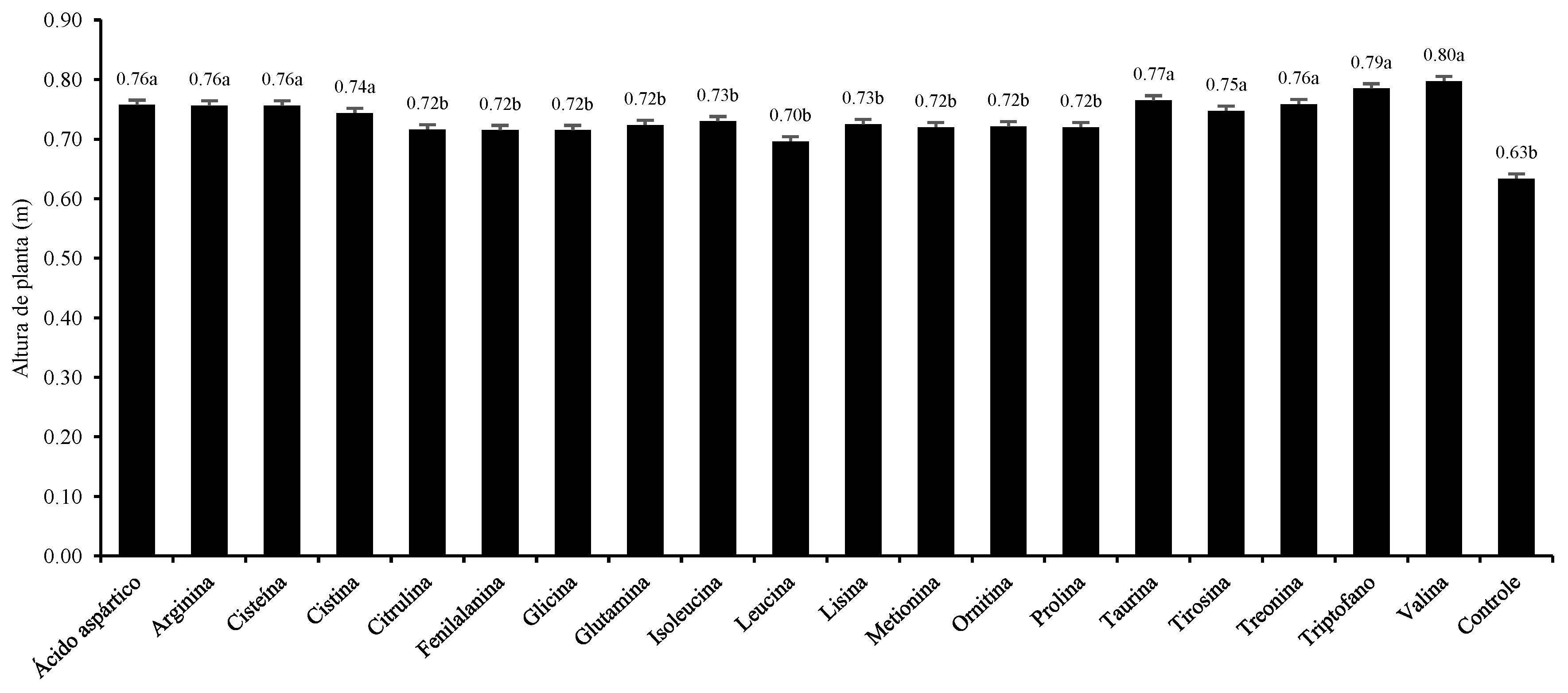
Figure 2.
Soybean grain productivity subjected to foliar application of amino acids, 2019-20 harvest, Rio Verde – GO. Means followed by the same letter in the columns do not differ among themselves (Scott-Knott at 5%).
Figure 2.
Soybean grain productivity subjected to foliar application of amino acids, 2019-20 harvest, Rio Verde – GO. Means followed by the same letter in the columns do not differ among themselves (Scott-Knott at 5%).
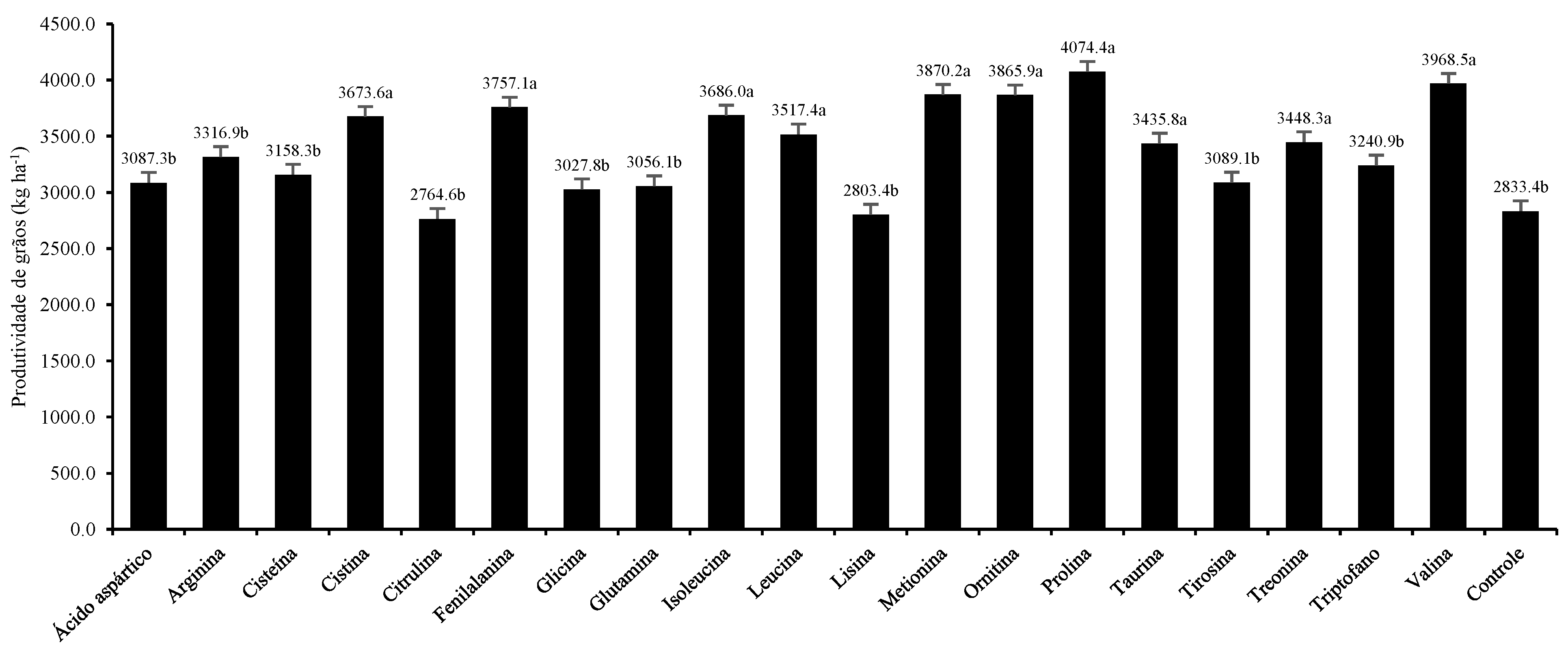

Table 1.
Chemical and granulometric analysis of soil samples collected before the installation of the experiment.
Table 1.
Chemical and granulometric analysis of soil samples collected before the installation of the experiment.
| Macronutrients | ||||||||||||||||
| Prof. | pH | P | S | K | Ca | Mg | Al | H+Al | M.O. | SB | CTC | V | m | |||
| cm | CaCl2 | mg dm-3 | cmolcdm-3 | g dm-3 | cmolcdm-3 | % | ||||||||||
| 0-20 | 3,9 | 7,53 | 17,3 | 19 | 0,5 | 0,37 | 0,92 | 7,50 | 32,6 | 0,92 | 8,51 | 10,8 | 50,0 | |||
| 20-40 | 3,9 | 5,31 | 16,8 | 17 | 0,36 | 0,28 | 0,85 | 6,35 | 29,0 | 0,68 | 7,03 | 9,7 | 55,6 | |||
| Micronutrients | Granulometry | |||||||||||||||
| B | Na | Cu | Fe | Mn | Zn | Sand | Silt | Clay | Textural class | |||||||
| mg dm-3 | % | |||||||||||||||
| 0-20 | 0,41 | 0,0 | 0,39 | 48,53 | 9,67 | 2,53 | 33 | 8 | 59 | Clayey | ||||||
| 20-40 | 0,41 | 0,0 | 0,34 | 45,03 | 6,05 | 1,8 | 33 | 4 | 63 | M. Clayey | ||||||
Soil solution pH, determined in calcium chloride solution; MO: organic matter, determined by colorimetric method; P: phosphorus, Mehlich; K+: potassium, Mehlich; Ca²⁺ and Mg²⁺: exchangeable calcium and magnesium contents, respectively, in KCl; S-SO₄²⁻: sulfur in the form of sulfates, extracted by calcium phosphate and determined by colorimetry. Al³⁺: exchangeable aluminum, extracted by 1 mol L⁻¹ potassium chloride solution. H+Al: total soil acidity, determined in SMP buffer solution at pH 7.5. SB: sum of bases (K+ + Ca²⁺ + Mg²⁺). CEC: cation exchange capacity (K+ + Ca²⁺ + Mg²⁺ + H+Al). V: base saturation of the soil (SB/CEC ratio). m: aluminum saturation [Al³⁺/(SB+Al³⁺)]. Cu, Fe, Mn, and Zn: copper, iron, manganese, and zinc, extracted by Mehlich solution.
Table 2.
Quantities and fertilizers used in the experiment.
| Fertilization | Source | Quantity |
| Correction | Dolomitic limestone1 | 3 t ha-1 |
| Sowing | Formulated 05-25-252 | 400 kg ha-1 |
1Applied broadcast over the entire area 30 days before planting. 2Applied in the sowing furrow.
Table 3.
Number of applications, timing, dose, commercial product, and active ingredients used during soybean cultivation.
Table 3.
Number of applications, timing, dose, commercial product, and active ingredients used during soybean cultivation.
| Application | Timing | Dose, commercial product, and active ingredients |
| 1ª | Pre-planting | 3,0 L ha-1 of Crucial (Glyphosate)+ 0,5 L ha-1 de Zethamaxx (Flumioxazina + Imazetapir) + 0,6 L ha-1 de U 46 (2,4-D) |
| TS | Sowing | 0,5 L 100 kg-1 de semente de Cropstar (Tiodicarbe + Imidacloprido) + Protreat (Tiram + Carbendazin) + 0,1 L 100 kg-1 of seed + 0,1 L 100 kg-1 of Cropseed (Bradyrhizobium japonicum) |
| 2ª | 20 DAE | 2,0 L ha-1 of Crucial (Glyphosate) + 0,8 L ha-1 of Cletodim (Viance) |
| 3ª | 40 DAE | 0,07 L ha-1 of Kaiso (Lambda-cialotrina) + 0,4 L ha-1 of Fox (Protioconazol + Trifloxistrobina) + 0,25% de Aureo |
| 4ª | 60 DAE | 0,07 L ha-1 of Kaiso (Lambda-cialotrina) + 0,4 L ha-1 of Fox (Protioconazol + Trifloxistrobina) + 0,25% of Aureo |
| 5ª | 70 DAE | 1,0 kg ha-1 of Perito (Acefato) + 0,2 L ha-1 of Valio (Orange oil) |
| 6ª | 80 DAE | 0,3 L ha-1 of Priori Xtra (Azoxystrobin + Cyproconazole) + 0,5% of Nimbus |
| Desiccation | 110 DAE | 2,0 L ha-1 of Gramoxone (Paraquat) + 0,2 L ha-1 of Valio (Orange oil) |
TS – Seed treatment; DAE – Days after emergence.
Table 4.
Description of treatments, number of applications, timing, and doses used.
| Treatments | Formulation | Dose (g ha-1) | Stages |
| 1 | Aspartic acid | 20 | V4 + R1 |
| 2 | Arginine | 20 | V4 + R1 |
| 3 | Cysteine | 20 | V4 + R1 |
| 4 | Cystine | 20 | V4 + R1 |
| 5 | Citrulline | 20 | V4 + R1 |
| 6 | Phenylalanine | 20 | V4 + R1 |
| 7 | Glycine | 20 | V4 + R1 |
| 8 | Glutamine | 20 | V4 + R1 |
| 9 | Isoleucine | 20 | V4 + R1 |
| 10 | Leucine | 20 | V4 + R1 |
| 11 | Lysine | 20 | V4 + R1 |
| 12 | Methionine | 20 | V4 + R1 |
| 13 | Ornithine | 20 | V4 + R1 |
| 14 | Proline | 20 | V4 + R1 |
| 15 | Taurine | 20 | V4 + R1 |
| 16 | Tyrosine | 20 | V4 + R1 |
| 17 | Threonine | 20 | V4 + R1 |
| 18 | Tryptophan | 20 | V4 + R1 |
| 19 | Valine | 20 | V4 + R1 |
| 20 | - | - | - |
Table 5.
Summary of the analysis of variance for the effects of foliar application of amino acids on biometric, nutritional, and grain productivity parameters, 2019-20 harvest, Rio Verde - GO.
Table 5.
Summary of the analysis of variance for the effects of foliar application of amino acids on biometric, nutritional, and grain productivity parameters, 2019-20 harvest, Rio Verde - GO.
| FV | GL | Mean squares | ||||||||||||||||||||
|---|---|---|---|---|---|---|---|---|---|---|---|---|---|---|---|---|---|---|---|---|---|---|
| Plant height | Number of internodes | Number of leaves | Number of branches | Number of pods | ||||||||||||||||||
| Treatments | 19 | 49,041 ** | 0,753 ns | 14,249 ns | 1,648 ns | 148,684 ns | ||||||||||||||||
| Blocks | 3 | 169,919 | 17,441 | 188,561 | 1,125 | 949,708 | ||||||||||||||||
| Residue | 57 | 18,318 | 2,391 | 20,947 | 1,289 | 241,116 | ||||||||||||||||
| CV (%) | 5,83 | 10,87 | 21,57 | 27,36 | 24,70 | |||||||||||||||||
| FV | GL | Mean squares | ||||||||||||||||||||
| N | P | K | Ca | Mg | S | |||||||||||||||||
| Treatments | 19 | 7,226 ns | 0,429 ns | 13,548 ns | 30,381 ns | 2,373 ns | 3,158 ns | |||||||||||||||
| Blocks | 3 | 23,140 | 1,099 | 80,858 | 503,765 | 72,167 | 4,539 | |||||||||||||||
| Residue | 57 | 10,041 | 0,297 | 18,360 | 20,799 | 2,157 | 3,315 | |||||||||||||||
| CV (%) | 7,82 | 14,96 | 26,66 | 21,09 | 15,49 | 53,85 | ||||||||||||||||
| FV | GL | Mean squares | ||||||||||||||||||||
| Fe | Mn | Cu | Zn | Mg | ||||||||||||||||||
| Treatments | 19 | 21947,183 ns | 2443,881 ns | 6,690 ns | 45,111 ns | 84,225 ns | ||||||||||||||||
| Blocks | 3 | 536778,340 | 4079,361 | 30,227 | 371,738 | 97,923 | ||||||||||||||||
| Residue | 57 | 17753,138 | 2689,721 | 5,868 | 43,648 | 69,947 | ||||||||||||||||
| CV (%) | 30,95 | 82,07 | 19,19 | 16,26 | 19,59 | |||||||||||||||||
| FV | GL | Mean squares | ||||||||||||||||||||
| 100-grain weight | Grain productivity (kg ha-1) | |||||||||||||||||||||
| Treatments | 19 | 0,634 ns | 495009,686 ** | |||||||||||||||||||
| Blocks | 3 | 10,627 | 15123,585 | |||||||||||||||||||
| Residue | 56 | 0,421 | 83400,751 | |||||||||||||||||||
| CV (%) | 3,45 | 8,53 | ||||||||||||||||||||
nsNot significant and *; ** significant at 5% and 1% probability, respectively, according to the F test. FV – Source of variation; GL – Degrees of freedom; and CV – Coefficient of variation.
Disclaimer/Publisher’s Note: The statements, opinions and data contained in all publications are solely those of the individual author(s) and contributor(s) and not of MDPI and/or the editor(s). MDPI and/or the editor(s) disclaim responsibility for any injury to people or property resulting from any ideas, methods, instructions or products referred to in the content. |
© 2025 by the authors. Licensee MDPI, Basel, Switzerland. This article is an open access article distributed under the terms and conditions of the Creative Commons Attribution (CC BY) license (http://creativecommons.org/licenses/by/4.0/).
Copyright: This open access article is published under a Creative Commons CC BY 4.0 license, which permit the free download, distribution, and reuse, provided that the author and preprint are cited in any reuse.


