

Submitted:
08 August 2025
Posted:
12 August 2025
You are already at the latest version
Abstract
This article presents a panoramic view of the scientific production on innovative behavior at a global level, which allows us to show authors and journals that are referents in the subject from 1961 to 2023, contributing to the Sustainable Development Goal (SDG) 9. Methodologically, traditional bibliometric laws and computational tools (VOSviewer software) were applied for data processing. The results show an exponential increase in publications from 1990 to 2022 with a critical mass in innovative behavior studies, concentrated in 17 journals and 46 authors with 4 or more publications. The main organizations leading scientific production in this area are in China and Australia. Finally, the Web of Science categories where the main journals are concentrated are Business, Management and Psychology.
Keywords:
innovation management
; human behavioral studies
; organizational psychology
; innovation performance
; leadership
; SDG 9
1. Introduction
Innovative behavior is increasingly important for the survival of organizations [1], generating advantages in the face of the unpredictable actions of the environment, causing the cognitive improvement of teams and responding faster to the dynamics of the environment, allowing to increase this ability to react [2]. Innovative behavior in addition to ensuring the longevity and success of organizations is necessary to combat sustainability challenges [3], as clearly expressed in SDG 9 "Build resilient infrastructure, promote inclusive and sustainable industrialization and foster innovation" [4]. Therefore, by fostering employees' innovative behavior, organizations can increase their chances of success in an increasingly competitive business environment [5].
This innovative behavior of employees is essential for organizations to be innovative, since they are the ones who use their knowledge and skills to generate new ideas and solutions, being the main responsible for innovation [6]. Therefore, companies must identify the factors that influence this behavior to encourage it and it is currently essential for the success of companies [7].
To enhance employees' creative self-efficacy in seeking organizational opportunities in the face of complex problems and coming up with innovative ideas, within the ethical innovative behavior framework, it is necessary to drive processes with diversity of personalities and seniority in the workplace [8,9,10].
In the case of public employees, they are key to improving public services, but research on this topic is scarce, especially in transition countries [11], in the private sphere the innovative behavior of members is essential for the project to be supported and successfully executed [12] in the special case of services these will benefit from the innovative behavior of employees both in bottom-up innovation and in the constant improvement of their processes [13].
Other ways for fostering innovative transformations in priority areas, such as environmental care, is through the imposition of legal regulations, complemented by market incentives, which have had a positive effect on technological solutions and innovative behavior towards environmental care [14]. The same is the case with inclusive measures encouraged by the organization which positively impacts on innovative behavior of employees [15].
In the manufacturing companies, it has been shown that practices associated with creating an innovative climate and culture with agile information channels and constant support from middle management with servant leadership, stimulate creativity and innovative behavior in work teams, along with other compensation and training measures [16,17,18,19,20,21].
In service companies, under the implementation of transformational leadership, achieving job satisfaction, confidence in their role, good working relationship in their job and among work teams favors the performance of their innovative behavior [22,23,24], a good example of this is the hospitality sector [22] and in the financial sector [23].
Transformational leaders are more effective than transactional leaders in generating innovative behavior in employees, as they focus more on inspiring and motivating followers than on exchanging rewards for task accomplishment [1]. Employees are more likely to be innovative when they expect their behavior to have a positive impact on their job performance and image within the organization [25]. Innovative behavior will be influenced by social norms, especially in contexts where people identify with a group [26], where job satisfaction can foster innovative behavior, given that it is not just an innate characteristic [27].
On the contrary, a high workload and a lack of social cohesion are inversely proportional to desirable innovative behavior and integration with external teams, being of vital importance that in the work teams are incorporated procedures that provide feedback from multiple lines of staff of the organization and thus collaborate, engage and empower employees in their jobs, in addition to ensuring the psycho-occupational care [28,29,30]. Mobile workplace stress can reduce innovation, increasing work-family conflict and reducing employee engagement. Therefore, companies should consider the potential impact of mobile workplace stress on innovation [31].
The innovative behavior of employees is key to organizational innovation, which in turn is essential for business success [32,33], and line managers have an important role to play in supporting them [33]. This support should be reinforced by working methods that intensify relationships with the external environment especially business partners, support from government institutions through policies, funding, R&D&i encouragement which has a positive impact on collaborative innovation, and technological convergence [34,35,36,37]. Service organizations need to find ways to foster innovation among employees, even in bureaucratic environments [38].
The study of innovative behavior is not new, but its importance for the success of organizations is becoming increasingly clear. Thus, the psychological factors and mechanisms that drive innovation in organizations continue to be the subject of research [39]. Therefore, this article seeks through a performance analysis and scientific mapping to distinguish authors, journals, and articles on innovative behavior of high recognition in the epistemic community around this topic, as well as the social relationships of co-authorship that occur within this community.
2. Materials and Methods
Based on a dataset extracted from the Core Collection of Web of Science (WoS) on May 17, 2023, with the thematic search vector on Innovative Behavior {TS=(Innovative NEAR/0 Behavior)}, the thematic search tag TS (performs a simultaneous search on the following fields: title, keywords, author, abstract and Keywords Plus®) and the word proximity operator (NEAR) and simultaneously incorporates both words [40]. Then, based on the “Guidelines for advancing theory and practice through bibliometric research” by [41] both performance analysis and science mapping are performed. For performance analysis, the bibliometric laws [42] of [43], Lotka [44], Bradford [45] and Hirsch's index [46] are used, and science mapping focuses on co-authorship analysis using VOSviewer software.
1) Price's Laws, allow to analyze the exponential growth of science (exponential growth adjustment of the annual publications number) as an expression of critical mass of knowledge interesting to be studied, and the obsolescence of scientific publications and by contrast the contemporaneity of science documented in terms of two semi-periods divided by the median number of publications ordered in a temporal way. This division, which makes it possible to distinguish between contemporary and obsolete literature, also gives way to the notion of classical literature, which stands out within the obsolete literature because of its recognition by the epistemic community expressed in the high number of citations received [43,47].
2) Zipf’s Law, refers to the concentration of word usage in the language, in this case the keywords assigned as metadata by Web of Science or Keywords plus© are used as a basis to study this concentration, highlighting the most used keywords in the set of articles, using as an estimate the square root over the set of keywords, which is then adjusted according to a discrete number of keywords, the resulting set of keywords plus© is known as outstanding keyword plus [48,49].
3) Lotka's Law, allows segregating authors of high production in a specific subject from those who have an ephemeral step in a particular area of scientific knowledge (high percentage of authors who only present one or a relatively small number of published papers), to estimate the concentration of authors the square root is applied on the total number of authors, which is then adjusted according to a discrete number of publications, the resulting set of authors is known as prolific authors [44,50,51].
4) Bradford's law, his study concentrates on the journals, mainly in what is known as Bradford's core, the smallest subset of journals that manages to concentrate one third of the total number of documents studied. The subsets that manage to concentrate the other thirds of documents according to their increasing order in number of journals are known as zones 1 and 2. Although all the attention is focused on the Bradford core for being the production environment that tends to congregate the most specialized authors, reviewers, and editors in a specific topic of study [45,52].
5) Hirsch index, which allows to determine the relative impact of scientific productivity on a corpus of selected articles. And it is expressed as a value n of documents, implying that these n documents have obtained n or more citations on a common counting basis for all these. [46,53]. In this case the h-index on the total of extracted documents will be used, as the h-index of some authors will be recovered from the extraction base, in this case from the WoS (Web of Science ResearcherID) author profiles.
6) Co-authorship analysis is used for the discovery of social relationships of both prolific authors and prolific membership organizations. In this case through clustering using VOSviewer [54].
7) Triangulation tables, a crossover table has been made based on the previous results. In this way, possible associations between prolific authors and articles in the h-index, Bradford core journals and articles in the h-index, and finally the triangulation between the 3 results: prolific authors, core journals and articles in the h-index will be sought.
3. Results
The WoS search resulted in 1,300 indexed articles, with data and metadata in English, published between 1961 and 2023, including 76 Early Access articles (no publication date defined yet) and marking the median of the semi-period of contemporary publications from 2019 onwards (See Table 1).
The set of 1,300 extracted articles presents an uninterrupted scientific production only since 1990, year from which it presents an annual exponential growth until 2022, as shown in Figure 1. Thus, the corpus studied complies with the law of exponential growth, evidencing a critical mass of knowledge that can be studied.
These 1,300 articles present 2,270 keywords plus©, which are concentrated in only 48 (square root = 2,270) with 35 or more occurrences, as shown in Figure 2 below.
Figure 2 shows two main clusters, one referring to the performance achieved by innovation processes in terms of innovative behavior (Green frames). And another one referring to organizational psychology, mainly leadership, and its effects on innovative behavior (Red frames).
In addition, a total of 3,345 authors were identified through VOSviewer, with 2,964 authors (89%) contributing to a single article. The analysis of prolific authors according to Lotka's Law [44] allows us to estimate that about 58 would be prolific authors (Square Root (3,345) = 58). Thus, 46 authors with 4 or more publications were selected. Those segregated from their co-authors with lower levels of publication are represented in Figure 3, where we can observe 2 tetrads, 5 triads, 5 dyads, plus 13 authors alone at this level of production.
Table 2 highlights that all clusters have current publications in the median of contemporary articles (from 2019 onwards), and as the most prolific author above all selected authors De Clercq, Dirk with 15 articles (2016-2022), researcher affiliated with the Goodman School of Business, Brock University (Canada). On the other hand it is necessary to name that the 13 authors presenting alone at this level of production are reduced to 12, given the digital identity disambiguation of the author Onne Janssen (also registered in full name as Janssen, O), who like Abraham Carmeli presents a production of 10 articles, followed by: Thomas W.H. Ng (7), Kwok Leung (6), Shaker Bani-Melhem (6), Sascha Kraus (5), Mariola Laguna (5), Tung-Ju Wu (5), Mohammed Aboramadan (4), Yvonne Brunetto (4), Liangyong Chen (4), and Zhen Wang (4).
The repeated presence of some affiliations among the co-authors with lower levels of production that are associated with the referent authors of each cluster has motivated us to present in Figure 4 a graph of organizational co-authorships (author affiliations), with proportional levels of demand. Thus, of the 1,498 author-affiliation organizations, 1,035 only contribute to one article and 39 are estimated to be prolific organizations (square root of 1,498), selecting 41 (2.7%) author organizations that contribute to 8 or more (up to 26) of the 1,300 published articles (1,300), and 41 (2.7%) author organizations that contribute to 8 or more (up to 26) of the 1,300 published articles.
Thus, Figure 4 presents a wide network of connections formed by 25 organizations that gather the green, red and blue clusters, with the extreme positions of Renmin University – China (26) and Swinburne University of Technology – Australia (21) with the main world contributions of scientific production in Innovative Behavior, network of which are also part: Brock University – Canada (16), Deakin University – Australia (15), and Harbin Institute of Technology – China (15).
Another aspect of interest to analyze in this understanding of the epistemic community around Innovative Behavior studies is the spaces of knowledge production. Thus, the law of dispersion of scientific literature or Bradford's Law allows us to identify, among the 443 journals where the 1,300 articles studied have been published, which of Bradford's core groups a limited subset of journals that concentrate an estimated total of one third of the articles, resulting in this case in 17 of 443 journals that concentrate 422 of the 1,300 articles (32.5%), journals that are presented in Table 3.
Table 3 shows Frontiers in Psychology and Sustainability as the journals with the highest production, and it can also be seen within the core that the Journal of Business Research has published articles on this topic for the longest time (Shuptrine, 1977). On the other hand, 9 of these journals are indexed in the WoS category of Management, 6 in Psychology (in different subcategories), and 4 in Business.
In addition to highlighting this set of journals, it is interesting to note that the set of most cited articles belonging to the h-index is 89 (89 articles with 89 or more citations), making it possible to identify highly cited contemporary publications and the set of classic articles on innovative behavior (information on these 89 documents is presented in Appendix A). Thus, Figure 5 presents the citations received by the 89 articles according to their publication date, dividing the time scale into contemporary and obsolescence semi-periods; the highly cited articles that are in the latter are the so-called classic articles.
This crossing of the h-index with the publication timeline (obsolescence and contemporary semi-periods) in Figure 5, indicates the existence of only 86 classic articles among the 572 articles published in the obsolescence period from 1961 to 2018 (orange dots, details in Appendix A) and only 3 highly cited contemporary articles in yellow (Jiang, Z; Hu, XW; Wang, ZM; Jiang, X, 2019, Qing, M; Asif, M; Hussain, A; Jameel, A, 2020, Wales, WJ; Covin, JG; Monsen, E, 2020). Being relevant we must highlight the 2,774 citations received by the classic article by Scott and Bruce (1994) and point out as the oldest classic the article by Lao (1970) with 103 citations.
Table 4 shows that of the 46 prolific authors (figure 3), only 11 have managed to produce articles whose citation level places them in the h-index, and it can also be seen that only 18 of the 89 articles in the h-index are authored by prolific researchers on innovative behavior. One Janssen stands out for contributing 6 articles to the h-index.
Figure 6 shows common aspects of these 18 articles according to their author keywords.
Figure 6 shows 39 author keywords. On the one hand, the concepts associated in a network with Organization innovations, Process innovations, and Management strategy converge in the concept Innovation (purple node). And on the other hand, concepts associated in network to Job stress, Workplace happiness, and Social network, converge in the concept Innovative Behavior (green node), both concepts being united by the concept Leadership (yellow intermediary node).
In the same way, the intersection between Bradford core journals with h-index articles is analyzed. As show in Table 5.
Table 5 shows that less than 50% of the journals that are in the Bradford nucleus (8/17) achieve a position in the h-index for their articles on innovative behavior. On the other hand, 24 of the 89 articles in the h-index have been published in Bradford nucleus journals.
In addition, for these 24 articles Figure 7 shows 56 consistently connected author keywords out of a total of 80 author keywords. The time trend contemplates an evolution from the innovation concept (cyan node) towards innovative behavior (light orange node). The most recently studied concepts are workplace happiness, job stress, leadership, and entrepreneurship (red nodes).
Finally, the cross-referencing of the articles identified in Table 4 and Table 5 allows us to present in Table 6 a reduced set of highly cited articles (h-index), produced by authors with a high level of publication in the subject under study (prolific authors) and published in journals where the world discussion on innovative behavior is concentrated (Bradford Core).
Table 6 shows 6 highly cited articles (h-index) with between 94 and 280 occurrences distributed temporally in the half-period of obsolescence, which, given their level of citations, can be considered classics. All these articles have been published in journals belonging to the core that concentrates in only 17 journals a third of the 1,300 documents studied. In this case, the 6 articles are published in 6 different journals indexed in the WoS categories of Business, Management or Psychology. Additionally, the 6 articles are authored by prolific researchers in the subject under study and 2 of these articles have author affiliation to the prolific organizations presented in Figure 4: Deakin University and Monash University (Newman et al., 2018), and University of Groningen (Janssen, 2004).
Figure 8a shows six articles of high scientific valuation, which present two temporal sequences of cross-citations which start at Janssen (2004), one to Bani-Melhem et al. (2018) and the other to Xerri (2013), passing through Carmeli (2009). Figure 8b shows that five articles with high scientific valuation share common references (Janssen, 2004, Carmeli et al., 2009, Xerri et al., 2013, Bani-Melhem et al., 2018, and Newman et al., 2018). In both figures (8a and 8b), from red to blue the number of citations decreases, the article by Tavassoli et al. (2015) is the only one that is completely isolated. Finally, Figure 8c displays 26 connected references from the five articles identified in Figure 8b. In the cases of Amabile (1996) and Hair (2019) these references are repeated in three articles, but it is the case of Scott (1994) the common reference that connects the five articles, giving rise to an invisible college on innovative behavior that is founded on his ideas.
4. Discussion
In relation to the Guidelines of Mukherjee et al. [41], an important theoretical contribution of our article is to make known the existence of a cluster of 25 cohesive organizations producing knowledge in innovative behavior, with a relevant participation of Renmin University (China) and Swinburne University of Technology (Australia). As well as the recognition for the role of economics and business and psychology research areas, as foundational in the theoretical development of innovative behavior. Additionally, context and temporality are provided regarding where and when it is possible to produce knowledge of high scientific recognition on innovative behavior.
From the methodological point of view, differences can be established with contemporary, similar, and related bibliometric research. Thus, in the bibliometric research of Peng et al. [58] on innovation in organizations, innovation is addressed as a general topic, whereas our work focuses specifically on innovative behavior. From the methodological point of view, some information extraction criteria are shared, such as using Web of Science, and the thematic tag TS allowing a search in several fields of the structured database at the same time and restricting the search to articles only. Although they have opted to limit the scope of Web of Science to the Social Science Citation Index (SSCI), while we have reviewed more indexes from the WoS Core Collection.
Another difference with the work of Peng et al. [58] is that they have limited themselves to the 20-year period, in which a large part of the publications is undoubtedly concentrated, unlike our study without temporal restrictions, which has extracted documents since 1961. They also incorporate restrictions to the area of management studies, which prevents us from observing the multidisciplinary/interdisciplinary nature in the innovation study, as shown in our results. Finally, they limit their search to English-language documents, even though the data and metadata analyzed from the Core Collection - Web of Science are recorded in English regardless of the language of the full document, which limits the inclusion of non-English speakers, thus incorporating a bias in the extracted documents. There are also no defined criteria to limit the results presented.
On the other hand, our work coincides with the bibliometric research published by Salam et al. [59] on Innovative Behavior on issues such as the starting year since 1961, the focus on article-type documents, not adding area or language restrictions and the use of VOSviewer for the analysis of co-authorships. Regarding the search vector, they have chosen to review the concept "innovative behavior" in titles and abstracts, while we have added the author keywords and WoS keywords (Keyword Plus©). Methodologically, our work contributes the use of bibliometric laws, not limiting itself to reporting top rankings (top 5, top 10) as is done in the work of Peng et al. [58] and Salam et al. [59].
Given the specificity of the work of Salam et al. [59]), despite differing the search base from WoS to Scopus and the final year considered in the period under study. There are similarities of results in their top 5 journal results with our journals in the Bradford core: Eur. J. Innov. Manag., J. Prod. Innov., Manag., Res. Policy, and Sustainability. The exception is Int. J. Innov. Manag. which does not comply with being indexed in WoS. There are also some similarities between some authors of its top 10, being incorporated within our authors 9 of them: Abraham Carmeli, Adalgisa Battistelli, Alexander Newman, Carlo Odoardi, Charlie Karlsson, Francesco Montani, Karin Sanders, Suk Bong Choi, and Terje Slatten. Except for Billal Afsar who in our extraction from WoS only presents 3 articles (Afsar, B; Badir, YF; Saeed, BB; Hafeez, S, 2017, Afsar, B; Cheema, S; Bin Saeed, B, 2018, Afsar, B; Shahjehan, A, 2018).
5. Conclusions
From a theoretical point of view, innovative behavior is a key factor in the dynamics of the business environment since it allows a much faster reaction in work teams to the changes and pressures of the market. The preparation and promotion of innovative behavior in work teams should be promoted by the organizations themselves to strengthen both their survival and success. Thus, innovative leadership should be differentiated depending on the type of private or public organization, with the latter facing a greater challenge to advance research on this topic.
Innovative behavior is widely favored through transformational leadership, which strengthens the motivational aspect of work teams, which translates into a greater impact on work performance and individual and team image. Stressful environments are understood as antagonistic cases, which affect both the work environment and the mental health of workers.
Our bibliometric analysis shows a sustained increase in more than three decades with a trend at an exponential rate of (R2 ≈ 94%), generating a critical mass of knowledge researchers over time, in which we have identified 86 classic articles. There are 46 authors with the highest productivity with 4 or more publications, being the organizations with the highest productivity located in China and Australia, achieving in both cases the main world contributions in the subject of innovative behavior.
Regarding co-authorship configurations, we found from tetrads to solo researchers. The most prolific author corresponds to Onne Janssen with h-index WoS 30 and 10 articles on the thematic, Abraham Carmeli with h-index WoS 48 and 10 articles, Alexander Newman with h-index WoS 46 and 7 articles, Thomas W.H. Ng with h-index 47 and 7 articles. In turn, the study identifies a trend of two main journals with the highest production which are Frontiers in Psychology and Sustainability, generating 90 and 63 articles with an impact factor of 3.8 and 3.9, although these are not associated with any of the 89 articles in the h-index of the 1,300 under study. The journal with the highest impact factor is International Journal Hospitality Management with a value of 11.7, followed by Journal of Business Research with 11.3.
The temporal evolution of the publications indicates that only 15% of the articles published between 1961 and 2019 (obsolescence period) are classics, that is, in this specific case, they have received more than 50 citations. While the oldest classic article was published in 1970 (Lao, 1970, with 103 citations), the most cited classic article dates only from 1994 (Scott and Bruce, 1994, with 2,774 citations).
Regarding the convergence of h-index author keywords, on the one hand we have constructs oriented to the innovation concept, and on the other hand to innovative behavior, both concepts being articulated by the concept of leadership.
The time trend shows a shift from the innovation concept to innovative behavior. The most recently studied concepts are happiness at work, work stress, leadership, and entrepreneurship.
In reference to the studies, it was possible to investigate the temporal sequences of cross-quotations and common references. In the first stage there are two temporal sequences of cross-citations starting in the article by Janssen (2004). One sequence leads to the article by Bani-Melhem et al. (2018) and the other to the article by Xerri (2013), passing through the article by Carmeli (2009). The article by Tavassoli et al. (2015) is the only one that is completely isolated.
In the second stage, five articles share common references. These articles are Janssen (2004), Carmeli et al. (2009), Xerri et al. (2013), Bani-Melhem et al. (2018) and Newman et al. (2018), Recognizing.
The references of Amabile (1996) and Hair (2019) which are repeated in three articles, the common reference connecting the five articles being that of Scott (1994). This suggests that there is an invisible college on innovative behavior that is grounded in Scott's ideas.
For future research, it is recommended to continue deepening in more specific aspects related to transformational leadership and its effect on innovative behavior based on topics oriented to public organizations, its relationship with the measurement of impacts on productivity and the levels achieved in organizational development and climate, in addition to making connections with the private sector through comparative studies.
Supplementary Materials
The following supporting information can be downloaded at the website of this paper posted on Preprints.org. Table S1: IB1300_4_Excel.xlsx.
Author Contributions
For research articles with several authors, a short paragraph specifying their individual contributions must be provided. The following statements should be used “Conceptualization, C.G.-D., A.A.-H., J.R.-A. and A.V.-M.; methodology, G.S.-S. and A.V.-M.; software, G.S.-S., and A.V.-M.; validation, A.A.-H., G.S.-S., and A.V.-M.; formal analysis, C.G.-D., G.S.-S., and A.V.-M..; investigation, , C.G.-D., G.S.-S., and A.V.-M.; resources, G.S.-S. and A.V.-M.; data curation, A.V.-M..; writing—original draft preparation, C.G.-D., J.R.-A., G.S.-S. and A.V.-M.; writing—review and editing, C.G.-D., A.A.-H., G.S.-S. and A.V.-M.; visualization, G.S.-S. and A.V.-M.; supervision, A.A.-H.; project administration, C.G.-D.; funding acquisition, C.G.-D., A.V.-M. and G.S.-S All authors have read and agreed to the published version of the manuscript.
Funding
The publication fee (article processing charge, APC) was partially funded through the publication incentive fund by Universidad Católica de la Santísima Concepción (Code: APC2024), Universidad Autónoma de Chile (Code: C.C. 456001), Universidad Arturo Prat (Code: APC2024) and Universidad de Las Américas (Code: APC2024).
Conflicts of Interest
The authors declare no conflicts of interest.
References
- Pieterse, A.N.; van Knippenberg, D.; Schippers, M.; Stam, D. Transformational and Transactional Leadership and Innovative Behavior: The Moderating Role of Psychological Empowerment. J. Organ. Behav. 2010, 31, 609–623. [Google Scholar] [CrossRef]
- Kotrschal, A.; Taborsky, B. Environmental Change Enhances Cognitive Abilities in Fish. PLoS Biol. 2010, 8, e1000351. [Google Scholar] [CrossRef]
- Duradoni, M.; Di Fabio, A. Intrapreneurial Self-Capital and Connectedness to Nature within Organizations. Sustainability 2019, 11, 3699. [Google Scholar] [CrossRef]
- Wu, J.; Guo, S.; Huang, H.; Liu, W.; Xiang, Y. Information and Communications Technologies for Sustainable Development Goals: State-of-the-Art, Needs and Perspectives. IEEE Commun. Surv. Tutor. 2018, 20, 2389–2406. [Google Scholar] [CrossRef]
- Park, S.; Jo, S.J. The Impact of Proactivity, Leader-Member Exchange, and Climate for Innovation on Innovative Behavior in the Korean Government Sector. Leadersh. Organ. Dev. J. 2018, 39, 130–149. [Google Scholar] [CrossRef]
- Song, J.Y.; Jiao, H.; Wang, C.H. How Work-Family Conflict Affects Knowledge Workers' Innovative Behavior: A Spillover-Crossover-Spillover Model of Dual-Career Couples. J. Knowl. Manag. 2023. [CrossRef]
- Tang, Y.; Shao, Y.F.; Chen, Y.J. Assessing the Mediation Mechanism of Job Satisfaction and Organizational Commitment on Innovative Behavior: The Perspective of Psychological Capital. Front. Psychol. 2019, 10, 2699. [Google Scholar] [CrossRef]
- Newman, A.; Neesham, C.; Manville, G.; Tse, H.H.M. Examining the Influence of Servant and Entrepreneurial Leadership on the Work Outcomes of Employees in Social Enterprises. Int. J. Hum. Resour. Manag. 2018, 29, 2905–2926. [Google Scholar] [CrossRef]
- Qing, M.; Asif, M.; Hussain, A.; Jameel, A. Exploring the Impact of Ethical Leadership on Job Satisfaction and Organizational Commitment in Public Sector Organizations: The Mediating Role of Psychological Empowerment. Rev. Manag. Sci. 2020, 14, 1405–1432. [Google Scholar] [CrossRef]
- Miao, Q.; Newman, A.; Schwarz, G.; Cooper, B. How Leadership and Public Service Motivation Enhance Innovative Behavior. Public Adm. Rev. 2018, 78, 71–81. [Google Scholar] [CrossRef]
- Nguyen, N.T.H.; Nguyen, D.; Vo, N.; Tuan, L.T. Fostering Public Sector Employees' Innovative Behavior: The Roles of Servant Leadership, Public Service Motivation, and Learning Goal Orientation. Adm. Soc. 2023, 55, 30–63. [Google Scholar] [CrossRef]
- Lei, H.S.; Lai, C.F.; Chen, C.C. How Does Project Supervisor Maintain Sustainability of Project Members? A Study from Leadership Perspective. Sustainability 2018, 10, 2785. [Google Scholar] [CrossRef]
- Hoang, G.; Luu, T.T.; Du, T.; Nguyen, T.T. Can Both Entrepreneurial and Ethical Leadership Shape Employees’ Service Innovative Behavior? J. Serv. Mark. 2023, 37, 446–463. [Google Scholar] [CrossRef]
- Zhang, Y.; Wang, J.R.; Xue, Y.J.; Yang, J. Impact of Environmental Regulations on Green Technological Innovative Behavior: An Empirical Study in China. J. Clean. Prod. 2018, 188, 763–773. [Google Scholar] [CrossRef]
- Qi, L.; Liu, B.; Wei, X.; Hu, Y.H. Impact of Inclusive Leadership on Employee Innovative Behavior: Perceived Organizational Support as a Mediator. PLoS ONE 2019, 14, e0212091. [Google Scholar] [CrossRef]
- Bos-Nehles, A.C.; Veenendaal, A.A.R. Perceptions of HR Practices and Innovative Work Behavior: The Moderating Effect of an Innovative Climate. Int. J. Hum. Resour. Manag. 2019, 30, 2661–2683. [Google Scholar] [CrossRef]
- Yu, M.C.; Mai, Q.; Tsai, S.B.; Dai, Y. An Empirical Study on the Organizational Trust, Employee-Organization Relationship and Innovative Behavior from the Integrated Perspective of Social Exchange and Organizational Sustainability. Sustainability 2018, 10, 30864. [Google Scholar] [CrossRef]
- Ali, M.; Li, Z.; Khan, S.; Shah, S.J.; Ullah, R. Linking Humble Leadership and Project Success: The Moderating Role of Top Management Support with Mediation of Team-Building. Int. J. Manag. Proj. Bus. 2021, 14, 545–562. [Google Scholar] [CrossRef]
- Yang, M.J.; Luu, T.T.; Qian, D. Dual-Focused Transformational Leadership and Service Innovation in Hospitality Organisations: A Multilevel Investigation. Int. J. Hosp. Manag. 2021, 98, 103035. [Google Scholar] [CrossRef]
- Bednall, T.C.; Rafferty, A.E.; Shipton, H.; Sanders, K.; Jackson, C.J. Innovative Behaviour: How Much Transformational Leadership Do You Need? Br. J. Manag. 2018, 29, 796–816. [Google Scholar] [CrossRef]
- Zada, S.; Khan, J.; Saeed, I.; Jun, Z.Y.; Vega-Muñoz, A.; Contreras-Barraza, N. Servant Leadership Behavior at Workplace and Knowledge Hoarding: A Moderation Mediation Examination. Front. Psychol. 2022, 13, 888761. [Google Scholar] [CrossRef]
- Bani-Melhem, S.; Zeffane, R.; Albaity, M. Determinants of Employees' Innovative Behavior. Int. J. Contemp. Hosp. Manag. 2018, 30, 1601–1620. [Google Scholar] [CrossRef]
- Hughes, M.; Rigtering, J.P.C.; Covin, J.G.; Bouncken, R.B.; Kraus, S. Innovative Behaviour, Trust and Perceived Workplace Performance. Br. J. Manag. 2018, 29, 750–768. [Google Scholar] [CrossRef]
- Karatepe, O.M.; Aboramadan, M.; Dahleez, K.A. Does Climate for Creativity Mediate the Impact of Servant Leadership on Management Innovation and Innovative Behavior in the Hotel Industry? Int. J. Contemp. Hosp. Manag. 2020, 32, 2497–2517. [Google Scholar] [CrossRef]
- Yuan, F.R.; Woodman, R.W. Innovative Behavior in The Workplace: The Role of Performance and Image Outcome Expectations. Acad. Manag. J. 2010, 53, 323–342. [Google Scholar] [CrossRef]
- Adarves-Yorno, I.; Postmes, T.; Haslam, S.A. Creative Innovation or Crazy Irrelevance? The Contribution of Group Norms and Social Identity to Creative Behavior. J. Exp. Soc. Psychol. 2007, 43, 410–416. [Google Scholar] [CrossRef]
- Niu, H.J. Is Innovation Behavior Congenital? Enhancing Job Satisfaction as a Moderator. Pers. Rev. 2014, 43, 288–302. [Google Scholar] [CrossRef]
- Montani, F.; Vandenberghe, C.; Khedhaouria, A.; Courcy, F. Examining the Inverted U-Shaped Relationship between Workload and Innovative Work Behavior: The Role of Work Engagement and Mindfulness. Hum. Relat. 2020, 73, 59–93. [Google Scholar] [CrossRef]
- Eva, N.; Meacham, H.; Newman, A.; Schwarz, G.; Tham, T.L. Is Coworker Feedback More Important than Supervisor Feedback for Increasing Innovative Behavior? Hum. Resour. Manag. 2019, 58, 383–396. [Google Scholar] [CrossRef]
- Carbonell, P.; Escudero, A.I.R. The Dark Side of Team Social Cohesion in NPD Team Boundary Spanning. J. Prod. Innov. Manag. 2019, 36, 149–171. [Google Scholar] [CrossRef]
- Wang, X.Y.; Zhang, Z.Y.; Chun, D. How Does Mobile Workplace Stress Affect Employee Innovative Behavior? The Role of Work-Family Conflict and Employee Engagement. Behav. Sci. 2022, 12, 2. [Google Scholar] [CrossRef]
- Li, M.L.; Hsu, C.H.C. Linking Customer-Employee Exchange and Employee Innovative Behavior. Int. J. Hosp. Manag. 2016, 56, 87–97. [Google Scholar] [CrossRef]
- Wen, Q.X.; Wu, Y.X.; Long, J. Influence of Ethical Leadership on Employees’ Innovative Behavior: The Role of Organization-Based Self-Esteem and Flexible Human Resource Management. Sustainability 2021, 13, 31359. [Google Scholar] [CrossRef]
- Jiao, H.; Yang, J.F.; Zhou, J.H.; Li, J.Z. Commercial Partnerships and Collaborative Innovation in China: The Moderating Effect of Technological Uncertainty and Dynamic Capabilities. J. Knowl. Manag. 2019, 23, 1429–1454. [Google Scholar] [CrossRef]
- Demircioglu, M.A.; Audretsch, D.B. Conditions for Complex Innovations: Evidence from Public Organizations. J. Technol. Transf. 2020, 45, 820–843. [Google Scholar] [CrossRef]
- Martinez-Roman, J.A.; Gamero, J.; Delgado-Gonzalez, M.D.; Tamayo, J.A. Innovativeness and Internationalization in SMEs: An Empirical Analysis in European Countries. Technol. Forecast. Soc. Chang. 2019, 148, 119716. [Google Scholar] [CrossRef]
- Suzigan, W.; Garcia, R.; Feitosa, P.H.A. Institutions and Industrial Policy in Brazil after Two Decades: Have We Built the Needed Institutions? Econ. Innov. New Technol. 2020, 29, 799–813. [Google Scholar] [CrossRef]
- Cohen, B.J. Fostering Innovation in a Large Human Services Bureaucracy. Adm. Soc. Work 1999, 23, 47. [Google Scholar] [CrossRef]
- Liu, Y.B.; Wang, W.; Chen, D.S. Linking Ambidextrous Organizational Culture to Innovative Behavior: A Moderated Mediation Model of Psychological Empowerment and Transformational Leadership. Front. Psychol. 2019, 10, 2192. [Google Scholar] [CrossRef]
- Clarivate Web of Science. Available online. https://www.webofknowledge.com/ 2025, (accessed on 17 May 2025).
- Mukherjee, D.; Lim, W.M.; Kumar, S.; Donthu, N. Guidelines for Advancing Theory and Practice through Bibliometric Research. J. Bus. Res. 2022. [CrossRef]
- Haddow, G. Bibliometric Research. In Research Methods, 2nd ed.; Williamson, K., Johanson, G., Eds.; Chandos Publishing: Oxford, UK, 2018; pp. 241–266. [Google Scholar] [CrossRef]
- Price, D. A General Theory of Bibliometric and Other Cumulative Advantage Processes. J. Assoc. Inf. Sci. 1976, 27, 292–306. [Google Scholar] [CrossRef]
- Lotka, A.J. The Frequency Distribution of Scientific Productivity. J. Wash. Acad. Sci. 1926, 16, 317–321. [Google Scholar]
- Bulik, S. Book use as a Bradford-Zipf Phenomenon. Coll. Res. Libr. 1978, 39, 215–219. [Google Scholar] [CrossRef]
- Hirsch, J.E. An Index to Quantify an Individual’s Scientific Research Output. Proc. Natl. Acad. Sci. USA 2005, 102, 16569–16572. [Google Scholar] [CrossRef] [PubMed]
- Dobrov, G.M.; Randolph, R.H.; Rauch, W.D. New Options for Team Research via International Computer Networks. Scientometrics 1979, 1, 387–404. [Google Scholar] [CrossRef]
- Zipf, G.K. Selected Studies of the Principle of Relative Frequency in Language; Oxford University Press: Oxford, UK, 1932. [Google Scholar]
- Merediz-Solà, I.; Bariviera, A.F. A Bibliometric Analysis of Bitcoin Scientific Production. Res. Int. Bus. Financ. 2019, 50, 294–305. [Google Scholar] [CrossRef]
- Nicholls, P.T. Price’s Square Root Law: Empirical Validity and Relation to Lotka’s Law. Inf. Process. Manag. 1988, 24, 469–477. [Google Scholar] [CrossRef]
- Tsai, H.H. Knowledge Management vs. Data Mining: Research Trend, Forecast and Citation Approach. Expert Syst. Appl. 2013, 40, 3160–3173. [Google Scholar] [CrossRef]
- Desai, N.; Veras, L.; Gosain, A. Using Bradford’s Law of Scattering to Identify the Core Journals of Pediatric Surgery. J. Surg. Res. 2018, 229, 90–95. [Google Scholar] [CrossRef]
- Crespo, N.; Simoes, N. Publication Performance Through the Lens of the h-index: How Can We Solve the Problem of the Ties? Soc. Sci. Q. 2019, 100, 2495–2506. [Google Scholar] [CrossRef]
- Van Eck, N.J.; Waltman, L. Software Survey: VOSviewer, a Computer Program for Bibliometric Mapping. Scientometrics 2010, 84, 523–538. [Google Scholar] [CrossRef]
- Crane, D. Social Structure in a Group of Scientists: A Test of the 'Invisible College' Hypothesis. Am. Sociol. Rev. 1969, 34, 335–352. [Google Scholar] [CrossRef]
- Sainaghi, R.; Phillips, P.; Baggio, R.; Mauri, A. Cross-Citation and Authorship Analysis of Hotel Performance Studies. Int. J. Hosp. Manag. 2018, 73, 75–84. [Google Scholar] [CrossRef]
- Vega, A.; Arjona, J.M.; Ariza, A.; Han, H.; Law, R. In Search of ‘A Research Front’ in Cruise Tourism Studies. Int. J. Hosp. Manag. 2020, 85, 102353. [Google Scholar] [CrossRef]
- Peng, R.Z.; Chen, J.S.; Wu, W.P. Mapping Innovation Research in Organizations: A Bibliometric Analysis. Front. Psychol. 2021, 12, 750960. [Google Scholar] [CrossRef]
- Salam, S.; Senin, A.A. A Bibliometric Study on Innovative Behavior Literature (1961–2019). SAGE Open 2022, 12, 21582440221109589. [Google Scholar] [CrossRef]
Figure 1.
Articles published on Innovative Behavior between 1990 and 2022.
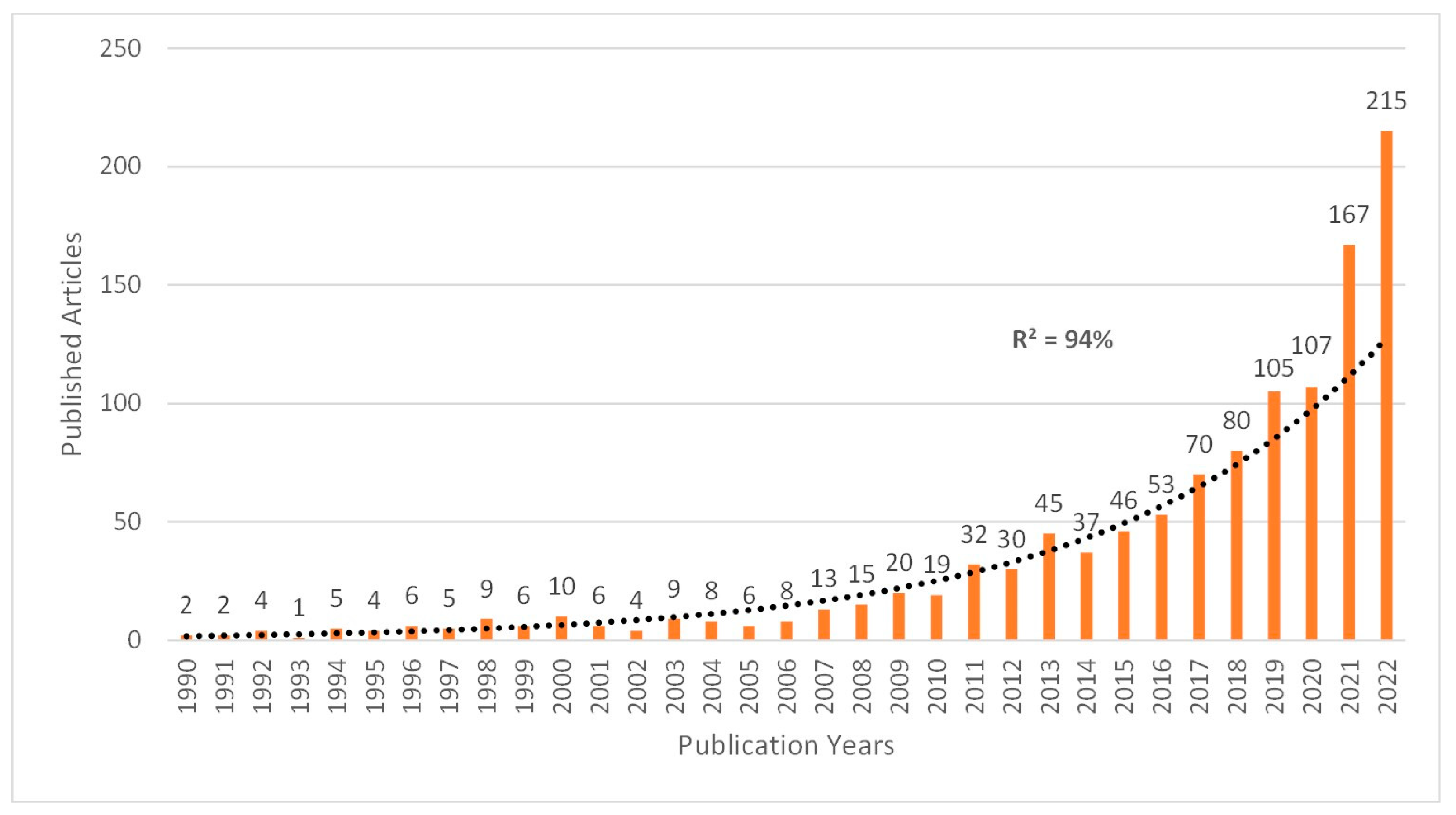
Figure 2.
Graph of outstanding keywords plus.
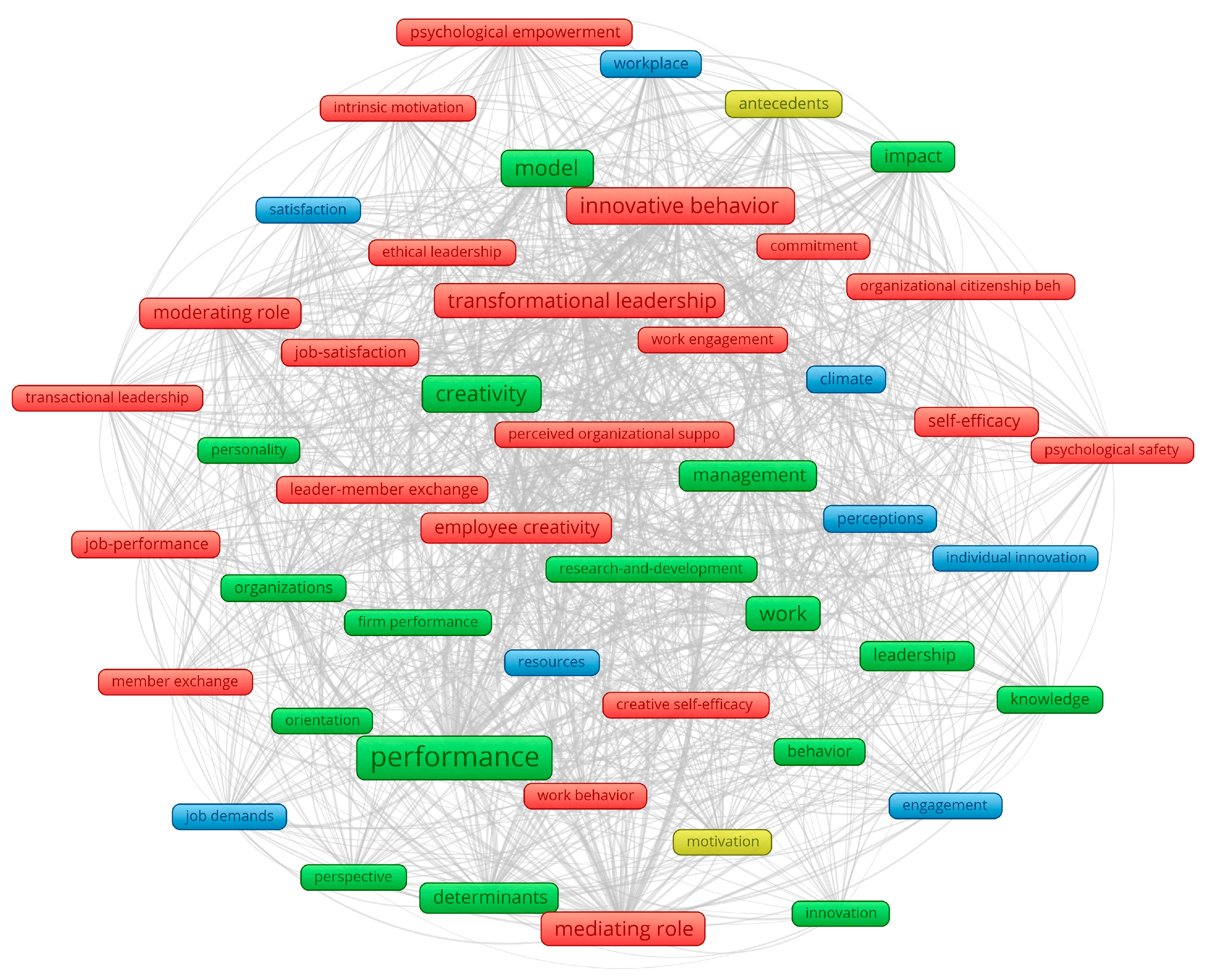
Figure 3.
Co-authorship graph among prolific authors.
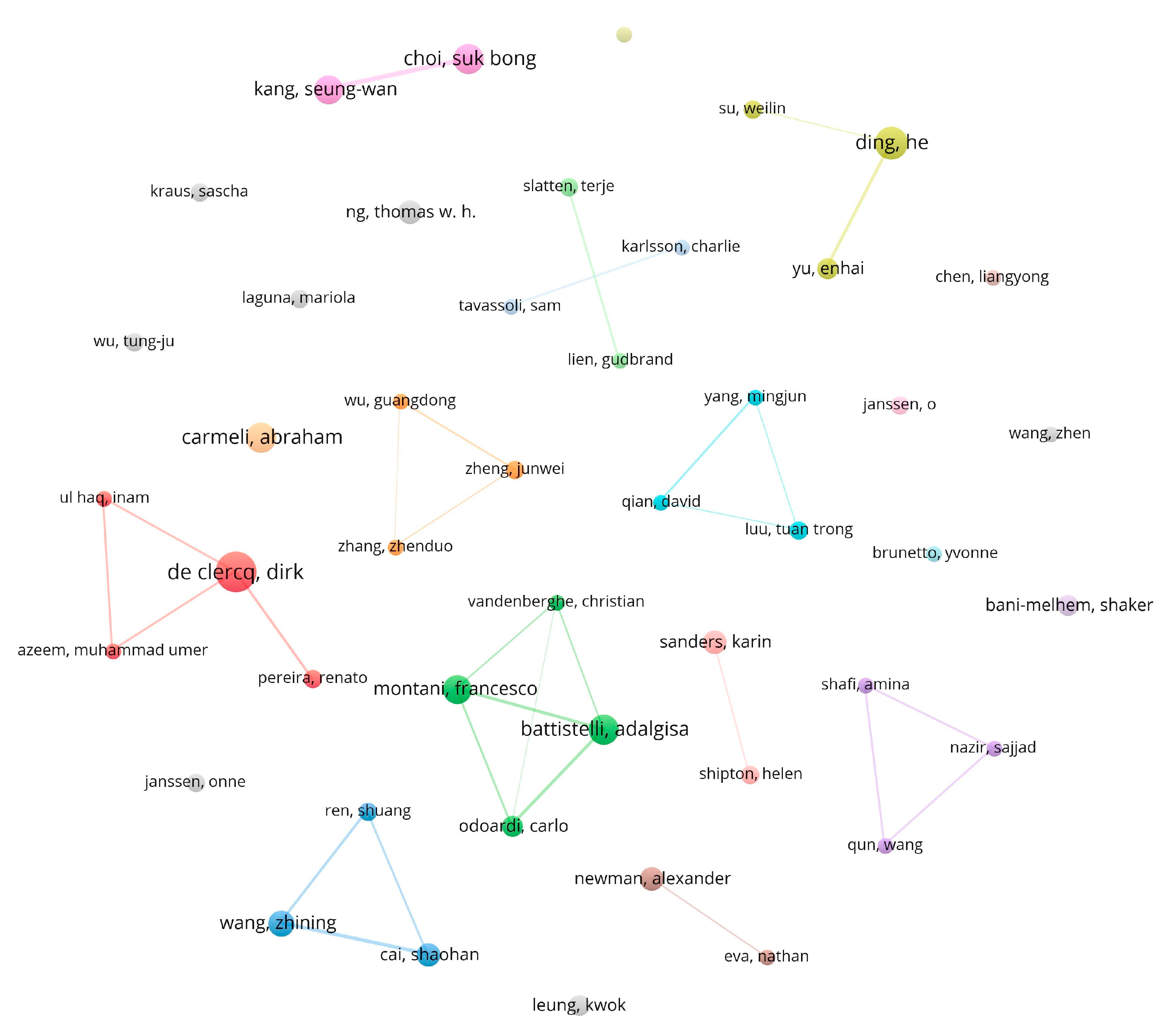
Figure 4.
Organizational co-authorship graph among prolific organizations.
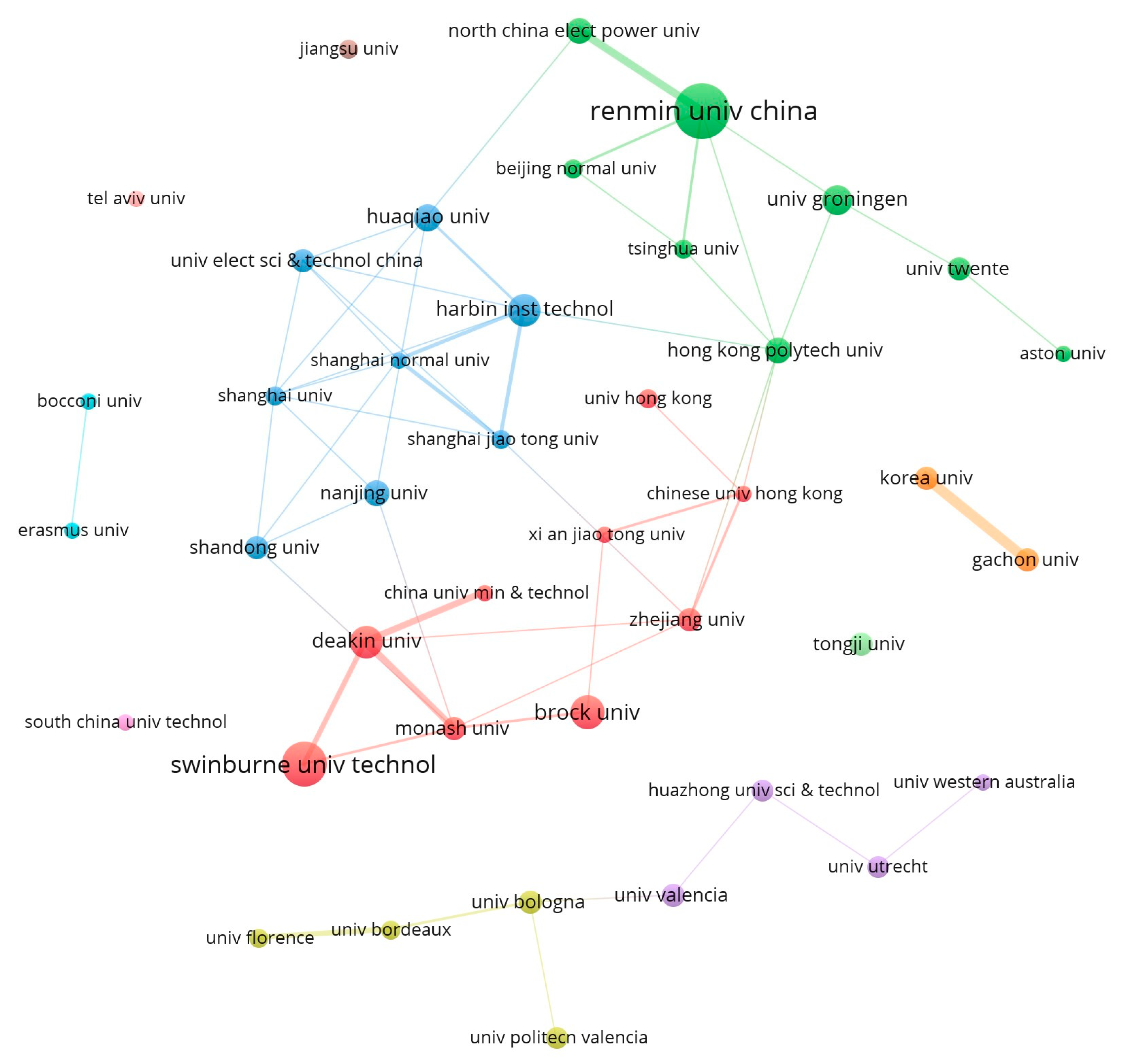
Figure 5.
Citations received in the WoS Core Collection to articles selected by h-index.
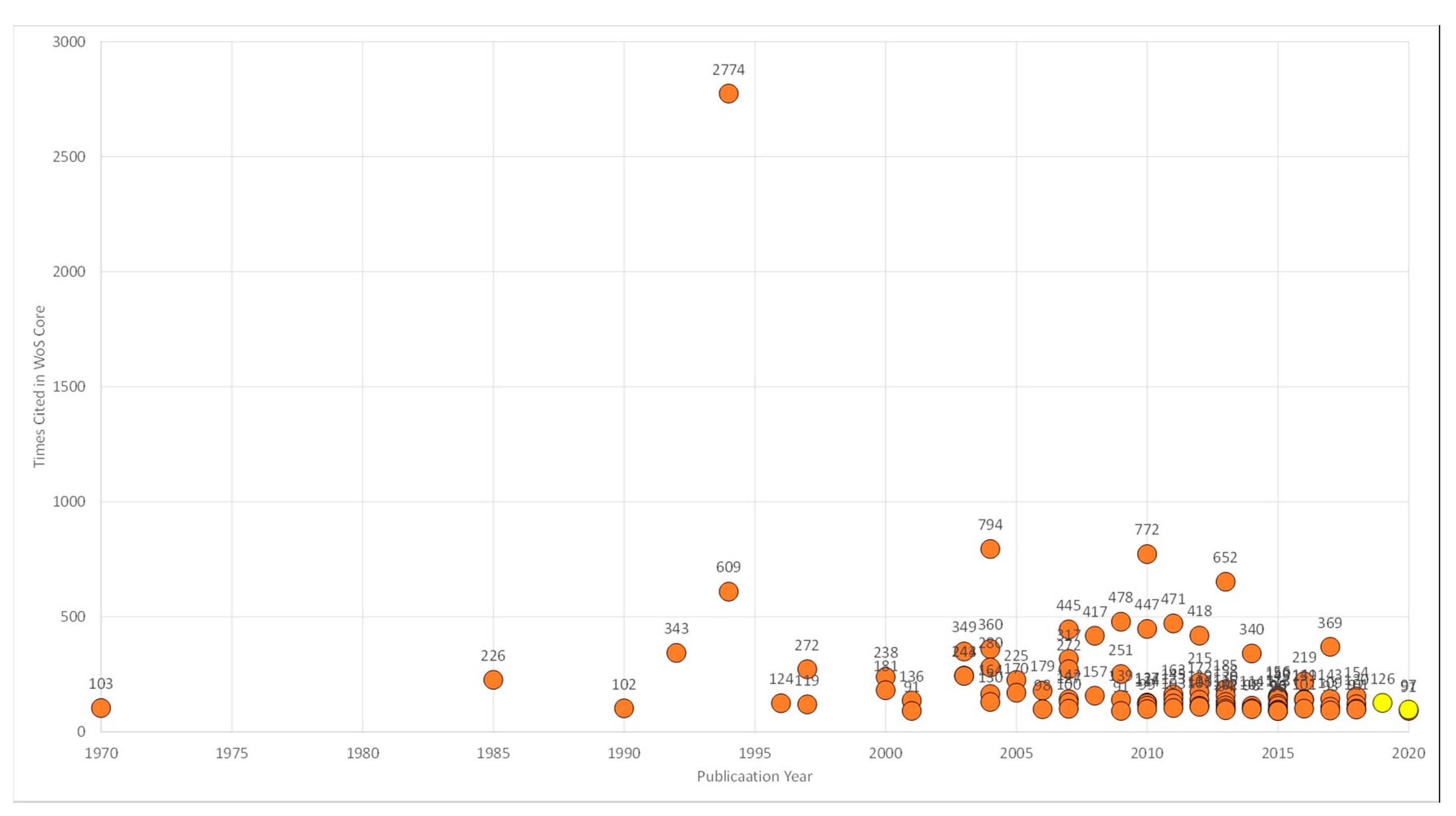
Figure 6.
Convergence of author keywords in h-index articles by prolific authors.
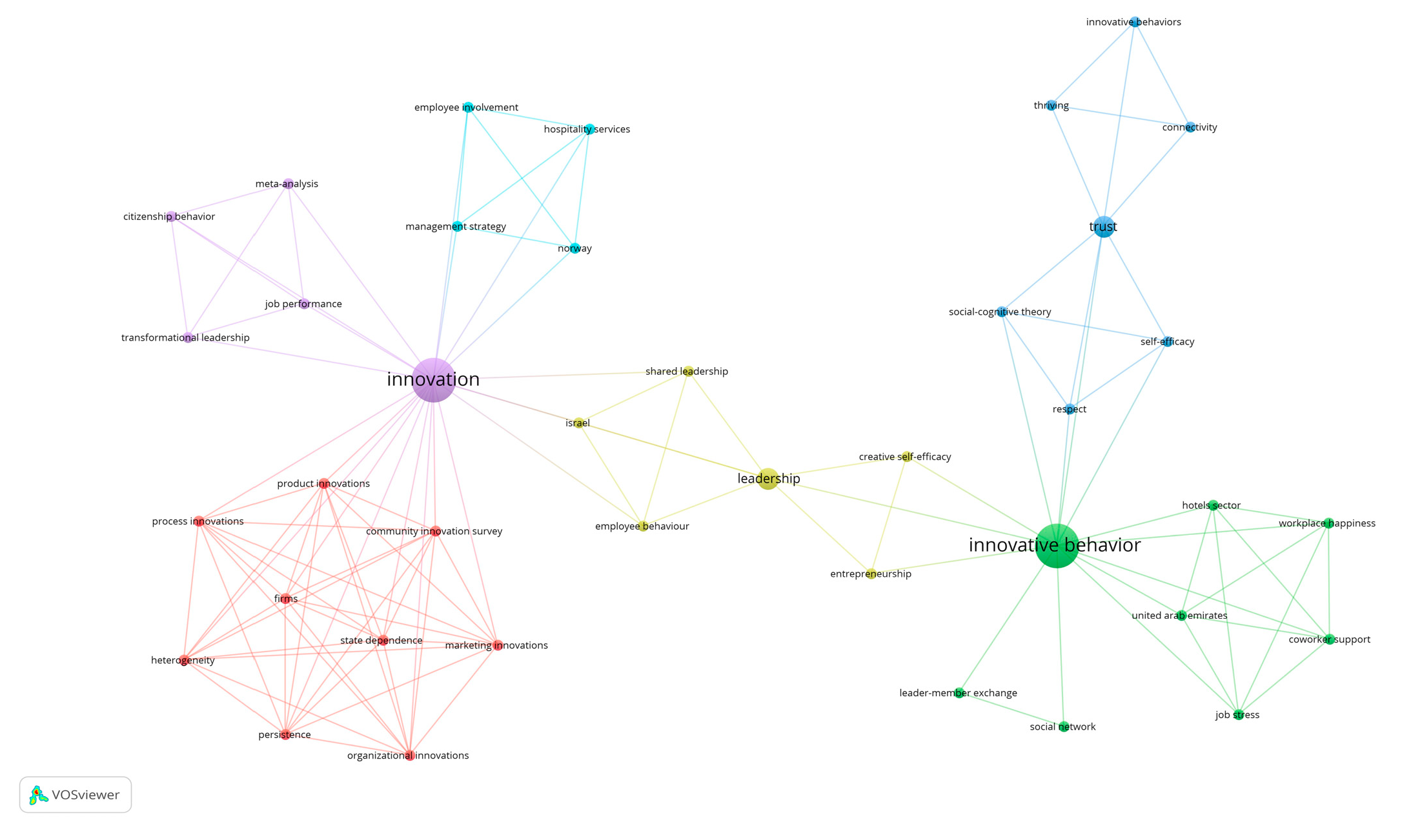
Figure 7.
Trends of author keywords in h-index articles and nucleus Bradford.
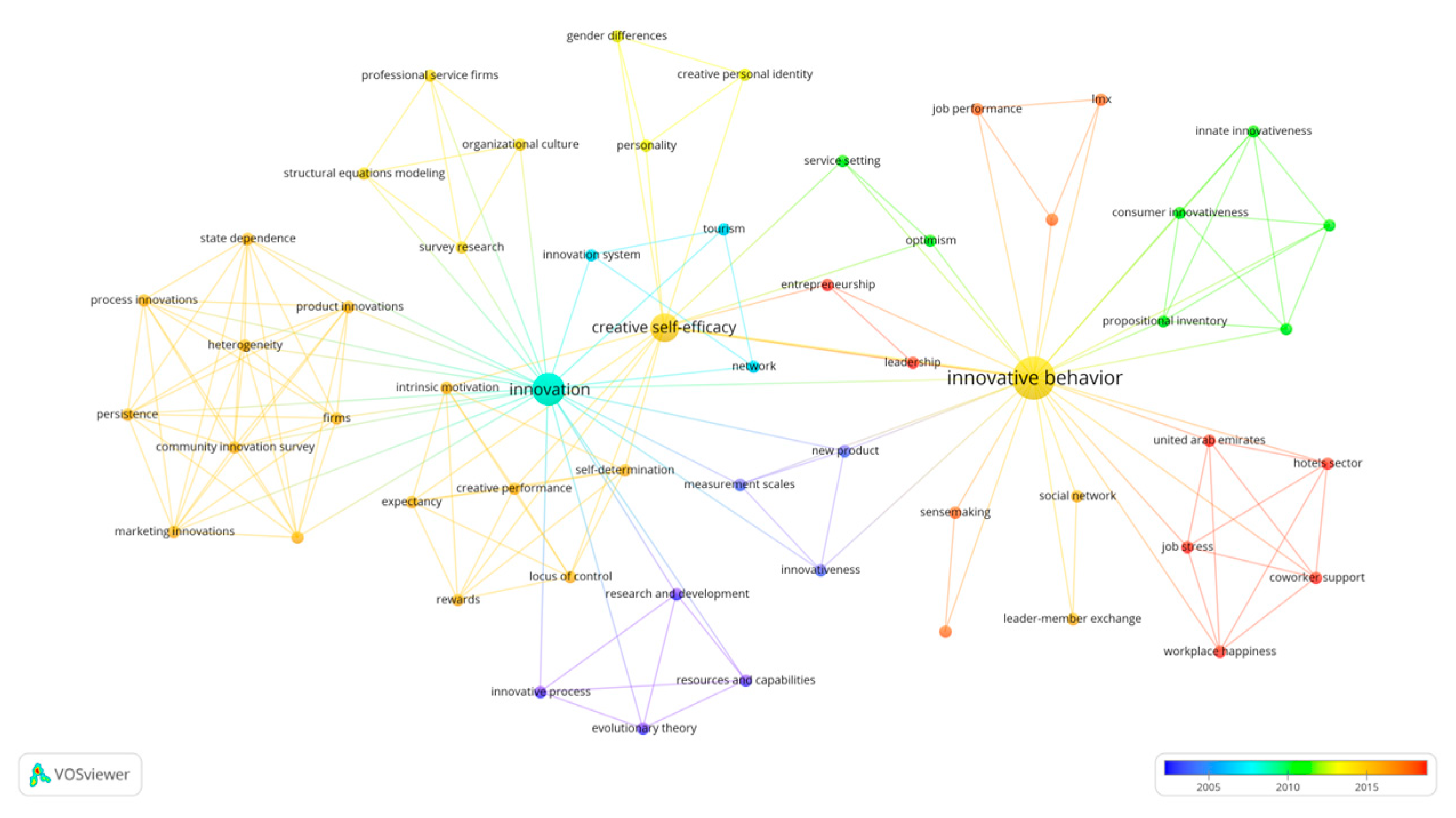
Figure 8.
Cross-citation and invisible college analysis.
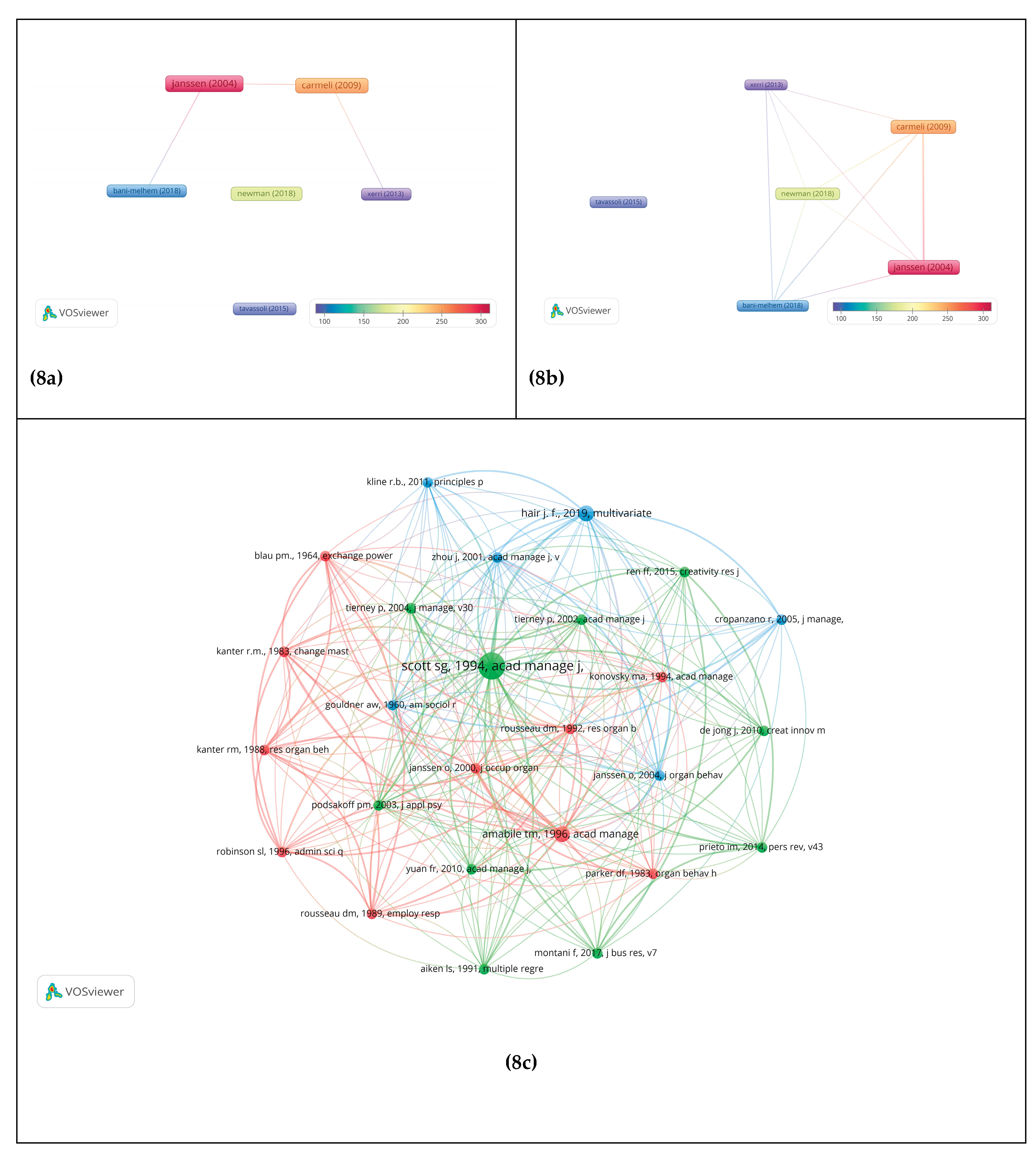

Table 1.
Data description.
| Descriptor | Type | Articles |
|---|---|---|
| Research Area (144 simple and combined areas) |
Business & Economics | 373 |
| Psychology | 225 | |
| Business & Economics; Psychology | 106 | |
| Science & Technology - Other Topics; Environmental Sciences & Ecology | 64 | |
| Others | 532 | |
| Language | English | 1276 |
| German | 11 | |
| Spanish | 6 | |
| Dutch | 3 | |
| Czech | 1 | |
| Hebrew | 1 | |
| Russian | 1 | |
| Ukrainian | 1 |
Table 2.
Clusters of prolific authors on Innovative Behavior.
| ID Cluster |
Prolific authors | Most prolific author | Production (Articles) |
Period | Affiliation (Last) |
|---|---|---|---|---|---|
| 1. | Choi, Suk Bong Kang, Seung-Wan |
Choi, Suk Bong |
10 | 2016 - 2022 | Korea Univ, Coll. Bus. & Econ. |
| 2. | Ding, He Su, Weilin Yu, Enhai |
Ding, He | 11 | 2019 - 2022 | North China Elect. Power Univ., Sch. Econ. & Manag. |
| 3. | Lien, Gudbrand Slatten, Terje |
Slatten, Terje | 5 | 2011 - 2022 | Inland Norway Univ. Appl. Sci. |
| 4. | Karlsson, Charlie Tavassoli, Sam |
= | 4 | 2015 - 2018 | RMIT Univ., Sch. Manag.; Lund Univ., CIRCLE; KTH, CESIS; Jonkoping Int Bus. Sch. |
| 5. | Luu, Tuan Trong Qian, David Yang, Mingjun |
Luu, Tuan Trong |
5 | 2021 - 2023 | Swinburne Univ. Technol., Swinbume Bus. Sch. |
| 6. | Azeem, Muhammad Umer De Clercq, Dirk Pereira, Renato Ul Haq, Inam |
De Clercq, Dirk | 15 | 2016 - 2022 | Brock Univ., Goodman Sch. Bus. |
| 7. | Battistelli, Adalgisa Montani, Francesco Odoardi, Carlo Vandenberghe, Christian |
Battistelli, Adalgisa | 10 | 2013 - 2023 | Univ. Bordeaux, Lab. Psychol. |
| 8. | Sanders, Karin Shipton, Helen |
Sanders, Karin | 7 | 2012 - 2018 | Univ. New South Wales, Sch. Manag. |
| 9. | Nazir, Sajjad Qun, Wang Shafi, Amina |
= | 4 | 2018 - 2021 | Hohai Univ., Bus. Sch.; Chagzhou Inst. Tecnol. Dept. HRM. |
| 10. | Eva, Nathan Newman, Alexander |
Newman, Alexander | 7 | 2012 - 2022 | Deakin Univ., Deakin Bus. Sch. |
| 11. | Cai, Shaohan Ren, Shuang Wang, Zhining |
Wang, Zhining | 8 | 2019 - 2022 | China Univ. Min. & Technol., Sch. Econ. & Manag. |
| 12. | Wu, Guangdong Zhang, Zhenduo Zheng, Junwei |
Zheng, Junwei | 5 | 2018 - 2022 | Kunming Univ. Sci. & Technol., Fac. Civil Engn. & Mech. |
Table 3.
Bradford Nucleus for journals publishing articles on Innovative Behavior.
| Journal | Articles | Period | Impact Factor (2022) |
WoS Categories |
| Front. Psychol. | 90 | 2011 – 2023 | 3.8 | Psychology, Multidisciplinary |
| Sustainability | 63 | 2018 – 2023 | 3.9 | Green & Sustainable Science & Technology; Environmental Sciences; Environmental Studies |
| Soc. Behav. Pers. | 27 | 2013 – 2023 | 1.3 | Psychology, Social |
| Pers. Rev. | 25 | 2000 – 2023 | 3.9 | Industrial Relations & Labor; Psychology, Applied; Management |
| Int. J. Contemp. Hosp. Manag. | 23 | 2014 – 2022 | 11.1 | Hospitality, Leisure, Sport & Tourism; Management |
| Eur. J. Innov. Manag. | 22 | 2015 – 2023 | 5.1 | Business; Management |
| Creat. Innov. Manag. | 19 | 2016 – 2022 | 3.5 | Management |
| Int. J. Hosp. Manag. | 18 | 2013 – 2023 | 11.7 | Hospitality, Leisure, Sport & Tourism |
| Int. J. Hum. Resour. Manag. | 18 | 2008 – 2023 | 5.6 | Management |
| Leadersh. Org. Dev. J. | 16 | 2014 – 2023 | 4.9 | Management |
| Res. Policy | 15 | 1995 – 2020 | 7.2 | Management |
| J. Prod. Innov. Manage. | 15 | 2008 – 2022 | 10.5 | Business; Engineering, Industrial; Management |
| J. Bus. Res. | 15 | 1977 – 2023 | 11.3 | Business |
| J. Creat. Behav. | 15 | 2009 – 2022 | 3.9 | Psychology, Educational |
| Curr. Psychol. | 14 | 2019 – 2022 | 2.8 | Psychology, Multidisciplinary |
| Int. J. Environ. Res. Public Health | 14 | 2019 – 2023 | 4.6* | Environmental Sciences; Public, Environmental & Occupational Health |
| J. Organ. Behav. | 13 | 2004 – 2022 | 6.8 | Business; Psychology, Applied; Management |
* JIF 2021.
Table 4.
Prolific authors and their article production in the h-index on innovative behavior.
| Author | Author h-index |
Art. | in h-index | (UT) |
| Janssen, Onne | 30 | 10 | 6 | WOS:000222272400005; WOS:000185259800006; WOS:000189076900004; WOS:000185691500004; WOS:000233872200005; WOS:000353055400005 |
| Carmeli, Abraham | 48 | 10 | 2 | WOS:000278023500002; WOS:000238963200006 |
| Newman, Alexander | 46 | 7 | 2 | WOS:000438002000001; WOS:000419941800007 |
| Ng, Thomas W. H. | 47 | 7 | 2 | WOS:000403628000003; WOS:000370170400002 |
| Bani-Melhem, Shaker | 11 | 6 | 1 | WOS:000431030300020 |
| Brunetto, Yvonne | 23 | 4 | 1 | WOS:000321609100008 |
| Karlsson, Charlie | 17 | 4 | 1 | WOS:000364620700008* |
| Leung, Kwok | 32 | 6 | 1 | WOS:000369142500003 |
| Sanders, Karin | 30 | 7 | 1 | WOS:000340856200004 |
| Slatten, Terje | 15 | 5 | 1 | WOS:000288729100005 |
| Tavassoli, Sam | 14 | 4 | 1 | WOS:000364620700008* |
* Corresponds to the same article.
Table 5.
Journals in the Bradford nucleus and their article production in the h-index of innovative behavior.
Table 5.
Journals in the Bradford nucleus and their article production in the h-index of innovative behavior.
| Journal | Articles | Articles in h-index |
Impact Factor (2023) |
UT (Unique WOS ID) |
|---|---|---|---|---|
| Int. J. Contemp. Hosp. Manag. | 23 | 2 | 11.1 | WOS:000424494100004; WOS:000431030300020*. |
| Int. J. Hosp. Manag. | 18 | 1 | 11.7 | WOS:000320568300036. |
| Int. J. Hum. Resour. Manag. | 18 | 1 | 5.6 | WOS:000321609100008*. |
| Res. Policy | 15 | 4 | 7.2 | WOS:000244495100006; WOS:000182558800002; WOS:000350837800013; WOS:000364620700008*. |
| J. Prod. Innov. Manage. | 15 | 2 | 10.5 | WOS:000256101400002; WOS:000310267800004. |
| J. Bus. Res. | 15 | 4 | 11.3 | WOS:000221064700014; WOS:000337856400006; WOS:000438002000001*; WOS:000289399000010. |
| J. Creat. Behav. | 15 | 3 | 3.9 | WOS:000278023500002*; WOS:000297866400002; WOS:000325865300003. |
| J. Organ. Behav. | 13 | 7 | 6.8 | WOS:000276912600007; WOS:000189076900004*; WOS:000348840600005; WOS:000484519000003; WOS:000353055400005*; WOS:000286290500006; WOS:000392430000004. |
* Articles by prolific authors, previously identified in Table 4.
Table 6.
Articles in the h-index published in journals in the Bradford nucleus with contributions from prolific authors in innovative behavior.
Table 6.
Articles in the h-index published in journals in the Bradford nucleus with contributions from prolific authors in innovative behavior.
| Authors | Title | Source | Affiliations | Pub. Year | Times cited, WoS Core | WoS Categories | UT (Unique WOS ID) |
|---|---|---|---|---|---|---|---|
| Bani-Melhem, S; Zeffane, R; Albaity, M | Determinants of employees' innovative behavior | Int. J. Contemp. Hosp. Manag. | University of Sharjah | 2018 | 101 | Hospitality, Leisure, Sport & Tourism; Management | WOS:000431030300020 |
| Xerri, MJ; Brunetto, Y | Fostering innovative behaviour: the importance of employee commitment and organisational citizenship behaviour | Int. J. Hum. Resour. Manag. | Southern Cross University | 2013 | 94 | Management | WOS:000321609100008 |
| Newman, A; Tse, HHM; Schwarz, G; Nielsen, I | The effects of employees' creative self-efficacy on innovative behavior: The role of entrepreneurial leadership | J. Bus. Res. | Deakin University*; Monash University*; RLUK- Research Libraries UK; University of London | 2018 | 154 | Business | WOS:000438002000001 |
| Carmeli, A; Spreitzer, GM | Trust, Connectivity, and Thriving: Implications for Innovative Behaviors at Work | J. Creat. Behav. | Bar Ilan University; University of Michigan | 2009 | 251 | Psychology, Educational | WOS:000278023500002 |
| Janssen, O | How fairness perceptions make innovative behavior more or less stressful | J. Organ. Behav. | University of Groningen* | 2004 | 280 | Business; Psychology, Applied; Management | WOS:000189076900004 |
| Tavassoli, S; Karlsson, C | Persistence of various types of innovation analyzed and explained | Res. Policy | Lund University; Blekinge Institute Technology; Royal Institute of Technology (KTH); Jonkoping University | 2015 | 95 | Management | WOS:000364620700008 |
* Prolific organizations identified in Figure 4.
Disclaimer/Publisher’s Note: The statements, opinions and data contained in all publications are solely those of the individual author(s) and contributor(s) and not of MDPI and/or the editor(s). MDPI and/or the editor(s) disclaim responsibility for any injury to people or property resulting from any ideas, methods, instructions or products referred to in the content. |
© 2025 by the authors. Licensee MDPI, Basel, Switzerland. This article is an open access article distributed under the terms and conditions of the Creative Commons Attribution (CC BY) license (http://creativecommons.org/licenses/by/4.0/).
Copyright: This open access article is published under a Creative Commons CC BY 4.0 license, which permit the free download, distribution, and reuse, provided that the author and preprint are cited in any reuse.


