

Submitted:
28 September 2024
Posted:
01 October 2024
You are already at the latest version
Abstract
This article examines empirically the research on digital strategy, addressing its temporal evolution, sources of scientific production, countries and organizations generating knowledge, and the topics investigated. It highlights key authors and journals from 1991 to 2023, contributing to Sustainable Development Goal (SDG) 9. Methodologically, traditional bibliometric laws and computational tools (VOSviewer software) were applied for data processing. The results show an exponential increase in publications from 2005 to 2022 with a critical mass in digital strategy studies, concentrated in 11 journals and 83 authors with 2 or more publications. The main organizations leading scientific production in this field are in the USA. Finally, the primary Web of Science categories for the leading journals are Business, Management, and Psychology. The research examines the use and adoption of digital strategies in marketing, the impact of digital transformation on business models, and the challenges it poses for human resources. In addition, the challenges arising from the impact of COVID-19, the rise of artificial intelligence, and the integration of digital strategies in public administration should continue to be addressed. Finally, industrial digital transformation and the challenges of Big Data in higher education have less connection with other key concepts analyzed.
Keywords:
Digital Strategy
; Bibliometrics
; Innovation
; Technology Management
; Technology Behavior
; Digital Skills
; Organizations
1. Introduction
Digital strategy has experienced significant growth in recent years. However, as a research topic, it remains relatively young. The earliest studies and use of the term ‘digital strategy’ date back to the early 1990s, beginning with the work of [1]. At that time, the focus was primarily on chemistry and physics, where digital resources such as the Internet and computers were employed for academic rather than commercial purposes.
Diane Coutu [2] in the Harvard Business Review, presented a case on the adoption of technologies and the impact that non-adoption would generate at that time [2], being the first information on digital strategy.
Its true breakthrough came a decade later, in 2010, driven by the disruptive onset of the digital era and the transformative impact of algorithms and real-time data management [3]. And where the impact has not only been in technology areas, but these range from agriculture [4], pharmaceutical [5], politics [6], and mining [7]. Digital strategy is distinguished from “IT strategy” as it addresses issues such as network effects, digital ecosystems, and new business models [3].
It is from the year 2017, that the phrase Digital Transformation begins to be included in scientific articles that has “Digital Strategy” as a key word, because since the digital transformation affects the entire organization, not just its administrative functions [8] identified [9] two key steps for implementing digital transformation strategies: establishing an operational backbone and creating a digital services platform, furthermore it is established that companies that rapidly embrace the digital era - profoundly changing their current strategies, systems, operating habits and business models - are highly likely to outperform their competitors and succeed in this dynamic environment [10].
Because in 2019 the Covid19 pandemic generated an acceleration of both digital transformation and digital strategies in different fields, given this global issue that posed a crisis in healthcare, organizations and in the day-to-day life of the population worldwide [11,12,13].
1.1. Use of Information Technology
In the field of digital strategy, digital technologies are applied closely linked to the emergence of the Internet [14] although technology can be defined as the creative factor in things developed by man [15,16], it is the use of technology and the Internet that have triggered processes of economic value creation [17]. In the 21st century, digital technologies have generated transformative processes that cause disruptions at both social and industrial levels [18]. The adoption of Information Technology (IT) to develop digital ecosystems offers multiple benefits, both social and economic [19]. In addition, digital capabilities drive innovation in business models, and integration in global chains facilitates the adoption of new business models [20]. UNESCO [21] has identified the use of Information Technology (IT) as an imperative social need (UNESCO) [21], this knowledge is also vital for businesses and therefore the employee is expected to adopt an intrapreneurial approach in the implementation of digital strategies [22].
The adoption of new technologies and the transformation of processes are generating significant changes in organizations [17]. These changes are supported by systems, information technologies (IT), strategies and people [23], with human capacity, skills and mindset being the decisive factors for the success or failure of digitalization [22,24]. Moreover, excessive self-confidence of leaders significantly influences digital transformation and sustainable competitive performance of SMEs [25]. Therefore, digital transformation has become a key pillar for organizations to remain competitive in this digital era [26], and SMEs should promote a digital culture and develop technology strategies to strengthen their capabilities and ensure their sustainability in dynamic markets [27].
IT transformation processes have marked a significant milestone in the implementation of continuous improvement in companies [28]. That change has generated a digital divide between those companies that are already immersed in the “wave” of digitization and those that have not yet decided to adopt this transformation [29,30]. Being crucial sectors in the implementation of digital advances: Industry [17], agriculture [31,32] commerce [33], tourism [34], finance [35], government [36] and education [37].
It is crucial for both small and large companies to recognize the opportunities and threats arising from the dynamism of digital transformation [38]. This phenomenon profoundly impacts organizational structures, which highlights the need for more scientific research, clear methodologies and practical applications to manage it properly [39]. In addition, it is critical to pay attention to each step of the digital transformation to ensure that the results are long-lasting and sustainable [40].
On the other hand, many small and medium-sized enterprises (SMEs) face significant challenges related to digital innovation processes [28,41]. Not all organizations succeed in implementing digital transformation, with estimates suggesting that 4 to 5 out of every 6 such initiatives fail [42,43,44]. This phenomenon may be related to poor execution of digital strategies [42], the dynamic environment and the innovations they are trying to implement [45]. A 2017 SAP report revealed that although 5 out of 6 companies consider digital transformation vital, only 3% have successfully completed it at the corporate level [35,46]. Market-driven business model innovation is key to improving sustainable performance and connects digital strategies to business success [47].
Finally, the rapid growth that digital technologies have experienced poses a number of challenges, including: cybersecurity [48], privacy [49] and digital inclusion [50]. Also, there is a proliferation of various models and theories to understand the adoption and diffusion of technologies [36], among these models is the Technology Acceptance Model [51], the Unified Theory of Technology Acceptance and Use [52,53] and the Technology-Organization-Environment (TOE) Framework [54]. There are models that allow assessing the progress and digital readiness of organizations [55], with the objective of measuring the level of digital maturity in different sectors [56,57]. To achieve a successful digital transformation, it is essential to create a strategic roadmap that directs the process from the formulation of the vision to its effective implementation [58].
This context demands continuous improvement in processes, driven by the disruption brought by artificial intelligence (AI) [59] and the growing relevance of sustainable models [60], which represents an inescapable challenge for organizations in the digital society. Although large companies often have defined digital strategies, these are not always aligned with sustainability objectives [61]. It is critical for digitized companies that meet societal expectations and sustainability goals to achieve acceptance and legitimacy among their stakeholders [62].
1.2. Innovation and Digital Strategy in Organizations
Digital leadership and organizational agility are two pillars for successful digital transformation [63]. Since digital strategy must go beyond technology and focus on human potential, developing investment in the entrepreneurial and innovative spirit of employees, as a key element for a successful and sustainable digital transformation [22].
Digital innovation is a performance driver, but its impact depends on effective IT implementation and a human team with the necessary competencies [28]. Therefore, training, communication and active participation reduce organizational resistance for the industry to succeed [64].
It is critical to analyze the routines that companies adopt to identify, leverage and reconfigure their dynamic capabilities in the context of innovation driven by digital transformation [65]. Creating a Digital Transformation Strategy (DTS) is an ongoing process that requires flexibility, constant learning, and adaptation to changing business needs [35]. Therefore, the success of digital transformation depends on closing the gap between strategy formulation and its practical implementation [42]. Furthermore, aligning digital strategies with resource mobilization is essential to ensure long-term sustainable results [66].
Having a clear and well-defined digital strategy allows companies to establish partnerships with technology firms, which gives them access to new technologies and improves efficiency in their operations [67]. The advent of digital technology is radically transforming the business landscape [68], where the desire for control and the ability to measure in real time are key driving forces of Industry 4.0 [17]. The transition to Industry 5.0 will be achieved when digital strategies reinforce technological development, integrating technology and people to optimize both operations and innovation [69].
Therefore, this article seeks through a performance analysis and scientific mapping to distinguish authors, journals, and articles on innovative behavior of high recognition in the epistemic community around this topic, as well as the social relationships of co-authorship that occur within this community.
2. Materials and Methods
Based on articles published in Web of Science Core Collection (Arts & Humanities Citation Index (A&HCI), Book Citation Index - Science (BKCI-S), Book Citation Index - Social Sciences & Humanities (BKCI-SSH), Conference Proceedings Citation Index - Science (CPCI-S), Conference Proceedings Citation Index - Social Science & Humanities (CPCI-SSH), Emerging Sources Citation Index (ESCI), Science Citation Index Expanded (SCI-EXPANDED), Social Science Citation Index (SSCI)), with a thematic search vector on digital strategy defined as TS=(digital NEAR/0 strateg*), a simultaneous search was carried out on November 15, 2023, in the fields of title, abstract, author keywords and keywords plus, for the concept composed of both keywords, arranged contiguously (with zero words between them) and with presence in one or more of these four search fields [70] .
1) The Price’s Laws offer the possibility to examine the exponential growth of science, represented by the exponential adjustment of the number of annual publications. This reflects the accumulation of knowledge that is interesting to study. Additionally, these laws also indicate the obsolescence of scientific publications, contrasting with the contemporaneity of science, which is documented in two semi-periods divided by the median number of publications ordered chronologically. This separation between contemporary and obsolete literature carries the notion of classical literature, which stands out within obsolete literature due to the recognition it receives from the epistemic community, expressed in the high number of citations received [71,72].
2) Zipf’s Law addresses the concentration of word usage within a specific language. In this framework, keywords assigned as metadata by Web of Science or Keywords plus© are used as a starting point to examine this concentration, highlighting those keywords that are most frequently used in the set of articles. To calculate this concentration, a square root operation is performed on the complete set of keywords, which is then adjusted according to a discrete number of keywords. The resulting set obtained from Keywords plus© is referred to as outstanding keywords [73,74].
3) Lotka’s Law allows differentiating between highly productive authors in a specific area and those who have an ephemeral participation in a particular field of scientific knowledge (characterized by a high percentage of authors who only present one or a few published articles). To estimate the concentration of authors, a square root is applied to the total number of authors, which is then adjusted according to a discrete number of publications. The resulting set of authors is known as prolific authors [75,76,77].
4) Bradford’s Law focuses on the realm of journals, specifically on what is known as the Bradford core, which represents the smallest subset of journals capable of covering one-third of the total number of studied documents. The other two-thirds of the documents, ordered by the increasing number of journals, are grouped into what is known as zones 1 and 2. Although attention is paid to the Bradford core because it tends to be the environment where the most specialized authors, reviewers, and editors congregate in a particular subject area [78,79].
5) The Hirsch index, also known as the h-index, is used to evaluate the relative impact of scientific production in a specific collection of articles. This index is represented by a value n, indicating that these n documents have received n or more citations in a common counting basis for all of them. In this context, the h-index will be applied to the total set of extracted documents, as this index can be retrieved from the Web of Science ResearcherID database for some authors.
6) Co-authorship analysis is used to identify social links between both prominent authors and organizations with prominent members. In this instance, it is carried out through data clustering using VOSviewer [80].

Table 1.
Characterization of document corpus to be analyzed.
| Phase | Variable | Value (or Sample, n) | Unit | Subsampling criterion |
|---|---|---|---|---|
| 1 | Time | 1991-2023 | Year | Period without blanks, Price’s Law [71] |
| 2 | Authors | 2046 | Person | Lotka’s Law[75] |
| 3 | Documents | 674 | Article | Hirsch’s index (h-index) |
| 4 | Place (Affilliation) | 90 | Country / Territory | Census |
| 5 | Journals | 487 | Journal | Bradford’s Law [78,79] |
| 6 | Keywords Plus | 1094 | Words | Zipf’s Law [73] |
3. Results
Between 1991 and 2023, a total of 674 articles on digital strategy were published and indexed in the various WoSCC databases. However, for scientific production, only years of continuous scientific production (2005 to 2022) were considered, showing an adjustment to exponential growth (R2) of 92%. Therefore, studies on the concept of digital strategy presented a critical mass of researchers worldwide, which shows the interest in expanding the body of knowledge related to digital strategy (see Figure 1).
The total of 674 articles is the scientific production of 2046 authors, and the prolific authors were estimated using Lotka’s [75] law as the square root of 2046 (≈ 45.23). Thus, it was estimated that the authors with the greatest contribution to the production of this knowledge were 46, but given the discrete number of articles, where it stands out that only 9 authors have published more than 2 articles related to digital strategy and 83 have conducted a minimum of 2 studies on this topic (see Figure 2). As for the prolific authors, Rezende, Denis Alcides is identified with 12 publications, positioning him as the author who has made the most contributions to the subject, followed by Alizadeh, Giannakopoulos, Kanellos and Sakas with 4 papers and Feijo de Almeida with 3. As this is a recent topic, those who have carried out more than 3 studies on this subject are considered prolific (see Figure 2).
Figure 3 shows a co-authorship graph, where each author is reflected as a node and the links between the nodes represent the joint participation in one or more documents, the nodes and links of the same color group the clusters of authors according to the intensity of their degree of cooperation, identifying nine clusters, including four triads (see Figure 3).
Table 2 below details the different and clusters of authors involved in research related to digital strategy, differentiated by color to facilitate their identification. The table also provides information on the institutions with which they are affiliated and their respective countries. This representation provides a better visualization of the academic collaboration and the main institutions involved in this field of study and their connections.
As part of the findings, it cannot be ignored that these prolific authors have contributed to the publication on digital strategy and how there are collaborative works in their research projects. However, there is no international relationship in publications between countries such as Brazil, USA, Greece and Italy where there are authors who have done joint work, but with a high national endogamy. Among the prolific authors, there is more national networking (endogamy) than evidence of work in networks, with the exception of the USA and Italy. Highlight the countries where this kind of work is being developed (See Table 2).
Next, the number of citations by authors is detailed through the calculation of the Hirsch index (h-index) presenting the impact of scientific productivity on the digital strategy; Figure 5 details the relationship of the different publications with the Sustainable Development Goals (SDGs) and Table 3 lists the articles with over 100 citations within these 39 papers or the most recognized articles on this topic.
To know the connection between authors, journals and WoS categories of digital strategy studies, we incorporated the Hirsch index (h-index) as a filter factor for citation impact. Figure 4 shows the h-index intercept, with 39 papers with 39 or more citations.
According to Web of Science, the articles are associated with the following SDGs, the main one being SDG-9, followed by SDG-3 and SDG-4 (See Figure 5).
Table 3 shows the details relating to Figure 4, indicating the details of each h-index document and where they are concentrated according to SDGs, mainly SDG 9.
In Figure 6, the geographical relationship of the co-authors is shown (See Figure 6), where each country is represented as a node and the links between the nodes represent the co-collaboration in the production of digital strategy. Table 4 shows the main countries with the productivity of articles, citations and connections with other documents.
In Figure 6 and Table 4, the countries with a high degree of scientific production always stand out, such as the United States with 17.6%, Spain and England with 10% each and the People’s Republic of China with 8.6%, which represents 46% of the scientific production on Digital Strategy. Only the USA is present among the countries that also have prolific authors, the rest of the countries do not present the same production dynamics.
However, when looking at the degrees of centrality of publications by country, it can be seen that although the United States has the largest amount of research, in terms of connections with other countries it is England that is positioned in first place with 36 connections (the highest degree of centrality), followed by the United States with 30, and then with an average of 20 connections are countries of the European Union such as Spain, France and Italy and the particular case of Australia that also has the same degree of centrality of its publications. Although England has the highest number of connections, it has only one prolific author, compared to the USA and Italy (see Table 4).
Table 4 shows the details of Figure 6, indicating the details of the first 20 countries with the highest number of published papers and citations.
In Table 5, the estimation of Bradford’s areas is presented, indicating the distribution of articles according to the most important journals in Web of Science (WoS), with the journals standing out for their number of citations and documents.
Table 6, according to Bradford’s law, shows that the first 2 journals are Sustainability and Technological Forecasting and Social Change. In accordance with the objectives and goals pursued by these scientific journals, they have distinguished themselves from other publications by their research areas, comprehensively prioritizing the topics of digital strategy and innovation in organizations. Publications on emerging technologies and digitization influence business transformation, improving efficiency and competitiveness. The Journal of Business Research and the International Journal of Innovation Management stand out for their focus on creating and managing innovation, fostering the development of new ideas and technologies to maintain a competitive advantage in an increasingly digitized world. IEEE Access provides analysis on the rapid dissemination of technological discoveries and their social impact, while Harvard Business Review offers practical strategic perspectives on how companies can integrate digital technologies into their operations and market strategies.
The Journal of Strategic Information Systems explores the strategic use of information systems, with an emphasis on IT governance. Sustainability provides interdisciplinary research on sustainability and its link to processes within organizations. Together, these journals offer a broad and multidimensional understanding of how digital strategies and innovation can be effectively implemented and managed in the contemporary business environment.
Being a database extracted from WoSCC, journals with Q1 are highly cited and recognized in the world, where it can be seen in Table 5, the journals with the highest impact such as Technological Forecasting and Social Change and International Journal of Production Economics with an Impact Factor higher than 12 and with a Cited Score higher than 21.3 lead the Digital Strategy research in terms of the number of citations and articles published on digital strategy. It is important to note that these journals are highly specialized in their research area such as business and engineering. While journals such as Sustainability has the largest number of articles published on this topic (23 articles), however, its citations are below 8% in relation to the journal with most cited, it is also established that there are 171 journals that have published only one (1) article on digital strategies.
Zipf’s law presents the keyword plus graphs, where each node reflects these are linked in the same color grouping clusters of keywords according to the intensity of occurrences in the scientific articles, identifying four clusters (see Figure 8).
In accordance with Figure 8, the themes of the scientific production on digital strategy created groups of keywords. For the 674 papers, a total of 1094 Plus keywords were established. According to Zipf’s law [73], 34 plus keywords were chosen, considering as estimator the square root of 1094 (=33.07) with the highest frequency of use, between 9 and 55 occurrences.
Thus, the set of Plus Keywords generated four clusters: 1) Use of digital strategies through PR in marketing. The blue, focused on impact, design, social networks, online, risk, knowledge (knowledge and perception of digital strategies); yellow, regarding technology, information, cities, adoption and systems (benefits of digital strategies and their adoption in their environment), the red, associated with management, performance, changes, big data, models, business, (responds to the management demanded by digital strategies); and the green, which has innovation, dynamic capabilities, transformation, strategies and perspective (establishing the new professional profile and the opportunity of digital strategy). It is important to highlight that the level of connection between the four clusters is significant. Resulting in the following lines of research: (1) Use of digital strategies through PR in marketing (2) Adoption of digital strategies and their benefits (3) The implications of digital transformation in business models (4) The challenges and opportunities of human resources in the digital strategy.
By means of the Figure 9, by means of the author’s keywords, a search was made for the topics that have been generating trends in recent years, which indicates the direction of research. Using Zipf’s law [73], 46 keywords were chosen considering as estimator the square root of 2253 (=47.46) with the highest frequency of use, between 6 and 30 occurrences.
Through Figure 9 above, it is specified that the trend of recent years in research incorporates the themes of: artificial intelligence, covid-19, sustainability, digital maturity, and digital transformation. While the topics such as internet, social networks, Smart city, ICT, strategy and Twitter present on average a higher seniority with respect to the other author keywords. Within the areas that are more isolated within the (1) Digital transformation and its influence on Industry processes for its sustainability. (2) Challenges of Big Data in Higher Education. Research challenges are: (1) The impact of Covid-19 in the digital transformation of organizations. (2) The rise of AI in digital transformation (3) The implications of digital strategy in public administration.
4. Discussion
The study analyzes the evolution of the digital strategy using a large WoS database and applying bibliometric laws such as Price’s Law [71] to indicate the exponential growth and critical mass of authors in this area [69,90,91]. This contrasts significantly with other studies using databases such as Scopus or Google Scholar [92,93] that cover fewer sources and have a smaller scope in certain fields of study compared to WOS. Using Zifp’s Law, 34 keywords and 4 clusters were used, which provides a more precise approach compared to other works [93] that manage more keywords and clusters coinciding in relevant topics such as digitization, innovation and business models (SME). In addition, through the application of Lotka’s Law, 45 authors were identified who have contributed significantly to digital strategy studies, although only 9 of them have more than 2 publications on digital strategy, which contrasts with other less rigorous research in the identification of prolific authors [90,92].
Currently, the topics of innovation, performance, impact and dynamic capabilities are cutting-edge areas in digital transformation research. According to Ren et al. [94], in their study “Construction of Digital Transformation Capability of Manufacturing Enterprises: Qualitative Meta-Analysis Based on Current Research”, these areas are receiving significant attention. On the other hand, terms such as digital strategy, digital transformation and digital maturity have established themselves as key concepts in the field, dominating contemporary research. This is reflected in the study by Schallmo et al., [95], entitled “The Art of Holistic Digitalisation: A Meta-View on Strategy, Transformation, Implementation, and Maturity”, which provides a holistic view on digitalization, spanning from strategy to digital maturity, and highlights the importance of these areas in the digital transformation of organizations.
The analysis shows a trend towards national collaboration in scientific output, with notable exceptions in the United States and Italy [93]. The most prominent journals in research on digital transformation and COVID-19 in SMEs include the Journal of Business Research and Technological Forecasting and Social Change. Studies such as Rezende et al., [96] and Marino-Romero et al., [97] highlight how digital strategy and digital capability are critical for organizational transformation, especially in SMEs. In addition, recent studies highlight the relevance of artificial intelligence, sustainability and digital maturity as emerging areas of research.
In terms of impact, research on Digital Strategy, with impact factors above 11 and CiteScore above 15, leads in number of citations and published articles. Authors such as Rezende, D.A. [98] who has conducted 14 research studies in this field, stand out in production, although some papers, such as Yoo et al. [81] have a high number of citations, but are limited to a single study.
Finally, the current landscape of digital strategy research highlights the importance of continuing to explore key topics such as the impact of COVID-19, the rise of artificial intelligence and the implications for public administration, aligning with the conclusions of Agostini & Nosella [99] on the influence of digital technologies on business models. Digital transformation in industrial processes for sustainability and the challenges of Big Data in higher education show less interaction with other key concepts analyzed. In addition, the digital transformation in industrial processes for sustainability and the challenges of Big Data in higher education show less interaction with other key concepts analyzed.
5. Conclusions
During the bibliometric study several findings were found. The first is to point out that the scientific production on this topic starts from 1991 to 2023, and has had an exponential growth from 2013, which demonstrates the relevance and research strength that the topic has awakened in the last 10 years.
Although it is true that digital strategy and digital transformation work simultaneously, they should not be confused, since the high scientific production of recent years has adopted both terms, reaffirming the contribution of this research. According to the bibliometric analysis provides a revealing insight into the trend over the years observed a significant increase in the growth of scientific production at an exponential rate (R2 ≈ 52%), which has allowed 2046 authors to build a substantial knowledge base on digital strategy.
In addition, the prolific authors who have made the most contributions on the topic, with 22 articles on digital strategy, with their article with the most citations being “Toward a model of the municipal evidence-based decision process in the strategic digital city context” [100] with 150 citations. It is important to note that all are researchers from Brazil, which evidences the poor contribution in works in the rest of the world regarding the topic of digital strategies. While the research with the most citations and reference in digital strategy is that of Yoo, Henfridsson, & Lyytinen [81] entitled “The New Organizing Logic of Digital Innovation: An Agenda for Information Systems Research” in which its focus is to describe the new architecture of systems and future organizational innovation, as it is currently being experienced.
At the same time, the resulting scientific production in the rest of the world is significant, since within the database there are up to 80 countries that have published at least one article on digital strategy. Those that have generated the most research are the United States, Spain, England, China and Germany. In the study presented by Ren et al. [94] their focus was only on China [94] and [95] focuses on a meta-vision of holistic digitization within organizations [95], so this research presents an opportunity to know the context and its research interest worldwide.
The study also highlights the topics on which digital strategy research revolves, where digital transformation, digital maturity and digitization are the most relevant for these studies, and how topics such as internet, social networks (Facebook, twitter) have been relegated by new trends such as industry 4.0, artificial intelligence and sustainability. And understanding the rapid growth of new technologies, there is no doubt that there is a lot of field to contribute on this topic.
Finally, as future lines of research, it is recommended to deepen the studies of digital strategy regarding the digital maturity of organizations, the impact of digital transformation inherent to the adoption of digital tools, the cost of adoption and non-adoption in the short and medium term.
Supplementary Materials
The following supporting information can be downloaded at the website of this paper posted on Preprints.org, Table S1: DS_DATA.xlsx.
Author Contributions
Conceptualization, G.C.-M., and A.V.-M.; methodology, G.C.-M., and G.S.-S.; validation, A.V.-M.; formal analysis, G.C.-M..; writing—original draft preparation, G.C.-M..; writing—review and editing, G.C.-M., P.T.-A., A.V.-M., and G.S.-S.; supervision, A.V.-M.; project administration, G.C.-M.; funding acquisition, A.V.-M., P.T.-A., and G.S.-S. All authors have read and agreed to the published version of the manuscript.
Funding
The Article Processing Charge (APC) was partially funded by Universidad Católica de la Santísima Concepción (Code: APC2024). Additionally, the publication fee (APC) was partially fi-nanced through the Publication Incentive Fund, 2024, by the Universidad Arturo Prat (Code: APC2024), Universidad de Las Americas (Code: APC2024), Universidad Central de Chile (Code: APC2024), and Universidad Sek (APC2024), through the publication incentive fund 2024.
Institutional Review Board Statement
Not applicable; this study does not involve humans or animals.
Informed Consent Statement
Not applicable.
Data Availability Statement
Data availability in the supplementary material.
Conflicts of Interest
The authors declare no conflicts of interest
References
- Cammarano, R.; Street, R.; McCormick, P. G.; Evans, M. E. Constant rate of change of magnetization hysteresis loop tracer. J. Appl. Phys. 1991, 69, 5100–5102. [CrossRef]
- Coutu, D. Too Old to Learn? Harvard Bus. Rev. 2000. Available in https://hbr.org/2000/11/too-old-to-learn. Accessed on 22 September 2024.
- Cepa, K.; Schildt, H. What to teach when we teach digital strategy? An exploration of the nascent field. Long Range Plann. 2023, 56. [CrossRef]
- Hoyk, E.; Szalai, A.; Palkovics, A.; Farkas, J.Z. Policy Gaps Related to Sustainability in Hungarian Agribusiness Development. Agronomy 2022, 12. [CrossRef]
- Reddy, A.V.; Rao, B.M. Opportunities and challenges for Indian Pharmaceutical companies in overseas markets and need of digital tools for sustainable success. Indian J. Pharm. Educ. 2017, 51, 226-238. [CrossRef]
- Chester, J.; Montgomery, K.C. The digital commercialisation of US politics — 2020 and beyond. Internet Policy Rev. 2019, 8. [CrossRef]
- Sanchez, M.A. Framework to assess organizational readiness for digital transformation. Dimens. Empresarial. 2017, 15. [CrossRef]
- Scupola, A.; Mergel, I. Co-production in digital transformation of public administration and public value creation: The case of Denmark. Gov. Inf. Q. 2022, 39. [CrossRef]
- Sebastian, I.M.; Ross, J.W.; Beath, C.; Mocker, M.; Moloney, K. G.; Fonstad, N. O. How Big Old Companies Navigate Digital Transformation. MIS Q. Exec. 2017, 16. Obtenido de https://aisel.aisnet.org/misqe/vol16/iss3/6/.
- Zhou, N.; Zhang, S.; Chen, J.; Han, X. The role of information technologies (ITs) in firms’ resource orchestration process: A case analysis of China’s “Huangshan 168”. Int. J. Inf. Manag. 2017, 37, 713-715. [CrossRef]
- Zaman, M.; Vo-Thanh, T.; Hasan, R.; Mohiuddin Babu, M. Mobile channel as a strategic distribution channel in times of crisis: A self-determination theory perspective. J. Strateg. Mark. 2021. [CrossRef]
- Baxter, J.; Floyd, A.; Jewitt, K. Pandemic, a catalyst for change: Strategic planning for digital education in English secondary schools, before during and post Covid. Brit. Educ. Res. J. 2022, 49, 329-351. [CrossRef]
- Gordon Isasi, J.; Narvaiza Cantin, L.; Gibaja Martíns, J.J. La comunicación integrada de marketing (CIM) en la educación superior (ES) en tiempos de pandemia. Rev. Estud. Emp. 2020, 2, 53-69. [CrossRef]
- Busca, L.; Bertrandias, L. A Framework for Digital Marketing Research: Investigating the Four Cultural Eras of Digital Marketing. J. Interact. Mark. 2020, 49, 1-19. [CrossRef]
- Ward, T.B.; Smith, S.M.; Finke, R.A. Handbook of creativity. In Creative cognition; 1999, 189-212. [CrossRef]
- Rodríguez, G.D. Ciencia, Tecnología y Sociedad: una mirada desde la Educación en Tecnología. Rev. Iberoam. Educ. 1998, 18, 1-31. Available in: https://cmapspublic.ihmc.us/rid=1240361964330_1247187883_27675/Ciencia_tecnologia_sociedad.pdf. Accessed on 22 September 2024.
- Horváth, D.; Szabó, R.Z. Driving forces and barriers of Industry 4.0: Do multinational and small and medium-sized companies have equal opportunities? Technol. Forecast. Soc. Change 2019, 146, 119-132. [CrossRef]
- Peter, M.; Kraft, C.; Lindeque, J. Strategic action fields of digital transformation: An exploration of the strategic action fields of Swiss SMEs and large enterprises. J. Strateg. Manag. 2020, 13, 160-180. [CrossRef]
- Priharsari, D.; Abedin, B.; Burdon, S.; Clegg, S.; Clay, J. National digital strategy development: Guidelines and lesson learnt from Asia Pacific countries. Technol. Forecast. Soc. Change 2023, 196. [CrossRef]
- Veiga, P.M.; Marnoto, S.; Guerra-Mota, M.; Rexhepi, G. Building new business models in MSMEs: Digital capabilities, global value chains integration and the moderating role of entrepreneurial failure. J. Small Bus. Enterp. Dev. 2024, 31, 492-514. [CrossRef]
- UNESCO. Qué necesita saber acerca del aprendizaje digital y la transformación de la educación. UNESCO 2022. Available in https://www.unesco.org/es/digital-education/need-know#:~:text=La%20UNESCO%20adopta%20un%20enfoque,ODS%204%20%2D%20Educaci%C3%B3n%202030%20y. Accessed on 22 September 2024.
- Ritala, P.; Baiyere, A.C.; Hughes, M.; Kraus, S. Digital strategy implementation: The role of individual entrepreneurial orientation and relational capital. Technol. Forecast. Soc. Change 2021, 171. [CrossRef]
- Porfírio, J.A.; Carrilho, T.; Felício, J.A.; Jardim, J. Leadership characteristics and digital transformation. J. Bus. Res. 2021, 124, 610-619. [CrossRef]
- Zimmer, M.; Baiyere, A.; Salmela, H. Digital workplace transformation: The importance of deinstitutionalising the taken for granted. In Twenty-Eighth European Conference on Information Systems (ECIS2020), Marrakesh, Morocco, 2020. Available in https://www.researchgate.net/publication/341265902. Accessed on 22 September 2024.
- Khattak, M.; Wu, Q.; Ahmad, M.; Hattab, I. The role of managerial overconfidence in digital transformation and sustainable competitive performance in emerging SMEs: The role of digital culture. Bus. Strategy Dev. 2024, 7. [CrossRef]
- Mihu, C.; Pitic, A.; Bayraktar, D. Drivers of Digital Transformation and their Impact on Organizational Management. Stud. Bus. Econ. 2023, 18. [CrossRef]
- Al-Omush, A.; Momany, M.T.; Hannoon, A.; Anwar, M. Digitalization and Sustainable Competitive Performance in Small–Medium Enterprises: A Moderation Mediation Model. Sustainability 2023, 15, 15668. [CrossRef]
- Eller, R.; Alford, P.; Kallmünzer, A.; Peters, M. Antecedents, consequences, and challenges of small and medium-sized enterprise digitalization. J. Bus. Res. 2020, 112, 119-127. [CrossRef]
- Helbig, N.; Gil-Garcia, J.R.; Ferro, E. Understanding the complexity of electronic government: Implications from the digital divide literature. Gov. Inf. Q. 2009, 26, 89-97. [CrossRef]
- Autio, E.; Thomas, S.L.D.; Wright, M. Digital affordances, spatial affordances, and the genesis of entrepreneurial ecosystems. Strateg. Entrep. J. 2017, 12, 72-95. [CrossRef]
- Cristobal-Fransi, E.; Daries, N.; Cardona, J.; Río-Rama, M. Challenges of digitization in the social economy in times of pandemic: the evolution of online presence and e-commerce in agri-food cooperatives. Agric. Food Econ. 2023, 11. [CrossRef]
- Gabriel, A.; Gandorfer, M. Adoption of digital technologies in agriculture—an inventory in a European small-scale farming region. Precis. Agric. 2023, 24, 68-91. [CrossRef]
- Frishammar, J.; Cenamor, J.; Cavalli-Björkman, H.; Hernell, E.; Carlsson, J. Digital strategies for two-sided markets: A case study of shopping malls. Decis. Support Syst. 2018, 108, 34-44. [CrossRef]
- Pateli, A.; Mylonas, N.; Spyrou, A. Organizational Adoption of Social Media in the Hospitality Industry: An Integrated Approach Based on DIT and TOE Frameworks. Sustainability. 2020, 12. [CrossRef]
- Chanias, S.; Myers, M.D.; Hess, T. Digital transformation strategy making in pre-digital organizations: The case of a financial services provider. J. Strateg. Inf. Syst. 2019, 28, 17-33. [CrossRef]
- Mikalef, P.; Lemmer, K.; Schaefer, C.; Ylinen, M.; Fjørtoft, S.; Torvatn, H.Y.; Niehaves, B. Enabling AI capabilities in government agencies: A study of determinants for European municipalities. Gov. Inf. Q. 2022, 39. [CrossRef]
- Muñoz Acuña, J.M.; Hernández-Perlines, F.; Ibarra Cisneros, M.A. Digital transformation and student satisfaction at the Autonomous University of Chile. J. Manag. Bus. Educ. 2024, 7, 220–243. [CrossRef]
- Toanca, L. Empirical research regarding the importance of digital transformation for Romanian SMEs. Manag. Econ. Rev. 2016, 1, 92-108. Obtenido de https://www.ceeol.com/search/article-detail?id=681025.
- Trusova, N.; Yeremenko, D.; Karma, S.; Kolokolchykova, I.; Skyrpnyk, S. Digitalization of Investment-Innovative Activities of the Trade Business Entities in Network IT-System. Stud. Appl. Econ. 2021, 39. [CrossRef]
- Su, N.; Yu, M. How to Warranty the Sustainability of a Company’s Digital Transformation Base on the Case of Chi Forest. In Proceedings of the International Conference on Business Excellence 2024, 18, 3557-3567. [CrossRef]
- Xie, X.; Han, Y.; Anderson, A.; Ribeiro-Navarrete, S. Digital platforms and SMEs’ business model innovation: Exploring the mediating mechanisms of capability reconfiguration. Int. J. Inf. Manag. 2022, 65. [CrossRef]
- Correani, A.; De Massis, A.; Frattini, F.; Petruzzelli, A.M.; Natalicchio, A. Implementing a Digital Strategy: Learning from the Experience of Three Digital Transformation Projects. Calif. Manag. Rev. 2020, 62, 37-56. [CrossRef]
- Kane, G.; Palmer, D.; Phillips, A.; Kiron, D.; Buckley, N. Strategy, Not Technology, Drives Digital Transformation. MIT Sloan Manag. Rev. 2015. Available in https://sloanreview.mit.edu/projects/strategy-drives-digital-transformation/. Accessed on 22 September 2024.
- Davenport, T.H.; Westerman, G. Why So Many High-Profile Digital Transformations Fail. Harv. Bus. Rev. 2018.
- Yeow, A.; Soh, C.; Hansen, R. Aligning with new digital strategy: A dynamic capabilities approach. J. Strateg. Inf. Syst. 2018, 27, 43-58. [CrossRef]
- Forbes. The Slow Pace of Digital Transformation. Forbes 2018. Available in https://www.forbes.com/sites/adigaskell/2018/06/08/the-slow-pace-of-digital-transformation/?sh=7deaa80c491b. Accessed on 22 September 2024.
- Chen, A.; Li, L.; Shahid, W. Digital transformation as the driving force for sustainable business performance: A moderated mediation model of market-driven business model innovation and digital leadership capabilities. Heliyon. 2024, 10, e29509. [CrossRef]
- Alahmari, A.; Duncan, B. Cybersecurity Risk Management in Small and Medium-Sized Enterprises: A Systematic Review of Recent Evidence. In Proceedings of the 2020 International Conference on Cyber Situational Awareness, Data Analytics and Assessment (CyberSA); Dublin, Ireland, 2020. [CrossRef]
- Fainmesser, I.P.; Galeotti, A.; Momot, R. Digital Privacy. Manag. Sci. 2022, 9. [CrossRef]
- Ye, X.; Yue, P. What matters to reshaping consumption patterns in China? Digital inclusion and supply chain. Finance Res. Lett. 2024, 59. [CrossRef]
- Davis, F.D. Perceived usefulness, perceived ease of use, and user acceptance of information technology. MIS Q. 1989, 13, 319-340. [CrossRef]
- Venkatesh, V.; Morris, M.; Davis, G.; Davis, F. User acceptance of information technology: Toward a unified view. MIS Q. 2003, 27, 425-478. [CrossRef]
- Benhabib, J. Reconciling Models of Diffusion and Innovation: A Theory of the Productivity Distribution and Technology Frontier. Econometrica 2021, 89. [CrossRef]
- Baker, J. The technology–organization–environment framework. Inf. Syst. Theory 2012, 28, 231-245. [CrossRef]
- Andersson, P.; Movin, S.; Mähring, M.; Teigland, R.; Wennberg, K. Managing Digital Transformation. Stockholm: Stockholm School of Economics Institute for Research (SIR), 2018. Available in https://www.hhs.se/contentassets/a3083bb76c384052b3f3f4c82236e38f/managing-digital-transformation-med-omslag.pdf. Accessed on 22 September 2024.
- De Carolis, A.M. A Maturity Model for Assessing the Digital Readiness of Manufacturing Companies. In Advances in Production Management Systems: The Path to Intelligent, Collaborative and Sustainable Manufacturing, IFIP Advances in Information and Communication Technology; Lödding, H.R.-D., Ed.; 2017; 513, 13-20. [CrossRef]
- Tarhan, A.; Turetken, O.; Reijers, H.A. Business process maturity models: A systematic literature review. Inf. Softw. Technol. 2016, 75, 122-134. [CrossRef]
- Ribeiro-Navarrete, B.; López-Cabarcos, M.; Piñeiro, J.; Virginia, S. The moment is now! From digital transformation to environmental performance. Venture Capital. 2023, 1-36. [CrossRef]
- Correia Loureiro, S.; Guerreiro, J.; Tussyadiah, I. Artificial intelligence in business: State of the art and future research agenda. J. Bus. Res. 2021, 129, 911-926. [CrossRef]
- Broccardo, L.; Zicari, A.; Jabeen, F.; Bhatti, Z.A. How digitalization supports a sustainable business model: A literature review. Technol. Forecast. Soc. Change. 2023, 187. [CrossRef]
- Díaz, R.; Montalvo, R. Digital Transformation as an Enabler to Become More Efficient in Sustainability: Evidence from Five Leading Companies in the Mexican Market. Sustainability 2022, 14, 15436. [CrossRef]
- Wang, Y. The Impact of Digital Strategic Orientation on Enterprise Sustainable Performance Against the Background of 2030 Sustainable Performance Goal. Math. Probl. Eng. 2022, 2263222, 10. [CrossRef]
- AlNuaimi, B.; Singh, S.; Ren, S.; Budhwar, P.; Vorobyev, D. Mastering digital transformation: The nexus between leadership, agility, and digital strategy. J. Bus. Res. 2022, 145, 636-648. [CrossRef]
- Horvath, D.; Szabo, R.Z. Driving forces and barriers of Industry 4.0: Do multinational and small and medium-sized companies have equal opportunities? Technol. Forecast. Soc. Change. 2019, 146, 119-132. [CrossRef]
- Ellström, D.; Holtstrom, J.; Berg, E.; Johansson, C. Dynamic capabilities for digital transformation. J. Strat. Manag. 2022, 15, 272-286. [CrossRef]
- Irfan, M.; Sulehri, N.A.; Manickiam, N. Digital threads in turbulent times: unraveling technostress and cleaner production in the food industry. Front. Robot. AI. 2024, 10, 1293904. [CrossRef]
- Hornuf, L.; Klus, M.; Lohwasser, T.; Schwienbacher, A. How do banks interact with fintech startups? Small Bus. Econ. 2021, 57, 1505-1526. [CrossRef]
- Manita, R.; Elommal, N.; Baudier, P.; Hikkerova, L. The digital transformation of external audit and its impact on corporate governance. Technol. Forecast. Soc. Change. 2020, 150. [CrossRef]
- Babkin, A.; Shkarupeta, E.; Kabasheva, I.; Rudaleva, I.; Vicentiy, A. A Framework for Digital Development of Industrial Systems in the Strategic Drift to Industry 5.0. Int. J. Technol. 2022, 13, 1373-1382. [CrossRef]
- Clarivate. Web of Science. Clarivate, November 15, 2023. Obtenido de https://www.webofknowledge.com/.
- Price, D. A general theory of bibliometric and other cumulative advantage processes. J. Assoc. Inf. Sci. 1976, 27, 292-306. [CrossRef]
- Dobrov, G.; Randolph, R.; Rauch, W. New options for team research via international computer networks. Scientometrics 1979, 1, 387-404. [CrossRef]
- Zipf, G. Selected Studies of the Principle of Relative Frequency in Language. Oxford University Press: Oxford, UK, 1932.
- Merediz-Solà, I.; Bariviera, A. A bibliometric analysis of bitcoin scientific production. Res. Int. Bus. Finance, 2019, 50, 294-305. [CrossRef]
- Lotka, A. The frequency distribution of scientific productivity. J. Wash. Acad. Sci. 1926, 16. Retrieved from https://books.google.hn/books?hl=es&lr=&id=gJlAOiCZRnwC&oi=fnd&pg=PR16&ots=W63AZ__TCs&sig=EGz1a6BI8qNFTkMYHxvaACiQBDo&redir_esc=y#v=onepage&q&f=false.
- Nicholls, P. Price’s square root law: Empirical validity and relation to Lotka’s law. Inf. Process. Manage. 1988, 24, 469-477. [CrossRef]
- Tsai, H. Knowledge management vs. data mining: Research trend, forecast and citation approach. Expert Syst. Appl. 2013, 40, 3160-3173. [CrossRef]
- Bulik, S. Book use as a Bradford-Zipf Phenomenon. Coll. Res. Libr. 1978, 39, 215-219. [CrossRef]
- Desai, N.; Veras, L.; Gosain, A. Using Bradford’s law of scattering to identify the core journals of pediatric surgery. J. Surg. Res. 2018, 229, 90-95. [CrossRef]
- Van Eck, N.; Waltman, L. Software survey: VOSviewer, a computer program for bibliometric mapping. Scientometrics. 2010, 84, 523-538. [CrossRef]
- Yoo, Y.; Henfridsson, O.; Lyytinen, K. Research Commentary—The New Organizing Logic of Digital Innovation: An Agenda for Information Systems Research. Inf. Syst. Res. 2010, 21. [CrossRef]
- Bharadwaj, A.; El Sawy, O.A.; Pavlou, P.A.; Venkatraman, N. Digital Business Strategy: Toward a Next Generation of Insights. MIS Q. 2013, 37. [CrossRef]
- Dwivedi, Y.K.; Hughes, D.L.; Coombs, C.; Constantiou, I.; Duan, Y.; Edwards, J.S.; Upadhyay, N. Impact of COVID-19 pandemic on information management research and practice: Transforming education, work and life. Int. J. Inf. Manag. 2020, 55. [CrossRef]
- Raj, A.; Dwivedi, G.; Sharma, A.; Jabbour, A.B.L.D.; Rajak, S. Barriers to the adoption of industry 4.0 technologies in the manufacturing sector: An inter-country comparative perspective. Int. J. Prod. Econ. 2020, 107546. [CrossRef]
- Perboli, G.; Musso, S.; Rosano, M. Blockchain in Logistics and Supply Chain: A Lean Approach for Designing Real-World Use Cases. IEEE Access 2018, 6, 62018-62028. [CrossRef]
- Bossetta, M. The Digital Architectures of Social Media: Comparing Political Campaigning on Facebook, Twitter, Instagram, and Snapchat in the 2016 US Election. The Digital Architectures of Social Media 2018, 95. [CrossRef]
- Mithas, S.; Tafti, A.; Mitchell, W. How a Firm’s Competitive Environment and Digital Strategic Posture Influence Digital Business Strategy. MIS Q. 2013, 37, 511-536. [CrossRef]
- Kreiss, D.; McGregor, S.C. Technology Firms Shape Political Communication: The Work of Microsoft, Facebook, Twitter, and Google With Campaigns During the 2016 U.S. Presidential Cycle. Polit. Commun. 2017, 35, 155-157. [CrossRef]
- Barrett, M.; Oborn, E.; Orlikowski, W. Creating Value in Online Communities: The Sociomaterial Configuring of Strategy, Platform, and Stakeholder Engagement. Inf. Syst. Res. 2016, 27, 665-991. [CrossRef]
- Ganga-Contreras, F.; Suarez-Amaya, W.; Alarcón-Henríquez, N.; Viancos-González, P.; Henríquez-Fuentes, F.; Abello-Romero, J. Scientific Production of the Relationship Between Leadership, Higher Education and Digital Transformation: A Bibliometric Analysis. Interciencia 2024, 49, 8-18.
- Facin, A.; Paes Leme Barbosa, A.; Matsumoto, C.; Gama Cruz, A.; Salerno, M. Featured topics in research on digital transformation: evidence from a bibliometric study and content analysis. Rev. Adm. Empresas 2022, 62. [CrossRef]
- Ogrean, C.; Herciu, M. Digital Transformation as Strategic Shift - A Bibliometric Analysis. Stud. Bus. Econ. 2021, 16, 136-151. [CrossRef]
- Ragazou, K.; Passas, I.; Sklavos, G. Investigating the Strategic Role of Digital Transformation Path of SMEs in the Era of COVID-19: A Bibliometric Analysis Using R. Sustainability. 2022, 14, 11295. [CrossRef]
- Ren, X.; Jing, H.; Zhang, Y. Construction of Digital Transformation Capability of Manufacturing Enterprises: Qualitative Meta-Analysis Based on Current Research. Sustainability, 2023, 15. [CrossRef]
- Schallmo, D.; Williams, C.; Tidd, J. The art of holistic digitalisation: a meta-view on strategy, transformation, implementation, and maturity. Int. J. Innov. Manag. 2022, 26. [CrossRef]
- Rezende, D.A.; Procopiuck, M.; Figueiredo, F. de C. Public Policy and a Strategic Digital City Project: A Case Study of the Brazilian Municipality of Vinhedo. J. Urban Technol. 2015, 22, 63-83. [CrossRef]
- Marino-Romero, J.; Palos-Sánchez, P.; Velicia-Martín, F. Evolution of digital transformation in SMEs management through a bibliometric analysis. Technol. Forecast. Soc. Change. 2024, 199. [CrossRef]
- Rezende, D.A. Strategic digital city: Concept, model, and research cases. J. Infrastruct. Policy Dev. 2023, 7. [CrossRef]
- Agostini, L.; Nosella, A. Industria 4.0 y modelos de negocio: una revisión bibliométrica de la literatura. Bus. Process Manag. J. 2021, 27, 1633-1655. [CrossRef]
- Ribeiro, S.S.; Rezende, D.A.; Yao, J. Toward a model of the municipal evidence-based decision process in the strategic digital city context. Information Polity. 2019, 24, 305-324. [CrossRef]
Figure 1.
Time series and trends of publications on digital strategy. Where the blue line is a time series of research and the orange line is the trend.
Figure 1.
Time series and trends of publications on digital strategy. Where the blue line is a time series of research and the orange line is the trend.
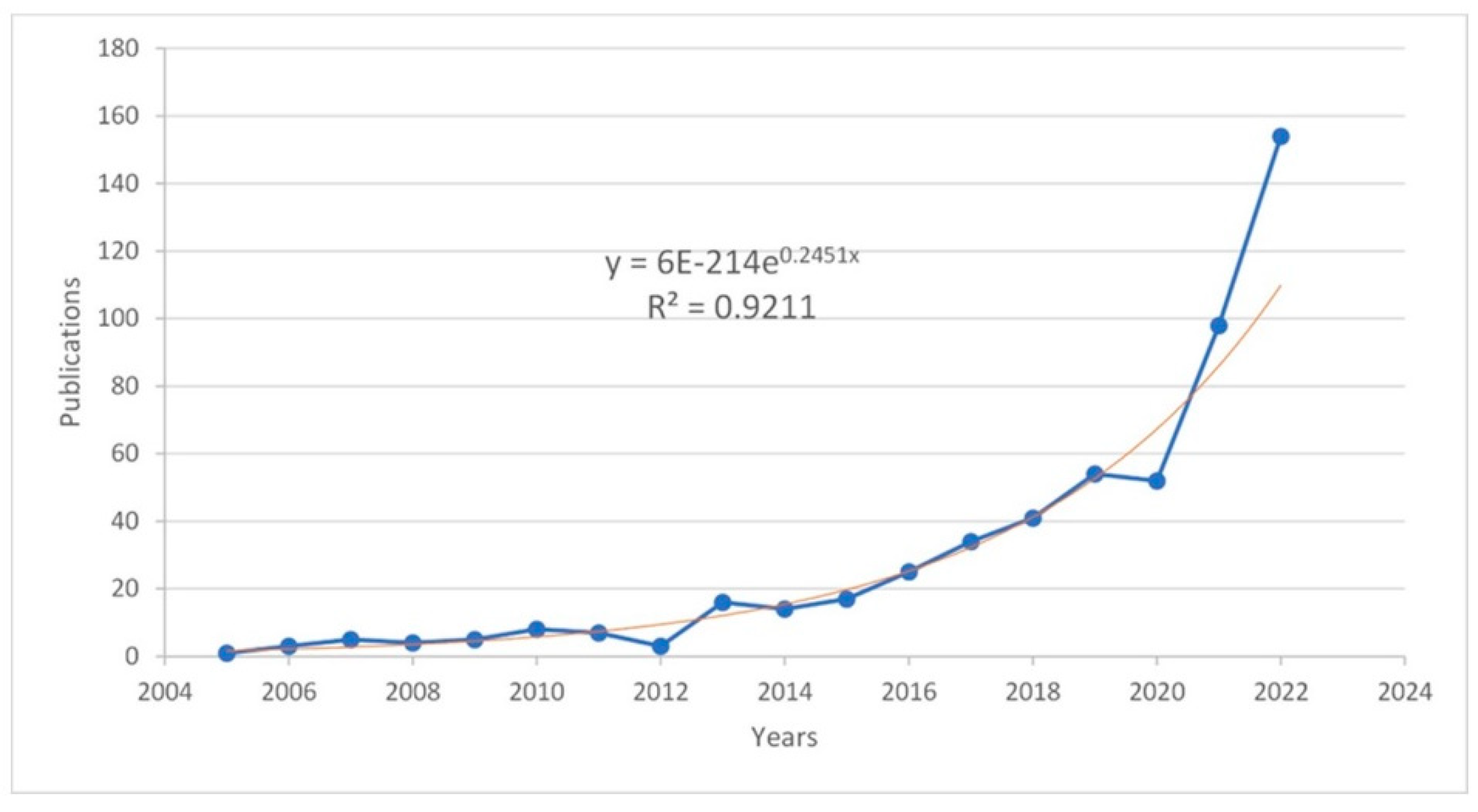
Figure 2.
Relationship between the level of scientific production and authorship. The figure shows the number of publications per author.
Figure 2.
Relationship between the level of scientific production and authorship. The figure shows the number of publications per author.
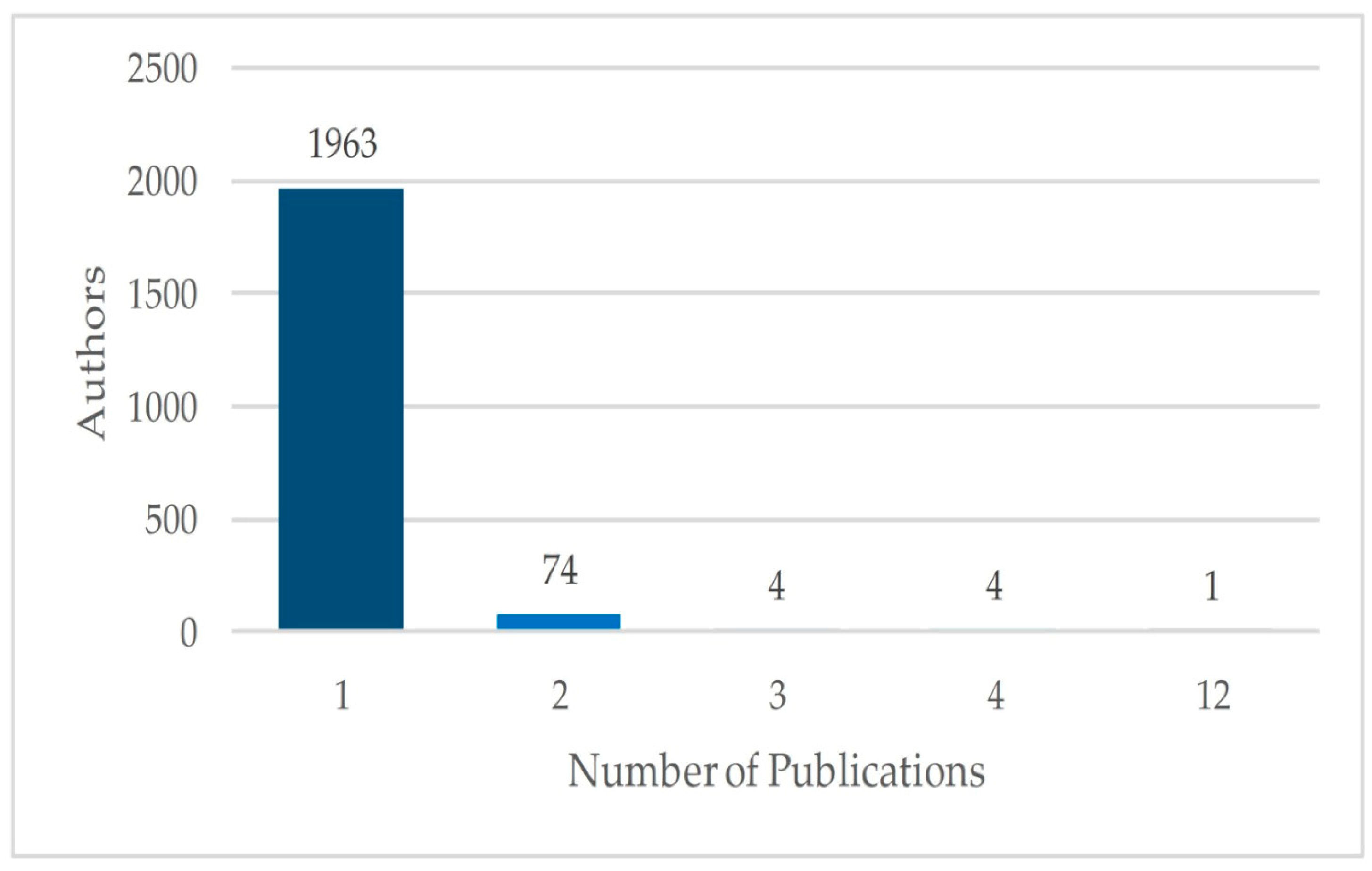
Figure 3.
Graph of prolific co-authorship and its relationships with three or more connections.
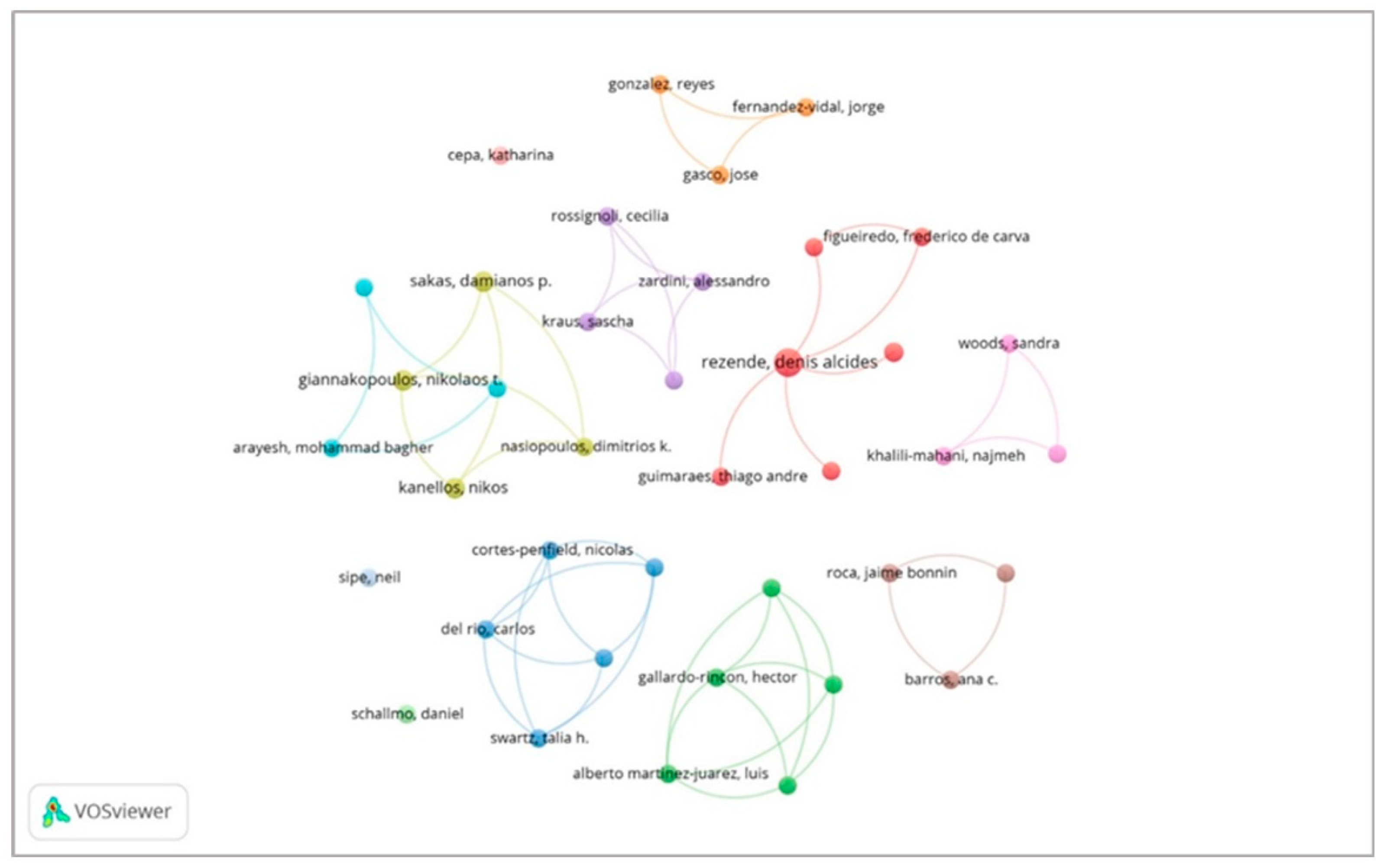
Figure 4.
h-index estimation. The blue line is a time series and the gray line is a trend.
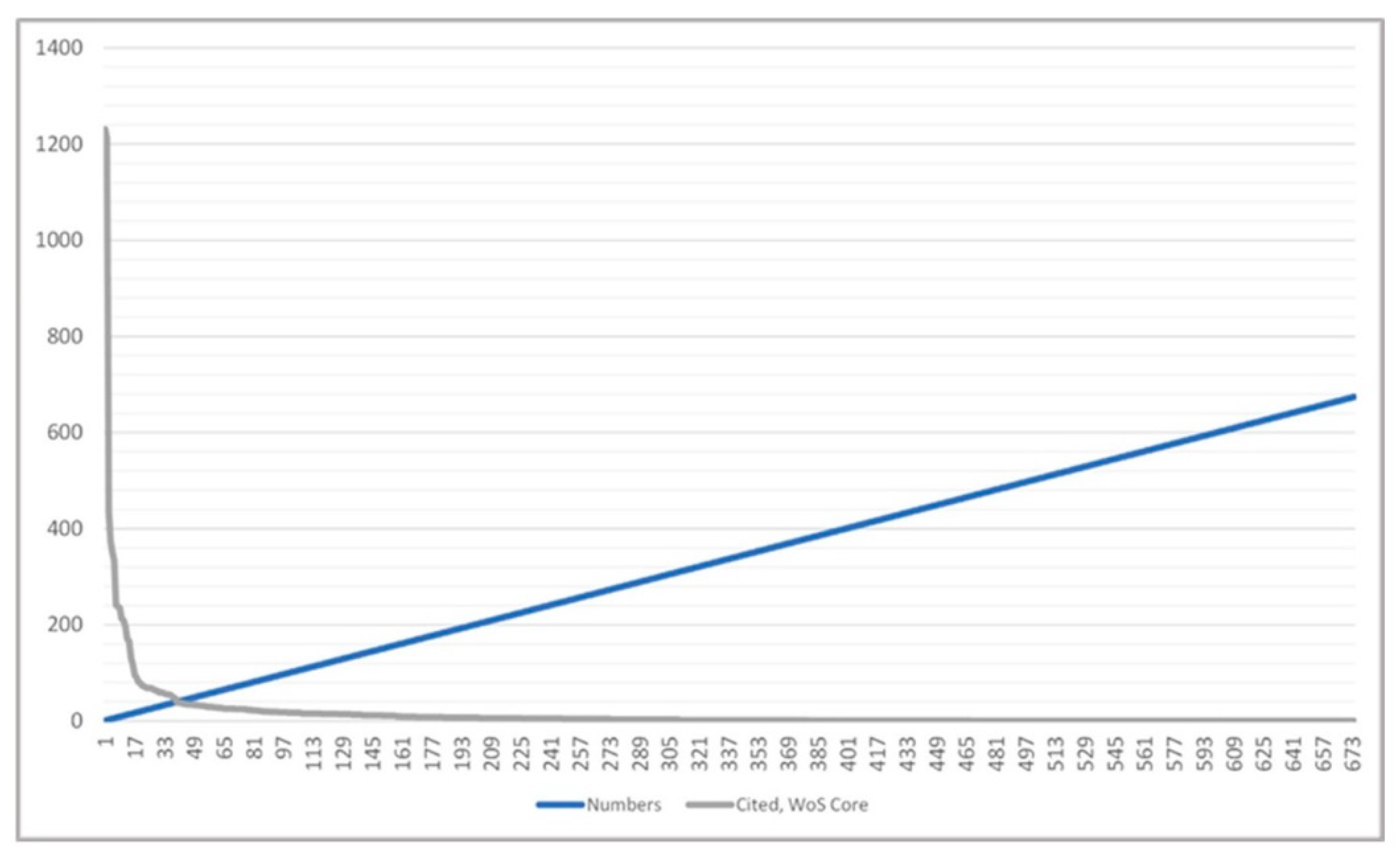
Figure 5.
Association of WoS articles to the SDGs.
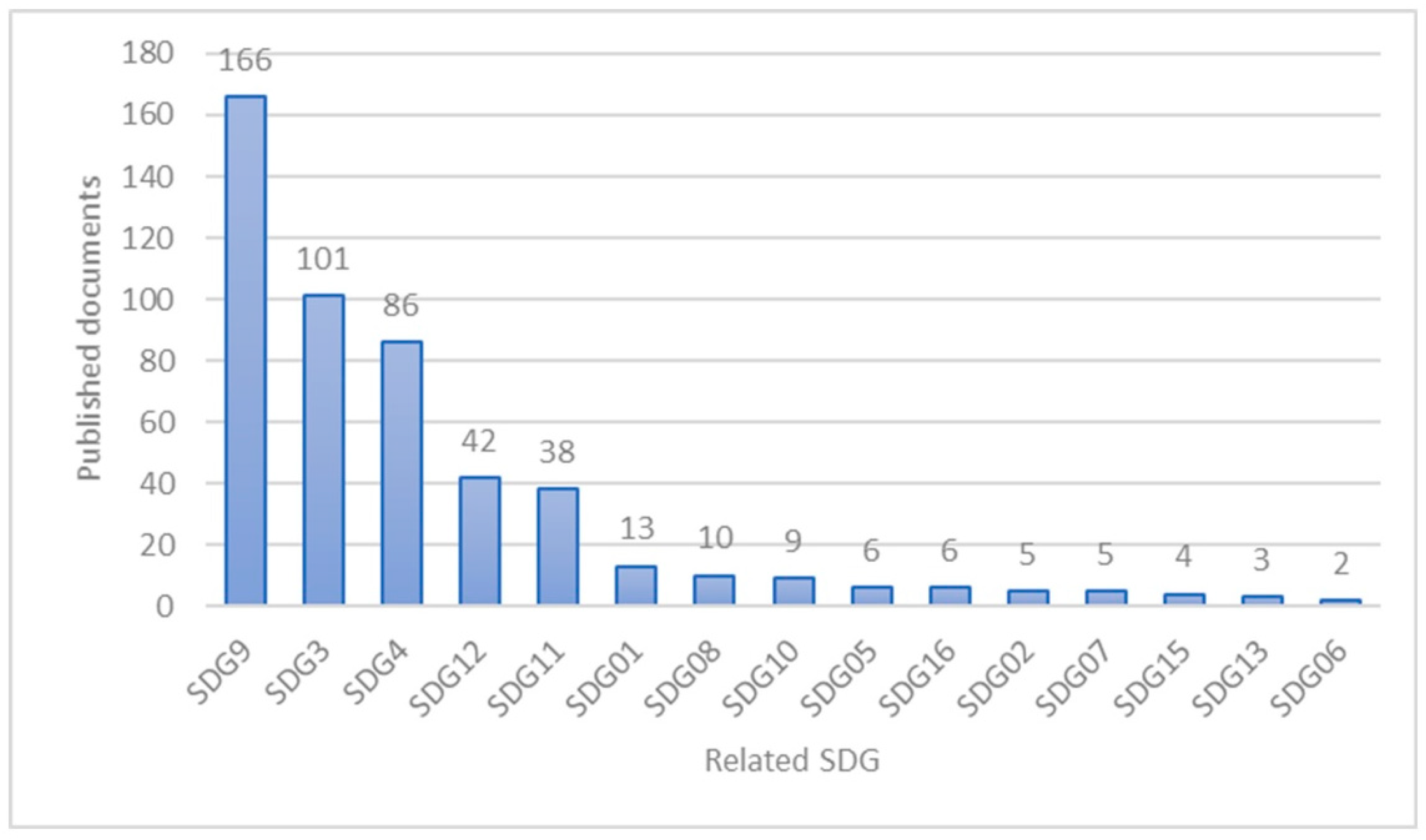
Figure 6.
Co-authorship / countries graph.
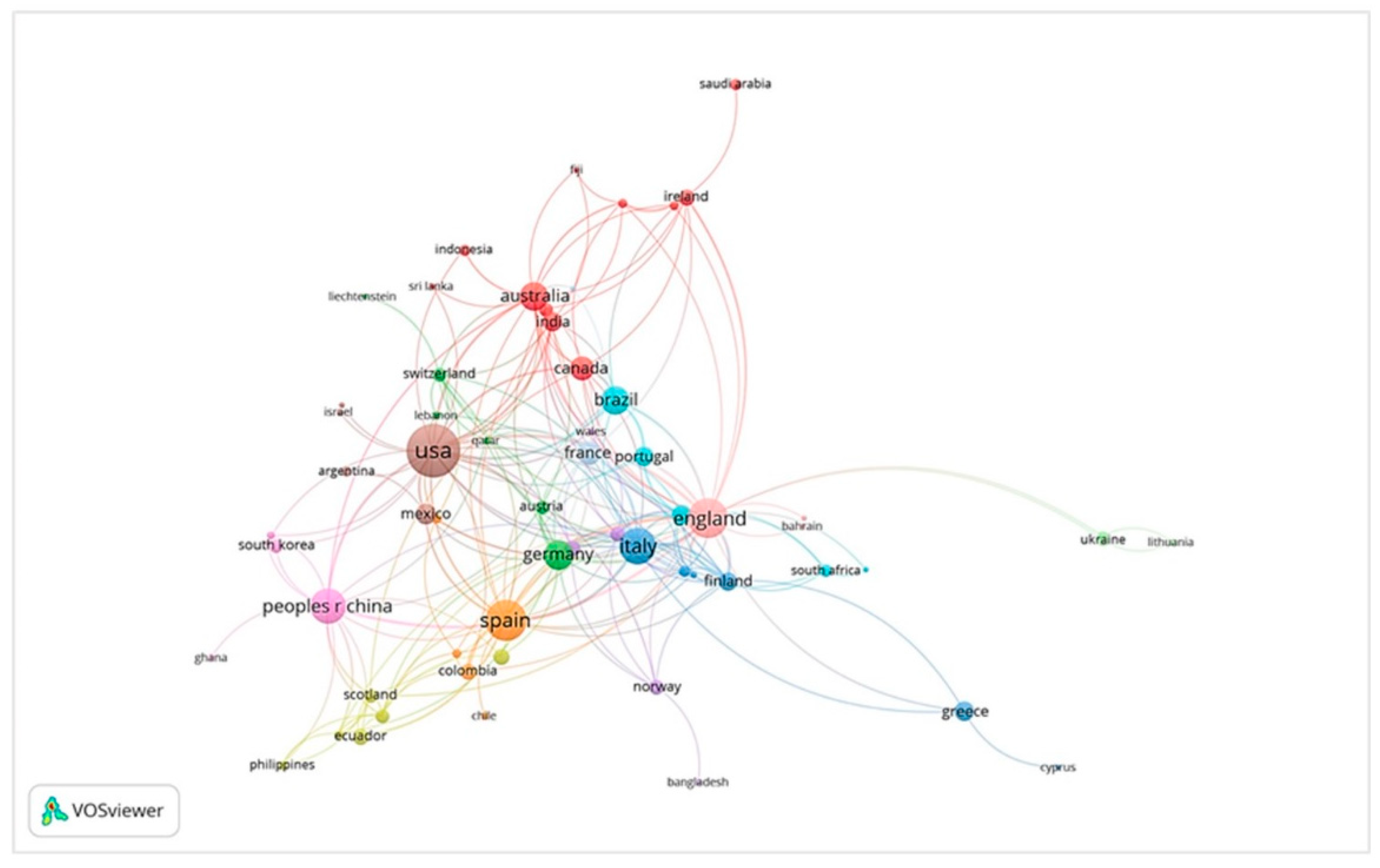
Figure 8.
Keywords Plus co-occurrence graph. Nodes of the same color form a thematic cluster.

Figure 9.
Author’s keywords cooccurrence graph by year.
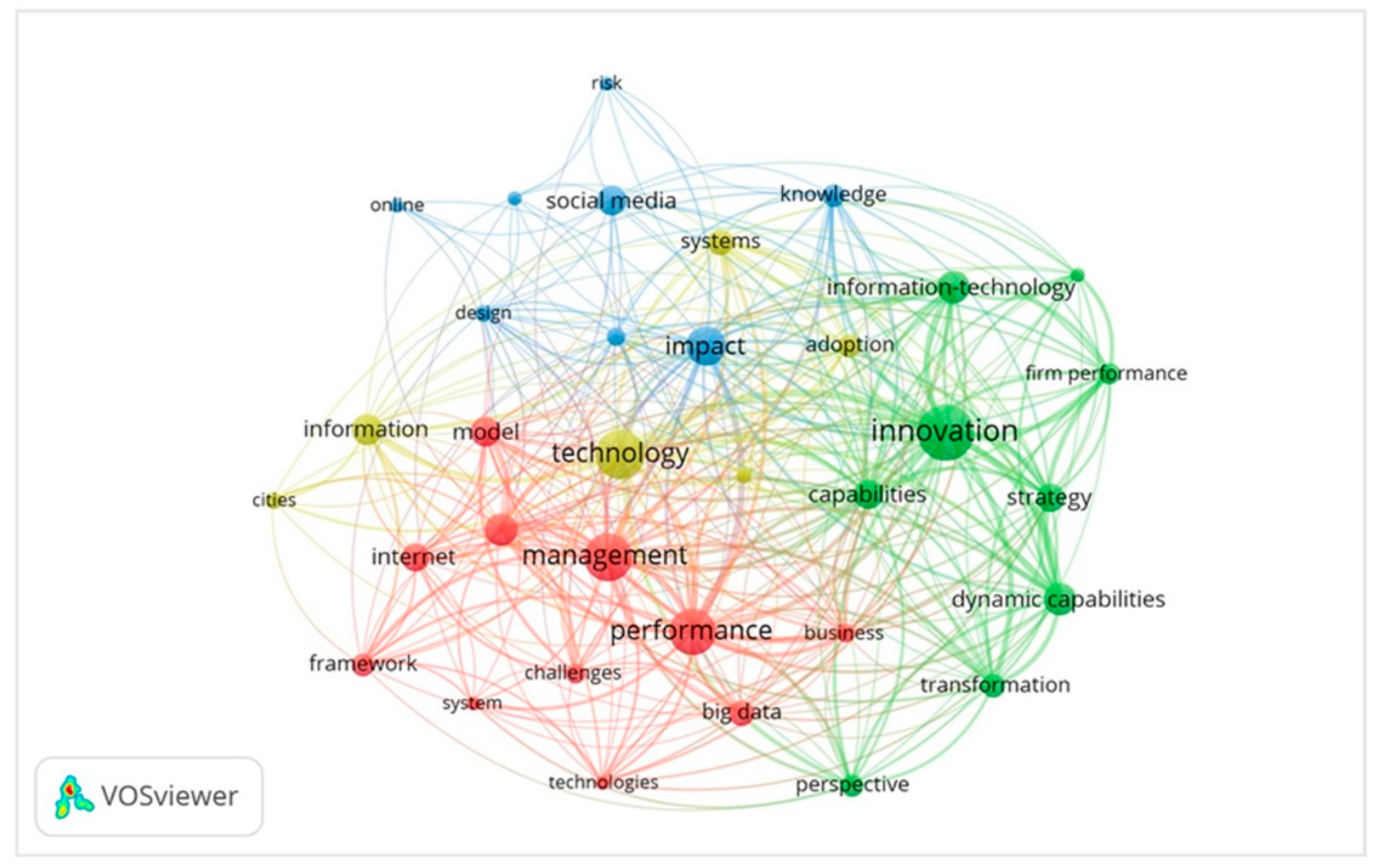
Table 2.
Prolific author clusters and affiliations with 4 or more relationships.
| Authors | Cluster | Afiliattion | Country |
|---|---|---|---|
| Rezende, Denis Alcides | Red | Pontificia Universidade Catolica do Parana | Brazil |
| Guimaraes, Thiago Andre | Red | Fed Inst Sci & Technol Parana IFPR, Tech & Technol | Brazil |
| Ribeiro, Sergio Silva | Red | Briercrest Coll & Seminary | Brazil |
| Procopiuck, Mario | Red | Pontificia Universidade Catolica do Parana | Brazil |
| Figueiredo, Frederico de Carvalho | Red | Pontifical Catholic Univ, Postgrad Program Urban Management | Brazil |
| Feijo de Almeida, Giovanna Gore | Red | Pontificia Universidade Catolica do Parana | Brazil |
| Alberto Martínez-Juarez, Luis | Green | London School of Hygiene & Tropical Medicine | England |
| Gallardo-Rincon, Hector | Green | Universidad de Guadalajara | Mexico |
| Saucedo-Martinez, Rodrigo | Green | Carlos Slim Fdn, Mexico City | Mexico |
| Montoya, Alejandra | Green | Carlos Slim Fdn, Mexico City | Mexico |
| Tapia-Conyer, Roberto | Green | Universidad Nacional Autonoma de Mexico | Mexico |
| Swartz, Talia H. | Blue | University of California System | USA |
| Spec, Andrej | Blue | Emory University | USA |
| Marcelin, Jasmine R. | Blue | University of Nebraska System | USA |
| Del Rio, Carlos | Blue | University of Nebraska Medical Center | USA |
| Cortes-Penfield, Nicolas | Blue | University of Nebraska Medical Center | USA |
| Giannakopoulos, Nikolaos T. | Yellow | Agricultural University of Athens | Greece |
| Kanellos, Nikos | Yellow | Agricultural University of Athens | Greece |
| Nasiopoulos, Dimitrios K. | Yellow | Agricultural University of Athens | Greece |
| Sakas, Damianos P. | Yellow | Agricultural University of Athens | Greece |
| Kraus, Sascha | Purple | Free University of Bozen-Bolzano | Italy |
| Orlandi, Ludovico Bullini | Purple | University of Bologna | Italy |
| Zardini, Alessandro | Purple | University of Verona | Italy |
| Rossignoli, Cecilia | Purple | University of Verona | Italy |
Table 3.
h-Index documents (with 100 or more citations).
| Authors | ISO Journal Abbreviation | Cited Times, Wos Score | Year Pub. | WoS Categories | Wos Index | SDGs |
|---|---|---|---|---|---|---|
| Yoo, Henfridsson, & Lyytinen [81] | Inf. Syst. Res. | 1231 | 2010 | Information Science & Library Science; Management | (SSCI) | 9 |
| Bharadwaj et al., [82] | MIS Q. | 1212 | 2013 | Computer Science, Information Systems; Information Science & Library Science; Management | (SCI-EXPANDED); (SSCI) | 9 |
| Horvath & Szabo [64] | Technol. Forecast. Soc. Chang. | 435 | 2019 | Business; Regional & Urban Planning | (SSCI) | 9,12 |
| Dwivedi et al., [83] | Int. J. Inf. Manage. | 372 | 2020 | Information Science & Library Science | (SSCI) | 4 |
| Raj et al., [84] | Int. J. Prod. Econ. | 349 | 2020 | Engineering, Industrial; Engineering, Manufacturing; Operations Research & Management Science | (SCI-EXPANDED); (SSCI) | 9,12 |
| Sebastian et al., [9] | MIS Q. Exec. | 335 | 2017 | Information Science & Library Science; Management | (SSCI) | 9 |
| Helbig, Gil-Garcia, & Ferro [29] | Gov. Inf. Q. | 241 | 2009 | Information Science & Library Science | (SSCI) | 4 |
| Yeow, Soh, & Hansen [45] | J. Strateg. Inf. Syst. | 238 | 2018 | Computer Science, Information Systems; Information Science & Library Science; Management | (SCI-EXPANDED); (SSCI) | 9 |
| Perboli, Musso, & Rosano [85] | IEEE Access | 235 | 2018 | Computer Science, Information Systems; Engineering, Electrical & Electronic; Telecommunications | (SCI-EXPANDED) | None |
| Bossetta [86] | Journal. Mass Commun. Q. | 213 | 2018 | Communication | (SSCI) | None |
| Chanias, Myers, & Hess [35] | J. Strateg. Inf. Syst. | 209 | 2019 | Computer Science, Information Systems; Information Science & Library Science; Management | (SCI-EXPANDED); (SSCI) | 9 |
| Mithas, Tafti, & Mitchell [87] | MIS Q. | 197 | 2013 | Computer Science, Information Systems; Information Science & Library Science; Management | (SCI-EXPANDED); (SSCI) | 9 |
| Correani et al., [42] | Calif. Manage. Rev. | 171 | 2020 | Business; Management | (SSCI) | 9 |
| Eller et al., [28] | J. Bus. Res. | 166 | 2020 | Business | (SSCI) | 9 |
| Kreiss & McGregor, [88] | Polit. Commun. | 131 | 2018 | Communication; Political Science | (SSCI) | None |
| Barrett, Oborn, & Orlikowski, [89] | Inf. Syst. Res. | 117 | 2016 | Information Science & Library Science; Management | (SSCI) | 9 |
Table 4.
Countries with the highest production of publications.
| Number | Countries | Publications | Citations | Degrees of Centrality | Percentage |
| 1 | USA | 119 | 5012 | 30 | 17.66% |
| 2 | Spain | 70 | 308 | 21 | 10.39% |
| 3 | England | 69 | 1578 | 36 | 10.24% |
| 4 | Italy | 58 | 774 | 19 | 8.61% |
| 5 | China | 53 | 578 | 17 | 7.86% |
| 6 | Germay | 39 | 902 | 16 | 5.79% |
| 7 | Brazil | 36 | 150 | 8 | 5.34% |
| 8 | Australia | 35 | 465 | 20 | 5.19% |
| 9 | Canadá | 25 | 563 | 11 | 3.71% |
| 10 | France | 24 | 760 | 20 | 3.56% |
| 11 | Mexico | 19 | 313 | 5 | 2.82% |
| 12 | Holand | 17 | 116 | 13 | 2.52% |
| 13 | Grecia | 16 | 110 | 4 | 2.37% |
| 14 | India | 16 | 912 | 15 | 2.37% |
| 15 | Portugal | 16 | 132 | 4 | 2.37% |
| 16 | Finland | 15 | 194 | 14 | 2.23% |
| 17 | Colombia | 12 | 19 | 5 | 1.78% |
| 18 | Ecuador | 12 | 20 | 5 | 1.78% |
| 19 | Irland | 12 | 143 | 11 | 1.78% |
| 20 | Russia | 11 | 51 | 5 | 1.63% |
Table 5.
Journals with the highest scientific production on digital strategy.
| Journal | Article | Categories WoS | Times Cited, WoS Core | Impact Factor | CiteScore | KeywordsPlus |
|---|---|---|---|---|---|---|
| Sustainability | 23 | Green & Sustainable Science & Technology; Environmental Sciences; Environmental Studies | 111 | 3.9 | 6.8 | Models; Management; Technologies; Innovation; Systems; Performance; Capabilities; Adoption; Systems; Transformation |
| Technological Forecasting and Social Change | 9 | Business; Regional & Urban Planning | 574 | 12.0 | 21.3 | Digital Transformation; technology; Information; Innovation; Dynamic Capabilities; Performance; Strategy |
| Journal of Business Research | 5 | Business | 337 | 11.3 | 20.3 | Business; transformation; Information; Innovation; Dynamic Capabilities; Performance; Management |
| International Journal of Production Economics | 5 | Engineering, Industrial; Engineering, Manufacturing; Operations Research & Management Science | 361 | 12.0 | 21.4 | Models; Management; Technologies; Innovation; Systems; Performance; Industry 4.0 |
| IEEE Access | 5 | Computer Science, Information Systems; Engineering, Electrical & Electronic; Telecommunications | 245 | 3.9 | 9.8 | Systems; Adoption; Integration; Big Data; Process Integration |
| International Journal of Innovation Management | 5 | Management | 30 | 2.1 | 3.7 | Business; Transformation; Models; Innovation; Dynamic Capabilities; Performance; Strategy |
| Harvard Business Review | 5 | Business; Management | 76 | 6.8 | 1.4 | Digital Strategy; Business; Models |
| Information Communication & Society | 5 | Communication; Sociology | 58 | 4.2 | 10.2 | Communication; Intenet; Politics; Media |
| Journal Of Strategic Information Systems | 4 | Computer Science, Information Systems; Information Science & Library Science; Management | 473 | 7.0 | 17.4 | Business; Technology; Innovation; Information-Sistems Strategy; Capabilities; Performance; Management |
| Bmj Open | 4 | Medicine, General & Internal | 9 | 2.9 | 3.4 | Behavior; Risk; Validation; Innovation |
| Frontiers In Psychology | 4 | Psychology, Multidisciplinary | 6 | 3.8 | 5.3 | Innovation; Transformation; Capabilities |
| Heliyon | 4 | Multidisciplinary Sciences | 6 | 4.0 | 4.5 | Big data; management |
| MIS Quarterly | 3 | Computer Science, Information Systems; Information Science & Library Science; Management | 1409 | 7.0 | 6.7 | Information-Systems Research; Organizational Routines; Performance; Innovation; Technology; Modularity; Infrastructures; Capabilities |
| Information Systems Research | 3 | Information Science & Library Science; Management | 1348 | 5.0 | 9.1 | Software; Organizations; Capabilities; Architecture; Governance; |
Disclaimer/Publisher’s Note: The statements, opinions and data contained in all publications are solely those of the individual author(s) and contributor(s) and not of MDPI and/or the editor(s). MDPI and/or the editor(s) disclaim responsibility for any injury to people or property resulting from any ideas, methods, instructions or products referred to in the content. |
© 2024 by the authors. Licensee MDPI, Basel, Switzerland. This article is an open access article distributed under the terms and conditions of the Creative Commons Attribution (CC BY) license (http://creativecommons.org/licenses/by/4.0/).
Copyright: This open access article is published under a Creative Commons CC BY 4.0 license, which permit the free download, distribution, and reuse, provided that the author and preprint are cited in any reuse.


