Preprint
Article

This version is not peer-reviewed.

Improving Telenomus remus Field Deployment: Contribution for Adult Release and Release Density to Biological Control Success

A peer-reviewed article of this preprint also exists.

Submitted:

09 August 2025

Posted:

12 August 2025

You are already at the latest version

Abstract

Egg parasitoids, such as Telenomus remus, face significant challenges after release, as their pupae are exposed to various mortality factors that reduce the efficiency of biological control programs. In this context, this study aimed to evaluate a solid diet that In this context, this study aimed to evaluate a solid diet that allows feeding adults while still inside the release capsules, enabling its storage and field application for adults. Three independent bioassays were performed, each with 20 completely randomized replications. The first bioassay evaluated the acceptance of a solid feed, honey soaked in cotton thread, compared to the traditional form, honey droplets. In the second bioassay, the storage periods after emergence of adults in capsules with solid food were analyzed, at 2, 4, 6 and 8 days post-emergence and the third bioassay was studied the efficacy of different release densities under field conditions. The results showed that the solid diet was well accepted in relation to the traditional diet, in addition, T. remus resulted in lower mortality inside the capsules, living up to four days without significant reductions in biological parameters or parasitism capacity. Therefore, the recommended dose of 20,000 parasitoids per hectare is not enough to keep S. frugiperda under economic thresholds. The flexibility of until four days to the release and the insights regarding the densitys provide a valuable improvement to establish T. remus as a biocontrol agent.

Keywords: 
;  ;  ;  ;  ;  

1. Introduction

The egg parasitoid Telenomus remus (Nixon) (Hymenoptera: Scelionidae) has emerged as one of the most promising candidates for Augmentative Biological Control (ABC) programs of the fall armyworm (FAW) Spodoptera frugiperda (Smith) (Lepidoptera: Noctuidae) around the world [1,2,3]. Despite the high FAW control triggered by genetically modified maize [4], due to the increased cases of resistance [5], insecticides are still largely adopted [6]. However, chemicals overuse has raised global concerns about their negative side-effects over the environment and human health [7,8]. Those concerns have gained increasing attention more recently, especially due to the vast extension of area in which FAW has occurred, invading new regions such as Africa, Asia, Australia and Europe [9,10]. This scenario turns this pest a global threat to food security [11] increasing the demand for sustainable tools to its management [12].
Among the most eco-friendly alternatives against FAW, Telenomus remus stands out [13] not only due to its high parasitism on Spodoptera spp. eggs [2] but also because of the high dispersal capacity of its adults [14] as well as its great host foraging potential [15]. Furthermore, its adults are able to parasitize Spodoptera eggs on overlapping layers; including those eggs located in the inner layers of egg masses, frequently covered with scales from the moth's wings [3]. Due to this extraordinary potential, T. remus has been one of the most studied egg parasitoids against Spodoptera spp., including FAW, in different countries around the world, especially in Latin America [2].
First releases in Latin America were performed manually in 1990s on small scales with overall positive results [2]. Releases of T. remus in Venezuela, Colombia, Guyana and Suriname achieved up to 80–100% of FAW egg parasitism [16,17,18,19,20]. In order to scale up the adoption of egg parasitoids as a biological control strategy over large areas, pupae close to adult emergence have been the preferred stage to be released by the biological control industry, due to the ease of mechanization of the release process [21]. However, it is important to consider that males of T. remus emerge up to 24 hours earlier than females [22]. Therefore, T. remus female released as pupae will stay longer in the field before adult emergence. It makes the released parasitoid, especially females, extremely vulnerable to different causes of mortality. Among the most important ones, high temperatures [23,24,25], rainfall [26] and predation [27] can be highlighted as the most frequent and impactful in reducing parasitoid survival in the field immediately after release. Therefore, it is of great theoretical and practical interest to evaluate new strategies to release T. remus in field conditions [2]. The refinement of protocols to release biocontrol agents, for instance T. remus, in ABC programs is one of the major obstacles to improving the use of biocontrol strategies inside integrated pest management (IPM) [28].
Despite the increasing interest in T. remus for biological control in Brazil, where it has only recently been officially registered for commercial use, key operational parameters still require refinement. In South America, release densities of T. remus in fields of maize range widely from 5,000 to 200,000 parasitoids per hectare [18,19,29,30,31,32,33,34,35,36,37]. This undefined clear recommendation protocol of how to release T. remus can be the responsible for the variations in the results recorded in the literature. Some Brazilian studies [34,37] reported lower parasitism (from 1.4 to 9.5%) after releasing T. remus (≤ 24 hours-old) following single releases of 100,000–200,000 individuals per hectare. However, considering the males emerge up to 24 hours before females [22], the released parasitoids have been probably mostly males and the remaining pupae (females) highly predated before emergence. In addition, not only releasing more parasitoids does not increase parasitism but also on the contrary, can reduce parasitism levels recorded in the field [38]. For most biocontrol agents released in ABC programs, there is an optimal release rate that produces effective control of host pest [39] highlighting the need for better-defined release protocols of T. remus.
Therefore, the present study aimed to improve the recommendations for T. remus releases by (a) testing the release of fed adults (from 24 to 48 hours) with the diet previously proposed for another parasitoid species, Telenomus podisi Ashmead (Hymenoptera: Scelionidae) [40], and (b) studying the efficacy of different release densities under field conditions. Together, these approaches aimed to optimize both the quality and quantity aspects of T. remus deployment, ultimately enhancing its adoption and effectiveness as a biocontrol agent against FAW.

2. Material and Methods

The experiments (experiment 1 and 2) were carried out under controlled laboratory conditions [25 ± 2°C, 80 ± 10% RH and 14h:10h Light:Dark (L/D) photoperiod] and the experiment 3 caried out in the field (23°21′19.2″ S, 51°10′16.8″ W) at the Brazilian Research and Agricultural Corporation (Embrapa Soja), in Londrina, PR, Brazil as detailed in the following.

2.1. Insects Rearing

Eggs of S. frugiperda as well as T. remus females used in the experiments were from insect colonies maintained in laboratory conditions [25 ± 2°C, 80 ± 10% RH and 14h:10h Light:Dark (L/D) photoperiod].
Spodoptera frugiperda specimens were originally collected from maize plants (C-strain) in Embrapa Field Station, Londrina, State of Paraná, Brazil (23°21′19.2″ S, 51°10′16.8″ W), in 2020 and morphologically identified using the Manual for the Identification of Insects and Other Invertebrates of Soybean Crops [41]. Since then, the insects have been maintained in the rearing during which new field insects had been introduced each year to maintain colony quality.
Larvae of both species were initially individualized in plastic cups (50 mL) containing an artificial bean-based diet [42] until reaching the pupae stage. Then, pupae were separated by sex [43] and transferred to acrylic cages (45 × 33 × 35 cm) for eclosion of the adults and their mating and oviposition. The adults were fed with a diet based on honey (10%) and distilled water. The cage was covered internally with white paper as oviposition substrate, and the eggs were collected daily for experiments or colony maintenance.
Telenomus remus was originally collected in Ecuador and reared at the parasitoid rearing facilities of ESALQ/USP (Luiz de Queiroz College of Agriculture, University of São Paulo). In 2008, a subset of this population was transferred to Embrapa Soybean, where it has since been maintained and periodically refreshed using individuals exhibiting favorable biological traits. Since then, T. remus has been reared in the laboratory using S. frugiperda egg masses (approximately 150 eggs each), which were glued onto cards (2 cm × 8 cm) and introduced into tubes together with eggs previously parasitized by T. remus. Small drops of honey were placed inside these tubes to feed the adults as soon as they emerged. The tubes were then closed, and the eggs allowed to be parasitized for 24 h. Adults that emerged from these eggs were used for trials or colony maintenance.

2.2. Experiment 1: Parasitism Capacity of Telenomus remus Fed on Liquid (Honey Droplets) vs. Solid Honey Diet)

Different tubes containing pupae of T. remus from the parasitoid rearing received one of tested diet described in the following, 6 days before the emergence of the insects for feeding the adults immediately after emergence. After 48 hours from emergence of the first adults, enough parasitoid females (20 females of each treatment) were individualized in Duran acrylic tubes (6 cm high and 1 cm in diameter) with the tested diet. The experiment was then conducted in a completely randomized design with two treatments (diets) and 20 replicates (the individualized females ≤ 48 hours with the tested diet). The studied diets were: (1) 100% honey offered in tiny droplets applied to the tube walls every two days (liquid control diet) provided ad libitum, and (2) 100% honey soaked into cotton strings (honey-solid diet) as proposed for T. podisi [40].
Each T. remus female (replicate) was provided a card (1.0 cm x 0.7 cm) with approximately 150 S. frugiperda eggs (< 24h old), which were replaced on daily basis until the parasitoid’s death. The experiment was conducted in climatized chambers (ELETROLab®, model EL 212, São Paulo, SP, Brazil). The removed egg cards were stored in the climatic chamber until evaluation.
The evaluated biological parameters included: (1) daily parasitism rate (number of eggs parasitized per day), (2) lifetime parasitism (total number of eggs parasitized per female), (3) emergence rate (%), (4) sex ratio (proportion of females), calculated as sr = number of females / (number of females + number of males), and (5) longevity of parental females (measured in days after release, with “release” defined in this experiment as the day parasitoids first received host eggs).

2.3. Experiment 2: Shelf Life of Adults of T. remus Inside Capsules with a Honey in Tiny Droplets Diet

The experiment was carried out in a completely randomized design with 4 treatments (different period of storage of T. remus inside capsules with solid diet at 25oC) and 20 replicates. The honey-solid diet [40] used was as described in the previous experiment composed of 100% honey soaked into cotton strings and allowed to dry. The evaluated periods of storage (treatments) were: 2 (control), 4, 6 and 8 days after the emergence of the first adults inside the capsules (males). A commercial, spherical capsule made of cellulose (Agribela Tecnologias Biológicas®) with a 3.0 cm diameter was used, containing 150 pupae of T. remus.
A total of 16 capsules were prepared 6 days before the emergence of the first T. remus adults and stored inside the same climatized chambers (ELETROLab®, model EL 212, São Paulo, SP, Brazil). Every 24h, the capsules were handled (turned over) to simulate possible shaking during the transport of the capsules from the production facility (biofactory) to the field. On each evaluation day (treatments), 4 capsules were opened and evaluated for the number of living and dead adult parasitoids inside each capsule. In addition, 20 females from those capsules opened were selected (20 replicates) to perform a parasitism capacity trial. Each replicate was composed of an individual female T. remus in a Duran acrylic tube (height 6 cm, diameter 1 cm) with white cards (1.0 cm x 0.7 cm) containing 150 eggs (< 24h old) of S. frugiperda, which were replaced daily until the death of the female. The honey droplets was provided as a drop in the tube for feeding the adults.
The following biological variables were evaluated: daily (number of eggs parasitized per day) and lifetime parasitism (total number of eggs parasitized per female), emergence (%), sex ratio (female proportion) [sr = number of females / (number of females + number of males)], parental longevity after release (number of days the parasitoid survived after the opening of the capsule), and number of living and dead adult parasitoids trapped inside each opened capsule.

2.4. Experiment 3: Field Performance of T. remus Under Different Release Densities

The experiment was conducted under field conditions during the 2024 maize growing season at the experimental field of Embrapa Soybean, located in Londrina, Paraná, Brazil (23°21′19.2″ S, 51°10′16.8″ W). The experiment consisted of four field plots (2.7 ha each), each assigned to one T. remus release density. Within each treatment plot, four subsampling points were used for parasitism evaluation, which were treated as pseudo-replications.
Treatments consisted of different release densities of fed adults of T. remus with diet proposed by [40] as following: i) 5.000; ii) 10.000; iii) 15.000; and iv) 20.000 parasitoids per hectare. All parasitoids were obtained from the T. remus colony maintained at the Parasitoid Laboratory of Embrapa Soybean, where they were reared on S. frugiperda eggs under controlled conditions. Likewise, sentinel egg masses used for parasitism evaluation originated from the same laboratory colony of S. frugiperda.
A baseline assessment was carried out before the first parasitoid release to evaluate the presence of natural parasitism in the area. Subsequently, parasitoid was released 3 times for each treatment plot, spaced from seven to ten days apart each release. Parasitoids were released as mated and honey-fed adults, with 24–48 hours post-emergence, ensuring that they were physiologically ready for host searching and parasitism. Adults were released inside biodegradable capsules, which were opened in the field at the time of release to allow dispersion. Capsules were evenly distributed across the field, with 35 release points per hectare [14]. In treatments with higher release densities, the number of capsules per hectare was proportionally increased but the number of releasing points was kept the same (35 points/ha) to maintain homogeneous distribution and prevent capsules from being overcrowded.
Parasitism evaluations were conducted at 1, 2, and 6 days after each release (i.e., at 24, 48, and 144 hours post-release). In each sampling, 10 naturally laid egg masses and 10 sentinel egg masses were collected per replicate. Sentinel eggs consisted of laboratory-produced S. frugiperda eggs glued onto cardboard strips (2.5 × 5 cm) and fixed on a flag in the field. All collected egg masses were individually transferred to plastic vials and brought to the entomology laboratory, where they were kept in climate chambers (25 ± 2 °C, 80 ± 10% RH, 14:10 h L:D photoperiod). Egg masses were monitored daily to record parasitoid emergence. Emerging S. frugiperda larvae were removed immediately to avoid cannibalism of parasitized eggs. Two response variables were analyzed: parasitism rate and proportion of parasitism between egg masses (natural and sentinel) per sampling date.

2.5. Statistical Analysis

Parasitism rate was analyzed using generalized linear mixed models (GLMMs) with a binomial error distribution and a logit link function, fitted with the glmmTMB package [44]. The model included treatment, sampling date, and their interaction as fixed effects, and block as a random effect. When the interaction was significant, we performed pairwise comparisons of treatments within each date using Tukey’s test (p < 0.05) via the emmeans package. Emergence rate (%) and sex ratio (proportion of females) were analyzed using generalized linear models (GLMs) with binomial error distribution and logit link function. Adult female longevity data were analyzed using one-way analysis of variance (ANOVA) to assess the effects of diet and storage duration on survival. When significant differences were detected, means were compared using Tukey’s test (α = 0.05). For GLM and GLMM, estimated marginal means and pairwise comparisons were calculated using the emmeans package [45], with Tukey adjustment for multiple comparisons where appropriate. All statistical analyses were performed in R version 4.3.2 [46].

3. Results

3.1. Experiment 1: Parasitism Capacity of T. remus Fed with Liquid Diet (Honey in Tiny Droplets) Compared to Honey-Solid Diet

An overall better parasitoid performance was recorded for adult parasitoids that received honey in tiny droplets. Although the difference was statistically significant, the lifetime number of S. frugiperda eggs parasitized was only 15.34% higher in parasitoids fed with this diet (165.4 eggs) compared to those fed with the honey-solid diet (143.4 eggs) (χ2= 914.21, df=13, p < 0.0002, Table 1).
Significant differences in the emergence (%) of parasitoids were also observed between the treatments (χ2= 44.51; df = 1; p < 0.001) but again with only 4% of difference. It was recorded 77.7% emergence (F2) from parasitism from adults fed with honey in tiny droplets compared to 73.7% emergence (F2) from parasitism from adults fed with the honey-solid diet. In contrast, no difference among T. remus diet was recorded for the progeny sex ratio (χ2= 0.0023; df= 2; p <0.724) or the parental longevity of adult females (days) (F(1, 8) = 1.01; p <0.300), which were not influenced by the tested diets (Table 1).
The distribution of the number of parasitized eggs per day over parasitoid lifetime was not influenced by the type of diet (Figure 1). The highest number of parasitized eggs was always recorded in the first 24 hours of parasitism with similar parasitism between tested diets. The parasitism rates were: 86.1 S. frugiperda eggs for parasitoids feeding on 100% honey droplets (liquid control diet) (Figure 1A) and 79.2 eggs for parasitoids feeding on solid diet (Figure 1B). The concentration of highest parasitism on the first day is an important aspect of parasitism capacity of egg parasitoids.
Another important characteristic is the time when a parasitoid reaches 80% of its lifetime parasitism capacity. This level of parasitism (80%) was reached after five days of parasitism by parasitoids fed with both diets (Figure 1A,B).

3.2. Experiment 2: Shelf Life (Storage Period in Days) of Adults of T. remus Inside Capsules with a Honey-Solid Diet

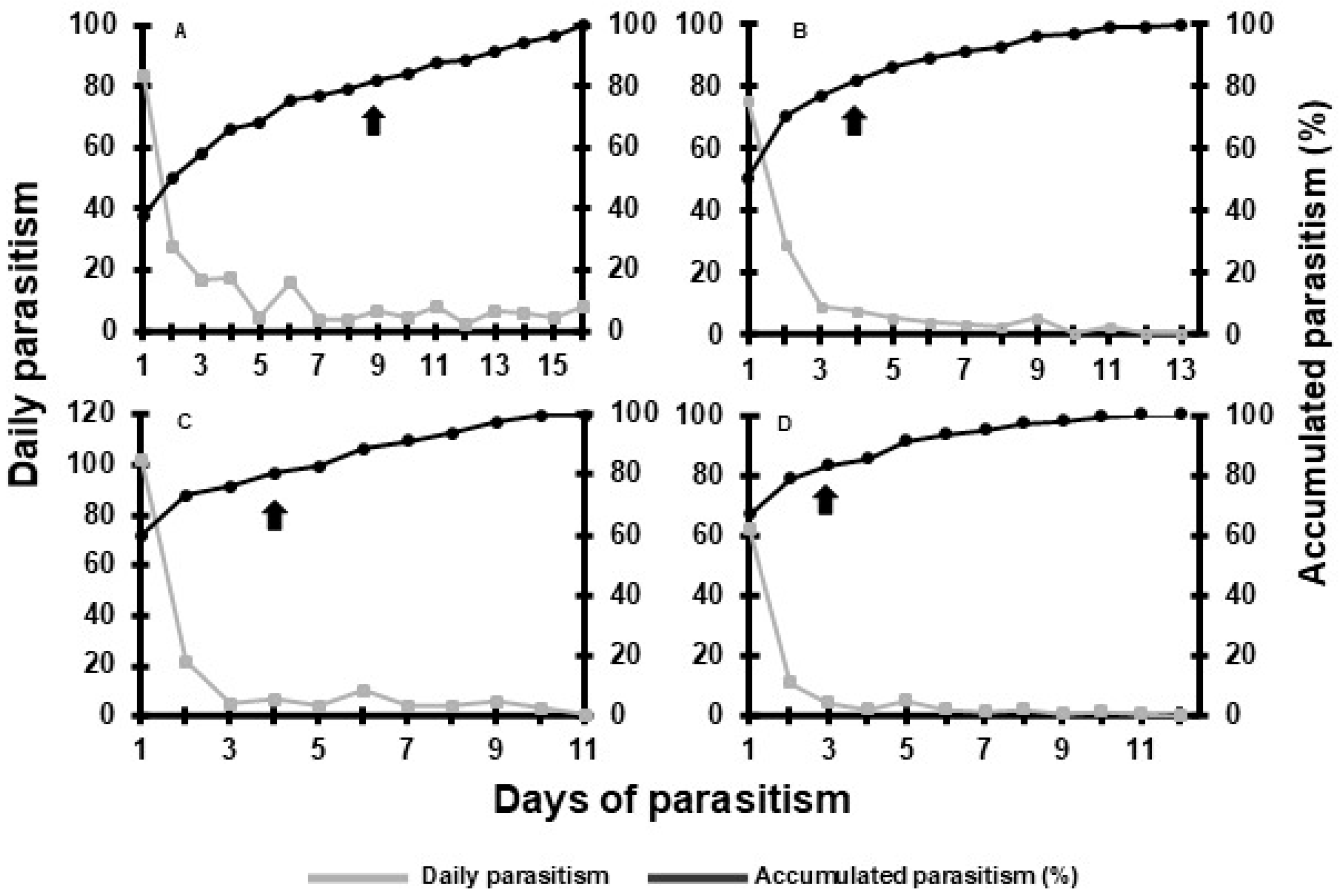
The highest number of parasitized S. frugiperda eggs was observed during the first 24 hours of parasitism (83.4, 75.5, 102.2 and 62.0 eggs) by T. remus storage during 2, 4, 6 and 8 days, respectively (Figure 2). Eighty percent parasitism was recorded at 9 days of parasitism (T. remus females stored ≤ 2 days) (Figure 2A), 4 days of parasitism (T. remus females stored ≤ 4 days) (Figure 2B), 4 days of parasitism (T. remus females stored ≤ 6 days) (Figure 2C) and only 3 days of parasitism (T. remus females stored ≤ 8 days) (Figure 2D). 80% parasitism was reached faster after the longest storage periods.
The lifetime number of eggs parasitized was significantly influenced by the storage periods, decreasing as storage time increased with no differences among 4 and 6 days of storage (χ2= 773.41; df = 3; p <0.002). The highest number of eggs parasitized during the females’ lifetime occurred in the lowest storage period 193.4 (storage ≤ 2 days) followed by 150.4 (storage ≤ 6 days) and 143.6 (storage ≤ 4 days) and lowest lifetime number of parasitized eggs 86.6 was recorded for females’ storage of 8 days (Table 2). This showed that the longest storage time had a marked impact on the parasitism capacity of T. remus with a reduction of 42.4% in the parasitism at eight days of storage compared to six days of storage.
Despite statistically significant differences among some treatments, emergence rates varied only slightly, ranging from 74.4% to 80.51% (χ² = 53.6; df = 3; p < 0.001), and the longevity of parental adult females ranged from 7.1 to 11.5 days (F(3, 27) = 33.07; p < 0.001), without exhibiting any clear trend. Likewise, the results show progeny sex ratios ranging from 0.56 to 0.80 (Deviance = 63, df= 3, p < 0.006). Taking these two last parameters into account, it is suggested that the storage time of 4 days in the capsules, had no negative effect on the desirable characteristics of the parasitism capacity of T. remus females after release.
The evaluation of parasitoids stored during the opening of the capsules revealed similar emergence rates, regardless of the storage duration, and generally low mortality. The amount of dead parasitoid adults found recorded inside the capsules ranged from 2.1 (2 days post-emergence) to 5.99% of the total adults per capsule (6 days post-emergence), with significant differences among treatments (Table 3). However, this difference was mainly driven by the lower mortality observed in the 2-day group, which differed significantly from the others. No significant differences were found among the remaining treatments. The mortality of emerged adults was always below 6%. These findings suggest that the solid food provided inside the capsules did not greatly contribute to the mortality, either by causing parasitoids to adhere to the strings or by starving them due to inaccessible food.

3.3. Experiment 3: Field Performance of T. remus Under Different Release Densities

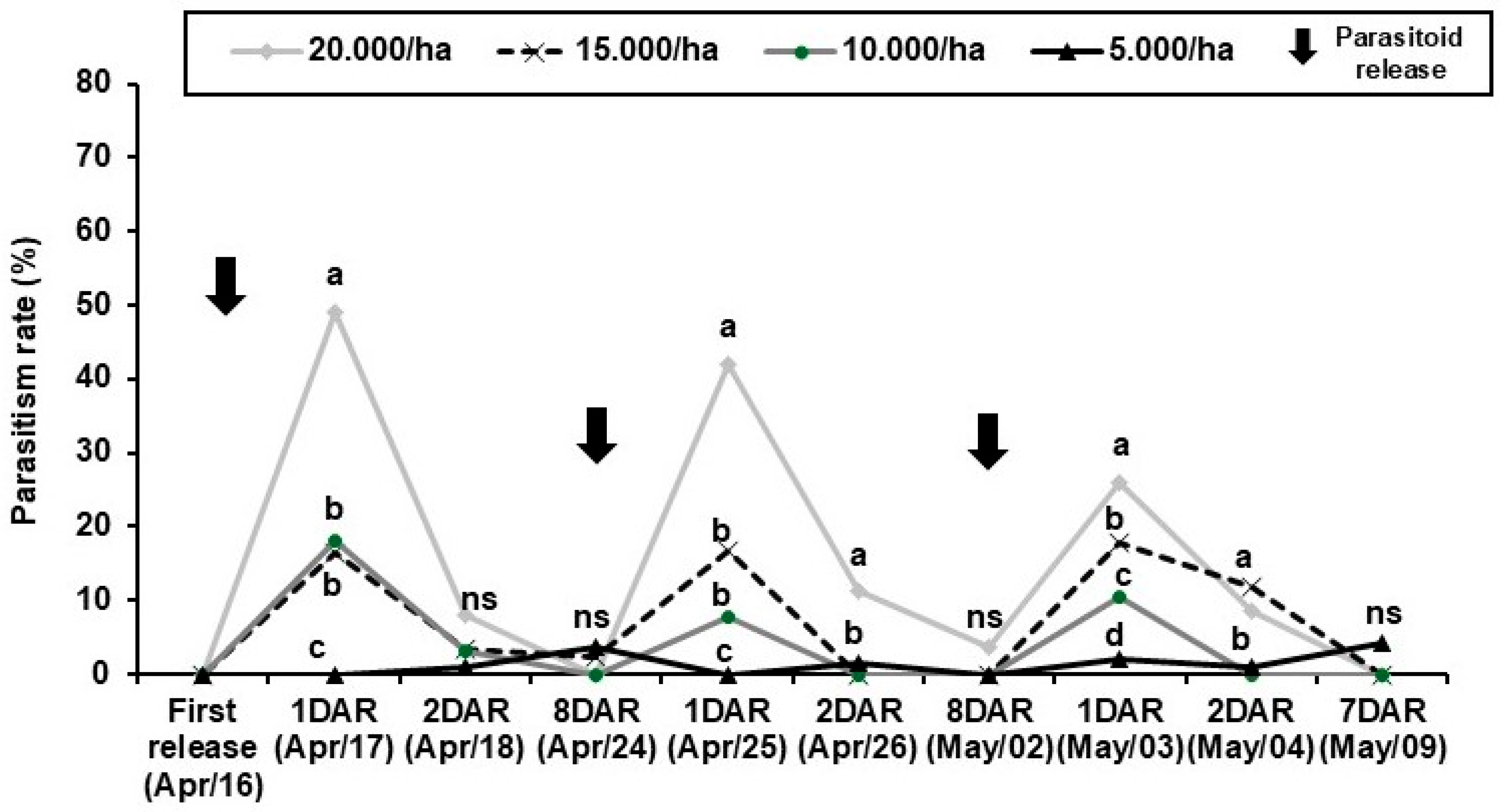
The field parasitism rate of Spodoptera frugiperda eggs recorded after the releases of different densities of T. remus positively responded to the increase in numbers of parasitoids (χ² = 3616.1, df = 3, p < 0.001). The highest parasitism was recorded in the treatment with 20,000 parasitoids/ha, reaching a peak of 49.1 ± 6.14% 24 hours after the first release (Figure 3). In contrast, the 5,000 parasitoids/ha treatment consistently showed the lowest parasitism levels, often near zero throughout the entire evaluation period. Overall, parasitism rates were higher in the treatments with 15,000 and 20,000 parasitoids/ha compared to the lower densities of 5,000 and 10,000 parasitoids/ha. The highest parasitism observed in the 15,000/ha treatment was 17.9 ± 2.57%, which, despite being close in density to the 20,000/ha treatment, was substantially lower in effectiveness.
Regardless of treatment, parasitism consistently peaked at 24 hours after each release and dropped sharply afterward. In the first release, the parasitism rate in the 20,000/ha treatment fell from 49.1% to only 8.0% on the second day. In the second release, the decline was from 42.1% to 11.0 ± 1.62%.
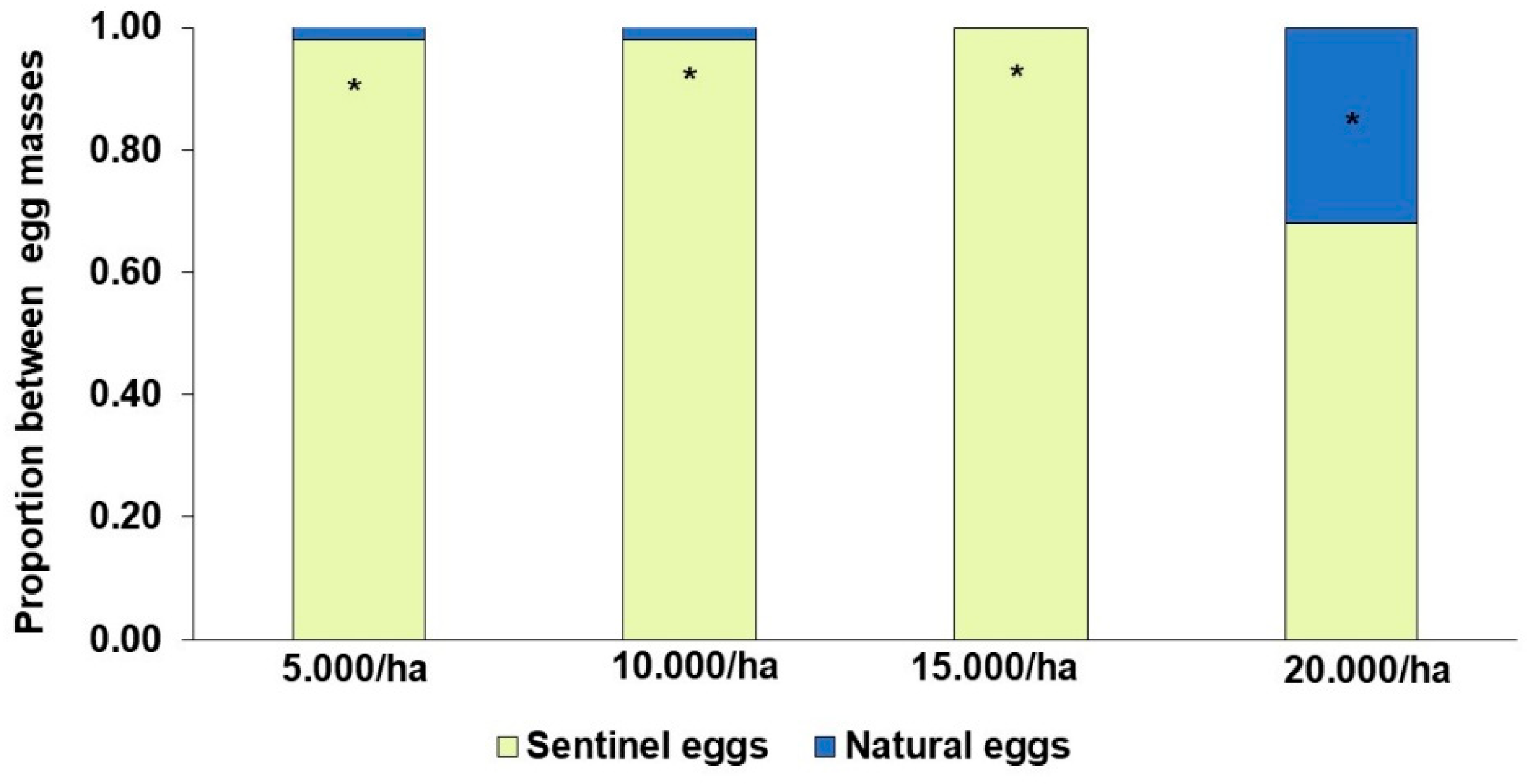
Nearly all parasitism recorded in the 5,000, 10,000, and 15,000 parasitoids/ha treatments occurred in sentinel egg masses (Figure 4). In contrast, parasitism in the 20,000/ha treatment occurred approximately in a 70%:30% ratio between sentinel and natural egg masses, indicating a broader dispersal and activity of the parasitoids at higher release densities.
Parasitism trends over time clearly highlight the superior performance of the 20,000 parasitoids/ha treatment, with pronounced peaks and greater temporal impact. Lower-density treatments maintained minimal and stable parasitism rates throughout the study period.

4. Discussion

Overall, the results herein reported illustrate that the release of fed adult parasitoids should be adopted with the use of the tested solid-honey diet previously described in the literature [40]. Being able to release T. remus as an adult fed has great advantages compared to the most common strategy currently adopted of releasing egg parasitoid pupae in bulk [21,47] increasing the parasitoid survival after released [40]. It will happen because when parasitoids are released in the field as pupae, predation [27], temperature [48], and rainfall [26], among other mortality causes, can significantly reduce released parasitoid survival and, therefore, its efficacy.
It is also important to consider that T. remus males, which as a Scelionidae, emerge up to 24 hours before female adults, which will be, then, exposed for longer periods of time to the causes of mortality following releases if released as pupae [49]. Consequently, in areas with abundant predators (ants, green lacewings, ladybugs, among others) or adverse climate conditions, the release of T. remus pupae can easily fail due to parasitoid mortality immediately after release [50]. Especially in tropical countries, where there is a diverse fauna and extreme weather condition, with high temperatures and/or many species of predators, 100% of pupae mortality only a few hours after releasing can be easily recorded [27]. It has been suggested [26] that T. remus should be released early in the morning, allowing released parasitoids to find shelter from higher temperatures commonly recorded later during the day. However, if parasitoid pupae are released, an additional 24 hours will be necessary for the emergence of females, and a single day of exposure to adverse weather conditions in the field can be sufficient to significantly reduce adult emergence. For instance, when exposing parasitoid pupae of another parasitoid species (T. podisi) in soybean fields for only 24 hours, it was observed a significant reduction in adult emergence [48]. Emergence was reduced from 76% (control) to close to 20% when pupae were exposed directly to sunlight between soybean rows (hotter spots), what certainly negatively impacts the release of parasitoid pupae and its efficacy.
The lower lifetime number of parasitized eggs of FAW recorded for parasitoid adults released after 4 days, compared to the control of 2 days of storage, can be easily compensated by increasing the number of parasitoids released in the field by around 15%. Six days of storage should be avoided due to the significant reduction in the parental longevity of females to only 7.35 days, which can impact performance in the field by reducing the time available for the parasitoid to find its host. Improving the shelf life of the T. remus bioinsecticide from zero to 4 days, although apparently modest, is a significant advancement that might prove beneficial in cases of rainy or extremely hot days, or even short delays in the transport of the parasitoid from production sites to the field, still preserving the efficacy of the parasitoid.
This aspect becomes even more critical when considering the physiological constraints of Scelionidae parasitoids. Minimizing food foraging effort is crucial, as synovigenic parasitoids, store few to no mature oocytes in their abdomen at the time of emergence [40,51]. Additionally, parasitoids with access to sugar sources in the field have longer lifespans and higher parasitism rates compared to those experiencing food deprivation [52]. Furthermore, once depleted of mature eggs, fed parasitoid females have also been reported to contribute to greater non-reproductive host mortality [53]. However, nectar or honeydew, the most common natural food sources for parasitoids, are usually scarce in large commodity crops such as soybean, for example [52,54]. Thus, after parasitoid release, their efficacy as biocontrol agents is often reduced by limited food availability in the field. Low availability and accessibility of food sources such as nectar or honeydew in target crops strongly reduce parasitoid retention in the field and host-finding efficacy [55].
In light of these physiological and ecological constraints, look for immediate shelter likely can enhance initial efficacy, since parasitism rates at the field level was consistently highest within the first 24 hours post-release, an action supported by laboratory observations showing peak T. remus parasitism on the first day [56], and by the understanding that starved parasitoids tend to prioritize foraging over host hunting [51].
Despite the technological potential of this release strategy, field effectiveness is also strongly tied to the high parasitoid release density [28]. For the success of biological IPM programs with T. remus, releases at the density of 20.000 parasitoids/ha which probably will also require another IPM control strategy to keep S. frugiperda under the economic threshold. This proposed density is different from previous results at which a range of 5.000 to 10.000 wasps per hectare per season was suggested [2], lower densities similar to the used density in Venezuela during the 1990s [18,29,31]. However, it is important to highlight that our trial was carried out in the second season (autumn/ winter) while most of the previous trials were carried out in the first crop season of maize (summer season), what completely differs in the weather conditions. Furthermore, despite some field trials carried out in Brazil, only one study has reported successful parasitism rates above 70%. This exception involved the release of 90,000 to 120,000 parasitoids/ha, achieving rates of 72.4% and 82.8% [32], a significantly higher density than the 20,000/ha tested in our field trial. Suggesting that future trials should also test higher densities than 20.000 parasitoids. However, production costs must be taken into consideration, being one of the major limiting factors for large-scale adoption of T. remus. Specifically, because mass rearing of T. remus remains constrained by the difficulty of its development within the eggs of its natural host and the substantial labor costs involved in its production [2,57].
The limited parasitism observed in natural egg masses at lower release densities may be explained also by a combination of biological and ecological factors. First, sentinel egg masses were placed in accessible and exposed positions, which greatly facilitated host detection, despite its great dispersion capacity [14]. In contrast, natural S. frugiperda eggs are often laid in concealed locations, such as between the base of the leaves, where physical access is more difficult for the parasitoid. Second, Telenomus remus exhibits a narrow host age window, with the highest parasitism success occurring in eggs 24 to 48 hours after released, and negligible parasitism beyond 72 hours after released [58], and it is likely that some of the natural eggs present at the time of parasitoid release were too old to be parasitized. Finally, the increase in parasitism of natural egg masses observed only at the highest release density can indicate a clear density-dependent effect. This pattern is consistent with previous findings by [15,32] and [59], who also observed a trend needing a high number of active females per egg mass to ensure sufficient parasitoid coverage, reaching until 45 T. remus females per 300 eggs of S. frugiperda. Such coverage is essential to overcome spatial and temporal limitations that often occur under field conditions and may vary depending on the crop's structure and phenology.
It is important to highlight that release intervals of 7 to 10 days may not be sufficient to maintain adequate control pressure, particularly under conditions of high infestation or pest migration. As noted by [28], a higher number of releases at shorter intervals extends the period in which active parasitoid populations are present in the field, thereby reducing the risk of pest resurgence from either survivors or new incoming individuals. Therefore, future studies should consider evaluating strategies that involve more frequent releases and/or higher parasitoid densities, aiming to enhance the overall effectiveness of biological control and to ensure longer-lasting protection over vulnerable pest stages.

5. Conclusions

The storage period after the emergence of the first adults should be kept from 2 to 4 days and make the release process of the T. remus more flexible and attractive to farmers, using the solid honey diet proposed by [40] for releasing fed T. podisi adults which can also be used for T. remus to reduce parasitoid mortality following the release of pupae. Such an increased shelf life can be extremely helpful when the release of T. remus must be delayed for one or two days, for instance, due to bad weather conditions. In addition, the release of fed adults should also reduce predation and other causes of mortality to which immobile T. remus pupae are more susceptible than adults.
The dose of 20,000 parasitoids per hectare proved to be the most effective and should be recommended as part of an integrated pest management (IPM) strategy, given that it resulted in approximately 50% control of Spodoptera frugiperda egg masses under field conditions considering the second season (autumn/ winter) in Brazil. However, this level of suppression may still be insufficient as a stand-alone strategy. Therefore, future studies should aim to evaluate the efficacy of lower doses, perform cost-effectiveness analyses, and explore shorter release intervals to optimize the practical use of egg parasitoids in field conditions.

Conflict of Interests

The authors declare that there is no conflict of interest.

Author Contributions

Conceptualization, Writing – Original Draft Preparation and Review & Editing W.P.S. and A.F.B.; Writing – Review & Editing Y.C.C.; L.R. and G.S.C.; Analysis R.S.I. and W.P.S.

Acknowledgments

The authors thank Embrapa Soja and Universidade Federal do Paraná for their financial support and the Coordination for the Improvement of Higher Education Personnel (CAPES), and the National Council for Scientific and Technological Development (CNPq).

References

  1. Kenis, M.; du Plessis, H.; van den Berg, J.; Ba, M.N.; Goergen, G.; Kwadjo, K.E. Telenomus remus, a candidate parasitoid for the biological control of Spodoptera frugiperda in Africa, is already present on the continent. Insects 2019, 10(4), 1–10. [CrossRef]
  2. Colmenarez, Y.C.; Babendreier, D.; Ferrer Wurst, F.R.; Vásquez-Freytez, C.L.; Bueno, A.F. The use of Telenomus remus (Nixon, 1937) (Hymenoptera: Scelionidae) in the management of Spodoptera spp.: Potential, challenges, and main benefits. CABI Agric. Biosci. 2022, 3, 5. [CrossRef]
  3. Li, T.H.; Bueno, A.F.; Desneux, N.; Zhang, L.; Wang, Z.; Dong, H.; Wang, S.; Zang, L.S. Current status of biological control of fall armyworm Spodoptera frugiperda by egg parasitoids. J. Pest Sci. 2023, 96, 1345–1363. [CrossRef]
  4. Horikoshi, R.J.; Vertuan, H.; Castro, A.A.; Morrell, K.; Griffith, C.; Evans, A.; Tan, J.; Asiimwe, P.; Anderson, H.; José, M.O.M.A.; et al. A new generation of Bt maize for control of fall armyworm (Spodoptera frugiperda). Pest Manag. Sci. 2021, 77, 3227–3736. [CrossRef]
  5. Yang, F.; Wang, Z.; Kerns, D.L. Resistance of Spodoptera frugiperda to Cry1, Cry2, and Vip3Aa Proteins in Bt Corn and Cotton in the Americas: Implications for the Rest of the World. J. Econ. Entomol. 2022, 115, 1752–1760. [CrossRef]
  6. Van den Berg, J.; du Plessis, H. Chemical control and insecticide resistance in Spodoptera frugiperda (Lepidoptera: Noctuidae). J. Econ. Entomol. 2022, 115, 1761–1771. [CrossRef]
  7. EFSA European Food Safety Authority, Nougadère, A.; Rzpecka, D.; Makowski, D.; Paoli, F.; Turillazzi, F.; Scala, M.; Sánchez, B.; Baldassarre, F.; Tramontini, S.; Vos, S. Spodoptera frugiperda – Pest Report to Support the Ranking of EU Candidate Priority Pests. EFSA Supporting Publication 2025, 22, EN-9266. [CrossRef]
  8. Ngegba, P.M.; Khalid, M.Z.; Jiang, W.; Zhong, G. An overview of insecticide resistance mechanisms, challenges, and management strategies in Spodoptera frugiperda. Crop Prot. 2025, 197, 107322.
  9. Agboyi, L.; Layodé, B.F.R.; Fening, K.O.; Beseh, P.; Attuquaye Clottey, V.; Day, R.; Kenis, M.; Babendreier, D. Assessing the potential of inoculative field releases of Telenomus remus to control Spodoptera frugiperda in Ghana. Insects 2021, 12, 665. [CrossRef]
  10. EPPO. EPPO Global Database: Spodoptera frugiperda distribution. Available online: https://gd.eppo.int/taxon/LAPHFR/distribution (accessed on 20 June 2025).
  11. Kenis, M.; Benelli, G.; Biondi, A.; Calatayud, P.-A.; Day, R.; Desneux, N.; Harrison, R.D.; Kriticos, D.; Rwomushana, I.; van den Berg, J.; Verheggen, F.; Zhang, Y.-J.; Agboyi, L.K.; Ahissou, R.B.; Ba, M.; Bernal, J.; Bueno, A.F.; Carriere, Y.; Carvalho, G.A.; Chen, X.-X.; Cicero, L.; Plessis, H.D.; Early, R.; Fallet, P.; Fiaboe, K.K.M.; Firake, D.M.; Goergen, G.; Groot, A.T.; Gupta, A.; Hu, G.; Huang, F.; Jaber, L.R.; Malo, E.; Meagher, R.J.J.; Mohamed, S.; Sanchez, D.M.; Nagoshi, R.N.; Negre, N.; Niassy, S.; Noboru, O.; Nyamukondiwa, C.; Omoto, C.; Palli, R.S.; Pavela, R.; Ramirez-Romero, R.; Rojas, J.; Subramanian, S.; Tabashnik, B.E.; Tay, W.T.; Virla, E.G.; Wang, S.; Williams, T.; Zang, L.-S.; Zhang, L.; Wu, K. Invasiveness, biology, ecology, and management of the fall armyworm, Spodoptera frugiperda. Entomol. Gen. 2022, 43(2), 187–241. [CrossRef]
  12. Togola, A.; Beyene, Y.; Bocco, R.; Tepa-Yotto, G.; Gowda, M.; Too, A.; Boddupalli, P. Fall armyworm (Spodoptera frugiperda) in Africa: Insights into biology, ecology and impact on staple crops, food systems and management approaches. Front. Agron. 2025, 7, 1538198.
  13. Gonzalez-Cabrera, J.; García-García, R.E.; Vega-Chavez, J.L.; Contreras-Bermudez, Y.; Mejía-García, N.; Ángeles-Chavez, E.; Sanchez-Gonzalez, J.A. Biological and population parameters of Telenomus remus and Trichogramma atopovirilia as biological control agents for Spodoptera frugiperda. Crop Prot. 2025, 188, 106995.
  14. Pomari-Fernandes, A.; Bueno, A.F.; De Bortoli, S.A.; Favetti, B.M. Dispersal capacity of the egg parasitoid Telenomus remus Nixon (Hymenoptera: Platygastridae) in maize and soybean crops. Biol. Control 2018, 126, 158–168. [CrossRef]
  15. Pomari, A.F.; Bueno, A.F.; Bueno, R.C.O.F.; Menezes Junior, A.O.; Fonseca, A.C.P.F. Releasing number of Telenomus remus (Nixon) (Hymenoptera: Platygastridae) against Spodoptera frugiperda Smith (Lepidoptera: Noctuidae) in corn, cotton, and soybean. Ciênc. Rural 2013, 43, 377–382. [CrossRef]
  16. Yaseen, M.; Bennett, F.D.; Barrow, R.M. Introduction of exotic parasites for control of Spodoptera frugiperda in Trinidad, the eastern Caribbean and Latin America. In Urgent Plant Pest and Disease Problems in the Caribbean, Braithwaite, C.W.D., Pollard, G.V., Eds.; Inter-American Institute for Cooperation on Agriculture: Ocho Rios, Jamaica, 1981; pp. 161–171.
  17. Cock, M.J.W. A review of biological control of pests in the Commonwealth Caribbean and Bermuda up to 1982. Commonwealth Institute of Biological Control Technical Communication; Commonwealth Institute of Biological Control: Farnham Royal, United Kingdom, 1985.
  18. Hernández, D.; Ferrer, F.; Linares, B. Introducción de Telenomus remus Nixon (Hym: Scelionidae) para controlar Spodoptera frugiperda (Lep: Noctuidae) en Yaritagua, Venezuela. Agron. Trop. 1989, 39(1), 199–205.
  19. García-Roa, F.; Mosquera, E.M.T.; Vargas, S.C.A.; Rojas, A.L. Control biológico, microbiológico y físico de Spodoptera frugiperda (Lepidoptera: Noctuidae), plaga del maíz y otros cultivos en Colombia. Rev. Colomb. Entomol. 2002, 28, 53–60. [CrossRef]
  20. Ferrer, W.F. Biological control of agricultural pests in Venezuela: Historical achievements of Servicio Biológico (SERVBIO). Rev. Cienc. Ambient. 2021, 55, 327–344. [CrossRef]
  21. Pinto, A.S.; Parra, J.R.P. Liberação de inimigos naturais. In Controle biológico no Brasil: Parasitoides e predadores, Parra, J.R.P., Botelho, P.S.M., Corrêa-Ferreira, B.S., Bento, J.M.S., Eds.; Manole: Barueri, SP, Brazil, 2002; pp. 325–342.
  22. Schwartz, A.; Gerling, D. Adult biology of Telenomus remus [Hymenoptera: Scelionidae] under laboratory conditions. Entomophaga 1974, 19, 483–492.
  23. Denis, D.; Pierre, J.S.; van Baaren, J.; van Alphen, J.J. How temperature and habitat quality affect parasitoid lifetime reproductive success—a simulation study. Ecol. Model. 2011, 222, 1604–1613. [CrossRef]
  24. Mubayiwa, M.; Machekano, H.; Mvumi, B.M.; Opio, W.A.; Segaiso, B. et al. Thermal performance drifts between the egg parasitoid Telenomus remus and the fall armyworm may threaten the efficacy of biological control under climate change. Entomol. Exp. Appl. 2025, 173, 338–350.
  25. Sampaio, F.; Marchioro, C.A.; Foerster, L.A. Modeling parasitoid development: Climate change impacts on Telenomus remus (Nixon) and Trichogramma foersteri (Takahashi) in southern Brazil. Pest Manag. Sci. 2025. [CrossRef]
  26. Grande, M.L.M.; Queiroz, A.P.; Gonçalves, J.; Hayashida, R.; Ventura, M.U.; Bueno, A.F. Impact of environmental variables on parasitism and emergence of Trichogramma pretiosum, Telenomus remus and Telenomus podisi. Neotrop. Entomol. 2021, 50(1), 1–10. [CrossRef]
  27. Parra, J.R.P. Biological control in Brazil: An overview. Sci. Agric. 2014, 71, 345–355. [CrossRef]
  28. Gomes Garcia, A.; Wajnberg, E.; Parra, J.R.P. Optimizing the releasing strategy used for the biological control of the sugarcane borer Diatraea saccharalis by Trichogramma galloi with computer modeling and simulation. Sci. Rep. 2024, 14, 9535.
  29. Linares, B. Farm family rearing of egg parasites in Venezuela. Biocontrol News Inform. 1998, 19, 76N.
  30. Cave, R.D.; Acosta, N.M. Telenomus remus Nixon: un parasitoide en el control biológico del gusano cogollero, Spodoptera frugiperda (Smith). Ceiba 1999, 40, 215–227.
  31. Ferrer, F. Biological of agricultural insect pest in Venezuela; advances, achievements, and future perspectives. Biocontrol News Inf. 2001, 22, 67–74.
  32. Figueiredo, M.L.C.; Lucia, T.M.C.D.; Cruz, I. Effect of Telenomus remus Nixon (Hymenoptera: Scelionidae) density on control of Spodoptera frugiperda (Smith) (Lepidoptera: Noctuidae) egg masses upon release in a maize field. Rev. Bras. Milho Sorgo 2002, 1, 12–19.
  33. Cruz, I. Controle biológico de pragas na cultura de milho para a produção de conservas (minimilho) por meio de parasitoides e predadores. Circular Técnica 2007, 91, Embrapa Milho e Sorgo, Sete Lagoas, MG, Brazil, 16 p.
  34. Varella, A.C.; Menezes-Netto, A.C.; Alonso, J.D.S.; Caixeta, D.F.; Peterson, R.K.D.; Fernandes, O.A. Mortality dynamics of Spodoptera frugiperda (Lepidoptera: Noctuidae) immatures in maize. PLoS ONE 2015, 10, e0130437.
  35. Ivan, I.A.F.; Silva, K.R.; Loboschi, D.L.; Araujo-Junior, L.P.; Sanots, A.J.P.S.; Pinto, A.S. Número de liberações de Telenomus remus no controle de ovos de Spodoptera frugiperda em milho de segunda safra. In Proceedings of the XXXI Congresso Nacional de Milho e Sorgo, Bento Gonçalves, RS, Brazil, 2016, pp. 289–293.
  36. Rezende SK, Loboschi DL, Alexandre NO, Carneiro RP, Arroyo BM, Pinto AS. Quantidade liberada de Telenomus remus no controle de ovos de Spodoptera frugiperda em milho de segunda safra. XXXI Congresso Nacional de Milho e Sorgo. 2016. p.308–313. Available at: http://www. abms.org.br/cnms2016_trabalhos/docs/1145.pdf.
  37. Salazar-Mendoza, P.; Rodriguez-Saona, C.; Fernandes, O.A. Release density, dispersal capacity, and optimal rearing conditions for Telenomus remus, an egg parasitoid of Spodoptera frugiperda, in maize. Biocontrol Sci. Techn. 2020, 3, 1–20.
  38. Collier, T.; van Steenwyk, R. A critical evaluation of augmentative biological control. Biol. Control 2004, 31, 245–256.
  39. Crowder, D.W. Impact of release rates on the effectiveness of augmentative biological control agents. J. Insect Sci. 2007, 7, 15.
  40. Roswadoski, L.; Sutil, W.P.; Carneiro, G.S.; Maciel, R.M.A.; Coelho Jr, A.; Bueno, A.F. Release strategy and egg parasitism of Telenomus podisi adults fed with different diets. Biol. Control 2024, 198, 105626. [CrossRef]
  41. Sosa-Gómez, D.R.; Corrêa-Ferreira, B.S.; Hoffmann-Campo, C.B.; Corso, I.C.; Oliveira, L.J.; Moscardi, F.; Panizzi, A.R.; Bueno, A.F.; Hirose, E.; Roggia, S. Manual de identificação de insetos e outros invertebrados da cultura da soja; Embrapa Soja: Londrina – PR, Brazil, 2014.
  42. Greene, G.L.; Leppla, N.C.; Dickerson, W.A. Velvet bean caterpillar: A rearing procedure and artificial medium. J. Econ. Entomol. 1976, 69(4), 488–497. [CrossRef]
  43. Butt, B.A. Sex determination of lepidopterous pupae; USDA: Washington, DC, USA, 1962; pp. 33–75.
  44. Brooks, M.E.; Kristensen, K.; van Benthem, K.J.; Magnusson, A.; Berg, C.W.; Nielsen, A.; Skaug, H.J.; Mächler, M.; Bolker, B.M. glmmTMB balances speed and flexibility among packages for zero-inflated generalized linear mixed modeling. R J. 2017, 9, 378–400.
  45. Lenth, R. Emmeans: Estimated marginal means, aka least-squares means; R Package Version 1.8.6, 2023. Available online: https://CRAN.R-project.org/package=emmeans (accessed on 31 July 2025).
  46. R Core Team. R: A language and environment for statistical computing; R Foundation for Statistical Computing: Vienna, Austria, 2023. Available online: https://www.R-project.org/ (accessed on 31 July 2025).
  47. Bueno, A.F.; Braz, É.C.; Favetti, B.M.; de Barros França-Neto, J.; Silva, G.V. Release of the egg parasitoid Telenomus podisi to manage the Neotropical Brown Stink Bug, Euschistus heros, in soybean production. Crop Prot. 2020, 137, 105310. [CrossRef]
  48. Braz, É.C.; Bueno, A.F.; Colombo, F.C.; Queiroz, A.P. Temperature impact on Telenomus podisi emergence in field releases of unprotected and encapsulated parasitoid pupae. Neotrop. Entomol. 2021, 50, 462–469. [CrossRef]
  49. Bueno, A.F.; Sutil, W.P.; Maciel, R.M.A.; Roswadoski, L.; Colmenarez, Y.C.; Colombo, F.C. Challenges and opportunities of using egg parasitoids in augmentative biological control of FAW in Brazil. Biol. Control 2023, 186, 105344. [CrossRef]
  50. Cave, R.D. Biology, ecology and use in pest management of Telenomus remus. Biocontrol News Inf. 2000, 21, 21–26.
  51. Lewis, W.; Stapel, J.O.; Cortesero, A.M.; Takasu, K. Understanding how parasitoids balance food and host needs: Importance to biological control. Biol. Control 1998, 11(2), 175–183.
  52. Kishinevsky, M.; Keasar, T.; Sivinski, J.; Segoli, M. Sugar feeding increases the lifespan and parasitism rates of a parasitoid wasp under field conditions. Ecol. Entomol. 2018, 43(6), 621–628. [CrossRef]
  53. Straser, R.K.; Wilson, H. Food deprivation alters reproductive performance of biocontrol agent Hadronotus pennsylvanicus. Sci. Rep. 2022, 12, 11322. [CrossRef]
  54. Montecelli, L.S.; Tena, A.; Idier, M.; Amiens-Desneux, E.; Desneux, N. Quality of aphid honeydew for a parasitoid varies as a function of both aphid species and host plant. Biol. Control 2020, 140, 104099. [CrossRef]
  55. Tuncbilek, A.S.; Bilbil, H.; Bakir, S.; Silici, S. The performance of Trichogramma (Hymenoptera: Trichogrammatidae) parasitoids feeding on honey sources. Tarım Bilimleri Derg. 2021, 27, 400–406. [CrossRef]
  56. Bueno, R.C.O.F.; Carneiro, T.R.; Bueno, A.F.; Pratissoli, D.; Fernandes, O.A.; Vieira, S.S. Parasitism capacity of Telenomus remus Nixon (Hymenoptera: Scelionidae) on Spodoptera frugiperda (Smith) (Lepidoptera: Noctuidae) eggs. Braz. Arch. Biol. Technol. 2010, 53, 1339.
  57. Vieira, N.F.; Pomari-Fernandes, A.; Lemes, A.A.F.; Vacari, A.M.; De Bortoli, S.A.; Bueno, A.F. Cost of production of Telenomus remus (Hymenoptera: Platygastridae) grown in natural and alternative hosts. J. Econ. Entomol. 2017, 110, 2724–2726.
  58. Queiroz, A. P. D., Favetti, B. M., Luski, P. G. G., Gonçalves, J., Neves, P. M. O. J., Bueno, A. D. F. (2019). Telenomus remus (Hymenoptera: Platygastridae) parasitism on Spodoptera frugiperda (Lepidoptera: Noctuidae) eggs: different parasitoid and host egg ages. Semina ciênc. agrar, 2933-2946.
  59. Queiroz, A.P.D.; Bueno, A.D.F.; Pomari-Fernandes, A.; Bortolotto, O.C.; Mikami, A.Y.; Olive, L. Influence of host preference, mating, and release density on the parasitism of Telenomus remus (Nixon) (Hymenoptera, Platygastridae). Rev. Bras. Entomol. 2017, 61, 86–90.
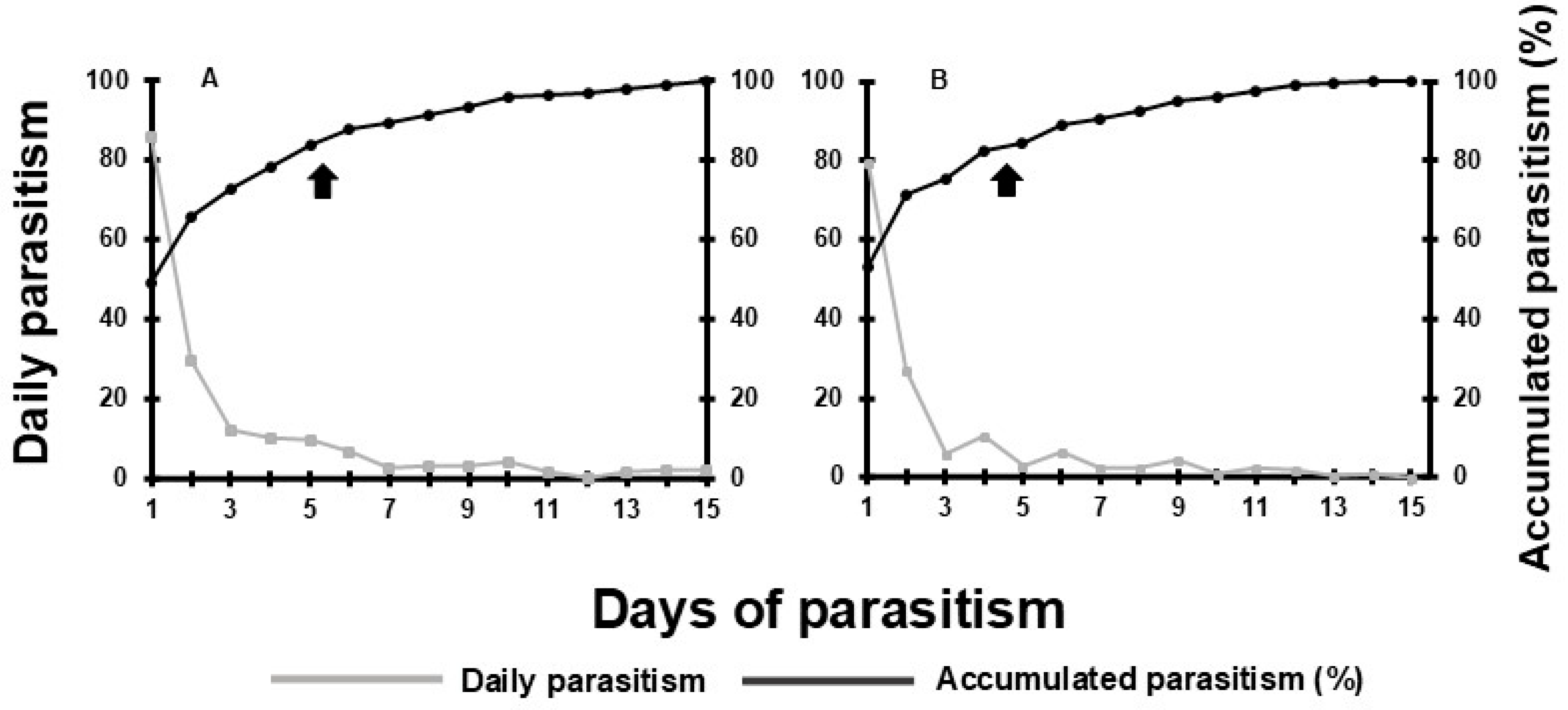
Figure 1. Parasitism capacity of T. remus fed with honey on string (A) and droplet of honey (B). Arrows indicate 80% of total parasitism (experiment 1).
Preprints 171807 g001
Figure 2. Parasitism capacity of T. remus fed with honey on string at different periods after emergence. (A) two days, (B) four days, (C) six days, (D) eight days. The arrows indicate 80% parasitism (experiment 2).
Preprints 171807 g002
Figure 3. Release of Telenomus remus at different densities (parasitoids/ha) in maize during the second cropping season of 2024, conducted at the Embrapa Soja experimental field (Londrina, Paraná, Brazil) (experiment 3). The x-axis shows the number of days after each parasitoid release, indicated as "DAR" (e.g., 1DAR = 1 day after release, etc.). Letters indicate significant differences among treatments within each date, based on generalized linear mixed models (GLMMs) with binomial distribution and logit link, followed by pairwise comparisons using Tukey’s test on estimated marginal means (p <0.05).
Preprints 171807 g003
Figure 4. Proportion of parasitized egg masses, sentinel and natural, following releases of Telenomus remus at different densities in maize during the second cropping season of 2024, conducted at the Embrapa Soja experimental field, Londrina, Paraná, Brazil (experiment 3).
Preprints 171807 g004
Table 1. Telenomus remus parasitism capacity on eggs of Spodoptera frugiperda with adult parasitoid feeding on different liquid diets (experiment 1).
Diet Lifetime number of parasitized eggs/female1 Emergence (%)2 Progeny sex ratio2 Parental longevity of adult females (days)3
100% honey in tiny droplets 165.4 ± 5.88 a 77.7 ± 1.84 a 0.69 ± 0.04 a 10.4 ± 0.71 a
100% honey in macerated cotton strings 143.4 ± 4.57 b 73.7 ± 1.01 b 0.70 ± 0.02 a 10.1 ± 0.40 a
Means ± Standard Error followed by the same letter within columns did not statistically differ from each other by 1(GLMM p > 0.05), 2(GLM p > 0.05) and 3(ANOVA p > 0.05).
Table 2. Telenomus remus parasitism capacity on eggs of Spodoptera frugiperda on different days after emergence, stored inside release capsules with a solid-honey diet (experiment 2).
Days of storage after parasitoid emergence Lifetime number of parasitized eggs/female1 Emergence (%)2 Progeny sex ratio2 Parental longevity of adult females (days)3
2 193.4 ± 8.82 a 79.9 ± 1.78 a 0.74 ± 0.02 a 11.5 ± 0.63 a
4 143. 6 ± 4.35 b 74.4 ± 1.75 b 0.80 ± 0.01 a 10.0 ± 0.35 a
6 150.4 ± 14.79 b 76.5 ± 1.79 b 0.56 ± 0.04 b 7.4 ± 0.69 b
8 86.6 ± 5.63 c 80.5 ± 1.88 a 0.71 ± 0.08 a 7.1 ± 0.54 b
Means ± Standard Error followed by the same letter within columns did not statistically differ from each other by 1 (GLMM p > 0.05), 2(GLM p > 0.05) and 3(Log rank test p > 0.05).
Table 3. Telenomus remus emergence (%) and dead adults (%) trapped inside capsules on different days after adult emergence from Spodoptera frugiperda eggs, with parasitoid adults feeding on a solid-honey diet (experiment 2).
Days after parasitoid emergence Emergence (%) of adults from pupae inside capsules Dead adults (%) trapped inside capsules
2 69.8 ± 2.76 a 2.1 ± 0.61 a
4 74.6 ± 2.56 a 5.2 ± 0.50 b
6 73.3 ± 3.58 a 5.9 ± 1.03 b
8 75.0 ± 0.97 a 5.5 ± 0.80 b
Means ± Standard Error followed by the same letter within columns did not statistically differ from each other (GLM p> 0.05).
Disclaimer/Publisher’s Note: The statements, opinions and data contained in all publications are solely those of the individual author(s) and contributor(s) and not of MDPI and/or the editor(s). MDPI and/or the editor(s) disclaim responsibility for any injury to people or property resulting from any ideas, methods, instructions or products referred to in the content.
Copyright: This open access article is published under a Creative Commons CC BY 4.0 license, which permit the free download, distribution, and reuse, provided that the author and preprint are cited in any reuse.
Prerpints.org logo

Preprints.org is a free preprint server supported by MDPI in Basel, Switzerland.

Subscribe

Disclaimer

Terms of Use

Privacy Policy

Privacy Settings

© 2025 MDPI (Basel, Switzerland) unless otherwise stated