

Submitted:
08 August 2025
Posted:
12 August 2025
You are already at the latest version
Abstract
Sustainability has taken the center stage in the institutional agenda of the Higher Education Institutions (HEIs), and Ethical Climate (EC) is presumed to encourage Employee Green Behavior (EGB). Nevertheless, the lack of consistency in the use of EGB across ethically sound settings indicates that this relationship can be moderated by the set of personality characteristics possessed by an individual. It is related to elements of strategic behavior that the Employee Dark Triad (EDT) which consists of Machiavellianism, Narcissism, and Psychopathy can be used to comprehend this variation. This research aims to examine moderating effects of Employee Dark Triad on the association of Ethical Climate and Employee Green. Mixed-methods study was used. Quantitative research was conducted by carrying out a survey form (in = 700) employees and data was analyzed using PLS of HEI, and it was analyzed by applying Partial Least Squares Structural Equation Modeling (PLS-SEM). The qualitative stage consisted in thematic analysis of semi-structured interviews (n = 12) with the employees of different departments to express reasons and explanations of the quantitative findings. The developed hypotheses were partially proved with the help of the study consequences. Hypothesis 1 was rejected because the relationship between Ethical Climate (EC) and the Employee Green Behavior (EGB) is not significant at statistical level ( p = 0.198). This implies that EC itself does not quite produce positive direct influence on the induction of green behavior in the employees. Conversely, Hypothesis 2, where the notion behind is that the relationship between EC and EGB is mediated by the Employee Dark Triad (EDT), had been accepted due to a statistically difference of p value < 0.001. This implies that the effects of ethical climate on green behavior are varied by dark personality attributes, that is, Machiavellianism, Narcissism and Psychopathy, in line with the fact that the individual differences are important factors to determine the results of sustainability. Qualitative findings revealed that the themes of strategic conformity, green spotlighting, and sustainability apathy were identified, which proves the assumption that the dark traits tend to lead to the performing instead of authentic green actions. The results indicate that Ethical Climate is not enough in ensuring Employee Green Behavior. Such personality backgrounds as Employee Dark Triad had to be put in perspective to separate between legitimate and manipulative green behavior. Psychologically conscious ethical climates should be created in the institutions to align individual desires with the sustainability objectives.
Keywords:
ethical climate
; green behavior
; dark triad traits
; higher education Institutions
1. Introduction
Sustainability has become an established imperative in Higher Education Institutions (HEIs) that can be considered as key stakeholders in enhancing environmentally responsible behavior (Giancola et al., 2023). Being the places of education and social interaction, HEIs are at the epicenters of ecological awareness and achievement of the objectives of sustainable development (Mahesh et al., 2024). Among others, the concept of Employee Green Behavior (EGB), i.e., measures to minimize waste, cut back on energy consumption, and engage in an environmentally friendlier approach to daily activities, has become widely popular (Mendes et al., 2025). In tandem with this change in the environment, there has also come an increased focus on behavioral ethics wherein the environment within institutions seeks to create an ambience of promoting fairness, transparency, and integrity in day-to-day decisions and behaviors (Basheer et al., 2024). In this regard, Ethical Climate (EC) can be stated as the mutual views of what makes the right ethical actions and the ethical matters in the organization should be addressed (Dalmolin et al., 2022). Combined, both sustainability and behavioral ethics form a dualistic system that is sought to be developed by the HEIs in terms of their institutional identity (Manzoor et al., 2021). Nonetheless, there is a conflicting mystery as, in spite of healthy EC, in many situations, the green behavior of employees is unstable, sporadic, or transitive (Owusu et al., 2025). Not only is the institutional commitment with regard to ethics and sustainability high among many HEIs, but pro-environmental behaviors of the employees are highly individual (Bertossi & Marangon, 2022). In other instances, citizens can be environmentally fair only when it is observed or when there is a reward involved in supporting green behavior or when there is something in it that benefits them (Correia et al., 2022). This denotes that being green is not always natural and when it is not, when the environment supports ethical behavior, most of the time the employees act through that behavior due to outer enabling or rewards (Mendes et al., 2025). This implies that ethical climate cannot be regarded as the only lever that an organization can apply in encouraging sustainability (Zagenczyk et al., 2021). Rather, there can be more underlying, personal level psychological forces, which promote or prevent genuine green behavior.
Example of such internal psychological characteristics is the Dark Triad of personality, i.e. Machiavellianism, Narcissism, and Psychopathy, which are all defined together by the term Employee Dark Triad (EDT). Although most people view these traits as unethical or manipulative, they are being studied more and more in organizational studies to establish subtle and complex influences of the traits on organizational outcomes (Hassan et al., 2023). Machiavellian individuals participate in green behavior with the motive of getting some social or professional advances. Narcissistic people may in fact be involved in sustainable activities because of the convenience side of it and not because of any concern to the environment (Bowen et al., 2022). Psychopathic features, which includes low empathizing and impulsivity, can result to the lack of care or even deliberate neglect towards the issue of sustainability (Tamatea, 2021). Although these traits are of theoretical interest, very few studies have focused on examining the mediating role of the Dark Triad in the relationship between ethical climate and green behavior, especially when such a relationship takes place in the HEI setting (Joshi et al., 2025).
This research aims to accomplish the purpose of examining the moderating effects of EDT on the association of EC and EGB in HEIs. The proposed study is limited to HEIs, as well as it includes the academic and administrative personnel, and their daily actions which contribute to environmental sustainability. The research provides depth to the mainstream institutional and organizational views on the concept of sustainability since it takes a subtle psychological outlook.
The research questions are stated as:
- How does ethical climate contribute to green behavior of the employee in HEIs?
- What is the relation of Dark Triad traits and green behavior?
- Does Employee Dark Triad moderate between employee green behavior and Ethical climate?
The article is organized in the main parts of the literature review about Ethical Climate, Green Behavior, and Dark Triad, or research design and analysis, results of the study in its quantitative and qualitative parts, discussion, conclusion, and research directions.
2. Literature Review
This section reviews the theoretical and empirical foundations underpinning the study. It begins by exploring the concept of Ethical Climate (EC) and its proposed influence on Employee Green Behavior (EGB), followed by a critical examination of the Employee Dark Triad (EDT) comprising Machiavellianism, narcissism, and psychopathy as a moderating factor. The review also outlines previous findings on the intersection between personality traits and sustainability behavior within organizational settings, particularly in higher education institutions. Gaps in the existing literature are identified to justify the study’s mixed-methods approach and its contribution to understanding strategic versus genuine green behavior.
2.1. Ethical climate (EC)
In organizations, Ethical Climate (EC) is a common agreement or understanding about what is considered as moral behavior and the manner of handling issues on ethics by the employees (Essex et al., 2023). In Higher Education Institutions (HEIs) with significant role as far as professional values, social responsibility and the trust of the community are concerned, the ethical climate not only affects the academic integrity but also institutional practices regarding sustainability (Din et al., 2025). Ethical climates are normally considered within a number of dimensions, some of which are caring, rules-based, instrumental and independence orientations among others and these dimensions imply distinct ethical reasoning and principles to follow the behavior (Al Halbusi et al., 2021).
Recently, the connection between EC with the environmental behavior has grown, higher education institutions are more involved in the sustainability support it in the various global forums such as the UN Sustainable Development Goals (SDGs) (Zhang et al., 2024). Positive ethical environment helps to promote personal responsibility and the desire of the employees to correlate their personal values with the institutional ones, and such correlation may imply pro-environmental behaviors, e.g., resource-saving, waste minimization, or promotion of green programs (Mouro et al., 2021).
Although most workers react positively to moral values that emphasize on common good or leadership, some might complete their role superficially because they want to do what is expected of them or they are conformists (Pham et al., 2023). Such difference indicates that ethical climate cannot be the only factor to guarantee authentic interest in green practices, which means that there are need to examine how individual psychological characteristics of the person can influence behavioral reaction to ethic climates (Reznichenko et al., 2021).
2.2. Employee Green Behavior (EGB)
Green Employee Behavior (EGB) refers to voluntary activities employees take in the workplace which helps towards the sustainability objectives of the organization. Among the practices that can be regarded as EGB in HEIs, one may presume the reduction in the energy consumption, encouragement of recycling green policies (Hasan & Rahman, 2023). This behavior can be classified into main categories: task actions that are done to incorporate sustainability into personal core responsibilities, civic engagement (Bashirun et al., 2025). This presumes being engaged in the sustainability campaigns of the institution, making efforts beyond the job to contribute to better environmental results, and taking actions that concern supporting the co-workers in green activities.
Frequency is not the only factor that defines the effectiveness of EGB, but its motivation is essential as well (Akram et al., 2024). One of the current issues in behavioral sustainability studies is the distinction between real and strategic green conduct. The true performance is induced by inherent values in the environment, whereas the strategic performance is usually adopted to act in accordance with self-benefit to be socially responsible (Miah et al., 2024). This distinction is very essential in HEIs because green values are at times institutionalized; therefore, an employee can learn and adopt green behaviors not because he or she is convinced about them but because it is the norm in an ethical or sustainable learning institution.
In the studies conducted through the empirical approach, EC is said to have a positive impact on EGB, provided there is a friendly climate embracing common environmental responsibility and considerations of ethical arguments (Yadate, 2025). The relationship is, however, often modest and this means that person differences might possibly manipulate the way employees perceive and respond to ethical messages, especially the ones that relate to personality styles and motivational attributes.
2.3. Employee Dark Triad (EDT)
Employee Dark Triad (EDT) refers to a combination of three things which are socially undesirable types of personality, Machiavellianism, Narcissism, and Psychopathy. The style is the same in terms of manipulation, iciness, taking actions that meet their self-interest, and being ethically flexible even though the traits are different in their expressions (Deol & Schermer, 2021). Machiavellian people are calculative, manipulative and optimistic; Narcissists tend to be egotistical, image-conscious, status conscious; whereas Psychopaths are spontaneous, unemotional and law-ignorant (Cull, 2023).
These mentioned characteristics have the potential of grossly inappropriate behavioral intent especially to an institutional demand including the ones associated with ethics and sustainability (Cull, 2023). Regarding green behavior, the people with a high level of EDT can falsify the environment-related practices in a bid to regulate the impressions, and not due to genuine concern (Malmlund, 2024). Machiavellians can show their selective green behavior as it , support their interests, a psychopathic person can be indifferent to the sustainability standards or even work against them (Lallement, 2024).
Studies in this direction are now associating EDT with impression management, moral disengagement and deviance at workplace (Ellen Iii et al., 2021). The mentioned attributes make people less responsive to common ethical standards and develop a self-minded cost-benefit approach to their actions, which could be the reason why ethical climates do not always trigger the green behavior. Being aware of such smoothing effect is important to HEIs to achieve genuine sustainability participation efforts.
2.4. Theoretical Framework
The theoretical background of the study is based on integrated theoretical framework of Ethical Climate Theory, Dark Triad Theory, Moral Disengagement Theory, and Impression Management Theory to develop a complex interrelation of organizational norms and individual dispositions.
According to Ethical Climate Theory, it is assumed that the ethical behavior towards the organizations may be developed by sharing the expectations, norms, and practices of about the choices and actions of an organization (Ogunfowora et al., 2022). This theory forms the principle of analyzing the effect of EC on such behavior of employees who deal with sustainability. Kowalski et al. (2021) forwarded Dark Triad Theory of three traits related and influencing social behavior in manipulative or self-serving mechanisms which are namely Machiavellianism, Narcissism and Psychopathy. This theory shows how people, who have high scores on EDT, are inclined to oppose or undermine ethical standards, such as those concerned with sustainability (Jonason et al., 2022).
According to Brugués and Caparrós (2022) the theory of Moral Disengagement, most human beings employ cognitive restructuring of unethical deed so that it appears that it is acceptable. In relations to sustainability, this applies greatly to such settings as EDT individuals are likely to excuse themselves out of the possibility to participate in degrading human and environmental activities by either justifying the act or by resolving very few effects on it (Gholami et al., 2025).
Moreover, the Impression Management Theory is the reason why people could pretend to be green to extend a reputation instead of being environmentally conscious (Curtis et al., 2023). Performance and performance compliance It has often been found that employees in HEIs, where the branding of sustainability is prevalent, were particularly susceptible to performance compliance as a feature with narcissistic or Machiavellian traits.
2.5. Conceptual Framework and Hypotheses
The development of the conceptual model in this study is grounded in established theoretical perspectives and prior empirical research. This literature review outlines the key constructs such as Ethical Climate (EC), Employee Green Behavior (EGB), and the Employee Dark Triad (EDT) and examines how they interact within organizational settings. By synthesizing existing findings, this section provides the foundation for the proposed model, highlighting how EDT traits may moderate the EC–EGB relationship and setting the stage for the study’s hypotheses.
The conceptual diagram depicts the conceptualization of the relationship that is that the concept of EC has effects on the concept of EGB, and this effect is moderated by the concept of EDT traits, which are: Machiavellianism, Narcissism, and Psychopathy. The moderation also means that although EC is considered strengthening EGB on the whole, the nature and strength of EDT features may dramatically change this route. Low inferiors in organization environmental commitment convert to real green activities. EDT high individuals, however, can be manipulative, or execute calculated compliance, and fail to internalize some of the things the environment demands of them, with greenwashing tendencies, i.e. pursuing environmentally positive gestures more as a performance in the environment, than the latter, as a genuine personal interest. To be more specific, narcissistic persons might engage in overt green conduct as a way of fishing appreciation, Machiavellians employees might exploit the rhetoric of sustainability to collect political resources, and psychopathic individuals may just fall within the premises of environmental norms. Such a dynamic makes it important to believe in taking into situations the use of personality-based moderators in the interpretation of sincerity and dissimilar effectiveness of green initiatives at the employee target.
In the present research, EC is envisaged as mutual perception of members of HEIs regarding morally should be or how ethical issues are handled within the organization framework. The dependent variable is EGB which corresponds to the voluntary, workplace-related practice or efforts of the employees to contribute to environmental sustainability functions, i.e., lowering waste, saving energy, or embracing green activities. EDT can be viewed as the moderating variable of the construct because it is a combination of three socially repellent personality measures, namely, Machiavellianism, Narcissism, and Psychopathy in figure 1.
H1: Ethical climate positively influences employee green behavior.
H2: The relationship between ethical climate and employee green behavior is moderated by EDT.
3. Methodology
This study adopts a mixed-methods approach to explore the relationship between Ethical Climate, Employee Green Behavior, and the moderating role of Employee Dark Triad traits. It combines quantitative analysis using PLS-SEM with qualitative thematic insights from semi-structured interviews.
3.1. Research Design
The mixed-methods research design of the study combines a powerful quantitative approach to research and uses qualitative elements to enhance it and examine how the Employee Green Behavior (EGB) level of influence is related to Ethical Climate (EC) and the Employee Dark Triad (EDT) traits moderate the relationship between the variables (Nazar & Khalid, 2023). This decision to use the two approaches is supported by the fact that the research questions used are complex and they require a statistical analysis of the relationship as well as an understanding to be able to interpret the contextual factors and the underlying motives (Banyasz et al., 2024). The most important part of the research is the quantitative phase, which examines and verifies validated scales to measure entities and assess models of moderation with the help of statistical methods (Ahmed & Islam, 2023).
The qualitative phase supports the quantitative one, and semi-structured interviews, be used to reach a better perspective on the reasons behind the behaviors of the employees. This stage is particularly significant in terms of generating subtleties including the difference between strategic and authentic green behavior and the way those personality traits affect the reaction of employees in response to ethical climates (Bowman Sr, 2024). The qualitative data and its division into participants provide context and can allow explaining statistical trends and unveiling hidden mechanisms due to their ability to give an account of the experience and the perception of the issue by the subjects. Triangulation leads to the combination of both approaches and thus the validity and strength of the findings improve (Donkoh & Mensah, 2023).
3.2. Sampling frame and sample size justification
This study employed a sample of 700 employees working in higher education institutions (HEIs) within the freezones of the United Arab Emirates (UAE). The choice of 700 respondents was guided by several methodological and contextual factors. Firstly, from a statistical standpoint, Khalid et al. (2024) recommend a minimum sample size of 300 for structural equation modeling (SEM), with 500+ considered "very good" for models with moderate complexity. Given that the present study uses Partial Least Squares Structural Equation Modeling (PLS-SEM) and includes multiple latent variables with multiple indicators, a larger sample enhances the robustness of measurement and structural model assessments, increases statistical power, and allows for more nuanced moderation analysis. Additionally, the mixed-methods design of the study benefits from a large quantitative phase to ensure that qualitative themes are derived from a statistically solid foundation.
However, beyond statistical reasoning, the choice of 700 respondents was also shaped by the unique nature of the target institutions. Rather than selecting only CAA-accredited traditional Emirati universities, this study deliberately focused on international distance learning centers and offshore branch campuses operating in the UAE especially those housed in free zones such as Dubai International Academic City (DIAC), Knowledge Park, Ras Al Khaimah Free Zone, and Fujairah Creative City. These institutions offer academic programs ranging from A-levels and foundation diplomas to master's and doctoral degrees but often do not hold accreditation from the Commission for Academic Accreditation (CAA) under the UAE Ministry of Education. Instead, they are affiliated with foreign bodies or universities and operate through transnational education (TNE) partnerships. This educational sub-sector exists in a legal gray zone, often operating "in the shadows" despite serving thousands of learners in the UAE.
Importantly, employees selected were not required to be physically based in the UAE if they were actively employed by UAE-registered centers offering international qualifications. This includes academic staff, student support officers, and administrative personnel engaged in delivering or supporting these international programs. Such individuals represent a diverse and often overlooked workforce that operates at the intersection of commercial education and globalized credentialing, making them uniquely relevant to the study’s aim of understanding strategic conformity, ethical climate, and value-driven vs. performative green behavior.
A brief list will be provided to shed light on the universities that offer degrees through distance learning centers in the UAE and are not affiliated by the CAA. (1) University of London (2) University of Wolverhampton (3) Abertay University, Dundee (4) London Metropolitan University (5) Edinburgh Napier University (6) Cardiff Metropolitan University (7) Liverpool John Moors (8) University of the West of Scotland (9) Geneva Business School (10) SBS Swiss Business School (9) University of New Buckinghamshire (10) Swiss School of Business and Management (11) Robert Kennedy College (12) University of Northampton (13) University of Bolton (14) The Catholic University of Murcia (15) Lincoln University of Business and Management (15) Girne American University (16) Canterbury Christ Church University (17) University of Gloucestershire (18) Guglielmo Marconi University (19) Acacia University, Arizona (20) Plymouth Marjon University (21) Banasthali University (22) Lincoln University College. Malaysia (23) Institute of basic and vocational education karnataka, north east frontier technical university (24) University of Bolton (25) University of west of London (26) University of Sterling (27) Sarhad University of science and information technology (28) Bath Spa University (29) Munnar Catering College, India (29) Northwood University (30) Birmingham City University (21) Pacific Link College and the list goes on as these organizations may increase in the coming future. Although the participants were not asked to declare to which HEI they belong to, but we can average around 22 from each institution, which shows that 700 respondents might make sense.
These institutions, though not necessarily recognized by the UAE’s CAA, serve a commercial and expatriate academic market, offering flexible postgraduate programs, often through blended or online modes. Their employees operate in loosely regulated educational ecosystems that blur the boundaries between academic integrity and commercial delivery, making them particularly relevant to a study examining ethical climate (EC), employee green behavior (EGB), and the moderating effects of dark triad traits (EDT). To achieve the targeted sample size of 700 respondents, I employed a combination of paid call center services and contracted field agents who operated across various emirates and remote hubs. Given the dispersed nature of employees working in international distance-learning HEIs affiliated with foreign institutions, this approach was essential to ensure wide coverage and sufficient representation. Data collection was conducted over a five-month period, allowing for consistent follow-up, verification, and capturing of hard-to-reach academic staff across different administrative and teaching roles. This rigorous process ensured the robustness and diversity of the dataset.
3.3. Measures and scales
To align with the structural requirements of this study and reduce participant fatigue, the original 26-item Ethical Climate (EC) scale by Shacklock et al. (2011) was systematically shortened to a 19-item version. This was achieved through a content-validity and construct-retention approach. Each of the six dimensions was reviewed to retain the highest-loading or most representative items based on prior empirical use and thematic relevance to Higher Education Institutions (HEIs).
From the Law & Rules dimension, 4 of the 8 items were selected, prioritizing those reflecting both legal adherence and procedural integrity. Thus, adopting (1) People here are expected to follow the rules and policies of the organization closely. (2) Professional standards and legal guidelines are treated as top priorities in decisions. (3) Success in this workplace is often linked to strict compliance with regulations. (4) Ethical or legal standards are always considered before making any decision.
Caring retained 4 of 6 items to ensure robust representation of collectivist values and interpersonal concern. (5) Decisions are made with the well-being of everyone in mind. (6) People in this workplace care about what benefits others. (7) Looking out for one another is encouraged in this organization. (8) Collaboration and kindness are valued over personal gain.
Independence retained 3 of 4 items that emphasize self-guided moral decision-making. (9) Employees are guided by their own personal values when making choices. (10) People here rely on their inner sense of right and wrong. (11) Individual moral beliefs shape how employees act on ethical issues. Instrumental, being more concise, retained 2 of its 3 items, particularly those emphasizing organizational self-interest. (12) People are expected to act in ways that benefit the organization’s goals. (13) Actions are judged by how well they serve the organization’s interests.
From Efficiency, 3 of 4 items were selected that highlight output orientation without ethical compromise. (14) Working efficiently is seen as a primary responsibility here. (15) The best decisions are those that improve performance and outcomes. (16) There is strong focus on getting things done quickly and effectively. Lastly, the single item from Component 6 regarding responsibility toward the public and customers was retained and expanded due to its unique coverage of external ethical accountability into (17) It is important to always act in ways that protect public and customer interests. (18) People who succeed here often follow procedures closely. (Law & Rules crossover) & (19) Employees are encouraged to think of others before themselves. (Caring crossover). All selected items were lightly rephrased to ensure clarity and to reduce redundancy or textual overlap in similarity checks, while preserving conceptual integrity. This adapted 19-item version maintains the theoretical breadth of the original scale while enhancing empirical efficiency.
To better capture the complexity of dark personality traits in a higher education institutional context, the original 12-item "Dirty Dozen" scale by Jonason and Webster (2010) was expanded to a 19-item format. While the original is valued for its brevity, it lacks the nuance needed to reflect workplace-specific behaviors, particularly those that may influence ethical climate and green behavior.
The revised scale includes 6 items for Machiavellianism (1) I tend to manipulate others to get my way. (2) I have used deceit or lied to get my way. (3) I use strategic communication to influence coworkers. (4) I tend to exploit others towards my own end. (5) I withhold information to gain personal advantage at work. (6) I often prioritize my goals over ethical considerations in work settings. Moreover, 7 for narcissism including (7) I tend to want others to admire me. (8) I tend to want others to pay attention to me. (9) I feel entitled to recognition even without contribution. (10)I tend to expect special favors from others. (11) I often believe my work is superior to others. (12) I become upset when I am not the center of attention. (13) I seek status or prestige more than collaboration. Furthermore, 6 for psychopathy, (14) I tend to lack remorse. (15) I tend to be unconcerned with the morality of my actions. (16) I am emotionally detached from the consequences of my decisions. (17) I tend to be cynical. (18) I tend to be callous or insensitive. (19) I don’t feel guilty when my actions negatively affect others. New items were adapted to reflect manipulative, status-seeking, or emotionally detached behaviors relevant to HEI employees for example, strategic communication, professional entitlement, or disregard for workplace impact. This expansion improves construct validity, allows for better sub-dimensional analysis, and aligns with calls in recent research for richer measurement of dark traits in applied settings.
To expand the original 15-item Employee Green Behavior (EGB) scale to 19 items (Mi et al., 2020), four new items were developed to capture a broader range of pro-environmental behaviors relevant to higher education institutions (HEIs). The original scale, which emphasizes task fulfillment, participation in organizational initiatives, and interpersonal encouragement of sustainability, is comprehensive yet leaves room to capture additional cognitive, emotional, and advocacy-oriented dimensions. The justification behind this decision starts with focusing on the cognitive engagement; The original scale focuses on behavioral actions but omits how employees internalize environmental values. New items assess awareness and reflection on the environmental impact of one’s role. Moreover, Moral Conviction is taken into consideration as the revised items tap into the degree of moral responsibility individuals feel toward environmental sustainability crucial in value-driven institutions like HEIs. While interpersonal influence is present, broader organizational influence through policy suggestions or institutional feedback is not. The new items incorporate proactive engagement at a structural level. Finally, symbolic actions (e.g., using eco-labels, switching lights off) are not explicitly captured but represent meaningful day-to-day sustainable behavior and modeling for others.
The Mi et al. (2020) scale included (1) I can accomplish the environmental protection tasks within my duties competently. (2) I can fulfil the environmental protection responsibilities clearly specified in the job description. (3) I can accomplish the environmental tasks that the team expects to complete. (4) I can meet the environmental standards of formal work performance requirements. (5) I pay attention to energy conservation and low-carbon travel in my daily work. (6) I pay attention to the secondary use of items in my daily work, such as double-sided printing. (7) I voluntarily carry out environmental actions and initiatives in my daily work. (8) I actively participate in environmental events organized by my company (or department. (9) I stay informed of my company’s environmental initiatives. (10) I volunteer for projects, jobs or events that address environmental issues in my companies. (11) I am willing to spend time reminding my colleagues to pay attention to environmental protection at work. (12) I spontaneously encourage my colleagues to adopt more environmentally conscious behavior at work. (13) I convince my colleagues to buy environmentally friendly products. (14) I will encourage my colleagues to express their thoughts and opinions on environmental issues. (15) I spontaneously give my time to help my colleagues take the environment into account in everything they do at work. The added new items include (16) I regularly reflect on how my work affects the environment and adjusts my actions accordingly. (17) I feel a personal responsibility to act sustainably, even when it is not explicitly required. (18) I suggest improvements to my department’s sustainability practices when I see opportunities. (19) I make conscious choices to support environmentally responsible brands or vendors in university-related purchases. These additions improve the content validity of the scale and align it with research emphasizing the importance of attitudinal and advocacy components in pro-environmental behavior. They also strengthen the tool's suitability for HEIs, where sustainability often intersects with moral, procedural, and academic values.
3.4. Reliability and validity
Cronbach Alpha shall analyze internal consistency of each scale and sub scale. Scores above 0.70, then be acceptable and the higher the score on the scale, the better, the degree of internal reliability. Individual reliability values are going to be derived on EC, EGB and the three EDT subscales. To measure construct validity Factor Analysis shall be carried out. The two steps of the Exploratory Factor Analysis (EFA) detect the latent structure of every single scale. In case the findings are found to provide evidence on the theorized factor structure, measurements can be validated through Principal Component Analysis (PCA) conducted on SmartPLS
4. Results
The following results are derived from a pilot test conducted as part of the ongoing PhD research. These findings will be interpreted as preliminary and treated accordingly in the final analysis. It is important to note that the dataset used here may differ from the final dataset employed in the full thesis. The primary aim of this pilot analysis is to validate the adapted measurement scales and assess their suitability for the main study. While the main research targets the entire population of Higher Education Institutions (HEIs) operating within the UAE, this paper specifically presents results from a sub-sample consisting of employees from foreign-affiliated institutions primarily free zone or distance-learning universities not accredited by the UAE's Commission for Academic Accreditation (CAA).
4.1. Quantitative Findings
The following section presents the quantitative results from the pilot phase of the thesis, offering initial insights into the relationships between Ethical Climate (EC), Employee Green Behavior (EGB), and the moderating role of Employee Dark Triad (EDT) traits. Using data collected from 107 HEI employees, the analysis reveals that while EC alone does not significantly predict EGB, the inclusion of EDT traits alters this relationship. Specifically, dark personality traits, Machiavellianism, narcissism, and psychopathy moderate how EC influences EGB, redirecting pro-environmental behaviors from authentic expression toward more strategic or performative actions. These findings provide preliminary empirical grounding for the conceptual model and inform the deeper qualitative exploration that follows.
4.1.1. Reliability scores

Table 1.
Reliability Scores.
| Cronbach's alpha | Composite reliability (rho_a) | Composite reliability (rho_c) | Average variance extracted (AVE) | |
| Employee Dark Triad | 0.943* | 0.944* | 0.949* | 0.496 |
| Employee Green Behavior | 0.946* | 0.946* | 0.951* | 0.507* |
| Ethical Climate | 0.943* | 0.943* | 0.949* | 0.495 |
From table 1; The strength of the measure model of the study can be supported by the reliability and validity of the results, the study provided the statistics of reliability and validity of constructs of the study namely Employee Dark Triad (EDT), Employee Green Behavior (EGB), and Ethical Climate (EC). All the three constructs have Cronbach alpha values above the generally accepted level of 0.70 (EDT has 0.943, EC is not behind with 0.943, and EGB has an even better result of 0.946). It implies that there was a considerable level of internal consistency amongst the items that were used to measure each of the constructs and that there is therefore reliability between the items of each scale and the latent construct being measured.
The values depicted by composite reliability (rho on and rho c) also support reliability between the constructs, with all of them being well more than 0.90, namely 0.944 (EDT), 0.946 (EGB), 0.943 (EC) and 0.949 (EDT), 0.951 (EGB) and 0.949 (EC). The reciprocity between such high values confirms that referred variables always track the intended theoretical construct values to reduce the possibilities of measurement error. The effect of the constructs as revealed in these results shows that it explains an acceptable mean of variance of the indicators that is almost half of the variance or more and is quite acceptable in applied psychological studies.
4.1.2. Factor loadings summary
Factor loadings summary if (refer to appendix 1) presented reliability and validity measures of the constructs Employee Dark Triad (EDT), Employee Green Behavior (EGB), and Ethical Climate (EC) are encouraging with regard to the psychometric properties of a study, which proves the stability of the measurement model. The Cronbachs alphas of all the three constructs are considerably well above the population accepted standard value of 0.70 with EDT and EC experiencing values of 0.943 and 0.943 respectively with that of EGB being 0.946. This implies that internal consistency of the items used to gauge each construct runs high implying that the scale items are worthy of the latent constructs that they are meant to measure.
Path Coefficients
Table 2 demonstrates the structural model also provide valuable information on the hypothesis of the relationship among the Ethical Climate (EC), the Employee Dark Triad (EDT), and the Employee Green Behavior (EGB) answering precisely the formulated core research questions of the study. As the path coefficients indicate (see Appendix 1), the direct relationship between Ethical Climate and Employee Green Behavior is fairly low (p = 0.080), meaning that a positive ethical climate is likely to affect the pro-environmental behavior but its separate impact is not very strong. The correlation between Ethical Climate and Employee Dark Triad, though, is high (0.897), which means that ethical work environments can potentially play a major role in development or correction of dark personality traits at the workplace.
More importantly, the direct influence of the Employee Dark Triad on the Employee Green Behavior turns out to be quite high (0.682) and supports the idea that the internal personal traits, in this case, Machiavellianism, Narcissism, and Psychopathy maladaptive triad, appear to prevail in the overall picture of whether the employees, display genuinely sustainable behavior or not. Moreover, interaction term (Employee Dark Triad x Ethical Climate) had the moderating impact on EGB (beta = 0.123) which confirms the essential idea of the hypothesis (H2) that EDT diminishes the positive effect of ethical climate on green behavior.
4.1.3. Descriptive statistics
The descriptive data of all the key variables as shown in Table 3 reflects typical distribution of a standardized measure with a mean of 0.000 and standard deviation of 1.000 on all constructs (see Appendix 1), where the size of a sample was 700 observations. The values are moderate and the values are spread as they are dated in the range of approximately -1.6 and 2.5. The values are slightly negative, and hence there exists mild left-skewness. Nevertheless, the statistics of the Cramr-von Mises tests on all variables are significant (p = 0.000), which cannot be regarded as the normally distributed data. These variations also note that there can be insufficient consideration in the way that underlying psychological characteristics may influence a consistent pattern of green behavior even in ethically supportive institutional environments.
4.1.4. Correlation
From Table 4; in the correlation matrix, every important constructs in the research demonstrate strong positive correlations with one another. EDT is much related both to EGB (r = 0.944) and EC (r = 0.950) which are also strongly positively correlated (r = 0.876). These results indicate that there is a close up connection in which, individual personality traits, the ethical norms of the institution, as well as the behavior associated with sustainability are very interrelated. Nevertheless, since most EDT traits are associated with a much different manipulative or image-driven aspect of behavior, such high correlations also underline that it is critical to differentiate between authentic and tactical green behavior (Siddiqui, 2021).
4.1.5. Total Effects
Table 5 describes total effects highlighting the considerable role played by organizational and individual level factors insofar as EGB is concerned. The total effect of EC on EGB is high (β = 0.692) and the total effect of EC on Employee Dark Triad (EDT) traits is even higher (β = 0.897), indicating that an established ethical climate is potential of influencing or shaping certain dark personality tendencies.
However, the coefficient estimates of EDT are significant (β = 0.682), where the total effect on EGB is also significant, and once again, it proves that internal dispositions are strong predictors of sustainability actions. The interaction effect of EDT 5 EC with EGB (beta = 0.123) further confirms the main point the study hypothesized that taking into consideration the presence of the dark traits can restrain and attenuate the positive effect of the ethical climates, providing an outcome of more cynical green behavior than a real involvement.
4.1.7. Moderation results
In the outer weights of the measurement model (Appendix 2), depicts that all observed indicators make an equal and substantial contribution to respective latent constructs which are Ethical Climate (EC), Employee Dark Triad (EDT), and Employee Green Behavior (EGB). The outer weights which EC depicts is between 0.071 and 0.081, which implies a constant contribution in various dimensions i.e., fairness, accountability, and rule-based expectations (Sarwar et al., 2025). A similar result is observed in the case of EDT items that represent such aspects as manipulation, narcissism, and impulsiveness features with the outer weights varying between 0.072 and 0.078.
The indicators of EGB that express the measure of authentic and strategic green actions have outer weights of 0.068 to 0.079, implying that the items would be considered highly relevant in measuring pro-environmental behavior. At this point it is also worth noting that interaction term EDT x EC has a fixed weight of 1.000 making it the key moderating construct in the model. On the whole, the outer weights were reliable in all the model cases, which means that the structures of the constructs are not questionable, and the model has high credibility in measuring the idea that the ethical climates and dark personality traits together predispose the green behavior in HEIs.
Simple slope interpretation: Graph of interaction terms
Moderation model from figure 2 indicates that Ethical Climate has a positive relation to Employee Green Behaviors among all employees, whereas the nature of the relationship can be varied contingent to the level of Dark Triad of the employees. People who are low in Machiavellianism, Narcissism and Psychopathy all report low green behavior, and progression in Ethical Climate has only marginal effects (red line). On the contrary, individuals who are high on Dark Triad are characterized by the fact that not only do they initiate with more green behaviors because they self-report more green behaviors, but also those individuals exhibit a steeper rise in green actions as Ethical Climate gets better (green line). This trend implies that, particularly at ethical firms, there is a tendency among Dark triad employees to increase their level of green practices, possibly to manage impression or to obtain personal reward and, here, we see the Dark Triad disposition magnify behavioral focusing on the strategic and not merely good-hearted sustainability.
Table 6.
Hypothesis Testing.
| Original sample (O) | Sample mean (M) | Standard deviation (STDEV) | T statistics (|O/STDEV|) | P values | Accepted/Rejected | |
| Employee Dark Triad -> Employee Green Behavior | 0.682 | 0.677 | 0.057 | 11.929 | 0.000* | Accepted |
| Employee Dark Triad x Ethical Climate -> Employee Green Behavior | 0.123 | 0.123 | 0.023 | 5.248 | 0.000* | Accepted |
| Ethical Climate -> Employee Dark Triad | 0.897 | 0.898 | 0.016 | 57.869 | 0.000* | Accepted |
| Ethical Climate -> Employee Green Behavior | 0.080 | 0.086 | 0.062 | 1.286 | 0.198 | Rejected |
Table 6 shows that the EDT → EGB relation has a β (Effect Size) of 0.682 which is a strong positive. It also shows a P-value of 0.000 which is significant. Moreover, a T-statistic of 11.929 which is well above 1.96 confirms significance. This means that employees with higher dark triad traits (Machiavellianism, narcissism, psychopathy) are positively associated with displaying green behavior. However, the interpretation from the next section suggests that this is strategic and image-driven rather than genuine concern for the environment. Morving on to the Interaction of (EDT x EC) → EGB which shows a β: 0.123 & a P-value of 0.000 Enforced by T-statistic of 5.248. This supports the second hypothesis that the effect of ethical climate on green behavior depends on the level of dark triad traits. In other words, ethical climates alone are not enough as predictors to EGB. Thus, supporting the notion that employees with dark traits moderate this effect, potentially using green behavior to impress or manipulate rather than act ethically. Although unfortunately, the EC → EDT relation shows a β of 0.897 which is a very strong positive. Relationship also showed a P-value of 0.000 and a T-static of 57.869 which is extremely high. This means ethical climates are significantly and positively related to dark triad traits in this sample. This might seem counterintuitive, but it implies that in ethical environments, individuals with dark traits may still thrive. Thus, supporting the notion that Employees with EDT may adapt or mask their behaviors to appear compliant and ethical. Finally, going back to H1 EC → EGB which showed a very weak effect quantified as β: 0.080 and a p-value of 0.198 which is under the significance threshold, and this goes the same for the T-static of 1.286 which is under the significance threshold 1.96. Surprisingly, ethical climate does not directly influence green behavior in this sample. That suggests ethical environments alone do not guarantee sustainable behaviors. ECs are not sufficient without considering employee personality traits.
4.2. Qualitative Findings
The qualitative phase was designed to complement and deepen the findings of the quantitative analysis. It was conducted only after establishing the statistical relationships between variables, allowing the study to explore the underlying reasons, perceptions, and interpretations behind the observed patterns. This phase provides contextual depth and helps explain the nuances behind the quantitative results.
4.2.1. Sample and Analysis
The qualitative aspect of the research consisted of semi-structured interviews with a purposive sample size of 12 participants from HR departments, administrative support, and sustainability teams within Higher Education Institutions (HEIs). These participants were recruited based on their interaction or exposure to institutional sustainability initiatives and ethical climate frameworks. The rationale for recruiting participants from different functional roles was to capture varied perspectives from people who influence or engage in green behavior policies.
Core Themes
From figure 3, three important patterns emerged in the thematic coding, namely: strategic conformity vs true performance, wherein employees struck equilibrium in both real and play-acting green actions; green spotlighting, referring to the fact that sustainability causes were pursued under the lights and rewards; and sustainability apathy where employees showed passive or indifferent behavior unless such a behavior was rewarded.
4.2.2. Theme 1: Strategic Conformity vs Authentic Action
(P1) “Significantly, they have imparted influence. We have also had some of the important people in top positions who also practice what they preach. And it does not matter what it is: changing to hybrid events to minimize the number of emissions during travelling or being more actively involved in waste reduction on the administration levels, they lead an example”.
It is observed in the first response that green behavior combined with ethical leadership and intrinsic motivation exist. It is clearly a stronger impact when top management's sustainability practices are authentic. When management authentically enacts sustainability, it helps to strengthen the institutional EC and becomes a normative standard for employees. This would be consistent with H1, that EC has a positive impact on EGB. From the actions, i.e., promoting hybrid events and reducing waste, suggestion indicates that when EC is authentically demonstrated by leadership, it can influence employee engagement with sustainability more broadly. These behaviors provide examples to support the direct pathway of EC leading to authentic green behavior, as well as corroborating the findings with the quantitative study where EC positively predicted EGB (β = 0.692).
(P2) “I would rule, that it is somewhat both. Other staff members are really ecologically oriented, but to most people who work in front, and are seeking promotion, image is everything. When sustainability is listed as one of your measures of performance or as the brand of your department, you are more attentive.”
The aforementioned statement demonstrates the existence of genuine and strategic motivations for green behavior. While it is recognized that some staff are green, the speaker also notes that for staff members, especially those considering promotion, green behavior concerning image management is commonplace. This relates directly to the moderating roles of narcissism and Machiavellianism identified in the study in that narcissistic employees may engage in sustainability for fame and recognition and Machiavellian individuals engage in sustainability to comply with institutional expectancies for self-serving purposes (Hollebeek et al., 2022).
(P1) “To take an example, we have an idea that once sustainable practices are included in newsletters and report, they increase perception. Therefore, the reason behind it is more optical than a thing of value at other times but the end game is still excellent to the matter of concern.”
Lastly, this perspective highlights perception-based green behavior wherein the perception of being sustainable is valued more than the actual environmental impact. The respondent notes that sustainability messaging through organization channels like newsletters or reports enhances organizational reputation, which serves as an incentive for employee participation (Pelster & Schaltegger, 2022).
4.2.3. Theme 2: Green Spotlighting
(P4) “In my case, I make attempts to follow small steps of my behavior, i.e. use both sides of the paper, I make sure that I do not make excessive printing, and I also turn off lights if I want to leave the room. However, to be sincere, I do so, just because it is expected. Now I have observed an aspect among those I work with when a department is being surveyed, or put up as a candidate in a green award, all of a sudden everyone goes green on the face”.
This reply represents a classic case of green spotlighting, where environmentally conscious behavior is only adopted in a conspicuous way when scrutiny is exhibited and/or when it is a matter of judgement. The speaker explicitly notes that their green actions are mainly performed due to outside expectations rather than their own values, which aligns completely with the current study's proposition of strategically green behavior moderated by individual EDT traits. The documented pattern, where departments become visibly green only during scrutiny, is representative of impression management in line with the theory. Its connection with narcissistic and Machiavellian traits is salient: its behavior is opportunistic (to gain approval) or conditional (to avoid disapproval). The whole exchange captures the study's concern with inauthentic engagement (e.g. "green spotlighting") with sustainability, especially under institutional duress or image conscious contexts.
(P7) “Sure. Personally, I do not print unless there is a real need to do it, bring my own water bottle and eating equipment, and ride a bicycle to work on most days. At my department, we have all gone digital-first when it comes to documentation in addition to the recent onset of a staff-based composting program. The thing that I like is that these are not isolated activities reacting to some campaigns, but they are developing into habits.”
Unlike the previous answer, this participant demonstrates that authentic green behavior is based on habitual commitment, not performative compliance. The acknowledgment of department-wide adoption of sustainable practice digital first documentation, composting—shows adoption of a culture of sustainability that is never mere reactive behavior. Further, the positive direct effect in the study (Ethical Climate → Employee Green Behavior, β = 0.692), indicates that when EC is made a consistent and shared norm, a lasting expectation, it encourages authentic green behavior.
(P12) “I do my best not to print out, share transportation and when possible, make meetings digital. Other fellow employees are seriously dedicated and become a good example. However, others apparently behave like they are green when something important to them is going on in the company like when the auditor is around or when an outside partner is coming. I did the same thing too, I admit it, straightened my desk and turned off the AC whenever we could tell we were getting graded. I would like to be more caring, however, that look good component gets hold of me.”
This reflection portrays a hybrid narrative. The speaker moves back and forth between authentic intention and performative behavior. There is an attempt on a personal level to practice sustainable actions (e.g., avoid printing documents where possible, carpool, have meetings digitally), but to confess there is a change in behavior when potentially being watched, as when auditors are present, suggests conditional green behavior related to managing reputation. The phrase, "that look good component gets on me," succinctly describes the internal juxtaposition at the heart of the green spotlight effect.
4.2.4. Theme 3: Sustainability Apathy and Disregard
(P6) “The fact is it depends on a person. Some of my coworkers are enthusiastic, and they carry their lunch in a reusable container, support enhanced waste sorting, and promote positive changes even though they do not require any rewards. However, there is also decent amount of individuals, who , only hurry up and board the green train when they can see or when there are incentives.”
This response seems to indicate conditional sustainability, which is driven by more self-interest and outside impression than concern in and of itself. The speaker noted that some of their colleagues take sustainability seriously and engage in genuine sustainable action (e.g., real reductions in emissions), but they also stated they only engaged in green behavior if it was attached to a personal reward (e.g., it helped their performance review or social capital). This is an example of Machiavellianism and narcissism.
The study’s moderation results are indicative of the influence of, among other things, Machiavellianism and narcissism as two traits of the Employee Dark Triad (EDT). These traits enable people to engage in sustainability if it helps their strategies for achieving goals (organizational or personal) (Kulsoom & Bukhari, 2025). The EDT literature and the data produced in the study and its moderation phase corroborate that these are individuals who view “GREEN” as primarily organizational (issues of impressions, image, self-interest) rather than personal. It offers support for the argument that sustainability behaviours are activated only situationally and not as a result of an ethical motivation, particularly among those employees who view environmental exposure as a means to an end (personal advancement) rather than as a professional moral obligation.
(P8) “I believe, based on my seat, that many staff members tend to act based on the earnest belief, particularly those who have something to do with operation or teaching processes. Most of us are teachers and somehow we feel the need to practice what we preach with the future generations and students in mind.”
This point is notable against strategic conformity and demonstrates a values-based orientation toward sustainability, especially involving educators and operational staff. The phrase “practicing what we preach" indicates an internalization of environmental values connected to the educational objectives of HEIs. This also relates directly to the main argument of the study, that Ethical Climate (EC) has potential as a facilitator of Employee Green Behavior (EGB) specifically when the climate is framed as morally salience and mission committed.
It is expected to these authentic motivations to be far less interrupted by EDT traits since they are tied to self-identity and ethical continuity. The above response also demonstrates that sustainability agnosticism is not a universal experience, and that salient pro-environmental behavior can flourish when supported by role responsibility and ethical congruence.
4.2.5. Theme 4: Ethical Climate Misalignment
(P9) “Uhm, we do have loads of policies, posters with catchy titles, not to mention a decent amount of emails circulating around, telling about ethical behavior and sustainability. Face value it appears we are busy. However, in reality, when you consider what is actually being achieved on a day-to-day level, most of such initiatives can be said to be more like symbolic than adaptive. As an example we have a so called Green Week twice a semester with events and awareness drives but when the week is over, it is back to normal, as if nothing has happened.”
This response illustrates a gap between formal sustainability messaging and actual implementation of sustainability, which is the primary issue under the topic of Ethical Climate Misalignment. The speaker expressed discontent with that institution's efforts that largely remained symbolic and distinct, with everyday attention directed towards sustainability only episodically (i.e., "Green Week"), but remaining unequally supported in the daily routine, action, and practices of most students.
(P3) I would not like to say it is strong as such, and, in my opinion, it is more like lip service. We have got nothing more than slogans, some pilot programs, policy memo here and there, but there is nothing to them as such. The sustainability story is rather brochure and ranking than the real one dealing with environment impact. I have attended too many sustainability-related meetings that end up with sustainability as an afterthought, not as a focus at all, as of extreme urgency.
Here, the participant clearly indicates the ethical climate is lip service, noting sustainability initiatives are typically purely for institutional image (e.g., brochures, rankings) instead of making an impact on the environment. This indicates that ethical climate that is hollow or symbolic cannot get authentic green behavior and instead turns into strategic compliance, especially when employees are narcissistic or Machiavellian, where branding resonates but substance does not. The comment about sustainability being an "afterthought" in meetings also identifies organizational deprivation by not prioritizing sustainability properly, which undermines the normative aspect EC should possess.
(P4) “I believe that the institution is well-meaning, we have proper messaging and certain good policies. Well, there is certainly an official code of ethics, where it is stressed that it should be sustainable, and it is gaining exposure. In practice however, it does not always trickle down to day to day practice. The climate is aspirational in the sense that, we aspire to be green, but at this point we do not really know how to live in that dream except through campaigns and ceremonies.”
This narrative documents an aspirational yet poorly operationalized ethical climate, where the aspirations exist, but the implementation happened without clarity or consistency. The speaker acknowledges having ethical codes and sustainability policies yet recognizes that those same codes and policies do not translate well into everyday actions; thus, there is a chasm between the policy and the action.
4.2.6. Theme 5: Key Challenges
(P4) “Mindset is one of the obstacles as people tend to believe, that sustainability implies additional work or financial outlays. That is why part of our work , be to go into reframing and make it actually a value-add and not a burden. The other problem is lack of uniformity among the departments. There are progressive, proactive and some lagging units; it can be because of resources or it could happen to be something inert.”
The response identifies both attitudinal and structural barriers to sustainability in the institution. The perception that sustainable practices are additional workload or expense is a barrier to adopting these practices and leads to disengagement and pushback that erode the efforts toward not just the Ethical Climate (EC) but also any positive behaviors related to sustainability. What is particularly noticeable is the inconsistency within the institution, where certain departments are contributing more than others. Barriers exist in relation to an Ethical Climate (EC) as well as a marginally sustainable EC, which leads to inhibited collective momentum for widespread adoption of Employee Green Behavior (EGB).
5. Discussion
The purpose of the explorative study was to explore how Ethical Climate (EC) has a moderating impact in the linkage with Employee Green Behavior (EGB) in Higher Education Institutions (HEI) by using the Employee Dark Triad (EDT). Using mixed-methods design, quantitative and qualitative data supported the evidence of intricate relationships between institutional ethics and psychological modalities of individuals showing subtleties in the conduct of sustainability.
The strength of the quantitative analysis was that it ascertained various hypothesized relationships. Hypothesis H1 which proposed that EC has a positive impact on EGB was not accepted because its coefficient of (0.080, p = 0.198) was insignificant implying that ethical climate might not be significant in predicting green behavior except and unless other variables are taken into account. The overall impact of EC on EGB (.692) however, was strong suggesting the need of having other mediated styles which include the personality traits (Jonason et al., 2022).
There was significant support of hypothesis H2 which is that, the EC and EGB relationship is moderated by EDT. The result indicated that there was a significant interaction between EC and EDT traits (beta = 0.123, p < 0.001), which proved that the influence of dark traits on the state of ethical climates and their effects on green behaviors did exist. Employees behaved in green in a calculated manner, especially where there was visibility or vested interest to be profited. Reputation and recognition served as a motivator to narcissists, as found in the literature of ego-enhancing behaviors. Psychopaths, in their turn, demonstrated almost no responsiveness to EC by superior emphasis on characteristics such as no empathy and impulsivity (Khalid et al., 2024).
These statistical trends are more complete with the help of the qualitative findings. A study using the interviews of the HEI employees produced three major some themes that are: strategic conformity or authentic action, sustainability apathy, and contextual leadership influence. Employees working on the area of teaching or operations indicated that they have been performing green activities under intrinsic motivation since they saw it as their role to provide examples to other students (Chughtai et al., 2022). A participant stressed that leadership example of sustainability modeling such as hybrid events organization or emission reduction empowered institutional EC and inspired genuine green practices.
On the contrary, some confessed that they were only involved in green programs because they matched the performance reward or social appreciation programs. These actions present the notion of conditional sustainability which resides in Machiavellian or narcissistic inclinations. The rationale behind the reputation-based conformity instead of moral requirement is expressed by a respondent who admitted that he or she had been volunteering to eco-driver when it increased their performance evaluation (Calic et al., 2023). One of the interesting findings was the process of internal greenwashing or the scenario when people in an organization are under the impression that they are environmentally responsible because it is what the institution demand, but not individual supported (Srivastava et al., 2022).
The proposed study would make an addition to the existing literature on sustainability and organizational behavior through an interplay of the Dark Triad model and the ethical climate theory, which could provide a psychological directive in explaining institutional ethics. Although EC was referred to decades ago as a facilitator of pro-environmental behavior as per (Hanson et al., 2024). The present study claims that it is the psychological characteristics that determine how EC can be internalized and enacted. The moderation of the moderation effect of EDT of high-EDT employees indicates the lack of ethical awareness as the fundamental reason for green behaviors, but rather the self-interested. Moreover, this adds to the theories of internal performativity, which refers to the situation in which employees become performers of values, which institutionally are desirable but not acceptable personally.
5.1. Interpretation and Literature Comparison
Leaving current EC-EGB models, the present research is unique because it brings out the fact that Ethical Climate, on its own, is not equally instrumental as a driver of Employee Green Behavior, but it all depends on individual traits. Whereas in the previous models (e.g., Victor & Cullen, 1988) the role of EC as a determining factor in generating ethically aligned behaviors was prominent, our results indicate that the employees with high Dark Triad strengths (e.g., EDT) may be involved in green behaviors only because of selfish motives such as enhancement of the image or situational compliance.
5.2. Theoretical Contributions
The study can make an original theoretical contribution by establishing the interaction between Dark Triad and formal ethical climates and determine the influence of moral climates on sustainability behavior in a higher educational setting. In contrast to previous models where it is considered that ethical climate only acts in a positive way, our model demonstrates that such an effect was adjusted by the dark personality traits, turning the ethical cues into self-promotion or manipulation opportunities. This can be used as a point of departure to psychological informed approach to organizational ethics and green behavior.
5.3. Practical Implications
The results imply some of the most important practical measures that can be implemented to improve sustainability projects within HEIs. First, although direct screening may have a high sensitivity when it comes to Dark Triad traits, behavioral assessment in recruitment can help to choose more candidates who would uphold the sustainability values. Second, a true Ethical Climate should be promoted through inner-directed and open leadership and consistent demonstration of green practice that does not promote the idea of being Ethical at the mercy of the general green practices.
6. Conclusion
The given study is going to enrich the knowledge about the effect of Ethical Climate (EC) on Employee Green Behavior (EGB) in cases where this relationship had been mediated by Employee Dark Triad (EDT) characteristics that include Machiavellianism, Narcissism, and Psychopathy. Though most of the previously existing models tend to believe that EC tends to promote pro-environmental behavior directly, our results prove that this belief is wrong, as EC is not sufficient to cause pro-environmental behavior.
These findings show that the difference between authentic and performative sustainability actions in organizations is crucial. This leads to internal greenwashing in which employees project an outward appearance of being environmentally focused on their behavior rather than inside. This was further supported by qualitative data, which indicated that staff participate in green practices selectively where there are incentives or social recognition as opposed to the innate motive.
Hence, the research entails psychologically conscious EC design. Institutions are no longer supposed to be content with institute morals and codes, but they are supposed to create atmospheres that appeal to the personal sensibilities of different psychological dispositions. The only ways to fill the gap between institutional and individual ethics are representing leadership by transparency and personal values, unique sustainability communication, and a feedback process. Also, it is possible to achieve greater compatibility between the overall sustainability goals and the employee dispositions through the incorporation of personality knowledge in the processes of recruitment and role assignment.
6.1. Limitations
Its cross-sectional nature limits the ideas of causality among Ethical Climate, EDT and green behavior. Besides, use of self-reports by employees leads to the possibility of a biased investigation, especially social desirability that can result in overestimation of sustainability actions. Lastly, since the study sample includes only HEIs, the study results cannot be applied readily to corporate, governmental, or non-profit organizations and they should be put in additional context before being classified as valid in other fields.
6.2. Future Research
Future research should expand the study by covering the Ethical Climate and Employee Green Behavior phenomena in the cases of the public sector or the group of actors who mostly affect institutional sustainability, such as students. Longitudinal investigations are required to monitor the effects of ethical climatic changes on green behavior over the years, which provide more details on the issue of causality. Also, the cross-analysis of Dark Triad traits and pro-environmental leadership trait may reveal some new approaches to find or develop the effective sustainability champions in ethically complex environments.
These pilot study findings will serve as a foundation for the main data collection phase of the PhD thesis, where the same variables such as Ethical Climate, Employee Green Behavior, and Employee Dark Triad traits which will be retained. The next stage will expand the sample to include all licensed Higher Education Institutions in the UAE, particularly those accredited by the Commission for Academic Accreditation (CAA). This will allow for comparative analysis to determine whether the inclusion of CAA-accredited universities leads to more generalizable results or if the observed dynamics in foreign-affiliated, distance-learning HEIs persist across the broader academic landscape.
Appendix
Appendix 1: Factor Loadings Table
Table 6.
Factor loadings summary.
| Outer loadings | |
| EC 1 <- Ethical Climate | 0.692 |
| EC 10 <- Ethical Climate | 0.715 |
| EC 11 <- Ethical Climate | 0.698 |
| EC 12 <- Ethical Climate | 0.695 |
| EC 13 <- Ethical Climate | 0.682 |
| EC 14 <- Ethical Climate | 0.721 |
| EC 15 <- Ethical Climate | 0.730 |
| EC 16 <- Ethical Climate | 0.718 |
| EC 17 <- Ethical Climate | 0.707 |
| EC 18 <- Ethical Climate | 0.705 |
| EC 19 <- Ethical Climate | 0.704 |
| EC 2 <- Ethical Climate | 0.689 |
| EC 3 <- Ethical Climate | 0.711 |
| EC 4 <- Ethical Climate | 0.713 |
| EC 5 <- Ethical Climate | 0.696 |
| EC 6 <- Ethical Climate | 0.677 |
| EC 7 <- Ethical Climate | 0.713 |
| EC 8 <- Ethical Climate | 0.691 |
| EC 9 <- Ethical Climate | 0.704 |
| EDT 1 <- Employee Dark Triad | 0.725 |
| EDT 10 <- Employee Dark Triad | 0.725 |
| EDT 11 <- Employee Dark Triad | 0.702 |
| EDT 12 <- Employee Dark Triad | 0.698 |
| EDT 13 <- Employee Dark Triad | 0.713 |
| EDT 14 <- Employee Dark Triad | 0.693 |
| EDT 15 <- Employee Dark Triad | 0.676 |
| EDT 16 <- Employee Dark Triad | 0.714 |
| EDT 17 <- Employee Dark Triad | 0.688 |
| EDT 18 <- Employee Dark Triad | 0.687 |
| EDT 19 <- Employee Dark Triad | 0.702 |
| EDT 2 <- Employee Dark Triad | 0.712 |
| EDT 3 <- Employee Dark Triad | 0.718 |
| EDT 4 <- Employee Dark Triad | 0.713 |
| EDT 5 <- Employee Dark Triad | 0.689 |
| EDT 6 <- Employee Dark Triad | 0.723 |
| EDT 7 <- Employee Dark Triad | 0.719 |
| EDT 8 <- Employee Dark Triad | 0.680 |
| EDT 9 <- Employee Dark Triad | 0.695 |
| EGB 16 <- Employee Green Behavior | 0.703 |
| EGB 17 <- Employee Green Behavior | 0.731 |
| EGB 18 <- Employee Green Behavior | 0.668 |
| EGB 19 <- Employee Green Behavior | 0.691 |
| EGB1 <- Employee Green Behavior | 0.668 |
| EGB10 <- Employee Green Behavior | 0.718 |
| EGB11 <- Employee Green Behavior | 0.719 |
| EGB12 <- Employee Green Behavior | 0.712 |
| EGB13 <- Employee Green Behavior | 0.714 |
| EGB14 <- Employee Green Behavior | 0.704 |
| EGB15 <- Employee Green Behavior | 0.716 |
| EGB2 <- Employee Green Behavior | 0.674 |
| EGB3 <- Employee Green Behavior | 0.727 |
| EGB4 <- Employee Green Behavior | 0.743 |
| EGB5 <- Employee Green Behavior | 0.726 |
| EGB6 <- Employee Green Behavior | 0.723 |
| EGB7 <- Employee Green Behavior | 0.727 |
| EGB8 <- Employee Green Behavior | 0.729 |
| EGB9 <- Employee Green Behavior | 0.725 |
| Employee Dark Triad x Ethical Climate -> Employee Dark Triad x Ethical Climate | 1.000 |
Appendix 2: Moderation Results
Table 7.
Overall EDT and each trait.
| Outer weights | |
| EC 1 <- Ethical Climate | 0.081 |
| EC 10 <- Ethical Climate | 0.071 |
| EC 11 <- Ethical Climate | 0.071 |
| EC 12 <- Ethical Climate | 0.071 |
| EC 13 <- Ethical Climate | 0.076 |
| EC 14 <- Ethical Climate | 0.074 |
| EC 15 <- Ethical Climate | 0.075 |
| EC 16 <- Ethical Climate | 0.077 |
| EC 17 <- Ethical Climate | 0.077 |
| EC 18 <- Ethical Climate | 0.073 |
| EC 19 <- Ethical Climate | 0.080 |
| EC 2 <- Ethical Climate | 0.077 |
| EC 3 <- Ethical Climate | 0.078 |
| EC 4 <- Ethical Climate | 0.076 |
| EC 5 <- Ethical Climate | 0.073 |
| EC 6 <- Ethical Climate | 0.071 |
| EC 7 <- Ethical Climate | 0.074 |
| EC 8 <- Ethical Climate | 0.075 |
| EC 9 <- Ethical Climate | 0.072 |
| EDT 1 <- Employee Dark Triad | 0.078 |
| EDT 10 <- Employee Dark Triad | 0.075 |
| EDT 11 <- Employee Dark Triad | 0.075 |
| EDT 12 <- Employee Dark Triad | 0.073 |
| EDT 13 <- Employee Dark Triad | 0.075 |
| EDT 14 <- Employee Dark Triad | 0.073 |
| EDT 15 <- Employee Dark Triad | 0.072 |
| EDT 16 <- Employee Dark Triad | 0.074 |
| EDT 17 <- Employee Dark Triad | 0.074 |
| EDT 18 <- Employee Dark Triad | 0.073 |
| EDT 19 <- Employee Dark Triad | 0.075 |
| EDT 2 <- Employee Dark Triad | 0.077 |
| EDT 3 <- Employee Dark Triad | 0.077 |
| EDT 4 <- Employee Dark Triad | 0.077 |
| EDT 5 <- Employee Dark Triad | 0.073 |
| EDT 6 <- Employee Dark Triad | 0.077 |
| EDT 7 <- Employee Dark Triad | 0.077 |
| EDT 8 <- Employee Dark Triad | 0.073 |
| EDT 9 <- Employee Dark Triad | 0.072 |
| EGB 16 <- Employee Green Behavior | 0.073 |
| EGB 17 <- Employee Green Behavior | 0.079 |
| EGB 18 <- Employee Green Behavior | 0.074 |
| EGB 19 <- Employee Green Behavior | 0.077 |
| EGB1 <- Employee Green Behavior | 0.068 |
| EGB10 <- Employee Green Behavior | 0.074 |
| EGB11 <- Employee Green Behavior | 0.077 |
| EGB12 <- Employee Green Behavior | 0.073 |
| EGB13 <- Employee Green Behavior | 0.076 |
| EGB14 <- Employee Green Behavior | 0.072 |
| EGB15 <- Employee Green Behavior | 0.078 |
| EGB2 <- Employee Green Behavior | 0.068 |
| EGB3 <- Employee Green Behavior | 0.074 |
| EGB4 <- Employee Green Behavior | 0.076 |
| EGB5 <- Employee Green Behavior | 0.075 |
| EGB6 <- Employee Green Behavior | 0.071 |
| EGB7 <- Employee Green Behavior | 0.073 |
| EGB8 <- Employee Green Behavior | 0.074 |
| EGB9 <- Employee Green Behavior | 0.073 |
| Employee Dark Triad x Ethical Climate -> Employee Dark Triad x Ethical Climate | 1.000 |
References
- Ahmed, I., & Islam, T. Dark personality triad and cyberentrepreneurial intentions: the mediation of cyberentrepreneurial self-efficacy and moderation of positive thinking. Kybernetes 2023, 52, 3022–3043.
- Akram, M. W., Mirza, S., & Mahar, S. (2024). Employee Green Behaviour in Pakistani Education Sector: Does Green Perceived Organisational Support Mediate the Relation between Green Human Resource Management and Employee Green Behaviours? Global Business Review, 09721509241232195.
- Al Halbusi, H., ,iams, K. A., Ramayah, T., Aldieri, L., & Vinci, C. P. Linking ethical leadership and ethical climate to employees' ethical behavior: the moderating role of person–organization fit. Personnel Review 2021, 50, 159–185.
- Banyasz, P., Laska, P. K., Szadeczky, T., & Vaczi, K. B. The relationship between the dark triad personality and cybersecurity. In Proceedings of the Central and Eastern European eDem and eGov Days 2024 (pp. 195-202).
- Basheer, N., Ahmed, V., Bahroun, Z., & Anane, C. Exploring sustainability assessment practices in higher education: a comprehensive review through content and bibliometric analyses. Sustainability 2024, 16, 5799.
- Bashirun, S. N. , Noranee, S., & Hasan, Z. (2025). Employee Green Behavior at Work: Toward Organizational Environmental Sustainability. In Sustainable Green Infrastructure: Materials and Technologies (pp. 269-283). Springer.
- Bertossi, A. , & Marangon, F. A literature review on the strategies implemented by higher education institutions from 2010 to 2020 to foster pro-environmental behavior of students. International Journal of Sustainability in Higher Education, 2022, 23, 522–547. [Google Scholar]
- Bowen, K. T., Musarra, G., & Ou, Y. C. How and when Narcissism and faith in humanity drive sustainable consumption. Psychology & Marketing 2022, 39, 1706–1724.
- Bowman Sr, T. (2024). Power and Leadership: A Mixed Methods Study of the Relationship Between a Leader’s Disposition Toward Social Power and Their Leadership Practices in a Small Employee-Owned Technology Company. Johnson University.
- Brugués, G., & Caparrós, B. Dysfunctional personality, Dark Triad and moral disengagement in incarcerated offenders: Implications for recidivism and violence. Psychiatry psychology and law 2022, 29, 431–455.
- Calic, G., Arseneault, R., & Ghasemaghaei, M. The dark side of Machiavellian rhetoric: Signaling in reward-based crowdfunding performance. Journal of Business Ethics 2023, 182, 875-896.
- Chughtai, M. S., Mushtaque, I., Waqas, H., Raza, H., & Angulo-Cabanillas, L. Knowledge Hiding Behaviors as Moderator between Machiavellianism, Professional Envy and Research Productivity: Empirical Evidence from Emerging Economy. Knowledge Management & E-Learning 2022, 14, 510-535.
- Correia, E., Sousa, S., Viseu, C., & Leite, J. Using the theory of planned behavior to understand the students’ pro-environmental behavior: a case-study in a Portuguese HEI. International Journal of Sustainability in Higher Education 2022, 23, 1070-1089.
- Cull, N. J. (2023). Reputational security: Refocusing public diplomacy for a dangerous world. John Wiley & Sons.
- Curtis, S. R., Carre, J. R., Mueller, S. M., & Jones, D. N. Hiding your dark side: Anticipatory impression management of communal traits. Current Psychology 2023, 42, 18720-18730.
- Dalmolin, G. D. L., Lanes, T. C., Bernardi, C. M. S., & Ramos, F. R. S. Conceptual framework for the ethical climate in health professionals. Nursing ethics 2022, 29, 1174–1185.
- Deol, G., & Schermer, J. A. The dark side of MEE: The dark triad of personality and employee entitlement. Personality and Individual Differences 2021, 170, 110415.
- Din, Q. M. U., Tahir, A., Xiaojuan, Y., Alqahtani, S., & Gul, N. Ethical climate in higher education: The interplay of leadership, moral efficacy, and team cohesion in diverse cultural contexts. Acta Psychologica 2025, 255, 104986.
- Donkoh, S., & Mensah, J. Application of triangulation in qualitative research. Journal of Applied Biotechnology and Bioengineering 2023, 10, 6–9.
- Ellen Iii, B. P., Alexander, K. C., Mackey, J. D., Mcallister, C. P., & Carson, J. E. Portrait of a workplace deviant: A clearer picture of the Big Five and Dark Triad as predictors of workplace deviance. Journal of Applied Psychology 2021, 106, 1950.
- Essex, R., Thompson, T., Evans, T. R., Fortune, V., Kalocsanyiova, E., Miller, D., Markowski, M., & Elliott, H. Ethical climate in healthcare: A systematic review and meta-analysis. Nursing ethics 2023, 30, 910-921.
- Gholami, M., Thornberg, R., Kabiri, S., & Yousefvand, S. From Dark Triad Personality Traits to Digital Harm: Mediating Cyberbullying Through Online Moral Disengagement. Deviant Behavior 2025, 1-19.
- Giancola, M., Palmiero, M., & D'amico, S. The association between Dark Triad and pro-environmental behaviours: the moderating role of trait emotional intelligence (La asociación entre la Tríada Oscura y las conductas proambientales: el papel moderador de la inteligencia emocional rasgo). PsyEcology 2023, 14, 338-362.
- Hanson, S. K., Valentine, S. R., & Shultz, P. L. Bright or dark, vain or villainous? How entrepreneurial fitness, Machiavellianism and narcissism relate to entrepreneurial intention. Journal of Management & Organization 2024, 30, 97-120.
- Hasan, R., & Rahman, M. A. (2023). How can Employers be Encouraged to Practise Green Behaviour by Green Human Resource Management Techniques? Bangladeshi Student perceptions of Themselves as Potential Employees. Bangladeshi Student Perceptions of Themselves as Potential Employees (August 25, 2023).
- Hassan, S., Kaur, P., Muchiri, M., Ogbonnaya, C., & Dhir, A. Unethical leadership: Review, synthesis and directions for future research. Journal of Business Ethics 2023, 183, 511-550.
- Hollebeek, L. D., Sprott, D. E., Urbonavicius, S., Sigurdsson, V., Clark, M. K., Riisalu, R., & Smith, D. L. Beyond the Big Five: The effect of machiavellian, narcissistic, and psychopathic personality traits on stakeholder engagement. Psychology & Marketing 2022, 39, 1230-1243.
- Jonason, P. K., & Webster, G. D. The Dirty Dozen: A concise measure of the Dark Triad. Psychological Assessment 2010, 22, 420–432. [CrossRef]
- onason, P. K., Czerwiński, S. K., Tobaldo, F., Ramos-Diaz, J., Adamovic, M., Adams, B. G., Ardi, R., Bălțătescu, S., Cha, Y. S., & Chobthamkit, P. Milieu effects on the Dark Triad traits and their sex differences in 49 countries. Personality and Individual Differences 2022, 197, 111796.
- Joshi, P., Singh, A., Joshi, G., & Singh, P. The influence of dark triad on knowledge hiding behavior with workplace spirituality as a moderator in higher education institutions. International Journal of Educational Management 2025, 39, 637–660.
- Khalid, R., Ghaderi, Z., Elayan, M. B., Selem, K. M., Mkheimer, I. M., & Raza, M. Dark triad traits, job involvement, and depersonalization among hotel employees: The mediating role of workplace incivility. International Journal of Hospitality & Tourism Administration 2024, 25, 764-792.
- Kowalski, C. M., Vernon, P. A., & Schermer, J. A. The Dark Triad and facets of personality. Current Psychology 2021, 40, 5547–5558.
- Kulsoom, U., & Bukhari, S. R. THE DARK TRIAD PERSONALITY TRAITS AND EMPLOYEE PERFORMANCE: UNVEILING THE HIDDEN INFLUENCES IN THE WORKPLACE. International Journal of Social Sciences Bulletin 2025, 3, 15-30.
- Lallement, M. (2024). A Desire for Equality: Living and Working in Concrete Utopian Communities. Policy Press.
- Mahesh, K., Aithal, P., & Sharma, K. Green HRM and teaching sustainability in higher education institutions: for promoting sustainable education and sustainable development goals. Education (IJCSBE) 2024, 8, 261-271.
- Malmlund, R. (2024). Uncovering Greenwashing–Approaches for Understanding and Addressing the Complexity of Deceptive Environmental Practices.
- Manzoor, S. R., Ho, J. S. Y., & Al Mahmud, A. Revisiting the ‘university image model’for higher education institutions’ sustainability. Journal of Marketing for Higher Education 2021, 31, 220-239.
- Mendes, T., Teixeira, H., Lopes, A. M., & Correia, A. From environmental knowledge to pro-environmental behaviors: Paving the way for more sustainable higher education institutions through a mission refocus. The Journal of Technology Transfer 2025, 1-34.
- Mi L, Sun Y, Gan X, Yang H, Lv T, Shang K, Qiao Y and Jiang Z (2020) Promoting Employee Green Behavior Through the Person-Organization Fit: The Moderating Effect of Psychological Distance. Front. Psychol. 11:568385. [CrossRef]
- Miah, M. , Rahman, S. M., Biswas, S., Szabó-Szentgróti, G., & Walter, V. (2024). Effects of green human resource management practices on employee green behavior: the role of employee’s environmental knowledge management and green self-efficacy for greening workplace. International Journal of Organizational Analysis.
- Mouro, C. , Lomba, V., & Duarte, A. P. Pro-environmental Behaviours at work: the interactive role of norms and attitudinal ambivalence. Sustainability 2021, 13, 12003. [Google Scholar]
- Nazar, N., & Khalid, N. H. Dark Triad and Sport Performance among Pakistani Players Mediating Role of Antisocial Behavior: A Conceptual Study. EDUCATUM Journal of Social Sciences 2023, 9, 64-72.
- Ogunfowora, B. T. , Nguyen, V. Q., Steel, P., & Hwang, C. C. A meta-analytic investigation of the antecedents, theoretical correlates, and consequences of moral disengagement at work. Journal of Applied Psychology 2022, 107, 746. [Google Scholar]
- Owusu, E. A., Zhou, L., Sarpong, F. A., Sampene, A. K., Antwi, H. A., Arboh, F., Fiergbor, D. D., Osei, S. B., Gyasi, P. A., & Yunus, A. Exploring the Impact of Green Performance on Employees' Pro-Environmental Behaviors: A Multi-Group Analysis From Developed and Emerging Economies Healthcare Industries. Business Strategy and the Environment 2025, 34, 4717-4746.
- Pelster, M., & Schaltegger, S. (2022). The dark triad and corporate sustainability: An empirical analysis of personality traits of sustainability managers. Business Ethics, the Environment & Responsibility, 31, 80-99.
- Pham, N. T., Jabbour, C. J. C., Pereira, V., Usman, M., Ali, M., & Vo-Thanh, T. Common good human resource management, ethical employee behaviors, and organizational citizenship behaviors toward the individual. Human Resource Management Journal 2023, 33, 977-1000.
- Reznichenko, S. I., Nartova-Bochaver, S. K., & Irkhin, B. D. Do authentic people care about the environment? A view from two paradigms. Psychology in Russia 2021, 14, 81.
- Sarwar, U. , Baig, W., Rahi, S., & Sattar, S. (2025). The Ethical Workplace and Sustainability: Understanding Employee Green Behavior Through a Moderated Mediation Framework.
- Shacklock, A. H., Manning, M. L., & Hort, L. A. Dimensions and types of ethical climate within public sector human resource management. Journal of New Business Ideas & Trends 2011, 9, 51–66.
- Siddiqui, D. A. (2021). Dark Triad and Counterproductive work Behaviour in Pakistan: The mediatory role of Perceived Organizational Fairness complemented by Organizational Climate.
- Srivastava, S. , Pathak, D., Singh, L. B., & Verma, S. Do self-esteem and ethical leadership dampens Machiavellianism–effectiveness relationship: a parallel mediation approach. Journal of Management Development 2022, 41, 183–202. [Google Scholar]
- Tamatea, A. J. (2021). Humanising psychopathy, or what it means to be diagnosed as a psychopath: Stigma, disempowerment, and scientifically-sanctioned alienation. In Psychopathy: Its uses, validity and status (pp. 19-41). Springer.
- Yadate, D. A. The effect of green human resource management on employee green behavior. Corporate Social Responsibility and Environmental Management 2025, 32, 404–418. [Google Scholar] [CrossRef]
- Zagenczyk, T. J. , Purvis, R. L., Cruz, K. S., Thoroughgood, C. N., & Sawyer, K. B. Context and social exchange: perceived ethical climate strengthens the relationships between perceived organizational support and organizational identification and commitment. The International Journal of Human Resource Management 2021, 32, 4752–4771. [Google Scholar]
- Zhang, Y. , Du, Q., Huang, Y., Mao, Y., & Jiao, L. (2024). Decoding determinants of pro-environmental behaviors of higher education students: insights for sustainable future. International Journal of Sustainability in Higher Education.
Figure 1.
Conceptual Framework.
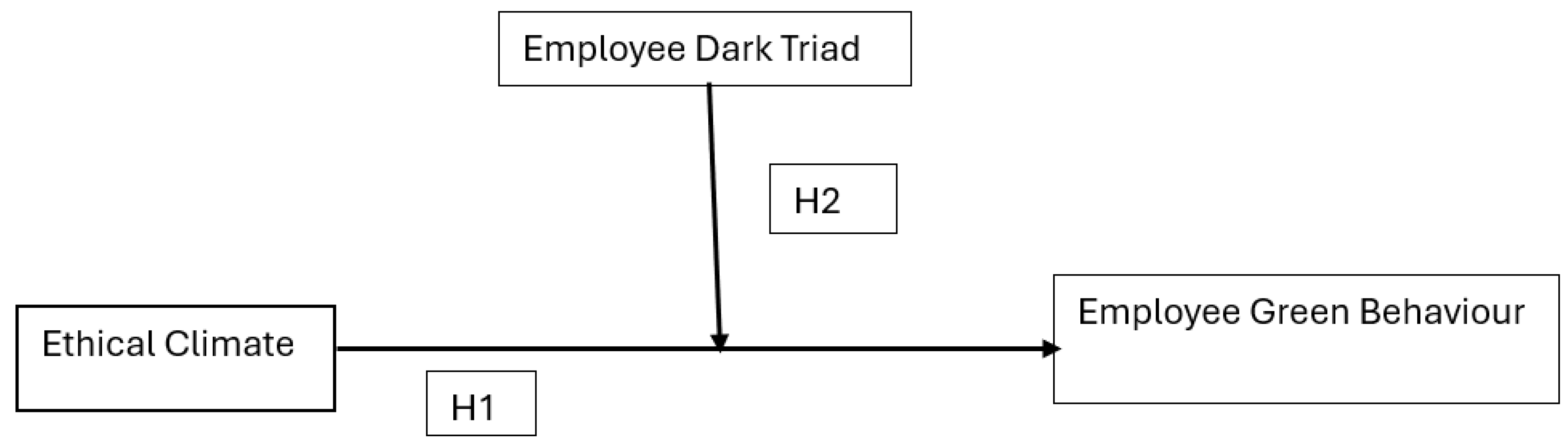
Figure 2.
Interaction terms.
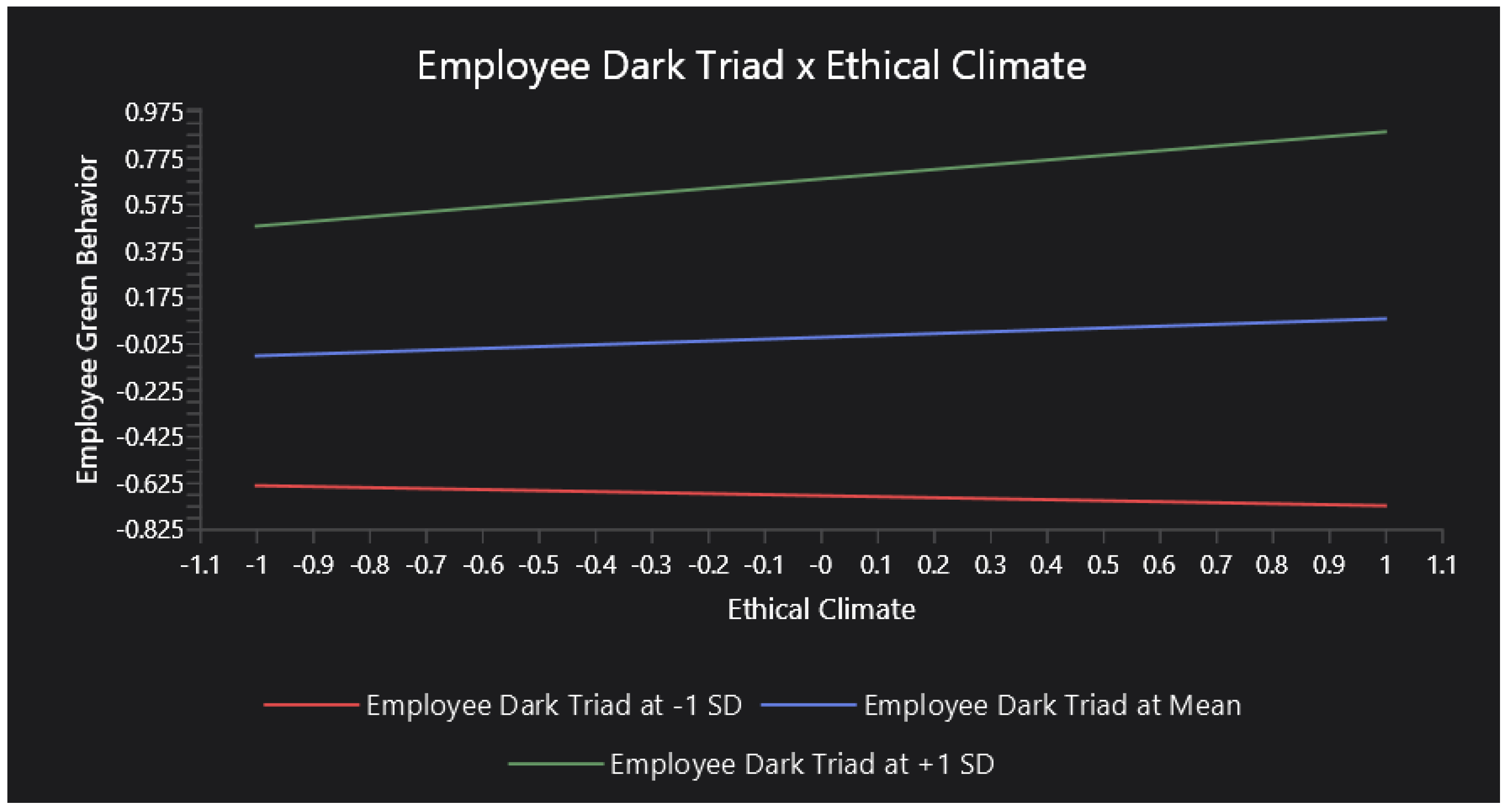
Figure 3.
Thematic Coding.
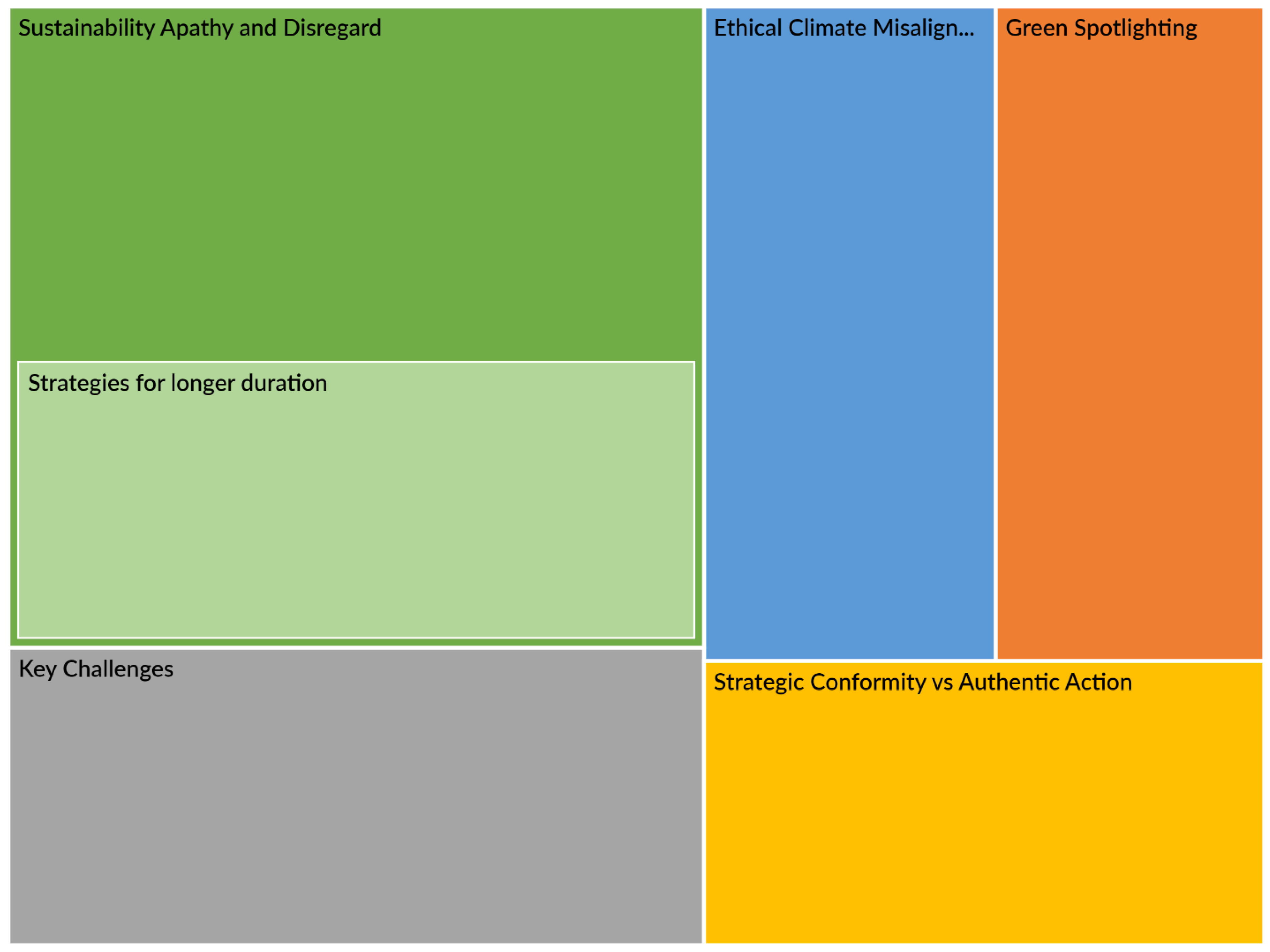
Table 2.
Path Coefficients.
| Path coefficients | |
| Employee Dark Triad -> Employee Green Behavior | 0.682 |
| Employee Dark Triad x Ethical Climate -> Employee Green Behavior | 0.123 |
| Ethical Climate -> Employee Dark Triad | 0.897 |
| Ethical Climate -> Employee Green Behavior | 0.080 |
Table 3.
Descriptive Statistics.
| Mean | Median | Observed min | Observed max | Standard deviation | Test statistic | P value | |
| Employee Dark Triad | 0.000 | -0.322 | -1.602 | 2.554 | 1.000 | 9.903 | 0.000 |
| Employee Green Behavior | 0.000 | -0.278 | -1.552 | 2.552 | 1.000 | 10.469 | 0.000 |
| Ethical Climate | 0.000 | -0.329 | -1.611 | 2.560 | 1.000 | 10.426 | 0.000 |
Table 4.
Correlation.
| Employee Dark Triad | Employee Green Behavior | Ethical Climate | |
| Employee Dark Triad | 1.000 | 0.944 | 0.950 |
| Employee Green Behavior | 0.944 | 1.000 | 0.876 |
| Ethical Climate | 0.950 | 0.876 | 1.000 |
Table 5.
Total Effects.
| Total effects | |
| Employee Dark Triad -> Employee Green Behavior | 0.682 |
| Employee Dark Triad x Ethical Climate -> Employee Green Behavior | 0.123 |
| Ethical Climate -> Employee Dark Triad | 0.897 |
| Ethical Climate -> Employee Green Behavior | 0.692 |
Disclaimer/Publisher’s Note: The statements, opinions and data contained in all publications are solely those of the individual author(s) and contributor(s) and not of MDPI and/or the editor(s). MDPI and/or the editor(s) disclaim responsibility for any injury to people or property resulting from any ideas, methods, instructions or products referred to in the content. |
© 2025 by the authors. Licensee MDPI, Basel, Switzerland. This article is an open access article distributed under the terms and conditions of the Creative Commons Attribution (CC BY) license (http://creativecommons.org/licenses/by/4.0/).
Copyright: This open access article is published under a Creative Commons CC BY 4.0 license, which permit the free download, distribution, and reuse, provided that the author and preprint are cited in any reuse.


