

Submitted:
10 August 2025
Posted:
11 August 2025
You are already at the latest version
Abstract
Emerging technologies with the potential to reduce vehicle speeds and enhance road safety have attracted increasing research interest. To address speeding behavior on the Jordanian Sahrawi Highway, this study employs a driving simulation experiment to evaluate potential countermeasures. A Dynamic Warning Crash Fact Sign (DWCFS) is proposed, and its effectiveness is assessed under various driving scenarios. The simulation replicates a high-speed section of the Sahrawi Highway, integrating DWCFS messages designed to influence driver behavior. Sixty participants will complete multiple experimental scenarios, divided into four data collection areas. Two scenarios feature dynamic messages: (1) “10 INJURIES OVER 2 YEARS – SLOW DOWN, SPEED KILLS,” and (2) “OVER 10 PEOPLE WERE KILLED LAST YEAR ON THIS ROAD.” Signs will be placed at different points, including the entrance to a residential area with an 80 km/h speed limit and on an uninterrupted section with a 110 km/h limit. Key performance measures—such as speed, lane position, acceleration, deceleration, and headway—will be compared to assess compliance and behavioral changes. It is anticipated that the DWCFS will lead to reductions in average speed, 85th percentile speed, and the proportion of vehicles exceeding the posted speed limits on the Sahrawi Highway.
Keywords:
road safety countermeasures
; sahrawi highway
; driver behavior
; speed limit compliance
; Intelligent Transportation Systems (ITS)
I. Goals and Objectives
The main goal of this research project is to evaluate the effectiveness of DWCFS as a speed reduction measure by analyzing its effect on driver performance. During the evaluation, two different messages will be examined to determine the most effective DWCFS. A driving simulator will be used to monitor driver performance and assess in providing concepts that can be used in the development of crash fact signs for Sahrawi highway as well as other arterial roads.
The overall objectives of the proposed project are listed below:
- 1.
- Developing a data-driven methodology to assess the effectiveness of different digital message signs, message types and installation locations.
- 2.
- Generating necessary results to allow better allocation of government resources by investing in effective DWCFS sign technologies for traffic improvement.
II. Introduction
1. Review and Analysis of Related Work
Speed limit is considered one of the essential components in providing safe roads. Most of the existing research has shown that higher speed limits on highways result in higher rates of fatal crashes. The latest research conducted in the United States that studied fatal crashes on rural interstates showed that states with 70 -75 mph speed limits faced more fatal crashes than states with 60 or 65 mph by around 31-54 percent, respectively [1,2,3,4,5,6,7,8,9,10,11,12,13,14,15]. Taylor [2] studied the impact of increased speed limits on the 1500 miles by conducting crash severities analysis. The study found a 10.5 percent increase in crash occurrences on roads where the speed limits were raised. The potential impact on the anticipated speed limit changed from 55 to 65 mph on non-freeway was studied by Gates et al.[3] . The study predicted an annual increase of 40.3 fatal crashes, 74.6 incapacitating crashes, and 631.8 property damage only.
Digital message signs which are also referred as dynamic message signs (DMS), variable message signs (VMS) or changeable message signs (CMS) are the vital part of the advanced traveller information systems (ATIS) that disseminates various real-time travel information to the road users. The DMS are digital devices that can display one or more alternative messages. The DMS usually displays traffic, operational, regulatory, warning, and guidance information. Specific examples of the information displayed on DMS include traffic diversion, travel time, congestion, upcoming roadwork, lane closures, incidences such as accidents and inclement weather, speed regulations, special events, and safety-related messages such as seatbelt usage campaigns [4,5]. The information provided by DMS such as incidences and route alternatives enhances the even distribution of traffic in the roadway network, thus improving the overall performance of the traffic system and reducing potential traffic delays [6]. The Manual on Uniform Traffic Control Devices (MUTCD), Chapter 2L, stipulates various aspects of DMS, which include the descriptions, applications, legibility design, message length and units of information and installation of permanent DMS [4]. The MUTCD refers readers to the Federal Highway Administration (FHWA)’s Changeable Message Sign Operation and Messaging Handbook, which provides DMS operational policies [5]. Also, each state Department of Transportation DOT has guidelines that supplement the DMS design and operational practices provided by the FHWA manuals and handbooks. Such guidelines and policies include how each message type should be posted, a list of message types that are prohibited and procedures on how message types are designed and approved [7].
A number of studies have been conducted to explore the effectiveness of DMS in terms of its design and the way it is operated. The design aspect includes installation details of DMS technologies such as vertical and horizontal location, size, font, color, light intensity and units of information. Operational factors include proximity of the DMS location relative to the specific event, when the message is displayed and message display duration. The most important measure of DMS effectiveness is the travelers’ compliance rate to the specific instructions being communicated (displayed) by the DMS. It is challenging to assess this measure quantitatively as it is hard to associate specific driver responses with the DMS information in a complex driving environment. However, various methods have been used to qualitatively and quantitatively estimate the effectiveness of DMS devices. Each study that evaluated the effectiveness of DMS used one or more of the following methods: stated preference survey, driving simulation, analysis of traffic flow, vehicle speeds or travel time data. Studies that carried out a cost-benefit analysis of DMSs utilized results from surveys, driving simulator or before-and-after studies of traffic flows to quantify the benefits or disbenefits of DMS relative to DMS installation and operational costs. However, benefit-cost analysis of DMS is very challenging as it is difficult to isolate the benefits of DMS from other sources of traveler route information such as smartphones, newspapers and TV [8].
There are different types of tools that are used in traffic safety research to gather driver behavior information. Driving simulators are considered one of the most important sources to acquire such information. Driving simulators have many benefits over other empirical methods because they allow for control over variables under study and provide safe operational environments.
The behavior of drivers with different skills and characteristics in a certain area can be analyzed on disaggregate basis by using driving simulator capability. Bella [9] examined the speed research validity of the driving simulator by copying a real work zone located in a driving simulator environment. 35 participants were recruited to test the scenario; it was found that the speeds were lower in the driving simulator compared to the field measurements. Nevertheless, the two speeds in the driving simulator and the field were not statically different. Bella [9] concluded that whenever the maneuver become simpler in the driving simulator, the validity of speed measurement improved.
[10] conducted a study to validate the driving simulator on road safety and highway geometric design based on continuous speed profiles. The study recruited 28 subjects; each participant had 30-km drives. The author concluded that simpler geometrics provide a larger difference in average speeds between the simulator and field data, and that was because of the difference in realized risk.
Bella [11] studied a driver’s speed behavior on curves to test the speed perception differences between real-life speed data and driving simulator data. 35 participants were recruited, based on annual driving distance, and driving experience, to ride the driving simulator on-road scenarios. The author found that there is no statistical difference in speed behavior between the driving simulator and reference data in the two types of curves that were studied.
In the literature, however, there is no research has been conducted to investigate the effectiveness of DWCFS on the Speeding behavior on Sahrawi Highway. Therefore, this project aims to behaviourally investigate the DWCFS effectiveness and public perception. A driving simulator non- will be used to capture and link actual drivers’ responses with performance with respect to various DWCFS designs. Subsequently, traffic flow and speed data measures will be performed to measure speed profiles for Sahrawi highways and determine the suggested location for DWCFS.
1. Significance of Work
The significance of the project is summarised as follows:
- 1.
- This project will contribute to developing a more reliable design of DWCFS to reduce speeding behaviour on Sahrawi Highway. This will push the wheel of using DWCFS by making dynamic message signs a more preferable method to be utilized in the traffic control devices, which will lead eventually to reduce crashes on Sahrawi Highway.
- 2.
- This project provides an excellent opportunity for Dr alhomidat to gain new skills and knowledge in the subject area and to improve his research and management skills to help him to enhance his competitiveness at the international level. He will also further expand his international long-term collaboration network across Jordan and other regions of the world, through participation in international conferences and co-authoring collaborative research papers with academics in America. The project will provide him with an opportunity for skills acquisition strategic planning and management of research activities at a senior academic level, which will be an important part of his professional record.
- 3.
- This project will be the first stage in establishing the Jordanian DWCFS message and deployment guidelines which are expected that other international specifications will rely on to enhance their design guidelines and requirements. The excellent disseminating and exploiting outcomes of this project are estimated to have a high potential at the regional and international levels. Dr Alhomaidat, jointly with the project team, will generate significant scientific results which will be disseminated through presentations at reputable international conferences and publications in the top 5-10% international journals. This will enrich our knowledge and enhance the research reputation of AHU university.
1. Methodology
To accomplish the objectives of this research, the research team will methodically perform the task as follow:
- 1.
- The research team will gather all relevant literature that has evaluated the effectiveness of DWCFS messages. The specific focus when reviewing the papers/reports will be on the methods and results obtained from those studies. Further, the research team will collect and review other countries guidelines for DWCFS design and operational practices.
- 2.
- The research team plans to identify and select study sites that cover the suburban and rural area contexts of the Sahrawi Highway. These sites suffer from speeding beheavior as well as a high crash rate. These sites will be used to mimic the scenario in the driving simulator.
- 3.
- Various types of data will be needed to accomplish the specified project objectives. The main types of data that will be collected include stated preference human factors survey, traffic flow and speed data, and travel time data. Driver performance and responses based on DWCFS message applications and installation details using the human factors survey and a driving simulator study.
- 4.
- Data Analyse:
- a)
- Stated preference human factors survey will be used to assess the DWCFS’s effectiveness and public perception towards them. The effectiveness of DWCFS information will be determined by examining the factors such as [12,13]: traveler’s awareness/familiarity with the DWCFS; traveler’s interpretation/understanding of the DWCFS information (i.e., comprehension); traveler’s perception towards the usefulness and credibility of DWCFS information, and traveler’s compliance with the recommended action.
- b)
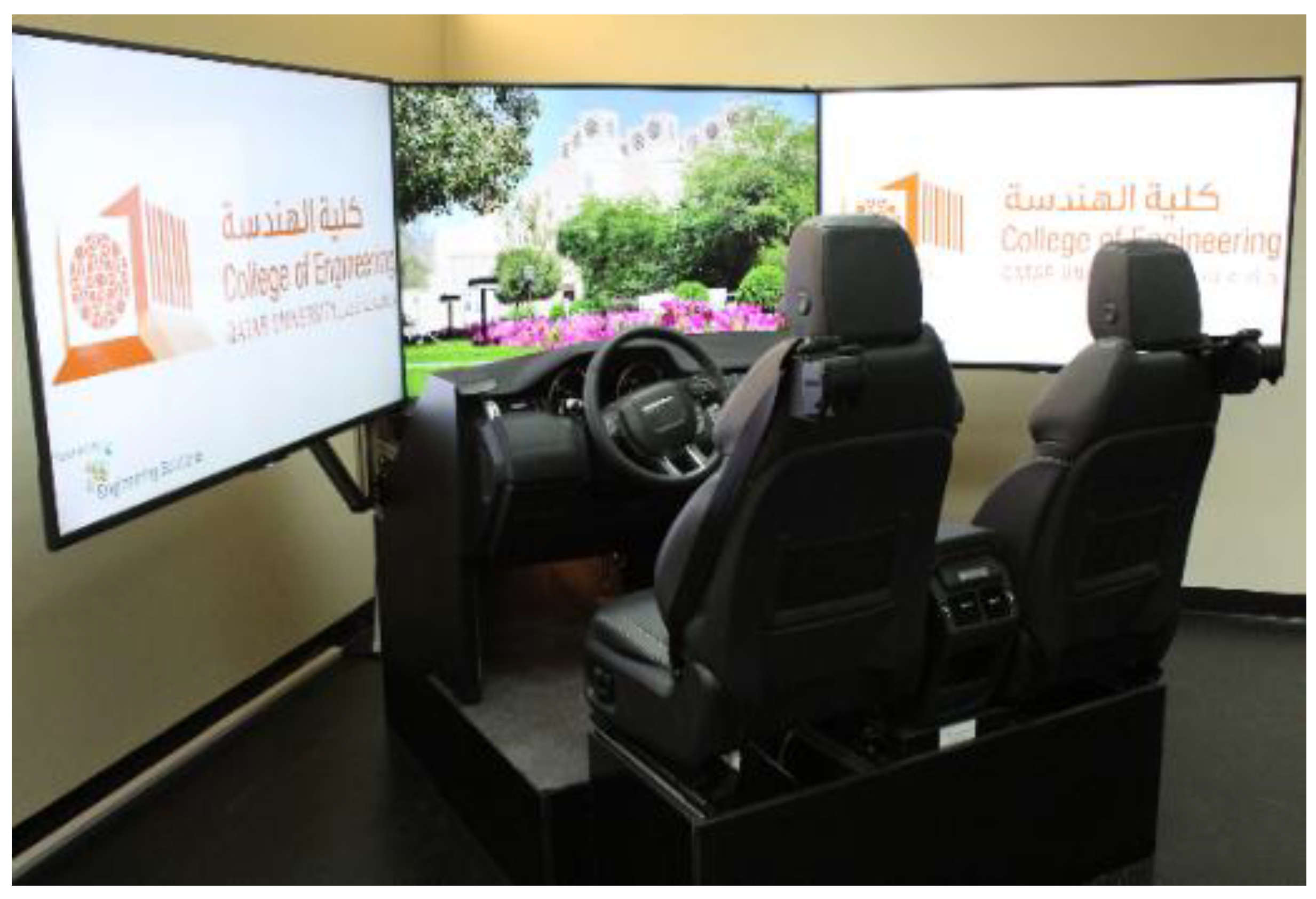
- A driving simulator will be utilized in this research as it has the capability of handling a large realistic network. A driving simulator can be used to generate and edit any road network by installing the map with signalized and unsignalized intersections, crossovers and interchanges, traffic signal poles and caps, horizontal and vertical, and merge and diverge areas.
Figure 1.
Driving simulator at Qatar Trasnportation and Traffic Safety Center, Qatar University.
- c)
- The research team will utilize traffic flow and speed data before the DWCFS installation to measure changes in traffic diversion rates and speed profiles. To complete this task, the research team will gather vehicle speed and traffic volume data from various sources including cido video camers and Bluetooth sensors.
2. Location and Safety Considerations:
From my experience in similar projects, this project is ranked as a low-risk project. Since the nature of work is office-based and there is no need to do any high-demand workand no safety requirements are needed. The project will be carried out in the main investigator’s office at the Engineering College/AHU. Data collection location will be limited to the AHU Engineering college. No other locations will be used for data collection.
Driving simulator risks are minimal and may only involve a rare short-term situation called simulator sickness that is reported to end as soon as the participant leaves the simulator. These are attributed to the visual stimulation, stimulation of vestibular system caused by perceived motion of the scenario and vehicle the driver is driving while not accompanied with corresponding physical motion cues, a situation common to fixed base simulators (Fisher, Rizzo, Caird , & Lee, 2011). Motion cues can at best be provided in full motion base simulators which may also be associated motion sickness. Driving simulator sickness is known not to last long after the subject leaves the simulator.
A pre-test will be administered to determine individuals with a history of experiencing motion sickness. This test will check the conditions listed below. An individual identified to experience these conditions at severe levels will not participate in the experiment. This pre-test will eliminate the possibility of simulator sickness cases among the subjects who participate in the experiment. Nevertheless, a post-stability and questionnaire test will be administered to check if the participants do experience simulator sickness. If an individual is determined to have simulator sickness symptoms in the post-test, they will be advised to rest for about 5 to 10 minutes before they leave the study room.
Short breaks within experiment sessions are also known to reduce the possibility of simulator sickness. Participants will be advised to take short breaks during the experiment.
3. Available Resources
The research team plans to conduct a driving simulation study to capture and link actual drivers’ responses with performances with respect to various DWCFS designs (color, size, position, font, unit of information etc. ) and message types. Selected roadway environments from Sahrawi highway with different CFS message types will be mimicked in the driving simulator. The driving simulator study will offer a controlled environment from which the actual impacts of DWCFS to drivers’ performances can be thoroughly assessed. The driving simulation experiment coupled with a survey will be used to connect the drivers’ stated perceptions and response to DWCFS with their actual actions in response to DWCFS messages when driving through a simulated driving environment. A high-fidelity driving simulator will be used to assess various aspects of drivers’ behaviors.
The research team will utilize traffic flow and speed data before the DWCFS installation to measure speed profiles. To complete this task, the research team will gather vehicle speed and traffic volume data from various sources including collect data from the field using Traffic Box (SEMI-Portable Sensor) developed by SMATS.
4. Expected Results/Outputs
The research team will ensure the inclusion of all the required outcomes which include:
- ●
- Identification of best practice applications of Crash Fact Message Signs worldwide and recommendations for guideline updates.
- ●
- Evaluation of DWCFS effectiveness and public perception toward DWCFS.
- ●
- A value matrix of message and sign type per geographic area (urban, and rural).
- ●
- Recommendation to Ministry of public works and housing on sign type and message categories with the greatest driver compliance that can be automated to maximize their effectiveness.
References
- A. Davis, E. Hacker, P. T. Savolainen, and T. J. Gates, “Longitudinal Analysis of Rural Interstate Fatalities in Relation to Speed Limit Policies,” Transp. Res. Rec. J. Transp. Res. Board, 2015. [CrossRef]
- W. Taylor, “The Impact of Raising the Speed Limit on Freeways in Michigan,” East Lnasing, 2000. [Online]. Available: https://www.michigan.gov/documents/mdot/RR771AUNIV_76A_539689_7.pdf.
- Alhomaidat, F., Kwigizile, V., Oh, J. S., & Van Houten, R. (2020). How does an increased freeway speed limit influence the frequency of crashes on adjacent roads?. Accident Analysis & Prevention, 136, 105433. by Timothy Gates, P. Savolainen, J. Kay, J. Finkelman, and A. Davis, “Evaluating Outcomes of Raising Speed Limits on High Speed Non-Freeways MDOT Research Administration Project Number: RC-1609B FINAL REPORT,” 2015.
- MUTCD, Manual on Uniform Traffic Control Devices. 2009.
- Alhomaidat, Fadi Abdallah. Impacts of freeway speed limit on safety and operation speed of adjacent arterial roads. Western Michigan University, 2019.
- Al-Bayati, Ahmed Jalil, et al. "The Effects of Temporary Portable Rumble Strips on Vehicle Speeds in Road Work Zones." Safety 10.4 (2024): 105. [CrossRef]
- Hasan, Raed Abdullah, Fadi Alhomaidat, and Mohammad S. Albdour. "Social norms and perceptions of Saudis on active transportation." Frontiers in Built Environment 10 (2024): 1369704. [CrossRef]
- Alhomaidat, Fadi, and Lusanni Acosta-Rodriguez. "How Does Pedestrian-Driver Behavior Influence in the Number of Crashes? A Michigan’s Case Study." Transport and Telecommunication Journal 22.2 (2021): 152-162. [CrossRef]
- C. L. Dudek, “Changeable Message Sign Operation and Messaging Handbook,” 2004.
- Alhomaidat, Fadi, Valerian Kwigizile, and Jun-Seok Oh. "Impacts of freeway speed limit on operation speed of adjacent arterial roads." IATSS research 45.2 (2021): 161-168. [CrossRef]
- S. AlKheder, F. AlRukaibi, and A. Aiash, “Drivers’ response to variable message signs (VMS) in Kuwait,” Cogn. Technol. Work, 2019. [CrossRef]
- Eljufout, Tamer, and Fadi Alhomaidat. "Utilizing Waste Rocks from Phosphate Mining in Jordan as Concrete Aggregates." Results in Engineering (2024): 102350. [CrossRef]
- Alhomaidat, F., Hasan, R. A., Eljufout, T., & Abbas, A. H. (2023). User’s perceptions of electric, hybrid, and fuel-powered vehicles in Iraq and Jordan. Case Studies on Transport Policy, 12, 101004. [CrossRef]
- T. Roelofs and J. Schroeder, “ENTERPRISE Transportation Pooled Fund Study TPF-5 ( 231 ). The Future of DMS Messaging,” 2016.
- Alhomaidat, Fadi, and Monya Twaissi. "Unlocking insights from commercial vehicle data: A machine learning approach for predicting commercial vehicle classes using Michigan State data (1999–2017)." Results in Engineering 21 (2024): 101691. [CrossRef]
- P. Edara et al., “Evaluating the Benefits of Dynamic Message Signs on Missouri’s Rural Corridors2011 ”. [CrossRef]
- F. Bella, “Validation of a Driving Simulator for Work Zone Design,” Transp. Res. Rec. J. Transp. Res. Board, 2005. [CrossRef]
- Alhomaidat, Fadi, and Tamer Eljufout. "Perception of cycling risks and needs associated with skill level, gender, and age." Archives of transport 59.3 (2021). [CrossRef]
- D. Llopis-Castelló, F. J. Camacho-Torregrosa, J. Marín-Morales, A. M. Pérez-Zuriaga, A. García, and J. F. Dols, “Validation of a Low-Cost Driving Simulator Based on Continuous Speed Profiles,” Transp. Res. Rec. J. Transp. Res. Board, 2016. [CrossRef]
- Alhomaidat, Fadi, et al. "The relationship between cycling risk perception and skill level of different age groups." Proceedings of the 6th Annual International Cycling Safety Conference, Davis, CA. Vol. 10. 2017.
- Oh, Jun-Seok, et al. Effect of Cycling Skills on Bicycle Safety and Comfort Associated with Bicycle Infrastructure and Environment. No. TRCLC 15-01. Western Michigan University. Transportation Research Center for Livable Communities, 2017.
- Oh, Jun-Seok, et al. "15-01 Effect of Cycling Skills on Bicycle Safety and Comfort Associated with Bicycle Infrastructure and Environment." (2017).
- Alhomaidat, Fadi, and Siamak Ardekani. "A statistical comparison of traffic measurements from the moving versus stationary observer methods." Journal of Transportation Technologies 5.4 (2015): 204-213. [CrossRef]
- F. Bella, “Driver perception hypothesis: Driving simulator study,” Transp. Res. Part F Traffic Psychol. Behav., 2014. [CrossRef]
- Alhomaidat, Fadi, et al. "User’s perceptions of electric, hybrid, and fuel-powered vehicles in Iraq and Jordan." Case Studies on Transport Policy 12 (2023): 101004. [CrossRef]
- J.-S. Oh et al., “Costs and Benefits of MDOT Intelligent Transportation System Deployments,” p. 203p, 2015.
- J.-S. Oh, Dynamic Route Guidance and Network Traffic Management: Theoretical Evaluation and and Practical Application Issues. 2001.
- Alhomaidat, Fadi, et al. "Using driving simulator to study the effect of crash fact signs on speeding behaviour along freeways." International journal of injury control and safety promotion 30.1 (2023): 15-25. [CrossRef]
- Alhomaidat, Fadi, et al. "Investigating the interaction between age and liability for crashes at stop-sign-controlled intersections." Transportation research interdisciplinary perspectives 14 (2022): 100612. [CrossRef]
- Hanandeh, Shadi, et al. "Modelling the free flow speed and 85th percentile speed using artificial neural network (ANN) and genetic algorithm." International review of civil engineering 13.4 (2022): 296-308. [CrossRef]
- Khliefat, Ibrahim, et al. "Improving the capacity and level of service at the sixth circle in Jordan by using traffic signals and roundabout metering approach." The Open Transportation Journal 15.1 (2021). [CrossRef]
Disclaimer/Publisher’s Note: The statements, opinions and data contained in all publications are solely those of the individual author(s) and contributor(s) and not of MDPI and/or the editor(s). MDPI and/or the editor(s) disclaim responsibility for any injury to people or property resulting from any ideas, methods, instructions or products referred to in the content. |
© 2025 by the authors. Licensee MDPI, Basel, Switzerland. This article is an open access article distributed under the terms and conditions of the Creative Commons Attribution (CC BY) license (http://creativecommons.org/licenses/by/4.0/).
Copyright: This open access article is published under a Creative Commons CC BY 4.0 license, which permit the free download, distribution, and reuse, provided that the author and preprint are cited in any reuse.


