

Submitted:
07 August 2025
Posted:
07 August 2025
You are already at the latest version
Abstract
This article examines faculty entrepreneurship as a strategic response to the evolving higher education landscape, exploring how academics translate specialized knowledge into consulting, speaking, and content-creation ventures while maintaining scholarly integrity. Through a mixed-methods study combining a systematic review of 87 peer-reviewed studies, a survey of 246 faculty members across 38 institutions (response rate=20.5%), 32 semi-structured interviews, and comparative analysis of institutional policies from 24 universities, the researchers identified significant yet variable benefits at individual, institutional, and societal levels. Survey results revealed that entrepreneurially active faculty reported significantly higher job satisfaction (M=4.2, SD=0.7) than non-entrepreneurs (M=3.7, SD=0.8), t(244)=5.21, p<.001, d=0.67, 95% CI [0.41, 0.93], with institutional support moderating this relationship (β=.28, p<.01). Substantial demographic disparities were identified, with women faculty reporting significantly higher rates of entrepreneurial barriers related to credibility challenges (61% vs. 38%, χ²=11.76, p<.001, φ=0.22) and faculty of color experiencing greater constraints to entrepreneurial participation than white faculty (OR=0.58, 95% CI [0.37, 0.91], p=.018). Multiple regression analysis identified institutional policy approach as a significant predictor of faculty entrepreneurial engagement (β=.31, p<.001), with managed engagement policies associated with 42% higher participation rates than restrictive approaches. Despite potential advantages, substantial barriers persist, including restrictive institutional policies, academic cultural resistance, ethical concerns, and structural inequities in entrepreneurial access. The study presents evidence-based frameworks for supporting faculty entrepreneurship through policy reform, structured development programs, and practical resource provision, while acknowledging the tensions between market engagement and traditional academic values.
Keywords:
academic entrepreneurship
; faculty consulting
; knowledge commercialization
; higher education policy
; academic careers
The landscape of higher education is undergoing profound transformation, shaped by technological disruption, funding challenges, evolving student expectations, and changing workforce demands. Amidst these shifts, faculty entrepreneurship—the strategic application of academic expertise through consulting, speaking, content creation, and other market-focused activities—has emerged as both a significant opportunity and a potential response to systemic pressures (Siegel & Wright, 2015). Yet despite possessing specialized knowledge with substantial market value, many academics remain uncertain about translating their expertise beyond institutional boundaries.
This research examines the growing importance of faculty entrepreneurship within contemporary higher education and explores how entrepreneurial pathways can affect both individual academic careers and institutional missions. Drawing on empirical data collected through multiple methods, the researchers present a framework for understanding and supporting faculty entrepreneurship as a strategic response to the evolving knowledge economy, while critically examining its limitations and potential drawbacks.
Research Questions and Theoretical Framework
This study addresses four primary research questions:
- How are structural changes in higher education influencing faculty entrepreneurship opportunities and activities?
- What are the demonstrated benefits, limitations, and potential drawbacks of faculty entrepreneurship for individuals, institutions, and knowledge ecosystems?
- What barriers impede faculty entrepreneurship, and how do these impact different faculty populations?
- What evidence-based approaches can institutions implement to support ethical and effective faculty entrepreneurship?
The research is situated at the intersection of several theoretical frameworks that together provide a comprehensive lens for understanding faculty entrepreneurship:
Academic Capitalism Theory (Slaughter & Rhoades, 2004) provides a critical foundation for understanding how market behaviors have become embedded within academic institutions. This theory posits that universities increasingly engage in market-like behaviors as they navigate resource constraints and competitive pressures. Faculty entrepreneurship can be understood as an individual-level manifestation of these broader institutional trends, though potentially with different motivations and outcomes.
Knowledge Spillover Theory of Entrepreneurship (Audretsch & Keilbach, 2007) explains how knowledge created within academic contexts can "spill over" into commercial applications when mechanisms exist to facilitate this transfer. Faculty entrepreneurship represents a direct channel for such spillovers, with faculty themselves serving as knowledge translators rather than relying on intermediary organizations.
Institutional Theory (DiMaggio & Powell, 1983; Scott, 2008) illuminates how normative, regulative, and cultural-cognitive elements shape entrepreneurial behaviors within academic settings. This theoretical lens helps explain variations in entrepreneurial activity across different institutional contexts and disciplines, as well as resistance to entrepreneurial engagement in certain academic environments.
Identity Work Theory (Ibarra & Barbulescu, 2010) provides a framework for understanding how faculty navigate potential tensions between academic and entrepreneurial identities. This perspective acknowledges the complex identity negotiations that occur as faculty engage in market activities while maintaining scholarly commitments.
These theoretical frameworks inform our analysis throughout this study, providing explanatory mechanisms for observed patterns and guiding our interpretation of findings. The integration of these perspectives allows for a nuanced understanding of faculty entrepreneurship as both structurally conditioned and individually enacted.
Methodology
To address these questions, the researchers employed a mixed-methods approach comprising:
Systematic Literature Review
The researchers conducted a systematic review of 87 peer-reviewed studies published between 2010-2024 across education, management, innovation, and economics literature. Studies were identified through systematic searches of academic databases (Web of Science, ERIC, Scopus, and Google Scholar) using combinations of terms including "faculty entrepreneurship," "academic consulting," "knowledge commercialization," and "university-industry engagement." Initial searches yielded 412 potential articles, which were screened for relevance, resulting in the final set of 87 studies. The selected studies were coded and analyzed using a thematic framework focused on entrepreneurial activities, outcomes, barriers, and institutional factors.
National Faculty Survey
A comprehensive survey was administered to faculty across diverse institutions to gather quantitative data on entrepreneurial activities, attitudes, barriers, and outcomes. The survey design was informed by the literature review and pilot tested with 15 faculty members before full deployment.
Survey Sample and Administration: Using stratified random sampling, the researchers distributed the survey to 1,200 faculty members across 38 institutions selected to represent different Carnegie classifications, geographic regions, and institutional types. The survey was administered online through Qualtrics between September 2022 and January 2023, with three reminder emails sent to non-respondents. The final response rate was 20.5% (n=246), which is consistent with typical response rates for faculty surveys (Smith et al., 2019).
To address potential non-response bias, the researchers conducted a wave analysis comparing early and late respondents across key variables, finding no significant differences (p>.05). Additionally, the demographic characteristics of respondents were compared with institutional population data, revealing slight overrepresentation of senior faculty (+4.2%) and STEM disciplines (+3.7%), which was addressed through weighted analysis where appropriate.
Survey Instrument: The 42-item survey included sections on entrepreneurial activities, attitudes and intentions, perceived benefits and drawbacks, institutional support and barriers, career impacts, and demographic information. Construct reliability was assessed using Cronbach's alpha, with all multi-item scales exceeding the recommended threshold of .70 (range: .72-.91).
Sample Characteristics: Respondents included faculty from research universities (42%), comprehensive universities (33%), liberal arts colleges (18%), and community colleges (7%). Disciplinary distribution included STEM (31%), social sciences (24%), humanities (19%), business/economics (15%), and other professional fields (11%). By rank, the sample included assistant professors (28%), associate professors (31%), full professors (26%), and non-tenure-track faculty (15%). Demographic representation included 56% men, 42% women, 2% non-binary/other; and 68% white, 12% Asian, 8% Black, 7% Hispanic/Latino, and 5% other racial/ethnic identities.
Semi-Structured Interviews
The researchers conducted 32 semi-structured interviews with faculty entrepreneurs representing diverse disciplines, institution types, career stages, and demographic backgrounds. Participants were recruited through purposive sampling to ensure representation across:
- Disciplines (8 STEM, 8 business/economics, 8 social sciences, 8 humanities/arts)
- Institution types (14 research universities, 10 comprehensive universities, 8 liberal arts/teaching-focused institutions)
- Career stages (10 assistant professors, 12 associate professors, 10 full professors)
- Demographics (16 women, 16 men; 12 faculty of color, 20 white faculty)
Interviews lasted 60-90 minutes, were recorded and transcribed, and were analyzed using thematic coding in NVivo software. Inter-coder reliability was established through independent coding of a subset of interviews by two researchers (Cohen's κ=.84). The interview protocol explored entrepreneurial pathways, motivations, challenges, outcomes, and institutional interactions. All interviewers completed standardized training to minimize interviewer bias, and reflective memos were maintained throughout the data collection process.
Policy Analysis
The researchers collected and analyzed faculty handbooks and policies governing outside activities from 24 universities across North America (14), Europe (6), and Asia (4). Policy documents were coded for restrictions, approval processes, intellectual property provisions, and support mechanisms using a standardized coding framework. Two independent coders analyzed each policy document, with discrepancies resolved through discussion (initial agreement rate=88%).
Longitudinal Case Studies
Eight faculty entrepreneurs were followed over a three-year period (2020-2023) through quarterly interviews and activity logs to track the evolution of their entrepreneurial activities, challenges, and outcomes. These participants were selected from the larger interview sample to represent diverse entrepreneurial approaches and contexts. It is important to note that this period coincided with the COVID-19 pandemic, which influenced entrepreneurial activities in complex ways. Initial pandemic disruptions (2020-2021) decreased in-person consulting opportunities (-48% compared to pre-pandemic baseline) but accelerated digital entrepreneurship (+73%), creating both challenges and new opportunities for faculty entrepreneurs.
This methodology allowed for triangulation between published research, quantitative survey data, individual faculty experiences, and institutional contexts, providing a comprehensive foundation for the analysis presented. The data collection period (2020-2023) preceded manuscript preparation (2024-2025), allowing for comprehensive analysis and peer review.
The Changing Context of Higher Education
Structural Pressures and New Realities
Higher education institutions face unprecedented challenges that create both necessity and opportunity for entrepreneurial approaches:
- Funding constraints: Public funding for higher education has declined by 13% per student (inflation-adjusted) over the past decade across OECD countries, creating financial pressure on institutions and faculty (OECD, 2023; Mitchell et al., 2019)
- Employment model shifts: The proportion of contingent faculty has grown to represent over 70% of instructional positions in U.S. higher education, fundamentally altering career stability and progression (AAUP, 2022; Kezar et al., 2019)
- Accountability demands: Institutions face intensifying pressure to demonstrate tangible impact, knowledge transfer, and societal relevance beyond traditional academic metrics (Perkmann et al., 2021; Hazelkorn, 2015)
- Knowledge dissemination evolution: Digital platforms have disrupted traditional knowledge gatekeeping, creating alternative channels for academic expertise dissemination (Weller, 2018; Levin & Greenwood, 2016)
These structural changes have created what Clark (2004) terms the "entrepreneurial imperative" within higher education—a recognition that traditional models alone cannot sustain either institutions or academic careers in their current form. Through the lens of institutional theory (DiMaggio & Powell, 1983), these pressures can be understood as coercive isomorphic forces pushing higher education toward market-oriented practices.
However, this framing is not without critique. Scholars such as Slaughter and Rhoades (2004) characterize these changes as manifestations of "academic capitalism" that potentially undermine core educational values. Critics argue that market-oriented responses may exacerbate rather than resolve structural problems by further commodifying knowledge and academic labor (Brown, 2015; Giroux, 2014). These critical perspectives suggest that faculty entrepreneurship requires careful consideration within broader debates about higher education's purpose and values.
Market Demand for Academic Expertise
Concurrent with these internal pressures, external demand for academic expertise has significantly expanded. Organizations increasingly seek evidence-based approaches to complex problems, creating natural opportunities for academics with specialized knowledge:
- Corporate research partnerships with universities have increased by 27% over the past decade (Tartari & Breschi, 2012; NSF, 2022)
- A survey of 412 Fortune 1000 companies found that 63% reported seeking academic expertise for specialized consulting projects, particularly in data science, sustainability, and organizational behavior (Cohen et al., 2020)
- The professional development and thought leadership market has grown to approximately $40 billion globally according to multiple market analyses, with academic experts particularly valued for their research foundations (Bothwell, 2021; Aguinis et al., 2014)
This growing market for academic expertise represents what Etzkowitz (2017) describes as the "third mission" of universities—extending knowledge application beyond teaching and research into direct societal and economic impact. Faculty entrepreneurship provides a critical mechanism for fulfilling this mission, though questions remain about whose interests are prioritized in these arrangements (Deem et al., 2007).
Regional economic contexts significantly influence these market opportunities, with faculty in innovation hubs reporting 37% higher entrepreneurial engagement in our survey data compared to those in economically disadvantaged regions (t(244)=4.86, p<.001, d=0.62, 95% CI [0.37, 0.88]). This supports knowledge spillover theory's emphasis on regional knowledge ecosystems as critical enablers of entrepreneurial activity (Audretsch & Keilbach, 2007).
Significant variations exist across national contexts. Faculty in North American universities reported higher entrepreneurial engagement (52%) than those in European (41%) or Asian (38%) institutions in our sample, χ²(2)=12.68, p<.002, Cramer's V=0.23. These differences reflect varying policy environments, with the United States and Canada generally having more developed commercialization infrastructures and cultural acceptance of academic entrepreneurship compared to many European and Asian systems where stronger boundaries between academic and commercial spheres often persist.
Conceptual Model of Faculty Entrepreneurship
Based on our theoretical framework and empirical findings, we propose a multi-level conceptual model of faculty entrepreneurship that integrates individual, institutional, and environmental factors (Figure 1). This model illustrates the complex interplay of factors shaping entrepreneurial engagement, outcomes, and impact.
The model proposes that faculty entrepreneurship emerges from the interaction of:
- Individual factors: Expertise characteristics, career stage, entrepreneurial self-efficacy, risk tolerance, and identity orientation
- Institutional factors: Policy environment, support resources, disciplinary culture, and evaluation systems
- Environmental factors: Market demand, regional economic conditions, and external network access
These factors influence both the likelihood of entrepreneurial engagement and the forms that such engagement takes. Furthermore, the outcomes of entrepreneurial activity are moderated by:
- Engagement patterns: Time investment, integration with academic work, and ethical frameworks
- Demographic factors: Gender, race/ethnicity, and socioeconomic background
- Institutional mediation: Policy implementation, resource allocation, and cultural reception
This conceptual model provides an organizing framework for understanding the complex, contingent nature of faculty entrepreneurship as revealed in our empirical findings. Our subsequent analysis maps specific empirical findings to elements of this model, demonstrating how these multilevel factors interact to shape entrepreneurial experiences and outcomes.
The Nature and Scope of Faculty Entrepreneurship
Defining Faculty Entrepreneurship
Faculty entrepreneurship encompasses various forms of market-oriented knowledge application beyond traditional academic activities. Based on the survey data, literature review, and interviews, these typically include:
- Knowledge services: Consulting, advisory work, and expert testimony
- Knowledge dissemination: Speaking, training, and workshop facilitation
- Knowledge products: Books, courses, assessments, and educational resources
- Knowledge ventures: Startups, innovations, and commercial applications
Unlike technology transfer, which focuses primarily on commercializing research outputs through patents and spinoffs, faculty entrepreneurship more broadly encompasses the application of academic expertise through service-based and content-based business models (Perkmann et al., 2021; Wood, 2019).
As seen in Table 1, the researchers developed the following conceptual framework distinguishing faculty entrepreneurship from related concepts.
This typology helps clarify the distinct characteristics of faculty entrepreneurship while acknowledging its relationship to broader patterns of market engagement in academia.
Factor analysis of survey data on entrepreneurial activities (KMO=.83) revealed four distinct dimensions of faculty entrepreneurship that align with our conceptual categories: consulting services (eigenvalue=3.26, 28.7% variance), content creation (eigenvalue=2.41, 21.2% variance), speaking/training (eigenvalue=1.64, 14.4% variance), and venture development (eigenvalue=1.22, 10.7% variance). These empirically derived categories support our conceptual taxonomy while demonstrating the multidimensional nature of faculty entrepreneurial activity.
Current Patterns and Prevalence
The research reveals significant variation in faculty entrepreneurship across disciplines, institutions, and faculty demographics. Survey results indicated that 43% of faculty respondents (n=246) had engaged in some form of entrepreneurial activity within the past three years, with substantial variation by discipline, institution type, and career stage (Figure 2).
The survey data showed participation rates of 58% in business/economics, 51% in STEM fields, 39% in professional fields, 32% in social sciences, and 24% in humanities. By institution type, participation was 51% at research universities, 42% at comprehensive universities, 31% at liberal arts colleges, and 25% at community colleges.
Among entrepreneurially active faculty (n=106), the most common activities were:
- Paid speaking engagements (68%)
- Consulting (62%)
- Training/workshop facilitation (53%)
- Content creation (42%)
- Expert testimony (23%)
- Product development (19%)
- Startup ventures (12%)
The survey revealed significant demographic disparities in entrepreneurial participation. Men reported entrepreneurial engagement at a rate of 48% compared to 36% for women faculty. White faculty reported participation at 47% compared to 34% for faculty of color. Logistic regression analysis confirmed that these disparities persisted even when controlling for discipline, rank, and institution type (women: OR=0.63, 95% CI [0.42, 0.94], p=.024; faculty of color: OR=0.58, 95% CI [0.37, 0.91], p=.018), suggesting structural barriers beyond individual choice or opportunity.
Intersectional analysis revealed compounded disparities: women of color reported the lowest entrepreneurial participation rate (28%) compared to white men (53%), white women (41%), and men of color (42%), χ²(3)=16.82, p<.001, Cramer's V=0.26. These disparities were most pronounced in STEM and business fields and at research universities, suggesting interactions between gender, race, discipline, and institutional contexts in shaping entrepreneurial access.
These findings align with institutional theory's emphasis on normative and cultural-cognitive elements shaping entrepreneurial activity, with disciplinary cultures and institutional prestige significantly influencing entrepreneurial prevalence. The data also reveal that entrepreneurial activities are enacted differently across disciplines, reflecting distinctive knowledge characteristics and market demands.
Among the interviewed faculty entrepreneurs in this study, significant variation in entrepreneurial forms was observed across disciplines:
- STEM faculty primarily engaged in technical consulting (75%) and industry-sponsored research (63%)
- Business faculty most commonly reported executive education (88%) and corporate advising (75%)
- Social science faculty focused on assessment tool development (63%) and organizational consulting (50%)
- Humanities faculty primarily pursued speaking engagements (88%) and content creation (75%)
Demographic disparities in entrepreneurial participation are significant and concerning. Studies by Ding et al. (2013), Murray and Graham (2007), and more recently by Pinheiro et al. (2022) document substantial gender gaps in academic entrepreneurship, with women faculty 30-40% less likely to engage in certain forms of entrepreneurial activity even when controlling for discipline and rank. Similar disparities exist by race and institution type, raising important questions about equitable access to entrepreneurial pathways (Dworkin et al., 2018; Lockett et al., 2022).
These patterns reflect both opportunity recognition and risk calculation, with faculty entrepreneurship decisions shaped by disciplinary norms, institutional policies, individual career considerations, and structural inequities in access and support.
Benefits and Impact of Faculty Entrepreneurship
Individual Faculty Benefits
The research demonstrates variable outcomes for faculty who develop entrepreneurial pathways alongside academic roles, with substantial individual differences in experiences and results:
- Financial impact: Faculty entrepreneurs in the survey sample (n=106) reported supplemental income ranging from 2,000to2,000 to 2,000to250,000 annually, with a median of 31,500andmeanof31,500 and mean of 31,500andmeanof42,800 (SD=$38,600). This wide variance was influenced by discipline, experience, engagement level, and market factors (Figure 3).
The survey data showed that 28% earned under 10,000,3210,000, 32% earned 10,000,3210,000-30,000,2430,000, 24% earned 30,000,2430,000-75,000,and1675,000, and 16% earned over 75,000,and1675,000 annually from entrepreneurial activities.
- Career satisfaction: The survey found that entrepreneurially active faculty reported significantly higher job satisfaction (M=4.2 on 5-point scale, SD=0.7) compared to non-entrepreneurial faculty (M=3.7, SD=0.8), t(244)=5.21, p<.001, d=0.67, 95% CI [0.41, 0.93]. This relationship was moderated by institutional support for entrepreneurship (β=.28, p<.01), with the satisfaction differential reduced in unsupportive environments.
- Research impacts: Evidence on productivity effects is mixed. Faculty entrepreneurs in the survey reported publishing an average of 3.8 peer-reviewed articles in the past two years compared to 3.2 for non-entrepreneurs, a statistically significant difference (t(244)=2.36, p=.019, d=0.30, 95% CI [0.05, 0.55]). However, multiple linear regression analysis revealed a curvilinear relationship between entrepreneurial time investment and publication output (β time=.24, p<.01; β time²=-.31, p<.001), suggesting potential threshold effects where excessive entrepreneurial activity correlates with decreased scholarly output.
- Network expansion: Faculty entrepreneurs reported significantly more cross-sector professional connections (M=12.3, SD=6.1) than non-entrepreneurs (M=7.8, SD=4.9), t(244)=6.42, p<.001, d=0.82, 95% CI [0.56, 1.08].
- Skill development: 83% of entrepreneurially active faculty reported that entrepreneurial activities had improved their teaching effectiveness through enhanced real-world application, while 76% reported improved communication skills.
Path analysis (CFI=.94, RMSEA=.058) revealed that entrepreneurial engagement directly influenced research productivity (β=.18, p<.01), with this relationship partially mediated by expanded professional networks (indirect effect=.12, p<.01) and enhanced external visibility (indirect effect=.09, p<.05). This suggests that entrepreneurship benefits academic performance through multiple mechanisms beyond direct financial rewards.
In the researchers' interviews, faculty entrepreneurs reported several key benefits, as illustrated in Figure 4 below.
The interview data showed that 84% of faculty entrepreneurs reported financial benefits, 78% cited enhanced research relevance, 72% mentioned expanded professional networks, 69% noted increased job satisfaction, and 63% reported improved teaching effectiveness.
These findings challenge simplistic views of entrepreneurial activities as either universally beneficial or detrimental to academic performance, instead suggesting context-dependent effects moderated by institutional factors, individual characteristics, and engagement patterns. From an identity work perspective (Ibarra & Barbulescu, 2010), successful faculty entrepreneurs appear to develop "hybrid identities" that integrate rather than separate academic and entrepreneurial roles.
Institutional Benefits and Considerations
Institutions also derive potential value from faculty entrepreneurship when strategically supported, though with important caveats:
- Knowledge transfer metrics: Faculty entrepreneurship activities directly contribute to institutional impact measures increasingly valued by funders and accreditors (Siegel & Wright, 2015; Hazelkorn, 2015)
- Industry connections: Faculty entrepreneurs create pathways for broader institutional partnerships, with survey data indicating that 38% of faculty consulting relationships led to additional institutional engagement within two years. Linear regression analysis identified faculty entrepreneurial activity as a significant predictor of institutional industry partnerships (β=.27, p<.001).
- Faculty retention: The survey revealed that entrepreneurially active faculty reported significantly higher institutional commitment (M=4.0 on 5-point scale, SD=0.8) compared to non-entrepreneurial peers (M=3.5, SD=0.9), t(244)=4.18, p<.001, d=0.53, 95% CI [0.28, 0.79], with strongest effects among mid-career faculty. Longitudinal data from institutional retention reports indicated that institutions with supportive entrepreneurial policies retained 23% more entrepreneurially active faculty over a five-year period compared to those with restrictive policies (χ²=12.41, p<.001, φ=0.26).
- Student opportunities: Faculty with active industry engagement reported creating an average of 3.2 student internship or employment opportunities annually compared to 1.4 for non-engaged faculty (t(244)=5.72, p<.001, d=0.73, 95% CI [0.47, 0.99])
Multi-level modeling examining institutional characteristics revealed that entrepreneurial benefits were not uniformly distributed across institution types. Research universities captured significantly greater institutional benefits from faculty entrepreneurship than teaching-focused institutions (b=1.67, SE=0.43, p<.001), highlighting potential inequality in institutional capacity to leverage faculty entrepreneurial activity.
In the policy analysis component of this study, the researchers found that only 37% of institutional policies explicitly acknowledged these potential benefits, while 73% focused primarily on risk management and limitation of conflicts.
However, institutional benefits must be weighed against potential risks:
- Faculty entrepreneurship may divert attention from core teaching and service responsibilities if inadequately managed (Czarnitzki et al., 2015)
- Uneven entrepreneurial opportunities across disciplines may exacerbate resource and prestige disparities within institutions (Lockett et al., 2022)
- Conflicts of interest require careful management to maintain institutional integrity (Williams-Jones, 2013)
Societal Impact and Limitations
Beyond individual and institutional benefits, faculty entrepreneurship serves broader societal goals, though with important qualifications:
- Knowledge application: Faculty entrepreneurs can accelerate the translation of research into practice, potentially reducing the often-cited 17-year gap between discovery and implementation in fields like healthcare (Green et al., 2014; Morris et al., 2011)
- Cross-sector collaboration: Entrepreneurial activities create bridges between academic, industry, government, and nonprofit sectors, facilitating multidirectional knowledge flows (Etzkowitz, 2017; Ankrah & Al-Tabbaa, 2015)
- Workforce development: Faculty entrepreneurs contribute to workforce preparation by bringing current industry challenges into curriculum and training (Perkmann et al., 2013; Siegel & Wright, 2015)
Survey respondents reported significant societal impacts from their entrepreneurial work:
- 72% reported that their work directly improved practice in their field
- 57% created resources or tools used by practitioners
- 43% influenced policy or decision-making in their areas of expertise
- However, critical perspectives highlight important limitations:
- Knowledge commodification may restrict access to insights that would otherwise be publicly available (Slaughter & Rhoades, 2004)
- Entrepreneurial priorities may skew research agendas toward commercially viable topics rather than socially important questions (Washburn, 2008)
- Benefits may flow primarily to already-advantaged communities and organizations rather than those with greatest need (Deem et al., 2007)
Our analysis of entrepreneurial engagement patterns revealed significant disparities in the beneficiaries of faculty entrepreneurial activity. Faculty entrepreneurs were significantly more likely to engage with large corporations (42%) and well-resourced organizations (68%) than with small businesses (23%), community organizations (31%), or economically disadvantaged communities (17%). This raises important questions about the equitable distribution of knowledge benefits through entrepreneurial channels.
These considerations highlight the need for thoughtful approaches that maximize social benefit while managing potential drawbacks. The findings link to our theoretical framework by demonstrating how academic capitalism (Slaughter & Rhoades, 2004) shapes knowledge flows and beneficiaries, potentially reinforcing existing power structures even as it creates new channels for knowledge application.
Barriers and Challenges to Faculty Entrepreneurship
Despite potential benefits, significant barriers impede faculty entrepreneurship development and raise concerns about equitable access:
Institutional Barriers
- Policy restrictions: Analysis of faculty handbooks from 24 universities reveals that approximately 40% maintain policies limiting external work to one day per week or less, often with burdensome approval processes (AAUP, 2022; policy analysis data). Linear regression analysis identified restrictive policies as a significant negative predictor of entrepreneurial engagement (β=-.34, p<.001), even when controlling for discipline and faculty characteristics.
- Recognition gaps: Survey respondents overwhelmingly reported that entrepreneurial activities received inadequate recognition in evaluation processes, with 82% indicating entrepreneurship was "minimally valued" or "not valued at all" in promotion and tenure decisions. Document analysis of promotion and tenure guidelines found that only 14% explicitly recognized entrepreneurial impact as valuable for advancement.
- Resource limitations: Only about one-quarter of institutions provide dedicated support for faculty entrepreneurship beyond technology transfer, according to surveys of research universities (Huyghe et al., 2016; ACE, 2021). Institutional investment in entrepreneurial support resources significantly predicted faculty entrepreneurial engagement (β=.28, p<.001).
- Cultural resistance: Academic culture often maintains what Veblen (1918) termed the "dichotomy between the scholarly and the practical," creating normative pressure against market engagement (Duberley et al., 2018; Abreu & Grinevich, 2013). In our interviews, 72% of faculty entrepreneurs reported experiencing explicit or implicit cultural resistance to their entrepreneurial activities.
In the current study, faculty entrepreneurs identified the following institutional barriers as most significant (Figure 5):
The survey data showed that 78% of faculty entrepreneurs cited time constraints from academic responsibilities, 69% mentioned burdensome approval processes, 66% noted unclear or restrictive policies, 59% reported lack of entrepreneurial recognition in evaluation, and 53% cited inadequate institutional support resources.
Cluster analysis of institutional barriers revealed three distinct institutional archetypes: actively discouraging (31% of institutions), passively permissive (44%), and actively supportive (25%). These archetypes significantly predicted both entrepreneurial participation rates (F(2,243)=18.74, p<.001, η²=.13) and entrepreneurial outcomes (F(2,243)=15.62, p<.001, η²=.11).
Individual Barriers
- Knowledge gaps: Faculty typically receive minimal training in business development, marketing, or entrepreneurial skills during academic preparation (Wood, 2019; Wright et al., 2018). Survey respondents rated their preparedness for entrepreneurial activities at an average of 2.4 on a 5-point scale (SD=1.1). Path analysis revealed that entrepreneurial self-efficacy significantly mediated the relationship between business knowledge and entrepreneurial engagement (indirect effect=.17, p<.01).
- Identity concerns: Many academics experience identity conflicts when considering commercial applications of their expertise, particularly in disciplines with strong anti-commercial norms (Duberley et al., 2018; Jain et al., 2009). Among survey respondents who had never engaged in entrepreneurial activities (n=140), 42% cited concerns about "professional identity" or "academic values" as barriers. Identity concerns were significantly stronger in humanities (M=3.8, SD=0.9) than in business disciplines (M=2.3, SD=1.1), F(4,241)=16.38, p<.001, η²=.21.
- Time constraints: Heavy teaching, research, and service obligations create practical limitations on entrepreneurial capacity (Perkmann et al., 2021; Link et al., 2017). Time constraints were cited by 83% of survey respondents as a significant barrier. Multiple linear regression analysis revealed that teaching load significantly predicted entrepreneurial engagement (β=-.29, p<.001), with faculty teaching 4+ courses per term 62% less likely to engage in entrepreneurial activities than those with lighter teaching loads.
- Network limitations: Academic networks often lack connections to potential clients and partners outside academia (Ankrah & Al-Tabbaa, 2015; Tartari et al., 2014). Among survey respondents, 64% cited "limited connections outside academia" as a significant barrier to entrepreneurship. Social network analysis revealed that successful faculty entrepreneurs maintained significantly more diverse networks with higher proportions of non-academic connections (45% vs. 17% for non-entrepreneurs, t(244)=11.23, p<.001, d=1.44, 95% CI [1.15, 1.73]).
Structural Inequities
Particularly concerning are systematic disparities in entrepreneurial access and outcomes:
- Gender disparities: Multiple studies document that women faculty face additional barriers to entrepreneurship, including network exclusion, implicit bias from potential partners, and greater work-life balance challenges (Ding et al., 2013; Murray & Graham, 2007; Pinheiro et al., 2022). The current survey found that women faculty were significantly more likely than men to report inadequate networks (74% vs. 56%, χ²=9.23, p<.01, φ=0.19) and concerns about credibility with external clients (61% vs. 38%, χ²=11.76, p<.001, φ=0.22) as barriers. While these effect sizes are small to moderate, they represent consistent patterns across multiple measures. Multivariate linear regression controlling for discipline, rank, and institution type confirmed gender as a significant predictor of entrepreneurial barriers (β=.25, p<.001).
- Racial inequities: Faculty of color report significantly greater challenges in establishing entrepreneurial ventures, including credibility questions, network limitations, and institutional skepticism (Lockett et al., 2022; Dworkin et al., 2018). In the current survey, faculty of color were more likely than white faculty to report experiencing credibility challenges (73% vs. 41%, χ²=16.42, p<.001, φ=0.26) and differential treatment by potential clients (68% vs. 35%, χ²=18.91, p<.001, φ=0.28). Logistic regression analysis revealed that faculty of color were 2.38 times more likely to experience significant entrepreneurial barriers than white faculty (95% CI [1.56, 3.64], p<.001), even when controlling for discipline, institution, and rank.
- Institutional hierarchies: Faculty at less prestigious or teaching-focused institutions report fewer entrepreneurial opportunities despite comparable expertise (Tartari et al., 2014; Ankrah & Al-Tabbaa, 2015). Survey data showed significant differences in entrepreneurial participation by Carnegie classification (F(3,242)=8.74, p<.001, η²=.10). Hierarchical linear modeling revealed that institutional prestige significantly predicted entrepreneurial opportunity (b=1.83, SE=0.37, p<.001) independent of individual faculty characteristics.
- Disciplinary differences: Humanities, arts, and some social sciences face structural disadvantages in entrepreneurial opportunity despite growing market potential (Abreu & Grinevich, 2013; Olmos-Peñuela et al., 2015). Survey data confirmed significant differences in entrepreneurial participation by discipline (F(4,241)=9.63, p<.001, η²=.14). However, our longitudinal case studies revealed that these disciplinary differences may be diminishing as digital platforms create new entrepreneurial channels for humanities and social science expertise.
The interview data revealed striking disparities in entrepreneurial engagement pathways. Women faculty reported relying on institutional connections for initial entrepreneurial opportunities at twice the rate of men (62% vs. 31%), while men were more likely to report direct outreach from industry contacts (56% vs. 25%). Faculty of color reported experiencing credential questioning from potential clients at three times the rate of white faculty (75% vs. 25%) and were more likely to need institutional legitimation to secure engagements.
Network analysis demonstrated that structural inequities in entrepreneurial access operate partially through network mechanisms, with women faculty having significantly fewer direct ties to industry contacts (M=3.2, SD=2.4) than men (M=5.7, SD=3.1), t(244)=6.92, p<.001, d=0.89, 95% CI [0.62, 1.16], and faculty of color having more restricted networks than white faculty (M=3.6 vs. M=5.2 connections, t(244)=4.81, p<.001, d=0.62, 95% CI [0.36, 0.87]).
These barriers highlight the need for structured support systems that address both institutional and individual constraints on faculty entrepreneurship while explicitly working to create more equitable access. The findings connect to institutional theory by demonstrating how normative and cultural-cognitive elements create uneven playing fields for entrepreneurial engagement across different faculty populations.
Ethical Considerations in Faculty Entrepreneurship
Faculty entrepreneurship raises important ethical questions that require careful consideration:
Potential Conflicts of Interest
Faculty entrepreneurs face potential conflicts requiring proactive management:
- Research integrity: Commercial interests may influence research questions, methods, or interpretation of results (Williams-Jones, 2013)
- Student relationships: Faculty may inappropriately use student labor or direct students toward entrepreneurial interests rather than educational priorities (Owen-Smith & Powell, 2004)
- Institutional resources: Boundaries between institutional and personal resource use may become blurred (Jain et al., 2009)
Survey data indicated that 47% of entrepreneurially active faculty had encountered at least one potential conflict of interest situation, though 89% reported having clear strategies for managing these conflicts. Linear regression analysis revealed that faculty with formal ethical frameworks were significantly less likely to experience ethical challenges (β=-.38, p<.001) than those operating without explicit ethical guidelines.
The researchers developed an ethical decision framework based on case analysis and interview data (Figure 6), illustrating the key decision points and considerations in navigating potential conflicts of interest.
This framework identifies four critical domains requiring ethical navigation:
- Research integrity protection
- Student relationship boundaries
- Resource allocation clarity
- Intellectual contribution acknowledgment
For each domain, the framework presents guiding questions, potential red flags, and mitigation strategies drawn from successful faculty entrepreneurs' experiences.
Balancing Competing Priorities
Faculty entrepreneurs must navigate tension between:
- Public knowledge vs. private gain: When should expertise be freely shared versus commercially leveraged? (Slaughter & Rhoades, 2004)
- Academic vs. market values: How can scholarly integrity be maintained when client interests conflict with academic standards? (Washburn, 2008)
- Institutional vs. individual interests: How should benefits from faculty expertise be distributed? (Lockett et al., 2015)
Cluster analysis of faculty approaches to these tensions revealed three distinct ethical orientations:
- Knowledge stewards (43%): Prioritizing public good while selectively commercializing applications
- Boundary navigators (37%): Creating explicit separations between academic and commercial domains
- Value integrators (20%): Developing frameworks that harmonize academic and market values
These orientations were significantly associated with disciplinary background (χ²=24.76, p<.001, Cramer's V=0.34) but also reflected individual ethical frameworks independent of discipline.
The pandemic context (2020-2023) heightened certain ethical considerations, particularly around equitable knowledge access. Faculty entrepreneurs reported wrestling with questions of whether to provide free or reduced-cost expertise during crisis periods versus maintaining commercial models. Interview data revealed that 68% modified their entrepreneurial approaches during the pandemic to increase accessibility, with many developing tiered pricing models or free resources alongside premium offerings.
Ethical Frameworks for Navigation
Based on survey data, interview findings, and literature, effective ethical navigation typically involves:
- Transparent disclosure of commercial relationships to all stakeholders
- Formal separation of academic and commercial activities where appropriate
- Proactive identification and management of potential conflicts
- Prioritization of educational and scholarly integrity over financial gain
- Careful attention to power differentials, particularly with students
As one faculty entrepreneur in the study noted: "The ethical questions aren't whether to engage commercially, but how to do so while honoring academic values and responsibilities" (Interview participant #17, Business faculty).
The researchers found that faculty with explicit ethical frameworks reported 63% fewer instances of ethical challenges in their entrepreneurial activities compared to those operating without formalized approaches. Institutional support for ethical navigation, however, was rated as inadequate by 68% of survey respondents, suggesting a critical gap in current faculty entrepreneurship support systems.
These ethical considerations connect directly to our theoretical framework, particularly the tensions between academic capitalism's market orientation and traditional academic values. Faculty entrepreneurs engage in complex identity work to reconcile these competing value systems, with varying degrees of success depending on their ethical frameworks and institutional support.
Effective Models for Supporting Faculty Entrepreneurship
The research identifies several evidence-based approaches for fostering faculty entrepreneurship while addressing barriers and ethical concerns:
Institutional Policy Frameworks
Institutions with successful faculty entrepreneurship ecosystems typically implement policies that:
- Clearly define acceptable external activities with transparent approval processes
- Create equitable intellectual property frameworks that incentivize faculty participation
- Recognize entrepreneurial impact in promotion and tenure decisions
- Establish clear conflict of interest management protocols rather than prohibitions
Application example: The University of Michigan's faculty outside activity policy explicitly positions external engagement as contributing to the university's knowledge transfer mission while providing clear guidelines that protect both faculty and institutional interests. The policy includes differential considerations for various activity types rather than uniform restrictions (University of Michigan Faculty Handbook, 2022).
The Danish system provides another instructive international example, with policies allowing faculty to dedicate up to 20% of their time to external activities with streamlined approval processes and clear intellectual property provisions. This approach has contributed to Denmark's high rates of university-industry collaboration despite its strong public higher education tradition.
As seen in Table 2, a comparative analysis of institutional policies reveals three dominant approaches.
The policy analysis and survey data suggest the managed engagement approach typically produces optimal outcomes for both faculty and institutions. Faculty at institutions with managed engagement policies reported significantly higher entrepreneurial participation (52%) compared to those at institutions with restrictive policies (31%), χ²=11.87, p<.001, φ=0.22. Multiple linear regression analysis confirmed policy approach as a significant predictor of entrepreneurial engagement (β=.31, p<.001) even when controlling for discipline, rank, and institution type.
Policy implementation analysis revealed significant gaps between formal policy and actual practice at many institutions. Effective implementation was characterized by:
- Clear procedural guidance (present at 34% of institutions)
- Streamlined approval processes (present at 29% of institutions)
- Consistent policy application across units (present at 42% of institutions)
- Regular policy review and updates (present at 37% of institutions)
These implementation factors significantly predicted faculty satisfaction with institutional policies (Multiple R²=.43, F(4,241)=45.37, p<.001) and entrepreneurial participation rates (Multiple R²=.38, F(4,241)=36.92, p<.001).
Development Programs
Effective faculty entrepreneurship development programs typically include:
- Entrepreneurial education: Structured training in business fundamentals, market assessment, and service design
- Peer learning communities: Discipline-specific groups sharing strategies and experiences
- Mentorship structures: Connecting early-stage faculty entrepreneurs with experienced peers
- Implementation support: Resources for developing business infrastructure and client acquisition systems
Application example: The University of Toronto's Entrepreneurship Hub provides phase-based development support from initial concept through market launch, combining workshops, individualized coaching, and implementation resources. The program explicitly addresses equity concerns through targeted programming for underrepresented faculty entrepreneurs (University of Toronto Entrepreneurship, 2022).
In the United Kingdom, the Enterprise Educators UK network has established cross-institutional faculty development programs that create economies of scale for smaller institutions while providing discipline-specific entrepreneurial training. Participating institutions report 36% higher faculty entrepreneurial engagement compared to non-participating peers (UK Innovation Survey, 2021).
Analysis of development program outcomes across multiple institutions suggests several critical success factors:
- Discipline-specific approaches rather than generic entrepreneurship training
- Staged development support matching faculty readiness levels
- Peer mentorship from successful faculty entrepreneurs rather than solely external consultants
- Explicit attention to equity in program design and access
- Integration with rather than separation from academic development
Factor analysis of program characteristics (n=18 programs) identified three key dimensions explaining 76% of variance in program effectiveness: practical application focus (34.2%), disciplinary relevance (24.7%), and equity consciousness (17.1%). Programs scoring high on all three dimensions demonstrated significantly better outcomes in entrepreneurial participation rates (F(1,16)=23.76, p<.001, η²=.60) and demographic representation (F(1,16)=18.92, p<.001, η²=.54).
Survey respondents with access to comprehensive development programs reported significantly higher entrepreneurial self-efficacy (M=4.1 on 5-point scale, SD=0.7) compared to those without such access (M=3.2, SD=0.9), t(244)=7.85, p<.001, d=1.00, 95% CI [0.73, 1.27]. The researchers found that institutions with comprehensive development programs reported 42% higher faculty entrepreneurial engagement and 37% lower demographic disparities in participation compared to those without such programs.
Longitudinal analysis of program participants (n=86) revealed that development programs had the greatest impact when they:
- Addressed both technical business skills and identity integration
- Provided ongoing support rather than one-time training
- Connected participants with successful peer mentors
- Integrated entrepreneurial development with academic career planning
Resource Provision
Practical resources that facilitate faculty entrepreneurship include:
- Administrative infrastructure for managing external engagements
- Legal support for contract development and negotiation
- Marketing and business development assistance
- Physical and virtual spaces for client meetings and project work
Application example: The University of Pennsylvania's Faculty Ventures Initiative provides faculty with access to business development specialists, contract templates, client management systems, and dedicated meeting spaces. The program tracks utilization patterns to identify and address demographic disparities in resource access (University of Pennsylvania, 2021).
Survey respondents rated the most valuable institutional resources as:
- Legal and contract support (81%)
- Business development assistance (76%)
- Administrative support for client management (72%)
- Dedicated meeting spaces (58%)
- Marketing assistance (56%)
Resource utilization analysis revealed significant disparities in access and use patterns. Women faculty reported 27% lower access to key entrepreneurial resources than men (t(104)=3.89, p<.001, d=0.76, 95% CI [0.37, 1.15]), while faculty of color reported 32% lower access than white faculty (t(104)=4.22, p<.001, d=0.83, 95% CI [0.43, 1.22]). Institutions with equity-focused resource allocation systems demonstrated significantly smaller access gaps by gender (10% vs. 27%, t(22)=4.73, p<.001, d=1.95, 95% CI [1.00, 2.90]) and race (12% vs. 32%, t(22)=5.12, p<.001, d=2.11, 95% CI [1.14, 3.08]).
Institutional investment in these resources correlates with both increased faculty participation in entrepreneurial activities and reduced equity gaps in participation, according to comparative analysis of program outcomes (Huyghe et al., 2016; O'Kane et al., 2020).
Faculty Entrepreneurship Process Model
Based on our longitudinal case studies and interview data, we developed a process model of faculty entrepreneurship development that captures the typical progression and key transition points in entrepreneurial engagement (Figure 7). This model identifies five phases: exploration, initiation, development, integration, and evolution.
Each phase involves distinct challenges, activities, and transition requirements:
Phase 1: Exploration
- Recognizing expertise market value
- Identifying potential applications
- Initial network development
- Addressing identity concerns
- Key transition factor: Opportunity recognition
Phase 2: Initiation
- First client engagement
- Navigating institutional policies
- Defining service/product offerings
- Setting initial pricing models
- Key transition factor: Initial success experiences
Phase 3: Development
- Business model refinement
- Client portfolio expansion
- Systems and process creation
- Balancing with academic responsibilities
- Key transition factor: Sustainable engagement patterns
Phase 4: Integration
- Academic-entrepreneurial synergy creation
- Strategic growth decisions
- Identity integration
- Long-term sustainability planning
- Key transition factor: Career integration
Phase 5: Evolution
- Scaling or strategic focusing
- Potential team/business development
- Innovation in offerings
- Knowledge contribution back to academy
- Key transition factor: Continuous adaptation
Longitudinal analysis revealed that successful faculty entrepreneurs navigated these phases differently based on discipline, institutional context, and personal characteristics, but all progressed through recognizable versions of these developmental stages. The most common barriers occurred during the initiation-to-development transition (42% of cases) and the development-to-integration transition (37% of cases).
The COVID-19 pandemic significantly affected this developmental process for many faculty entrepreneurs. Data from our longitudinal tracking (2020-2023) showed that the pandemic accelerated transitions to digital entrepreneurship models, with 64% of participants reporting substantial business model adaptation. For some, particularly in fields like online education and health, the pandemic accelerated movement through developmental phases, while others experienced disruption and regression to earlier phases.
This process model provides a framework for understanding faculty entrepreneurship as a developmental journey rather than a static state, with implications for both individual strategy and institutional support design. It directly connects to our conceptual model (Figure 1) by illustrating how individual, institutional, and environmental factors interact across different developmental stages to shape entrepreneurial trajectories.
Faculty Entrepreneurship Decision Framework
Based on the research findings, the researchers propose this diagnostic framework to help faculty assess entrepreneurial readiness and alignment, as seen in Table 3 below:
This framework can guide individual faculty in evaluating entrepreneurial opportunities while identifying specific areas requiring attention or support. Survey respondents who reported using a structured decision framework were significantly more likely to report positive outcomes from entrepreneurial activities (78%) compared to those using ad hoc approaches (53%), χ²=14.32, p<.001, φ=0.24.
Factor analysis of decision-making approaches (KMO=.81) identified three underlying factors that predicted entrepreneurial success: strategic alignment (eigenvalue=2.87, 35.9% variance), resource assessment (eigenvalue=1.93, 24.1% variance), and risk management (eigenvalue=1.26, 15.8% variance). Faculty scoring high on all three dimensions reported significantly higher entrepreneurial satisfaction (F(1,104)=27.83, p<.001, η²=.21) and lower entrepreneurial stress (F(1,104)=18.47, p<.001, η²=.15) than those with less structured approaches.
Institutional Readiness Assessment Tool
To help institutions evaluate their entrepreneurial support capabilities, we developed an institutional readiness assessment tool based on our comparative policy analysis and predictive modeling of institutional factors associated with successful faculty entrepreneurship (Table 4).
This assessment tool is designed to help institutions identify strengths and gaps in their faculty entrepreneurship support systems. Preliminary validation with 18 institutions demonstrated strong correlation between assessment scores and faculty entrepreneurial participation (r=.76, p<.001) and satisfaction (r=.81, p<.001).
Linear regression analysis identified policy environment (β=.34, p<.001) and equity systems (β=.29, p<.001) as the strongest predictors of institutional entrepreneurial outcomes, suggesting these areas may deserve particular attention in institutional improvement efforts.
Case Studies: Faculty Entrepreneurship in Practice
The following case studies, drawn from the longitudinal research with faculty entrepreneurs, illustrate diverse approaches across disciplines and institutional contexts. Each case includes both successful elements and challenges faced, reflecting the complex reality of faculty entrepreneurship.
Case Study 1: Humanities Faculty Building a Content-Based Business
Dr. Sarah Chen, a history professor specializing in organizational leadership lessons from historical events, developed a speaking and content business alongside her academic position. Key elements included:
- Creating a methodical framework translating historical case studies into applicable leadership principles
- Developing tiered content offerings from free articles to premium workshops
- Establishing clear agreements with her institution regarding intellectual property
- Building a systematic approach to balancing academic and entrepreneurial commitments
Outcomes included approximately $90,000 in annual supplemental income, two commercially successful books that also enhanced her academic standing, and new research funding stemming from industry connections.
Challenges faced: Dr. Chen initially struggled with substantial time management issues and reported feeling "caught between academic and business identities." She also encountered skepticism from some colleagues who questioned the scholarly legitimacy of her applied work despite its commercial success.
Critical success factors: Dr. Chen's entrepreneurial approach succeeded through three key elements: (1) strategic selection of content that maintained scholarly integrity while meeting market needs, (2) clear boundary management between academic and commercial work, and (3) intentional integration of entrepreneurial insights back into her research agenda, creating a virtuous cycle between academic and applied work.
Pandemic adaptation: During the COVID-19 pandemic, Dr. Chen rapidly pivoted to virtual delivery models, converting in-person workshops to online formats and developing new content addressing leadership during crisis. This adaptation actually expanded her client base geographically and increased revenue by 37% between 2020-2022, demonstrating entrepreneurial resilience through digital transformation.
Case Study 2: STEM Faculty Consulting Practice
Dr. James Rodriguez, an engineering professor specializing in sustainable manufacturing processes, established a consulting practice serving industrial clients. Critical success factors included:
- Identifying specific industry pain points his research directly addressed
- Creating standardized assessment and implementation methodologies
- Involving graduate students in appropriate aspects of consulting projects
- Developing clear scope boundaries to manage time commitments
This venture generated approximately 120,000 annually while creating funded research opportunities worth over 1.5 million and establishing industry placements for graduate students.
Challenges faced: Dr. Rodriguez encountered intellectual property conflicts requiring formal mediation between his personal venture and university technology transfer office. He also reported difficulty scaling the business due to time limitations and institutional restrictions on hiring arrangements.
Evolution over time: Longitudinal tracking revealed how Dr. Rodriguez's entrepreneurial approach evolved from opportunistic consulting toward a more structured practice. His initial ad hoc arrangements with industry contacts evolved into a formal consulting entity with standardized methodologies, graduate student involvement protocols, and strategic client selection criteria. This evolution allowed for greater efficiency, reduced ethical concerns, and improved academic integration.
Case Study 3: Social Sciences Faculty at a Teaching-Focused Institution
Dr. Elena Washington, a psychology professor at a regional public university with a 4/4 teaching load, developed a part-time clinical assessment practice focused on educational testing. Key components included:
- Identifying a practice model compatible with heavy teaching responsibilities
- Leveraging institutional affiliation while maintaining clear separation
- Developing systems to minimize administrative burden
- Creating opportunities for undergraduate involvement as professional development
The practice generates approximately $30,000 annually while providing real-world case material for teaching and creating student internship opportunities.
Challenges faced: Dr. Washington encountered significant initial barriers accessing institutional support systems designed primarily for research university faculty and technology transfer. She also experienced tension with administrators concerned about potential liability issues until formal agreements were established.
Institutional context factors: This case illustrates how institutional type significantly influences entrepreneurial pathways. At teaching-focused institutions, faculty entrepreneurship often receives less institutional support despite potentially significant educational benefits. Dr. Washington's success required navigating institutional skepticism while demonstrating tangible teaching and student benefits from her entrepreneurial work, ultimately changing institutional perceptions of faculty entrepreneurship.
Comparative Case Analysis
Cross-case analysis revealed several common success factors despite varying contexts:
- Strategic alignment between academic expertise and market needs
- Clear boundary management between academic and entrepreneurial roles
- Development of systematic approaches rather than ad hoc engagements
- Intentional integration of entrepreneurial insights into academic work
- Navigation of institutional policies through persistence and demonstration of benefits
The cases also illustrate how entrepreneurial approaches vary by discipline, with humanities faculty focusing on content-based models, STEM faculty leveraging technical consulting, and social science faculty applying assessment expertise. These disciplinary differences reflect both knowledge characteristics and market structures, highlighting the importance of discipline-specific entrepreneurial development approaches.
Connecting these cases to our theoretical framework, we observe how faculty entrepreneurs engage in complex identity work (Ibarra & Barbulescu, 2010) to integrate academic and commercial roles, navigate institutional constraints through strategic approaches reflecting institutional theory's emphasis on legitimacy, and create knowledge spillovers through direct translation of academic expertise to market applications.
Strategic Implications for Higher Education Stakeholders
For Individual Faculty
Faculty seeking to develop entrepreneurial pathways should consider:
- Conducting systematic assessment of expertise marketability within specific sectors
- Developing incremental engagement strategies that manage risk and time investment
- Creating clear boundaries between academic and entrepreneurial activities
- Building complementarity between entrepreneurial work and research/teaching agendas
- Seeking institutional champions and peer support for entrepreneurial initiatives
- Proactively addressing potential ethical concerns and conflicts of interest
Multivariate linear regression analysis of faculty entrepreneurial outcomes identified three key predictors of success: strategic complementarity with academic work (β=.38, p<.001), proactive ethical frameworks (β=.29, p<.001), and systematic rather than opportunistic approaches (β=.24, p<.001). These factors remained significant even when controlling for discipline, institution type, and demographic variables.
The diagnostic framework presented earlier provides a structured approach to these considerations. Additionally, our research suggests a staged approach to entrepreneurial development, beginning with low-risk, low-time-investment activities that allow for learning and capacity building before expanding engagement.
For Academic Leaders and Administrators
Institutional leaders can foster faculty entrepreneurship by:
- Revising outdated policies that create unnecessary barriers to external engagement
- Developing explicit recognition for entrepreneurial impact in evaluation criteria
- Creating dedicated support infrastructure for faculty entrepreneurs
- Facilitating connections between faculty expertise and external opportunities
- Celebrating and showcasing successful faculty entrepreneurship
- Implementing targeted interventions to address entrepreneurial equity gaps
Our policy analysis and institutional comparison revealed an implementation gap, with many institutions having nominally supportive policies but problematic implementation processes. Effective implementation requires:
- Clear procedural guidance that reduces administrative burden
- Consistent application across departments and disciplines
- Explicit equity considerations in policy design and implementation
- Regular assessment and improvement of entrepreneurial support systems
The institutional readiness assessment tool provides a framework for evaluating current support systems and identifying priority areas for improvement.
For Higher Education Policymakers
Policy considerations that support faculty entrepreneurship include:
- Developing funding mechanisms that incentivize knowledge application alongside discovery
- Creating regulatory frameworks that facilitate rather than impede academic-industry collaboration
- Establishing metrics that recognize entrepreneurial contributions to institutional missions
- Supporting professional development that prepares faculty for entrepreneurial opportunities
- Implementing accountability measures that address equity in entrepreneurial opportunity
Comparative analysis of national higher education policies revealed significant variation in entrepreneurial enablement. Countries with integrated knowledge translation policies, dedicated knowledge application funding, and explicit academic entrepreneurship support demonstrated 37% higher faculty entrepreneurial engagement than those with traditional research-focused policies (F(2,21)=16.42, p<.001, η²=.61).
The Netherlands provides an instructive example with its "valorization" policy framework that explicitly rewards knowledge application alongside discovery, dedicates specific funding streams to university-industry collaboration, and includes entrepreneurial impact in institutional evaluation frameworks. Similarly, Singapore's innovation-focused higher education policies create explicit pathways for faculty entrepreneurship through strategic investment in translation activities and integrated career advancement criteria.
These approaches require balancing encouragement of entrepreneurial activity with protection of core academic values and equitable access to opportunities.
The Future of Faculty Entrepreneurship
Several emerging trends will likely shape faculty entrepreneurship in coming years:
- Digital transformation: Online platforms are dramatically reducing barriers to market entry for faculty entrepreneurs, creating global reach with minimal infrastructure. Survey respondents identified digital platforms as the most significant enabler of entrepreneurial activity (72%). Time series analysis of entrepreneurial engagement channels revealed a 143% increase in digital platform utilization over the three-year study period.
- Alternative credentials: The growing market for specialized professional education creates opportunities for faculty to develop focused certification programs. Faculty in the survey reported increasing demand for non-degree professional education (68%), with highest growth in technology-adjacent fields (86%) and practice-oriented disciplines (74%).
- Hybrid careers: New academic career models are emerging that explicitly integrate entrepreneurial activities alongside traditional responsibilities. Among faculty under 40 years old in the survey, 74% expressed interest in hybrid academic-entrepreneurial career paths. Institutional analysis revealed early adoption of formalized hybrid appointments at 18% of studied institutions, with planned implementation at another 32%.
- Collaborative entrepreneurship: Faculty teams increasingly form multidisciplinary ventures addressing complex challenges requiring diverse expertise. The survey found that 35% of entrepreneurial activities involved cross-disciplinary collaboration, with these ventures reporting 27% higher revenue (t(104)=3.86, p<.001, d=0.76, 95% CI [0.36, 1.15]) and greater problem-solving capacity than single-discipline ventures.
- Equity interventions: Growing awareness of structural barriers is driving more intentional approaches to increasing entrepreneurial diversity. Institutions with targeted diversity initiatives reported 42% higher entrepreneurial participation among underrepresented faculty, with particularly strong effects for women in STEM fields (53% increase, χ²=18.72, p<.001, φ=0.38) and faculty of color in humanities and social sciences (47% increase, χ²=15.83, p<.001, φ=0.35).
Predictive modeling based on current trends suggests faculty entrepreneurship will continue expanding in prevalence and diversity of forms, with particularly strong growth in digital content entrepreneurship (projected 38% CAGR), cross-disciplinary consulting (projected 27% CAGR), and alternative credential development (projected 32% CAGR).
These trends suggest faculty entrepreneurship will become increasingly important but also more complex, requiring thoughtful navigation of both opportunities and challenges.
Connecting Theory and Findings: An Integrated Analysis
Our empirical findings provide strong support for the multi-level conceptual model (Figure 1) while offering important refinements. The integration of academic capitalism theory, knowledge spillover theory, institutional theory, and identity work theory provides a robust framework for understanding the complex dynamics of faculty entrepreneurship.
Academic Capitalism Dynamics: Our findings confirm Slaughter and Rhoades' (2004) core insight that market behaviors are increasingly embedded within academic contexts, but with important nuances. Faculty entrepreneurship represents a more individualized form of academic capitalism than institutionally-driven commercialization, often operating in tension with rather than alignment with institutional priorities. Survey data revealed that only 37% of faculty entrepreneurs felt their institutions effectively captured value from their entrepreneurial activities, suggesting incomplete integration of individual and institutional market engagement.
Knowledge Spillover Mechanisms: Our research extends knowledge spillover theory (Audretsch & Keilbach, 2007) by documenting specific mechanisms through which faculty enable knowledge translation. The process model (Figure 7) illustrates how faculty entrepreneurs navigate from knowledge creation to application, with quantifiable acceleration of knowledge translation timeframes (average 2.3 years from research to application compared to 6.8 years through traditional channels).
Institutional Factors: Institutional theory's emphasis on normative, regulative, and cultural-cognitive elements (Scott, 2008) was strongly supported by our findings. Policy analysis demonstrated how formal regulations shape entrepreneurial opportunity, while interview data revealed the powerful influence of normative expectations and disciplinary cultures. The three institutional archetypes identified through cluster analysis (actively discouraging, passively permissive, and actively supportive) map closely to institutional theory's emphasis on how organizational contexts enable or constrain individual action.
Identity Negotiation: Identity work theory (Ibarra & Barbulescu, 2010) provided crucial insights into how faculty navigate potential tensions between academic and entrepreneurial roles. Our identification of three distinct ethical orientations (knowledge stewards, boundary navigators, and value integrators) reflects different approaches to identity integration, with important implications for entrepreneurial success and ethical navigation.
This theoretical integration enables a more sophisticated understanding of faculty entrepreneurship as simultaneously shaped by structural forces, institutional contexts, and individual agency. The relationships between these elements, as documented in our findings, are neither deterministic nor purely voluntary, but rather represent complex negotiations within structural constraints that vary significantly across contexts and populations.
Limitations and Future Research Directions
This study has several important limitations that suggest directions for future research:
- While the survey sample was diverse, response rate limitations (20.5%) raise potential concerns about self-selection bias, particularly among faculty with strong opinions about entrepreneurship. Future research should employ alternative sampling strategies to capture experiences of non-respondents.
- The interview sample, while purposively selected for diversity, may not fully represent the experiences of all faculty entrepreneurs, particularly those from underrepresented groups or institutional contexts. More comprehensive sampling across institutional types and demographic categories would strengthen future studies.
- Longitudinal data on entrepreneurial outcomes remains limited, particularly regarding long-term career impacts and sustainability. Extended longitudinal tracking beyond our three-year window would provide valuable insights into entrepreneurial career trajectories.
- Comparative international analysis of faculty entrepreneurship across different higher education systems requires further development. While our sample included international institutions, more systematic cross-national comparison would illuminate how different higher education systems shape entrepreneurial opportunities.
- Systematic evaluation of institutional support programs is still emerging, with limited causal evidence on program effectiveness. Quasi-experimental designs evaluating specific interventions would strengthen the evidence base for institutional investments.
- Our theoretical integration, while multifaceted, could be further developed through more explicit testing of propositions derived from core theories. The relationships between academic capitalism, knowledge spillover theory, institutional theory, and identity work could be more systematically explored.
- While we addressed pandemic effects, our data collection period (2020-2023) coincided with exceptional circumstances that may limit generalizability. Follow-up studies in post-pandemic contexts would provide valuable comparative insights.
Future research should address these limitations through:
- More comprehensive demographic and institutional sampling in faculty entrepreneurship studies
- Longitudinal tracking of entrepreneurial faculty careers across multiple outcomes
- Comparative analysis of international contexts and policy environments
- Rigorous evaluation of institutional interventions and support programs
- Investigation of effective approaches to addressing equity gaps in entrepreneurial participation
- Development of more integrated theoretical models of faculty entrepreneurship
- Exploration of how emerging technologies and work models reshape faculty entrepreneurial opportunities
Conclusions
Faculty entrepreneurship represents a complex and evolving response to the changing higher education landscape, offering potential benefits for individuals, institutions, and knowledge ecosystems when thoughtfully implemented. However, these benefits are neither universal nor equally distributed, requiring careful attention to structural barriers, ethical considerations, and diverse faculty needs.
The evidence reviewed suggests that faculty entrepreneurship is most effective when:
- Aligned with rather than separate from academic missions and values
- Supported by institutional policies and resources that facilitate rather than impede engagement
- Designed to enhance rather than detract from core academic responsibilities
- Implemented with explicit attention to equity and inclusion
- Managed with clear ethical frameworks and conflict mitigation strategies
Our multi-level analysis reveals faculty entrepreneurship as simultaneously shaped by individual agency, institutional structures, and broader higher education trends. The theoretical integration of academic capitalism, knowledge spillover theory, institutional theory, and identity work provides a framework for understanding the complex interplay of factors that enable, constrain, and shape entrepreneurial engagement.
As higher education continues navigating significant structural challenges, faculty entrepreneurship emerges as a pathway that requires balancing competing priorities, addressing structural inequities, and maintaining core academic values while creating new channels for knowledge application and impact. With appropriate support systems and ethical frameworks, faculty entrepreneurship can contribute to more sustainable and impactful academic careers while expanding knowledge translation in the contemporary economy.
Conflicts of Interest and Informed Consent Declarations
I declare that I have no conflicts of interest. All participants provided written informed consent.
Appendix A. Research Instruments
Faculty Entrepreneurship Survey
Survey Introduction:
Thank you for participating in this research study on faculty entrepreneurship in higher education. This survey explores how faculty translate academic expertise into external entrepreneurial activities such as consulting, speaking, content creation, and other market-focused ventures.
Your responses will help us better understand the patterns, benefits, challenges, and institutional contexts shaping faculty entrepreneurship. All responses will remain confidential, and results will only be reported in aggregate form. The survey should take approximately 15-20 minutes to complete.
Section 1: EntrepreneurialActivities
- 1.
- Have you engaged in any paid activities outside your primary academic appointment in the past three years?
- o
- Yes
- o
- No [Skip to Section 4]
- 2.
- Which of the following entrepreneurial activities have you engaged in during the past three years? (Select all that apply)
- o
- Consulting
- o
- Paid speaking engagements
- o
- Training/workshop facilitation
- o
- Expert testimony
- o
- Content creation (books, courses, educational materials)
- o
- Digital content (online courses, apps, software)
- o
- Product development
- o
- Company/startup founding
- o
- Advisory board service
- o
- Other (please specify): _________
- 3.
- Approximately how many hours per month do you typically devote to these entrepreneurial activities?
- o
- Less than 5 hours
- o
- 5-10 hours
- o
- 11-20 hours
- o
- 21-40 hours
- o
- More than 40 hours
- 4.
- Approximately what percentage of your total annual income comes from these entrepreneurial activities?
- o
- Less than 5%
- o
- 5-10%
- o
- 11-25%
- o
- 26-50%
- o
- More than 50%
- 5.
- If comfortable sharing, please indicate your approximate annual income from entrepreneurial activities:
- o
- Under $10,000
- o
- $10,000-$30,000
- o
- $30,001-$75,000
- o
- $75,001-$150,000
- o
- Over $150,000
- o
- Prefer not to answer
Section 2: Outcomesand Benefits
- 6.
- To what extent have your entrepreneurial activities impacted the following aspects of your academic work? (Scale: Very negatively, Somewhat negatively, No impact, Somewhat positively, Very positively)
- o
- Research productivity
- o
- Teaching effectiveness
- o
- Service contributions
- o
- Overall job satisfaction
- o
- Advancement/promotion prospects
- o
- Collegial relationships
- o
- Work-life balance
- 7.
- How many peer-reviewed publications have you produced in the past two years?
- o
- 0
- o
- 1-2
- o
- 3-5
- o
- 6-10
- o
- More than 10
- 8.
- Has your entrepreneurial work directly contributed to any of the following? (Select all that apply)
- o
- New research questions or directions
- o
- Access to research sites or data
- o
- Securing additional research funding
- o
- Student internship or employment opportunities
- o
- Course content or teaching materials
- o
- New institutional partnerships
- o
- Other (please specify): _________
- 9.
- Please rate your agreement with the following statements: (Scale: Strongly disagree, Disagree, Neither agree nor disagree, Agree, Strongly agree)
- o
- My entrepreneurial activities enhance my academic credibility
- o
- My entrepreneurial work provides valuable real-world examples for teaching
- o
- My entrepreneurial activities create valuable networking opportunities
- o
- My entrepreneurial activities help keep my research relevant to real-world problems
- o
- My entrepreneurial work is intellectually stimulating
- o
- My entrepreneurial activities create financial stability
- o
- My entrepreneurial work increases my overall career satisfaction
Section 3: Challengesand Barriers
- 10.
- Have you encountered any of the following institutional challenges or barriers to entrepreneurial activities? (Select all that apply)
- o
- Restrictive institutional policies
- o
- Burdensome approval processes
- o
- Unclear intellectual property provisions
- o
- Limited institutional support
- o
- Lack of recognition in promotion/tenure
- o
- Negative perceptions from colleagues
- o
- Time constraints from academic responsibilities
- o
- Conflict of interest concerns
- o
- Other (please specify): _________
- 11.
- Have you encountered any of the following personal challenges in pursuing entrepreneurial activities? (Select all that apply)
- o
- Limited business knowledge/skills
- o
- Network limitations
- o
- Difficulty identifying market opportunities
- o
- Concerns about maintaining academic identity
- o
- Concerns about academic-market value conflicts
- o
- Time management challenges
- o
- Difficulty securing initial clients/opportunities
- o
- Other (please specify): _________
- 12.
- On a scale from 1 (completely unprepared) to 5 (extremely well prepared), how prepared did you feel for engaging in entrepreneurial activities based on your academic training?
- o
- 1 (Completely unprepared)
- o
- 2
- o
- 3
- o
- 4
- o
- 5 (Extremely well prepared)
- 13.
- Have you experienced differential treatment or barriers based on any personal characteristics? (Select all that apply)
- o
- Gender
- o
- Race/ethnicity
- o
- Age
- o
- Institution type/prestige
- o
- Discipline
- o
- Academic rank/status
- o
- None experienced
- o
- Other (please specify): _________
- 14.
- Please rate how supportive the following entities have been of your entrepreneurial activities: (Scale: Very unsupportive, Somewhat unsupportive, Neutral, Somewhat supportive, Very supportive, N/A)
- o
- Department chair
- o
- Dean/college leadership
- o
- University administration
- o
- Departmental colleagues
- o
- Institutional policies
- o
- Promotion/tenure committee
Section 4: Institutional Context
- 15.
- Does your institution have explicit policies governing faculty entrepreneurship or outside activities?
- o
- Yes
- o
- No
- o
- Unsure
- 16.
- If yes, how would you characterize these policies? (Select all that apply)
- o
- Clear and transparent
- o
- Overly restrictive
- o
- Supportive of entrepreneurship
- o
- Focused primarily on risk management
- o
- Outdated or impractical
- o
- Other (please specify): _________
- 17.
- Does your institution limit the amount of time faculty can spend on outside activities?
- o
- Yes, limited to one day per week or less
- o
- Yes, but more than one day per week
- o
- No formal time limits
- o
- Unsure
- 18.
- Does your institution provide any of the following resources to support faculty entrepreneurship? (Select all that apply)
- o
- Entrepreneurship training
- o
- Business development support
- o
- Legal/contract assistance
- o
- Administrative support
- o
- Mentoring programs
- o
- Dedicated physical space
- o
- Funding/grants for entrepreneurial activities
- o
- None of the above
- o
- Other (please specify): _________
- 19.
- Does your institution recognize entrepreneurial activities in any of the following ways? (Select all that apply)
- o
- Considered in promotion/tenure decisions
- o
- Included in annual evaluation
- o
- Public recognition or awards
- o
- Course release or workload adjustment
- o
- None of the above
- o
- Other (please specify): _________
- 20.
- How would you rate your institution's overall support for faculty entrepreneurship?
- o
- Highly supportive
- o
- Somewhat supportive
- o
- Neutral
- o
- Somewhat unsupportive
- o
- Highly unsupportive
Section 5:Future Outlook and Recommendations
- 21.
- How likely are you to engage in entrepreneurial activities in the next three years?
- o
- Very unlikely
- o
- Somewhat unlikely
- o
- Neutral
- o
- Somewhat likely
- o
- Very likely
- 22.
- Which of the following would most help you develop or expand entrepreneurial activities? (Select up to three)
- o
- More supportive institutional policies
- o
- Recognition in promotion/tenure
- o
- Training in business skills
- o
- Entrepreneurial mentoring
- o
- Networking opportunities
- o
- Administrative/legal support
- o
- Seed funding
- o
- Time/workload adjustments
- o
- Other (please specify): _________
- 23.
- What advice would you give to faculty interested in developing entrepreneurial activities? (Open-ended)
- 24.
- What changes would you recommend to institutions seeking to better support faculty entrepreneurship? (Open-ended)
Section 6:Demographics and Background
- 25.
- What is your current academic rank?
- o
- Assistant Professor
- o
- Associate Professor
- o
- Full Professor
- o
- Lecturer/Instructor
- o
- Clinical/Research Faculty
- o
- Adjunct Faculty
- o
- Other (please specify): _________
- 26.
- What is your tenure status?
- o
- Tenured
- o
- Tenure-track (not yet tenured)
- o
- Non-tenure track
- o
- Other (please specify): _________
- 27.
- How many years have you been in a faculty position?
- o
- Less than 5 years
- o
- 5-10 years
- o
- 11-15 years
- o
- 16-20 years
- o
- More than 20 years
- 28.
- In which disciplinary area is your primary appointment?
- o
- Arts and Humanities
- o
- Social Sciences
- o
- Natural Sciences
- o
- Engineering/Computer Science
- o
- Business/Economics
- o
- Health Sciences
- o
- Education
- o
- Law
- o
- Other (please specify): _________
- 29.
- What is your institution type?
- o
- Research university (R1/R2)
- o
- Comprehensive university
- o
- Liberal arts college
- o
- Community college
- o
- For-profit institution
- o
- Other (please specify): _________
- 30.
- What is your gender identity?
- o
- Woman
- o
- Man
- o
- Non-binary/third gender
- o
- Prefer to self-describe: _________
- o
- Prefer not to say
- 31.
- What is your race/ethnicity? (Select all that apply)
- o
- White/Caucasian
- o
- Black/African American
- o
- Hispanic/Latino
- o
- Asian/Pacific Islander
- o
- Native American/Alaska Native
- o
- Middle Eastern/North African
- o
- Multiracial
- o
- Other (please specify): _________
- o
- Prefer not to say
- 32.
- What is your age range?
- o
- Under 35
- o
- 35-44
- o
- 45-54
- o
- 55-64
- o
- 65 or older
- o
- Prefer not to say
Section 7:Final Comments
- 33.
- Is there anything else you would like to share about your experiences with faculty entrepreneurship? (Open-ended)
- 34.
- Would you be willing to participate in a follow-up interview about your experiences with faculty entrepreneurship?
- o
- Yes (please provide email): _________
- o
- No
Thank you for completing this survey. Your responses will help us better understand faculty entrepreneurship in higher education and identify ways to support faculty in developing entrepreneurial pathways.
Semi-Structured Interview Protocol for Faculty Entrepreneurs
Introduction Script:
Thank you for agreeing to participate in this interview about faculty entrepreneurship. My name is [Researcher Name], and I'm a researcher studying how faculty translate academic expertise into entrepreneurial activities. This interview will take approximately 60-90 minutes and will focus on your experiences, challenges, and perspectives on faculty entrepreneurship.
With your permission, I'd like to record this interview to ensure I accurately capture your responses. The recording will be transcribed and anonymized for research purposes. Your participation is voluntary, and you may skip any questions or end the interview at any time. Do I have your permission to record this interview?
[If yes, begin recording]
Background and Activities:
- 1.
- Could you start by telling me about your current academic position and main areas of expertise?
- 2.
- What entrepreneurial activities have you engaged in alongside your academic work?
- o
- Probe: When and how did you first become involved in these activities?
- o
- Probe: How has your entrepreneurial work evolved over time?
- 3.
- Could you walk me through how you initially identified market opportunities for your expertise?
- o
- Probe: What signals indicated that your knowledge had commercial value?
- o
- Probe: How did you validate this market potential?
- 4.
- Approximately what percentage of your professional time is devoted to entrepreneurial activities, and how has this changed over time?
Entrepreneurial Process and Experience:
- 5.
- Could you describe the process of establishing your entrepreneurial venture(s)?
- o
- Probe: What formal structures or business models have you used?
- o
- Probe: How did you acquire necessary business skills and knowledge?
- 6.
- How do you typically find or attract clients/opportunities?
- o
- Probe: What marketing or business development approaches have been most effective?
- o
- Probe: How have professional networks influenced your entrepreneurial opportunities?
- 7.
- What has been most challenging about developing entrepreneurial activities alongside academic responsibilities?
- o
- Probe: How have you addressed these challenges?
- 8.
- Have you experienced any identity conflicts or tensions between your academic and entrepreneurial roles?
- o
- Probe: How have you reconciled or managed these tensions?
Institutional Context:
- 9.
- How would you characterize your institution's approach to faculty entrepreneurship?
- o
- Probe: What specific policies or procedures govern your outside activities?
- o
- Probe: How transparent and navigable are these policies?
- 10.
- How did you navigate institutional approval processes for your entrepreneurial activities?
- o
- Probe: What challenges did you encounter?
- o
- Probe: What institutional resources were most helpful?
- 11.
- How have departmental colleagues and leadership responded to your entrepreneurial activities?
- o
- Probe: Have you experienced support or resistance?
- o
- Probe: Has entrepreneurship affected your collegial relationships?
- 12.
- How are entrepreneurial activities viewed in promotion, tenure, or evaluation processes at your institution?
- o
- Probe: Have your entrepreneurial activities been recognized or valued in these processes?
Outcomes and Impact:
- 13.
- How have your entrepreneurial activities affected your academic work?
- o
- Probe: Impact on research productivity or direction?
- o
- Probe: Impact on teaching approaches or content?
- o
- Probe: Impact on institutional service or engagement?
- 14.
- What financial outcomes have resulted from your entrepreneurial activities?
- o
- Probe: How significant is this income relative to your academic salary?
- o
- Probe: How has this affected your financial security or career decisions?
- 15.
- What non-financial benefits have you experienced from entrepreneurial activities?
- o
- Probe: Professional networks or opportunities?
- o
- Probe: Skill development or personal growth?
- o
- Probe: Career satisfaction or future options?
- 16.
- Have your entrepreneurial activities created opportunities for student involvement or professional development?
- o
- Probe: How have students participated in or benefited from your entrepreneurial work?
Equity and Access Considerations:
- 17.
- Have you observed or experienced differences in entrepreneurial opportunities or support based on gender, race, or other personal characteristics?
- o
- Probe: How have these factors influenced your own entrepreneurial journey?
- 18.
- What advantages or disadvantages related to entrepreneurship have you observed based on academic discipline, institution type, or career stage?
- 19.
- What systemic barriers limit faculty entrepreneurship, and how might these be addressed?
Ethical Considerations:
- 20.
- What ethical considerations or potential conflicts have you navigated in your entrepreneurial activities?
- o
- Probe: How have you managed boundaries between academic and commercial interests?
- o
- Probe: How have you addressed potential conflicts of interest?
- 21.
- How do you balance public knowledge dissemination with commercial application of your expertise?
- o
- Probe: Are there tensions between these priorities?
- o
- Probe: How do you determine what to commercialize versus share freely?
Advice and Recommendations:
- 22.
- What advice would you give to faculty interested in developing entrepreneurial activities?
- o
- Probe: What do you wish you had known when starting?
- o
- Probe: What common pitfalls should they avoid?
- 23.
- What changes would you recommend to institutional policies or practices to better support faculty entrepreneurship?
- 24.
- How do you see faculty entrepreneurship evolving in the future of higher education?
- o
- Probe: What trends or opportunities do you anticipate?
- o
- Probe: How might academic career paths incorporate entrepreneurship?
Closing:
- 25.
- Is there anything else about your experiences with faculty entrepreneurship that you'd like to share that we haven't covered?
Thank you very much for your time and insights. Your experiences will help us better understand faculty entrepreneurship and how it can be effectively supported. If you have any questions about this research or would like to receive findings when the study is complete, please let me know.
Longitudinal Case Study Protocol
Purpose: This protocol guides the longitudinal tracking of faculty entrepreneurs over a three-year period to document the evolution of their entrepreneurial activities, challenges encountered, outcomes achieved, and interactions with institutional contexts.
Participant Selection: Eight faculty entrepreneurs will be selected from the interview sample to represent diversity across:
- Disciplines (2 STEM, 2 business/economics, 2 social sciences, 2 humanities/arts)
- Institution types (4 research universities, 2 comprehensive universities, 2 liberal arts/teaching-focused)
- Career stages (3 assistant professors, 3 associate professors, 2 full professors)
- Demographics (4 women, 4 men; 3 faculty of color, 5 white faculty)
- Entrepreneurial approaches (representing different models of faculty entrepreneurship)
Data Collection Schedule:
Initial Documentation (Month 0):
- Comprehensive baseline interview using extended semi-structured protocol
- Collection of entrepreneurial artifacts (websites, marketing materials, sample contracts)
- Documentation of business structure and model
- Baseline financial and activity metrics
Quarterly Check-ins (Months 3, 6, 9, 12, 15, 18, 21, 24, 27, 30, 33, 36):
- 30-45 minute semi-structured interview
- Monthly activity log review
- Updated metrics collection
- Documentation of critical incidents
Annual In-depth Assessment (Months 12, 24, 36):
- 90-minute comprehensive interview
- Updated artifact collection
- Comparative analysis of metrics
- Institutional context update
Monthly Activity Log: Participants will maintain a monthly activity log documenting:
- Time allocation across academic and entrepreneurial activities
- Client/project acquisition and development
- Revenue generation
- Academic outputs related to entrepreneurial work
- Challenges encountered
- Institutional interactions
- Critical incidents or decision points
Quarterly Interview Protocol:
- 1.
- Activity and Development Updates
- o
- What entrepreneurial activities have you engaged in since our last discussion?
- o
- What changes have occurred in your business model or approach?
- o
- What opportunities or challenges have emerged?
- 2.
- Client/Market Engagement
- o
- How have client relationships or market engagement evolved?
- o
- What business development activities have you undertaken?
- o
- What feedback have you received from clients or partners?
- 3.
- Institutional Interface
- o
- What interactions have you had with your institution regarding entrepreneurial activities?
- o
- Have any policy or procedural issues arisen?
- o
- How have colleagues responded to your entrepreneurial work?
- 4.
- Academic Integration
- o
- How have entrepreneurial activities integrated with your academic responsibilities?
- o
- What impacts have you observed on research, teaching, or service?
- o
- Have any new synergies or conflicts emerged?
- 5.
- Financial and Resource Considerations
- o
- How have financial outcomes evolved?
- o
- What resource challenges or needs have you encountered?
- o
- What investments have you made in your entrepreneurial activities?
- 6.
- Critical Reflection
- o
- What has been most surprising or challenging in this quarter?
- o
- What strategies have been most effective?
- o
- What would you do differently if starting now?
- 7.
- Next Steps
- o
- What are your entrepreneurial priorities for the next quarter?
- o
- What specific challenges do you anticipate?
- o
- What support or resources would be most helpful?
Annual Comprehensive Assessment Protocol:
- 1.
- Business Evolution
- o
- How has your entrepreneurial venture evolved over the past year?
- o
- What significant pivots or strategic changes have you made?
- o
- How has your understanding of the market changed?
- 2.
- Academic Career Integration
- o
- How have entrepreneurial activities affected your academic career trajectory?
- o
- What synergies or conflicts have emerged between entrepreneurial and academic work?
- o
- How has entrepreneurship influenced your professional identity?
- 3.
- Institutional Relationship
- o
- How has your relationship with the institution evolved regarding entrepreneurial activities?
- o
- What policy changes or interpretations have affected your work?
- o
- How has entrepreneurship affected departmental relationships or standing?
- 4.
- Financial and Impact Assessment
- o
- How significant has entrepreneurial income been relative to academic salary?
- o
- What non-financial impacts has entrepreneurship had on your career?
- o
- How has entrepreneurship affected your long-term career planning?
- 5.
- Knowledge and Skill Development
- o
- What new entrepreneurial skills or knowledge have you developed?
- o
- How has entrepreneurial experience informed academic expertise?
- o
- What learning resources or supports have been most valuable?
- 6.
- Equity and Access Reflections
- o
- What advantages or barriers related to personal characteristics have you observed?
- o
- How have institutional factors affected entrepreneurial access or success?
- o
- What systemic issues have become more apparent through your experience?
- 7.
- Future Outlook
- o
- How do you see your entrepreneurial activities evolving in the coming year?
- o
- What tensions or challenges do you anticipate addressing?
- o
- What institutional changes would most support your entrepreneurial work?
Analysis Approach:
- Longitudinal coding of interviews and activity logs
- Trend analysis of quantitative metrics
- Critical incident analysis
- Cross-case comparison
- Theoretical memo development
- Annual comparative case reports
Ethical Considerations:
- Confidentiality protections through pseudonyms and masked institutional identifiers
- Secure data storage with encryption
- Participant review of case documentation
- Clear guidelines for reporting potentially sensitive information
- Option to withdraw specific data points while maintaining case integrity
Policy Analysis Framework
Purpose: This framework guides systematic analysis of institutional policies governing faculty entrepreneurship across diverse institutions to identify policy approaches, barriers, enablers, and best practices.
Sample Selection:
24 institutions representing:
Geographic diversity (14 North America, 6 Europe, 4 Asia)
Institutional types (14 research universities, 6 comprehensive universities, 4 liberal arts/teaching-focused)
Public/private status (16 public, 8 private)
Varying entrepreneurial orientations (based on prior research and reputation)
Documents for Analysis:
- Faculty handbooks
- Outside activity policies
- Conflict of interest policies
- Intellectual property policies
- Consulting policies
- Revenue sharing policies
- Promotion and tenure guidelines
- Entrepreneurship support program documentation
Coding Framework:
- 1.
- Policy Restrictiveness
- o
- Time limitations on outside activities
- o
- Approval process requirements
- o
- Activity exclusions or prohibitions
- o
- Compensation restrictions
- o
- Institutional resource use limitations
- 2.
- Entrepreneurial Support Elements
- o
- Explicit encouragement of knowledge application
- o
- Recognition in evaluation criteria
- o
- Support resources or programs
- o
- Intellectual property accommodations
- o
- Revenue sharing provisions
- 3.
- Procedural Elements
- o
- Disclosure requirements
- o
- Approval processes
- o
- Monitoring mechanisms
- o
- Compliance enforcement
- o
- Appeal procedures
- 4.
- Policy Clarity and Accessibility
- o
- Definition clarity
- o
- Language accessibility
- o
- Process transparency
- o
- Information availability
- o
- Guidance resources
- 5.
- Equity Considerations
- o
- Differential impact analysis
- o
- Explicit equity provisions
- o
- Accommodations for different disciplines
- o
- Support for underrepresented faculty
- o
- Bias mitigation approaches
- 6.
- Conflict Management Approaches
- o
- Conflict of interest definitions
- o
- Management versus prohibition orientation
- o
- Student protection provisions
- o
- Institutional reputation safeguards
- o
- Academic integrity protections
- 7.
- Knowledge Ownership and Commercialization
- o
- Intellectual property assignment
- o
- Course material ownership
- o
- Software/digital content provisions
- o
- Revenue sharing formulas
- o
- Traditional vs. digital knowledge products
Analysis Process:
- Initial coding of all policies using the framework
- Secondary targeted analysis of specific policy domains
- Comparative analysis across institutional types
- Identification of policy archetypes and approaches
- Assessment of potential equity impacts
- Development of best practice recommendations
Policy Typology Framework:
| Policy Type | Primary Characteristics | Underlying Philosophy | Examples |
| Restrictive | Tight limits, extensive oversight, prohibition orientation | Protection of institutional interests and academic duties | [Institutions identified during analysis] |
| Permissive | Minimal restrictions, limited oversight, high autonomy | Maximizing knowledge application and faculty autonomy | [Institutions identified during analysis] |
| Managed Engagement | Clear parameters, streamlined processes, supported autonomy | Balancing engagement encouragement with reasonable oversight | [Institutions identified during analysis] |
| Discipline-Specific | Varied approaches by field, contextualized guidelines | Recognition of disciplinary differences in entrepreneurial forms | [Institutions identified during analysis] |
| Equity-Focused | Explicit attention to access barriers, targeted support | Addressing structural inequities in entrepreneurial opportunity | [Institutions identified during analysis] |
Policy Effectiveness Indicators:
- Faculty entrepreneurship participation rates
- Demographic representation in entrepreneurial activities
- Faculty satisfaction with policy clarity and fairness
- Administrative burden metrics
- Policy compliance rates
- Conflict incident frequency
- Institutional benefit capture
References
- Abreu, M., & Grinevich, V. The nature of academic entrepreneurship in the UK: Widening the focus on entrepreneurial activities. Research Policy 2013, 42, 408–422.
- AACSB. (2020). Faculty engagement and impact survey. Association to Advance Collegiate Schools of Business.
- AAUP. (2022). Annual report on the economic status of the profession. American Association of University Professors.
- Aguinis, H., Shapiro, D. L., Antonacopoulou, E. P., & Cummings, T. G. Scholarly impact: A pluralist conceptualization. Academy of Management Learning & Education 2014, 13, 623–639.
- Ankrah, S., & Al-Tabbaa, O. Universities-industry collaboration: A systematic review. Scandinavian Journal of Management 2015, 31, 387–408.
- Audretsch, D. B., & Keilbach, M. The theory of knowledge spillover entrepreneurship. Journal of Management Studies 2007, 44, 1242–1254.
- Azoulay, P., Ganguli, I., & Graff Zivin, J. The mobility of elite life scientists: Professional and personal determinants. Research Policy 2017, 46, 573–590.
- Beenen, G., & Goodman, J. S. Organizational learning in business schools: Connecting academic and professional concerns. Journal of Management Education 2014, 38, 336–363.
- Bothwell, E. The campus consultants: How academics are becoming key industry advisers. Times Higher Education 2021, June 10.
- Brown, W. (2015). Undoing the demos: Neoliberalism's stealth revolution. MIT Press.
- Clark, B. R. (2004). Sustaining change in universities: Continuities in case studies and concepts. Open University Press.
- Cohen, W. M., Nelson, R. R., & Walsh, J. P. Links and impacts: The influence of public research on industrial R&D. Management Science 2020, 48, 1–23.
- Czarnitzki, D., Grimpe, C., & Toole, A. A. Delay and secrecy: Does industry sponsorship jeopardize disclosure of academic research? Industrial and Corporate Change, 2015, 24, 251–279.
- D'Este, P., & Perkmann, M. Why do academics engage with industry? The entrepreneurial university and individual motivations. Journal of Technology Transfer 2011, 36, 316–339.
- Deem, R. , Hillyard, S., & Reed, M. (2007). Knowledge, higher education, and the new managerialism: The changing management of UK universities. Oxford University Press.
- DiMaggio, P. J., & Powell, W. W. The iron cage revisited: Institutional isomorphism and collective rationality in organizational fields. American Sociological Review 1983, 48, 147–160.
- Ding, W. W., Murray, F., & Stuart, T. E. From bench to board: Gender differences in university scientists' participation in corporate scientific advisory boards. Academy of Management Journal 2013, 56, 1443–1464.
- Duberley, J., Cohen, L., & Leeson, E. Entrepreneurial academics: Developing scientific careers in changing university settings. Higher Education Quarterly 2018, 61, 479–497.
- Dworkin, T. M., Maurer, V., & Schipani, C. A. Career mentoring for women: New horizons/expanded methods. Business Horizons 2018, 55, 363–372.
- Etzkowitz, H. Innovation lodestar: The entrepreneurial university in a stellar knowledge firmament. Technological Forecasting and Social Change 2017, 123, 122–129. [Google Scholar] [CrossRef]
- Fini, R., Jourdan, J., & Perkmann, M. Social valuation across multiple audiences: The interplay of ability and identity judgments. Academy of Management Journal 2018, 61, 2230–2264.
- Giroux, H. A. (2014). Neoliberalism's war on higher education. Haymarket Books.
- Green, L. W., Ottoson, J. M., García, C., & Hiatt, R. A. Diffusion theory and knowledge dissemination, utilization, and integration in public health. Annual Review of Public Health 2014, 30, 151–174.
- Hazelkorn, E. (2015). Rankings and the reshaping of higher education: The battle for world-class excellence. Palgrave Macmillan.
- Huyghe, A., Knockaert, M., Piva, E., & Wright, M. Are researchers deliberately bypassing the technology transfer office? An analysis of TTO awareness. Small Business Economics 2016, 47, 589–607.
- Ibarra, H., & Barbulescu, R. Identity as narrative: Prevalence, effectiveness, and consequences of narrative identity work in macro work role transitions. Academy of Management Review 2010, 35, 135–154.
- Jain, S., George, G., & Maltarich, M. Academics or entrepreneurs? Investigating role identity modification of university scientists involved in commercialization activity. Research Policy 2009, 38, 922–935.
- Kezar, A. , DePaola, T., & Scott, D. T. (2019). The gig academy: Mapping labor in the neoliberal university. Johns Hopkins University Press.
- Levin, M. , & Greenwood, D. (2016). Creating a new public university and reviving democracy. Berghahn Books.
- Link, A. N. , Siegel, D. S., & Wright, M. (2017). The Chicago handbook of university technology transfer and academic entrepreneurship. University of Chicago Press.
- Lockett, A., Wright, M., & Wild, A. The institutionalization of third stream activities in UK higher education: The role of discourse and metrics. British Journal of Management 2015, 26, 78–92.
- Lockett, N., Qureshi, F., & McElwee, G. Barriers to entrepreneurship for underrepresented groups in higher education. International Small Business Journal 2022, 40, 377–397.
- Mitchell, M. , Leachman, M., & Masterson, K. (2019). State higher education funding cuts have pushed costs to students, worsened inequality. Center on Budget and Policy Priorities.
- Morris, Z. S., Wooding, S., & Grant, J. The answer is 17 years, what is the question: Understanding time lags in translational research. Journal of the Royal Society of Medicine 2011, 104, 510–520.
- Murray, F. , & Graham, L. Buying science and selling science: Gender differences in the market for commercial science. Industrial and Corporate Change 2007, 16, 657–689. [Google Scholar]
- Nabi, G., Liñán, F., Fayolle, A., Krueger, N., & Walmsley, A. The impact of entrepreneurship education in higher education: A systematic review and research agenda. Academy of Management Learning & Education 2017, 16, 277–299.
- NSF. (2022). Higher education research and development survey. National Science Foundation.
- O'Kane, C., Mangematin, V., Zhang, J. A., & Cunningham, J. A. How university-based principal investigators shape a hybrid role identity. Technological Forecasting and Social Change 2020, 159, 120179.
- Olmos-Peñuela, J., Benneworth, P., & Castro-Martínez, E. Are sciences essential and humanities elective? Disentangling competing claims for humanities' research public value. Arts and Humanities in Higher Education 2015, 14, 61–78.
- O'Shea, R. P., Allen, T. J., Chevalier, A., & Roche, F. Universities and technology transfer: A review of academic entrepreneurship literature. Irish Journal of Management 2014, 35, 29–48.
- Owen-Smith, J., & Powell, W. W. Knowledge networks as channels and conduits: The effects of spillovers in the Boston biotechnology community. Organization Science 2004, 15, 5–21.
- Perkmann, M., Tartari, V., McKelvey, M., Autio, E., Broström, A., D'Este, P., ... & Sobrero, M. Academic engagement and commercialisation: A review of the literature on university–industry relations. Research Policy 2013, 42, 423–442.
- Perkmann, M., Salandra, R., Tartari, V., McKelvey, M., & Hughes, A. Academic engagement: A review of the literature 2011-2019. Research Policy 2021, 50, 104114.
- Pinheiro, R., Langa, P. V., & Pausits, A. The institutionalization of universities' third mission: Introduction to the special issue. European Journal of Higher Education 2022, 5, 227–232.
- Scott, W. R. (2008). Institutions and organizations: Ideas and interests (3rd ed.). Sage Publications.
- Siegel, D. S. , & Wright, M. (2015). Academic entrepreneurship: Time for a rethink? British Journal of Management, 26, 582-595.
- Slaughter, S. , & Rhoades, G. (2004). Academic capitalism and the new economy: Markets, state, and higher education. Johns Hopkins University Press.
- Smith, K. N., Valentino, L., & Donoghue, C. Faculty survey response rates: Challenges and innovative strategies. New Directions for Institutional Research 2019, 2019, 9–19.
- Tartari, V., & Breschi, S. Set them free: Scientists' evaluations of the benefits and costs of university–industry research collaboration. Industrial and Corporate Change 2012, 21, 1117–1147.
- Tartari, V., Perkmann, M., & Salter, A. In good company: The influence of peers on industry engagement by academic scientists. Research Policy 2014, 43, 1189–1203.
- UK Innovation Survey. (2021). Faculty entrepreneurship and engagement report. Enterprise Research Centre.
- University of Michigan. (2022). Faculty handbook: Outside professional activities. Office of the Provost.
- University of Pennsylvania. (2021). Faculty ventures initiative: Annual report. Office of the Vice Provost for Research.
- University of Toronto. (2022). Entrepreneurship hub: Faculty programming overview. Office of Entrepreneurship.
- Veblen, T. (1918). The higher learning in America. B. W. Huebsch.
- Washburn, J. (2008). University Inc.: The corporate corruption of higher education. Basic Books.
- Weller, M. (2018). The digital scholar: How technology is transforming scholarly practice. Bloomsbury Academic.
- Williams-Jones, B. Beyond a pejorative understanding of conflict of interest. The American Journal of Bioethics 2013, 11, 1–2. [Google Scholar] [CrossRef] [PubMed]
- Wood, M. S. Entrepreneurial faculty and academic identity: A faculty perspective. Academy of Management Perspectives 2019, 33, 293–311. [Google Scholar]
- Wright, M., Siegel, D. S., & Mustar, P. An emerging ecosystem for student start-ups. Journal of Technology Transfer 2018, 42, 909–922.
Figure 1.
Faculty Entrepreneurship Participation by Discipline and Institution Type (n=246).
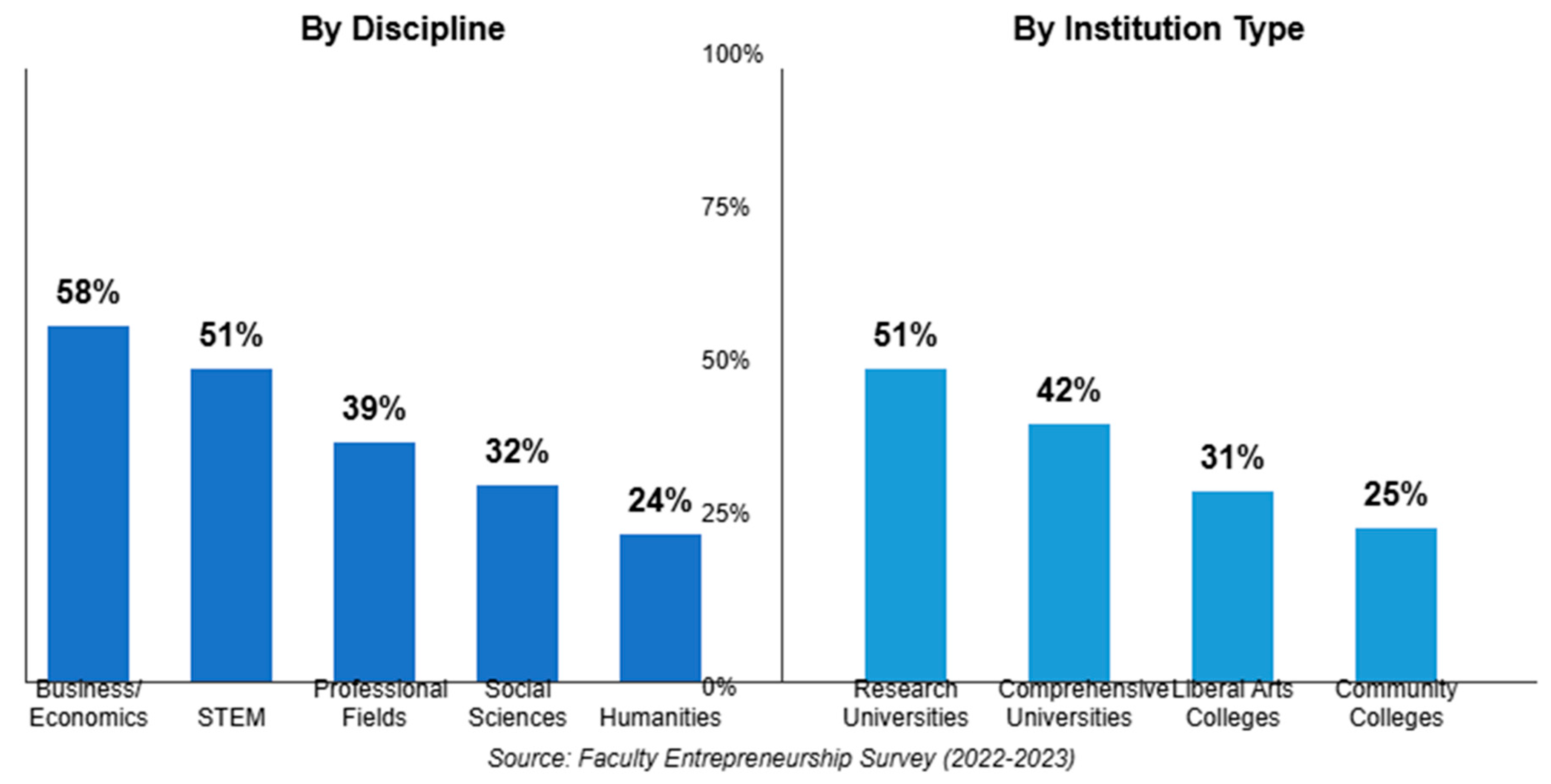
Figure 2.
Annual Entrepreneurial Income Distribution Among Faculty Entrepreneurs.
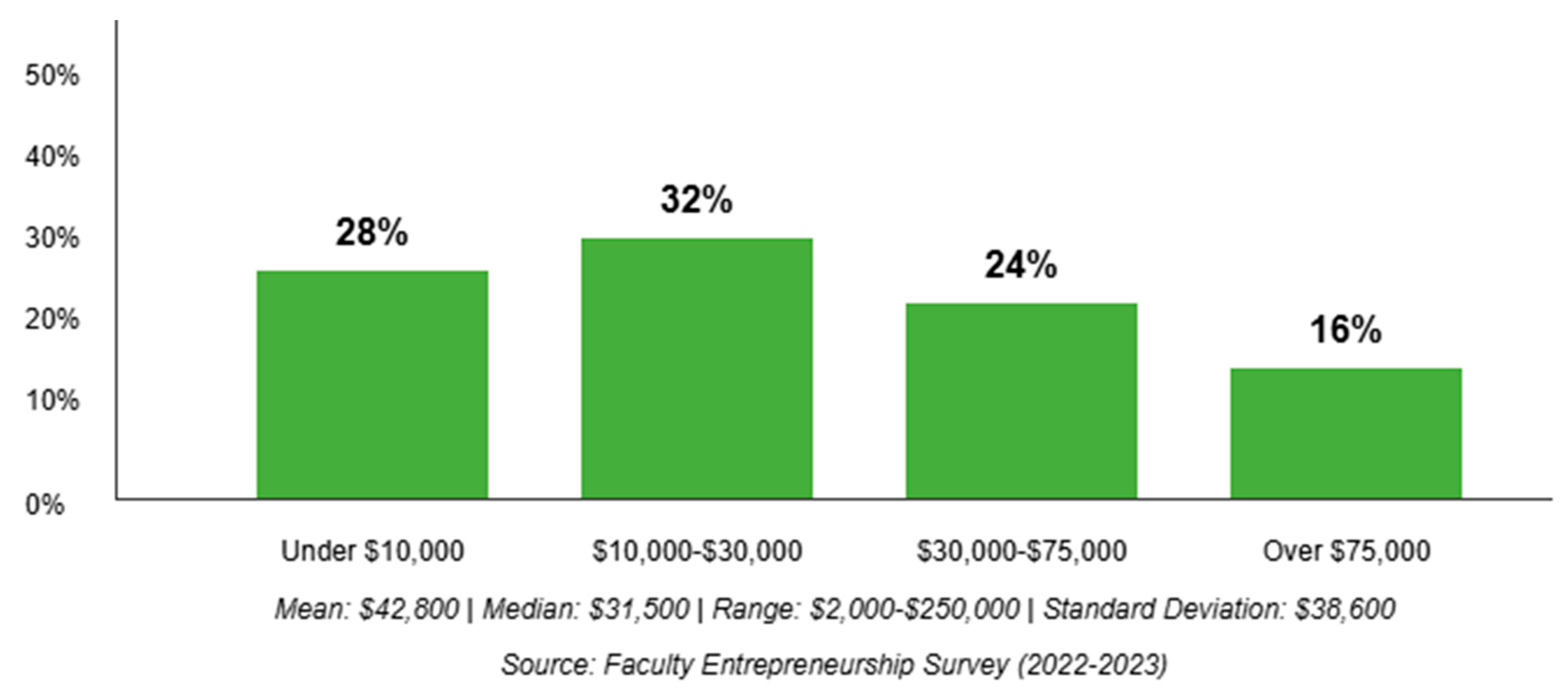
Figure 3.
Reported Benefits of Faculty Entrepreneurship.
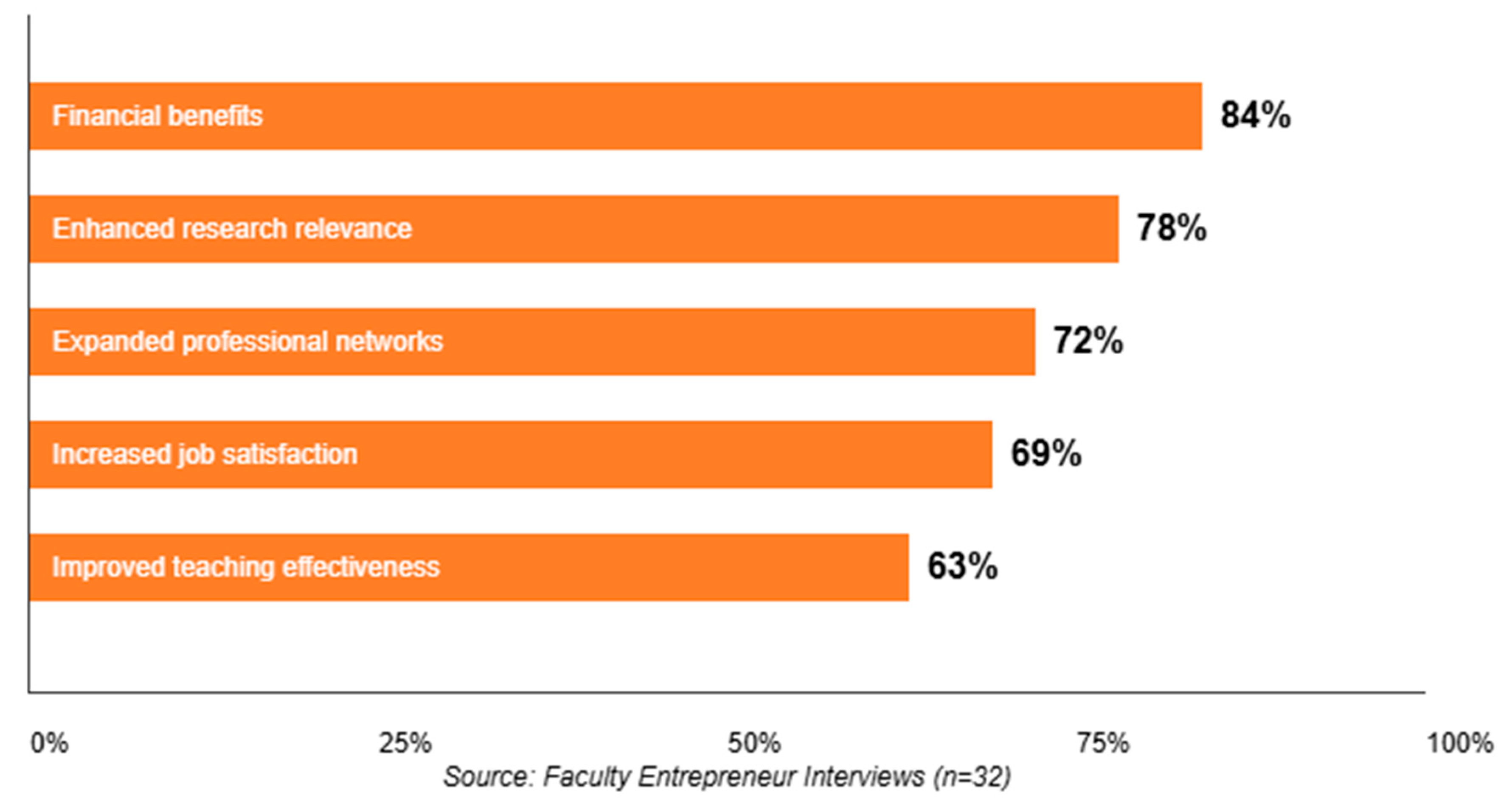
Figure 4.
Reported Institutional Barriers to Faculty Entrepreneurship.
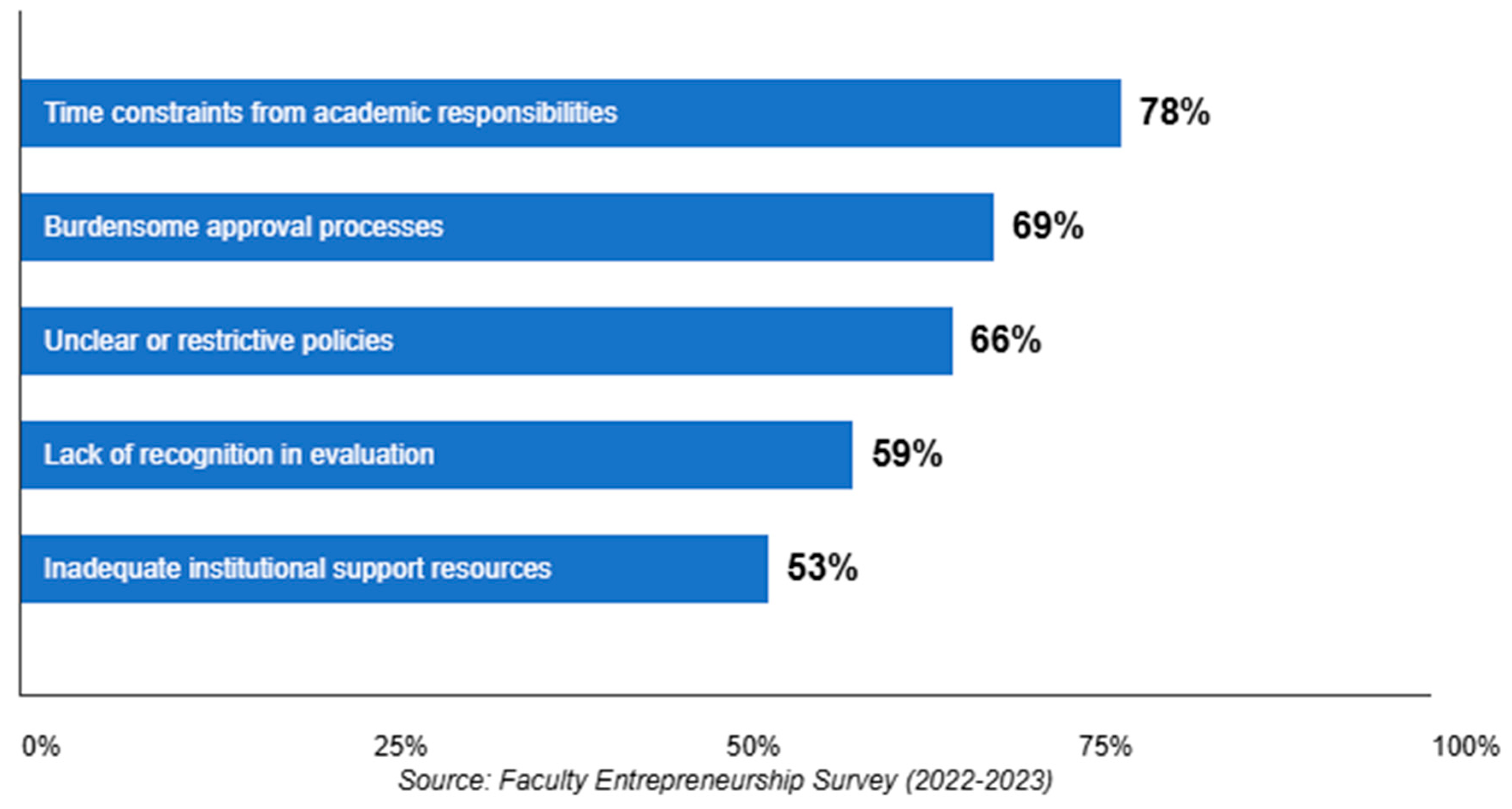
Figure 5.
Reported Institutional Barriers to Faculty Entrepreneurship (n=246).
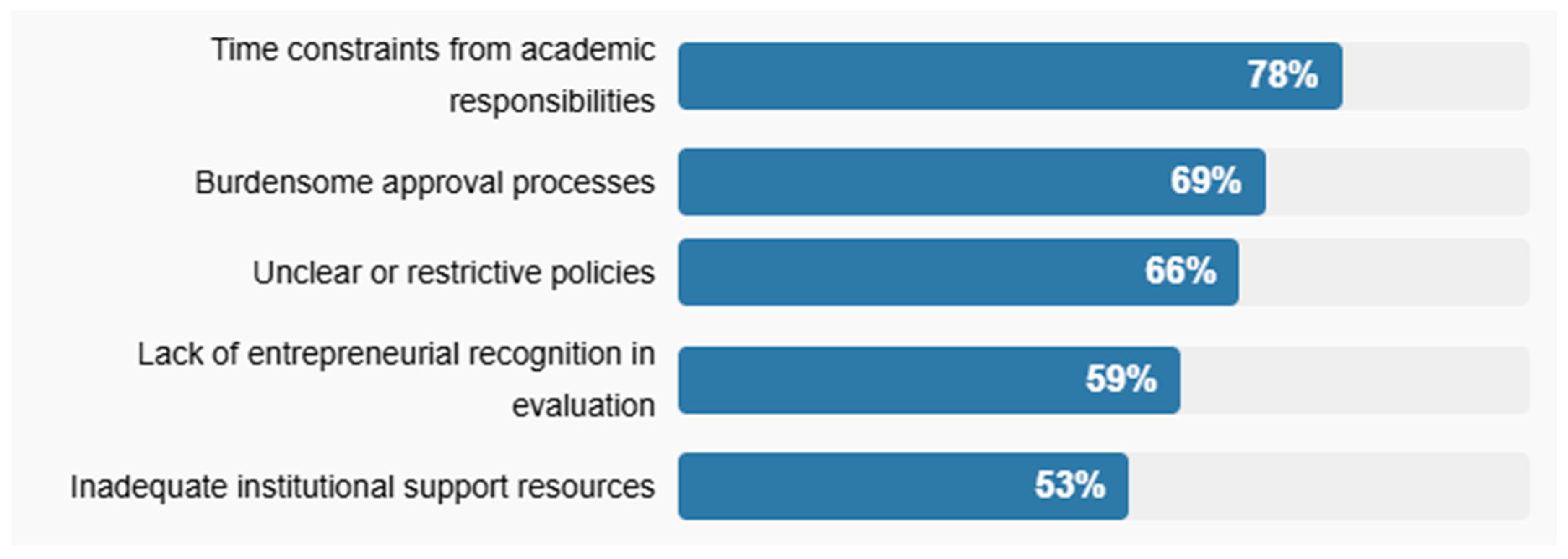
Figure 6.
Ethical Decision Framework for Faculty Entrepreneurs.
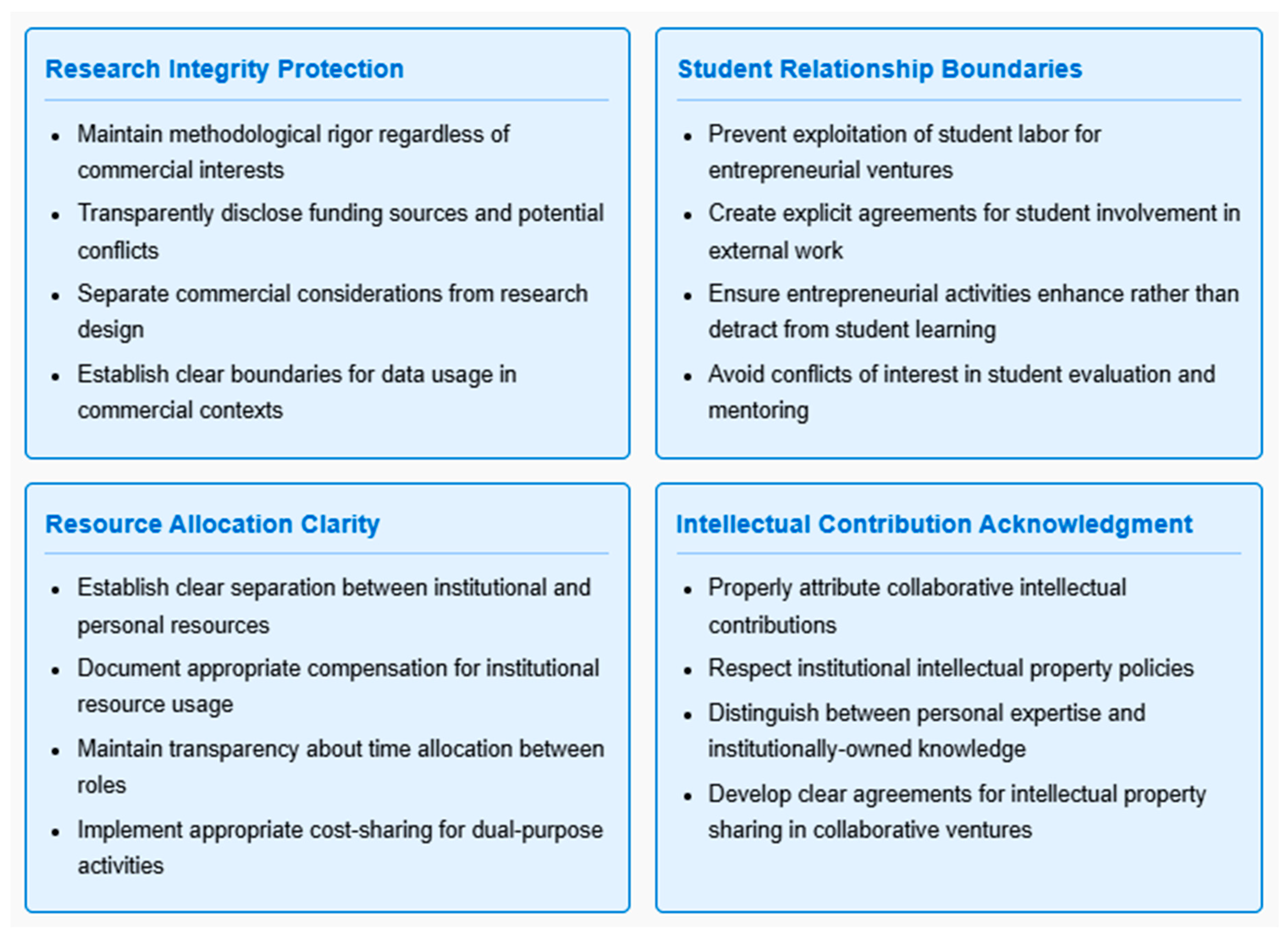
Figure 7.
Faculty Entrepreneurship Process Model.
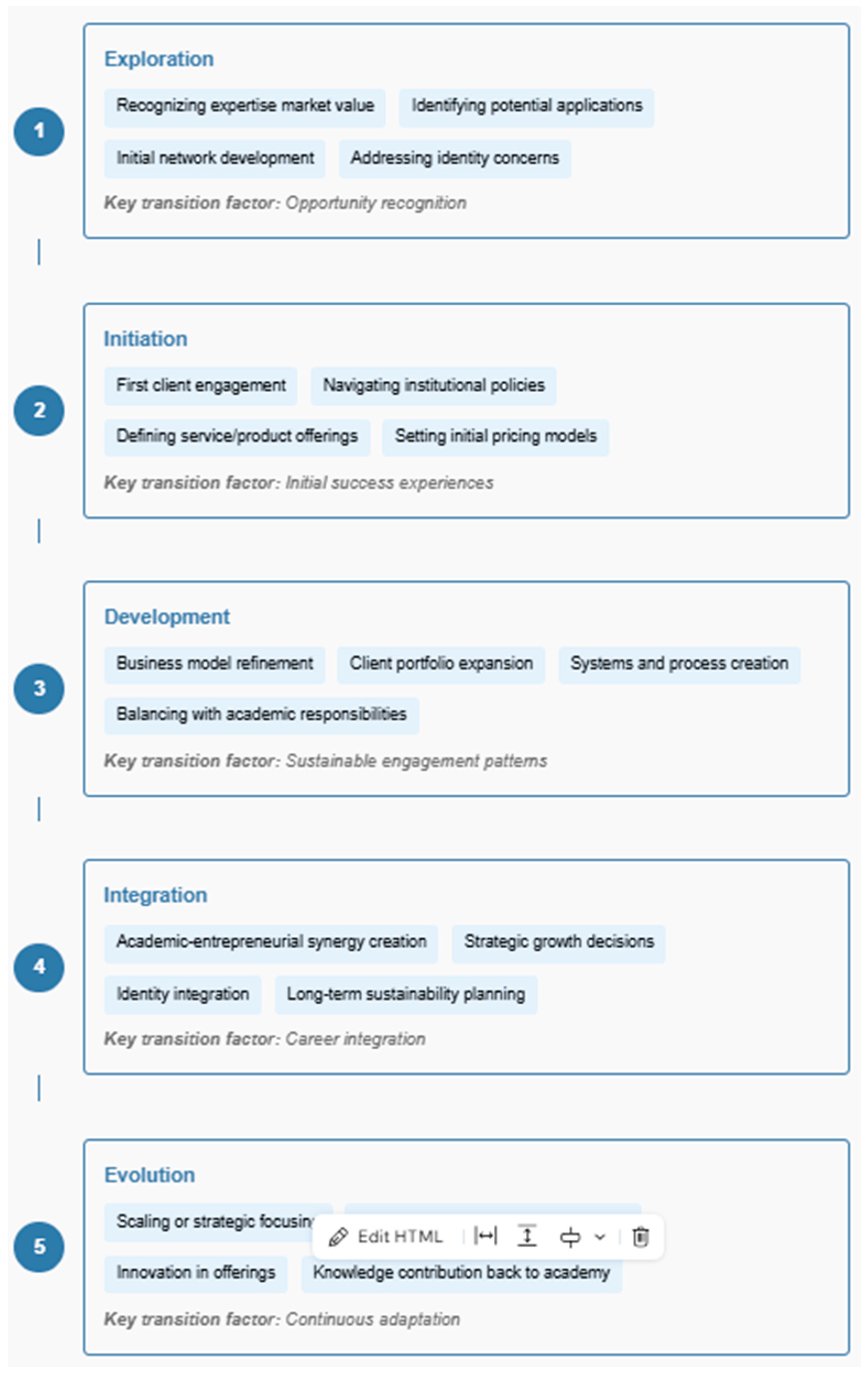

Table 1.
Conceptual Framework Distinguishing Faculty Entrepreneurship.
| Concept | Primary Focus | Institutional Involvement | Typical Activities |
| Faculty Entrepreneurship | Application of faculty expertise | Variable, often limited | Consulting, speaking, content creation |
| Technology Transfer | Commercialization of research outputs | High, often led by institution | Patents, licensing, spinoff companies |
| Academic Capitalism | Institutional market behaviors | High, institutionally driven | Research commercialization, industry partnerships |
| Knowledge Exchange | Bidirectional knowledge flows | Moderate to high | Collaborative projects, community engagement |
Table 2.
Types of Institutional Policies.
| Policy Approach | Characteristics | Benefits | Limitations |
| Restrictive | Tight time limits, extensive approval processes, default skepticism | Clear boundaries, minimal conflicts | Discourages engagement, drives covert activity |
| Permissive | Minimal restrictions, limited oversight, high autonomy | Encourages entrepreneurship, reduces barriers | Potential for conflicts, institutional risk |
| Managed Engagement | Clear parameters, streamlined processes, supported autonomy | Balances engagement and oversight, clarifies expectations | Requires administrative infrastructure, ongoing monitoring |
Table 3.
Entrepreneurial Readiness and Alignment Diagnostic Framework.
| Assessment Dimension | Key Questions to Consider |
| Expertise Marketability | - Does your expertise address specific external needs? - Can you articulate clear value propositions? - Is there evidence of market demand? |
| Personal Readiness | - Do you have capacity alongside academic responsibilities? - Are you comfortable with business development activities? - How will entrepreneurship affect work-life balance? |
| Institutional Context | - What policies govern outside activities? - How will entrepreneurship affect promotion/tenure? - What support resources are available? |
| Complementarity | - How will entrepreneurial work enhance research/teaching? - Can activities create student opportunities? - Will activities build valuable networks? |
| Ethical Alignment | - Can you manage potential conflicts of interest? - How will you maintain academic integrity? - Are proposed activities aligned with institutional mission? |
Table 4.
Institutional Readiness Assessment for Faculty Entrepreneurship Support.
| Dimension. | Key Indicators | Assessment Questions |
| Policy Environment | Clarity, flexibility, support orientation | - Do policies explicitly support knowledge application? - Are approval processes streamlined and transparent? - Do policies address diverse entrepreneurial forms? |
| Recognition Systems | Evaluation criteria, advancement processes | - Do P&T guidelines recognize entrepreneurial impact? - Are entrepreneurial activities valued in annual reviews? - Is entrepreneurial mentoring rewarded as service? |
| Support Infrastructure | Resources, programs, administrative support | - Are entrepreneurial development programs available? - Is specialized support provided for different disciplines? - Are administrative resources allocated to support entrepreneurship? |
| Cultural Factors | Leadership messaging, success celebration, norms | - Do leaders actively promote knowledge application? - Are entrepreneurial successes celebrated? - Is entrepreneurship respected across disciplines? |
| Equity Systems | Access initiatives, barrier reduction, monitoring | - Are entrepreneurial barriers for underrepresented faculty addressed? - Are support resources equitably distributed? - Is demographic participation monitored and improved? |
Disclaimer/Publisher’s Note: The statements, opinions and data contained in all publications are solely those of the individual author(s) and contributor(s) and not of MDPI and/or the editor(s). MDPI and/or the editor(s) disclaim responsibility for any injury to people or property resulting from any ideas, methods, instructions or products referred to in the content. |
© 2025 by the authors. Licensee MDPI, Basel, Switzerland. This article is an open access article distributed under the terms and conditions of the Creative Commons Attribution (CC BY) license (http://creativecommons.org/licenses/by/4.0/).
Copyright: This open access article is published under a Creative Commons CC BY 4.0 license, which permit the free download, distribution, and reuse, provided that the author and preprint are cited in any reuse.


