

Submitted:
16 February 2025
Posted:
17 February 2025
You are already at the latest version
Preprints on COVID-19 and SARS-CoV-2
Abstract
The COVID-19 pandemic has severely impacted micro-enterprises, key drivers of developing economies, by causing financial instability, market uncertainty, and operational disruptions. These challenges highlight the urgent need for strategic adaptability and resilience. This study explores Strategic Entrepreneurship by integrating environmental, organizational, and individual dimensions into a framework that captures opportunity-seeking and profit-seeking behaviors. Specifically, this research examines the effects of Knowledge Management Capability (KMC) on Entrepreneurial Orientation (EO), Entrepreneurial Finance (EF), Entrepreneurial Marketing (EM), and Business Resilience (BR), as well as the impact of EO, EF, and EM on BR. Using a quantitative approach, data were collected from 125 culinary micro-enterprises in Bandung, and analyzed using Partial Least Squares Structural Equation Modeling (PLS-SEM). The study findings revealed that KMC significantly influences EO, EF, EM, and BR. Furthermore, EO, EF, and EM contribute to strengthening BR, with EF emerging as the most influential factor, underscoring the critical role of financial strategy in sustaining micro-enterprises during the crisis. This study refines the Strategic Entrepreneurship model, bridging entrepreneurship and strategic management, and providing empirical insights from an emerging economy. From a policy perspective, the findings advocate for inclusive financial policies, digital knowledge-sharing infrastructures, and capacity-building initiatives to support micro-enterprises in navigating future disruptions.
Keywords:
knowledge management capability
; entrepreneurial orientation
; entrepreneurial finance
; entrepreneurial marketing
; business resilience
; culinary micro-entreprises
1. Introduction
The COVID-19 pandemic has caused widespread disruptions globally, resulting in substantial changes and posing serious challenges to the sustainability and growth of businesses. The disruption primarily stems from government policies in countries affected by the pandemic, which have introduced various restrictions on community activities. These measures include widespread lockdowns, travel and mobility restrictions, enforced quarantines, limitations on public gatherings, and constraints on MICE (meetings, incentives, conventions, and exhibitions) events. Consequently, several businesses have been forced to temporarily halt their operations due to regulatory constraints and operate with reduced capacity [1].
In this context, businesses across the globe have reacted in various manners [2,3]. According to [4], the pandemic has caused substantial changes in mobility, international trade, consumption patterns, and lifestyle norms. Company has also encountered limited operational hours, decreased client base, diminishing revenues, and employee disengagement [5]. Various strategies employed by individuals and governments to mitigate the impact of the pandemic have been extensively [4,6]. However, much of this research focuses on economic effects at the national level or under specific conditions, predominantly in industrialized nations like the United States [6]. In contrast, there remains a noticeable gap in studies examining the pandemic’s impact on businesses in developing countries [5]. This gap highlights the urgency of research on entrepreneurship in these regions, given the complex interplay of factors that shape entrepreneurial activities in developing economies [7].
Micro, Small, and Medium Enterprises (MSMEs) play a crucial role in driving Indonesia’s economic growth as a developing country, accounting for 99% of all business entities. According to data from the Indonesian Chamber of Commerce and Industry, in 2023, the number of MSME actors reached approximately 66 million, contributing 61% to Indonesia’s Gross Domestic Product (GDP), equivalent to IDR 9,580 trillion, and employing around 117 million workers, representing 97% of the total workforce. A micro-enterprise, as outlined in Government Regulation No. 7 of 2021 on Micro, Small, and Medium Enterprises, is defined as a business entity with an annual turnover of up to IDR 2,000,000,000 (two billion rupiahs) and a maximum capital of IDR 1,000,000,000 (one billion rupiahs), excluding the value of land and buildings used for business operations.
In the 2021 Taste Atlas Awards, Bandung was awarded fifth position in the category of “Best City in Asia for Traditional Food.” The number of domestic and international travelers visiting the city has been increasing at a rapid pace throughout history. However, the pandemic in 2019 precipitated a precipitous decline. The data on tourist arrivals in Bandung shows that foreign tourists decreased by 88.05% from 252,842 in 2019 to 30,210 in 2020. Similarly, the number of domestic tourists decreased by 60.7% from 8,175,221 in 2019 to 3,214,390 in 2020. In 2022, tourism remained the largest contributor to the Regional Original Income (PAD), generating a total revenue of IDR 708,203,430,685, as reported by the Bandung City Tourism Office. The culinary sector emerged as the most significant contributor within this, with a total of IDR 334,973,160,369.
The pandemic has severely affected many culinary micro-enterprises, which accounts for their considerable contribution. Culinary micro-enterprises represent 48.57% of the MSMEs in Bandung. According to the Cooperatives and Micro, Small, and Medium Enterprises Service, the number of MSMEs grew by 351.33% (527 businesses) in 2018, compared to just 150 businesses in the previous year. This was succeeded by a decrease of 31.69% (360) and 25.55% (268) in 2019 and 2020, respectively. The number decreased by 60.97% (722) in 2022, despite a significant increase of 690.3% (1,850) in 2021.
In such a situation, companies must shift their focus from pursuing competitive advantage to ensuring their survival; every strategy they formulate should be tailored to support the recovery process during the crisis [8]. Understanding the post-crisis recovery processes of micro-entreprises is crucial as significant economic drivers and contributors to societal recovery [9,10]. Furthermore, the persistent impacts of the pandemic demand the adoption of innovative approaches across all aspects of entrepreneurial activities for micro-enterprises [11]. Businesses are increasingly accepting business resilience (BR) to recover from major disruptions [12]. This need for resilience is especially evident when dealing with unexpected events [13].
Exploring strategies to withstand sporadic crises and effectively address regular hazards is a crucial field of analysis. Company must develop resilient structures to successfully manage the obstacles [14]. This supports the ability to withstand market or environmental disruptions while maintaining efficient resource allocation [15,16].
Entrepreneurial attitude must be possessed in the current competitive environment, which may be achieved by the strategic selection and implementation of initiatives. This mentality embodies a conceptualization of business and the potential that exploits the benefits of unpredictability [17]. [18] suggest that entrepreneurial attitudes can be strengthened through strategic behaviors that maximize opportunities and build a sustainable competitive advantage for the future. The integration of entrepreneurship with strategic management is often regarded as a hallmark of global transformation, particularly in emerging economies [19,20].
Entrepreneurship scholars highlight the importance of Strategic Entrepreneurship (SE) as an approach that integrates opportunity-seeking and advantage-seeking behaviors to enhance business resilience. Prior research suggests that firms leveraging SE principles were better able to withstand economic downturns, such as during the 2008 financial crisis ([18] and the COVID-19 pandemic [21]. These studies highlight the role of adaptability and strategic resource allocation in fostering resilience [17].
This perspective combines elements from entrepreneurial orientation (EO), entrepreneurial finance (EF), and entrepreneurial marketing (EM) with knowledge management capability (KMC) as a core driver of long-term sustainability. However, existing research primarily focuses on large firms or developed economies, leaving a gap in understanding how micro-enterprises in emerging markets navigate crises through SE strategies. Recent studies highlight the lack of empirical research on how micro-enterprises in developing economies apply SE principles to overcome economic shocks. For instance, [21] discusses the role of entrepreneurial strategies in crisis management, while [22] emphasizes the importance of knowledge-based entrepreneurship in fostering resilience among small businesses. These findings underscore the need for further investigation in this area.
This study aims to advance the understanding of strategic entrepreneurship by integrating environmental, organizational, and individual dimensions into a dynamic framework. Specifically, this study aims to analyze the impact of Knowledge Management Capability (KMC) on entrepreneurial orientation (EO), entrepreneurial finance (EF), entrepreneurial marketing (EM), and the influence of each of these variables on BR to determine the most important factors in micro-enterprise survival during crises.
2. Theoretical Background and Hypotheses Formulation
The model built through the theory of strategic entrepreneurship is appropriate for connecting and knowing the extent of the influence of the capabilities owned by the company when implemented through the entrepreneurial process in producing the goals that the company wants to achieve. This developing and dynamic field of research necessitates a more complete model of strategic entrepreneurship to include multidimensional and larger domains in sustainable development. The diverse range of disciplines, functions, and contexts in entrepreneurship research creates substantial possibilities for exploring several levels of complexity [23]. Meanwhile, the notions of actions and strategic management are complementary rather than interchangeable [24,25]. Within strategic framework, entrepreneurial activities are essential for identifying and leveraging the most suitable opportunities to gain a competitive advantage [17]. The core aim of entrepreneurial endeavors is to identify and actively pursue opportunities [26], whereas the primary focus of strategic management lies in creating competitive advantages and generating wealth [17]. Strategic entrepreneurship combines both. According to [27], the strategic entrepreneurship framework consists of three key components: resource or factor inputs, the resource orchestration process, and the resulting outcomes.Research manuscripts reporting large datasets that are deposited in a publicly available database should specify where the data have been deposited and provide the relevant accession numbers. If the accession numbers have not yet been obtained at the time of submission, please state that they will be provided during review. They must be provided prior to publication.
The first step includes the identification of the resources or elements that function as inputs to the strategic entrepreneurship process. These can include environmental variables and resources inside a company. The focus of this research is on KMC, an organizational resource serving as the essential basis for the entrepreneurial process. The strategic philosophy of knowledge management has been prominent in allowing company to cultivate the necessary skills to effectively traverse the growing dynamism and uncertainty of the business environment [28]. Knowledge management capability is developed through the foundation of infrastructure and the implementation of effective processes [29]. Despite the relatively recent inception [30], the notion of knowledge management capability has rapidly attracted the interest of managers and scholars from many fields who acknowledge the importance as a subject of corporate interest [31]. This is seen as an innovative feature in the domains of management and new subfield of specialization [32]. In the modern economy, organizational competitiveness has shifted from relying on physical and tangible assets to emphasizing knowledge as its foundation [33]. Businesses that can efficiently use the information inherent in the organizations and implement the concept in operations, manufacturing, and services acquire a competitive advantage. As a result, managing knowledge effectively is emerging as a critical component of organizational operations [34].
The second step of the process, known as resource orchestration, includes measures implemented to enable the efficient administration of resources [17]. This includes organizing the resource portfolio, integrating resources, and maximizing capabilities [35]. These activities include the systematic arrangement of resources, integration into capabilities, and utilization to generate value for consumers through the principles of entrepreneurial orientation (EO), entrepreneurial finance (EF), and entrepreneurial marketing (EM). These variables function as mechanisms that use information to propel strategic activities. In the strategic entrepreneurship model, EO serves as the fundamental basis that directs the utilization of other resources and skills. However, the variable can also be regarded as a component of a dynamic process including continuous activities in the execution of entrepreneurial plans. EO is evident in the leadership style of business owners [36].
The selection of EO, EF, and EM as variables for the orchestration process of the strategic entrepreneurship model was based on multiple factors. [37,38] highlight that businesses adopting an entrepreneurial approach often attain higher levels of performance. EO assesses the degree of entrepreneurial involvement in activities such as innovation, proactive behavior, and risk-taking [39,40,41]. Effective implementation mitigates the likelihood of operational failure [42] and confers a competitive edge [43]. In addition, the presence of financial resources is essential for achieving business success. Sufficient financial resources positively influence the viability of innovation and enhance the efficiency of organizational operations [44].
The probability of successful innovation in small company is also enhanced by a robust finance structure to stimulate economic growth. In contrast, inadequate finance systems lead to a state of inactivity, rendering several MSMEs incapable of engaging in competition [45]. EF is crucial for improving entrepreneurial performance [46]. EM has become a convincing alternative because of the foundation in the theory and practice of company functioning in highly uncertain environments [47]. The concept is an expanding area receiving a substantial acknowledgment [48,49]. Meanwhile, EM shows the interconnection of entrepreneurship, marketing, and innovation [50].
Concerning the third step, the processes and actions influencing strategic entrepreneurship lead to variety of potential outcomes to enhance the wealth of the owners Within this framework, supplementary economic activities, such as job creation, technological progress, and economic stability and growth, are positively influenced, thereby contributing to societal benefits. Additionally, social benefits may arise [17], with competitive advantage serving as the ultimate objective. Businesses that fail to establish a competitive advantage are unlikely to attain business resilience (BR). The critical role of innovation in the global economy, the contribution of entrepreneurial activity to economic development, and the essential function of strategic management in ensuring survival and achieving success collectively underscore the growing relevance of strategic entrepreneurship in contemporary discourse [17].
2.1. Knowledge Management Capability (KMC) as an Independent Variable
This research considers knowledge management capability (KMC) as an input and independent variable. KMC represents a business resource that equips organizations with the ability to innovate, demonstrate proactivity, and take calculated business risks [51,52]. Existing research on EO in micro and small businesses have identified innovation, proactivity, and risk-taking as crucial elements for the success of company in competitive economic conditions [38,53,54]. According to [38], company effectively using knowledge-based resources and showing an entrepreneurial attitude can achieve strong performance. Similarly, [55] stated that resource capabilities were seen as valuable assets for participating in entrepreneurial activities. Corporate entities also obtain intangible knowledge assets for unique activities. [56]) reported that an inadequate allocation of resources and expertise within a company could affect the ability to fully and efficiently accept the entrepreneurial method.
KMC is the capacity to effectively manage knowledge by integrating the concept among members and coordinating individual activities [29]. In theory, [31] suggested that company using knowledge-based resources would achieve favorable outcomes by participating in competitive activities. Essential aspects of company performance should be enhanced by the development of effective knowledge management capability. In addition, learning effect should be conducted, which includes an increase in the capacity to generate value over time. Several research observed that KMC contributed to profitability, as evidenced by an increase in return on investment (ROI) and return on equity (ROE) [57,58]. The significance of KMC in improving the financial and non-financial performance of company, regardless of the scale, is shown by [59].
KMC enhances profitability and growth, promotes innovation, improves customer satisfaction, increases product or service quality, and provides greater flexibility in resource utilization for MSMEs [59]. The process of acquiring information on current customer demands, competitor strategies, and supplier capabilities contributes significantly to the generation of new knowledge. This improves the effectiveness and efficiency of company, resulting in non-financial improvements [60,61,62]. Additionally, knowledge resources are used to determine the necessary actions to mitigate risks when pursuing opportunities and minimizing potential financial losses [63].
Innovative products and services are offered to consumers by establishing, identifying, and updating knowledge base through KMC. Additionally, company is capable of capitalizing on the value of knowledge, which is essential for the promotion of innovative thinking and the stimulation of corporate investment [59]. The efficient and precise application of KMC provides a strategic competitive edge [64], empowering organizations to extract valuable lessons from past achievements, interpret competitor actions, and adaptively shape future strategies [65]. According to [47]), company that implements EM are capable of transforming resources into distinct advantages. Strong KMC are essential for the effective utilization of resources, even in the face of substantial constraints.
Within the framework of strategic management literature, KMC is defined as the infrastructure and processes employed to transform inputs into intended outcomes [66]. The development of the KMC concept offers a significant competitive edge, as knowledge has evolved into a strategic resource essential for building organizational capabilities [28]. Key benefits include the ability to commercialize innovative products, enhance coordination, and foster innovation. Additionally, it enables organizations to anticipate unexpected challenges, adapt to dynamic market conditions, and minimize redundancies in information and knowledge management. These advantages form a critical basis for assessing the contribution of KMC to organizational effectiveness [29], leading to the formulation of the following hypotheses.
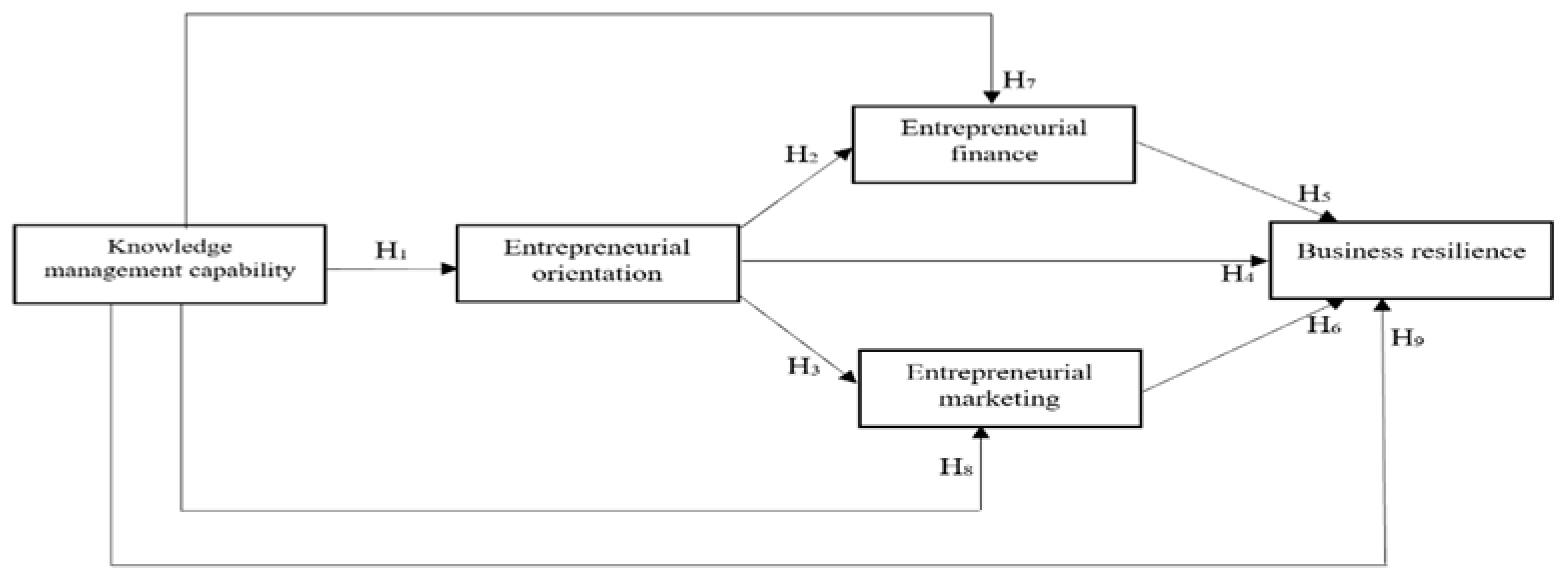
H1. There is a positive relationship between KMC and EO.
H7. There is a positive relationship between KMC and EF.
H8. There is a positive relationship between KMC and EM.
H9. There is a positive relationship between KMC and BR.
2.2. Entrepreneurial Orientation (EO) and Entrepreneurial Finance (EF)
[41] reported that EO introduced ’proactive’ innovations ahead of competitors, engaged in product market innovation, and conducted risky businesses [38]. This concept is the processes, practices, and decision-making methods used to act entrepreneurially, as stated by [67], who identified autonomy and competitive aggressiveness. These variables are perceived as strategic orientation reflecting the competitive strategies of a company, including risk-taking, innovativeness, proactiveness, competitive aggressiveness, and autonomy. Each dimension has the potential to fluctuate independently. The effort exerted to engage entrepreneurial behavior is referred to as EO [68]. Conversely, there is no agreement regarding the definition of EF. [69] explained the variable as a financial activity that combined proactive profit strategies, innovative investment, and hazardous financing to improve company performance. [70] defined the concept as a discipline that analyzed the mobilization and allocation of financial resources, risk management, and optimization of contracts to generate and enhance value within the context of entrepreneurship.
Numerous research emphasized the importance of EO in the context of organizational success. Company that adopts the concept [37,38] can take risks, act proactively, and innovate in strategic decision-making processes [39,40,41]. Additionally, the risk of business failure is reduced and competitive advantage can be enhanced through the appropriate implementation of EO [42,43]. The propensity for risk-taking is a critical aspect of the variable at the organizational level. This is connected to the readiness to allocate considerable resources to company with the potential for high returns but associated with high risk [71]. [72] reported that organizations prioritizing risk established a competitive advantage or acquired new capabilities. [73] also stated that proactive company pursued funding opportunities by adopting a more strategic method to financial resource management. Conversely, smaller and financially fragile businesses are more prone to closures or major economic disruptions [74,75,76].
The financial decision-making process is more flexible with autonomy within EO. Autonomous entrepreneurs have greater flexibility in determining financing strategies that are consistent with the vision stated. [67] showed that autonomy facilitated the implementation of more rapid financial decisions and improved the ability to adapt to market fluctuations.
H2. There is a positive relationship between EO and EF.
2.3. Entrepreneurial Orientation (EO) and Entrepreneurial Marketing (EM)
EO and EM are two concepts closely interconnected in the field of entrepreneurship. EM is a marketing strategy that incorporates entrepreneurial principles to identify and capitalize on market opportunities. [47] defined the concept as the marketing process of a company that prioritized the identification and utilization of opportunities in uncertain environments in the presence of resource scarcity. In this context, proactive company recognizes and capitalizes on developing market opportunities. [47]) also emphasized that the capacity to take advantage of market gaps and develop market-leading strategies was closely associated with proactivity, as opposed to adhering to established trends.
Company with a high degree of EO implemented audacious and risky strategies, such as entering new markets or experimenting with untested methods. [71] observed that risk-taking was essential to EO since the variable motivated company to experiment with inventive strategies. Autonomy empowers individuals or marketing teams to implement innovative ideas without being impeded by bureaucratic procedures. [67] reported that autonomy within EO enabled more rapid and adaptable responses to market changes and opportunities. Additionally, company showing robust competitive aggressiveness implements assertive marketing strategies to increase share. [77] stated that competitive aggressiveness could be a critical factor in outperforming competitors, particularly in saturated markets.
H3. There is positive relationship between EO and EM.
2.4. Business Resilience (BR) as a Dependent Variable
Resilience is a multidimensional and multidisciplinary concept that includes a variety of disciplines, such as economics, urban development, and business. Even though the concept was relatively new [78,79]). [80] suggested that resilience capacity was largely responsible for the ability to survive and flourish. This ability allows company to profit from circumstances with substantial negative consequences. Additionally, BR establishes a foundation for the development of adequate strategic diversity, which enables company to implement a diverse array of options and results. The variable also functions as a mechanism to make informed decisions among available alternatives [13].
Resilience refers to the ability to demonstrate resourcefulness by leveraging internal and external resources to address a wide range of contextual and developmental challenges [81]. This concept encompasses the capacity to adapt to ongoing risks while effectively withstanding and recovering from periodic disruptions [82]. It is characterized by two key dimensions: agility ([81] and organizational resilience ([83]).
According to [84], the most resilient company consistently maintains the dynamic equilibrium between four innovation strategies, namely entrepreneurship, exploration, knowledge management, and collaboration [46]. In the context of MSMEs, [38,54] emphasized that EO was a contributing factor to the ability to endure in competitive environments. To facilitate the accumulation of experience in managing failure, this orientation motivates company to implement more precise strategies when confronted with periodic crises [85]. The formulation of strategies designed to identify early warning signals of environmental changes is indicative of an EO [86]. This effective method identifies new opportunities for resource-constrained company, such as micro and small enterprises.
Company is capable of maintaining profitability and adapting strategies in response to unexpected obstacles through the effective utilization of capital [87]. [88] observed that larger MSMEs with greater access to financial resources tend to be more resilient during economic downturns. The availability of financial resources has been recognized as a pivotal element in enhancing the resilience of MSMEs [89]. Similarly, [90] reported that the financial position at the onset of an economic crisis was a more significant factor in determining resilience than age or size.
EM is defined by [91,92] as the process by which company pursues opportunities in uncertain market environments, frequently operating under resource constraints. In situations of substantial environmental change and restricted resources, this variable has been determined to be the most effective [93]. EM prioritizes innovative strategies for resource optimization, innovation, risk management, and value creation, adopting a “big picture” perspective. The variable collectively represents the diverse strategies and responses of MSMEs [94]. [95] also argued that EM was highly regarded by capitalists and particularly well-suited to smaller company. This is due to the variable’s significant influence on financial performance, which fosters the establishment of a robust and sustainable business, drives growth, and enhances customer satisfaction [96].
H4. There is a positive relationship between EO and BR.
H5. There is a positive relationship between EF and BR.
H6. There is a positive relationship between EM and BR.
Figure 1.
Conceptual Framework.
3. Research Methodology
3.1. Sampling and Data Collection
[97] emphasized that defining a clear target population was essential to ensure the accuracy of the selection and sampling processes. In this research, several criteria were established to identify culinary micro-enterprises suitable for inclusion in the population. These included 1) Registration with the Bandung City Cooperative and UMKM Service as a micro-enterprises operating in the culinary subsector of Bandung City between 2018 and 2023; 2) Having a maximum business capital of IDR 1,000,000,000 (one billion rupiah), excluding land and buildings designated for operational use, and generating annual revenue not exceeding IDR 2,000,000,000 (two billion rupiah); 3) Utilizing information and communication technology alongside digital financial tools (including social media platforms, e-commerce systems, and digital payment solutions); 4) Managing the business in a structured manner, including employing at least one staff member and executing management functions, and; 5) Having business partners or collaborators. Based on the criteria, 181 culinary micro-enterprises in the culinary subsector were identified as meeting the requirements for inclusion in the population.
Probability sampling was used, specifically adopting the simple random method. The Slovin formula, as referenced by [98], was utilized to determine the sample size, yielding a total of 125 culinary micro-enterprises as respondents. Meanwhile, data collection took place between November and December 2024 through surveys and distribution of questionnaires using Google Forms. The responses were measured on a five-point Likert scale, with values assigned as follows: 1 for Strongly Disagree, 2 for Disagree, 3 for Neutral, 4 for Agree, and 5 for Strongly Agree, allowing for a nuanced evaluation of participants’ perceptions.
For the analysis, Structural Equation Modeling (SEM) was adopted using Partial Least Squares (PLS) with the SmartPLS 3.0 software. This multivariate quantitative method was used to test different hypotheses related to the influence of a variable on another and to show the relationships [99]. Each variable was classified and presented in Table 1 to facilitate hypothesis testing.
3.2. Variables and Indicators
This research uses an independent variable namely knowledge management capability (KMC) [29], and four dependent variables, including entrepreneurial orientation (EO) [67], entrepreneurial finance (EF) [100], and business resilience (BR) [101]. The respondents were asked a total of 74 questions based on the five variables examined, as presented in Table 1.
4. Result
4.1. Respondent Characteristics
Respondent characteristics, including gender, age of the entrepreneur, educational background, type of business, number of employees, and duration of operation, are presented in Table 2. The results report that 73.6% and 26.4% of respondents are male and female, respectively. Therefore, male show resilience, perseverance, and patience in managing and sustaining businesses.
In the distribution of respondents, 34.4% are between the ages of 36 and 45, while 49.6% have completed a senior high school education in terms of educational heritage. This presents a challenge in enhancing the quality of human resources to support business growth by improving the capacity and skills required. The culinary cart businesses are the principal source of livelihood for 93 respondents, with 74.4% conducting the operation. In addition, 56% of respondents employ between one to three employees. The micro culinary company in Bandung City have persevered and thrived in the face of significant challenges since 48.8% have been in business for 7 to 13 years.
4.2. Outer Model Results
The outer model evaluation is performed to show that the measurement instruments are valid and reliable. A valid loading factor value exceeds 0.7 [102]. According to [99], certain indicators, including the knowledge-sharing reward system (X1.6) must be eliminated from the model due to loading factor of less than 0.5 (0.235). Subsequently, the model must be retested for convergent validity. In Figure 2, each indicator of the variables has a loading factor exceeding 0.5 since the validity test is satisfied.
The knowledge-sharing reward system indicator (X1.6) was regarded as less suitable for micro-enterprises by respondents, primarily due to limited financial resources. This is consistent with [103], where formal human resource management practices, such as reward systems, are frequently disregarded. Short-term results and business sustainability are the primary objectives of company, as opposed to structured human resource development. Furthermore, Table 3 presents the outcomes of the Fornell-Larcker criterion analysis, which indicates that the square root of the Average Variance Extracted (AVE) should surpass the correlations with other constructs to ensure discriminant validity [104].
According to [99], Average Variance Extracted (AVE) represents the average variance of each measurement item contained within a variable and reflects the extent to which the variable, as a whole, can explain the variation in its measurement items. The recommended minimum AVE value is 0.50. The results show that the indicators for the variables KMC, EO, EF, EM, and RB have Cronbach’s alpha values above 0.7. Similarly, the composite reliability values for all variables in this study exceed 0.7. [105] states that to achieve good reliability, both composite reliability and Cronbach’s alpha values must be greater than 0.7.
The outer model evaluation was conducted using a variety of criteria, such as the loading factor, AVE, cross-loading, Cronbach’s alpha, and composite reliability as shown in Table 4. The constructs are accurately measured by the indicators designated for each variable, which show strong reliability. Therefore, the subsequent phase of the research process includes the assessment of the interior model.
4.3. Inner Model Results
The inner model evaluation referred to as structural analysis, is performed to guarantee the accuracy and robustness of the structural model developed. A method known as robust regression is implemented when the data contains irregular errors or anomalies with the potential to distort the model [106]. This method is essential for the analysis of data impacted by outliers, allowing for the creation of a model impervious to anomalies. Inner model evaluation can be seen from several indicators including: Coefficient of Determination (R²); Predictive Relevance (Q²); and Goodness of Fit Index (GoF) as shown in Table 5.
The predictive relevance test (Q²) is designed to evaluate whether the model demonstrates good predictive capability. The Q-square test in Smart-PLS can be performed using the blindfolding procedure. The Q-square test results indicate that if Q² > 0, the variables and data utilized in the study effectively predict the model; conversely, if Q² < 0, the variables and data fail to predict the model adequately [105]. According to Table 5, the R-square test result for the business resilience variable is 0.603, indicating a moderate level but on the brink of strong. This suggests that KMC, EO, EF, and EM account for 60.3% of the variance in BR, while the remaining 39.7% is attributed to external variables. EF has the second-highest R² value at 0.534, classified as moderate. This implies that KMC and EO can account for 53.4% of the variance in EF, while the remaining 46.6% is attributed to external variables.
The predictive capability of the model is evaluated using Q² test. The blindfolding procedure is used to administer Q² test in SmartPLS. A Q² value greater than 0 suggests that the variables and data have a high degree of predictive power. Meanwhile, Q² value less than 0 shows that the model is not predictively accurate ([105]. The Q² values for all variables are greater than 0, signifying that the model is well-predicted. [99] proposed a formula for calculating the GoF index. The square root of the average communalities and R² values are used to determine GoF.
[107] defined small, medium, and large GoF values as 0.1, 0.25, and 0.38 or higher, respectively. The GoF value was 0.565, suggesting that the model accurately showed the real-world phenomenon. A total of 9 hypotheses comprise the path coefficient results, which evaluate the direct impact of independent variables on the dependent. The f-square test also referred to as the effect size, is used to assess the intensity of the direct influence at the structural level. According to [99], F-square values of 0.02, 0.15, and 0.35 were considered to indicate small, medium, and large effects, respectively. The second hypothesis has the highest path coefficient, with a value of 0.547, quantifying the concept for the high effect size category. This is succeeded by the initial hypothesis classified as having a high effect size with a value of 0.544. The eighth hypothesis has the third-highest path coefficient of 0.422 in the moderate effect size category. Meanwhile, path coefficient values of 0.287, 0.271, 0.259, 0.245, 0.227, and 0.181 are assigned to the remaining hypotheses five, seven, six, three, four, and nine classified as having a small effect size. These results suggest that variables in the model have positive path coefficients. Therefore, the stronger the influence of a specific independent variable on the dependent, the greater the path coefficient value.
In the first hypothesis, entrepreneurial orientation (EO) is positively and significantly influenced by knowledge management capability (KMC), as evidenced by a p-value of 0.000, which is less than the threshold of 0.050 (Table 6). This supports the initial hypothesis by confirming a positive and substantial relationship between KMC and EO. These results were consistent with [51,52], where KMC was an entrepreneurial resource enabling the company to innovate, take proactive measures, and accept risk. The second hypothesis test also shows that entrepreneurial finance (EF) is significantly and positively influenced by EO, with a p-value of 0.000. This hypothesis is confirmed because the p-value is less than 0.050, with a significant and positive relationship. According to [108], resource enhancement, particularly in the context of finance, is a fundamental aspect of EO. Entrepreneurs continue to confront a significant obstacle in the form of capital access essential for the establishment and expansion of company.
The third hypothesis shows that EO has a positive and significant impact on entrepreneurial marketing (EM), with a p-value of 0.001. This relationship is also considered positive and significant since the p-value is less than 0.050. The results are consistent with [67], where innovativeness is indicative of an inclination to investigate novel concepts, experiment, as well as create novel products and processes. According to the fourth hypothesis, EO has a statistically significant and positive impact on BR, with a p-value of 0.005. The fourth hypothesis is adopted since the value is less than the 0.050 threshold. According to [38,54], the EO of SMEs is a significant factor in the ability to withstand competitive environments.
The fifth hypothesis suggests that EF has a positive and significant impact on BR, with a p-value of 0.001). This confirms a positive and significant relationship between EF and BR, supporting the fifth hypothesis since the p-value is less than 0.050. The results were consistent with [89], which emphasized the significance of access to finance in improving resilience. Similarly, [88] reported that larger MSMEs with improved financial access were more resilient during economic downturns. The sixth hypothesis shows that EM has a positive and significant impact on BR, with a p-value of 0.000 less than 0.050. According to [109], EM assists organizations in evaluating the environment and comprehending the changes from external disruptions to devise suitable countermeasures.
The seventh hypothesis reports that EF is positively and significantly influenced by KMC, with a p-value of 0.000. This hypothesis is supported since the p-value is less than 0.050. [59] showed the importance of KMC in improving the financial and non-financial performance of company, including large company and MSMEs. The eighth hypothesis reported that KMC had a significant and positive impact on EM, with a p-value of 0.000. This hypothesis is adopted since the p-value is less than 0.050. [59] stated that KMC offered innovative products and services to consumers to create, identify, and update knowledge base. The variable advocates for the recognition of knowledge, which is a crucial element in the promotion of innovative thinking and the direction of corporate investment. The ninth hypothesis shows that KMC has a significant and positive impact on BR, as evidenced by a p-value of 0.009. The hypothesis is adopted since the p-value is less than 0.050. This discovery is consistent with the research conducted by [28], where the development of KMC can offer a competitive advantage and contribute to the long-term survival of a company.
5. Discussion
In micro and small enterprises, knowledge management capability (KMC) is administered humanistically, and the technology used is classified as non-automation. KMC variable encompasses two dimensions: knowledge management infrastructure and knowledge management processes [29]. Knowledge management infrastructure is a repository of information accumulated over the course of company history and can be used to inform contemporary decision-making [110].
Knowledge management capability should be analyzed in the context of company capabilities, with infrastructure functioning as a fundamental building block [111]. Errors are the most evident sub-dimension of company culture, as evidenced by the indicators, according to the descriptive analysis. In a competitive market with limited resources, micro-enterprises frequently experience substantial pressure to survive. In this context, the capacity to learn from errors is an essential distinguishing characteristic. Owners and employees of culinary micro-enterprises who adopt the concept regard errors in recipes, customer service, or marketing strategies as valuable learning opportunities. [29] reported that errors were considered essential inputs for performance enhancement, innovation, and learning. The knowledge management process, on the other hand, is an integral part of a company’s business operations that transforms individual knowledge into organizational knowledge. This knowledge can be widely shared across the organization and effectively applied [59]. Conversely, individuals who withhold knowledge can obstruct the flow of valuable information, hinder collaboration, and stifle innovation, making it essential for organizations to address knowledge hiding in order to foster an entrepreneurial climate that encourages knowledge sharing, teamwork, and innovative efforts [112].
The most influential sub-dimension is the application sub-dimension, specifically the capacity to coordinate activities. [29] identified knowledge application as a critical factor in the transformation of the concept into tangible value. [28] analyzed the concept by emphasizing the significance of using knowledge to improve efficiency and productivity. Micro-enterprises can enhance competitiveness and resilience by efficiently leveraging knowledge to streamline and optimize operations, thereby saving time, resources, and costs. For instance, the reduction of waiting times and the improvement of customer satisfaction are achieved by streamlining service processes, automating order-taking, or using fundamental technology to expedite payments. Culinary micro-entrepreneurs must prioritize the sub-dimension of knowledge protection within the knowledge management process. There is a limitation of policies and procedures to protect knowledge from theft, unlawful exploitation, or improper use. However, knowledge protection is crucial when knowledge is utilized to create or sustain a competitive advantage [113].
Significant academic interest has been generated by research on the impact of KMC to enhance entrepreneurial characteristics. [114] reported that KMC enabled company to offer the knowledge resources required to identify and capitalize on new business opportunities. Entrepreneurial training and capacity enhancement should focus on equipping business owners with effective knowledge management strategies. This approach ensures that they are capable of mentoring and passing down their unique expertise to succeeding generations, thereby safeguarding the continuity of essential practices [115].
Company can be more innovative and responsive to market changes with the implementation of a robust knowledge management system. This was evident during the pandemic, when online sales increased the income of culinary micro-entrepreneurs. The success of micro-entrepreneurs is attributed to the capacity to leverage a variety of e-commerce platforms, including Shopee Food, GrabFood, GoFood, and Instagram. The use of social media platforms for customer information and knowledge sharing has a positive effect on the growth of SME performance and profitability [116]. Employees can be educated on the utilization of best practices in work procedures, such as the development of visually appealing product images for online sales platforms or the utilization of profit-and-loss monitoring applications for cash flow management, by usign information obtained from YouTube, Google, and social media. Micro-enterprises respond to and recover from internal and external disruptions by developing innovative solutions to address competitive business challenges through the effective application of knowledge. Company must establish a structured framework for organizing, integrating, and disseminating knowledge, as these processes help minimize redundancy and replace outdated knowledge-both of which are crucial for attaining superior performance [62]. Entrepreneurs are the architects of capacity creation for productivity and growth [117].
Proactiveness, innovativeness, risk-taking, competitive aggressiveness, and autonomy are the five dimensions of entrepreneurial orientation (EO). The dimension of competitive aggressiveness is the most prominent in the investigation of culinary micro-enterprises, particularly as evidenced by indicators of outperforming competitors. [67] defined competitive aggressiveness as a propensity to directly and assertively challenge competitors to establish or preserve a market advantage. The indicator of outperforming the competition pertains to the degree to which the company endeavors to exceed the competitors in fields including innovation, pricing, service, and product quality. Aggressive pricing strategies, such as offering lower prices than competitors or substantial discounts, may be implemented by culinary micro-enterprises to attract additional consumers. For example, a food stall may provide exclusive discounts during specific hours to attract a greater number of customers than the adjacent competitors. There is autonomy to generate ideas, execute initiatives, and achieve desired results with minimal or no interference from senior management [67].
Micro-enterprises are frequently distinguished by the more flexible and straightforward company structures, which allow proprietors and employees to make decisions quickly without the need to navigate intricate bureaucratic procedures. Owners and employees can adapt to market fluctuations and customer preferences due to autonomy. For instance, new menu items or promotional campaigns may be promptly implemented. Autonomy also provides culinary micro-enterprises with the ability to more effectively adjust to changing environments, such as economic fluctuations or evolving consumer preferences. Micro-enterprises with high EO are innovative, consistently creating new products and services in line with the evolving requirements of the market. In uncertain conditions, innovation is essential for preserving competitiveness and relevance. Innovation through the introduction of new technologies and exploitation of new markets can create value for the company [118]. [119] reported that innovative strategies could lead to benefits, such as the successful implementation of new methodologies and technologies, enhanced performance, improved net profits, and increased revenue.
Culinary micro-enterprises have the opportunity to innovate through the creation of cakes with trendy cartoon character toppings, the provision of healthier menu options without sugar and flour, as well as the production of artisanal bread made from whole wheat and natural ingredients. Additionally, risk-taking is accepted as a critical element of EO since micro-enterprises must take significant risks to experiment with novel strategies or enter new markets [120]. Resilience is developed by consistently adapting and developing strategies to surmount obstacles facilitated by the capacity to take calculated risks and learn from failures. Flexibility and openness to new experiences is linked to independence, risk-taking, initiative and the entrepreneur’s desire to set up their own business [121].
Entrepreneurial finance (EF) is the only variable directly measured by its indicators. In this research, EF includes the acquisition of capital, as well as the effective management and utilization to guarantee the survival and development of a business. Risk management is identified as a critical element of EF for culinary micro-enterprises. These businesses maintain operational continuity and increase the resilience to economic challenges by identifying and mitigating financial risks. According to [41], risk management is a critical component of EF, allowing businesses to remain adaptable and resilient in the presence of economic and market uncertainty.
Culinary micro-enterprises must be proficient in the proactive identification of potential financial risks, including fluctuations in raw material prices, changes in government regulations, or shifts in consumer preferences. For instance, numerous culinary micro-enterprises have collaborated with raw material suppliers to mitigate the risk of supply disruptions, as evidenced by the COVID-19 pandemic, reducing reliance on a single source.
The implementation of EF strategy is distinguished by revenue diversification, long-term financial planning, and flexible cash flow management [100]. Financial hazards can have a more significant impact on micro-enterprises than on larger businesses due to limited resources [70]. Micro-enterprises can effectively navigate financial challenges and sustain operations due to increased access to capital. Therefore, these organizations are obligated to investigate a diverse array of funding alternatives, such as government-subsidized microloans, crowdfunding, and company capital. Resilience against business challenges can be enhanced to achieve operational continuity by implementing adaptive financial management strategies, securing access to alternative funding sources, and innovating financial management with risk recognition and mitigation.
Entrepreneurs must also be able to optimize financial contracts obtained either through banking, crowdfunding, or other investors. Maintaining their trust through timely loan installment payments and transparency of the company’s financial statements. Increasing value can be realized by updating the menu based on customer feedback, improving operational processes, or adopting technology for higher efficiency. Through EF, entrepreneurs can develop more effective and adaptive financial strategies, allowing them to overcome financing challenges and take advantage of existing growth opportunities [70]. EF helps in determining when and how to invest funds for expansion, product development, and operational improvements. This approach is not only helpful in the early stages of a business but is also essential for long-term sustainability and success.
In a fragmented and dynamic context, entrepreneurial marketing (EM) necessitates entrepreneurs to function as change agents and innovators [47]. The dimension of resource leveraging, specifically the indicator of assigning employees to multiple duties, was the most prominent. [47] defined resource leveraging as the innovative utilization of existing resources to accomplish the highest possible outcomes. Assigning employees to multiple duties is a prevalent method to optimize limited resources. This may include employees assuming responsibilities such as administering the cashier, serving customers, and cooking, which facilitates the optimization of a small workforce and reduces labor costs. Operational hazards are also mitigated by using employees capable of multitasking. Reassigning to more urgent duties can be conducted in a particular area of the business experiencing challenges to ensure company stability.
The innovativeness dimension, particularly the indicator of prioritizing creativity, received high scores from respondents. In this research, innovativeness is defined as the utilization of creativity to create new products, processes, or business models allowing organizations to remain competitive and adapt. [38] showed the significance of innovation in the development of strategies enabling micro-businesses to be distinguished in competitive markets. Similarly, [122] reported that company prioritizing innovation and creativity overcome crises and obstacles.
MSMEs that implement innovative marketing strategies show improved adaptability to market fluctuations and evolving consumer preferences to promptly address trends [123,124]. For instance, during the COVID-19 pandemic, culinary micro-entrepreneurs demonstrated innovation by developing products or services that aligned with evolving consumer demands, such as offering new menus focused on healthier food options. Many culinary micro-businesses in Bandung survived the pandemic by employing EM strategies to accommodate consumer preferences during lockdowns. The manner of business operation is being revolutionized by digital innovation [125], which is essential for the resilience of proprietors. This transformation sustains sales and fortifies customer relationships. Involving customers in brainstorming sessions enables them to contribute unique ideas and suggestions, fostering innovation while simultaneously cultivating a sense of ownership and loyalty, which enhances their commitment to the product and drives word-of-mouth advocacy, ultimately strengthening the development process [126].
The concept of business resilience (BR) can be categorized into two main perspectives. The first, as [127] said relates to recovery from unexpected events and resumption of previous operations. While the second, as stated by [79] includes the pursuit of new opportunities under pressure. [82] describe the important role of corporate resilience and agility as critical factors in improving BR. Agility reflects an organization’s ability to adapt quickly to changing conditions, while resilience signifies its capacity to face challenges and recover from unexpected disruptions. Culinary micro-enterprises are able to adapt and thrive in an uncertain environment to survive the crisis. The capacity to improve commodities and services, diversify products, and increase supply chain flexibility must be increased to build BR [127].
Various strategies have been implemented to deal with supply chain challenges, including forming several partnerships with raw material suppliers, increasing stock in anticipation of certain seasons, such as Ramadan and Eid al-Fitr, and finding affordable substitute materials. For example, snakehead fish as a substitute for mackerel. Supply chain disruptions and a decline in demand pose risks to the capital chain, which can potentially jeopardize the survival of businesses [128]. According to [129], resilience tends to strengthen in parallel with an organization’s capacity to adjust to variations in both demand and supply. The cultivation of BR necessitates company adaptability and flexibility [130]. According to [131], highlight resilience as an essential capability that allows businesses to quickly process information, adjust to evolving conditions, and implement strategies effectively.
The pandemic has led to market shifts posing a challenge in maintaining profitability since online purchasing has become a new consumer habit. Several proprietors are undaunted by the obstacles and remain optimistic about the capacity to navigate the crisis.
6. Conclusions
In conclusion, many significant discoveries were presented in this research. Initially, the entrepreneurial orientation (EO) of culinary micro-enterprises was improved by knowledge management capability (KMC). These businesses experience enhanced entrepreneurial finance (EF) due to EO. Entrepreneurial marketing (EM) was also positively influenced by EO. In addition, EO enhanced the resilience of culinary micro-enterprises in the face of business disruptions. EF and EM contributed to business resilience (BR) and were stimulated by KMC. BR of culinary micro-enterprises was directly enhanced by KMC. The findings validate that culinary micro-enterprises can successfully apply strategic entrepreneurship to overcome the challenges brought by the COVID-19 pandemic. To facilitate entrepreneurial processes and establish BR, micro-enterprises capitalized on resources by implementing effective KMC. In this context, EF had the most significant impact on BR. This was because businesses using EF endured during periods of economic uncertainty or crisis by effectively managing financial resources, including planning, cash flow management, and investment decision-making. Micro-enterprises maintained adequate funds through effective financial management to operate, pay employees, purchase basic materials, reduce unnecessary costs, and respond to emergencies.
The complete entrepreneurial process, including EO and EM, was integrated with KMC to accomplish company objectives. Culinary micro-entrepreneurs were required to systematically acquire and document knowledge related to business operations, market trends, customer preferences, as well as product and service innovations to establish and manage a strong knowledge base. These included consumer data, recipes, effective marketing strategies, information on suppliers, distribution networks, and guidelines for using digital e-commerce platforms.
Culinary micro-entrepreneurs could identify new business opportunities and respond to market shifts, such as food trends or underserved market niches, by leveraging accumulated data and insights. Company could sustain operations, remain competitive over the long term, and build resilience to learn from prior successes and failures.
6.1. Theoritical and Policy Implications
This study strengthens the strategic entrepreneurship model by illustrating how micro-enterprises in emerging economies integrate opportunity-seeking and advantage-seeking behaviors to navigate crises. The strategic entrepreneurship model emphasizes the simultaneous orchestration of knowledge management capabilities, entrepreneurial mindset, finance, and marketing capabilities to maintain business resilience. This is in contrast to the traditional entrepreneurship framework that focuses on innovation or risk-taking alone. This study shows how knowledge management capabilities (KMC) drive entrepreneurial orientation (EO), entrepreneurial finance (EF), and entrepreneurial marketing (EM), thus providing an understanding of how micro-enterprises strategically align their resources to maintain competitiveness under conditions of uncertainty. This strategic entrepreneurship model highlights the need for an adaptive knowledge-based approach that enables micro-enterprises to remain agile in a rapidly changing environment.
Therefore, from a policy perspective, these findings underscore the importance of multi-level mechanisms and support that enable micro-enterprises to enhance their strategic entrepreneurship capabilities. The government should design policies that are able to bridge financial assistance, with a focus on integrated support systems, such as the development of digital infrastructure, access to entrepreneurship training, and incentives for business collaboration. Encouraging partnerships between micro-enterprises, financial institutions, and innovation hubs can further enhance knowledge transfer and long-term sustainability.
For practitioners, this study reinforces the importance of embedding strategic thinking into daily operations, ensuring that decision-making processes incorporate both short-term market responsiveness and long-term growth strategies. Industry stakeholders, including incubators, business associations, and investors, should prioritize initiatives that support technology adoption, business model innovation, and financial literacy to enhance micro-enterprise resilience. By applying the strategic entrepreneurship model, small businesses can build more sustainable competitive advantages, even in volatile economic conditions.
6.2. Limitations and Future Research
This research presents empirical evidence on how entrepreneurial strategies contribute to strengthening business resilience (BR) in micro-enterprises; however, several limitations must be acknowledged. First, the research focuses solely on culinary micro-enterprises in Bandung, Indonesia, which may limit generalizability across different sectors and geographical contexts. Future research should explore various industries and geographic contexts to enhance the generalizability of these findings. Additionally, since this study employs a cross-sectional design, it only captures data at a specific moment, making it difficult to analyze how strategic entrepreneurial behaviors develop over time. Implementing a longitudinal approach would allow for a more comprehensive examination of the dynamic processes that contribute to business resilience. Furthermore, this study focuses primarily on the direct effects of knowledge management capability (KMC), entrepreneurial orientation (EO), entrepreneurial finance (EF), and entrepreneurial marketing (EM) on business resilience (BR), without incorporating potential mediating or moderating factors that could further explain these relationships.
Author Contributions
Conceptualization, D.C., B.H., T.H.; Data curation, D.C., B.H., T.H.; Formal analysis, D.C., B.H.; Formal acquisition, D.C., B.H., M.P., T.H.; Funding acquisition, D.C.; Investigation, D.C.; Methodology, D.C., B.H., M.P., T.H.; Validation, B.H., M.P., T.H.; Writing original draft, D.C.; Review and editing, D.C., B.H., T.H.; Supervision, B.H., M.P., T.H.; Project administration, D.C.; Software, D.C.; Resources, D.C. All authors have read and agreed to the published version of the manuscript.
Funding
The research was financed by Balai Pembiayaan Pendidikan Tinggi (BPPT) and Lembaga Pengelola Dana Pendidikan (LPDP) with the awardee number 202209091457.
Institutional Review Board Statement
The study was conducted in accordance with the Declaration of Helsinki, and approved by the Ethics Committee of National Research and Innovation Agency (NRIA) with the number: 887/ KE.01/SK/11/2024 issued on November 8, 2024.
Informed Consent Statement
Informed consent was obtained from all subjects involved in the study.
Data Availability Statement
The study did not publish any data online
Acknowledgments
We would like to extend our thanks to all the participating respondents, who took the time to complete the questionnaire. Without their help and assistance, the outcome of the paper would not have been feasible.
Conflicts of Interest
The authors declare that they have no conflict of interests.
References
- M. Breier, A. Kallmuenzer, T. Clauss, J. Gast, S. Kraus, and V. Tiberius, “The role of business model innovation in the hospitality industry during the COVID-19 Crisis.,” Int. J. Hosp. Manag., vol. 92, p. 102723, 2021. [CrossRef]
- S. Brammer, L. Branicki, and M. K. Linnenluecke, “Covid-19, societalization, and the future of business in society,” Acad. Manag. Perspect., vol. 34, no. 4, pp. 493–507, 2020. [CrossRef]
- N. Donthu and A. Gustafsson, “Effects of COVID-19 on Business and Research,” J. Bus. Res., vol. 117, pp. 284–289, 2020. [CrossRef]
- S. Kraus, M. Breier, and S. Dasí-Rodríguez, “The art of crafting a systematic literature review in entrepreneurship research,” Int. Entrep. Manag. J., vol. 16, no. 3, pp. 1023–1042, 2020. [CrossRef]
- O. Damilola, I. Deborah, O. Oyedele, and A.-A. Kehinde, “Global pandemic and business performance,” Int. J. Res. Bus. Soc. Sci., vol. 9, no. 6, pp. 01–11, 2020. [CrossRef]
- W. McKibbin and R. Fernando, “The Global Macroeconomic Impacts of COVID-19: Seven Scenario,” Asian Econ. Pap., vol. 20, pp. 1–30, 2020. [CrossRef]
- E. W. Liguori, J. Muldoon, O. M. Ogundana, Y. Lee, and G. A. Wilson, “Charting the future of entrepreneurship: a roadmap for interdisciplinary research and societal impact,” Cogent Bus. Manag., vol. 11, no. 1, 2024. [CrossRef]
- C. Bratianu and R. Bejinaru, “COVID-19 induced emergent knowledge strategies,” Knowl. Process Manag., vol. 28, no. 1, pp. 11–17, 2021. [CrossRef]
- R. V. Mahto, O. Llanos-Contreras, and M. Hebles, “Post-disaster recovery for family firms: The role of owner motivations, firm resources, and dynamic capabilities.,” J. Bus. Res., vol. 145, pp. 117–129, 2022. [CrossRef]
- R. Chaudhuri, S. Chatterjee, S. Kraus, and D. Vrontis, “Assessing the AI-CRM technology capability for sustaining family businesses in times of crisis: The moderating role of strategic intent,” J. Fam. Bus. Manag., vol. 13, no. 1, pp. 46–67, 2023. [CrossRef]
- R. M. Pelikanova, E. D. Cvik, and R. K. MacGregor, “Addressing the COVID-19 challenges by SMEs in the hotel industry – A czech sustainability message for emerging economies,” J. Entrep. Emerg. Econ., vol. 13, no. 4, pp. 525–546, 2021. [CrossRef]
- R. Swaminathan, “How Can Resilience Create and Build Market Value?,” J. Creat. Value, vol. 8, no. 2, pp. 204–218, 2022. [CrossRef]
- C. A. Lengnick-Hall, T. E. Beck, and M. L. Lengnick-Hall, “Developing a capacity for organizational resilience through strategic human resource management,” Hum. Resour. Manag. Rev., vol. 21, no. 3, pp. 243–255, 2011. [CrossRef]
- R. J. Floetgen et al., “Introducing platform ecosystem resilience: leveraging mobility platforms and their ecosystems for the new normal during COVID-19,” Eur. J. Inf. Syst., vol. 30, no. 304–321, 2021. [CrossRef]
- C. Perrings, “Resilience and sustainable development,” Environ. Dev. Econ., vol. 11, no. 4, pp. 417–427, 2006. [CrossRef]
- M. Sabatino, “Economic crisis and resilience: resilient capacity and competitiveness of the enterprises,” J. Bus. Res., vol. 69, no. 5, pp. 1924–1927, 2016. [CrossRef]
- M. A. Hitt, R. D. Ireland, D. G. Sirmon, and C. A. Trahms, “Strategic Entrepreneurship: Creating Value for Individuals, Organizations, and Society,” Acad. Manag. Perspect., vol. 25, no. 2, pp. 57–75, 2011. [CrossRef]
- R. D. Ireland, J. G. Covin, and D. F. Kuratko, “Conceptualizing Corporate Entrepreneurship Strategy,” Entrep. Theory Pract., vol. 33, no. 1, pp. 19–46, 2009. [CrossRef]
- M. H. Morris, D. F. Kuratko, and M. Schindehutte, “Towards integration: Understanding entrepreneurship through frameworks,” Int. J. Entrep. Innov., vol. 2, no. 1, pp. 35–49, 2001. [CrossRef]
- S. A. Zahra, R. D. Ireland, and M. A. Hitt, “International expansion by new venture firms: International diversity, mode of market entry, technological learning, and performance,” Acad. Manag. J., vol. 43, no. 5, pp. 925–950, 2000. [CrossRef]
- V. Ratten, “Coronavirus (covid-19) and entrepreneurship: changing life and work landscape,” J. Small Bus. Entrep., vol. 32, no. 5, pp. 503–516, 2020. [CrossRef]
- N. Baporikar, Handbook of Research on Sustaining SMEs and Entrepreneurial Innovation in the Post-COVID-19 Era. United States of America: IGI Global, 2021. [Online]. Available: https://www.researchgate.net/profile/Sheikh_Mohammed_Huque/publication/348815326_Contemporary_Perspectives_on_Entrepreneurial_Challenges_and_Innovation_in_Education_A_Study_on_Pandemic_Situation_in_Bangladesh/links/601192f3a6fdcc071b97de39/Contemporary-Pe.
- D. A. Shepherd, “Multilevel entrepreneurship research: Opportunities for studying entrepreneurial decision making,” J. Manage., vol. 37, no. 2, pp. 412–420, 2011. [CrossRef]
- J. T. Mahoney and Y. Y. Kor, “The Entrepreneurial Mindset: Strategies for Continuously Creating Opportunity in an Age of Uncertainty, 26, 457-459.,” Acad. Manag. Rev., vol. 26, pp. 457–459, 2001. [CrossRef]
- G. D. Meyer and K. A. Heppard, Entrepreneurship as strategy: Competing on the entrepreneurial edge. Thousand Oaks, CA: Sage Publications, 2000. [CrossRef]
- M. A. Hitt, R. D. Ireland, S. M. Camp, and D. L. Sexton, “Strategic Entrepreneurship: Integrating Entrepreneurial and Strategic Management Perspectives,” Strateg. Entrep. Creat. a New Mindset, pp. 1–16, 2017. [CrossRef]
- B. Djordjevic, “Strategic entrepreneurship,” Mediterr. J. Soc. Sci., vol. 4, no. 15 SPEC.ISSUE, pp. 127–135, 2013. [CrossRef]
- Q. T. N. Nguyen, P. A. Neck, and T. H. Nguyen, “The Critical Role of Knowledge Management in Achieving and Sustaining Organisational Competitive Advantage,” Int. Bus. Res., vol. 2, no. 3, pp. 3–16, 2009. [CrossRef]
- A. H. Gold, A. Malhotra, and A. H. Segars, “Knowledge management: An organizational capabilities perspective,” J. Manag. Inf. Syst., vol. 18, no. 1, pp. 185–214, 2001. [CrossRef]
- M. Alvesson and D. Karreman, “Odd couple: Making sense of the curious concept of knowledge management,” J. Manag. Stud., vol. 38, no. 7, pp. 995–1016, 2001. [CrossRef]
- J. D. McKeen, M. H. Zack, and S. Singh, “Knowledge management and organizational performance: An exploratory survey,” Proc. Annu. Hawaii Int. Conf. Syst. Sci., vol. 7, no. C, pp. 1–9, 2006. [CrossRef]
- R. Hull, “Knowledge management and the conduct of expert labour. Managing knowledge: Critical investigations of work and learning,” Macmillan, 2000, pp. 49–68.
- P. Akhavan, M. Jafari, and M. Fathian, “Critical success factors of knowledge management systems: a multi-case analysis,” Eur. Bus. Rev., vol. 18, no. 2, pp. 97–113, 2006. [CrossRef]
- V. Grover and T. H. Davenport, “General perspectives on knowledge management: Fostering a research agenda,” J. Manag. Inf. Syst., vol. 18, no. 1, pp. 5–21, 2001. [CrossRef]
- R. D. Ireland, M. A. Hitt, and D. G. Sirmon, “A model of strategic entrepreneurship: The construct and its dimensions,” J. Manage., vol. 29, no. 6, pp. 963–989, 2003. [CrossRef]
- J. Hill and L. T. Wright, “Defining the Scope of Entrepreneurial Marketing: a Qualitative Approach,” J. Enterprising Cult., vol. 08, no. 01, pp. 23–46, 2000. [CrossRef]
- A. Rauch, J. Wiklund, G. T. Lumpkin, and M. Frese, “Entrepreneurial orientation and business performance: An assessment of past research and suggestions for the future,” Entrep. Theory Pract., vol. 33, no. 3, pp. 761–787, 2009. [CrossRef]
- J. Wiklund and D. Shepherd, “Knowledge-based resources, entrepreneurial orientation, and the performance of small and medium-sized businesses,” Strateg. Manag. J., vol. 24, no. 13, pp. 1307–1314, 2003. [CrossRef]
- S. Lim and B. R. Envick, “Gender and entrepreneurial orientation: A multi-country study,” Int. Entrep. Manag. J., vol. 9, no. 3, pp. 465–482, 2013. [CrossRef]
- G. T. Lumpkin and G. G. Dess, “Linking two dimensions of entrepreneurial orientation to firm performance: The moderating role of environment and industry life cycle,” J. Bus. Ventur., vol. 16, no. 5, pp. 429–451, 2001. [CrossRef]
- D. Miller, “The correlates of entrepreneurship in three types of firms,” Manage. Sci., vol. 29, no. 7, pp. 770–791, 1983. [CrossRef]
- C. A. Nwankwo and M. Kanyangale, “Entrepreneurial orientation and survival of small and medium enterprises in Nigeria: An examination of the integrative entrepreneurial marketing model,” Int. J. Entrep., vol. 24, no. 2, pp. 1–14, 2020.
- N. M. N. Ibrahim and R. Mahmood, “Mediating role of competitive advantage on the relationship between entrepreneurial orientation and the performance of small and medium enterprises,” Int. Bus. Manag., vol. 10, no. 12, pp. 2444–2452, 2016. [CrossRef]
- F. Gergely, “The effects of strategic orientations and perceived environment on firm performance,” J. Compet., vol. 8, no. 1, pp. 55–65, 2016. [CrossRef]
- J. Abor, “Debt policy and performance of SMEs: Evidence from Ghanaian and South African firms,” J. risk Financ., vol. 8, no. 4, pp. 364–379, 2007. [CrossRef]
- C. Bellavitis, I. Filatotchev, D. S. Kamuriwo, and T. Vanacker, “Entrepreneurial finance: new frontiers of research and practice: Editorial for the special issue Embracing entrepreneurial funding innovations,” Ventur. Cap., vol. 19, no. 1–2, pp. 1–16, 2017. [CrossRef]
- M. H. Morris, M. Schindehutte, and R. W. LaForge, “Entrepreneurial Marketing: A Construct for Integrating Emerging Entrepreneurship and Marketing Perspectives,” J. Mark. Theory Pract., vol. 10, no. 4, pp. 1–19, 2002. [CrossRef]
- G. E. Hills, C. M. Hultman, and M. P. Miles, “The Evolution and Development of EM,” J. Small Bus. Manag., vol. 46, no. 1, pp. 99–112, 2008. [CrossRef]
- S. Kraus, R. Harms, and M. Fink, “Entrepreneurial marketing: Moving beyond marketing in new ventures,” Int. J. Entrep. Innov. Manag., vol. 11, no. 1, pp. 19–34, 2010. [CrossRef]
- R. Jones and J. Rowley, “Presentation of a generic ‘EMICO’ framework for research exploration of entrepreneurial marketing in SMEs,” J. Res. Mark. Entrep., vol. 11, no. 1, pp. 5–21, 2009. [CrossRef]
- M. Hock-Doepgen, T. Clauss, S. Kraus, and C. F. Cheng, “Knowledge management capabilities and organizational risk-taking for business model innovation in SMEs.,” J. Bus. Res., vol. 130, pp. 683–697, 2021. [CrossRef]
- N. Fang, Z. Yuli, and X. Hongzhi, “Acquisition of resources, formal organization and entrepreneurial orientation of new ventures,” J. Chinese Entrep., vol. 1, no. 1, pp. 40–52, 2008. [CrossRef]
- R. L. Osborne, “The essence of entrepreneurial success,” Manag. Decis., vol. 33, no. 7, pp. 4–9, 1995. [CrossRef]
- V. Bouchard and O. Basso, “Exploring the links between entrepreneurial orientation and intrapreneurship in SMEs,” J. Small Bus. Enterp. Dev., vol. 18, no. 2, pp. 219–231, 2011. [CrossRef]
- D. J. Teece, “Dynamic capabilities: Routines versus entrepreneurial action,” J. Manag. Stud., vol. 49, no. 8, pp. 1395–1401, 2012. [CrossRef]
- M. Hughes and R. E. Morgan, “Deconstructing the relationship between entrepreneurial orientation and business performance at the embryonic stage of firm growth,” Ind. Mark. Manag., vol. 36, no. 5, pp. 651–661, 2007. [CrossRef]
- G. P. Huber, “Organizational learning: the contributing processes and the literatures.,” Organ. Sci., vol. 2, no. 1, pp. 88–115, 1991. [CrossRef]
- D. C. Galunic and S. Rodan, “Resource recombinations in the firm: knowledge structures and the potential for schumpeterian innovation,” Strateg. Manag. J., vol. 19, no. 12, pp. 1193–1201, 1998. [CrossRef]
- Salina Daud, “Knowledge management processes in SMES and large firms: A comparative evaluation,” African J. Bus. Manag., vol. 6, no. 11, 2012. [CrossRef]
- G. R. Oliver, “A tenth anniversary assessment of Davenport and Prusak (1998/2000) Working Knowledge: Practitioner approaches to knowledge in organisations.,” Knowl. Manag. Res. Pract., vol. 11, no. 1, pp. 10–22, 2013. [CrossRef]
- K. C. Lee, S. Lee, and I. W. Kang, “KMPI: measuring knowledge management performance,” Inf. Manag., vol. 42, no. 3, pp. 469–482, 2005. [CrossRef]
- S. T. Ha, M. C. Lo, M. K. Suaidi, A. A. Mohamad, and Z. Bin Razak, “Knowledge management process, entrepreneurial orientation and performance in smes: Evidence from an emerging economy,” Sustainability, vol. 13, no. 17, 2021. [CrossRef]
- M. H. Morris, M. Schindehutte, and R. W. LaForge, “The emergence of entrepreneurial marketing: Nature and meaning,” Entrep. W. Ahead, pp. 91–104, 2001. [CrossRef]
- Y. Sun, J. Liu, and Y. Ding, “Analysis of the relationship between open innovation, knowledge management capability and dual innovation.,” Technol. Anal. Strateg. Manag., vol. 32, no. 1, pp. 15–28, 2020. [CrossRef]
- L. Chi, T. Ravichandran, and G. Andrevski, “Information technology, network structure, and competitive action,” Inf. Syst. Res., vol. 21, no. 3, pp. 543–570, 2010. [CrossRef]
- R. Amit and P. J. H. Schoemaker, “Strategic assets and organizational rent,” Strateg. Manag. J., vol. 14, no. 1, pp. 33–46, 1993. [CrossRef]
- G. T. Lumpkin and G. G. Dess, “Clarifying the entrepreneurial orientation construct and linking it to performance,” Acad. Manag. Rev., 1996. [CrossRef]
- S. Kraus, J. P. C. Rigtering, M. Hughes, and V. Hosman, “Entrepreneurial orientation and the business performance of SMEs: A quantitative study from the Netherlands,” Rev. Manag. Sci., vol. 6, no. 2, pp. 161–182, 2012. [CrossRef]
- M. R. Rita, S. Wahyudi, H. Muharam, A. T. Thren, and R. Robiyanto, “The role of entrepreneurship oriented finance in improving MSME performance: The demand side of the entrepreneurial finance perspective,” Contaduria y Adm., vol. 67, no. 3, pp. 24–53, 2022. [CrossRef]
- D. Klonowski, “Venture capital and entrepreneurial growth by acquisitions: A case study from emerging markets,” J. Priv. Equity, vol. 19, no. 3, pp. 21–29, 2016. [CrossRef]
- D. Miller and P. H. Friesen, “Innovation in conservative and entrepreneurial firms: Two models of strategic momentum.,” Strateg. Manag. J., 1982. [CrossRef]
- H. Liu, J. Hou, P. Yang, and X. Ding, “Entrepreneurial orientation, organizational capability, and competitive advantage in emerging economies: Evidence from China,” African J. Bus. Manag., vol. 5, no. 10, pp. 3891–3901, 2011. [CrossRef]
- B. S. Anderson, J. G. Covin, and D. P. Slevin, “Understanding the relationship between entrepreneurial orientation and strategic learning capability: an empirical investigation,” Strateg. Entrep. J., vol. 3, no. 3, pp. 218–240, 2009. [CrossRef]
- M. Belitski, C. Guenther, A. S. Kritikos, and R. Thurik, “Economic effects of the COVID-19 pandemic on entrepreneurship and small businesses,” Small Bus. Econ., pp. 1–17, 2022. [CrossRef]
- O. Khlystova, Y. Kalyuzhnova, and M. Belitski, “The impact of the COVID-19 pandemic on the creative industries: A literature review and future research agenda.,” J. Bus. Res., no. 139, pp. 1192–1210, 2022. [CrossRef]
- O. Torrès, A. Benzari, C. Fisch, J. Mukerjee, A. Swalhi, and R. Thurik, “Risk of burnout in French entrepreneurs during the COVID-19 crisis,” Small Bus. Econ., pp. 1–23, 2021. [CrossRef]
- S. A. Zahra, “Being entrepreneurial and market driven: implications for company performance,” J. Strateg. Manag., vol. 1, no. 2, pp. 125–142, 2008. [CrossRef]
- M. K. Linnenluecke, “Resilience in business and management research: A review of influential publications and a research agenda,” Int. J. Manag. Rev., vol. 19, no. 1, pp. 4–30, 2017. [CrossRef]
- D. L. Coutu, “How resilience works,” Harv. Bus. Rev., vol. 80, no. 5, pp. 46–56, 2002.
- K. Burnard and R. Bhamra, “Organisational resilience: development of a conceptual framework for organisational responses,” Int. J. Prod. Res., vol. 49, no. 18, pp. 5581–5599, 2011. [CrossRef]
- P. P. Tallon and A. Pinsonneault, “Competing perspectives on the link between strategic information technology alignment and organizational agility: Insights from a mediation model,” MIS Q. Manag. Inf. Syst., vol. 35, no. 2, pp. 463–486, 2011. [CrossRef]
- Y. Xia, Z. Qiao, and G. Xie, “Corporate resilience to the COVID-19 pandemic: The role of digital finance,” Pacific Basin Financ. J., vol. 74, no. July 2021, p. 101791, 2022. [CrossRef]
- S. Ambulkar, J. Blackhurst, and S. Grawe, “Firm’s resilience to supply chain disruptions: Scale development and empirical examination,” J. Oper. Manag., vol. 33–34, pp. 111–122, 2015. [CrossRef]
- D. J. Teece, “The Palgrave Encyclopedia of Strategic Management,” Palgrave Encycl. Strateg. Manag., pp. 1–9, 2017. [CrossRef]
- T. A. Williams, D. A. Gruber, K. M. Sutcliffe, D. A. Shepherd, and E. Y. Zhao, “Organizational response to adversity: Fusing crisis management and resilience research streams,” Acad. Manag. Ann., vol. 11, no. 2, pp. 733–769, 2017. [CrossRef]
- A. V. Lee, J. Vargo, and E. Seville, “Developing a Tool to Measure and Compare Organizations’ Resilience,” Nat. Hazards Rev., vol. 14, no. 1, pp. 29–41, 2013. [CrossRef]
- A. Schwienbacher and B. Larralde, “Crowdfunding of small entrepreneurial ventures,” in Handbook of entrepreneurial finance, Forthcomin.Oxford University Press, 2010. [CrossRef]
- M. Cowling, W. Liu, A. Ledger, and N. Zhang, “What really happens to small and medium-sized enterprises in a global economic recession? UK evidence on sales and job dynamics,” Int. Small Bus. J. Res. Entrep., vol. 33, no. 5, pp. 488–513, 2015. [CrossRef]
- A. Tognazzo, P. Gubitta, and S. D. Favaron, “Does slack always affect resilience? A study of quasi-medium-sized Italian firms,” Entrep. Reg. Dev., vol. 28, no. 9–10, pp. 768–790, 2016. [CrossRef]
- G. McGuinness and T. Hogan, “Bank credit and trade credit: Evidence from SMEs over the financial crisis,” Int. Small Bus. J., vol. 34, no. 4, pp. 412–445, 2014. [CrossRef]
- E. Collinson and E. Shaw, “Entrepreneurial marketing – a historical perspective on development and practice,” Manag. Decis., vol. 39, no. 9, pp. 761–766, 2001. [CrossRef]
- G. E. Hills, “Marketing and entrepreneurship research issues: Scholarly justification.,” Res. Mark. interface, vol. 1, pp. 3–15, 1987.
- R. C. Becherer and J. G. Maurer, “The Moderating Effect of Environmental Variables on the Entrepreneurial and Marketing Orientation of Entrepreneur-Led Firms,” Entrep. Theory Pract., vol. 22, no. 1, pp. 47–58, 1997. [CrossRef]
- M. Franco, M. de F. Santos, I. Ramalho, and C. Nunes, “An exploratory study of entrepreneurial marketing in SMEs: The role of the founder-entrepreneur,” J. Small Bus. Enterp. Dev., vol. 21, no. 2, pp. 265–283, 2014. [CrossRef]
- I. Chaston, “Small Firm Performance: Assessing the Interaction between Entrepreneurial Style and Organizational Structure,” Eur. J. Mark., vol. 31, no. 11/12, pp. 814–831, 1997. [CrossRef]
- R. C. Becherer, M. M. Helms, and J. P. McDonald, “The Effect of Entrepreneural Marketing on Outcome Goals in SMEs,” New Engl. J. Entrep., vol. 15, no. 1, pp. 7–18, 2012. [CrossRef]
- H. Taherdoost, “Validity and reliability of the research instrument; how to test the validation of a questionnaire/survey in a research,” Int. J. Acad. Res. Manag., vol. 5, 2016. [CrossRef]
- T. P. Ryan, Sample size determination and power. John Wiley & Sons, 2013. [CrossRef]
- J. F. Hair, J. J. Risher, M. Sarstedt, and C. M. Ringle, “When to use and how to report the results of PLS-SEM,” Eur. Bus. Rev., vol. 31, no. 1, pp. 2–24, 2019. [CrossRef]
- D. Klonowski, Strategic Entrepreneurial Finance. 2014. [CrossRef]
- Q. Xia, Y. Xie, S. Hu, and J. Song, “Exploring how entrepreneurial orientation improve firm resilience in digital era: findings from sequential mediation and FsQCA,” Eur. J. Innov. Manag., 2022. [CrossRef]
- M. R. Ab Hamid, W. Sami, and M. H. Mohmad Sidek, “Discriminant Validity Assessment: Use of Fornell & Larcker criterion versus HTMT Criterion,” J. Phys. Conf. Ser., vol. 890, no. 1, pp. 0–5, 2017. [CrossRef]
- S. Marlow and D. Patton, “Minding the gap between employers and employees: The challenge for owner-managers of smaller manufacturing firms,” Empl. relations, vol. 24, no. 5, pp. 523–539, 2002. [CrossRef]
- M. Sarstedt, J. F. Hair, J. H. Cheah, J. M. Becker, and C. M. Ringle, “How to specify, estimate, and validate higher-order constructs in PLS-SEM,” Australas. Mark. J., vol. 27, no. 3, pp. 197–211, 2019. [CrossRef]
- W. W. Chin, “The partial least squares approach to structural equation modelling. In Marcoulides G. A. (Ed.),” Mod. Methods Bus. Res., vol. 295, no. 2, pp. 295–336, 1998. [CrossRef]
- D. F. Andrews and F. R. Hampel, Robust estimates of location: Survey and advances. Princenton University Press, 2015. [CrossRef]
- M. Tenenhaus, S. Amato, and V. Esposito Vinzi, “A global goodness-of-fit index for PLS structural equation modelling,” in Proceedings of the XLII SIS scientific meeting, 2004, pp. 739–742.
- C. Clark, “The impact of entrepreneurs’ oral ‘pitch’ presentation skills on business angels’ initial screening investment decisions,” Ventur. Cap., vol. 10, no. 3, pp. 257–279, 2008. [CrossRef]
- J. Dewald and F. Bowen, “Storm clouds and silver linings: Responding to disruptive innovations through cognitive resilience,” Entrep. Theory Pract., vol. 34, no. 1, pp. 197–218, 2010. [CrossRef]
- J. P. Walsh and G. R. Ungson, “Organizational Memory,” Acad. Manag. Rev., vol. 16, no. 1, pp. 57–91, 1991. [CrossRef]
- Y. J. Yeh, S. Q. Lai, and C. T. Ho, “Knowledge management enablers: A case study,” Ind. Manag. Data Syst., vol. 106, no. 6, pp. 793–810, 2006. [CrossRef]
- C. Bratianu, R. Mocanu, D. F. Stanescu, and R. Bejinaru, “The Impact of Knowledge Hiding on Entrepreneurial Orientation: The Mediating Role of Factual Autonomy,” Sustainability, vol. 15, no. 17. p. 13057, 2023. [CrossRef]
- J. P. Liebeskind, “Knowledge, strategy, and the theory of the firm,” in Knowledge and strategy, Routledge, 1999, pp. 197–219. [CrossRef]
- J. Alegre and R. Chiva, “Linking Entrepreneurial Orientation and Firm Performance: The Role of Organizational Learning Capability and Innovation Performance,” J. Small Bus. Manag., vol. 51, no. 4, pp. 491–507, 2013. [CrossRef]
- E. O. Jones, “Indigenous knowledge management practices in subsistence farming: A comprehensive evaluation,” Sustain. Technol. Entrep., vol. 3, no. 2, p. 100058, 2024. [CrossRef]
- S. S. Ghazwani and S. Alzahrani, “The Use of Social Media Platforms for Competitive Information and Knowledge Sharing and Its Effect on SMEs’ Profitability and Growth through Innovation,” Sustainability, vol. 16, no. 1. p. 106, 2024. [CrossRef]
- J. Mitra, Y. A. Abubakar, and M. Sagagi, “Knowledge creation and human capital for development: The role of graduate entrepreneurship,” Educ. Train., vol. 53, no. 5, pp. 462–479, 2011. [CrossRef]
- L. C. Ortigueira-Sánchez, D. H. B. Welsh, and W. C. Stein, “Innovation drivers for export performance,” Sustain. Technol. Entrep., vol. 1, no. 2, 2022. [CrossRef]
- G. D. Sharma, S. Kraus, E. Liguori, U. K. Bamel, and R. Chopra, “Entrepreneurial challenges of COVID-19: Re-thinking entrepreneurship after the crisis,” J. Small Bus. Manag., vol. 62, no. 2, pp. 824–846, 2022. [CrossRef]
- J. G. Covin, K. M. Green, and D. P. Slevin, “Strategic Process Effects on The Entrepreneurial Orientation-Sales Growth Rate Relationship,” Entrep. Theory Pract., vol. 30, no. 1, pp. 57–82, 2006. [CrossRef]
- S. Khodor, A. Y. Aránega, and V. Ramadani, “Impact of digitalization and innovation in women’s entrepreneurial orientation on sustainable start-up intention,” Sustain. Technol. Entrep., vol. 3, no. 3, 2024. [CrossRef]
- S. A. Zahra and J. G. Covin, “Contextual influences on the corporate entrepreneurship performance relationship: A longitudinal analysis,” J. Bus. Ventur., vol. 10, no. 1, pp. 43–58, 1995. [CrossRef]
- K. Amoa-Gyarteng, S. Dhliwayo, and V. Adekomaya, “Innovative marketing and sales promotion: catalysts or inhibitors of SME performance in Ghana,” Cogent Bus. Manag., vol. 11, no. 1, p. 2353851, 2024. [CrossRef]
- S. Demyen, “The Online Shopping Experience During the Pandemic and After—A Turning Point for Sustainable Fashion Business Management?,” J. Theor. Appl. Electron. Commer. Res. , vol. 19, no. 4, pp. 3632–3658, 2024. [CrossRef]
- S. B. Steidle, C. Glass, M. Rice, and D. A. Henderson, “Addressing Wicked Problems (SDGs) Through Community Colleges: Leveraging Entrepreneurial Leadership for Economic Development Post-COVID,” J. Knowl. Econ., pp. 1–26, 2024. [CrossRef]
- A. Arshad Ali and A. Mahmood, “How Do Supply Chain Integration and Product Innovation Capability Drive Sustainable Operational Performance?,” Sustainability, vol. 16, no. 1. p. 277, 2024. [CrossRef]
- N. Ortiz-de-Mandojana and P. Bansal, “The long term benefits of organizational resilience through sustainable business practices,” Strateg. Manag. J., vol. 37, no. 8, pp. 1615–1631, 2016. [CrossRef]
- E. Hadjielias, M. Christofi, and S. Tarba, “Contextualizing small business resilience during the COVID-19 pandemic: evidence from small business owner-managers,” Small Bus. Econ., vol. 59, no. 4, pp. 1351–1380, 2022. [CrossRef]
- M. Kamalahmadi and M. M. Parast, “A review of the literature on the principles of enterprise and supply chain resilience: Major findings and directions for future research,” Int. J. Prod. Econ., vol. 171, pp. 116–133, 2016. [CrossRef]
- D. Smallbone, D. Deakins, and M. Battisti, “Small business responses to a major economic downturn: empirical perspectives from New Zealand and the UK,” Int. Small Bus. J., vol. 3, no. 5, pp. 754–777, 2012. [CrossRef]
- E. de Oliveira Teixeira and W. B. Werther Jr, “Resilience: Continuous renewal of competitive advantages,” Bus. Horiz., vol. 56, no. 3, pp. 333–342, 2013. [CrossRef]
Figure 2.
Outer Model.
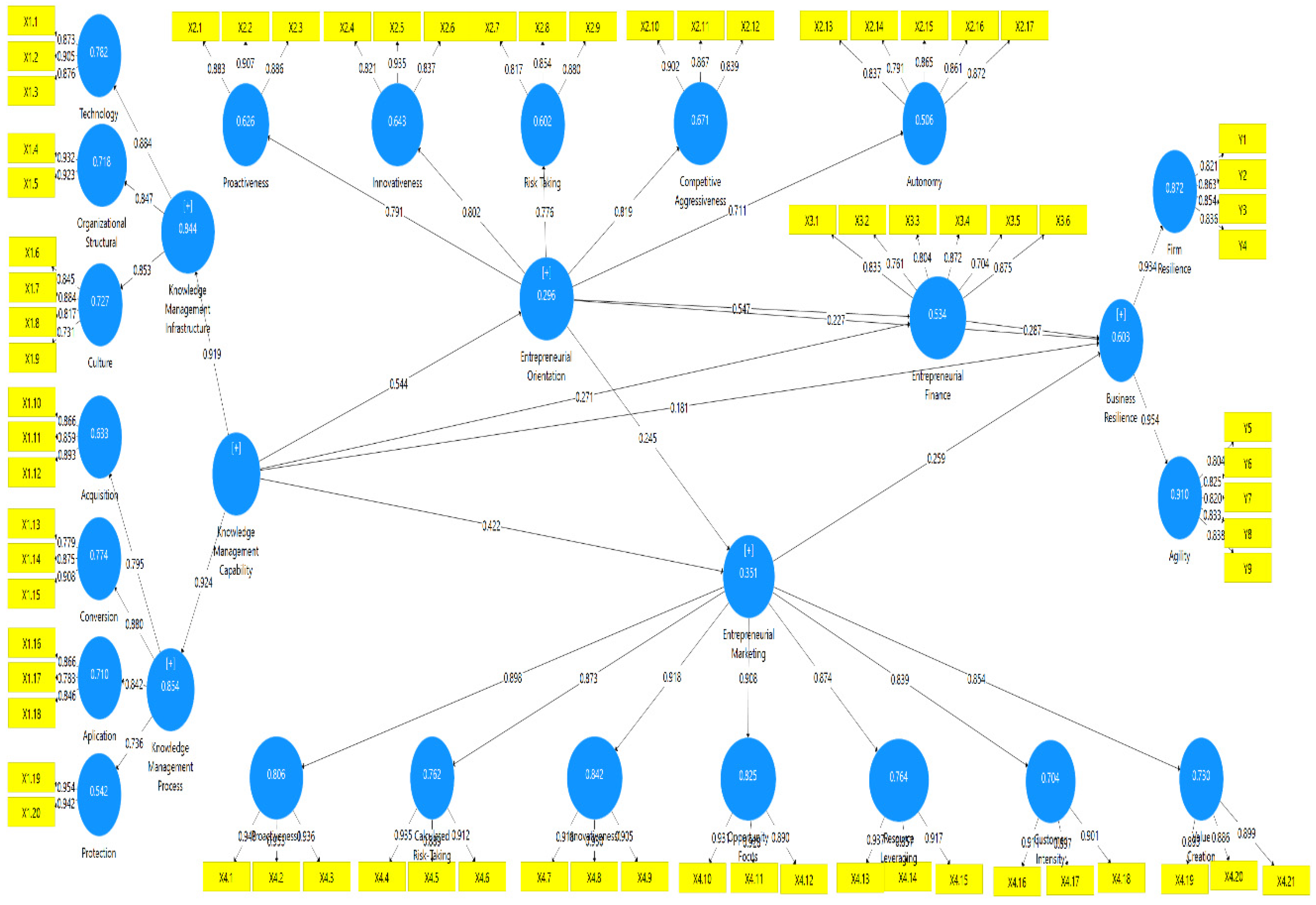

Table 1.
Operational Variables.
| Variable | Dimension | Indicator |
| Knowledge Management Capability (KMC) [29] |
Knowledge management infrastructure which consists of sub-dimensions: | |
| Technology | Easy to learn, technology as a source of learning information, utilizing technology to compete | |
| Organizational structure | Knowledge interaction and sharing, new knowledge facility, knowledge sharing reward system | |
| Culture | Believes in mistakes as a source of learning, mutual trust, company encourages asking questions, believing in imitation as a source of learning | |
| Knowledge management process which consists of sub-dimensions: | ||
| Acquisition | Extracting knowledge from customers, extracting knowledge from partners, extracting knowledge from employees | |
| Conversion | Turning knowledge into products/services, transferring knowledge, absorbing knowledge | |
| Aplication | Easy to practice, saves activity, improve competitive ability | |
|
Entrepreneurial orientation (EO) [67] |
Protection | Protection policy, protection procedures |
| Proactiveness | Initiative, excels at opportunity identification, quick to take action | |
| Innovativeness | Actively innovating, creative business operations, looking for new ways | |
| Risk taking | Risk perception, risk taking, exploration and experimentation for opportunities | |
| Competitive aggressiveness | Competitive business, aggressive competition, outperforming the competition | |
| Autonomy | Employees work independently, employee initiative, employees are given authority and responsibility, employees have access to important information, employees are free to communicate | |
| Entrepreneurial finance (EF) [100] |
- | Effective financial resource management entails the mobilization of capital, strategic allocation of resources, risk mitigation, optimization of financial agreements, and the creation and enhancement of value within the context of entrepreneurship |
|
Entrepreneurial marketing (EM) ([47]) |
Proactiveness | New ways to improve business, different ways of making products, anticipate problems and create opportunities |
| Calculated Risk-Taking | Willing to take risks, can predict risk, analyze environmental conditions | |
| Innovativeness | New innovation, prioritize creativity, changes in design | |
| Opportunity focus | Quick to seize new opportunities, search for new opportunities, knowing market demand information | |
| Resource leveraging | Utilize your closest contacts, work harder, positioning employees with many positions | |
| Customer intensity | Proximity to customers, customer satisfaction, providing new information to customers | |
| Value creation | Creating more value through service, providing something different, use of social media for advertising messages | |
| Business Resilience (BR) [101] |
Company resilience | The ability to manage and adapt effectively to disruptions in the supply chain, respond swiftly to unexpected challenges, and maintain a high level of situational awareness demonstrates organizational resilience and flexibility in dynamic environments |
| Agility | The capacity to address customer demands effectively, adjust production systems efficiently, make prompt and informed decisions, actively seek information to support organizational restructuring, and interpret market changes as opportunities reflects a dynamic and adaptive organizational approach | |
Table 2.
Profile of Respondents.
| Characteristics | Frequency | % | Characteristics | Frequency | % | ||
| Gender | Type of Business | ||||||
| 1. | Male | 92 | 73.6 | 1. | Restaurant | 5 | 0.04 |
| 2. | Female | 33 | 26.4 | 2. | Food stalls | 8 | 6.4 |
| Age | 3. | Culinary carts | 93 | 74.4 | |||
| 1. | <25 years old | 0 | 0 | 4. | Various cakes and snacks | 10 | 12 |
| 2. | 26 - 35 years old | 35 | 28 | 5. | Beverage/ coffee shop | 1 | 3.2 |
| 3. | 36 - 45 years old | 43 | 34.4 | Number of Workers | |||
| 4. | 46 - 55 years old | 31 | 24.8 | 1. | 1 - 3 people | 70 | 56 |
| 5. | >55 years old | 16 | 12.8 | 2. | 4 - 6 people | 50 | 40 |
| Education background | 3. | 7 - 9 people | 5 | 4 | |||
| 1. | Elementary school | 3 | 2.4 | 4. | >9 individuals | 0 | 0 |
| 2. | Junior high school | 12 | 9.6 | Work Experience | |||
| 3. | Senior high school | 62 | 49.6 | 1. | 6 years | 33 | 26,4 |
| 4. | Diploma | 20 | 16 | 2. | 7 - 13 years | 61 | 48,8 |
| 5. | Bachelor | 28 | 22.4 | 3. | 14 - 20 years | 20 | 16 |
| 6. | Magister | 0 | 0 | 4. | 21 - 27 years | 10 | 8 |
| 7. | Doctor | 0 | 0 | 5. | >27 years | 1 | 0,8 |
Table 3.
Fornell Larcker.
| Variable | KMC | EF | EO | EM | BR |
| KMC | 0.855 | ||||
| EF | 0.568 | 0.811 | |||
| EO | 0.544 | 0.694 | 0.881 | ||
| EM | 0.556 | 0.457 | 0.475 | 0.781 | |
| BR | 0.611 | 0.665 | 0.647 | 0.598 | 0.944 |
Table 4.
Construct reliability.
| Variable | AVE | CR | CA |
| KMC | 0.731 | 0.961 | 0.936 |
| EO | 0.609 | 0.886 | 0.921 |
| EF | 0.657 | 0.920 | 0.894 |
| EM | 0.776 | 0.960 | 0.972 |
| BR | 0.891 | 0.942 | 0.923 |
Table 5.
R-Square, Q-Square, and GoF.
| Variable | R2 | Q2 | GoF |
| EO | 0.296 | 0.128 | 0.565 |
| EF | 0.534 | 0.341 | |
| EM | 0.351 | 0.220 | |
| BR | 0.603 | 0.354 |
Table 6.
Hypothesis testing result.
| Hypothesis | Path coeff | T-Statistic | P-value | f-square | |
| H1 | KMC → OE | 0.544 | 7.710 | 0.000 | 0.421 |
| H2 | OE → EF | 0.547 | 7.675 | 0.000 | 0.452 |
| H3 | OE → EM | 0.245 | 3.097 | 0.001 | 0.065 |
| H4 | OE → BR | 0.227 | 2.573 | 0.005 | 0.061 |
| H5 | EF → BR | 0.287 | 3.082 | 0.001 | 0.096 |
| H6 | EM → BR | 0.259 | 3.438 | 0.000 | 0.109 |
| H7 | KMC → EF | 0.271 | 3.610 | 0.000 | 0.111 |
| H8 | KMC → EM | 0.422 | 5.749 | 0.000 | 0.193 |
| H9 | KMC → BR | 0.181 | 2.369 | 0.009 | 0.045 |
Disclaimer/Publisher’s Note: The statements, opinions and data contained in all publications are solely those of the individual author(s) and contributor(s) and not of MDPI and/or the editor(s). MDPI and/or the editor(s) disclaim responsibility for any injury to people or property resulting from any ideas, methods, instructions or products referred to in the content. |
© 2025 by the authors. Licensee MDPI, Basel, Switzerland. This article is an open access article distributed under the terms and conditions of the Creative Commons Attribution (CC BY) license (http://creativecommons.org/licenses/by/4.0/).
Copyright: This open access article is published under a Creative Commons CC BY 4.0 license, which permit the free download, distribution, and reuse, provided that the author and preprint are cited in any reuse.


