

Submitted:
31 July 2025
Posted:
06 August 2025
You are already at the latest version
Abstract
This study investigates the integration of Lean management and digital micro-credentials as innovative strategies for sustainable project management in the Brazilian public sector. Addressing persistent challenges related to inefficiency, fragmented processes, and insufficient professional qualification, the research aims to strengthen institutional performance and align public administration with the Sustainable Development Goals. The methodology involved a mixed-methods intervention conducted in partnership between the Ministry of Agriculture and Fluminense Federal University, combining participatory organizational diagnosis, implementation of modular training via digital micro-credentials, and collaborative development of standardized operational tools. Thirty-seven public servants from diverse administrative units participated in the intervention. The results demonstrated a significant increase in administrative efficiency, with a training completion rate of 89%, improved process standardization, and enhanced practical competencies among participants. Qualitative feedback highlighted greater empowerment, clearer communication, and a stronger culture of evidence-based management. However, barriers such as limited institutional recognition of micro-credentials and disparities in digital infrastructure were identified. The findings indicate that integrating Lean principles with digital micro-credentials constitutes a viable and replicable approach for promoting sustainable innovation, professional development, and process improvement within public administration, with direct contributions to the achievement of the Sustainable Development Goals in complex governmental environments.
Keywords:
Brazil lean management
; micro-credentials
; public sector
; sustainable project management
; capacity building
; digital transformation
; professional development
; innovation in public administration
; Brazil
; sustainable development goals
1. Introduction
The management of decentralized public policies in Brazil underscores persistent complexities in achieving sustainability and effectiveness within public administration. Within this setting, the Decentralized Execution Terms (TEDs) have become emblematic of the multi-dimensional challenges present in the Brazilian federal system. The successful implementation of TEDs demands coordination among multiple institutional actors, systematic alignment of processes, and rigorous adherence to legal and regulatory frameworks. Yet, as documented in the literature, TEDs have long been hindered by fragmented internal communication, procedural inconsistencies, and a lack of targeted training for the public servants tasked with their management [1]. These recurring shortcomings frequently result in operational delays, rework, and limited effectiveness, eroding public trust and undermining the long-term sustainability of government projects [2].
To overcome such institutional barriers, contemporary research and practical experiences advocate for the adoption of innovative approaches that transcend conventional training and incremental procedural reform. Among these alternatives, Lean management has emerged as a promising methodology for public sector innovation. Originally developed in the manufacturing industry, Lean management focuses on the systematic elimination of waste, simplification and standardization of processes, and a commitment to continuous improvement [3]. Adaptations of Lean thinking to the public sector have demonstrated its capacity to streamline workflows, enhance transparency, and foster a culture of ongoing professional development among public servants [4,5]. Empirical studies confirm that Lean methodologies can be particularly effective in environments characterized by bureaucratic complexity and operational fragmentation, as found in Brazilian federal administration [6].
Alongside Lean practices, the growing adoption of digital micro-credentials presents a transformative alternative for professional development in the public sector. Unlike traditional, broad-based and often lengthy training programs, micro-credentials provide modular, focused learning opportunities designed to address specific competencies required in daily administrative work. This competency-based model facilitates the rapid acquisition and formal validation of relevant skills, enhancing both individual motivation and institutional adaptability [7]. The integration of micro-credentials with digital learning management systems (LMS) allows for flexible, transparent, and personalized training pathways, improving accessibility and the practical effectiveness of capacity-building initiatives [8,9].
In this context, the convergence of Lean management and digital micro-credentials constitutes an innovative and empirically supported strategy for strengthening the capacity and sustainability of public sector project management. The present research, developed through a strategic partnership between the Brazilian Ministry of Agriculture and Fluminense Federal University (UFF), empirically investigates the application and impact of this integrated model within the context of TEDs in federal administration. The study seeks to address several core questions: Can Lean management and digital micro-credentialing together overcome institutional challenges and advance sustainable project management? What measurable impacts are observed in terms of operational efficiency, professional qualification, and institutional resilience? How might this model contribute to Brazil’s advancement of the Sustainable Development Goals (SDGs) within the public administration sphere?
By rigorously analyzing the implementation and outcomes of this integrated framework, this study aims to provide a substantive contribution to the theoretical and practical literature on public sector innovation. Through robust empirical evidence and a clearly articulated methodological structure, the research offers actionable insights for public managers, policymakers, and scholars interested in building more sustainable, responsive, and future-oriented public institutions.
2. Materials and Methods
This study adopted a qualitative, applied research-intervention approach, conducted through a formal partnership between the Brazilian Ministry of Agriculture and Fluminense Federal University. The methodological strategy followed a research-intervention paradigm, seeking to produce actionable knowledge while addressing operational challenges inherent to the management of Decentralized Execution Terms (TEDs) in Brazil’s federal public sector [1]. This approach is consistent with the growing emphasis in contemporary public administration research on practical, context-sensitive methodologies capable of bridging the gap between theory and implementation [3,4].
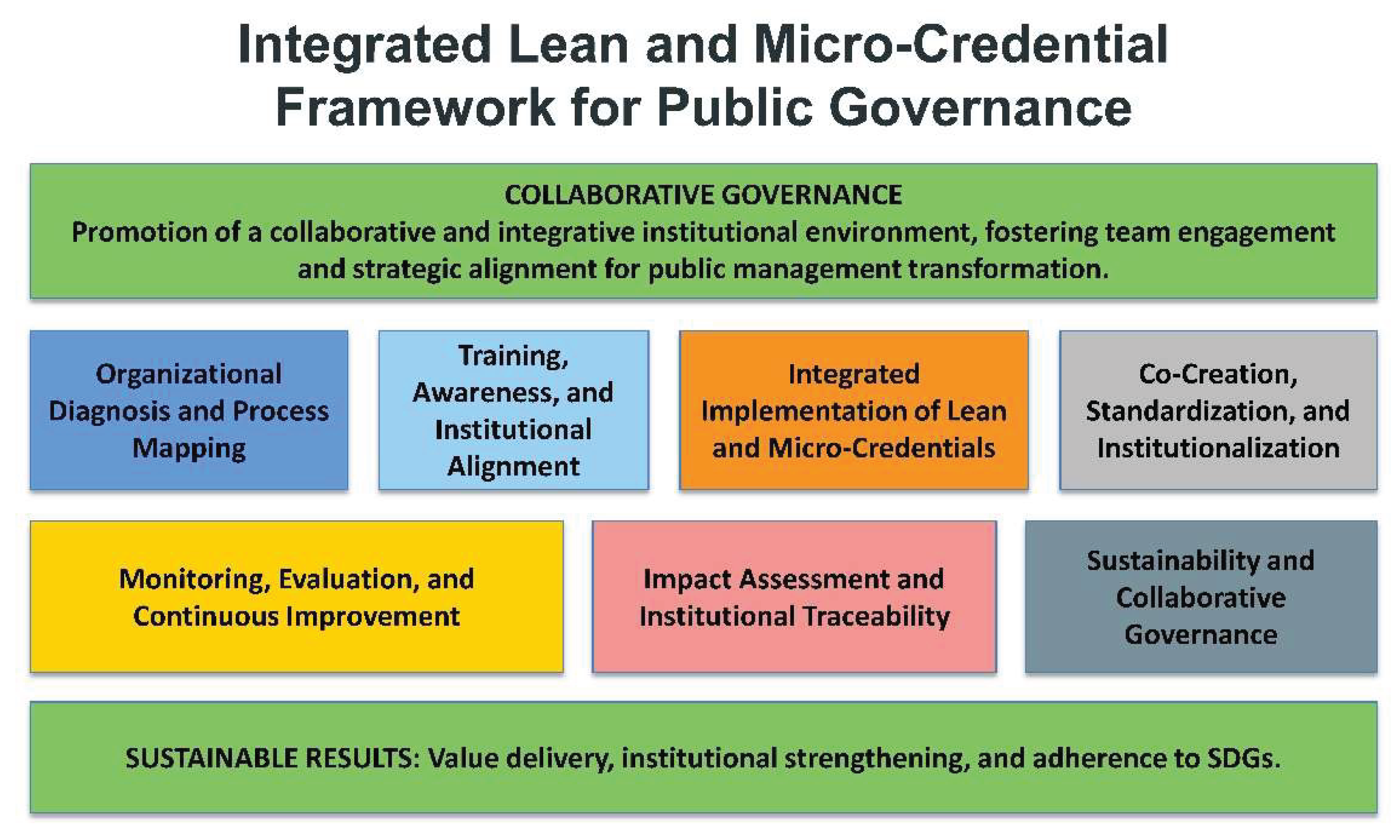
The research unfolded in three interconnected phases. In the first phase, a participatory organizational diagnosis was conducted using semi-structured interviews with thirty-seven public servants from various administrative units involved directly with TEDs. The sample was intentionally diverse in institutional roles and professional backgrounds, to ensure that different perspectives and operational realities were represented. These interviews were complemented by a documentary analysis of technical reports, regulatory documents, and internal process records, in order to triangulate data and produce a robust diagnostic baseline [1,2]. The methodological approach adopted in this research is schematically represented in Figure 1.
Based on the diagnostic findings, the second phase implemented a modular professional development program anchored in digital micro-credentials. The program was structured around the core operational competencies identified as priorities, such as process mapping, workflow standardization, and application of Lean tools in administrative settings [5,6]. Active learning methodologies, including real-case studies, simulations, and collaborative exercises, were incorporated throughout the modules. Training was delivered via a secure digital learning management system (LMS), enabling transparent monitoring, participant assessment, and digital certification [7,8]. The LMS provided flexible, customizable learning pathways, supporting the adaptation of content to diverse individual and institutional needs [9].
The third phase emphasized participatory co-creation as an institutional innovation strategy. A series of collaborative workshops engaged public servants in the joint development of standardized manuals, checklists, and process templates, reflecting both best practices from the literature and the practical wisdom of experienced practitioners. All tools and outputs were validated by the participants, ensuring organizational legitimacy and the sustainable integration of innovations into daily routines [8,9].
The evaluation combined quantitative metrics—such as module completion rates, assessment scores, and platform participation logs—with qualitative feedback from structured questionnaires and group discussions. Observed changes in operational routines and updated process documentation provided evidence of longitudinal impact.
All research instruments, including interview guides and micro-credential module outlines, are available from the corresponding author upon reasonable request. Data generated from interviews and internal documentation are protected by institutional confidentiality and cannot be publicly deposited. No large-scale datasets or external repository accession numbers are applicable.
Research ethics were rigorously observed in accordance with the standards of Fluminense Federal University and national regulations for research involving public servants. Participation was voluntary, with informed consent secured from all participants before data collection. Since the study engaged only adult public servants in their official capacity and collected no sensitive or health-related personal data, institutional review board approval and registration codes were not required [1].
Regarding generative artificial intelligence (GenAI), no AI tools were used for scientific design, data analysis, or interpretation. AI assistance was limited strictly to minor language refinement and document formatting, and all scientific content, data analysis, and interpretation are the sole responsibility of the authors.
This transparent and carefully documented methodology provides a robust foundation for replication and adaptation by future researchers, thereby advancing empirical and applied understanding in public sector innovation and organizational capacity building.
3. Results
The implementation of the integrated Lean management and digital micro-credential model produced significant and measurable results at individual, procedural, and institutional levels within the Brazilian federal public sector. Throughout the intervention, both qualitative and quantitative evidence demonstrated clear advancements in operational efficiency, staff engagement, and the formalization of best practices in Decentralized Execution Terms (TEDs) management.
Regarding participant engagement and profile, the study involved thirty-seven public servants representing diverse administrative units and professional trajectories. The modular and digital structure of the micro-credential program was met with a high degree of acceptance: approximately 89 percent of enrolled participants successfully completed all required learning modules. This high completion rate reflected both the practical relevance of the content and the adaptability of the digital learning platform to the realities of public administration work [7,8].
Qualitative feedback collected from structured questionnaires and group discussions indicated that the Lean methodology was instrumental in helping public servants identify and address wasteful practices in their daily routines. Participants reported greater clarity in process mapping and a marked improvement in the standardization of workflows. The application of Lean tools, such as value stream mapping and the Plan-Do-Check-Act (PDCA) cycle, enabled teams to streamline internal communication, minimize process redundancies, and clarify role responsibilities within project teams. Many respondents described the experience as a turning point in their professional engagement, noting improvements in teamwork, reduction of rework, and an enhanced sense of purpose in their institutional roles [3,4,5].
The effectiveness of digital micro-credentials was also evidenced by the rapid acquisition and immediate application of new skills in the workplace. Participants highlighted the value of modular, focused training and praised the opportunity to receive formal validation for competencies that directly supported their operational responsibilities. This practical, competency-based approach was widely regarded as more effective than traditional training formats, which often failed to connect with the immediate demands of public sector work [7,8,9].
At the institutional level, the co-creation process led to the development and adoption of standardized operational tools, including manuals and checklists, which were rapidly integrated into everyday administrative routines. The participatory nature of the co-creation workshops not only improved the technical quality of these materials but also contributed to increased legitimacy and acceptance among public servants. These operational resources formalized previously informal knowledge and supported the institutionalization of evidence-based management practices [8,9].
Analysis of administrative data and process documentation revealed a tangible reduction in process inconsistencies and greater uniformity across TED management practices after the intervention. Improvements in internal audit trails, documentation standards, and the clarity of procedural guidelines were observed in the months following the implementation of the new model. These findings were corroborated by participants’ self-reported perceptions of reduced operational bottlenecks and improved problem-solving capacity within their teams.
The empirical results also indicate a direct contribution to the advancement of several Sustainable Development Goals (SDGs), especially SDG 4 (Quality Education), SDG 8 (Decent Work and Economic Growth), and SDG 16 (Peace, Justice and Strong Institutions). By promoting evidence-based, flexible, and sustainable professional development pathways, the integrated approach enhanced the overall resilience and performance of the public sector, as well as the transparency and accountability of decentralized project management [2,7,8].
Despite the considerable progress achieved, the research identified ongoing challenges to the full institutionalization of the model. One significant barrier was the limited formal recognition of digital micro-credentials within public career advancement frameworks, which restricted their value as instruments for functional progression. Additionally, disparities in digital infrastructure and access across administrative units highlighted the importance of ongoing investment in technological resources to ensure full inclusion and scalability.
In summary, the results affirm the effectiveness of combining Lean management with digital micro-credentials for public sector innovation. The findings point to a replicable and sustainable strategy for strengthening operational capacity, professional development, and institutional resilience in complex public administration environments.
4. Discussion
The results of this research reinforce and extend the existing body of knowledge regarding innovative management practices in the public sector, notably through the articulation of Lean management and digital micro-credentials. The high level of engagement and completion among public servants aligns with findings from Selvaratnam and Sankey, as well as Mnisi, who observed that modular, competency-based learning pathways are more effective in public administration than conventional, broad-based approaches [7,8]. This supports the argument that capacity-building strategies must prioritize adaptability, immediate relevance, and direct linkage to practical challenges in order to foster professional motivation and sustainable learning outcomes.
The observed impact of Lean management on administrative workflows and operational routines finds resonance with the works of Radnor, Bruschi and Forcellini, and Teeuwen, who have shown that Lean principles facilitate waste identification, process standardization, and the consolidation of a culture of continuous improvement in government settings [3,4,5]. In this study, participants highlighted substantial gains in workflow clarity, internal communication, and role distribution. These outcomes mirror results from international case studies in both developed and emerging economies, such as those documented by Kluza et al., which demonstrate that Lean methodologies can be effectively adapted to diverse bureaucratic and regulatory environments [6]. By enabling teams to co-create new operational tools, the intervention also reflected best practices in collaborative governance, as advocated by Parreira do Amaral and Tikkanen, and González-Morales and Santana-Vega, who identify institutional participation as a key factor for the sustainability of public sector innovations [8,9].
The integration of digital micro-credentials into the training model was crucial for fostering rapid skill acquisition, formalizing competencies, and increasing public servants’ confidence in their ability to address complex problems. These results are consistent with recent studies on digital transformation and professional development in public administration, such as those by Grech et al. and Morris et al., which emphasize the importance of digital tools for building institutional capacity and promoting equitable access to lifelong learning opportunities [10,11]. The deployment of a secure and flexible LMS enabled the adaptation of training pathways to a variety of professional backgrounds, supporting both inclusiveness and efficiency in the upskilling process.
The empirical outcomes described here also contribute to the international debate on the Sustainable Development Goals (SDGs). Advancements related to SDG 4, SDG 8, and SDG 16 in this study confirm the potential of process innovation and capacity-building for strengthening institutional effectiveness, transparency, and resilience [2,7]. These findings align with global discussions on public governance modernization, as highlighted in the comparative studies of Grech et al. and Luckin et al., which point to the centrality of digital skills, organizational learning, and evidence-based management in advancing the public interest [10,12]. The positive impact on auditability, documentation, and transparency further demonstrates that micro-credentialed learning and Lean management, when institutionalized, can serve as replicable models for organizational transformation across jurisdictions.
Despite these successes, persistent challenges remain. The limited formal recognition of micro-credentials in existing career frameworks was identified as a barrier, echoing international evidence on the slow pace of adaptation in bureaucratic promotion systems [10,11]. Similarly, digital inequality and infrastructure gaps across administrative units highlight the continuing need for targeted investment and strategic policy design to ensure that the benefits of innovation are widely distributed. The reliance on digital platforms raises questions about accessibility, long-term user engagement, and the ethical management of digital data, all of which should be further investigated in future research.
This study demonstrates that combining Lean management and digital micro-credentials yields robust improvements in operational capacity and organizational learning in the public sector. The participatory and evidence-based approach adopted here can serve as a model for public organizations seeking to enhance their effectiveness and responsiveness in increasingly complex environments. Future research should pursue longitudinal assessments of intervention impact, comparative studies across different administrative levels or countries, and analyses of how digital learning platforms can be optimized to serve the diverse and evolving needs of public service professionals. Expanding the international dialogue and exchanging concrete experiences will be essential for advancing both theory and practice in the field of public sector innovation.
5. Conclusions
This research demonstrated that the integration of Lean management principles and digital micro-credentials can produce transformative and measurable improvements in public sector organizations faced with complex, decentralized administrative challenges. By combining a participatory diagnostic process, competency-based modular training, and collaborative development of operational tools, the study offers a methodological blueprint that is not only grounded in empirical evidence but also strongly aligned with international best practices for institutional innovation.
The empirical results substantiate that Lean management, when adapted and implemented through active engagement of public servants, significantly enhances operational efficiency, reduces redundancies, and fosters a shared organizational culture focused on continuous improvement and transparency [3,4,5]. The adoption of digital micro-credentials addressed long-standing gaps in public sector professional development, providing a flexible and accessible means for public servants to acquire, validate, and apply new competencies relevant to their daily functions [7,8,9]. These findings corroborate and advance the growing consensus in the literature that targeted, modular capacity-building interventions outperform traditional training models in both impact and sustainability, especially in environments marked by procedural fragmentation and rapidly evolving demands [7,8].
The co-creation of standardized manuals, checklists, and operational guidelines through collaborative workshops proved essential not only for technical accuracy but for organizational legitimacy and the sustainable institutionalization of new practices. This participatory strategy directly responded to calls in international governance research for bottom-up approaches and the meaningful inclusion of practitioners in the reform process [8,9]. The experience documented here illustrates how collective knowledge production within the public sector can accelerate the translation of evidence-based innovation into everyday routines, improving auditability, accountability, and resilience [2,10].
At the systemic level, the research demonstrates that capacity-building models anchored in Lean thinking and micro-credentialing can contribute substantively to key Sustainable Development Goals, such as quality education, decent work, and effective institutions [2,7]. The linkage between individual professional development, organizational reform, and broader policy objectives highlights the strategic potential of integrated approaches for modernizing public administration.
However, significant challenges persist. The study exposed institutional inertia in the recognition of micro-credentials for career advancement and uneven access to digital infrastructure across administrative units. These barriers echo global concerns identified in comparative studies of public sector digital transformation and underline the need for sustained policy advocacy, investment, and cross-sectoral dialogue to scale successful innovations [10,11,12].
Looking forward, this research encourages scholars and practitioners to further investigate the long-term impacts of integrated Lean and micro-credential models, explore their application across diverse governmental and cultural settings, and examine the dynamic interplay between digital learning environments and organizational change. Comparative analyses, longitudinal studies, and cross-national collaborations will be vital for advancing both the science and practice of public sector modernization in an era of escalating complexity and public expectation.
In conclusion, the Brazilian experience detailed in this study provides compelling evidence that the thoughtful integration of Lean methodologies and digital micro-credentials can drive meaningful, scalable, and sustainable improvements in public administration. By fostering continuous learning, collaborative problem-solving, and institutional resilience, such models offer a promising pathway for governments seeking to build adaptive and high-performing organizations in pursuit of sustainable development.
Author Contributions
Conceptualization, E.S.S.; methodology, E.S.S.; formal analysis, E.S.S.; investigation, E.S.S.; resources, E.S.S.; data curation, E.S.S.; writing—original draft preparation, E.S.S.; writing—review and editing, E.S.S., A.B.S., and R.D.C.; visualization, E.S.S.; supervision, A.B.S. and R.D.C.; project administration, A.B.S. and R.D.C.; funding acquisition, A.B.S. and R.D.C. All authors have read and agreed to the published version of the manuscript.
Funding
This research was funded by the Brazilian Ministry of Agriculture and Livestock (MAPA), through Decentralized Execution Term (TED) No. 805/2022 (SIAFI 939175), executed in partnership with Fluminense Federal University (UFF). The APC was funded by MAPA.
Institutional Review Board Statement
Ethical review and approval were waived for this study due to the involvement solely of adult public servants performing official duties and the absence of sensitive personal data collection, in accordance with Fluminense Federal University’s Ethics Committee guidance.
Informed Consent Statement
Informed consent was obtained from all participants involved in the study through formal consent in the research participation form.
Data Availability Statement
The data presented in this study are available on request from the corresponding author. The data are not publicly available due to institutional confidentiality restrictions.
Acknowledgments
The authors would like to thank all participating public servants and the technical staff who contributed to the successful implementation of the project. Special thanks are extended to the administrative and institutional teams at the Ministry of Agriculture and Fluminense Federal University for their continuous support.
Conflicts of Interest
The authors declare no conflicts of interest. The funders had no role in the design of the study; in the collection, analyses, or interpretation of data; in the writing of the manuscript; or in the decision to publish the results.
Abbreviations
The following abbreviations are used in this manuscript:
| TED | Decentralized Execution Term |
| MAPA | Ministry of Agriculture and Livestock |
| UFF | Fluminense Federal University |
| LMS | Learning Management System |
| SDG | Sustainable Development Goal |
| MDPI | Multidisciplinary Digital Publishing Institute |
References
- Brunetti, E.S.; Nogueira, S.P.; Barbosa, J.L. Capacitação para a gestão pública no Brasil: desafios e perspectivas. Revista do Serviço Público 2020, 71(4), 819–838. [CrossRef]
- Brasil. Ministério da Agricultura e Pecuária. Relatório de Execução dos Termos de Execução Descentralizada (TEDs), 2023.
- Bruschi, R.P.; Forcellini, F.A. Aplicação dos princípios Lean na administração pública brasileira: desafios e resultados. Revista de Administração Pública 2019, 53(6), 1198–1216. [CrossRef]
- Radnor, Z. Special Issue: Lean in public services. Public Money & Management 2013, 33(3), 161–162. [CrossRef]
- Teeuwen, B. Lean for the public sector: The pursuit of perfection in government services; CRC Press: Boca Raton, USA, 2011.
- Kluza, K.; Marciniuk, P.; Szostak, E. Agricultural policy and public sector innovation: Evidence from emerging economies. Journal of Public Affairs 2021, 21(3), e2242. [CrossRef]
- Selvaratnam, R.M.; Sankey, M. The promise of micro-credentials in upskilling public sector employees. International Review of Education 2021, 67(5–6), 785–804. [CrossRef]
- Mnisi, T. The value of micro-credentials in public sector capacity building. Journal of Continuing Education and Training 2023, 10(2), 67–79. [CrossRef]
- Waithira, M.R.; Kibaara, D.; Nyaboga, E. Rethinking public sector training: Micro-credentials and lifelong learning. Journal of Public Affairs Education 2024, 30(1), 101–117. [CrossRef]
- Grech, V.; et al. Digital maturity in public institutions: Comparative study and perspectives. Government Information Quarterly 2021, 38(1), 101533. [CrossRef]
- Morris, A.; Gopalan, V.; Singh, R. Barriers and enablers to digital learning in the public sector: A comparative analysis. International Journal of Public Sector Management 2022, 35(1), 22–41. [CrossRef]
- Luckin, R.; Holmes, W.; Griffiths, M.; Forcier, L.B. Intelligence unleashed: An argument for AI in education; Pearson, 2024.
- Parreira do Amaral, M.; Tikkanen, T. Inter-institutional partnerships for innovation in public administration: Challenges and opportunities. European Journal of Education 2022, 57(3), 449–463. [CrossRef]
- González-Morales, M.B.; Santana-Vega, L.E. Micro-credentials and public administration: Promoting employability and innovation in the public sector. Public Policy and Administration 2020, 19(2), 23–35. [CrossRef]
Figure 1.
Integrated Lean and Micro-Credential Framework for Public Governance.
Disclaimer/Publisher’s Note: The statements, opinions and data contained in all publications are solely those of the individual author(s) and contributor(s) and not of MDPI and/or the editor(s). MDPI and/or the editor(s) disclaim responsibility for any injury to people or property resulting from any ideas, methods, instructions or products referred to in the content. |
© 2025 by the authors. Licensee MDPI, Basel, Switzerland. This article is an open access article distributed under the terms and conditions of the Creative Commons Attribution (CC BY) license (http://creativecommons.org/licenses/by/4.0/).
Copyright: This open access article is published under a Creative Commons CC BY 4.0 license, which permit the free download, distribution, and reuse, provided that the author and preprint are cited in any reuse.


