

Submitted:
26 September 2025
Posted:
29 September 2025
You are already at the latest version
Abstract
This article examines the key success factors of IT project management in the context of Kazakhstan, a country striving toward an innovation-driven and sustainable economy. Based on a mixed-methods approach that combines a literature review, in-depth interviews with senior managers, and a survey of 30 IT project professionals, the study identifies and analyzes 59 project management processes across initiation, planning, implementation, monitoring, and completion stages. The findings demonstrate that communication, stakeholder engagement, clear project documentation, effective delegation, motivation, and team competence are among the most critical determinants of project success. Correlation analysis confirms strong interdependencies between financial planning, human resource practices, and communication processes, highlighting their synergistic impact on project outcomes. However, several highly valued practices – such as integration-stage budgeting, lesson-learned journals, and external quality assurance – are underutilized in Kazakh enterprises, limiting efficiency and sustainability. The results confirm the hypotheses that (1) key success processes can be identified, (2) team composition and competence are decisive, and (3) communication and leadership significantly influence outcomes. This study contributes to the growing body of knowledge on sustainable project management by offering practical insights into IT project success in emerging economies, with implications for both scholars and practitioners engaged in digital transformation.
Keywords:
project management
; IT projects
; sustainability
; success factors
; Kazakhstan
; communication
; team competence
; digital transformation
1. Introduction
Project management (PM) is a foremost tool that allows the implementation of specific tasks within the existing structure of the enterprise or between different enterprises, in which, if possible, there should not be a negative impact on the initial project tasks.
Project management is focused on obtaining certain results and stops with their achievement. As for project activity, it is based on a process approach and consists of coordinating the implementation and support processes through those of management, which implies goal setting, planning, organization and control [1].
Project management is a rapidly developing field and is defined as “the ability to determine and set the goals, plan their achievement and execute the plan with accountability and control” [2]. Currently, the approach to project management is formalized [3] and based on many specialized methodologies, for example: Agile, PRINCE2, classical approach and others [4]. There are also flexible methods, based on an iterative, step-by-step development cycle that quickly creates functional application versions and delivers them to the customer for evaluation [5]. For the specific methodology certain skills are required which are confirmed by certificates in the field of project management. It is assumed that the candidate in the field of project management is to acquire those certain skills and qualities that will allow him to professionally engage in specific project activities [6,7].
The role of project management in the sustainable development of enterprises also occupies a central position. According to some authors, project management acts as a tool for implementing organizational changes [8], an increasing number of publications draws attention to the role of projects in the sustainable development of organizations and society [9,10,11]. Modern project management requires skills to deal with complexities and uncertainties combined with ever-changing businesses and technologies.
Recent studies emphasize that sustainable IT project management requires combining Agile practices, ESG frameworks, green IT strategies, and data-driven approaches. Zakrzewska et al. [12] show that Agile methods such as design thinking and team rituals foster efficiency and social sustainability, while Ahmad and Al-Baik [13] highlight the importance of trust, transparency, and organizational culture for large-scale agile projects. Kyriakogkonas et al. [14] propose integrating ESG criteria into project governance, making sustainability a formal responsibility of project leaders, and Ebirim et al. [15] demonstrate that holistic planning and stakeholder engagement are essential for reducing the environmental footprint of data center projects. Complementing these perspectives, Pantović et al. [16] argue that data-driven decision making improves sustainability by enabling better resource allocation, risk mitigation, and process optimization in IT projects. Gaweł et al. [17] proposed combination of risk mitigation methods of decision making in sustainable project evaluation.
The literature suggests that sustainable IT project management succeeds when operational agility, responsible governance, ecological awareness, and analytics-based decision making are combined into a holistic framework, ensuring that projects deliver not only on time and within budget but also with lasting social and environmental value.
Scope management, involving boundary-setting and responsibility allocation, is essential for control and performance [18,19]. Tools and methods are increasingly assessed for their strategic value [20]. In Kazakhstan, effective IT project management has improved tech stability and profitability, pointing to key success factors embedded in specific processes.
The main goal of this research is to identify the key success factors in managing IT projects of enterprises in countries developing innovative and sustainable economy based on Kazakh economy. This study explores the correlation between process use and IT project success, testing the following hypotheses.
Hypothesis 1:
Key success processes of IT project management can be identified.
Hypothesis 2:
A well-composed, skilled team is critical to managing IT projects.
Hypothesis 3:
Professional process use, team leadership, and communication drive success of IT projects.
Methods included expert interviews and anonymous surveys of Kazakhstani enterprises.
The remainder of the paper is structured as follows. Section 2 reviews the literature on project management standards, methodologies, and international practices, with a focus on their relevance to sustainable development. Section 3 analyzes the main challenges of IT project management in Kazakhstan during its transition to an innovation-driven economy. Section 4 presents insights from in-depth expert interviews, identifying key practical success factors. Section 5 reports the findings of a survey conducted among IT project professionals in Kazakhstani enterprises, examining the implementation of project management processes and their perceived effectiveness. Section 6 discusses the confirmation of the proposed hypotheses and reflects on the implications for sustainable project management. Finally, Section 7 concludes with recommendations and directions for further research.
2. Literature Review
2.1. Standards of Project Management
Project management used in the processes of any industry is a part of the management system, the tools of which are successfully used in management at both state and private levels. Effective and professional project management, carried out along with the introduction of innovations in various sectors of economic activity and production, makes it possible to correctly plan and successfully implement projects, while optimizing time, financial costs taking into account human resources, while not compromising the planned quality of the final project result [21].
Modern project management relies on global standards that integrate best practices, tools, and methodologies. The PMBoK Guide by Project Management Institute [22] offers a foundational framework adaptable to various industries. Project Portfolio Management [23] and the Standard for Program Management support coordination, communication, and accountability across complex project environments [24]. OPM3 links project activities to strategic goals through maturity assessments. The ISO 9000 series emphasizes quality management, continuous improvement, and auditing standards [25]. The UK’s APM BoK defines core competencies via its “5 Dimensions of Professionalism” and offers certified qualifications [26].
In sum, standards like PMI’s OPM3, ISO 9000, and APM BoK reinforce structured project execution, quality assurance, and professional growth - enhancing organizational efficiency and ensuring reliable outcomes (Table 1).

Table 1.
Standards used in project management.
| Standard | Function |
|---|---|
| Project Management Body of Knowledge (PMBoK) | Project Management Process Group |
| Project Portfolio Management (PPM) | Management of complex projects |
| The Standard for Program Management | Effective communication and coordination within groups |
| Organizational Project Management Maturity Model (OPM3) | Achieving strategic goals |
| ISO International Standards | A set of basic elements of quality management |
| Association for Project Management (APM) | The development of professional discipline |
Source: own research based on International Standards of Project Management.
Project management follows a classical five-phase model that includes: initiation, planning, development, implementation and testing, and monitoring and completion.
2.2. Overview of Available Methods
Over time, project management has evolved into traditional and flexible approaches. Traditional methods (e.g., PRINCE2) follow linear, milestone-based models suited for predictable contexts [27]. Flexible methods like Agile, Scrum, Lean, Kanban, and Six Sigma emphasize adaptability, iterations, and stakeholder feedback [28,29,30,31,32,33,34]. Agile enables incremental development, Scrum structures it through sprints and defined roles [35]. Lean focuses on eliminating waste [36], while Six Sigma improves quality through data-driven analysis [37]. PRINCE2 offers a scalable, process-oriented framework. Today, hybrid models blend structure and agility to enhance efficiency and strategic alignment [38,39].
2.3. Comparative Analysis Between Selected Countries Using Project Management
In modern conditions of development of society and the economy, the formation of a project management system and increasing its effectiveness is based on the use of the latest information and communication technologies and approaches that offer a set of tools to improve the quality of the project management system, ensure transparency of decisions and facilitate public access. In this regard, project management technologies have been increasingly used in the public and private sectors, which allow comprehensively developing and managing the implementation of the project in order to achieve a socially significant result, regardless of the scope of its implementation. The approaches and methods of each country have their own results, but the problems that countries face are remarkably similar to each other. Each country tries to adapt some generally recognized methods due to its culture, mentality and community, but it does not always come to the desired results.
Czech Republic: Since the early 21st century, the Czech Republic has increasingly viewed project management as a key instrument for achieving effective governance. Factors such as foreign investment, economic pressures for innovation, and access to EU funding have driven managers to adopt modern methodologies [40]. Project management is most prevalent in information, telecommunications, and construction industries, though challenges in implementation remain.
A 2012 national survey involving 178 project and portfolio managers from large organizations (budget over CZK 10 million, more than 100 employees) assessed project success, tool usage, and training approaches [41]. Results showed high familiarity (90–98%) with global best practices in logical structuring, time planning, and evaluation, while 43% were unfamiliar with agile methods.
Russian Federation: Similar to the Czech Republic, the Russian Federation began implementing project management in the early 2000s. Over the past two decades, various methods have been adopted, with a strong emphasis on learning from foreign experience due to a historical lag in domestic practices, particularly in information and communication technologies. The long-standing administrative-command management style hindered large-scale projects, and despite abundant resources, demand for such projects was low [42].
Significant changes occurred between 2000–2010, marked by proactive project development, business process transformation, and increased demand for IT training. Initially, performance stability issues were common. Project management practices became industry-adapted, gradually shifting toward flexible methodologies. A milestone was the successful execution of the 2014 Winter Olympic Games in Sochi, recognized internationally as one of Russia’s most successful large-scale projects in the past decade.
Drawing on global practices, Russia adopted innovative tools such as outsourcing, benchmarking, and reengineering to enhance project management. However, challenges remain: a shortage of experienced and certified professionals, low trust in consulting firms, insufficient motivation to adopt innovations, and strong resistance to change often linked to fear and stress at middle management levels.
Japan: Japanese project management is recognized worldwide, with the P2M standard developed by Ohara in 2001 [43], being its first formal framework for innovative enterprises. Managed by the Project Management Certification, P2M provides a strategic foundation for innovation aimed at enhancing corporate value through competitive, flexible, and adaptive methodologies. It integrates entry-level project management, program management, and 11 segment management structures to address complexity, uncertainty, and extensibility.
P2M is applied across Japan’s key industries - construction, manufacturing, and information technology - considered critical for the country’s innovation-driven economy. The Kaikaku Project Management (KPM) model, an advanced version of P2M, emerged as part of Japan’s reforms following the 1990s deflationary depression. KPM emphasizes kakusin (innovation), kaihatsu (development), and kaizen (improvement), fostering well-structured project systems that often lead to successful outcomes.
P2M covers the full project lifecycle from idea generation and planning to implementation, investment, recovery, and value creation.
In manufacturing, project management supports production system innovation, AI integration, and automation, with a focus on cost reduction, efficiency, and productivity gains. However, mastering sustainable efficiency remains challenging.
In IT, KPM’s knowledge base platform enables project visualization, knowledge circulation, and innovation-driven cost and risk reduction. Applications extend to disaster prevention (e.g., earthquake prediction) and value creation through corporate software and service innovation, following models such as the 3S-scheme.
Overall, P2M and KPM strategies have proven effective in managing Japan’s sophisticated projects, supporting competitiveness and sustained innovation nationwide.
Croatia: Certification of project managers in Croatia, aligned with ISO 17024 and conducted by IPMA and PMI, plays a crucial role in project management [44]. Croatia views certification as fundamental to project implementation processes. A national study, with statistically significant results, examined the impact of certification on the development of project management and ranked Croatia’s management maturity.
The research, conducted through semi-structured interviews in two thematic areas - certification processes and the development of project management as a profession - revealed that certification enhances knowledge, skills, and competitiveness in the national market. It also facilitates the transfer of accumulated experience to Croatian project managers and strengthens the recognition of project management as a professional field delivering higher-quality services.
Certification positively influences job market demand, encouraging companies to invest in certified employees, thereby strengthening human and structural capital through improved business processes and methodologies. Since the early years of adopting certification, Croatia has monitored internal motivators and control parameters to guide the ongoing development of project management in the country.
Kazakhstan: Project management in Kazakhstan began in the mid-1990s and needs further development in line with international standards, considering national enterprise practices. Its growth is hindered by spontaneous, uncoordinated implementation across sectors, and the traditional system fails to meet modern business and government needs, reducing competitiveness. Some enterprises and consulting firms already apply project management methods [45]. International organizations in Kazakhstan share experience, but lack effective communication and economic mechanisms with domestic firms.
Since 2010, the government has supported project management with major investments and international events involving foreign experts. A Technical Committee for Standardization of Project Management was created under the Committee for Technical Regulation of Standardization, including ministries, departments, and professional associations for the 2010–2014 industrial and innovative development program. Kazakhstan has started developing a national project management standard harmonized with international norms, aligning program documents in ministries and institutions.
A shortage of qualified specialists persists. Public and private universities now offer project management programs at all levels, and the Competence Center at the Academy of Public Administration trains top managers [46]. In 2007, the non-profit Project Manager Club was opened in Almaty, with 157 members, including Ph.D. holders, professors, executives, and certified professionals (IPMA, PMI).
Kazakhstan still lags behind leading countries in project management, portfolios, and programs. To address this, the 2010-2020 development program outlines goals: create state policy for integration into the global system; harmonize national and international standards; expand education and retraining; motivate adoption; introduce the project manager position into official qualifications; develop domestic certification; and improve interaction between international and local organizations.
2.4. Advantages, Disadvantages, and Prospects of Project Management
Project management involves a series of actions and tasks aimed at achieving a specific goal, using knowledge, skills, tools, and methods. PMBOK has evolved since 1983, expanding the areas of knowledge from six to nine and highlighting five process groups: initiation, planning, execution, monitoring and controlling, and closing. APM proposed a broader approach, considering goals, strategy, technology, people, business, and the environment, viewing the PMI model as too narrow. Despite this, a unified theory of project management still does not exist, and the PM and MoP approaches offer different perspectives on project success [47]. Complex projects require a multi-stage organization involving various specializations and departments, increasing both vertical and horizontal differentiation of the structure. The project organizational structure defines relationships among participants, communication lines, coordination, and role allocation, affecting complexity and management efficiency. Project managers must consider the context, external environmental changes, and adapt the structure for successful project execution.
3. Challenges of IT Project Management During the transition to Innovative and Sustainable Economy in Kazakhstan
3.1. IT Project Management in the Context of the Development of the Republic of Kazakhstan in the Period of Digitalization
In the early stages of IT management development across many post-Soviet countries, including Kazakhstan, enterprises established dedicated IT departments to align technology efforts with strategic business goals. Though formal IT project management was still nascent in the early 2000s, these units significantly advanced national economic development by delivering industry-specific digital solutions. As digital infrastructure expanded, former CIS countries gradually adopted broader IT management frameworks. By the mid-2000s, growing demand for structured technological initiatives led to the rise of IT project management as a distinct discipline, crucial to supporting economic modernization.
To join the world’s top 30 economies by 2050, Kazakhstan must adopt global best practices, including project management [48]. PM emerged globally with PMI in 1969 and the PMBOK® Guide [22]. Kazakhstan formalized PM via ST RK ISO 21500-2014, though cultural neutrality limits its contextual fit [49].
PM development in Kazakhstan lags behind the West due to slow digitalization and legacy governance. Recognition of PM dates back to 1993 [50]. Today’s PM ecosystem spans ministries, universities, and associations like the Union of Project Managers, yet innovation-linked PM remains weak and terminology inconsistent.
3.2. Project Management in the Field of Information Technology
Information technology project management (IT-PM) now plays a strategic role by aligning digital initiatives with governance, focusing on value delivery, not just execution [51]. Collaboration is vital [52], though challenged by communication gaps [53]. Cross-sector learnings, e.g., from healthcare, highlight the power of knowledge sharing [54].
In intellectual labor like IT, clan-based control - built on shared values - enhances engagement [55]. Communication connects governance, teamwork, and control; digital contexts demand a balance of formal/informal flows [56]. Agile supports adaptability via iteration and stakeholder input [57].
Project size alters risk: large projects struggle with coordination; small ones carry high stakes [57]. Outsourcing needs transparency and trust [59]. The project manager is central - combining soft skills with technical acumen [60,61].
Tools like Project Management Information Systems (PMIS) aid coordination but communication plans remain crucial [62]. In essence, IT-PM requires integrated governance, adaptive teams, strategic communication, and contextual control. Future research must explore real-world practice to refine success models.
3.3. International Approaches used in Solving Existing Problems of Project Management in the Field of Information Technology
Project Management Information Systems have evolved into strategic platforms integrating planning, budgeting, and risk management through real-time data [63]. Especially valuable in agile, multi-site environments, they enhance transparency and control [64].
Core features - dashboards, templates, scheduling - enable coordination and deviation management [65]. Centralized systems replace fragmented tools, reinforcing auditability and project memory.
Manager competence is critical: communication, innovation, and customer satisfaction all hinge on leadership [66,67]. Leaders must grasp IT domains to align projects with strategy [68]. PMIS are strategic assets. Diagnostic tools support stability, interactive tools foster agility. Future evolution lies in AI, Agile, and blockchain integration.
3.4. Implementation Period and Development of IT Project Management at Enterprises in Kazakhstan
Project management in Kazakhstan gained momentum post 2008-2010 financial crisis but developed unevenly, lacking centralized authority or unified methodology [69]. While global frameworks like PMBoK and PRINCE2 were adopted, local implementation was inconsistent. Major firms such as KazMunayGas and Kazatomprom established project offices with international support, yet national standardization lagged until ST RK ISO 21500-2014, which lacks critical elements like business case development [70].
Challenges persist: vague feasibility studies, stakeholder disengagement, and project delays reflect deeper structural issues. Government projects, often unique and non-repetitive, hinder standardized PM application [71]. The consulting market remains small, led by state demand.
A turning point came in 2016 with Zerde’s designation as the lead integrator for public IT projects, followed by the “Digital Kazakhstan” program, which prioritized e-gov, digital literacy, and tech development [72]. This spurred structured PM adoption, especially in IT risk analysis, governance, and performance evaluation.
Kazakhstan’s PM ecosystem – driven by foreign expertise, domestic professionals, and consulting – is evolving toward a formalized, strategic discipline.
4. Key Success Factors in the Application of Project Management in the Field of Information Technology According to Experts
4.1. Methodology of Research
To explore success factors in IT project management in Kazakhstan, qualitative in-depth interviews were conducted with 5 experts from LLPs and JSCs across industrial, governmental, and consulting sectors. Participants included two men and three women in senior roles (e.g., project managers, department heads), selected for their active involvement and expertise in enterprise-level PM. The interviews were conducted in 2020-2021.
A semi-structured format guided the interviews, fostering open discussion while maintaining consistency [73]. Respondents received open-ended questions in advance, allowing reflection (Appendix A). This method enabled rich, experience-based insights into practical PM challenges and success factors. The interviewer remained neutral to encourage candid input and reduce bias. Thematic analysis of the responses revealed recurring patterns critical to IT project success, enriching existing literature and contextualizing PM practices in Kazakhstan’s evolving IT landscape.
4.2. Analysis of In-Depth Interviews with Experts
The interviews revealed key success factors in project management based on practitioners’ experiences. Tailored, pre-shared questions enabled focused, individual responses. Despite subjective input, common themes emerged: clear communication, negotiation, and team alignment were vital for timely delivery. Conflict resolution and inclusive dialogue helped prevent delays. Respondents emphasized team competence, mentoring, and addressing underperformance. PMIS tools were unanimously valued for enhancing workflow efficiency. Two experts highlighted the need for regulatory adaptability amid legal changes. These insights from Kazakhstan’s public and private sectors reflect practical approaches to managing projects in complex, dynamic environments. Some key factors in project management are reflected in the Table 2.
Table 2.
Key factors of project management according to experts.
| Key factors | Brief description of the key factors | Number of answers |
|---|---|---|
| Communications | Communication drives project success | 5 answers |
| Motivation | Team motivation via financial, psychological, and personal involvement | 5 answers |
| Constructive discussion | Gather input and suggestions from all project team members | 5 answers |
| Tool | A multifunctional information system can significantly streamline and accelerate the entire UP process | 5 answers |
| Delegation | Delegating authority eases workload and aids goal achievement | 4 answers |
| Work format | Traditional offline work enhances project outcomes by minimizing misunderstandings between the team and the Customer | 4 answers |
| Team Building | Informal team-building meetings strengthen team spirit and help reduce stress and conflicts | 4 answers |
| Mentoring | Mentor inexperienced team members | 3 answers |
| Change Management | Integrate change management into project planning | 2 answers |
| Risks | Balance risks and plan mitigations | 2 answers |
| Results | Showing interim results boosts customer confidence and project success | 2 answers |
| Project Team | Carefully match team roles to individual psychotypes during formation | 2 answers |
| Project subject area | A thorough survey of the subject area of a potential project. Understanding the needs of the Customer. | 2 answers |
Source: own research based on the conducted in-depth interviews.
5. IT Project Management Success factors in Kazakh Enterprises—A Survey Research
5.1. The Methodology of the Research
The study targeted IT project professionals at enterprises implementing information systems. Organizations with active project-based management were identified using 2020 data from the National Bureau of Statistics.
The final stage involved anonymous paper surveys of project managers and IT analysts, assessing how PM methods were applied across the IT system lifecycle. Respondents shared experience-based, qualitative insights on the impact of lifecycle stages on enterprise performance. The survey research was conducted in 2020-2021.
The survey explored: domain analysis, team formation, financial planning, communication, PM’s role, monitoring, quality assurance, and closure. It was structured in two parts:
Part A: respondents rated PM impact on performance (6-point scale);
Part B: indicated use of specific practices (“yes”, “no”, “don’t know”).
The questionnaire was based on prior literature and developed after a comprehensive review (Appendix B).
5.2. Sample Description and Respondent Characteristics
The survey targeted professionals with practical experience in managing IT projects at enterprises with an IT focus. To ensure the relevance of the data, respondents were selected based on their direct involvement in implementing IT projects using established project management methodologies. The target group included project managers, IT department heads, business analysts, and staff from project management offices.
Out of 40 distributed questionnaires, 30 were completed. The majority (74%, or 22 respondents) were from medium-sized enterprises; 23% (7 respondents) from small businesses, and only 4% (1 respondent) from a large enterprise.
Regarding industry affiliation, most respondents (63%, or 19 individuals) worked in information and communication enterprises. Others included international consulting firms and private IT companies (10%), human resource development and data centers (7%), and a postal services IT department (3%).
By role, project managers made up the largest group (40%), followed by IT managers (27%). Smaller groups included department directors (17%), IT analysts (10%), and one head of a project office and one deputy IT director (3% each). Although no board-level executives participated, all respondents held significant responsibility for project outcomes and coordination with senior leadership.
5.3. Analysis of the Survey Results
5.3.1. The Quality of Project Management in the Surveyed Enterprises
Respondents highlighted several IT project management processes they consider important but noted are often absent in their enterprises. Out of 59 identified processes, only six were applied by all 13 surveyed companies. These include:
- Communicating project goals and plans;
- Distributing work within the team;
- Tracking project progress;
- Conducting stakeholder meetings;
- Attending customer-requested events;
- Monitoring tasks per the project plan.
More commonly used processes involved progress reporting (30 respondents), business requirements definition (28), project documentation (29), team meetings (30), and collaboration with suppliers (28).
Less frequently implemented processes include preparing the production environment – e.g., accounting for downtime, overtime pay, and managerial supervision (used by only 5 respondents), and setting environmental requirements (used by 8).
These practices fall under the five Project Management Process Groups:
- Initiating – defining and authorizing the project;
- Planning – setting scope and strategy;
- Executing – delivering on project objectives;
- Monitoring and Controlling – overseeing progress and managing change;
- Closing – formally completing the work.
These groups interact via process flows, where outputs from one process serve as inputs to another, regardless of phase. It’s important to distinguish these process groups from project phases – they are functional, not chronological. A summary table of responses concerning the implementation of individual factors related to the groups of the project management process of the studied enterprises is given in the Table 3.
Table 3.
The degree of implementation of groups of project management processes in the surveyed enterprises.
Table 3.
The degree of implementation of groups of project management processes in the surveyed enterprises.
| IT Project Management Process Groups | Characteristic | Details | Number of answers | ||
|---|---|---|---|---|---|
| yes | no | do not know | |||
| Initiation | Determining of project requirements | Written form for determining the purpose of the study | 30 | 0 | 0 |
| Determination of the resources involved during the research | 26 | 4 | 0 | ||
| Delegation | 25 | 4 | 1 | ||
| Research methods | 18 | 9 | 3 | ||
| Organization and documentation | 29 | 1 | 0 | ||
| Evaluation of the result obtained and conducting additional research | 22 | 6 | 2 | ||
| Planning | Budget planning | Application of dividing the project into stages | 21 | 4 | 5 |
| Accounting for the integration stage | 5 | 18 | 7 | ||
| An estimate of the workload required to complete each phase of the project | 16 | 10 | 4 | ||
| Accounting for the cost of specialized services | 20 | 4 | 6 | ||
| Accounting for the cost of equipment | 19 | 4 | 7 | ||
| Estimating the cost of products | 15 | 9 | 6 | ||
| Development of a project risk plan | 22 | 6 | 2 | ||
| Formation of an IT project development team | Previous projects | 23 | 3 | 4 | |
| Personal merit | 13 | 13 | 4 | ||
| Management recommendations | 16 | 9 | 5 | ||
| Recommendations from team members | 21 | 5 | 4 | ||
| Social networks, well-known HR sources | 19 | 8 | 3 | ||
| Project planning | Overview | 30 | 0 | 0 | |
| Sponsors | 17 | 8 | 5 | ||
| Development team members | 24 | 5 | 1 | ||
| Requirements | 28 | 0 | 2 | ||
| Scheduled tasks | 28 | 1 | 1 | ||
| Estimated resources | 27 | 0 | 3 | ||
| Environment | 8 | 14 | 8 | ||
| Business requirements | 28 | 0 | 2 | ||
| Implementation plans | 25 | 2 | 3 | ||
| Support plans | 19 | 6 | 5 | ||
| Learning plans | 26 | 1 | 3 | ||
| Project implementation | Implementation of an IT project | Discussion of work distribution with the project team | 30 | 0 | 0 |
| Focus on work | 26 | 4 | 0 | ||
| Conducting a meeting with members of the project team | 28 | 2 | 0 | ||
| Tracking the progress of the project | 30 | 0 | 0 | ||
| Formation of the reporting process | 26 | 2 | 2 | ||
| Collection of project statistics and methods | 25 | 3 | 2 | ||
| Tracking financial constraints | 13 | 11 | 6 | ||
| Financial management | 20 | 6 | 4 | ||
| Tracking the real cost of the project | 20 | 5 | 5 | ||
| Determination of wage costs | 20 | 6 | 4 | ||
| Communications | Communication plan | 19 | 9 | 2 | |
| Meetings with project stakeholders | 30 | 0 | 0 | ||
| Participation in meetings | 30 | 0 | 0 | ||
| Interaction with project working groups | 27 | 3 | 0 | ||
| The relationship of the project manager with the project team | Unload of the top managers from the routine, creation of the best conditions for solving strategic management tasks | 24 | 6 | 0 | |
| Increasing the involvement and interest of the project team | 25 | 4 | 1 | ||
| Independent decisions that were effectively reflected in the result of the project | 23 | 6 | 1 | ||
| The efficiency of the team has significantly increased | 24 | 4 | 2 | ||
| Increase of the motivation for team members | 17 | 8 | 5 | ||
| Quality assurance | Quality management of documentation | 18 | 10 | 2 | |
| Project product quality management | 10 | 14 | 6 | ||
| Monitoring | Project execution and control | Monitoring the progress of the project tasks | 30 | 0 | 0 |
| Participation in various project-related work meetings with the Supplier | 28 | 1 | 1 | ||
| Preparation of relevant reports | 29 | 1 | 0 | ||
| Monitoring and managing project risks | 24 | 4 | 2 | ||
| Completion | Project completion | Acceptance tests | 24 | 5 | 1 |
| Refinement on the submitted comments from the representatives of the tested laboratory | 23 | 3 | 4 | ||
| Commissioning into commercial operation | 26 | 3 | 1 | ||
| Reporting | 28 | 2 | 0 | ||
| Lesson learned journal | 19 | 8 | 3 | ||
Analysis of the implementation levels across enterprises showed that only one company applied all 59 identified project management processes. Another implemented 58, and two others – 56. The rest (9 enterprises) reported using fewer than 55 processes, with the lowest being just 5.
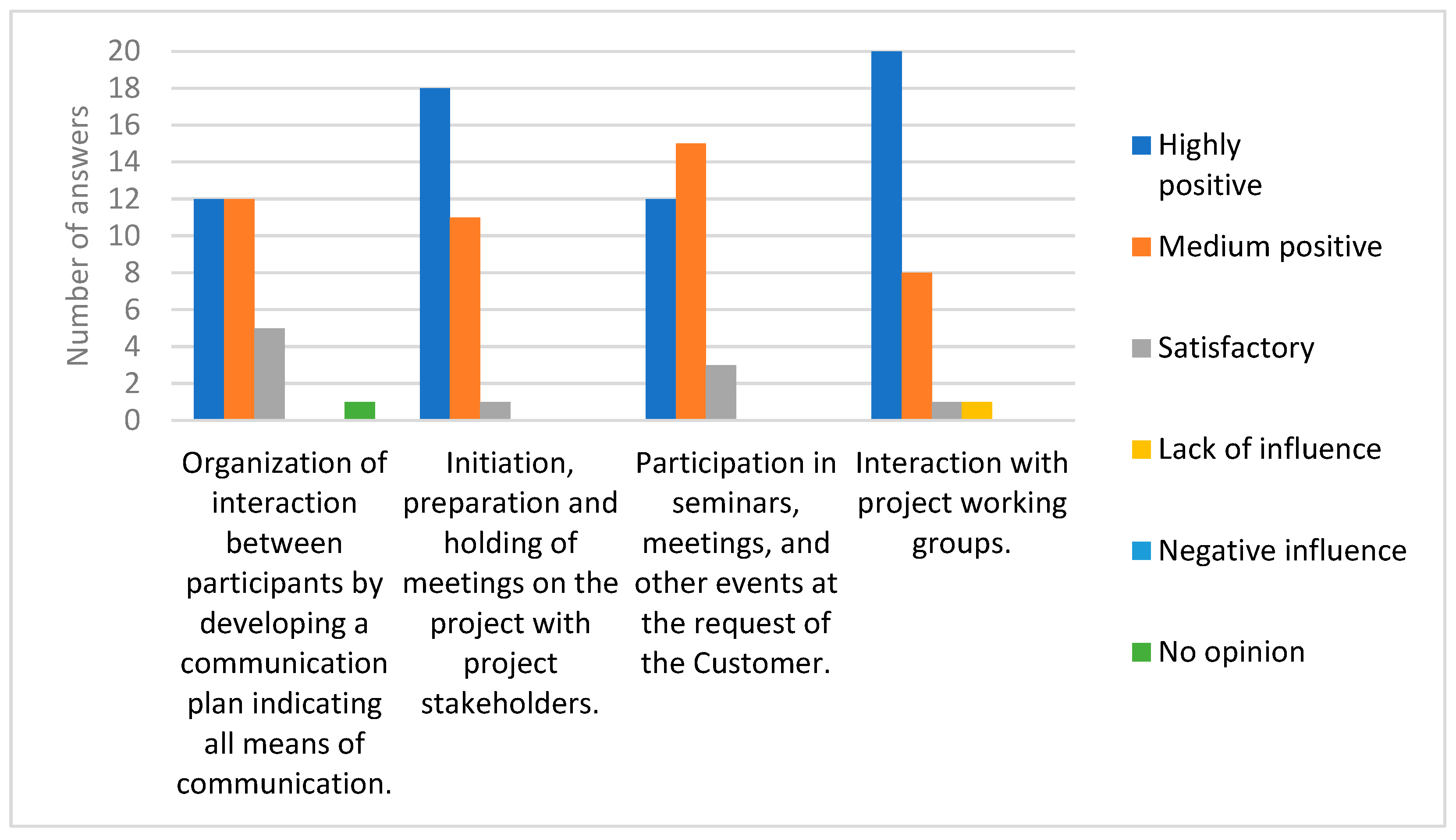
Communication management emerged as a common challenge in IT project implementation. Respondents were asked to indicate communication approaches used in their organizations. The most frequently mentioned were:
Interaction with project teams – used in 9 out of 13 enterprises (20 mentions);
Stakeholder meetings – initiated and conducted in 7 enterprises (18 mentions). The results obtained concerning communication approaches in the implementation of IT projects in the studied enterprises are shown in Figure 1.
Figure 1.
Communication management – impact of communication on the implementation of a project.
5.3.2. Evaluation of Project Management in the Surveyed Enterprises
To evaluate the effectiveness of project management processes in IT projects, respondents assessed each of the 59 processes using a six-point scale: from highly positive to negative influence or no opinion. The results, summarized in Figure 2 and Table 4, showed that all processes were perceived positively, though with varying degrees of significance.
Figure 2.
The impact of selected project management processes on the success of IT projects, according to respondents.
Figure 2.
The impact of selected project management processes on the success of IT projects, according to respondents.
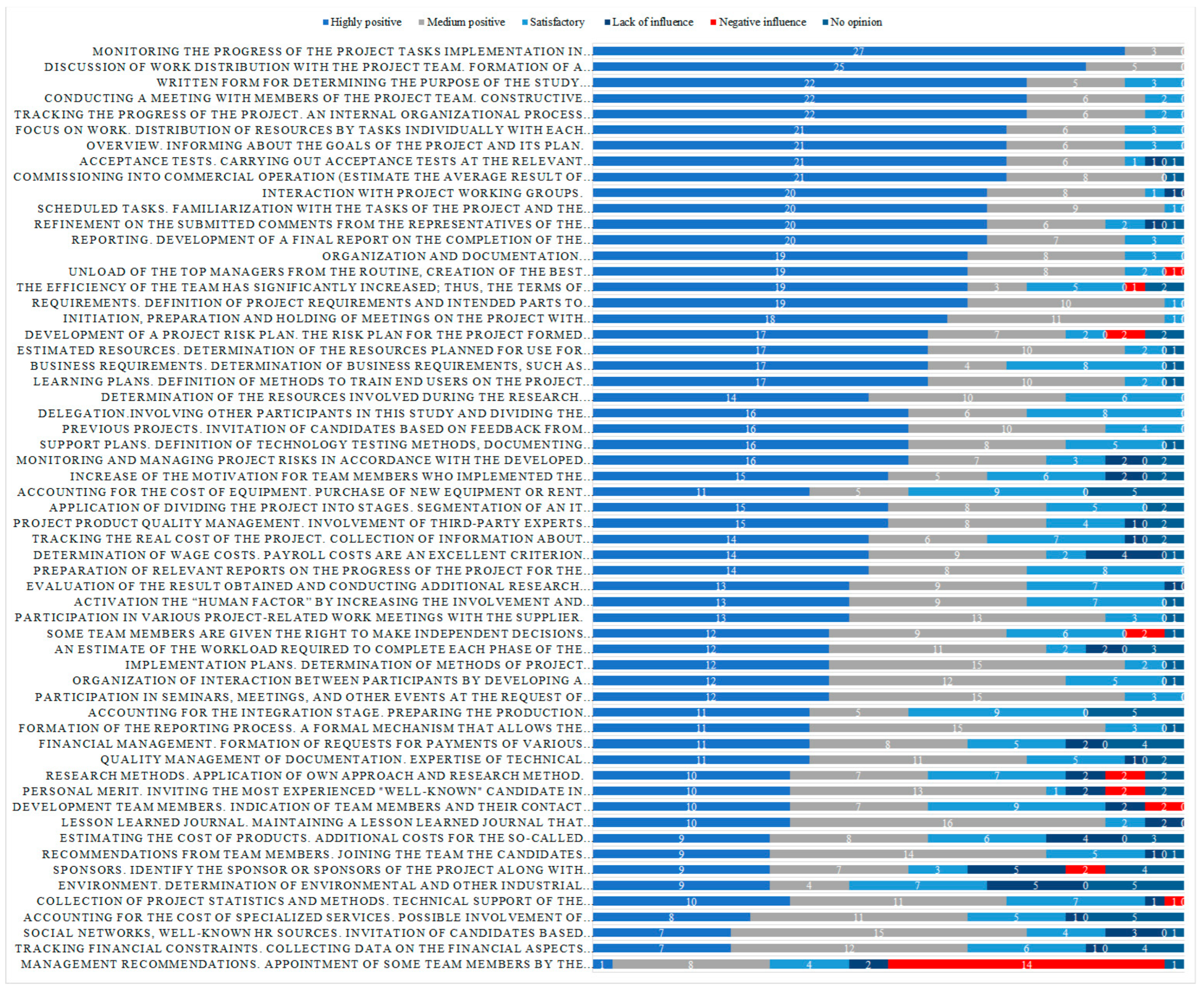
The most influential processes, consistently rated highest, included:
- Clear documentation of project objectives;
- Informing the team about project goals and plans;
- Work distribution discussions;
- Progress tracking;
- Meetings with stakeholders;
- Participation in client-requested events;
- Task monitoring per the project plan.
At the lower end of the list were:
- Definition of environmental and technical requirements;
- Quality management of the project product;
Integration stage planning (e.g., preparing production environments, budgeting for downtime, overtime, and managerial supervision).
Despite variations in ratings, no sharp boundary was found between critical and secondary processes – the differences in perceived value were gradual. Hence, the study concludes that all surveyed processes contribute to project success, but the top nine merit particular attention from project managers. Thus, it seems interesting to compare the most highly rated, most important key processes with the number of surveyed enterprises implementing individual processes. This comparison is shown in the following table (Table 4).
Table 4.
Top-rated project management processes and their implementation in surveyed enterprises.
| Processes | Group of processes | Highly positive responses | Number of enterprises applying processes |
|---|---|---|---|
| Track task progress against the project plan | Monitoring | 27 | 9 |
| Work distribution discussed with project team | Planning | 25 | 9 |
| A written statement defines the study’s purpose | Planning | 22 | 9 |
| Holding a meeting with the project team | Development | 22 | 9 |
| Tracking the progress of the project | Development | 22 | 7 |
| Project overview and goal briefing | Planning | 21 | 9 |
| Task-focused resource allocation discussed individually with each team member | Planning | 21 | 9 |
| Acceptance tests conducted at relevant organizations before commercial launch | Implementation and testing | 21 | 8 |
| Average outcome of commissioning into commercial operation | Completion | 21 | 9 |
Table 4 presents nine the highest-rated project management processes, grouped accordingly, along with their implementation levels and enterprise coverage. Most top-rated processes are widely adopted, yet two remain underused: (1) monitoring task progress per the work plan and (2) team work distribution discussions – each applied in only 9 of 13 enterprises. Given their high impact on IT project success, these practices should be integrated by any enterprise aiming for effective project management.
5.3.3. The Relationship Between the Level of Use of Key Project Management Processes and the Degree of Their Implementation
The final stage of the analysis of the collected survey data focused on examining the relationship between the extent of use of project management processes at the surveyed enterprises and the overall perceived impact of project management practices on the implementation of IT projects.
A total of 59 project management processes were identified as the most frequently used and, consequently, as the key success factors in IT project implementation. These processes were logically grouped into process groups, as defined in the PMBOK Guide-Sixth Edition [22], which conceptualizes a process group as a logical collection of input data, tools and techniques, and outputs related to project management.
The selected project management processes are interconnected through their outputs, and may involve overlapping activities occurring throughout various phases of the project life cycle. The level of use of project management processes was measured by the number of processes implemented at each individual enterprise (with a maximum of 59 processes possible).
In addition to reporting which project management processes were in use, each respondent was asked to assess the overall impact of implementing a project management system at their enterprise. The response options provided were as follows:
- Highly positive
- Medium positive
- Satisfactory
- No influence
- Negative influence
- No opinion
Based on the results of all 30 completed questionnaires, the number of project management processes implemented by each enterprise was determined. Subsequently, using the reported overall impact ratings, a correlation analysis was conducted to identify the relationship between the extent of process implementation and the perceived effectiveness of project management in IT projects. The correlation coefficients between the level of use of project management processes and the overall impact of project management implementation using Spearman's rank correlation coefficient with the highest values presents Table 5.
Table 5.
Selected Spearman's correlation between highly rated project management processes and their actual implementation in IT projects.
Table 5.
Selected Spearman's correlation between highly rated project management processes and their actual implementation in IT projects.
| Project management process | Correlation coefficient* |
|---|---|
| Research methods. Application of own approach and research method/Preparation of relevant reports on the progress of the project for the Sponsor and the Customer of the project | 0.72 |
| Activation the “human factor” by increasing the involvement and interest of the project team/Focus on work. Distribution of resources by tasks individually with each member of the project team | 0.88 |
| The efficiency of the team has significantly increased; thus, the terms of the project were met on time for the Customer/Focus on work. Distribution of resources by tasks individually with each member of the project team | 0.78 |
| Accounting for the cost of specialized services. Possible involvement of consulting or subcontracting team members/Accounting for the cost of equipment. Purchase of new equipment or rent of host premises and servers for the deployment of an IT project | 0.78 |
| Implementation plans. Determination of methods of project implementation to the state of industrial use/Learning plans. Definition of methods to train end users on the project supplied parts | 0.80 |
| Support plans. Definition of technology testing methods, documenting methods, and support methods by own- or third-party companies/Learning plans. Definition of methods to train end users on the project supplied parts | 0.80 |
| Learning plans. Definition of methods to train end users on the project supplied parts/Personal merit. Inviting the most experienced "well-known" candidate in the field of IT to give a future project a certain status or fame | 0.80 |
| Learning plans. Definition of methods to train end users on the project supplied parts/Management recommendations. Appointment of some team members by the management despite some lack of competence of these candidates in the part of the project that is planned in the future | 0.75 |
| Learning plans. Definition of methods to train end users on the project supplied parts/Social networks, well-known HR sources. Invitation of candidates based on submitted CVs from Internet sources. Based on the results of the interview, a general project team is formed | 0.85 |
| Participation in various project-related work meetings with the Supplier/Acceptance tests. Carrying out acceptance tests at the relevant organizations and putting into commercial operation | 0.79 |
* – significance at the level of p < 0.05.
The analysis of rank correlation coefficients between project management processes and IT project success revealed that five processes had strong correlations (0.80), and seventeen showed moderately strong ones (0.70), confirming that key practices consistently support success.
A core finding was the high impact of evaluating project outcomes and conducting follow-up research, strongly linked to team selection via HR sources and requirement definition – a combination foundational to early-stage project success [22].
Financial oversight, particularly wage cost estimation, correlated with improved team efficiency, support planning, and user training – highlighting the role of budgeting in both cost control and performance [74].
Clear team roles were tied to cost estimation and sponsor identification, showing how coordination supports financial and strategic alignment. Motivation emerged as critical, connecting with individual research, resource planning, environmental factors, and implementation strategy.
Processes like equipment cost accounting and product cost estimation were frequently linked with team engagement, phase planning, and sponsor collaboration, showing interdependence in financial and HR dimensions.
Evaluation and communication, especially post-project analysis and decision delegation, were central to iterative improvement. Sponsor identification was deeply connected with finance, resourcing, and team structure.
Environmental assessments aligned with HR-based team formation and equipment/resource planning. Support planning was embedded across nearly all domains – from implementation to vendor collaboration – highlighting its strategic importance.
Even moderately correlated processes (0.50) appeared 148 times, underscoring the interconnected nature of effective project management.
Success depends not on isolated practices but on their synergistic interaction – particularly across finance, HR, motivation, communication, and strategic oversight.
Alongside with this, according to the respondents, there are important project management processes which are not implemented at the surveyed enterprises due to some circumstances. Nevertheless, the respondents evaluated them fairly highly in terms of positive impact but in the practical part of the survey mentioned that they do not use them in their enterprises. The information is clearly exposed in the Table 6.
Table 6.
Processes that are important in project management according to the respondents, but are not used in the studied enterprises.
Table 6.
Processes that are important in project management according to the respondents, but are not used in the studied enterprises.
| The title of the project management process in the survey | Number of respondents (those who evaluated the processes highly but said they didn’t use them at enterprises) |
|---|---|
| Accounting for the integration stage. Preparing the production environment for the implementation of the project requires budgeting for system shutdown times, delays, overtime payment and time required for the project manager to supervise the work carried out on schedule. | 13 |
| Personal merit. Inviting the most experienced “well-known” candidate in the field of IT to give a future project a certain status or fame. | 10 |
| Project product quality management. Involvement of third-party experts with a “fresh eye” to carry out work on testing the completed project work, which will help in improving the quality of the software. | 9 |
| An estimate of the workload required to complete each phase of the project. Tariff rates for time tracking of each team member are planned at each stage of the project. | 8 |
| Environment. Determination of environmental and other industrial requirements for the project plan. | 7 |
| Lesson learned journal. Maintaining a lesson learned journal that reflects all the challenges the team and project manager faced. | 7 |
| Tracking financial constraints. Collecting data on the financial aspects of the project by the project manager for the project sponsor. | 6 |
| Organization of interaction between participants by developing a communication plan indicating all means of communication. | 5 |
| Support plans. Definition of technology testing methods, documenting methods, and support methods by own- or third-party companies. | 5 |
| Quality management of documentation. Expertise of technical documentation at an accredited laboratory that has an appropriate license for these types of work. | 5 |
| Increase of the motivation for team members who implemented the project and were able to reveal new professional qualities of team members. | 5 |
Based on the analysis of significant project management processes that are currently not implemented in some enterprises, it is essential that these processes be considered for future application, particularly in the context of IT project implementation. The calculated Spearman’s rank correlation coefficients for processes related to project team management revealed statistically significant, moderately positive relationships between some variables, with significance confirmed at the 5% level. These findings warrant further examination in relation to the second hypothesis of the study, which explores the influence of project management practices on the success of IT projects. The detailed information is exposed in Table 7.
Table 7.
Spearman’s correlations between team-related success factors and process implementation impact.
Table 7.
Spearman’s correlations between team-related success factors and process implementation impact.
| Variable (success factor) |
Implementation | |||||
|---|---|---|---|---|---|---|
| I | II | III | IV | V | ||
| Declaration | I | 0.03 | 0.10 | 0.34 | 0.39 | 0.07 |
| II | -0.26 | -0.13 | -0.09 | 0.23 | -0.08 | |
| III | -0.17 | -0.17 | 0.18 | 0.09 | -0.23 | |
| IV | -0.27 | 0.04 | 0.30 | 0.27 | -0.12 | |
| V | -0.12 | -0.09 | 0.26 | 0.16 | 0.34 | |
Shaded background indicates significance at the level of p < 0.05. I – Previous projects. Invitation of candidates based on feedback from colleagues from previous projects. Selection of candidates based on the opinion of colleagues. II – Personal merit. Inviting the most experienced 'well-known' candidate in the field of IT to give a future project a certain status or fame. III – Management recommendations. Appointment of some team members by the management despite some lack of competence of these candidates in the part of the project that is planned in the future. IV – Recommendations from team members. Joining the team of candidates invited by the team members, who recommended them. V – Social networks, well-known HR sources. Invitation of candidates based on submitted CVs from Internet sources. Based on the results of the interview, a general project team is formed.
It is important to highlight that the information obtained in the course of the conducted researches does not give a certain explanation to the obtained results. In order to have an opportunity to make more reliable conclusions it is necessary to conduct further researches.
6. Discussion
To test the hypotheses proposed at the start of the research, the author applied three key methods: a review of academic literature (both Kazakhstani and international), in-depth interviews with senior managers experienced in IT project implementation, and an anonymous survey of practitioners involved in such projects.
Hypothesis 1 was confirmed through the identification of 59 project management processes – exceeding the 49 listed in PMBOK (6th edition) – as core elements of effective IT project implementation. These processes, grouped by logical function, are considered essential throughout the full project life cycle. Insights from top managers during interviews also reinforced the importance of specific processes such as communication, motivation, delegation, risk management, and change control as key success factors in their work.
Hypothesis 2, which focused on the role of the project team, also found support. Literature emphasizes the importance of team competence, cohesion, and interdisciplinary collaboration for project success. Interviewees echoed these points, noting that careful selection, motivation, and internal dynamics significantly affect project outcomes. Statistical analysis revealed modest but clear connections between team-related management processes and project outcomes, supporting the view that the project team is indeed a major success factor in IT projects.
Hypothesis 3 addressed the impact of professional use of project management tools, effective team leadership, and consistent communication. Both theoretical sources and interviews stressed communication as a critical factor in achieving project goals. Senior managers highlighted the value of face-to-face interactions, constructive discussions, team cohesion, and shared decision-making. However, statistical data on communicative processes showed only weak correlations. While interaction exists, the relatively low figures suggest that further research on communication’s quantitative impact may be needed. Despite this, the interview findings confirm the relevance of communication in project success.
Overall, the results drawn from literature, expert interviews, and survey analysis provide strong confirmation of Hypotheses 1 and 2, while offering moderate support for Hypothesis 3.
7. Conclusions
The aim of this research was to determine the key success factors in the sustainable implementation of IT projects. Through an extensive literature review, 59 project management processes were identified and categorized into five groups: Initiation, Planning, Implementation, Monitoring, and Completion. All these processes were found to have a positive impact on project success and can be considered essential for effective project management.
The most highly valued factors include communication, pre-project surveys, planning, continuous stakeholder engagement, project control, change management, domain expertise, risk management, delegation, and project outcomes. All the most important success factors show the crucial role of inclusion of all team members and other stakeholders into project management.
The identified success factors in IT project management not only enhance organizational efficiency but also contribute directly to sustainable development. Clear communication, stakeholder engagement, and continuous knowledge sharing foster transparency and long-term trust, which are essential for socially responsible project execution. Similarly, effective risk management, team competence, and motivation promote resilience and adaptability – key qualities for enterprises operating in dynamic and resource-constrained environments. By embedding these practices, IT project management supports not only the achievement of immediate business objectives but also the broader goals of innovation-driven and sustainable economic growth.
It is recommended that future research compares enterprises that apply the project approach with those that do not - starting from financial metrics - to evaluate its broader organizational impact. However, limited data availability from Kazakhstani enterprises remains a challenge.
Attention should also be paid to processes recognized as important by survey respondents but not implemented in practice, as these may play a critical role in future project success.
In closing, project management in IT remains a developing area in Kazakhstan's digital transformation. As the country moves toward an innovation-driven sustainable economy, greater knowledge and application of modern project management methods are essential, warranting continued research and practical guidance. Our findings can be useful for any country developing sustainable digital transformation.
Author Contributions
Conceptualization, S.A.; methodology, S.A. and A.P.; formal analysis, S.A. and A.P.; investigation, S.A.; writing—original draft preparation, S.A. and A.P.; writing—review and editing, A.P. supervision, A.P. All authors have read and agreed to the published version of the manuscript.
Funding
The APC was funded under subvention funds for the Faculty of Management and by- program “Excellence Initiative—Research University” for the AGH University of Krakow.
Institutional Review Board Statement
Not applicable.
Informed Consent Statement
Not applicable.
Data Availability Statement
The original contributions presented in this study are included in the article and supplementary material. Further inquiries can be directed to the corresponding authors.
Conflicts of Interest
The authors declare no conflicts of interest.
Appendix A
- IN-DEPTH INTERVIEW WITH TOP IT MANAGERS
- Competence
- 7.
- How experienced are you as a Project Manager? (number of years)
- 8.
- Do you have a project management qualification, certification, or membership?
- 9.
- What is the most desired skill that is required to become a successful project manager according to your experience? Please give a couple of examples regarding your past projects.
Experience
- 10.
- How mature do you think your organization is in terms of project management?
- 11.
- What’s your preferred project management methodology?
- 12.
- What project management software (tools) do you prefer?
- 13.
- Which specific products do you currently use?
- 14.
- What methods would help you deliver projects better?
- 15.
- Did you have a difficult project in your experience? What was this complex project about, and how did you manage to implement it?
- 16.
- What are the greatest challenges in delivering projects?
- 17.
- How do you deal when you’re overwhelmed or underperforming?
Remote work experience
- 18.
- Have you managed remote teams and outsourced resources?
- 19.
- Work from home has become the new reality in the post-COVID-19 world. How well are you prepared to manage a remote team?
- 20.
- What difficulties did you encounter while working remotely? (team, Internet, communication)
- 21.
- Do you think that remote project management work can be as effective as office (traditional) work?
Clear Communication
- 22.
- What is your communication style with your team?
- 23.
- What were the communication challenges during your projects?
- 24.
- How do you manage team members who are not working to their full potential?
- 25.
- What is your strategy for working with an underperforming team member?
Consistency and Integrity
- 26.
- Do you report "bad" news? If yes, how do you report bad news?
- 27.
- How have you handled disgruntled employees?
- 28.
- What are some examples of times you’ve kept your promise even when that might have been difficult?
Customer Orientation
- 29.
- How do you ensure you and your team deliver or exceed customer expectations?
- 30.
- Suppose the project has gone off the rails. What steps would you take to get it back on track?
- 31.
- Suppose the customer is not happy about the quality of the project outcomes. How do you handle the situation? What is your way of handling an unhappy stakeholder?
Focus on results
- 32.
- How do you go about managing the performance of your team?
- 33.
- How do you motivate team members?
- 34.
- What are some of the tools and resources you’ve used to develop your team?
Effective Delegation
- 35.
- Do you delegate?
- 36.
- How easily do you delegate responsibility?
- 37.
- How do you monitor and review the delegated responsibilities?
Goal Focus
- 38.
- How do you set goals for your team? How do you track these goals?
- 39.
- What are the techniques you may use to define the scope of a project?
- 40.
- Describe the team forming process you follow in project management.
- 41.
- What general metrics do you use to determine if a project is progressing on track?
Managing Ambiguity and Risks
- 42.
- Describe two areas in your current project, where there is a high level of uncertainty. How do you tackle these uncertainties?
- 43.
- How do you control changes to your project?
- 44.
- Do you seek help outside of the project team?
- 45.
- What approach do you take when a project hits a roadblock and does not go according to plan, despite the team's best efforts?
Prioritizing and Time Management
- 46.
- How do you ensure that your project is always on track?
- 47.
- What tools do you use as a manager to plan your activities as well as that of your team?
- 48.
- How do you help the team prioritize competing or simultaneously urgent tasks?
- 49.
- How do you prioritize tasks on a project?
- 50.
- What is your strategy for prioritizing the tasks?
Proactive Decision Making
- 51.
- Give a few examples of proactive decision-making in your past projects
- 52.
- Can you give a few examples of a time when you made a tough decision, and it backfired?
Conflicts
- 53.
- What is your strategy to deal with internal conflicts among the team members?
- 54.
- Do conflicts affect the overall project outcome?
- 55.
- How do you gain agreement with teams?
Appendix B
SURVEY OF RESPONDENTS FROM THE IT FIELD
The survey questionnaire was divided vertically into two parts.
Part "A". What impact on the success and degree of implementation of an IT project has a phased study of the subject area? Possible answers: Highly, positive, Medium positive, Satisfactory, Lack of influence, Negative influence, No opinion.
Part “B”. Are similar research stages used at your enterprise? Possible answers: Yes, No, Do not know.
QUESTIONS
- Basic principles of conducting a domain survey before implementing an IT project. Based on your own experience, evaluate the impact of the following research that affects the implementation of the IT project (part "a"). In addition, for each step of the IT project research, indicate whether the research is generally used at your enterprise (part "b"). Please fill out both parts of the survey (part "a", "b").
1. Written form for determining the purpose of the study.
Documentation of the goals set allows to accurately focus on a certain range of the studied area, which will allow to successfully carry out the work.
2. Determination of the resources involved during the research.
Maintaining a list of viewed publications. Information sources include the following:
- -
- previous experience;
- -
- the experience of other people;
- -
- proven and high-quality Internet sites;
- -
- specialized magazines;
- -
- professional literature on relevant topics.
3. Delegation.
Involving other participants in this study and dividing the study area into sectors with assigning them to each participant from the team.
4. Research methods.
Application of own approach and research method.
5. Organization and documentation.
Collection of joint information accumulated personally and by members of the project team.
6. Evaluation of the result obtained and conducting additional research.
Checking the jointly collected information on the subject area of the project being implemented. In case of missing information, continuation of the study at an unscheduled date.
The relationship of the project manager with the management and the project team. Based on your own experience, evaluate the effectiveness of tasks when using the function of delegating responsibilities and tasks on the project (part "a"). In addition, for each of the presented characteristics of delegation, is it used at your enterprise in the implementation of IT projects (part "b"). Please fill out both parts of the survey (part "a", "b").
Unload of the top managers from the routine, creation of the best conditions for solving strategic management tasks.
Activation the “human factor” by increasing the involvement and interest of the project team.
Some team members are given the right to make independent decisions that were effectively reflected in the result of the project.
The efficiency of the team has significantly increased; thus, the terms of the project were met on time for the Customer.
Increase of the motivation for team members who implemented the project and were able to reveal new professional qualities of team members.
- The stages of the design of the financial part used for the implementation of the IT project. Based on your own experience, evaluate the stages of project budgeting of an IT project as part of its design (part "a"). In addition, is there a specific methodology for calculating the budget for each IT project at your enterprise (part "b"). Please fill out both parts of the survey (part "a", "b").
- 1.
- Application of dividing the project into stages. Segmentation of an IT project into its component parts, which makes it easier to determine characteristic points and estimate the amount of work at each stage.
- 2.
- Accounting for the integration stage. Preparing the production environment for the implementation of the project requires budgeting for system shutdown times, delays, overtime payment and time required for the project manager to supervise the work carried out on schedule.
- 3.
- An estimate of the workload required to complete each phase of the project. Tariff rates for time tracking of each team member are planned at each stage of the project.
- 4.
- Accounting for the cost of specialized services. Possible involvement of consulting or subcontracting team members.
- 5.
- Accounting for the cost of equipment. Purchase of new equipment or rent of host premises and servers for the deployment of an IT project.
- 6.
- Estimating the cost of products. Additional costs for the so-called "office work" that are required at all stages of the IT project.
- 7.
- Development of a project risk plan. The risk plan for the project formed during the study.
- Formation of an IT project development team. Based on your own experience, evaluate the criteria for selecting candidates for the IT project development team (part "a"). In addition, is there a certain criterion for selecting an IT team for the successful implementation of an IT project (part "b"). Please fill out both parts of the survey (part "a", "b").
- 1.
- Previous projects. Invitation of candidates based on feedback from colleagues from previous projects. Selection of candidates based on the opinion of colleagues.
- 2.
- Personal merit. Inviting the most experienced "well-known" candidate in the field of IT to give a future project a certain status or fame.
- 3.
- Management recommendations. Appointment of some team members by the management despite some lack of competence of these candidates in the part of the project that is planned in the future.
- 4.
- Recommendations from team members. Joining the team the candidates invited by the team members, who recommended them.
- 5.
- Social networks, well-known HR sources. Invitation of candidates based on submitted CVs from Internet sources. Based on the results of the interview, a general project team is formed.
- Formation of an IT project plan. Based on your own experience, evaluate the main stages of the IT project plan that was implemented at your enterprise (part "a"). In addition, does the project plan apply at all at your enterprise (part "b"). Please fill out both parts of the survey (part "a", "b").
- 1.
- Overview. Informing about the goals of the project and its plan.
- 2.
- Sponsors. Identify the sponsor or sponsors of the project along with their contact information.
- 3.
- Development team members. Indication of team members and their contact information.
- 4.
- Requirements. Definition of project requirements and intended parts to be supplied.
- 5.
- Scheduled tasks. Familiarization with the tasks of the project and the work division scheme. May contain a chart.
- 6.
- Estimated resources. Determination of the resources planned for use for the implementation of the project. Resources include users, equipment and services.
- 7.
- Environment. Determination of environmental and other industrial requirements for the project plan.
- 8.
- Business requirements. Determination of business requirements, such as accounted business cycles, anticipated project deliverables, and meeting schedule.
- 9.
- Implementation plans. Determination of methods of project implementation to the state of industrial use.
- 10.
- Support plans. Definition of technology testing methods, documenting methods, and support methods by own- or third-party companies.
- 11.
- Learning plans. Definition of methods to train end users on the project supplied parts.
- Implementation of the IT project plan. Based on your own experience, evaluate the application of the presented approaches in the implementation of the project plan (part "a"). In addition, is the plan for the implementation of the project applied at your enterprise (part "b"). Please fill out both parts of the survey (part "a", "b").
- 1.
- Discussion of work distribution with the project team. Formation of a responsible team, whose members build trusting relationships with each other. Regular general meeting defined by formal regulations, as well as the use of informal types of communication with the team.
- 2.
- Focus on work. Distribution of resources by tasks individually with each member of the project team.
- 3.
- Conducting a meeting with members of the project team. Constructive meeting on project tasks with the ability to present reports from each member of the project team on the work performed.
- 4.
- Tracking the progress of the project. An internal organizational process for team reporting on completed tasks, which reflects the progress of the project and allows to analyze the amount of work done, the budget and the time remaining until the completion of the project.
- 5.
- Formation of the reporting process. A formal mechanism that allows the team to regularly report to the manager on the progress of the project schedule.
- 6.
- Collection of project statistics and methods. Technical support of the process of collecting data on the spent working time and the percentage of tasks completed. The methods can be different, for example, e-mail, spreadsheets, web application (form), Microsoft project, Microsoft Project Central, etc.
- 7.
- Tracking financial constraints. Collecting data on the financial aspects of the project by the project manager for the project sponsor.
- 8.
- Financial management. Formation of requests for payments of various nature related to the project, purchase orders, payments, invoices, etc.
- 9.
- Tracking the real cost of the project. Collection of information about payment of invoices to vendors and consultants, as well as the time spent by team members on tasks already completed.
- 10.
- Determination of wage costs. Payroll costs are an excellent criterion for constantly checking the completion of a project against the budget cost of the project.
- Communications management. Based on your own experience, evaluate the impact of communication on the implementation of the project (part "a"). In addition, whether certain characteristics of communication management are applied to the implementation of the project at your enterprise (part "b"). Please fill out both parts of the survey (part "a", "b").
- 1.
- Organization of interaction between participants by developing a communication plan indicating all means of communication.
- 2.
- Initiation, preparation and holding of meetings on the project with project stakeholders.
- 3.
- Participation in seminars, meetings, and other events at the request of the Customer.
- 4.
- Interaction with project working groups.
- Implementation and control of the project. Based on your own experience, evaluate the management of project implementation according to the presented criteria, as well as tracking project risks (part "a"). In addition, is the monitoring of project implementation and risks applied at your enterprise (part “b”). Please fill out both parts of the survey (part "a", "b").
- 1.
- Monitoring the progress of the project tasks implementation in accordance with the project work plan.
- 2.
- Participation in various project-related work meetings with the Supplier.
- 3.
- Preparation of relevant reports on the progress of the project for the Sponsor and the Customer of the project.
- 4.
- Monitoring and managing project risks in accordance with the developed risk plan.
- Quality assurance. Based on your own experience, evaluate the main criteria in ensuring the quality of project management to obtain the desired result at the end of the IT project (part "a"). In addition, does the concept of providing quality assurance apply to the management of IT projects at your enterprise (part b). Please fill out both parts of the survey (part "a", "b").
- 1.
- Quality management of documentation. Expertise of technical documentation at an accredited laboratory that has an appropriate license for these types of work.
- 2.
- Project product quality management. Involvement of third-party experts with a "fresh eye" to carry out work on testing the completed project work, which will help in improving the quality of the software.
- Completion of the project. Based on your own experience, evaluate the application of the following completing stages within the framework of the project plan with the results of the completed tasks (part "a"). In addition, does your enterprise apply the final reporting on the completion of the project (part "b"). Please fill out both parts of the survey (part "a", "b").
- 1.
- Acceptance tests. Carrying out acceptance tests at the relevant organizations and putting into commercial operation.
- 2.
- Refinement on the submitted comments from the representatives of the tested laboratory.
- 3.
- Commissioning into commercial operation (estimate the average result of commissioning into commercial operation).
- 4.
- Reporting. Development of a final report on the completion of the project, indicating the achieved goals of the project.
- 5.
- Lesson learned journal. Maintaining a lesson learned journal that reflects all the challenges the team and project manager faced.
References
- Trocki, M. Nowoczesne zarządzanie projektami; PriceWaterhouseCoopers: Warsaw, 2012. [Google Scholar]
- Samid, G. Too much project management: A vice in disguise (and how to minimize it). Cost Engineering 1995, 37, 18. [Google Scholar]
- Kaplan, R.S.; Norton, D.P. The Balanced Scorecard – Measures that drive Performance. Harvard Business Review 1992, 70, 71–79. [Google Scholar]
- Trocki, M. Metody i standardy zarządzania projektami; PriceWaterhouseCoopers: Warsaw, 2017. [Google Scholar]
- Carlson, R.; Turner, R. Review of Agile Case Studies for Applicability to Aircraft Systems Integration. Procedia Computer Science 2013, 16, 469–474. [Google Scholar] [CrossRef]
- Pohler, D.; Willness, C. Balancing interests in the search for occupational legitimacy: the HR professionalization project in Canada. Hum. Resour. Manag. 2014, 53, 467–488. [Google Scholar] [CrossRef]
- Chen, Y.-S.; Chang, B.-G.; Lee, C.-C. The association between continuing professional education and the financial performance of public accounting firms. Int. J. Hum. Resour. Manag. 2008, 19, 1720–1737. [Google Scholar] [CrossRef]
- Lundin, R.A.; Söderholm, A. A theory of the temporary organization. Scand. J. Manag. 1995, 11, 437–455. [Google Scholar] [CrossRef]
- Marcelino-Sádaba, S.; Pérez-Ezcurdia, A.; González-Jaen, L.F. Using project management as a way to sustainability. J. Clean. Prod. 2015, 99, 1–16. [Google Scholar] [CrossRef]
- Sabini, L.; Muzio, D.; Alderman, N. 25 years of ‘sustainable projects’: What we know and what the literature says. Int. J. Proj. Manag. 2019, 37, 820–838. [Google Scholar] [CrossRef]
- Silvius, G.; Schipper, R. Sustainability in project management: A literature review and impact analysis. Soc. Bus. 2014, 4, 63–96. [Google Scholar] [CrossRef]
- Zakrzewska, M.; Piwowar-Sulej, K.; Jarosz, S.; Sagan, A.; Sołtysik, M. The linkage between Agile project management and sustainable development: A theoretical and empirical view. Sustain. Dev. 2022. [Google Scholar] [CrossRef]
- Ahmad, M.O.; Al-Baik, O. Fostering social sustainability in large-scale agile projects: Insights from Swedish software companies. J. Decis. Syst. 2025, 34, 2464749. [Google Scholar] [CrossRef]
- Kyriakogkonas, P.; Garefalakis, A.; Pappa, E.; Kagias, P. Sustainable Project Management under the Light of ESG Criteria: A Theoretical Approach. Theor. Econ. Lett. 2022, 12, 1517–1538. [Google Scholar] [CrossRef]
- Ebirim, W.; Usman, F.O.; Montero, D.; Ninduwezuor-Ehiobu, N.; Olu-lawal, K.; Emmanuel, E. Project management strategies for implementing energy-efficient cooling solutions in emerging data center markets. World J. Adv. Res. Rev. 2024, 21, 1802–1809. [Google Scholar] [CrossRef]
- Pantović, V.; Vidojević, D.; Vujičić, S.; Sofijanić, S.; Jovanović-Milenković, M. Data-Driven Decision Making for Sustainable IT Project Management Excellence. Sustainability 2024, 16, 3014. [Google Scholar] [CrossRef]
- Gaweł, B.; Rębiasz, B.; Paliński, A. Integrating Probability and Possibility Theory: A Novel Approach to Valuing Real Options in Uncertain Environments. Appl. Sci. 2025, 15, 7143. [Google Scholar] [CrossRef]
- Rehman, I.U.; Ullah, S.; Rauf, A.; Shahid, A.A. Scope management in agile versus traditional software development methods. In Proc. Natl. Softw. Eng. Conf. 2010, pp. 1–6.
- Marnada, P.; Raharjo, T.; Hardian, B.; Prasetyo, A. Agile project management challenge in handling scope and change: A systematic literature review. Procedia Comput. Sci. 2022, 197, 290–300. [Google Scholar] [CrossRef]
- Kerzner, H.; Saladis, F. Value-driven Project Management; Wiley & Sons: Hoboken, 2009. [Google Scholar]
- Taizhanova, Zh.A. Kazakhstan on the way to Project Management. In Proc. 1st Int. Congr. Project Managers in the Republic of Kazakhstan; 2015; p. 79.
- A Guide to the Project Management Body of Knowledge (PMBOK Guide), 6th ed.; Project Management Institute: Newtown Square, PA, USA, 2017.
- The Standard for Portfolio Management, 4th ed.; Project Management Institute: Newtown Square, PA, USA, 2017.
- The Standard for Program Management, 4th ed.; Project Management Institute: Newtown Square, PA, USA, 2017.
- International Standard ISO 9000, Quality Management; Cert Academy: 2015.
- Association for Project Management Body of Knowledge; APM: London, UK, 2013.
- Serbskaya, O.V. Modern methods of project management. J. Mater. Afanasyev Readings 2016, 128–129. [Google Scholar]
- Beck, K.; Beedle, M.; van Bennekum, A.; Cockburn, A.; Cunningham, W.; Fowler, M.; Grenning, J.; Highsmith, J.; Hunt, A.; Jeffries, R.; Kern, J.; Marick, B.; Martin, R.C.; Mellor, S.; Schwaber, K.; Sutherland, J.; Thomas, D. Manifesto for Agile Software Development. 2001.
- Bohinc, T. Grundlagen des Projektmanagements: Methoden, Techniken und Tools für Projektleiter; GABAL: Offenbach, Germany, 2019. [Google Scholar]
- Brechner, E. Agile Project Management with Kanban; Microsoft Press: Redmond, WA, USA, 2015. [Google Scholar]
- Sutherland, J.; Sutherland, J.J. Scrum: The Art of Doing Twice the Work in Half the Time; Crown Publishing: New York, NY, USA, 2015. [Google Scholar]
- Preubig, J. Agiles Projektmanagement: Agilität und Scrum im klassischen Projektumfeld; Haufe Lexware: Freiburg, Germany, 2018. [Google Scholar] [CrossRef]
- Wysocki, R.K. Effective Project Management: Traditional, Agile, Extreme, 7th ed.; Wiley: Hoboken, NJ, USA, 2014. [Google Scholar]
- Axelos. PRINCE2 Agile; The Stationery Office: London, UK, 2017. [Google Scholar]
- Alecsandrova, T.V. , Improving effectiveness of project management in organizations based on flexible Agile methodology, Journal of Economy and Business 2019, Vol.9, p. 11.
- Terentyeva, Z.S.; Khalizova, I.A. Flexible project management methods. Azimuth Sci. Res. Econ. Adm. 2019, 374–375. [Google Scholar]
- Surzhikov, M.A. Improvement of foreign trade using the Six Sigma methodology. Bull. Rostov State Econ. Univ. 2010, 38–41. [Google Scholar]
- Schoeneberg, K.-P. Komplexitätsmanagement in Unternehmen; Gabler: Wiesbaden, Germany, 2014. [Google Scholar]
- Productlab. Top 7 project management methods: Agile, Scrum, Kanban, PRINCE2 and others. 2025. Available online: https://www.pmservices.ru/project-management-news/top-7-metodov-upravleniya-proektami-agile-scrum-kanban-prince2-i-drugie/ (accessed on 11 March 2025).
- Dolezal, J.; Lacko, B.; Machal, P.; et al. Project Management according to IPMA; Grada Publishing: Prague, Czech Republic, 2012. [Google Scholar]
- Dvorak, D.; Repal, M.; Marecek, M. Project Portfolio Management: The Best Practise of Portfolio Management; Computer Press: Brno, Czech Republic, 2011. [Google Scholar]
- Mironenko, N.V.; Leonova, O.V. Evolution of project management development in Russia and abroad. Manag. Consult. 2017. Available online: http://cyberleninka.ru/article/n/evolyutsiya-razvitiyaproektnogo-upravleniya-v-rossii-i-za-rubezhom (accessed on 14 April 2020).
- Ohara, S. P2M: A Guidebook of Project and Program Management for Enterprise Innovation; Project Management Association of Japan: Tokyo, Japan, 2001. [Google Scholar]
- Blažević, G.; Mišić, S.; Šimac, M. Importance of managing PMO in Croatian PM market. In Proc. 27th IPMA World Congress; 2014.
- Medeubaeva, M. How to implement project management in Kazakhstan. 2019. Available online: https://inbusiness.kz/ru/news/kak-vnedrit-proektnoe-upravlenie-v-kazahstane (accessed on 2 November 2020).
- Project Manager: who is he? Mining.kz. 2013. Available online: http://mining.kz/en/2013-04-17-13-05-07/publications/item/521-proektnyj-menedzher-kto-on-v-kazakhstane-otsutstvuet-edinaya-sistema-upravleniya-proektami (accessed on 20 November 2020).
- Crawford, L.; Hassner-Nahmias, A.H. Competencies for managing change. Int. J. Proj. Manag. 2010, 28, 405–412. [Google Scholar] [CrossRef]
- Nazarbayev, N.A.; Strategy Kazakhstan-2050. New political course of the established state: Message of the President of the Republic of Kazakhstan. 2012. Available online: https://www.akorda.kz/en/addresses/addresses_of_president/address-by-the-president-of-the-republic-of-kazakhstan-leader-of-the-nation-nnazarbayev-strategy-kazakhstan-2050-new-political-course-of-the-established-state (accessed on 11 November 2020).
- National Standard of the Republic of Kazakhstan. ISO 21500:2012 Guidance on project management. 2012.
- First Congress of Engineers of Kazakhstan: Almaty, 21–22 May 1993;; KazstateIsti: Almaty, Kazakhstan, 1993; p. 107.
- Sirisomboonsuk, P.; Gu, V.C.; Cao, R.Q.; Burns, J.R. Relationships between project governance and information technology governance and their impact on project performance. Int. J. Proj. Manag. 2018, 36, 288–299. [Google Scholar] [CrossRef]
- Aapaoja, A.; Herrala, M.; Pekuri, A.; Haapasalo, H. The characteristics of and cornerstones for creating integrated teams. Int. J. Manag. Proj. Bus. 2013, 6, 695–713. [Google Scholar] [CrossRef]
- Bedwell, W.; Wildman, J.; DiazGranados, D.; Salazar, M.; Kramer, W. Collaboration at work: An integrative multilevel conceptualization. Hum. Resour. Manag. Rev. 2012, 22, 128–145. [Google Scholar] [CrossRef]
- Susskind, L.; Camacho, A.; Schenk, T. A critical assessment of collaborative adaptive management in practice. J. Appl. Ecol. 2011, 49, 47–51. [Google Scholar] [CrossRef]
- Kanwal, N.; Zafar, M.Sh.; Bashir, S. The combined effects of managerial control, resource commitment, and top management support on the successful delivery of information systems projects. Int. J. Proj. Manag. 2017, 35, 1459–1465. [Google Scholar] [CrossRef]
- Zulch, B.G. Communication: The foundation of project management. Procedia Technol. 2014, 16, 1000–1009. [Google Scholar] [CrossRef]
- Mastrogiacomo, S.; Missonier, S.; Bonazzi, R. Talk before it’s too late: Reconsidering the role of conversation in information systems project management. J. Manag. Inf. Syst. 2014, 31, 44–78. [Google Scholar] [CrossRef]
- Martinsuo, M.; Hoverfält, P. Change program management: Toward a capability for managing value-oriented, integrated multi-project change in its context. Int. J. Proj. Manag. 2017, 36, 134–146. [Google Scholar] [CrossRef]
- Mao, J.Y.; Lee, J.N.; Deng, C.P. Vendors’ perspectives on trust and control in offshore information systems outsourcing. Inf. Manag. 2008, 45, 482–492. [Google Scholar] [CrossRef]
- El-Sabaa, S. The skills and career path of an effective project manager. Int. J. Proj. Manag. 2001, 19, 1–3. [Google Scholar] [CrossRef]
- Rehman, R.; Shahzad, M.; Farooq, M.S.; Javaid, M.U. Impact of leadership behavior of a project manager on his/her subordinate’s job attitudes and job outcomes. Asia Pac. Manag. Rev. 2020, 25, 38–39. [Google Scholar] [CrossRef]
- Kostalova, J.; Tetrevova, L.; Svedikc, J. Support of Project Management Methods by Project Management Information System. Procedia Soc. Behav. Sci. 2015, 210, 97. [Google Scholar] [CrossRef]
- Ahlemann, F. Towards a conceptual reference model for project management information systems. Int. J. Prod. Manag. 2009, 27, 19–30. [Google Scholar] [CrossRef]
- Ferreira, A.; Otley, D. The design and use of performance management systems: An extended framework for analysis. Manag. Account. Res. 2009, 20, 263–282. [Google Scholar] [CrossRef]
- Sakka, O.; Barki, H.; Cote, L. Interactive and diagnostic uses of management control systems in IS projects: Antecedents and their impact on performance. Inf. Manag. 2013, 50, 265–274. [Google Scholar] [CrossRef]
- Ireland, L.R. Customer satisfaction: The project manager’s role. Int. J. Proj. Manag. 1992, 10, 123–127. [Google Scholar] [CrossRef]
- Blindenbach-Driessen, F.; Van den Ende, J. Innovation in project-based firms: The context dependency of success factors. Res. Policy 2006, 35, 545–561. [Google Scholar] [CrossRef]
- Bassellier, G.; Reich, B.H.; Benbasat, I. Information technology competence of business managers: A definition and research model. J. Manag. Inf. Syst. 2001, 17, 159–182. [Google Scholar] [CrossRef]
- Esengeldina, A.S. The Project management: problems and perspectives of development in RK. Bull. Natl. Acad. Sci. Repub. Kazakhstan 2015, 4, 59–64. [Google Scholar]
- State program of industrial and innovative development of the Republic of Kazakhstan for 2015-2019, https://policy.asiapacificenergy.org/node/309. (accessed on 11 September 2025).
- Kuprava, T.A. Project Management. Introductory Course: Textbook; RUDN Publishing House: Moscow, Russia, 2008; p. 121. [Google Scholar]
- Zerde. National Info Communication Holding Zerde. 2020. Available online: https://zerde.kz (accessed on 30 August 2020).
- Rosenthal, M. W: Qualitative research methods, 2016; 8. [CrossRef]
- Kerzner, H. Project Management: A Systems Approach to Planning, Scheduling, and Controlling, 12th ed.; Wiley: Hoboken, NJ, USA, 2018. [Google Scholar]
Disclaimer/Publisher’s Note: The statements, opinions and data contained in all publications are solely those of the individual author(s) and contributor(s) and not of MDPI and/or the editor(s). MDPI and/or the editor(s) disclaim responsibility for any injury to people or property resulting from any ideas, methods, instructions or products referred to in the content. |
© 2025 by the authors. Licensee MDPI, Basel, Switzerland. This article is an open access article distributed under the terms and conditions of the Creative Commons Attribution (CC BY) license (https://creativecommons.org/licenses/by/4.0/).
Copyright: This open access article is published under a Creative Commons CC BY 4.0 license, which permit the free download, distribution, and reuse, provided that the author and preprint are cited in any reuse.


