

Submitted:
04 August 2025
Posted:
05 August 2025
You are already at the latest version
Abstract
Avogadro’s number is one of the profound constants of science—quantifying the relationship between the atomic and macroscopic worlds. This review traces its evolution from theoretical origins and experimental measurement to its exact status as a defining SI constant. Special emphasis is placed on our innovative work based on computational framework for estimating the unified atomic mass unit (UAMU) and Avogadro number. Our approach, grounded in first-principles of nuclear physics and realized in transparent Python algorithms, uniquely relates macroscopic constants directly to nuclear binding energies across a broad range of elements and nuclides. By demonstrating that Avogadro’s number is essentially the inverse of the computed UAMU, and by systematically analysing results from both advanced semi-empirical mass models and our Strong and Electroweak Mass Formula, our approach reveals a deep physical interplay between nuclear saturation and the emergence of Avogadro’s constant. This computational paradigm, adaptable to AI-driven improvements and new nuclear data, offers powerful pedagogical, conceptual, and research benefits, complementing established experimental methods. The review discusses these advances alongside the historical, scientific, and educational significance of Avogadro’s number, and concludes by outlining future prospects at the intersection of nuclear physics, computation, and fundamental metrology. Following a crude approximation, for Z = (1 to 140) having 15504 atomic nuclides, estimated value of the Avogadro number is, (6.017052 to 6.017185) x10^26 atoms/kg. It needs a review with respect to conceptual validation, statistical procedures and python program changes/corrections/updates.
Keywords:
mystery of the origin of the Avogadro number
; strong interaction
; semi-empirical mass formula
; strong and electroweak mass formula
; mole
; number of atoms/(gram or kg)
1. Introduction
The unassuming appearance of Avogadro’s number, , in physical and chemical equations belies its monumental role. It provides the essential bridge between the atomic and the macroscopic, making possible the conversion between moles, masses, atom counts, and molecular scales. The journey of Avogadro’s number—from conjecture, to experimental pursuit, to precise definition—parallels the rise of modern science’s ability to measure, define, and compute with extraordinary precision. It may be noted that, the Avogadro number—approximately 6.022 × 10²³—is indispensable for connecting atomic-scale counting with laboratory-scale measurements [1]. Yet, unlike certain fundamental constants etched deep into the framework of physical law, Avogadro’s number owes its existence and magnitude to historical conventions and pragmatic decisions about measurement. Rather than reflecting an underlying principle or symmetry of the universe, its value emerges from how scientists have chosen to define the mole, the gram, and related units over time.
This origin sets Avogadro’s number apart from constants such as the speed of light or Planck’s constant, whose roles flow directly from the very bedrock of physics and embody universal symmetry or necessity. In contrast, Avogadro’s number is a human-defined bridge: its magnitude reflects our need for a practical conversion between the microscopic world, where particles are individually counted, and the macroscopic quantities used in everyday laboratory practice.
Importantly, this contingent nature is rarely emphasized in mainstream educational materials. More often, the Avogadro number is simply presented as a fixed constant, with little discussion of how its value ultimately traces back to historical and practical choices in metrology, rather than a dictate of nature. Experimental efforts, such as the precise counting of atoms in silicon spheres, allow us to measure Avogadro’s number to many decimal places, but no theoretical law specifies that it must take its particular value.
Thus, Avogadro’s number subtly illustrates a gap in our physical understanding: while it is fundamental for scientific calculations and theories, its specific value is not demanded by the laws of nature but by the conventions and practicalities of measurement. This arbitrariness is seldom directly addressed in mainstream scientific discourse, often leaving a mistaken impression of inevitability or deeper significance where, in reality, there is a product of human-defined convention [2,3].
2. Historical Evolution of Avogadro’s Number
2.1. Origins: Concepts and Challenges
- Amedeo Avogadro (1811): Proposed that equal volumes of any gas, at equal temperature and pressure, contain equal numbers of molecules—an assertion that paved the way for atomic and molecular quantification, but without specifying a numerical value or mole concept.
- Nineteenth Century Progress: Advances in kinetic theory and gas laws (notably by Loschmidt in 1865) produced the first numerical estimates—originally the number of molecules per cubic centimetre, now called the Loschmidt constant.
- Jean Perrin (Early 1900s): Named the constant in honour of Avogadro and, through Brownian motion studies, provided the first values near those accepted today.
- Mole Concept: Only solidified with Stanislao Cannizzaro’s advocacy at the Karlsruhe Congress (1860), integrating Avogadro’s hypothesis into chemical atomic weights and equations.
2.2. From Experiment to Definition
The 20th century witnessed remarkable advances:
- Millikan’s Oil Drop: Linked the electron charge with Faraday’s constant, providing an indirect path to .
- Modern SI System: Culminated in the 2019 SI redefinition, which fixes at a stipulated value: . This is now an exact number [1], anchoring the mole and providing the metric for “amount of substance.”
3. Current Scientific Status
3.1. The SI Mole and Avogadro Number
The 2019 SI redefinition resolves the mole’s conceptual ambiguity:
- Definition: One mole contains exactly 6.02214076 × 10²³ specified elementary entities.
- Interpretation: This value is not subject to revision by further experiment; improvements now affect implementations, not the SI constant itself.
3.2. Dimensionality and Educational Nuances
Avogadro’s number is formally dimensioned “per mole”, but:
- Historically and pedagogically, “atoms per gram” or “atoms per kilogram” have also been used, corresponding to “gram-mole” or “kg-mole.”
- Modern SI disambiguates, but educational material often benefits from clarifying such usage for students and practitioners.
4. Scientific Significance
4.1. Why Avogadro’s Number Matters
- Chemical Quantification: Enables precise mass–molecule conversion, underpins stoichiometry, and defines fundamental units in chemistry and biology.
- Physics and Beyond: Links atomic mass unit to kilogram, allowing direct comparison of micro and macro scales. Without , the “bridge” between atomic mass (u) and macroscopic mass simply does not exist.
- Measurement and Metrology: Permits construction and realization of standards for mass, amount, and associated constants.
4.2. Educational and Conceptual Impact
- Teaching and understanding moles, atomic/molecular scale, and macroscopic phenomena are impossible without grasping Avogadro’s number.
- Clarifies large number concepts and demonstrates the unity of measurement across scales.
5. Computational Determination of Avogadro Number from Nuclear Physics: State-of-the-Art
5.1. Traditional Experimental Approaches
- Electrochemical Methods: Combine electron charge and Faraday constant.
- These have yielded values agreed upon to many significant digits—at or below parts per billion uncertainty.
5.2. Recent Computational Innovations
Nuclear Binding Energy-Based Computation
We have proposed a fundamentally different, theory-driven estimate of Avogadro’s number [7]:
- Logic: Avogadro’s number emerges as the inverse of the average atomic mass unit as computed from first-principles of nuclear mass and binding energy models.
-
Procedure:
- Compute average nucleon rest energy (mean of neutron and proton rest masses).
- Subtract average nuclear binding energy per nucleon (from models such as the SEMF or SEWMF).
- Add the electron rest mass energy.
- Convert the total energy to mass (via ), defining the unified atomic mass unit (UAMU).
- Take the reciprocal of UAMU (with mass expressed in kg or gram) to yield Avogadro’s number with units “atoms per kg” or “atoms per gram.”
-
Nuclear Mass Formulae Used:
- Strong and Electroweak Mass Formula (SEWMF): A simplified, innovative model emphasizing volume and electroweak contributions with fewer parameters.
- Key Results: Computed Avogadro values closely match accepted constants, particularly near iron (Z=26), where nuclear binding energy per nucleon peaks.
- Averaging across Z = 6 to 118 illustrates robustness and the physical role of nuclear binding saturation in determining Avogadro's number.
6. Special Features of Our Approach
Our approach stands out distinctly among methods for deriving Avogadro’s number. Key special features include:
6.1. Nuclear Binding Energy–Centric Physical Framework
Rooted in first-principles of nuclear physics, our method relates the unified atomic mass unit and Avogadro number directly to nuclear binding energies [19,20,21,22,23,24,25,26,27,28], bypassing dependence on macroscopic bulk measurements like crystal densities. This bridges fundamental subatomic properties with macroscopic constants.
6.2. Explicit Inverse Relation Between Avogadro Number and Atomic Mass Unit
We emphasize and concretely operationalize the relation: This direct link clarifies the origin and computation of Avogadro’s number in a straightforward manner, instead of relying solely on phenomenological or empirical approximations.
6.3. Comprehensive Coverage Across the Nuclear Landscape
Applied systematically over proton numbers from encompassing stable and unstable isotopes, method provides averaged values across wide mass number intervals, giving insights into trends, uncertainties, and highlighting particularly stable regions such as around iron.
6.4. Dual-Formula Testing and Model Flexibility
By employing both a refined semi-empirical mass formula (SEMF) and our own Strong and Electroweak Mass Formula (SEWMF), we demonstrate the adaptability and consistency of our approach—even as different nuclear physics models are considered.
6.5. Clear Dimensional and Unit Treatment
A noteworthy pedagogical advancement is our careful discussion on units: showing how expressing atomic mass units in grams vs. kilograms leads to Avogadro numbers with units “atoms per gram” or “atoms per kilogram.” This resolves historical ambiguities and clarifies distinctions between gram-mole and kg-mole concepts.
6.6. Computational Transparency and Pedagogical Potential
Our calculations are implemented openly in Python, promoting reproducibility and accessibility. The approach serves as a powerful educational tool — capable of enhancing curricula and enabling students to explore fundamental physics with modern computational means.
6.7. Forward-Looking Integration with Artificial Intelligence
We explicitly propose incorporating AI and machine learning to refine nuclear binding energy parameters and hence improve accuracy. Our dynamic model invites continuous improvement as new nuclear data emerges.
6.8. Unifying Conceptual Framework for the Mole and Avogadro Number
Our model provides a fresh perspective unifying traditional “number of atoms per unit mass” viewpoints with SI conventions, enhancing conceptual clarity about the mole and its realizations.
7. Discussion
7.1. Strengths and Advantages
- Conceptual Unification: Offers a physically grounded derivation linking nuclear properties and fundamental constants.
- Transparency: Open code and explicit calculations enable clear verification and educational utility.
- Extendibility: Adaptable to new nuclear data, mass formulas, and AI-enhanced models.
- Pedagogical Impact: Facilitates advanced teaching and exploration of the nuclear origins of macroscopic constants.
7.2. Limitations
- Model-Based Approximations: Relies on semi-empirical formulae, which are approximations especially far from stability.
- Metrological Precision: Does not currently exceed precision achieved by crystallographic and electrochemical methods.
- Dimensional Nuances: Confusion can arise if dimensional and unit conventions are not well explained.
- Data Gaps: Nuclear properties near drip lines and superheavy nuclei remain experimentally and theoretically challenging.
7.3. Future Prospects
- AI and machine learning promise better nuclear mass models, potentially increasing computational accuracy.
- Web-based educational tools could expand accessibility.
- Further exploration of nuclear physics at the limits (superheavy elements, drip lines) can deepen understanding.
7. Mainstream Experimental Determination of Avogadro’s Number
Avogadro’s number, , currently fixed as is one of the essential constants anchoring the International System of Units (SI). Its value is established through highly precise and experimentally rigorous international measurements. The dominant and most accurate mainstream method for determining is based on the X-ray crystallographic analysis of ultra-pure silicon-28 (28Si) spheres. Here’s an elaborate explanation of this method:
7.1. The Silicon-28 Sphere Method: Measuring Avogadro’s Number by Counting Atoms
- Rationale: Silicon crystals are well-studied and can be prepared almost perfectly. The atomic arrangement within the crystal lattice is regular and highly repeatable, enabling physicists to count the exact number of atoms in a precisely measured volume [4,56].
-
Key Steps:
- Fabrication of Spheres: Scientists manufacture nearly perfect spheres composed of single-crystal silicon highly enriched in the isotope 28Si. The spheres typically weigh about one kilogram and have surface roughness minimized to improve measurement accuracy.
- Measurement of Molar Mass (): Through isotope dilution mass spectrometry, the relative isotopic composition is determined with extreme precision, yielding the molar mass of the silicon sphere.
- Determination of the Crystal Lattice Constant (): Using high-resolution methods such as X-ray interferometry or optical interferometry, the lattice parameter (the length of the cubic unit cell edge) is measured. Silicon’s crystal structure is diamond cubic, which has 8 atoms per unit cell.
- Measurement of the Sphere Volume (): Interferometric techniques also precisely determine the macroscopic volume of the sphere.
- Calculation of Number of Atoms: The total number of atoms in the sphere is given by , where 8 is atoms per unit cell. By dividing the total mass by the molar mass, the number of moles is determined, allowing the calculation of .
- Mathematical Basis: Avogadro’s number links the mole to a direct count of number of atoms via as, , where is the mass of the sphere. Thus,
- Precision and Significance: This method yields the most precise and reproducible value for currently available, reducing uncertainties to parts per billion. This accuracy has been central to the 2019 SI redefinition [1], where the Avogadro number is fixed exactly, decoupling it from experimental uncertainty.
7.2. Complementary and Historical Experimental Techniques
Before the silicon crystal method, and as additional verifications, other strategies were employed:
- Millikan Oil-Drop Experiment: Linked the elementary electric charge ee to Faraday’s constant, allowing estimation of .
- Perrin’s Brownian Motion Approach: Analysed fluctuations of suspended particles to estimate the Avogadro number indirectly.
- Gas Density and Kinetic Theory Methodologies: Measured gas properties to calculate numbers of particles per volume.
Though valuable historically, none match the precision achieved by silicon crystallography.
8. Our Nuclear-Computational Approach with a Unified 6 Term Semi Empirical Mass Formula
In contrast to experimental measurement, we have developed a theoretically driven and computational approach, bridging fundamental nuclear physics and macroscopic constants.
8.1. Physical and Computational Framework
- Starting Point: We consider the basic nuclear constituents — protons and neutrons — and their rest energies, combined with nuclear binding energies which represent the energy saving (mass deficit) due to nuclear forces holding the nucleons together.
-
Key Steps in our Calculation:
- Average Nucleon Rest Energy (ANRE): Calculate the mean rest energy of a nucleon, i.e., the average of proton and neutron rest masses multiplied by c2.
- Average Binding Energy per Nucleon (ABEPN): Across the periodic table (Z=1 to 118), and considering isotopes with mass numbers from approximately 2Z to 3.5Z, compute the average nuclear binding energy per nucleon using nuclear mass formulae.
- Average Nuclear Energy Unit (ANEU): Subtract the average binding energy per nucleon from the mean nucleon rest energy to get the effective nuclear mass-energy contribution.
- Add Electron Rest Energy: Incorporate the electron rest mass energy, acknowledging the electrons associated with atoms.
- Calculate Unified Atomic Mass Unit (UAMU): Use the relation to convert the nuclear and electron energy sum to a mass unit.
- Calculate Avogadro Number: Consider the inverse of this mass unit (adjusted for units in grams or kilograms) to estimate the Avogadro number:
-
Nuclear Models Used:
- The classical Semi-Empirical Mass Formula (SEMF), including volume, surface, Coulomb, asymmetry, pairing and other microscopic terms.
- Our unified 6 term SEMF [30] applicable from Z=1 to 140.where,
- Following this unified SEMF applicable from Z= (1 to 140) and considering and , as the lower and upper mass limits, there is a scope for estimating the Avogadro number.
- Considering proton drip lines and neutron drip lines and by fixing the lower and upper mass limits for Z=1 to 140, in a systematic way, for each and every element, corresponding Avogadro number can be estimated by considering average binding energy per nucleon for all of the isotopes under consideration.
- Applying the statistical approach for all the elements, one unique value of can be obtained.
- In a collective approach and by considering the average binding energy effects of the revolving electrons, value of the Avogadro number can be tuned further.
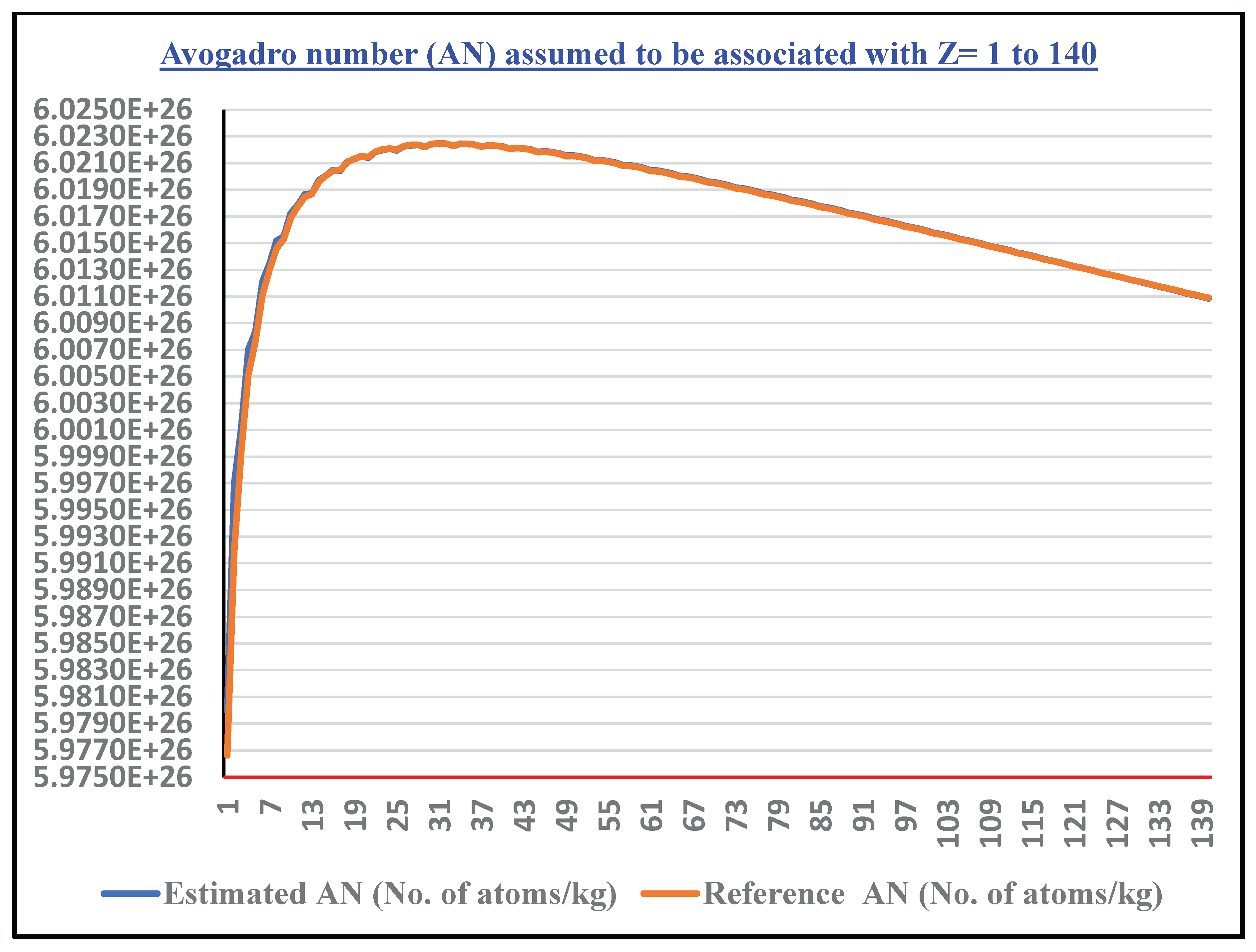
- See Figure 3 for the estimated Avogadro number assumed to be associated with Z=1 to 140.
-
Results and Trends:
- Our calculations show excellent agreement near iron (Z=26), the nucleus with peak binding energy per nucleon and thus greatest stability. The approach naturally explains why Avogadro’s number emerges as it does — as a function of nuclear binding energy saturation effects associated with strong interaction. Starting from Z = (1 to 140), for a total number of 15504 atomic nuclides, estimated
- We recognize that our proposed computational procedure for deriving Avogadro’s number from nuclear binding energies represents a new perspective and methodology in the field. We look forward to the scientific community’s thorough understanding, critical evaluation, and constructive feedback on its validity, applicability, and potential refinements. Such collective scrutiny and collaboration are vital for advancing knowledge and integrating nuclear theory innovations with metrological constants.
8.2. Conceptual and Practical Differences
- By averaging over wide ranges of nuclei—both stable and unstable—it provides a global survey of nuclear structure’s impact on atomic mass units and, consequently, Avogadro’s number.
- The dimensionality of the computed Avogadro number (atoms per gram or kilogram) is made explicit, aiding conceptual clarity around “gram mole” versus “kg mole.”
- We make Python code openly available, underscoring transparency and reproducibility.
9. Reframing the Mole Concept: Distinguishing Between Gram Mole and Kilogram Mole in Understanding Avogadro’s Number
In our approach, as we delve deeper into resolving the fundamental origin and underlying mystery of the Avogadro number, the traditional mole concept increasingly reveals its inherent arbitrariness—particularly when considered in relation to the number of atoms per unit mass, such as per gram or per kilogram. Conventionally viewed as a fixed count of particles, the mole [32,33,34,35] is often regarded as a universal and absolute quantity. However, closer scrutiny shows this is not strictly the case. Rather, the mole’s definition is deeply intertwined with specific, historically contingent choices about mass units that have shifted over time—initially anchored to the gram and more recently tied to the kilogram. These shifts highlight that the mole, as a concept, is not independent of the measurement scale it references but instead depends on the unit of mass against which the number of constituent particles is counted.
This understanding inevitably leads us to propose that the mole should always be explicitly qualified as either a “gram mole” or a “kilogram mole” (and potentially other variants if other mass units become relevant), depending on the mass scale under consideration. Doing so more honestly reflects the relationship between atomic-scale quantities and macroscopic measurements, and it prevents the implicit assumption that the mole is a unit-less, immutable constant. By explicitly denoting the mole relative to a specific mass unit, such as "gram mole" or “kilogram mole”, we clarify the underlying linkage: the numerical scale relating atoms or molecules to bulk mass is fundamentally a function of our chosen mass standard.
Making such distinctions carries several important conceptual and practical implications. Firstly, it demystifies the mole by situating its value within a framework of human-defined conventions rather than presenting it as a natural absolute. This demystification is crucial in both educational and research contexts, fostering clearer understanding and avoiding misconceptions that the mole is a fundamental constant of nature on the same footing as physical constants like the speed of light or Planck’s constant. Instead, it underscores that the mole is a pragmatic and highly useful construct devised for bridging microscopic and macroscopic worlds, shaped by measurement choices that have evolved historically.
Secondly, qualifying the mole relative to mass units enhances transparency and precision in communication of scientific measurements. It reduces ambiguity for chemists, physicists, and engineers who may work with different mass conventions or who may transition between older and newer SI definitions. For example, before the 2019 redefinition of the SI base units, the mole was defined based on 12 grams of carbon-12. Now, the mole is defined as containing an exact number of elementary entities, independent of a reference mass, yet in practice, laboratory-scale measurements inevitably refer to mass standards such as grams or kilograms. The explicit terminology of “gram mole” or “kilogram mole” thus harmonizes conceptual clarity with practical realities.
Furthermore, this reframing brings to light the historical and metrological context in which the mole emerged. It draws attention to how our unit systems and constants are shaped by the technological capabilities, standards, and needs of scientific communities rather than discovered “a priori” in nature. Recognizing that Avogadro’s number and the mole are products of human-defined measurement systems enhances scientific literacy and encourages a more critical perspective on how fundamental constants are established and applied.
Finally, by embracing the qualifiers “gram mole” and “kilogram mole”, scientists and educators invite a more nuanced dialogue about units and constants that may be extended to other areas where unit conventions exert strong influence on scientific understanding. This approach promotes transparency, reduces confusion, and ultimately strengthens the foundation of quantitative science by emphasizing clarity about the assumptions and definitions underlying critical measurements.
In summary, by explicitly contextualizing the mole as a “gram mole” or “kilogram mole”, we not only address the arbitrariness exposed by the evolving relationship between particle counts and mass units but also promote conceptual clarity, historical awareness, and precision in scientific communication. This perspective makes it clear that the mole is a practical tool shaped by human convention—a profound insight when striving to unravel the basic physical origin and meaning of Avogadro’s number.
10. ‘The SI Unit Definition of the Mole as Exactly 6.022×10²³ Entities’ Is Problematic
- a)
- Arbitrariness of the Fixed Number: Defining the mole as exactly 6.02214076×10²³ entities is fundamentally arbitrary and lacks grounding in any underlying physical law or natural constant. Unlike fundamental constants such as the speed of light or Planck’s constant, which emerge from universal physical principles, the mole’s fixed numerical value is a human-imposed convention based on historical measurement practices. This arbitrary choice undermines the conceptual purity expected of SI base units.
- b)
- Confusion Between Counting and Mass Units: The mole concept conflates a simple count of entities with mass-related units, leading to persistent confusion. A fixed number of particles per mole ignores the variable isotopic compositions and practical measurement realities of substances in different materials and environments. This rigid linkage oversimplifies complex physical and chemical phenomena and may mislead non-expert users into believing the mole represents a natural constant rather than a pragmatic standard.
- c)
- Mismatch Between Macroscopic and Microscopic Scales: While intended to bridge microscopic atomic scales with macroscopic quantities, fixing the mole at a static large number creates tension when combined with other SI units—particularly mass units defined in kilograms. The factor of 1,000 difference between “per gram” and “per kilogram” counting and the mole’s role as a counting unit is not explicitly resolved, introducing potential inconsistencies, scaling ambiguities, and dimensional confusion in practical use.
- d)
- Pedagogical and Educational Challenges: Emphasizing an exact fixed number for the mole fosters misunderstandings in teaching and learning. Students and practitioners may mistakenly ascribe deeper physical meaning to the number 6.022×10²³, not appreciating its conventional and approximate nature rooted in historical metrology. This hampers scientific literacy and encourages conceptual errors, especially given evolving definitions and measurement techniques.
- e)
- Limitation for Future Scientific Refinement: Fixing the mole’s value rigidly constrains future adjustments and refinements in measurement science and fundamental metrology. Advances in quantum measurement, nuclear physics, or experimental precision may reveal subtleties or require flexibility in the mole’s definition that a fixed integer disallows, potentially impeding scientific progress and adaptation.
- f)
- Disconnect From Natural Variability in Substances: Because isotopic and atomic compositions vary naturally and experimentally, a fixed mole number disregards the heterogeneous nature of real-world samples. This imposes a brittle idealized standard that fails to capture practical chemical variability, limiting the mole’s usefulness in advanced research and precise applications.
Although fixing the mole at exactly 6.02214076 × 10²³ particles helps maintain consistency in measurements, this choice is somewhat arbitrary. It does not reflect a natural law but seems to be a ‘human decision’ made for convenience. Because of this, the definition can create conceptual difficulties, cause confusion around units and scales, and may limit future improvements in how we measure amount of substance. Recognizing that the mole is a practical convention—not a fundamental physical constant—can help improve clarity in science education and support better communication in metrology as measurement science advances.
11. Conclusion
Our innovative computational framework offers a fresh and physically grounded perspective on determining Avogadro’s number. By leveraging nuclear binding energy formulae and implementing transparent Python-based calculations, our approach uniquely ties the unified atomic mass unit and Avogadro number directly to fundamental nuclear properties across the entire nuclear chart (Z = 1 to 140). This method’s strengths lie in:
- Its explicit physical logic, highlighting the inverse relationship between Avogadro’s number and the unified atomic mass unit,
- Its capacity to incorporate and compare multiple nuclear mass models, including both advanced semi-empirical mass formulae and our novel Strong and Electroweak Mass Formula,
- The identification of nuclear binding energy saturation—especially near iron—as a principal factor determining Avogadro’s number’s precise value,
- The clarification of dimensional and unit conventions, elucidating “atoms per gram” versus “atoms per kilogram” and reconciling these with SI mole definitions,
- Its transparent, reproducible computational implementation and pedagogical value,
- The openness to future refinements driven by AI and machine learning methods applied to nuclear mass and binding energy data.
While current experimental methods maintain superior absolute precision for metrological applications, our approach enriches conceptual and educational understanding of Avogadro’s number, offering an independent and adaptable computational paradigm. It also provides promising pathways for integrating nuclear physics advances and data science techniques to further improve nuclear mass models and fundamental constants.
In light of these contributions, this approach deserves recognition as both a significant research endeavour and a versatile teaching tool. Future directions include refining the nuclear mass coefficients with large-scale data, exploring nuclear stability boundaries, creating interactive computational platforms for education, and deepening the quantum–macroscopic linkage embodied by Avogadro’s constant.
Thus, the constant named after Avogadro continues not only to unify dimensions of matter and measurement but also to inspire innovative integration of atomic-scale precision with macroscopic standards, driving advancements in fundamental metrology and shaping the redefinition of SI units in modern science.
Data Availability Statement
The data that support the findings of this study are openly available.
Acknowledgements
Authors are very much thankful to the “Perplexity AI” for its valuable guidelines and discussion. Author Seshavatharam is indebted to professors Padma Shri M. Nagaphani Sarma, Chairman, Shri K.V. Krishna Murthy, founder Chairman, Institute of Scientific Research in Vedas (I-SERVE), Hyderabad, India and Shri K.V.R.S. Murthy, former scientist IICT (CSIR), Govt. of India, Director, Research and Development, I-SERVE, for their valuable guidance and great support in developing this subject.
Conflicts of Interest
Authors declare no conflict of interest in this paper or subject.
References
- Tiesinga, E.; Mohr, P.J.; Newell, D.B.; Taylor, B.N. CODATA recommended values of the fundamental physical constants: 2018. Rev. Mod. Phys. 2021, 93, 025010–033105. [Google Scholar] [CrossRef]
- Siafarikas, M.; Stylos, G.; Chatzimitakos, T.; Georgopoulos, K.; Kosmidis, C.; Kotsis, K.T. Experimental teaching of the Avogadro constant. Phys. Educ. 2023, 58, 065026. [Google Scholar] [CrossRef]
- Nordén, B. The Mole, Avogadro’s Number and Albert Einstein. Mol Front J. 5:66-78, 2021.
- Becker, P.; Bettin, H. The Avogadro constant: determining the number of atoms in a single-crystal 28 Si sphere. Philos. Trans. R. Soc. A: Math. Phys. Eng. Sci. 2011, 369, 3925–3935. [Google Scholar] [CrossRef]
- Fujii, K.; Massa, E.; Bettin, H.; Kuramoto, N.; Mana, G. Avogadro constant measurements using enriched28Si monocrystals. Metrologia 2017, 55, L1–L4. [Google Scholar] [CrossRef]
- Kirkpatrick, J.; McMorrow, B.; Turban, D.H.P.; Gaunt, A.L.; Spencer, J.S.; Matthews, A.G.D.G.; Obika, A.; Thiry, L.; Fortunato, M.; Pfau, D.; et al. Pushing the frontiers of density functionals by solving the fractional electron problem. Science 2021, 374, 1385–1389. [Google Scholar] [CrossRef]
- Seshavatharam, U.; Lakshminarayana, S. Computing unified atomic mass unit and Avogadro number with various nuclear binding energy formulae coded in Python. Int. J. Chem. Stud. 2025, 13, 24–30. [Google Scholar] [CrossRef]
- Gao ZP, Wang YJ, Lü HL, et al. Machine learning the nuclear mass. Nucl Sci Tech. 32,109, 2021.
- Bethe, H.A. Thomas-Fermi Theory of Nuclei. Phys. Rev. B 1968, 167, 879–907. [Google Scholar] [CrossRef]
- Myers, W.; Swiatecki, W. Nuclear properties according to the Thomas-Fermi model. Nucl. Phys. A 1996, 601, 141–167. [Google Scholar] [CrossRef]
- Myers W., D. and Swiatecki W. J. Table of nuclear masses according to the 1994 Thomas-Fermi model. United States: N. p., 1994. Web.
- P.R. Chowdhury, C. P.R. Chowdhury, C. Samanta, D.N. Basu, Modified Bethe– Weizsacker mass formula with isotonic shift and new driplines. Mod. Phys. Lett. A 20, 1605–1618, 2005.
- Royer, G. On the coefficients of the liquid drop model mass formulae and nuclear radii. Nucl. Phys. A 2008, 807, 105–118. [Google Scholar] [CrossRef]
- Djelloul Benzaid, Salaheddine Bentridi, Abdelkader Kerraci, Naima Amrani. Bethe–Weizsa¨cker semiempirical mass formula coefficients 2019 update based on AME2016.NUCL. SCI. TECH. 31:9, 2020.
- Peng Guo, et. al. (DRHBc Mass Table Collaboration), Nuclear mass table in deformed relativistic Hartree-Bogoliubov theory in continuum, II: Even-Z nuclei. Atomic Data and Nuclear Data Tables 158, 101661, 2024.
- Cht. Mavrodiev S, Deliyergiyev M.A. Modification of the nuclear landscape in the inverse problem framework using the generalized Bethe-Weizsäcker mass formula. Int. J. Mod. Phys. E 27: 1850015, 2018.
- Ghahramany, N.; Gharaati, S.; Ghanaatian, M. New approach to nuclear binding energy in integrated nuclear model. J. Theor. Appl. Phys. 2012, 6, 3. [Google Scholar] [CrossRef]
- Erler, J.; Birge, N.; Kortelainen, M.; Nazarewicz, W.; Olsen, E.; Perhac, A.M.; Stoitsov, M. The limits of the nuclear landscape. Nature 2012, 486, 509–512. [Google Scholar] [CrossRef]
- Seshavatharam, U.V.S. and Lakshminarayana S. Understanding the Role of Nuclear Elementary Charge and Its Potential in Estimating Nuclear Binding Energy and Strong Coupling Constant. Hadronic Journal. 48, 207-230, 2025.
- Seshavatharam, U.V. S and Lakshminarayana S. Radius, surface area and volume dependent electroweak term and isospin dependent asymmetry term of the strong and electroweak mass formula. Int. J. Phys. Appl. 2025;7(1):122-134.
- Seshavatharam, U.V. S and Lakshminarayana S. Understanding the Origins of Quark Charges, Quantum of Magnetic Flux, Planck’s Radiation Constant and Celestial Magnetic Moments with the 4G Model of Nuclear Charge. Current Physics. 1, e090524229812, 122-147, 2024.
- Seshavatharam, U.V. S and Lakshminarayana S. Exploring condensed matter physics with refined electroweak term of the strong and electroweak mass formula. World Scientific News.193(2) 105-13, 2024.
- Seshavatharam U., V. S, Gunavardhana Naidu T and Lakshminarayana S. Nuclear evidences for confirming the physical existence of 585 GeV weak fermion and galactic observations of TeV radiation. International Journal of Advanced Astronomy. 13(1):1-17, 2025.
- Seshavatharam U. V., S. , Gunavardhana Naidu T and Lakshminarayana S. 2022. To confirm the existence of heavy weak fermion of rest energy 585 GeV. AIP Conf. Proc. 2451 p 02 0003.
- Seshavatharam U V S and Lakshminarayana, S. 4G model of final unification – A brief report Journal of Physics: Conference Series 2197 p 012029, 2022.
- Seshavatharam U., V. S and Lakshminarayana S., H. K. Cherop and K. M. Khanna, Three Unified Nuclear Binding Energy Formulae. World Scientific News, 163, 30-77, 2022.
- S, S.U.V.; S, L. On the Combined Role of Strong and Electroweak Interactions in Understanding Nuclear Binding Energy Scheme. Mapana J. Sci. 2021, 20. [Google Scholar] [CrossRef]
- Seshavatharam, U.V. S and Lakshminarayana S., Strong and Weak Interactions in Ghahramany’s Integrated Nuclear Binding Energy Formula. World Scientific News, 161, 111-129, 2021.
- Seshavatharam, U. V. S.; Lakshminarayana, S. Revised Electroweak and Asymmetry Terms of the Strong and Electroweak Mass Formula Associated with 4G Model of Final Unification. Preprints 202505 0425, 2025. [Google Scholar]
- Seshavatharam, U. V. S. and S. Lakshminarayana. A Unified 6-Term Formula for Nuclear Binding Energy with a Single Set of Energy Coefficients for Z = 1–140. Preprints 2025072397. 2025.
- Unke OT, et al. Machine learning force fields. Chem Rev.121(16),10142-10186, 2021.
- Sarikaya, M. A view about the short histories of the mole and Avogadro’s number. Found. Chem. 2011, 15, 79–91. [Google Scholar] [CrossRef]
- Giunta, C.J. The Mole and Amount of Substance in Chemistry and Education: Beyond Official Definitions. J. Chem. Educ. 2015, 92, 1593–1597. [Google Scholar] [CrossRef]
- BIPM, The International System of Units (SI): Ninth Edition, 2019, Section 2.1.1.4 Amount of substance and the mole.
- Roberto Marquardt, Juris Meija, Zoltán Mester, Marcy Towns, Ron Weir, Richard Davis and Jürgen Stohner, Definition of the mole (IUPAC Recommendation 2017), Pure Appl. Chem. 90(1), 175-180, 2018.
Figure 1.
Binding energy curve and Avogadro number for Z=14.
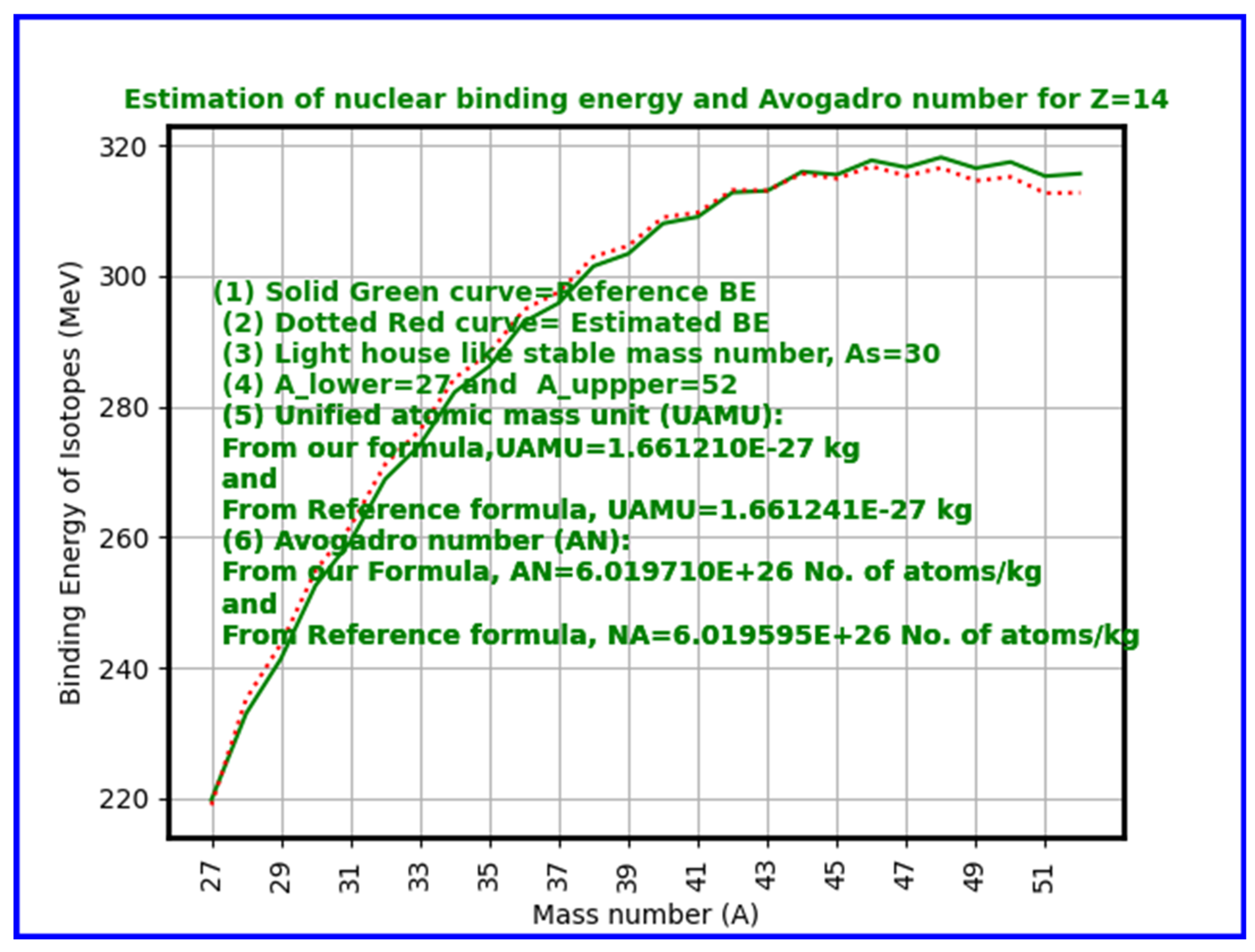
Figure 2.
Binding energy curve and Avogadro number for Z=26.
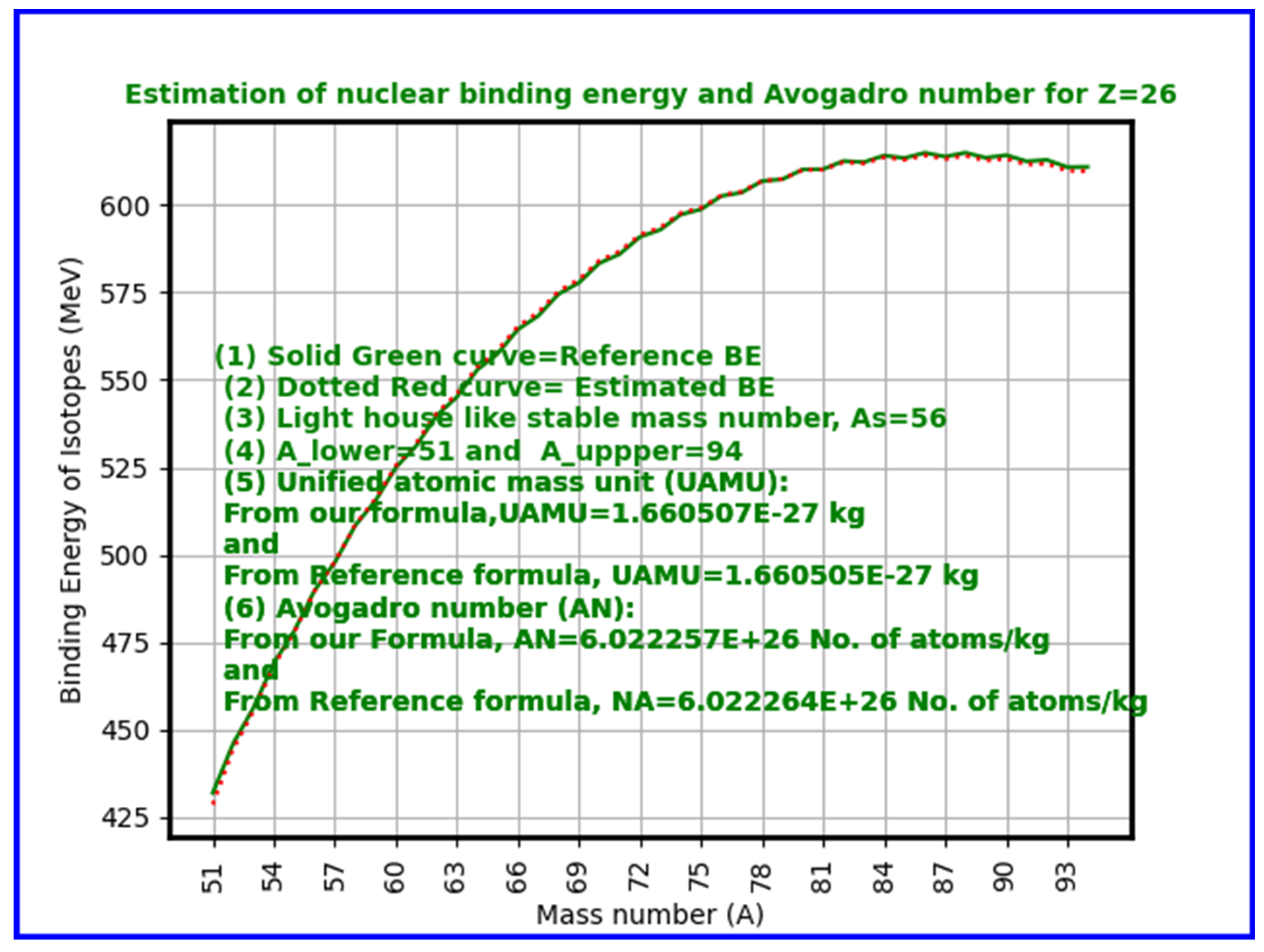
Figure 3.
Avogadro number (NA) assumed to be associated with Z= 1 to 140.
Disclaimer/Publisher’s Note: The statements, opinions and data contained in all publications are solely those of the individual author(s) and contributor(s) and not of MDPI and/or the editor(s). MDPI and/or the editor(s) disclaim responsibility for any injury to people or property resulting from any ideas, methods, instructions or products referred to in the content. |
© 2025 by the authors. Licensee MDPI, Basel, Switzerland. This article is an open access article distributed under the terms and conditions of the Creative Commons Attribution (CC BY) license (http://creativecommons.org/licenses/by/4.0/).
Copyright: This open access article is published under a Creative Commons CC BY 4.0 license, which permit the free download, distribution, and reuse, provided that the author and preprint are cited in any reuse.


