

Submitted:
04 August 2025
Posted:
05 August 2025
You are already at the latest version
Abstract
Promoting comprehensive green transformation of economic and social development is a key link in achieving high-quality economic development. Green technology innovation is the core content and important guarantee for comprehensive green transformation of economic and social development. This paper constructs a quasi-natural experiment of synergistic empowerment of digital intelligence policies using national big data pilot zone policies and smart city policies. Based on panel data from 265 prefecture-level cities from 2006 to 2021, this study examines the mechanism and heterogeneous effects of digital intelligence policy synergistic empowerment on green technology innovation. The results show that: 1) Digital intelligence policies have a significant synergistic empowerment effect on green technology innovation, and this conclusion remains valid after a series of robustness tests. 2) Under the analytical framework of "technology realization-institutional change-development model," digital intelligence policies can synergistically empower green technology innovation through three dimensions: human capital agglomeration, environmental regulation, and intellectual property protection. 3) For eastern regions, cities with better economic foundations, environmentally protected key cities, non-resource cities, and non-old industrial base cities, the synergistic empowerment effect of digital intelligence policies on green technology innovation is more pronounced. Based on this, we should expand the breadth and depth of digital intelligence policy synergistic pilots, and deeply explore the technology realization mechanism represented by human capital agglomeration, the institutional change mechanism represented by environmental regulation, and the development model represented by intellectual property protection. This paper provides important insights for building green technology innovation mechanisms and accelerating comprehensive green transformation of economic and social development.
Keywords:
Green technology innovation
; Big Data Comprehensive Pilot Zone
; Smart city
; Synergistic empowerment
; Digital intelligence policy
1. Introduction
Promoting the green transformation of economic and social development is a key link in achieving high-quality development and a fundamental strategy for addressing resource, environmental, and ecological issues. In 2024, the Central Committee of the Communist Party of China and the State Council issued the "Opinions on Accelerating the Comprehensive Green Transformation of Economic and Social Development," emphasizing the need to improve the green transformation policy system and proposing to accelerate industrial upgrading and transformation of green development models. The comprehensive green transformation of economic and social development is an important part of the macro policy system for industrial green transformation. Green technology innovation, as the strategic support for comprehensive green transformation mechanisms, is the core content and important guarantee for establishing green development mechanisms. National big data pilot zone policies provide underlying data element support for green technology innovation and construct data element empowerment systems. Smart city policies provide smart development platform construction for green technology innovation. Digital intelligence policies are an important component of the comprehensive green transformation policy system for economic and social development. However, China's comprehensive green transformation of economic and social development is still in its initial construction phase, and insufficient green technology innovation capability is the core problem limiting the green transformation of the macro-economic system. Under these circumstances, the synergy of digital intelligence policies becomes an effective policy tool for empowering green technology innovation. In existing literature, there is still a lack of research on the synergistic impact of national big data pilot zones and smart city pilots on green technology innovation through coordinated digital intelligence policies. Whether digital policies represented by data elements in national big data pilot zones and smart policies represented by smart development platforms in smart cities can synergistically empower green technology innovation remains unknown. If digital intelligence policy synergy produces potential empowerment effects, through what influence mechanisms is this achieved? What heterogeneous characteristics exist in the synergistic empowerment of green technology innovation by digital intelligence policies? Therefore, scientifically answering these questions and realizing the supporting role of green technology innovation provides theoretical and practical significance for building a comprehensive green development transformation system for economic and society.
Currently, a small number of scholars have verified the climbing effects of green technology innovation from a macro policy perspective (Song Hong et al., 2019). On one hand, some scholars have affirmed the empowerment effects of digital policies on green technology innovation. National big data comprehensive pilot zones can positively impact enterprise innovation capabilities from the perspective of digital technology development (Wang Xiaohong and Li Na, 2022). Data elements generated by digital policies can effectively empower the improvement of enterprise green innovation capabilities (Aghion, 2019; Chen Wen and Chang Qi, 2022). Data element agglomeration can improve the allocation efficiency of data elements and empower the technological innovation level of national big data comprehensive pilot zone areas (Farboodi, 2021; Liu Chuanming et al., 2023). National big data comprehensive pilot zone policies can effectively enhance urban innovation capabilities (Xu Lin et al., 2022). On the other hand, existing literature has found that smart policies have positive impacts on green technology innovation. Smart city construction significantly promotes the "quantity and quality improvement" of green technology innovation (Song Deyong et al., 2021). Additionally, smart city construction pilots enhance urban innovation capabilities through urban informatization levels and financial development intelligence levels (VARIAN, 2010; KE et al., 2017; He Lingyun and Ma Qingshan, 2021). Furthermore, smart cities can promote urban innovation by aggregating high-end human capital, and the empowerment effects of smart cities show certain differences in geographical locations (CARAGLIUA, 2019; Yuan Hang and Zhu Chengliang, 2020). Overall, existing literature has provided important references for this paper's analysis from digital policies and smart policies, but there is still a lack of research on the empowerment role of digital intelligence policy synergy on urban green technology innovation from a policy coordination perspective. Individual literature studies urban digital technology innovation from digital intelligence policy coordination (Han Xianfeng et al., 2025), manufacturing "dual carbon" development research (Liu Qilei et al., 2023), and urban digital intelligence development research (Han Xianfeng et al., 2023), but there is still a lack of research on whether digital intelligence policy synergy can effectively empower green technology innovation.
Compared to previous studies, the marginal contributions of this paper are: ① Constructing a digital intelligence policy research system with national big data pilot zones and smart city construction, expanding the analytical framework for digital intelligence policies. ②Systematically constructing a "technology realization-institutional change-development model" research framework for digital intelligence policy synergistic empowerment. This paper systematically evaluates the impact mechanisms and effects of digital intelligence policy synergy on green technology innovation, broadening the boundaries of policy pilot research and providing theoretical insights and decision-making references for policy synergistic empowerment of comprehensive green transformation of economic and society.
2. Policy Background and Research Hypotheses
2.1. Policy Background
To achieve comprehensive green transformation of economic and social development, strengthen the role of green production in the new round of technological revolution and industrial transformation, effectively advance green technology innovation capabilities and economic operational efficiency, and consolidate fundamental production elements for industrial green transformation. The National Development and Reform Commission, the Ministry of Industry and Information Technology, and the Office of the Central Cyberspace Affairs Commission of the People's Republic of China successively approved eight comprehensive big data pilot zones in 2015 and 2016, establishing data element sharing mechanisms aimed at promoting data element flow within fundamental production factors and fully leveraging the new driving force role of data elements in economic operations. Furthermore, data elements can innovate the integration model between digital economy and real economy, constructing a data element economy dominated by data industries. Additionally, data elements can further strengthen the empowerment effects of digital infrastructure, achieving data integration within regions, industrial chains, and enterprises, and building multi-element data sharing and open platforms. Moreover, data element circulation constructs big data circulation markets, cultivates data platforms, connects diverse data participating entities, optimizes resource allocation, enhances production efficiency, and establishes a solid data element foundation for green production transformation.
According to the "Smart City Standardization White Paper (2022)" published by the China Industrial Control Systems Cyber Emergency Response Team, in 2012, the central government officially issued the "Notice on Carrying Out National Smart City Pilot Work" and released the "Interim Management Measures for National Smart City Pilots" and the "National Smart City (District, Town) Pilot Indicator System (Trial)." The pilot city lists were announced in batches in 2012, 2013, and 2014. In 2016, the state proposed the concept of new smart cities, advancing smart city construction as an important task in national new urbanization, providing reliable technical support for urban green technology innovation. Furthermore, data element policies represented by national comprehensive big data pilot zones and smart development policies represented by smart cities are not independent of each other, but rather constitute an interconnected and mutually empowering collaborative system. As data elements and smart development continue to integrate, pilot cities should focus on data elements and smart development systems to optimize overall production factor allocation, promote industrial structure upgrading, and advance green production transformation. This provides new insights for the collaborative empowerment of green technology innovation through national comprehensive big data pilot zone policies and smart city policies. Therefore, national comprehensive big data pilot zone policies and smart city policies provide a quasi-natural experiment for this study's research on digital intelligence policy collaborative empowerment of green technology innovation.
2.2. Research Hypotheses
2.2.1. Basic Mechanism of Digital Intelligence Policy Collaborative Empowerment of Green Technology Innovation
Digital intelligence policy collaboration helps promote comprehensive green transformation of economy and society supported by green technology innovation. On one hand, national comprehensive big data pilot zones rely on digital infrastructure construction to build data elements, providing underlying data support for green technology innovation and subsequently establishing a reliable development foundation for comprehensive green transformation of economy and society. On the other hand, smart cities create urban big data resource analysis and integration platforms, efficiently and dynamically allocating urban production factors through smart development platform construction, achieving effective allocation of urban production activity resources, thereby constructing a smart development platform that integrates data elements into urban final production activities. Based on this, this paper proposes:
H1: Digital intelligence policy collaboration can effectively empower green technology innovation.
2.1.2. Transmission Mechanism of Digital Intelligence Policy Collaborative Empowerment of Green Technology Innovation
Digital intelligence policy serves as the top-level design for comprehensive green transformation of economic and social development, substantially providing underlying policy support for green technology innovation. Given this, this paper establishes a "technology realization-institutional change-development model" analytical framework, analyzing the internal logic of digital intelligence policy collaboration in promoting green technology innovation from three dimensions: human capital agglomeration, environmental regulation, and intellectual property protection.
Human Capital Agglomeration. Human capital agglomeration is the technological realization guarantee for achieving green technology innovation. Digital intelligence policy collaboration facilitates human capital agglomeration, primarily manifested in the integration of talent chains with innovation chains and industrial chains (Nie et al., 2024). On one hand, digital intelligence policy collaborative empowerment drives talent factor allocation, strengthens technological progress processes, enhances knowledge innovation, technology absorption, and technology diffusion effects, guiding talent factors to embed in innovation chains. Furthermore, frontier development of innovation chains requires high-level, specialized talents as fundamental support, while deep development of innovation chains requires corresponding talents to drive endogenous technological progress. On the other hand, digital intelligence policy collaboration helps aggregate human capital to fill talent gaps in industrial chains, filling industrial terminal segments through talent introduction policies and talent factor allocation. Additionally, green transformation and upgrading of industrial chains can achieve factor allocation and smart development through digital intelligence policies, cultivating talent chains through industrial chain development practical achievements (Zhang and Gu, 2021). Generally speaking, digital intelligence policy collaboration creates data element foundations and smart development platforms, continuously strengthening and optimizing human capital foundations, providing internal driving force for innovation chains and industrial chains. Furthermore, human capital agglomeration also requires digital intelligence policy data elements and smart platforms to achieve internal green upgrading of talents. Thus, digital intelligence policies can deepen the integration depth of talent chains, innovation chains, and industrial chains through human capital agglomeration, providing underlying support for green technology innovation.
Environmental Regulation. Digital intelligence policy collaboration effectively exerts institutional change effects, enhancing environmental regulation effectiveness, primarily manifested in driving institutional effectiveness of environmental regulation at the macro level and effectively facilitating the transformation of enterprise green production willingness into actual green behavior at the micro level. On one hand, digital intelligence policy collaboration is more effective in strengthening environmental regulation. Cities with digital intelligence policy collaboration possess richer data element resources and can build environmental monitoring platforms based on data elements, constructing data identification, data processing, and data optimization smart development platforms for comprehensive green transformation of socio-economic development, deepening regulatory systems and enhancing the breadth and depth of environmental regulation implementation. On the other hand, digital intelligence policy collaboration helps transform enterprise green technology innovation willingness into green technology innovation behavior (Wang and Zhang, 2018). Digital intelligence policies provide certain incentive effects for enterprise green technology innovation through pollution monitoring and other means established based on data elements and smart development platforms, and data elements and smart development platforms can provide necessary green technology support for enterprises, transforming external policy incentives into positive governance effects that influence enterprise internal green production. Furthermore, green technology innovation at the enterprise production end drives industry green production transformation, helping to improve environmental regulation monitoring and implementation methods. Additionally, enterprise terminal green production governance also creates data element foundations for overall green technology innovation data element collection and smart development construction. Digital intelligence policy collaboration provides systematic technical support and governance solutions for environmental regulation institutional change. In summary, digital intelligence policy collaboration can drive institutional effectiveness of environmental regulation at the macro level and effectively facilitate the transformation of enterprise green production willingness into actual green behavior at the micro level through institutional change.
Intellectual Property Protection Mechanism. Digital intelligence policy collaboration helps establish intellectual property protection mechanism green development models, primarily manifested in establishing effective government and efficient markets. On one hand, government departments can collaborate to formulate relevant laws and regulations based on digital intelligence policy collaboration, strengthen intellectual property judicial protection systems, and provide basic guarantees for innovation momentum. More comprehensive property protection systems can enhance intellectual property protection levels. Additionally, data elements and smart development platforms can improve law enforcement efficiency, and higher law enforcement efficiency can enhance enterprise innovation willingness, implementing innovation willingness into innovation behavior from the legal guarantee dimension. Moreover, digital intelligence policy collaboration can utilize data elements and smart platforms to optimize intellectual property protection systems, thereby integrating cross-regional, cross-industry, and inter-enterprise intellectual property flows at the macro level, expanding green production radiation effects and promoting comprehensive green transformation of economic and social development. On the other hand, digital intelligence policy collaboration can establish effective intellectual property markets. In creating favorable business environments, sound intellectual property protection systems can create favorable business environments and optimize enterprise innovation environments (Li et al., 2021). In intellectual property transactions, comprehensive intellectual property protection systems can make intellectual property transactions more legalized and standardized. Additionally, digital intelligence policy collaboration typically possesses more comprehensive data integration centers, providing sufficient momentum for intellectual property sharing, factor flow, and promoting knowledge spillover. Furthermore, the construction of intellectual property protection mechanisms also places higher requirements on digital intelligence policies. To continuously empower green technology innovation, governments assist marginal enterprises in green production patent introduction through digital intelligence platforms, strengthening industrial green transformation from the supply side and thereby enhancing the overall effect of digital intelligence policy empowerment of green technology innovation. Based on this, this paper proposes:
H2: Digital intelligence policies collaboratively empower green technology innovation through human capital agglomeration, environmental regulation, and intellectual property protection under the "technology realization-institutional change-development model" framework.
2.1.3. Heterogeneity Analysis of Digital Intelligence Policy Collaborative Empowerment of Green Technology Innovation
From a geographical location perspective, the effects of digital intelligence policy collaborative empowerment of green technology innovation may vary across different regions (Qian et al., 2015). Generally speaking, in terms of technology realization, eastern regions have production factor advantages such as talent agglomeration that effectively realize efficiency in green technology innovation and technological development (Luo and Liang, 2016; Guo and Yang, 2020). Central and western regions face more severe environmental problems, thus green technology innovation has significant improvement potential in both economic and environmental benefits.
From an economic foundation perspective, economic development levels may exhibit certain differences in environmental regulation institutional change benefits. Cities with better economic foundations possess richer data resource endowments and more comprehensive smart development platform factor support, have comprehensive policy system guarantees for institutional changes such as environmental policies, and can strengthen the breadth and depth of environmental regulation and other institutional change implementation. Furthermore, environmental regulation constrains enterprise production behavior through mandatory external requirements, transforming green technology innovation willingness into green technology innovation behavior, guiding enterprises to occupy favorable positions in production chains and value chain allocation through green technology innovation. Additionally, based on data elements and smart development platforms, government departments can establish relevant policy compensation mechanisms. According to technological innovation theory, government compensation mechanisms can effectively empower enterprise innovation positive externalities. Meanwhile, according to government intervention theory, government compensation mechanisms can effectively optimize resource allocation and correct green technology innovation development mechanisms. Cities with weaker economic foundations are often limited by data element collection and have limited effectiveness in environmental regulation construction, implementation, and supervision. Their green technology innovation frontier fields are constrained by fundamental factor support, causing them to fail to create "innovation compensation effects" and "cost benefits" in environmental regulation implementation effects. Combined with lack of relevant policy support, this weakens environmental regulation and other institutional change benefits.
From a resource endowment perspective, the empowerment effects of digital intelligence policy collaboration may also differ across cities with different resource endowments. Non-resource cities and non-old industrial base cities have diversified industrial structures. With the help of digital intelligence systems, they can relatively easily transform from traditional industries to green production by leveraging technical means accumulated from traditional industries and deep production foundations. Meanwhile, in green technology innovation development and achievement transformation, non-resource cities leverage relatively mature intellectual property development models, create internal innovation system factor flows, leverage the advantages of mature technology and deep foundations in traditional industries, introduce green production technologies, and simultaneously focus on new concepts and technologies for new industry green production, embedding green industry transformation concepts into local diversified industrial structures, constructing diversified collaborative industrial structures, and promoting comprehensive green transformation of economic and social development. Correspondingly, resource cities and old industrial base cities are constrained by single industrial structures and face problems in industrial green transformation including low development levels, unreasonable spatial distribution, low green technology development levels, and low green technology achievement transformation levels. Additionally, resource cities and old industrial base cities also lack relevant policy support and corresponding technical support in constructing data element collection and smart development platform construction, making it difficult to establish effective intellectual property protection mechanisms, with obvious defects in innovation factor internal flow development models. Based on this, this paper proposes:
H3: For eastern region cities, cities with better economic foundations, non-resource cities, and non-old industrial base cities, the effects of digital intelligence policy collaborative empowerment of green technology innovation are stronger.
3. Research Design
3.1. Model Construction
This paper constructs a composite quasi-natural experiment of policy collaborative empowerment based on national comprehensive big data pilot zones and smart city pilots, exploring whether digital intelligence policies can generate collaborative effects on urban green technology innovation. By controlling for endogeneity through bidirectional fixed effects of cities and time, the following regression model is constructed:
where i represents city, t represents year; represents urban green technology innovation, represents the policy synergy variable of national big data comprehensive pilot zones and smart cities; represents control variables for urban green technology innovation; represents city fixed effects; represents time fixed effects; represents the random error term.
3.2. Variable Setting and Analysis
3.2.1. Dependent Variable
Green technology innovation (qtiq) is the dependent variable in this paper. Green technology innovation, which achieves resource conservation and pollution reduction through green innovation, is the core connotation of high-quality development and an important guarantee for achieving comprehensive green transformation of economic and social development. Following Jin Peizhen et al. (2019), this paper uses the number of green patent grants per 10,000 people to measure green technology innovation.
3.2.2. Core Explanatory Variable
Based on national comprehensive big data pilot zones and smart city pilots, this paper constructs the digital intelligence policy variable. Digital intelligence policy (didit) is the core explanatory variable in this paper, representing the product of city dummy variable and time dummy variable, i.e., the interaction term Treati*Postt. Where Treat is the basis for identifying whether it belongs to the experimental group—if a city becomes a "dual pilot" in the current year and subsequent years, the experimental group is assigned a value of 1, otherwise 0; Post is the policy implementation time dummy variable, assigned a value of 1 in the year of dual pilot implementation and subsequent years, otherwise 0. For the former, 22 cities with synchronized digital intelligence policy pilots are set as the experimental group, and the other 243 cities are set as the control group. For the latter, the first year of simultaneous digital intelligence policy implementation and subsequent years are assigned a value of 1, otherwise 0.
3.2.3. Mechanism Variables
① Human capital (human). Human capital is an important pillar for the integration of industrial chains and innovation chains (Zhao Binbin et al., 2025). Talent is the primary resource for innovation and also the source of driving force and intellectual support for innovative development (Chen Min et al., 2024). The richer the human capital, the more important leverage points green technology innovation possesses. Human capital is represented by the ratio of enrolled undergraduate and junior college students to total population at year-end. ② Environmental regulation (en_re), represented by the comprehensive utilization rate of general industrial solid waste. ③ Intellectual property protection level (property), following Dang Wenjuan and Luo Qingfeng's research (2021), represented by the number of intellectual property trial case closures.
3.2.4. Control Variables
To achieve unbiased estimation results of policy effects, this paper also controls for other control variables that may affect green technology innovation. ① Regional economic development level (eco), measured by per capita regional GDP in logarithm; ② Foreign investment level (invest), measured by the ratio of actual utilized foreign investment to regional GDP; ③ Degree of opening to the outside world (open): depicted by the ratio of total import and export volume to regional GDP; ④ Government intervention degree (goven), represented by the ratio of government general fiscal expenditure to regional GDP; ⑤ Urbanization rate (urban), represented by the ratio of urban permanent residents to total permanent residents; ⑥ Overall industrial structure upgrading (strup), represented by primary industry value-added as percentage of GDP × 1 + secondary industry value-added as percentage of GDP × 2 + tertiary industry value-added as percentage of GDP × 3; ⑦ Population density (pop), reflected by the ratio of regional permanent population to urban area.
3.3. Data Sources and Parallel Trends Test
This paper conducts analysis based on panel data from 265 prefecture-level cities in China from 2006-2021. Basic data comes from the "China Statistical Yearbook," "China City Statistical Yearbook," CSMAR database, CNRDS database, and other relevant years. For some missing data, linear interpolation method is used for completion.
Furthermore, in the research sample, there are 51 national comprehensive big data pilot zone cities, 96 smart city pilots, 22 cities implementing dual pilot digital intelligence policies, and 169 cities that have not conducted national comprehensive big data pilot zone trials or smart city pilots. In the baseline regression, the experimental group consists of 22 digital intelligence policy "dual pilot" cities, with the remaining 243 cities as the control group. The parallel trends test results in Figure 1 show that before the implementation of digital intelligence policies, there was no significant difference in green technology innovation levels between the experimental and control groups, with an overall stable trend, satisfying the ex-ante parallel requirement. After the implementation of digital intelligence policies, the experimental and control groups showed significant differences in green technology innovation levels, with significantly positive regression coefficients, indicating that the parallel trends assumption holds.
4. Experimental Results and Analysis
4.1. Baseline Regression
Table 1 presents the baseline regression results. Column (1) shows the net effect without control variables, and column (2) shows the regression results with control variables added to column (1). The results indicate that the coefficient of digital intelligence policy synergy on green technology innovation is positive and significant, demonstrating that the synergistic empowerment effect of digital intelligence policies on green technology innovation is significant. Columns (3) and (4) respectively show the regression results with time fixed effects and city fixed effects added to columns (1) and (2). The results show that under the control of endogeneity effects, the regression coefficient of digital intelligence policy synergy on green technology innovation remains significantly positive, further confirming that digital intelligence policy synergy can effectively empower green technology innovation. Thus, H1 is verified.
4.2. Robustness Tests
To further strengthen the robustness of the research, the following robustness tests are conducted.
4.2.1. Excluding Parallel Policy Interference
To eliminate potential interference from related policies during the study period on the estimation results, this paper introduces dummy variables for four policies: "Broadband China Policy Pilot" (2011), "Low-Carbon City Policy Pilot" (2010), "Key Air Pollution Control Region Policy Pilot" (2012), and "Supply Chain Demonstration Zone Policy Pilot" (2018), denoted as didbcp, didlccp, didkapaca, and didscdz respectively, and conducts baseline regression estimation. The results show that after excluding the influence of other concurrent related policies, the impact of digital intelligence policy synergy on green technology innovation remains consistent with the baseline regression results, indicating the robustness of the research conclusions.

Table 2.
Robustness Tests-Exclusion of Concurrent Policy Interventions.
| (1) | (2) | (3) | (4) | |
| Excluding "Broadband China Policy" | Excluding "Low-carbon City Policy" | Excluding "Key Air Pollution Control Policy" | Excluding "Supply Chain Demo Zone Policy" | |
| Variables | qtiq | qtiq | qtiq | qtiq |
| did | 0.099*** | 0.116*** | 0.099*** | 0.099*** |
| (5.942) | (6.827) | (5.942) | (5.942) | |
| didbcp | 0.132*** | |||
| (14.239) | ||||
| didlccp | 0.072*** | |||
| (7.820) | ||||
| didkapaca | 0.132*** | |||
| (14.239) | ||||
| didscdz | 0.132*** | |||
| (14.239) | ||||
| Controls | YES | YES | YES | YES |
| Obs | 3,836 | 3,836 | 3,836 | 3,836 |
| R2 | 0.713 | 0.702 | 0.713 | 0.713 |
| Year FE | YES | YES | YES | YES |
| City FE | YES | YES | YES | YES |
4.2.2. Adjusting Sample Period
By changing the research period, the sample study interval is randomly adjusted to 2009-2019 and regression is conducted again. The results show that the conclusion of digital intelligence dual pilot policy empowering green technology innovation remains consistent with the baseline regression.
4.2.3. Lagged Treatment of Dependent Variable
Considering that green patents require a certain amount of time from application to authorization, following Xue Nanzhi and Wu Chaopeng (2023), robustness tests are conducted by replacing the dependent variable with one-period lagged and two-period lagged dependent variables respectively. The results show that after lagged treatment of the dependent variable, digital intelligence policy still has a significantly positive impact on empowering green technology innovation, and the conclusions are basically consistent with the baseline regression, thus the baseline conclusions are robust.
4.2.4. Replacing Dependent Variable
Using the quantity of urban green technology innovation to replace the dependent variable, the green technology innovation indicator is re-estimated. The results show that the synergistic empowerment effect of digital intelligence policy on green technology innovation remains significant, indicating that the baseline conclusions of this paper remain robust.
4.2.5. Placebo Test
The DID coefficient distribution is randomly sampled and repeated 500 times to obtain the policy shock utility of pseudo "dual pilot" policies for placebo testing. The results are shown in Figure 2, where the dashed line represents the regression coefficient from the previous study, and the red circles represent the randomly sampled regression coefficients. It can be seen that the coefficients obtained from random sampling differ significantly from the previous true regression coefficients, and most random coefficients are concentrated near zero, indicating that the research results in this paper are less affected by unobservable potential factors.
Table 3.
Robustness Tests.
| (1) | (2) | (3) | (4) | |
| Adjustment of Sample Period | Lagged Dependent Variable Treatment | Lagged Dependent Variable Treatment | Replacement of Dependent Variable | |
| Variables | qtiq | L.qtiq | L2.qtiq | qtin |
| did | 0.075*** | 0.097*** | 0.090*** | 0.199*** |
| (4.695) | (6.188) | (5.674) | (4.302) | |
| Controls | YES | YES | YES | YES |
| Obs | 2,047 | 3,315 | 3,059 | 3,836 |
| R2 | 0.863 | 0.712 | 0.695 | 0.774 |
| Year FE | YES | YES | YES | YES |
| City FE | YES | YES | YES | YES |
4.3. Transmission Mechanism Analysis
Based on the theoretical analysis above and following Jiang Ting (2022)'s strategy, this section conducts mechanism testing from three dimensions—human capital agglomeration, environmental regulation, and intellectual property protection—based on the "technology realization-institutional reform-development model" analytical framework. The estimation results are shown in Table 4. It can be found that digital intelligence policies can synergistically empower urban green technology innovation through channels such as human capital agglomeration, environmental regulation, and intellectual property protection, thus verifying H2.
4.3.1. Human Capital Agglomeration
Column (1) of Table 4 shows the test results for human capital agglomeration (human). The coefficient of digital intelligence policy synergy's impact on urban green technology innovation is significantly positive, indicating that digital intelligence policies can synergistically promote high-level agglomeration of human capital (Zhao Chen et al., 2023). On one hand, human capital agglomeration can establish specialized division of labor, forming a development path where human capital clustering drives knowledge innovation, technology absorption, and technology diffusion (Tai Hang and Cui Xiaoyong, 2017). Moreover, green technology innovation is a comprehensive exploratory activity based on frontier and interdisciplinary fields, and human capital agglomeration can bring rapid learning in green technology innovation knowledge and technical learning and imitation in green production. On the other hand, human capital clustering brings an integration path for innovation implementation into industries. The advancement of green technology innovation is realized through the integration process of "green technology patents-green technology production-green technology industry" (Zhu Weijie et al., 2023). Green technology innovation is not only reflected in green innovation patents, but also in sustainable production methods based on market demand and led by green production methods. This process of industrial green transformation poses new requirements for green technology innovation and continuously promotes the upgrading of human capital agglomeration, thereby forming the integration of talent chains, innovation chains, and industrial chains.
4.3.2. Environmental Regulation
From column (2) of Table 4, the coefficient of digital intelligence policy synergy's impact on environmental regulation (en_re) is significantly positive, indicating that digital intelligence policy synergy can effectively establish environmental regulation (Tao Feng et al., 2021). On one hand, at the macro level, environmental regulation establishes command-based institutional reform issued through administrative means, which to some extent helps promote the transition of production methods toward green production and establishes the foundation for green technology innovation development. Additionally, environmental regulation also forms a market-based elimination mechanism based on market regulation, which can effectively establish green production incentive mechanisms and constraint policies, and its realized implicit energy-saving and emission-reduction innovation effects are also intrinsic requirements for green technology innovation advancement. On the other hand, at the micro level, environmental regulation optimizes enterprises' production behavior, thereby generating positive economic benefits. Enterprises achieve green production through green technology innovation and realize production position advancement among upstream and downstream enterprises. Meanwhile, the implementation of environmental regulation also effectively drives the transformation of enterprises' green technology innovation willingness into green technology innovation behavior.
4.3.3. Intellectual Property Protection
According to column (3) of Table 4, the coefficient of digital intelligence policy synergy's impact on intellectual property protection is significantly positive, indicating that digital intelligence policy synergy can effectively establish intellectual property protection mechanisms. On one hand, a sound intellectual property protection mechanism is an essential duty of an effective government, and the parallel system of judicial protection and administrative protection of intellectual property provided by an effective government serves as an effective institutional guarantee for innovation activities. Furthermore, institutional guarantees at the effective government level can urge green transformation of production methods from the source, thereby substantially enhancing green technology innovation. On the other hand, a sound intellectual property protection mechanism is an important fundamental element for establishing an effective market, providing basic guarantees for market innovation factor agglomeration through the establishment of intellectual property protection mechanisms. Meanwhile, an effective market can bring urban innovation clustering effects, accelerating the formation of an integrated system of talent chains, innovation chains, and industrial chains, thereby positively promoting the advancement of green technology innovation.
4.4. Comparative Analysis of "Dual Pilot" Digital Intelligence Policy Synergy Effects
To explore the policy advantages of "dual pilot" compared to "single pilot" in empowering urban green technology innovation, this study excludes "non-pilot" samples and resets experimental and control groups, using DID coefficients to measure the net effect of "single pilot" becoming "dual pilot" on green technology innovation. Columns (1) and (2) of Table 5 show that the empowerment effect of digital intelligence dual pilot policies on green technology innovation is more significant compared to single pilot policies. The analysis further subdivides the policy effect differences between National Big Data Comprehensive Pilot Zone pilot and Smart City pilot as single pilots versus digital intelligence dual pilots. Specifically, policy effect comparative analysis is conducted between digital intelligence dual pilots and National Big Data Comprehensive Pilot Zone single pilot or Smart City single pilot, excluding samples that became single pilots but did not become digital intelligence dual pilots to ensure net effects in policy evaluation. According to columns (3) and (4) of Table 5, under the background of National Big Data Comprehensive Pilot Zone pilot, digital intelligence dual pilots can synergistically empower green technology innovation. According to columns (5) and (6) of Table 5, it can be found that under the background of Smart City pilot, digital intelligence dual pilots have certain positive effects in empowering green technology innovation, but under the impact of other influencing factors, the synergistic empowerment effects of digital intelligence policies show differential impacts. This also indicates that the National Big Data Comprehensive Pilot Zone pilot plays a foundational role in digital intelligence policy synergy.
4.5. Heterogeneity Analysis
Based on the "technology realization-institutional reform-development model" analytical framework constructed above, this section further explores the differentiated utility of digital intelligence policies in empowering green technology innovation under different economic development characteristics and resource endowment conditions. The results are basically consistent with H3 expectations.
4.5.1. Geographic Location
The research sample is divided into eastern, central, and western regions, with estimation results shown in columns (1), (2), and (3) of Table 6. Digital intelligence policy synergy produces more effective empowerment in eastern regions, while in central and western regions, the synergistic empowerment effect of digital intelligence policies has not manifested. Possible reasons include that digital intelligence policies are still in their early implementation stage, traditional industries and high energy-consuming industries account for a relatively heavy proportion in central and western regions, and the renewal of green innovation technologies has certain time lags, thus the empowerment effects of digital intelligence policies in central and western regions have not yet emerged. Eastern regions, based on superior geographic location and policy execution capacity, possess certain infrastructure foundations in achieving talent agglomeration effects, environmental regulation, and intellectual property protection systems, thereby better releasing the empowerment role of digital intelligence policies for green technology innovation.
4.5.2. Economic Foundation Heterogeneity
On one hand, megacities, super-large cities, and large cities in the research sample are classified as cities with better economic foundations, while other cities are classified as cities with weaker economic foundations, with results shown in columns (4) and (5) of Table 6. Comparatively, digital intelligence policies generate more efficient synergistic effects in cities with better economic foundations. Possible reasons include that cities with better economic foundations enjoy more policy radiation, governments are usually more proactive and provide more related policy support and guidance. Meanwhile, cities with better economic foundations also have richer human capital, and simultaneously possess more comprehensive high-level talent introduction policies and settlement policies, making it easier to establish the foundation for integrating talent chains with innovation chains and industrial chains. Additionally, cities with better economic foundations usually have relatively complete laws and regulations, with more comprehensive systems in terms of property rights protection mechanisms, thereby creating favorable business environments. These all provide prerequisites for digital intelligence policies to empower green technology innovation in cities with better economic foundations. On the other hand, cities with weaker economic foundations find it difficult to form human capital agglomeration, cannot release talent chain effects, and lack effective support for frontier green technology innovation. Meanwhile, compared to cities with better economic foundations, cities with weaker economic foundations lack fiscal support for green production transformation. Consequently, the synergistic empowerment effects of digital intelligence policies are not yet significant.
4.5.3. Resource Endowment Heterogeneity
On one hand, the research sample is divided into key environmental protection cities and non-key environmental protection cities. Results are shown in columns (1) and (2) of Table 7. It can be seen that in terms of institutional reform, digital intelligence policies have significant positive impacts on green technology innovation in key environmental protection cities, while in non-key environmental protection cities, the synergistic empowerment effects of digital intelligence policies are not obvious. From the perspective of environmental regulation, possible reasons include that administrative implementation of environmental regulation can effectively promote the transition of production methods toward green production, thereby forcing green technology upgrades and enhancing green technology innovation effects. Meanwhile, key environmental protection cities also introduce corresponding environmental regulation talents in a targeted manner, thereby forming talent agglomeration effects and further promoting the integration of talent chains and innovation chains, creating favorable conditions for digital intelligence policy synergistic empowerment. On the other hand, the research sample is divided into old industrial base cities and non-old industrial base cities. Columns (3) and (4) of Table 7 show regression results for old industrial base cities and non-old industrial base cities respectively. It can be seen that digital intelligence policies have significant positive impacts on non-old industrial base cities, while in old industrial base cities, digital intelligence policies have certain inhibiting effects on green technology innovation. Possible reasons include that old industrial base cities have single industrial structures and high concentration of polluting enterprises, while their talent structures are also relatively homogeneous, making it difficult to achieve green technology innovation in traditional industries within a short time. Non-old industrial base cities have rapid development of emerging industries and sound urban industrial structures, making it easier to realize development paths of knowledge innovation, technology absorption, and technology diffusion, thus making the synergistic empowerment effects of digital intelligence policies more significant in the short term. Additionally, the research sample is divided into resource cities and non-resource cities. Results are shown in columns (5) and (6) of Table 7. It can be found that the empowerment effects of digital intelligence policies are significant in non-resource cities, while in resource cities, digital intelligence policies actually inhibit the advancement of green technology innovation to a certain extent. Possible reasons include that green technology innovation often requires substantial R&D funding and has characteristics of delayed feedback, while resource cities often rely on resource output rather than innovation and transformation development. Meanwhile, the single industrial structure of resource cities makes it difficult to form green technology innovation willingness in the short term before achieving breakthrough innovations, thus limiting the development space for green technology innovation. Resource cities lack innovation subject consciousness, and the integration of talent chains, innovation chains, and industrial chains faces certain bottlenecks, making it difficult to create favorable conditions for digital intelligence policy synergistic empowerment.
Table 7.
Heterogeneity Analysis II: Environmental Protection Focus, Industrial Heritage, and Resource Dependence.
Table 7.
Heterogeneity Analysis II: Environmental Protection Focus, Industrial Heritage, and Resource Dependence.
| (1) | (2) | (3) | (4) | (5) | (6) | |
| Key Environmental Protection Cities | Non-Key Environmental Protection Cities | Traditional Industrial Base Cities | Non-Traditional Industrial Base Cities | Resource-Based Cities | Non-Resource-Based Cities | |
| Variables | qtiq | qtiq | qtiq | qtiq | qtiq | qtiq |
| did | 0.141*** | 0.001 | -0.031** | 0.157*** | -0.013* | 0.183*** |
| (4.495) | (0.069) | (-2.347) | (6.459) | (-1.890) | (7.141) | |
| Controls | YES | YES | YES | YES | YES | YES |
| Obs | 1,511 | 2,325 | 1,275 | 2,561 | 1,481 | 2,355 |
| R2 | 0.734 | 0.595 | 0.661 | 0.713 | 0.640 | 0.723 |
| Year FE | YES | YES | YES | YES | YES | YES |
| City FE | YES | YES | YES | YES | YES | YES |
5. Conclusions and Policy Implications
Based on panel data from 265 prefecture-level cities from 2006-2021, this paper uses a multi-period DID model to analyze the synergistic empowerment effects of "dual pilot" digital intelligence policies—National Big Data Comprehensive Pilot Zone and Smart City—on urban green technology innovation, exploring the internal mechanisms and heterogeneous effects of digital intelligence policies in empowering green technology innovation. The results show: ①Digital intelligence policies can effectively empower urban green technology innovation. ②Digital intelligence policies can establish a "technology realization-institutional reform-development model" system, exerting human capital agglomeration, environmental regulation, and intellectual property protection effects to effectively and synergistically empower urban green technology innovation. ③The empowerment effects of digital intelligence policies on urban green technology innovation exhibit significant heterogeneous characteristics under different geographic locations, economic foundations, and resource endowments. ④Compared to single policy "single pilot," the synergistic "dual pilot" digital intelligence policies show more pronounced effects in empowering urban green technology innovation. Based on these conclusions, this paper proposes the following policy implications:
(1) Strengthen digital intelligence policy synergistic coordination and form joint forces for green technology innovation to accelerate comprehensive green transformation of economic and social development. On one hand, expand the breadth of digital intelligence policy pilots, strengthen the scope of digital intelligence policy pilots, and rationally plan the implementation framework for digital intelligence policy pilots. Establish and improve digital intelligence policy pilot coordination mechanisms, and further extend to comprehensive pilots across regions, industries, and enterprises, building national digital intelligence policy demonstration zones and creating green transformation highlands. On the other hand, promote deep integration of digital intelligence policies and deepen the development of digital intelligence policy synergy. Governments at all levels should accelerate exploration of digital intelligence policy integration mechanisms, deepen coordinated advancement of big data development and smart development, deepen synergistic and complementary mechanisms between digital intelligence policies and multiple policies, scientifically promote comprehensive integration of digital intelligence policies across regional, industrial, and enterprise levels, strengthen regional green development cooperation, create green industrial clusters, and accelerate the formation of green technology innovation advancement mechanisms.
(2) Focus on the "technology realization-institutional reform-development model" logic of digital intelligence policies, strengthen technology realization innovation, policy reform innovation, and development model innovation that support green transformation, fully leverage the important pathways of human capital agglomeration, environmental regulation, and intellectual property protection, and fully utilize green technology innovation development mechanisms to provide sustained momentum and institutional guarantees for green transformation. ① Broaden green technology innovation realization pathways, improve human capital agglomeration mechanisms, promote integrated development of talent chains, innovation chains, and industrial chains, strengthen high-level talent introduction and settlement systems to provide solid development momentum for green technology innovation. Meanwhile, establish talent mobility mechanisms, create innovation-based industrial upgrading mechanisms, and build policy integration mechanisms. ② Strengthen institutional reforms, enhance the breadth and intensity of environmental regulation, establish government-led and market-guided innovation development mechanisms to achieve industrial green production transformation. Meanwhile, promote supply-side green reforms, customize policy support for green technology in fiscal and technological areas to achieve high production efficiency and shape new drivers of economic growth. ③ Strengthen intellectual property protection policy systems, create favorable patent competition environments, and reinforce the development logic of effective government and efficient markets. Optimize patent certification systems, strengthen relevant laws and regulations, construct a "green technology patent innovation-green technology production-green transformation" system, improve the empowerment effects of digital intelligence policies within the system, and provide new momentum for green technology innovation advancement.
(3)Refine digital intelligence policy implementation strategies, optimize spatial patterns for green transformation development, adapt to local conditions, promote digital intelligence policies at different levels, build green technology innovation systems, and comprehensively advance green transformation. From a geographic location perspective, digital intelligence policy strategies should be refined, comprehensively considering actual regional development conditions and adhering to coordinated transformation. Eastern regions should promote integrated "green technology patent innovation-green technology production-green transformation" systems, while central and western regions should advance green technology innovation infrastructure construction to enhance the overall empowerment utility of digital intelligence policies for green technology innovation. From an economic foundation perspective, at the macro level, attention should be paid to redistributing talent, innovation, and industrial resources in regions with better economic foundations, while regions with weaker economic foundations should focus on fundamental systems such as market entry and exit mechanisms for green technology innovation. At the micro level, attention should be paid to the leading role of chain-leading enterprises in green technology innovation, leveraging their guiding and driving role in green innovation to guide chain enterprises toward green production and catalyze overall advancement in green technology innovation. From a resource endowment perspective, policy support for green transformation in resource-based regions and old industrial base cities should be increased, digital intelligence policy planning should be well-designed, green technology advancement should be achieved through policies, while attention should also be paid to industrial upgrading and transformation, breaking traditional resource output pathways, creating new models for resource innovation development, fully utilizing the synergistic empowerment effects of digital intelligence policies, and laying solid foundations for the "green technology patent innovation-green technology production-green transformation" development system.
Table 7.
Heterogeneity Analysis II: Environmental Protection Focus, Industrial Heritage, and Resource Dependence.
Table 7.
Heterogeneity Analysis II: Environmental Protection Focus, Industrial Heritage, and Resource Dependence.
| (1) | (2) | (3) | (4) | (5) | (6) | |
| Key Environmental Protection Cities | Non-Key Environmental Protection Cities | Traditional Industrial Base Cities | Non-Traditional Industrial Base Cities | Resource-Based Cities | Non-Resource-Based Cities | |
| Variables | qtiq | qtiq | qtiq | qtiq | qtiq | qtiq |
| did | 0.141*** | 0.001 | -0.031** | 0.157*** | -0.013* | 0.183*** |
| (4.495) | (0.069) | (-2.347) | (6.459) | (-1.890) | (7.141) | |
| Controls | YES | YES | YES | YES | YES | YES |
| Obs | 1,511 | 2,325 | 1,275 | 2,561 | 1,481 | 2,355 |
| R2 | 0.734 | 0.595 | 0.661 | 0.713 | 0.640 | 0.723 |
| Year FE | YES | YES | YES | YES | YES | YES |
| City FE | YES | YES | YES | YES | YES | YES |
References
- SONG H, SUN Y J, CHEN D K. Government air pollution control effects: Empirical evidence from China's low-carbon city initiatives [J]. Journal of Management World, 2019, 35(6): 95-108, 195.
- WANG X H, LI N. Digital technology development, industry-university-research collaboration, and corporate innovation capability: Evidence from national big data pilot zones [J]. Science Research Management, 2022, 42(17): 1-8.
- AGHION P, BERGEAUD A, BOPPART T, et al. A theory of falling growth and rising rents [R]. NBER Working Paper No. 26448, 2019.
- CHEN W, CHANG Q. Does big data empower corporate green innovation? Quasi-natural experimental evidence from national big data pilot zones [J]. Finance & Economics, 2022, (8): 76-92.
- LIU C M, CHEN L, WEI X M. Impact of data factor agglomeration on technological innovation: Evidence from big data pilot zones [J]. Journal of Shanghai University of Finance and Economics, 2023, 25(5): 107-121.
- FARBOODI M, VELDKAMP L. A growth model of the data economy [R]. NBER Working Paper No. 28427, 2021.
- XU L, HOU L Q, CHENG G B. Innovation effects of national big data pilot zones [J]. Science & Technology Progress and Policy, 2022, 39(20): 101-111.
- SONG D Y, LI C, LI X Y. Does new infrastructure construction promote "quality-quantity synergy" in green innovation? Evidence from smart city pilots [J]. China Population, Resources and Environment, 2021, 31(11): 155-164.
- HE L Y, MA Q S. Can smart city pilots enhance urban innovation capacity? Multi-period DID evidence [J]. Finance and Trade Research, 2021, 32(3): 28-40. [CrossRef]
- VARIAN H, R. Computer mediated transactions [J]. American Economic Review, 2010, 100(2): 1-10.
- KE X, CHEN H Q, HONG Y M, et al. Do China's high-speed-rail projects promote local economy? New panel data evidence [J]. China Economic Review, 2017, 44: 203-226.
- YUAN H, ZHU C L. Do smart cities accelerate urban innovation? [J]. China Soft Science, 2020, (12): 75-83.
- CARAGLIU A, DEL BO C. Smart innovative cities: The impact of smart city policies on urban innovation [J]. Technological Forecasting and Social Change, 2019, 142: 373-383. [CrossRef]
- HAN X F, GOU Y N, DONG M F. Impact of smart-digital policy synergy on urban digital innovation [J]. Science Research Management, 2025: 1-14. (In press).
- LIU Q L, ZHAO W, SU J Q, et al. Manufacturing decarbonization through digital-intelligent transformation: Logic, pathways and policy [J]. Science Management Research, 2023, 41(3): 79-88.
- HAN X F, LI J J, XU J. Synergistic effects of "Broadband China" and smart city policies on urban digital development [J]. Chinese Journal of Management, 2025: 1-10. (In press).
- NIE C H, ZHAO F J, LI C C, et al. Integration of innovation-industrial-capital-talent chains [J]. Bulletin of Chinese Academy of Sciences, 2024, 39(2): 262-269. [CrossRef]
- ZHANG Q M, GU Y P. Linkage and synergy: Internal logic of "four-chain" integration in industry-education collaboration [J]. Journal of National Academy of Education Administration, 2021, (4): 48-56.
- WANG J R, ZHANG Y. Environmental regulation, green innovation willingness, and green innovation behavior [J]. Studies in Science of Science, 2018, 36(2): 352-360. [CrossRef]
- LI W J, PENG Y H, TAN Y C. Judicial protection of intellectual property and corporate innovation: Structural changes in China's innovation landscape [J]. Economic Research Journal, 2021, 56(5): 144-161.
- QIAN L, XIAO R Q, CHEN Z W. Green technology innovation efficiency in Chinese industrial enterprises: Regional differences based on metafrontier-DEA [J]. Economic Theory and Business Management, 2015, (1): 26-43.
- LUO L W, LIANG S R. Green technology innovation efficiency in regional industries: Factor decomposition [J]. China Population, Resources and Environment, 2016, 26(9): 149-157.
- GUO J, YANG L C. Environmental regulation, government R&D funding, and green technology innovation: Provincial-level evidence [J]. Science & Technology Progress and Policy, 2020, 37(10): 37-44.
- JIN P Z, YIN D S, JIN Z. Urban heterogeneity, institutional supply, and innovation quality [J]. The Journal of World Economy, 2019, 42(11): 99-123.
- ZHAO B B, MEI L, CHEN K H, et al. Innovation-industrial chain integration: Connotation, determinants and pathways [J]. China Soft Science, 2025, (2): 26-39.
- CHEN M, DONG X, ZHONG Q T. Integration points and pathways for innovation-industrial-capital-talent chains [J]. Science and Technology Management Research, 2024, 44(23): 1-9.
- DANG W J, LUO Q F. Environmental regulation, IP protection and regional innovation capability [J]. Journal of Chongqing University (Social Science Edition), 2021, 27(3): 203-215.
- XUE N Z, WU C P. Mandatory CSR disclosure and indigenous innovation: Evidence from "chokepoint" technology breakthroughs [J]. Accounting Research, 2023, (10): 19-32.
- JIANG, T. Mediation and moderation effects in causal inference [J]. China Industrial Economics, 2022, (5): 100-120.
- ZHAO C, LIN C, GAO Z H. Talent chain support for innovation-industrial chain integration: Comparative China-US analysis [J]. China Soft Science, 2023, (11): 23-37.
- TAI H, CUI X Y. Human capital structure and technological progress: Heterogeneity analysis [J]. Nankai Economic Studies, 2019, (4): 143-166.
- ZHU W J, HAN W C, LU R Y, et al. Industry innovation networks from science-driven perspective: 5G industry case [J]. Technology Economics, 2023, 42(6): 1-12.
- TAO F, ZHAO J Y, ZHOU H. Does environmental regulation achieve "quality-quantity synergy" in green innovation? Evidence from environmental accountability systems [J]. China Industrial Economics, 2021, (2): 136-154.
Figure 1.
Parallel Trends Test.
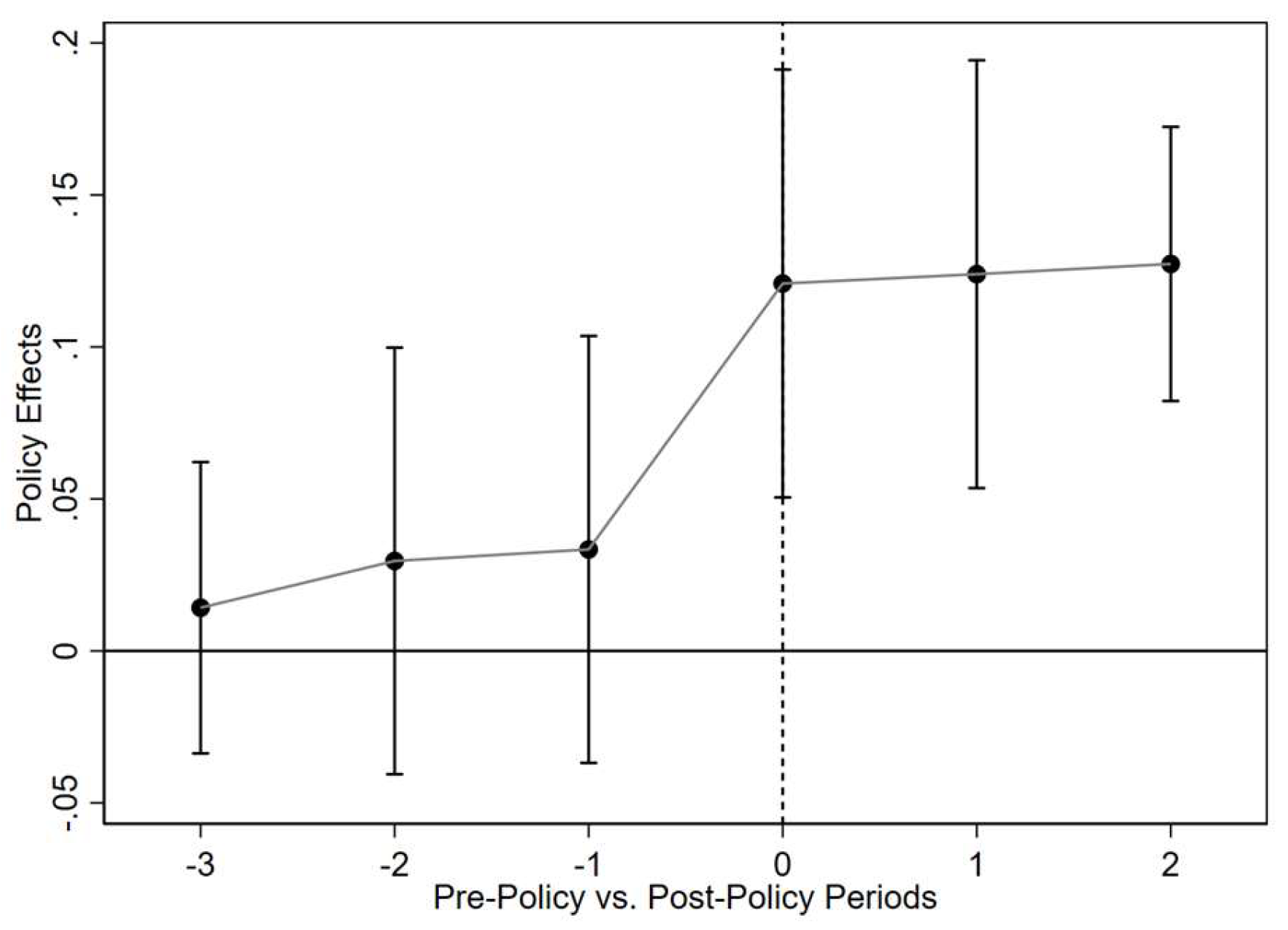
Figure 2.
Placebo Test.
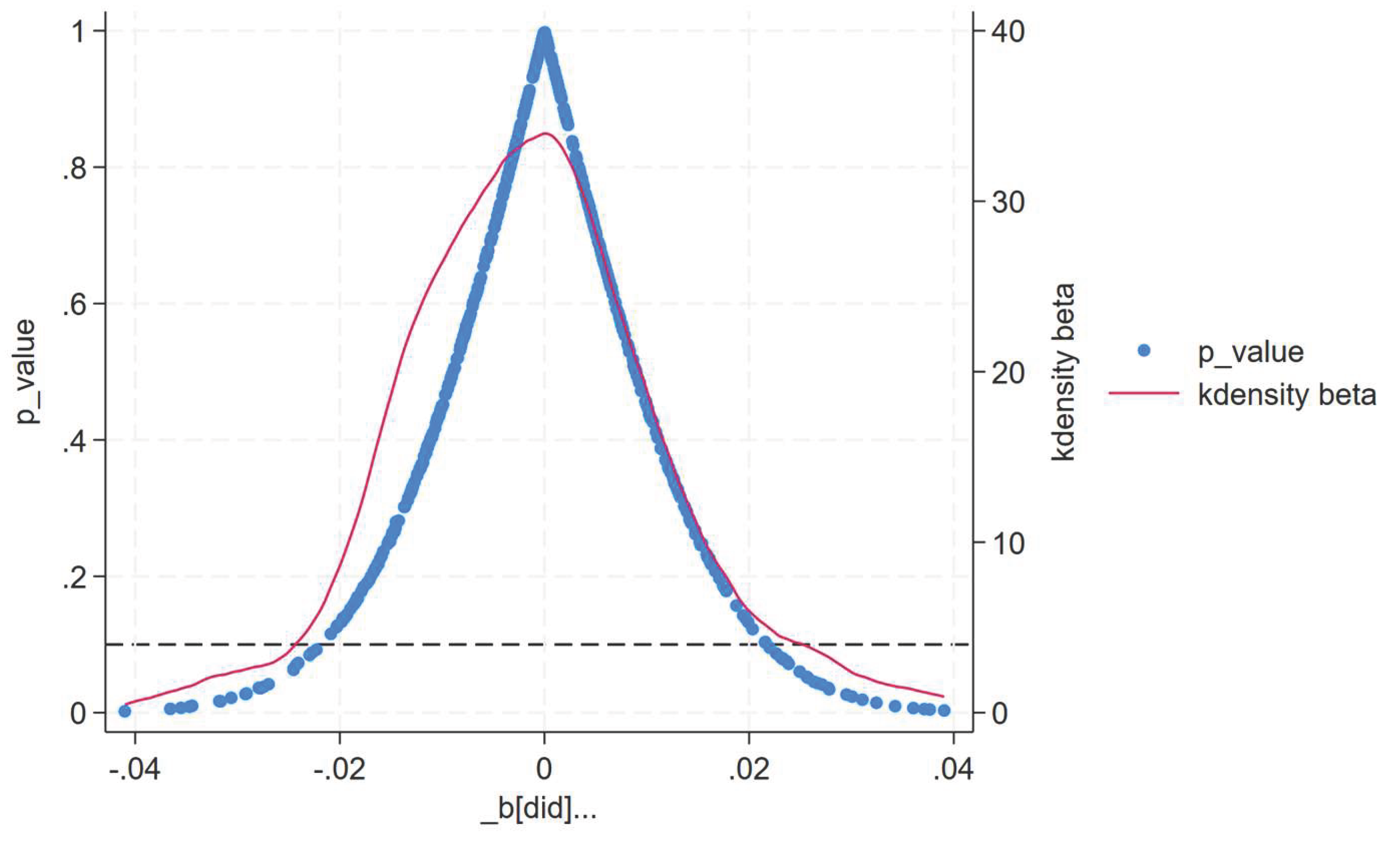
Table 1.
Baseline Regression Results.
| (1) | (2) | (3) | (4) | |
| model1 | model 2 | model 3 | model 4 | |
| Variables | qtiq | qtiq | qtiq | qtiq |
| did | 0.259*** | 0.146*** | 0.141*** | 0.114*** |
| (11.916) | (7.697) | (7.669) | (6.641) | |
| Controls | NO | YES | NO | YES |
| Obs | 3,836 | 3,836 | 3,836 | 3,836 |
| R2 | 0.036 | 0.308 | 0.637 | 0.696 |
| Year FE | NO | NO | YES | YES |
| City FE | NO | NO | YES | YES |
Note:***, **, and * denote statistical significance at the 1%, 5%, and 10% levels, respectively; t-values are reported in parentheses. This notation convention applies uniformly to all subsequent tables.
Table 4.
Transmission Mechanism Analysis.
| (1) | (2) | (3) | |
| Human Capital Agglomeration | Environmental Regulation | Intellectual Property Protection | |
| Variables | human | en_re | property |
| did | 0.003*** | 3.961*** | 0.040*** |
| (4.998) | (2.678) | (8.968) | |
| Controls | YES | YES | YES |
| Obs | 3,836 | 3,836 | 3,836 |
| R2 | 0.959 | 0.727 | 0.641 |
| Year FE | YES | YES | YES |
| City FE | YES | YES | YES |
Table 5.
Analysis of Net Synergistic Effects of Dual-Pilot Policies.
| (1) | (2) | (3) | (4) | (5) | (6) | |
| Single-Pilot vs. Dual-Pilot Aggregate Effects | BDCPZ Single-Pilot vs. Dual-Pilot Effects | Smart City Single-Pilot vs. Dual-Pilot Effects | ||||
| Variables | qtiq | qtiq | qtiq | qtiq | qtiq | qtiq |
| did | 0.139*** | 0.103*** | 0.139*** | 0.102*** | 0.125*** | 0.053 |
| (6.214) | (5.011) | (5.683) | (4.456) | (3.191) | (1.605) | |
| Controls | NO | YES | NO | YES | NO | YES |
| Obs | 1,700 | 1,700 | 1,381 | 1,381 | 561 | 561 |
| R2 | 0.661 | 0.728 | 0.651 | 0.716 | 0.776 | 0.857 |
| Year FE | YES | YES | YES | YES | YES | YES |
| City FE | YES | YES | YES | YES | YES | YES |
Table 6.
Heterogeneity Analysis I: Regional and Economic Disparities.
| (1) | (2) | (3) | (4) | (5) | |
| East Area | Middle Area | West Area | Economically Advanced | Economically Weaker | |
| Variables | qtiq | qtiq | qtiq | qtiq | qtiq |
| did | 0.254*** | -0.005 | 0.006 | 0.096*** | -0.001 |
| (6.039) | (-0.298) | (0.504) | (2.970) | (-0.068) | |
| Controls | YES | YES | YES | YES | YES |
| Obs | 1,395 | 1,291 | 1,150 | 1,379 | 2,457 |
| R2 | 0.742 | 0.648 | 0.663 | 0.753 | 0.566 |
| Year FE | YES | YES | YES | YES | YES |
| City FE | YES | YES | YES | YES | YES |
Disclaimer/Publisher’s Note: The statements, opinions and data contained in all publications are solely those of the individual author(s) and contributor(s) and not of MDPI and/or the editor(s). MDPI and/or the editor(s) disclaim responsibility for any injury to people or property resulting from any ideas, methods, instructions or products referred to in the content. |
© 2025 by the authors. Licensee MDPI, Basel, Switzerland. This article is an open access article distributed under the terms and conditions of the Creative Commons Attribution (CC BY) license (http://creativecommons.org/licenses/by/4.0/).
Copyright: This open access article is published under a Creative Commons CC BY 4.0 license, which permit the free download, distribution, and reuse, provided that the author and preprint are cited in any reuse.


