

Submitted:
20 May 2024
Posted:
20 May 2024
You are already at the latest version
Abstract
To meet the dual-carbon objective, China's economy needs to move from a carbon-intensive to a green economy. Green technology innovation and renewable energy development are key to promoting green economic growth. The study uses 2010–2022 provincial panel data from 30 Chinese provinces. The super-efficient SBM model measures the province's green economic growth index. A panel fixed-effects model is used to experimentally evaluate how green technology innovation and renewable energy development affect green economic growth. Green financing moderates and a panel threshold model tests the threshold effect of renewable energy development on green economic growth. The results demonstrate that (1) China's green economic growth is rising and has a "U" shape. (2) all selected variables significantly impact green economic growth. However, population density, government intervention, and industrial structure are inversely associated with GEG. Green economic growth is significantly boosted by the moderate role of green finance in the development of renewable energy and green technological innovation. (3) Renewable energy development has a single threshold non-linear effect on green economic growth, depending on its development level and green technological innovation. Considering China's current condition and research findings, this study examines the green energy transition to promote green economic growth and high-quality economic development. Meanwhile, puts forward some important policy recommendations.
Keywords:
green economic growth: renewable energy development
; green technological innovation
; green finance
1. Introduction
Since 1950, the global economy has grown rapidly to meet humanity's urgent material needs. However, this has also resulted in countries paying a heavy price regarding resources and the environment (Lin & Zhou, 2022). According to findings by the Intergovernmental Panel on Climate Change (IPCC), anthropogenic activities, specifically, the excessive burning of fossil fuels is a major source of greenhouse gas emissions, including methane, carbon dioxide, and nitrous oxide. These emissions are principal contributors to climate change, posing significant global sustainable development challenges (Dong et al., 2022; Energy, 2015). Considering the severe ecological context, green development is important (Ali et al., 2021). Recently, there has been a rapid and widespread focus on green economic growth as a global pursuit (Mensah et al., 2019). Green economic growth involves intentionally prioritizing adopting environmentally friendly practices in production and consumption (Luukkanen et al., 2019), primarily achieved through the introduction and widespread adoption of innovative green technologies and the advancement of renewable energy sources.
Technological innovation can curtail natural resource utilization, alleviate ecological harm, and augment resource allocation efficiency by introducing novel products, processes, services, and market-based solutions (Huang et al., 2022). Technological innovation and greening are important for promoting low-carbon economic transformation (Qi & Qi, 2020). In order to achieve a low-carbon transition, China is now accelerating its energy transition (Qi et al., 2022). Given its zero carbon emissions, in China, renewable energy is recognized as the energy of the future (Sadorsky, 2014).
Additionally, as climate change intensifies, coupled with fluctuations in energy prices and supportive government policies for renewable energy, there's an increasing emphasis on utilizing green energy by increasing the use of renewable energy (C. Chen et al., 2020). According to the special report of the Intergovernmental Panel on Climate Change (IPCC), we can reduce greenhouse gas emissions and lessen the negative effects of climate change but also promotes socio-economic development, provides access to energy, enhances energy security, and reduces environmental and health impacts (Inglesi-Lotz & Dogan, 2018; Nicolli & Vona, 2019). Developing renewable energy is the most promising method to gradually replace fossil energy (Energy, 2015). The creation and application of renewable energy is an essential strategy for mitigating the consumption of fossil fuels, minimizing pollution levels in the environment, halting global warming, resolving energy-related issues, and promoting sustainable development (Gullberg et al., 2014; C. W. Lee & Zhong, 2014). However, environmental quality may be impacted by the production and use of renewable energy being restricted by inadequate power transmission systems and a lack of technological innovation (Heal, 2010). Thus, it is critical to acknowledge the critical role that technological innovation capabilities play in filling the gap between the development of renewable energy and the expansion of the green economy (Su & Fan, 2022). Technological innovation can improve renewable energy's technological capabilities, advancing renewable energy development (Lin & Zhu, 2019). Technological innovation, which provides the technical foundation for renewable energy (Khan, Su, Umar, et al., 2022), can effectively boost the capacity of renewable energy sources to satisfy energy demand and transform the energy structure (W. Chen & Lei, 2018), which has a more direct impact on environmental and energy conditions and, in turn, influences China's level of green development (Su & Fan, 2022). Investing in renewable energy technologies contributes to mitigating adverse climate impacts and promoting a low-carbon green economy (D. Zhang et al., 2022). However, green technology innovation requires a lot of money, and owing to its high-risk, long-term nature and restricted funding costs, traditional finance is reluctant to fund technology innovation (Wei et al., 2015). Additionally, some nations do not have a high level of development in renewable energy, mostly because of a lack of funding (Z. Li et al., 2022). It can be seen that financing is one of the main challenges in driving the transition to a green economy (L. He et al., 2019). China focuses on the impact of green finance on economic transformation, the expansion of the green economy, and recovery from COVID-19, in order to address the financial challenge of developing a green economy (Huang et al., 2022), devoting major efforts to develop green finance, supporting green technology innovation, green projects (C.-H. Yu et al., 2021), accelerating green and low-carbon development (Xinhua News Agency, 2021). In the context of China's current emphasis on energy conservation and emission reduction and the pursuit of sustainable economic development, it is of great significance to examine the impact of green technological innovation and renewable energy development on green economic growth. To create a panel data model, this study uses annual data for 30 provinces from 2010 to 2022. Empirical analysis of the effects of renewable energy production and green technical innovation on green economic growth is the goal. The moderating influence of green finance is also examined in this study. In order to verify the threshold effect and nonlinear influence of renewable energy development on green economic development, we also create a panel threshold model. Finally, we provide specific corrective activities to promote the development of green economic growth.
Renewable energy development is currently a prominent topic, and technological innovation is crucial for supporting in the shift to a green economy. Additionally, green finance is fundamental to stimulating the expansion of the green economy. Currently, a substantial quantity of academic research investigates the relationship between green financing and the growth of the green economy, as well as a number of technical advancements and the development of renewable energy sources. However, there is a dearth of research that unifies these four elements within a single framework. To fill this gap, this study thoroughly examines how technological innovation and the advancement of renewable energy contribute to the expansion of the green economy. This study involves the construction of a panel regression model, a threshold model, a moderate model for benchmark analysis, and a mechanism test. Compared to the existing literature, this study presents potential novel contributions in the following areas: First, this study thoroughly examines, at both theoretical and empirical levels, how the advancement of renewable energy sources and technology innovation affects the growth of the green economy. Additionally, benchmark analyses offer empirical evidence supporting technological innovation's role in promoting green transformation. Second, with the rapid advancement of renewable energy, it is crucial to investigate How technological advancements affect the way that renewable energy consumption and green economic growth interact through threshold effects. This analysis will provide both a theoretical framework and empirical evidence to support the expansion of renewable energy and its role in green economic growth. Third, green finance acts as a bridge between finance, environmental improvement, and economic growth, serving as a pivotal factor in promoting low-carbon, green growth. However, there is still a shortage of academic studies on the mechanism by which green finance influences green economic growth from a technological innovation perspective. This paper utilizes empirical analysis to examine green finance's moderating effect and analyzes the interrelationships among technological innovation, the advancement of renewable energy, and the rise of the green GDP. Findings from theoretical and empirical studies provide policymakers with important references and a solid foundation for effectively promoting green economic growth and sustainable development.
The structure of this paper is as follows: Section 2 provides an in-depth review of the pertinent literature, along with an exploration of the theoretical foundations. Section 3 delineates the data and methodology, including model configuration, indicator measurement, and data sources. Section 4 provides the empirical findings and conducts a thorough analysis of the data. The concluding section summarizes the study's outcomes and outlines the implications for related policy measures.
2. Literature Review and Theoretical Framework
2.1. Literature Review
Interest in "green growth" has grown dramatically in recent years because the global quest for economic prosperity has sometimes resulted in environmental damage. Environmental quality is improved by green economic growth, which also helps to lessen the negative consequences of environmental deterioration (Anser et al., 2020; Chien et al., 2021; Rao et al., 2022). Recently, many academics have studied the Green Economic Growth Influence Mechanism, primarily concentrating on the following areas:
Previous researchers have measured and explored the meaning of green economic growth, generating specific findings. Green economic growth applies sustainable development ideas to real-world conditions, as defined by the World Commission on Environment and Development in its study "Our Common Future” and is defined as the fulfillment of current human development needs without sacrificing meeting the requirements of future generations for growth. However, the concept of green economic growth lacks a universally agreed-upon definition. Upon reviewing the literature on green growth in the economy, researchers have gradually come to the following conclusions: Sustainability, resource efficiency, environmental friendliness, innovation, and benefits to society of a green economy. It was emphasized that a green economy’s development was essential for balancing environment preservation and economic growth. Prior research has concentrated on examining the meaning (Ekins, 2002), measurement (S. E. Kim et al., 2014), relationship with resource environment (Robaina & Madaleno, 2019), motivation and paths to preserve the environment and conserve resources (Gu et al., 2016; Villa, 1990), and factors that are driving the expansion of green economies (Kennet & Heinemann, 2006). Scholars investigate the green economic growth measurement research using various DEA methods (Charnes et al., 1978) and measurement indicators since it is impossible to observe green economic growth directly, researchers quantify it using econometric techniques and mathematical programming. Studies at different regional levels use the CRS-DEA model(Shi & Shen, 2008), SBM-DEA models(Song et al., 2020), etc. The assessment and evaluation of the state of the environment and the economic growth in various regions, and also used the DEA methodology to study the factors affecting green economic growth(Y. Li & Pan, 2016; X. Luo & Jin, 2017; Ruan et al., 2020).
Researchers have investigated the connection between technological innovation and the advancement of renewable energy sources the connection between the development of renewable energy sources and technical innovation in great detail and the expansion of the green economy. As per the neoclassical economic growth theory, innovation is the primary catalyst for economic growth and significantly influences the economy's long-term growth path (Solow, 1956), this theory receives empirical support from a multitude of studies(Pece et al., 2015). As the idea of "green economic growth" continues to gain traction, academics are starting to investigate how technological innovation affects this growth, realizing that it can have a substantial positive influence. Technological innovation can help long-term sustainable economic growth by reducing carbon dioxide emissions(Goulder & Schneider, 1999; Jin, 2012; Popp et al., 2011), as a key factor in increasing green economic growth (X. Li, 2019). In the area of renewable energy, the energy's performance and efficiency can be enhanced through the introduction of more efficient and advanced technologies, which will help the green economy grow overall. Khan et al. (2022) Show how the adoption and use of renewable energy resources are impacted by the development of novel technology. Through innovation in renewable energy technology, the country can generate renewable energy at a lower cost, satisfy the increasing energy requirements, and progressively diminish its reliance on conventional fossil fuels (W. Chen & Lei, 2018). lessen the effects of climate change(Irandoust, 2016), realizing a society with reduced carbon emissions (Bayer et al., 2013). Therefore, technological innovation can lead to a wider application of renewable energy and take the lead in supporting the green economy's growth (Xie et al., 2018).
The widespread and cost-effective deployment of renewable energy largely hinges on the continuous innovation and advancement of renewable energy technologies. However, due to green innovation being a long-term, high-risk project, it faced financial constraints. According to the United Nations Environment Program (UNEP), one of the main challenges to advancing the transition of the green economy is funding. founded on a study of the empirical data, According to Cowan (1999), green finance investments are closely linked to environmental quality. To address the lack of capital injection, the financial sector needs to provide financial inputs (Egli et al., 2018). Thus, overcoming financial barriers to advance the green economy will be crucial soon. As a fresh approach to finance, one essential and innovative approach to solving this problem is to use green financing instruments (Bhatnagar & Sharma, 2022). With the help of the green financing instrument, more money will be invested in the development of different green projects, which will bring about exogenous green economic expansion. Green finance, through encouraging green projects, can strengthen green growth drivers in developing nations (H. Zhang et al., 2022). Green projects can reduce air pollution-related deaths, raise welfare levels, create jobs, and establish an economy based on green technologies (Xu et al., 2023). For example, developing sustainable energy sources creates more favorable conditions for economic development and presents opportunities for sustainable economic development and green growth. Countries can advance green innovation, which can aid in addressing environmental issues and advancing sustainable development, by supporting and promoting green finance (Huang et al., 2022). Zhou et al. (2022) demonstrated that facilitating financial and technological innovation via the intermediating function of green finance significantly contributes to advancing the green economy. Jiakui et al. (2023) boosted the development of green technology and created green financial tools for green total factor productivity and green economic growth. Green finance recognizes renewable energy as a key way to drive an innovative transition and address the climate crisis (Z. Liu et al., 2021; K. Q. Zhang et al., 2022). Some studies on the nexus of green finance and other variables, upgrading of energy structure (Ji & Zhang, 2019), resource efficiency (Xu et al., 2023), industrial structure (J. He et al., 2023), carbon emission (Meo & Abd Karim, 2022), and green total factors productivity (C.-C. Lee & Lee, 2022). However, in the majority of current studies, green finance has not been taken into consideration as a moderating variable between green technical innovation and renewable energy development's impact on green growth.
Certain advancements have been made in domestic academia's theoretical and empirical research on green economic growth. According to previous research reviewed, we can realize that, first, previous studies have focused on renewable energy development (W. Fang et al., 2022), environment regulation (X. Zhao et al., 2022a), technology innovation (J. Zhao et al., 2022), and green finance (Xu et al., 2023) as the influencing factors of green economic growth, but have not found that incorporate technological innovation, renewable energy development, green finance and green economic growth into a harmonized framework, this research bridges this gap. Second, renewable energy development requires high-tech support (Sawhney & Kahn, 2012), but existing technological conditions may hinder renewable energy progress and affect the expansion of the green economy. So, the relationship between them is not simply linear, so as green technology innovations change, the relationship between the development of renewable energy and the expansion of the environmentally friendly economy can reach a turning point. However, existing research rarely examines green technology innovation have the “threshold effect” of renewable energy development on green economic growth. Third, in addition to green financing, which has emerged as the key driver behind the promotion of green development, green technology innovation is the fundamental means of attaining green development (Chemmanur & Fulghieri, 2014). However, few studies have examined the influence of green technology innovation and renewable energy development on green economic growth, as well as the moderating role of green finance on these developments, are all examined in this unified framework. Considering the aforementioned shortcomings, the Super-efficient SBM model is used in this study to evaluate the rate of growth of the green economy in thirty distinct Chinese areas. The impact of green technological innovation, renewable energy development, and green finance on the expansion of the green economy is then examined. Additionally, it investigates the underlying mechanisms behind these impacts. which can theoretically address the gaps in current research and offer theoretical guidance for the implementation of regional green economic transformation.
2.2. Theoretical Framework
The framework of sustainable development is used to define the concept of "green growth," emphasizing the need to prevent ecological degradation in the pursuit of economic development. Achieving green economic expansion requires achieving green and low-emission economic development, in which the economic growth model and the energy structure must change to low-carbon, green models. Renewable energy is widely acknowledged to play a vital function in reducing worldwide climate shifts and guaranteeing energy security. Consequently, achieving green economic growth requires the increase of renewable energy sources. Economic theories and schools of thinking about a country's economic development and growth have a lengthy history. The neoclassical economic growth model was created by Solow R (1957) in the 1960s, which emphasized the economic growth rate is related to technology, labor, and capital. Following this growth theory, technology's impact on the country is crucial among these factors. Thus, a nation can attain favorable economic growth if it can implement laws and other measures to promote technological development.
The goal of low-carbon economic expansion is known as“green economic growth” that concurrently safeguards the environment and fosters sustainable development. To accomplish this objective, it is imperative to introduce green technologies and implement green projects, which require significant financial investments. Green financing tools can meet the funding needs for these technologies(Lin & Bai, 2023) and green projects(Abakah et al., 2023). As per Porter's theory, green finance, by providing financial support, has an "innovation compensation effect" on green technological innovation, which ultimately improves the green economy’s effectiveness. Consequently, from the standpoint of the neoclassical growth theory, green finance can be viewed as a key mechanism to promote environmentally friendly technological innovations and practices for sustainable economic growth. Fabozzi et al. (2022) have presented a unique economic theory of "green growth," in which the advancement of renewable energy is one of the key tenets (X. Zhao et al., 2022b). The biggest developing country, China, is placing more focus on renewable energy (see Figure 1) and developing a green economy, increasing its market for renewable energy, deploying more renewable energy systems, and providing clean energy for economic development to support environmental preservation and future economic growth.
3. Data and Methodology
3.1. Variable Selection and Measurement
3.1.1. Dependent Variable
The explained variable is the green economic growth index (GEG). "Green economic growth" is defined by the OECD as advancing economic development while guaranteeing the continuous provision of environmental services and a range of resources for human well-being by natural assets. The extant scholarly discourse on methodologies for quantifying green economic growth and its associated metrics is generally divided into two main groups: measurements of single factors and measurements of total factors. (K. Li & Lin, 2017). Single-factor indicators simply summarize the correlation between particular factor inputs and economic outputs, usually ignoring the complex dynamics of factor substitution. Given that singular factors typically lack independent capacity to drive economic growth, their reliability has been subject to scrutiny to a certain degree (Shahbaz et al., 2020). Compared to single-factor productivity measures that only account for one input, total-factor productivity measurement captures various aspects of production, such as labor and capital, and more accurately captures the core of economic growth. Within the context of the neoclassical theory of economic growth, t the approach to total factor productivity that accounts for capital, labor, and other production inputs has seen great advances and widespread adoption (Jerzmanowski, 2007). Data Envelopment Analysis (DEA) modeling (Charnes et al., 1978; Banker et al., 1984) is a non-parametric efficiency evaluation tool that can effectively assess economic growth performance. However, in addition to the inputs of environmental and energy considerations, green economic growth takes into account the coexistence of desired and undesired outputs that ineluctably arise simultaneously in the manufacturing process (Song & Wang, 2016). Therefore, Tone (2001) proposes a non-angular, non-radial SBM model that considers input-output slack and incorporates undesirable outputs into efficiency measurement. In the undesired output SBM model, there are decision-making units simultaneously is 1, it is not conducive to the further mutual understanding of decision-making units. It is not possible to quantify the decision-making process unit more accurately by comparing the calculation results are sorted. To this end, Tone (2002) and Cooper et al. (2007) propose an SBM super-efficiency model that includes undesirable outputs to solve this problem. Super-efficiency model SBM was chosen to calculate the performance indicators of green economic growth because the model better reflects the characteristics of green economic expansion. The basic principle of the SBM super-efficiency model is shown in equation (1).
Here, represents green economic growth performance, which assessed growth in the green economy, expressed as GEG; are slack variables for the input, desired output, and undesired output, respectively; number of indicators for the input, desired output, and undesired output. is the weight vector; when the value the higher, the green economic growth is better. Refer to Shang (2023), measuring Green Economy Growth Performance (GEGP) Using an Ultra-Efficient SBM Model. The indicators of inputs are labor, capital, land, and energy; those of outputs are intended output, and use the actual regional GDP as the actual regional GDP. Regarding undesired output, from the existing studies, it can be found that there are two main types of variables used as non-expected proxies: one using carbon dioxide and the other using industrial pollution triple emissions. Drawing on Tan et al. (2023), the study used three different indicators, specifically, the emissions of industrial wastewater, industrial flue gas, and industrial solid waste to assess undesired outputs. Table 1 displays the chosen metrics for measuring green economic growth.
3.1.2. Independent Variables
Some people think it is possible to reduce environmental pollution in heavily polluted provinces or regions while supporting the rapid green economies' growth by promoting the combination of innovation in green technologies and the advancement of renewable energy utilization. Substantial financial investment is crucial to drive advancements in renewable energy and innovative green technologies. As an emerging form of financial system, green finance can finance the provision of both cleaner energy projects and technical advancements, thus attracting the attention of more and more scholars. Numerous investigations have revealed a connection between innovative green technologies, renewable energy sources, and green funding (Huang et al., 2022; Khan et al., 2022; C.-C. Lee, Wang, et al., 2023). Therefore, concerning the measurement of indicators related to green funding, development of renewable energy, and innovation in green technology, different scholars assess them from various perspectives according to their research needs. In the last few years, many scholars have used the number of green invention patents to measure green innovation (C.-H. Yu et al., 2021). Green invention patents more accurately capture the significance and benefits of innovation-related activities(K. Du et al., 2021). Green finance's primary meaning is to follow market economy rules and focus on constructing an ecological civilization through the utilization of funds, securities, insurance, and other diversified financial tools. In addition, green economic growth is a win-win situation in which economic development is accompanied by a reduction in negative environmental impacts by promoting the use of clean energy and the reduction of carbon emissions (An, 2008). Regarding the measurement of green finance, research by R. Liu et al. (2019) is cited in this study, the four main green financial activities are green credit, investments, securities, and insurance (Table 2 shows the indicators system) to create an extensive green finance index. Furthermore, given the complex connection between the advancement of green finance and governmental support, this study adds environmental protection expenditures to the indicator system designed to give a more accurate estimate of the pace of the increase in green finance. Referring to Lee et al. (2022) use the entropy approach for assessing green financing to weigh the sub-indicators and obtain the overall indicator green finance development comprehensive evaluation index to evaluate green finance. Regarding renewable energy development, most scholars measured using renewable energy power generation (Dong et al., 2022; C.-C. Lee, Zhang, et al., 2023; Zheng et al., 2021; Zhu et al., 2022). Additionally, renewable energy use in each province uses the share of primary electricity excluding nuclear power.
3.1.3. Control Variables
Apart from the primary explanatory factors previously discussed, which are anticipated to influence green economic growth, there might exist additional variables that are pertinent to green economic growth, thus, require control. In this study, six control variables were established based on the existing literature.
Level of economic development (PGDP). The Environmental Kuznets Curve (EKC) postulates a relationship between environmental deterioration and economic growth that follows an inverted U-shaped pattern. Specifically, as economic growth rates increase, environmental pollution initially rises, but after reaching a certain economic threshold, human societies tend to prioritize environmental quality, thereby promoting a decoupling phenomenon between carbon emissions intensity and economic development levels (Y. Luo et al., 2017), which will be beneficial to the GEG. Per capita gross regional product (PGDP), a stand-in for degrees of economic development, is employed in many current studies (J. Du et al., 2023; Tan et al., 2023; Wan & Sheng, 2022; Xie et al., 2020). The GDP per capita (PGDP) shows the various stages of economic growth. Because PGDP has a wide range of values, this study logarithmically processes PGDP to avoid heteroscedasticity.
The population density (PD). A dense population and economic development have a complex relationship. One way that higher population densities can support economic growth is by making the labor force a more important factor (Liddle, 2014). Conversely, increased population density will lead to higher emissions of pollutants and energy usage (Ohlan, 2015), which causes the "crowding effect" on the surrounding natural environment. Utilizing the approach employed by He et al. (2019), the population density (PD) is expressed as people per kilometer of land area.
Government intervention (GOV). the governmental intervention can compensate for the limitations of market forces by implementing suitable administrative measures. For example, government intervention can facilitate the restructuring of industrial sectors, gradually phasing out outdated and polluting industries (D.-H. Kim et al., 2016). The Government should play to its strengths, and proactively boost funding and subsidies for the development of low-carbon technologies and the execution of green projects. These strategic measures facilitate industrial upgrading, diminish dependence on fossil fuels, enhance environmental quality, and efficiently accelerate the green economy's growth. Utilizing the approach employed by Zhan et al. (2023), GOV is calculated by dividing the whole fiscal spending of the government by the gross domestic product of the region.
Industrial structure (IS). The tertiary industry is now driving China's economic growth instead of the secondary industry. The tertiary sector is often considered to be more environmentally sustainable because it produces fewer waste emissions and uses less energy. In contrast, the secondary industry is commonly associated with greater pollution, emission, and energy consumption levels. An increase in the tertiary industry's share helps to reduce air pollution (Wan et al., 2023). Consequently, the development of the green economy will be strongly impacted by the changes in the industrial structure. To eliminate the impact of differences in industrial structure, the paper accounts for the GDP share of the tertiary sector (Zhou et al., 2020).
3.2. Data Sources and Descriptive Statistics
Except for Taiwan, Hong Kong, Macao, and the Tibet Autonomous Region, this study examines a data sample of thirty Chinese provinces and autonomous areas. It covers the period from 2010 to 2022. The fundamental information is derived from environmental status bulletins, national, provincial, and municipal statistical yearbooks, moreover a few professional statistical yearbooks like the "China Statistical Yearbook," "China Energy Statistical Yearbook," "China Agricultural Statistical Yearbook," "China Industrial Statistical Yearbook," "China Population and Environment Statistical Yearbook," "China Science and Technology Statistical Yearbook," and numerous regional statistical yearbooks. The definitions of the detail variables are presented in Table 3 and present descriptive statistics in Table 4.
3.3. Methodology
3.3.1. Construre Regression Modeling of Panel Data
The purpose of this study is to evaluate how well renewable energy production and green technical innovation contribute to green economic growth. Regarding the study constructs, the model that follows is created:
Correspondingly, the empirical form of the proposed model is:
To examine the moderating green finance's function in the context of technology innovation and renewable energy development and their collective impact on green economic growth, an interaction term is incorporated into Equation (3). The model is subsequently expanded as follows:
Where GRG means green economic growth, GIT means green technology innovation, RED means renewable energy development, foreign direct investment level is referred to as FDI, PGDP means per capita gross regional product, PD means population density, GOV means government intervention, IS means industrial structure, is individual and time effects, respectively, and is error term, which obeys an independent same distribution.
3.3.2. Threshold Regression Modeling of Panel Data
Considering that technological innovation levels determine how much of an impact renewable energy production has on the expansion of the green economy, the objective of this study is to discover whether there exists a specific level of technological innovation that acts as a threshold, above which the impact of developing renewable energy on the expansion of the green economy becomes significant, distinguishing between effects observed above and below this identified threshold, the study extends Equation (3). Recognizing the potential endogeneity issues within the model, we use a framework that is based on Hansen's (1996) static panel threshold model and further incorporate insights from the panel threshold model proposed by Dang et al. (2012). The basic form of the model is as follows:
In equaion (5) and (6), is the explanatory variable and is a control variable moment matrix, in brackets is the threshold variable, which corresponds to technological innovation in this article, is the threshold value. is an indicator function, that is, if the conditions in the brackets are true, its value is 1; otherwise, its value is 0.
4. Empirical Results
4.1. Trends in the Level of Green Technology Innovation, Renewable Energy Development, and Green Economic Growth
Figure 2 illustrates the correlation among green economic growth (GEG), green technology innovation (GTI), and renewable energy consumption (RED). As shown in Figure 1, As RED and GTI increase, GEG initially shows a decreasing then increasing trend, exerting a U-shaped impact on green development. Possible plausible explanations for this phenomenon are mainly because the available technology is relatively mature compared to traditional energy sources, leading to the nation's reliance on conventional energy use. However, because of downsizing, using renewable energy comes at a hefty expense. resulting in short-term harm to green economic growth. In addition, Governments may promote green technology innovation and renewable energy development through subsidies and incentives, and it can require some time for markets and industries to adapt to these policies, with the maturity of green technologies and the cost-effectiveness of renewable energy increasing over time, contributing to a rise in green economic growth.
As shown in Figure 3. Overall, China’s green economic growth tendency is upward for every region. However, owing to differences in economic growth among regions and levels of environmental governance across different provinces, there is variability in the degree of green economic growth observed. Since 2013, China has initiated several significant measures for ecological and environmental protection and green economic development, concentrating on reducing non-renewable resources and enhancing support for environmental sectors like forestry, information technology, green buildings, and transportation, to effectively promote green economic growth. Higher economic growth provinces and regions—such as Beijing, Shanghai, Tianjin, Jiangsu, Zhejiang, Guangdong, and Hainan—have taken the lead in realizing the significance of green development. With well-established infrastructure and a robust economic foundation, these areas have swiftly responded to policy directives, channeling more funds and technology into clean energy projects, such as the construction of sun and wind-powered power plants, or advancing the deployment of new energy vehicles. These efforts contribute to the reduction of fossil fuel dependence, lower emissions of carbon dioxide, enhance the quality of the air, and advance green economic growth within these regions.
4.2. Panel Unit Root Test
This study conducts a stationarity test on each variable before model estimation to prevent "spurious regression" and make sure the model's estimation is accurate. There are six ways to perform unit root tests that are frequently used. To evaluate the smoothness of the variables in this study, three approaches were used: the Hadri (HT) test (2000), the Im, Pesaran, and Shin (IPS) test (2007), and the Levin, Lin, and Chu (LLC) test (2002). The test results are shown in Table 5. Except for GTI and PD, which failed the IPS test, the test results indicate every variable passed all three tests. Generally speaking, If the variables pass both tests, the series can be considered stationary. For the sake of rigor, this article will further conduct a cointegration test. In analyzing panel data, performing a panel unit root test is crucial to confirm the accuracy of the regression findings and prevent the occurrence of misleading correlations.
4.3. Panel Cointegration Tests
After examining the unit root test findings, it's essential to ascertain whether there is a consistent relationship between the variables. The cointegration relationship between variables is examined using three different approaches within this study: Kao, Pedroni, and Westerlund. Table 6 displays the findings. Despite the lack of significance in the Pedroni framework's Phillips-Perron t-test, the other two statistics showed meaningful cointegration correlations. Additionally, at the 10% significance level, every other variable rejected as false the null hypothesis that cointegration did not occur. Consequently, it can be said that the variables as a whole have a cointegration connection.
4.4. Regression Model Selection
Regression technique selection. First, a regression technique selection is made for the model. Given the dependent variable being GEG and the corresponding F-test probability of 0.0000, the "fixed effects model" ought to be chosen instead of the "pooled regression" strategy. Given the 0.0000 accompanying probability for the M-test, the "random effects" model ought to be chosen above the "pooled regression" model. A Hausman test with a 0.0000 probability suggests that the "fixed effects model" is preferred over the "random effects model." Consequently, the "fixed effects model (FE)" should be employed for analysis. Table 7 presents the test findings.
4.5. Results of Multiple Linear Regression
In order to examine how advances in renewable energy and green technology affect the growth of the green economy, this study uses fixed-effect approaches as the standard regression approach. The results are shown in the last column of Table 8. Our analysis reveals that at a significance level of 1%, green economic growth is boosted by 1.04% for every 10% increase in renewable energy consumption (RED). This finding is statistically significant, suggesting that the association is highly strong and stable, which demonstrates that both environment quality and energy efficiency can be enhanced by the usage of renewable energy, which are important factors in promoting a green economy. It was discovered in the study that for every 1% rise in the use of renewable energy, the performance of the green economy increases by 3.2%; this effect is considerable. The same conclusion is reached by Mohsin et al. (2022).
The findings reveal that increasing green economic growth by 0.131% follows increases in green technology innovation. The positive coefficient estimated for GTI suggests that even a minimal 1% increase significantly enhances green economic growth (GEG). In this paper, green technology innovation refers mainly to technology innovation related to renewable energy. Through the optimization of energy consumption patterns and increased energy efficiency, environmental impacts can be mitigated by green technological innovation and energy-related stresses. Concurrently, both dependence on fossil fuels for energy and energy use per production unit can be decreased with the aid of technological innovation, consequently, this will balance the correlation between energy consumption and economic growth and promote sustainable economic growth. The finding aligns with the conclusions indicated by Su and Fan (2022), who discovered that the standard for green development is directly raised by the development of renewable energy technologies. These results align with those of earlier research that have been discovered by Suki et al. (2022) and Wang et al. (2022).
According to the findings, green economic growth is positively impacted by green finance. with GEG increasing by 1.398% for every 1% increase in GF at the level of significance of 1%. The primary reason green finance significantly underpins the development of sustainable industries by funneling essential capital and technological resources towards environmentally friendly sectors. For instance, governmental provisions of fiscal subsidies and tax incentives for renewable energy initiatives, alleviate the financial burdens of initial capital and operational costs for enterprises. Concurrently, Strategic planning for the Green Development Fund and the facilitation of low-interest loans from financial institutions catalyze innovation and implementation of green technologies. Collectively, these efforts propel the acceleration of green economic growth. These findings are consistent with those of earlier research, for instance, Odugbesan et al. (2021) indicate that a new financial model called "green finance" aims to enhance and safeguard the environment, assist green industries financially, actively direct money and technology toward these sectors, and speed the green economy gap. Qian et al. (2022) showed that green development is significantly promoted by green credit.
Further, examines the extent to which green technology innovation and renewable energy development enhance green economic growth via the mechanisms of green finance. This study adds an interaction term to the analysis equation between growth in green technology, green financing, and renewable energy. This method allows for an evaluation of green finance’s moderating function in innovation in green technology, advancements in renewable energy, and expansion of the green economy. The results, which are shown in Table 9, show that, the interaction coefficients between green technical innovation, renewable energy development, and green funding show a significant and positive association at the 1% level of significance. This suggests that green financing drives green economic growth through the development of renewable energy sources and green technical innovation. Consistent with the views of Y. Fang & Shao (2022), C. Li & Umair (2023), (Dai & Xiong, 2023). For example, In their study, Dai and Xiong (2023) looked at how green finance affected Asia’s economic recovery and recommended that Governments increase funding to promote renewable energy technology R&D. The estimation findings above underscore that green technology innovation and the development of renewable energy sources are greatly aided by green finance, which in turn promotes green economic growth. Moreover, it positively moderates the dynamic connection between innovation in green technology, the development of renewable energy, and growth in the green economy. Here are some potential explanations: Green finance is a crucial approach in regional environmental governance that uses loan interest rates and constraints to incentivize polluting firms to transition to green technologies. Specifically, green finance compels these enterprises to innovate environmentally friendly technologies by lowering lending limits and raising interest rates for polluting sectors. Simultaneously, green finance streamlines the financing procedures for eco-friendly enterprises by reducing lending rates and raising loan ceilings. This approach promotes allocating social capital towards ecologically sustainable industries, hence stimulating green innovation. Additionally, green finance promotes renewable energy project development, like solar and wind energy projects, by employing strategies that include the issuing of environmentally friendly bonds, the creation of green funds, and the application of tax incentives and subsidized interest rates. These measures effectively decrease the financial burden and risks of investing in renewable energy. In summary, green finance helps to balance the demands of environmental preservation with those of economic development, guiding the economy toward greater sustainability and greenness. It also encourages innovation and the broad use of environmental technologies.
From a control perspective, There is a noticeable positive correlation with per capita GDP (PGDP), aligning with the findings reported by Tan et al. (2023). As GDP per capita grows, people's demand for and emphasis on the environment, including clean air and water, will increase accordingly, which will encourage businesses to implement more ecologically friendly measures and innovations to meet consumer demand, while governments will strengthen environmental policies and regulations to incentivize companies to adopt environmentally friendly production methods. This aligns with the principles of the Environmental Kuznets Curve (EKC), as countries become wealthier, they prioritize environmental protection, leading to a decline in pollution. At the 1% level, population density (PD) GEG has a negative correlation. With the rise in population density, natural resources like land, water, and energy are at risk of overdevelopment and overexploitation. Areas with high population densities are typically associated with heightened industrial output, transportation, and human activities, which may lead to significant waste and pollutants production. Government interventions (GOV) and industrial structure (IS) both exhibit negative and statistically substantial green economic growth (GEG) effects. The negative impact of government interventions may be because that market failures, inappropriate resource allocation, ineffective policy implementation, and a lack of foresight, which may result in excessive subsidies to industries with poor environmental performance, thus stifling innovation and application of clean technologies. Additionally, overregulation can increase operational costs for businesses, particularly small and medium enterprises, limiting their ability to adopt green technologies. China's primary source of carbon dioxide emissions is the industrial sector. Upgrading the industrial structure may result in increased use of energy and emissions of carbon, which can hinder green development's advancement (Zhong et al., 2015). Accordingly, a larger share of the secondary sector may hinder advancements in green economic growth. This observation aligns with the findings of S. Yu et al. (2020) and J. He et al. (2023).
4.6. Panel Threshold Model Analysis
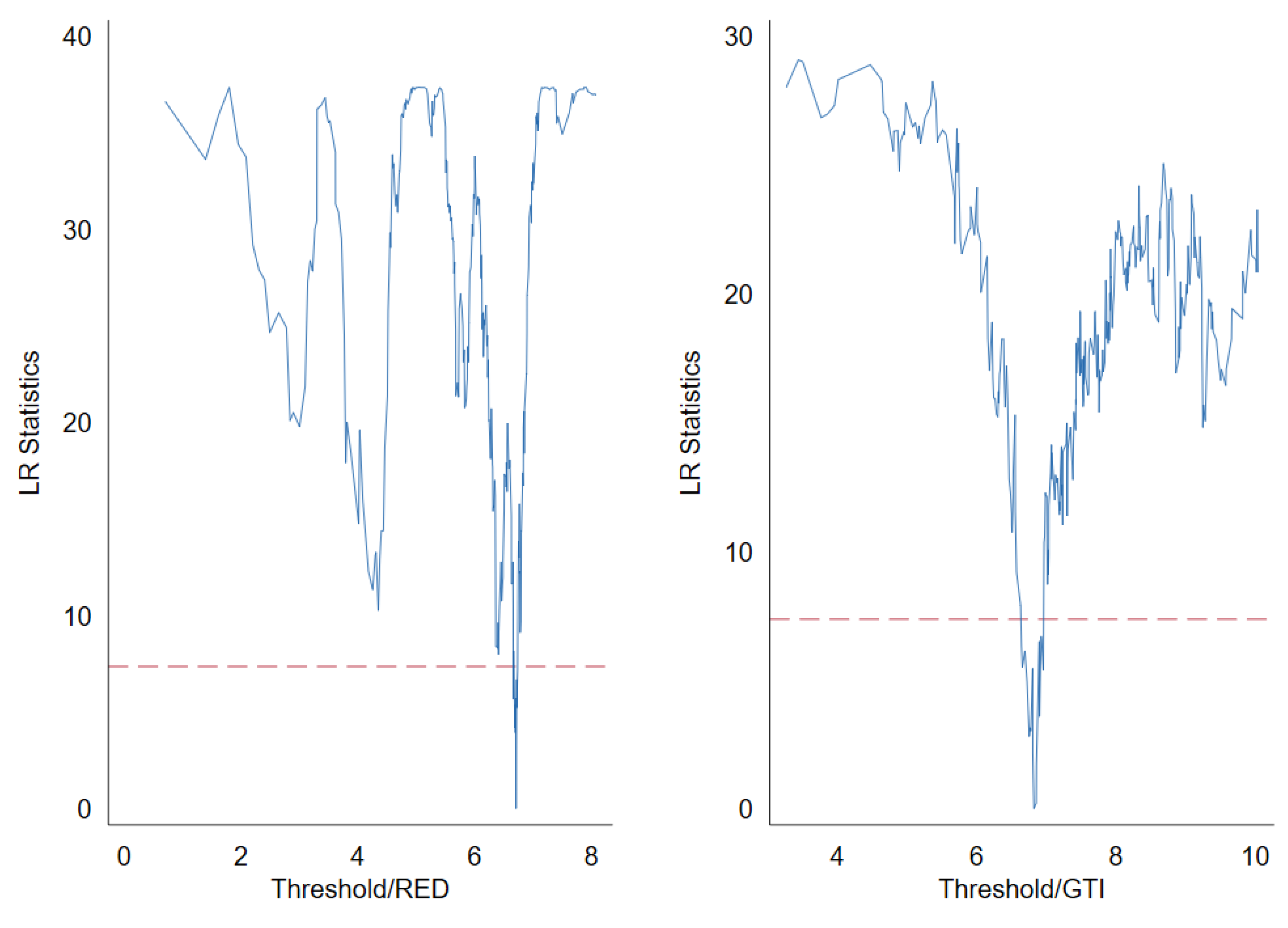
Drawing on the "bootstrap" method introduced by Hansen (1999) and utilizing the Stata 18.0 statistical software, the study conducted 1000 resamples to calculate the P-values for test statistics, thus determining the presence of threshold effects. Based on the findings displayed in Table 9, both RED and GTI, serving as threshold variables, exhibit a single threshold effect, at 10% level P-values of less than 0.1, which exhibits statistical significance. Therefore, there is a threshold impact for both green technology innovation and renewable energy on green economic growth. Corresponding to Table 10, based on the ideas of the threshold model, the estimated threshold values, denoted asγ, are identified at the points where the Likelihood Ratio (LR) statistics approach zero. Figure 3 displays the likelihood ratio function graphs for RED and GTI with threshold estimates of 6.700 and 6.814, respectively, within the 95% confidence interval. In the graphical representations, for Likelihood Ratio (LR) statistics, the minima indicate the real threshold values. The delineation of a critical value at 7.35, represented by a dashed line, and its substantial exceedance over the threshold values confirms the validity of these thresholds.
Following the panel threshold effect test results, additional threshold regression analysis was undertaken, with the findings detailed in Table 11. Model 5 indicates that when the RED level is below 6.700, renewable energy production affects green economic growth by 0.104. Conversely, when the RED level exceeds 6.700, this coefficient increases to 0.126. This outcome aligns with the findings from the initial benchmark regression and substantiates the reliability of the findings. The outcomes of Model 5 prove that while the renewable energy development level is less than a certain threshold, its consumption has a noteworthy but relatively less intense boost to economic growth. However, once this threshold is beyond, the effect of renewable energy on the economy becomes more pronounced and stronger. This may be because above the threshold, renewable energy technologies are more mature, policy and infrastructure support is better, and efficiency and economies of scale effects increase.
Model 6 demonstrates that when green technology innovation levels are below 6.816, growth in the green economy and advancements in renewable energy have a 0.127 impact coefficient, indicating a substantial beneficial impact. When the green technology innovation level exceeds 6.816, this impact coefficient increases to 0.147 is significant at the 1% level of statistical significance. This indicates that the contribution of renewable energy to economic growth increases as green technology innovation increases. The result aligns with the findings of (X. Li et al., 2018; Saba et al., 2023; Wang et al., 2020). The explanations for the reasons include the following aspects: firstly, technological advances have improved the efficiency of energy production, making renewable energy more competitive in the market by reducing the cost per unit of output. Secondly, as production costs decrease and technology becomes more advanced, the government and the market offer greater assistance to renewable energy, such as financial subsidies and tax incentives, which further promote its growth. Additionally, highly efficient and eco-friendly energy solutions can enhance energy security, and reduce environmental pollution and reliance on traditional fossil fuels at the same time, which will help the economy shift to green development.
Figure 3.
The likelihood ratio distribution of the estimated threshold value of renewable energy development and green technology innovation.
Figure 3.
The likelihood ratio distribution of the estimated threshold value of renewable energy development and green technology innovation.
5. Conclusion and Policy Implications
5.1. Conclusions
We employ a super-efficient DEA model to examine green economic growth using balanced panel data from 30 Chinese regions between 2010 and 2022. The panel data model explains how advances in renewable energy and green technology have an effect on the green economy's growth. Analyzing the nonlinear effects of green technological innovation and renewable energy development under various threshold limitations, as well as the threshold effects of these developments on green economic growth, is done by using threshold regression models. The following are the primary conclusions: Firstly, China's overall green economic growth shows an upward trend, from the development of green economy technology to the growth of renewable energy and the connection between the two to green economic growth. According to the chart, each province saw a drop in the measure of green economic growth, followed by a subsequent rise, indicating an inverted "U" shaped development trend. The GEG varies throughout each location because of the varying levels of environmental management and economic growth. Secondly, the benchmark results indicate that all selected variables greatly influence the rise of the green economy. However, population density, government intervention, GEG, and industrial structure have an inverse relationship. Simultaneously, green funding has a moderating function in the contribution of green technology innovation and renewable energy development to green economic growth. Furthermore, green technology innovation and renewable energy development can boost green economic growth through green finance. Thirdly, green technical innovation has one threshold impact on the development of renewable energy and green economic growth, according to threshold effect analysis. Specifically, renewable energy development has a limited effect on the rise of the green economy when green technology innovation lowers below a particular level. However, once this barrier is crossed, the potential for developing renewable energy to accelerate green economic growth is greatly increased. Additionally, at the current state of the art, utilizing RED as a threshold variable, we investigate the ideal range for consuming renewable energy to support the expansion of the green economy. The results are similar to the GTI as a threshold value.
5.2. Policy Recommendations
Based on its earlier findings, the report suggests the following policies:
- (1)
- To promote the development of a green economy, it is essential to enhance local green development and achieve regional coordination. Local governments should strengthen talent cultivation to provide continuous support for green development. Governments should also optimize the environment for green innovation, integrate resources, and guide policies to improve the capabilities of green technologies, thereby improving resource efficiency and achieving energy transition. We should formulate customized and distinct green development policies to showcase the unique strengths and characteristics of various regions. Advanced regions, such as Guangdong and Jiangsu, can lead by providing technical support and promoting collaboration for green development in other areas. For example, Guangdong Province has become one of the leading regions in China's green economy by encouraging clean energy development and promoting the environmental protection industry. It can share its experiences and technologies with other regions, helping to improve their green development. Ultimately, we can advance local green development and promote harmonious and enduring growth of the environmentally friendly economy by strengthening talent cultivation, optimizing the innovation environment, implementing differentiated policies, and promoting regional cooperation.
- (2)
- To enhance green technology innovation and renewable energy development, as well as to foster the growth of green finance and optimize industrial structure adjustments. First, governments should fund green technology and renewable energy research. It can achieve this by establishing green technology innovation hubs, providing R&D funding, and encouraging enterprises, research institutions, and universities to increase their research and innovative efforts regarding renewable energy and green technology. Second, governments should establish a robust green finance system, providing a range of financial services and solutions to aid in the advancement of renewable energy and green technology. For example, governments can incentivize financial firms to issue green bonds to attract capital into the green economy sector and enhance green finance regulation to ensure that green financial products are credible and transparent. Lastly, it is necessary to optimize industrial structure by imposing strict environmental standards on high-pollution industries and promoting the growth of eco-friendly sectors. Furthermore, it is critical to adjust government intervention methods to reduce reliance on traditional industries and ensure rational resource allocation.
- (3)
- To augment the green technology development research and enhance utilizing renewable energy, it is recommended to establish a specialized institution tasked with monitoring the advancements in green technology innovation and renewable energy development. This body would also evaluate their impacts on green economic growth, ensuring alignment with sustainability goals. We can quickly adjust and optimize relevant policies to fully capitalize on their potential to stimulate economic growth once we determine that the development level in a particular area is approaching or has exceeded a certain threshold.
References
- Abakah, E.J.A.; Nasreen, S.; Tiwari, A.K.; Lee, C.-C. US leveraged loan and debt markets: Implications for optimal portfolio and hedging. International Review of Financial Analysis 2023, 87, 102514. [Google Scholar] [CrossRef]
- Ali, E.B.; Anufriev, V.P.; Amfo, B. Green economy implementation in Ghana as a road map for a sustainable development drive: A review. Scientific African 2021, 12, e00756. [Google Scholar] [CrossRef]
- An, W. The Meaning, Mechanism and Practice of Green Finance. Economic Latitude and Longitude 2008, 5, 156–158. [Google Scholar]
- Anser, M.K.; Iqbal, W.; Ahmad, U.S.; Fatima, A.; Chaudhry, I.S. Environmental efficiency and the role of energy innovation in emissions reduction. Environmental Science and Pollution Research 2020, 27, 29451–29463. [Google Scholar] [CrossRef] [PubMed]
- Banker, R.D.; Charnes, A.; Cooper, W.W. Some models for estimating technical and scale inefficiencies in data envelopment analysis. Management Science 1984, 30, 1078–1092. [Google Scholar] [CrossRef]
- Bayer, P.; Dolan, L.; Urpelainen, J. Global patterns of renewable energy innovation, 1990–2009. Energy for Sustainable Development 2013, 17, 288–295. [Google Scholar] [CrossRef]
- Bhatnagar, S.; Sharma, D. Evolution of green finance and its enablers: A bibliometric analysis. Renewable and Sustainable Energy Reviews 2022, 162, 112405. [Google Scholar] [CrossRef]
- Charnes, A.; Cooper, W.W.; Rhodes, E. Measuring the efficiency of decision making units. European Journal of Operational Research 1978, 2, 429–444. [Google Scholar] [CrossRef]
- Chemmanur, T.J.; Fulghieri, P. Entrepreneurial finance and innovation: An introduction and agenda for future research. The Review of Financial Studies 2014, 27, 1–19. [Google Scholar] [CrossRef]
- Chen, C.; Pinar, M.; Stengos, T. Renewable energy consumption and economic growth nexus: Evidence from a threshold model. Energy Policy 2020, 139, 111295. [Google Scholar] [CrossRef]
- Chen, W.; Lei, Y. The impacts of renewable energy and technological innovation on environment-energy-growth nexus: New evidence from a panel quantile regression. Renewable Energy 2018, 123, 1–14. [Google Scholar] [CrossRef]
- Chien, F.; Kamran, H.W.; Albashar, G.; Iqbal, W. Dynamic planning, conversion, and management strategy of different renewable energy sources: a sustainable solution for severe energy crises in emerging economies. International Journal of Hydrogen Energy 2021, 46, 7745–7758. [Google Scholar] [CrossRef]
- Cooper, W.W.; Seiford, L.M.; Tone, K. Data envelopment analysis: a comprehensive text with models, applications, references and DEA-solver software (Vol. 2). Springer: 2007.
- Dai, L.; Xiong, Y. Does the green finance development and renewable energy affect the economic recovery in Asian economies. Renewable Energy 2023, 216, 118922. [Google Scholar] [CrossRef]
- Dang, V.A.; Kim, M.; Shin, Y. Asymmetric capital structure adjustments: New evidence from dynamic panel threshold models. Journal of Empirical Finance 2012, 19, 465–482. [Google Scholar] [CrossRef]
- Dong, F.; Li, Y.; Gao, Y.; Zhu, J.; Qin, C.; Zhang, X. Energy transition and carbon neutrality: Exploring the non-linear impact of renewable energy development on carbon emission efficiency in developed countries. Resources, Conservation and Recycling 2022, 177, 106002. [Google Scholar] [CrossRef]
- Doraszelski, U.; Jaumandreu, J. R&D and productivity: Estimating endogenous productivity. Review of Economic Studies 2013, 80, 1338–1383. [Google Scholar]
- Du, J.; Shen, Z.; Song, M.; Vardanyan, M. The role of green financing in facilitating renewable energy transition in China: Perspectives from energy governance, environmental regulation, and market reforms. Energy Economics 2023, 120, 106595. [Google Scholar] [CrossRef]
- Du, K.; Cheng, Y.; Yao, X. Environmental regulation, green technology innovation, and industrial structure upgrading: The road to the green transformation of Chinese cities. Energy Economics 2021, 98, 105247. [Google Scholar] [CrossRef]
- Egli, F.; Steffen, B.; Schmidt, T.S. A dynamic analysis of financing conditions for renewable energy technologies. Nature Energy 2018, 3, 1084–1092. [Google Scholar] [CrossRef]
- Ekins, P. Economic growth and environmental sustainability: the prospects for green growth. Routledge: 2002.
- Energy, R. Renewable Energy and Climate Change; International Renewable Energy Agency: United Arab Emirates, 2015. [Google Scholar]
- Fabozzi, F.J.; Focardi, S.; Ponta, L.; Rivoire, M.; Mazza, D. The economic theory of qualitative green growth. Structural Change and Economic Dynamics 2022, 61, 242–254. [Google Scholar] [CrossRef]
- Fang, W.; Liu, Z.; Putra, A.R. S. Role of research and development in green economic growth through renewable energy development: empirical evidence from South Asia. Renewable Energy 2022, 194, 1142–1152. [Google Scholar] [CrossRef]
- Fang, Y.; Shao, Z. Whether green finance can effectively moderate the green technology innovation effect of heterogeneous environmental regulation. International Journal of Environmental Research and Public Health 2022, 19, 3646. [Google Scholar] [CrossRef]
- Goulder, L.H.; Schneider, S.H. Induced technological change and the attractiveness of CO2 abatement policies. Resource and Energy Economics 1999, 21, 211–253. [Google Scholar] [CrossRef]
- Gu, S.; Xie, M.; Zhang, X. Green Development: New Concepts and New Measures. Environmental Protection 2016, 12, 13–15. [Google Scholar]
- Gullberg, A.T.; Ohlhorst, D.; Schreurs, M. Towards a low carbon energy future–Renewable energy cooperation between Germany and Norway. Renewable Energy 2014, 68, 216–222. [Google Scholar] [CrossRef]
- Hansen, B.E. Inference when a nuisance parameter is not identified under the null hypothesis. Econometrica: Journal of the Econometric Society, 1996; 413–430. [Google Scholar]
- He, J.; Iqbal, W.; Su, F. Nexus between renewable energy investment, green finance, and sustainable development: Role of industrial structure and technical innovations. Renewable Energy 2023, 210, 715–724. [Google Scholar] [CrossRef]
- He, L.; Zhang, L.; Zhong, Z.; Wang, D.; Wang, F. Green credit, renewable energy investment and green economy development: Empirical analysis based on 150 listed companies of China. Journal of Cleaner Production 2019, 208, 363–372. [Google Scholar] [CrossRef]
- Heal, G. (2010). Reflections—the economics of renewable energy in the United States. Review of Environmental Economics and Policy.
- Huang, Y.; Chen, C.; Lei, L.; Zhang, Y. Impacts of green finance on green innovation: A spatial and nonlinear perspective. Journal of Cleaner Production 2022, 365, 132548. [Google Scholar] [CrossRef]
- Inglesi-Lotz, R.; Dogan, E. The role of renewable versus non-renewable energy to the level of CO2 emissions a panel analysis of sub-Saharan Africa’s Βig 10 electricity generators. Renewable Energy 2018, 123, 36–43. [Google Scholar] [CrossRef]
- Irandoust, M. The renewable energy-growth nexus with carbon emissions and technological innovation: Evidence from the Nordic countries. Ecological Indicators 2016, 69, 118–125. [Google Scholar] [CrossRef]
- Jerzmanowski, M. Total factor productivity differences: Appropriate technology vs. efficiency. European Economic Review 2007, 51, 2080–2110. [Google Scholar] [CrossRef]
- Ji, Q.; Zhang, D. How much does financial development contribute to renewable energy growth and upgrading of energy structure in China? Energy Policy 2019, 128, 114–124. [Google Scholar] [CrossRef]
- Jiakui, C.; Abbas, J.; Najam, H.; Liu, J.; Abbas, J. Green technological innovation, green finance, and financial development and their role in green total factor productivity: Empirical insights from China. Journal of Cleaner Production 2023, 382, 135131. [Google Scholar] [CrossRef]
- Jin, W. Can technological innovation help China take on its climate responsibility? An intertemporal general equilibrium analysis. Energy Policy 2012, 49, 629–641. [Google Scholar] [CrossRef]
- Kennet, M.; Heinemann, V. Green Economics: setting the scene. Aims, context, and philosophical underpinning of the distinctive new solutions offered by Green Economics. International Journal of Green Economics 2006, 1, 68–102. [Google Scholar] [CrossRef]
- Khan, K.; Su, C.W.; Rehman, A.U.; Ullah, R. Is technological innovation a driver of renewable energy? Technology in Society 2022, 70, 102044. [Google Scholar] [CrossRef]
- Kim, D.-H.; Lin, S.-C.; Chen, T.-C. Financial structure, firm size and industry growth. International Review of Economics & Finance 2016, 41, 23–39. [Google Scholar]
- Kim, S.E.; Kim, H.; Chae, Y. A new approach to measuring green growth: Application to the OECD and Korea. Futures 2014, 63, 37–48. [Google Scholar] [CrossRef]
- Lee, C.-C.; Lee, C.-C. How does green finance affect green total factor productivity? Evidence from China. Energy Economics 2022, 107, 105863. [Google Scholar] [CrossRef]
- Lee, C.-C.; Wang, F.; Chang, Y.-F. Does green finance promote renewable energy? Evidence from China. Resources Policy 2023, 82, 103439. [Google Scholar] [CrossRef]
- Lee, C.-C.; Zhang, J.; Hou, S. The impact of regional renewable energy development on environmental sustainability in China. Resources Policy 2023, 80, 103245. [Google Scholar] [CrossRef]
- Lee, C.W.; Zhong, J. Top down strategy for renewable energy investment: Conceptual framework and implementation. Renewable Energy 2014, 68, 761–773. [Google Scholar] [CrossRef]
- Li, C.; Umair, M. Does green finance development goals affects renewable energy in China. Renewable Energy 2023, 203, 898–905. [Google Scholar] [CrossRef]
- Li, K.; Lin, B. Economic growth model, structural transformation, and green productivity in China. Applied Energy 2017, 187, 489–500. [Google Scholar] [CrossRef]
- Li, X. Regional green economic growth: measurement, decomposition and driving factors - Empirical data from Japan. Journal of Hebei University of Economics and Trade 2019, 40, 24–34. [Google Scholar]
- Li, X.; Song, Y.; Yao, Z.; Xiao, R. Forecasting China’s CO 2 emissions for energy consumption based on cointegration approach. Discrete Dynamics in Nature and Society 2018, 2018. [Google Scholar]
- Li, Y.; Pan, W. Drivers of green transformation and upgrading of resource-based industries. Technical Economy 2016, 35, 65–69. [Google Scholar]
- Li, Z.; Luan, R.; Lin, B. The trend and factors affecting renewable energy distribution and disparity across countries. Energy 2022, 254, 124265. [Google Scholar] [CrossRef]
- Liddle, B. Impact of population, age structure, and urbanization on carbon emissions/energy consumption: evidence from macro-level, cross-country analyses. Population and Environment 2014, 35, 286–304. [Google Scholar] [CrossRef]
- Lin, B.; Bai, R. Nexus between green finance development and green technological innovation: A potential way to achieve the renewable energy transition. Renewable Energy 2023, 218, 119295. [Google Scholar]
- Lin, B.; Zhou, Y. Measuring the green economic growth in China: Influencing factors and policy perspectives. Energy 2022, 241, 122518. [Google Scholar] [CrossRef]
- Lin, B.; Zhu, J. The role of renewable energy technological innovation on climate change: Empirical evidence from China. Science of the Total Environment 2019, 659, 1505–1512. [Google Scholar] [CrossRef] [PubMed]
- Liu, R.; Wang, D.; Zhang, L.; Zhang, L. Can green financial development promote regional ecological efficiency? A case study of China. Natural Hazards 2019, 95, 325–341. [Google Scholar] [CrossRef]
- Liu, Z.; Xu, J.; Wei, Y.; Hatab, A.A.; Lan, J. Nexus between green financing, renewable energy generation, and energy efficiency: empirical insights through DEA technique. Environmental Science and Pollution Research 2021, 1–14. [Google Scholar] [CrossRef]
- Luo, X.; Jin, Y. Research on Green Development Efficiency of Resource-based Cities under Transformation and Upgrading--Taking the Central Region as an Example. Journal of Southwest Jiaotong University: Social Science Edition 2017, 18, 77–83. [Google Scholar]
- Luo, Y.; Long, X.; Wu, C.; Zhang, J. Decoupling CO2 emissions from economic growth in the agricultural sector across 30 Chinese provinces from 1997 to 2014. Journal of Cleaner Production 2017, 159, 220–228. [Google Scholar] [CrossRef]
- Luukkanen, J.; Kaivo-Oja, J.; Vähäkari, N.; O’Mahony, T.; Korkeakoski, M.; Panula-Ontto, J.; Phonhalath, K.; Nanthavong, K.; Reincke, K.; Vehmas, J. Green economic development in Lao PDR: A sustainability window analysis of Green Growth Productivity and the Efficiency Gap. Journal of Cleaner Production 2019, 211, 818–829. [Google Scholar] [CrossRef]
- Ma, H.; Dong, S. Impact of different types of environmental regulation on carbon emission efficiency. Beijing Institute of Technology 2020, 22, 1–10. [Google Scholar]
- Mensah, C.N.; Long, X.; Dauda, L.; Boamah, K.B.; Salman, M.; Appiah-Twum, F.; Tachie, A.K. Technological innovation and green growth in the Organization for Economic Cooperation and Development economies. Journal of Cleaner Production 2019, 240, 118204. [Google Scholar] [CrossRef]
- Meo, M.S.; Abd Karim, M.Z. The role of green finance in reducing CO2 emissions: An empirical analysis. Borsa Istanbul Review 2022, 22, 169–178. [Google Scholar]
- Mohsin, M.; Taghizadeh-Hesary, F.; Iqbal, N.; Saydaliev, H.B. The role of technological progress and renewable energy deployment in green economic growth. Renewable Energy 2022, 190, 777–787. [Google Scholar] [CrossRef]
- Murphy, B. Outline of the People’s Republic of China 14th Five-Year Plan for National Economic and Social Development and Long-Range Objectives for 2035. Descripción Del 14o Plan Quinquenal de La República Popular China Para El Desarrollo Económico y Social Nacional y Los Objetivos a Largo Plazo Para 2021, 2035, 102. [Google Scholar]
- Nicolli, F.; Vona, F. Energy market liberalization and renewable energy policies in OECD countries. Energy Policy 2019, 128, 853–867. [Google Scholar] [CrossRef]
- Odugbesan, J.A.; Rjoub, H.; Ifediora, C.U.; Iloka, C.B. Do financial regulations matters for sustainable green economy: evidence from Turkey. Environmental Science and Pollution Research 2021, 28, 56642–56657. [Google Scholar] [CrossRef] [PubMed]
- Ohlan, R. The impact of population density, energy consumption, economic growth and trade openness on CO2 emissions in India. Natural Hazards 2015, 79, 1409–1428. [Google Scholar] [CrossRef]
- Pece, A.M.; Simona, O.E. O.; Salisteanu, F. Innovation and economic growth: An empirical analysis for CEE countries. Procedia Economics and Finance 2015, 26, 461–467. [Google Scholar] [CrossRef]
- Popp, D.; Hascic, I.; Medhi, N. Technology and the diffusion of renewable energy. Energy Economics 2011, 33, 648–662. [Google Scholar] [CrossRef]
- Qi, X.; Guo, Y.; Guo, P.; Yao, X.; Liu, X. Do subsidies and R&D investment boost energy transition performance? Evidence from Chinese renewable energy firms. Energy Policy 2022, 164, 112909. [Google Scholar]
- Qian, Y.; Liu, J.; Forrest, J.Y.-L. Impact of financial agglomeration on regional green economic growth: evidence from China. Journal of Environmental Planning and Management 2022, 65, 1611–1636. [Google Scholar] [CrossRef]
- Rao, F.; Tang, Y.M.; Chau, K.Y.; Iqbal, W.; Abbas, M. Assessment of energy poverty and key influencing factors in N11 countries. Sustainable Production and Consumption 2022, 30, 1–15. [Google Scholar] [CrossRef]
- Robaina, M.; Madaleno, M. Resources: Eco-efficiency, sustainability, and innovation in tourism. The Future of Tourism: Innovation and Sustainability, 2019; 19–41. [Google Scholar]
- Ruan, F.; Yan, L.; Wang, D. The complexity of the resource-based cities in China on creating sustainable development. Cities 2020, 97, 102571. [Google Scholar] [CrossRef]
- Saba, C.S.; Djemo, C.R. T.; Eita, J.H.; Ngepah, N. Towards environmental sustainability path in Africa: The critical role of ICT, renewable energy sources, agriculturalization, industrialization, and institutional quality. Energy Reports 2023, 10, 4025–4050. [Google Scholar] [CrossRef]
- Sadorsky, P. The effect of urbanization on CO2 emissions in emerging economies. Energy Economics 2014, 41, 147–153. [Google Scholar] [CrossRef]
- Sawhney, A.; Kahn, M.E. Understanding cross-national trends in high-tech renewable power equipment exports to the United States. Energy Policy 2012, 46, 308–318. [Google Scholar] [CrossRef]
- Shahbaz, M.; Raghutla, C.; Song, M.; Zameer, H.; Jiao, Z. Public-private partnerships investment in energy as new determinant of CO2 emissions: the role of technological innovations in China. Energy Economics 2020, 86, 104664. [Google Scholar] [CrossRef]
- Shang, Y. The impact of Yangtze River Delta low-carbon technology innovation cooperation on green economic growth. China’s Population, Resources and Environment, 2023; 135–145. [Google Scholar]
- Shi, B.; Shen, K. rong. Total Factor Energy Efficiency in China under Market Segregation: An Empirical Analysis Based on the Super-Efficient DEA Approach. World Economy 2008, 9, 49–59. [Google Scholar]
- Solow, R.M. A contribution to the theory of economic growth. The Quarterly Journal of Economics 1956, 70, 65–94. [Google Scholar] [CrossRef]
- Song, M.; Wang, S. Can employment structure promote environment-biased technical progress? Technological Forecasting and Social Change 2016, 112, 285–292. [Google Scholar] [CrossRef]
- Song, M.; Zhao, X.; Shang, Y.; Chen, B. Realization of green transition based on the anti-driving mechanism: an analysis of environmental regulation from the perspective of resource dependence in China. Science of the Total Environment 2020, 698, 134317. [Google Scholar] [CrossRef]
- Su, Y.; Fan, Q. Renewable energy technology innovation, industrial structure upgrading and green development from the perspective of China’s provinces. Technological Forecasting and Social Change 2022, 180, 121727. [Google Scholar] [CrossRef]
- Tan, J.; Su, X.; Wang, R. The impact of natural resource dependence and green finance on green economic growth in the context of COP26. Resources Policy 2023, 81, 103351. [Google Scholar] [CrossRef]
- Tone, K. A slacks-based measure of efficiency in data envelopment analysis. European Journal of Operational Research 2001, 130, 498–509. [Google Scholar] [CrossRef]
- Villa, L.S. Invention, inventive learning, and innovative capacity. Behavioral Science 1990, 35, 290–310. [Google Scholar] [CrossRef]
- Wan, Y.; Sheng, N. Clarifying the relationship among green investment, clean energy consumption, carbon emissions, and economic growth: a provincial panel analysis of China. Environmental Science and Pollution Research 2022, 1–15. [Google Scholar] [CrossRef] [PubMed]
- Wan, Y.; Sheng, N.; Wei, X.; Su, H. Study on the spatial spillover effect and path mechanism of green finance development on China’s energy structure transformation. Journal of Cleaner Production 2023, 137820. [Google Scholar] [CrossRef]
- Wang, R.; Mirza, N.; Vasbieva, D.G.; Abbas, Q.; Xiong, D. The nexus of carbon emissions, financial development, renewable energy consumption, and technological innovation: what should be the priorities in light of COP 21 Agreements? Journal of Environmental Management 2020, 271, 111027. [Google Scholar] [CrossRef] [PubMed]
- Wei, Z.; Yuguo, J.; Jiaping, W. Greenization of venture capital and green innovation of Chinese entity industry. Ecological Indicators 2015, 51, 31–41. [Google Scholar] [CrossRef]
- Xiao, Z.; Tan, R.; Jianbang Shi. A study of the impact of environmental regulation on regional green innovation efficiency - a quasi-natural experiment based on the ‘carbon credit’ pilot. Engineering Management Technology Frontier 2022, 41, 63–69. [Google Scholar]
- Xie, F.; Liu, C.; Chen, H.; Wang, N. Threshold effects of new energy consumption transformation on economic growth. Sustainability 2018, 10, 4124. [Google Scholar] [CrossRef]
- Xie, F.; Liu, Y.; Guan, F.; Wang, N. The role of technological progress and renewable energy deployment in green economic growth. Environmental Sciences Europe 2020, 32, 1–15. [Google Scholar]
- Xu, J.; She, S.; Gao, P.; Sun, Y. Role of green finance in resource efficiency and green economic growth. Resources Policy 2023, 81, 103349. [Google Scholar] [CrossRef]
- Yu, B.; Fan, C. Green finance, technological innovation and high-quality economic development. Nanjing Social Sciences 2022, 9, 31–43. [Google Scholar]
- Yu, C.-H.; Wu, X.; Zhang, D.; Chen, S.; Zhao, J. Demand for green finance: Resolving financing constraints on green innovation in China. Energy Policy 2021, 153, 112255. [Google Scholar] [CrossRef]
- Yu, S.; Hu, X.; Li, L.; Chen, H. Does the development of renewable energy promote carbon reduction? Evidence from Chinese provinces. Journal of Environmental Management 2020, 268, 110634. [Google Scholar] [CrossRef]
- Zhan, Z.; Wang, R.; Liu, Y. The Impact of Fintech and Green Finance Synergy on Industrial Structure Upgrading - Based on the perspective of heterogeneous environmental regulation. 2023, 152–162.
- Zhang, D.; Mohsin, M.; Taghizadeh-Hesary, F. Does green finance counteract the climate change mitigation: asymmetric effect of renewable energy investment and R&D. Energy Economics 2022, 113, 106183. [Google Scholar]
- Zhang, H.; Geng, C.; Wei, J. Coordinated development between green finance and environmental performance in China: The spatial-temporal difference and driving factors. Journal of Cleaner Production 2022, 346, 131150. [Google Scholar] [CrossRef]
- Zhang, K.Q.; Chen, H.H.; Tang, L.Z.; Qiao, S. Green finance, innovation and the energy-environment-climate nexus. Frontiers in Environmental Science 2022, 10, 879681. [Google Scholar] [CrossRef]
- Zhao, J.; Shahbaz, M.; Dong, K. How does energy poverty eradication promote green growth in China? The role of technological innovation. Technological Forecasting and Social Change 2022, 175, 121384. [Google Scholar] [CrossRef]
- Zhao, X.; Mahendru, M.; Ma, X.; Rao, A.; Shang, Y. Impacts of environmental regulations on green economic growth in China: New guidelines regarding renewable energy and energy efficiency. Renewable Energy 2022, 187, 728–742. [Google Scholar] [CrossRef]
- Zhao, X.; Mahendru, M.; Ma, X.; Rao, A.; Shang, Y. Impacts of environmental regulations on green economic growth in China: New guidelines regarding renewable energy and energy efficiency. Renewable Energy 2022, 187, 728–742. [Google Scholar] [CrossRef]
- Zheng, H.; Song, M.; Shen, Z. The evolution of renewable energy and its impact on carbon reduction in China. Energy 2021, 237, 121639. [Google Scholar] [CrossRef]
- Zhong, W.; Jiang, F.; Wan, X. The empirical study on the impact of industrial structure changes on the carbon intensity in China. Audit & Economy Research 2015, 6, 88–96. [Google Scholar]
- Zhou, G.; Zhu, J.; Luo, S. The impact of fintech innovation on green growth in China: Mediating effect of green finance. Ecological Economics 2022, 193, 107308. [Google Scholar] [CrossRef]
- Zhou, X.; Tang, X.; Zhang, R. Impact of green finance on economic development and environmental quality: a study based on provincial panel data from China. Environmental Science and Pollution Research 2020, 27, 19915–19932. [Google Scholar] [CrossRef]
- Zhu, Y.; Taylor, D.; Wang, Z. The role of renewable energy in reducing residential fossil energy-related CO2 emissions: evidence from rural China. Journal of Cleaner Production 2022, 366, 132891. [Google Scholar] [CrossRef]
Figure 1.
Renewable energy consumption (% of total final energy consumption).
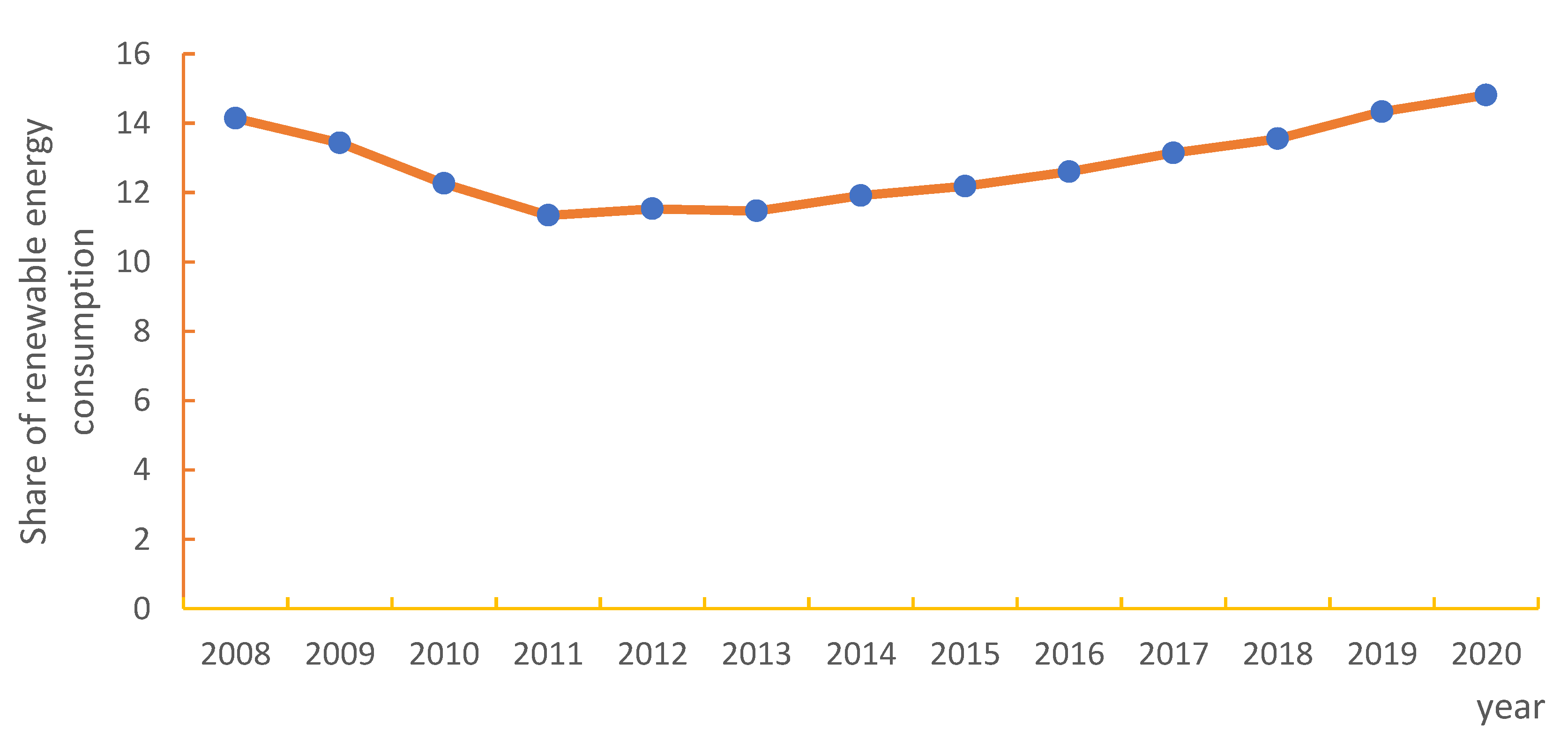
Figure 2.
The relationship between the amount of green economic growth, the use of renewable energy, and the creation of green technologies (2010–2022).
Figure 2.
The relationship between the amount of green economic growth, the use of renewable energy, and the creation of green technologies (2010–2022).
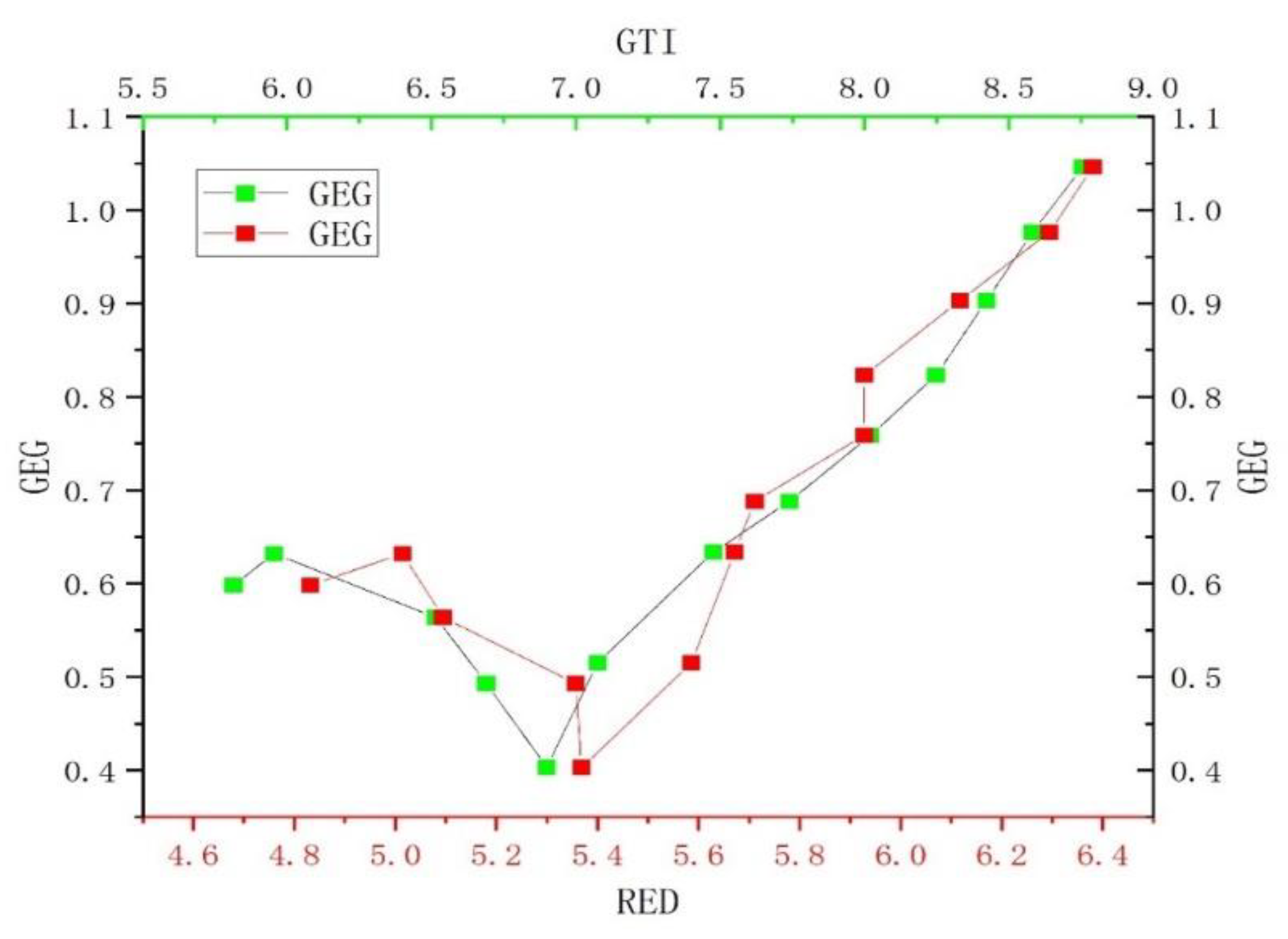
Figure 3.
Changes in green economic growth level in China’s 30 provinces (2010–2022). Notice: The numbers on the abscissa represent Beijing, Tianjin, Hebei, Shanxi, Neimenggu, Liaoning, Jilin, Heilongjiang, Shanghai, Jiangsu, Zhejiang, Anhui, Fujian, Jiangxi, Shandong, Henan, Hubei, Hunan, Guangdong, Guangxi, Hainan, Chongqing, Sichuan, Guizhou, Yunnan, Shanxi, Gansu, Qinghai, Ningxia, Xinjiang.
Figure 3.
Changes in green economic growth level in China’s 30 provinces (2010–2022). Notice: The numbers on the abscissa represent Beijing, Tianjin, Hebei, Shanxi, Neimenggu, Liaoning, Jilin, Heilongjiang, Shanghai, Jiangsu, Zhejiang, Anhui, Fujian, Jiangxi, Shandong, Henan, Hubei, Hunan, Guangdong, Guangxi, Hainan, Chongqing, Sichuan, Guizhou, Yunnan, Shanxi, Gansu, Qinghai, Ningxia, Xinjiang.
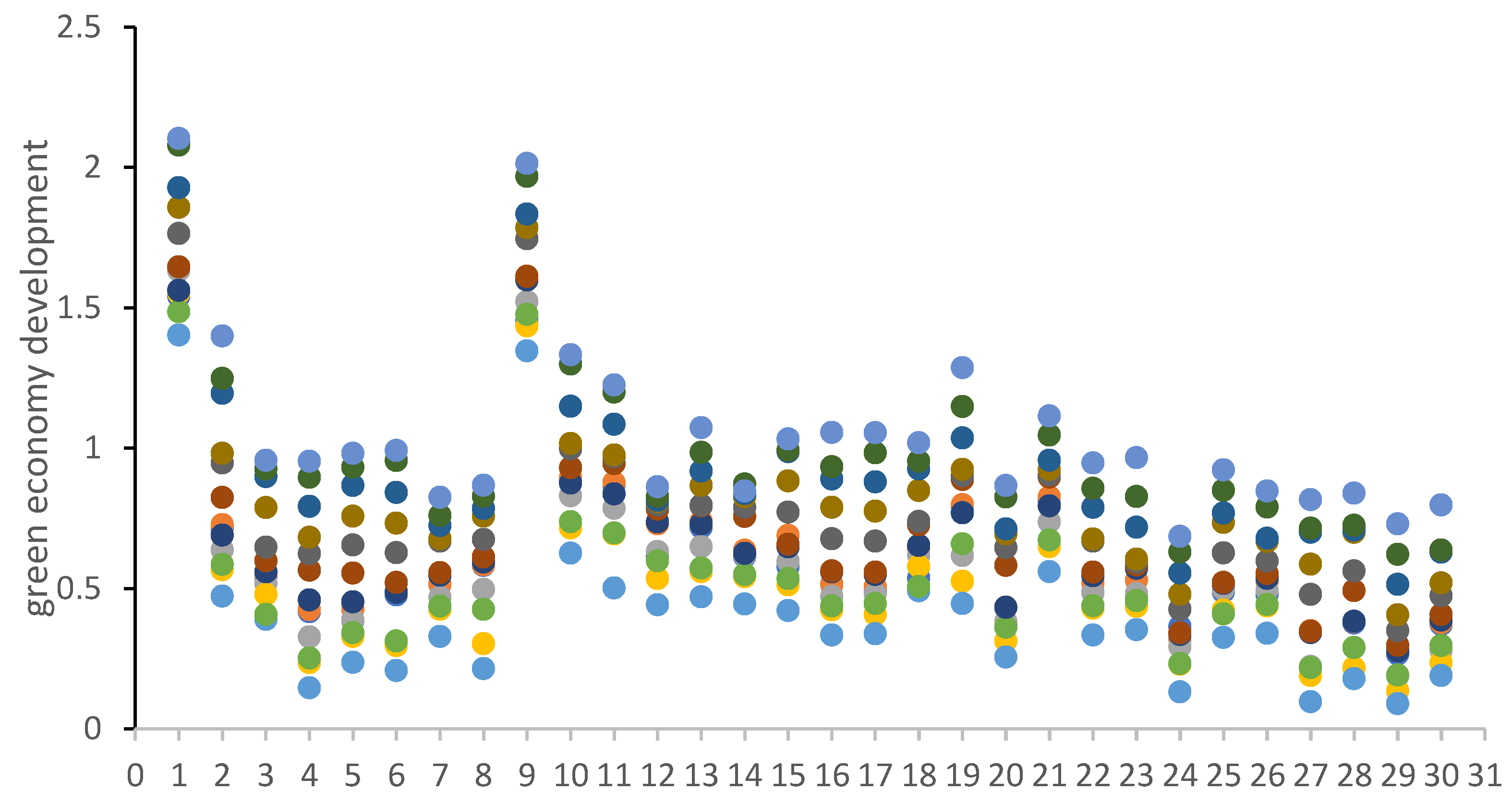

Table 1.
Green economic growth input-output indicator system.
| Indicators | Category | Specific indicators | Indicator Measurement | Reference | Unit |
| inputs | Factor inputs | Labor | Number of employees in each province at the end of the year | Tan et al. (2023) | 10,000 people |
| Capital | Physical capital stock per province (perpetual inventory method) | Ma & Dong (2020) | 100 million yuan | ||
| Land | Land area per provincial administrative area | X. Zhao et al. (2022a) | km² | ||
| Energy | Energy consumption per province (mainly refers to coke, coal, and natural gas) | Tan et al. (2023) | 10,000 tons of standard coal | ||
| outputs | Desired outputs (Economic benefit) |
Economic Development Level | GDP total | Shang (2023) | 100 million yuan |
| Undesired output (Environmental impact) |
Environmental Pollution Level | Industrial waste gas emissions | Xiao et al. (2022) | 100 million cu.m | |
| Industrial wastewater emissions | 104 tons | ||||
| Industrial general solid waste emissions | 104 tons |
Table 2.
Green finance development level indicator evaluation system.
| Overall indicator | sub-indicator | Indicators measurement | Reference |
| Green Finance Development Index | Green credit | The ratio of interest expenditure within the total industry for six high energy-consuming sectors | B. Yu & Fan (2022) |
| Green securities | The ratio of the market value of the six energy-intensive industries to the overall market value of A-shares | Wan et al. (2023) | |
| Green Insurance | The ratio of agricultural insurance income to the gross agricultural output value | Lee et al. (2023) | |
| Green investment | The investment-to-gross Domestic Product (GDP) ratio for environmental pollution prevention. | Tan et al. (2023) | |
| Environmental support | The ratio of government spending on environmental protection to total government spending | Zhan et al. (2023) |
Table 3.
Data Description of the Variables.
| Variable | Symbol | Measurement | Source |
| Green Economic Growth | GEG | by the super-efficient SBM | CSY, PSY, CESY |
| Technology Innovation | TI | green invention patents | CNIPA |
| Renewable Development | RED | renewable energy power generation | CEPY |
| Green Finance | GF | construct a comprehensive index of green finance | CSY,CISY,CESY, PSY, CASY |
| Economic Development Level | PGDP | regional gross domestic product per capita | PSY |
| Population Density | PD | the density of the population per square kilometer | PSY |
| Government Intervention | GOV | government fiscal expenditure/GDP | PSY |
| Industrial Structure | IS | The ratio of the tertiary sector's output value to Gross Domestic Product (GDP) | CSY |
Note: “CSY = China Statistical Yearbook; PSY= Provincial Statistical Yearbooks; CESY= China Environmental Statistical Yearbook; CNIPA= China National Intellectual Property Administration; CEPY = China Electric Power Yearbook; CISY= China Industrial Statistics Yearbook; CASY= China Agricultural Statistical Yearbook”.
Table 4.
Descriptive statistics.
| Variables | N | Mean | Standard deviation | Min. | Max. |
| GEG | 390 | 0.695 | 0.358 | 0.0890 | 2.102 |
| RED | 390 | 5.584 | 1.495 | 0 | 8.339 |
| GTI | 390 | 7.466 | 1.479 | 2.565 | 10.72 |
| GF | 390 | 0.0660 | 0.0243 | 0.0271 | 0.172 |
| IS | 390 | 1.125 | 0.647 | 0.494 | 5.297 |
| GOV | 390 | 0.251 | 0.105 | 0.106 | 0.758 |
| PD | 390 | 5.470 | 1.289 | 2.053 | 8.275 |
| PGDP | 390 | 1.277 | 0.811 | 0.476 | 4.934 |
Table 5.
Panel unit root tests.
| Variable | LLC test | IPS test | HT test | stability |
| GEG | -7.813*** | -3.640*** | -3.640*** | stable |
| RED | -7.890*** | -3.000*** | -2.300*** | stable |
| GTI | -3.227*** | -1.200 | -1.760** | stable |
| GF | -3.764*** | -3.911*** | -3.334*** | stable |
| IS | -2.650*** | -2.430*** | -7.282*** | stable |
| PGDP | -4.283*** | -2.865*** | -2.638*** | stable |
| PD | -5.354*** | 1.395 | -2.865*** | stable |
| GOV | -7.041*** | -4.823*** | -4.823*** | stable |
Notes: *,**,*** denote significance at 1%, 5% and 10% respectively. The figures in the table represent the statistical values for the LLC, IPS, and PP tests, respectively. All numbers have been adjusted to retain three decimal places.
Table 6.
Co-integration test results.
| Method | Test statistics | statistic | p-value |
| Westerlund test | Variance ratio | 11.287*** | 0.000 |
| Pedroni test | Modified Phillips–Perron t | 10.370*** | 0.000 |
| Phillips–Perron t | -0.794 | 0.213 | |
| Augmented Dickey-Fuller t | -2.226** | 0.013 | |
| Kao test | Modified Dickey-Fuller t | -2.523*** | 0.006 |
| Dickey-Fuller t | -4.304*** | 0.000 | |
| Augmented Dickey-Fuller t | -5.787*** | 0.000 | |
| Unadjusted modified Dickey-Fuller t | -3.044*** | 0.001 | |
| Unadjusted Dickey-Fuller t | -4.545*** | 0.000 |
Table 7.
Test results.
| Test Summary | statistical value | Prob. |
| F test | 46.49 | 0.0000 |
| LM test | 1726.64 | 0.0000 |
| Hausman test | 189.01 | 0.0000 |
Table 8.
Static panel regression results.
| (1) | (2) | (3) | |||
| Variables | Ols | RE | FE | ||
| RED | 0.038*** | 0.034** | 0.104*** | ||
| (0.021) | (0.018) | (0.019) | |||
| GTI | 0.100*** | 0.131*** | 0.131*** | ||
| (0.011) | (0.013) | (0.015) | |||
| GF | 0.574 | 1.430** | 1.398** | ||
| (0.482) | (0.611) | (0.611) | |||
| PGDP | 0.263*** | 0.243*** | 0.102* | ||
| (0.018) | (0.033) | (0.054) | |||
| PD | 0.054*** | 0.013 | -1.132*** | ||
| (0.016) | (0.029) | (0.232) | |||
| GOV | 0.868*** | 0.050 | -0.935*** | ||
| (0.161) | (0.209) | (0.231) | |||
| IS | -0.037** | -0.033** | -0.043*** | ||
| (0.015) | (0.016) | (0.015) | |||
| Constant | -0.923*** | -0.960*** | 5.383*** | ||
| (0.142) | (0.202) | (1.224) | |||
| Observations | 390 | 390 | 390 | ||
| R-squared | 0.725 | 0.559 | 0.631 | ||
| Hausman test | Prob > chi2 = 0.0000 |
Notes: Standard errors in parentheses; *** p<0.01, ** p<0.05, * p<0.1.
Table 9.
The moderating effect of green technological innovation.
| (1) | (2) | ||
| Variables | Eq. (3) | Eq. (4) | |
| RED | 0.097*** | 0.089*** | |
| (0.020) | (0.019) | ||
| GTI | 0.138*** | 0.150*** | |
| (0.015) | (0.015) | ||
| GF | 1.438*** | 1.005* | |
| (0.638) | (0.597) | ||
| GF*RED | 0.232** | ||
| (0.057) | |||
| GF*GTI | 0.455*** | ||
| (0.057) | |||
| GOV | -0.975*** | -1.049*** | |
| (0.234) | (0.229) | ||
| IS | -0.040*** | -0.0399*** | |
| (0.015) | (0.0147) | ||
| PGDP | 0.082 | 0.138*** | |
| (0.053) | (0.0527) | ||
| PD | -1.144*** | -1.357*** | |
| (0.232) | (0.230) | ||
| Constant | 5.462*** | 6.557*** | |
| (1.219) | (1.208) | ||
| Observations | 390 | 390 | |
| R-squared | 0.636 | 0.653 |
Notes: Standard errors in parentheses; *** p<0.01, ** p<0.05, * p<0.1.
Table 10.
Threshold effect test results.
| Threshold variable |
Threshold number |
F-statistics | p-Value | Threshold value |
Confidence Intervals(95%) |
| RED | Single | 38.17 | 0.021 | 6.700 | [6.675, 6.708] |
| GTI | Single | 29.74 | 0.051 | 6.816 | [6.713, 6.849] |
Table 11.
Estimation results of threshold models.
| Model (5) | Model (6) | ||
| Variables | Threshold variable: RED | Threshold variable: GTI | |
| GTI | 0.083*** | ||
| (0.060) | |||
| GF | 0.098 | 0.220 | |
| (0.174) | (0.186) | ||
| PGDP | 0.032*** | 0.046*** | |
| (0.006) | (0.006) | ||
| IS | -0.367** | -0.314*** | |
| (0.068) | (0.073) | ||
| GOV | -0.828*** | -0.771*** | |
| (0.211) | (0.228) | ||
| PD | -1.529*** | -0.813*** | |
| (0.211) | (0.223) | ||
| RED·1{RED≤6.405} | 0.104*** | ||
| (0.019) | |||
| RED·1 {RED>6.405} | 0.126*** | ||
| (0.020) | |||
| RED·1{GTI≤11.59} | 0.127*** | ||
| (0.017) | |||
| RED·1{GTI>11.59} | 0.147*** (0.016) |
Notes: Standard errors in parentheses; *** p<0.01, ** p<0.05, * p<0.1.
Disclaimer/Publisher’s Note: The statements, opinions and data contained in all publications are solely those of the individual author(s) and contributor(s) and not of MDPI and/or the editor(s). MDPI and/or the editor(s) disclaim responsibility for any injury to people or property resulting from any ideas, methods, instructions or products referred to in the content. |
© 2024 by the authors. Licensee MDPI, Basel, Switzerland. This article is an open access article distributed under the terms and conditions of the Creative Commons Attribution (CC BY) license (https://creativecommons.org/licenses/by/4.0/).
Copyright: This open access article is published under a Creative Commons CC BY 4.0 license, which permit the free download, distribution, and reuse, provided that the author and preprint are cited in any reuse.


