

Submitted:
30 July 2025
Posted:
31 July 2025
You are already at the latest version
Abstract
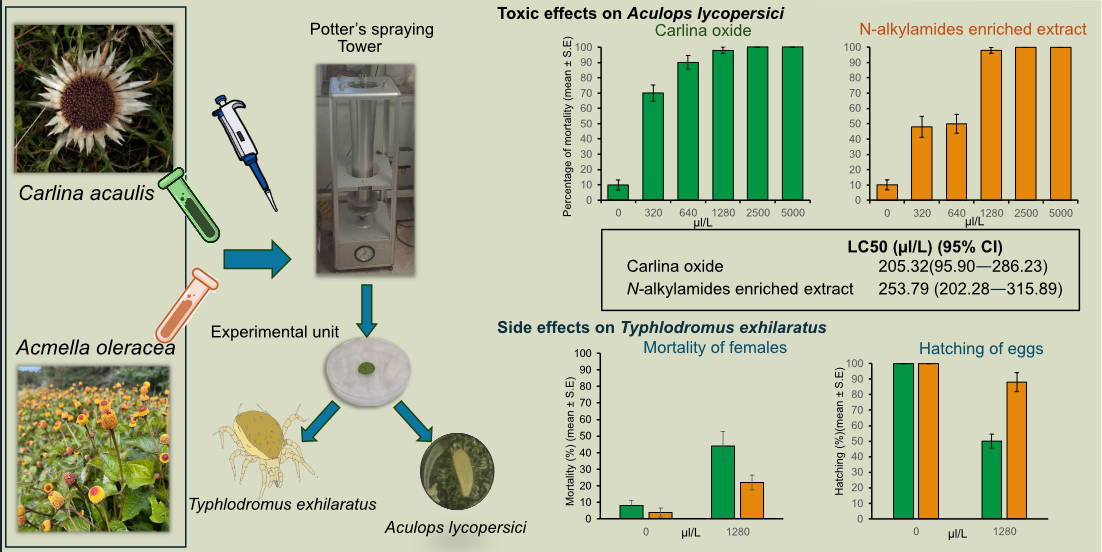
Tomato russet mite, Aculops lycopersici is considered one of the most important crop pests globally. The main control strategy is based on synthetic acaricides which, however, create resistant strains and ecological risks. In this context, biopesticides could be a viable and sustainable alternative for the eriophyid control. In the present study, the toxic effects of a N-alkylamides-enriched extract obtained from Acmella oleracea and of carlina oxide, the main bioactive component of Carlina acaulis, on A. lycopersici were evaluated, as well as their side effects on the phytoseiid Typhlodromus exhilaratus Ragusa under laboratory conditions. Six concentrations were tested for each product against A. lycopersici adults (0, 320, 640, 1280, 2500 and 5000 μL L-1), and the median concentration (1280 μL L-1) was evaluated against eggs and females of the phytoseiid T. exhilaratus. Both the N-alkylamides-enriched extract and carlina oxide showed total lethal effects (100% of mortality) towards A. lycopersici at the two highest concentrations. Moderate to high mortality was also recorded with the lower concentrations: from 42.22 to 97.78%. Probit analysis identified LC₅₀ values of 205.32 μL L-1for carlina oxide and 253.79 μL L-1 for the N-alkylamides-enriched extract, respectively. Carlina oxide showed a moderate ovicidal effect on T. exhilaratus eggs (50.00% hatching rate) on T. exhilaratus, and caused 39.13% mortality on females, whereas the N-alkylamides-enriched extract was less toxic, with a hatching rate of 88.00% and a mortality rate of 18.75% on females. In conclusion, carlina oxide and the N-alkylamides-enriched extract showed high toxicity on A. lycopersici, with a reduced effect on phytoseiid. These results highlight the potential of these products as sustainable means for the management of tomato russet mite.
Keywords:
1. Introduction
2. Materials and Methods
2.1. Extraction and Analysis of Carlina Acaulis and Acmella Oleracea Derived Products
2.2. Rearing of Aculops Lycopersici
2.3. Rearing of Typhlodromus Exhilaratus
2.4. Adult Cohort of Aculops Lycopersici
2.5. Females and Eggs Cohort of Typhlodromus Exhilaratus
2.6. Experimental Units for Aculops Lycopersici and Typhlodromus Exhilaratus
2.7. Effects of Carlina Oxide and N-Alkylamides-Enriched Extract on Aculops Lycopersici
2.8. Side Effects of Carlina Oxide and N-Alkylamides-Enriched Extract on Typhlodromus Exhilaratus
2.9. Statistical Analysis
3. Results
3.1. Analyses of Carlina Oxide and N-Alkylamides-Enriched Extract
3.2. Toxicity of Carlina Oxide and N-Alkylamides-Enriched Extract on Aculops Lycopersici
3.3. Side Effects of Carlina Oxide and N-Alkylamides-Enriched Extract on Typhlodromus Exhilaratus
4. Discussion
Author Contributions
Funding
Conflicts of Interest
References
- Duso, C.; Castagnoli, M.; Simoni, S.; Angeli, G. The Impact of Eriophyoids on Crops: Recent Issues on Aculus schlechtendali, Calepitrimerus vitis and Aculops lycopersici. Exp. Appl. Acarol. 2010, 51, 151–168. https://doi.org/10.1007/s10493-009-9300-0.
- Haque, M.M. Population Growth of Tomato Russet Mite, Aculops lycopersici (Acari: Eriophyidae) and Its Injury Effect on the Growth of Tomato Plants. J. Acarol. Soc. Jpn. 2002, 11, 1–10. https://doi.org/10.2300/acari.11.1.
- Pfaff, A.L. Aculops lycopersici Tryon (Acari: Eriophyoidea) Monitoring, Control Options and Economic Relevance in German Tomato Cultivation. Ph.D. Thesis, Georg-August Universitat Gottingen, Bad Hersfeld, Germany, (April 2023), 2024. http://dx.doi.org/10.53846/goediss-10291.
- Perring, T.M.; Farrar, C.A. Historical Perspective and Current World Status of the Tomato Russet Mite (Acari: Eriophyidae). In Historical Perspective and Current World Status of the Tomato Russet Mite (Acari: Eriophyidae); BioOne, 1986; p. 1. https://doi.org/10.4182/CCMM7124.63.1.
- Royalty, R.N.; Perring, T.M. Morphological Analysis of Damage to Tomato Leaflets by Tomato Russet Mite (Acari: Eriophyidae). J. Econ. Entomol. 1988, 81, 816–820. https://doi.org/10.1093/jee/81.3.816.
- Van Leeuwen, T.; Witters, J.; Nauen, R.; Duso, C.; Tirry, L. The Control of Eriophyoid Mites: State of the Art and Future Challenges. Exp. Appl. Acarol. 2010, 51, 205–224. https://doi.org/10.1007/s10493-009-9312-9.
- Pfaff, A.; Gabriel, D.; Böckmann, E. Observation and Restriction of Aculops lycopersici Dispersal in Tomato Layer Cultivation. J. Plant Dis. Prot. 2024, 131, 155–166. https://doi.org/10.1007/s41348-023-00817-6.
- Royalty, R.N.; Perring, T.M. Reduction in Photosynthesis of Tomato Leaflets Caused by Tomato Russet Mite (Acari: Eriophyidae). Environ. Entomol. 1989, 18, 256–260. https://doi.org/10.1093/ee/18.2.256.
- Bailey, S.; Keifer, H. The Tomato Russet Mite, Phyllocoptes destructor Keifer: Its Present Status. 1943. https://doi.org/10.1093/jee/36.5.706.
- Rice, R.E.; Strong, F.E. Bionomics of the Tomato Russet Mite, Vasates lycopersici (Massee). Ann. Entomol. Soc. Am. 1962, 55, 431–435. https://doi.org/10.1093/aesa/55.4.431.
- Vervaet, L.; De Vis, R.; De Clercq, P.; Van Leeuwen, T. Is the Emerging Mite Pest Aculops lycopersici Controllable? Global and Genome-based Insights in Its Biology and Management. Pest Manag. Sci. 2021, 77, 2635–2644. https://doi.org/10.1002/ps.6265.
- Xu, X.; Li, L.-Y.; Wang, D.-S.; Hong, X.-Y.; Wu, J.; Yuan, Y.-D.; Xie, X.-C. Effect of temperature and relative humidity on development and reproduction of the tomato russet mite, Aculops lycopersici (Massee) (Acarina, Eriophyidae). Acta Entomol. Sin. 2006, 49(5), 816–821.
- Marčić, D.; Döker, I.; Tsolakis, H. Bioacaricides in Crop Protection—What Is the State of Play? Insects 2025, 16, 95. https://doi.org/10.3390/insects16010095.
- Jacobson, M. Botanical Pesticides: Past, Present, and Future. In; ACS Publications, 1989 ISBN 1947-5918. https://doi.org/10.1021/bk-1989-0387.ch001.
- Regnault-Roger, C.; Vincent, C.; Arnason, J.T. Essential Oils in Insect Control: Low-Risk Products in a High-Stakes World. Annu. Rev. Entomol. 2012, 57, 405–424. https://doi.org/10.1146/annurev-ento-120710-100554.
- Isman, M.B.; Grieneisen, M.L. Botanical Insecticide Research: Many Publications, Limited Useful Data. Trends Plant Sci. 2014, 19, 140–145. https://doi.org/10.1016/j.tplants.2013.11.005.
- Lengai, G.M.; Muthomi, J.W.; Mbega, E.R. Phytochemical Activity and Role of Botanical Pesticides in Pest Management for Sustainable Agricultural Crop Production. Sci. Afr. 2020, 7, e00239. https://doi.org/10.1016/j.sciaf.2019.e00239.
- Kavallieratos, N.G.; Boukouvala, M.C.; Ntalaka, C.T.; Skourti, A.; Nika, E.P.; Maggi, F.; Spinozzi, E.; Mazzara, E.; Petrelli, R.; Lupidi, G. Efficacy of 12 Commercial Essential Oils as Wheat Protectants against Stored-Product Beetles, and Their Acetylcholinesterase Inhibitory Activity. Entomol. Gen. 2021, 41. https://doi.org/10.1127/entomologia/2021/1255.
- Zeni, V.; Benelli, G.; Campolo, O.; Giunti, G.; Palmeri, V.; Maggi, F.; Rizzo, R.; Lo Verde, G.; Lucchi, A.; Canale, A. Toxics or Lures? Biological and Behavioral Effects of Plant Essential Oils on Tephritidae Fruit Flies. Molecules 2021, 26, 5898. https://doi.org/10.3390/molecules26195898.
- Benelli, G.; Rizzo, R.; Zeni, V.; Govigli, A.; Samková, A.; Sinacori, M.; Verde, G.L.; Pavela, R.; Cappellacci, L.; Petrelli, R. Carlina acaulis and Trachyspermum ammi Essential Oils Formulated in Protein Baits Are Highly Toxic and Reduce Aggressiveness in the Medfly, Ceratitis capitata. Ind. Crops Prod. 2021, 161, 113191. https://doi.org/10.1016/j.indcrop.2020.113191.
- Benelli, G.; Ceccarelli, C.; Zeni, V.; Rizzo, R.; Verde, G.L.; Sinacori, M.; Boukouvala, M.C.; Kavallieratos, N.G.; Ubaldi, M.; Tomassoni, D. Lethal and Behavioural Effects of a Green Insecticide against an Invasive Polyphagous Fruit Fly Pest and Its Safety to Mammals. Chemosphere 2022, 287, 132089. https://doi.org/10.1016/j.chemosphere.2021.132089.
- Rizzo, R.; Verde, G.L.; Sinacori, M.; Maggi, F.; Cappellacci, L.; Petrelli, R.; Vittori, S.; Morshedloo, M.R.; Fofie, N.B.Y.; Benelli, G. Developing Green Insecticides to Manage Olive Fruit Flies? Ingestion Toxicity of Four Essential Oils in Protein Baits on Bactrocera oleae. Ind. Crops Prod. 2020, 143, 111884. https://doi.org/10.1016/j.indcrop.2019.111884.
- Rizzo, R.; Pistillo, M.; Germinara, G.S.; Lo Verde, G.; Sinacori, M.; Maggi, F.; Petrelli, R.; Spinozzi, E.; Cappellacci, L.; Zeni, V. Bioactivity of Carlina acaulis Essential Oil and Its Main Component towards the Olive Fruit Fly, Bactrocera oleae: Ingestion Toxicity, Electrophysiological and Behavioral Insights. Insects 2021, 12, 880. https://doi.org/10.3390/insects12100880.
- Rizzo, R.; Ragusa, E.; Benelli, G.; Lo Verde, G.; Zeni, V.; Maggi, F.; Petrelli, R.; Spinozzi, E.; Ferrati, M.; Sinacori, M.; Tsolakis, H. Lethal and Sublethal Effects of Carlina Oxide on Tetranychus urticae (Acari: Tetranychidae) and Neoseiulus californicus (Acari: Phytoseiidae). Pest Manag. Sci. 2023, 80, 967–977. https://doi.org/10.1002/ps.7827.
- Benelli, G.; Pavela, R.; Petrelli, R.; Nzekoue, F.K.; Cappellacci, L.; Lupidi, G.; Quassinti, L.; Bramucci, M.; Sut, S.; Dall’Acqua, S. Carlina Oxide from Carlina acaulis Root Essential Oil Acts as a Potent Mosquito Larvicide. Ind. Crops Prod. 2019, 137, 356–366. https://doi.org/10.1016/j.indcrop.2019.05.037.
- Spinozzi, E.; Ferrati, M.; Baldassarri, C.; Cappellacci, L.; Marmugi, M.; Caselli, A.; Benelli, G.; Maggi, F.; Petrelli, R. A Review of the Chemistry and Biological Activities of Acmella oleracea (“Jambù”, Asteraceae), with a View to the Development of Bioinsecticides and Acaricides. Plants 2022, 11, 2721. https://doi.org/10.3390/plants11202721.
- Kavallieratos, N.G.; Spinozzi, E.; Filintas, C.S.; Nika, E.P.; Skourti, A.; Panariti, A.M.E.; Ferrati, M.; Petrelli, R.; Ricciutelli, M.; Angeloni, S. Acmella oleracea Extracts as Green Pesticides against Eight Arthropods Attacking Stored Products. Environ. Sci. Pollut. Res. 2023, 30, 94904–94927. https://doi.org/10.1007/s11356-023-28577-8.
- Ferrati, M.; Spinozzi, E.; Baldassarri, C.; Rossi, P.; Favia, G.; Fiorini, D.; De Zordi, N.; Drenaggi, E.; De Fazi, L.; Benelli, G. Green Purification of Acmella oleracea Extract by Wiped-Film Short Path Molecular Distillation Boosts the Insecticidal Activity on Mosquito Larvae. Ind. Crops Prod. 2024, 218, 118818. https://doi.org/10.1016/j.indcrop.2024.118818.
- Giordano, T.; Cerasa, G.; Marotta, I.; Conte, M.; Orlando, S.; Salamone, A.; Mammano, M.M.; Greco, C.; Tsolakis, H. Toxicity of Essential Oils of Origanum vulgare, Salvia rosmarinus, and Salvia officinalis Against Aculops lycopersici. Plants 2025, 14, 1462. https://doi.org/10.3390/plants14101462.
- Tixier, M.-S.; Dennj, P.; Douin, M.; Kreiter, S.; Haralabos, T. Mites of the Genus Typhlodromus (Acari: Phytoseiidae) from Southern France: Combined Morphological and Molecular Approaches for Species Identification. Zootaxa 2019, 4604, zootaxa-4604. https://doi.org/10.11646/zootaxa.4604.2.2.
- Tsolakis, H.; Sinacori, M.; Ragusa, E.; Lombardo, A. Biological Parameters of Neoseiulus longilaterus (Athias-Henriot)(Parasitiformes, Phytoseiidae) Fed on Prey and Pollen in Laboratory Conditions. Syst. Appl. Acarol. 2019, 24, 1757–1768. https://doi.org/10.11158/saa.24.9.12.
- Hardman, J.M.; Franklin, J.L.; Moreau, D.L.; Bostanian, N.J. An Index for Selective Toxicity of Miticides to Phytophagous Mites and Their Predators Based on Orchard Trials. Pest Manag. Sci. Former. Pestic. Sci. 2003, 59, 1321–1332. https://doi.org/10.1002/ps.769.
- Abbott, W.S. Method of computing the effectiveness of an insecticide. J. Econ. Entomol. 1925, 18, 265–267.
- Sterk, G.; Hassan, S.A.; Baillod, M.; Bakker, F.; Bigler, F.; Blümel, S.; Bogenschütz, H.; Boller, E.; Bromand, B.; Brun, J. Results of the Seventh Joint Pesticide Testing Programme Carried out by the IOBC/WPRS-Working Group ‘Pesticides and Beneficial Organisms.’ BioControl 1999, 44, 99–117. https://doi.org/10.1023/A:1009959009802.
- Patnaik, S.; Rout, K.; Pal, S.; Panda, P.K.; Mukherjee, P.S.; Sahoo, S. Essential Oils of Aromatic and Medicinal Plants as Botanical Biocide for Management of Coconut Eriophyid Mite (Aceria guerreronis Keifer). Psyche J. Entomol. 2011, 2011, 710929. https://doi.org/10.1155/2011/710929.
- Mossa, A.-T.H.; Afia, S.I.; Mohafrash, S.M.; Abou-Awad, B.A. Formulation and Characterization of Garlic (Allium sativum L.) Essential Oil Nanoemulsion and Its Acaricidal Activity on Eriophyid Olive Mites (Acari: Eriophyidae). Environ. Sci. Pollut. Res. 2018, 25, 10526–10537. https://doi.org/10.1007/s11356-017-0752-1.
- Brito, D.R.; Pinto-Zevallos, D.M.; de Sena Filho, J.G.; Coelho, C.R.; Nogueira, P.C.; de Carvalho, H.W.; Teodoro, A.V. Bioactivity of the Essential Oil from Sweet Orange Leaves against the Coconut Mite Aceria guerreronis (Acari: Eriophyidae) and Selectivity to a Generalist Predator. Crop Prot. 2021, 148, 105737. https://doi.org/10.1016/j.cropro.2021.105737.
- Kunnathattil, M.; Narayanankutty, A.; Visakh, N.U.; Pathrose, B.; Punathil, T.; Kaimal, S.G. Phytochemical Characterization, Fumigant and Contact Toxicity Activities of Four Essential Oils Against Eriophyid Gall Mite, Aceria pongamiae Keifer (Acarina: Eriophyidae). Chem. Biodivers. 2024, 21, e202401535. https://doi.org/10.1002/cbdv.202401535.
- El-Sharabasy, H.M. Acaricidal Activities of Artemisia judaica L. Extracts against Tetranychus urticae Koch and Its Predator Phytoseiulus persimilis Athias Henriot (Tetranychidae: Phytoseiidae). J. Biopestic. 2010, 3, 514. http://dx.doi.org/10.57182/jbiopestic.3.2.514-519.
- Benelli, G.; Pavela, R.; Canale, A.; Mehlhorn, H. Tick Repellents and Acaricides of Botanical Origin: A Green Roadmap to Control Tick-Borne Diseases? Parasitol. Res. 2016, 115, 2545–2560. https://doi.org/10.1007/s00436-016-5095-1.
- Ismail, M.S.M.; Tag, H.M.; Rizk, M.A. Acaricidal, Ovicidal, and Repellent Effects of Tagetes Patula Leaf Extract against Tetranychus urticae Koch (Acari: Tetranychidae). J. Plant Prot. Res. 2019, 59. http://dx.doi.org/10.24425/jppr.2019.129285.
- Tong, F.; Gross, A.D.; Dolan, M.C.; Coats, J.R. The Phenolic Monoterpenoid Carvacrol Inhibits the Binding of Nicotine to the Housefly Nicotinic Acetylcholine Receptor. Pest Manag. Sci. 2012, 69, 775–780. https://doi.org/10.1002/ps.3443.
- Pavela, R.; Maggi, F.; Petrelli, R.; Cappellacci, L.; Buccioni, M.; Palmieri, A.; Canale, A.; Benelli, G. Outstanding Insecticidal Activity and Sublethal Effects of Carlina acaulis Root Essential Oil on the Housefly, Musca domestica, with Insights on Its Toxicity on Human Cells. Food Chem. Toxicol. 2019, 136, 111037. https://doi.org/10.1016/j.fct.2019.111037.
- Kavallieratos, N.G.; Nika, E.P.; Skourti, A.; Spinozzi, E.; Ferrati, M.; Petrelli, R.; Maggi, F.; Benelli, G. Carlina Acaulis Essential Oil: A Candidate Product for Agrochemical Industry Due to Its Pesticidal Capacity. Ind. Crops Prod. 2022, 188, 115572. https://doi.org/10.1016/j.indcrop.2022.115572.
- Spinozzi, E.; Ferrati, M.; Cappellacci, L.; Caselli, A.; Perinelli, D.R.; Bonacucina, G.; Maggi, F.; Strzemski, M.; Petrelli, R.; Pavela, R. Carlina acaulis L. (Asteraceae): Biology, Phytochemistry, and Application as a Promising Source of Effective Green Insecticides and Acaricides. Ind. Crops Prod. 2023, 192, 116076. https://doi.org/10.1016/j.indcrop.2022.116076.
- Spinozzi, E.; Ferrati, M.; Baldassarri, C.; Maggi, F.; Pavela, R.; Benelli, G.; Aguzzi, C.; Zeppa, L.; Cappellacci, L.; Palmieri, A. Synthesis of Carlina Oxide Analogues and Evaluation of Their Insecticidal Efficacy and Cytotoxicity. J. Nat. Prod. 2023, 86, 1307–1316. https://doi.org/10.1021/acs.jnatprod.3c00137.
- Negri, R. Polyacetylenes from Terrestrial Plants and Fungi: Recent Phytochemical and Biological Advances. Fitoterapia 2015, 106, 92–109. https://doi.org/10.1016/j.fitote.2015.08.011.
- Kadir, H.A.; Zakaria, M.B.; Kechil, A.A.; Azirun, M.D. Toxicity and Electrophysiological Effects of Spilanthes Amella Murr. Extracts on Periplaneta americana L. Pestic. Sci. 1989, 25, 329–335. https://doi.org/10.1002/ps.2780250402.
- Moreno, S.C.; Carvalho, G.A.; Picanço, M.C.; Morais, E.G.; Pereira, R.M. Bioactivity of Compounds from Acmella oleracea against Tuta absoluta (Meyrick)(Lepidoptera: Gelechiidae) and Selectivity to Two Non-target Species. Pest Manag. Sci. 2012, 68, 386–393. https://doi.org/10.1002/ps.2274.
- Gouvêa, S.M.; Carvalho, G.A.; Fidelis, E.G.; Ribeiro, A.V.; Farias, E.S.; Picanco, M.C. Effects of Paracress (Acmella oleracea) Extracts on the Aphids Myzus persicae and Lipaphis erysimi and Two Natural Enemies. Ind. Crops Prod. 2019, 128, 399–404. https://doi.org/10.1016/j.indcrop.2018.11.040.
- Marchesini, P.; Barbosa, A.F.; Sanches, M.N.G.; do Nascimento, R.M.; Vale, F.L.; Fabri, R.L.; Maturano, R.; de Carvalho, M.G.; Monteiro, C. Acaricidal Activity of Acmella oleracea (Asteraceae) Extract against Rhipicephalus microplus: What Is the Influence of Spilanthol? Vet. Parasitol. 2020, 283, 109170. https://doi.org/10.1016/j.vetpar.2020.109170.
- Alhewairini, S. Toxicity Evaluation of Oxamyl against Tomato Russet Mite, Aculops lycopersici (Massee)(Acari: Eriophyidae) and Two Spotted Spider Mite, Tetranychus urticae Koch (Acari: Tetranychidae) under Greenhouse Conditions. Braz. J. Biol. 2022, 84, e253469. https://doi.org/10.1590/1519-6984.253469.
- Novák, M.; Pavela, R.; Spinozzi, E.; Ferrati, M.; Petrelli, R.; Maggi, F.; Ricciardi, R.; Benelli, G. Lethal and Sublethal Effects of Carlina Oxide on the Aphid Metopolophium dirhodum and Its Non-Target Impact on Two Biological Control Agents. J. Pest Sci. 2024, 97, 2131–2138. https://doi.org/10.1007/s10340-024-01768-z.
- Tortorici, S.; Bedini, S.; Casadei, A.; Pistillo, M.O.; Lapenda, F.; D’Isita, I.; Petrelli, R.; Bonacucina, G.; Perinelli, D.R.; Ferrati, M. Targeting Xylella Fastidiosa: Sustainable Management of Philaenus spumarius Using Carlina Oxide. Ind. Crops Prod. 2024, 222, 119923. https://doi.org/10.1016/j.indcrop.2024.119923.
- Duso, C.; Van Leeuwen, T.; Pozzebon, A. Improving the Compatibility of Pesticides and Predatory Mites: Recent Findings on Physiological and Ecological Selectivity. Curr. Opin. Insect Sci. 2020, 39, 63–68. https://doi.org/10.1016/j.cois.2020.03.005.

| N-alkylamides | Concentration (g/100 g) ± SDa |
| (2Z)-N-isobutyl-2-nonene-6,8-diynamide | 0.6 ± 0.0 |
| (2E)-N-isobutyl-2-undecene-8,10-diynamide | 0.3 ± 0.0 |
| (2E,6Z,8E)-N-isobutyl-2,6,8-decatrienamide (spilanthol) | 44.6 ± 0.2 |
| (2E,7Z)-N-isobutyl-2,7-decadienamide | 0.4 ± 0.0 |
| (2E)-N-(2-metilbutyl)-2-undecene-8,10-diynamide | |
| (2E,6Z,8E)-N-(2-metilbutyl)-2,6,8-decatrienamide | 2.7 ± 0.0 |
| Total N-alkylamides | 48.6 ± 0.2 |
| Compound/extract | Concentration |
Mortality (%) (mean ± S.E.) |
Survival time days | Overall mortality | Adjusted mortality (Abbott) | Toxicity class* | |||
| (µL L-1) | Day 1 | Day 2 | Day 3 | Day 4 | (mean ± SE) | (% ± SE) | (%) | (-) | |
| Carlina oxide | 5000 | 100.0 ± 0.00 a | - | - | - | 0.00 ± 0.00 a | 100.00 ± 0.00 a | 100.00 | 4 |
| 2500 | 100.0 ± 0.00 a | - | - | - | 0.00 ± 0.00 a | 100.00 ± 0.00 a | 100.00 | 4 | |
| 1280 | 88.00 ± 4.42 ab | 8.00 ± 3.27 f | 2.00 ± 2.00 f | 0.00 ± 0.00 f | 0.20 ± 0.095 ab | 98.00 ± 2.00 a | 97.78 | 4 | |
| 640 | 66.00 ± 8.97 cd | 10.00 ± 4.47 f | 14.00 ± 4.27 f | 0.00 ± 0.00 f | 0.78 ± 0.184 b | 90.00 ± 4.47 a | 88.89 | 4 | |
| 320 | 44.00 ± 8.33 de | 14.00 ± 6.70 f | 4.00 ± 2.67 f | 8.00 ± 3.27 f | 1.66 ± 0.250 c | 70.00 ± 5.37 b | 66.67 | 3 | |
| 0 | 0.00 ± 0.00 f | 6.00 ± 3.06 f | 4.00 ± 2.67 f | 0.00 ± 0.00 f | 3.74 ± 0.114 e | 10.00 ± 3.33 c | 0.00 | - | |
| N-alkylamides-enriched extract | 5000 | 94.00 ± 3.06 ab | 4.00 ± 2.67 f | 2.00 ± 2.00 f | - | 0.08 ± 0.048 a | 100.00 ± 0.00 a | 100.00 | 4 |
| 2500 | 92.00 ± 4.42 ab | 6.00 ± 4.27 f | 2.00 ± 2.00 f | - | 0.10 ± 0.051 a | 100.00 ± 0.00 a | 100.00 | 4 | |
| 1280 | 78.00 ± 7.57 bc | 12.00 ± 3.27 f | 6.00 ± 6.00 f | 2.00 ± 2.00 f | 0.38 ± 0.121 ab | 98.00 ± 2.00 a | 97.78 | 4 | |
| 640 | 22.00 ± 9.64 ef | 10.00 ± 6.15 f | 10.00 ± 6.15 f | 8.00 ± 4.42 f | 2.54 ± 0.238 d | 50.00 ± 6.15 b | 44.44 | 2 | |
| 320 | 18.00 ± 8.14 ef | 10.00 ± 8.03 f | 10.00 ± 4.47 f | 10.00 ± 5.37 f | 2.68 ± 0.228 d | 48.00 ± 6.80 b | 42.22 | 2 | |
| 0 | 4.00 ± 2.67 f | 6.00 ± 3.06 f | 0.00 ± 0.00 f | 0.00 ± 0.00 f | 3.66 ± 0.147 e | 10.00 ± 3.33 c | 0.00 | - | |
| Plant extract |
LC10 µL L-1 (95% CI) |
LC30 µL L-1 (95% CI) |
LC50 µL L-1 (95% CI) |
LC90 µL L-1 (95% CI) |
LC95 µL L-1 (95% CI) |
Intercept ± SE | Slope ± SE | Goodness of fit χ2 (d.f.) |
| Carlina oxide | 67.40 (13.22-127.83) |
130.16 (42.92-204.40) |
205.32 (95.90-286.23) |
625.48 (494.02-902.00) |
857.76 (653.49-1502.62) |
-6.12 ± 1.63 | 2.64 ± 0.60 | 0.14 (3) p=0.98 |
| N-alkylamides-enriched extract | 39.00 (24.22-55.68) |
117.93 (87.44-150.71) |
253.79 (202.28-315.89) |
1651.58 (1192.94-2537.64) |
2808.66 (1905.1-4743.84) |
-3.78 ± 0.34 | 1.57 ± 0.13 | 32.53 (6) p=0.000 |
| Concentration |
Hatching/day (%) mean ± SE |
Overall hatching |
|||
| Extract | (µL L-1) | Day 1 | Day 2 | Day 3 | (% ± SE) |
| Carlina oxide | 1280 | 44.00 ± 4.99 ab | 4.00 ± 2.67 a | 2.00 ± 2.00 a | 50.00 ± 4.47 a |
| 0 | 40.00 ± 9.89 b | 38.00 ± 9.17 b | 22.00 ± 3.59 b | 100.00 ± 0.00 b | |
| N-alkylamides-enriched extract | 1280 | 22.00 ± 7.57 b | 28.00 ± 8.00 b | 38.00 ± 8.14 b | 88.00 ± 6.11 c |
| 0 | 68.00 ± 7.42 a | 32.00 ± 7.42 b | 0.00 a | 100.00 ± 0.00 b | |
| Extract | Concentration |
Mortality/day (%, mean ± SE) |
Overall Mortality | Survival time days |
Fecundity Eggs/female/day |
Adjusted mortality Abbott | Toxicity class* | |||
| (µL L-1) | Day 1 | Day 2 | Day 3 | Day 4 | (% ± SE) | (mean ± SE) | (mean ± SE) | (%) | (-) | |
| Carlina oxide | 1280 | 28.00 ± 8.00 a | 8.00 ± 3.27 b | 2.00 ± 2.00 b | 6.00 ± 4.27 b | 44.00 ± 8.84 a | 2.54 ± 0.256 a | 0.11 ± 0.031 a | 39.13 | 2 |
| 0 | 2.00 ± 2.00 b | 4.00 ± 2.67 b | 2.00 ± 2.00 b | 0.00 ± 0.00 b | 8.00 ± 3.27 b | 3.76 ± 0.120 b | 0.48 ± 0.039 b | 0.00 | - | |
| N-alkylamides-enriched extract | 1280 | 12.00 ± 5.33 a | 10.00 ± 4.47 b | 0.00 ± 0.00 b | 0.00 ± 0.00 b | 22.00 ± 4.67 c | 3.22 ± 0.212 b | 0.59 ± 0.053 b | 18.75 | 1 |
| 0 | 2.00 ± 2.00 b | 2.00 ± 2.00 b | 0.00 ± 0.00 b | 0.00 ± 0.00 b | 4.00 ± 2.67 b | 3.86 ± 0.099 b | 0.58 ± 0.030 b | 0.00 | - | |
Disclaimer/Publisher’s Note: The statements, opinions and data contained in all publications are solely those of the individual author(s) and contributor(s) and not of MDPI and/or the editor(s). MDPI and/or the editor(s) disclaim responsibility for any injury to people or property resulting from any ideas, methods, instructions or products referred to in the content. |
© 2025 by the authors. Licensee MDPI, Basel, Switzerland. This article is an open access article distributed under the terms and conditions of the Creative Commons Attribution (CC BY) license (http://creativecommons.org/licenses/by/4.0/).


