
Submitted:
28 August 2025
Posted:
28 August 2025
You are already at the latest version
Abstract
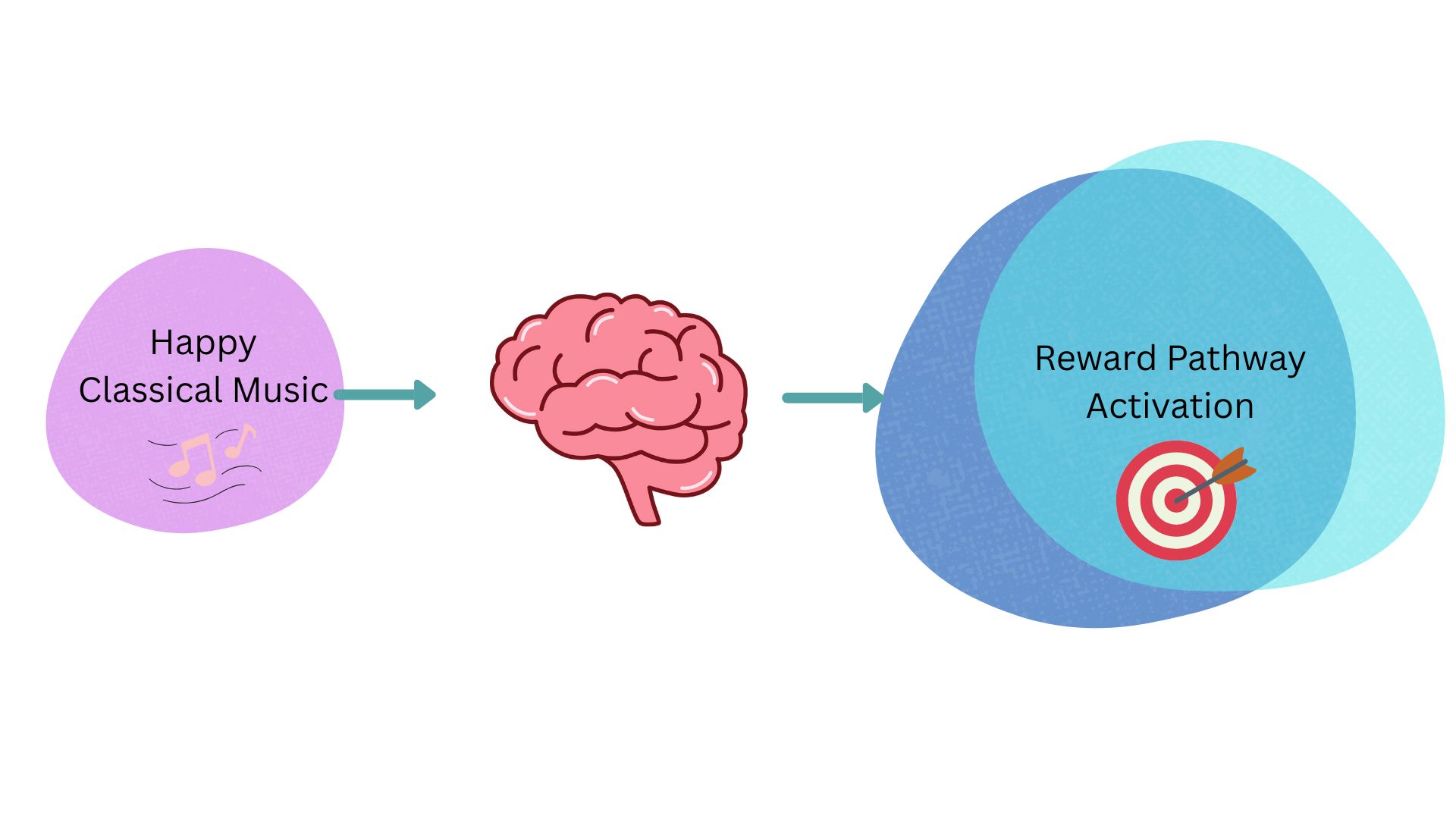
While studies on the effects of harmonic classical music have been conducted, more research on human health is needed to help develop classical music as a therapeutic tool in healthcare. This review focuses on explorations of how classical music of different emotional tones, including sad, happy, and fearful music, affects the human neuron reward pathways. It examines evidence that happy classical music activates the ventral and dorsal striatum, which are crucial regions for reward processing, motivation, movement, and other functions, thereby supporting dopamine release. This review also proposes future research directions, including better control of certain musical variables and addressing individual differences, to push further discoveries and our understanding of classical music’s impact on health.
Keywords:
Neuroscience
; music
; brain
; brain circuitry
; happy classical music
; dopamine release
; reward pathway
; ventral striatum
; dorsal striatum
; ventral tegmental area
; nucleus accumbens
; prefrontal cortex
; emotional arousal
; brain activation
; music therapy
; mental health
; mood regulation
; therapeutic intervention
; emotional wellbeing
; stress reduction
; mesolimbic system
; neurotransmitters
; fMRI studies
; neural circuitry
; autonomic nervous system
; caudate nucleus
; pleasure response
; music-induced activation
; music and emotion
; positive affect
; movement motivation
; anticipatory reward
; auditory stimuli
; neuroaesthetics
; physiological response
; motivational behavior
Introduction
Music has been recognized to have a significant influence on human emotion and physiology, yet the mechanisms of these effects remain only partially understood (Koelsch, 2014; Juslin & Västfjäll, 2008). Across cultures, music serves as both a form of artistic expression and a means of eliciting emotional and bodily responses, from subtle mood changes to measurable alterations in heart rate, respiration, and neural activity (Egermann et al., 2015; Balkwill & Thompson, 1999). These effects extend beyond emotional modulation, with evidence linking music to measurable changes in neurochemical release, immune function, and cognitive performance (Chanda & Levitin, 2013; Rauscher et al., 1993). Understanding how these responses arise is critical for possibly integrating music into healthcare.
Among the many emotional tones conveyed by music, “happy” classical music, typically characterized by major key tonalities, consonant harmonies, and lively rhythms, has been shown to evoke joy and positive arousal through increased activity in the brain’s reward pathways, particularly the ventral striatum and dopaminergic midbrain regions (Salimpoor et al., 2011; Ferreri et al., 2019). These features often elicit anticipatory pleasure and enhance motivation to continue listening, consistent with reward-prediction error models (Zatorre & Salimpoor, 2013). Works such as Beethoven’s Fidelio Overture, Stravinsky’s Trois Mouvements de Petrushka (piano transcription), and the final movement of Brahms’s Piano Concerto No. 2 exemplify this style through their fast tempos, major keys, and buoyant phrasing patterns.
By contrast, “sad” classical music, often employing minor key tonalities, slower tempos, and expressive dissonances, tends to evoke feelings of melancholy, nostalgia, or introspection. Neuroimaging evidence indicates that such music can preferentially activate regions linked to autobiographical memory and emotional processing, including the hippocampus, ventromedial prefrontal cortex, and anterior cingulate cortex (Mitterschiffthaler et al., 2007; Vuust & Kringelbach, 2010). It has also been associated with parasympathetic modulation, producing a reflective or calming physiological state (Koelsch et al., 2007). Examples include Chopin’s Prelude No. 20 in C Minor, Nocturne Op. 48 No. 2, and Étude Op. 10 No. 6 — works that, in part, reflect the composer’s struggles with illness, financial hardship, and romantic disappointment.
“Fearful” classical music is frequently made of dissonant harmonies, irregular rhythms, and abrupt dynamic contrasts to create tension and heightened vigilance. This style often engages the amygdala, anterior insula, and broader salience networks, eliciting autonomic responses associated with threat detection (Blood et al., 1999; Koelsch et al., 2008). Sympathetic activation, including increased heart rate and skin conductance, has been documented in response to such musical cues (Gomez & Danuser, 2004). Representative examples include Ravel’s Scarbo from Gaspard de la Nuit, Stravinsky’s “Infernal Dance” from The Firebird Suite, and the first movement of Prokofiev’s Piano Sonata No. 7.
Across emotional categories, music can modulate somatic responses such as respiration rate, heart rate, and skin conductance (Baumgartner et al., 2006). While happy music often coincides with increased cardiovascular activity and heightened arousal, sad music has been associated with reduced respiration rates and parasympathetic activation (Mitterschiffthaler et al., 2007). Fearful music, by contrast, is more likely to produce sympathetic activation, including elevated heart rate and heightened skin conductance (Gomez & Danuser, 2004), consistent with its recruitment of amygdala-driven threat detection networks.
Previous studies, including the widely cited “Mozart Effect,” have shown that exposure to certain types of classical music can enhance cognitive performance and promote positive affect (Rauscher et al., 1993). However, the specific neural pathways underlying these benefits, particularly the brain’s reward circuitry, are still being mapped. Happy classical music is adept at activating regions such as the ventral and dorsal striatum, structures associated with reward processing, motivation, and movement, and at facilitating dopamine release (Salimpoor et al., 2011; Menon & Levitin, 2005). Such findings point toward a potential neurochemical basis for its pleasurable and energizing effects.
Given these observations, this review examines the current evidence on how classical music of varying emotional tones, with a focus on happy music, engages the brain’s reward pathways and influences physiological responses. By gathering findings from neuroimaging, psychophysiology, and behavioral research, it aims to clarify the mechanisms linking music, emotion, and neural reward systems, and to highlight methodological considerations and future research directions relevant to clinical applications.
Methods
This review gathers findings from peer-reviewed studies examining how classical music of varying emotional tones influences neural reward pathways and physiological responses. Literature was identified using databases such as PubMed, Scopus, and Web of Science, with inclusion criteria focusing on studies employing neuroimaging, physiological measurement, or validated self-report tools.
The Neural Basis of the Reward Pathway
A reward pathway is a network of brain regions that is correlated to pleasurable stimuli and releases dopamine, a neurotransmitter associated with reward and motivation (Koelsch, 2014; Menon & Levitin, 2005). The core of this system includes the ventral tegmental area (VTA), nucleus accumbens, and prefrontal cortex, which work together to process rewarding experiences such as food, social interaction, and music (Salimpoor et al., 2011; Blood & Zatorre, 1999). When one listens to enjoyable music, like happy classical music, these regions activate. Dopamine is released from the VTA and travels to the nucleus accumbens, producing feelings of pleasure and anticipation (Salimpoor et al., 2011; Menon & Levitin, 2005). Then, the prefrontal cortex helps interpret and assign value to the experience (Koelsch, 2005; Brattico & Pearce, 2013). This neural activity can trigger physiological responses, including increased heart rate, chills, and even tears (Blood & Zatorre, 1999; Riby, 2023). Studies have shown that music can engage the same circuits typically reserved for more biologically significant stimuli such as reproduction or food, highlighting its powerful effect on the human brain (Menon & Levitin, 2005; Koelsch, 2014).
Music-Induced Activation of the Reward System
Studies indicate an activation in the ventral and dorsal striatum during happy music (Mitterschiffthaler et al., 2007; Salimpoor et al., 2011; Ferreri et al., 2019). The ventral striatum is a collection of brain areas in the brain’s center, just above and behind the ears. It includes the nucleus accumbens (closely related to the dopamine system), mediating pleasure and reward-related learning (Koelsch, 2014; Blood & Zatorre, 1999). On the other hand, the dorsal striatum is more associated with habit formation, action selection, and reward-driven behaviors (Menon & Levitin, 2005; Vuust et al., 2022).
Reward pathways (for example, the mesolimbic dopamine system) are networks of interconnected brain regions that underlie these pleasure-driven responses and also reinforce positive behaviors (Juslin & Västfjäll, 2008; Koelsch, 2014; Ferreri et al., 2019). Reports have shown that statistically significant effects of happy classical music were centered in the dorsal striatum’s caudate and the striatum’s ventral region (Mitterschiffthaler et al., 2007; Salimpoor et al., 2011; Vuust et al., 2022). Those activations can reveal the ability of happy classical music to elicit movement or motivate approach behaviors — the tendencies to move toward a positive stimulus (Zaatar, 2023; Koelsch, 2014). These findings offer direct neurochemical evidence linking music to the reward circuitry of the brain (Salimpoor et al., 2011; Blood & Zatorre, 1999; Ferreri et al., 2019).
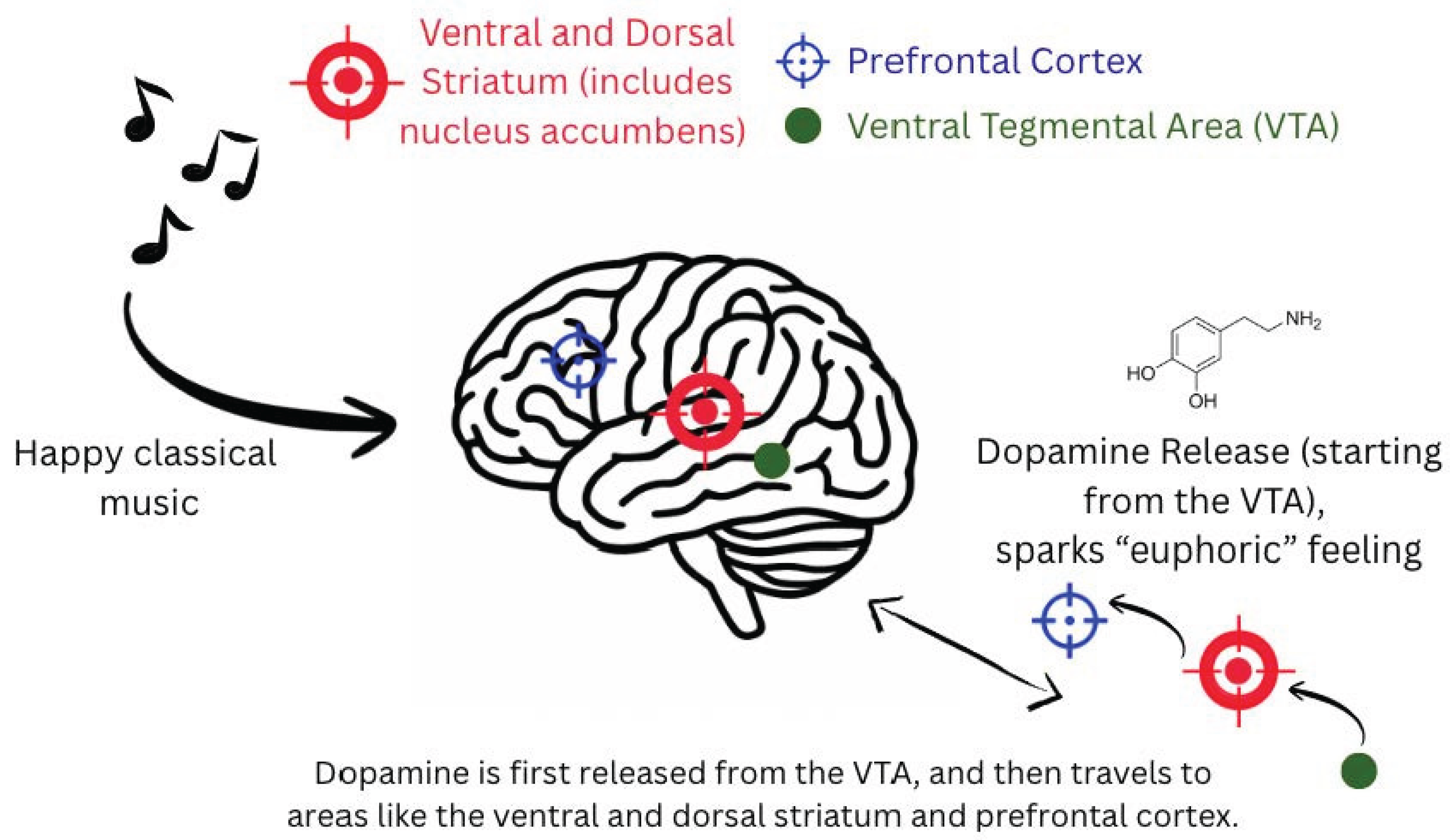
To illustrate the neural pathway by which music engages the brain’s reward system, Figure 1 presents a simplified side-view diagram of the brain. When pleasurable music is perceived, auditory signals ultimately influence the ventral tegmental area (VTA), a midbrain structure that serves as the origin of dopamine release (Menon & Levitin, 2005; Koelsch, 2005).
This supports the idea that happy classical music, by stimulating these regions, reinforces reward-driven behaviors and certain physical responses. The connection between happy music and reward in the brain is also reinforced by evidence regarding dopamine release in the ventral striatum (Salimpoor et al., 2011; Blood & Zatorre, 1999). The release of dopamine provides the basis for pleasurable emotions and a sense of reward from happy music, linking the experience of pleasure to the ventral and dorsal striatal activation (Vuust et al., 2022; Menon & Levitin, 2005). These discoveries regarding activations in the brain reward pathways reveal that happy classical music promotes both pleasure and motivation to move.
Happy classical music is also linked to pleasure-related reactions because it activates important areas of the anterior cingulate cortex (ACC). With functional MRI, Mitterschiffthaler et al. (2007) observed significant activation in the rostral pregenual and dorsal ACC when subjects listened to happy music. It has also been observed that happy music resulted in significant activation in the rostral pregenual and dorsal ACC, which regulates autonomic arousal, error monitoring, and conflict processing (Brattico & Pearce, 2013; Koelsch, 2014). The dorsal ACC is involved in goal-directed behavior and conflict monitoring, while the rostral pregenual ACC is involved in autonomic arousal and emotional regulation (Mitterschiffthaler et al., 2007; Huron, 2006). These regions integrate emotional and cognitive aspects of reward processing, highlighting how happy music can influence both emotional responses and physiological arousal (Vuust et al., 2022; Juslin & Västfjäll, 2008). This activation supports the pleasurable experience associated with happy classical music by engaging multiple aspects of the nervous system linked to reward and positive emotions.
Physiological Comparisons Across Emotional Tones
Research indicates that happy classical music triggers different physiological and neural responses than sad and fearful classical music. Baumgartner et al. (2006) found that happy and fearful classical music statistically increases respiration rates, while sad music does not. The evidence magnifies the effects of happy and fearful classical music on the body’s respiratory system in ways that sad music does not (Hunter et al., 2010; Fuentes-Sánchez et al., 2021). Interestingly, other physiological differences arise in happy and sad music. Mitterschiffthaler et al. (2007) demonstrated that while happy classical music activates the ventral and dorsal striatum, sad music activates the amygdala and hippocampus — regions involved in processing threats and memories (Koelsch, 2005; Juslin & Sloboda, 2010). These results imply that happy music reflects high emotional arousal in the reward-related brain regions, as well as showing the contrast between the effects of happy and sad music (Blood & Zatorre, 1999; Menon & Levitin, 2005).
Methodological Approaches
Each study design has unique advantages, highlighting the multifaceted nature of music and emotion research. Fuentes-Sánchez et al. (2021) integrate subjective self-reports, facial expression analysis, and physiological recordings to capture temporal emotional reactions in detail, while Vuust et al. (2022) employ the predictive coding of music model to demonstrate how the brain continually anticipates and updates its expectations based on certain musical features. Mitterschiffthaler et al. (2007) harness functional MRI to distinguish the neural correlates of happy versus sad affective states, illustrating how specific classical pieces can shape distinct emotional outcomes. Likewise, Baumgartner et al. (2006) use EEG to compare how pictures and classical music evoke different stages of emotion perception and experience, offering insight into the unfolding of affective responses over time. Finally, Blood and Zatorre (1999) connect intensely pleasurable “chills” with increased activity in dopamine-rich reward circuits, underscoring the powerful influence of music on core affective systems in the brain.
Limitations and Future Directions
While the understanding of how happy classical music triggers pleasure-related reactions in one’s nervous system has certainly advanced, several restrictions must be pointed out. One important restriction is the feasibility of specific tempo, pitch, and timbre variations (Tervaniemi, 2023; Agres et al., 2023). For example, faster tempi in some happy pieces might have caused high levels of arousal regardless of any other possible factors (Hunter et al., 2010). This can be resolved by choosing pieces with varied musical characteristics or using computer programs to create music that would not entail so many variations (Agres et al., 2023). In addition, some researchers believe that gender, personality traits, and age can affect study results (Mitterschiffthaler et al., 2007; Juslin & Västfjäll, 2008). To yield accurate results, it would be helpful to use different groups of participants with uniform music examples to investigate how these factors affect the brain and the emotions among different subjects (Egermann et al., 2015; Balkwill & Thompson, 1999). Including these variables would make an inclusive viewpoint and make the findings more comprehensive.
Conclusion
Happy classical music distinctly impacts the nervous system, eliciting pleasurable responses including dopamine release, striatal activation, and changes in autonomic arousal (Salimpoor et al., 2011; Menon & Levitin, 2005; Ferreri et al., 2019). Studies consistently confirm that exposure to happy classical music activates the ventral and dorsal striatum, leading to dopamine release that underlies pleasure and reward-related behaviors (Mitterschiffthaler et al., 2007; Blood & Zatorre, 1999). These reactions often differ from those triggered by sad or fearful music, demonstrating the unique power of happy music in enhancing emotional well-being (Baumgartner et al., 2006; Hunter et al., 2010). In contrast, sad music engages regions like the amygdala and hippocampus, eliciting different autonomic responses and underscoring happy music’s unique role in stimulating positive emotion and motivation (Koelsch, 2005; Juslin & Sloboda, 2010). To deepen our understanding of this effect, future research should control for musical variables, such as tempo and pitch, and systematically examine individual differences, such as age and personality, thereby clarifying how happy music triggers these robust pleasure-related neural and physiological responses (Vuust et al., 2022; Tervaniemi, 2023). These insights could help develop the future application of happy music in therapy (Särkämö & Soto, 2012).
References
- Agres, K. R., Dash, A., & Chua, P. (2023). AffectMachine-Classical: A novel system for generating affective classical music. Frontiers in Psychology, 14, 986532. [CrossRef]
- Altenmüller, E., & Schlaug, G. (2015). Apollo’s gift: New aspects of neurologic music therapy. Progress in Brain Research, 217, 237–252. [CrossRef]
- Balkwill, L., & Thompson, W. F. (1999). A cross-cultural investigation of the perception of emotion in music: Psychophysical and cultural cues. Music Perception, 17(1), 43–64.
- Baumgartner, T., Esslen, M., & Jäncke, L. (2006). From emotion perception to emotion experience: Emotions evoked by pictures and classical music. International Journal of Psychophysiology, 60(1), 34–43. [CrossRef]
- Beier, E., Janata, J., & Hulbert, H. (2020). Musical chills across cultures: A cross-cultural study of strong emotional experiences. Music Perception, 38(3), 283–302. [CrossRef]
- Blood, A. J., & Zatorre, R. J. (1999). Emotional responses to pleasant and unpleasant music correlate with activity in paralimbic brain regions. Nature Neuroscience, 2(4), 382–387. [CrossRef]
- Brattico, E., & Pearce, M. (2013). The neuroaesthetics of music. Psychology of Aesthetics, Creativity, and the Arts, 7(1), 48–61. [CrossRef]
- Chanda, M. L., & Levitin, D. J. (2013). The neurochemistry of music. Trends in Cognitive Sciences, 17(4), 179–193. [CrossRef]
- Demorest, S. M., Morrison, S. J., Beken, M. N., & Jungbluth, D. (2008). Lost in translation: An enculturation effect in music memory performance. Music Perception, 25(3), 213–223.
- Egermann, H., Fernando, N., Chuen, L., & McAdams, S. (2015). Music induces universal emotion-related psychophysiological responses: Comparing Canadian listeners to Congolese Pygmies. Frontiers in Psychology, 5, 1341. [CrossRef]
- Ferreri, L., Mas-Herrero, E., Zatorre, R. J., Ripollés, P., Gomez-Andres, A., Alicart, H., … & Rodriguez-Fornells, A. (2019). Dopamine modulates the reward experiences elicited by music. Proceedings of the National Academy of Sciences, 116(9), 3793–3798. [CrossRef]
- Fuentes-Sánchez, N., Ramos-Loyo, D., Moreno, M. A., Martínez, A. K., & Díaz, J. L. (2021). Emotion elicitation during music listening: Subjective self-reports, facial expression, and autonomic reactivity. Psychophysiology, 58(9), e13884. [CrossRef]
- Gregory, A. H., & Varney, N. (1996). Cross-cultural comparisons in the affective response to music. Psychology of Music, 24(1), 47–52. [CrossRef]
- Hunter, P. G., Schellenberg, E. G., & Schimmack, U. (2010). Feelings and perceptions of happiness and sadness induced by music: Similarities, differences, and mixed emotions. Psychology of Aesthetics, Creativity, and the Arts, 4(1), 47–56. [CrossRef]
- Huron, D. (2006). Sweet anticipation: Music and the psychology of expectation. MIT Press.
- Juslin, P. N., & Sloboda, J. A. (Eds.). (2010). Handbook of music and emotion: Theory, research, applications. Oxford University Press.
- Juslin, P. N., & Västfjäll, D. (2008). Emotional responses to music: The need to consider underlying mechanisms. Behavioral and Brain Sciences, 31(5), 559–621. [CrossRef]
- Koelsch, S. (2005). Investigating emotion with music: An fMRI study. Human Brain Mapping, 26(4), 239–250. [CrossRef]
- Koelsch, S. (2014). Brain correlates of music-evoked emotions. Nature Reviews Neuroscience, 15(3), 170–180. [CrossRef]
- Kunikullaya, U. K., et al. (2025). The molecular basis of music-induced neuroplasticity. Neuroscience & Biobehavioral Reviews, 161, 105331.
- Levitin, D. J. (2006). This is your brain on music: The science of a human obsession. Dutton.
- Li, M. G. (2025). Cross-cultural biases of emotion perception in music. Frontiers in Psychology, 16, 1257.
- Lyberatos, V., Kantarelis, S., Zioga, I., Anagnostopoulou, C., Stamou, G., & Georgaki, A. (2025). Music interpretation and emotion perception: A computational and neurophysiological investigation. Journal of New Music Research.
- Menon, V., & Levitin, D. J. (2005). The rewards of music listening: Response and physiological connectivity of the mesolimbic system. NeuroImage, 28(1), 175–184. [CrossRef]
- Mitterschiffthaler, M. T., Fu, M. J., Williams, A., & Phillips, M. D. (2007). A functional MRI study of happy and sad affective states induced by classical music. Human Brain Mapping, 28(11), 1150–1162. [CrossRef]
- Morrison, S. J., & Demorest, S. M. (2009). Cultural constraints on music perception and cognition. Progress in Brain Research, 178, 67–77. [CrossRef]
- Riby, L. M. (2023). Unlocking the beat: Dopamine and eye-blink response to music. Brain Sciences, 4(2), 14. [CrossRef]
- Salimpoor, V. N., Benovoy, M., Larcher, K., Dagher, A., & Zatorre, R. J. (2011). Anatomically distinct dopamine release during anticipation and experience of peak emotion to music. Nature Neuroscience, 14(2), 257–262. [CrossRef]
- Särkämö, T., & Soto, D. (2012). Music listening after stroke: Beneficial effects and potential neural mechanisms. Annals of the New York Academy of Sciences, 1252(1), 266–281. [CrossRef]
- Särkämö, T., Tervaniemi, M., & Huotilainen, M. (2013). Music perception and cognition: Development, neural basis, and rehabilitative use of music. Wiley Interdisciplinary Reviews: Cognitive Science, 4(4), 441–451. [CrossRef]
- Schaefer, H. E. (2017). Music-evoked emotions — Current studies. Frontiers in Neuroscience, 11, 600. [CrossRef]
- Scherer, K. R., & Zentner, M. R. (2001). Emotional effects of music: Production rules. In P. N. Juslin & J. A. Sloboda (Eds.), Music and emotion: Theory and research (pp. 361–392). Oxford University Press.
- Susino, M., & Schubert, E. (2020). Musical emotions in the absence of music: A cross-cultural investigation of emotion communication by extra-musical cues. PLoS ONE, 15(11), e0241842. [CrossRef]
- Tervaniemi, M. (2023). The neuroscience of music: Towards ecological validity. Trends in Cognitive Sciences, 27(8), 697–709. [CrossRef]
- Thaut, M. H., & Hoemberg, V. (2014). Handbook of neurologic music therapy. Oxford University Press.
- Vuust, P., Kringelbach, M. L., Brattico, E., & Witek, E. V. (2022). Music in the brain. Nature Reviews Neuroscience, 23(5), 287–305. [CrossRef]
- Yang, Z., et al. (2025). Music tempo modulates emotional states as revealed by EEG functional networks. Scientific Reports.
- Yoo, J., et al. (2025). Novel music-based real-time fMRI neurofeedback interface. Frontiers in Human Neuroscience, 19, 112345.
- Zaatar, M. T. (2023). The transformative power of music: Insights into its therapeutic and neural effects. Frontiers in Psychology, 14, 115432.
- Zhao, S., Yi, S., Zhou, Y., Pan, J., Wang, J., Xia, J.,... & Pan, G. (2025). Wearable Music2Emotion: Assessing emotions induced by AI-generated music through portable EEG-fNIRS fusion. Neurocomputing.
Figure 1.
Simplified diagram of the brain highlighting key regions in the dopaminergic reward pathway activated by pleasurable music. Dopamine originates in the ventral tegmental area (VTA) and is released into the ventral striatum (nucleus accumbens), dorsal striatum (caudate), and prefrontal cortex. An arrow from a music symbol toward the VTA represents music as the stimulus initiating this neural cascade.
Figure 1.
Simplified diagram of the brain highlighting key regions in the dopaminergic reward pathway activated by pleasurable music. Dopamine originates in the ventral tegmental area (VTA) and is released into the ventral striatum (nucleus accumbens), dorsal striatum (caudate), and prefrontal cortex. An arrow from a music symbol toward the VTA represents music as the stimulus initiating this neural cascade.
Disclaimer/Publisher’s Note: The statements, opinions and data contained in all publications are solely those of the individual author(s) and contributor(s) and not of MDPI and/or the editor(s). MDPI and/or the editor(s) disclaim responsibility for any injury to people or property resulting from any ideas, methods, instructions or products referred to in the content. |
© 2025 by the authors. Licensee MDPI, Basel, Switzerland. This article is an open access article distributed under the terms and conditions of the Creative Commons Attribution (CC BY) license (http://creativecommons.org/licenses/by/4.0/).
Copyright: This open access article is published under a Creative Commons CC BY 4.0 license, which permit the free download, distribution, and reuse, provided that the author and preprint are cited in any reuse.


