

Submitted:
28 July 2025
Posted:
29 July 2025
You are already at the latest version
Abstract
In this work, we tried to express the critical temperature, Tc, of elemental superconductors through the atomic numbers, Z, of the elements at arbitrary pressure and radiation dose. It turned out that the critical temperature depends not only on the crystal symmetry and lattice parameters of the elemental superconductor crystal, but also on the lattice parameters and symmetry of crystals of the chemical elements to the right and left (with an atomic number one unit higher and one unit lower in the periodic table) of the superconductor at the same temperature, pressure and radiation dose. It also turned out that it was impossible to collect all this information in full due to its absence. Accordingly, at this stage of the work we have only groped the possible dependence of the critical temperature of elemental superconductors on the atomic number under arbitrary external conditions.
Keywords:
elemental superconductors
; critical temperature
; high pressure
; radiation dose
; lattice parameters
; atomic number
1. Introduction
Despite the great progress in describing superconductivity using the Bardeen-Cooper-Schrieffer (BCS) [1] and Ginzburg-Landau [2] theories and their derivatives [3,4], we still do not have a formula expressing Tc in terms of the atomic number Z of an elemental superconductor. Having this formula would mean a deeper understanding of the phenomenon of superconductivity. This will also allow us to predict new superconducting transuranic elements beyond americium. The possible existence of such a formula is determined by the presence of an experimental dependence of the critical temperature on the atomic number of the elements, represented in the Periodic Table of Superconductivity [5,6,7]. In this table we see 31 elements that superconduct at atmospheric pressure, four elements that superconductive under irradiation (Pd) or been grinded into fine powder (Np) or been in the nanotubes form (C) or been in the thin film form (Cr) and all of them at ambient pressure, and 22 – at high pressure. We have represented this table as a graph of a function (Figure 1) that we want to write in mathematical form.
The logarithmic scale on the ordinate of the Tc(Z) graph in Figure 1 is chosen for better perception, since Tc varies from 0.0004 K for lithium at normal pressure to 29 K for calcium at high pressure. The existing formulas describing the dependence of the critical temperature on the characteristics of the superconducting element contain physical quantities that are ambiguous in their derivation, such as the Hopfield parameter and the lattice spring constant [8]. These physical quantities determine or are determined by the electronic structure of the crystal, and the latter is determined not only by external conditions (temperature T, pressure p and indirectly by the radiation dose D), but also by the charge of the nucleus of the atom of the superconducting element. Since these dependences are too complex, we do not expect that the atomic number Z will be included in the desired formula Tc = Tc(Z) in an explicit form.
2. Finding a Mathematical Expression for the Tc(Z) Graph
First, we find the domain and range of the function Tc(Z), shown in Figure 1. The domain of this function is the set of natural numbers {Z ∈ N: 1 ≤ Z ≤ 95}, but this is at first glance. It is known that new transuranic superheavy elements continue to be discovered, and everyone hopes for the existence of an island of nuclear stability after Z = 164 [9], which, probably, in the distant future will make it possible to create at least microparticles of these elements to determine their physical properties. Therefore, we will extend the domain of Tc(Z) to infinity: {Z ∈ N: 1 ≤ Z < + ∞}. On the other hand, it is widely believed that the center of neutron stars contains nuclear matter consisting only of neutrons, and great efforts are being made to describe the properties of this matter [10]. Therefore, we will have to extend the domain of Tc(Z) to integers: {Z ∈ Z: 0 ≤ Z < + ∞}. But in 2011, 309 antihydrogen atoms were produced and trapped for 1000 seconds [11]. This means that we have the right to assume the possibility of obtaining in the distant future or detecting in space antimatter with an arbitrary negative Z. Therefore, the domain of Tc(Z) is the set of integers: {Z ∈ Z: – ∞ < Z < + ∞}. Figure 1 shows what we have now, but how the graph Tc(Z) will expand along the Z axis over the next hundreds of years, no one knows. The range of Tc(Z) is the set of real numbers: {Tc ∈ R: 0 ≤ Tc ≤ 29}. But we must take into account the possibility of further increasing the critical temperature of elemental superconductors with the improvement of high-pressure technology. Taking into account the possible superconductivity of metallic hydrogen at 450 K and 3.5 TPa pressure [12], we will expand the range of Tc(Z) to 450 K: {Tc ∈ R: 0 ≤ Tc ≤ 450}.
Suppose we are trying to obtain Tc(Z) by solving the Schrödinger equation for electrons in a crystal with arbitrary Z of its atoms and arbitrary T, p, and D. Inevitably, we will obtain quantum selection rules for some quantum numbers that characterize our system of electrons in this crystal with the ability to form Cooper pairs. Let us denote these quantum numbers by the letter N, and let them run through integer values from 1 to 57 and further. Let us further assume that these selection rules determine those atomic numbers Z for which the existence of Cooper pairs is possible. This means that there is some function Zsc = f (N) such that for N varying from N = 1 to 57, f (N) yields integers that coincide with the atomic numbers of superconducting elements: Zsc = {3, 4, 5, 6, 8, 13, 14, 15, 16, 20, 21, 22, 23, 24, 26, 30, 31, 32, 33, 34, 35, 38, 39, 40, 41, 42, 43, 44, 45, 46, 48, 49, 50, 51, 52, 53, 55, 56, 57, 58, 63, 71, 72, 73, 74, 75, 76, 77, 80, 81, 82, 83, 90, 91, 92, 93, 95}. We assume that 57 values of N can be associated with 57 values from the set Zsc in any order. We found a combination of integers that matches only 28 numbers from the set Zsc. Since the range of this combination of integers coincides with the quantum rule (with a given Zsc) not completely, but only by half, we designated it as f1/2(N):
where rpi(x) is a function that rounds x to the nearest integer of x [13], Table 1 contains the values of N and f1/2 (N) without and with rounding. For some values of f1/2(N) = Z we have different N (these values are highlighted in black in Table 1): if N=14 or 28, then Z = 58, etc.
Let us now return to the dependence of Tc on Z in Figure 1. It can be assumed that Tc should be expressed in terms of Dirac functions:
where are integers: Z0 ∈ Zsc. The rule for elements of the set Zsc is approximately expressed by formula (1). Among the physical characteristics of a superconducting crystal that affect Tc, we consider the lattice parameters a ≡ a(Z, T, p, D), b ≡ b(Z, T, p, D) and c ≡ c(Z, T, p, D) as functions of atomic number Z, temperature T, pressure p, and irradiation dose D. In this case the lattice parameters must be taken at Tc or near Tc, but as can be seen below, it is not easy to find from scientific data the lattice parameters of crystals of chemical elements at low temperatures.
Tc(Z) ∝ δ (Z – Z0)
In the next step, we take into account that most elemental superconductors have an inverse dependence of Tc on the lattice parameters with increasing pressure [6]. This dependence is valid only for the first gigapascals or the first tens of GPa. With further increase in pressure, the dependence becomes very complex. To simplify the reasoning, we will adopt a simple inversely proportional relationship between Tc and the lattice parameters and complicate the Dirac function, which will be responsible for the behavior of Tc at high pressure:
where Z0 ∈ Zsc, and we plan to use the following property of the Dirac function: . Applying this property to (3), we obtain:
These derivatives have a complex behavior with pressure, so we assume that they are responsible for the behavior of Tc at high pressure via lattice parameters since a ≡ a (Z, p, D), …. We must take into account that the left side is in Kelvin and to bring the right side to it we must multiply it by the coefficient:
where is Planck constant, c is the speed of light, kB is Boltzmann constant. We introduced a dimensionless quantity SZ related to the symmetry of the crystal at given Tc, p and D.
If we know Tc and the dependence of the lattice parameters on atomic numbers, we can substitute the derivatives into (5) and find SZ for a particular elemental superconductor. If we find the law of change of SZ, then we can substitute it into (5) and find the general law of dependence Tc(Z). We found that the law of change of lattice parameters from the atomic number of a chemical element does not exist in mathematical form. There are data on the lattice parameters of elements mainly at room temperatures and only for inert gases at low temperatures. In Figure 2 we have depicted this dependence. There are two ways to calculate the derivatives in (5). The first way is to find a mathematical relationship for a(Z), b(Z), and c(Z) (for fixed p = p′ and D = D′) using some phenomenology and take derivatives with respect to Z at Z0 ∈ Zsc. This is another scientific problem that distracts us from the problem posed in this article. The second way is to take into account that a(Z) (and of course b(Z), c(Z)) is a discrete function, the derivative of which is a simple change in the function when the argument changes by one. We calculate the derivative by averaging this change on the left and right sides of Z0:
and for and we do the same.
Let us find the symmetry coefficients for lithium S ≡ SLi at room and low temperatures. We will take the pressure equal to atmospheric p0, and the ionizing radiation is zero (or natural) D0. We do this to estimate errors in determining symmetry coefficients as majority of lattice parameters data in literature concerns only the room temperature. Lattice parameters of Li (Z0 = 3) at room temperature: a = b = c = 351 pm [14]. Lattice parameters of He (Z = Z0 – 1 = 2) at a temperature of 1 – 1.5 K and a pressure of 2.5 MPa (the solid state is absent at p < 2.5 MPa): a = b = c = 424.2 pm [15]. Lattice parameters of Be (Z = Z0 + 1 = 4) at room temperature, ambient pressure and zero radiation: a = b = 228.58 pm, c = 358.43 pm [16]. As a result:
= (228.58 – 424.20)/2 = – 97.81 pm, = – 97.81 pm,
= (358.43 – 424.20)/2 = – 32.88 pm.
Now we substitute this result into (5) and find the symmetry coefficient for lithium SLi:
Tc (Li, p0, D0) = – SLi ⋅ ℏc/kB ⋅1012 ⋅ (97.81 + 97.81 + 32.88)/3512 = – SLi ⋅ 0.23 ⋅ 228.5/3512 = – SLi ⋅ 4.2658 ⋅ 106, SLi = – Tc (Li, p0, D0) / (4.2658 ⋅ 106) = – 4 ⋅ 10 – 4 / (4.2658 ⋅ 106) = – 0.9377 ⋅ 10 – 10.
We have intentionally removed the brackets for the modulus to get the exact value of the symmetry coefficient. Let us repeat the above calculations, taking into account the lattice parameters of Li at T = 4.2 K: a = b = 311.1 pm, c = 509.3 pm [17]. We did not find data for beryllium at low temperatures, and we got:
= (228.58 – 424.20)/2 = – 97.81 pm, = – 97.81 pm,
= (358.43 – 424.20)/2 = – 32.88 pm,
Tc(Li,p0,D0)= – SLi⋅⋅c/kB⋅1012[m]⋅((2⋅97.81/311.12) + 32.88/509.32) = – SLi⋅4.9403⋅106,
SLi = – Tc(Li, p0, D0) / (4.9403⋅106) = – 4⋅10–4 /(4.9403⋅106) = – 0.8097⋅10–10.
The relative deviation between SLi at room temperature and low temperatures is about 14%. Let us keep in mind that the symmetry coefficients calculated for other superconducting elements with use of lattice parameters at room temperatures deviate from the symmetry coefficient at low temperatures to the same extent. We assume that, just as the derivatives of the lattice parameters of a superconducting element depend on the lattice parameters of neighboring elements with atomic numbers one unit higher and one unit lower, so the symmetry coefficient depends on the crystal structure of neighboring elements. The symmetry coefficients for superconducting bulk elements at ambient pressure p0 and zero radiation D0 are given in Table 2. We did not calculate the symmetry coefficients for superconductors at high pressure or at non-zero ionizing radiation due to the lack of data on the lattice parameters under these conditions. The space group numbers of superconducting elements and their neighbors are also shown in Table 2. For example, the space group of helium is 225, lithium is 194, and beryllium is also 194, and the transition between these symmetries is denoted as 225 – 194 – 194, where the space group of the superconductor is in the center.
To find a mathematical expression for SZ, we first find in Table 2 those that have the same transition space groups, in the hope that they will be close in order of magnitude. And indeed, we have three associations: 1. The 194-194-229 transition for STi, SZr and SHf is highlighted in red in Table 2, the SZ for these three elements of Group 4 of the periodic table have similar negative values. 2. The 194-229-229 transition for SV, SNb, and STa, which are related to the elements in Group 5 of the periodic table, is highlighted in blue in Table 2. 3. The 229-194-194 transition for STc, SLa and SRe in Table 2 is highlighted in green and has the worst agreement. And three more associations with two elements in each, highlighted in bold black, light gray and yellow. Within pairs, their values have at least the same sign. We explain the discrepancy in each association by using incorrect crystal lattice parameters at room temperatures (they should be at low temperatures), which additionally affects the calculations of derivatives. Now we need to express the symmetry coefficient SZ in terms of the symmetry properties of crystals of superconducting elements and their neighbors in the periodic table for all these associations.
Since SZ depends on the symmetry of the superconductor crystal and its neighbors in the periodic table, we can write, for example, for the three transitions 194 – 194 – 229:
where A194 characterizes the hcp crystal structure, since the space group number 194 corresponds to the hcp (hexagonal close-packed) crystal structure of the P63/mmc space group, A229 characterizes the bcc (body-centered cubic) crystal structure. Similarly for the other two associations 194 – 229 – 229 and 229 – 194 – 194:
SHf ≈ SZr ≈ STi = A194 ± A194 ± A229
SV ≈ SNb ≈ STa = A194 ± A229 ± A229
STc ≈ SLa ≈ SRe = A229 ± A194 ± A194
Since the order of the space groups in their combination for SZ matters, the signs in (7 – 9) can be different, despite the fact that we have only two coefficients: A194 and A229. Having struggled with these expressions, we came to the conclusion that when going from hexagonal to cubic symmetry there should be a sum, and when going from cubic to hexagonal symmetry there should be a subtraction:
STi = 2⋅A194 + A229, SV = A194 + 2⋅A229
STc = A229 – 2⋅A194
A(space grope number) ≡ Asgn must be a function of integers representing the number of mirror planes, the order of the symmetry axes and their number, the presence of a center and axes of inversion, and so on. The best expressions we found satisfactory (10 – 11): A194 = 1/(9!3!4) = 0.115⋅10–6, A229 = –1/(8!3!4) = – 1.033⋅10–6. These values give an approximate SZ of (10 – 11). Knowing A194, we found A225 from 194 – 194 – 225 for SRu and SOs using rule (10): A225 = – 1/(9!4!4) = – 3⋅10–8. And we can write approximate formula for SZ:
where Asg(atomic number) is the symmetry factor for the element with atomic number Z with space group number sg, n is the number of symmetry axes, k is the number of mirror planes plus 1 for hexagonal or plus 2 for cubic symmetry, m = 4 at least for hexagonal and cubic symmetry. And we recall that SZ is a function of external parameters: SZ = SZ (T, p, D), that is, the symmetry of the crystal changes under the influence of external parameters, which we must take into account in the calculations.
SZ = Asg(Z-1) ± AsgZ ± Asg(Z+1), Asg(atomic number) ≈ (±1)/(n! ⋅ k! ⋅ m)
3. Conclusion
Trying to describe the experimental dependence of Tc through Z at an arbitrary pressure p and radiation dose D, we obtained the following formula:
From this formula it is clear that Tc depends on the lattice parameters of not only the superconducting element, but also neighboring elements with an atomic number one unit less and one unit greater. The lattice parameters of neighboring elements must be taken at the same temperature, pressure and radiation dose as those of the superconductor.
At the moment it is not clear whether the quantum selection rule Zsc = f(N) should be written for all 57 elemental superconductors or whether there should be a different expression for selection by atomic numbers for high-pressure superconductors. An approximate expression for f(N) is shown in (1). The quantum rule on the atomic numbers of superconducting elements allows us to predict new elemental superconductors when the exact form of f(N) will be found. Of particular interest are transuranium elements with Z > 95. In (13) we put many dots for N after 57, which means that at N = 58 we should get Z for the new elemental superconductor.
The main problem we found was the lack of information about the lattice parameters of the elements at low temperatures. For correct use (13) it is also necessary to know the lattice parameters of the elements at high pressure from low to room temperature. It would be great if there was a database of such data, including information on the symmetry of crystals under pressure and at different temperatures. The data in [18] concern only room temperatures, except for hydrogen and inert gases, for which the lattice parameters are taken at low temperatures. There is no information at all about changes in the lattice parameters and symmetry of crystals of elemental superconductors under the influence of ionizing radiation, especially at low temperatures.
Acknowledgments
The work was paid for from the budget of Ukraine: the code of the program classification of expenses and budget lending is 6541030, scientific and scientific-technical activities of scientific institutions of the National Academy of Sciences of Ukraine.
References
- Romeo Francesco and Maiellaro Alfonso, Phys. Rev. B 109, 134509 (2024). Available online: https://link.aps.org/doi/10.1103/PhysRevB.109.134509.
- S. Serfaty, Academic Press (2006) 355-362. [CrossRef]
- H. Nakada and K. Tanabe, Phys. Rev. C 74, 061301 (2006). Available online: https://link.aps.org/doi/10.1103/PhysRevC.74.061301.
- N. V. Orlova, A. A. Shanenko, M. V. Milosevich, F. M. Peeters, A. V. Vagov, V. M. Axt, Phys. Rev. B 87, 134510 (2013). Available online: https://link.aps.org/doi/10.1103/PhysRevB.87.134510.
- Michael Koblischka and Anjela Koblischka-Veneva, Calculation of the transition temperature of superconducting elements. Encyclopedia.pub (2023). Available online: https://encyclopedia.pub/entry/19562.
- J. S. Schilling and J. J. Hamlin, J. Phys.: Conf. Ser. 121, 052006 (2008). [CrossRef]
- J. J. Hamlin, Physica C: Superconductivity and its Applications 514, 59-76 (2015). [CrossRef]
- D. A. Papaconstantopoulos. Novel Superconducting Materials 3, 29-33 (2017). [CrossRef]
- E. LaForge, W. Price, J. Rafelski, Eur. Phys. J. Plus 138, 812 (2023). [CrossRef]
- J. Keller, K. Hebeler, C. J. Pethick, A. Schwenk, Phys. Rev. Lett. 132, 232701 (2024). [CrossRef]
- The ALPHA Collaboration. Confinement of antihydrogen for 1,000 seconds. Nature Phys 7, 558–564 (2011). [CrossRef]
- Mehmet Dogan et al. J. Phys.: Condens. Matter 36, 01LT01 (2024). [CrossRef]
- The rpi(x) function is the Python equivalent of round(x).
- M. R/. Nadler and C. P. Kempier, Analytical Chemistry 31, 12, 2109 (1959). [CrossRef]
- F. Schuch, R. L. Mills, Phys. Rev. Lett. 6, 596 (1961). [CrossRef]
- Y. W. Yang and P. Coppens, Acta Crystallogr. 34A, 61 (1978). [CrossRef]
- W. Overhauser, Phys. Rev. Lett. 53, 64 (1984). [CrossRef]
- The periodic table of the elements. Available online: https://www.webelements.com/.
Figure 1.
Experimental dependence of the critical temperature Tc on the atomic number Z of chemical elements at normal pressure p and zero irradiation dose D – black dots, at normal pressure and under irradiation – green dots, only at high pressure – blue dots, when the chemical element is in the form of a thin film or fine powder – yellow dots. The data were taken from [5,6,7].
Figure 1.
Experimental dependence of the critical temperature Tc on the atomic number Z of chemical elements at normal pressure p and zero irradiation dose D – black dots, at normal pressure and under irradiation – green dots, only at high pressure – blue dots, when the chemical element is in the form of a thin film or fine powder – yellow dots. The data were taken from [5,6,7].
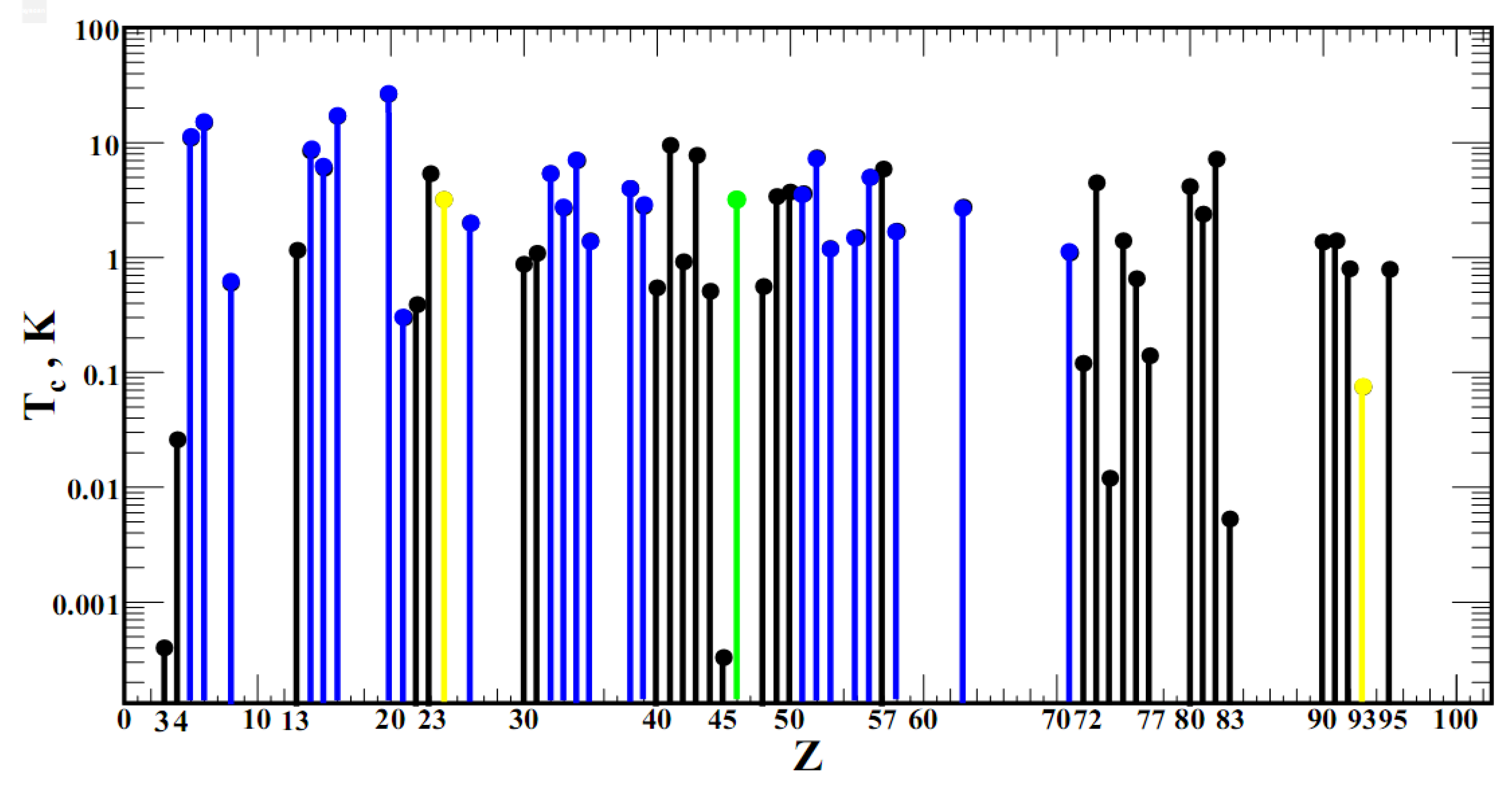
Figure 2.
Dependence of lattice parameters on atomic number: a(Z) is a solid red line with dots in the form of filled circles, b(Z) is a green dashed line with dots in the form of empty circles, c(Z) is a blue dotted line with dots in the form of empty squares. All data were obtained at room temperature, except for inert gases and hydrogen. The data were taken from [18] and references cited therein.
Figure 2.
Dependence of lattice parameters on atomic number: a(Z) is a solid red line with dots in the form of filled circles, b(Z) is a green dashed line with dots in the form of empty circles, c(Z) is a blue dotted line with dots in the form of empty squares. All data were obtained at room temperature, except for inert gases and hydrogen. The data were taken from [18] and references cited therein.
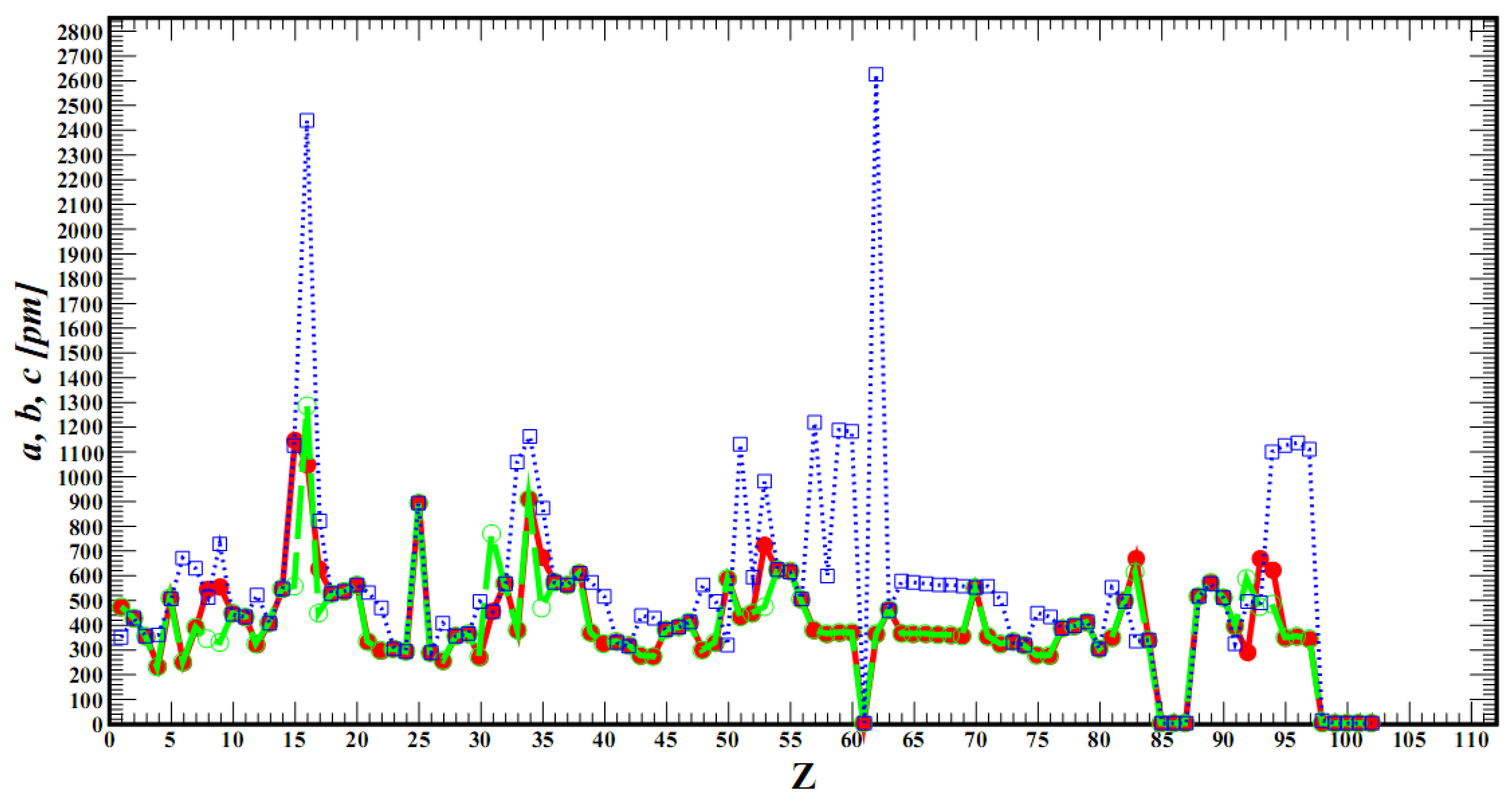

Table 1.
Values of the function f1/2(N) representing the quantum selection rule for atomic numbers that define a superconducting chemical element (sc element).
Table 1.
Values of the function f1/2(N) representing the quantum selection rule for atomic numbers that define a superconducting chemical element (sc element).
| N | f1/2(N) | rpi(f1/2(N)) | sc element | Tc K, at patm | Tc K, at high p GPa |
|---|---|---|---|---|---|
| 1 | 13.13 | 13 | Al | 1.19 | |
| 2 | 22.04 | 22 | Ti | 0.39 | 3.35 K, 56 GPa |
| 5 | 71.90 | 72 | Hf | 0.12 | 8.6 K, 62 GPa |
| 6 | 92.73 | 93 | Np | 0.075 | |
| 9 | 89.57 | 90 | Th | 1.37 | |
| 10 | 91.61 | 92 | U | 0.8 | 2.4 K, 1.2 GPa |
| 12 | 73.61 | 74 | W | 0.012 | |
| 13 | 41.15 | 41 | Nb | 9.50 | 9.9 K, 10 GPa |
| 14 | 57.98 | 58 | Ce | 1.7 K, 5 GPa | |
| 15 | 15.51 | 16 | S | 17.3 K, 190 GPa | |
| 16 | 49.12 | 49 | In | 3.404 | |
| 18 | 46.49 | 46 | Pd | 3.2, irradiated | |
| 19 | 43.15 | 43 | Tc | 7.77 | |
| 22 | 49.70 | 50 | Sn | 3.722 | 5.3 K, 11.3 GPa |
| 23 | 50.79 | 51 | Sb | 3.9 K, 25 GPa | |
| 24 | 52.48 | 52 | Te | 7.5 K, 35 GPa | |
| 26 | 55.37 | 55 | Cs | 1.3 K, 12 GPa | |
| 27 | 56.81 | 57 | La | 6.00 | 13 K, 15 GPa |
| 28 | 58.29 | 58 | Ce above | ||
| 31 | 62.65 | 63 | Eu | 2.75 K, 142 GPa | |
| 37 | 71.28 | 71 | Lu | 12.4 K, 174 GPa | |
| 38 | 72.71 | 73 | Ta | 4.483 | 4.5 K, 43 GPa |
| 39 | 74.15 | 74 | W above | ||
| 40 | 75.57 | 76 | Os | 0.66 | |
| 41 | 77.00 | 77 | Ir | 0.14 | |
| 43 | 79.85 | 80 | Hg | 4.15 | |
| 44 | 81.27 | 81 | Tl | 2.39 | |
| 45 | 82.68 | 83 | Bi | 0.0053 | 8.5 K, 9.1 GPa |
| 50 | 89.76 | 90 | Th above | ||
| 51 | 91.17 | 91 | Pa | 1.4 | |
| 52 | 92.58 | 93 | Np above | ||
| 54 | 95.40 | 95 | Am | 0.79 | 2.2 K, 6 GPa |
Table 2.
Table of values of symmetry coefficients S of superconducting elements used in formula (6). Space group of superconductors is shown in center of digital combination in column “Transition space gropes”, from left – space group of elements with atomic number one unit less, at right – one unit more.
Table 2.
Table of values of symmetry coefficients S of superconducting elements used in formula (6). Space group of superconductors is shown in center of digital combination in column “Transition space gropes”, from left – space group of elements with atomic number one unit less, at right – one unit more.
| S(element) | Value | Transition space gropes | S(element) | Value | Transition space gropes | S(element) | Value | Transition space gropes |
|---|---|---|---|---|---|---|---|---|
| SLi | -0.938⋅10-10 | 225-194-194 | SRu | 0.167⋅10-6 | 194-194-225 | SIr | 0.064⋅10-6 | 194-225-225 |
| SBe | 3.138⋅10-9 | 229-194-166 | SRh | 1.907⋅10-10 | 194-225-225 | SHg | 16.021⋅10-6 | 225-166-194 |
| SAl | 1.264⋅10-6 | 194-225-227 | SCd | -0.062⋅10-6 | 225-194-139 | STl | 0.536⋅10-6 | 166-194-225 |
| STi | -0.324⋅10-6 | 194-194-229 | SIn | 0.672⋅10-6 | 194-139-141 | SPb | 4.196⋅10-6 | 194-225-12 |
| SV | -2.321⋅10-6 | 194-229-229 | SSn | 0.468⋅10-6 | 139-141-166 | STh | -0.531⋅10-6 | 225-225-139 |
| SZn | 0.103⋅10-6 | 225-194-64 | SLa | -2.726⋅10-6 | 229-194-194 | SPa | -1.147⋅10-6 | 225-139-63 |
| SGa | 0.412⋅10-6 | 194-64-225 | SHf | -0.259⋅10-6 | 194-194-229 | SU | 0.265⋅10-6 | 139-63-62 |
| SZr | -0.467⋅10-6 | 194-194-229 | STa | -2.189⋅10-6 | 194-229-229 | SAm | -0.263⋅10-6 | 11-194-194 |
| SNb | -4.037⋅10-6 | 194-229-229 | SW | 0.127⋅10-6 | 229-229-194 | |||
| SMo | 1.517⋅10-6 | 229-229-194 | SRe | -2.687⋅10-6 | 229-194-194 | |||
| STc | -12.082⋅10-6 | 229-194-194 | SOs | 0.238⋅10-6 | 194-194-225 |
Disclaimer/Publisher’s Note: The statements, opinions and data contained in all publications are solely those of the individual author(s) and contributor(s) and not of MDPI and/or the editor(s). MDPI and/or the editor(s) disclaim responsibility for any injury to people or property resulting from any ideas, methods, instructions or products referred to in the content. |
© 2025 by the authors. Licensee MDPI, Basel, Switzerland. This article is an open access article distributed under the terms and conditions of the Creative Commons Attribution (CC BY) license (http://creativecommons.org/licenses/by/4.0/).
Copyright: This open access article is published under a Creative Commons CC BY 4.0 license, which permit the free download, distribution, and reuse, provided that the author and preprint are cited in any reuse.


