

Submitted:
24 July 2025
Posted:
25 July 2025
You are already at the latest version
Abstract
A systems approach is applied to a real-life case involving the production and use of a non-carbonized briquette branded YAZINI, made from renewable bamboo (Bambusa vulgaris). YAZINI is promoted as a green fuel alternative to traditional hardwood firewood and charcoal. Currently, approximately 95% of East Africans rely on unsustainable firewood and charcoal derived from hardwoods—a practice that is rapidly degrading forest cover and contributing to adverse climate change impacts. Conventional wisdom holds that bamboo afforestation in the energy value-chain where the end product is used for cooking is eligible for carbon credits. However, the location-dependent net YAZINI value-chain stages’ contribution to the overall carbon footprint is worthy exploring. This case study shows that when each stage of the YAZINI production value chain is analyzed for carbon sequestration and emissions, a net positive sequestration of approximately 1.3 metric tons of carbon per ton of briquettes used annually can be achieved, the bulk of which is due to bamboo left in the field.
Keywords:
biofuel
; bioenergy
; bamboo
; carbon credit
; charcoal
; sustainable development
1. Introduction
A recent market survey by the Private Sector Foundation [1] on institutional cooking in Uganda revealed that firewood is the dominant fuel, used by 90% of institutions, often in combination with charcoal (14%). In the hotel and restaurant sector, charcoal accounts for 85% of cooking energy. More broadly, approximately 95% of the East African population relies on unsustainable firewood and/or charcoal for cooking energy [2]. Given the region’s rapid population growth—the highest globally—continuation of current practices is expected to accelerate deforestation, with severe environmental consequences.
Our long-term goal is to transform cooking practices in Uganda while simultaneously restoring forests through the introduction of sustainable firewood and charcoal sourced from planted, renewable bamboo. Bamboo is a woody, perennial member of the grass family Poaceae, subfamily Bambusoideae, and is among the fastest-growing woody plants in the world. Compared to traditional forest timber species, bamboo has a short rotation cycle of 3 to 5 years and is harvested selectively (“tag harvesting”), whereby only mature culms are removed. Replanting is unnecessary, as bamboo regenerates from its rhizome structures, continuously producing new shoots. A single clump can support culms of various ages, enabling ongoing harvesting.
Preliminary studies on the usability of bamboo firewood and charcoal in Uganda revealed a major limitation: bamboo burns rapidly, releasing energy quickly, in contrast to traditional hardwood fuels that burn more slowly. The slow-burning characteristic aligns with Ugandan cooking traditions, which often favor prolonged simmering. As a result, bamboo’s fast-burning nature is perceived as less efficient and unsuitable for conventional cooking needs. To address this challenge, we conceptualized and tested a green firewood alternative—YAZINI—produced from crushed, dried, and densified bamboo. Usability studies show strong potential for user adoption [3]. Furthermore, carbonization of YAZINI yields a green charcoal that performs competitively in the urban and peri-urban domestic market, which is currently dominated by unsustainable charcoal.
Bamboo’s full contribution to carbon sequestration is limited when part of the biomass is burned in comparison to bamboo-based durable products [4,5]. However, the extent of the sequestration compromise is value-chain dependent. We present a positive net carbon sequestration achievable when bamboo-based products like YAZINI are used as cooking fuel. This perspective draws on successful examples of carbon credit initiatives involving efficient cookstoves—such as the Berkeley-Darfur Stove [6]—and carbon storage projects in African woodlands [7]. These initiatives argue that reducing biomass consumption leads to fewer trees being cut down, allowing the remaining forest to continue sequestering carbon. Similarly, YAZINI contributes to forest preservation by substituting unsustainable hardwoods. However, the YAZINI value chain involves multiple stages, each contributing to the overall carbon footprint. Using the best available data, we have quantified the carbon emissions and sequestration at each stage to estimate the net carbon balance, which provides the relative sequestration/emission for the YAZINI value-chain case in support of sustainable energy and climate mitigation.
2. Materials and Methods
The economic unit used in our calculations is one metric ton (1,000 kg) of YAZINI firewood, produced annually from a single bamboo species—Bambusa vulgaris—as the sole raw material. This choice reflects best management practices, where culm harvesting from each bamboo clump occurs once per year. Ethiopia, Kenya, and Uganda host approximately 1.47 million hectares, 133,272 hectares, and 54,533 hectares of bamboo resources, respectively, primarily composed of two indigenous species: Oldeania alpina (syn. Yushania alpina/Arundinaria alpina) and Oxytenanthera abyssinica [8]. In addition to these native species, several Asian bamboo species have been introduced to the region. Among them, Bambusa vulgaris and Dendrocalamus asper are prominent in Kenya and Uganda. Notably, these introduced species exhibit higher Fuel Value Index (FVI) scores compared to indigenous types [3]. We selected B. vulgaris for this study due to its superior performance and more extensive research coverage under sub-Saharan African conditions, relative to D. asper.
3. Results
The results of the emission and sequestration throughout the YAZINI production value-chain are provided below, categorized into ten “buckets.”
3.1. Above-Ground Carbon Sequestration from Bambusa vulgaris Clumps (Bucket 1)
The bamboo stumps from which mature culms (25%) are harvested continue to sequester carbon. According to Kaam et al. [9], 1,000 kg of YAZINI firewood is produced from approximately 93.33 culms, based on a yield of 10.49 kg per culm. Assuming a planting density of 260 clumps per hectare [6], and 6,000 culms per hectare, this translates to about 23 culms per clump—rounded to 25 for simplicity. If all culms in a clump were harvested, only 3.81 clumps [(93.33 culms) ÷ (25 culms per clump)] would be required to produce 1,000 kg of YAZINI. However, under sustainable management, only 25% of culms are harvested annually, increasing the required number of clumps to 15.3 [(3.81) ÷ 0.25]. This equates to 0.0588 ha [(15.3 clumps) ÷ (260 clumps/ha)] of land. To maintain a conservative estimate, we adopt a lower published acreage of 0.0124 ha from Adu-Poku et al. [10]. The difference between the two numbers is 4 to 5 times, suggesting that research in needed to establish the actual number for Uganda and/or East African agro-climatic conditions. Assuming an average above-ground carbon sequestration of 63.45 tC ha⁻¹, derived from four independent studies cited by Adu-Poku et al. [10], the estimated sequestration per 1,000 kg of YAZINI firewood is 0.8370 tC [(63.45 tC/ha) × 0.0124 ha].
3.2. Below-Ground Carbon Sequestration (Bucket 2)
Following the Intergovernmental Panel on Climate Change (IPCC) guidance, below-ground carbon sequestration is estimated at 20% of above-ground biomass for B. vulgaris. Applying this factor yields 0.1674 tC per 1,000 kg of YAZINI firewood [20% × 0.8370 tC].
3.3. Litter Carbon Sequestration (Bucket 3)
Using the same 0.0124 ha area, and in the absence of comprehensive data on litter sequestration for B. vulgaris, we adopt the experimental value of 4.25 tC ha⁻¹ reported by Adu-Poku et al. [10]. This results in a litter carbon sequestration of 0.0527 tC per 1,000 kg of YAZINI firewood [(4.25 tC/ha) × 0.0124 ha].
3.4. Continued Carbon Sequestration by the Saved Forest Trees (Bucket 4)
The substitution of hardwood firewood with YAZINI firewood preserves existing forest trees, allowing them to continue sequestering carbon. With 0.0124 ha of bamboo land replacing forest-sourced fuelwood, and using a mid-range annual carbon sequestration rate of 57,000 kg C ha⁻¹ for tropical forests [12], the carbon savings from forest preservation amount to 0.7068 tC per 1,000 kg of YAZINI firewood [(0.0124 ha) × (57,000 kg C/ha)].
3.5. Transportation of Harvested Bambusa.vulgaris from the Plantation to the Manufacturing Facility (Bucket 5)
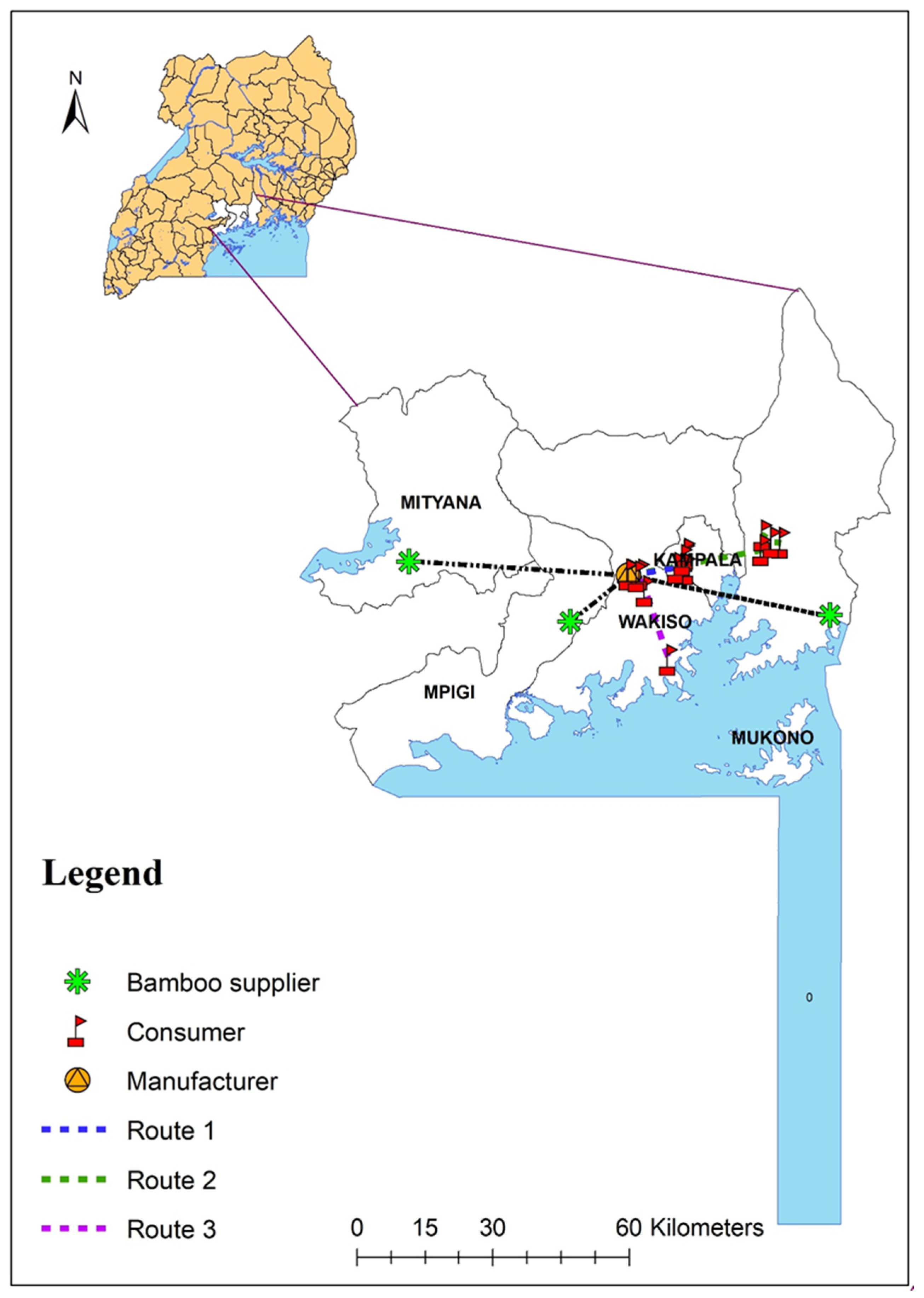
Bamboo culms are sourced from plantations in Mukono, Mityana, and Mpigi districts. These are transported to a manufacturing facility located in Wakiso district. The finished YAZINI firewood is then distributed to 15 educational institutions clustered across Kampala, Wakiso, and Mukono districts, as illustrated in Figure 1. Each institution serves over 5,000 students and employs 5 to 10 kitchen staff. This pilot supply chain currently involves only YAZINI firewood; however, similar calculations for YAZINI charcoal would be straightforward to perform in the future.
Carbon emissions in the transport and logistics industry are on the rise, with road transport accounting for the highest percentage [13], despite efforts to improve efficiency and move to electric powered and hybrid vehicles. This is solely due to reliance on diesel trucks for large haulage [14] as well as a larger road transport network compared to other transport modes. Two methods are used to compute carbon emissions for transportation, and these are: Activity based approach, where the CO2 emissions are calculated based on the transport operations of a given entity, and energy based approach, where the total amount of energy used in a transport operation is computed with a CO2 emission factor, distance and tonnage hauled to obtain the emissions. See Guidelines for Measuring and Managing CO2 Emission from Freight Transport Operations [15]. The later approach has been used here because it is easy to compute and highly accurate considering that access to the energy usage records such as fuel consumed, and distance covered are available [16].
As shown in Figure 1, the current consumers are in Kampala, Mukono and Wakiso districts. The transportation routes used in distribution of YAZINI firewood to the consumer and to deliver raw material to the facility were evaluated for CO2 emissions, the predominant greenhouse gas generated from diesel engine trucks. The distances and diesel fuel consumed are indicated in Figure 1 caption. A gallon of diesel combusted in a truck emits about 10.21 kg of CO2 (EPA Centre for Corporate Climate Leadership, https://www.epa.gov/climateleadershipconverting), converting to 2.7 kg of CO2 per litre of diesel. Hence the distances computed from the distribution and supply routes were used alongside the fuel consumption from the trucks per tonnage of YAZINI transported to determine the carbon emissions from the distribution of a ton of YAZINI. A Tata SFC 709 Ex 7-ton truck was used for these calculations. This vehicle has a fuel consumption of 7 km/litre of diesel. The vehicle was assessed for fuel efficiency in relation to the tonnage hauled as well as the distance travelled along these routes. The fuel consumed was divided by the product of the trucks load and the distance covered. An average efficiency expressed in litres per ton-kilometre (l (t-km)-1) was generated.
Figure 1.
Map of Wakiso district that surround Kampala, the capital city, and the neighbouring bamboo raw material sources of Mityana (distance of 54.3 km, diesel fuel consumption of 7.76 l), Mpigi (distance of 17.4 km, diesel fuel consumption of 2.49 l) and Mukono-Katosi (distance of 71.94 km, diesel consumption of 10.20 l). Bamboo raw material (culms or poles) is secured from the three plantations as shown and hauled to the manufacturing site (Nsangi) in a suburb of greater Kampala. From Nsangi the finished product is hauled to three main groups of schools located on three distinct routes. Route 1 (distance of 28.7 km, fuel diesel consumption of 4.10 l) school include: Makerere College, Makerere University, Lubiri High, Lubiri Secondary and Mengo Senior Secondary. Route 2 (distance of 52.4 km, diesel fuel consumption of 7.49 l) schools include: Seeta High, Bishop's Senior Secondary, Uganda Christian University and Namilyango Boys Secondary. Route 3 (distance of 39.9 km, diesel fuel consumption of 5.70 l) schools include: Kings’ College, Hanna International, Sumaiya Girls, Trinity College, St. Mary's College, and St. Mark Senior Secondary.
Figure 1.
Map of Wakiso district that surround Kampala, the capital city, and the neighbouring bamboo raw material sources of Mityana (distance of 54.3 km, diesel fuel consumption of 7.76 l), Mpigi (distance of 17.4 km, diesel fuel consumption of 2.49 l) and Mukono-Katosi (distance of 71.94 km, diesel consumption of 10.20 l). Bamboo raw material (culms or poles) is secured from the three plantations as shown and hauled to the manufacturing site (Nsangi) in a suburb of greater Kampala. From Nsangi the finished product is hauled to three main groups of schools located on three distinct routes. Route 1 (distance of 28.7 km, fuel diesel consumption of 4.10 l) school include: Makerere College, Makerere University, Lubiri High, Lubiri Secondary and Mengo Senior Secondary. Route 2 (distance of 52.4 km, diesel fuel consumption of 7.49 l) schools include: Seeta High, Bishop's Senior Secondary, Uganda Christian University and Namilyango Boys Secondary. Route 3 (distance of 39.9 km, diesel fuel consumption of 5.70 l) schools include: Kings’ College, Hanna International, Sumaiya Girls, Trinity College, St. Mary's College, and St. Mark Senior Secondary.
Fuel Efficiency = [Fuel consumed (l)] ÷ [Load (t) x Distance (km)].
CO2 emissions for a given load hauled for a known distance is obtained from the product of the fuel efficiency, the average CO2 emission per litre of diesel, distance and tonnage hauled. This is expressed in kilograms as follows.
CO2 Emission = Fuel efficiency (l t-1km-1) x CO2 per litre of diesel (kg l-1) x Tonnage hauled (kg).
Consider a fully loaded truck of 7 tons moving from Wakiso to the manufacturing facility (Thermogenn), a distance of about 54.3 km. The vehicle has a consumption of 7 kilometers per liter:
Fuel consumed = (54.3, km)÷(7, km l-1) = 7.76 l.
Fuel Consumption, l kg-1km-1 = (Fuel Consumed, l)÷ [(Load, kg) x (Distance, km)]
= (7.76, l)÷ [(7,000, kg)(54.3, km)]= 0.0000204 l kg-1 km-1.
CO2 Emission, kg/km = Fuel Efficiency, l kg-1 km-1) x (CO2 Emission per litre of diesel, kg l-1) x (Tonnage hauled, kg)
= 0.0000204 × 2.7 × 7000
= 0.3859 kg/km of bamboo supplied or YAZINI distributed.
For all recurrent trips for YAZINI production or delivery, the CO2 emissions is easily computed from this model, which is a nexus of the energy and activity-based approaches of CO2 analysis. The total CO2 emissions in kilograms is obtained by calculating the product of CO2 emissions per km by the distance travelled in kilometres. For example, the CO2 emission for the Mityana raw bamboo supply to the manufacturing facility comes to 20.95 kg [(0.3859, kg /km) x (54.3, km)]. Similarly, the CO2 emissions for the Mukono and Mpigi raw bamboo supply come to 27.55 and 6.71 kg, respectively. The total CO2 emission for the three bamboo supply routes comes to 55.21 kg CO2 [20.95+27.55+6.71]. To convert to kg C t-1, we multiply by 12.01/44.009, g C/g CO2 and divide by 7 t (truck capacity per trip) to yield emission of 2.15 kg C (1000 kg YAZINI)-1 or -0.0022 tC (1000 kg YAZINI)-1.
3.6. Crushing of Poles or Culms, Branches, and Leaves (Bucket 6)
The crusher is powered by a “green” hydroelectric power source. IPCC (Intergovernmental Panel on Climate Change) has proposed carbon footprint of hydroelectric power plants of 24 g CO2-eq/kW-h. The bamboo crusher was locally developed [3]. It is unique in that it cuts and crushes in a single pass. The wet bamboo equivalent of 1000 kg of YAZINI, based on initial and final moisture contents of 48.8% ([17] and 10%, respectively, is crushed in 1.757 h. The crusher is powered by a 18 hp motor, which if operated at 80% of maximum rating, consuming 33.9284 kW-h (1000 kg YAZINI)-1 [80%(18, hp) x (1.341, kW/hp) x (1.757, h/1000 kg YAZINI)]. The carbon emission comes to – 0.2222 kg C (1000 kg YAZINI)-1 [(12.01/44.009, g C/g CO2) x (33.9284, kW-h/1000 kg YAZINI) x (24 g CO2-eq/kW-h) x (1 kg C/1000 g C)] , a negligibly small emission of -0.0002 tC (1000 kg YAZINI)-1
3.7. Drying of the Crushed Bamboo (Bucket 7)
We have not found any estimate of the carbon footprint of solar drying that involve simple capture of the sun power. We speculate that it will be negligibly small and as such can be considered carbon neutral.
3.8. High Pressure Densification (Bucket 8)
The high pressure densification of bamboo uses hydroelectric power. IPCC (Intergovernmental Panel on Climate Change) has proposed carbon footprint of hydroelectric power plants of 24 g CO2-eq/kW-h. The two electric motors of the press are rated at 50 and 1.5 horsepower (hp). We are assuming that under normal operation the motors operate at 80% of their maximum rating. Conversion to kW comes to 55.2492 kW [80%(50+1.5, hp) (1.341, kW/hp)]. At its peak operation, the press makes 700 kg of Yazini per hour. To make 1000 kg of YAZINI requires 1.429 h (1000 kg YAZINI)-1, yielding a kW-h (1000 kg YAZINI)-1 of 78.9511 [(55.4292, kW) (1.429, h/1000 kg YAZINI)]. Therefore, the carbon emission from the press comes to –0.5171 kg C (1000 kg YAZINI)-1 [(12.01/44.009, g C/g CO2) (78.551, kW-h/1000 kg YAZINI) (24, g CO2/kW-h) (1/1000, kg/g)] or -0.0005 tC (1000 kg YAZINI)-1.
3.9. Transporting YAZINI from the Manufacturing Facility to the Points of Use (Bucket 9)
The same logic developed in Bucket 5 is followed here. Using the YAZINI delivery routes’ distances from Figure 1 caption, the total kg CO2 for the three delivery routes comes to 46.69 [15.39+11.08+20.22]. Converting to kg C/1000 kg YAZINI, yields an emission of 1.82 kg C (1000 kg YAZINI)-1 [(12.01/44.009, g C/g CO2) x (46.69, kg CO2 (7, t)-1] or -0.0018 tC (1000 kg YAZINI)-1.
3.10. Cooking/Combustion with/of YAZINI Firewood (Bucket 10)
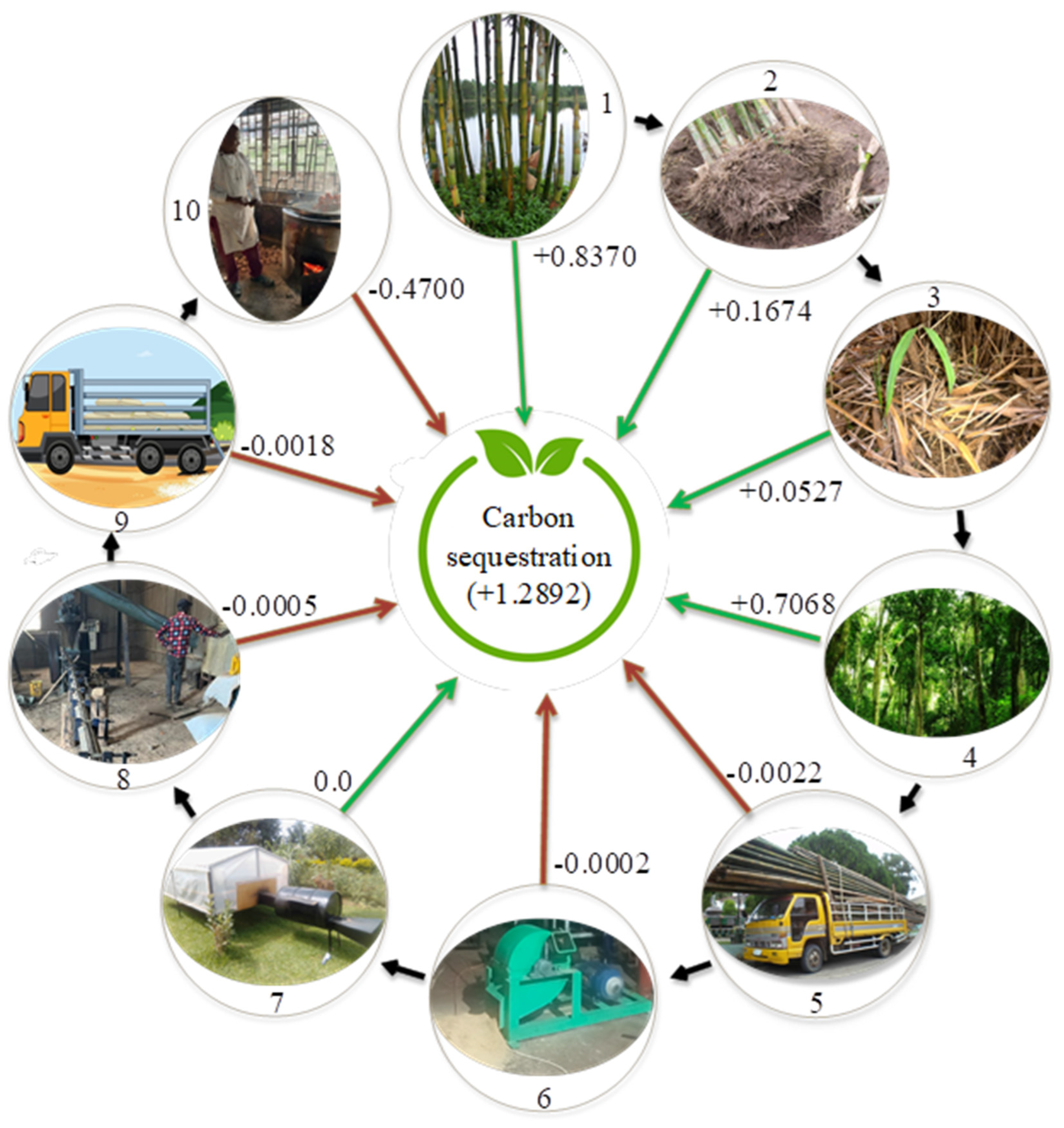
According to Rousset et al. [18], the elemental carbon composition of B. vulgaris is 47%. Therefore, carbon from a ton of YAZINI comes to an emission of 470 kg [47% (1,000, kg)] or -0.470 tC (1000 kg YAZINI)-1. The results of the above ten-bucket calculations are summarized in Figure 2. As shown, approximately 1.3 metric tons of carbon are sequestered in relation to using one metric ton of YAZINI per year. The majority of sequestered carbon comes from the bamboo plantations which provide mature bamboo to feed the YAZINI making value-chain. The catch here is that bamboo is renewable. As expected, the majority of emissions come from burning of YAXINI for cooking in kitchen stoves.
Figure 2.
Carbon emission/sequestration in the green (sustainable) bamboo-based firewood production value-chain – units of tC (1000 kg YAZINI)-1 year-1: 1) Bambusa vulgaris clump sequestration, above ground, 2) B. vulgaris clump sequestration, below ground, 3) B. vulgaris clump sequestration, litter, 4) Harvested bamboo and the saved equivalent forest tree continued sequestration, 5) Emission from transportation of harvested B. vulgaris from the plantation to the manufacturing facility, 6) Emission from crushing of B. vulgaris poles or culms, branches and leaves, 7) Emission from drying of the crushed B. vulgaris, 8) Emission from high pressure densification, 9) Emission from transporting the product from the manufacturing facility to the points of use, and 10) Emission from cooking with the product in household or institutional kitchens.
Figure 2.
Carbon emission/sequestration in the green (sustainable) bamboo-based firewood production value-chain – units of tC (1000 kg YAZINI)-1 year-1: 1) Bambusa vulgaris clump sequestration, above ground, 2) B. vulgaris clump sequestration, below ground, 3) B. vulgaris clump sequestration, litter, 4) Harvested bamboo and the saved equivalent forest tree continued sequestration, 5) Emission from transportation of harvested B. vulgaris from the plantation to the manufacturing facility, 6) Emission from crushing of B. vulgaris poles or culms, branches and leaves, 7) Emission from drying of the crushed B. vulgaris, 8) Emission from high pressure densification, 9) Emission from transporting the product from the manufacturing facility to the points of use, and 10) Emission from cooking with the product in household or institutional kitchens.
4. Discussion
Since the inspiration to consider looking into net carbon emission/sequestration was from work done with improved cookstove (ICS), it is worthy it to compare carbon reduction estimates between the two product types. The ICS carbon credits are built on the saving that accrues in comparison to the traditional three-stone stove. While the saving per ICS or households may be small, the idea is to pool the many ICS or the households using them at the country level to come up with marketable quantities.
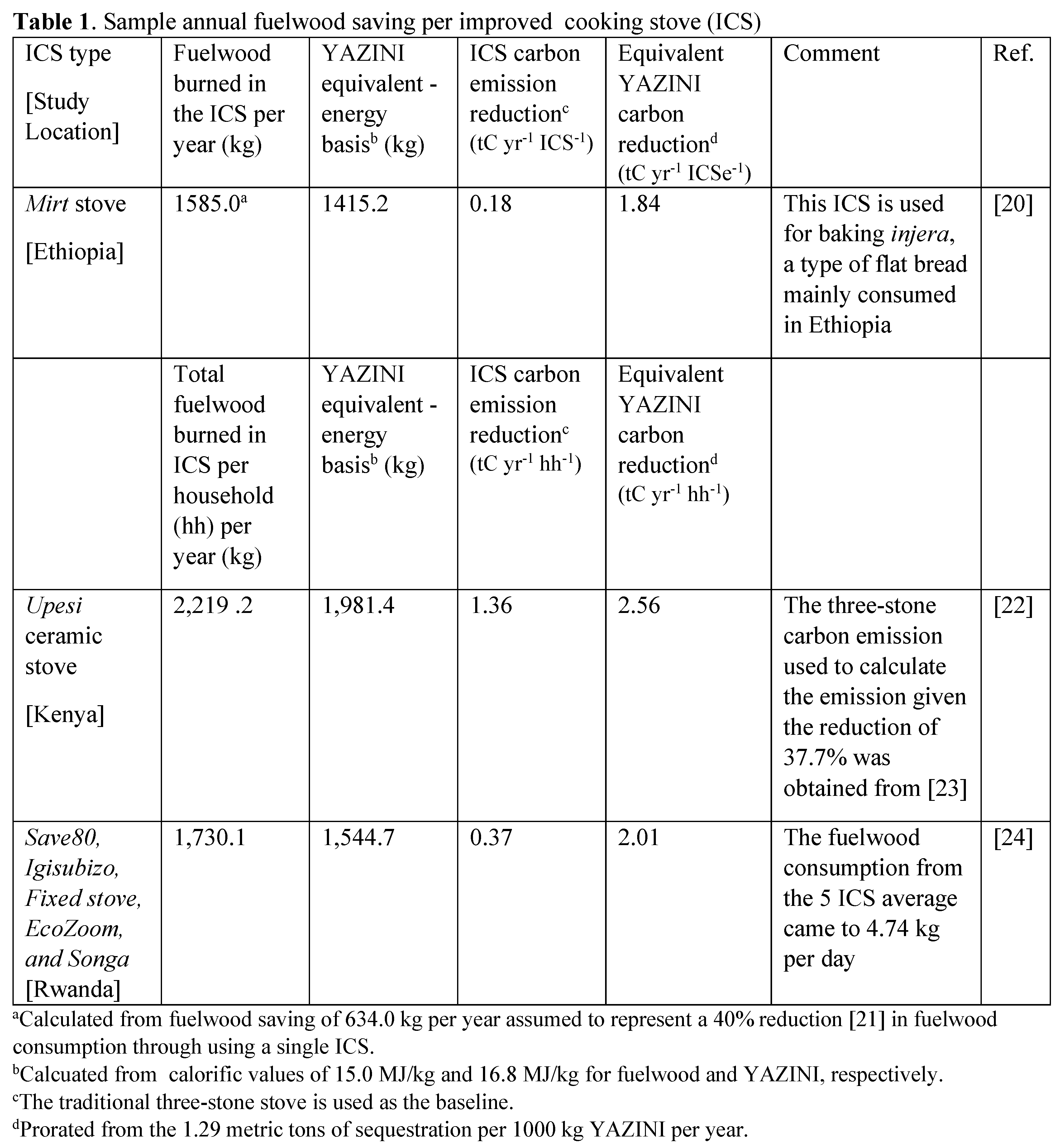
Three ICS carbon saving examples are presented in Table 1. These examples come from field studies that are real-life as opposed to laboratory studies conducted with water boiling tests in very well controlled environments. The economic units in one study [20] and the other two [22,24] are a single ICS and household (hh) that may use one or more ICS, respectively. So, it is not surprising that the single ICS presents the lowest saving. The comforting observation is that although carbon savings from equivalent YAZINI use are in range – not more than a factor of 2.
 |
While the overall positive sequestration from YAZINI is encouraging, it should be pointed out that the estimate has been based on parameters developed in multiple countries. There are several research opportunities to generate knowledge that will enable more accurate estimates. For example, the development of allometric models, e.g., [19], or validating existing models for several bamboos of interest to the energy value-chain would add value with Uganda bamboos raised under local agro-climatic conditions. Additionally, only a couple bamboo species growing in Uganda have been characterized with respect to their physical, mechanical, chemical and fiber properties [8]. Extending such studies to all the bamboo species may reveal more bamboo suitable for energy and other applications.
5. Conclusions
For each 1000 kg of YAZINI consumed, a net sequestration of 1.29 tC is estimated. The majority of the sequestration relies on the bamboo plantation or forest. The highest emission of approximately 0.5 t comes from burning the YAZINI. The unit operations within the value-chain contribute dismal emission. Even if distances for source of raw materials and delivery of products triple, the effect on the overall sequestration would still be dismal. The point of this case, based on a real value-chain of raw material sources, manufacturing, and product distribution, is the relative from to emission/sequestration contribution by the various stages of the YAZINI production and use operations. Additionally, the benefits of YAZINI use in relation to health of kitchen workers and energy cost may add more value beyond carbon emission reduction.
Author Contributions
Conceptualization, W.S.K and I.W.K; methodology, JJK, JG and WSK; writing—original draft preparation, J.J.K. and W.S.K.; writing—review and editing, W.N. W.S.K, I.W.K, J.J.K, and J.G.; funding acquisition, W.S.K and I.W.K. All authors have read and agreed to the published version of the manuscript.
Funding
This research was funded by FRANCAISE DE DEVELOPPEMENT, Grant No. CUG1122 01
Data Availability Statement
The authors confirm that the data supporting the findings of this study are available within the article [and/or] its supplementary materials.
Acknowledgments
Dr. Elizabeth Balyejusa Kizito, Director, Directorate of Research, Partnerships and Innovation at Uganda Christian University, is acknowledged for logistic support.
Conflicts of Interest
WSK is a co-founder of Thermogenn, a private entity that is partnering with Uganda Christian University toward piloting the production and distribution of YAZINI firewood to a number of secondary schools of Kampala, the capital of Uganda, as well as numerous households.
Abbreviations
The following abbreviations are used in this manuscript:
| C EPA hh ICS IPCC |
Carbon Environmental Protection Agency house hold Improved Cook Stoves Intergovernmental Panel on Climate Change |
References
- A Private Sector Foundation (2020). Uganda Clean Cooking Supply Chain Expansion Project: Market Survey on Institutional Cooking in Uganda, page 7, 2020. The report is not publicly available; a copy was obtained from Geoffrey Ssebuggwawo (gssebuggwawo@psfuganda.org.ug) of Private Sector Foundation.
- Rose, J.; Bensch, G.; Munyehirwe, A.; Peters, J. The forgotten coal: Charcoal demand in sub-Saharan Africa, World Development Perspectives 2022, 25, 100401. [CrossRef]
- Kisaalita, W.S.; Galiwango, J.; Karama, J.J.; Namutosi, W.; Katono, I.W.; Kalanzi, M. (2024). Densified briquette (YAZINI) characterization: Toward a bamboo-based energy value-chain in Uganda. Renewable and Sustainable Energy Reviews (In preparation).
- Nath, A.J.; Das, G.; Das, A.K. Above ground standing biomass and carbon storage in village bamboos in North East India. Biomass and Bioenergy 2009, 33, 1188–1196. [Google Scholar] [CrossRef]
- Nfornkah, B.N.; Kaam, R.; Martin, T.; Louis, S.; Cedric, C.D.; Forje, G.W.; Delanot, T.A.; Rosine, T.M.; Baurel, A.J.; Loic, T.; Herman, Z.T.G.; Yves, K.; Varten, D.S. Culm allometry and carbon storage capacity of Bambusa Vulgaris Schrad. ex J.C. Wendel. in the tropical evergreen rain forest of Cameroon. Journal of Sustainable Forestry 2021, 40, 622–638. [Google Scholar] [CrossRef]
- Coffey, E.R.; Mesenbring, E.C.; Agao, D.; Alirigia, R.; Begay, T.; Moro, A.; Oduro, A.; Brown, Z.; Dickinson, K.L.; Hannigan, M.P. A glimpse into real-world kitchens: Improving our understanding of cookstove usage through in-field photo-observations and improved cooking event detection (CookED) analytics. Development Engineering 2021, 6, 100065. [Google Scholar] [CrossRef]
- Grace, J.; Ryan, C.M.; Williams, M.; Powell, P.; Goodman, L.; Tipper, R. A pilot project to store carbon as biomass in African woodlands. Carbon Management 2010, 1, 227–235. [Google Scholar] [CrossRef]
- Hankun, W.; Hong, C.; Rong, Z.; Liu Xing’e, L.; Durai, J. (2019). Properties of East African Bamboo: The Physical, Mechanical, Chemical and Fibre Test Results of Three East African Bamboo Species. INBAR Working Paper No. 81. Title of Site. Available online: URL (accessed on June 5, 2025).
- Kaam, R.; Tchamba, M.; Nfornkah, B.N.; Djomo, C.C. Allometric equations and carbon stocks assessment for Bambusa vulgaris Schrad. ex J.C. Wendl. in the bimodal rainfall forest of Cameroon. Heliyon 2023, 9, e21251. [Google Scholar] [CrossRef] [PubMed]
- Adu-Poku, A.; Obeng, G.Y.; Mensah, E.; Kwaku, M.; Acheampong, N.; Duah-Gyamfi, A.; Adu-Bredu, S. Assessment of aboveground, below ground, and total biomass carbon storage potential of Bambusa vulgaris in tropical moist forest in Ghana, West Africa. Renewable Energy and Environmental Sustainability 2023, 8, 3. [Google Scholar] [CrossRef]
- Amoah, M.; Assan, F.; Dadzie, P.K. Aboveground biomass storage and fuel values of Bambusa vulgaris, Oxynanteria abyssinica and Bambusa vulgaris var. vitata plantations in the Bobiri forest reserve of Ghana. Journal of Sustainable Forestry 2020, 39, 113–136. [Google Scholar] [CrossRef]
- N’Gbalaa, F.N.; Guéib, A.M.; Tondoha, J.E. Carbon stocks in selected tree plantations, as compared with semi-deciduous forests in central-west Côte d’Ivoire. Agriculture, Ecosystems and Environment 2017, 239, 32–37. [Google Scholar] [CrossRef]
- Chen, L.; Zhang, B.; Hou, H.; Taudes, A. (2013). Carbon trading system for road freight transport: the impact of government regulation. Advances in Transportation Studies an International Journal, Special Issue, 49–60. http://worldcat.org/issn/18245463.
- Pantoja-Gallegos, J.L.; Dominguez Vergara, N.; Dominguez-Perez, D.N. Calculation of the fuel consumption, fuel economy and carbon dioxide emissions of a heavy-duty vehicle. Journal of Physics: Conference Series 2022, 2307. [Google Scholar] [CrossRef]
- European Chemical Transport Association. (2011). Guidelines for Measuring and Managing CO2 Emission from Freight Transport Operations. https://www.ecta.com/wp-content/uploads/2021/03/ECTA-CEFIC-GUIDELINE-FOR-MEASURING-AND-MANAGING-CO2-ISSUE-1.pdf.
- Piecyk, M.I.; Mckinnon, A.C. Forecasting the carbon footprint of road freight transport in 2020. International Journal of Production Economics 2020, 128, 31–42. [Google Scholar] [CrossRef]
- Anokye, R.; Kalong, R.M.; Bakar, E.S.; Ratnasingam, J.; Jawaid, M.; Awang, K.B. Variations in moisture content affect the shrinkage of Gigantochloa scortechinii and Bambusa vulgaris at different heights of the bamboo culm. BioResources 2014, 9, 7484–7493. [Google Scholar] [CrossRef]
- Rousset, P.; Aguiar, C.; Labbe, N.; Commandre, J.-M. Enhancing the combustible properties of bamboo by torrefaction. Bioresource Technology 2011, 102, 8225–8231. [Google Scholar] [CrossRef] [PubMed]
- Kafalew, A.; Soromessa, T.; Demisew, S.; Belina, M. Validation of allometric models for Sele-Noni Forest in Ethiopia. Modelling Earth Systems and Environment 2023, 9, 2239–2258. [Google Scholar] [CrossRef]
- Mekonnen, A.; Beyene, A.; Bluffstone, R.; Gebreegziabher, Z. Martinsson, P.; Toman, M.; Vieider, F. Ecological Economics 2022, 198, 107467. [Google Scholar] [CrossRef]
- Dresen, E.; DeVries, B.; Herod, M.; Verchot, L.; Müller, R. Fuelwood savings and carbon emission reduction by the use of improved cooking stoves in an Afromontane Forest, Ethiopia Land. 2014, 3, 1137–1157. [CrossRef]
- Lang, M.A.; Espira, A. A large-scale, village-level test of wood consumption patterns in a modified traditional cook stove in Kenya. Energy for Sustainable Development 2019, 49, 11–20. [Google Scholar] [CrossRef]
- Bailis, R.; Ezzati, M.; Kammen, D.M. Greenhouse gas implications of household energy technology in Kenya. Environmental Science and Technology 2003, 37, 2051–2059. [Google Scholar] [CrossRef] [PubMed]
- Uwizeyimana, V.; Mutert, M.; Mbonigaba, T.; Niyonshuti, A.; Nkurikiye, J.B.; Nsabuwera, V.; Peters, J.; Ruticumugambi, J.A.; Gatesi, J.; Mukuralinda, A.; Verbist, B.; Muys, B. Assessment of the efficiency of improved cooking stoves and their impact in reducing forest degradation and contaminant emissions in Eastern Rwanda. Energy for Sustainable Development 2024, 80, 101442. [Google Scholar] [CrossRef]
Disclaimer/Publisher’s Note: The statements, opinions and data contained in all publications are solely those of the individual author(s) and contributor(s) and not of MDPI and/or the editor(s). MDPI and/or the editor(s) disclaim responsibility for any injury to people or property resulting from any ideas, methods, instructions or products referred to in the content. |
© 2025 by the authors. Licensee MDPI, Basel, Switzerland. This article is an open access article distributed under the terms and conditions of the Creative Commons Attribution (CC BY) license (https://creativecommons.org/licenses/by/4.0/).
Copyright: This open access article is published under a Creative Commons CC BY 4.0 license, which permit the free download, distribution, and reuse, provided that the author and preprint are cited in any reuse.


