

Submitted:
24 July 2025
Posted:
25 July 2025
You are already at the latest version
Abstract
This paper presents the results of the modern species composition of the genus Allium L. (Amaryllidaceae) of the western part of the Kyrgyz Alatau. The data on phylogeny, ploidy, chorological data are presented and a modern prospectus of species of the genus Allium in the study area is compiled. Large subgenera of Allium and Melanocrommyum are revealed, which proves the general regularity for mountainous regions of Central Asia. Ploidy of some species (A. artrosanguineum and A. turkestanicum) of the genus Allium growing in the western part of the Kyrgyz Alatau were studied for the first time using flow cytometry methods. The nrITS sequencing was used to construct a phylogenetic tree including sequences from the NCBI database. The phylogenetic tree of species of the genus Allium of the Kyrgyz Alatau was compiled taking into account previously published data. In the course of field studies and literature data, the list of studied Allium species in the Kyrgyz Alatau is represented by 25 species, which include 7 subgenera and 17 sections. Also, the nomenclature of onion species is brought to the modern understanding of some species names. Based on specimens of the genus Allium collected in the western part of the Kyrgyz Alatau, an integral assessment of the current species composition using molecular-genetic, cytometric and traditional botanical methods was carried out.
Keywords:
genus Allius
; ITS data
; flow cytometry
; Kyrgyz Alatau
1. Introduction
The genus Allium L. (Amaryllidaceae J. St.-Hil.), which is a complex systematic group, includes more than 1000 species [1,2]. The ecological range of Allium representatives extends from the alpine and subalpine belts to deserts. Almost one third of them grow in the mountains of Central Asia - the world’s largest centre of diversity of Allium species. Only in the Tien Shan mountains, which are characterised by a high degree of endemism, there are 13 major subgenera of the genus Allium, including 56 species endemics to this mountain system [3,4]. According to literature data, there are from 9 to 21 endemic species of this genus and 14 subendemic taxa in the flora of Kazakhstan [5,6,7]. The object of the present study were species of the genus Allium L. of the Kazakhstani (western) part of the Kyrgyz Alatau Range, located at the junction of the Northern and Western Tien Shan and characterised by a correspondingly transitional composition of the flora. According to the botanical and geographical zoning of Kazakhstan, the Kyrgyz Alatau belongs to the Saharan-Gobi desert region, Iran-Turan subregion, Dzungar-North Tien Shan province, Kyrgyz mountain subprovince [8] (Figure 1).
The aim of the study was phylogenetic and taxonomic evaluation of species of the genus Allium L. growing in the Kyrgyz Alatau using ITS data to clarify their relationships and identify the systematic position of individual species in the context of existing classifications.
The fundamental treatment of the genus Allium is the analysis of onions carried out by Vvedensky A.I. for the ‘Flora of the USSR’ [5]. In this summary, Vvedensky A.I. [5] divided the genus into 9 sections. In ‘Flora of Kazakhstan’ [6] by Pavlov N.V. and Polyakov P.P. for the territory of the republic as a whole 108 species of onions are indicated, 29 of which are given as endemic. According to the data of Baytenov M.S. [9] the genus Allium in the flora of Kazakhstan is represented by 140 species.
Published by Epiktetov V.G. [10] the list of representatives of the genus Allium in the flora of Kazakhstan includes 127 species. At that, 25 species from 7 subgenera and 17 sections are represented in the Kazakh part of the Kyrgyz Alatau Range. Since the Kyrgyz Alatau is a transboundary ridge, it is possible to expand the list by onion species growing in the territories bordering Kyrgyzstan.
2. Results
2.1. Distribution Analyses
As a result of the analysis of literature data, herbarium materials and our own field research, an annotated prospectus of 25 species of the genus Allium growing in the Kyrgyz Alatau was compiled. Among the identified species, 1 endemic (A. oreoprasoides), 2 subendemics (A. margaritae, A. trachyscordum), which are also distributed in Kyrgyzstan, and 1 rare species listed in the Red Book of the Republic (A. suworowii) [12,13].
Three species of onion, which according to literature data [14] were cited for the Kazakhstan part of the Kyrgyz Alatau (Allium altissimum, Allium schoenoprasum, A. kokanicum) were excluded from the list. One of the largest subgenera of the studied genus includes two main groups: Allium, consisting of 6 sections, also subgenera Melanocrommyum and Reticulatobulbosa, including 3sections. Some of the Allium species from Kyrgyz Alatau see in Figure 2.
Meanwhile, in other subgenera, several large sections are also distinguished, each with an equal number of species: Acmopetala and Falcatifolia.
An annotated outline of the current species composition of the genus Allium of the Kyrgyz Alatau is presented below.
Annotated prospectus of species of the genus Allium L. of the Kyrgyz Alatau
Subgenus Allium
Section Allium
Allium sativum L. (1753 in Sp. Pl. 1: 296) - syn. A. longicuspis Regel (1875 in Trudy Imp. S.-Peterburgsk. Bot. Sada 3.2: 45.
The wild plants described as A. longicuspis Regel are feral cultivated garlic [15].
Perennial. Grows in shrubs and along the banks of streams at the bottom of gorges in the lower belt of mountains. Blooms VI-VIII.
Viewed herbarium specimens from the Kyrgyz Alatau: AA (The southwestern extremity of the Kirghiz ridge, the foothills to the north-west. from Almaly-sai, along the meadow slopes, 03.VI.1963, Goloskokov V. P.).
Distribution in Kazakhstan: 25. Zailiyskiy-Kungei Alatau, 25a. Ketmen-Terskey Alatau, 26. Chu-Ili mountains, 27. Kyrgyz Alatau, 28. Karatau, 29. Western Tien-Shan.
General distribution: Iranian-mountain-Middle Asian cultivated species (cultivated worldwide).
Section Brevispatha Valsecchi (1974 in Giorn. Bot. Ital. 108(1-2): 92).
Typus species Allium parciflorum Viv.
Allium margaritae B. Fedtsch. (1918 in Izv. Glavn. Bot. Sada R.S.F.S.R. 18: 14.)
Perennial. Grows on rubbly outcrops of variegated rocks. Blooms V-VI.
Viewed herbarium specimens from the Kyrgyz Alatau: AA (Kyrgyz Alatau, Zhambyl region, Ulken Almalysay gorge, southern slope. N 42°53ʹ56ʺ E71°42ʹ43ʺ h-1200m, 26.08.2024, Vesselova P.V., Bilibayeva B.K., Abdildanov D.Sh., Ussen S., Akhmetzhanova R.K.)
Distribution in Kazakhstan: 16. Betpakdala, 26. Chu-Ili Mountains, 27. Kyrgyz Alatau.
General distribution: Betpakdala-North Tyanshan (endemic).
Section Caerulea (Omelcz.) F. O. Khass. (1996 in Öztürk, Seqmen & Gork (eds.) Plant Life in South-West and Central Asia: 150).
Typus species Allium caeruleum Pall.
Allium caesium Schrenk (1844 in Bull. Cl. Phys.-Math. Acad. Imp. Sci. Saint-Pétersbourg 2: 113)
Perennial. Grows in steppes and deserts, on plumes and mountain slopes up to the middle belt. Blooms IV-VII.
Viewed herbarium specimens from the Kyrgyz Alatau: MW (foothills of the Kirghiz Range, feather grass steppe, 08. VI. 1958, collector Gubanov I.; north-western extremity of the Kirghiz ridge, Syugaty gorge in the lower tichi of the river, along the southern rocky slopes, 05. VI. 1963, collector: Goloskokov V.P.); AA (Western tip of the Kyrgyz Alatau, valley of the Merke River, left-bank slope among Bushes. 29.V.1985, Chubarova T.U. North-Western Tip of the Kirghiz Ridge. Syugata Gorge in the lower reaches of the river. Along the southern rocky slopes. 05.VI.1963. Goloskokov V. P. Kirghiz Alatau. Kyzylsu river gorge, foothills, north-eastern slopes. 1500 m above sea level. 16.VII.1948. Rubtsov N. I. Kirghiz ridge. Almalyk-sai gorge, a gap west of the beginning of the gorge, feather grass steppe with spirea bushes and groups of St. John’s wort. 25.V.1961. Fisyun V.V. Chibindy Gorge, ridge crest, near the rocks. 04.VI.1960. Gamayunova A.P. Zhambyl region, Turar, Ryskulovsky district, Makpal gorge N 42. 8651568 E 71. 9170940 03.V.2025. Vesselova P.V., Kudabayeva G.M., Friesen N.V., Abdildanov D.Sh., Kenesbay A.Kh., Akhmetzhanova R.K.).
Distribution in Kazakhstan: 3. Irtysh, 9. Turgai, 10. Western Shallow Soil, 11. Eastern Cretaceous-Popochon, 16. Betpakdala, 17. Moyinkum, 18. Balkhash-Alakol, 21. Turkestan, 24. Dzungarian Alatau, 25. Zailiyskiy-Kungei Alatau, 25a. Ketmen-Terskey Alatau, 26. Chu-Ili Mountains, 27. Kyrgyz Alatau, 28. Karatau, 29. Western Tien Shan.
General distribution: North-Turanian-Mountain-Middle Asian (Kazakhstan, Kyrgyzstan, Tajikistan, Uzbekistan, Xinjiang).
Allium caeruleum Pall. (1773 Reise Russ. Reich 2: 737)
Perennial. Grows on high dry steppes, in foothills and mountains, in wet meadows and shrubs. Blooms V-VI.
Viewed herbarium specimens from the Kyrgyz Alatau: MW (Akyrtobe, Taldybulak gorge 11.VII. 1924, collectors: Popov M.G., Makieva E.M.); AA (Kara-Bulak gorge, the bottom of the gorge, among the high mint. 07.VI.1961 Gamayunova A. P. Ushch. Syugates. A damp meadow along the bottom of the gorge in the upper reaches. 03.VI.1961, Gamayunova A.P. South-Western Extremity of the Kirghiz Range. Almaly-Sai gorge. Along the southern rocky slopes. 03.VI.1963. Goloskokov V. P. Right side of the sh.r. Merke. South-western rocky slope. 03.VII.1947, Rubtsov N.I., Stepanova E.F.).
Distribution in Kazakhstan: 2. Tobyl-Ishim, 4. Semipalatinsk hog, 9. Turgai, 10. Western Shallow Soil, 11. Eastern Shallow Soil, 12. Zaisan, 16. Betpakdala, 18. Balkhash-Alakol, 24. Dzungarian Alatau, 25. Zailiyskiy-Kungei Alatau, 25a. Ketmen-Terskey Alatau, 26. Chu-Ili Mountains, 27. Kyrgyz Alatau.
General distribution: Central Palaearctic (Russia: Altai, Kazakhstan, Kyrgyzstan, Tajikistan, Uzbekistan, China: Xinjiang).
Section Pallasia (Tzag.) F.O.Khass., R.M.Fritsch & N.Friesen ( 2017 in Flora Uzbekistana 1: 87). Typus A. pallasii Murrai
Allium caricifolium Kar et Kir. (1841 in Bull. Soc. Imp. Naturalistes Moscou 14: 854) - Allium pallasii Murrai pro parte [16].
Perennial. Grows on rubbly and stony slopes, outcrops of variegated rocks, less often in the upper belts of mountains. Blooms V-VI.
Viewed herbarium specimens from the Kyrgyz Alatau: AA (Zhambyl region, Merken district, Molaly gorge. N42°45’35” E73°1’29” h-1230 m 24.V.2023. Vesselova P.V., Kudabayeva G.M., Shormanova A.A., Osmonali B.B., Abdildanov D.Sh., Ussen S.; Zhambyl region, Turar Ryskulov district, Makpal gorge N 42. 8651568 E 71. 9170940 03.V.2025. Vesselova P.V., Kudabayeva G.M., Friesen N.V., Abdildanov D.Sh., Kenesbay A.Kh., Akhmetzhanova R.K.).
Distribution in Kazakhstan: 24. Dzungarian Alatau, 25. Zailiyskiy-Kungei Alatau, 25a. Ketmen-Terskey Alatau, 26. Chu-Ili Mountains, 27. Kyrgyz Alatau.
General distribution: mountain-central Asian (Kazakhstan, Kyrgyzstan, Tajikistan, Uzbekistan, China: Xinjiang).
Section Mediasia F. O. Khass., Yengal.& N. Friesen (2006 in Aliso 22: 386).
Typus A. turkestanicum Regel
Allium turkestanicum Regel (1875 in Trudy Imp. S.-Peterburgsk. Bot. Sada 3.2: 197).
Perennial. Grows in clay, sandy and rubbly desert steppes. Blooms VI-VII.
Viewed herbarium specimens from the Kyrgyz Alatau: AA (Kirghiz Range, northern gorges, Katudzhan gorge, dry slopes of the left bank; on shallow earth in groups. 16.VI.1961 Gamayunova A.P.).
Distribution in Kazakhstan: 15. Kyzylorda, 16. Betpakdala, 18. Balkhash-Alakol, 21. Turkestan, 25. Zailiyskiy-Kungei Alatau, 26. Chu-Ili Mountains, 27. Kyrgyz Alatau, 28. Karatau.
General distribution: North Turanian-mountain-Middle Asian (Kazakhstan, Kyrgyzstan, Tajikistan, Turkmenistan, Uzbekistan).
Section Minuta F. O. Khass. (1996 In Öztürk, Seqmen & Gork (eds.) Plant Life in South-West and Central Asia: 150.)
Typus A. minutum Vved.
Allium parvulum Vved. (1934 in Byull. Sredne-Aziatsk. Gosud. Univ. xix. 124).
Perennial. Grows on rubbly variegated plumes of mountains. Blooms V-VI.
Viewed herbarium specimens from the Kyrgyz Alatau: AA (Dzhambi region, steppe hillock between Chu and Lugovaya stations. 25.V.1948. Pavlov N.V. South-Kazakh region. Department of Land Management, Aulie-Ata district. Plain from Ak-Chulak. Bluegrass-sedge steppe with coarse forbs.14.V.1933. Kornilova V. S.).
Distribution in Kazakhstan: 25. Zailiyskiy-Kungai Alatau, 27. Kyrgyz Alatau, 28. Karatau.
General distribution: Prityanshansky (Kazakhstan, Kyrgyzstan).
Subgenus Butomissa (Salish.) N. Friesen (2006 in Aliso 22: 387) – Genus Butomissa Salisb. 1866 in Gen. Pl. fragm. Cont. part. Liriogamae: 90.
Section Austromontana N. Friesen (2006 in Aliso 22: 387)
Typus species Allium oreoprasum Schrenk
Allium oreoprasum Schrenk (1842 in Bull. Acad. Imp. Sci. Saint-Pétersbourg 10.23: 354).
Perennial. Inhabits rocks and rocky slopes of mountains. Blooms V-VII.
Viewed herbarium specimens from the Kyrgyz Alatau: AA (Kyrgyz Alatau, valley of the Merke River, right side of the Taldysu tract, southern slope. 26.VI.1985. Chubarova T.U. Western Extremity of the Kyrgyz Alatau, Kaindy River Valley, Dry Eastern Rocky Slope in the Lower Cordon Area. 20.V.1984. Nelina N.V. Zap. extremity of the Kirghiz Alatau, southern. macroslope. the valley of the Nelda River. Rocky slope of the south-eastern exposure, thickets. 21.VI.1984. Nelina N.V.).
Distribution in Kazakhstan: 24. Dzungarian Alatau, 25. Zailiyskiy-Kungei Alatau, 25a. Ketmen-Terskey Alatau, 27. Kyrgyz Alatau, 29. Western Tien Shan.
General distribution: Mountain-central Asian (Afghanistan, Kazakhstan, Kyrgyzstan, Pakistan, Tajikistan, Tibet, Uzbekistan, Western Himalayas, Xinjiang).
Subgenus Сepa (Mill.) Prokh. (1990 in Razp. Slov. Akad. Znanosti Umetn., Razr. Nar. Vede (SAZU) 31: 250, 251). — Cepa Mill. 1754 in Gard. Dict. Abr., ed. 4.
Typus species Allium cepa L.
Section Annuloprason T.V. Egorova (1977 in Rast. Tsent. Azii, Mater. Bot. Inst. Komarova 7: 57).
Typus Allium atrosanguineum Schrenk
Allium atrosanguineum Schrenk (1842 in Bull. Acad. Imp. Sci. Saint-Pétersbourg 10.23: 355).
Perennial. Grows on stony and fine-grained places in alpine and subalpine belts of mountains, often in huge thickets. Blooms VI-VIII.
Viewed herbarium specimens from the Kyrgyz Alatau: AA (Western tip of the Kyrgyz Alatau, Southern macroslope, Kenkol Valley. 04.VI.1984. Karmysheva N.Kh. Western extremity of the Kyrgyz Alatau, the valley of the Aspara River, the Kumbel Pass, a wet meadow and a south-eastern stony-rubble slope. 12.VII.1984. Zaripov R.G. Kirghiz ridge, upper reaches of the gorge. Solver. Alpine lawn on compacted soil. 17.VI.1961. Fisyun V.V. Ridge of the Kyrgyz Alatau, Zhambyl region, Turar, Ryskulov district, Karakystak pass. N42°40ʹ7ʺ E72°50ʹ26ʺ h-2530m 19.07.2023. Vesselova P.V., Kudabayeva G.M., Friesen N.V., Osmonali B.B., Abdildanov D.Sh., Ussen S.).
Distribution in Kazakhstan: 23. Tarbagatai, 24. Dzungarian Alatau, 25. Zailiyskiy-Kungei Alatau, 25a. Ketmen-Terskey Alatau, 27. Kyrgyz Alatau, 29. Western Tien Shan.
General distribution: mountain-central Asian (Afghanistan, China, Kazakhstan, Kyrgyzstan, Pakistan, Tajikistan, Uzbekistan).
Allium semenovii Regel (1986 in Bull. Soc. Imp. Naturalistes Moscou 41.1: 449).
Perennial. Grows in alpine meadows. Blooms VI-VII.
Viewed herbarium specimens from the Kyrgyz Alatau: AA (Kirghiz Range, Chungur Gorge, upper reaches of the Solyusher River. 17.VI.1961. Fisyun V.V.).
Distribution in Kazakhstan: 24. Dzungarian Alatau, 25. Zailiyskiy-Kungei Alatau,, 25a. Ketmen- Terskey Alatau, 27. Kyrgyz Alatau.
General distribution: Mountain-Middle Asian-Himalayan (Kazakhstan, Kyrgyzstan, Tajikistan, Western China, India: Himalayas).
Subgenus Melanocrommyum (Webb & Berth.) Rouy (1910 in Fl. France 12: 378 — Allium sect. Melanocrommyum Webb et Berth (1846 in Phytogr. Canar. 3: 347).
Typus Allium nigrum L.
Section Acmopetala R.M. Fritsch (1992 in Hanelt et al. (eds.), The genus Allium: taxonomical problems and genetic resources: 74).
Typus Allium backhousianum Regel.
Allium dasyphyllum Vved. (1925 in Byull. Sredne-Aziatsk. Gosud. Univ. ix. Suppl. 6).
Perennial. Grows on stony slopes in the upper belt of mountains. Blooms VII.
Distribution in Kazakhstan: 27. Kyrgyz Alatau [17].
General distribution: Kyrgyz-Alatau (endemic to the Kyrgyz Alatau (Kyrgyzstan, Kazakhstan - sub-endemic).
Allium taschkenticum F.O. Khass. et R.M. Fritsch (1994 in Linz. Biol. Beitr. 26: 971).
Typus Allium taschkenticum F.O. Khass. et R.M. Fritsch
Perennial. Grows on shrubby and herbaceous slopes in the lower belt of mountains. Blooms V-VI.
Distribution in Kazakhstan: 26. Chu-Ili Mountains, 27. Kyrgyz Alatau, 29. Western Tien Shan.
General distribution: Western Tien Shan (Kazakhstan - subendem, Kyrgyzstan, Uzbekistan).
Allium suworowii Regel (1881 in Gartenflora 30: 356.)
Perennial. Grows on shrubby and herbaceous slopes and plumes of mountains. Blooms V-VI.
Viewed herbarium specimens from the Kyrgyz Alatau: AA (A saline damp meadow in the steppe between Chu and Lugovaya stations. 24.V.1948. Pavlov N.V. Kirghiz Alatau, the valley of the Kaindy River, near the road in the vicinity of the lower cordon. 20.V.1984. Nelina N.V. Kirghiz Alatau, uroch. Chungur (Slutorsky). Gorge. Kara-Archa. 28.V.1984. Nelina N. V. Zhambyl Region, Turar Ryskulovsky District, Makpal Gorge. N 42. 8651568 E 71. 9170940 H-1182 m. 03.05.2025. Vesselova P.V., Kudabayeva G.M., Friesen N.V., Abdildanov D.Sh., Kenesbay A.Kh., Akhmetzhanova R.K.).
Distribution in Kazakhstan: 18. Balkhash-Alakol, 21. Turkestan, 27. Kyrgyz Alatau, 28. Karatau, 29. Western Tien Shan.
General distribution: Near-North Tien Shan (Afghanistan, Kazakhstan, Kyrgyzstan, Tadzhikistan, Turkmenistan, Uzbekistan).
Section Longibidentata (R.M. Fritsch) R.M. Fritsch (2009 in Bot. Jahrb. Syst. 127.4: 465) – 1994 in in Khassanov & Fritsch, Linzer Biol. Beiträge 26: 974..
Typus Allium fetisowi Regel
Allium fetisowi Regel (1877 in Trudy Imp. S.-Peterburgsk. Bot. Sada 5: 631).
Perennial. Grows on shrubby and herbaceous slopes in the lower belt of mountains. Blooms V-VI.
Viewed herbarium specimens from the Kyrgyz Alatau: MW (Akyrtobe, Taldybulak gorge, subalpine and alpine cereals, 12. VII. 1924, collector: Popov M.G.); AA (Western tip of the Kyrgyz Alatau, Chungur gorge, right bank of the river, south-eastern slope and top of the mountain. 28.VI.1985. Chubarova T.U. North-Western Tip of the Kirghiz Ridge. Syugata Gorge in the upper reaches of the river. Along the steep northern slope. 07.VI.1963. Goloskokov V.P. Kirghiz ridge, northern gorges. Almalyk-sai gorge, steppe slopes with shrubs, at the top of the spurs, height 1500 m. 23.V.1963. Gamayunova A.P. Kirghiz ridge, Almalyk-sai gorge. Steppe meadows in the middle part of the ridge along the wide saddle of the Kaindy. 01.VI.1961 Gamayunova A.P. Kirghiz ridge, Almalyk-sai gorge 3rd gap to the west of the main gorge. Steppe slopes of the southern exposure, stony places. 26.V.1961. Fisyun V. V.)
Distribution in Kazakhstan: 25. Zailiyskiy-Kungei Alatau, 26. Chu-Ili Mountains, 27. Kyrgyz Alatau, 29. Western Tien Shan.
General distribution: Tien Shan (Kazakhstan, Kyrgyzstan, China).
Section Miniprason R.M. Fritsch (1992 in Hanelt et al. (eds.), The genus Allium: taxonomical problems and genetic resources: 74).
Typus Allium karataviense Regel.
Allium karataviense Regel (1875 in Acta Horti Petropolit. 3.2: 243.
Perennial. Grows on rubbly mobile placers in the lower and middle belts of mountains.
Blooms IV-VI.
Viewed herbarium specimens from the Kyrgyz Alatau: AA (Kyrgyz Range. 03.VII.1947. Rubtsov N. I., Stepanova E. F. Kirghiz Ridge. The vicinity of the city of Dzhambul, foothills, the beginning of the Butumainak gorge, scree. 18.V.1961. Fisyun V. V. Western tip of the Kyrgyz Alatau, valley of the Syugatti River, rocky canyon, thalweg. 24.V.1984. Nelina N. V.).
Distribution in Kazakhstan: 26. Chu-Ili Mountains, 27. Kyrgyz Alatau, 28. Karatau, 29. Western Tien-Shan.
General distribution: Iranian-mountain-Middle Asian (Afghanistan, Kazakhstan, Kyrgyzstan, Tajikistan, Uzbekistan).
Subgenus Polyprason Radic (1990 in Razp. Slov. Akad. Znan. Umet. 31: 253).
Typus Allium moschatum L.
Section Falcatifolia N. Friesen (2006 in Aliso 22: 390)
Typus Allium carolinianum DC.
Allium platyspathum Schrenk (1841 in Enum. Pl. Nov.: 7).
Perennial. Grows in subalpine and alpine meadows. BloomsVI-VII.
Viewed herbarium specimens from the Kyrgyz Alatau: AA (Kyrgyz Alatau. Kaindy tract, grass-sedge bog with birch and spruce, 2200 m above sea level. 18.VII.1948. Rubtsov N. I. Aspara Forest, Kumbel pass, south-eastern slope. Alt. 3000–3500 m above sea level. 12.VIII.1980. Zaripov R. G. Kyrgyz Alatau, Karabalty gorge, near the Tyuzashu pass. Along the wet sais, 2750 m. 16.VII.1970. Roldugin I. I.).
Distribution in Kazakhstan: 22. Altai, 23. Tarbagatai, 24. Dzungarian Alatau, 25. Zailiyskiy-Kungei Alatau, 25a. Ketmen-Terskey Alatau, 27. Kyrgyz Alatau, 29. Western Tien Shan.
General distribution: mountain-central Asian (Afghanistan, Altai, Kazakhstan, Kyrgyzstan, Mongolia, Mongolia, Pakistan, Tajikistan, Uzbekistan, Western China).
Allium polyhyllum Kar. et Kir. (1842 in Bull. Soc. Imp. Naturalistes Moscou 15: 509) - syn. A. carolinianum Redoute pro parte [18].
Perennial. Occurs on rubbly slopes, in alpine and subalpine belts of mountains. Blooms VII-VIII.
Viewed herbarium specimens from the Kyrgyz Alatau: MW (upper reaches of the Kishi Kaindy, rocky slope, 19.VII. 1951, collector Golubev V.); AA (Kirghiz Range, 4-5 km west of the Merke River Gorge. 18.VII.1947. Rubtsov N.I., Stepanova E.F. Northern macroslope, shch. Nelds. Rocky slopes. 15.VI.1984. Nelina N.V. Kirghiz Ridge. Gorge. Sulyusher. Alpine lawns near snowfields. 17.VI.1961. Fisyun V.V. Kyrgyz Alatau, shch. Shaldy in the rocks. 27.VIII.1951. Baitenov M.S.).
Distribution in Kazakhstan: 24. Dzungarian Alatau, 25. Zailiyskiy-Kungei Alatau, 25a. Ketmen-Terskey Alatau, 27. Kyrgyz Alatau, 29. Western Tien Shan.
General distribution: mountain-central Asian (Afghanistan, Kazakhstan, Kyrgyzstan, Mongolia, Nepal, Pakistan, Tajikistan, Tibet, Uzbekistan, China).
Allium hymenorhizum Ledeb. (1830 in Fl. Altaica 2:12).
Perennial. Inhabits damp saline meadows, in mountains on grassy marshes and meadows.
Blooms VI-VII.
Viewed herbarium specimens from the Kyrgyz Alatau: AA (Western tip of the Kyrgyz Alatau, valley of the Aspara River, Archaly tract. 15.07.1984. Zaripov R.G. Zap. the extremity of the Kirghiz Alatau, the valley of the Aspara River, the Kumbel Pass, a wet meadow. 16.08.1984. Zaripov R.G.
Kyrgyz Range. The Aral-Tyube river gorge, a gravelly slope among fescue vegetation. 05.08.1947. Rubtsov N.I., Stepanova E.F. Ridge of the Kyrgyz Alatau, Zhambyl region, Turar Ryskulov district, serpentine. N42°40ʹ26ʺ E72°50ʹ31ʺ h-2290m. 19.07.2023. Vesselova P.V., Kudabayeva G.M., Friesen N.V., Osmonali B.B., Abdildanov D.Sh., Ussen S.).
Distribution in Kazakhstan: 18. Balkhash-Alakol, 22. Altai, 23. Tarbagatai, 24. Dzungarian Alatau, 25. Zailiyskiy-Kungei Alatau, 25a. Ketmen-Terskey Alatau, 26. Chu-Ili Mountains, 27. Kyrgyz Alatau, 28. Karatau, 29. Western Tien-Shan.
General distribution: Iranian-mountain-central Asian (Afghanistan, Russia, Iran, Kazakhstan, Kyrgyzstan, Mongolia, Tajikistan, Turkey, Uzbekistan, China).
Section Oreiprason F. Herm. (1939 in Feddes Repert. 46: 57).
Typus Allium saxatile M.Bieb.
Allium leptomorphum Vved. (1952 in Bot. Mater. Gerb. Inst. Bot. Akad. Nauk Uzbeksk. S.S.R. xiii. 29).
Perennial. Grows on rocks and placers of mountains. Blooms VII-VIII.
Distribution in Kazakhstan: 25. Zailiyskiy-Kungei Alatau, 26. Chu-Ili Mountains, 27. Kyrgyz Alatau.
General distribution: North Tianshanian (Kazakhstan, Kyrgyzstan).
Allium obliquum L. (1753 in Sp. Pl. 1: 296).
Perennial. Grows on rocks and stony slopes in foothills and lower belt of mountains. Blooms VI-VII.
Viewed herbarium specimens from the Kyrgyz Alatau: AA (Kyrgyz Alatau, Kultakhr gorge, scree. 19.08.1948. Rubtsov N. I.).
Distribution in Kazakhstan: 23. Tarbagatai, 24. Dzungarian Alatau, 25. Zailiyskiy Kungei, Alatau, 25a. Ketmen-Terskey Alatau, 26. Chu-Ili Mountains, 27. Kyrgyz Alatau, 28. Karatau.
General distribution: Central Palaearctic (Romania, Ukraine, Russia (Southern Urals, Siberia), Kazakhstan, Kyrgyzstan, Mongolia, China (western).
Subgenus Porphyroprason (Ekberg) R.M.Fritsch (2006 in Aliso 22: 386 - Allium sect. Porphyroprason Ekberg 1969in Bot. Not. 122: 65.
Typus Allium oreophilum C.A:Mey.
Section Porphyroprason Ekberg (1969in Bot. Not. 122: 65.
Typus A. oreophilum C. A. Mey
Allium platystemon Kar. & Kir. (1842 in Bull. Soc. Imp. Naturalistes Moscou 15(2): 514). - Syn. A. oreophillum C.A.Mey. pro parte [19].
Perennial. Grows on rubbly slopes in the upper belt of mountains. Blooms VI-VIII.
Viewed herbarium specimens from the Kyrgyz Alatau: MW (Kishi Kaindy, the top of the mountain range, 19.VII. 1951, collector Golubev V.); AA (Kirghiz ridge, 4–5 km west of the Merke river gorge, northern gravelly slope, about 2700 m above sea level. 14.VII.1947. Rubtsov N.I., Stepanova E.F. Kirghiz Alatau. Upper reaches of the Shamsi River, alpine meadow, on crushed stone. 31.VII.1948. Rubtsov N.I.).
Distribution in Kazakhstan: 23. Tarbagatai, 24. Dzungarian Alatau, 25. Zailiyskiy-Kungei Alatau, 25a. Ketmen-Terskey Alatau, 27. Kyrgyz Alatau, 29. Western Tien Shan.
General distribution: mountain-central Asian (Afghanistan, Kazakhstan, Kyrgyzstan, Pakistan, Tajikistan, Uzbekistan, China).
Subgenus Reticulatobulbosa (Kamelin) N. Friesen (2005 in Aliso 22: 389).
Typus Allium lineare L.
Section Campanulata Kamelin (1980 in Bot. Journ. 65.10: 1461).
Typus Allium xiphopetalum Aitch. & Baker
Allium barsczewskii Lipsky (1900 in Acta Horti Petropolit. 18: 114)
Perennial. Occurs on fine-grained or rubbly steppes, slopes of foothills and mountains.
Flowering V-VII, flowering VI-VIII.
Viewed herbarium specimens from the Kyrgyz Alatau: AA (Aulie-Ata district. Trails of the Kyrgyz ridge. To the northeast of the Ak-Chulak base of the Konesovkhoz No 49. 13.V.1933. Kornilova V. S. Kirghizskii hr. Suyundyk-sai river. The northern slope is about 2500 m above sea level. 22.VII.1947. Rubtsov N. I., Stepanova E. F. Kirghiz Ridge. Sundyk-sai river gorge, northern slope. Height about 2500 m. 28.VII.1947. Rubtsov N.I., Stepanova E.F. Dzhamb.region, steppe trail of the mountain between the village of Chulak-Tau and Kok-Tal. 30.V.1948. Pavlov N.V. Kirghiz ridge, western extremity. Butumainak gorge. Limestone cliffs, southern slope. 19.V.1961. Fisyun V.V. Kirghiz ridge, northern gorges. Almalyk-sai gorge, southern steppe slopes. 22.V.1961. Fisyun V.V. Kirghiz Ridge. The central part of Almalyk-say. Southern steppe slope among Carex pachystilis. 22.V.1961. Gamayunova A.P. Kirghiz Range, Northern Gorges. Almaly-Sai Gorge. Meadow-Steppe Slopes. 24.V.1961. Fisyun V.V. Kirghiz ridge, Almalyk-sai gorge, eastern slit. 24.V.1961 Gamayunova A.P. Kyrgyz ridge, northern gorges. Uzunbulak gorge, ridges of spurs. 28.V.1961. Fisyun V.V. Kirghiz Range, the upper reaches of the Kaindy river, near the top of Mount Tegres, at an altitude of 1500 m. 01.VI.1961. Gamayunova A. P. Kirghiz ridge, northern gorges. Slopes of the Dzhaksalyk-Sai Ridge. 01.VI.1961. Gamayunova A. P. Foothill loess plain of the Kirghiz ridge between Lugovoy and Dzhambul. Among the ephemerae. 15.V.1963. Goloskokov V.P. Foothill loess plain of the Kirghiz ridge between Merke and Meadow. Among the ephemeral meadow. 15.05.1963. Goloskokov V.P. South-western tip of the Kirghiz ridge. Almaly-sai gorge. Along the southern rocky slopes. 02.VI.1963 Goloskokov V.P. Western tip of the Kyrgyz Alatau, valley of the Syugatti River, stony red ridge of low mountains. 24.V.1984 Nelina N.V. Kirg. Alat. river Aspara, tract. Char, watershed. 22.VI.1985. Chubarova T. U. Zhambyl region, Kyrgyz Alatau. Merke Gorge, near the outpost 12.V.2018 Vesselova P.V., Mukhtubayeva S.K., Danilov M.P. Zhambyl region, Kyrgyz Alatau. Merke Gorge, near the outpost 12.V.2018 Vesselova P.V., Mukhtubayeva S.K., Danilov M.P.).
Distribution in Kazakhstan: 21. Turkestan, 25. Zailiyskiy-Kungei Alatau, 26. Chu-Ili Mountains, 27. Kyrgyz Alatau, 28. Karatau, 29. Western Tien-Shan.
General distribution: Iranian-Mountain-Middle Asian-Western Himalayan (Afghanistan, Iran, Kazakhstan, Kirgizstan, Pakistan, Tadzhikistan, Uzbekistan, West Himalaya)
Allium longiradiatum (Regel) Vved. (1923 in Vved. & al., Key Fl. Tashkent Pt. 1 — Allium tataricum var. longiradiatum Regel 1875 in Acta Horti Petropolit. 3.2: 180).
Viewed herbarium specimens from the Kyrgyz Alatau: AA (Kyrgyz Alatau ridge, foothills. 25.V.1986. Kamenetskaya I. I.).
Perennial. Inhabits loess plains and foothills. Blooms IV-V.
Distribution in Kazakhstan: 27. Kyrgyz Alatau, 29. Western Tien Shan.
General distribution: Western Tien Shan (Kazakhstan, Uzbekistan).
Section Scabriscapa (Tscholok.)N.Friesen (2006 in Aliso 22: 389).
Typus Allium scabriscapum Boiss.
Allium trachyscordum Vved. (1925 in Byull. Sredne-Aziatsk. Gosud. Univ. ix. Suppl. 11).
Perennial. Occurs on rubbly mountain slopes. Blooms VI-VII.
Viewed herbarium specimens from the Kyrgyz Alatau: AA (South-western tip of the Kirghiz ridge, foothills to the north-west of Almaly-Say. 03.VI.1963. Goloskokov V.P. Zap. tip of the Kyrgyz Alatau. Dale Sugats, left-bank lowlands from the cordon 2-3 km up. 15.VI.1985 Karmysheva N.Kh. Western tip of the Kyrgyz Alatau, northern macroslope, valley of the Syugata River, red hills adjacent to the mouth of the river. 05.VIII.1988. Karmysheva N.Kh.).
Distribution in Kazakhstan: 16. Betpakdala, 26. Chu-Ili Mountains, 27. Kyrgyz Alatau, 28. Karatau.
General distribution: Betpakdala-Severoturan-Tianshanian (Kazakhstan, Kyrgyzstan).
Section Nigrimontana N. Friesen (2006 in Aliso 22:390).
Typus Allium drobovii Vved.
Allium oreoprasoides Vved. (1925 in Trudy Turkestansk. Nauchn. Obshch. 2: 29).
Perennial. Inhabits rubbly mountain slopes. Blooms V-VI.
Viewed herbarium specimens from the Kyrgyz Alatau: AA (The western tip of the Kyrgyz Alatau, the valley of the Aspara River, the Archaly tract. 19.VIII.1984. Zaripov R.G. Zap. Kyrgyz Alatau, northern macroslope, mouth of the Syugatta River, red-crushed stone ridges. 24.V.1984. Nelina N.V.).
Distribution in Kazakhstan: 27. Kyrgyz Alatau, 28. Karatau.
General distribution: Western Tianshan (Kazakhstan (Endem).
The chorological analysis of the studied group of species showed that 16 types of ranges were distributed among 7 arealological groups: Central Palearctic (2 species), Mountain-Central Asian (7 species), Mountain-Middle Asian (5 species), North-Turano-Mountain-Middle Asian (2 species), Betpakdalin-Tianshan (2 species), Tianshan (6 species), Prityanshan (2 species). Such distribution of species speaks in favour of the mountain origin of most of the composition of the studied species.
2.2. Flow Cytometry
For 6 species collected during expedition trips (Allium turkestanicum, A. suworiwii, A. barzsczewskii, A. artrosanguineum, A. margaritae, A. caeruleum), flow cytometry analysis was performed. Data on the genome size of these samples were obtained (Table 1; Figure 3).
As a result of screening the literature data, a table on genome size was compiled for other species of the genus Allium growing in the western part of the Kyrgyz Alatau (Table 2).
2.3. Phylogenetic Analysis
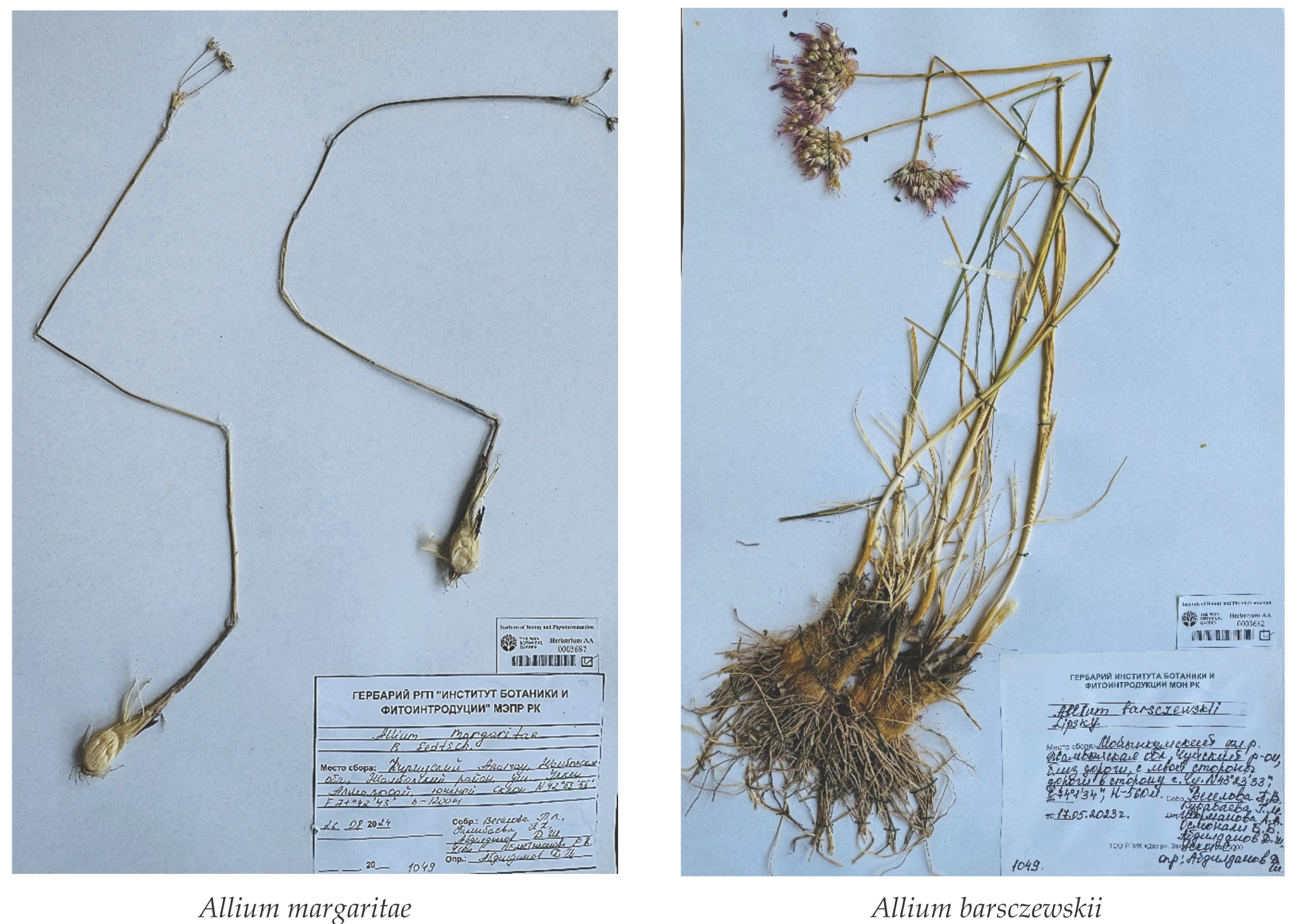
Due to the fact that out of 25 species noted for the Kazakhstan part of the flora of the Kyrgyz Alatau ridge, we had actual genetic material at our disposal for only 6 species (Figure 4), we were able to obtain ITS sequences only for these 6 species (8 specimens) (Table 3), the remaining ITS sequences were taken from the NCBI database [11]. It should be noted that most of the sequences used in this paper (for the missing species from the NCBI database), were sequenced earlier also by the authors of this paper.
Sequencing of ITS (ITS1-ITS4) fragments was carried out for 6 species (8 specimens) (Appendix A). Of these, 5 species were collected directly from the study area. The rest – the sequences used in this work – were sequenced previously (in other works of the authors of the paper). The ITS tree of sequences is made using the studied specimens and supplemented with specimens from the NCBI database. Samples of own materials are highlighted in bold in the tree. For ease of visual perception, colour highlighting is done.
The tree shows not only species affiliation, but also subgenus and sectional divisions (Figure 5).
3. Discussion
The analysis of species composition shows that within the Kyrgyz Alatau, representatives of subgenera Allium and Melanocrommyum are the most widely distributed among 7 subgenera of the studied genus. Such distribution corresponds to the general regularity noted for mountainous regions of Central Asia [1,4].
The subgenus Allium includes the largest number of species - 9 (5 sections), belonging mainly to the Allium section and characterised by adaptation to growing in the upper belt of mountains (subalpine and alpine belts). Representatives of the subgenus Allium are characterised by a wide ecological amplitude and play a key role in the vegetation cover of mountain ecosystems of the Kyrgyz Alatau. Subgenus Melanocrommyum is represented by 5 species (3 sections), characterised by characteristic large inflorescences, which underlines their potential ornamental value. Representatives of the subgenus are adapted to arid conditions and are confined to stony places. Phenological plasticity and clear ecological predilection of species testify to high adaptive ability of the genus to different conditions of altitudinal belt of the region.
The richness of species and their specialisation underline the floristic uniqueness of the Kyrgyz Alatau as an important centre of biodiversity of the genus Allium in Central Asia. The majority of species are regionally confined to the Tien Shan floristic province. Some species are also found in the neighbouring ranges: Terskey Alatau, Zailiyskiy Alatau, Karatau. Allium species in the Kyrgyz Alatau are clearly differentiated by altitudinal and microclimatic conditions, which indicates their high ecological plasticity and adaptation to extreme mountain conditions. Distribution by belts reflects the gradient from xerophytic steppes to mesophytic high-mountain meadows. Species of the genus Allium within the Kyrgyz Alatau on the territory of Kazakhstan demonstrate clear confinement to certain altitudinal belts and habitat types. The main mass of species is represented by inhabitants of mountain, subalpine and alpine belts, with a pronounced propensity to specific ecological conditions.
In general, the ecology and ranges of representatives of the genus Allium in the Kyrgyz Alatau reflect a high degree of ecological specialisation combined with geographical selectivity. Many species are confined to narrow ecological niches, which makes them vulnerable to anthropogenic impact and climatic changes. At the same time, species with a wider ecological amplitude often become components of secondary habitats, reflecting the processes of adaptation and change of plant communities under increasing pressure.
According to the results of the analysis by flow cytometry, data were obtained for six species of the genus Allium, represented in four subgenera and belonging to different sections. The following species were identified in the subgenus Allium: A. turkestanicum from section Mediasia with DNA content of 22.310 ± 0.566 pg, A. margaritae from section Brevispatha with 13.907 ± 0.047 pg and A. caeruleum from section Caerulea with 20.043 ± 0.796 pg. In subgenus Melanocrommyum, A. suworiwii, a representative of section Acmopetala, is characterised by a value of 44.159 ± 0.446 pg. Subgenus Reticulatobulbosa is represented by the species A. barzschzewskii from section Campanulata (21.948 ± 0.624 pg), and subgenus Cepa - by the species A. artrosanguineum from section Annuloprason with DNA content of 22.740 ± 0.018 pg (Table 2).
According to literature data, although the genome size is quite different, ploidy is similar in all and all are diploid (Figure 2).
According to the Plant DNA database [28], for most species characteristic of the Kyrgyz Alatau, the DNA content varies within 20-30 pg (Table 3), with some exceptions showing much higher values. For example, Allium karataviense recorded 39.68 pg, A. platystemon 38.80 pg, and A. suworowii 37.62 pg. According to Jones and Rees [25], the minimum amount of DNA within the genus Allium was previously recorded in A. schoenoprasum (16.90 pg). It should be noted that for a significant number of species of the genus Allium, the size of the nuclear genome has not been determined so far, which opens prospects for further studies.
Within the framework of the present work, for A. margaritae, we recorded the minimum value of DNA content in the genus Allium equal to 13.907 ± 0.047 pg (Table 1; 3). This is significantly lower than the value reported in Vakhtina et al. [22], where 31.50 pg is given for the same species. This discrepancy probably indicates the possible presence of polyploid forms within A. margaritae. Considering the low coefficient of variation of our measurements (0.34%), the data obtained seem reliable.
Similar discrepancies between published data and our results were found for Allium barzschzewskii and A. suworowii. For A. barzschzewskii, we determined the DNA content at 21.948 pg with a coefficient of variation of 2.84%, while a number of earlier publications for this species give a value of 31.60 pg [20]. Taking into account outdated methods of analysis and possible methodological differences, a discrepancy of about 10 pg can be considered acceptable.
For A. suworowii, we obtained a value of 44.159 pg (CV = 1.01%), whereas the database gives 37.62 pg [24]. Despite some difference, both values are in a close range and probably reflect both intraspecific variability and differences in the methods used. It should be emphasised that modern flow cytometry technologies provide higher accuracy and reproducibility of results, which increases the reliability of our measurements.
The species A. caeruleum showed a value of 20.043 pg (CV = 3.97%), which is comparable to the previously published genome size of 23.50 pg [21]. Thus, the data confirm each other within the margin of error.
For the two species studied, A. artrosanguineum and A. turkestanicum, the results of flow cytometry are presented for the first time. The values obtained are 22.740 ± 0.018 pg (CV = 0.08%) and 22.310 ± 0.566 pg (CV = 2.54%), respectively.
Molecular phylogenetic data are of particular interest: based on the analysis of ITS-sequences, it was found that the studied onion species from the Kyrgyz Alatau occupy the expected phylogenetic positions and correspond to previously published phylogenetic reconstructions [29,30,31,32,33,34], with no significant deviations detected. However, given that only five of the 25 Allium species distributed in the Kyrgyz Alatau were sampled directly from the Kyrgyz Range (see Table 3), further sequencing may reveal new or refined phylogenetic relationships.
4. Material and Methods
4.1. Distribution Analyses
Field studies were conducted during 2024-2025 on the territory of the western part of the Kyrgyz Alatau. The research included route surveys covering various types of habitats. In the course of field work, a targeted collection of herbarium material and samples of representatives of the genus Allium L. growing in this territory was carried out [5,6]. Along with this, they were photographed (Figure 2), geographically referenced using a GPS device (Figure 4).
The fundamental works on the genus Allium [3,5,6,35] were used to identify the collected materials and all modern publications on the genus Allium affecting species growing in the Kyrgyz Alatau [29,30,31,32,33,34,35,36] were considered. The herbarium collections of the Institute of Botany and Phytointroduction (AA, Almaty, Kazakhstan) and the Moscow State University named after M.V. Lomonosov (MW, Moscow, Russia) were studied. The names of taxa are given according to the databases International Plant Names Index (IPNI) [37] and Plants of the World Online (POWO) [2]. Materials from the Plantarium website [17] were also used.
The QGIS 3.34.13 program was used for data mapping (https://qgis.org, accessed on 5 June 2025).
4.2. Flow Cytometry
The DNA content was determined by flow cytometry techniques with propidium iodide (PI) staining. Leaves dried with silica gel were used as samples. Samples were chopped with standard using a sharp razor blade in LB01 buffer containing PI (50 µg/ml), RNase (50 µg/ml) [38] supplemented with 12 mM sodium thiosulfate and 1% polyvinylpyrrolidone [39]. The nuclear suspension was filtered through nylon filter with a pore size 30 μm. Analyses were performed on a Cytoflex (Beckman Coulter, Inc.) cytometer. Peaks with at least 1000 nuclei and a CV of less than 5 % were used for analysis. Histograms were visualized and processed using CytExpert software (Beckman Coulter, Inc.). Descriptive statistic was calculated using XLStat (Addinsoft). As an internal standard was used the Pisum sativum ‘Ctirad’, 2C = 9.09 pg and Vicia faba ‘Inovec’, 2C = 26.9 pg [38,40].
4.3. Phylogenetic Analyses
ITS DNA fragments were sequenced for the species studied of the genus Allium. The primers ITS1 (5’-TCCGTAGGTGAACCTGCGG-3’) and ITS4 (5’-TCCTCCTCCGCTTATTGATATATGC-3’) were used for ITS fragments. Polymerase chain reaction was performed in 50 µl of reaction mixture using Biomaster HS-Taq PCR-Color 2x PCR kit (Biolabmix LLC, Novosibirsk) in the following composition: per sample: 25 µl of ready PCR mixture, 21 µl of H2O, 1 µl of 10 mM respective primers, 2 µl of total DNA. Amplification protocol: 95 °C (3 min); 35 cycles: 95 °C (20 s), 57 °C (30 s), 72 °C (30 s); 72 °C (5 min). Amplification products were purified using microcolumns. Sequencing was performed by the Sanger method using an ABI PRISM 3500 XL sequencer. The obtained nucleotide sequences were aligned using the ClustalW algorithm in the MEGAX software [41] with manual evaluation of the read quality.
Both datasets (nrITS markers) were analyzed separately through Fitch parsimony with the heuristic search option in PAUP version 4.0 b10 [42] with MULTREES, TBR branch swapping, and 100 replicates of random addition sequence. Gaps were treated as missing data. The consistency index (CI) was calculated to estimate the amount of homoplasy in the character set [43]. The most parsimonious trees returned by the analysis were summarized in one consensus tree using the strict consensus method. Bootstrap support (BS)—were performed using 1,000 pseudoreplicates to assess the support of the clades [44]. Bayesian phylogenetic analyses were also performed using MrBayes 3.1.23 [45]. The sequence evolution model was chosen by following the Akaike information criterion (AIC) obtained from jModelTest2 [46]. Two independent analyses with four Markov chains were run for 10 million generations, sampling trees every 100 generations. The first 25% of the trees were discarded as burn-in. The remaining 150,000 trees were combined into a single dataset, and a majority-rule consensus tree was obtained, along with posterior probabilities (PP).
Two species were selected as an outgroup: Tulbaghia violacea Harv. and Nothoscordum bivalve (L.) Britton [34].
5. Conclusions
Thus, as a result of complex field studies, molecular-genetic analysis and critical review of literature data, it was established that the flora of the genus Allium in the Kyrgyz Alatau is represented by 25 species belonging to 7 subgenera and 17 sections. Within the framework of this work the nomenclature of a number of taxa was brought in accordance with modern systematic ideas (e.g., Allium polyphyllum as a synonym of A. carolinianum and A. caricifolium – A. pallasii), which is important for unification of regional and global databases.
The analysis of chorological data indicates the predominance of species with mountain genesis, reflecting the specific conditions of formation of the Central Asian flora. The results of flow cytometry showed that at the same level of ploidy (diploids), representatives of Allium show significant variation in the size of the nuclear genome. This suggests the presence of adaptive divergence due to the ecological diversity of mountain ecosystems of the Kyrgyz Alatau.
According to the phylogenetic tree, species are arranged in accordance with the expected taxonomic relationships, but further study of representatives of the genus Allium growing in the western part of the Kyrgyz Alatau may lead to clarification of the systematic composition, including possible identification of previously unrecorded species or exclusion of erroneously included taxa.
Author Contributions
Conceptualization, D.Sh.A.; methodology, D.Sh.A., N.F., B.B.O., S.U. and M.V.S.; formal analysis, N.F., P.V.V. and G.M.K.; writing-preparation of the initial draft, D.Sh.A., P.V.V., G.M.K. and N.F.; editing, N.F., D.Sh.A., P.V.V. and G.M.K.; author’s supervision, N.F.; project administration, D.Sh.A. and N.F.; acquisition of funding, P.V.V. All authors have read and agreed to the published version of the manuscript.
Funding
This research is funded by the Science Committee of the Ministry of Science and Higher Education of the Republic of Kazakhstan (Grant АР23484591”Comprehensive research (floristic, molecular genetic and resource) on the Allium L. genus of the Kyrgyz Alatau cross-border ridge — a scientific foundation for the management of the region’s natural resources” (2024–2026)).
Data Availability Statement
All data supporting this study’s findings are available in the main text or Appendix A.
Conflicts of Interest
All authors declare that they have no competing interests and personal relationships and agree on the contents of the paper.
Appendix A
References
- Friesen, N, 2023. Chapter 1. Introduction to Edible Alliums: Evolution, Classification and Domestication. In: Edible Allium: Botany, Production and Uses (Eds. H.D.Rabinowich and B.Thomas) CAB International Wallingford. Pp. 1 – 19. [CrossRef]
- POWO Plants of the World Online. Facilitated by the Royal Botanic Gardens, Kew. Available online: http://www. plantsoftheworldonline.org (accessed on 10 June 2025).
- Vvedensky, A.I. Genus Allium L. Identifier of Plants of Central Asia; FAN Uzbek SSR: Tashkent, Uzbekistan, 1971; pp. 39–89. (In Russian) [Google Scholar]
- Khassanov, F.O. Taxonomical and Etnobotanical aspect of Allium species from Midle Asia with particular reference to subgenus Allium. In The Allium Genomes, Compedium of Plant Genomes; Shigyo, M., Ed.; Springer Nature: Cham, Switzerland, 2018. [Google Scholar] [CrossRef]
- Vvedensky, A.I. Genus Allium L. Flora of the USSR.; Publishing House of the USSR Academy of Sciences: Leningrad, Russia, 1935; Volume 4, pp. 112–280. (In Russian) [Google Scholar]
- Pavlov, N.V. (Ed.) Flora of Kazakhstan; Academy of Sciences of the Kazakh SSR: Alma-Ata, Kazakhstan, 1958; Volume 2. (In Russian) [Google Scholar]
- Kubentayev, S.A.; Alibekov, D.T.; Perezhogin, Y.V.; Lazkov, G.A.; Kupriyanov, A.N.; Ebel, A.L.; Izbastina, K.; Borodulina, O.; Kubentayeva, B.B. Revised checklist of endemic vascular plants of Kazakhstan. PhytoKeys 2024, 238, 241–279. [Google Scholar] [CrossRef]
- Botanical Geography of Kazakhstan and Central Asia (Within the Desert Region). St. Petersburg, Russia„ 2003; p. 424.
- Baitenov, Muslim S. “Flora Kazahstana. Rodovoj kompleks flory [Flora of Kazakhstan. Generic complex of flora].” Almaty: Gylym, 2001.
- Epiktetov, V.; The Genus Allium in the Flora of Kazakhstan. Floristic List. 2025. Available online: https://www.plantarium.ru/ page/flora/id/1087.html (accessed on 10 June 2025).
- National Center for Biotechnology Information (NCBI) https://www.ncbi.nlm.nih.gov/. (accessed on 10 June 2025).
- Abdildanov, D.S.; Vesselova, P.V., Kudabayeva, G.M., Osmonali, B.B., Shormanova,A.A., Ussen, S. (2023). To the distribution of Allium suworowii Regel within Kazakhstan. Redaksyalyk alka, 13. (In Russian).
- Red Book of Kazakhstan]. Vol. 2. Part 1. Rasteniia — Plants. (2d ed.). Astana: «ArtPrintXX1» [in Russian].
- Gemejiyeva, N.; Abdildanov, D.; Kudabayeva, G.; Vesselova, P.; Nelina, N.; Friesen, N. Species of the genus Allium L. of the western part of the Kyrgyz Alatau ridge: the current status and prospects of studying. Fundamental and Experimental Biology 2025, 11830, 13–25. [Google Scholar] [CrossRef]
- Tokenova, A.; Sitpayeva, G.; Gemejiyeva, N.; Suleimenova, S.; Friesen, N.; Batayeva, D. Wild Allium longicuspis Regel is a Feral Form of Allium sativum L. in Kazakhstan: A Comparative Molecular Genetic Analysis. OnLine Journal of Biological Sciences. 2023. [Google Scholar] [CrossRef]
- Friesen, N.; Grützmacher, L.; Skaptsov, M.; Vesselova, P.; Dorofeyev, V.; Luferov, A.N.; Hurka, H. Allium pallasii and A. caricifolium—Surprisingly diverse old steppe species, showing a clear geographical barrier in Lake Zaysan. Plants 2022, 11, 1465. [Google Scholar] [CrossRef] [PubMed]
- Plantarium (2007–2025): An Open Online Atlas-Definition of Plants and Lichens of Russia And Neighbouring Countries. Electronic Resource. Available online: http://www.plantarium.ru/ (accessed on 10 June 2025).
- Sennikov, A.N.; Lazkov, G.A.; Ganabyeva, M.R.; Friesen, N.; German, D.A. Taxonomic corrections and new records for vascular plants of Kyrgyzstan, 6. Nordik Journal of Botany 2025, 2025, e04731. [Google Scholar] [CrossRef]
- Friesen, N.; Lazkov, G.; Levichev, I.G.; Leweke, M.; Abdildanov, D.; Turdumatova, N.; Murtazaliev, R.; Dzumanov, S.; Sitpayeva, G.T.; Vesselova, P.; Epiktetov, V.; Ertuğrul, K.; Tugay, O.; Fritsch, R.M. Taxonomy and dated molecular phylogeny of Allium oreophilum sensu lato (A. subg. Porphyroprason) uncover a surprising number of cryptic taxa. Taxon. 2025. [Google Scholar] [CrossRef]
- Labani, R.M.; Elkington, T.T. Nuclear DNA variation in the genus Allium L. (Liliaceae). Heredity 1987, 59, 119–128. [Google Scholar] [CrossRef]
- Ohri, D.; Pistrick, K. Phenology and genome size variation in Allium L. tight correlation? Plant Biol. 2001, 3, 654–660. [Google Scholar] [CrossRef]
- Vakhtina, L.I.; Zakirova, R.O.; Vakhtin, Y.B. Interspecific differences in DNA content and taxonomically significant characters in the genus Allium L.(Liliaceae). Bot. Zhurnal Leningrad 1977, 62, 677–684. [Google Scholar]
- Gurushidze, M.; Fuchs, J.; Blattner, F.R. The evolution of genome size variation in drumstick onions (Allium subgenus Melanocrommyum). Systematic Botany 2012, 37, 96–104. [Google Scholar] [CrossRef]
- Gurushidze, M.; Fritsch, R.M.; Blattner, F.R. . Phylogenetic analysis of Allium subgenus Melanocrommyum infers cryptic species and demands a new sectional classification. Molecular Phylogenetics and Evolution 2008, 49, 997–1007. [Google Scholar] [CrossRef]
- Jones, R.N.; Rees, H. The influence of B-chromosomes upon the nuclear phenotype in rye. Chromosoma 1968, 24, 158–176. [Google Scholar] [CrossRef]
- Baranyi, M.; Greilhuber, J. Genome size in Allium: in quest of reproducible data. Annals of Botany 1999, 83, 687–695. [Google Scholar] [CrossRef]
- Brandham, P.E.; Doherty, M.J. Genome size variation in the Aloaceae, an angiosperm family displaying karyotypic orthoselection. Annals of Botany 1998, 82, 67–73. [Google Scholar] [CrossRef]
- Leitch, I.J.; Johnston, E.; Pellicer, J.; Hidalgo, O.; Bennett, M.D. Plant DNA C-values Database (release 9.0, April 2019). Available online: https://cvalues.science.kew.org/ (accessed on 10 June 2025).
- Friesen, N.; Fritsch, R.M.; Blattner, F. Phylogeny and new intrageneric classification of Allium L. (Alliaceae) based on nuclear ribosomal DNA ITS sequences. Aliso 2006, 22, 372–395. [Google Scholar] [CrossRef]
- Li, Q.Q. , Zhou, S.D., He, X.J., Yu, Y., Zhang, Y.C., & Wei, X.Q. Phylogeny and biogeography of Allium (Amaryllidaceae: Allieae) based on nuclear ribosomal internal transcribed spacer and chloroplast rps16 sequences, focusing on the inclusion of species endemic to China. Annals of botany 2010, 106, 709–733. [Google Scholar] [CrossRef]
- Abdildanov, D.S.; Vesselova, P.V.; Kudabayeva, G.M.; Osmonali, B.B.; Skaptsov, M.V.; Friesen, N. Endemic of Kazakhstan Allium lehmannianum Merckl. Ex Bunge and Its Position Within the Genus Allium. Plants 2025, 14, 1113. [Google Scholar] [CrossRef]
- Yusupov, Z.; Ergashov, I.; Volis, S.; Makhmudjanov, D.; Dekhkonov, D.; Khassanov, F.; Sun, H. (). Seed macro-and micromorphology in Allium (Amaryllidaceae) and its phylogenetic significance. Annals of Botany 2022, 129, 869–911. [Google Scholar] [CrossRef]
- Seregin, A.P.; Friesen, N. Molecular and morphological revision reveals different evolution patterns in Allium sect. Oreiprason and sect. Falcatifolia (Amaryllidaceae). In:Timonin AC (Ed.) Semicentenary after Konstantin Meyer: XIII Moscow Symposium on plant phylogeny. MSU, Moscow, 2015 353–356. [CrossRef]
- Friesen, N.; Herden, T.; Leweke, M.; Grützmacher, L.; Fragman-Sapir, O.; Hurka, H.; Frank, R.; Blattner, F.R.; Fritsch, R.M. Dated phylogeny, phylogeography, and classification of Allium subgenus Amerallium (Amaryllidaceae) from the Old World, based on six DNA fragments. Taxon 2024, 73, 971–991. [Google Scholar] [CrossRef]
- Goloskokov, V.P. (Ed.) Illustrated Identifier of Plants of Kazakhstan; Nauka Kazahskoj SSR: Alma-Ata, Kazakhstan, 1969; Volume 1. (In Russian) [Google Scholar]
- State Plant Cadastre of Zhambyl region - Almaty, 2007. - 517 p. (In Russian).
- The Royal Botanic Gardens Kew; Harvard University Herbaria; Libraries and Australian National Botanic Gardens. IPNI International Plant Names Index. Available online: http://www.ipni.org (accessed on 10 June 2025).
- Doležel, J.; Sgorbati, S.; Lucretti, S. Comparison of three DNA fluorochromes for flow cytometric estimation of nuclear DNA content in plants. Physiol. Plant. 1992, 85, 625–631. [Google Scholar] [CrossRef]
- Skaptsov, M.V.; Kutsev, M.G.; Smirnov, S.V.; Vaganov, A.V.; Uvarova, O.V.; Shmakov, A.I. Standards in plant flow cytometry: An overview, polymorphism and linearity issues. Turczaninowia 2024, 27, 86–104. [Google Scholar] [CrossRef]
- Doležel, J.; Greilhuber, J.; Lucretti, S.; Meister, A.; Lysák, M.; Nardi, L.; Obermayer, R. Plant genome size estimation by flow cytometry: Inter-laboratory comparison. Ann. Bot. 1998, 82, 17–26. [Google Scholar] [CrossRef]
- Kumar, S.; Stecher, G.; Tamura, K. MEGA 7: Molecular Evolutionary Genetic Analysis version 7.0 for bigger datasets. Mol. Biol. Evol. 2016, 33, 1870–1874. [Google Scholar] [CrossRef]
- Swofford, D.L. PAUP*: Phylogenetic analysis using parsimony (*and other methods), version 4.0b10. 2002. Sunderland, MA: Sinauer Associates.
- Kluge, A.G.; Farris, J.S. Quantitative phyletic and the evolution of anurans. Syst. Zool. 1969, 18, 1–32. [Google Scholar] [CrossRef]
- Felsenstein, J. Confidence limits on phylogenies: an approach using the bootstrap. Evolution (Lancaster) 1985, 39, 783–791. [Google Scholar] [CrossRef]
- Ronquist, F.; Huelsenbeck, J.P. MrBayes 3: Bayesian phylogenetic inference under mixed models. Bioinformatics 2003, 19, 1572–1574. [Google Scholar] [CrossRef] [PubMed]
- Darriba, D.; Taboada, G.L.; Doallo, R.; Posada, D. jModelTest 2: more models, new heuristics and parallel computing. Nature Meth. 2012, 9, 772. [Google Scholar] [CrossRef] [PubMed]
Figure 1.
The study area is the Kazakh part of the Kyrgyz Alatau range.
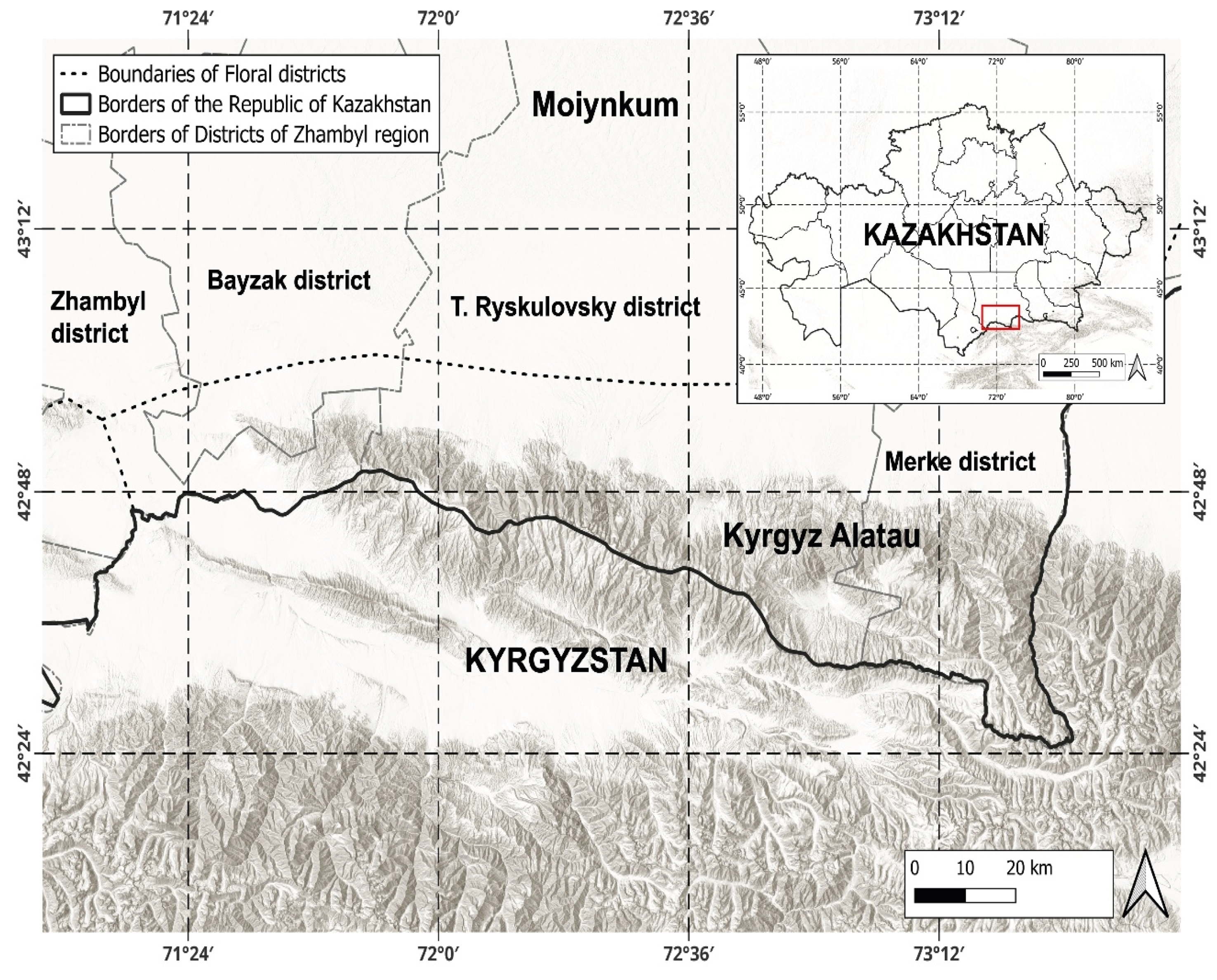
Figure 2.
– Photos of some species of the genus Allium in the Kyrgyz Alatau (A – A. caricifolium (Zhambyl region, Turar Ryskulov district, Makpal gorge, 03.V.2025), B – Allium barsczewskii (Zhambyl region, Turar Ryskulov district, Makpal gorge, 03.V.2025), C–Allium trachyscordum (Zhambyl region, Zhambyl district, Kara-Arsha gorge 05.V.2025), D – Allium suworowii (Zhambyl region, Turar Ryskulov district, Syugaty gorge 03.V.2025), E– Allium karataviense (Zhambyl region, Turar Ryskulov district, Syugaty gorge 03.V.2025), F – Allium fetisowii (Zhambyl region, Turar Ryskulov district, Syugaty gorge 03.V.2025)).
Figure 2.
– Photos of some species of the genus Allium in the Kyrgyz Alatau (A – A. caricifolium (Zhambyl region, Turar Ryskulov district, Makpal gorge, 03.V.2025), B – Allium barsczewskii (Zhambyl region, Turar Ryskulov district, Makpal gorge, 03.V.2025), C–Allium trachyscordum (Zhambyl region, Zhambyl district, Kara-Arsha gorge 05.V.2025), D – Allium suworowii (Zhambyl region, Turar Ryskulov district, Syugaty gorge 03.V.2025), E– Allium karataviense (Zhambyl region, Turar Ryskulov district, Syugaty gorge 03.V.2025), F – Allium fetisowii (Zhambyl region, Turar Ryskulov district, Syugaty gorge 03.V.2025)).
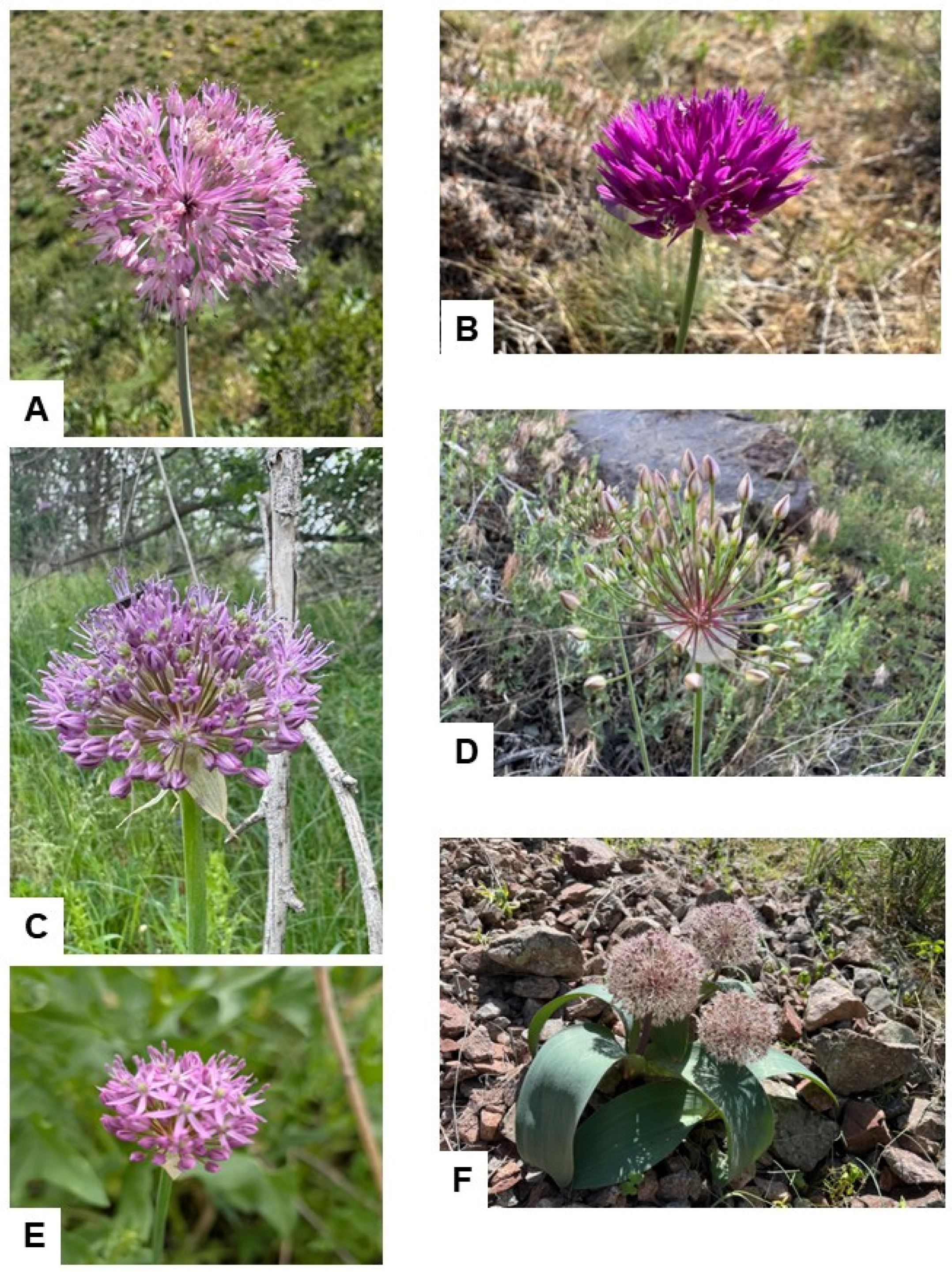
Figure 3.
Examples of ungated flow cytometric histograms of the Allium samples (log scale). A, A. barzsczewskii; B, A. turkestanicum; C, A. atrosanguineum; D, A. margaritae; E, A. suworowii. P.s. – Pisum sativum internal standard; V.f. – Vicia faba internal standard.
Figure 3.
Examples of ungated flow cytometric histograms of the Allium samples (log scale). A, A. barzsczewskii; B, A. turkestanicum; C, A. atrosanguineum; D, A. margaritae; E, A. suworowii. P.s. – Pisum sativum internal standard; V.f. – Vicia faba internal standard.
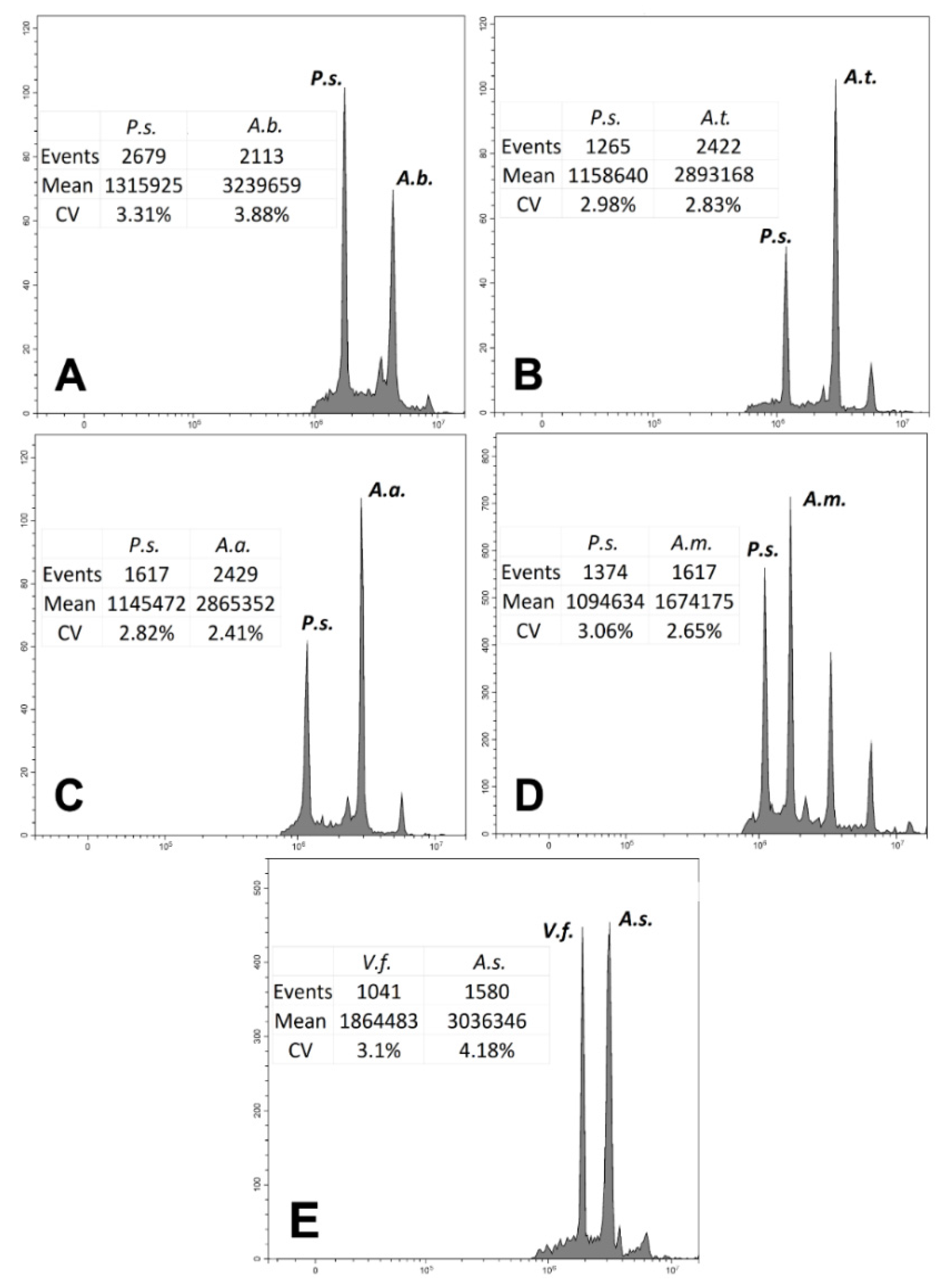
Figure 4.
Map of specimen collection points of Allium species.
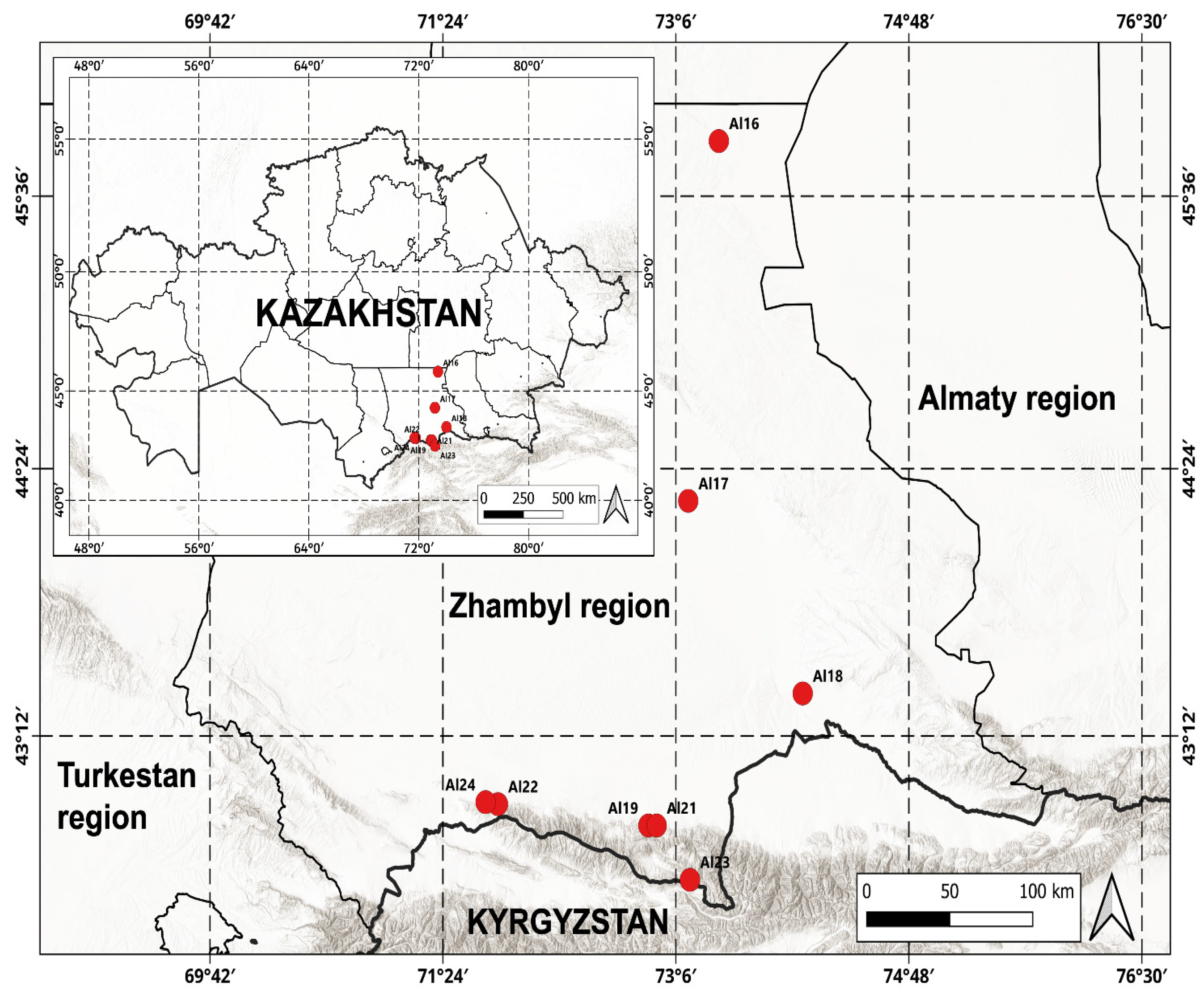
Figure 5.
ITS tree of species of the genus Allium. The joint presence of Bayesian with a probability greater than 0.98 and bootstrap support greater than 95% is indicated by a black dot. The samples we investigated are highlighted in bold. The following data were obtained by running the data through the JModeltest software: 010234+G+F, -lnL 7923.16582, AIC 16137.894239, weight 0.493067.
Figure 5.
ITS tree of species of the genus Allium. The joint presence of Bayesian with a probability greater than 0.98 and bootstrap support greater than 95% is indicated by a black dot. The samples we investigated are highlighted in bold. The following data were obtained by running the data through the JModeltest software: 010234+G+F, -lnL 7923.16582, AIC 16137.894239, weight 0.493067.
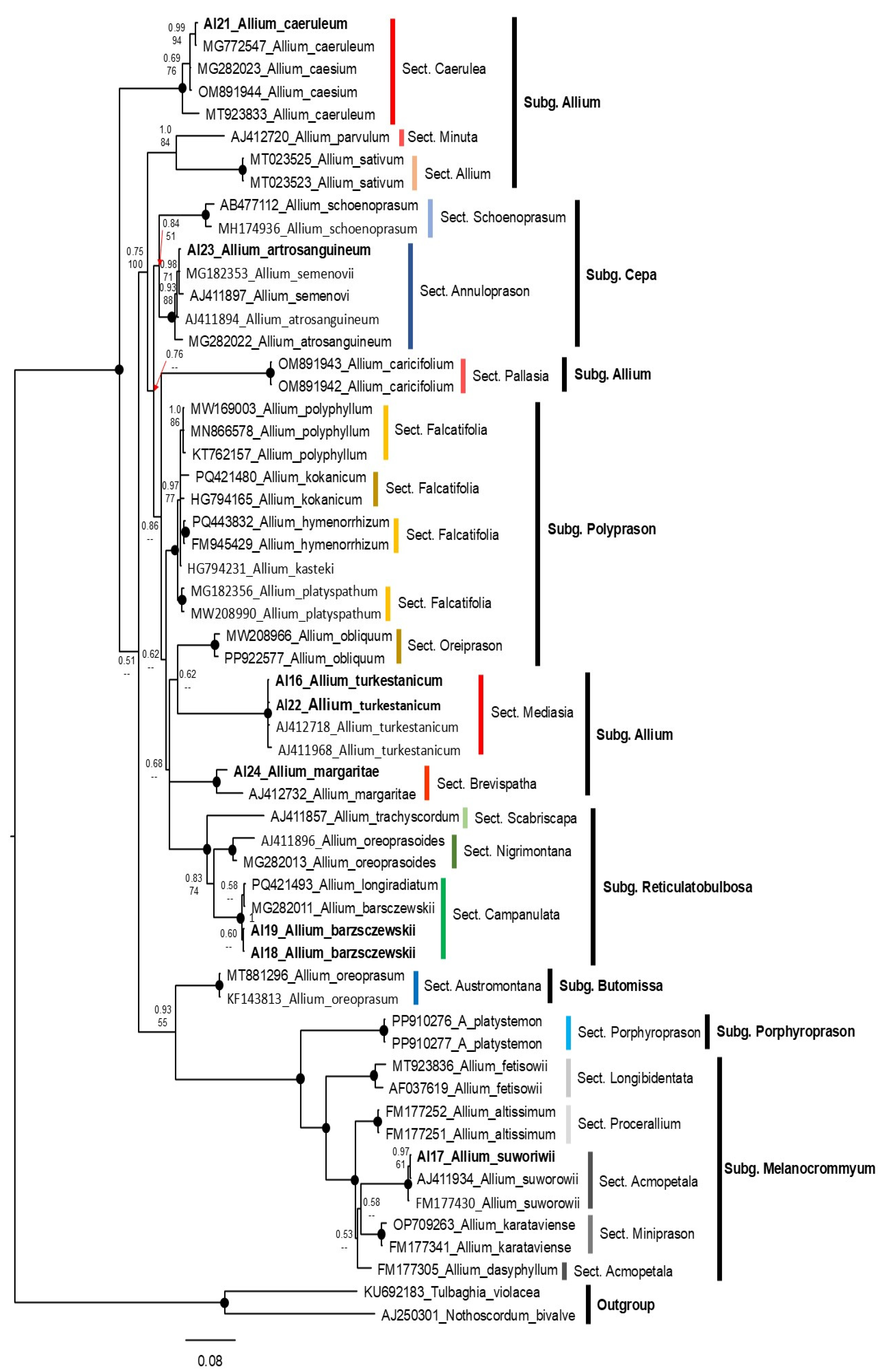

Table 1.
DNA content of the studied Allium samples.
| Species | Mean 2C ± SD, pg | CV | 1C, Gbp | Expected ploidy |
|---|---|---|---|---|
| A. turkestanicum | 22,310 ±0,566 | 2,54% | 21,820 | 2 |
| A. suworiwii | 44,159 ± 0,446 | 1,01% | 43,187 | 2 |
| A. barzsczewskii | 21,948 ± 0,624 | 2,84% | 21,465 | 2 |
| A. artrosanguineum | 22,740 ± 0,018 | 0,08% | 22,240 | 2 |
| A. margaritae | 13,907 ± 0,047 | 0,34% | 13,601 | 2 |
| A. caeruleum | 20,043 ± 0,796 | 3,97% | 19,602 | 2 |
Table 2.
Genome sizes of the studied species of the genus Allium (according to literature sources and databases).
Table 2.
Genome sizes of the studied species of the genus Allium (according to literature sources and databases).
| № | Species | DNA Amount2C (pg) | Original Reference |
|---|---|---|---|
| 3 | A. barsczewskii | 31.60 | [20] |
| 4 | A. caeruleum | 23.50 | [21] |
| 5 | A. caesium | 25.90 | [22] |
| 8 | A. fetisowii | 26.26 | [23] |
| 9 | A. hymenorhizum | 25.70 | [21] |
| 10 | A. karataviense | 39.68 | [26] |
| 13 | A. longicuspis | 35.10 | [27] |
| 15 | A. margaritae | 31.50 | [22] |
| 16 | A. oreophilum | 38.80 | [22] |
| 19 | A. obliquum | 26.30 | [21] |
| 23 | A. schoenoprasum | 16.90 | [25] |
| 25 | A. suworowii | 37.62 | [24] |
Table 3.
Collection points of genetic material of species of the genus Allium and accessions number of ITS sequences.
Table 3.
Collection points of genetic material of species of the genus Allium and accessions number of ITS sequences.
| № | Sample number | Species | Location of material collection | Voucher number | ITS |
|---|---|---|---|---|---|
| 1 | Al16 | Allium turkestanicum | Betpakdala floristic region, Zhambyl region, southern part of BetpakdalaN 45.839444 E 73.413889 | AA0003680 | PV915722 |
| 2 | Al17 | A. suworowii | Moyinkum floristic area, Zhambyl region, Chui district, close to the road, Moyinkum-Chu highway, sands. Saxaulnik. N 44.257222 E 73.190556 |
AA0003681 | PV915724 |
| 3 | Al18 | A. barsczewskii | Moyinkum floristic area, Zhambyl region, Chui district, close to the road on the left side of the road in the town of Chu. N 43.3925 E 74.026111 | AA0003682 | PV915721 |
| 4 | Al19 | A. barsczewskii | Kyrgyz Alatau, Zhambyl region, T. Ryskulov district, Karakystak village. N 42.792222 E 72.9 | AA0003683 | PV915720 |
| 5 | Al21 | A. caeruleum | Kyrgyz Alatau, Zhambyl region, T. Ryskulov district, Karakystak. N 42.792222 E 72.9 | AA0003684 | PV915723 |
| 6 | Al22 | A. turkestanicum | Kyrgyz Alatau, Zhambyl region N 42.889830 E 71.801594 |
AA0003685 | PV915719 |
| 7 | Al23 | A. atrosanguineum | Kyrgyz Alatau, Zhambyl Oblast, Kaskasu Gorge. N 42.543611 E 73.203333 |
AA0003686 | PV915718 |
| 8 | Al24 | A. margaritae | Kyrgyz Alatau, Zhambyl region, Zhambyl district, ul. Ulken Almalysay, southern slope. N 42.898889 E 71.711944 |
AA0003687 | PV915717 |
Disclaimer/Publisher’s Note: The statements, opinions and data contained in all publications are solely those of the individual author(s) and contributor(s) and not of MDPI and/or the editor(s). MDPI and/or the editor(s) disclaim responsibility for any injury to people or property resulting from any ideas, methods, instructions or products referred to in the content. |
© 2025 by the authors. Licensee MDPI, Basel, Switzerland. This article is an open access article distributed under the terms and conditions of the Creative Commons Attribution (CC BY) license (http://creativecommons.org/licenses/by/4.0/).
Copyright: This open access article is published under a Creative Commons CC BY 4.0 license, which permit the free download, distribution, and reuse, provided that the author and preprint are cited in any reuse.


