

Submitted:
24 July 2025
Posted:
25 July 2025
Read the latest preprint version here
Abstract
The velocity of light is one of the most fundamental questions in physics. For centuries, the velocity of light has been a subject of scientific discussion. In this article, we will discuss this subject based on the experimental data. Marmet measured in 2000 that light needs 14 μs more when traveling in the direction S.F to N.Y., when traveling back in the opposite direction. These data are the main tools of this research. The result of the research is that light has a constant velocity in a still medium. In the dynamic medium velocity of light increases or decreases depending on the position of the apparatus that measures its velocity. The second postulate of STR is valid only in a stationary ether.
Keywords:
velocity of light
; ether
; STR
; VTR
1. Introduction
Precise measurement confirmed that light needs μs (microseconds) extra when traveling from San Francisco to New York: “However, an accurate measurement of the time interval given by the GPS shows that light takes an extra 0.014 microseconds for light to travel eastward (from S.F. to N.Y.)” [1]. Light is energy, and energy can only move in a medium that also has an attribute of energy. We will introduce back old model of ether, which is not static; it is dynamic, it moves and rotates with stellar objects. Earth rotates in the direction from S.F. to N.Y. Local ether moves and rotates with the Earth. That’s why light, when moving in the direction of Earth's motion, has a smaller velocity than when moving in the opposite direction. The distance from GPS satellite above New York and GPS satellite above San Francisco is about 4500 km. Light needs 15000 microseconds to travel this distance. If Earth were to move through the stationary non-rotating ether, the situation would be as follows:
Earth rotates local ether and the situation is as follows:
Imagine measuring the velocity of light with an apparatus. This apparatus would also move in the ether. That’s why when we would measure light in the direction of S.F.-N.Y., the measured velocity of light would be the velocity of light minus the velocity of the ether in which the apparatus exists. When we would measure in the direction N.Y.-S.F., the measured velocity of light would be the velocity of light plus the velocity of the ether in which the apparatus exists. This measurement confirms that at the latitudes of San Francisco and New York, at the height of GPS satellites, which is 20.200 km above the surface, ether has a velocity of 140 km/s. This causes changes in the velocity of light when moving from S.F. to N.Y. or in the opposite direction.
At 39 degrees north, Earth's surface rotation velocity is 1301 km/h. The Earth is rotating the local ether at a height of 20.200 kilometres above Earth’s surface, with approximately 11% of its rotational velocity. We suppose that at the Earth's surface, the rotational velocity of the ether is close to the rotational velocity of the Earth’s surface. The local ether is moving and rotating with the Earth. That’s why the Michelson-Morley experiment gave a null result. Since it was carried out with false premise that Earth moves through the stationary ether [2].
2. Result of the Measurement of the Velocity of Light Depend on the Observer Position
Imagine you swim in a lake at a speed of 15 km/h where water is at rest and continue to swim in a river that comes out of the lake, which has a speed of 10 km/h. Your speed on the lake will be 15 km/h. Also, for an observer on the bank of the lake, your speed will be 15 km/h. Your speed in the river will be 5 km/h as for an internal observer and 25 km/h for an observer on the bank of the river.
The same happens for an internal observer when measuring the duration of light motion from San Francisco to New York. The observer and the apparatus are in the local ether in motion and so the apparatus measures velocity of light.
The lake represents the ether at rest, the river represents moving ether, and you, as the swimmer, represent light and its variable velocity. When you start swimming upstream, you will have a speed of 25 km/h concerning the river. When swimming upstream, for the external observer on the bank of the river, you will have a speed of 5 km/h. The same happens for an external observer in the Fizeau and Sagnac experiments [2].
When you would move out of the Earth’s local ether into the area of ether at rest, you would measure that velocity of light when moving from S.F. to N.Y has velocity of .
Figure 1.
Local ether rotates with the Earth.
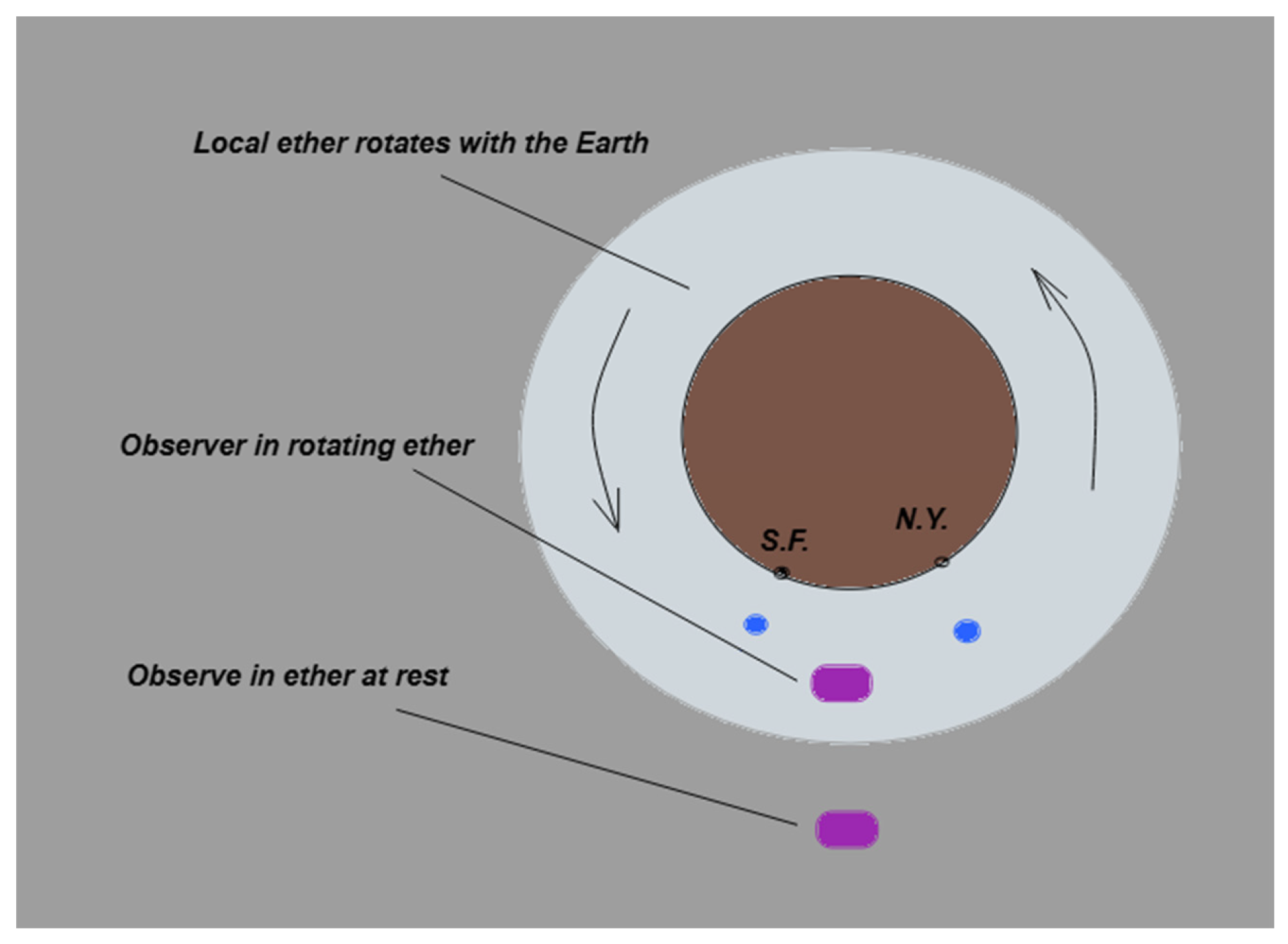
In measuring the speed of light, the observer's position is crucial. In the case of moving ether, Einstein was correct that the observer's location determines how they perceive physical reality. The observer within the moving ether experiences the velocity of light differently from the observer outside of the moving ether in the ether at rest.
3. Discussion
The Special Relativity postulate about the constancy of light is valid only for the areas of universal space where the ether is at rest. Sagnac experiment [3,4] and Fizeau experiment [5,6] proved that the velocity of light is not constant. In the Sagnac experiment interferometer rotates the local ether; in the Fizeau experiment, water moves the local ether [2].
Vibrating Rays Theory (VRT) also proposes that velocity of light is not constant and depends on the velocity of the source and on the velocity of the receiver [7]. In VTR velocity of light coming out of the source that moves with velocity is as follows: . If this is right, then it would be difficult to explain the Doppler effect: in the case that the source moves or the receiver moves so that the distance between them increases, the light wave will be stretched. In the case that the source moves or the receiver moves so that the distance between them decreases, then the light wave will be squished. If light is not stretched or squished, as is the case in VTR, where light increases velocity when the source is in motion, there is no Doppler effect.
VTR has a problem to explain how the Doppler effect is generated. Classical explanation of the Doppler effect is that with the motion of the source or receiver, the light gets stretched or squished, but its velocity of light remains unchanged, see Figure 2:
Experiments conducted on the Earth’s surface involving the Doppler effect were all performed within the local dynamic ether. The source and receiver were always located in the same local ether that moves and rotates with the Earth. Therefore, the results of the measurements are as if they were performed in a stationary ether.
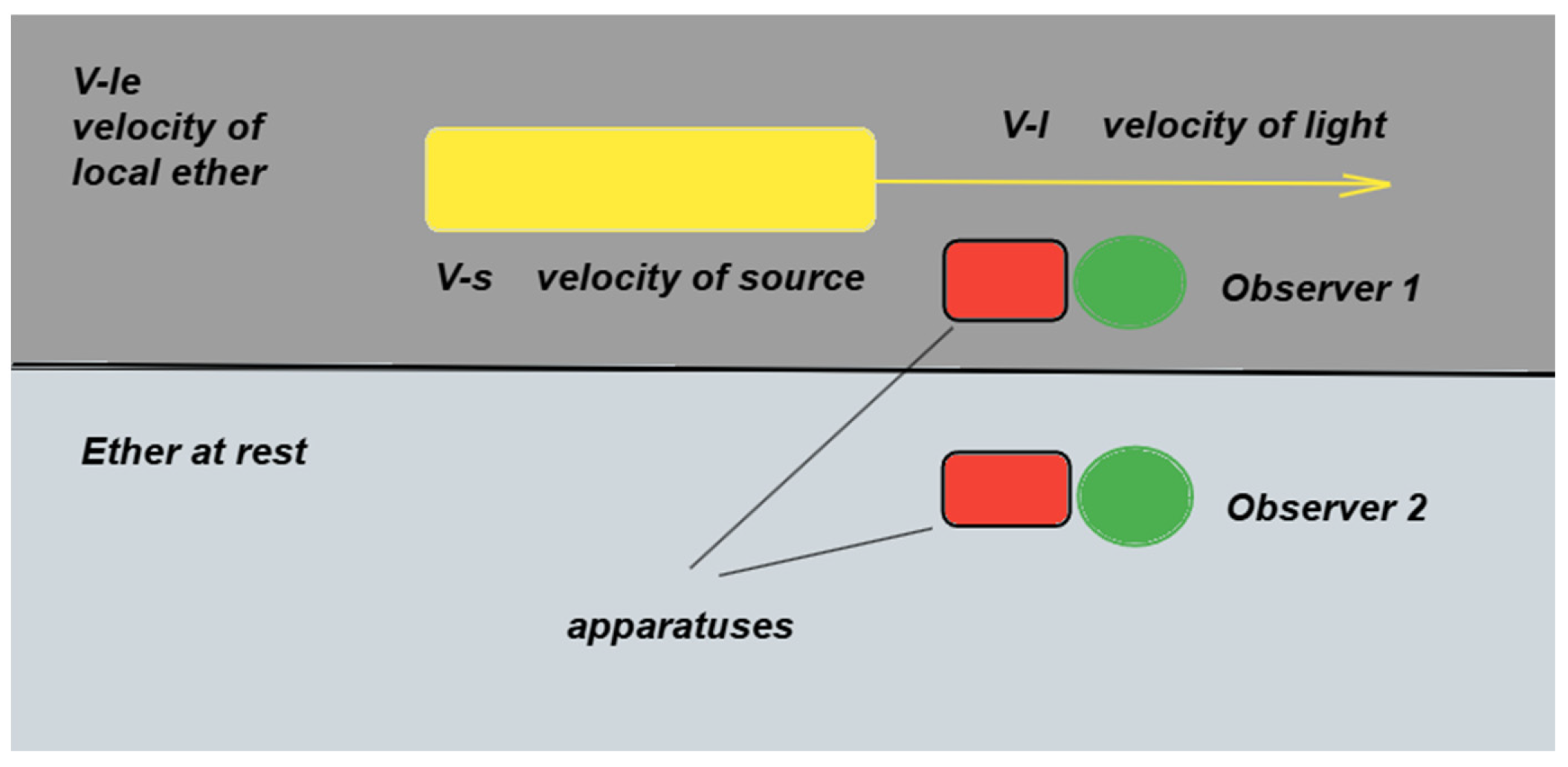
In STR, space is empty, and light moves through an empty space deprived of physical properties. This is its weakest point [2]. In VTR, light moves along the rays that are created by the source of light, and these rays extend into the infinity of space. Imagine that the source of light is placed in a moving ether and we have two apparatuses that measure the velocity of the light. One is in the local moving ether, the other is in the stationary ether, see Figure 3:
According to Ether Relativity, velocity of light for the observer 1 and 2 will be:
According to STR, velocity of light for the observer 1 and 2 will be:
According to VTR, velocity of light for the observer 1 and 2 will be:
Eq. (1) has experimental verification when light moves from S.F. to N.Y. Eq. (2) has experimental verification in Fizeau experiment and in Sagnac experiment. Equations of STR (3,4) and equations VTR (5.6) were never experimentally proved. The second postulate of STR is only valid in a stationary ether. It is not valid in the Sagnac and the Fizeau experiments, where the interferometer (Sagnac) and the flow of the water in the tube (Fizeau) create an additional motion of local ether. This decreases the velocity of light for an internal observer and increases it for an external observer.
We have seen in this article that in the ether model, photon is the wave of the ether, and its velocity has minimal variations in the moving and rotating ether. The speed of light also diminishes minimally with the increase of gravity and the decrease of the variable energy density of ether. In modern physic, this effect is named “gravitational time delay”: “Because, according to the general theory, the speed of a light wave depends on the strength of the gravitational potential along its path, these time delays should thereby be increased by almost 2×10⁻⁴ sec when the radar pulses pass near the sun. Such a change, equivalent to 60 km in distance, could now be measured over the required path length to within about 5% to 10% with presently obtainable equipment” [8]. The official interpretation of modern physic is that because of gravitational time delay in stronger gravity, time as the 4th coordinate of space stretches, and this means that the signal needs more time to reach from point A to point B. Interpretation is not right; the fact is that in stronger gravity, where the energy density of ether diminishes, light speed diminishes minimally. Again, STR second postulate is not valid.
4. Conclusions
STR is a great intellectual achievement of 20th-century physics. The first postulate of STR has been confirmed valid in all experiments done so far. The second postulate has not been confirmed in all experiments, and revision is required: the velocity of light is constant in a stationary ether where gravity force is not changing. In a dynamic ether velocity of light is not constant.
References
- Paul Marmet, The GPS and the constant velocity of light, Acta Scientiarum, 22 (2000), no. 5, 1269-1279. https://periodicos.uem.br/ojs/index.php/ActaSciTechnol/article/view/3062/2214.
- Amrit Sorli, Einstein Legacy: Ether relativity and cosmology, preprint https://www.preprints.org/manuscript/202506.0266/v2. [CrossRef]
- Sagnac, Georges (1913), "L'éther lumineux démontré par l'effet du vent relatif d'éther dans un interféromètre en rotation uniforme" [The demonstration of the luminiferous aether by an interferometer in uniform rotation], Comptes Rendus, 157: 708–710.
- Sagnac, Georges (1913), "Sur la preuve de la réalité de l'éther lumineux par l'expérience de l'interférographe tournant" [On the proof of the reality of the luminiferous aether by the experiment with a rotating interferometer], Comptes Rendus, 157: 1410–1413.
- Fizeau, H. (1851). "Sur les hypothèses relatives à l'éther lumineux". Comptes Rendus. 33: 349–355. English: Fizeau, H. (1851). "The Hypotheses Relating to the Luminous Aether, and an Experiment which Appears to Demonstrate that the Motion of Bodies Alters the Velocity with which Light Propagates itself in their Interior" . Philosophical Magazine. 2: 568–573. [CrossRef]
- Fizeau, H. (1859). "Sur les hypothèses relatives à l'éther lumineux". Ann. Chim. Phys. 57: 385–404. English: Fizeau, H. (1860). "On the Effect of the Motion of a Body upon the Velocity with which it is traversed by Light" . Philosophical Magazine. 19: 245–260.
- Luis Bilbao, Luis Bernal, Fernando Minotti, Vibrating rays theory (2019) https://arxiv.org/abs/1407.5001. [CrossRef]
- Irwin I. Shapiro (1964). "Fourth Test of General Relativity". Physical Review Letters. 13 (26): 789-791. Bibcode:1964PhRvL..13..789S. [CrossRef]
Figure 2.
Doppler effect of light.
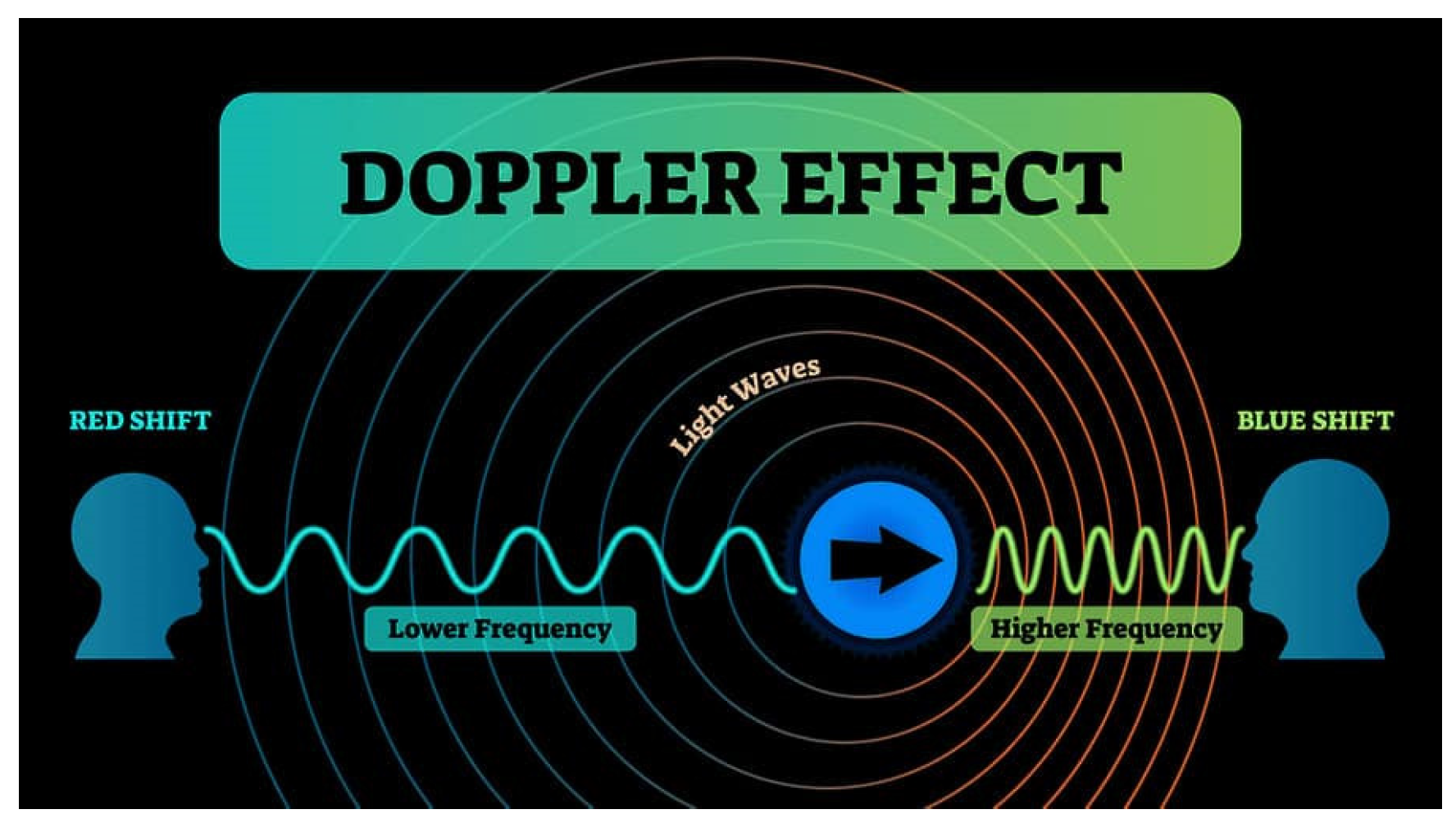
Figure 3.
Velocity of light in moving ether.
Disclaimer/Publisher’s Note: The statements, opinions and data contained in all publications are solely those of the individual author(s) and contributor(s) and not of MDPI and/or the editor(s). MDPI and/or the editor(s) disclaim responsibility for any injury to people or property resulting from any ideas, methods, instructions or products referred to in the content. |
© 2025 by the author. Licensee MDPI, Basel, Switzerland. This article is an open access article distributed under the terms and conditions of the Creative Commons Attribution (CC BY) license (https://creativecommons.org/licenses/by/4.0/).
Copyright: This open access article is published under a Creative Commons CC BY 4.0 license, which permit the free download, distribution, and reuse, provided that the author and preprint are cited in any reuse.


