

Submitted:
23 July 2025
Posted:
28 July 2025
You are already at the latest version
Abstract
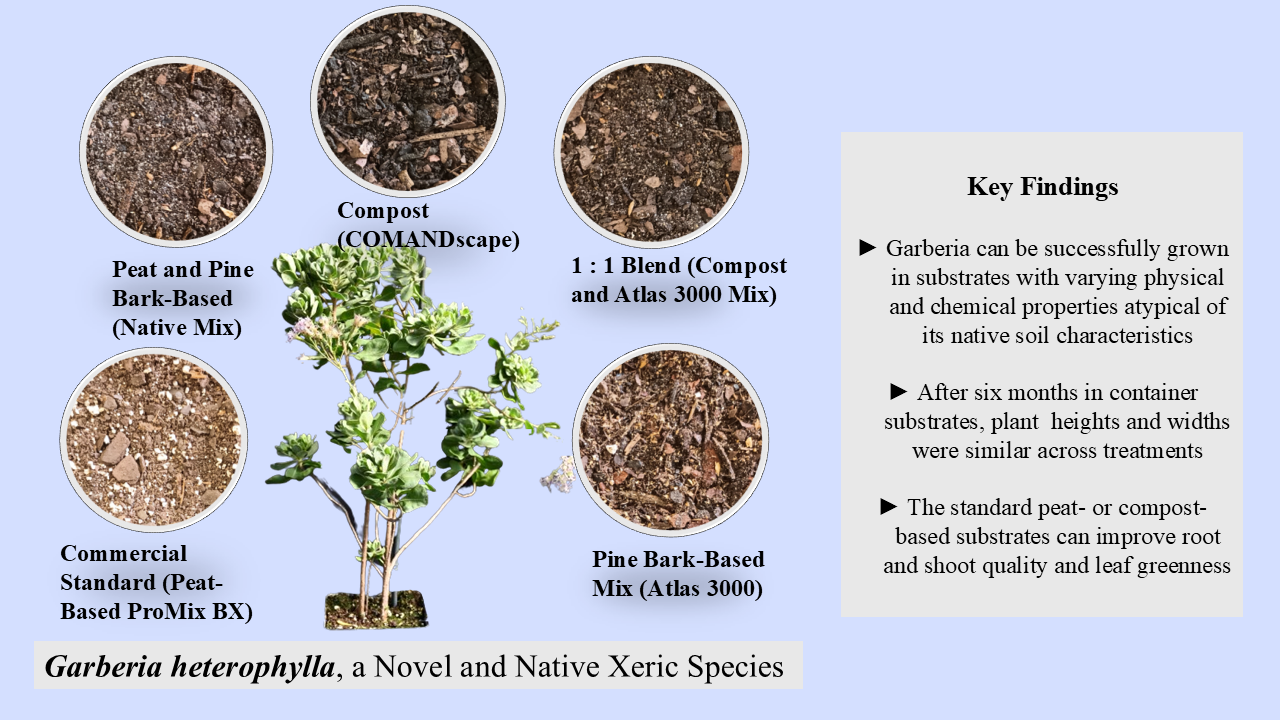
Container production of landscape plants requires reliably consistent and affordable substrates with properties suitable for a wide range of species. Native plant production often requires additional considerations when determining ideal substrates for species found in precise ecosystems. Thus, the introduction of novel native species, such as garberia [Garberia heterophylla (W. Bartram) Merrill & F. Harper] requires research insight into discerning which type of substrate provides the greatest plant quality in the least amount of time. In this greenhouse study, garberia was container-grown for six months in five substrates. These included two different pine-bark-based media (Atlas 3000 and ‘Native mix’) typically used for native plant production, a commercial standard of peat-based medium (ProMix BX), and compost-based medium (COMANDscape) by itself or at a 1:1 compost: native mix ratio. All substrates varied from each other in terms of pH and electroconductivity (EC), with ProMix BX having the most acidic pH (5.3) and COMANDscape having the highest EC (5.2 dS/m). The ProMix BX had the greatest water holding capacity, while the Atlas 3000 had the greatest bulk and particle densities. After six months, plant heights and widths were similar between treatments. The ProMix BX yielded the greatest shoot and root dry matter values, and well-developed root systems that held the substrate the best. Plants grown in ProMix BX or COMANDscape had the greatest SPAD values and very good to excellent shoot visual quality ratings, compared to other substrates evaluated. While garberia was found to be a slow-growing species regardless of substrate, these results demonstrate its tolerance of diverse substrates that are non-characteristic of the soil where it thrives naturally. This knowledge can be useful for nursery practitioners; ultimately contributing to expanded production and the widened use of garberia in landscapes.
Keywords:
nursery plant production
; peat-based media
; compost-based media
; pollinator plants
1. Introduction
The demand for native plants in commercial and home landscapes continues to grow, spurred by increased consumer awareness of the many benefits they can bring to a garden [1]. Native plants play an important role in pollinator conservation [2], sustainable landscaping [3], and wildlife support [4]. Representing only 10% of nursery sales in the U.S. [5], native plant availability is restricted by a combination of factors. This includes a lack of species-specific propagation protocols [6,7], limited availability of native seed [8], and reliable access to affordable, consistent, and sustainable soilless media [9]. These barriers contribute to the underrepresented native plant diversity observed in the existing commercial nursery inventory [10]. Typically used container substrates are either custom-made to meet a grower’s needs or selected from existing pre-formulated commercial mixes; and purchased in bags or bulk with the right combination of peat, bark, sand, perlite, and vermiculite to accommodate anywhere from 50 to 300 different plant species [11]. As it is not practical to design different substrates to optimize the production of each species, nurseries will routinely settle for a single mix for container production and a slightly different mix for propagation [12].
Since the 1930’s, sphagnum peat moss has been used as a predominant component in container substrates due to its high water-holding capacity, reduced weight, and organic properties. However, peat-harvesting efforts are of increasing environmental concern and regulatory scrutiny [13]. Notably, in 2024 members of the European Union Parliament voted unanimously to pass the Nature Restoration Law, which mandates that EU nations restore and rewet 30% of drained peatlands by 2030, 40% by 2040, and 50% by 2050 [14], highlighting a critical need to identify suitable replacements. As an alternative to commonly used commercial substrates containing high proportions of peat, researchers have studied the use of composted agricultural byproducts for container nursery production [15], such as parboiled rice hulls [16], olive mill waste [17], and anaerobic digestate [18]. Compost as a peat substitute carries the advantages of being locally available, with the ability to be produced reliably from a broad range of municipal and agricultural waste products [19].
In the last two decades, considerable work has been done to explore the effects of compost on container production of natives, including wildflowers [9,20], wetland species [21], shrubs [22,23], perennials [24,25], trees [26], and grasses [27]. Commonalities of compost research findings include: 1) species-specific responses, 2) negative responses for salt-sensitive species [28], and 3) inconsistent results from varying compost qualities. In general, up to 50% compost can be amended with a commercially available substrate without adversely affecting plant performance [20, 21, 22]. These outcomes may be attributed in part to changes in physical properties such as increased water holding and cation exchange capacities [29].
The varying soil properties found where plants naturally occur can help predict their preferred substrate in container production, especially in regard to pH and overall composition [30]. For example, Wilson et al. [21] evaluated a series of hammock and flatwood species in peat and compost-based substrates. They found species-specific growth and flowering responses to substrates having different organic matter and water holding capacities. Yet, the height and flowering of other xeric species, such as black-eyed Susan (Rudbeckia hirta L.) and spotted bee balm (Monarda punctata L.) remained the same, regardless of the substrate composition. Likewise, a mixed species response was observed by LaPierre et al. [27] who compared grasses native to hydric, mesic, and xeric communities grown in five container substrates. They found wiregrass (Aristida beyrichiana Trin. & Rupr.), with a xeric to periodically hydric soil moisture preference, had a non-significant response to substrates for height and biomass. However, lopsided Indiangrass [Sorghastrum secundum (Elliott) Nash.], with a mesic soil moisture preference, and sugarcane plumegrass [Saccharum giganteum (Walter) Pers.], with a hydric soil moisture preference, typically had the greatest growth responses when produced in substrates with the highest percentages of peat.
Garberia heterophylla, commonly referred to as garberia, is a Florida endemic species grown by only a handful of nurseries [31], found in the sandhills and scrubs of Northern and Central Florida. Garberia belongs to a monotypic genus in Asteraceae and is a small to medium-sized shrub with showy fall flowers and attractive gray-green foliage [32]. Species like garberia represent novel, underutilized natives, which could be grown more broadly with research-based production protocols in place [33]. In a recent study, Carapezza et al. [34] documented the seed biology of garberia to help increase its nursery availability and landscape use. However, pertinent to this endeavor, its growth and flowering performance in different container substrates remains unknown.
The overall goal of this study was to determine optimal substrates for container production of garberia and explore alternative substrates to peat. Specific objectives were to: 1) characterize the chemical and physical properties of five container substrates with varying levels of peat and compost, 2) evaluate the effects of substrates on plant growth and development over time, and 3) determine how the substrates affect overall plant quality and ornamental appeal.
2. Materials and Methods
2.1. Plant Material and Substrate Sourcing
In August of 2024, seed-propagated garberia liners (5.1 cm height x 3.2 cm width pots) were obtained from a commercial native nursery (The Natives Inc. Davenport, Florida). Uniform plants (19.2 to 23.7 cm in height) were up-potted into quart-sized containers (12.0 cm height x 10.5 cm width) (The HC Companies, Twinsburg, OH) filled with five commercially available or custom media mixes (Table 1, Figure 1): 1) Atlas 3000 (Atlas Peat and Soil, Boynton Beach, FL), 2) ProMix BX (Premier Tech Growers and Consumers, Quakertown, PA), 3) Native mix, a custom pine and wood chip based proprietary media from Reliable Peat (Reliable Peat Company, Groveland, FL), 4) COMANDscape (Life Soils, Newberry, FL), a compost and composted pine fines based media, and 5) a 1:1 v:v blend of COMANDscape and Atlas 3000.
2.2 Physical, Chemical and Elemental Properties
The chemical properties of substrates, including pH, electroconductivity (EC), and nutrient content, were evaluated at the UF/IFAS Extension Soil Laboratory. Substrate pH and EC were determined from pour-through samples. The Environmental Protection Agency method 3050 [35] was used to determine total P, K, Ca, and Mg. An acid digestion procedure was used to prepare the samples for analysis by Inductively Coupled Argon Plasma Spectroscopy (ICP) (Model 61E, Thermo Jarrell Ash Corp, Franklin, Massachusetts) wherein samples were air-dried for two days and ground to a powder with a ball mill grinder. A portion of the sample (1.0 g) was digested in nitric acid, then treated with 30% hydrogen peroxide. The sample was then refluxed with nitric acid, filtered through Whatman filter paper (no. 41), and diluted to 100 mL for analysis. Substrate physical properties were evaluated using a method adapted from Bragg and Chambers [36]. The air-filled porosity was determined with a random 350 mL sample of each substrate using the Wolverhampton submersion method that measures the volume of drained water in relation to the volume of the substrate. The samples were then oven-dried for five days at 70 °C (158 °F) to determine water holding capacity, total porosity, bulk density, and particle density using the methods and calculations described by Niedziela and Nelson [37].
2.3. Plant Growth and Performance under Greenhouse Conditions
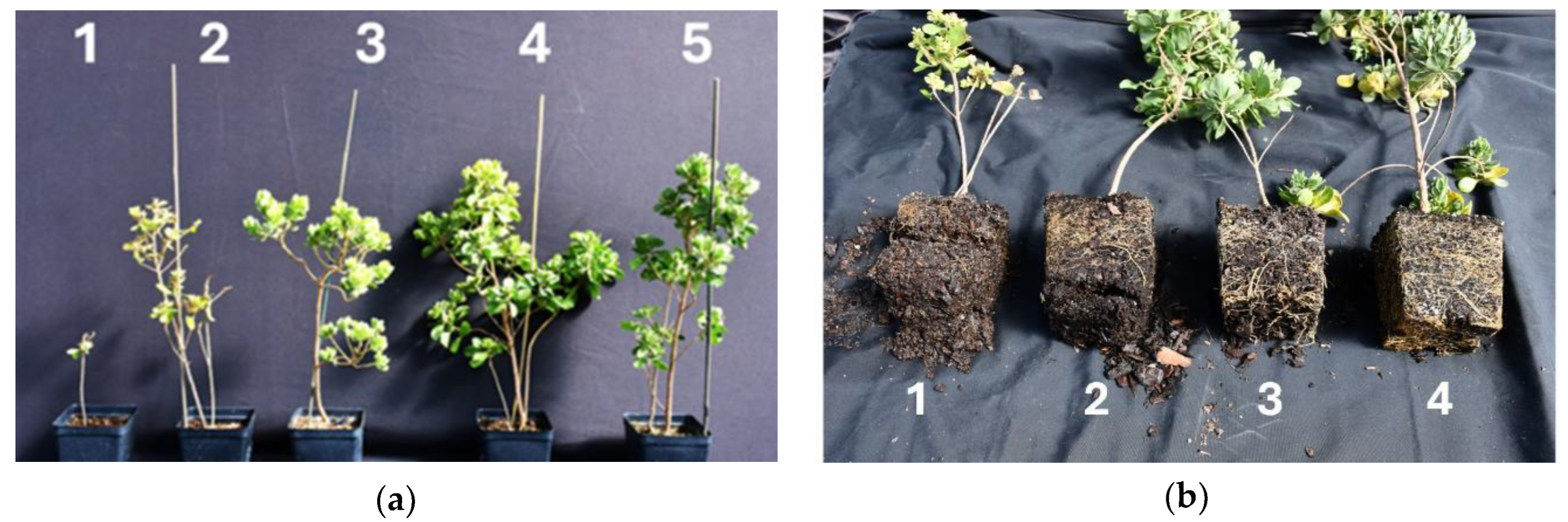
On 7 August 2024, five single plant replicates from each treatment were placed in four blocks and kept in a multi-bay, sawtooth roof, environmentally controlled greenhouse with retractable side walls. The greenhouse was set to cool at 22.2⁰C/72⁰F and warm at 17.2⁰C/63⁰F. The temperature at shelf level was continuously logged and recorded using a HOBO Pendant MX Temp (LI-COR, Lincoln, NE). Average light intensity ranged from 460 to 975 µmol s−1 m−2. Valor shading was automatically deployed during the hottest parts of the day during summer months. Plants were fertigated manually and doses of nitrogen (N), phosphorus (P2O5), and potassium (K2O) at 300:100:300 mg/L were applied weekly using ammonium nitrate, urea phosphate, and potassium nitrate [Cal-Mag Special Fertilizer (JR Peter’s Excel 15N-5P-15K, Allentown, PA)]. Plants were regularly scouted for pests and disease and were treated with pesticides Talstar P® (FMC Agricultural Solutions, Philadelphia, PA) and Azatin® O (OHP Inc., Morrisville, NC) as needed during the 6-month period to ensure optimum plant health. Garberia plants were evaluated monthly, with height and two perpendicular widths recorded using a meter stick. Chlorophyll content was estimated using a SPAD meter (SPAD-502Plus, Konica Minolta, Tokyo, Japan), taking the average of three measurements from newly matured leaves. Shoot quality was determined as described by Smith et al. [9], using a 1-5 scale where: 1 = very poor quality, nearly dead, 2 = poor quality, unsaleable, 3 = acceptable form, some chlorosis, 4 = very good form and color, little chlorosis, and 5 = excellent form, no chlorosis (Figure 2). The presence of flowers or flower buds was recorded beginning in month 5 when several individual plants began floral development. At six months plants were destructively harvested, and root quality was determined using a 1-4 scale as described by Mikell et al. [38] where: 1 = rootball holding 25% or less of the substrate, 2 = rootball holding 50% of the substrate, 3 = rootball holding 75% of the substrate, and 4 = rootball holding 100% of the substrate (Figure 2). Then, roots were manually washed, plants were cut at the crown, and above- and below-ground portions were bagged and dried at 60°C for four days. Root and shoot dry mass were recorded for each plant upon removal from the drying oven.
 |
 |
| (a) | (b) |
2.4. Experimental Design and Statistical Analysis
A randomized complete block design was used for the greenhouse evaluation, with each treatment replicated in 4 blocks. The five substrates were treated as independent variables, while soil characteristics, visual quality ratings, and total above and below-ground biomass were treated as dependent variables. Height, average width, SPAD, root dry mass, shoot dry mass, and substrate properties data were subjected to a one-way analysis of variance (ANOVA) with significant means separated by Tukey’s HSD test, p ≤ 0.05. Non-parametric data (root and shoot visual quality) was subjected to a Kruskal-Wallis test, with pairwise comparisons determined by paired samples Wilcoxon test, α ≤ 0.05. All analyses were completed using RStudio (RStudio 12.1 for Windows, Boston, MA).
3. Results
3.1. Analysis of Substrate Properties
There was a significant effect of substrate for each of the measured elemental properties. The pH among substrate treatments ranged from 5.3 (ProMix BX) to 7.8 (Native mix), with each differing from one another (Table 2). The electroconductivity of substrates ranged from 0.4 (Native mix) to 5.1 (COMANDscape), with each also differing from one another. The percentage of organic matter in the substrates was lowest for the Atlas 3000 mix (40.5%) and highest for the Native mix (82.6%), with COMANDscape, ProMix BX, and the 1:1 mix having similar organic matter compared to each other (Table 2). COMANDscape was highest in all measured nutrients except phosphorus, which was highest in the ProMix BX treatment. The native mix had significantly lower P, K, Ca, and Mg than all other treatments.
A significant effect of substrate was also observed for each of the measured physical properties (Table 3). The water holding capacity among substrates ranged from 46.3% (Native mix) to 64.2% (ProMix BX), where both the COMANDscape and Native mix had similarly low water holding capacities compared to Atlas 3000 or ProMix BX. The air-filled porosity ranged from 8.0% (ProMix BX) to 16.4% (COMANDscape), with COMANDscape being greater than the ProMix BX and 1:1 compost mix, which were similar to each other. The range of total porosity among substrates was 57.7% (Native mix) to 72.0% (ProMix BX), with the latter substrate having greater total porosity than all other substrates, except Atlas 3000. Other physical properties of substrates ranged from 0.16 g∙cm-3 (COMANDscape) to 0.40 g∙cm-3 (Atlas 3000) for bulk density, and 0.56 g∙cm-3 (ProMix 3000) to 1.23 g∙cm-3 (Atlas 3000) for particle density. For both of these properties, Atlas 3000 was greater than all other substrates evaluated (Table 3).
3.2. Growth, SPAD, and Dry Mass
After garberia was grown for three months in containerized substrates, a significant treatment effect was observed for plant height, average width (average of two perpendicular widths), and SPAD (Table 4). Plants grown in the ProMix BX were taller and wider than plants grown in the other substrates. However, after 6 months, there was no difference in height and width among the substrates. The leaf greenness (SPAD) of container plants was also influenced by substrate composition (Table 4). Plants grown in COMANDscape, Native mix, and Pro-mix BX for 3 months had greater leaf greenness (SPAD) compared to plants grown in the Atlas 3000 and 1:1 compost mix. After 6 months, only plants grown in ProMix BX and COMANDscape had higher SPAD than other substrate treatments. The final shoot and root dry mass was also affected by the substrate (Table 3.3). Plants grown in ProMix BX experienced the greatest shoot and root mass compared to all other substrates.
3.3. Root and Shoot Visual Quality
Subjective plant quality measurements revealed a significant substrate effect on both shoot and root quality of garberia. The shoot visual quality (1 to 5 scale) ranged from 2.96 (acceptable) to 4.90 (excellent) after 3 months, and 2.98 (acceptable) to 4.75 (very good to excellent) after six months (Figure 3a). Plants grown in ProMix BX for three months had the greatest shoot visual quality rating (4.90) compared to all other substrates, followed by plants grown in COMANDscape that had higher shoot quality (4.28) than plants grown in the Atlas 3000 and 1:1 mix. Plants grown in ProMix BX for six months also had the greatest shoot visual quality rating (4.75), compared to the other substrate treatments, except COMANDscape (4.04).
The root quality (1 to 4 scale) of plants grown for six months in different substrates ranged from 2.65 (roots holding nearly 75% of the medium) to 4.00 (roots holding 100% of the medium). Plants grown in ProMix BX had the most developed root systems (4.0), compared to other substrates. Plants grown in Atlas 3000, Native mix, and 1:1 (2.65 to 3.11) had less root development than plants grown in ProMix BX and COMANDscape (Figure 3b).
4. Discussion
In this study, we evaluated the growth and quality of garberia plants grown in five different substrates, which included peat, bark, and compost-based mixes having highly variable physical and chemical properties. The substrates ranged in price from $3.00 to $16.73 per 2.8 ft3 bag, with the predominant peat-based ProMix BX costing 5.6 times more than the predominant pine bark- and wood chip–based native substrates. The lowest pH of these substrates (5.3, ProMix BX) was considered ‘acceptable’ for container media of woody ornamentals, while the other four substrates fell in the ‘very high’ pH category (>6.5). These guidelines were based on container media test interpretations for woody ornamentals as described by Mylavarapu and Yeager [39] and can be an important consideration for plant growth. For most nursery crops, a container substrate pH ranging from 5.4 to 6.5 is recommended, representing the pH range in which plant macro- and micro-nutrients are most available in solution [40]. Niemiera and Wright [41] point out that a higher substrate pH (above 6.5) may be needed for species which prefer nitrate (NO3−) to ammonium (NH4+), as nitrification occurs more rapidly in neutral to slightly basic conditions. In contrast, a sensitivity to alkalinity, presented as reduced growth and leaf greenness, may result from a reduction in root hydraulic conductivity that follows aquaporin closure in root tissue, as well as a decrease in iron chelate reductase activity, the enzyme responsible for converting ferric iron to the more soluble ferrous iron [42]. Typically, a pH in container substrates that is greater than 7.0 is suggestive that some essential elements may become restrictive to plants. This may have contributed to the slightly lower shoot quality ratings and dry mass accumulation we observed for plants grown in the higher pH substrates compared to the industry standard, ProMix BX. In container production of thryallis (Galphimia gracilis Bartl.), Albano et al. [43] found that reducing the substrate pH (from 7.4 to 6.4), achieved though irrigation water acidification improved leaf greenness, visual quality, and visible root development which could be an option for nursery operations having that capability. Interestingly, the substrates most typical of those used for native plant production (Atlas 3000 and Native mix) displayed the highest pH, having less peat and the addition of 10% sand.
Along with pH, a wide range of leachate EC values were observed among substrates that were considered ‘low’ (< 0.7 dS•m-1, native mix), ‘optimum’ (1.0 to 1.5 dS•m-1, ProMix BX), ‘high’ (1.5 to 3.0 dS•m-1, Atlas 3000), or ‘very high’ (>3.0 dS•m-1, COMANDscape and 1:1 COMAND: Atlas mix) based on recommendations for container media [39]. The soluble salt of substrates is helpful in providing a general indication of the available macronutrient status for plant growth. Most greenhouse crops prefer a growing medium EC of 2 to 3.5 dS•m-1 [44]. This value may be lower if growing salt-sensitive species or higher if growing heavy feeding floriculture crops, the latter not applying to garberia. High salinity in container substrates can cause plant responses like reduced shoot growth [45], chlorosis, and inhibited root development [46] by inducing a state of “physiological drought” where osmotic pressure is reduced at the root zone, slowing the uptake of water and nutrients. Mechanisms underlying drought tolerance, including morphological adaptations such as longer root hairs and thickened leaf cuticles, as well as physiological adaptations, are also observed in salt tolerant species [47,48]. Thus, drought-tolerant native plants may have some improved ability to respond favorably to substrates with very high EC. Interestingly, other ornamental xeric plants, such as blanket flower (Gaillardia pulchella Foug.) [20], spotted beebalm (Monarda punctata L.) [21], and butterfly bush (Buddleja spp L.) [49] have also shown a tolerance to high EC in compost-amended substrates. However, this relationship between plant responses and adaptations to drought and high salinity soil is not universally observed [48]. Notably, the COMANDscape had EC values 3.6× greater than the commercial standard, Pro-mix BX. While values greater than 3.5 can be detrimental to some species, this substrate still fell within ranges commonly reported for different types of compost [50,51,23], yielding high SPAD values, ‘very good’ shoot quality ratings above a 4.0 (1-5 scale), and well-developed roots completely holding the substrate (3.7 of 1-4 scale). The highly organic compost used in this study was most impressive not only for its waste by-product environmental practicality, but with NO3N, P, K, Ca, and Mg values all magnitudes higher than the other substrates. While high, these macronutrients did not exceed the ‘excessive’ range to avoid based on substrate testing guidelines [52].
In addition to chemical property assessments, the substrates evaluated in this study displayed a range of measured physical properties that fell within normal ranges reported for container plant production [36,53]. Namely, the predominately bark-based substrates (Atlas 3000, Native mix, COMANDscape) tended to have greater air-filled porosity (AFP) (10.9 to 16.40%) considered ‘high’ (10-20% by guidelines) due to the large pores formed around the bark particles resulting in less water-holding capacity [54]. Comparatively, the ProMix BX containing 80% peat had 7.8% AFP, considered ‘intermediate’ between the 5-10% guidelines [55]. As pine bark is still one of the most commonly used organic components of container mixes in the southern U.S. ornamental industry, it is worthwhile to note that the age, handling, and particle size of bark components are additional factors to consider along with the percentage of bark in a substrate [56]. For example, we observed the COMANDscape mix contained pink bark fines that were screened smaller than the bark particles of the Native mix and Atlas 3000, contributing to a lower bulk density. Pine bark is favored as a substrate component for its low cost, as well as reduced shrinkage when compared to peat moss [57]. Notably, there was little variation in shrinkage between the media treatments in this study, which ranged from 0.7-1.9 cm. Instead, substrate properties likely contributed to the differences observed in this study. Interestingly, the Native mix and Atlas 3000 produced plants with visually thicker roots where the root tips held slightly less of the rootball than plants grown in ProMix BX and COMANDscape that had finer roots more capable of encapsulating the rootball. Yao et al. [58] observed that larger-sized pine bark may present physical barriers that can alter or impede root development of fine root systems, inducing plant responses such as thickening of roots and a change in root trajectory. These differences have been reflected in root dry mass of other species [24]. In more extreme cases, substrates restrictive of healthy root development may result in a reduced capacity to assimilate nutrients important in hormonal signaling and plant development [59,60] or reduced unsaturated hydraulic conductivity limiting availability of water [61]. In addition to the relevance of root morphology to container production of plants, the root to shoot ratio may be helpful to discern biomass allocation, as higher root to shoot ratios have been associated with nutrient deficiency and moisture stress [62]. In our study, the ratios ranged from 3.8 (ProMix BX) to 5.1 (Atlas 3000), revealing the investment of energy dedicated to root development was not at a detriment to shoot development, or vice versa, particularly for plants grown in ProMix BX.
Of interest is the relationship between garberia’s positive performance among diverse container substrates and the soil and environmental conditions associated with its natural ecosystem. It grows well in sandhill and xeric hammock regions of the state, characterized by nutrient-poor, well-drained, sandy soils [32]. These xeric soils of the Florida central ridge and flatwoods regions, typically classified as entisols or spodosols [63], tend to be coarse-textured with limited development of soil horizons, and are lower in NH4+ and NO3 than mesic soils or soils that are high in organic matter [64]. Still, garberia responded favorably to varying container substrate treatments having properties uncharacteristic of the soils it is endemic to. In contrast to containerized plants, plants of xeric habitats have a greater capacity to compensate for changes in their environment, partitioning their resources toward a deeper and more extensive root system to support their drought tolerance. Thus, they tend to have a lower root to shoot ratio [65]. However, the relationship between available moisture and root biomass accumulation is inconsistent and poorly understood [66,67]. Observationally in trial gardens, we found garberia prefers sunny areas with dry, well-drained sandy soils. Requiring irrigation only to establish, it benefits from mulch, a slow-release fertilizer at planting, and dappled afternoon shade. Thus, its preference of peat- and compost-based substrates over Atlas 3000 was not anticipated, particularly as Atlas 3000, containing the least organic matter and 10% sand, has been reported as a suitable substrate for the production of other plant species native to a range of plant communities [21].
Ornamental appeal is of chief interest to nursery growers, as plant purchases at major retailers are often more driven by favorable growth or flower production than other traits such as pollinator value and drought resistance [69]. Characteristics which contribute to plant visual quality include size, degree of branching, leaf number, symmetry of shape, leaf greenness, as well as the canopy level and clustering of flowers [70]. Despite substrate treatments differing in their chemical and physical properties, final height and width of plants were similar. Yet, differences were revealed in visual quality with plants grown in COMANDscape and ProMix BX receiving higher rankings due to branching, form, and color. Wilson and Stoffella [68] observed a similar effect for containerized perennial salvia (Salvia ‘Van Houttei’ Sell ex J.A. Schultes; Salvia gauranitica St.-Hil. ex Benth. ‘Black and Blue’; Salvia longispicata Martius Galeotti x S. farinacea Benth. ‘Indigo Spires’) where visual quality and SPAD were similar between plants grown in a commercial standard of peat-based media and plants grown in 50% and 100% compost. Likewise, Massa et al. [71] reported similar plant quality of impatiens (Impatiens hawkeri W. Bull) grown in 50% compost compared to 100% compost. The many benefits of incorporating compost in substrates have been well documented in improved traits such as shoot formation in young transplants [72], plant height and radial growth [26], root biomass [73], and shoot biomass [20]. Lacking in this study was the ability to determine if flower initiation and abundance were influenced by substrate treatments. Although flower bud initiation and anthesis were recorded, only about 10.9% of the plants began floral development during the timeframe of the experiment. While garberia is a fall blooming species capable of flowering in its first year after planting, an additional 4-6 weeks was needed to fully characterize flowering responses to treatments. Smith et al. [9] recorded the flowering response of different wildflower species grown in four different substrates and only observed differences in flower ratings for 4 out of the 9 species evaluated. Indeed, floral appeal remains a top factor in consumer preference for purchasing native plants [1], warranting further research in this area.
Despite garberia plants being grown under ideal conditions in an environmentally controlled greenhouse with the provision of excellent substrates and intense management, we observed garberia to be a slow growing species. A typical greenhouse time for finishing woody liners in quarts may require 8-12 weeks, depending on the species and substrate [22, 74]. With garberia, the majority of post-transplant growth occurred during this timeframe, yet root systems were not fully developed until 5-6 months, depending on the substrate. While part of this may be attributed to plants overwintering, this observation is consistent with prior propagation studies [34] and grower observations [12]. While a positive plant growth response among substrates was observed, nursery growers should carefully weigh the potential advantages of growing garberia in highly porous substrates primarily composed of peat (i.e., ProMix BX), namely an improvement in root quality and faster production times (by 4-6 weeks) with the disadvantages of a higher cost and environmental concerns associated with peat harvesting. Also of potential concern is the inclusion of perlite in the peat-based media, which requires destructive production practices and poses risks if ingested [75]. The use of pine bark is also not without concerns if its high demand cannot meet availability long-term [76]. Likewise, advantages and disadvantages may be considered for compost-based substrates. The added organic matter provided by COMANDscape was beneficial to garberia’s overall visual appearance, yet its high EC could be restrictive to other species if particularly salt sensitive [46].
These findings showcase garberia’s versatility in containerized production systems, supporting its broader application to nursery producers. A noted limitation of this study was the absence of a formal post container landscape evaluation to determine longer-term performance. While this wasn’t possible with the destructive harvesting of roots, it is likely the container substrate effects may not have translated to landscape performance. For example, Wilson et al. [24] grew three native shrub species in compost or peat-based substrates and found nonmeaningful effects when transplanted to the landscape for 32 weeks. Still, landscape trialing of novel species is of critical importance prior to nursery introduction or recommendation to consumers [9,77] and merits further exploration.
5. Conclusions
Despite chemical and physical property differences, the substrates evaluated were found to be moderately to highly suitable for garberia production achieving similar plant heights and widths. In contrast to the slightly basic, largely mineral soils where garberia is naturally found, highly suitable substrates shared traits such as a lower pH and a significant organic matter component. Garberia exhibited similar growth, visual quality, and root quality in both peat-based and compost-based substrates, suggesting the feasibility of organic waste byproducts for production. Substrates with moderate suitability, having higher amounts of bark with sand, produced plants with slightly reduced leaf color, form, and root quality that were still considered marketable but may require additional production time. Regardless of substrate, garberia was amenable to container production systems meriting its use for restoration and landscape purposes.
Supplementary Materials
Not applicable.
Author Contributions
Conceptualization, S.W.; methodology, S.W. and G.C.; formal analysis, G.C.; investigation, G.C.; resources, M.M and M.T..; data curation, G.C.; writing—original draft preparation, G.C. and S.B.; writing—review and editing, S.B., M.M. and M.T.; visualization, G.C.; supervision, S.B.; project administration, S.B.; funding acquisition, S.B. All authors have read and agreed to the published version of the manuscript.
Funding
This research received no external funding.
Data Availability Statement
The original contributions presented in the study are included in the article; further inquiries can be directed to the corresponding authors.
Acknowledgments
The authors would like to thank N. Bissett and S. Kiefer at The Natives Nursery for providing the plant material used in this study, and M. Singleton at LifeSoils for providing the compost. We also thank B. Owens, C. Banner, and R. Roberge for their attentive management of the greenhouses. Special thanks to lab members M. Cabrera, A. Jackson and L. Roberti for data collection assistance.
Conflicts of Interest
The authors declare no conflicts of interest. The funders had no role in the design of the study; in the collection, analyses, or interpretation of data; in the writing of the manuscript; or in the decision to publish the results.
References
- Rihn, A.L.; Knuth, M.J.; Peterson, B.J.; Torres, A.P.; Campbell, J.H.; Boyer, C.R.; Palma, M.A.; Khachatryan, H. Investigating drivers of native plant production in the United States green industry. Sustainability 2022, 14, 6774. [Google Scholar] [CrossRef]
- Kalaman, H.; Wilson, S.B.; Mallinger, R.E.; Knox, G.W.; van Santen, E. Evaluating native and non-native ornamentals as pollinator plants in Florida: I Floral abundance and insect visitation. HortScience 2022, 57, 126–136. [Google Scholar] [CrossRef]
- Silva, J.J.; Wilson, S.B.; Knox, G.W.; Mallinger, R.E. Evaluation of plant growth and flowering performance of Florida native and non-native ornamentals under varying irrigation. HortTechnology 2024, 34, 629–643. [Google Scholar] [CrossRef]
- Threlfall, C.G.; Mata, L.; Mackie, J.A.; Hahs, A.K.; Stork, N.E.; Williams, N.S.G.; Livesley, S.J.; Beggs, J. Increasing biodiversity in urban green spaces through simple vegetation interventions. J. Appl. Ecol. 2017, 54, 1874–1883. [Google Scholar] [CrossRef]
- Rihn, A.L.; Torres, A.; Behe, B.K.; Barton, S. Unwrapping the native plant black box: consumer perceptions and segments for target market strategies. HortTechnology 2024, 34, 361–371. [Google Scholar] [CrossRef]
- Henry, A.L; Robinson, R.; Sinnott, K.; Brunson, M.; Ernst, A.; Tarsa, E.; Kettenring, K.M. Got plants? Availability of and challenges to production of native plants for wetland restoration. Res. Ecol. 2024, 32. [Google Scholar] [CrossRef]
- Wilson, S.B.; Perez, H.; Thetford, M. Propagation, production, and landscape evaluation of native wildflowers in West, Central and South Florida. Florida Wildflower Foundation Condensed Progress Report, 2010. Available online: https://www.flawildflowers.org/wp-content/resources/pdfs/Research/Wildflower%20year-end%20progress%20report-Wilson%20et%20al.pdf (accessed on 15 May 2025).
- Lavallee, K.; Soti, P.G.; Rodrigo, H.; Kariyat, R.; Racelis, A. Pre-sowing treatments improve germinability of South Texas native plant seeds. Plants 2021, 10, 2545. [Google Scholar] [CrossRef]
- Smith, A.M.; Wilson, S.B.; Thetford, M.; Nolan, K.L.; Adams, C.R. Performance of nine Florida native wildflower species grown in varying container substrates. Nativ. Plants J. 2014, 15, 75. [Google Scholar] [CrossRef]
- Zinnen, J.; Barak, R.S.; Matthews, J.W. Influence of ecological characteristics and phylogeny on native plant species’ commercial availability. Ecol. Appl. 2024, 35, e3070. [Google Scholar] [CrossRef]
- LeBude, A.V.; White, S.A.; Fulcher, A.F.; Frank, S.; Klingeman III, W.E.; Chong, J.; Chappell, M.R.; Windham, A.; Braman, K.; Hale, F.; Dunwell, W.; Williams-Woodward, J.; Ivors, K.; Adkins, C.; Neal, J. Assessing the integrated pest management practices of southeastern US ornamental nursery operations. Pest Manag. Sci. 2012, 68, 1278–1288. [Google Scholar] [CrossRef]
- Godts, M. (Green Isle Gardens, Groveland, Florida, USA). Personal communication, 2024.
- Beaulieu, J.; Belayneh, B.; Lea-Cox, J.D.; Swett, C.L. Improving container nursery crop sustainability: effects of conservation-driven adaptations in soilless substrate and water use on plant growth and soil-borne disease development. HortScience 2022, 57, 674–683. [Google Scholar] [CrossRef]
- European Union Parliament (Brussels, Belgium); European Council (Brussels, Belgium). Nature Restoration Law, 2024.
- Fields, J.; Owen Jr., J.; Lamm, A.; Altland, J.E.; Jackson, B.; Zheng, Y.; Oki, L.; Fontenot, K.; Samtani, J.; Campbell, B. Soilless substrate science: a North American needs assessment to steer soilless substrate research into the future. Acta Hortic. 2021, 1317, 313–318. [Google Scholar] [CrossRef]
- Choi, S.; Xu, L.; Kim, H.J. Influence of physical propertires of peat-based potting mixes substituted with parboiled rice hulls on plant growth under two irrigation regimes. HEB 2019, 60, 895–911. [Google Scholar] [CrossRef]
- Chilosi, G.; Esposito, A.; Castellani, F.; Stanzione, V.; Aleandri, M.; Dell’Unto, D.; Tomassini, A.; Vannini, A.; Altieri, R. Characterization and use of olive mill waste compost as peat surrogate in substrate for cultivation of Photinia potted plants: assessment of growth performance and in vitro suppressiveness. Waste Biomass Valorization 2018, 9, 919–928. [Google Scholar] [CrossRef]
- Asp, H.; Bergstrand, K.J.; Casperson, S.; Hultberg, M. Anaerobic digestate as peat substitute and fertiliser in pot production of basil. Biol. Agric. Hortic. 2022, 38, 247–257. [Google Scholar] [CrossRef]
- Nocentini, M.; Mastrolonardo, G.; Michelozzi, M.; Cencetti, G.; Lenzi, A.; Panettieri, M.; Knicker, H.; Certini, G. Effects of biochar and compost addition in potting substrates on growth and volatile compounds profile in basil (Ocimum basilicum L.). J. Sci. Food Agric. 2024, 104, 1609–1620. [Google Scholar] [CrossRef]
- Danielson, H.E.; Wilson, S.B.; Schoellhorn, R.K.; Stoffella, P.S. Container and field-evaluation of Gaillardia pulchella production in compost-based media. Comb. Proc. Inter. Plant Prop. Soc. 2004, 54, 637–642. [Google Scholar]
- Wilson, S.B.; Stoffella, P.J. Using compost for container production of ornamental wetland and flatwood species native to Florida. Nativ. Plants J. 2006, 7, 293. [Google Scholar] [CrossRef]
- Wilson, S.B.; Mecca, L.K.; Stoffella, P.J.; Graetz, D.A. Using compost for container production of ornamental hammock species native to Florida. Nativ. Plants J. 2005, 5, 186. [Google Scholar] [CrossRef]
- Ostos, J.C.; López-Garrido, R.; Murillo, J.M.; López, R. Substitution of peat for municipal solid waste- and sewage sludge-based composts in nursery growing media: Effects on growth and nutrition of the native shrub Pistacia lentiscus L. Bioresour. Technol. 2008, 99, 1793–1800. [Google Scholar] [CrossRef] [PubMed]
- Wilson, S.B.; Mecca, L.K.; Danielson, H.E.; Graetz, D.A.; Stoffella, P.J. Container and field evaluation of three native shrubs grown in compost-based media. Compost Sci. Util. 2006, 14, 178–183. [Google Scholar] [CrossRef]
- Di Lonardo, S.; Cacini, S.; Becucci, L.; Lenzi, A.; Orsenigo, S.; Zubani, L.; Rossi, G.; Zaccheo, P.; Massa, D. Testing new peat-free substrate mixtures for the cultivation of perennial herbaceous species: A case study on Leucanthemum vulgare Lam. Sci. Hortic. 2021, 289, 110472. [Google Scholar] [CrossRef]
- Manrique-Vega, S.M.; Alvarado-Sanabria, O. Compost increases soil fertility and promotes the growth of five tropical species used in urban forestry. FLORAM 2023, 30, 100211. [Google Scholar] [CrossRef]
- LaPierre, G.D.J.; Check, C.; Wilson, S.B. Performance of three Florida native grasses grown in varying container substrates. Nativ. Plants J. 2025, 25, 192–199. [Google Scholar] [CrossRef]
- Do, T.C.V.; Scherer, H.W. Compost as growing media component for salt-sensitive plants. Plant Soil Environ. 2013, 59, 214–220. [Google Scholar] [CrossRef]
- Witcher, A.L.; Pickens, J.M.; Blythe, E.K. Container color and compost substrate affect root zone temperature and growth of “Green Giant” arborvitae. Agronomy 2020, 10, 484. [Google Scholar] [CrossRef]
- Stanton, K.M.; Mickelbart, M.V. Growth and foliar nutrition of Spiraea alba Du Roi and Spiraea tomentosa L. in response to root zone pH. Sci. Hortic. 2014, 165, 23–28. [Google Scholar] [CrossRef]
- Florida Association of Native Nurseries (FANN) Native Plant and Service Directory. Available online: https://fann.org/plants> 2025 (accessed on 20 March 2025).
- Wunderlin, R.P.; Hansen, B.F.; Franck, A.R.; Essig, F.B. Atlas of Florida Plants. Available online: https://florida.plantatlas.usf.edu (accessed on 20 March 2025).
- Wilson, S.B. Expanding our plant palette: The role of natives and non-invasive cultivars. In Proceedings of the Florida State Horticultural Society, United States, 19 October 2020, (virtual).
- Carapezza, G.C.; Wilson, S.B.; McMillan, M.; vanSanten, E. Seed germination of garberia (Garberia heterophylla (W. Bartram) Merr. & F. Harper), a pollinator plant with ornamental appeal. Seeds, 2025; 4, 23. [Google Scholar] [CrossRef]
- [USEPA] United States Environmental Protection Agency. Test methods for evaluating solid waste. 1998 SW-846 (Methods 3050).
- Bragg, N.C.; Chambers, B.J. Interpretation and advisory applications of compost air-filled porosity (AFP) measurements. Acta Hortic. 1988, 221, 35–44. [Google Scholar] [CrossRef]
- Niedziela, C.E.; Nelson, P.V. A rapid method for determining physical properties of undisturbed substrate. HortScience 1992, 27, 1279–1280. [Google Scholar] [CrossRef]
- Mikell, L.; Wilson, S.B.; Marbel, C.S.; Vendrame, W.; van Santen, E. Sexual and asexual reproduction of Wild lime (Zanthoxylum fagara L. Sarg), a native Florida plant with ornamental and ecological value. J. Environ. Hortic. 2024, 42, 131–139. [Google Scholar] [CrossRef]
- Mylavarapu, R.; Yeager, T.; UF/IFAS Extension nutrient management series: container media nutrient test interpretation. SL180. Gainesville, FL: University of Florida Institute of Food and Agricultural Sciences. 2015. Available online: https://edis.ifas.ufl.edu/publication/SS316 (accessed on 17 May 2025).
- Jackson, K.; Thounaojam, T.; Meetei, T.T. Influence of soil pH on nutrient availability: a review. JETIR 2018, 5, 707, Available at: http://www.jetir.org/papers/JETIRDZ06090.pdf. [Google Scholar]
- Niemiera, A.X.; Wright, R.D. Effect of liming rate on nitrification in a pine bark medium. JASHS 1986, 111, 713–715, Available at: https://api.semanticscholar.org/CorpusID:101068913 . [Google Scholar] [CrossRef]
- Zhang, W.; Zwiazek, J.J. Effects of root medium pH on root water transport and apoplastic pH in red-osier dogwood (Cornus sericea) and paper birch (Betula papyrifera) seedlings. J. Plant Biol. 2016, 18, 1001–1007. [Google Scholar] [CrossRef]
- Albano, J.P.; Altland, J.; Merhaut, D.J.; Wilson, S.B.; Wilson, P.C. Irrigation water acidification for nursery crop production: substrate pH, electrical conductivity, nutrient concentrations, and plant nutrition and growth. HortScience 2017, 52, 1401–1405. [Google Scholar] [CrossRef]
- Nemali, K.; van Iersel, M.W. Light intensity and fertilizer concentration: i. estimating optimal fertilizer concentrations from water-use efficiency of wax begonia. HortScience 2004, 36, 1287–1292. [Google Scholar] [CrossRef]
- Aydinsakir, K.; Dinc, N. .; Buyuktas, D.; Karaguzel, U.O.; Ozkan, C.F.; Vuran, F.A. Effects of salinity levels and substrates on yield and flower quality of soilless cultivated rose grown in an unheated greenhouse. Fresenius Environ. Bull. 2018, 27, 1424–1436. [Google Scholar] [CrossRef]
- Coca, L.I.R.; González, M.T.G.; Unday, Z.G.; Hernández, J.J.; Jáuregui, M.M.R.; Cancio, Y.F. Effects of sodium salinity on rice (Oryza sativa L.) cultivation: a review. Sustainability 2023, 15, 1804. [Google Scholar] [CrossRef]
- Galviz, Y.C.; Valerio, R. Leaf morphoanatomical traits of Jacquinia armillaris Jacq. (Theophrastoideae-Primulaceae) in two xeric shrublands from Venezuela. Neotrop. Biodivers. 2021, 7, 364–375. [Google Scholar] [CrossRef]
- Iqbal, N.; Umar, S.; Khan, N.A.; Khan, M.I.R. A new perspective of phytohormones in salinity tolerance: Regulation of proline metabolism. Environ. Exp. Bot. 2014, 100, 34–42. [Google Scholar] [CrossRef]
- Picchioni, G.A.; Ruiz, J.; Goss, R.M.; Mexal, J.G. Nursery crop growth response to municipal biosolids: species salt and xeric adaptation a factor? Compost Sci. Util. 2014, 22, 138–152. [Google Scholar] [CrossRef]
- Bustamante, M.A.; Gomis, M.P.; Pérez-Murcia, M.D.; Gangi, D.; Ceglie, F.G.; Paredes, C.; Pérez-Espinosa, A.; Bernal, M.P.; Moral, R. Use of livestock waste composts as nursery growing media: effect of a washing pre-treatment. Sci. Hortic. 2021, 281, 109954. [Google Scholar] [CrossRef]
- Jayasinghe, G.Y.; Arachchi-Liyana, I.D.; Tokashiki, Y. Evaluation of containerized substrates developed from cattle manure compost and synthetic aggregates for ornamental plant production as a peat alternative. Resour. Conserv. Recycl. 2010, 54, 1412–1418. [Google Scholar] [CrossRef]
- Bayabil, H.K.; Tilahun, F.T.; Li, Y.; Campoverde, E.V.; Moisture retention and chemical properties of nursery potting substrates, AE562. Gainesville, FL: University of Florida Institute of Food and Agricultural Sciences. 2024. Available online: https://edis.ifas.ufl.edu/publication/AE562 (accessed on 17 May 2025).
- Yeager, T.H. Southern Nurserymen’s Association. Best Management Practices Guide for Producing Container Grown Plants. Marietta, GA: Southern Nurserymen’s Association, 1997. Print.
- Carmona, E.; Moreno, M.T.; Avilés, M.; Ordovás, J. Composting of wine industry wastes and their use as a substrate for growing soilless ornamental plants. SJAR 2012, 10, 482–491. [Google Scholar] [CrossRef]
- Bunt, A.C. 1988. Media and Mixes for Container Grown Plants. Unwin Hyman Ltd., London.
- Kaderabek, L.E.; Jackson, B.E.; Fonteno, W.C. Changes in the physical, chemical, and hydrological properties of pine bark over twelve months of aging. Comb. Proc. Inter. Plant Prop. Soc. 2016, 66, 313–317. [Google Scholar]
- Altland, J.E.; Krause, C. Change in physical properties of pine bark and switchgrass substrates over time. J. Environ. Hortic. 2012, 30, 113–117. [Google Scholar] [CrossRef]
- Yao, J.J.; Barés, J.; Dupuy, L.X.; Kold, E. Physical obstacles in the substrate cause maize root growth trajectories to switch from vertical to oblique. J. Exp. Bot. 2024, 76, 546–561. [Google Scholar] [CrossRef] [PubMed]
- Fu, Y.F.; Yang, X.Y.; Zhang, Z.W.; Yuan, S. Synergistic effects of nitrogen metabolites on auxin regulating plant growth and development. Front. Plant Sci. 2022, 13, 1098787. [Google Scholar] [CrossRef] [PubMed]
- Zhang, Y.H.; Liu, B.H.; Kong, F.J.; Chen, L.Y. Nutrient-mediated modulation of flowering time. Front. Plant Sci. 2023, 14, 1101611. [Google Scholar] [CrossRef]
- Fields, J.S.; Owen, J.S.; Altland, J.E.; van Lersel, M.W.; Jackson, B.E. Soilless substrate can be hydrology can be engineered to influence plant water status for an ornamental containerized crop grown within optimal water potentials. J. Am. Soc. Hortic. Sci. 2018, 143, 268–281. [Google Scholar] [CrossRef]
- Worrall, R.J.; Lamont, G.P.; O’Connell, M.A.; Nicholls, P.J. The growth response of container-grown woody ornamentals to controlled-release fertilizers. Sci. Hortic. 1987, 32, 275–286. [Google Scholar] [CrossRef]
- Kantz, R.S.; Hoehn, T.S.; Haddad, K.; Rogers, T.; Atkeson, T.; Estevez, E. Natural systems, p. 82–113. In: E.A. Fernald and E.D. Purdum (eds.). Water Resources Atlas of Florida, 1998. Florida State University, Tallahassee, FL.
- Baruzzi, C.; Hong, J.; Zamora, C.; Stein, C.; Crandall, R.M. The pyrogenic bunchgrass Aristida beyrichiana is negatively affected by soil biota when planted outside of its home soil. Plant Soil 2022, 479, 621–630. [Google Scholar] [CrossRef]
- Wang, X.P.; Fang, J.Y.; Zhu, B. Forest biomass and root-shoot allocation in northeast China. For. Ecol. Manag. 2008, 255, 4007–4020. [Google Scholar] [CrossRef]
- Reich, P.B.; Luo, Y.; Bradford, J.B.; Poorter, H.; Perry, C.H.; Oleksyn, J. Temperature drives global patterns in forest biomass distribution in leaves, stems, and roots. Proc. Natl. Acad. Sci. U.S.A. 2014, 111, 1721–13726. [Google Scholar] [CrossRef]
- Qi. Y.; Wei, W.; Chen, C.; Chen, L. Plant root-shoot biomass allocation over diverse biomes: a global synthesis. Glob. Ecol. Conserv. 2019, 18, e00606. [Google Scholar] [CrossRef]
- Wilson, S.B.; Stoffella, P.J.; Graetz, D.A. Compost amended media and irrigation system influence containerized perennial Salvia. J. Am. Soc. Hortic. Sci. 2003, 128, 260–268. [Google Scholar] [CrossRef]
- Wei, X.; Knuth, M.; Khachatryan, H. The role of consumers knowledge of native and pollinator-friendly plants and their prioritization of plant characteristics in purchase decisions. HortScience 2024, 59, 941–948. [Google Scholar] [CrossRef]
- Garbez, M.; Symoneaux, R.; Belin, É.; Caraglio, Y.; Chéné, Y.; Donès, N.; Durand, J.B.; Hunault, G.; Relion, D.; Sigogne, M.; Rousseau, D.; Galopin, G. Ornamental plants architectural characteristics in relation to visual sensory attributes: a new approach on the rose bush for objective evaluation of the visual quality. Eur. J. Hortic. Sci. 2018, 83, 187–201. [Google Scholar] [CrossRef]
- Massa, D.; Prisa, D.; Lazzereschi, S.; Cacini, S.; Burchi, G. Heterogenous response of two bedding plants to peat substitution by two green composts. Hort. Sci. 2018, 45, 164–172. [Google Scholar] [CrossRef]
- Suzigan, N.M.; Cardoso, G.D.; Barbosa, N.A.; da Costa, G.C.P.; Gomes, G.; Moura, S.D.; de Oliveira, M.E.R.; Campos, L.F.C.; de Melo, H.C.; Gonçalves, J.D. Organic compost in promoting growth and photosynthetic performance of Pereskia aculeata Mill. (Cactaceae) saplings. Cienc. Rural 2025, 55. [Google Scholar] [CrossRef]
- Bignami, C.; Melegari, F.; Zaccardelli, M.; Pane, C.; Ronga, D. Composted solid digestate and vineyard winter prunings partially replace peat in growing substrates for micropropagated highbush blueberry in the nursery. Agronomy 2022, 12, 337. [Google Scholar] [CrossRef]
- Cabrera, M.; Wilson, S.B.; Rostan, V.; Wilson, P.C. Influence of thiamethoxam application method, timing and rate on contamination of floral resources in lantana. Comb. Proc. Intl. Plant Prop. Soc. 2024, 74, 375–386, https://ipps.org/uploads/docs/6d_sr_cabrera.pdf. [Google Scholar]
- Jo, S.; Chae, Y.; Lee, S.; Koo, Y.; Kim, H.; Kang, B.T.; Yun, T. Gastrointestional complications following ingestion of potting soil in a dog. Vet. Sci. 2025, 12, 355. [Google Scholar] [CrossRef]
- Murphy, A.M.; Gilliam, C.H.; Fain, G.B.; Torbert, H.A.; Gallagher, T.V.; Sibley, J.L.; Marble, S.C.; Witcher, A.L. Extending pine bark supplies with wholetree and clean chip residual substrates. J. Environ. Hortic. 2010, 28, 217–223. [Google Scholar] [CrossRef]
- Campbell Martinez, G.; Wilson, S.B.; Thetford, M.; Steppe, C.; Perez, H.E. Cutting propagation and landscape performance of an underutilized southeastern native herb, coastalplain honeycombhead (Balduina angustifolia). J. Environ. Hort. 2024, 42, 46–53. [Google Scholar] [CrossRef]
Figure 1.
Substrates used to evaluate container production of Garberia heterophylla. A. ProMix BX (Premier Tech Growers and Consumers, Quakertown, PA) B. Custom native mix (Reliable Peat Company, Groveland, FL) C. 1:1 mix, containing equal parts COMANDscape and custom native mix D. COMANDscape (Life Soils, Newberry, FL) E. Atlas 3000 (Atlas Peat and Soil, Boynton Beach, FL)
Figure 1.
Substrates used to evaluate container production of Garberia heterophylla. A. ProMix BX (Premier Tech Growers and Consumers, Quakertown, PA) B. Custom native mix (Reliable Peat Company, Groveland, FL) C. 1:1 mix, containing equal parts COMANDscape and custom native mix D. COMANDscape (Life Soils, Newberry, FL) E. Atlas 3000 (Atlas Peat and Soil, Boynton Beach, FL)
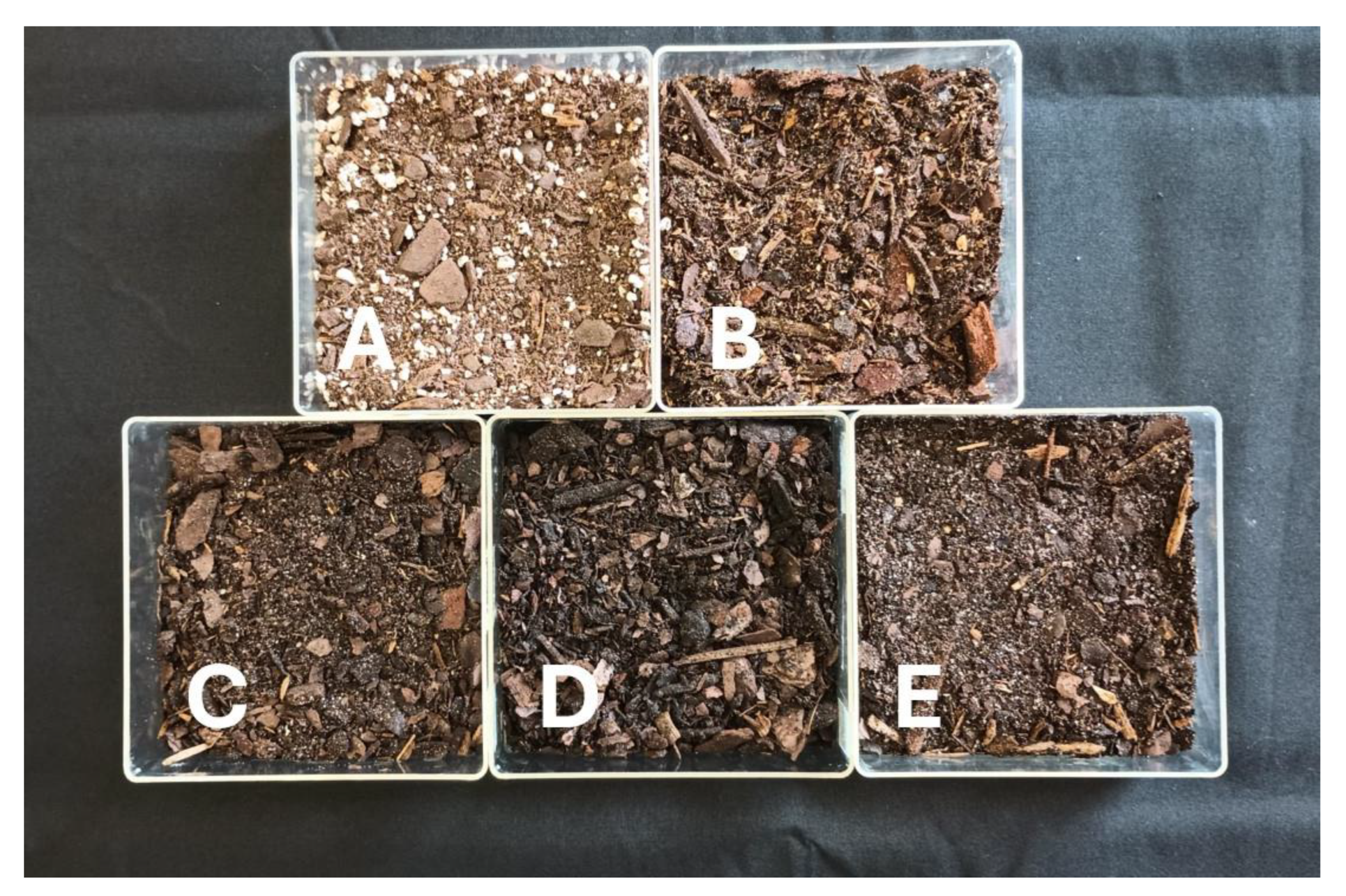
Figure 2.
Visual representation of the shoot (a) and root (b) quality scale used to evaluate the growth of garberia (Garberia heterophylla) in five substrates. Shoot visual quality was determined using a scale from 1 to 5, where 1= very poor quality, nearly dead plant, 3= acceptable form, some chlorosis, and 5= excellent form, little to no chlorosis or necrosis. Root quality was determined using a scale from 1 to 4, where 1= rootball holding 25% or less of the substrate, 2= rootball holding 50% of the substrate, 3= rootball holding 75% of the substrate, and 4=rootball holding 100% of the substrate.
Figure 2.
Visual representation of the shoot (a) and root (b) quality scale used to evaluate the growth of garberia (Garberia heterophylla) in five substrates. Shoot visual quality was determined using a scale from 1 to 5, where 1= very poor quality, nearly dead plant, 3= acceptable form, some chlorosis, and 5= excellent form, little to no chlorosis or necrosis. Root quality was determined using a scale from 1 to 4, where 1= rootball holding 25% or less of the substrate, 2= rootball holding 50% of the substrate, 3= rootball holding 75% of the substrate, and 4=rootball holding 100% of the substrate.
| (a) | (b) |
Figure 3.
(a) Mean shoot quality of garberia (Garberia heterophylla) plants grown in five substrates at 3- and 6-months, rated on a 1-5 scale where 1= very poor quality, nearly dead plant, 3= acceptable form, some chlorosis, and 5= excellent form, little to no chlorosis. (b) Mean root quality of garberia after six months of growth in five substrates. Root quality was determined using a scale from 1 to 4, where 1= rootball holding 25% or less of the medium and 4=rootball holding 100% of the medium. Different letters represent statistical significance among substrate treatments as determined by Wilcox’s pairwise test at α= 0.05.
Figure 3.
(a) Mean shoot quality of garberia (Garberia heterophylla) plants grown in five substrates at 3- and 6-months, rated on a 1-5 scale where 1= very poor quality, nearly dead plant, 3= acceptable form, some chlorosis, and 5= excellent form, little to no chlorosis. (b) Mean root quality of garberia after six months of growth in five substrates. Root quality was determined using a scale from 1 to 4, where 1= rootball holding 25% or less of the medium and 4=rootball holding 100% of the medium. Different letters represent statistical significance among substrate treatments as determined by Wilcox’s pairwise test at α= 0.05.
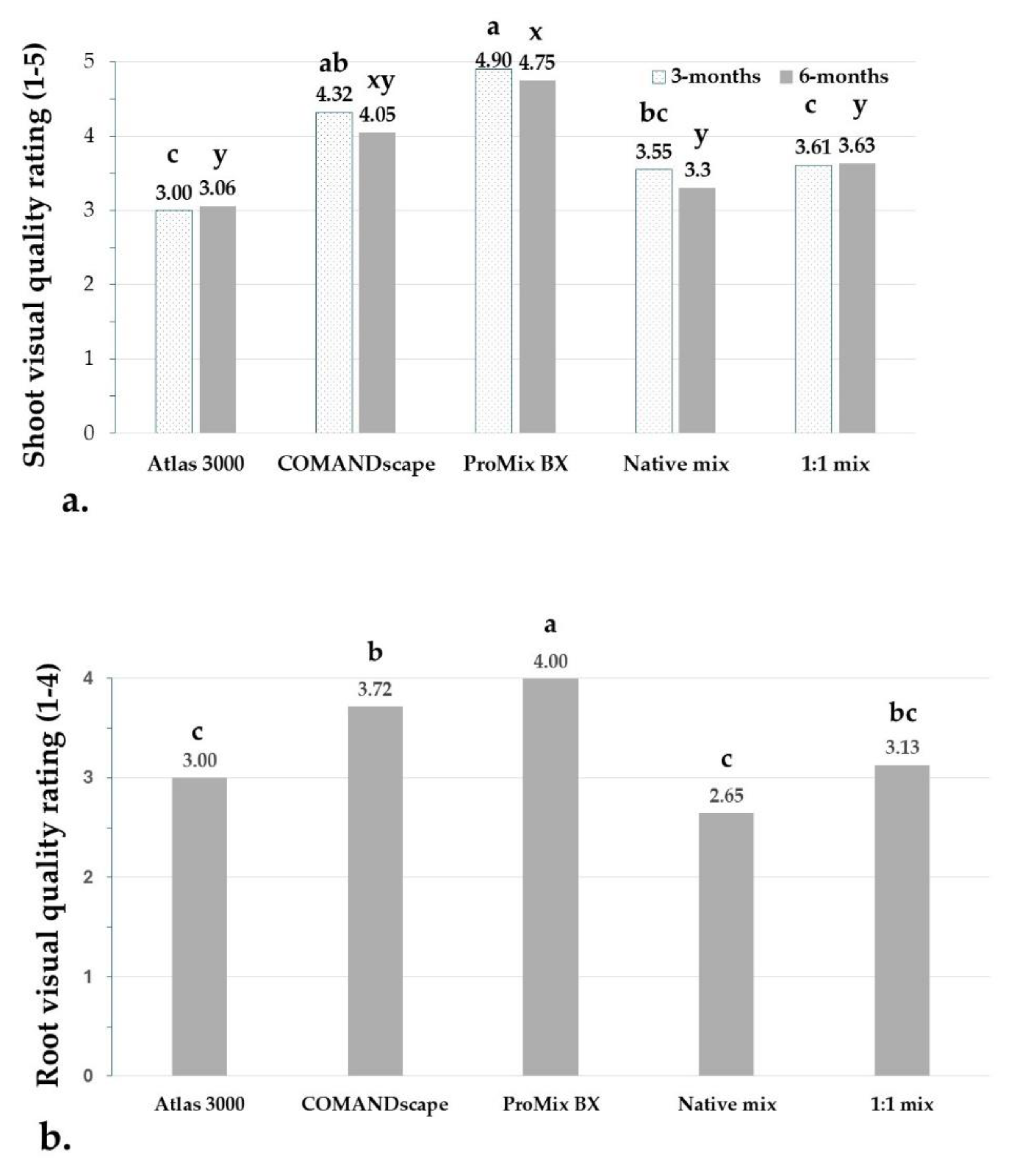

Table 1.
Approximate cost and percent composition of four commercially available and custom-blended substrate mixes used to evaluate the growth of garberia (Garberia heterophylla).
Table 1.
Approximate cost and percent composition of four commercially available and custom-blended substrate mixes used to evaluate the growth of garberia (Garberia heterophylla).
| Substrate | Cost (USD1) |
Peat | Pine | Perlite | Vermi-culite | Saw dust | Coarse sand | Wood chips | Compost |
|---|---|---|---|---|---|---|---|---|---|
| Atlas 3000 | $10.00 | 40 | 50 | - | - | - | 10 | - | - |
| COMANDscape | $11.50 | - | - | - | - | - | - | - | 1002 |
| Native mix | $3.00 | 6 | 47 | - | - | 10 | 10 | 27 | - |
| ProMix BX | $16.76 | 80 | - | 10 | 10 | - | - | - | - |
| 1:1 compost mix3 |
$7.25 | 20 | 25 | - | - | - | 5 | - | 50 |
1 Cost is by volume, referring to the price of 2.8 ft3 of substrate. Prices calculated at the time of purchase in the winter of 2024, excluding shipping. 2The source materials for the COMANDscape were primarily yard waste (75%), and other readily available carbon sources, including bagasse (sugarcane waste), food waste, animal bedding, animal waste, and occasionally biosolids at a low rate. 31:1 v:v mix prepared by blending equal parts Atlas 3000 and COMANDscape compost.
Table 2.
Chemical and elemental properties of five containerized media substrate treatments used to evaluate the growth of garberia (Garberia heterophylla).
Table 2.
Chemical and elemental properties of five containerized media substrate treatments used to evaluate the growth of garberia (Garberia heterophylla).
| Substrate | pH | Electrical conduc-tivity(dS/m) | Organic matter (%) | NO3N (mg/L) |
P (mg/L) |
K (mg/L) |
Ca (mg/L) |
Mg (mg/L) |
|---|---|---|---|---|---|---|---|---|
| Atlas 3000 | 7.6b1 | 2.1c | 40.5c | 2.4c | 10.0d | 244.2c | 135.1c | 32.9c |
| COMANDscape | 6.6d | 5.1a | 73.2b | 321.1a | 36.3b | 552.7a | 285.6a | 110.6a |
| Native mix | 7.8a | 0.4e | 82.6a | 0.1c | 4.0e | 49.8e | 63.8e | 5.8d |
| ProMix BX | 5.3e | 1.4d | 73.4b | 0.1c | 47.3a | 157.8d | 88.4d | 104.9a |
| 1:1 compost mix2 | 7.2c | 3.9b | 61.9b | 179.8b | 24.5c | 432.0b | 243.1b | 76.1b |
1 Means within the same column that are followed by the same letter do not differ at α = 0.05. 2 1:1 mix prepared by mixing equal parts Atlas 3000 and COMANDscape
Table 3.
Physical properties of five containerized media treatments used to evaluate the growth of garberia (Garberia heterophylla).
Table 3.
Physical properties of five containerized media treatments used to evaluate the growth of garberia (Garberia heterophylla).
| Substrate | Water-holding capacity (% v/v) |
Air-filled porosity (% v/v) |
Total porosity (% v/v) |
Bulk density (g∙cm-3) |
Particle density (g∙cm-3) |
| Atlas 3000 | 54.46b1 | 10.86ab | 65.31ab | 0.42a | 1.23a |
|
COMANDscape |
47.54c | 16.40a | 63.94b | 0.16d | 0.66bc |
| Native mix | 46.32c | 11.37ab | 57.68b | 0.34b | 0.81b |
| ProMix BX | 64.15a | 7.83b | 71.98a | 0.24c | 0.56c |
| 1:1 compost mix2 | 51.76bc | 8.19b | 59.95b | 0.33b | 0.81b |
1 Means within the same column that are followed by the same letter do not differ at α = 0.05. 2 1:1 mix prepared by mixing equal parts Atlas 3000 and COMANDscape
Table 4.
Mean height, width, and SPAD of garberia (Garberia heterophylla) planted in five substrates for 3- and 6-month periods in a greenhouse. Mean root and shoot dry mass (DM) are shown at 6-month harvest. Lowercase letters indicate statistically meaningful differences (Tukey test) among substrate treatments for each measured trait within each row (α = 0.05).
Table 4.
Mean height, width, and SPAD of garberia (Garberia heterophylla) planted in five substrates for 3- and 6-month periods in a greenhouse. Mean root and shoot dry mass (DM) are shown at 6-month harvest. Lowercase letters indicate statistically meaningful differences (Tukey test) among substrate treatments for each measured trait within each row (α = 0.05).
| Month | Atlas 3000 | COMAND-scape | Native mix | ProMix BX | 1:1 mix1 |
| 3-months | |||||
| Height (cm) Width2 (cm) SPAD3 |
28.97b 17.39b 48.50b |
31.56b 19.04b 58.38a |
30.85b 17.74b 56.12a |
33.84a 24.35a 58.87a |
26.99b 17.42b 52.79b |
| 6-months | |||||
| Height (cm) Width (cm) SPAD Shoot DM (g) Root DM (g) |
31.82a 22.23a 49.89b 9.56b 1.89b |
33.80a 20.69a 56.12a 13.84b 2.90b |
30.71a 21.66a 50.43b 10.97b 2.51b |
35.95a 25.62a 63.45a 22.66a 6.00a |
30.64a 18.98a 54.14b 10.31b 2.29b |
1 1:1 mix prepared by mixing equal parts Atlas 3000 and COMANDscape. 2 Value represents the average of two perpendicular widths per plant. 3 Representative of leaf greenness, indicating the amount of chlorophyll in leaves.
Disclaimer/Publisher’s Note: The statements, opinions and data contained in all publications are solely those of the individual author(s) and contributor(s) and not of MDPI and/or the editor(s). MDPI and/or the editor(s) disclaim responsibility for any injury to people or property resulting from any ideas, methods, instructions or products referred to in the content. |
© 2025 by the authors. Licensee MDPI, Basel, Switzerland. This article is an open access article distributed under the terms and conditions of the Creative Commons Attribution (CC BY) license (http://creativecommons.org/licenses/by/4.0/).
Copyright: This open access article is published under a Creative Commons CC BY 4.0 license, which permit the free download, distribution, and reuse, provided that the author and preprint are cited in any reuse.