

Submitted:
24 July 2025
Posted:
24 July 2025
You are already at the latest version
Abstract
The significant rise of electric vehicles in urban areas calls for research on smart charging to promote electric mobility. Existing research is fragmented, focusing on single aspects of smart charging, with inconsistent findings. Thus, a bibliometric analysis was conducted to identify the key themes and propose future research agendas on smart charging for electric mobility in urban areas research to guide policy formulation and promote widespread uptake of electric vehicles. A total of 201 publications covering the period 2005 to 2025 were extracted from the Scopus database. Results revealed four key themes are used on smart charging for e-mobility in urban areas research: smart charging technologies and optimisation strategies, grid integration and vehicle-to-grid systems, renewable energy and environmental sustainability, and urban mobility systems and infrastructure development. Despite their importance, real-world testing and smarter integration with cities and grids, especially in developing countries, remain largely underexplored. Future research should focus on large-scale vehicle-to-grid integration, user behavior analysis, and coordinated planning of smart charging with urban transport and policy frameworks.
Keywords:
smart charging
; intelligent charging
; electric mobility
; e‐mobility
; electric vehicle
; urban area
1. Introduction
During the last few years, there have been efforts to adopt electric vehicles (EVs) in urban areas. For instance, India has an ambitious plan for electrifying urban transport, mainly using two-wheelers, three-wheelers, and electric buses [1]. The increased electric mobility (e-mobility in urban areas presents opportunities and challenges. In India, investments in charging infrastructure and electrification of the transport sector are expected to spur economic growth resulting from increased electricity demand and more job opportunities [1]. In addition, there is a shift toward EVs in transportation because of their minimal environmental impacts, such as reduced carbon emissions, energy savings, and improved urban air quality [2,3,4,5,6]. However, the growing number of EVs leads to increased electricity demand [7]. In addition, EVs are characterised by range limitations, insufficient charging infrastructure, and time consuming charging process [2,3], likely to hinder widespread EV adoption. Thus, there is a need for efficient and fast charging solutions, such as smart charging, to manage the increasing electricity demands and support the growing uptake of EVs in urban areas. An efficient EV charging management system relies on effective communication among EVs, electric vehicle supply equipment, and the power grid [8].
Smart charging refers to the innovative functions of EV charging stations that revamp the charging framework by deploying and managing power distribution in a more flexible and productive way [9]. Mlindelwa et al. [2] assert that charging time and mode can be changed in smart charging depending on network traffic, renewable energy production, and requirements of EV owners. It collects and analyses usage data to optimise system performance, real-time surveillance of charger usage and status, and monitors energy consumption while managing network congestion by pre-booking charging ports [9]. Smart charging helps drivers locate idle charging stations, charge faster and safer, and reduce charging costs [8]. It also assists charging stations to control electricity consumption and remotely monitor EV charging events [8]. Smart charging can also optimise energy usage behaviours linked to new charging technologies, challenges in identifying charging stations during daytime hours, increasing infrastructure and equipment costs, and potential system overloads during high demand periods [6].
Smart charging can postpone energy usage to minimise the total energy system costs in a city while still meeting energy demands of EVs [10]. This is impossible for inflexible charging (i.e., conventional charging), where vehicles charge during stops for over one hour until complete, or the vehicle departs [10]. The lengthy EV stoppages during the charging process do not support conventional charging in urban areas. Lengthy queues at the charging stations result to recharging delays [6], discouraging EV owners in urban areas. In addition, urban areas are characterised by limited space, high traffic congestion, high electricity demand during peak hours, and rising pollution [5,11]. Furthermore, the number of delivery vehicles is expected to rise by 36% until 2030 in the world's top 100 cities [12], thus increasing traffic congestion. These provide justifications for smart charging for electric mobility urban areas. Mlindelwa et al. [2] recommend smart (flexible) charging for future smart cities to respond to customer needs. Smart charging has been implemented to alleviate traffic congestion, optimise parking space utilisation, improve parking efficiency, and support sustainable utilization of energy [6].
Despite the existence of numerous studies on smart charging for EVs in urban areas, a preliminary search in the Scopus database using keywords (Article title: (“smart charging” OR “intelligent charging”) AND ("electric transport" OR "e-transport" OR "electric mobility" OR "e-mobility") AND (“bibliometric” OR “review”) failed to identify a study directly aligned with the focus of this review. In addition, existing research is fragmented, with inconsistent findings, and focuses on single aspects of smart charging such as benefits and challenges [2,5], vehicle grid integration and charging technologies [13,14], renewable energy and sustainability concerns [6,14], economic and viability analysis [11], and optimised smart charging [15,16]. In addition, integration of electric charging infrastructure in urban areas is an underexplored area in electric mobility [17]. This reveals a gap in the literature, emphasising the need to conduct a comprehensive review to synthesise existing knowledge and guide future research directions. This is crucial in supporting policy formulation and accelerating the widespread use of EVs in urban areas. This review is guided by the following specific objectives:
- To identify the key themes used in smart charging for electric mobility in urban areas research.
- To propose future research agendas on smart charging for electric mobility in urban areas.
The next sections of this review are organised as follows: Section Two (materials and methods), Section Three (results), Section Four (discussion), and Section Five (conclusions).
2. Materials and Methods
A bibliometric analysis was utilised to identify key themes in smart charging for electric mobility in urban areas research. Bibliometric analysis employs quantitative methods, namely performance analysis and science mapping, to examine large amounts of scientific data to identify emerging areas in a field [18]. Similarly, bibliometric analysis is a good technique used to reveal key themes from publications, offering insights on past, present, and future research [19]. A search was undertaken in the Scopus database on 29th May 2025 using a combination of keywords: (Article title, Abstract, Keywords (“smart charging” OR “intelligent charging”) AND (“electric vehicle” OR “electric car” OR “electric bike” OR “electric scooter” OR “electric rickshaw” OR “electric automobile” OR “electric truck” OR “electric mobility” OR “electric micromobility” OR “electric transport” OR “EV” OR “BEV” OR “HEV” OR “PHEV” OR “FCEV” OR “EREV” OR “e-vehicle” OR “e-car” OR “e-bike” OR “e-scooter” OR “e-rickshaw” OR “e-automobile” OR “e-truck” OR “e-mobility” OR “e-micromobility” OR “e-transport” OR ((“battery” OR “plug-in battery” OR “hybrid” OR “fuel cell” OR “extended range”) AND “electric vehicle”)) AND (“urban” OR “town” OR “city” OR “cities” OR “metropolitan”). To ensure comprehensive coverage, alternatives to the keywords “smart charging,” “electric mobility,” and “urban areas” were considered. The Scopus database is a trusted source of bibliometric data [20]. This search was restricted to journal articles, review papers, conference papers, and book chapters published in English between 2005 and 2025, displaying 211 publications.
After a manual inspection of the topics and abstracts, 10 publications were found to be irrelevant and deleted. The deleted publications covered topics like smart buildings, sustainable urban regeneration, and general reviews on urban mobility, which were not directly aligned with the focus of this study, resulting in 201 publications. The 201 publications were exported as CSV Excel file for bibliometric analysis using the Biblioshiny app via the Bibliometrix package version 4.3.0. Among the 201 publications, 89 (44.3%) are articles, and two (1%) are reviews (Table 1). Table 1 presents key information of the data used in this review. It was noted that even though the search was restricted to publications between 2005 and 2025, the first publication was in 2011. In addition, the average age per publication is 4.17 years, suggesting that this is a young field. There is a high average citations per publication (17.56) (Table 1), underscoring the impact and relevance of research in the field.
3. Results
This section is divided into two subsections: performance analysis and science mapping.
3.1. Performance Analysis
The early phase (2011 to 2016) recorded minimal research, ranging between one to five publications per year (Figure 1). Smart charging for electric mobility was a new concept during this stage. A noticeable growth was recorded in 2017, with 12 publications. Between 2017 and 2020, moderate growth between 12 and 15 publications was recorded yearly. This could be attributed to emerging standards like ISO 15118 and growing policy support from most governments laying the groundwork for smart charging. Substantial growth was recorded in 2021, with 28 publications and a high of 39 publications in 2024. The significant growth can be attributed to an increase in smart charging resulting from technological innovations, policy, and charging infrastructure developments. The noticeable decline to 12 publications in 2025 (Figure 1) is likely due to the incomplete indexing of publications for the current year.
3.1.1. Most Productive Journals
Table 2 shows that Sustainable Cities and Society Review is the most productive journal with seven publications, an h-index of 6, a g-index of 7, an m-index of 1.2, and 171 total citations computed from 2021. The journal mainly focuses on sustainable and smart urban systems across energy, infrastructure, and society. The Applied Energy journal is influential, with the highest total citations (TC=490) from seven publications. The journal primarily focuses on applied research on innovative technologies and low-carbon and renewable energy systems. The World Electric Vehicle Journal is an emerging journal with an m-index of 0.857, from 12 publications with 105 total citations calculated from 2019. This specialised journal primarily focuses on electric vehicle technologies and charging infrastructure.
The journals are classified into three themes based on their scope: smart city and urban sustainability, energy systems and grid optimisation, and electric vehicles and charging innovations. The smart city and urban sustainability theme include Sustainable Cities and Society Review, Sustainability, and IEEE Power and Energy Society General Meeting. The energy systems and grid optimisation theme includes Applied Energy, Energies, Energy, Energy Reports, IEEE Transactions on Smart Grid, and Journal of Modern Power Systems and Clean Energy. The last theme on electric vehicles and charging innovations includes the World Electric Vehicle Journal, IEEE Access, ETransportation, and IEEE Transactions on Industry Applications (Table 2). From the preceding results, research should integrate insights from urban sustainability, energy system optimisation, and EV charging technology innovations to advance smart charging for electric mobility in urban areas.
3.1.2. Most Productive Authors
Table 3 shows that Clairand, J-M. is the most productive author with four publications, an h-index of 4, a g-index of 4, an m-index of 0.44, and 213 total citations computed from 2017. The author focuses on the smart charging of EVs, highlighting aggregator-based strategies that optimise costs, user preferences, and grid stability. Ahmad, I. is an influential author with the highest total citations (TC=340) from two publications. The author addresses the low adoption of EVs, focusing on smart charging strategies to reduce grid stress, charging time, and charging costs. Li, X. is the most productive veteran author with three publications, an h-index of 3, a g-index of 3, and 147 total citations computed from 2014. The author focuses on smart urban EV charging, using pricing and communication strategies to optimise demand and the use of charging infrastructure. Andersen, P. is the most productive emerging author with two publications, an m-index of 0.5, and 34 total citations computed from 2022. The author focuses on how synchronised charging behaviour driven by cost-based incentives can cause grid congestion. From the preceding results, research should integrate insights from user needs, grid efficiency, charging infrastructure, and cost incentives to advance smart charging for electric mobility in urban areas.
3.1.3. Most Productive Countries
The five leading countries in terms of scientific production frequencies are China (97), Italy (92), India (89), Germany (76), and the USA (70) (Table 4). China’s leadership can be attributed to its aggressive national policies promoting electric transport and investments in charging infrastructure. An emerging market like India is ranked second with research efforts towards the need to address pollution and traffic congestion in its densely populated urban areas. European countries led by Italy, Germany, the UK, and Sweden are majority of the most productive countries on the topic. Research in most European countries primarily focus on the use of renewable energy, grid optimisation, and urban infrastructure planning. Iran, a developing economy, was ranked among the most productive countries with a frequency of 29. Research in Iran primarily focuses on cost-effective charging strategies and grid management solutions to support the growing urban areas. It was noted that developing economies from South America and Africa do not feature among the leading countries in scientific production on the topic (Table 4).
3.2. Science Mapping
3.2.1. Co-Authorship Analysis
The country collaboration map visually depicts the intensity (colours) and direction (lines) of collaboration amongst countries in a field [17]. The country collaboration map shows strong collaborations (thicker lines) exist between Spain and Ecuador (Figure 2). The collaboration primarily focuses on user-responsive EV charging optimisation models that heavily rely on aggregators and are tested using simulated urban distribution networks. The USA collaborates with Canada, Iran, and Singapore. For instance, collaborations between the USA and Singapore primarily focus on electrifying on-demand vehicle fleets (i.e., ride-hailing) and the infrastructure, policy, and data integration required to facilitate this transition. The highest research output on the topic emanates from China, India, Germany, and the USA (dark blue colour). In contrast, the emerging/ least research output (light blue colour) emanates from countries like South Africa, Kenya, Argentina, Brazil, Saudi Arabia, Indonesia, and Australia (Figure 2). For instance, research in South Africa primarily focuses on how smart charging strategies can mitigate the strain on power grids to make large-scale EV adoption more feasible and sustainable.
3.2.2. Word Analysis
Word analysis was utilised to determine the most frequently used keywords on the topic and their relationships using word frequency analysis and word cloud. The analysis identified 645 author keywords related to smart charging for electric mobility in urban areas (Table 1). The large number of keywords depicts the broad scope of research on this topic. Table 5 presents the top 50 most common keywords. Four main themes emerge: smart charging technologies, grid integration, green renewable energy, and urban mobility systems. The smart charging technologies theme includes keywords such as charging (batteries), charging station(s), charging infrastructures, charging systems, secondary batteries, charging strategies, charging systems, battery management systems, internet-of-things, learning systems, digital storage, and machine learning. Deploying smart charging technologies is necessary to support electric transport in urban areas. The grid integration theme includes keywords like vehicle-to-grid, electric power transmission networks, electric power distribution, distribution grid, smart grid, smart power grids, electric utilities, and vehicle-to-grid (V2G). This indicates that grid reliability is crucial in the smart charging for electric mobility in urban areas. The green renewable energy theme includes keywords such as renewable energy resources, renewable energies, solar energy, greenhouse gases, fossil fuels, environmental impact, energy efficiency, and energy management. This highlights the significance of aligning smart charging with renewable energy for sustainable electric transport in urban areas. The theme of urban mobility systems includes keywords like smart city, urban transportation, fleet operations, scheduling, distribution systems, commerce, and commercial vehicles (Table 5). Thus, smart charging should integrate reliable grids, renewable energy, and efficient urban mobility for sustainable electric transport.
A word cloud, which visually represents keywords in a text using different colours based on their frequency, was used to show the commonly used keywords and their relationships on the topic. Charging (batteries) is the most prominent keyword, located at the center of the word cloud (Figure 3). This implies that charging (batteries) is a key enabler of smart charging for electric mobility in urban areas. In the word cloud, charging (batteries) is surrounded by other large keywords like smart-grid, vehicle-to-grid, and electric power transmission networks. This indicates that battery charging is becoming a key component of modern grid networks that support smart charging in urban areas. Charging station, charging infrastructures, and charging strategies are placed on top of each other next to vehicle-to-grid in the word cloud. This indicates the logistical and deployment challenges. Keywords like internet-of-things, machine learning, learning systems, smart grid, energy storage, energy efficiency, and renewable energy resources are located at the edges of the word cloud. This suggests emerging technological innovations and renewable energy efforts in smart charging for electric mobility in urban areas. Keywords like social acceptance, regulations, and policy frameworks are not represented in the word cloud (Figure 3).
3.2.3. Thematic Mapping
Thematic mapping visualises research on how important or developed topics are. It includes: motor themes (first quadrant), which are both central and developed; basic themes (second quadrant), which are central but undeveloped; emerging or declining themes (third quadrant), which are both peripheral and undeveloped; and niche themes (fourth quadrant), which are peripheral yet well developed [19,21,22].
The motor theme (quadrant one) comprises keywords such as charging(batteries), charging station, electric power transmission networks, smart city, and secondary batteries (Figure 4). This represents technological and infrastructural systems that form the foundation (i.e., backbone) of smart charging for electric mobility in urban areas. The basic themes (quadrant two) relate to grid integration and sustainability concerns. The theme on grid integration includes keywords like smart charging, vehicle-to-grid, and electric power distribution, while the theme on sustainability concerns comprises keywords such as environmental impact, greenhouse gases, gas emissions, sustainable development, and traffic congestion. Since the themes are relevant but underexplored, there is a need for in-depth research to fully exploit the potential of smart charging for electric mobility in urban areas. The niche theme (quadrant four) relates to keywords such as electric buses, energy policy, transportation system, charging time, and demand analysis. To maximise the impact of smart charging for electric mobility in urban areas, deeper insight into energy policies and demand analysis is necessary. The emerging or declining themes (quadrant three) include keywords like distribution transformer and electric transformer (Figure 4).
3.2.4. Citation Analysis
Citation analysis aids in evaluating influential publications on smart charging for electric mobility in urban areas.
Table 6 shows the most cited publication on smart charging for electric mobility in urban areas. The most influential article, with 37.56 citations per year, was by Moghaddam et al. [23], investigating the use of optimisation to find charging station locations that minimise charging time, travel time, and cost along the City road network. The high number of citations per year implies that this is groundbreaking work on the topic, offering a multi-objective optimisation approach that addresses key EV adoption barriers such as EV charging time, cost, and idle waiting time.
The top-cited publications revealed four main themes: optimised smart charging, renewable energy integration, predictive charging control, and vehicle grid integration. Top cited publications on optimised smart charging demonstrate that optimised smart charging must balance multiple objectives such as travel convenience, cost, emissions, and user satisfaction using real-world data [23,27,28]. Studies by Heinisch et al. [10] and Fachrizal et al. [14] showed that some research focuses on renewable energy integration to smart charging for electric mobility in urban areas. While Fachrizal et al. [14] showed that a V2G scheme and a wind-PV electricity production share of 70:30 can be achieved in an optimal model, Heinisch et al. [10] estimated that 85% of the overall demand in charging electric cars is flexible, and smart charging strategies can enable up to 62% solar PV in the charging electricity mix. Some studies focus on predictive charging control, highlighting the use of artificial intelligence and predictive models to forecast charging station usage and energy demand. For instance, Ma and Faye [15] proposed a hybrid LSTSM neural network predicting the occupancy of EV charging stations in the United Kingdom. Some studies also focus on vehicle grid integration [10,13,14,25,26]. Van Der Kam and Van Sark [13] simulated an optimisation model to study the increase in self-consumption of photovoltaic power by smart charging of electric vehicles and V2G technology in the Netherlands. Geng et al. [25] explored smart charging management system considering transportation and power distribution systems. Fachrizal et al. [14] considered energy matching optimisation at urban scale with smart EV charging and V2G technology in a net-zero energy city.
4. Discussion
The findings presented in the previous section aid in uncovering four key themes used in the study of smart charging for electric mobility in urban areas. These include smart charging technologies and optimisation strategies, grid integration and vehicle-to-grid systems, renewable energy and environmental sustainability, and urban mobility systems and infrastructure development. The theme of smart charging technologies and optimisation strategies is identified from word analysis using keywords such as battery management, charging infrastructures, charging strategies, and machine learning. Clairand, J and Ahmad, I identified as among the most productive authors, contribute significantly to the topic. They propose aggregator-based models and smart scheduling approaches aimed at balancing cost, user needs, and grid performance. In citation analysis, Ma and Faye [15] proposed a hybrid LSTSM neural network predicting the usage patterns of charging stations in the UK. Moghaddam et al. [23] also proposed a multi-objective optimisation model to find the optimal charging station along the Washington City road network, finding that the simulated solution that reduces charging costs and waiting time.
The grid integration and vehicle-to-grid systems theme relates to the role of electric mobility in supporting grid stability through two-way energy exchange, as seen in journals like Applied Energy. According to the word analysis, keywords like smart grid, electric power distribution, and V2G also support this theme. The top-cited publications reveal that V2G can improve load/ energy matching in urban areas [14]. The renewable energy and environmental sustainability theme relates to integrating solar, wind, and other green energy sources into smart charging systems. In agreement, Mogire et al. [29] found that the common research topics in electric mobility/ electric vehicles often emphasise sustainability issues such as carbon footprint. The most productive journals, such as Energy, Energies, and the Energy Report, support this. In addition, keywords such as solar energy, greenhouse gases, energy efficiency, environmental impact, and sustainable development in the word analysis emphasise the environmental benefits of aligning smart charging with renewable energy. In relation to the top cited publications, Heinisch et al. [10] found that up to 85% of the total charging demand for electric cars can be flexibly adjusted, and smart charging strategies can allow up to 62% solar PV in the EV charging electricity mix. Fachrizal et al. [14] also found that optimal load-matching performance is attained in a net-zero energy city with a V2G scheme and a wind-PV electricity production share of 70:30. This implies that renewable-based smart charging can achieve significant solar and wind PV electricity penetration in urban areas for electric mobility.
The urban mobility systems and infrastructure deployment theme focuses on integrating smart charging within the transportation networks in urban areas. Tole [8] indicates that smart charging addresses challenges such as diifficulties in identifying charging stations, infrastructure costs, and overloads during peak periods which are common in urban areas. The theme is supported by the most productive journals, such as Sustainable Cities and Society, and keywords like smart cities, urban transportation, fleet operations, scheduling, and distribution systems in word analysis. According to the top cited publications, Moghaddam et al. [23] used a multi-objective optimisation model to find the optimal charging station along the Washington City road network driving from Oregon to Vancouver, Canada. Thus, optimising smart charging infrastructure placement significantly affects charging costs and waiting time. Integrating smart charging into urban mobility systems allows more efficient traffic and energy management, especially in areas with high delivery vehicle volumes and limited parking availability [6,12].
5. Conclusions
This review noted a significant growth in research on smart charging for electric mobility in urban areas since 2017. The notable growth results from technological innovations, policy, and charging infrastructure developments. Furthermore, research on the topic predominantly focuses on four themes: smart charging technologies and optimisation strategies, grid integration and vehicle-to-grid systems, renewable energy and environmental sustainability, and urban mobility systems and infrastructure development. Future research should aim to address research gaps identified in the four themes.
- Current research found that smart charging technologies and optimisation strategies is an important theme. Most studies primarily focus on cost reduction, grid stability, and scheduling efficiency using simulation-based models. Future research should move beyond simulations to include surveys, large-scale pilot projects, and real-world testing of smart charging that incorporates dynamic data such as user satisfaction, environmental goals, and infrastructure limitations, especially in developing economies.
- Current research on grid integration and vehicle-to-grid systems theme focuses on how electric vehicles can support grid stability through two-way energy exchange, optimising load balancing, and improving energy matching in urban areas with renewable energy sources. Future research should develop real-time models for large-scale V2G integration, investigate the effects on grid stability with renewable energy, and design policies to support V2G use, especially in developing economies.
- Current research on the renewable energy and environmental sustainability theme mainly focuses on integrating renewable energy sources like wind and solar into smart charging systems to lower carbon emissions and increase energy efficiency. Future research should move beyond the environmental benefits of integrating renewable energy into smart charging and include other sustainability benefits like cost-effectiveness and user behaviour to promote widespread adoption.
- Current research on urban mobility systems and infrastructure development theme focuses on placing smart charging stations in the right locations, improving traffic and energy flow, and supporting electric vehicles in busy urban areas. Future research should explore integrating smart charging stations with public transport, ridesharing, and logistics hubs to reduce congestion. In addition, future research should examine urban planning frameworks and policy instruments used by local governments to coordinate charging infrastructure rollout for smart mobility, especially in developing economies.
This review is limited to publications extracted from the Scopus database. While the Scopus database is recognised as a trusted source of bibliometric data, it may not include some niche publications relevant to the topic. Future researchers may consider other relevant databases like Web of Science, PubMed, and Science Direct to incorporate any overlooked publications. The review also used a combination of keywords listed in the materials and methods section of this review. Although relevant, future researchers may consider emerging keywords for a more comprehensive review.
Overall, this review contributes to the theoretical understanding of smart charging for electric mobility in urban areas by identifying four critical research themes: smart charging technologies and optimisation strategies, grid integration and vehicle-to-grid systems, renewable energy and environmental sustainability, urban mobility systems and infrastructure development. The review also emphasises shifting focus from simulation models to investing in real-world implementation and supportive policy formulation, especially in developing economies. Urban planners and policymakers can use the theoretical framework to implement smart charging infrastructure that balances the four themes to ensure efficient energy use, grid stability, environmental sustainability, and smooth urban mobility. It also guides industry stakeholders to focus on real-world testing and integration of vehicle-to-grid systems and renewable energy sources to optimise costs and improve urban mobility.
References
- World Bank. Electric Mobility Assessment, Business Model and Action Plan in India. 2022. Available online: https://documents1.worldbank.org/curated/en/099651206172224743/pdf/IDU02131336d03f5c04f11093bd095d144caa38f.pdf (accessed on 29 May 2025).
- Mlindelwa, S.; Chowdhury, S. D.; Lencwe, M. J. Overview of the challenges, developments, and solutions for electric vehicle charging infrastructure. In the Proceedings of the 32nd Southern African Universities Power Engineering Conference (SAUPEC), Stellenbosch, South Africa, 24-25 January 2024. [CrossRef]
- Ramesh, P.; Kumar Gouda, P.; Sandhya, S.; Dhanush, C. N.; Pavithra, Y. C.; Simran, S. Intelligent charging system for electric vehicle batteries. In the Proceedings of the International Conference on Electronics, Computing, Communication and Control Technology (ICECCC), Bengaluru, India, 2-3 May 2024. [CrossRef]
- Mogire, E; Kilbourn, P.; Luke, R. Last mile delivery technologies for electronic commerce: A bibliometric review Journal of Electronic Commerce in Organizations 2025, 23(1), 1-26, 2025. [CrossRef]
- Rancilio, G.; Bovera, F.; & Delfanti, M. Slow but steady: Assessing the benefits of slow public EV charging infrastructure in metropolitan areas. World Electric Vehicle Journal 2025, 16(3), 148. [CrossRef]
- Trimboli, M.; Antonelli, N.; Avila, L. Optimal V2B management for a smart charging station with renewable energy resources. Journal of Reliable Intelligent Environments 2025, 11(2), 1–12. [Google Scholar] [CrossRef]
- Marxen, H.; Ansarin, M. Smart charging of EVs: Would you share your data for money? In the Proceedings of the Pre-ICIS Workshop Proceedings, Copenhagen, Denmark, 10-11 December 2022. https://aisel.aisnet.org/sprouts_proceedings_siggreen_2022/2.
- Tole, S. An overview of the future smart charging infrastructure for electric vehicles. International Journal of Applied Power Engineering 2024, 13(3), 687–694. [Google Scholar] [CrossRef]
- Jeevitha, A.; Vasudeva Banninthaya, K.; Srikanth, G. S. Design and implementation of smart charging for LMV. In: Reddy, A.; Marla, D.; Favorskaya, M.N.; Satapathy, S.C. (eds) Intelligent Manufacturing and Energy Sustainability. Smart Innovation, Systems and Technologies 2021, 213. Springer, Singapore. [CrossRef]
- Heinisch, V.; Göransson, L.; Erlandsson, R.; Hodel, H.; Johnsson, F.; Odenberger, M. Smart electric vehicle charging strategies for sectoral coupling in a city energy system. Applied Energy 2021, 288, 116640. [Google Scholar] [CrossRef]
- Khan, W.; Ahmad, F.; Ahmad, A.; Alam, M. S.; Ahuja, A. Electric vehicle charging infrastructure in India: Viability analysis. In: Pillai, R., et al. ISGW 2017: Compendium of Technical Papers. Lecture Notes in Electrical Engineering 2018, Springer, Singapore. [CrossRef]
- World Economic Forum. The Future of the Last-Mile Ecosystem. 2020. Available online: https://www.weforum.org/publications/the-future-of-the-last-mile-ecosystem/ (accessed on 19 May 2025).
- Van Der Kam, M.; Van Sark, W. Smart charging of electric vehicles with photovoltaic power and vehicle-to-grid technology in a microgrid: A case study. Applied Energy 2015, 152, 20–30. [Google Scholar] [CrossRef]
- Fachrizal, R.; Qian, K.; Lindberg, O.; Shepero, M.; Adam, R.; Widén, J.; Munkhammar, J. Urban-scale energy matching optimization with smart EV charging and V2G in a net-zero energy city powered by wind and solar energy. ETransportation 2024, 20, 100314. [Google Scholar] [CrossRef]
- Ma, T. Y.; Faye, S. Multistep electric vehicle charging station occupancy prediction using hybrid LSTM neural networks. Energy 2022, 244, 123217. [Google Scholar] [CrossRef]
- Salmani, H.; Rezazadeh, A.; Sedighizadeh, M. Robust stochastic blockchain model for peer-to-peer energy trading among charging stations of electric vehicles. Journal of Operation and Automation in Power Engineering 2024, 12(1), 54–68. [Google Scholar] [CrossRef]
- Mogire, E; Kilbourn, P; Luke, R. Electric vehicles in last-mile delivery: A bibliometric review. World Electric Vehicle Journal, 2025; 16, 52. [CrossRef]
- Donthu, N.; Kumar, S.; Mukherjee, D.; Pandey, N.; Lim, W.M. How to conduct a bibliometric analysis: An overview and guidelines. Journal of Business Research 2021, 133, 285–296. [Google Scholar] [CrossRef]
- Luke, R.; Mageto, J. Impact of China’s belt and road initiative on logistics management in Africa: A bibliometric analysis. Journal of International Logistics and Trade 2023, 21, 204–219. [Google Scholar] [CrossRef]
- Baas, J.; Schotten, M.; Plume, A.; Côté, G.; Karimi, R. Scopus as a curated, high-quality bibliometric data source for academic research in quantitative science studies. Quantitative Science Studies 2020, 1(1), 377–386. [Google Scholar] [CrossRef]
- Callon, M.; Courtial, J.P.; Laville, F. Co-word analysis as a tool for describing the network of interactions between basic and technological research: The case of polymer chemistry. Scientometrics 1991, 22, 155–205. [Google Scholar] [CrossRef]
- Mageto, J. Current and future trends of information technology and sustainability in logistics outsourcing. Sustainability 2022, 14(13), 7641. [Google Scholar] [CrossRef]
- Moghaddam, Z.; Ahmad, I.; Habibi, D.; Phung, Q. V. Smart charging strategy for electric vehicle charging stations. IEEE Transactions on Transportation Electrification 2017, 4(1), 76–88. [Google Scholar] [CrossRef]
- Fachrizal, R.; Shepero, M.; van der Meer, D.; Munkhammar, J.; Widén, J. Smart charging of electric vehicles considering photovoltaic power production and electricity consumption: A review. ETransportation 2020, 4, 100056. [Google Scholar] [CrossRef]
- Geng, L.; Lu, Z.; He, L.; Zhang, J.; Li, X.; Guo, X. Smart charging management system for electric vehicles in coupled transportation and power distribution systems. Energy 2019, 189, 116275. [Google Scholar] [CrossRef]
- Sadeghian, O.; Nazari-Heris, M.; Abapour, M.; Taheri, S. S.; Zare, K. Improving reliability of distribution networks using plug-in electric vehicles and demand response. Journal of Modern Power Systems and Clean Energy 2019, 7(5), 1189–1199. [Google Scholar] [CrossRef]
- Khaksari, A.; Tsaousoglou, G.; Makris, P.; Steriotis, K.; Efthymiopoulos, N.; Varvarigos, E. Sizing of electric vehicle charging stations with smart charging capabilities and quality of service requirements. Sustainable Cities and Society 2021, 70, 102872. [Google Scholar] [CrossRef]
- Li, J.; Wang, G.; Wang, X.; Du, Y. Smart charging strategy for electric vehicles based on marginal carbon emission factors and time-of-use price. Sustainable Cities and Society 2023, 96, 104708. [Google Scholar] [CrossRef]
- Mogire, E.; Kilbourn, P.; Luke, R. Green innovations in last mile delivery for e-commerce: A bibliometric review. In Proceedings of the 17th International Business Conference (IBC), Stellenbosch, South Africa, 22–25 September 2024. https://internationalbusinessconference.com/wp-content/uploads/2024/10/CP171-Mogire-Green-Innovations-final-Corrected.pdf.
Figure 1.
Number of publications per year.
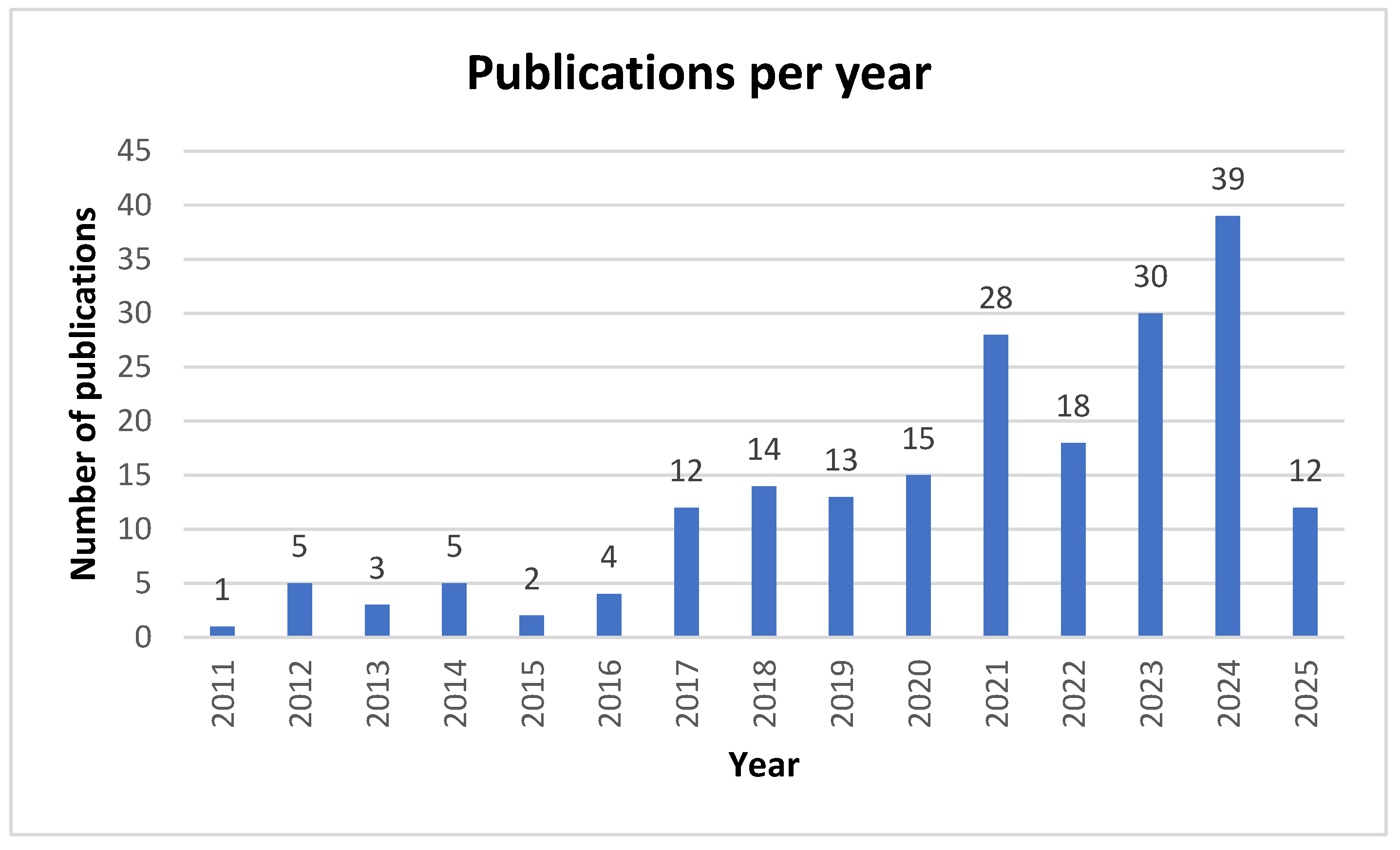
Figure 2.
Country collaborations map.
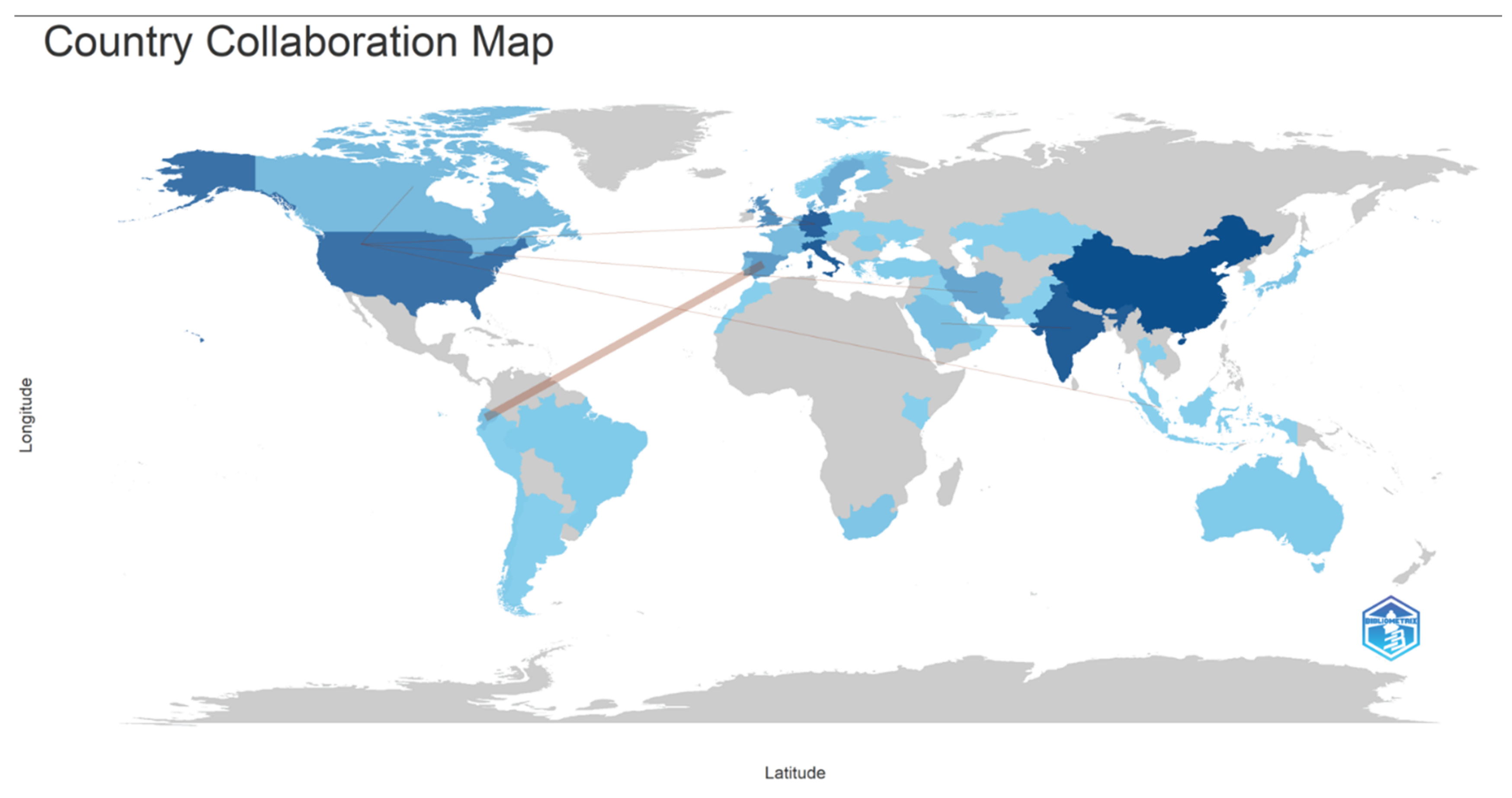
Figure 3.
The word cloud.
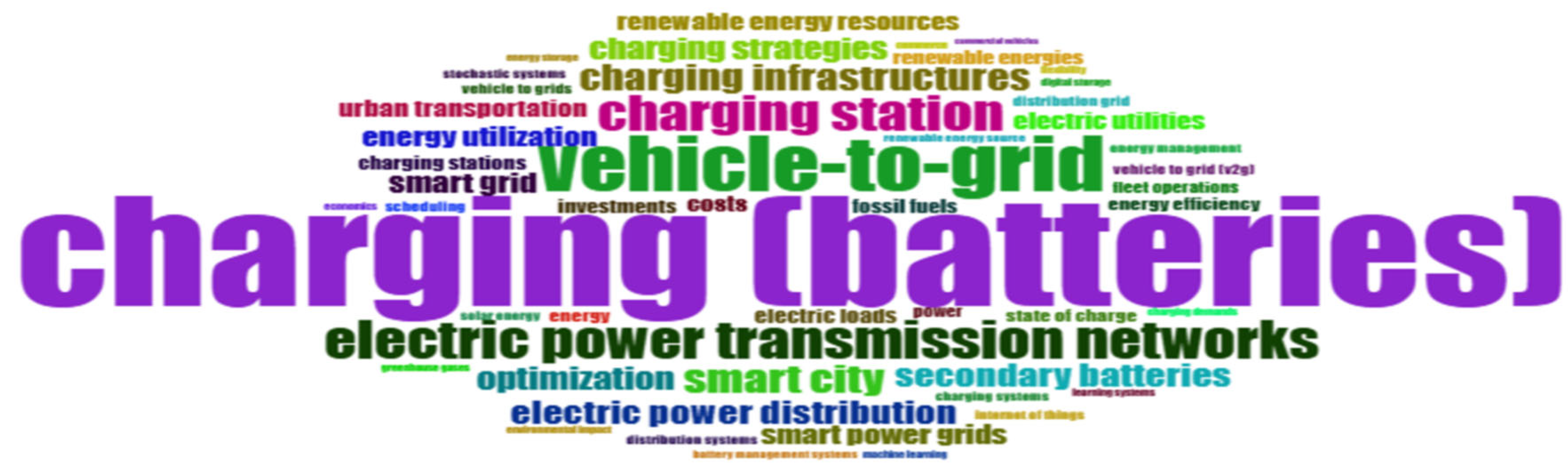
Figure 4.
The thematic map.
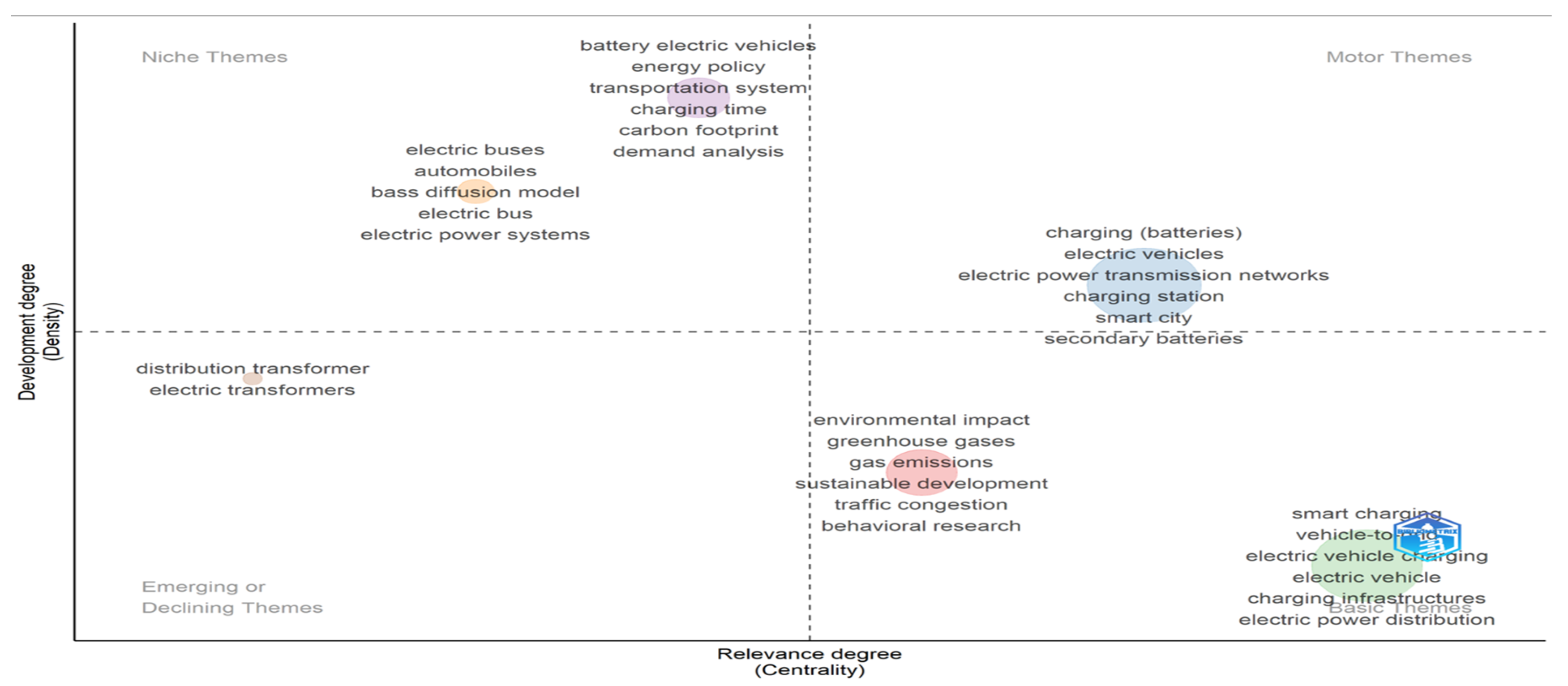

Table 1.
Key information concerning the publications.
| Description | Results |
| Timespan | 2011:2025 |
| Sources (Journals, Books, etc.) | 130 |
| Documents | 201 |
| Annual Growth Rate % | 19.42 |
| Document Average Age | 4.17 |
| Average citations per doc | 17.56 |
| References | 5935 |
| DOCUMENT CONTENTS | |
| Keywords Plus (ID) | 1484 |
| Author's Keywords (DE) | 645 |
| AUTHORS | |
| Authors | 737 |
| Authors of single-authored docs | 12 |
| AUTHORS COLLABORATION | |
| Single-authored docs | 12 |
| Co-Authors per Doc | 3.97 |
| International co-authorships % | 20.4 |
| DOCUMENT TYPES | |
| Article | 89 |
| book chapter | 13 |
| conference paper | 97 |
| Review | 2 |
Table 2.
Top 15 most productive journals.
| Rank | Journal | h-index | g-index | m-index | TC | NP | PY_start |
| 1 | Sustainable Cities and Society | 6 | 7 | 1.2 | 171 | 7 | 2021 |
| 2 | World Electric Vehicle Journal | 6 | 10 | 0.857 | 105 | 12 | 2019 |
| 3 | Applied Energy | 5 | 7 | 0.455 | 490 | 7 | 2015 |
| 4 | Energies | 5 | 7 | 0.625 | 138 | 7 | 2018 |
| 5 | IEEE Access | 4 | 5 | 0.5 | 186 | 5 | 2018 |
| 6 | Sustainability | 4 | 4 | 0.667 | 86 | 4 | 2020 |
| 7 | Etransportation | 3 | 3 | 0.5 | 262 | 3 | 2020 |
| 8 | IEEE Power and Energy Society General Meeting | 3 | 3 | 0.214 | 85 | 3 | 2012 |
| 9 | 2020 15th International Conference on Ecological Vehicles and Renewable Energies, EVER 2020 | 2 | 2 | 0.333 | 15 | 2 | 2020 |
| 10 | Applied Sciences | 2 | 2 | 0.286 | 26 | 2 | 2019 |
| 11 | Energy | 2 | 3 | 0.286 | 207 | 3 | 2019 |
| 12 | Energy Reports | 2 | 2 | 0.5 | 18 | 2 | 2022 |
| 13 | IEEE Transactions on Industry Applications | 2 | 2 | 0.167 | 91 | 2 | 2014 |
| 14 | IEEE Transactions on Smart Grid | 2 | 2 | 0.4 | 55 | 2 | 2021 |
| 15 | Journal of Modern Power Systems and Clean Energy | 2 | 2 | 0.286 | 174 | 2 | 2019 |
Table 3.
Top 15 most productive authors.
| Rank | Author | h-index | g-index | m-index | TC | NP | PY_start |
| 1 | Clairand, J-M. | 4 | 4 | 0.444 | 213 | 4 | 2017 |
| 2 | Li, X. | 3 | 3 | 0.25 | 147 | 3 | 2014 |
| 3 | Pasetti, M. | 3 | 3 | 0.375 | 76 | 3 | 2018 |
| 4 | Ahmad, I. | 2 | 2 | 0.222 | 340 | 2 | 2017 |
| 5 | Alvarez-Bel, C. | 2 | 2 | 0.25 | 175 | 2 | 2018 |
| 6 | Andersen, P. | 2 | 2 | 0.5 | 34 | 2 | 2022 |
| 7 | Bruno, R. | 2 | 2 | 0.167 | 24 | 2 | 2014 |
| 8 | Chen, J. | 2 | 2 | 0.333 | 52 | 2 | 2020 |
| 9 | Chen, Z. | 2 | 2 | 0.4 | 22 | 2 | 2021 |
| 10 | Chu, C-C. | 2 | 2 | 0.25 | 124 | 2 | 2018 |
| 11 | Fachrizal, R. | 2 | 2 | 0.333 | 249 | 2 | 2020 |
| 12 | Ferrari, P. | 2 | 2 | 0.25 | 69 | 2 | 2018 |
| 13 | Finke, S. | 2 | 2 | 0.4 | 14 | 2 | 2021 |
| 14 | Flammini, A. | 2 | 2 | 0.25 | 69 | 2 | 2018 |
| 15 | Gadh, R. | 2 | 2 | 0.25 | 124 | 2 | 2018 |
Table 4.
Top 15 countries’ scientific production.
| Rank | Country | Frequency |
| 1 | China | 97 |
| 2 | Italy | 92 |
| 3 | India | 89 |
| 4 | Germany | 76 |
| 5 | USA | 70 |
| 6 | UK | 32 |
| 7 | Sweden | 31 |
| 8 | Iran | 29 |
| 9 | Netherlands | 29 |
| 10 | Spain | 29 |
| 11 | Austria | 20 |
| 12 | Denmark | 17 |
| 13 | Belgium | 16 |
| 14 | Finland | 15 |
| 15 | Portugal | 14 |
Table 5.
Top 50 most frequent words.
| Rank | Word(s) | Occurrences | Rank | Word(s) | Occurrences |
| 1 | charging (batteries) | 97 | 26 | fleet operations | 10 |
| 2 | vehicle-to-grid | 48 | 27 | power | 10 |
| 3 | electric power transmission networks | 33 | 28 | distribution grid | 9 |
| 4 | charging station | 31 | 29 | scheduling | 9 |
| 5 | smart city | 25 | 30 | vehicle to grid (v2g) | 9 |
| 6 | charging infrastructures | 23 | 31 | vehicle to grids | 9 |
| 7 | electric power distribution | 21 | 32 | charging systems | 8 |
| 8 | secondary batteries | 21 | 33 | distribution systems | 8 |
| 9 | optimisation | 20 | 34 | energy management | 8 |
| 10 | charging strategies | 19 | 35 | internet of things | 8 |
| 11 | smart grid | 18 | 36 | solar energy | 8 |
| 12 | energy utilisation | 17 | 37 | stochastic systems | 8 |
| 13 | smart power grids | 17 | 38 | battery management systems | 7 |
| 14 | electric utilities | 15 | 39 | renewable energy source | 7 |
| 15 | renewable energy resources | 15 | 40 | charging demands | 6 |
| 16 | urban transportation | 15 | 41 | commerce | 6 |
| 17 | costs | 14 | 42 | digital storage | 6 |
| 18 | electric loads | 13 | 43 | economics | 6 |
| 19 | charging stations | 12 | 44 | energy storage | 6 |
| 20 | fossil fuels | 12 | 45 | environmental impact | 6 |
| 21 | investments | 12 | 46 | flexibility | 6 |
| 22 | renewable energies | 12 | 47 | greenhouse gases | 6 |
| 23 | energy | 11 | 48 | learning systems | 6 |
| 24 | energy efficiency | 11 | 49 | machine learning | 6 |
| 25 | state of charge | 11 | 50 | commercial vehicles | 5 |
Table 6.
Top 10 most cited publications based on total citations per year.
| Rank | Authors | Total citations per year | Title | Journal | Summary |
| 1. | Moghaddam et al. [23] | 37.56 | Smart charging strategy for electric vehicle charging stations | IEEE Transactions on transportation electrification | The study used a multi-objective optimisation model to find the optimal charging station along the Washington City road network from Oregon to Vancouver, Canada. The aim was to ensure minimum charging time, charging cost, and travel time. Simulations showed that the proposed solution greatly reduces charging costs and waiting time. |
| 2. | Fachrizal et al. [24] | 35.33 | Smart charging of electric vehicles considering photovoltaic power production and electricity consumption: a review | ETransportation | The study reviewed studies on smart charging considering photovoltaic power production and electricity consumption. Smart charging aspects that were reviewed included configurations, objectives, algorithms, and mathematical models. |
| 3. | Van Der Kam, and Van Sark [13] | 27.36 | Smart charging of electric vehicles with photovoltaic power and vehicle-to-grid technology in a microgrid; a case study | Applied energy | The study used a linear optimisation model to study the increase in the self-consumption of photovoltaic power through smart charging of electric vehicles and vehicle-to-grid technology in the Netherlands. The aim was to ensure minimum charging time, charging cost, and travel time. Simulations showed self-consumption rises from 49% to 62-87%, and demand peaks reduce by 27-67%. |
| 4. | Ma and Faye [15] | 23.50 | Multistep electric vehicle charging station occupancy prediction using hybrid LSTM neural networks | Energy | The study proposed a hybrid LSTSM neural network predicting the occupancy of EV charging stations in the United Kingdom. Results showed a strong potential for improvement of charging station occupancy prediction methods, allowing EV-based mobility service operators to develop smart charging scheduling strategies. |
| 5. | Fachrizal et al. [14] | 18.50 | Urban-scale energy matching optimisation with smart EV charging and V2G in a net-zero energy city powered by wind and solar energy | ETransportation | The case study assessed the optimal energy-matching potentials in a zero-energy city in Sweden. Simulation results showed that the optimal load-matching performance is attained in a net-zero energy city with a V2G scheme and a wind-PV electricity production share of 70:30. |
| 6. | Geng et al. [25] | 15.86 | Smart charging management system for electric vehicles in coupled transportation and power distribution systems | Energy | The study proposes a smart charging management system that considers EV users' elastic response to electricity charging prices in Sweden. Simulation results showed that the system effectively improves voltage quality, and reduces operational costs in distribution and total traffic delay cost. |
| 7. | Heinisch et al. [10] | 15.60 | Smart electric vehicle charging strategies for sectoral coupling in a city energy system | Applied Energy | The study examined how integrating EVs with smart charging can help cities to achieve net-zero emissions. Up to 85% of the overall demand in charging electric cars is flexible, and smart charging strategies can enable up to 62% solar PV in the charging electricity mix. |
| 8. | Sadeghian et al. [26] | 14.14 | Improving reliability of distribution networks using plug-in electric vehicles and demand response | Journal of Modern Power Systems and Clean Energy | The study aims to improve distribution system reliability using demand response programs and smart charging of PEVs in Iran. Simulation results showed that the system effectively enhances reliability and network performance. |
| 9. | Khaksari et al. [27] | 14.00 | Sizing of electric vehicle charging stations with smart charging capabilities and quality of service requirements | Sustainable Cities and Society | The study provides an optimisation framework that minimises the investment cost of charging station operators, subject to achieving a certain quality of service for their clients. Results showed significant variation in the choice of charger types based on the charging control model in the charging station. |
| 10. | Li et al. [28] | 12.67 | Smart charging strategy for electric vehicles based on marginal carbon emission factors and time-of-use price | Sustainable Cities and Society | The study proposes a smart charging strategy based on an improved local search genetic algorithm that considers both the time-of-use price and marginal emission factors. Results showed that the smart charging strategy reduces cost by 27% and emissions by 16% compared to uncontrolled charging. |
Disclaimer/Publisher’s Note: The statements, opinions and data contained in all publications are solely those of the individual author(s) and contributor(s) and not of MDPI and/or the editor(s). MDPI and/or the editor(s) disclaim responsibility for any injury to people or property resulting from any ideas, methods, instructions or products referred to in the content. |
© 2025 by the authors. Licensee MDPI, Basel, Switzerland. This article is an open access article distributed under the terms and conditions of the Creative Commons Attribution (CC BY) license (http://creativecommons.org/licenses/by/4.0/).
Copyright: This open access article is published under a Creative Commons CC BY 4.0 license, which permit the free download, distribution, and reuse, provided that the author and preprint are cited in any reuse.


