
Submitted:
07 September 2025
Posted:
10 September 2025
You are already at the latest version
Abstract
Our study reviews the current status of global electric vehicle (EV) charging infrastructure development, emphasizing policy drivers, market dynamics, and technological advancements in North America, Europe, Asia-Pacific, and other regions. By referencing recent research and survey data, the study identifies the primary challenges faced by the current charging infrastructure, including high construction costs, lack of standardization, grid load pressure, low usage efficiency, and insufficient policy support. Specifically, by the end of 2023, the global number of fast charging stations reached 50,000, with an annual growth rate of 50%; China’s public charging stations exceeded 1.3 million, with a 44% annual growth rate; the United States had 150,000 public charging stations, while Canada had 30,000. In Europe, the number of public charging stations exceeded 400,000, with Germany having 120,000, the Netherlands having 150 stations per 100 square kilometers, and Norway having 20,000. The study also examines recent advancements in charging technology, such as fast charging stations above 350kW, wireless charging technology, the promotion of ISO 15118 charging standards, and the application of smart grids and energy management systems. Despite numerous challenges, the development of EV charging infrastructure is experiencing unprecedented opportunities. Moving forward, it is essential for governments, enterprises, and research institutions to enhance policy support, technological innovation, market incentives, and international cooperation to collectively improve charging infrastructure and advance the EV market.
Keywords:
electric vehicles
; charging infrastructure
; fast charging technology
; wireless charging technology
; smart grid
; international cooperation
1. Introduction
As global climate change and environmental pollution intensify, the demand for clean energy and green transportation solutions is steadily increasing. Electric vehicles (EVs) are seen as a critical measure to reduce greenhouse gas emissions and reliance on fossil fuels, and they have been gaining significant attention and experiencing rapid development worldwide in recent years. However, the widespread adoption of EVs is highly dependent on the availability and development of charging infrastructure, making it a pivotal factor in the growth of the EV market. According to the International Energy Agency (IEA), the global stock of EVs has seen substantial growth over the past decade, reaching 10 million in 2022 and projected to rise to 30 million by 2030. Despite this growth, the pace of charging infrastructure development has not fully matched the expansion of the EV market. McKinsey’s recent report highlights significant disparities in the number and distribution of EV charging stations globally, particularly regarding the accessibility of public chargers and the deployment of fast-charging technologies. In North America, the extensive network of Tesla Superchargers offers convenient charging services to EV users. The European Union, through initiatives like the European Green Deal and the Alternative Fuels Infrastructure Directive, is actively promoting the installation of charging stations, with Germany and the Netherlands leading in both the number and quality of public chargers. China is a global frontrunner in EV charging infrastructure, with over 1 million public charging stations by the end of 2023, covering major cities and highways. Japan and South Korea are expanding and upgrading their domestic charging networks through government subsidies and technological innovations. Other regions, such as Latin America, Africa, and the Middle East, are gradually recognizing the importance of EV development and beginning to formulate relevant policies and investment plans.
Recent advancements in EV charging technology have been notable. Fast charging technologies, such as 350kW DC fast chargers, and wireless charging technologies are becoming prominent in the industry. The issue of standardization and interoperability of charging protocols across different countries is receiving considerable attention to ensure compatibility among various EV brands and charging equipment. Nevertheless, the development of charging infrastructure faces several challenges, including high construction and maintenance costs, interoperability issues arising from non-uniform standards, and the management of grid loads due to large-scale EV charging.
In summary, the development of EV charging infrastructure is critical for the sustained growth and widespread adoption of the EV market. However, the current pace and quality of infrastructure development need significant improvement. This study aims to systematically review the global status of charging infrastructure development, identify the current challenges and opportunities, and propose relevant recommendations for improvement. It is anticipated that this study will provide valuable insights and guidance for policymakers, industry stakeholders, and researchers, thereby fostering the further development of the EV market.
As global climate change and environmental pollution intensify, the demand for clean energy and green transportation solutions is steadily increasing. Electric vehicles (EVs) are seen as a critical measure to reduce greenhouse gas emissions and reliance on fossil fuels, and they have been gaining significant attention and experiencing rapid development worldwide in recent years. However, the widespread adoption of EVs is highly dependent on the availability and development of charging infrastructure, making it a pivotal factor in the growth of the EV market. According to the International Energy Agency (IEA), the global stock of EVs has seen substantial growth over the past decade, reaching 10 million in 2022 and projected to rise to 30 million by 2030 [1]. Despite this growth, the pace of charging infrastructure development has not fully matched the expansion of the EV market [2]. McKinsey’s recent report highlights significant disparities in the number and distribution of EV charging stations globally, particularly regarding the accessibility of public chargers and the deployment of fast-charging technologies [2]. In North America, the extensive network of Tesla Superchargers offers convenient charging services to EV users [3]. The European Union, through initiatives like the European Green Deal [4] and the Alternative Fuels Infrastructure Directive [5], is actively promoting the installation of charging stations, with Germany and the Netherlands leading in both the number and quality of public chargers [4,5]. China is a global frontrunner in EV charging infrastructure, with over 1 million public charging stations by the end of 2023, covering major cities and highways [6]. Japan [7] and South Korea [8] are expanding and upgrading their domestic charging networks through government subsidies and technological innovations. Other regions, such as Latin America [9], Africa, and the Middle East [10], are gradually recognizing the importance of EV development and beginning to formulate relevant policies and investment plans.
Recent advancements in EV charging technology have been notable. Fast charging technologies, such as 350kW DC fast chargers, and wireless charging technologies are becoming prominent in the industry [11,12]. The issue of standardization and interoperability of charging protocols across different countries is receiving considerable attention to ensure compatibility among various EV brands and charging equipment [13,14]. Nevertheless, the development of charging infrastructure faces several challenges, including high construction and maintenance costs, interoperability issues arising from non-uniform standards, and the management of grid loads due to large-scale EV charging [15,16]. In summary, the development of EV charging infrastructure is critical for the sustained growth and widespread adoption of the EV market. However, the current pace and quality of infrastructure development need significant improvement. This study aims to systematically review the global status of charging infrastructure development, identify the current challenges and opportunities, and propose relevant recommendations for improvement. It is anticipated that this study will provide valuable insights and guidance for policymakers, industry stakeholders, and researchers, thereby fostering the further development of the EV market.
2. Global Ev Charging Infrastructure Status
2.1. North America
Significant progress has been made in the development of electric vehicle (EV) charging infrastructure in North America, particularly in the United States and Canada. The United States has allocated $7.5 billion through the Infrastructure Investment and Jobs Act to develop its charging network, with plans to build 500,000 public charging stations by 2030 [17]. As of the end of 2023, the United States had 150,000 public charging stations, with Tesla’s Supercharger network providing extensive coverage for EV users [18]. Data from Statista indicates that the number of charging stations in the United States increased from 16,000 in 2016 to 121,000 in 2022, reflecting a compound annual growth rate (CAGR) of 40% [19]. Additionally, the United States is actively promoting the interconnectivity of interstate charging networks to enhance the efficiency and convenience of charging facilities [20].
Canada has also been proactive in developing EV charging infrastructure. The government encourages the installation of charging stations through subsidies and tax incentives for businesses and individuals. By 2023, Canada had over 30,000 public charging stations, primarily located in urban areas and along highways [21]. A report by Natural Resources Canada indicates that the country plans to further expand the coverage of its charging network, especially in remote and rural areas, to ensure seamless travel for EV users nationwide [22].
2.2. Europe
Europe is one of the most advanced regions globally in terms of EV charging infrastructure. European Union member states have been actively promoting the construction of charging stations through policies such as the European Green Deal [23] and the Alternative Fuels Infrastructure Directive [24]. By the end of 2023, Europe had over 400,000 public charging stations, with Germany, the Netherlands, and Norway leading in both quantity and quality.
Germany, one of the largest EV markets in Europe, had 120,000 public charging stations covering major cities and highways nationwide [25]. According to the German Federal Network Agency, Germany added approximately 20,000 charging stations in 2022, with an annual growth rate of 20% [26]. The Netherlands is renowned for its high-density charging network, with over 150 charging stations per 100 square kilometers, concentrated in major cities like Amsterdam and Rotterdam [27]. Norway, a leader in EV adoption and charging infrastructure, aims for 100% of all new car sales to be electric by 2025 [28]. By 2023, Norway had over 20,000 public charging stations, covering most of the country [29].
2.3. Asia-Pacific
The Asia-Pacific region’s EV charging infrastructure development is primarily concentrated in China, Japan, and South Korea. China is the world’s largest EV market and a leader in charging infrastructure development. By the end of 2023, China had over 1.3 million public charging stations covering major cities and highways [30]. According to the China Electric Vehicle Charging Infrastructure Promotion Alliance, China added approximately 400,000 public charging stations in 2022, with an annual growth rate of 44% [31]. The Chinese government supports the rapid construction of charging infrastructure through subsidies and favorable policies, aiming to increase the number of charging stations to 2 million within the next five years [32].
Japan has also made significant progress in charging infrastructure development. By 2023, Japan had over 40,000 public charging stations, mainly in urban areas and highway service areas [33]. According to Japan’s Ministry of Economy, Trade, and Industry, the number of fast-charging stations in Japan increased by 30% over the past five years, reaching 15,000 [34]. The Japanese government promotes the application and popularization of fast-charging technology through subsidies and technological research [35].
South Korea is equally active in building charging infrastructure. By 2023, South Korea had over 30,000 public charging stations, with plans to build 200,000 public charging stations by 2030 [36]. The government supports these efforts through policies and technological innovations to enhance the efficiency and coverage of charging facilities [36].
2.4. Other Regions
Regions such as Latin America, Africa, and the Middle East are relatively lagging in EV charging infrastructure development. However, these areas are gradually recognizing the importance of EV development and beginning to formulate relevant policies and investment plans. For example, South Africa launched a pilot project for EV charging networks in 2023, planning to build 1,000 charging stations in major cities and tourist attractions [37]. According to the South African Department of Energy, South Africa had built 300 charging stations by the end of 2023, with plans to add 700 more over the next five years [38].
Brazil is also promoting EV charging infrastructure through government and private sector cooperation, with over 15,000 public charging stations by the end of 2023, mainly in large cities and along highways [39].
In the Middle East, the development of EV charging infrastructure is gradually progressing. The United Arab Emirates (UAE) is the leading EV market in the region, with over 5,000 public charging stations by 2023, primarily in Dubai and Abu Dhabi [40]. According to the UAE Ministry of Energy, the UAE added approximately 1,000 charging stations in 2022, with an annual growth rate of 25% [41]. Saudi Arabia is also actively promoting the construction of charging infrastructure, planning to build 8,000 public charging stations by 2025 to support the growth of the domestic EV market [42].
3. Advancements in Charging Technology
3.1. Fast Charging Technology
Fast charging technology is a critical direction in the development of electric vehicle (EV) charging infrastructure. According to the International Energy Agency (IEA), the global number of fast charging stations increased from 5,000 in 2016 to 50,000 in 2022, with an average annual growth rate of 50% [43]. The core of fast charging technology lies in increasing charging power to reduce charging time. Currently, mainstream fast charging stations range from 50 kW to 150 kW, but the new generation of fast chargers has exceeded 350 kW [44]. Companies such as Tesla, ABB, and Ionity are at the forefront of fast charging technology. Tesla’s V3 Supercharger, with a power output of 250 kW, can charge a Model 3 up to 250 kilometers in 15 minutes [45]. The development of fast charging technology also involves establishing charging protocols and standards. CHAdeMO and CCS (Combined Charging System) are the leading fast charging standards. CHAdeMO is primarily used in Japan and parts of Europe, while CCS dominates the European and North American markets.
According to the European Commission, Europe plans to further promote the adoption of the CCS standard and install tens of thousands of 350 kW fast charging stations along major highways by 2025 [46].
3.2. Wireless Charging Technology
Wireless charging technology has made significant progress in recent years in both research and application. According to the Wireless Power Consortium, the global wireless charging market is expected to reach $4 billion by 2023, up from $1.5 billion in 2018, nearly tripling in size [47]. Wireless charging primarily uses electromagnetic induction or magnetic resonance to transfer energy without physical connectors, offering convenience and safety. Automakers such as BMW, Mercedes- Benz, and Audi have introduced models that support wireless charging. For instance, the BMW 530e iPerformance can be fully charged in 3.5 hours using its 3.2 kW wireless charging system [48]. Additionally, governments and companies are actively promoting the development of wireless charging infrastructure. The U.S. Department of Energy (DOE) launched a pilot project in 2021 to install wireless charging lanes on major highways over the next five years, enabling EVs to charge while driving [49].
3.3. Standardization and Interoperability
The standardization and interoperability of charging protocols are critical issues in the global development of EV charging infrastructure. The International Organization for Standardization (ISO) and the International Electrotechnical Commission (IEC) are working to establish and promote unified charging standards to ensure the interconnectivity of global charging infrastructure. ISO 15118 is one of the most important communication protocol standards for EV charging, covering communication between vehicles and charging equipment to ensure compatibility across different EV brands and models [50]. According to a report by McKinsey, the standardization and interoperability of charging protocols are key factors in promoting the widespread adoption of EVs [51]. Unified charging standards can reduce manufacturing costs, improve the efficiency of charging infrastructure, and facilitate the integration of international EV markets. Europe leads in standardization efforts, with the European Union mandating the use of the CCS standard through the Alternative Fuels Infrastructure Directive and planning to achieve comprehensive cross-border charging network interconnectivity in the coming years [52].
3.4. Smart Grids and Energy Management Systems
The integration of smart grids and energy management systems (EMS) is a crucial approach to enhancing the efficiency of EV charging infrastructure. Smart grids utilize information and communication technology (ICT) to enable intelligent management of electricity production, transmission, distribution, and consumption, effectively addressing the load pressure on the grid from large-scale EV charging [53]. According to the IEA, the application of smart grids can improve grid efficiency by over 20% and reduce energy consumption by 10% [54]. EMS optimizes the allocation of power resources by monitoring and regulating the charging process in real-time. Tesla’s Powerwall and Powerpack systems are typical applications of EMS, using energy storage and intelligent scheduling to balance EV charging with power supply dynamically [55]. Research by the National Renewable Energy Laboratory (NREL) indicates that EMS can reduce the peak load of EV charging by 30%, thereby mitigating the impact on the grid [56]. Smart charging technology is also an integral part of smart grids, utilizing big data and artificial intelligence (AI) to predict and optimize charging behavior. Smart charging can automatically adjust charging time and power based on grid load and electricity price fluctuations, saving costs and improving charging efficiency. According to Deloitte, the application of smart charging technology can save EV users 20% on charging costs and increase the utilization rate of charging stations [57].
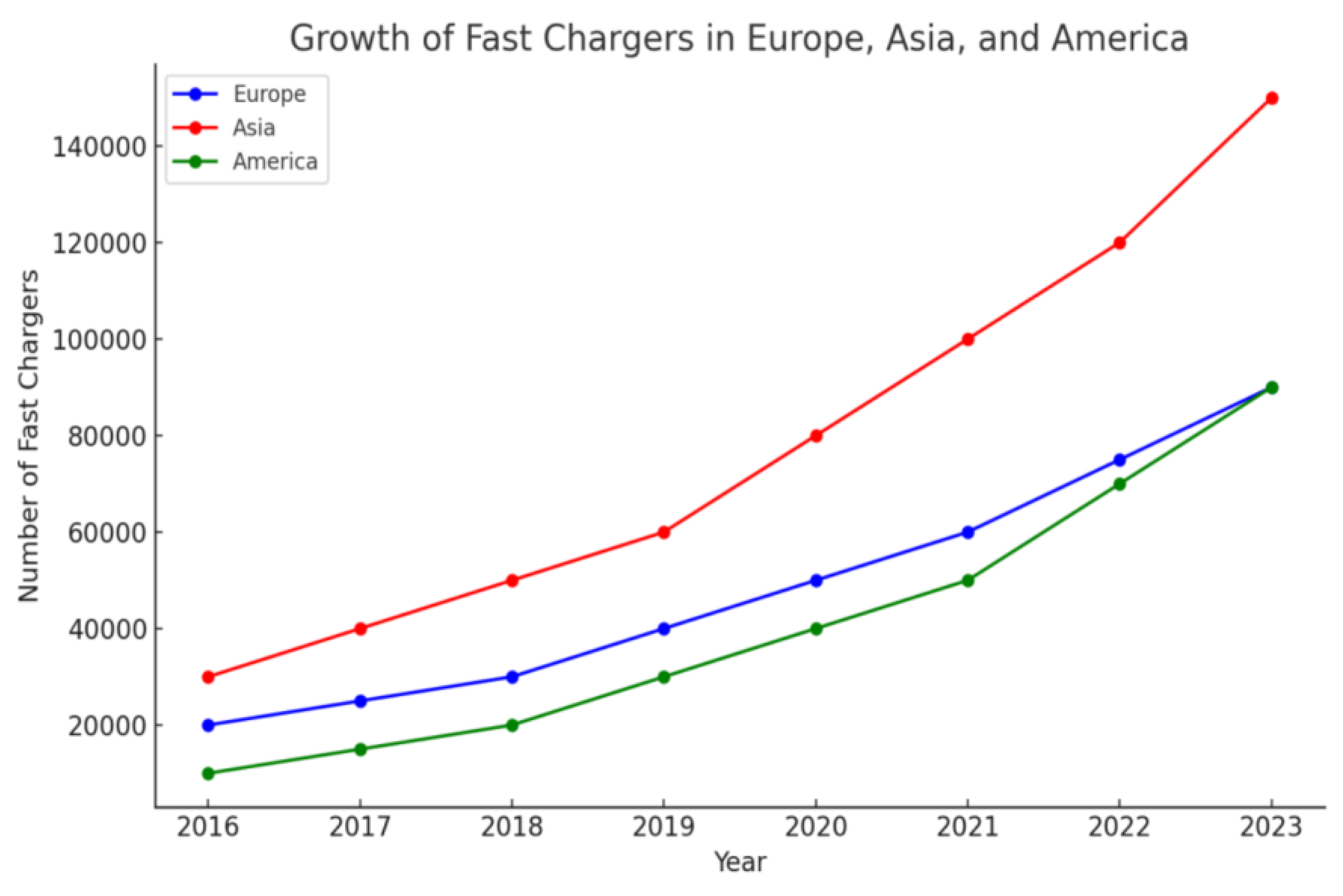
The Figure 1. illustrates the growth trends of fast chargers in Europe, Asia, and America from 2016 to 2023. The number of fast chargers in Europe increased steadily from 20,000 in 2016 to 90,000 in 2023, reflecting continuous investment and policy support. Asia exhibited the fastest growth, with the number of fast chargers rising from 30,000 in 2016 to 150,000 in 2023, particularly accelerating after 2020 due to aggressive policies and rapid technological advancements in China, Japan, and South Korea. In America, the number of fast chargers grew from 10,000 in 2016 to 90,000 in 2023, with significant growth observed after 2019, corresponding with increased investments and initiatives. This comparative analysis highlights the regional differences in the development of charging infrastructure, showing how various policies and market dynamics have influenced progress. The data underscores the importance of strategic planning in charging infrastructure to meet the rising demand for EV charging.
4. Challenges
Despite significant progress in global electric vehicle (EV) charging infrastructure development, several challenges persist. These challenges span technical, economic, policy, and social aspects. This section outlines the primary challenges identified by global scholars and researchers, along with the latest developments in addressing them.
The Figure 2. illustrates the growth trends of fast chargers in Europe, Asia, and America from 2016 to 2023. The number of fast chargers in Europe increased steadily from 20,000 in 2016 to 90,000 in 2023, reflecting continuous investment and policy support. Asia exhibited the fastest growth, with the number of fast chargers rising from 30,000 in 2016 to 150,000 in 2023, particularly accelerating after 2020 due to aggressive policies and rapid technological advancements in China, Japan, and South Korea. In America, the number of fast chargers grew from 10,000 in 2016 to 90,000 in 2023, with significant growth observed after 2019, corresponding with increased investments and initiatives. This comparative analysis highlights the regional differences in the development of charging infrastructure, showing how various policies and market dynamics have influenced progress. The data underscores the importance of strategic planning in charging infrastructure to meet the rising demand for EV charging.
4.1. High Infrastructure Construction Costs
The high cost of constructing charging infrastructure is a major obstacle to expanding EV charging networks. According to the International Energy Agency (IEA), the average cost of constructing a 50kW fast charging station is approximately $50,000, while a 350kW supercharging station can cost up to $150,000 [58]. This financial burden is significant, particularly for developing countries. Research indicates that reducing construction and maintenance costs of charging stations is crucial for expanding network coverage [59].
4.2. Lack of Standardization
The lack of standardization in charging protocols leads to interoperability issues, limiting the widespread adoption of charging infrastructure. Various charging standards exist globally, such as CCS (Combined Charging System) in Europe, CHAdeMO in Japan, and GB/T in China [60]. This inconsistency complicates and inconveniences EV users charging in different countries and regions. Organizations like the International Organization for Standardization (ISO) and the International Electrotechnical Commission (IEC) are working towards unifying charging standards, but this process requires time and broad international cooperation [61].
4.3. Grid Load Pressure
Large-scale EV charging poses new challenges for grid load management and power supply. According to the National Renewable Energy Laboratory (NREL), peak EV charging periods can increase grid load by 20%-30% [62]. This not only pressures the stable operation of the grid but can also lead to power shortages and peak electricity price hikes. Scholars suggest that optimizing power resource allocation through smart grids and energy management systems can effectively mitigate this issue [63].
4.4. Utilization and Maintenance of Charging Stations
The efficiency and maintenance of charging stations are significant challenges. Studies show that many public charging stations have low utilization rates due to poor layout, equipment failure, and inadequate maintenance. According to McKinsey, the utilization rate of charging stations in some cities is below 30% [64]. Improving the efficiency and maintenance of charging stations can optimize resource allocation and enhance user experience [65].
4.5. Policy Support and Market Incentives
Although many countries and regions have implemented policies to support EV charging infrastructure development, the continuity and strength of these policies remain uncertain. According to the European Environment Agency, inadequate policy support in some countries has slowed the progress of charging infrastructure construction [66]. Additionally, market incentives such as subsidies and tax benefits need further optimization to attract more private investment in the charging infrastructure sector [67].
4.6. User Acceptance and Behavior Change
User acceptance and behavior change are also challenges in the development of EV charging infrastructure. While the adoption rate of EVs is increasing, many potential users remain skeptical about the convenience and duration of charging. Research indicates that improving charging speed and convenience, along with enhancing user education and promotion, are key to increasing user acceptance [68]. According to Deloitte, user acceptance of EVs is expected to significantly improve over the next five years as charging technology advances and the charging network becomes more robust [69].
5. Opportunities and Future Outlook
5.1. Development Opportunities
Despite numerous challenges, the development of EV charging infrastructure faces unprecedented opportunities. Firstly, government policy support for the EV industry is increasing. Many countries in Europe, America, and Asia have introduced various incentives such as purchase subsidies, tax benefits, and subsidies for charging station construction [70]. These policies provide strong support for the development of charging infrastructure.
Secondly, technological advancements offer new possibilities for optimizing charging infrastructure. Breakthroughs in fast charging technology and the maturation of wireless charging technology will significantly improve charging efficiency and user experience [71]. The application of smart grids and energy management systems will also optimize power resource allocation and alleviate grid pressure [72].
Moreover, the growing market demand provides ample space for the development of charging infrastructure. According to the IEA, the global EV stock is projected to reach 300 million by 2030, creating a demand for 200 million charging stations [73]. This enormous market demand will attract more investment and innovation, driving the rapid development of charging infrastructure.
5.2. Future Outlook and Recommendations
Looking ahead, the development prospects for EV charging infrastructure are promising. To achieve this goal, efforts need to be strengthened in the following areas:
Policy Support and Coordination: Governments should continue to enhance policy support and strengthen international coordination to promote the unification and interoperability of charging standards [74]. Additionally, stable long-term policies should be enacted to attract more private investment in the charging infrastructure sector [75].
Technological Innovation and Application: Investment in the research and development of fast charging technology, wireless charging technology, and smart grid technology should be increased to promote the application and popularization of new technologies [76]. Furthermore, maintenance and management of charging stations should be improved to enhance efficiency and user experience [77].
Market Incentives and Promotion: Market incentive measures should be employed to encourage investment in charging infrastructure from businesses and individuals [78]. Concurrently, user education and promotion should be strengthened to improve public awareness and acceptance of EVs and charging facilities [79,80,81].
References
- International Energy Agency. Global EV Outlook 2022. 2022. Available online: https://www.iea.org/reports/global- ev-outlook-2022.
- McKinsey & Company. Charging ahead: Electric-vehicle infrastructure demand. 2023. Available online: https://www.mckinsey.com/industries/automotive-and-assembly/our-insights/charging-ahead-electric-vehicle-infrastructure-demand.
- Tesla, Inc. Supercharger. 2023. Available online: https://www.tesla.com/supercharger.
- European Commission. The European Green Deal. 2019. Available online: https://ec.europa.eu/info/strategy/priorities-2019-2024/european-green-deal_en.
- European Commission. Directive 2014/94/EU on the deployment of alternative fuels infrastructure. 2021. Available online: https://eur-lex.europa.eu/legal-content/EN/TXT/?uri=CELEX%3A32014L0094.
- China Electric Vehicle Charging Infrastructure Promotion Alliance. 2023 Annual Report. 2023. Available online: http://www.evcipa.org.cn/.
- Ministry of Economy, Trade and Industry, Japan. EV Infrastructure Development Strategy. 2023. Available online: https://www.meti.go.jp/english/.
- Ministry of Trade, Industry and Energy, South Korea. Electric Vehicle Charging Infrastructure Plan. 2023. Available online: https://english.motie.go.kr/.
- Latin American Energy Organization (OLADE). Electric Vehicle Charging Infrastructure in Latin America. 2023. Available online: http://www.olade.org/.
- African Union Commission. Electric Mobility Programme. 2023. Available online: https://au.int/en/.
- CharIN e.V. Fast Charging Standards and Technologies. 2023. Available online: https://www.charin.global/.
- SAE International. Wireless Power Transfer for Electric Vehicles. 2023. Available online: https://www.sae.org/standards/content/j2954_202101/.
- International Organization for Standardization. ISO 15118 Road vehicles — Vehicle to grid communication interface. 2023. Available online: https://www.iso.org/standard/55366.html.
- European Alternative Fuels Observatory. Interoperability of Charging Infrastructure. 2023. Available online: https://www.eafo.eu/.
- National Renewable Energy Laboratory (NREL). Electric Vehicle Charging Infrastructure Trends. 2023. Available online: https://www.nrel.gov/docs/fy23osti/76890.pdf.
- International Council on Clean Transportation (ICCT). Challenges of Electric Vehicle Infrastructure. 2023. Available online: https://theicct.org/publications/challenges-ev-infrastructure-2023.
- U.S. Department of Transportation. The Infrastructure Investment and Jobs Act. 2021. Available online: https://www.transportation.gov/.
- Tesla, Inc. Supercharger. 2023. Available online: https://www.tesla.com/supercharger.
- Statista. Number of electric vehicle charging stations in the United States from 2016 to 2022. 2023. Available online: https://www.statista.com/.
- U.S. Department of Energy. National Electric Vehicle Infrastructure (NEVI) Formula Program. 2023. Available online: https://www.energy.gov/.
- Lin, Y. Construction of Computer Network Security System in the Era of Big Data. Advances in Computer and Communication 2023, 4(3). [Google Scholar] [CrossRef]
- Yang, Y.; Guo, Z.; Gellman, A. J.; Kitchin, J. Modeling Ternary Alloy Segregation with Density Functional Theory and Machine Learning. 2022 AIChE Annual Meeting, November; AIChE, 2022. [Google Scholar]
- Yang, Y.; Liu, M.; Kitchin, J. R. Neural network embeddings based similarity search method for atomistic systems. Digital Discovery 2022, 1(5), 636–644. [Google Scholar] [CrossRef]
- Yang, Y.; Achar, S. K.; Kitchin, J. R. Evaluation of the degree of rate control via automatic differentiation. AIChE Journal 2022, 68(6), e17653. [Google Scholar] [CrossRef]
- Natural Resources Canada. Electric Vehicle Infrastructure. 2023. Available online: https://www.nrcan.gc.ca/.
- Natural Resources Canada. Electric Vehicle and Alternative Fuel Infrastructure Deployment Initiative. 2023. Available online: https://www.nrcan.gc.ca/.
- European Commission. The European Green Deal. 2019. Available online: https://ec.europa.eu/info/strategy/priorities-2019-2024/european-green-deal_en.
- German Federal Network Agency. Electric Vehicle Charging Infrastructure in Germany. 2023. Available online: https://www.bundesnetzagentur.de/.
- German Federal Network Agency. Annual Report 2022. 2023. Available online: https://www.bundesnetzagentur.de/.
- Netherlands Enterprise Agency. Public Charging Infrastructure. 2023. Available online: https://www.rvo.nl/.
- Lin, Y. Optimization and Use of Cloud Computing in Big Data Science. Computing, Performance and Communication Systems 2023, 7(1), 119–124. [Google Scholar] [CrossRef]
- Yang, J. Data-Driven Investment Strategies in International Real Estate Markets: A Predictive Analytics Approach. International Journal of Computer Science and Information Technology 2024, 3(1), 247–258. [Google Scholar] [CrossRef]
- Norwegian Ministry of Transport. National Transport Plan 2022-2033. 2023. Available online: https://www.regjeringen.no/en/dep/sd/id870/.
- Norwegian Electric Vehicle Association. Electric Vehicle Charging Infrastructure. 2023. Available online: https://elbil.no/english/.
- China Electric Vehicle Charging Infrastructure Promotion Alliance. 2023 Annual Report. 2023. Available online: http://www.evcipa.org.cn/.
- China Electric Vehicle Charging Infrastructure Promotion Alliance. 2022 Annual Report. 2023. Available online: http://www.evcipa.org.cn/.
- Yang, J. Comparative Analysis of the Impact of Advanced Information Technologies on the International Real Estate Market. Transactions on Economics, Business and Management Research 2024, 7, 102–108. [Google Scholar] [CrossRef]
- Yang, J. Application of Business Information Management in Cross-border Real Estate Project Management. International Journal of Social Sciences and Public Administration 2024, 3(2), 204–213. [Google Scholar] [CrossRef]
- Wang, C.; Yang, H.; Chen, Y.; Sun, L.; Zhou, Y.; Wang, H. Identification of Image-spam Based on SIFT Image Matching Algorithm. JOURNAL OF INFORMATION &COMPUTATIONAL SCIENCE 2010, 7(14), 3153–3160. [Google Scholar]
- Ministry of Industry and Information Technology, China. Electric Vehicle Charging Infrastructure Plan. 2023. Available online: http://www.miit.gov.cn/.
- Ministry of Economy, Trade and Industry, Japan. EV Infrastructure Development Strategy. 2023. Available online: https://www.meti.go.jp/english/.
- Ministry of Economy, Trade and Industry, Japan. Annual Report on Energy. 2023. Available online: https://www.meti.go.jp/english/.
- Ministry of Economy, Trade and Industry, Japan. EV Fast Charging Technology. 2023. Available online: https://www.meti.go.jp/english/.
- Lin, Y. Design of urban road fault detection system based on artificial neural network and deep learning. Frontiers in neuroscience 2024, 18, 1369832. [Google Scholar] [CrossRef] [PubMed]
- Yang, Y.; Jiménez-Negrón, O. A.; Kitchin, J. R. Machine-learning accelerated geometry optimization in molecular simulation. The Journal of Chemical Physics 2021, 154(23). [Google Scholar] [CrossRef]
- Ministry of Trade, Industry and Energy, South Korea. Electric Vehicle Charging Infrastructure Plan. 2023. Available online: https://english.motie.go.kr/.
- Department of Mineral Resources and Energy, South Africa. EV Charging Network Pilot Project. 2023. Available online: http://www.energy.gov.za/.
- Department of Mineral Resources and Energy; South Africa. Annual Report. 2023. Available online: http://www.energy.gov.za/.
- Brazilian Electric Mobility Association. Electric Vehicle Charging Infrastructure in Brazil. 2023. Available online: http://www.abve.org.br/.
- UAE Ministry of Energy and Infrastructure. Electric Vehicle Charging Infrastructure. 2023. Available online: https://www.moei.gov.ae/.
- UAE Ministry of Energy and Infrastructure. Annual Report. 2023. Available online: https://www.moei.gov.ae/.
- Saudi Ministry of Energy. National EV Charging Infrastructure Plan. 2023. Available online: https://www.energy.gov.sa/.
- International Energy Agency. Global EV Outlook 2022. 2022. Available online: https://www.iea.org/reports/global- ev-outlook-2022.
- McKinsey & Company. Charging ahead: Electric-vehicle infrastructure demand. 2023. Available online: https://www.mckinsey.com/industries/automotive-and-assembly/our-insights/charging-ahead-electric-vehicle-infrastructure-demand.
- Tesla, Inc. Supercharger. 2023. Available online: https://www.tesla.com/supercharger.
- Wireless Power Consortium. Wireless Charging Market Growth. 2023. Available online: https://www.wirelesspowerconsortium.com/.
- BMW Group. Wireless Charging for BMW 530e. 2023. Available online: https://www.bmw.com/.
- U.S. Department of Energy. Wireless Charging Pilot Program. 2021. Available online: https://www.energy.gov/.
- Chen, T.; Lian, J.; Sun, B. An Exploration of the Development of Computerized Data Mining Techniques and Their Application. International Journal of Computer Science and Information Technology 2024, 3(1), 206–212. [Google Scholar] [CrossRef]
- An, L.; Song, C.; Zhang, Q.; Wei, X. Methods for assessing spillover effects between concurrent green initiatives. MethodsX 2024, 12, 102672. [Google Scholar] [CrossRef] [PubMed]
- Shih, H. C.; Wei, X.; An, L.; Weeks, J.; Stow, D. Urban and Rural BMI Trajectories in Southeastern Ghana: A Space-Time Modeling Perspective on Spatial Autocorrelation. International Journal of Geospatial and Environmental Research 2024, 11(1), 3. [Google Scholar]
- International Organization for Standardization. ISO 15118 Road vehicles — Vehicle to grid communication interface. 2023. Available online: https://www.iso.org/standard/55366.html.
- International Energy Agency. Global EV Outlook 2022. 2022. Available online: https://www.iea.org/reports/global- ev-outlook-2022.
- International Energy Agency. Global EV Outlook 2022. 2022. Available online: https://www.iea.org/reports/global- ev-outlook-2022.
- Tesla, Inc. Powerwall and Powerpack. 2023. Available online: https://www.tesla.com/energy.
- National Renewable Energy Laboratory (NREL). Electric Vehicle Charging Infrastructure Trends. 2023. Available online: https://www.nrel.gov/docs/fy23osti/76890.pdf.
- Deloitte. Smart Charging Technology and its Impact. 2023. Available online: https://www.deloitte.com/.
- Tu, H.; Shi, Y.; Xu, M. Integrating conditional shape embedding with generative adversarial network-to assess raster format architectural sketch. In 2023 Annual Modeling and Simulation Conference (ANNSIM); IEEE, May 2023; pp. 560–571. [Google Scholar]
- Shi, Y.; Ma, C.; Wang, C.; Wu, T.; Jiang, X. Harmonizing Emotions: An AI-Driven Sound Therapy System Design for Enhancing Mental Health of Older Adults. In International Conference on Human-Computer Interaction; Springer Nature Switzerland: Cham, May 2024; pp. 439–455. [Google Scholar]
- International Energy Agency. Global EV Outlook 2022. 2022. Available online: https://www.iea.org/reports/global- ev-outlook-2022.
- International Organization for Standardization. ISO 15118 Road vehicles — Vehicle to grid communication interface. 2023. Available online: https://www.iso.org/standard/55366.html.
- International Electrotechnical Commission. EV Charging Standards. 2023. Available online: https://www.iec.ch/.
- Liu, M.; Li, Y. Numerical analysis and calculation of urban landscape spatial pattern. In 2nd International Conference on Intelligent Design and Innovative Technology (ICIDIT 2023); Atlantis Press, October 2023; pp. 113–119. [Google Scholar]
- Lin, Y. Discussion on the Development of Artificial Intelligence by Computer Information Technology.
- National Renewable Energy Laboratory (NREL). Electric Vehicle Charging Infrastructure Trends. 2023. Available online: https://www.nrel.gov/docs/fy23osti/76890.pdf.
- National Renewable Energy Laboratory (NREL). Electric Vehicle Charging Infrastructure Trends. 2023. Available online: https://www.nrel.gov/docs/fy23osti/76890.pdf.
- McKinsey & Company. Charging ahead: Electric-vehicle infrastructure demand. 2023. Available online: https://www.mckinsey.com/industries/automotive-and-assembly/our-insights/charging-ahead-electric-vehicle-infrastructure-demand.
- McKinsey & Company. Charging ahead: Electric-vehicle infrastructure demand. 2023. Available online: https://www.mckinsey.com/industries/automotive-and-assembly/our-insights/charging-ahead-electric-vehicle-infrastructure-demand.
- European Environment Agency. Electric Vehicle Charging Infrastructure. 2023. Available online: https://www.eea.europa.eu/.
- Xu, T. Comparative Analysis of Machine Learning Algorithms for Consumer Credit Risk Assessment. Transactions on Computer Science and Intelligent Systems Research 2024, 4, 60–67. [Google Scholar] [CrossRef]
- Wang, C.; Yang, H.; Chen, Y.; Sun, L.; Wang, H.; Zhou, Y. Identification of Image-spam Based on Perimetric Complexity Analysis and SIFT Image Matching Algorithm. JOURNAL OF INFORMATION &COMPUTATIONAL SCIENCE 2012, 9(4), 1073–1081. [Google Scholar]
- Soana, V.; Shi, Y.; Lin, T. A Mobile, Shape-Changing Architectural System: Robotically-Actuated Bending- Active Tensile Hybrid Modules.
- Zhong, Y.; Liu, Y.; Gao, E.; Wei, C.; Wang, Z.; Yan, C. Deep Learning Solutions for Pneumonia Detection: Performance Comparison of Custom and Transfer Learning Models. medRxiv 2024, 2024–06. [Google Scholar] [CrossRef]
- Lian, J.; Chen, T. Research on Complex Data Mining Analysis and Pattern Recognition Based on Deep Learning. Journal of Computing and Electronic Information Management 2024, 12(3), 37–41. [Google Scholar] [CrossRef]
Figure 1.
Growth of Different EV Charging Technologies from 2016 to 2023.
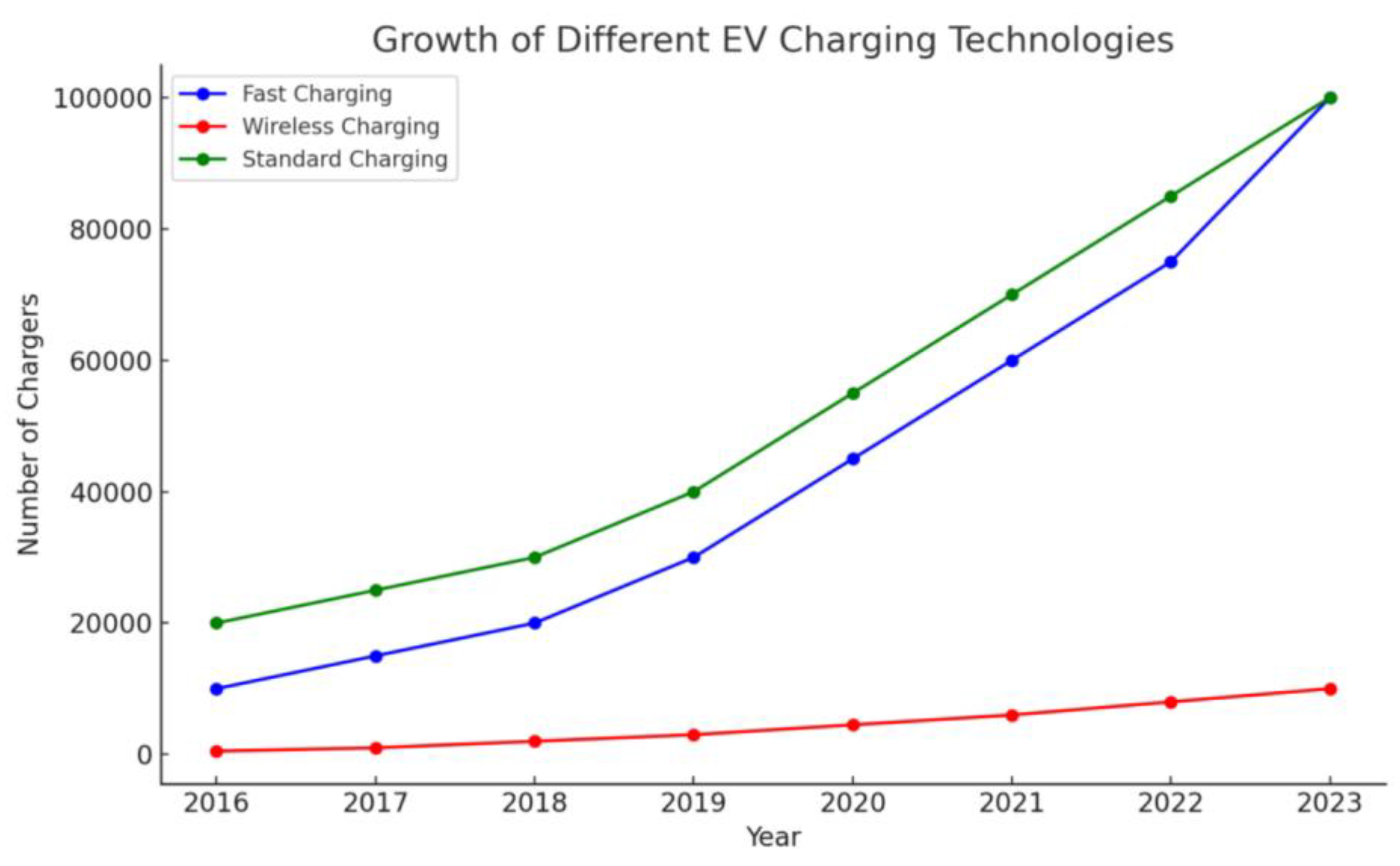
Figure 2.
Growth of Fast Chargers in Europe, Asia, and America from 2016 to 2023.
Disclaimer/Publisher’s Note: The statements, opinions and data contained in all publications are solely those of the individual author(s) and contributor(s) and not of MDPI and/or the editor(s). MDPI and/or the editor(s) disclaim responsibility for any injury to people or property resulting from any ideas, methods, instructions or products referred to in the content. |
© 2025 by the authors. Licensee MDPI, Basel, Switzerland. This article is an open access article distributed under the terms and conditions of the Creative Commons Attribution (CC BY) license (http://creativecommons.org/licenses/by/4.0/).
Copyright: This open access article is published under a Creative Commons CC BY 4.0 license, which permit the free download, distribution, and reuse, provided that the author and preprint are cited in any reuse.


