

Submitted:
24 July 2025
Posted:
24 July 2025
You are already at the latest version
Abstract
This study examines the structural transformation of Kazakhstan’s labor market in the context of accelerated digitalization and post-pandemic recovery. Situated within the broader discourse on labor adaptability in emerging economies, this study addresses how digital and institutional shifts are reshaping employment patterns, sectoral composition, and workforce dynamics. Using panel data analysis, regression models, and cluster techniques, this study evaluates the impact of digital infrastructure, sectoral specialization, educational investment, and demographic trends on labor productivity, formal employment, and unemployment. Empirical findings highlight a growing divergence between regions, with digitally advanced urban centers outperforming agrarian and resource-dependent areas in employment growth and labor efficiency. The study results also reveal that youth unemployment and the segment of young people Not in Employment, Education, or Training (NEET) remain structurally embedded challenges, characterized by significant gender-based and regional disparities. Furthermore, the informal sector persists as an adaptive buffer, especially during periods of economic uncertainty, but continues to limit social protection coverage. This study concludes that Kazakhstan’s labor market is undergoing a transition from an industrial resource model to a service- and knowledge-based configuration. Effective policy responses should focus on enhancing digital inclusion, promoting flexible employment models, and targeting youth labor integration. These insights provide a basis for designing regionally differentiated labor strategies aligned with long-term economic modernization.
Keywords:
labor market
; digital transformation
; employment structure
; informal employment
; youth unemployment
; Kazakhstan
; regional disparities
; NEET
; productivity
; economic modernization
1. Introduction
In recent years, global labor markets have undergone significant structural shifts, driven by rapid digital transformation, demographic transitions, and recurrent macroeconomic shocks. These developments have reshaped employment systems, altered skill requirements, and intensified inequalities across and within countries (ILO, 2020; OECD, 2019; World Bank, 2023). In emerging economies, where institutional frameworks and labor market infrastructures are still evolving, these transformations present both opportunities and vulnerabilities.
Kazakhstan offers a particularly relevant case for analysis due to its post-Soviet legacy, structural reliance on resource extraction industries, and increasing commitment to digital modernization. The country has initiated a range of policy measures aimed at employment formalization, youth labor market integration, and digital capacity building (OECD, 2022; Khussainova et al., 2023). However, the effectiveness of these measures remains uneven, with persistent disparities across regions, sectors, and demographic groups. Informality, underemployment, and youth exclusion continue to constrain inclusive labor market development (ADB, 2020; World Bank, 2023).
The changing nature of employment in Kazakhstan—shaped by automation, platform-based work, and limited institutional adaptability—raises critical policy questions. The spread of digital technologies has introduced flexible and remote work opportunities, yet their adoption remains concentrated in urban centers and formal sectors, leaving rural populations and vulnerable groups at a disadvantage (OECD, 2022). At the same time, national strategies often prioritize quantitative labor market indicators, without adequately addressing structural inequalities and skill mismatches.
Understanding the interaction between digital transformation, labor market structure, and institutional context is essential for identifying sustainable employment pathways. Kazakhstan’s experience illustrates the dual nature of digitalization: while it holds promise for productivity gains and job creation, it also risks deepening labor market segmentation if not accompanied by inclusive reforms.
The remainder of the article is structured as follows:
Section 2 reviews the relevant literature on labor market transformation, with an emphasis on digitalization, informal employment, youth labor force participation, and institutional responses.
Section 3 outlines the methodological framework, including data sources, model specifications, and analytical techniques.
Section 4 presents the empirical findings, covering employment trends, regional disparities, structural changes, and productivity dynamics.
Section 5 discusses the results in light of existing research and policy frameworks.
Section 6 concludes with a summary of the key findings, study limitations, and suggestions for future research directions.
2. Literature Review
The transformation of labor markets under the dual influence of digitalization and economic restructuring has garnered considerable scholarly attention. Key areas of focus include the interplay between technological innovation, institutional capacities, and demographic dynamics in shaping employment outcomes, labor productivity, and structural inclusion.
2.1. Digitalization and Labor Market Adjustment
Contemporary labor economics literature emphasizes the disruptive yet enabling role of digital technologies. The concept of the "second machine age" (Brynjolfsson & McAfee, 2014) encapsulates the simultaneous displacement of routine labor and the emergence of demand for digital skills. Quantitative analyses have revealed that digitalization contributes positively to productivity growth, though its distributional effects often exacerbate skill mismatches and regional labor market disparities (Autor et al., 2020; OECD, 2021).
In emerging economies, including Kazakhstan, digital transformation reflects a dual trajectory. On one hand, it stimulates employment in IT, gig platforms, and remote work; on the other, its effects are mediated by infrastructural deficits and institutional asymmetries (Graham & Dutton, 2019). National case studies confirm that while urban labor markets benefit from digital innovation, rural areas remain excluded due to limited connectivity and investment (Baimukhanov et al., 2021; Zholdasbekova, 2020).
Recent regional studies reinforce the view that digital transformation in Kazakhstan, while promising, does not automatically lead to inclusive labor market outcomes. Gyiazov (2025) shows that digital literacy plays a critical role in shaping the capacity of local labor forces to adapt to automation, with statistically significant links to formal employment. However, in the absence of coordinated upskilling strategies and reforms in labor market governance, these benefits remain unevenly distributed. This observation aligns with findings from the OECD (OECD 2025), which highlights persistent regional disparities in access to digital infrastructure and skills, particularly in rural areas. Similarly, the ILO (ILO 2025) warns that without targeted social policy, digitalization may deepen labor market segmentation, especially among youth and marginalized groups. Complementing this, the European Training Foundation (European Training Foundation 2024) identifies platform-based employment as a growing but spatially uneven trend across Central Asia, constrained by weak regulatory environments and infrastructural gaps.
Theoretical explanations of these dynamics remain diverse. The technological unemployment framework forecasts a net loss in jobs due to automation (Frey & Osborne, 2017), while compensatory models suggest that emerging sectors can absorb displaced workers, conditional on skill reallocation and policy support (Arntz et al., 2016; Autor, 2015). A third strand of thought introduces a temporal dimension: automation may cause short-term disruptions, but adaptive responses through education and institutional reform can facilitate longer-term recovery (Bloom & McKenna, 2021; Tigland et al., 2022). This analytical heterogeneity points to the necessity of context-sensitive frameworks, especially in post-transition economies.
2.2. Informality and Structural Constraints
Informal employment constitutes a major structural issue in Kazakhstan and other post-Soviet economies. Literature identifies its persistence as a function of weak regulatory systems, limited formal sector absorption capacity, and urban–rural disparities (La Porta & Shleifer, 2014; ADB, 2022). Empirical findings show that informality is disproportionately concentrated among self-employed rural workers and women (Kenjebayeva & Sagiyeva, 2019), with significant implications for income security, access to social protection, and economic mobility.
The formalization agenda is complicated by the heterogeneity of informal arrangements, ranging from traditional subsistence activities to digitally mediated gig work. Consequently, scholars advocate for sector-specific strategies that combine institutional reform with digital integration and administrative transparency (Campos et al., 2022).
2.3. Youth Labor Market Exclusion and NEET Patterns
Youth labor exclusion, measured by the NEET indicator, is a critical concern in transitional economies. Cross-country evidence underscores the long-term consequences of NEET status for labor market integration and socioeconomic stability (Eurofound, 2016). In Kazakhstan, NEET prevalence is exacerbated by regional and gender imbalances, particularly in under-resourced oblasts and among young women (UNDP Kazakhstan, 2021; Amirgaliyeva & Dosmuratova, 2022).
Digitalization has not had uniform effects across all population groups. Gender-specific studies show that while economic growth and digital expansion increase labor force participation among women, structural constraints such as childcare gaps, cultural norms, and sectoral segregation continue to limit their full economic integration (Kakizhanova et al., 2025). Meanwhile, youth remain highly exposed to labor market fluctuations. The NEET segment—young people not in employment, education, or training—represents a persistent structural vulnerability, especially in peripheral regions (Khussainova et al., 2023; ILO, 2025).
Policy responses remain largely reactive, relying on short-term job placement programs. However, recent analyses suggest that structural reforms targeting education-to-employment transitions, digital inclusion, and gender-sensitive training are necessary for sustainable outcomes (Center for the Development of Human Resources, 2023).
2.4. Institutional Response and Labor Policy Adaptation
Institutional responses to labor market challenges in Kazakhstan are shaped by legacies of centralized planning, such as a dominant public sector and weak collective bargaining. Evaluations of programs like Enbek reveal mixed results: while effective in urban settings, their outreach remains limited in rural contexts (Suleimenova, 2020; Uvaliyeva, 2023).
Scholars emphasize the need for differentiated policy design that aligns regulatory reform with support for digital employment models and expansion of the social protection system. The literature further suggests that state interventions must evolve to accommodate the changing nature of work and support informal-to-formal transitions in a nuanced manner.
The 2023–2029 Concept of Labor Market Development, adopted by the Kazakh government (Government of the Republic of Kazakhstan, 2023), underscores the role of targeted institutional reform, digital employment models, and expanded social protection in achieving inclusive labor market outcomes (Beisembina et al., 2025). The World Bank notes that success requires not only modernization of public employment services but also incentives for formalizing informal work and supporting platform-based employment through regulatory adjustment and social insurance coverage .
International organizations reinforce these themes. The 2024–2026 World Social Protection Report advocates extending social insurance to informal and platform workers as a foundation for decent work and just transitions (World Bank, 2024). Similarly, the ILO's 2025 formalization roadmap recommends simplifying tax compliance, strengthening enforcement, and broadening social protection to support worker transitions from informal to formal employment (ILO, 2025).
Emerging evidence from the UNDP (UNDP, 2024) highlights concrete institutional innovations: the expansion of free online training modules via the Skills Enbek platform in partnership with Enbek.kz has improved access to digital skills, particularly in remote regions undp.org. This step aligns with broader calls for coupling digital upskilling policies with active social protection and governance capabilities—especially outside urban centers.
Altogether, these contributions indicate that state interventions must evolve beyond supply-side job programs. Successful strategies intertwine regulatory reform, digital employment facilitation, and inclusive social protection, enabling adaptive transitions from informal to formal and platform-based labor arrangements.
2.5. Identified Gaps and Analytical Positioning
Despite a growing empirical base, significant gaps persist in the literature. Specifically, few studies offer a regionally disaggregated analysis of labor market adaptability under digital pressure, or systematically evaluate the effectiveness of employment policy tools in addressing informality and youth exclusion.
This study seeks to address these gaps through an integrated analytical framework combining econometric modeling and institutional analysis. Key research questions include:
How do Kazakhstan’s regional labor markets respond to digital and structural shocks?
What are the limitations of current government employment strategies in ensuring long-term sustainability and inclusion?
Does digitalization reduce or reinforce labor market inequalities?
Can coordinated models involving individuals, businesses, and state actors enhance structural resilience?
3. Methodology
This study applies a quantitative research design to examine the structural and institutional determinants of labor market transformation in Kazakhstan from 2014 to 2023. The methodological approach integrates econometric modeling, cluster analysis, and correlation techniques to assess how digitalization, informality, and youth exclusion shape regional employment dynamics.
This analysis is guided by the following hypothesis: Digital transformation and the expansion of high-tech employment contribute positively to regional labor productivity and employment formalization, whereas structural and institutional barriers—especially those affecting rural areas and youth—continue to limit the inclusiveness of labor market outcomes.
These barriers manifest through persistent informal employment, unequal access to digital infrastructure, regional disparities in educational attainment, and limited institutional capacity to support school-to-work transitions. As a result, despite observable gains in aggregate indicators, the benefits of economic modernization remain unevenly distributed across demographic groups and geographic regions. Understanding these dual dynamics is essential for designing integrated policy responses that foster both economic efficiency and social equity in Kazakhstan’s labor market.
To examine this proposition empirically and account for spatial and institutional variation, the study adopts a structured analytical framework that integrates quantitative methods and regionally disaggregated data.
To test the stated hypothesis, this study conducts an integrated empirical assessment of Kazakhstan’s labor market, drawing on official statistics, regional datasets, and econometric modeling. The analysis contributes to the broader academic discourse on labor digitalization, informality, and institutional adaptation in emerging economies (ILO, 2020; OECD, 2019; World Bank, 2023).
The core methodological approach involves panel regression models with fixed effects, which enable the isolation of structural factors influencing labor productivity and formal employment. This model specification is particularly appropriate for the regional dataset, as it controls for time-invariant characteristics and unobserved heterogeneity across Kazakhstan’s regions, ensuring more robust estimation of the effects of digital infrastructure, public investment, and sectoral composition.
In parallel, k-means clustering was applied to classify regions into distinct typologies based on their digital readiness, labor market inclusion, and socio-economic structure. This unsupervised machine learning method was chosen for its efficiency in handling multivariate spatial data and for enabling the identification of latent spatial patterns not immediately visible through linear modeling alone.
The selection of variables was guided by international research and policy frameworks (e.g., OECD, ILO), focusing on indicators of digital infrastructure (e.g., internet access, ICT employment share); educational attainment and NEET rates; informality (proxied by share of informal employment); public investment per capita; employment and labor productivity metrics.
The dataset combines official national statistics from the Bureau of National Statistics of Kazakhstan and the National Bank, along with international data from ILO, OECD, and the Asian Development Bank (ADB). Data were structured as a balanced panel across Kazakhstan’s regions over ten years (2014–2023).
To complement the econometric and clustering results, Pearson correlation analysis was conducted to examine the relationship between youth unemployment and total unemployment, while factor analysis was used to reduce multicollinearity and extract latent dimensions reflecting regional labor asymmetries.
The models assume the stability of macroeconomic trends across regions and the internal consistency of statistical indicators. While the use of regional aggregates provides valuable insights into structural dynamics, it limits the capacity to capture individual-level behavioral responses, unregistered informal employment, or short-term shocks. Additionally, the quality of input data may vary across regions and periods.
To ensure robustness, sensitivity tests were conducted using alternative clustering thresholds and model specifications. Results were checked for consistency across multiple runs, and multicollinearity diagnostics were applied to assess variable independence.
This multi-method approach strengthens the validity of the findings by triangulating quantitative evidence from diverse methodological perspectives, allowing for a more comprehensive understanding of how technological and institutional factors reshape Kazakhstan’s labor market.
4. Results
4.1. Structural Features and Transformational Trends of Kazakhstan’s Labor Market
Kazakhstan’s labor market represents a structurally heterogeneous system influenced by the legacy of a centrally planned economy and the ongoing impact of global economic and technological transformations. The existing model combines market-based mechanisms with high levels of state involvement, a dominant resource-extractive sector, and persistent informality. These features have contributed to notable disparities across regions, sectors, and occupational groups in terms of employment, productivity, and wage levels.
Table 1 summarizes the core structural characteristics of the labor market, as identified through sectoral data and institutional assessments.
To empirically assess the interplay between labor demand and supply, the study employed a contextual analysis using macroeconomic panel data, demographic indicators, and sectoral employment patterns. A labor demand–supply balance model was constructed to identify regional mismatches and structural bottlenecks. This framework aligns labor demand by sector with available labor resources, enabling a region-specific diagnosis of surpluses and deficits (Center for the Development of Human Resources, 2021).
The analysis reveals strong sectoral and spatial segmentation in both labor demand and supply (Table 2). While sectors such as oil and gas, IT, finance, and agriculture exhibit high demand, labor supply is concentrated in traditional low-productivity sectors. Moreover, major cities concentrate human capital and attract internal migrants, whereas rural areas face elevated unemployment and outmigration of working-age populations.
Two exogenous shocks—COVID-19 and digitalization—have substantially reshaped labor market dynamics. The pandemic caused short-term contractions in employment, particularly in sectors requiring physical presence. Conversely, digitalization has created long-term shifts toward flexible employment formats and new job categories in digital services (Arynova et al., 2024). These structural shocks have accelerated the need for adaptive labor policies and enhanced institutional coordination to support reskilling, formalization, and labor mobility. Key comparative effects of these shocks are summarized in Table 3.
To further analyze labor productivity trends, the annual growth rate of real GDP per employed person from 2014 to 2023 was assessed. Figure 1 illustrates the variations in labor efficiency over time, capturing the structural inflection points associated with economic shocks.
To further investigate the heterogeneity of labor productivity across Kazakhstan’s regions, a cluster analysis was conducted using the k-means algorithm. This methodological approach allowed for the classification of regions into relatively homogeneous groups based on their labor productivity performance. The analysis was based on the average annual growth rates of real GDP per employed person for the period 2020–2023, supplemented by measures of dispersion such as variance and observed extremities. This clustering enabled the identification of distinct regional productivity profiles, providing a clearer understanding of spatial economic dynamics and allowing for the differentiation of policy responses. The resulting typology delineated three clusters of regions with similar growth trajectories and structural features (Table 4).
To quantitatively assess the influence of socioeconomic factors on labor productivity across Kazakhstan’s regions during the period 2020–2023, this study employed a panel regression model using the Ordinary Least Squares (OLS) method. The dependent variable was defined as the annual growth rate of real gross domestic product (GDP) per employed person, serving as a proxy for the efficiency of labor resource utilization.
The regression specification is presented as follows:
where
Yit = β0 + β1ICTit + β2TECHit + β3EDUit + β4RESit + β5URBit + εit,
- Yit—the growth rate of real GDP per employed person in region i in year t;
- ICTit—the level of digitalization (the percentage of households with internet access);
- TECHit—the share of employment in high-tech industries;
- EDUit—the public expenditure on education (as a percentage of gross regional product);
- RESit—the share of employment in the resource sector;
- URBit—the level of urbanization (the share of urban population);
- εit—the stochastic error term capturing the influence of unobserved factors.
The model was estimated using aggregated panel data for 17 regions over four consecutive years. All variables were tested for multicollinearity and stationarity. The residual diagnostics confirmed compliance with key OLS assumptions, including homoscedasticity, no autocorrelation, and normal distribution of residuals.
4.2. Structural Shifts and Empirical Assessment of Employment Dynamics in Kazakhstan (2014–2023)
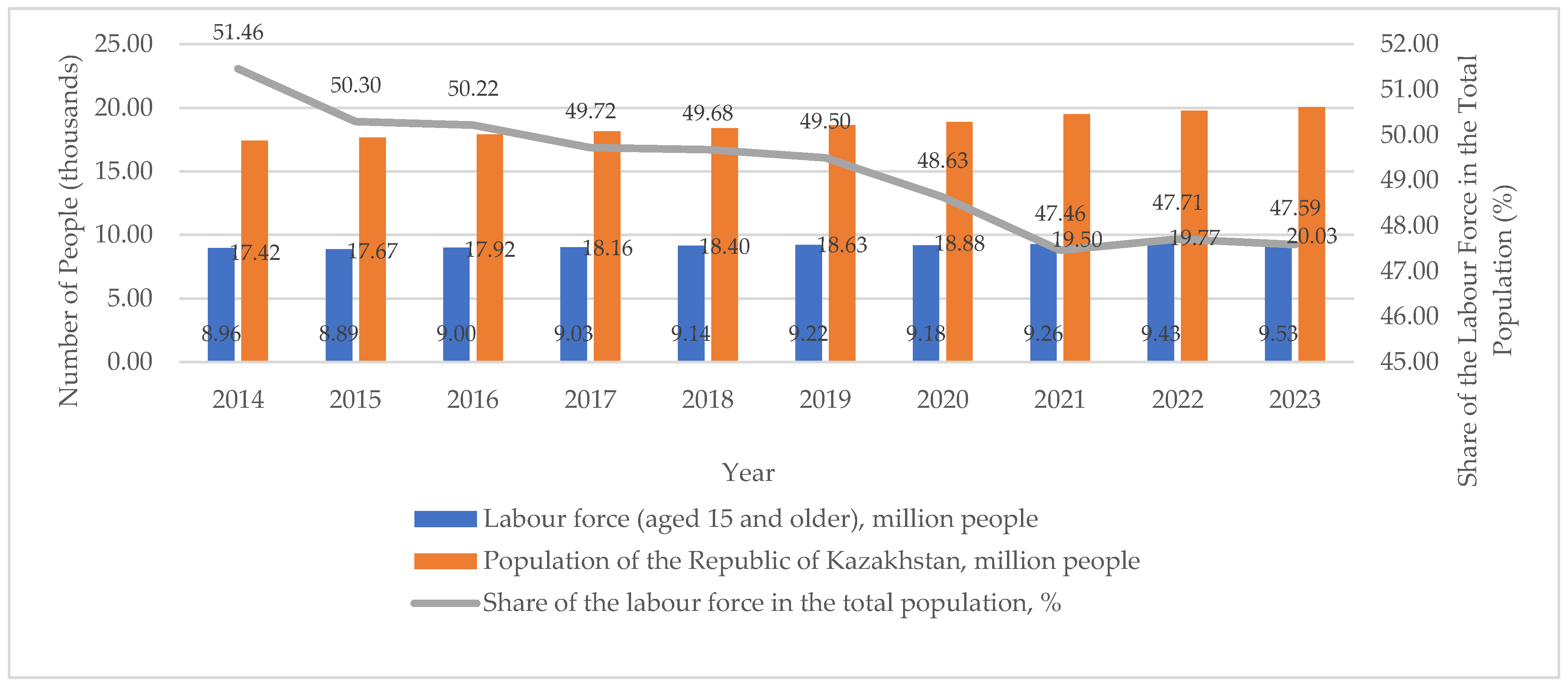
Over the past decade, Kazakhstan’s labor market has experienced substantial transformation, shaped by demographic evolution, macroeconomic volatility, and external disruptions. One of the key demographic trends is the continued population growth, accompanied by a relative decline in the economically active segment of the population (Appendix B, Figure A1). This pattern suggests a gradual erosion of labor potential, influenced by both population ageing and changes in labor market participation modalities, including the expansion of informal and non-standard employment. These developments highlight the need for a data-driven revision of national employment policies, particularly in the context of post-pandemic recovery and ongoing digital transition.
The COVID-19 pandemic introduced a significant external shock to Kazakhstan’s labor market, leading to a pronounced drop in labor force participation, down to 48.63% in 2020, the lowest point of the past decade. This disruption coincided with simultaneous declines in employment, real wages, and GDP. Such dynamics confirm the high macroeconomic sensitivity of the national labor market and highlight structural constraints in its adaptive capacity. While GDP growth gradually recovered in the post-pandemic years, employment exhibited a slower response, pointing to an asymmetrical and delayed adjustment pattern.
To empirically test the relationship between macroeconomic indicators and employment performance, the following regression model was applied:
EmploymentGrowtht = β0 + β1⋅GDPGrowtht + β2⋅RealWageIndext + εt,
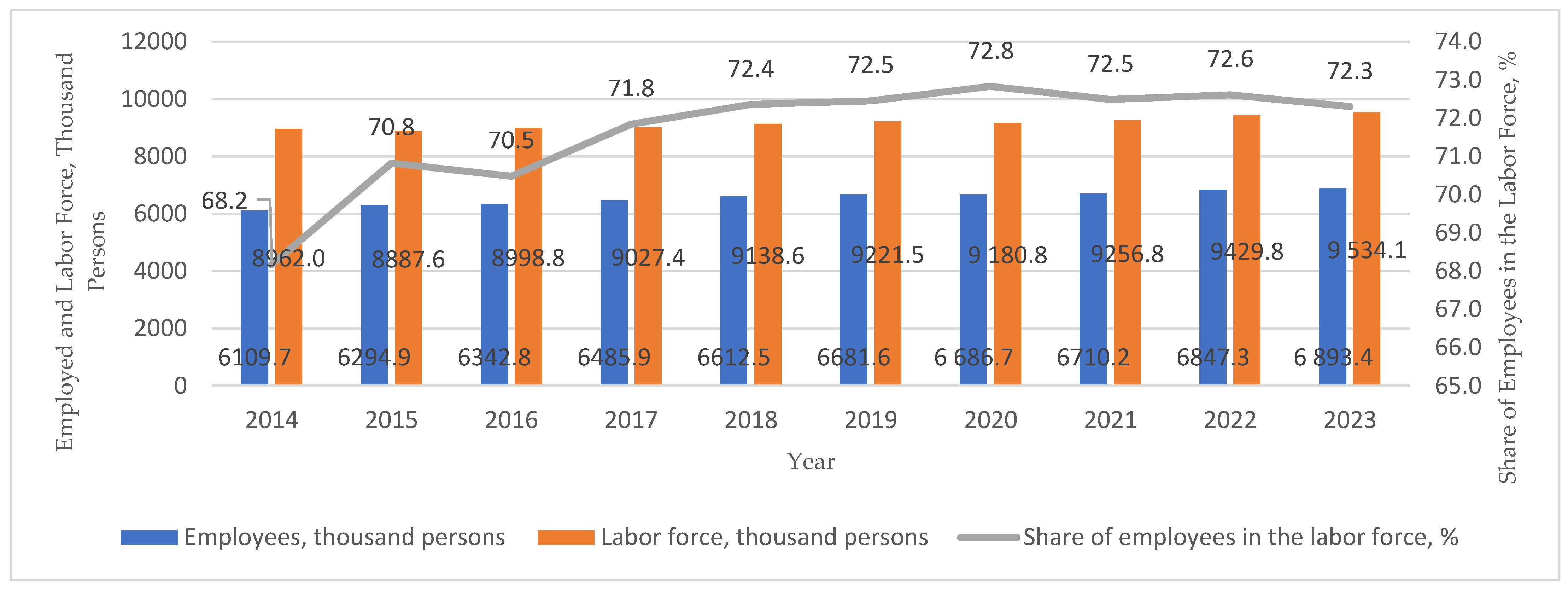
Longitudinal data from 2014–2023 further support a trend toward formalization. The number of salaried employees rose from 6.11 million to 6.89 million, increasing their share from 68.2% to 72.3%, while self-employment declined—suggesting institutional consolidation and expanded coverage of labor protections (Appendix D, Figure A2).
To explore the drivers of this trend, a second OLS regression was run with the share of formal employees as the dependent variable. Explanatory variables included total employment, unemployment rate, and labor force size. The model structure is:
where
FormalEmploymentSharet = β0 + β1⋅Employedt + β2⋅Unempt + β3⋅Workforcet + εt
FormalEmploymentShareₜ—the share of employees in total employment in year t;
Employedₜ—the number of employed persons in year t (in thousands);
Unempₜ—the unemployment rate (%);
Workforceₜ—the total labor force (in thousands);
β0—the intercept, representing the baseline level of formal employment when all explanatory variables are zero;
β1—the coefficient for Employed, indicating the change in the formal employment share with a 1000-person increase in employment (Appendix E, Table A3);
β2—the coefficient for Unemp, reflecting the change in formal employment share with a one-percentage-point increase in the unemployment rate;
β3—the coefficient for Workforce, capturing the increase in formal employment associated with a 1000-person increase in the labor force;
εt—the stochastic error term.
A sectoral analysis of employment structure highlighted a gradual shift away from agriculture and low-productivity sectors toward education, healthcare, and ICT. These structural changes are summarized in Table 5.
Regional disparities remain evident, with high-tech job growth concentrated in urban centers, while peripheral regions face slower sectoral transitions. These findings emphasize the need for regionally adapted employment strategies and a stronger alignment between labor market needs and vocational training systems. Figure 2 illustrates the key risks associated with Kazakhstan’s labor market transformation, including uneven regional development, skill gaps, and structural inertia in traditional sectors.
Overall, Kazakhstan’s labor market is shifting toward a more diversified and formal structure, but challenges persist, including skills mismatches and uneven access to digital and educational resources.
4.3. Unemployment Dynamics and Labor Market Vulnerabilities
The analysis of unemployment trends provides critical insights into the structural and cyclical performance of the labor market. In Kazakhstan, unemployment has remained relatively stable in absolute terms over the past decade, with the number of unemployed persons fluctuating between 451.9 and 452.2 thousand. However, the share of officially registered unemployed individuals increased notably—from 0.4% in 2014 to 1.8% in 2023—suggesting improvements in registration coverage or shifts in institutional engagement with job seekers (Appendix H, Figure A3).
Figure 3 illustrates these dynamics: while the overall unemployment rate remained relatively stable between 4.7% and 5.1% over the analyzed period, both youth and long-term unemployment displayed more substantial variability. Youth unemployment in the 15–34 age category consistently exceeded the general rate, following a cyclical pattern and showing signs of stagnation at elevated levels. Long-term unemployment, meanwhile, remained above 2% for most of the period, declining to 1.2% only in 2023. These trends underscore a growing internal stratification within the unemployed population and the persistent vulnerability of specific demographic groups.
The preceding correlation and graphical analysis identified consistent relationships among core unemployment indicators in Kazakhstan, suggesting structural segmentation within the labor market. These findings justify the construction of a multiple linear regression model to quantitatively assess how youth and long-term unemployment contribute to overall unemployment.
The model specification is as follows:
where
Y = β0 + β1X1 + β2X2 + ε
Y—the overall unemployment rate in the economy (as a percentage);
X1—the youth unemployment rate (ages 15–34, in percent);
X2—the long-term unemployment rate (in percent);
β0—the intercept (constant), representing the baseline unemployment level;
β1, β2—the model parameters indicating the marginal effect of the respective variables;
ε—the random error term accounting for other unobserved factors
The regression, based on OLS estimation for 2014–2023, yielded the following equation:
Y = 3.46 + 0.33⋅X1 + 0.074⋅X2
Disaggregation by gender (Figure 4) reveals a persistent gap: in all observed years, women had higher NEET rates than men. In 2023, for instance, the rate stood at 4.2% for women and 3.3% for men. This pattern highlights gender-specific constraints and supports the need for inclusive, gender-sensitive employment and education programs.
Similarly, the regional distribution of NEET rates highlights pronounced disparities between urban and rural youth. In 2023, the NEET rate among rural youth reached 13.1%, more than double the rate observed in urban areas (5.8%). This disparity may reflect limited access to quality education, vocational training, and formal employment opportunities—especially for young women residing in rural regions.
To further investigate spatial disparities and structural vulnerabilities among youth, a cluster analysis was performed using NEET rates across Kazakhstan's regions for the year 2023. The results of this analysis are presented below (Table 6).
Given the established influence of youth unemployment on NEET formation, further empirical analysis was conducted to assess the sensitivity of NEET levels to labor market conditions. A simple linear regression model was developed to quantify the relationship between the youth NEET rate (ages 15–24) and the overall unemployment rate:
where
NEET15–24 = α + β⋅Unemployment + ε
NEET 15–24—the share of youth aged 15–24 Not in Education, Employment, or Training;
Unemployment—the overall national unemployment rate (%);
α—the intercept, representing the base level of NEET if unemployment was zero;
β—the sensitivity coefficient of NEET to changes in the unemployment rate;
ε—the stochastic error term accounting for unobserved factors.
The regression results, based on data from 2014 to 2023, are as follows:
NEET 15–24 = −24.52 + 6.22⋅Unemployment
A critical subcategory within Kazakhstan’s unemployment structure is the group of individuals who have never held formal employment. This group is disproportionately represented in regions such as Turkistan (83.4%), Mangystau (68.3%), and Shymkent (25.9%). Their persistent exclusion from the labor market is likely rooted in structural barriers, including limited access to career guidance, underdeveloped first-job infrastructure, and weak institutional support for school-to-work transitions.
Correlation analysis indicates that this group is not strongly associated with traditional long-term unemployment indicators, suggesting it represents a distinct structural challenge. The prevalence of “never worked” individuals in both rural and urban regions highlights its multifaceted nature, unrelated solely to geographic remoteness.
From a policy perspective, this group represents a high-risk segment for intergenerational unemployment and chronic labor market exclusion. Late entry into formal employment significantly reduces the probability of stable career development and increases vulnerability to poverty. Cluster analysis confirms that regions with high concentrations of “never worked” individuals form a separate category within the national unemployment structure.
These findings support the need for targeted interventions focused on labor market entry, such as school-to-work transition programs, subsidised first-job schemes, and early career mentoring. In this context, the “never worked” indicator should be recognized as a key metric for labor market diagnostics and youth policy formulation.
4.4. The Informal Labor Sector in Kazakhstan: Structure, Trends, and Digital Transition
Kazakhstan’s labor market exhibits a dual structure, combining formal employment under state regulation with a persistent informal sector. While formal jobs offer legal protections and social guarantees, informal employment—prevalent in small enterprises, self-employment, and unregistered labor—remains associated with precarious conditions and limited access to benefits.
Between 2014 and 2023, the share of informal employment declined significantly, from 25.0% to 12.8%, reflecting the impact of policy interventions, post-crisis recovery, and institutional modernization. The most pronounced reductions occurred between 2014 and 2017, while after 2020, the trend stabilized, pointing to entrenched informality in certain sectors (Figure 5).
Although informal employment has followed a declining trend overall, it continues to serve as a functional adaptation mechanism during periods of macroeconomic uncertainty. The post-2020 increase in self-employment further underscores this role. As of 2023, the self-employed population in Kazakhstan reached 2.2 million, with 44.9% earning less than KZT 100,000 per month (approximately USD 200), and 2.1% reporting incomes below the official subsistence minimum (Figure 6).
Despite ongoing digitalization efforts, Kazakhstan’s labor market has seen only limited expansion in remote and digitally mediated employment. As of 2023, formally registered remote workers accounted for merely 0.47% of total employment, indicating that flexible work formats remain underutilized (Table 7). Remote work is predominantly concentrated in urban centers such as Almaty and Astana, while rural regions continue to exhibit minimal participation in online labor markets. This disparity underscores the uneven diffusion of digital infrastructure and the persistence of structural barriers to inclusive digital employment.
Although informal employment has followed a declining trend overall, it continues to serve as a functional adaptation mechanism during periods of macroeconomic uncertainty. The post-2020 increase in self-employment further underscores this role. As of 2023, the self-employed population in Kazakhstan reached 2.2 million, with 44.9% earning less than KZT 100,000 per month (approximately USD 200), and 2.1% reporting incomes below the official subsistence minimum (Figure 7).
In summary, although Kazakhstan has achieved measurable progress in reducing informal employment, persistent structural barriers and digital disparities continue to hinder full labor market formalization. Advancing inclusive and sustainable labor market development will require targeted efforts to expand access to formal employment, strengthen digital infrastructure across regions, and formally integrate hybrid work forms—such as freelancing and platform-based labor—into the regulatory and social protection systems.
4.5. Empirical Assessment of Wage Dynamics in Kazakhstan (2014–2023)
Wage dynamics in Kazakhstan over the past decade demonstrate the combined effects of macroeconomic trends, administrative policy shifts, and institutional reforms. Time series data for 2014–2023 illustrate both nominal growth and structural fluctuations across key wage indicators, including average monthly wages, real wage indices, and the statutory minimum wage (Bureau of National Statistics of Kazakhstan, 2024).
From 2014 to 2024, the average nominal monthly wage increased more than threefold, from KZT 121,021 to KZT 434,982 (Figure 8).
This growth reflects both economic expansion and policy-driven adjustments. However, wage levels expressed in USD reveal significant volatility: average wages declined from USD 675 in 2014 to USD 418 in 2016, primarily due to exchange rate depreciation, before recovering to USD 927 in 2024. These patterns highlight the strong sensitivity of real income to currency fluctuations.
The minimum wage has also increased—rising from KZT 19,966 in 2014 to KZT 85,000 in 2024—following a series of state-led upward revisions, particularly after 2019. Despite this growth, the rate of increase in minimum wages has lagged behind that of average wages, raising equity concerns and suggesting limited redistributive impact of minimum wage policy in terms of preserving real purchasing power.
Moreover, applying regional cluster analysis that accounts for digitalization and sectoral employment patterns offers a valuable avenue for further investigation.
5. Discussion
5.1. Interpretation of Key Findings
5.1.1. Structural Transformation of the Labor Market
The study confirms that Kazakhstan’s labor market is undergoing structural transformation shaped by digitalization, sectoral shifts, and institutional change. This section interprets the empirical findings in light of existing research and discusses their implications for public policy and future studies.
Kazakhstan’s historical dependence on oil, gas, and mining has shaped labor demand toward capital-intensive and regionally concentrated industries. However, the past decade has witnessed a gradual transition toward services, high-tech industries, and the digital economy. Empirical evidence suggests a growing demand for workers with digital and analytical competencies, particularly in IT, data analytics, and e-commerce (Center for the Development of Human Resources, 2021).
Despite this progress, institutional rigidities continue to constrain labor market efficiency. The public sector remains a dominant employer, especially in healthcare, education, and public administration, where it accounts for over 25% of formal employment (Stat.gov.kz, 2023). While this contributes to employment stability, it also suppresses competitive pressures and labor mobility. Informal employment remains widespread, especially in construction, agriculture, and trade, limiting access to social protection and reinforcing inequality.
Regional disparities remain a structural feature of Kazakhstan’s labor market. Labor oversupply persists in the southern regions, while northern and industrialized oblasts experience shortages of qualified personnel. These imbalances reflect the uneven distribution of economic activity and demographic pressure.
Kazakhstan’s labor market is undergoing a structural transition from an industrial to a digitally driven model, shaped by macroeconomic shifts, demographic changes, and technological transformation. This evolution requires adjustments in employment policy—particularly in workforce retraining, regional balancing, and the expansion of high-tech and knowledge-intensive sectors. A coordinated, multi-level policy framework is essential to manage these complex transformations effectively.
To empirically capture these dynamics, an analysis of regional labor productivity for the period 2014–2023 was conducted. The annual growth rate of real gross domestic product (GDP) per employed person was used as a core indicator to assess labor efficiency and economic sensitivity to shocks, including the COVID-19 pandemic and digitalization processes (National Bank of Kazakhstan, 2025; Center for the Development of Human Resources, 2021).
During 2014–2019, labor productivity growth remained stable (100.2%–105.9%), reflecting a balanced relationship between employment and output. In 2020, the rate dropped to 97.5%, indicating the adverse effects of the pandemic, particularly on sectors such as tourism, food services, and retail. A moderate recovery followed in 2021 (103.3%), with further increases to 104.7% in 2023, likely driven by the adoption of digital technologies and organizational adaptation.
The estimation results from Equation (1) highlight the structural importance of digitalization and innovation-oriented employment in improving labor productivity across regions. In contrast, reliance on the resource sector is negatively associated with efficiency, emphasizing the need for economic diversification in Kazakhstan.
The estimation results (Appendix A, Table A1) show that the model accounts for 63% of the variation in regional labor productivity (R² = 0.63). Digitalization and employment in high-tech sectors emerge as key positive drivers, while dependence on the resource sector negatively affects productivity, underscoring the need for economic diversification across Kazakhstan’s regions. The level of digitalization (β=0.452, p < 0.01) showed the strongest positive effect, confirming the critical role of ICT adoption in improving efficiency. Employment in high-tech industries was also positively associated with productivity growth (β=0.376, p < 0.05). Public expenditure on education exhibited a moderately positive effect (β=0.237, p < 0.1). Conversely, the share of resource-sector employment was negatively associated with productivity outcomes (β=−0.314, p < 0.05). The urbanization variable was not statistically significant.
These results underscore the structural significance of digitalization and innovation-oriented employment for regional productivity in Kazakhstan. They also support the development of targeted regional policies aimed at accelerating digital transformation, reducing reliance on extractive sectors, and strengthening the role of education in human capital formation.
5.1.2. Macroeconomic Drivers of Employment
The regression results from Equation (2), estimated using the Ordinary Least Squares (OLS) method, confirm the procyclical nature of Kazakhstan’s labor market. Employment growth is significantly influenced by GDP and real wage dynamics—an expected pattern for transitional economies where labor demand is sensitive to macroeconomic fluctuations. Furthermore, regional clustering analysis reveals growing labor market polarization, with urban centers exhibiting stronger performance relative to agrarian.
Both GDP growth (β ≈ 0.39, p < 0.05) and real wage growth (β ≈ 0.57, p < 0.01) exert a statistically significant positive influence on employment dynamics—an expected pattern for transitional economies. The model’s explanatory power (R² = 0.69) confirms the procyclical nature of employment in Kazakhstan, where job creation is closely linked to economic performance and income trends (Appendix C, Table A2).
Complementing this, a k-means cluster analysis was conducted using annual regional data from 2020–2023. Based on employment levels, wage growth, GDP per capita, and digitalization (measured as internet access), three regional clusters were identified:
Cluster 1: High economic activity and digitalization (Almaty, Astana, Karaganda)
Cluster 2: Moderate performance and transitional structures (Akmola, Pavlodar, East Kazakhstan)
Cluster 3: Agrarian regions with low digital access and high informality (Zhambyl, Turkistan, Kyzylorda)
These findings indicate growing regional labor market polarization and highlight the need for tailored policy measures to enhance digital infrastructure, formalize employment, and promote mobility in lagging areas.
5.1.3. Formalization and Institutional Constraints
Equation (3) shows that employment formalization is positively influenced by labor force growth and negatively affected by unemployment. This supports the hypothesis of progressive formalization during economic expansion. Nonetheless, institutional rigidities and high rural informality persist. Correlation results (Appendix G, Table A5) validate these trends, underscoring the need for improved enforcement and incentives for formal job creation.
The estimated regression model exhibited strong explanatory capacity, as indicated by a coefficient of determination of R² = 0.83, suggesting that 83% of the variation in the formal employment share is accounted for by the included independent variables. All estimated coefficients were statistically significant at the p < 0.05 level, confirming the robustness and reliability of the observed relationships.
The model was estimated using the Ordinary Least Squares (OLS) method, drawing on annual data from 2014 to 2023. A summary of the regression results, including coefficient estimates, standard errors, and significance levels, is provided in Appendix F, Table A4.
The results of the regression analysis underscore the pronounced sensitivity of employment formalization to shifts in macroeconomic conditions. In particular, an increase in the total number of employed persons is positively and significantly associated with a higher share of formal employment, supporting the hypothesis of progressive formalization within Kazakhstan’s labor market. Similarly, expansion in the overall labor force contributes to a greater proportion of formal employment.
By contrast, the unemployment rate shows a statistically significant negative relationship with formalization levels. This finding suggests that higher unemployment may push a segment of the workforce into informal employment or reflect contracting demand for formal labor during periods of economic downturn.
The model’s strong explanatory power is indicated by a high coefficient of determination (R² = 0.83), reinforcing its utility as a diagnostic and policy-relevant tool for monitoring structural labor market transformations.
To complement the regression findings, a correlation analysis was conducted. A strong positive correlation was observed between the number of employees and total employment (r = 0.93), while a strong inverse correlation was identified between the unemployment rate and the share of employees (r = –0.88). These results confirm the robustness of the model’s underlying assumptions and further support the empirical relevance of the selected variables (Appendix G, Table A5).
The empirical findings underscore the role of macroeconomic and institutional factors in shaping long-term trends toward labor market formalization in Kazakhstan. These results provide quantitative support for the development of targeted and regionally differentiated employment policies. However, beyond institutional reform, it is crucial to examine the internal reallocation of labor across sectors, as this process offers insight into the underlying drivers of economic modernization and labor productivity dynamics.
5.1.4. Sectoral Employment Shifts
A longitudinal analysis of Kazakhstan’s employment structure over the 2014–2023 period reveals a gradual shift from an agrarian–industrial employment model to features more aligned with a post-industrial economy. Notably, the most substantial change occurred in the agricultural sector, where the share of total employment declined from 18.9% in 2014 to 11.9% in 2023 (Table 5), marking a reduction of 7 percentage points. This shift reflects both demographic transitions—particularly urbanization—and the increasing mechanization of agricultural production, which has reduced labor intensity and raised productivity levels.
By contrast, the industrial sector has exhibited relative stability in employment share, with only marginal decline. This suggests a gradual internal restructuring from traditional extractive activities toward more capital- and technology-intensive manufacturing processes. The observed contraction in employment in construction and adjacent industries may also reflect automation trends, shifts in investment patterns, and shortened project implementation cycles in infrastructure and housing.
Overall, these structural changes point to a reallocation of labor resources consistent with global patterns of economic transition, albeit influenced by Kazakhstan’s specific institutional and regional characteristics. Continued monitoring of sectoral employment dynamics is essential for informing workforce development policies and anticipating future skill demand in a digitally driven economy.
The sectoral structure of employment in Kazakhstan has undergone notable transformation over the past decade, with a pronounced shift toward service-oriented and knowledge-intensive sectors. The most significant employment growth was observed in trade, education, healthcare, ICT, and professional services—sectors associated with higher value-added and greater resilience to external shocks.
This shift reflects structural modernization processes, including the expansion of digital infrastructure, demographic changes, and targeted public investment. In particular, rising employment in education and healthcare highlights increased demand for social services, while growth in ICT and professional services signals the transition toward a digital economy.
Conversely, employment in agriculture and low-productivity industry declined, indicating reduced labor demand in traditional sectors due to urbanization and technological advancement. The share of employment in agriculture dropped by 7 percentage points between 2014 and 2023, reflecting rising productivity and decreased labor intensity.
5.1.5. Unemployment and Youth Vulnerability
Although the overall number of unemployed persons in Kazakhstan remained relatively stable between 2014 and 2023, underlying structural patterns point to deeper labor market vulnerabilities. To investigate these patterns, a correlation analysis was performed using national labor statistics for the same period. The results, summarized in Appendix I (Table A6), reveal several statistically significant relationships that shed light on the composition and persistence of unemployment.
A strong positive correlation between overall and youth unemployment rates (r = 0.90–0.96) confirms the heightened vulnerability of younger cohorts to labor market shocks, especially those aged 15–24 and 15–34.
A robust correlation between general and long-term unemployment (r = 0.81) indicates persistent joblessness and potential inefficiencies in active labor market policies.
Notably, a negative correlation was identified between the unemployment rate and the number of registered unemployed (r = –0.82), pointing to possible gaps in institutional coverage or the presence of unregistered unemployment.
These findings emphasize the structural nature of youth and long-term unemployment in Kazakhstan and suggest that headline unemployment rates may underestimate the true scale of labor market exclusion. The results also provide a basis for further econometric modeling to quantify the contribution of specific factors to changes in unemployment.
A key empirical finding is the strong positive correlation between the overall unemployment rate and youth unemployment indicators. The correlation coefficients for the 15–24 and 15–34 age groups reach 0.90 and 0.96, respectively, indicating a high sensitivity of general unemployment dynamics to fluctuations within the youth segment (Appendix I, Table A6). This suggests that youth are disproportionately affected by labor market instability and that structural barriers continue to hinder their effective integration into formal employment.
These results support the rationale for constructing a multivariate regression model to quantify the contribution of specific variables—particularly youth and long-term unemployment—to overall unemployment trends. The observed associations also reveal underlying weaknesses in labor market resilience and raise concerns about the sustainability of employment outcomes for younger cohorts.
Another statistically significant relationship is found between the general unemployment rate and the long-term unemployment rate, with a correlation coefficient of 0.81. This indicates a persistent connection between short-term labor market fluctuations and prolonged joblessness, which may reflect the limited efficacy of active labor market policies. The data highlight the need for targeted reintegration programs aimed at individuals facing extended periods of unemployment.
In contrast, the analysis reveals a negative correlation between the unemployment rate and the number and proportion of registered unemployed individuals (r = −0.82 and r = −0.84, respectively). This pattern may point to limitations in the official registration system and suggest the presence of unrecorded or “shadow” unemployment. As a result, the actual scale of labor market distress may be underestimated by conventional indicators.
The estimation results from Equation (5) highlight the structural role of youth unemployment in shaping overall labor market performance in Kazakhstan. The coefficient for youth unemployment is particularly strong and statistically significant, indicating that labor market instability disproportionately affects younger cohorts. Long-term unemployment also contributes to aggregate joblessness, though to a lesser extent. These findings underscore the importance of sustained, youth-focused employment strategies and targeted reintegration programs.
The model exhibits a high explanatory power (R² = 0.951), confirming that youth and long-term unemployment jointly account for over 95% of the variation in the aggregate unemployment rate.
The coefficient for youth unemployment (β₁ = 0.33, p < 0.001) is highly significant, emphasizing its central role in driving unemployment fluctuations. The coefficient for long-term unemployment (β₂ = 0.074, p = 0.091) is moderately significant, suggesting a secondary but noteworthy contribution. Both signs are positive, consistent with theoretical expectations and prior correlation results.
These findings reinforce the conclusion that young people, particularly those in transitional life stages, are disproportionately exposed to labor market risks. The persistence of long-term unemployment further suggests systemic barriers to re-employment, requiring targeted policy intervention.
In light of these results, the NEET (Not in Employment, Education, or Training) indicator serves as a critical marker of structural exclusion, especially among youth. Analysis of national statistics shows a generally declining NEET trend from 2014 to 2022, followed by a reversal in 2023. Specifically, for the 15–24 age group, the NEET rate decreased from 7.0% in 2014 to 4.6% in 2022, then rose to 6.0% in 2023. For the 15–34 group, the decline was from 8.8% to 6.5%, followed by an increase to 7.3% (Bureau of National Statistics, 2023).
The regional distribution of NEET rates in Kazakhstan reveals considerable disparities. Cluster analysis based on NEET levels in 2023 grouped regions into three distinct clusters (Table 10). Cluster 1 includes regions with relatively low NEET rates (4.8–6.1%), such as Astana, Shymkent, and several industrialized western and northwestern regions. Cluster 2 represents regions close to the national average (6.7–7.0%), including Akmola, Almaty, and Zhambyl Regions. Cluster 3 consists of Karaganda, Turkistan, Ulytau, and Mangystau Regions, where NEET rates are highest (9.9–11.7%). These findings highlight the spatial concentration of youth vulnerability and suggest the need for geographically targeted policy responses.
The regression results from Equation (7) suggest that youth disengagement from employment and education is closely tied to labor market performance. This highlights the limitations of employment-only approaches and the need for comprehensive social and educational support programs.
The model demonstrates a positive association: a one-percentage-point increase in unemployment corresponds to a 6.22 percentage-point increase in the NEET rate. While the intercept lacks a standalone interpretation, the slope coefficient is significant at the 90% confidence level (p = 0.056). The model’s explanatory power is moderate (R² = 0.383), indicating that nearly 38% of the variation in the NEET rate is explained by changes in unemployment, with the remainder attributable to other structural and institutional factors.
These results underscore the complexity of the NEET phenomenon and suggest that employment policies alone may be insufficient to address youth disengagement. Multidimensional approaches, including educational reform and targeted social inclusion initiatives, are essential.
5.1.6. Informality and Spatial Inequality
The share of informal employment in Kazakhstan declined notably from 25.0% in 2014 to 12.8% in 2023, indicating measurable progress toward formalization. This trend is accompanied by a steady increase in salaried positions, reflecting the gradual shift toward more regulated forms of employment. However, informal work remains widespread in rural areas and among self-employed individuals, suggesting persistent structural barriers that continue to limit the full implementation of formal employment policies.
Marked spatial disparities persist: in 2023, informal employment in rural areas reached 20.5%, compared to 8.0% in urban areas, driven by limited access to formal jobs and sectoral composition. Gender gaps have narrowed over time, with informal employment rates converging to 13.1% for men and 12.5% for women by 2023. This convergence reflects both improved formalization in female-dominated sectors and targeted employment initiatives.
These dynamics underscore the structural nature of informality in Kazakhstan, particularly in rural and low-productivity regions. Expanding formal job opportunities requires integrated policy responses—strengthening rural infrastructure, enhancing regulatory reach, and incentivizing formalization through digital tools and support for micro-enterprises.
The COVID-19 pandemic had a short-term but notable effect on informal employment dynamics, particularly among men. Job losses in the formal sector during the crisis led to a temporary surge in informal economic activities, illustrating the sector’s role as a buffer during labor market shocks. In contrast, female employment patterns remained relatively stable, likely due to sectoral concentration and limited occupational mobility.
5.1.7. Real Wage Dynamics and Labor Income Determinants
The analysis of Kazakhstan’s wage structure demonstrates a robust relationship between nominal earnings and real income levels, while the minimum wage exhibits a comparatively weaker influence. To examine these dynamics, an empirical assessment was conducted using national wage statistics for the period 2014–2023, focusing on the interdependencies among nominal wages, the minimum wage, and both nominal and real wage indices under conditions of macroeconomic volatility.
Pearson correlation analysis revealed a strong positive association between nominal wages and the minimum wage (r = 0.95), as well as between nominal wages and the nominal wage index (r = 0.92). The real wage index also showed a positive correlation with these indicators, although to a lesser degree—reflecting the dampening effects of inflation and the divergence between nominal growth and actual purchasing power (Appendix J, Table A7).
These patterns were further confirmed by a multiple linear regression model (Equation 8), which identifies nominal wages as the primary driver of real wage index variation. In contrast, the minimum wage coefficient is weaker and only marginally significant, suggesting that administrative wage policies play a limited role in ensuring household income security. Moreover, external shocks such as currency devaluation in 2015 and the COVID-19 pandemic in 2020 had measurable negative effects on real income, underscoring the need for more adaptive and market-responsive income policies.
Collectively, these findings indicate that real income resilience in Kazakhstan depends predominantly on sustained nominal wage growth, while minimum wage adjustments alone are insufficient to protect household welfare in times of economic stress. Future wage policy design should incorporate inflation expectations, regional cost-of-living differences, and productivity growth to enhance the effectiveness of income support mechanisms.
To identify the key drivers of changes in real wages, a multiple linear regression model was developed, with the real wage index as the dependent variable. The model includes nominal wages and the minimum wage as explanatory variables and was estimated using the Ordinary Least Squares (OLS) method based on annual data from 2014 to 2023. The results indicate a statistically significant positive effect of nominal wages on the real wage index (p < 0.05), while the coefficient for the minimum wage is negative and only marginally significant. The model demonstrates strong explanatory power, with an R² value of 0.81, indicating that 81% of the variation in the real wage index is accounted for by the selected predictors (Appendix K, Table A8).
The years 2015 and 2020 were particularly sensitive to external shocks. The 2015 currency devaluation led to a significant decline in real incomes in USD terms, while the COVID-19 pandemic in 2020 caused the real wage index to drop below 100%, reflecting a contraction in purchasing power. Although the minimum wage was raised during 2022–2023, these adjustments resulted in only modest improvements in real incomes, suggesting limited effectiveness of administrative wage policies in protecting household welfare.
The empirical findings indicate that nominal wage growth remains the primary driver of real income dynamics in Kazakhstan, while changes in the minimum wage have a less consistent and often weaker effect. To strengthen income policy, future models should incorporate additional variables such as inflation expectations, regional cost-of-living differences, and labor productivity.
5.2. Broader Implications
The findings of this study reveal structural bifurcation within Kazakhstan’s labor market, reflecting broader socioeconomic trends. On one hand, there is an evident shift toward digital, high-skilled, and flexible employment, primarily concentrated in urban areas. On the other hand, informality, underemployment, and low-productivity jobs remain widespread in rural regions. This duality reinforces labor market segmentation and contributes to inequalities in job stability, income levels, and access to social protection.
The development of the ICT sector and other high-value-added services offers promising opportunities for sustainable employment growth. However, this potential is constrained by persistent infrastructure gaps, low digital literacy, and the limited reach of reskilling and vocational education programs. These challenges are particularly pronounced in peripheral and rural areas, where the diffusion of remote work and platform-based employment remains minimal due to digital exclusion.
A key vulnerability identified in the analysis is the structural exclusion of youth, especially among rural populations and women. The strong statistical relationship between overall unemployment and NEET (Not in Employment, Education, or Training) rates indicates that youth disengagement from the labor market is both a cause and a consequence of broader labor market inefficiencies. These dynamics point to the need for comprehensive, gender-responsive labor market strategies, including improved pathways from education to employment, targeted support for first-job acquisition, and promotion of youth entrepreneurship.
Importantly, Kazakhstan has made regulatory progress by adopting the Social Code in 2023, which formally introduces the legal category of platform-based employment into national legislation (Social Code of the Republic of Kazakhstan, 2023). This legislative shift acknowledges the growing presence of non-standard work models—including freelancing, gig work, and digital platform jobs—and provides a normative foundation for their gradual integration into the formal labor system. However, the practical implementation of these provisions remains limited, and further institutional, regulatory, and technological measures are required to extend social insurance coverage and legal protection to workers engaged in hybrid and informal forms of employment.
To facilitate long-term strategic planning, this study proposes a scenario-based framework (Appendix L, Table A9), which outlines three labor market development pathways—optimistic, baseline, and pessimistic—based on current trajectories of digitalization, institutional reform, and inclusivity. These scenarios provide benchmark indicators that can guide policymakers in designing forward-looking, evidence-based employment strategies that address structural disparities and promote inclusive labor market transformation.
6. Conclusions
Kazakhstan’s labor market is undergoing a multifaceted transformation shaped by digitalization, economic restructuring, and demographic trends. This study provides empirical evidence that digital infrastructure and employment in high-tech sectors are key drivers of regional labor productivity, underscoring the importance of technological readiness for sustainable economic growth. At the same time, persistent informality, skill mismatches, and territorial inequality constrain inclusive development.
Youth unemployment and the high NEET rate remain systemic challenges, particularly in rural and socioeconomically disadvantaged regions. The strong statistical relationship between youth-specific indicators and overall labor market performance confirms the central role of youth employment in shaping broader labor outcomes. To address these challenges, Kazakhstan’s government institutions should adopt an integrated and proactive policy framework targeting youth labor market inclusion.
First, school-to-work transition mechanisms should be strengthened through expanded access to internships, apprenticeships, and subsidized first-job programs coordinated by the Ministry of Labor and Social Protection. These measures would ease entry into formal employment, especially for graduates in non-urban regions.
Second, regionally adapted vocational training and digital upskilling programs must be scaled up, with a particular focus on enhancing access to ICT competencies and soft skills among young people. This effort can build on existing platforms such as Skills Enbek, but requires broader outreach in low-connectivity areas and among disadvantaged youth.
Third, gender-sensitive policies should address the specific constraints faced by young women, such as access to childcare, cultural norms, and occupational segregation. This includes support for flexible work formats, entrepreneurship programs for young women, and training tailored to high-demand digital sectors.
Finally, the government should prioritize data-driven monitoring systems to identify regional NEET hotspots and allocate resources efficiently. This includes investing in local employment centers, career guidance services in schools, and the integration of digital labor market intelligence tools.
Collectively, these measures would support a more inclusive and productive youth workforce, contributing to long-term human capital development and economic resilience.
Although the informal employment rate in Kazakhstan has shown a downward trend, non-standard and platform-based labor continues to expand, particularly in urban centers, while remaining largely outside the scope of existing regulatory and social protection frameworks. In recent years, the government has taken steps to address these gaps—for example, through pilot projects on remote employment regulation, digital skills training programs on platforms such as Skills Enbek, and the gradual introduction of simplified tax mechanisms for self-employed individuals. However, these measures remain fragmented and limited in reach.
To ensure that the ongoing transformation of the labor market is both inclusive and sustainable, further policy consolidation is required. This includes adapting labor legislation to formally recognize hybrid and digital employment formats, strengthening the integration of platform workers and freelancers into the social insurance system, and enhancing financial and institutional support for formalization—especially in rural and economically vulnerable regions.
A coherent policy strategy is therefore needed—one that promotes digital innovation and productivity growth while reinforcing the institutional capacity of the labor system, reducing territorial disparities, and expanding access to secure employment. In this regard, Kazakhstan’s public institutions—such as the Ministry of Labor and Social Protection, the Ministry of Digital Development, Innovations and Aerospace Industry of the Republic of Kazakhstan, and regional Akimats—should work in coordination to implement cross-sectoral labor market reforms that are responsive to spatial, technological, and demographic challenges.
6.1. Limitations and Directions for Future Research
While this study offers an in-depth empirical assessment of Kazakhstan’s labor market transformation in the context of digitalization and structural shifts, several limitations must be acknowledged.
First, the analysis is based primarily on aggregated national and regional-level data. This limits the ability to assess micro-level labor behavior, firm-specific dynamics, and individual decision-making processes regarding employment, education, or participation in the informal economy.
Second, the study employs a cross-sectional and short-term longitudinal design, which may not fully capture the long-term effects and lagged responses associated with digitalization, macroeconomic shocks, or institutional reforms. The absence of panel data restricts the ability to conduct time-sensitive causal inference or dynamic modeling.
Third, due to data availability constraints, some potentially influential variables—such as sectoral labor mobility, inflation expectations, and interregional migration—were excluded from the regression models. This may affect the completeness of the explanatory framework and leaves room for model enhancement.
Fourth, measurement challenges remain with respect to informal employment, gig economy participation, and remote work—especially in rural areas—due to gaps in official statistical coverage and classification inconsistencies.
To address these limitations, future research should consider the following directions:
Microdata Analysis: Utilizing household or enterprise-level datasets would enable more granular insights into job quality, employment preferences, and informal work strategies.
Longitudinal Modeling: Tracking employment outcomes over time would help assess the long-term effects of technological change, demographic shifts, and policy interventions.
Program Evaluation: Rigorous impact assessments of government employment initiatives, particularly those targeting youth and rural populations, would inform evidence-based policy adjustments.
Comparative Studies: Benchmarking Kazakhstan’s labor market against other resource-based or post-Soviet economies could offer valuable perspectives on shared challenges and successful strategies for labor system modernization.
By incorporating these approaches, future studies can strengthen the empirical basis for labor market reforms and contribute to a more inclusive and adaptive employment ecosystem in the digital age.
Author Contributions
Conceptualization, Z.A. and S.V.; methodology, S.V.; software, D.B.; validation, Z.A., S.K., and S.Z.; formal analysis, Z.A. and S.V.; investigation, Z.A. and S.K.; resources, S.Z.; data curation, D.B.; writing—original draft preparation, Z.A.; writing—review and editing, Z.A., D.B.; visualization, S.K.; supervision, Z.A.; project administration, Z.A.; funding acquisition, Z.A. All authors have read and agreed to the published version of the manuscript.
Funding
This research was funded by COMMITTEE OF SCIENCE OF THE MINISTRY OF SCIENCE AND HIGHER EDUCATION OF THE REPUBLIC OF KAZAKHSTAN, grant number IRN AP19676438, “Mechanism for Ensuring Balanced Interaction Between the Labor Market and the Education System in the Context of Economic Digitalization”.
Institutional Review Board Statement
Not applicable.
Informed Consent Statement
Informed consent was obtained from all subjects involved in this study.
Data Availability Statement
Publicly available datasets were analyzed in this study. The data used are open-source. Neither classified nor trade secret data were used. These data can be found at https://stat.gov.kz/ (accessed on 28 September 2024) and https://erdo.enbek.kz/ (accessed on 15 November 2024).
Conflicts of Interest
The authors declare no conflicts of interest.
Abbreviations
| ADB | Asian Development Bank Institute |
| GDP | gross domestic product |
| ILO | International Labour Organization |
| ICT | information and communication technologies |
| NEET | Not in Employment, Education, or Training |
| OLS | Ordinary Least Squares |
Appendix A

Table A1.
Results of OLS regression model: determinants of real GDP growth per employed person (2020–2023).
Table A1.
Results of OLS regression model: determinants of real GDP growth per employed person (2020–2023).
| Variable | Coefficient (β) | Std. Error | t-Statistic | p-Value | Interpretation |
| ICT_Access | 0.452 | 0.148 | 3.05 | 0.004 | Strong positive impact of digital infrastructure |
| Tech_Employment | 0.376 | 0.162 | 2.32 | 0.025 | Technological employment boosts labor productivity |
| Gov_Edu_Spending | 0.237 | 0.130 | 1.82 | 0.075 | Moderate positive effect of public education spending |
| Resource_Dependency | −0.314 | 0.122 | −2.57 | 0.013 | Resource dependence hinders productivity growth |
| Urban_Pop | 0.091 | 0.118 | 0.77 | 0.442 | Statistically insignificant |
| Constant | 99.472 | 2.106 | 47.24 | <0.001 | Baseline growth rate |
| R-squared (R2) | 0.63 | — | — | — | Model explains 63% of variance in dependent variable |
Source: compiled by the authors based on the results of the OLS regression analysis for the period of 2020–2023.
Appendix B
Figure A1.
Employment dynamics in Kazakhstan for 2014–2023, %. Source: Bureau of National Statistics of the Republic of Kazakhstan,www.stat.gov.kz.
Figure A1.
Employment dynamics in Kazakhstan for 2014–2023, %. Source: Bureau of National Statistics of the Republic of Kazakhstan,www.stat.gov.kz.
Appendix C
Table A2.
Results of regression analysis of impact of macroeconomic factors on employment in Kazakhstan (2014–2023).
Table A2.
Results of regression analysis of impact of macroeconomic factors on employment in Kazakhstan (2014–2023).
| Variable | Coefficient (β) | Standard Error | t-Statistic | p-Value | Interpretation |
| GDP Growth Rate | 0.39 | 0.145 | 2.69 | 0.028 | Positive impact on employment |
| Real Wage Index | 0.57 | 0.113 | 5.04 | 0.004 | Significant effect on employment growth |
| Constant | −1.12 | 0.514 | −2.18 | 0.056 | Statistically insignificant at 5% level |
| Coefficient of Determination (R2) | 0.69 | — | — | — | Model explains 69% of variation |
Source: compiled by the authors based on the results of the OLS regression analysis using annual data for Kazakhstan from 2014 to 2023.
Appendix D
Figure A2.
Dynamics of the number of employees for 2014–2023. Source: Source: Bureau of National Statistics of the Republic of Kazakhstan,www.stat.gov.kz.
Figure A2.
Dynamics of the number of employees for 2014–2023. Source: Source: Bureau of National Statistics of the Republic of Kazakhstan,www.stat.gov.kz.
Appendix E
Table A3.
Interpretation of regression coefficients in formal employment model.
| Coefficient | Direction of Impact | Interpretation |
| β1 > 0 | Positive | An increase in total employment contributes to a rise in the share of formal employment, indicating the institutional strengthening of the official sector of the economy. |
| β2 < 0 | Negative | A higher unemployment rate reduces the share of formal employment, possibly reflecting the displacement of workers into informal or temporary employment forms. |
| β3 > 0 | Positive | Growth in the overall labor force positively influences formalization, likely due to demographic factors and the expansion of employment systems. |
Source: compiled by the authors based on regression model outputs; signs of coefficients indicate the direction and strength of influence on the formal employment share.
Appendix F
Table A4.
Regression results for determinants of growth in share of formal employment in Kazakhstan (2014–2023).
Table A4.
Regression results for determinants of growth in share of formal employment in Kazakhstan (2014–2023).
| Variable | Coefficient (β) | Standard Error | p-Value | Interpretation |
| Number of Employed Persons | 0.456 | 0.118 | 0.007 | Positive effect on formalization |
| Unemployment Rate | –0.273 | 0.095 | 0.019 | Negative effect |
| Labor Force | 0.364 | 0.134 | 0.022 | Growth in the labor force increases the share of employees |
| Constant | 48.32 | 2.44 | 0.001 | Baseline level |
| R2 | 0.83 | — | — | The model explains 83% of the variance. |
Source: compiled by the authors based on the results of a multiple regression analysis. The model identifies key macroeconomic determinants influencing the growth in the share of formally employed individuals.
Appendix G
Table A5.
Correlation matrix of key labor market indicators in Kazakhstan (2014–2023).
| Indicators | Share of Employees | Number of Employed Persons | Unemployment Rate | Labor Force |
| Share of Employees | 1.00 | 0.93 | −0.88 | 0.90 |
| Number of Employed Persons | 0.93 | 1.00 | −0.86 | 0.92 |
| Unemployment Rate | −0.88 | −0.86 | 1.00 | −0.82 |
| Labor Force | 0.90 | 0.92 | −0.82 | 1.00 |
Source: compiled by the authors based on official labor market statistics from www.stat.gov.kz. Values represent Pearson correlation coefficients for 2014–2023.
Appendix H
Figure A3.
Dynamics of unemployment indicators in Kazakhstan for 2014–2023. Source: Bureau of National Statistics of the Republic of Kazakhstan,www.stat.gov.kz.
Figure A3.
Dynamics of unemployment indicators in Kazakhstan for 2014–2023. Source: Bureau of National Statistics of the Republic of Kazakhstan,www.stat.gov.kz.
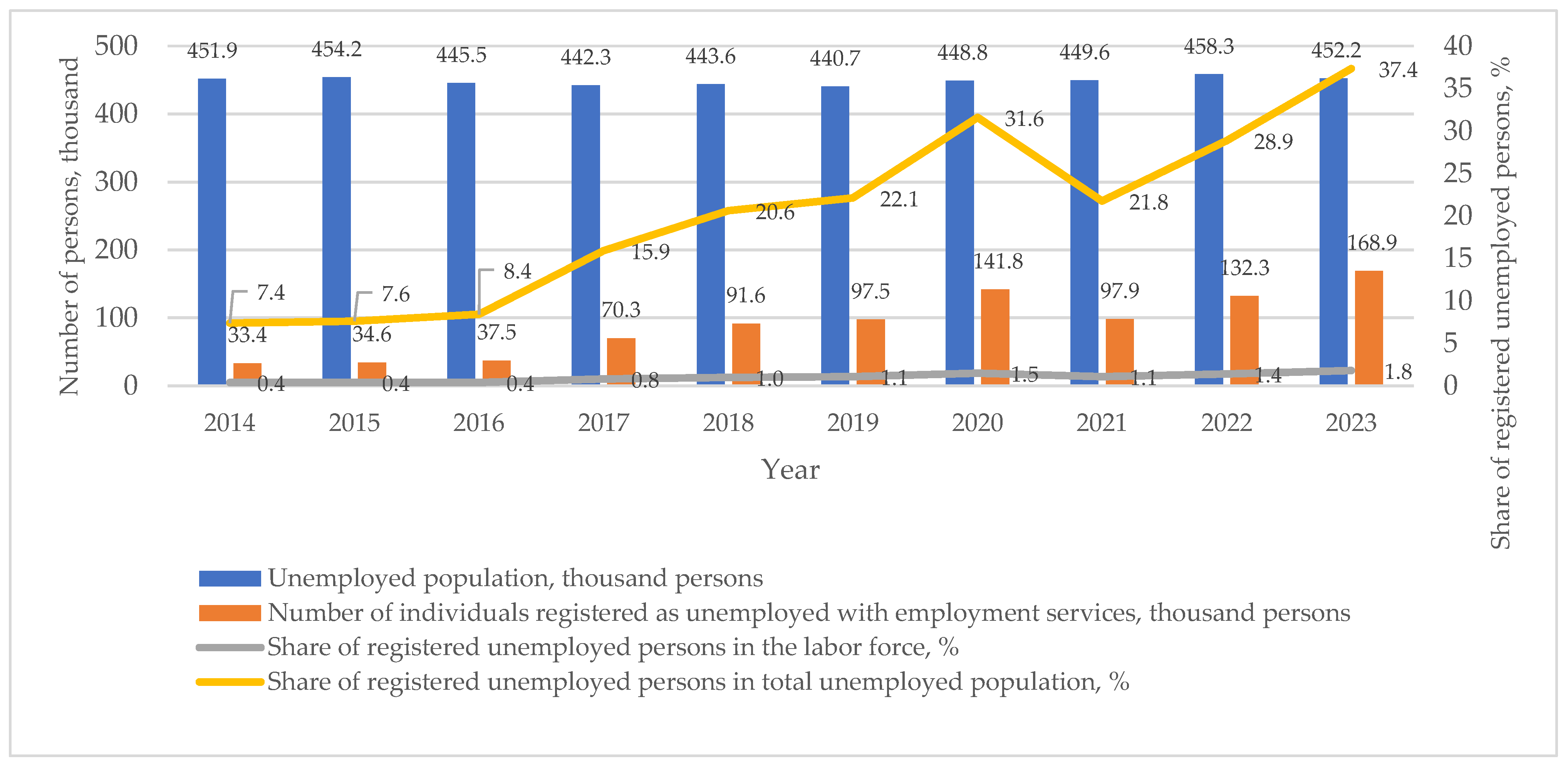
Appendix I
Table A6.
Correlation matrix of unemployment indicators in Kazakhstan (2014–2023).
| Indicators | Unemployment Rate (%) | Youth (15–34), % | Youth (15–24), % | Long-term Unemployment, % | Registered Unemployed Persons, thousand |
| Unemployment Rate (%) | 1.00 | 0.96 | 0.90 | 0.81 | −0.82 |
| Youth (15–34), % | 0.96 | 1.00 | 0.88 | 0.73 | −0.88 |
| Youth (15–24), % | 0.90 | 0.88 | 1.00 | 0.71 | −0.62 |
| Long-term Unemployment, % | 0.81 | 0.73 | 0.71 | 1.00 | −0.68 |
| Registered Unemployed Persons, thousand | −0.82 | −0.88 | −0.62 | −0.68 | 1.00 |
Source: compiled by the authors based on official labor statistics from www.stat.gov.kz. Values represent Pearson correlation coefficients for unemployment-related indicators over the period of 2014–2023.
Appendix J
Table A7.
Correlation matrix of key wage indicators (2014–2023).
| Indicator | Nominal Wage | Nominal Wage Index | Real Wage Index | Minimum Wage |
| Nominal Wage | 1.00 | 0.92 | 0.82 | 0.95 |
| Nominal Wage Index | 0.92 | 1.00 | 0.90 | 0.84 |
| Real Wage Index | 0.82 | 0.90 | 1.00 | 0.78 |
| Minimum Wage | 0.95 | 0.84 | 0.78 | 1.00 |
Source: compiled by the authors based on regression analysis results.
Appendix K
Table A8.
Regression analysis of factors influencing the real wage index in Kazakhstan (2014–2023).
| Variable | Coefficient (β) | Standard Error | p-Value | Interpretation |
| Nominal Wage | 0.000082 | 0.00003 | 0.014 | Positive effect on real wages |
| Minimum Wage | −0.00051 | 0.00026 | 0.078 | Slightly negative effect on real wages |
| Constant | 95.6 | 0.48 | 0.001 | Baseline level of real wage index |
| R2 | 0.81 | — | — | The model explains 81% of the variance |
Source: compiled by the authors based on regression analysis results.
Appendix L
Table A9.
Labor market development scenarios in Kazakhstan under digital transformation.
| Scenario | Description | Key Indicators (by 2030) | Expected Outcomes |
| Optimistic | Rapid digital infrastructure rollout, effective youth employment strategies, large-scale upskilling, integration of informal workers | NEET rate: ≤4% Informal employment: ≤8% Digital sector employment: ≥10% Remote work share: ≥5% Labor productivity growth: ≥4% annually |
Inclusive labor market growth, regional convergence, reduced informality, and strong integration of youth |
| Pessimistic | Fragmented digitalization, persistent institutional inertia, growing digital divide, ineffective employment policies | NEET rate: ≥10% Informal employment: ≥18% Digital sector employment: ≤5% Remote work share: ≤1% Labor productivity growth: ≤1% annually |
Widening disparities, youth exclusion, stagnant productivity, expansion of precarious employment |
| Optimal (Baseline) | Gradual digital integration, moderate success of targeted employment programs, partial formalization, improvement in urban centers | NEET rate: 6–7% Informal employment: 10–12% Digital sector employment: 6–8% Remote work share: 2–3% Labor productivity growth: 2–3% annually |
Moderate formalization, selective inclusion of youth, persistent rural–urban gaps, partial transition to digital economy |
Source: compiled by the authors based on the results of the conducted analysis of Kazakhstan’s labor market for the period of 2014–2023. Indicator values reflect scenario-based projections under the varying assumptions of digital transformation, institutional effectiveness, and labor market inclusivity.
References
- Acemoglu, D.; Restrepo, P. Robots and Jobs: Evidence from US Labor Markets. J. Politi- Econ. 2020, 128, 2188–2244. [Google Scholar] [CrossRef]
- ADB, 2022) ADB. (2022). Kazakhstan Country Diagnostic Study: Toward a More Inclusive and Resilient Labor Market. Asian Development Bank.
- Adilkhanova, 2023) Adilkhanova, Z. (2023). Unemployment rate in Kazakhstan: An alternative calculation (Analytical note No. 2023–02). Monetary Policy Department, National Bank of Kazakhstan.
- Amirgaliyeva & Dosmuratova, 2022) Amirgaliyeva, A., & Dosmuratova, A. (2022). Socioeconomic determinants of NEET youth in the south of Kazakhstan. Bulletin of the Academy of Labor and Social Relations, 3, 77–88.
- Arntz et al., 2016) Arntz, M.; Gregory, T.; Zierahn, U. (2016). The Risk of Automation for Jobs in OECD Countries: A Com-parative Analysis. OECD Social, Employment and Migration Working Papers, No. 189. OECD Publishing. Available online: https://www.oecd.org/en/publications/the-risk-of-automation-for-jobs-in-oecd-countries_5jlz9h56dvq7-en (accessed on 23 January 2025).
- Arynova, Z.; Shelomentseva, V.; Kaidarova, S.; Zolotareva, S.; Bekniyazova, D. TRENDS IN THE DEVELOPMENT OF THE LABOR MARKET IN THE CONTEXT OF DIGITALIZATION OF THE ECONOMY. Bull. 2024, 3, 318–333. [Google Scholar] [CrossRef]
- Autor, *!!! REPLACE !!!*; et al. , 2020) Autor, D., Mindell, D., & Reynolds, E. (2020). The Work of the Future: Building Better Jobs in an Age of Intelligent Machines. MIT Task Force on the Work of the Future.
- Autor, D.H. Why Are There Still So Many Jobs? The History and Future of Workplace Automation. J. Econ. Perspect. 2015, 29, 3–30. [Google Scholar] [CrossRef]
- Brynjolfsson and McAfee, 2014). Brynjolfsson, E., & McAfee, A. (2014). The Second Machine Age: Work, Progress, and Prosperity in a Time of Brilliant Technologies. W.W. Norton & Company.
- Baimukhanov, *!!! REPLACE !!!*; et al. , 2021) Baimukhanov, A., Bekmagambetova, A., & Amangeldina, G. (2021). Digital economy and the transformation of employment in Kazakhstan. Journal of Asian Business and Economic Studies, 28(4), 389–403. [CrossRef]
- Beisembina, A.; Abuselidze, G.; Nurmaganbetova, B.; Kabakova, G.; Makenova, A.; Nurgaliyeva, A. The Labour Market in Kazakhstan Under Conditions of Active Transformation of Their Economy. Economies 2025, 13, 131. [Google Scholar] [CrossRef]
- Bloom & McKenna, 2021) Bloom, D. E., & McKenna, M. J. (2021). The future of work in the age of AI. Harvard Public Health Review, 26, 1–7.
- Kudrle, R.T. Moves and countermoves in the digitization challenges to international taxation. Technol. Soc. 2021, 64. [Google Scholar] [CrossRef]
- Bonin, *!!! REPLACE !!!*; et al. , 2015) Bonin, H., Gregory, T., & Zierahn, U. (2015). Übertragung der Studie von Frey/Osborne (2013) auf Deutschland. ZEW—Zentrum für Europäische Wirtschaftsforschung GmbH.
- Bowles, 2014) Bowles, J. (2014, July 17). The computerisation of European jobs. Bruegel Blog. Available online: https://www.bruegel.org/blog-post/computerisation-european-jobs (accessed on 19 August 2024).
- Bruck & Burke, 2016) Bruck, J., & Burke, I. (2016). The great decoupling: Automation, productivity and inequality. Oxford Review of Economic Policy, 32(2), 221–234.
- Bureau of National Statistics of the Kazakhstan, 2024) Bureau of National Statistics of the Kazakhstan. (2024). Structure and distribution of wages of employees in the Kazakhstan (by the end of 2024). Statistical Bulletin. Available online: https://stat.gov.kz/en/industries/labor-and-income/stat-wags/publications/184222/ (accessed on 5 February 2025).
- Bureau of National Statistics, 2023) Bureau of National Statistics. (2023). Labor market indicators. Available online: https://stat.gov.kz (accessed on 28 September 2024).
- Campos, F.; Frese, M.; Goldstein, M.; Iacovone, L.; Johnson, H.C.; McKenzie, D.; Mensmann, M. Teaching personal initiative beats traditional training in boosting small business in West Africa. Science 2017, 357, 1287–1290. [Google Scholar] [CrossRef] [PubMed]
- Center for the Development of Human Resources, 2021) Center for the Development of Human Resources(2021). The national report «The labour market of Kazakhstan: Development in a new reality» Available online:. Available online: https://erdo.enbek.kz/news/414 (accessed on 11 October 2024).
- Center for the Development of Human Resources, 2022) Center for the Development of Human Resources(2022). The national report «The labour market of Kazakhstan: On the way to digital reality» Available online:. Available online: https://erdo.enbek.kz/news/241 (accessed on 25 November 2024).
- Center for the Development of Human Resources, 2023) Center for the Development of Human Resources (2023). The national report «The Future Workforce: Youth in Kazakhstan’s Labor Market» Available online:. Available online: https://drive.google.com/file/d/1rGYomZ6r6tao9unGHD0RSJpqqZPXCaWL/view (accessed on 23 October 2024).
- Dauth et al, 2017) Dauth, W., Findeisen, S., Suedekum, J., & Woessner, N. (2017). German Robots – The Impact of Industrial Robots on Workers (CEPR Discussion Paper No. DP12306). Centre for Economic Policy Research. https://cepr. 1230.
- Eurofound, 2016) Eurofound. (2016). Exploring the diversity of NEETs. European Foundation for the Improvement of Living and Working Conditions.
- European Training Foundation, 2025) European Training Foundation (ETF). New Forms of Work and Platform Work in Central Asia; ETF: Turin, Italy, 2024; Available online: https://www.etf.europa.eu/en/publications-and-resources/publications/new-forms-work-and-platform-work-central-asia (accessed on 10 July 2025).
- Federation of Trade Unions of the Kazakhstan, 2022) Federation of Trade Unions of the Kazakhstan. (2022). Report on Plat-form-Based Employment in Kazakhstan. Kasipodaq.kz. Available online: https://kasipodaq.kz/wp-content/uploads/Отчет-пo-латфoрменнoй-занятoсти-oктябрь-2022.pdf. (accessed on 7 October 2024).
- Ford, 2015) Ford, M. (2015). The rise of the robots: Technology and the threat of a jobless future. Basic Books.
- Frey, C.B.; Osborne, M.A. The future of employment: How susceptible are jobs to computerisation? Technol. Forecast. Soc. Chang. 2017, 114, 254–280. [Google Scholar] [CrossRef]
- Government of the Republic of Kazakhstan, 2023). Government of the Republic of Kazakhstan (2023). Resolution No. 1050 of 19 December 2023: On Approval of the Concept for the Development of the Labor Market of the Republic of Kazakhstan for 2023–2029. (In Kazakh). Available online: https://adilet.zan.kz/rus/docs/P2300001050.
- Graham & Dutton, 2019) Graham, M., & Dutton, W. H. (Eds.). (2019). Society and the Internet: How networks of information and communication are changing our lives (2nd ed.). Oxford University Press.
- Gyiazov, A. T. 2025) Gyiazov, A. T. The Impact of Digital Literacy on Kazakhstan’s Employment Structure in the Context of Tech-nological Change. Economy: Strategy and Practice, 20(1), 6–18.
- ILO, 2018) International Labour Organization. (2018). Formalization of the informal economy: Global trends and policy recom-mendations. International Labour Organization.
- ILO, 2020) International Labour Organization. (2020). Women and men in the informal economy: A statistical picture (3rd ed.); International Labour Organization.
- ILO, 2020) International Labour Organization.(2020). World Employment and Social Outlook: Trends 2020. Geneva: ILO.
- ILO, 2025) International Labour Organization (2025). World Employment and Social Outlook: Trends 2025; ILO: Geneva, Switzerland, 2025. [Google Scholar]
- ILO, 2025) International Labour Organization (2025). Formalizing the Informal Economy: A Roadmap towards Decent Work. Report VI for the 113th Session of the International Labour Conference; ILO: Geneva, Switzerland, 2025. [Google Scholar]
- Johansson, *!!! REPLACE !!!*; et al. , 2020) Johansson, J., Nafchi, M. Z., & Mohelska, H. (2020). Digital transformation and employment in the EU: Regional effects and policy implications. European Journal of Business Science and Technology, 6(1), 5–18.
- Kakizhanova, T.; Utepkaliyeva, K.; Zeinolla, S.; Aben, A.; Ilyashova, G. Impact of Digitalization, Economic Growth and Birth Rate on Female Labor Force: Evidence from Kazakhstan. ECONOMICS 2025, 13, 95–110. [Google Scholar] [CrossRef]
- Kenjebayeva & Sagiyeva, 2019) Kenjebayeva, L., & Sagiyeva, R. (2019). Informal employment in Kazakhstan: Gender and regional aspects. Economic Research Kazakhstan, 2(16), 45–53.
- Keynes, 1930) Keynes, J.M. (1930). Economic possibilities for our grandchildren. In Essays in Persuasion. Macmillan.
- Khussainova, Z.; Gazizova, M.; Abauova, G.; Zhartay, Z.; Raikhanova, G. Problems of Generating Productive Employment in the Youth Labor Market as a Dominant Risk Reduction Factor for the NEET Youth Segment in Kazakhstan. Economies 2023, 11, 116. [Google Scholar] [CrossRef]
- La Porta, R.; Shleifer, A. Informality and Development. J. Econ. Perspect. 2014, 28, 109–126. [Google Scholar] [CrossRef]
- McAfee, 2016) McAfee, A. (2016). More from the second machine age: Work, progress, and prosperity in a time of brilliant technologies. MIT Initiative on the Digital Economy.
- Nafchi & Mohelska, 2019) Nafchi, M.Z., & Mohelska, H. (2019). The impact of Industry 4.0 on labor market: Theoretical and empirical evidence. Acta Informatica Pragensia, 8(3), 152–165.
- National Bank of Kazakhstan, 2025) National Bank of Kazakhstan. (2025). Macroeconomic review: Exchange rates, inflation and wages. Available online: https://nationalbank.kz (accessed on 1 March 2025).
- Nazarbayev University, 2021) Nazarbayev University. (2021). Labour market inequality and informality in Kazakhstan: Empirical review. Center for Policy Research.
- OECD OECD Skills Strategy Kazakhstan; Organisation for Economic Co-Operation and Development (OECD): Paris, France, 2021.
- OECD, 2021) OECD. (2021). The future of work: OECD employment outlook 2021. OECD Publishing. [CrossRef]
- OECD, 2025) OECD (2025). OECD Public Governance Scan of Kazakhstan; OECD Publishing: Paris, France, 2025. [Google Scholar]
- Pajarinen & Rouvinen, 2014) Pajarinen, M., & Rouvinen, P. (2014). Computerization threatens one third of Finnish em-ployment. ETLA Brief, 22, 1–6.
- Prettner, 2019) Prettner, K. ( 163, 273–292.
- Prettner, K.; Strulik, H. Innovation, automation, and inequality: Policy challenges in the race against the machine. J. Monetary Econ. 2020, 116, 249–265. [Google Scholar] [CrossRef]
- Siri & Kergroch, 2023) Siri, S., & Kergroch, S. (2023). Modeling adaptive labor policies under automation scenarios. Future of Work Studies, 4(2), 111–128.
- Social Code of the Republic of Kazakhstan, 2023) Social Code of the Republic of Kazakhstan (2023), No. 224-VII, adopted on , 2023. Available online: https://adilet.zan. 20 April 2300.
- Suleimenova, 2020) Suleimenova, S. ( 11(2), 153–164. [CrossRef]
- Sumer & Daut, 2022) Sumer, B., & Daut, V. (2022). Digital transformation and labor markets: Regional perspectives. Techno-logical and Economic Development of Economy, 28(4), 987–1005.
- Tigland, *!!! REPLACE !!!*; et al. , 2022) Tigland, R. ( 9(1), 1–19.
- Tulegenova & Tuleuova, 2022) Tulegenova, G., & Tuleuova, A. (2022). The impact of ICT infrastructure on regional labor market development in Kazakhstan. Economy: Strategy and Practice, 17(3), 89–101.
- UNDP Kazakhstan, 2021) UNDP Kazakhstan. (2021). Youth employment and NEET analysis in Kazakhstan. United Nations Development Programme.
- UNDP, 2024) United Nations Development Programme (UNDP). Transforming Careers: How UNDP Increases Employment Opportunities for the Population; UNDP Kazakhstan, 2024. Available online: https://www.undp.org/kazakhstan/news/transforming-careers-how-undp-increases-employment-opportunities-population (accessed on 10 July 2025).
- Uvaliyeva, 2023) Uvaliyeva, D. (2023). Assessment of the efficiency of state employment programs in Kazakhstan: Regional perspective. Public Administration and Policy Review, 4(1), 34–49.
- Van der Zande, 2020) Van der Zande, J. (2020). AI displacement and workforce resilience: A regional analysis. European Labour Studies Journal, 5(2), 45–60.
- Vossner & Schneider, 2017) Vossner, N., & Schneider, H. (2017). Digital disruption and labor adjustment: An empirical study across European regions. Labour Economics, 49, 1–15.
- World Bank, 2020) World Bank. (2020). Pathways to better jobs in IDA countries: Findings from jobs diagnostics. World Bank.
- World Bank, 2023) World Bank. (2023). More, better and inclusive jobs in Kazakhstan. Available online: https://documents1.worldbank.org/curated/en/099030724012521561/pdf/P17983812e207b06a188db1b5af589b895f.pdf (accessed on day month year).
- World Bank, 2023) World Bank. (2023). Kazakhstan Jobs Diagnostic. W: Washington, DC.
- World Bank, 2024) World Bank (2024). World Social Protection Report 2024–2026: Universal Coverage for More Resilient Societies; World Bank: Washington, DC, USA. Available online: https://openknowledge.worldbank.org/server/api/core/bitstreams/3a191516-270b-40c9-acdf-79e3f382c708/content.
- Zholdasbekova, 2020) Zholdasbekova, A. (2020). Regional digital inequality in Kazakhstan: Causes and labor market impli-cations. Central Asia Journal of Social Sciences and Humanities, 5(2), 55–67.
Figure 1.
Annual growth rate of real GDP per employed person as a percentage of the previous year. Source: Bureau of National Statistics of the Republic of Kazakhstan,www.stat.gov.kz.
Figure 1.
Annual growth rate of real GDP per employed person as a percentage of the previous year. Source: Bureau of National Statistics of the Republic of Kazakhstan,www.stat.gov.kz.
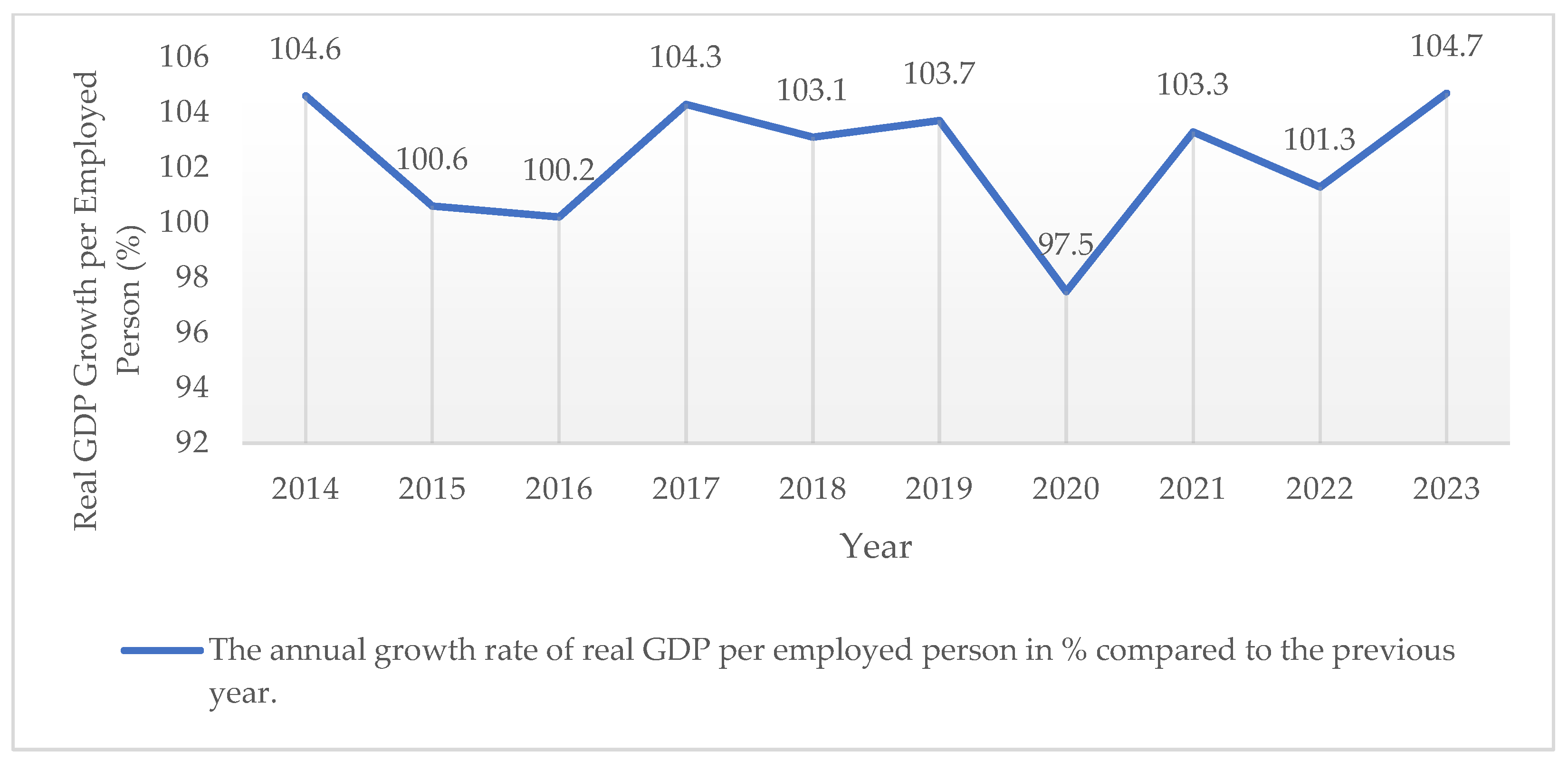
Figure 2.
Risks of sectoral transformation of the labor market in Kazakhstan. Source: adapted from ILO (2020), World Bank (2023), and OECD (2021).
Figure 2.
Risks of sectoral transformation of the labor market in Kazakhstan. Source: adapted from ILO (2020), World Bank (2023), and OECD (2021).
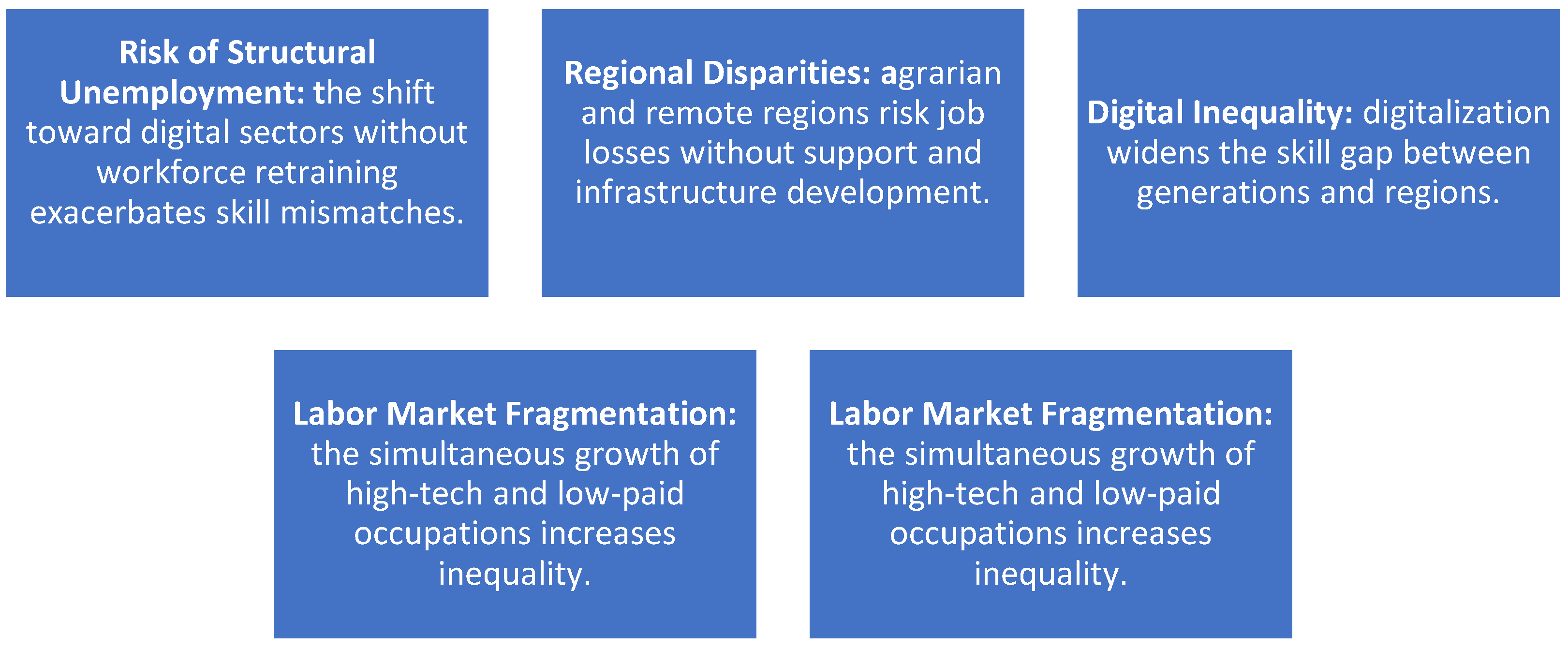
Figure 3.
Dynamics of the unemployment rate in Kazakhstan for 2014–2023. Source: Bureau of National Statistics of the Republic of Kazakhstan,www.stat.gov.kz.
Figure 3.
Dynamics of the unemployment rate in Kazakhstan for 2014–2023. Source: Bureau of National Statistics of the Republic of Kazakhstan,www.stat.gov.kz.
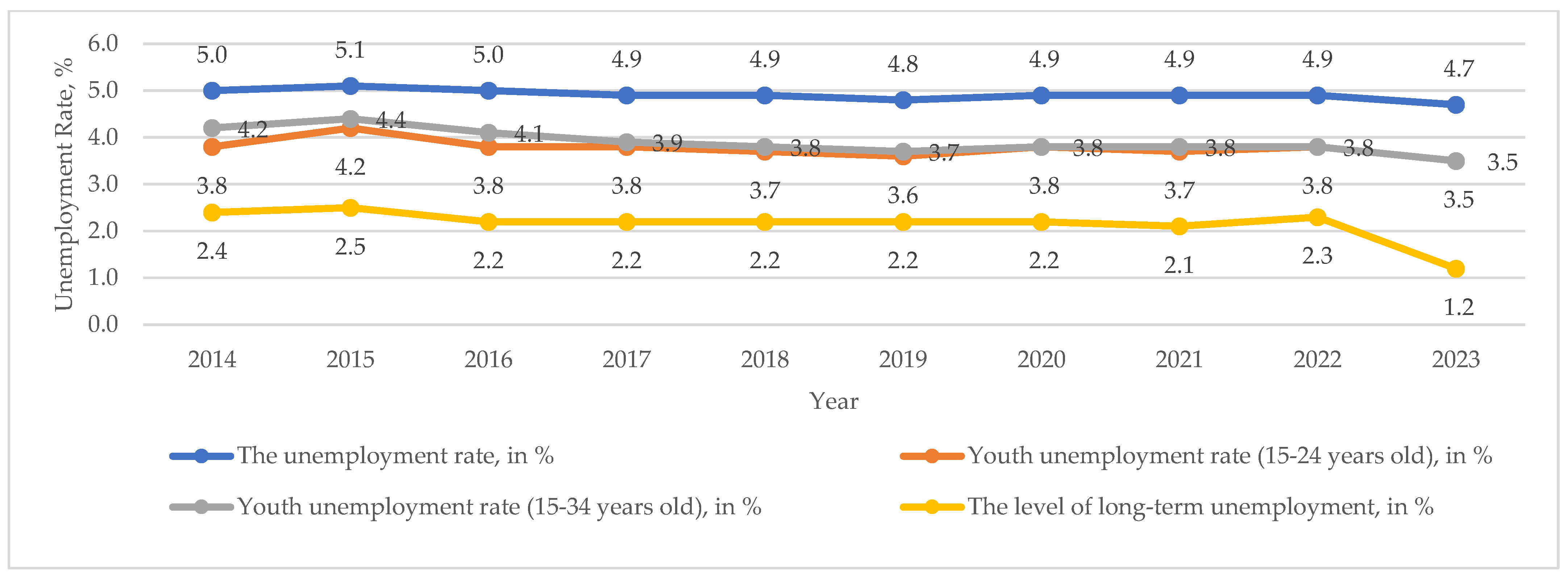
Figure 4.
Dynamics of the share of youth Not in Education, Employment, or Training (NEET), %. Source: Bureau of National Statistics of the Republic of Kazakhstan,www.stat.gov.kz.
Figure 4.
Dynamics of the share of youth Not in Education, Employment, or Training (NEET), %. Source: Bureau of National Statistics of the Republic of Kazakhstan,www.stat.gov.kz.
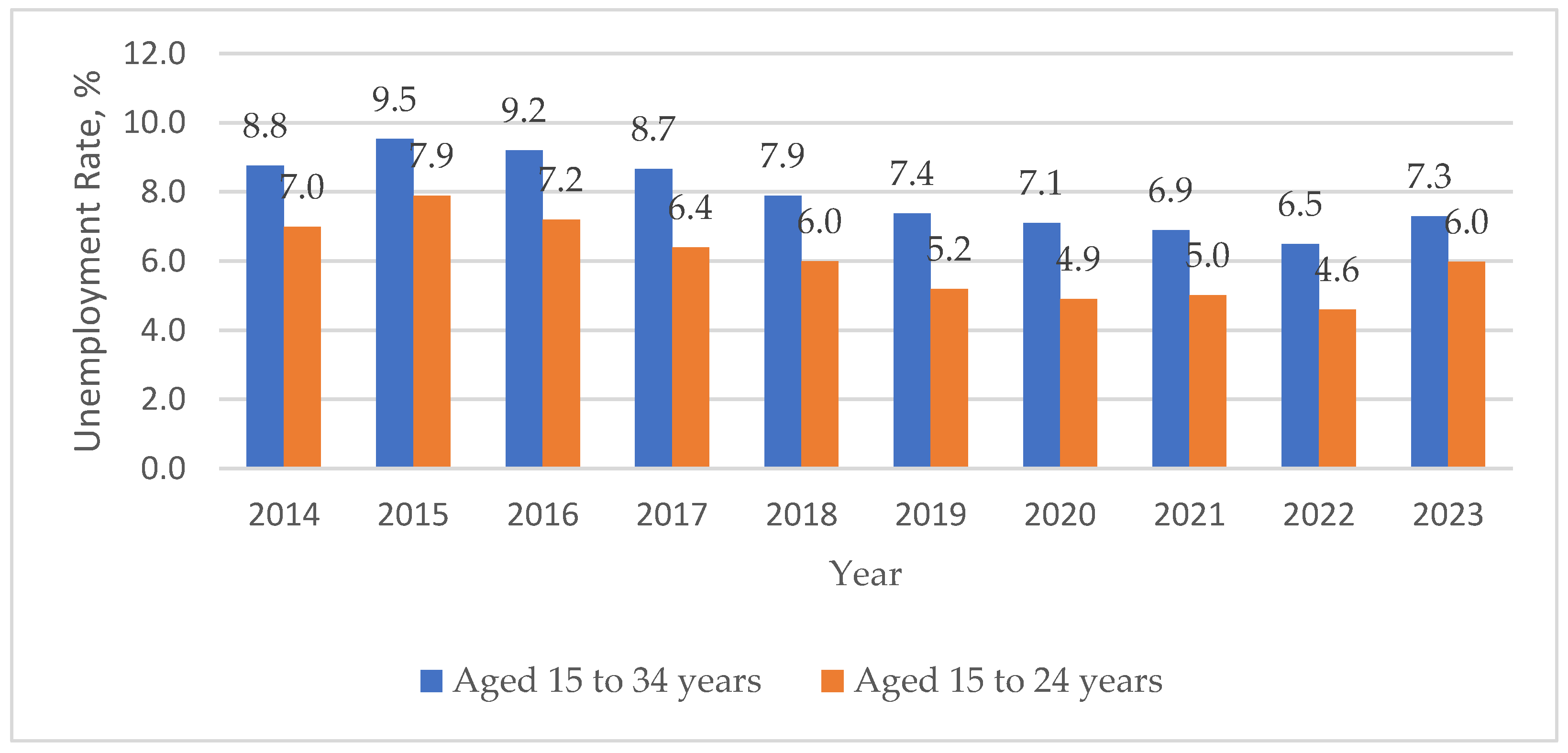
Figure 5.
Share of informal employment in Kazakhstan for 2014–2023. Source: Bureau of National Statistics of the Republic of Kazakhstan, www.stat.gov.kz.
Figure 5.
Share of informal employment in Kazakhstan for 2014–2023. Source: Bureau of National Statistics of the Republic of Kazakhstan, www.stat.gov.kz.
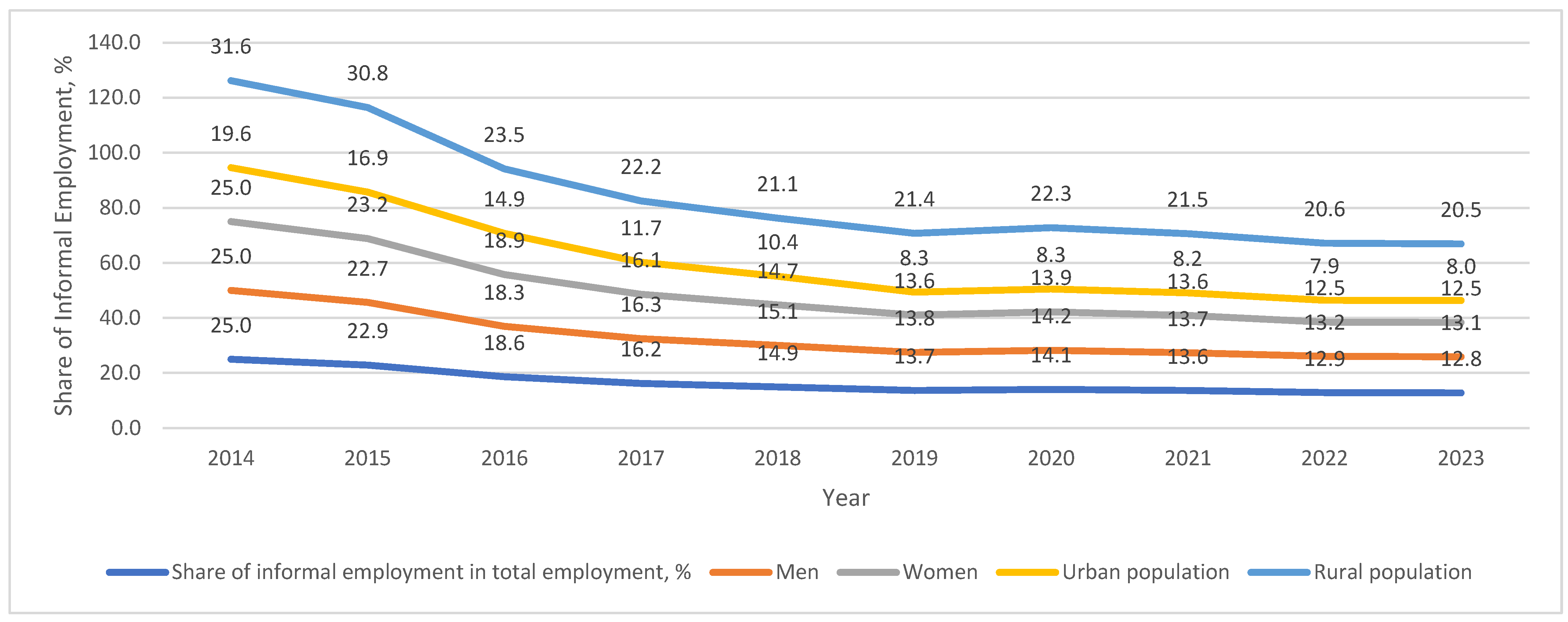
Figure 6.
Dynamics of the number of self-employed persons, 2014—2023. Source: Bureau of National Statistics of the Republic of Kazakhstan,www.stat.gov.kz.
Figure 6.
Dynamics of the number of self-employed persons, 2014—2023. Source: Bureau of National Statistics of the Republic of Kazakhstan,www.stat.gov.kz.
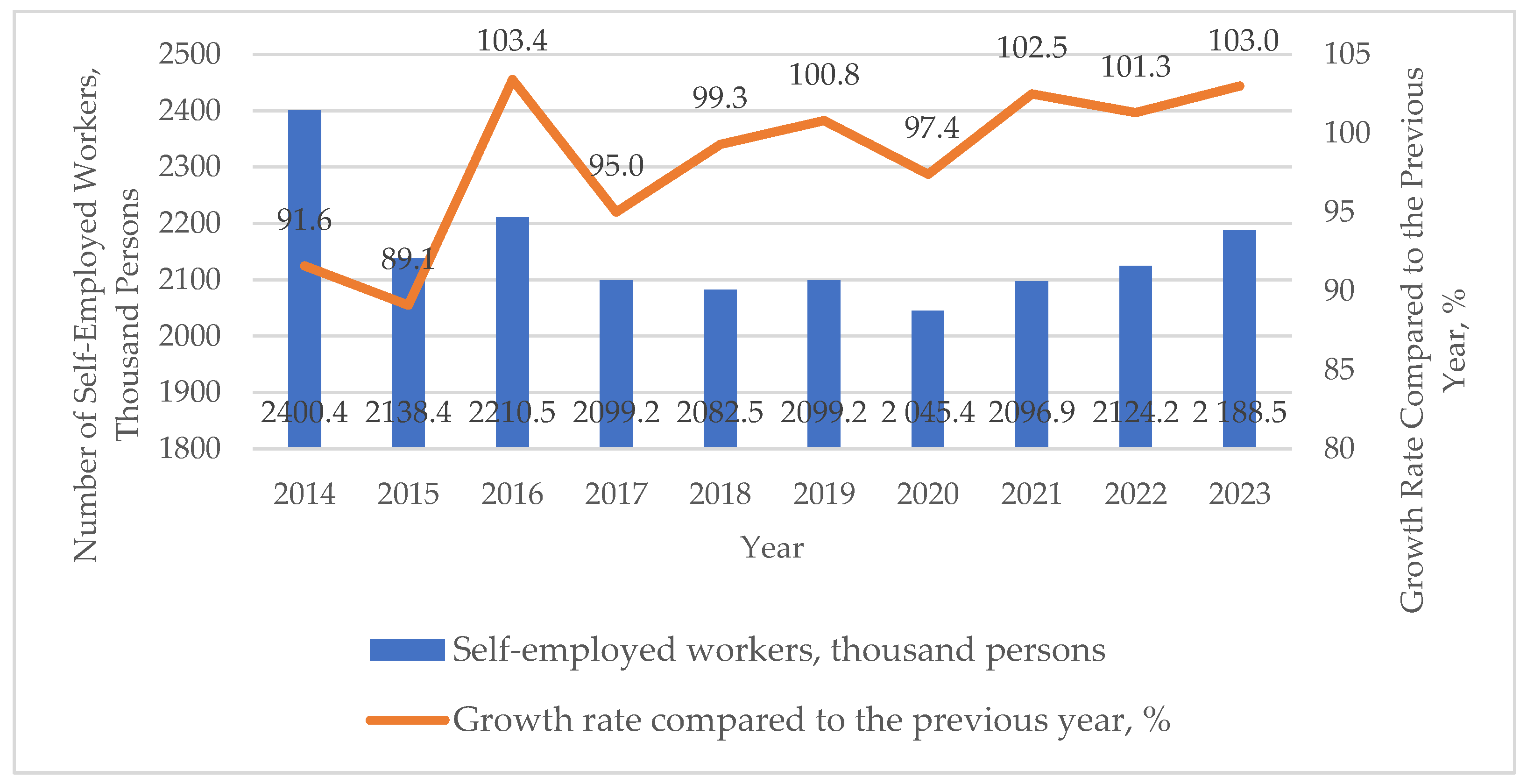
Figure 7.
Sectoral composition of Kazakhstan’s gig economy. Source: Bureau of National Statistics of the Republic of Kazakhstan,www.stat.gov.kz.
Figure 7.
Sectoral composition of Kazakhstan’s gig economy. Source: Bureau of National Statistics of the Republic of Kazakhstan,www.stat.gov.kz.
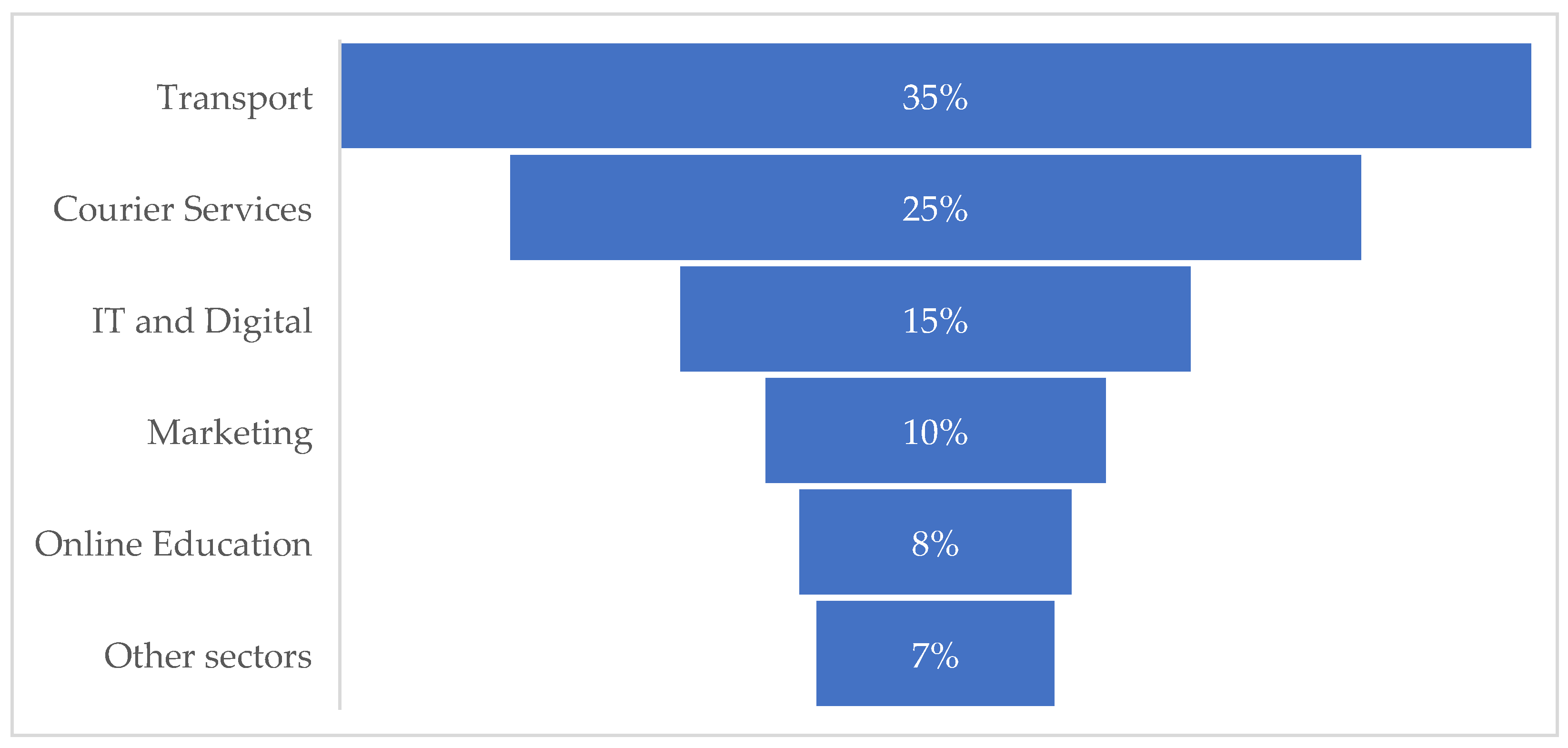
Figure 8.
Wage dynamics in Kazakhstan for 2014–2023. Source: Bureau of National Statistics of the Republic of Kazakhstan,www.stat.gov.kz.
Figure 8.
Wage dynamics in Kazakhstan for 2014–2023. Source: Bureau of National Statistics of the Republic of Kazakhstan,www.stat.gov.kz.
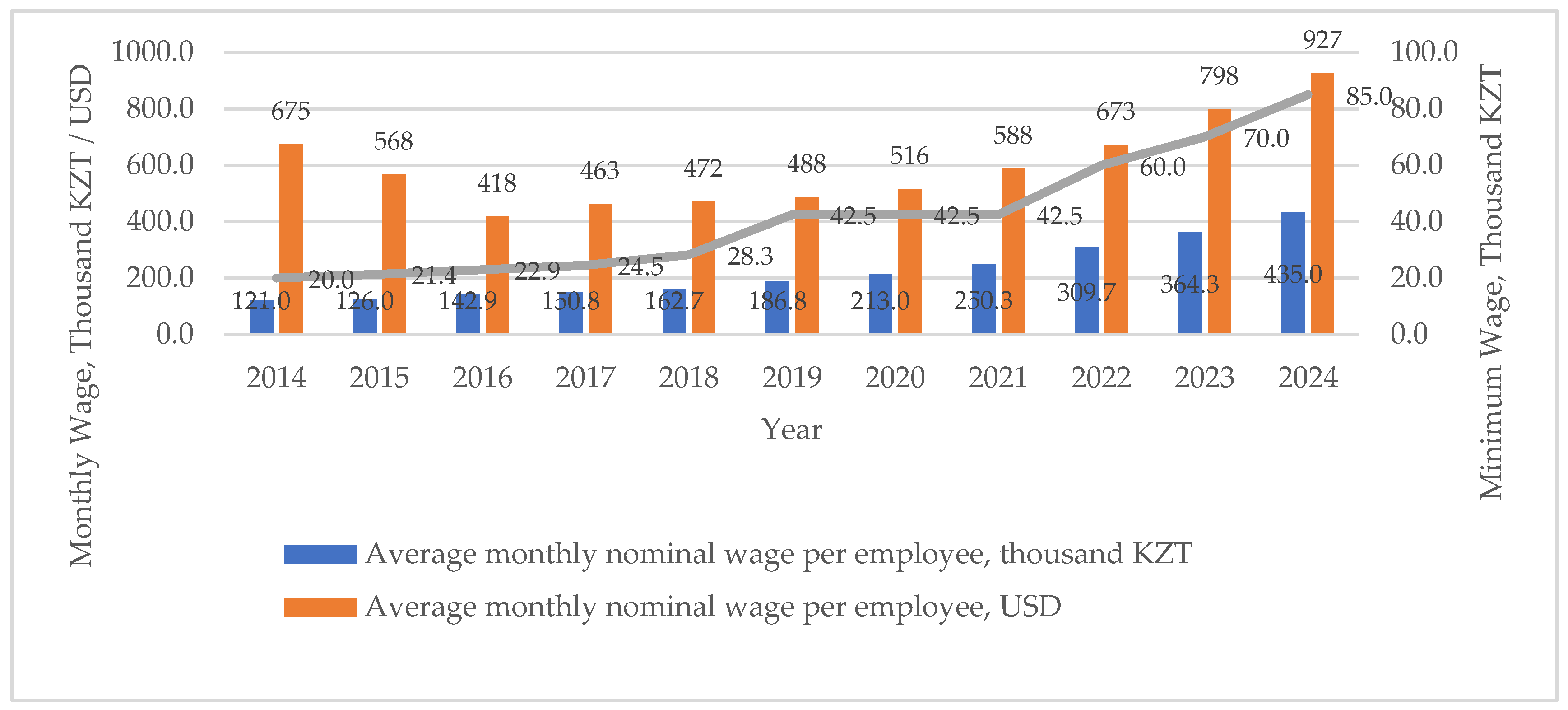
Table 1.
Structural characteristics of Kazakhstan’s labor market.
| Aspect | Description |
| Resource Dependence | The concentration of employment in the oil, gas, and mining sectors creates sectoral and regional asymmetries in income distribution and job availability. |
| Role of the Public Sector | The predominance of employment in the public sector ensures social stability but limits competition, reduces labor market flexibility, and increases fiscal pressure. |
| Scale of Informal Employment | A high share of informal employment is observed in construction, trade, and agriculture, which reduces legal protection and the level of social security for workers. |
| Regional Disparities | Southern regions of Kazakhstan are characterized by an oversupply of labor, while northern regions face shortages of qualified personnel, deepening territorial imbalances. |
| Digital Transformation | The adoption of digital technologies and automation stimulates demand for IT professionals but leads to labor displacement in traditional sectors. |
| Demographic Features | Youth represent a significant share of the labor force but face limitations in experience and qualifications. |
| Migration Processes | Internal migration increases pressure on labor markets in major cities, while external migration and brain drain weaken the economy’s skilled labor potential. |
Source: Bureau of National Statistics, Center for the Development of Human Resources, and Ministry of Labor and Social Protection of Republic Kazakhstan (2020–2023).
Table 2.
Factors shaping labor demand and supply in Kazakhstan.
| Category | Labor Demand Factors | Labor Supply Factors |
| Sectoral Economic Structure | Rising demand in oil and gas industry, construction, IT sector, agriculture, and finance | Labor resources concentrated in traditional sectors; growing number of IT and service graduates |
| Regional Characteristics | Increased demand in urban centers (Almaty, Astana, Shymkent) | High unemployment in rural areas; migration to cities |
| Digitalization and Automation | Growing demand for specialists in programming, Big Data, and digital marketing | Shortage of workers with digital skills; need for retraining |
| Labor Migration | Influx of migrants into construction, agriculture, and service sectors | Outflow of qualified professionals abroad; internal migration from rural regions to major cities |
| Government Policy | Subsidies and entrepreneurship programs creating new jobs | Skill training for the unemployed; state internships and grant support |
| Demographic Trends | Aging population increases demand for healthcare, caregiving, automation, and management | High youth unemployment, limited employment opportunities for graduates |
| Informal Sector | Active demand for informal labor in construction, trade, and services | Large share of self-employed and informally employed; absence of formal labor contracts |
Source: Bureau of National Statistics, Center for the Development of Human Resources, national employment programs (2020–2023), and sectoral labor market reports.
Table 3.
Comparative impact of COVID-19 pandemic and digitalization on labor market aspects.
| Aspect | Impact of COVID-19 Pandemic | Impact of Digitalization |
| Unemployment Rate | Sharp increase in unemployment, especially in 2020 | Gradual decline due to creation of new digital jobs |
| Employment Formats | Decline in employment in traditional sectors; expansion of remote work | Steady growth of flexible models: freelance, remote, and hybrid arrangements |
| Labor Productivity | Decrease in efficiency under restrictions and instability | Productivity growth driven by process automation and digital platforms |
| Sectoral Redistribution | Severe decline in tourism, food services, and passenger transport | Increased employment in IT, e-commerce, fintech, and related sectors |
| Technology Adoption | Emergency deployment of online tools and platforms | Strategic development of AI, Big Data, cloud solutions, and digital HR management tools |
| Business Process Transformation | Temporary adaptation to remote work | Deep reorganization of processes with emphasis on digital skills and technological resilience |
Source: compiled by the authors based on ILO (2020–2023), OECD (2022), Bureau of National Statistics, and Centre for the Development of Human Resources reports.
Table 4.
Clustering results (3 Clusters).
| Cluster | Regions | Characteristics |
| 1 | Zhetysu Region, Karaganda Region, Kostanay Region | Sustained high growth >105% |
| 2 | Abai Region, Akmola Region, Almaty City, Pavlodar Region | Moderate growth ~101–104% |
| 3 | Aktobe Region, Mangystau Region, Astana City | Low growth, instability <100% |
Source: compiled by the authors based on the results of cluster analysis of regional labor productivity growth. Data reflect average growth patterns across three identified groups of regions.
Table 5.
Structural shifts in sectoral employment in Kazakhstan.
| Sector | Share of Employment, % | Change, p.p. | |
| 2014 | 2023 | ||
| Agriculture, Forestry, and Fisheries | 18.9 | 11.9 | −7.0 |
| Industry | 12.8 | 12.3 | −0.5 |
| Construction | 8.0 | 7.1 | −0.9 |
| Trade and Repair | 14.7 | 16.7 | +2.0 |
| Transport and Storage | 6.9 | 7.1 | +0.2 |
| Education | 11.5 | 13.0 | +1.5 |
| Healthcare and Social Services | 5.5 | 6.4 | +0.9 |
| Professional, Scientific, and Technical Activities | 1.9 | 2.9 | +1.0 |
| Information and Communication (ICT) | 1.9 | 2.1 | +0.2 |
Source: Bureau of National Statistics of the Republic of Kazakhstan (https://stat.gov.kz).
Table 6.
Regional clustering of NEET rates in Kazakhstan (2014–2023).
| Cluster | NEET Range (%) | Regions |
| Cluster 1 (Low NEET) | 4.8–6.1 | Astana, Shymkent, West Kazakhstan, East Kazakhstan, Kostanay, Pavlodar |
| Cluster 2 (Medium NEET) | 6.7–7.0 | Almaty, Akmola, Almaty Region, Zhambyl |
| Cluster 3 (High NEET) | 9.9–11.7 | Karaganda, Turkistan, Ulytau, Mangystau |
Source: compiled by the authors based on the average NEET rates across regions. Clusters were formed using value-based segmentation to reflect low, medium, and high NEET prevalence over the study period.
Table 7.
Share of remote workers by region in Kazakhstan in 2023
| Region | Total Employed Population | Remote Workers | Share of Remote Workers (%) |
| Kazakhstan (Total) | 9,081,920 | 42,514 | 0.47 |
| Almaty City | 1,045,505 | 3231 | 0.04 |
| Astana City | 658,663 | 2434 | 0.03 |
| Karagandy Region | 535,799 | 4590 | 0.05 |
| Atyrau Region | 335,132 | 33 | 0.00 |
| East Kazakhstan Region | 368,832 | 321 | 0.00 |
Source: Authors’ calculations based on data from the Bureau of National Statistics of the Republic of Kazakhstan (www.stat.gov.kz). The table presents selected regions; the full dataset covers 20 regions.
Disclaimer/Publisher’s Note: The statements, opinions and data contained in all publications are solely those of the individual author(s) and contributor(s) and not of MDPI and/or the editor(s). MDPI and/or the editor(s) disclaim responsibility for any injury to people or property resulting from any ideas, methods, instructions or products referred to in the content. |
© 2025 by the authors. Licensee MDPI, Basel, Switzerland. This article is an open access article distributed under the terms and conditions of the Creative Commons Attribution (CC BY) license (https://creativecommons.org/licenses/by/4.0/).
Copyright: This open access article is published under a Creative Commons CC BY 4.0 license, which permit the free download, distribution, and reuse, provided that the author and preprint are cited in any reuse.


