

Submitted:
23 July 2025
Posted:
24 July 2025
You are already at the latest version
Abstract
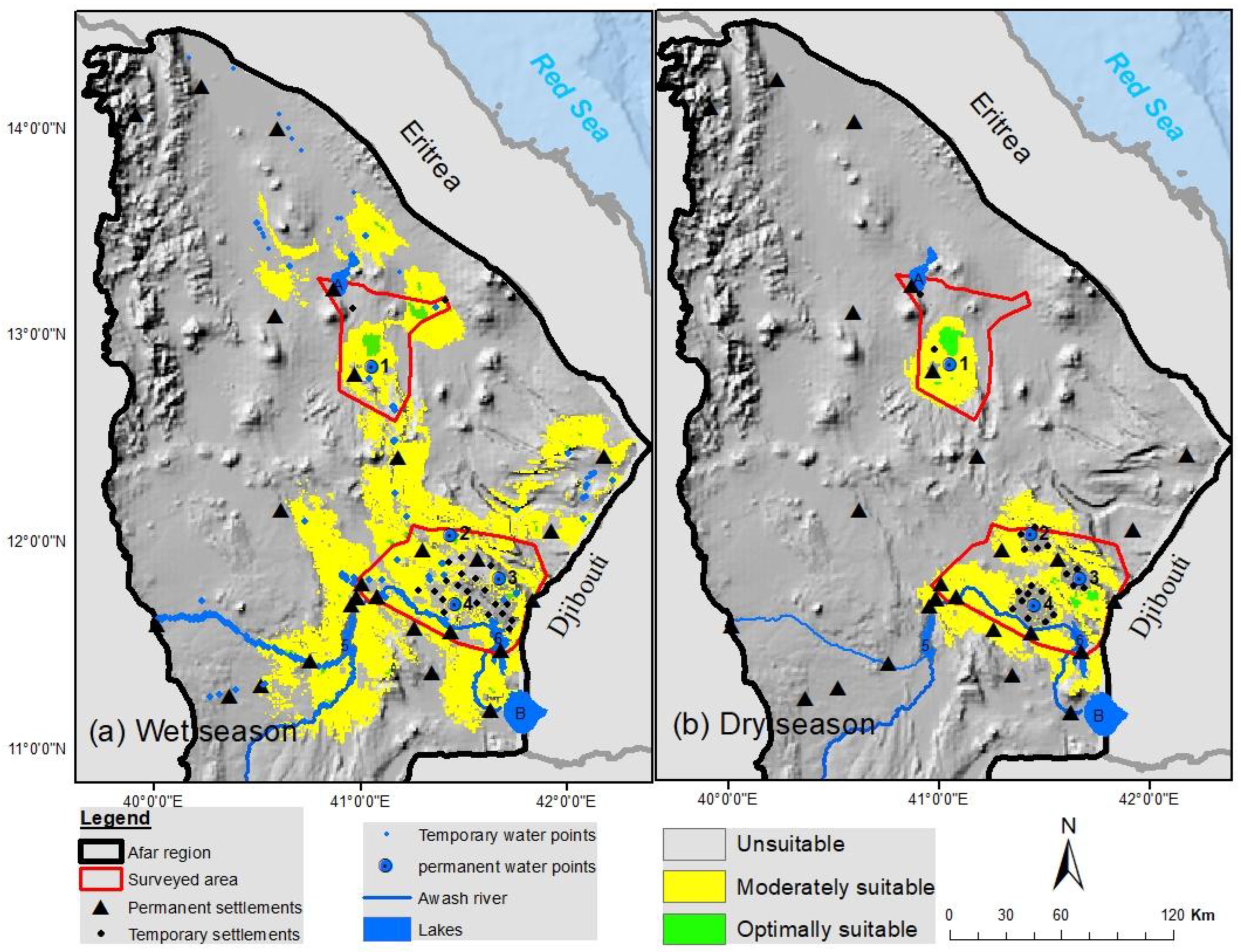
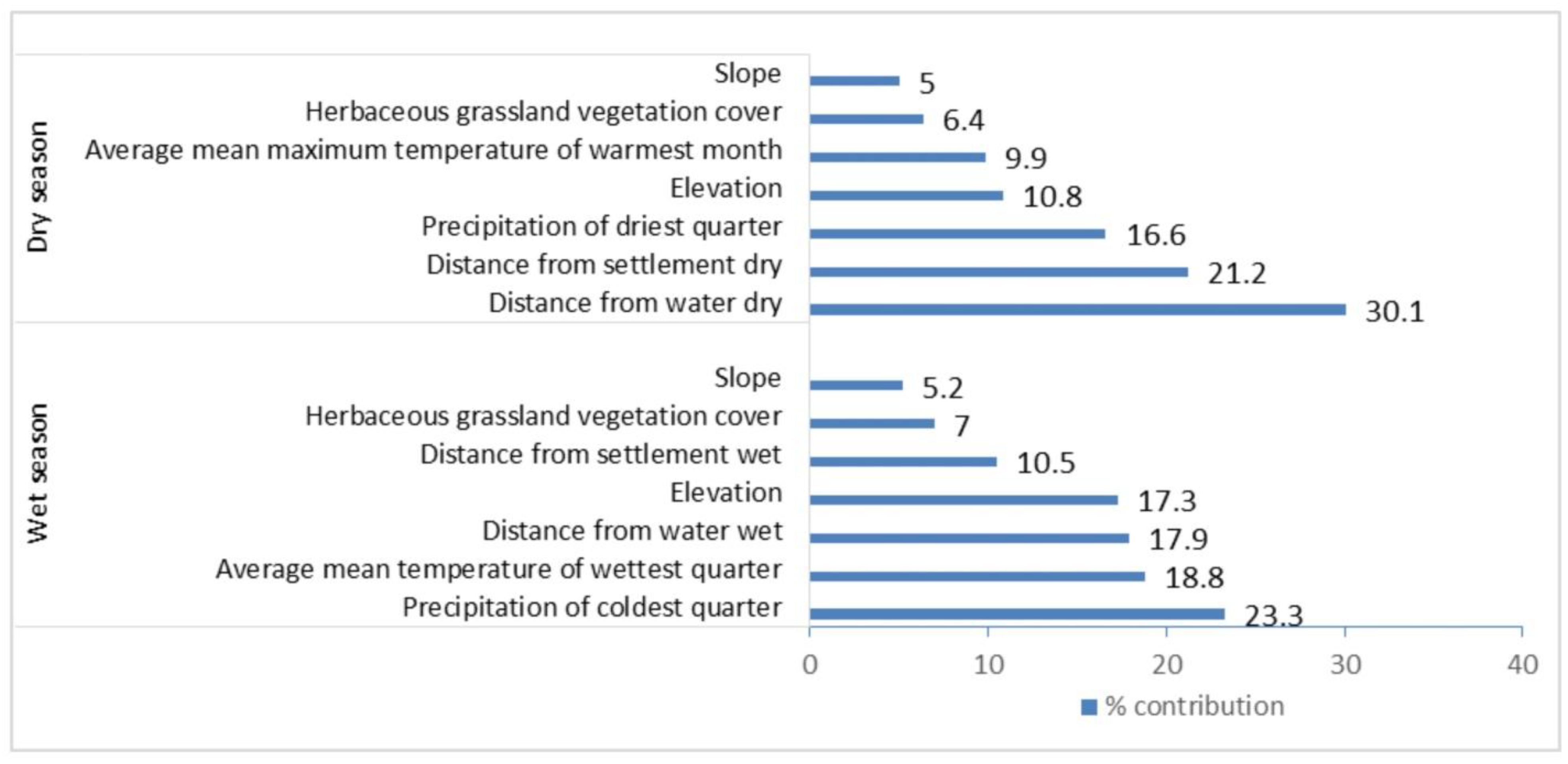
The Critically Endangered African wild ass are found in low population densities and there may be as few as 600 individuals in the Danakil Desert of Ethiopia and Eritrea. An understanding of suitable habitats is important for prioritizing the African wild ass conservation and management. In this study, maximum entropy (Maxent) modeling using African wild ass presence location data collected and separately prepared covariates to determine suitable habitat. The sample size (116 and 87) was determined by the number of occurrence points after removing duplicates for dry and wet seasons, respectively. The predicted moderately suitable habitat area extent was greater during the wet season (15,223 km2) than during the dry season (6,052 km2). Precipitation, temperature and distance from water sources were vital variables for the wet season while distance from water sources and distance from the settlements were important determinant covariates for the dry season. Model performances were high, with the area under the curve (AUC) values of 0.927 and 0.950 for wet and dry seasons, respectively. This information prioritizes where protected areas should be established for African wild ass conservation and also indicates potential new undocumented locations to guide surveys in the Danakil Desert of Afar Region, Ethiopia.
Keywords:
1. Introduction
2. Materials and Methods
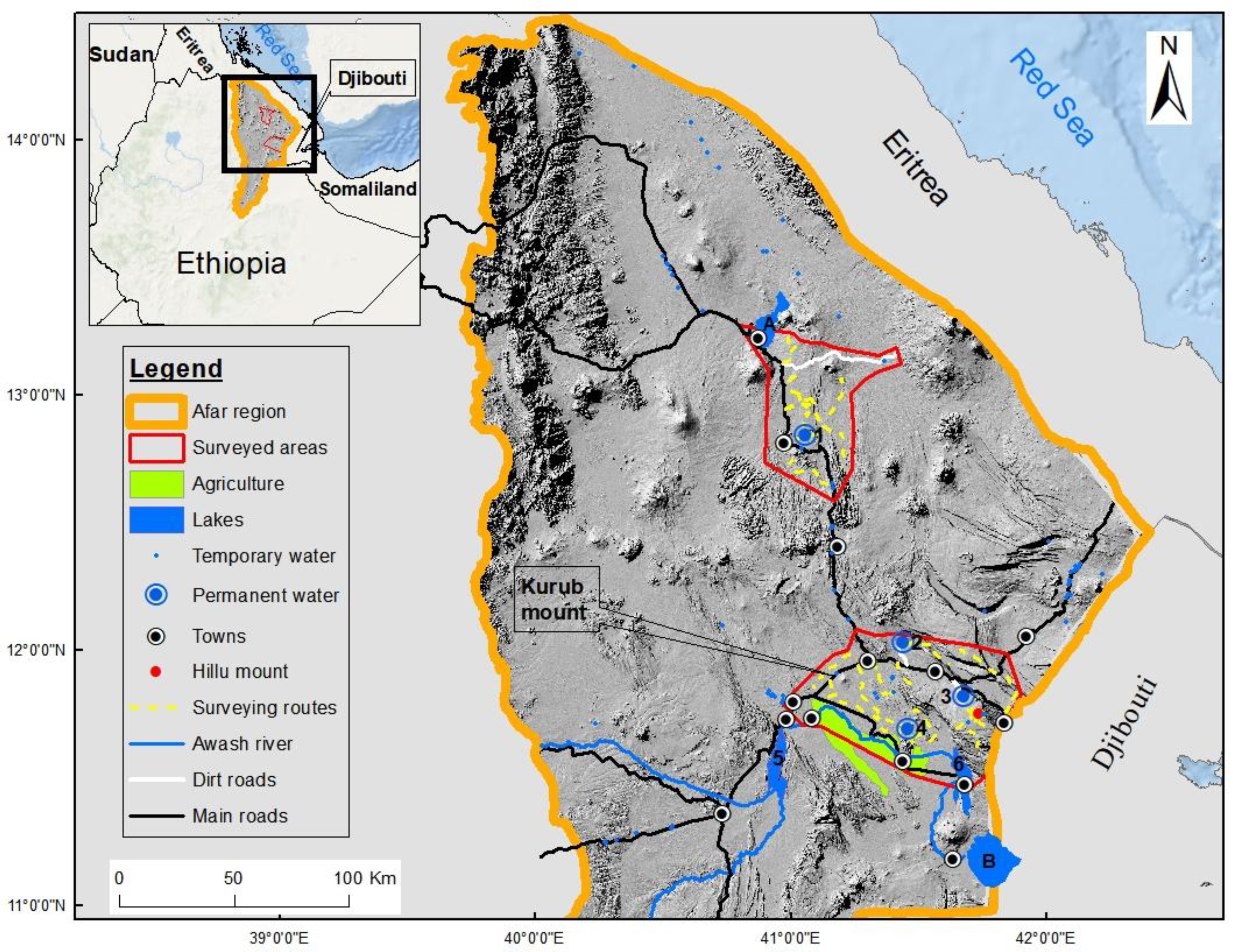
2.1. Study Area
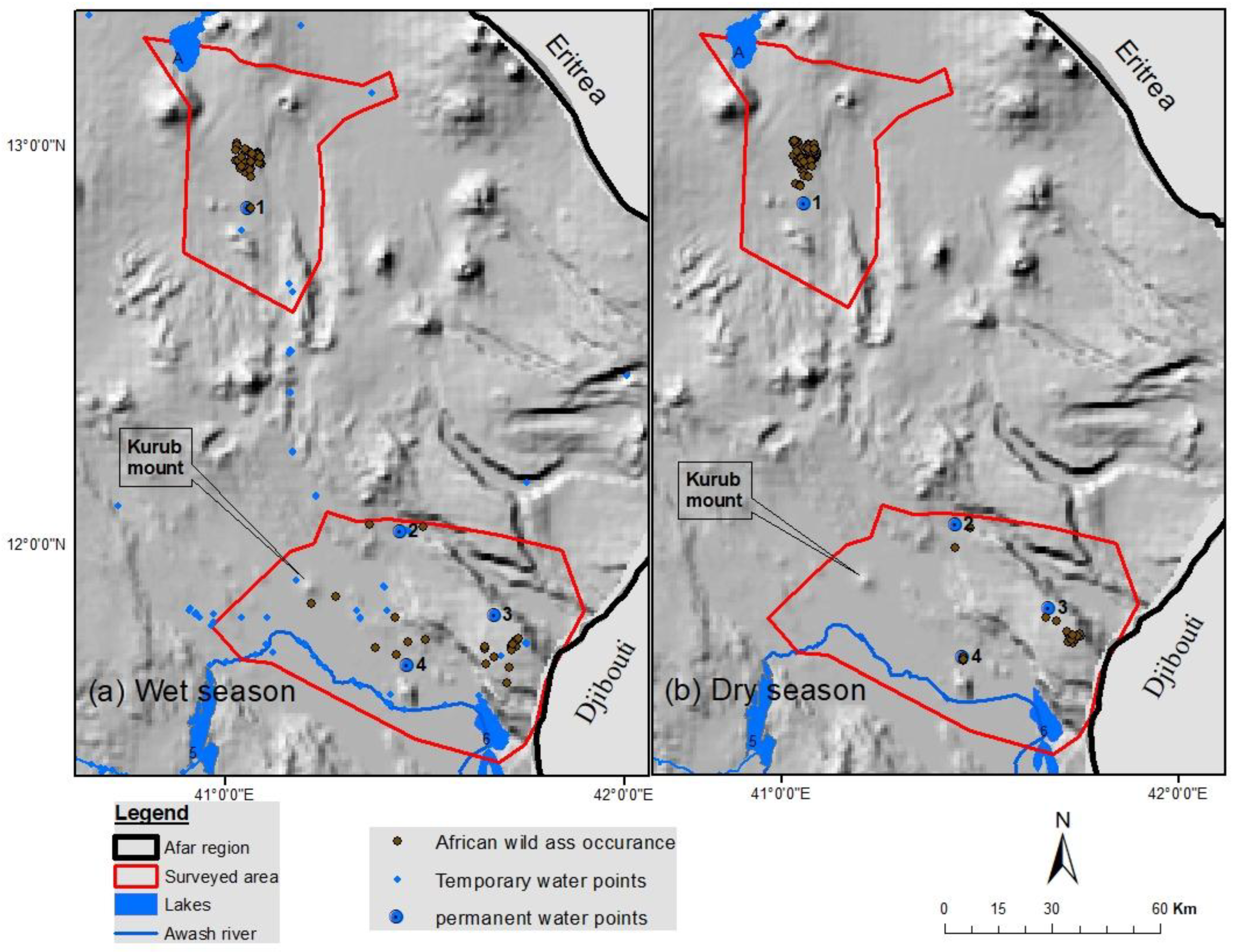
2.2. Data Collection
2.3. Predictor Variables
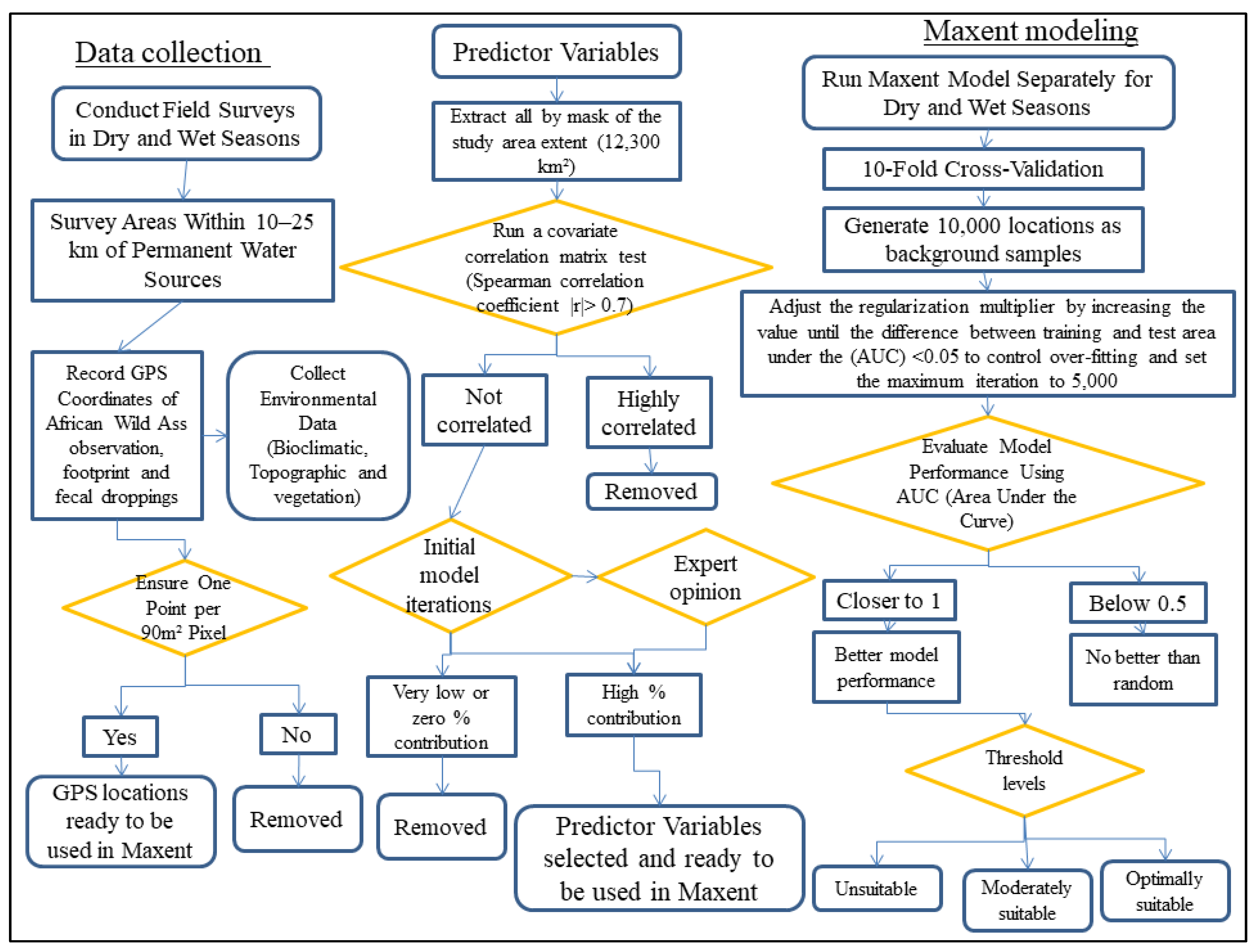
2.4. Data Analysis
3. Results
4. Discussion
5. Conclusions
Supplementary Materials
Author Contributions
Funding
Institutional Review Board Statement
Informed Consent Statement
Data Availability Statement
Acknowledgments
Conflicts of Interest
References
- Klingel, H. Social Behaviour of African Equidae. Zool. Afri. 1972, 7, 175–185. [Google Scholar] [CrossRef]
- Yalden, D., M. Largen, and D. Kock. Catalogue of the mammals of Ethiopia. Monit. Zool. Italiano. Supp. 1986, 21, 31–103. [Google Scholar] [CrossRef]
- Moehlman, P., F. Kebede, and H. Yohannes, Equus africanus, The IUCN red list of threatened species, 2015. pp. 1–13.
- Moehlman, P.D. (Ed.) The African wild ass. In Equids Zebras, Asses and Horses. Status Survey and Conservation Action Plan, ed. P.D. Moehlman. IUCN/SSC Equid Specialist Group, IUCN, Gland. 2002; pp. 2–10.
- Moehlman, P.D., S. King, and F. Kebede, eds. Status and conservation of threatened equids. In Wild equids: ecology, management, and conservation, ed. J. Ransom and P. Kaczensky. Johns Hopkins University Press, Baltimore, Maryland. 2016; pp. 167–186.
- Kebede, F. , Ecology and community-based conservation of Grevy’s zebra (Equus grevyi) and African wild ass (Equus africanus) in the Afar Region, in Ecology and systematic zoology, 2012, Addis Ababa University, Addis Ababa, 12/2012.
- Kebede, F. , Research and Community-Based Conservation of the African Wild Ass in the Danakil Desert of Ethiopia, Report to EWCA, 2015. pp. 1-21.
- Kebede, F., L. Berhanu, and P. Moehlman, Distribution and population status of the African Wild Ass (Equus africanus) in Ethiopia, Report to Saint Louis Zoo, New York, 2007. pp. 11.
- Mohammed, R. , Current population, activity budget, land use/land cover change and habitat use overlap of African wild ass (Equus africanus, Fitzinger, 1857) with livestock in Afar Region, Ethiopia, in Ecology and systematic zoology, 2021, Addis Ababa University, Addis Ababa, 02/2021.
- Tesfai, R.T., N. Owen-Smith, F. Parrini, and P.D. Moehlman. African wild ass drinking behaviour on the Messir Plateau, Danakil Desert, Eritrea. J. Arid Environ. [CrossRef]
- Manor, R. and D. Saltz. Impact of human nuisance disturbance on vigilance and group size of a social ungulate. Ecol. Appl. 2003, 13, 1830–1834. [Google Scholar] [CrossRef]
- Esmaeili, S., K. A. Schoenecker, and S.R. King. Resource availability and heterogeneity affect space use and resource selection of a feral ungulate. Ecosphere 2024, 15, e4939. [Google Scholar] [CrossRef]
- Hackel, J.D. Community Conservation and the Future of Africas Wildlife. Conserv. Biol. 1999, 13, 726–734. [Google Scholar] [CrossRef]
- Kebede, F., P. D. Moehlman, A. Bekele, and P.H. Evangelista. Predicting seasonal habitat suitability for the critically endangered A frican wild ass in the Danakil, Ethiopia. Afri. J. Ecol. 2014, 52, 533–542. [Google Scholar] [CrossRef]
- Miao, Z., Q. Wang, X. Lu, D. Chen, W. Zhang, X. Zhou, and D.C. MacMillan. Compassionate conservation and the challenge of sustainable wildlife management: a survey of the urban public of China. Animals 2021, 11, 2521. [Google Scholar] [CrossRef]
- Walsh, J.C., L. V. Dicks, and W.J. Sutherland. The effect of scientific evidence on conservation practitioners’ management decisions. Conserv. Biol. 2015, 29, 88–98. [Google Scholar] [CrossRef]
- Pullin, A.S., T. M. Knight, D.A. Stone, and K. Charman. Do conservation managers use scientific evidence to support their decision-making? Biol. conserv. 2004, 119, 245–252. [Google Scholar] [CrossRef]
- Christensen, N.L., A. M. Bartuska, J.H. Brown, S. Carpenter, C. d’Antonio, R. Francis, J.F. Franklin, J.A. MacMahon, R.F. Noss, and D.J. Parsons. The report of the Ecological Society of America committee on the scientific basis for ecosystem management. Ecol. appl. 1996, 6, 665–691. [Google Scholar] [CrossRef]
- Pearson, R. Species’ Distribution Modeling for Conservation Educators and Practitioners. AMNH 2007, 50, 54–89. [Google Scholar] [CrossRef]
- Williams, J.N., C. Seo, J. Thorne, J.K. Nelson, S. Erwin, J.M. O’Brien, and M.W. Schwartz. Using species distribution models to predict new occurrences for rare plants. Divers. Distrib. 2009, 15, 565–576. [Google Scholar] [CrossRef]
- Jackson, C.R. and M.P. Robertson. Predicting the potential distribution of an endangered cryptic subterranean mammal from few occurrence records. J. Nat. Conserv. 2011, 19, 87–94. [Google Scholar] [CrossRef]
- Guisan, A. and W. Thuiller. Predicting species distribution: offering more than simple habitat models. Ecol. lett. 2005, 8, 993–1009. [Google Scholar] [CrossRef] [PubMed]
- Cowley, M.J., R. J. Wilson, J.L. León-Cortés, D. Gutiérrez, C.R. Bulman, and C.D. Thomas. Habitat-based statistical models for predicting the spatial distribution of butterflies and day-flying moths in a fragmented landscape. J. Appl. Ecol. 2000, 37, 60–72. [Google Scholar] [CrossRef]
- Pearce, J. and S. Ferrier. Evaluating the predictive performance of habitat models developed using logistic regression. Ecol. Model. 2000, 133, 225–245. [Google Scholar] [CrossRef]
- Phillips, S.J., R. P. Anderson, and R.E. Schapire. Maximum entropy modeling of species geographic distributions. Ecol. Model. 2006, 190, 231–259. [Google Scholar] [CrossRef]
- Baldwin, R. Use of Maximum Entropy Modeling in Wildlife Research. Entropy 2009, 11, 854–866. [Google Scholar] [CrossRef]
- Yackulic, C.B., R. Chandler, E.F. Zipkin, J.A. Royle, J.D. Nichols, E.H. Campbell Grant, and S. Veran. Presence-only modelling using MAXENT: when can we trust the inferences? Methods Ecol. Evol. 2013, 4, 236–243. [Google Scholar] [CrossRef]
- Merow, C., J. M. Allen, M. Aiello-Lammens, and J.A. Silander Jr. Improving niche and range estimates with Maxent and point process models by integrating spatially explicit information. Glob. Ecol. Biogeogr. 2016, 25, 1022–1036. [Google Scholar] [CrossRef]
- Young, N.E., R. S. Anderson, S.M. Chignell, A.G. Vorster, R. Lawrence, and P.H. Evangelista. A survival guide to Landsat preprocessing. Ecol. 2017, 98, 920–932. [Google Scholar] [CrossRef]
- Bradie, J. and B. Leung. A quantitative synthesis of the importance of variables used in MaxEnt species distribution models. J. Biogeogr. 2017, 44, 1344–1361. [Google Scholar] [CrossRef]
- McGarvey, D.J., M. Menon, T. Woods, S. Tassone, J. Reese, M. Vergamini, and E. Kellogg. On the use of climate covariates in aquatic species distribution models: are we at risk of throwing out the baby with the bath water? Ecography 2018, 41, 695–712. [Google Scholar] [CrossRef]
- DeCesare, N.J., M. Hebblewhite, M. Bradley, D. Hervieux, L. Neufeld, and M. Musiani. Linking habitat selection and predation risk to spatial variation in survival. J. Anim. Ecol. 2014, 83, 343–352. [Google Scholar] [CrossRef] [PubMed]
- Matthiopoulos, J., J. R. Fieberg, and G. Aarts, Species-Habitat Associations: Spatial data, predictive models, and ecological insights. 2023.
- Wu, W., Y. Li, and Y. Hu. Simulation of potential habitat overlap between red deer (Cervus elaphus) and roe deer (Capreolus capreolus) in northeastern China. Peer J. 2016, 4, 1–19. [Google Scholar] [CrossRef] [PubMed]
- Singh, N.J. and E.J. Milner-Gulland. Conserving a moving target: planning protection for a migratory species as its distribution changes. J. Appl. Ecol. 2011, 48, 35–46. [Google Scholar] [CrossRef]
- West, A.M., S. Kumar, C.S. Brown, T.J. Stohlgren, and J. Bromberg. Field validation of an invasive species Maxent model. Ecol. Inform. 2016, 36, 126–134. [Google Scholar] [CrossRef]
- Nesbitt, L.M. From south to north through Danakil. Geogr. J. 1929, 73, 529–539. [Google Scholar] [CrossRef]
- Fazzini, M., C. Bisci, and P. Billi, The climate of Ethiopia, in Landscapes and landforms of Ethiopia. 2015, Springer. p. 65-87.
- Billi, P. , Geomorphological landscapes of Ethiopia, in Landscapes and landforms of Ethiopia. 2015, Springer. p. 3-32.
- Cavalazzi, B., R. Barbieri, F. Gómez, B. Capaccioni, K. Olsson-Francis, M. Pondrelli, A. Rossi, K. Hickman-Lewis, A. Agangi, and G. Gasparotto. The Dallol geothermal area, Northern Afar (Ethiopia)—An exceptional planetary field analog on Earth. Astrobiology 2019, 19, 553–578. [Google Scholar] [CrossRef]
- Yalden, D.W., M. J. Largen, D. Kock, and J.C. Hillman. Catalogue of the mammals of Ethiopia and Eritrea. 7. Revised checklist, zoogeography and conservation. Trop. Zool. 1996, 9, 73–164. [Google Scholar] [CrossRef]
- Data from NMAE, National Meteorological Agency of Ethiopia, Samara Branch. Samara, Ethiopia., 1986-2016.
- Western, D. The environment and ecology of pastoralists in arid savannas. Dev. & Change 1982, 13, 183–211. [Google Scholar]
- Eberhardt, L. Transect methods for population studies. J. Wildl. Manage. 1978, 1–31. [Google Scholar] [CrossRef]
- Brennan, K.E., P. J. Twigg, A. Watson, A. Pennington, J. Sumner, R. Davis, J. Jackson, B. Brooks, F. Grant, and R. Underwood, Cross-cultural systematic biological surveys in Australia’s Western Desert, 2012, Wiley Online Library.
- Jaeger, E.C. , Desert wildlife. 1961: Stanford University Press.
- Janssen, D.L. and J.L. Allen, eds. Equidae,. In Fowler’s Zoo and Wild Animal Medicine, ed. E. Miller and M. Fowler. Elsevier Saunders, Missouri. 2015; pp. 559–567.
- Austin, M.P. and V.N. Kimberly. Improving species distribution models for climate change studies: variable selection and scale. J. Biogeogr. 2011, 38, 1–8. [Google Scholar] [CrossRef]
- Elith, J., S. J. Phillips, T. Hastie, M. Dudík, Y.E. Chee, and C.J. Yates. A statistical explanation of MaxEnt for ecologists. Divers. Distrib. 2011, 17, 43–57. [Google Scholar] [CrossRef]
- ESRI, ArcGIS 10.8 Environmental Systems Research Institute, Inc., Redlands, USA, 2019.
- Gorelick, N., M. Hancher, M. Dixon, S. Ilyushchenko, D. Thau, and R. Moore. Google Earth Engine: Planetary-scale geospatial analysis for everyone. Remote Sens. Environ. 2017, 202, 18–27. [Google Scholar] [CrossRef]
- Dormann, C.F., J. Elith, S. Bacher, C. Buchmann, G. Carl, and G. Carré. Collinearity: a review of methods to deal with it and a simulation study evaluating their performance. Ecography 2013, 36, 27–46. [Google Scholar] [CrossRef]
- Davies, J., L. Poulsen, B. Schulte-Herbrüggen, K. Mackinnon, N. Crawhall, W. Henwood, N. Dudley, J. Smith, and M. Gudka, Conserving dryland biodiversity. xii+ 84p. Available from IUCN (International Union for the Conservation of Nature), Nairobi, Kenya. 2012.
- Gutiérrez-Hernández, O. and L.V. García, Relationship between precipitation and species distribution, in Precipitation. 2021, Elsevier. p. 239-259.
- Weltzin, J.F. and D.T. Tissue. Resource pulses in arid environments: Patterns of rain, patterns of life. New Phytol.
- Western, D. Water availability and its influence on the structure and dynamics of a savannah large mammal community. Afr. J. Ecol. 1975, 13, 265–286. [Google Scholar] [CrossRef]
- Inman, R.D., K. E. Nussear, T.C. Esque, A.G. Vandergast, S.A. Hathaway, D.A. Wood, K.R. Barr, and R.N. Fisher, Mapping habitat for multiple species in the Desert Southwest, 2014, US Geological Survey.
- Cain, J.W., J. V. Gedir, J.P. Marshal, P.R. Krausman, J.D. Allen, G.C. Duff, B.D. Jansen, and J.R. Morgart. Extreme precipitation variability, forage quality and large herbivore diet selection in arid environments. Oikos 2017, 126, 1459–1471. [Google Scholar] [CrossRef]
- Gedir, J.V., J. W. Cain III, P.R. Krausman, J.D. Allen, G.C. Duff, and J.R. Morgart. Potential foraging decisions by a desert ungulate to balance water and nutrient intake in a water-stressed environment. PloS one 2016, 11, e0148795. [Google Scholar] [CrossRef]
- Valavi, R., G. Guillera-Arroita, J.J. Lahoz-Monfort, and J. Elith. Predictive performance of presence-only species distribution models: a benchmark study with reproducible code. Ecol. Monogr. 2022, 92, 1–27. [Google Scholar] [CrossRef]
- Jarnevich, C.S., T. J. Stohlgren, S. Kumar, J.T. Morisette, and T.R. Holcombe. Caveats for correlative species distribution modeling. Ecol. Inform. 2015, 29, 6–15. [Google Scholar] [CrossRef]
- Merow, C., M. J. Smith, and J.A. Silander Jr. A practical guide to MaxEnt for modeling species’ distributions: what it does, and why inputs and settings matter. Ecography 2013, 36, 1058–1069. [Google Scholar] [CrossRef]
- Shabani, F., L. Kumar, and M. Ahmadi. Assessing accuracy methods of species distribution models: AUC, specificity, sensitivity and the true skill statistic. GJHSS: B Geography, Geo-Sciences, Environmental Science & Disaster Management.
- Roberts, D.R., V. Bahn, S. Ciuti, M.S. Boyce, J. Elith, and G. Guillera-Arroita. Cross-validation strategies for data with temporal, spatial, hierarchical, or phylogenetic structure. Ecography 2017, 40, 913–929. [Google Scholar] [CrossRef]
- Cao, Y., R. E. DeWalt, J.L. Robinson, T. Tweddale, L. Hinz, and M. Pessino. Using Maxent to model the historic distributions of stonefly species in Illinois streams: the effects of regularization and threshold selections. Ecol. Model. 2013, 259, 30–39. [Google Scholar] [CrossRef]
- Hirzel, A.H., G. Le Lay, V. Helfer, C. Randin, and A. Guisan. Evaluating the ability of habitat suitability models to predict species presences. Ecol. Model. 2006, 199, 142–152. [Google Scholar] [CrossRef]
- Tesfai, R.T., F. Parrini, P.D. Moehlman, N. Young, and P. Evangelista. Predicting suitable habitat for the Critically Endangered African wild ass Equus africanus in the Danakil Desert of Eritrea. Oryx 2023, 57, 592–599. [Google Scholar] [CrossRef]
- Brown, J.H. and S.M. Ernest. Rain and rodents: complex dynamics of desert consumers: although water is the primary limiting resource in desert ecosystems, the relationship between rodent population dynamics and precipitation is complex and nonlinear. BioScience 2002, 52, 979–987. [Google Scholar] [CrossRef]
- Klingel, H. Observations on social organization and behaviour of African and Asiatic Wild Asses /Equus africanus and Equus hemionus/. Appl. Anim. Behav. Sci. 1998, 60, 103–113. [Google Scholar] [CrossRef]
- Connolly, E., J. Allan, P. Brehony, A. Aduda, G. Western, S. Russell, A. Dickman, and P. Tyrrell. Coexistence in an African pastoral landscape: Evidence that livestock and wildlife temporally partition water resources. Afr. J. Ecol. 2021, 59, 696–711. [Google Scholar] [CrossRef]
- Tesfai, R.T., N. Owen-Smith, F. Parrini, and P.D. Moehlman. How spatial and dietary overlap with domestic livestock affect African wild ass nutrition on the Messir Plateau (Eritrea). J. Mammal. 1174. [Google Scholar] [CrossRef]
- Hall, L.K. , Competition Dynamics Within Communities of Desert Wildlife at Water Sources. 2016: Brigham Young University.
- Gedir, J.V., J. W. Cain III, T.L. Swetnam, P.R. Krausman, and J.R. Morgart. Extreme drought and adaptive resource selection by a desert mammal. Ecosphere 2020, 11, e03175. [Google Scholar] [CrossRef]
- Moehlman, P.D., F. Kebede, and H. Yohannes, eds. Equus africanus,. In The Mammals of Africa: Carnivores, Pangolins, Equids and Rhinoceroses, ed. J. Kingdon and M. Hoffmann. Bloomsbury Publishing, London. 2013; pp. 414–417.
- Grenot, C.J. Ecophysiological characteristics of large herbivorous mammals in arid Africa and the Middle East. J. Arid Environ. 1992, 23, 125–155. [Google Scholar] [CrossRef]
- Saltz, D., D. I. Rubenstein, and G.C. White. The impact of increased environmental stochasticity due to climate change on the dynamics of Asiatic wild ass. Conserv. Biol. 2006, 20, 1402–1409. [Google Scholar] [CrossRef]
- Marshal, J.P., P. R. Krausman, and V.C. Bleich. Rainfall, temperature, and forage dynamics affect nutritional quality of desert mule deer forage. REM 2005, 58, 360–365. [Google Scholar]
- Moehlman, P.D. Behavioral patterns and communication in feral asses (Equus africanus). Appl. Anim. Behav. Sci. 60, 125–169. [CrossRef]
- Warton, D.I., I. W. Renner, and D. Ramp. Model-based control of observer bias for the analysis of presence-only data in ecology. PloS one 2013, 8, e79168. [Google Scholar] [CrossRef]
- Bradley, B.A., A. D. Olsson, O. Wang, B.G. Dickson, L. Pelech, S.E. Sesnie, and L.J. Zachmann. Species detection vs. habitat suitability: are we biasing habitat suitability models with remotely sensed data? Ecol. Model. 2012, 244, 57–64. [Google Scholar] [CrossRef]

| The 19 bio-climate variables |
| Bio 1=Annual Mean Temperature |
| Bio 2=Mean Diurnal Range (Mean monthly (max temp – min temp)) |
| Bio 3=Isothermality (P2/P7)*(100) |
| Bio 4=Temperature Seasonality (standard deviation*100) |
| Bio 5=Max Temperature of Warmest Month |
| Bio 6=Min Temperature of Coldest Month |
| Bio 7=Temperature Annual Range (P5-P6) |
| Bio 8=Mean Temperature of Wettest Quarter |
| Bio 9=Mean Temperature of Driest Quarter |
| Bio 10=Mean Temperature of Warmest Quarter |
| Bio 11=Mean Temperature of Coldest Quarter |
| Bio 12=Annual Precipitation |
| Bio 13=Precipitation of Wettest Month |
| Bio 14=Precipitation of Driest Month |
| Bio 15=Precipitation of Seasonality (Coefficient of Variation) |
| Bio 16=Precipitation of Wettest Quarter |
| Bio 17=Precipitation of Driest Quarter |
| Bio 18=Precipitation of Warmest Quarter |
| Bio 19=Precipitation of Coldest Quarter |
| Wet season predictor variables | Dry season predictor variables | Source |
|---|---|---|
| Distance from water | Distance from water | Constructed using ArcGIS v. 10.8 |
| Distance from settlement | Distance from settlement | Constructed using ArcGIS v. 10.8 |
| Precipitation of coldest quarter | Precipitation of driest quarter | Downloaded from CHELSA (www.chelsa-climate.org) |
| Temperature of wettest quarter | Max-temperature of warmest month | Downloaded from CHELSA (www.chelsa-climate.org) |
| Elevation | Elevation | Downloaded from ESA (https://esa-worldcover.org) |
| Herbaceous grassland cover of wet | Herbaceous grassland cover of dry | Downloaded from ESA (https://esa-worldcover.org) |
| Slope | Slope | Downloaded from ESA (https://esa-worldcover.org) |
Disclaimer/Publisher’s Note: The statements, opinions and data contained in all publications are solely those of the individual author(s) and contributor(s) and not of MDPI and/or the editor(s). MDPI and/or the editor(s) disclaim responsibility for any injury to people or property resulting from any ideas, methods, instructions or products referred to in the content. |
© 2025 by the authors. Licensee MDPI, Basel, Switzerland. This article is an open access article distributed under the terms and conditions of the Creative Commons Attribution (CC BY) license (http://creativecommons.org/licenses/by/4.0/).


