
Submitted:
06 August 2025
Posted:
08 August 2025
You are already at the latest version
Abstract
Objective: To determine whether executive function impairment is a defining feature in individuals with Neurofibromatosis Type 1 (NF1), through the analysis of assessments conducted using the BRIEF questionnaire. Design: Systematic review and meta-analysis focused on the evaluation of executive functions using the BRIEF instrument in individuals diagnosed with NF1. Data Sources: Studies gathered from relevant academic databases that used BRIEF or BRIEF-P to assess executive functions in populations with NF1. Study Selection: Included studies evaluated executive functions in individuals with a clinical diagnosis of NF1 using BRIEF, as reported by parents and teachers, and provided statistically analyzable effect sizes. Data Extraction: Effect sizes (Cohen's d) were collected and analyzed across various BRIEF scales, including clinical indices and global executive function indices. Results: Moderate to high executive deficits were observed in individuals with NF1 in areas such as Self-Monitoring, Working Memory, Initiative, Monitoring, Planning/Organization, and in the general indices of Metacognition and Behavioral Regulation, with effect sizes ranging from 0.658 to 1.031. No significant deficits were found in the Flexibility scale. Parent and teacher evaluations revealed moderate executive deficits (d = 0.494–0.625). Deficits were higher when assessed with BRIEF compared to BRIEF-P (d = 0.381–0.815). Conclusions: Executive function impairment is a significant feature in individuals with NF1, particularly in behavioral regulation and metacognition domains, as evidenced by BRIEF assessments.
Keywords:
BRIEF
; executive functioning
; neurofibromatosis Type 1 (NF1)
Introduction
Neurofibromatosis Type 1 (NF1) is a hereditary genetic disorder characterized by the formation of tumors (neurofibromas) in nerve tissues of the skin, cranial nerves, and spinal cord.
Diagnosis is based on clinical criteria established by the United States National Institutes of Health (NIH). It involves a clinical assessment taking into account various signs and symptoms.
Pediatric cancer survivors are at high risk of experiencing a variety of late effects, including impairments in physical, motor, and cognitive functioning. [1]. Cancer treatment-related factors have been linked to deficits in executive functions (EF) among survivors [2]. [3] It analyzes studies on children with Neurofibromatosis Type 1 (NF1) and their executive functions, especially planning and inhibitory control.
Método
Review of executive functioning in individuals with NF1 following the procedure established by the principles of the PRISMA statement [7].
Eligibility Criteria of the Studies and Selection Process
The PICOS strategy (Participants, Interventions, Comparisons, Outcomes, Study design) was used [8]. To select the inclusion criteria, the PECOS strategy was used (i.e., considering the dimensions of Participants, Exposure, Comparison, Outcomes, and Study design):
(i) Participants: Children and adolescents (under 18 years of age) who are survivors of and/or affected by a pediatric brain tumor and/or who were exposed to oncological treatments during the fetal period.
(ii) Exposure: Individuals who have been exposed to a brain tumor during childhood and/or to oncological treatments in the fetal period.
(iii) Comparison: Deficits in executive functioning compared to individuals who were not exposed to a brain tumor in childhood and/or oncological treatment in the fetal period.
(iv) Outcomes: Executive functioning profile assessed using the BRIEF scales (self-report and/or informant report).
(v) Studies: Descriptive studies (pediatric brain tumor survivor group) and comparative-causal studies (control group versus pediatric brain tumor survivor group).
In the development of this review, inclusion and exclusion criteria were established, as summarized in Table 1:
Search Strategy
Following the guidelines established by the PRISMA statement [7]. To this end, the databases PubMed, Springer Link, and Scopus were consulted, selecting articles published from 2010 to March 2024. The search strategy used is included in Annex 1.
In the first stage, a bibliographic search was initially conducted using the following keywords in English: "cancer," "tumor," and "executive function." Subsequently, the studies were categorized based on tumor type, and studies with an NF1 diagnosis were selected for the meta-analysis.
A total of 78,933 articles were retrieved, allowing for tracking the evolution of research on the topic. In the second stage, specific filters unique to each database were applied: full text, empirical studies, English or Spanish language, and open access.
Included Studies
A total of 48 studies were selected as the basis for the present review. Among these, studies with an NF1 diagnosis were selected [10,11,12,13,14,15]. The included studies are presented in Annex 2.
The studies were screened by first reading the titles and eliminating those unrelated to the research objective. Subsequently, a second screening was conducted by reading the abstracts to assess their suitability according to the previously established inclusion and exclusion criteria.
Figure 1 shows the study screening process, starting from 78,993 studies, with 6 studies selected for inclusion in the meta-analysis
Bias Assessment
Data Análisis
A meta-analysis was conducted using the SPSS program (Meta-analysis module).
For quantitative variables, mean differences were used.
Effect sizes were calculated using Cohen’s d (Cohen, Reference Cohen1988).
A Cohen’s d effect size in the range of [0.2 – 0.35] was considered small, [0.35 – 0.65] moderate, and > 0.65 large. Statistical inferences were based on the analysis of 95% confidence intervals (CI). A random-effects model was chosen, assuming that effects are not the same across all studies.
Results
Effect Measures
Cohen’s d effect sizes were calculated from data of 6 studies that used the BRIEF (in different versions) in 4.488 NF1 patients and 2.922 controls.
Table 3 presents the detailed meta-analysis results for subgroups based on the different clinical scales and indices, informant, and BRIEF version.
Individuals with NF1 showed overall moderate executive deficits compared to the community sample (d = 0.606; p = 0.000; 95% CI 0.513 – 0.699).
An analysis of the different clinical scales and indices shows that the significant executive deficits vary:
I) Small but significant executive deficits compared to the community sample in: (i) Emotional Control (d = 0.314; p = 0.001; 95% CI 0.127 – 0.501); (ii) Inhibitory Self-Control Index (d = 0.264; p = 0.039; 95% CI 0.014 – 0.514).
II) Moderate significant deficits compared to the community sample in: (i) Inhibition (d = 0.498; p = 0.001; 95% CI 0.310 – 0.687); (ii) Global Executive Functioning (d = 0.575; p = 0.001; 95% CI 0.222 – 0.927); (iii) Organization of Materials (d = 0.521; p = 0.000; 95% CI 0.254 – 0.788).
III) Large significant deficits compared to the community sample in: (i) Self-Monitoring (d = 1.031; p = 0.000; 95% CI 0.712 – 1.350); (ii) Metacognition Index (d = 0.949; p = 0.001; 95% CI 0.681 – 1.218); (iii) Emerging Metacognition Index (d = 0.658; p = 0.001; 95% CI 0.422 – 0.893); (iv) Behavioral Regulation Index (d = 0.691; p = 0.001; 95% CI 0.380 – 1.002); (v) Initiative (d = 0.750; p = 0.001; 95% CI 0.479 – 1.020); (vi) Working Memory (d = 0.968; p = 0.000; 95% CI 0.803 – 1.132); (vii) Monitoring (d = 0.848; p = 0.001; 95% CI 0.444 – 1.251);
(viii) Planning/Organization (d = 0.715; p = 0.001; 95% CI 0.501 – 0.929).
No significant deficit was found in the clinical Flexibility scale (d = 0.325) or Flexibility Index (d = 0.081).
IV) An analysis of the different clinical scales and indices shows moderate significant executive deficits compared to the community sample when evaluated by: (i) Parents (d = 0.625; p = 0.000; 95% CI 0.527 – 0.724); (ii) Teachers (d = 0.494; p = 0.001; 95% CI 0.218 – 0.771).
V) An analysis of the different clinical scales and indices shows large significant executive deficits compared to the community sample when evaluated by BRIEF (d = 0.815; p = 0.000; 95% CI 0.715 – 0.915) and moderate deficits when evaluated by BRIEF-P (d = 0.381; p = 0.001; 95% CI 0.268 – 0.494).
Homogeneity and Heterogeneity
The heterogeneity test and the chi-square test were performed. Significant heterogeneity greater than 40% suggests the presence of heterogeneity (16). The presence and amount of statistical heterogeneity were assessed using the I² statistic, with significance set at p < .10 (17) (see Table 4).
Heterogeneity was driven in the clinical scales and indices by: Flexibility (χ²₄ = 15.193; p = .004) (I² = 70.4%) and Global Executive Functioning Index (χ²₄ = 14.681; p = .005) (I² = 71.3%).
Heterogeneity was driven by: Parents (χ²₅₂ = 1635.862; p = .001) (I² = 68.4%) and Teachers (χ²₈ = 27.631; p = .001) (I² = 71.0%).
Heterogeneity was driven by: BRIEF (χ²₃₀ = 67.367; p = .001) (I² = 56.2%) and BRIEF-P (χ²₈ = 56.560; p = .002) (I² = 47.2%).
The overall model (χ²₆₁ = 197.594; p = .001) (I² = 69%).
The subgroup homogeneity test was significant for clinical scales and indices and for the different versions of BRIEF, indicating that the studies have heterogeneous results.
Global clinical scales and indices: (χ²₁₄ = 77.267; p = .001) significant Global informants: (χ²₁ = 0.770; p = .380) not significant Global versions: (χ²₁ = 31.759; p = .001) significant.
Forest Plot
The differences (effect size) between individuals with NF1 and controls are graphically represented in the clinical scales and indices of the BRIEF (Figure 2), where a forest plot is presented.
In this meta-analysis, the effect size index used was the standardized mean difference between the two groups—Cohen’s d. Positive values indicated greater executive functioning deficits in individuals diagnosed with NF1 compared to community samples or typically developing samples.
This meta-analysis included effect sizes from 6 studies using the effect size index (Cohen’s d).
In the different forest plots, the mean (overall) effect size and its 95% confidence interval are shown at the bottom (d = 0.61; 95% CI = 0.51–0.70).
With a Cohen’s d of 0.61, according to Cohen’s (1988) guidelines, this effect size reflects a moderate relevance (close to 0.61).
The homogeneity statistic reached statistical significance [Q(61) = 197.59, p = .000].
The subgroup homogeneity test for clinical scales and indices was significant [Q(14) = 77.27, p = 0.000].
The subgroup homogeneity test for informants was significant [Q(1) = 0.77, p = 0.038].
The subgroup homogeneity test for the different versions of BRIEF was significant [Q(1) = 31.76, p = 0.000].
The I² index was high, I² = 69% (considered substantial heterogeneity), and the between-study variance reached τ² = 0.09 (τ = 0.3).
Global Effect Size Test
The global effect test [z = 12.78, p = 0.00] is below 0.05. There are statistically significant differences in executive functioning between patients with NF1 and the community sample, with a clear trend of executive deficits in the NF1 participant group.
Discussion
Our review and meta-analysis revealed that executive function impairments, as assessed using the BRIEF, were present in patients with NF1. Executive deficits were associated with moderate to high significant impairments across all domains of executive functioning, with the exception of flexibility. Moderate executive functioning deficits were found to be significant when assessed by parents and other informants (teachers), and high when assessed with the BRIEF, and moderate with the BRIEF-P.
Only studies that used the BRIEF in its various versions to evaluate executive functioning in individuals with NF1 were included—this is, to our knowledge, the first review and meta-analysis focused exclusively on studies using a single instrument. Our rationale for including only BRIEF studies was to allow for an ecologically valid assessment of executive functions, thereby ensuring homogeneity across studies.
The magnitude of executive deficits recorded in this research is, in general terms, consistent with results observed in previous studies [10].
However, our finding of a non-significant deficit in flexibility in individuals with NF1 compared to controls contrasts notably with the existing literature.
[15,18] have shown that children with NF1 exhibit difficulties across multiple domains of executive function (EF), with impairments both in everyday EF and in performance on laboratory-based tests. When assessing EF skills in daily life using the BRIEF, problems were observed across all relevant subscales.
Limitations
One limitation of the present review and meta-analysis is the lack of evaluation of the association between executive functioning and its impact on quality of life. The importance of considering this association was highlighted in a previous meta-analysis [10].
Conclusions
Executive deficits are evident in individuals with NF1. These deficits can have a significant impact on the academic, social, and emotional lives of individuals with NF1, highlighting the importance of their assessment. Early identification, along with educational and neuropsychological support, is key to preventing these difficulties from significantly interfering with academic, personal, and occupational functioning.
ANNEX 1: Search Strategy
Below is the search strategy used to gather the literature necessary for this review.
Database 1: PubMed
Strategy:#1# [(CANCER) OR (TUMOR)] AND [(BRIEF) OR (EXECUTIVE FUNCTION)],,,"((""cancer s""[All Fields] OR ""cancerated""[All Fields] OR ""canceration""[All Fields] OR ""cancerization""[All Fields] OR ""cancerized""[All Fields] OR ""cancerous""[All Fields] OR ""neoplasms""[MeSH Terms] OR ""neoplasms""[All Fields] OR ""cancer""[All Fields] OR ""cancers""[All Fields] OR (""cysts""[MeSH Terms] OR ""cysts""[All Fields] OR ""cyst""[All Fields] OR ""neurofibroma""[MeSH Terms] OR ""neurofibroma""[All Fields] OR ""neurofibromas""[All Fields] OR ""tumor s""[All Fields] OR ""tumoral""[All Fields] OR ""tumorous""[All Fields] OR ""tumour""[All Fields] OR ""neoplasms""[MeSH Terms] OR ""neoplasms""[All Fields] OR ""tumor""[All Fields] OR ""tumour s""[All Fields] OR ""tumoural""[All Fields] OR ""tumourous""[All Fields] OR ""tumours""[All Fields] OR ""tumors""[All Fields])) AND (""brief""[All Fields] OR ""briefed""[All Fields] OR ""briefing""[All Fields] OR ""briefings""[All Fields] OR ""briefs""[All Fields])) OR (""executive function""[MeSH Terms] OR (""executive""[All Fields] AND ""function""[All Fields]) OR ""executive function""[All Fields])","64,465",12:23:06
Strategy:#2# (CANCER) OR (TUMOR)] AND [(BRIEF) OR (EXECUTIVE FUNCTION)
#2,[(CANCER) OR (TUMOR)] AND [(BRIEF) OR (EXECUTIVE FUNCTION)],,"Free full text, Full text","(((""cancer s""[All Fields] OR ""cancerated""[All Fields] OR ""canceration""[All Fields] OR ""cancerization""[All Fields] OR ""cancerized""[All Fields] OR ""cancerous""[All Fields] OR ""neoplasms""[MeSH Terms] OR ""neoplasms""[All Fields] OR ""cancer""[All Fields] OR ""cancers""[All Fields] OR (""cysts""[MeSH Terms] OR ""cysts""[All Fields] OR ""cyst""[All Fields] OR ""neurofibroma""[MeSH Terms] OR ""neurofibroma""[All Fields] OR ""neurofibromas""[All Fields] OR ""tumor s""[All Fields] OR ""tumoral""[All Fields] OR ""tumorous""[All Fields] OR ""tumour""[All Fields] OR ""neoplasms""[MeSH Terms] OR ""neoplasms""[All Fields] OR ""tumor""[All Fields] OR ""tumour s""[All Fields] OR ""tumoural""[All Fields] OR ""tumourous""[All Fields] OR ""tumours""[All Fields] OR ""tumors""[All Fields])) AND (""brief""[All Fields] OR ""briefed""[All Fields] OR ""briefing""[All Fields] OR ""briefings""[All Fields] OR ""briefs""[All Fields])) OR (""executive function""[MeSH Terms] OR (""executive""[All Fields] AND ""function""[All Fields]) OR ""executive function""[All Fields])) AND ((ffrft[Filter]) AND (fft[Filter]))","28,955",12:33:13
67,045 results
Filters, limits, and justification:
Search 1.1:
Search Terms: (CANCER) OR (TUMOR) AND (BRIEF) OR (EXECUTIVE FUNCTION)
Applied Filters: Full text, Child: 6–12 years, Preschool Child: 2–5 years, from 2010 to 2024
Results: 6,894 results
Search 1.2:
Search Terms:
67,045 results
Filters, limits y justificación:
Search 1.1:
- Search Terms: (CANCER) OR (TUMOR) AND (BRIEF) OR (EXECUTIVE FUNCTION)
- Applied Filters: Full text, Child: 6-12 years, Preschool Child: 2-5 years, desde 2010 hasta 2024
- Results: 6,894 results
Search 1.3:
- Search Terms: (CANCER) OR (TUMOR) AND (BRIEF) OR (EXECUTIVE FUNCTION)
#3,[(CANCER) OR (TUMOR)] AND [(BRIEF) OR (EXECUTIVE FUNCTION)],,Full text,"(((""cancer s""[All Fields] OR ""cancerated""[All Fields] OR ""canceration""[All Fields] OR ""cancerization""[All Fields] OR ""cancerized""[All Fields] OR ""cancerous""[All Fields] OR ""neoplasms""[MeSH Terms] OR ""neoplasms""[All Fields] OR ""cancer""[All Fields] OR ""cancers""[All Fields] OR (""cysts""[MeSH Terms] OR ""cysts""[All Fields] OR ""cyst""[All Fields] OR ""neurofibroma""[MeSH Terms] OR ""neurofibroma""[All Fields] OR ""neurofibromas""[All Fields] OR ""tumor s""[All Fields] OR ""tumoral""[All Fields] OR ""tumorous""[All Fields] OR ""tumour""[All Fields] OR ""neoplasms""[MeSH Terms] OR ""neoplasms""[All Fields] OR ""tumor""[All Fields] OR ""tumour s""[All Fields] OR ""tumoural""[All Fields] OR ""tumourous""[All Fields] OR ""tumours""[All Fields] OR ""tumors""[All Fields])) AND (""brief""[All Fields] OR ""briefed""[All Fields] OR ""briefing""[All Fields] OR ""briefings""[All Fields] OR ""briefs""[All Fields])) OR (""executive function""[MeSH Terms] OR (""executive""[All Fields] AND ""function""[All Fields]) OR ""executive function""[All Fields])) AND (fft[Filter])","60,228",12:33:10
- Applied Filters: Full text, Randomized Controlled Trial, Preschool Child: 2-5 years, Child: 6-12 years, from 2010 to 2024
- Results: 501 results
Search 1.4:
- Search Terms: (CANCER) OR (TUMOR) AND (BRIEF) OR (EXECUTIVE FUNCTION)
#4,[(CANCER) OR (TUMOR)] AND [(BRIEF) OR (EXECUTIVE FUNCTION)],,,"((""cancer s""[All Fields] OR ""cancerated""[All Fields] OR ""canceration""[All Fields] OR ""cancerization""[All Fields] OR ""cancerized""[All Fields] OR ""cancerous""[All Fields] OR ""neoplasms""[MeSH Terms] OR ""neoplasms""[All Fields] OR ""cancer""[All Fields] OR ""cancers""[All Fields] OR (""cysts""[MeSH Terms] OR ""cysts""[All Fields] OR ""cyst""[All Fields] OR ""neurofibroma""[MeSH Terms] OR ""neurofibroma""[All Fields] OR ""neurofibromas""[All Fields] OR ""tumor s""[All Fields] OR ""tumoral""[All Fields] OR ""tumorous""[All Fields] OR ""tumour""[All Fields] OR ""neoplasms""[MeSH Terms] OR ""neoplasms""[All Fields] OR ""tumor""[All Fields] OR ""tumour s""[All Fields] OR ""tumoural""[All Fields] OR ""tumourous""[All Fields] OR ""tumours""[All Fields] OR ""tumors""[All Fields])) AND (""brief""[All Fields] OR ""briefed""[All Fields] OR ""briefing""[All Fields] OR ""briefings""[All Fields] OR ""briefs""[All Fields])) OR (""executive function""[MeSH Terms] OR (""executive""[All Fields] AND ""function""[All Fields]) OR ""executive function""[All Fields])","64,465",12:23:06
- Applied Filters: Free full text, Full text, Randomized Controlled Trial, Preschool Child: 2-5 years, Child: 6-12 years, desde 2010 hasta 2024
- Results: 271 results
Database 2: Springer Link
Strategy Search 2:
- Search Terms: [(CANCER) OR (TUMOR)] AND [(BRIEF) OR (EXECUTIVE FUNCTION)]
- Results sin Filters: 10,000 results
Applied Filters: Research article: 2010-2024, Psychology y Neurology
- Results:57 documentos.
Database 3: SCOPUS
Strategy Search 3:
Filter 3.1: Psychology
- Search Terms: ([cancer OR tumor]) AND [(brief OR (executive AND function))]
- Applied Filters:
- LIMIT-TO (SUBJAREA, "PSYC"): Limita la Search a la subárea de psicología.
- LIMIT-TO (DOCTYPE, "ar" OR "re"): Incluye solo artículos de investigación o revisiones.
- LIMIT-TO (EXACTKEYWORD, "Human"): Restringe la Search a estudios en humanos.
- LIMIT-TO (PUBSTAGE, "final"): Incluye solo artículos en su versión final.
- LIMIT-TO (OA, "all"): Incluye artículos de acceso abierto.
- Results: 1,888 documentos.
Filter 3.2: Temporal (2010-2024)
- Search Terms: ([cancer OR tumor]) AND [(brief OR (executive AND function))]
- Applied Filters:
- LIMIT-TO (SUBJAREA, "PSYC"): Limita la Search a la subárea de psicología.
- LIMIT-TO (DOCTYPE, "ar" OR "re"): Incluye solo artículos de investigación o revisiones.
- LIMIT-TO (EXACTKEYWORD, "Human"): Restringe la Search a estudios en humanos.
- LIMIT-TO (PUBSTAGE, "final"): Incluye solo artículos en su versión final.
- LIMIT-TO (OA, "all"): Incluye artículos de acceso abierto.
- Results: 1,654 documentos.
Filter 3.3: Limitado a Journals
- Search Terms: ([cancer OR tumor]) AND [(brief OR (executive AND function))]
- Applied Filters:
- PUBYEAR > 2009 AND PUBYEAR < 2025: Limita los results a estudios publicados entre 2010 y 2024.
- LIMIT-TO (SUBJAREA, "psyc"): Limita la Search a la subárea de psicología.
- LIMIT-TO (DOCTYPE, "ar" OR "re"): Incluye solo artículos de investigación o revisiones.
- LIMIT-TO (EXACTKEYWORD, "human"): Restringe la Search a estudios en humanos.
- LIMIT-TO (PUBSTAGE, "final"): Incluye solo artículos en su versión final.
- LIMIT-TO (OA, "all"): Incluye artículos de acceso abierto.
- LIMIT-TO (SRCTYPE, "j"): Limita la Search a artículos publicados en revistas.
- Results: 1,650 documentos.
Filter 3.4: Limitado a Niños
- Search Terms: ([cancer OR tumor]) AND [(brief OR (executive AND function))]
- Applied Filters:
- PUBYEAR > 2009 AND PUBYEAR < 2025: Limita los results a estudios publicados entre 2010 y 2024.
- LIMIT-TO (SUBJAREA, "psyc"): Limita la Search a la subárea de psicología.
- LIMIT-TO (DOCTYPE, "ar" OR "re"): Incluye solo artículos de investigación o revisiones.
- LIMIT-TO (EXACTKEYWORD, "child, preschool"): Restringe la Search a estudios que incluyan niños en edad preescolar y niños.
- LIMIT-TO (PUBSTAGE, "final"): Incluye solo artículos en su versión final.
- LIMIT-TO (OA, "all"): Incluye artículos de acceso abierto.
- LIMIT-TO (SRCTYPE, "j"): Limita la Search a artículos publicados en revistas.
- Results:57 documentos.
ANNEX 2: Studies Included in the Meta-Analysis

| Nº | Estudio | Revista/Especifica de oncología | Títle (BRIEF) | País | Sample (n) |
Cancer | Age (diagnosis and/or evaluation) | Sex N(SD) | Methodology | Design | Instrument | Specific results | Meta-analysis |
| 1. | (Beaussart-Corbat et al., 2021) | Journal of Clinical and Experimental Neuropsychology / NO | NO | France | NF1 Group: (n=33) Control Group: (n=52) Informants: Parents (n=31) Teachers: (n=18) |
Neurofiromatosis Type 1 (NF1) |
3–5 years G. NF1: 56.67 (11.27) months Control Group: 55.75 (10.37) months |
NF1 Group: 17/16 (male/female) Control Group: 27/25 (male/female) |
IV: NF1 Group vs. Control Group DV: BRIEF-P Intellectual Ability (WPPSI-IV) |
Comparative-causal | BRIEF-P (parents and teachers) |
Parents: Flexibility, Inhibition Teachers: Global, Inhibition, and Emotional Control |
YES Informant: parents teachers |
| 2. | (Casnar & Klein-Tasman, 2016) | Journal of Pediatric Psychology / NO | NO | Wisconsin (EE.UU) | NF1 Group: (n=26) Control Group: (n=37) |
Neurofibromatosis Type 1 (NF1) |
NF1 4.53 (0.87) Control Group: l 4.51 (0.89) |
NF1 Men: 17 (65%) Women: 9 (34%) Control Group Men: 23 (62%) Women: 14 (38%) |
IV: NF1 Group vs. Control Group DV: Executive Functioning (BRIEF-P) |
Comparative-causal | BRIEF-P | Executive Functioning of NF1 | YES Informant: parents |
| 3. | (Gilboa et al., 2014) | Neuropsychological Rehabilitation /NO | NO | Israel | NF1 Group: (n= 29) Control Group: (n=27) |
Neurofibromatosis Tipo I (NF1) | NF1 12.3 (2.6) G. Control 12.4 (2.5) |
NF1 Men: 8 Women: 21 Control Group Men: 8 Women: 19 |
IV: NF1 Group vs. Control Group DV: BADS-C BRIEF–Parents ACES–Teacher |
Comparative-causal | BRIEF parents |
Predictor of academic performance | YES Informant: parents |
| 4. | (Lorenzo et al., 2013) | The Journal of Pediatrics / NO | NO | Australia | NF1 Group: (n=43) Control Group: (n=43) |
Neurofibromatosis Tipo 1 (NF1) | NF1 Group 40.23 (0.72) months Control Group 40.16 (0.48) months |
NF1 Group M = 32 (74%) F = 11 (26%) Control Group M = 32 (74%) F = 11 (26%) |
IV: NF1 Group vs. Control Group DV: BASC – II BRIEF-P CADS-P |
Comparativo-causal | BRIEF-P parents |
Preschoolers Cognitive and executive profile |
YES Informant: parents |
| 5. | (Maier et al., 2024) | Child Neuropsychology / NO | NO | Australia | Control Group: (n=55) NF1 Group (n=191): Typical (n=41) NF1 Group: Bordelin (n=30) NF1 Group: Impaired (n=120) |
Neurofribromatosis Tipe 1 (NF1) |
Control 11.81 (2.61) NF1 10.38 (2.36) Typical NF1 11.61 (2.75) Borderline NF1 9.98 (2.29) Impaired NF1 10.06 (2.11) |
Men = Control 22 (40%) NF1 104 (54.45%) Typical NF1 27 (65.85%) Borderline NF1 13 (56.67%) Impaired NF1 64 (53.33%) |
IV: NF1 Group vs. Control Group DV: RCFT, IQ, Visuospatial abilities, BRIEF, Tower of London, The Conners ADHD DSM-IV Scales (CDAS) |
Comparative-causal | BRIEF | FE global | YES Informant: parents |
| 6. | (Payne et al., 2011) | Child Neuropsychology / NO | NO | Australia | NF1 Group: (n=168) Control Group: (n=55) |
Neurofibromatosis Tipe 1 (NF1) |
6–16 NF1 Group = 10.62 (2.28) Control Group = 11.24 |
G. NF1= H=108 M=91 G. Control |
VI; G. NF1 vs. G Control VD: BRIEF, Conners`ADHD DSM-IV Scales (CADS), Wechsler Intelligence Scales for Children-Third Edition or Fourth Edition (WISC-III / WISC-IV) |
Comparative-causal | BRIEF (parents and teachers) |
Attention | YES |
References
- Benzing, V.; Siegwart, V.; Anzeneder, S.; Spitzhüttl, J.; Grotzer, M.; Roebers, C.M.; Steinlin, M.; Leibundgut, K.; Everts, R.; Schmidt, M. The mediational role of executive functions for the relationship between motor ability and academic performance in pediatric cancer survivors. Psychol. Sport Exerc. 2022, 60. [CrossRef]
- Vega, J.N.; Dumas, J.; Newhouse, P.A. Cognitive Effects of Chemotherapy and Cancer-Related Treatments in Older Adults. Am. J. Geriatr. Psychiatry 2017, 25, 1415–1426. [CrossRef]
- Lehtonen, A.; Howie, E.; Trump, D.; Huson, S.M. Behaviour in children with neurofibromatosis type 1: cognition, executive function, attention, emotion, and social competence. Dev. Med. Child Neurol. 2012, 55, 111–125. [CrossRef]
- Hendrickson, N.; McCrimmon, A. Test Review: Behavior Rating Inventory of Executive Function®, Second Edition (BRIEF®2) by Gioia, G.A., Isquith, P.K., Guy, S.C., & Kenworthy, L. Can. J. Sch. Psychol. 2019, 34, 73–78.
- Roth, R.M.; Isquith, P.K.; Gioia, G.A. Behavioral Rating Inventory of Executive Function—Adult version. Psychological Assessment Resources; 2005.
- Isquith, P.K.; Crawford, J.S.; Espy, K.A.; Gioia, G.A. Assessment of executive function in preschool-aged children. Ment. Retard. Dev. Disabil. Res. Rev. 2005, 11, 209–215. [CrossRef]
- Page MJ, McKenzie JE, Bossuyt PM, Boutron I, Hoffmann TC, Mulrow CD, et al. The PRISMA 2020 statement: An updated guideline for reporting systematic reviews. PLoS Med. 29 de marzo de 2021;18(3):e1003583.
- Santos, C.M.d.C.; Pimenta, C.A.d.M.; Nobre, M.R.C. The PICO strategy for the research question construction and evidence search. Rev. Latino-Americana de Enferm. 2007, 15, 508–511. [CrossRef]
- Wells GA, Wells G, Shea B, Shea B, O’Connell D, Peterson J, et al. The Newcastle-Ottawa Scale (NOS) for Assessing the Quality of Nonrandomised Studies in Meta-Analyses. En 2014. Disponible en: https://api.semanticscholar.org/CorpusID:79550924.
- Beaussart-Corbat, M.-L.; Barbarot, S.; Farges, D.; Martin, L.; Roy, A. Executive functions in preschool-aged children with neurofibromatosis type 1: Value for early assessment. J. Clin. Exp. Neuropsychol. 2021, 43, 163–175. [CrossRef]
- Casnar, C.L.; Klein-Tasman, B.P. Parent and Teacher Perspectives on Emerging Executive Functioning in Preschoolers With Neurofibromatosis Type 1: Comparison to Unaffected Children and Lab-Based Measures. J. Pediatr. Psychol. 2016. [CrossRef]
- Gilboa, Y.; Rosenblum, S.; Fattal-Valevski, A.; Toledano-Alhadef, H.; Rizzo, A.(.; Josman, N. Using a Virtual Classroom environment to describe the attention deficits profile of children with Neurofibromatosis type 1. Res. Dev. Disabil. 2011, 32, 2608–2613. [CrossRef]
- Lorenzo, J.; Barton, B.; Arnold, S.S.; North, K.N. Cognitive Features that Distinguish Preschool-Age Children with Neurofibromatosis Type 1 from Their Peers: A Matched Case-Control Study. J. Pediatr. 2013, 163, 1479–1483.e1. [CrossRef]
- Maier, S.; van Elst, L.T.; Philipsen, A.; Lange, T.; Feige, B.; Glauche, V.; Nickel, K.; Matthies, S.; Alm, B.; Sobanski, E.; et al. Effects of 12-Week Methylphenidate Treatment on Neurometabolism in Adult Patients with ADHD: The First Double-Blind Placebo-Controlled MR Spectroscopy Study. J. Clin. Med. 2020, 9, 2601. [CrossRef]
- Payne, J.M.; Hyman, S.L.; Shores, E.A.; North, K.N. Assessment of executive function and attention in children with neurofibromatosis type 1: Relationships between cognitive measures and real-world behavior. Child Neuropsychol. 2011, 17, 313–329. [CrossRef]
- Higgins JPT, Thompson SG. Quantifying heterogeneity in a meta-analysis. Statistics in Medicine. 15 de junio de 2002;21(11):1539-58.
- Higgins, J.P.T.; Thompson, S.G.; Deeks, J.J.; Altman, D.G. Measuring inconsistency in meta-analyses. BMJ 2003, 327, 557–560. [CrossRef]
- Roy S, Mandal N, Ray A, Roy PK, Bhattacharyya A, Saha PK. Effectiveness of neurofeedback training, behaviour management including attention enhancement training and medication in children with attention-deficit/hyperactivity disorder – A comparative follow up study. Asian Journal of Psychiatry. 2022;76:103133.
Figure 1.
Flow diagram.
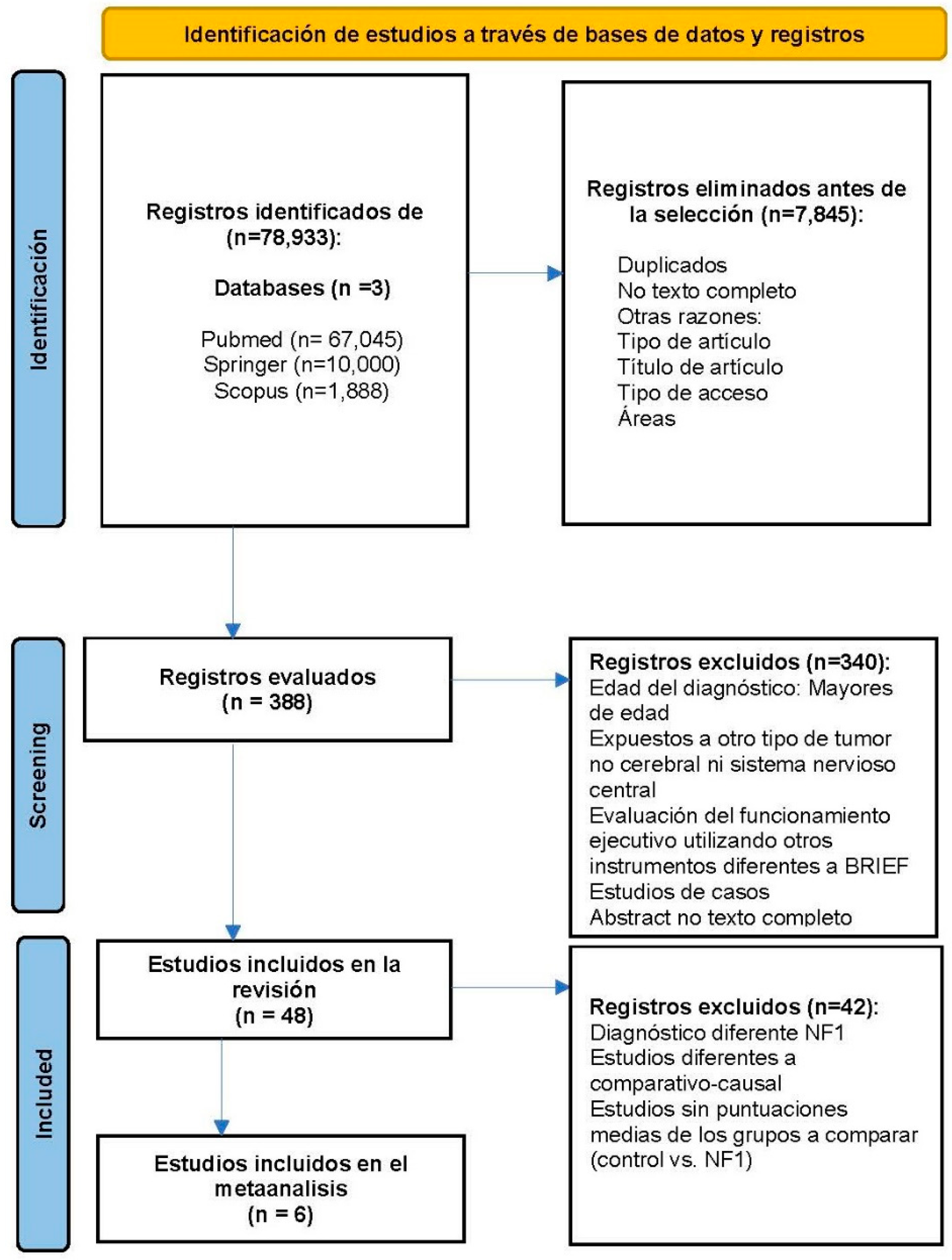
Figure 2.
Forest plot (clinical scales and BRIEF indices).
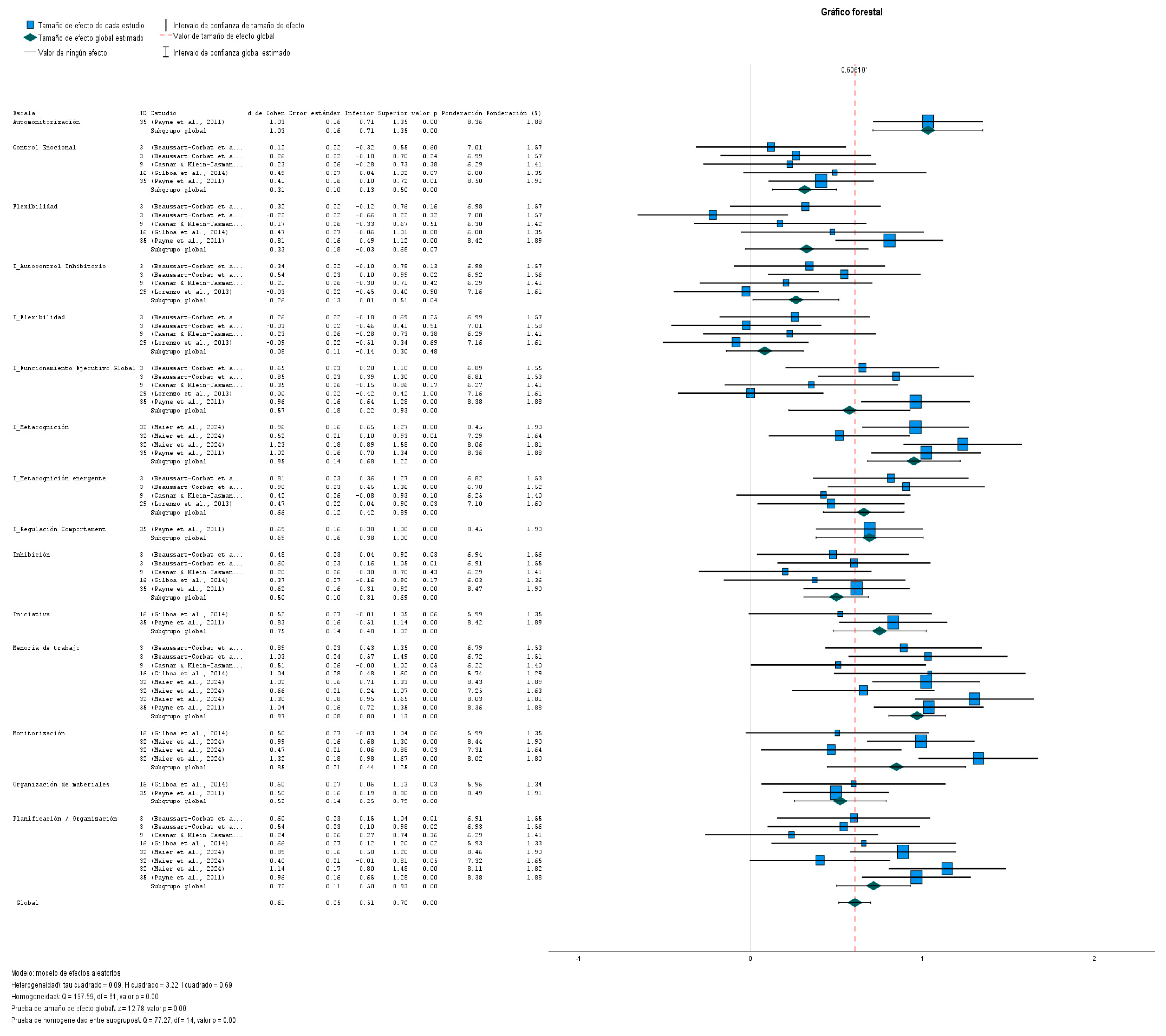
Table 1.
Inclusion and exclusion criteria for review studies.
| Inclusion | Exclusion |
| Age at diagnosis: Individuals under 18 years of both sexes | Age at diagnosis: Adults |
| Exposed to a brain tumor in pediatric age and/or exposed to oncological treatments during the fetal period | Exposed to other types of tumors not related to the brain or central nervous system |
| Evaluation of executive functioning using the BRIEF scales in their different versions and translations | Evaluation of executive functioning using other instruments |
| Ex post facto studies (descriptive, comparative-causal) | Case studies |
Table 2.
Risk assessment of the included studies using the Newcastle-Ottawa Quality Assessment Scale.
Table 2.
Risk assessment of the included studies using the Newcastle-Ottawa Quality Assessment Scale.
| Study | Type of study | Dimensions | Total | Risk | |||||||
| 1 | 2 | 3 | 4 | 5 | 6 | 7 | 8 | ||||
| 3 | Comparative-causal | 1 | 1 | 1 | 1 | 1 | 1 | 1 | 1 | 8 | Low |
| 9 | Comparative-causal | 1 | 1 | 1 | 1 | 1 | 1 | 1 | 1 | 8 | Low |
| 16 | Comparative-causal | 1 | 1 | 1 | 1 | 1 | 1 | 1 | 1 | 8 | Low |
| 29 | Comparative-causal | 1 | 1 | 1 | 1 | 1 | 2 | 1 | 1 | 9 | Low |
| 32 | Comparative-causal | 1 | 1 | 2 | 1 | 1 | 1 | 1 | 1 | 9 | Low |
| 35 | Comparative-causal | 1 | 1 | 1 | 1 | 1 | 2 | 1 | 1 | 9 | Low |
Table 3.
Effect size estimates.
| Clinical scales / Indixes / Informants | Effect size | Standard error | Z | Sig. (two-tailed) | 95% Confidence interval | 95% Prediction interval | ||||
| Lower | Upper | Lower | Upper | |||||||
| Clinical scales / Indixes | Automonitorizacióna | 1.031 | .1628 | 6.329 | <.001 | .712 | 1.350 | . | . | |
| Control Emocional | .314 | .0955 | 3.290 | .001 | .127 | .501 | .010 | .618 | ||
| Flexibilidad | .325 | .1825 | 1.783 | .075 | -.032 | .683 | -.901 | 1.552 | ||
| I_Autocontrol Inhibitorio | .264 | .1275 | 2.066 | .039 | .014 | .514 | -.464 | .992 | ||
| I_Flexibilidad | .081 | .1141 | .710 | .478 | -.143 | .305 | -.410 | .572 | ||
| I_Funcionamiento Ejecutivo Global | .575 | .1799 | 3.195 | .001 | .222 | .927 | -.642 | 1.792 | ||
| I_Metacognición | .949 | .1368 | 6.938 | <.001 | .681 | 1.218 | -.127 | 2.026 | ||
| I_Metacognición emergente | .658 | .1201 | 5.474 | <.001 | .422 | .893 | .092 | 1.223 | ||
| I_Regulación Comportamenta | .691 | .1588 | 4.353 | <.001 | .380 | 1.002 | . | . | ||
| Inhibición | .498 | .0962 | 5.180 | <.001 | .310 | .687 | .192 | .805 | ||
| Iniciativa | .750 | .1380 | 5.430 | <.001 | .479 | 1.020 | . | . | ||
| Memoria de trabajo | .968 | .0841 | 11.501 | .000 | .803 | 1.132 | .614 | 1.321 | ||
| Monitorización | .848 | .2057 | 4.121 | <.001 | .444 | 1.251 | -.925 | 2.621 | ||
| Organización de materiales | .521 | .1362 | 3.823 | <.001 | .254 | .788 | . | . | ||
| Planificación / Organización | .715 | .1092 | 6.548 | <.001 | .501 | .929 | .095 | 1.335 | ||
| Informants | Padres | .625 | .0501 | 12.484 | .000 | .527 | .724 | .022 | 1.229 | |
| Profesores | .494 | .1410 | 3.503 | <.001 | .218 | .771 | -.412 | 1.401 | ||
| Versions | BRIEF | .815 | .0511 | 15.959 | .000 | .715 | .915 | .375 | 1.255 | |
| BRIEF-P | .381 | .0577 | 6.595 | <.001 | .268 | .494 | -.085 | .847 | ||
| Global | .606 | .0474 | 12.783 | .000 | .513 | .699 | -.012 | 1.224 | ||
| a. It is based on the t-distribution | ||||||||||
Table 4.
Homogeneity test and heterogeneity test.
| Test of homogeneity | Test of heterogeneity | |||||
| Chi-squared (Q statistic) | gl | Sig. | Tau square | H square | I square (%) | |
| Self-monitoring a | . | . | . | . | . | . |
| Emotional control | 1.731 | 4 | .785 | 0.000 | 1.000 | 0.0 |
| Flexibility | 15.193 | 4 | .004 | 0.115 | 3.378 | 70.4 |
| Index Inhibitory self-control | 3.526 | 3 | .317 | 0.012 | 1.234 | 19.0 |
| Index Flexibility | 1.770 | 3 | .621 | 0.000 | 1.000 | 0.0 |
| Index Global executive functioning | 14.681 | 4 | .005 | 0.114 | 3.481 | 71.3 |
| Index Metacognition | 7.067 | 3 | .070 | 0.044 | 2.436 | 58.9 |
| Index Emergent metacognition | 3.160 | 3 | .368 | 0.003 | 1.052 | 5.0 |
| Index Behavioral regulation a | . | . | . | . | . | . |
| Inhibition | 2.322 | 4 | .677 | 0.000 | 1.000 | 0.0 |
| Initiative | .949 | 1 | .330 | 0.000 | 1.000 | 0.0 |
| Working memory | 9.341 | 7 | .229 | 0.014 | 1.328 | 24.7 |
| Monitoring | 12.385 | 3 | .006 | 0.128 | 4.280 | 76.6 |
| Materials organization | .107 | 1 | .744 | 0.000 | 1.000 | 0.0 |
| Planning / Organization | 15.706 | 7 | .028 | 0.052 | 2.287 | 56.3 |
| Parents | 163.862 | 52 | <.001 | 0.088 | 3.163 | 68.4 |
| Teachers | 27.631 | 8 | <.001 | 0.127 | 3.451 | 71.0 |
| BRIEF | 67.367 | 30 | <.001 | 0.044 | 2.281 | 56.2 |
| BRIEF-P | 56.560 | 30 | .002 | 0.049 | 1.893 | 47.2 |
| Global | 197.594 | 61 | <.001 | 0.093 | 3.223 | 69.0 |
Disclaimer/Publisher’s Note: The statements, opinions and data contained in all publications are solely those of the individual author(s) and contributor(s) and not of MDPI and/or the editor(s). MDPI and/or the editor(s) disclaim responsibility for any injury to people or property resulting from any ideas, methods, instructions or products referred to in the content. |
© 2025 by the authors. Licensee MDPI, Basel, Switzerland. This article is an open access article distributed under the terms and conditions of the Creative Commons Attribution (CC BY) license (http://creativecommons.org/licenses/by/4.0/).
Copyright: This open access article is published under a Creative Commons CC BY 4.0 license, which permit the free download, distribution, and reuse, provided that the author and preprint are cited in any reuse.


