

Submitted:
20 July 2025
Posted:
21 July 2025
You are already at the latest version
Abstract
The aim of this study is to examine the role and importance of certain promotional policies in supporting the image of Greek public museums with direct consequences on their visibility and attractiveness at national and global level. It also examines whether the implementation of these policies is directly related to both the dynamics of the museums and the geographical location in which they are located. In particular, emphasis was given to the comparative analysis of the degree of adoption of promotion policies between museums located in the major urban centers of Greece (Athens and Thessaloniki) and those located in the Greek periphery. For these purposes, questionnaires were handed out to museum directors and managers in Greece (national and regional). In a total of 173 public museums and archaeological sites (also having a museum) in the country, 114 questionnaires were sent out, covering 66% of the surveyed reference population. A hundred (100) valid questionnaires were collected (response rate: 88%), covering 58% of the public museums in Greece and in particular 25 museums and archaeological sites of national importance and 75 of regional/local importance. Data were analyzed by using Exploratory and Confirmatory Factor Analyses, Structural Equation modelling techniques as well as Parametric tests (T-tests). The results highlight the importance of external orientation, strategic digital engagement, and visibility through networks over traditional marketing tactics. Furthermore, the findings reveal that museums in urban areas consistently demonstrate higher levels of awareness as well as greater adoption of modern and extroverted marketing strategies, indicating that they can be key drivers of urban tourism development, reshaping the way cities develop.
Keywords:
Public museums
; Cultural image
; Policies
; Regional development
; Greece
; Empirical research
1. Introduction: Museums and Cities
Nearly, three decades ago, Ginsburgh and Mairesse [1] (1997) explored how museums are defined. They examined definitions from major organizations like the International Council of Museums (ICOM), the Museums Association in the United Kingdom, and the American Association of Museums. Despite differences in wording, their analysis concludes to a common point. More particularly, what sets museums apart from other institutions is the character of their activities – especially conservation, research and communication. Museums, as institutions, also play a vital role in interpreting and presenting the material culture of particular societies [2,3,4,5,6,7]. Almost twenty years ago, Van Aalst and Boogaats [8] noted that as museums undergo a process of repositioning, simultaneously there is a shift in their function. Their traditional core functions (conservation, research and restoration of the collection) have gradually been deprioritized, while museums have increasingly evolved into spaces focused on exhibitions. The multidimensional character of museums, reflects on the last definition decided to be valid by ICOM in Prague on 24 August 2022. More specifically:
‘The Museum is a non-profit organization, permanently at the service of the society in which it researches, collects, preserves, interprets, and exhibits the tangible and intangible cultural heritage. Open to the public, accessible and inclusive, museums support diversity and sustainability. They operate and communicate ethically, professionally and with the participation of communities, providing diverse experiences for education, entertainment, reflection, and knowledge dissemination’ [9]
As a result, the internal nature of museums as institutions and as ‘distinctive environments’, or ‘productive organizations’ became increasingly complex since the 1990s [10]. This complexity was partially attributed to the incorporation of a commercial function within their operation [11,12]. Additionally, their evolving role in the cultural and economic development of cities required a more focused and nuanced examination [13,14,15,16]. For example, Tufts and Milne [17], argued that the economic impacts of museums in local economy extends beyond visitors’ numbers. Over the years, several studies have highlighted the vital role of museums and heritage sites in generating income and stimulating local economies through cultural content [18,19,20,21,22]. To be more particular, supporting local businesses, attracting tourists, creating employment opportunities for locals and encouraging new enterprises and residents to settle in the area were among the economic benefits that museums and heritage sites offer to urban areas [23].
It was in the mid-1970s when the museum development began, and it was expressed by a significant focus among many European cities on building new museums and expanding existing ones [24]. Kotler et al., [25] referred to this phenomenon as “museum mega-wave” which was influenced by place competition and the efforts to enhance urban attractiveness through cultural investment. Contrary to the perception of museums as isolated or underused components of the urban economy, several examples highlight their integration into broader clusters of entertainment and cultural activities. In that way, these clusters have not only contributed to rising visitors’ numbers but have also played a role in neighbourhood revitalization and the emergence of new businesses [26]. A typical example of a museum cluster is found in the Unites States, in the Penn Quarter of Washington D.C., where it serves as a hub of economic and cultural prosperity [26,27]. This case suggest that museum investment is not merely symbolic, but also play a significant role in urban revitalization strategies. Another characteristic example that demonstrates the strong potential of museums to drive local economic growth is the Museum of New Zealand’s Te Papa Tongarewa, which attracted over two million visitors in its first year [28].
There are more cases highlighting the vital role museums play in shaping urban cultural identity and offer tourism development opportunities, especially in the last decade. For instance, a key element in Rotterdam’s strategic plan to become the “European City of Culture” in 2020 was how to leverage the city’s traditional museums in order to enhance its urban tourism offering [29]. Similarly, the Guggenheim Museum in Bilbao gained great attention as a powerful catalyst for urban regeneration and tourism development, giving rise to the well-know “Bilbao effect” [30,31,32,33,34]. In Bradford, the National Museum of Photography Film and Television, the Colour Museum and the National Millennium Heritage Center offered a tourism zone just outside the city center [35]. Berlin also invested in its museum-driven urban transition. This transition included the redevelopment of the Hamburger Bahnhof into a contemporary art museum, the establishment of a new Jewish Museum, and the enhancement of the German Historical Museum [36]. From this perspective, it has been examined the boarder role that museums play in urban revitalization in regeneration efforts across the UK and Europe [37,38]. In addition, recent studies have emphasized the positive impact of museums in advancing the sustainable development goals [39,40,41,42,43,44].
In the Greek context, which is the focus of this study, the role of public museums—particularly archaeological museums—has long been difficult to define. For decades, these institutions have primarily been associated with a traditional mission of preservation and custodianship of cultural heritage [45]. However, more recently, they are increasingly expected to adapt to a flexible and market-oriented role, functioning as cultural products within the dynamics of the global economy [46].
In addition, being entrusted with the preservation and promotion of the national cultural heritage, museums accumulate and activate social authority, by providing interpretative suggestions on their collections, narratives that are employed communicatively in the social framework they function. The interpretive and operational role they adopt confirms their institutional character and ensures their survival [47].
This transition from a “traditional” to a “modern” museum model is particularly evident in the growing importance of digital technologies, visual communication, and social media. While such tools have long been integrated into museum practices across Europe and globally, it is only within the past decade that these developments have begun to significantly influence the Greek cultural and museum sector [48,49,50,51,52,53]. This evolution underscores the pressing need for adaptation to the new digital and communicative realities shaping the contemporary museum landscape.
The cases above constitute successful examples of museums contribution on places’ economic and cultural development. Of course, some very important questions arise concerning the adoption and the planning of marketing and promotional policies.
In line with the aims of the present research, this article investigates the marketing and promotional policies adopted by public museums. To this end, it draws on primary empirical data collected from museum executives (including directors, managers, and administrators) across 100 public museums in Greece—a country renowned for its cultural legacy and historical heritage. In particular, Section 2 introduces the conceptual framework of museum marketing and the role of promotional policies. Section 3 reviews key findings from previous studies, while Section 4 outlines the principal marketing strategies examined. Section 5 and Section 6 describe the methodology and present the empirical findings, followed by discussion and interpretation. The article concludes by drawing together the main outcomes of the quantitative analysis and reflecting on their implications for cultural policy and museum management.
2. Marketing Museums and the Role of Promotional Policies
A huge number of studies especially the last decades, award the contribution of marketing to museums. The main hypothesis is that museums are ‘goods’, which are applied to specific potential target markets, contributing to urban cultural and economic development, as well as, to the satisfaction of the needs, demands and perceptions of the target markets [54,55,56,57,58]. Kotler and Andreasen [59], Rentschler and Hede [60] and Heroux and Csipak [61], define marketing strategy for non-profit organisations, including museums, so that it is customer focused, with appropriate orientation towards the marketplace. Museums were no exception to the implementation of modern marketing strategies. Tobelem [62] identifies four main factors on museums marketing: the growth of museums, the financial constraints, the increased competition among museums, and the necessity to deeper understanding of visitors’ behavior. He claimed that each of these factors influences specific strategies and approaches within the museum’s marketing plan, which is designed to meet the goals of the museums within the boarder micro- and macro-economic context of a given period.
Marketing is a powerful tool for organizations; however, it can have negative impacts if it is not focused properly to the actual needs and perceptions of target markets [63,64]. For a marketing plan to be considered successful, it is necessary to analyze both the museums’ internal and external environments. This process involves the identification of institutional strengths and weaknesses, as well as the recognition of opportunities and threats within an increasingly competitive cultural environment. Importantly, the adoption of marketing strategies in museums does not imply a dilution of their historical or cultural significance, nor does it compromise the traditional cultural identity of the urban context in which they operate. In contrast, as Kotler and Kotler [65] argued in their ‘market repositioning strategy’, the repositioning of a museum should not exclude but to be centered on meeting the needs of the community and playing an active role in its development. In that way, museums can enhance their appeal and make more substantial contribution to urban development.
However, to transform the traditional character of a museum or to adopt and alternative model for it is not a straightforward task. This process requires a deep understanding of the role that the museum has for the city and the significance it holds for its target markets. Museums serve several functions. Among its fundamental roles is to collect and preserve objects, but their boarder cultural function extends to serving as a symbol of community pride and as an institution that contributes to the civil and cultural development of society [66]. As previously mentioned, museums have long been defined by their traditional roles - conservation, research and communication - as unique institutions offering distinctive cultural goods. At the same time, their commercial function has become increasingly prominent, as cities often use museums as strategic assets to enhance their attractiveness. Among the main advantages of the commercialization of arts and culture is that allows cultural institutions, such as museums, to strengthen their competitive profile relative to other sectors by effectively utilizing marketing and management tools [67]. The role and significance of museums in the context of urban development have undergone a substantial transformation over time. Today, each museum is recognized as possessing distinct value—not only for its visitors, but also for the local community and for the institution itself, as it contributes to cultural vitality, education, and social cohesion. Withing this redefined perspective on the role of museums, effective promotion strategies have become essential. In Scotland, several museums have taken adopted this modern approach and developed their management and marketing strategies in order to elevate their public presence. The main characteristic of these initiatives is their focus on understanding the needs of their audience and enhancing the quality and efficiency of the services they provide. Exhibit-related information, publications, academic research, donation programs and a variety of educational initiatives are among the modern services that have been provided by museums [68]. Furthermore, several cases around the world have adopted notable marketing strategies. These include the Quai Branly Museum in Australia [69], the Vietnam Museum of Ethnology [70] or the Virginia Museum of Fine Arts, and the Boston’s Museum of Science (both in USA) [65]. These examples highlight not only the essential role of marketing strategic planning in enhancing the development and attractiveness of museums, but also the importance of effectively implementing these strategies in contributing to the broader economic development of the regions in which the museums operate.
3. Some Previous Studies in Brief
Several studies examine the promotion policies of museum’s image. For instance, Johnson and Thomas [10] and Deffner and Metaxas [15] supported that videos, tapes, and publications based on the museum’s collections can reach a far wider audience than is possible via the turnstiles. There are also, studies that related with the planning and the implementation of strategies and policies through museums development. Tufts and Milne [17], drawing on data from 26 museums and 61 interviews, examined the significance of the supply-side operational context in 1990s Montreal, with particular emphasis on the evolving role of cultural institutions in urban economic development. Similarly, Jansen-Verbeke and van Rekom [29] conducted a qualitative study exploring the relationship between the ‘cultural tourist’ and the ‘museum visitor’, as an initial step in assessing the potential of the ‘museum park strategy’ within the framework of urban tourism development policy in the case of Amsterdam. Pusa [71] used semi-structured interviews of managers of the Museum of Contemporary Art Kiasma, the Espoo Museum of Modern Art (EMMA) and the Didrichsen Art Museum, in Finland, in order to describe and analyze the branding processes in practice as well as the components of the museum brand in three art museums. In addition, Munk [72], with questionnaires, has evaluated future policies, considerations, projects and vision, in the case of the Terezin Memorial, Czech Republic. Furthermore, Mejon et al., [73] using questionnaires to managers of 133 museums in the Autonomy Community in Catalonia, determine to which cultural institutions perform marketing policies. Lehman and Roach [74] explores the strategic role of electronic marketing in the Australian museum sector, using a qualitative approach, while Cole [56] considers the contribution that marketing can make to museum survival strategies and, in particular, the application of marketing tools to mining heritage museums. Vicente et al., [75] examine the role of innovation regarding visitors experience through the use of questionnaires in 408 museums in Britain, France, Italy and Spain. Finally, Luscombe et al. [76], drawing on findings from a five-year qualitative study of penal history museums across Canada, examine how such institutions seek to attract visitors and generate revenue in order to sustain their operations within an increasingly competitive cultural landscape.
Regarding Greece, scientific empirical studies are limited but it’s important to mention some of them that took place in Greece over the last years. For instance, Apostolakis and Jaffry [77] used discrete choice modeling methodology in order to examine consumers’ preferences regarding heritage attractions in the island of Crete. At the same way, and using primary data, Mavragani [78] investigates the level of tourist satisfaction and its relationship to both intention to recommend and future revisit behavior, based on empirical data from five museums located in urban areas of Greece. Polyzos et al., [79] measuring the attractiveness of the archaeological sites, historical monuments and museums of Greek prefectures and using statistical analysis and data from NSSG, concluded that cultural resources do influence the tourist development in a positive way. In addition, Deffner et al., [80], using primary data, pinpointed the role and importance of the Tobacco Museum of Kavala city and its contribution to the enforcement of the image and development of the city, while recently, Goulaptsi and Tsourvakas [81] examines the way that small regional museums have managed to adopt strategic managerial methods in order to face economic crisis. Similarly, the last years there are a number of scientific efforts to identify the ways and the means of cultural heritage management of Greek museums [82,83,84].
The role of partnership development is crucial in cultural tourism area [85,86]. Museums establish short or long-term relationships with individuals, organizations, governments and businesses that contribute to the museum and, at the same time, provide some benefit to their partners [87,88]. The details of these relationships vary, from direct financial or in-kind contributions in return for advertising or promotional opportunities, to cooperative ventures with other museums or community organizations. In all of these collaborative efforts, it is clear to be said that museums cannot operate in isolation and must rely on partners and allies if they like to achieve their goals [88]. Partnership with other museums that share similar interests can be particularly valuable, enabling the exchange of exhibitions, ideas, and even artifacts. In addition, a partnership between two or more museums can focus on joint marketing strategies, the sharing of personnel or specialized knowledge, and co-production of exhibitions [88]. Therefore, it is essential for a museum to be an active member of national and regional cultural associations. By participating in such association, museums contribute to collective efforts in areas such as such as advocacy, standards development and policy influence. In return, they benefit from increased representation, access to funding opportunities and advocacy information, as well as professional development and networking through conferences, workshops and training sessions.
Taking into account the main interest in policies promoting the image of museums in the formulation of strategies and policies, this research focuses on the Greek reality by examining the role and importance of certain promotion policies in supporting the image of 100 public Greek museums and archaeological sites with direct consequences on their degree of recognition. It also examines whether the implementation of such policies is associated with the operational capacity of each museum, as well as its geographic location within the country. This study offers an innovative contribution, as empirical research on the marketing practices of public museums, particularly within the Greek context, remains limited. Its findings shed light on critical dimensions of national cultural policy, with particular emphasis on the evolving role of public museums as strategic actors in cultural and urban development and visibility.
4. The Studied Marketing (Promotional) Policies
This study uses seventeen (17) promotional policies in order to evaluate which of them public museums in Greece pay particular attention. Our analysis includes specific promotional policies such as representation on cultural magazines and cultural-tourism guides [89], public relations plan [90], the creation of a brand museum image [91,92] or planning and organising cultural events [93,94,95] etc. Through the examination of these policies, the study seeks to assess the extent to which museums actively promote their institutional image within their external environment, their orientation toward the development and implementation of structured marketing and public relations plans, as well as the degree of their collaboration with local stakeholders and their connection with cultural organizations at the European level. These specific marketing policies are outlined in Table 1.
5. Methodology
5.1. Research Questions and Hypotheses
To investigate the relationship between marketing strategies and the visibility of public museums, this study formulates a set of research questions and corresponding hypotheses, grounded in the relevant literature on public sector marketing that was presented above. More specifically, three main research questions were developed:
Research Question 1 (RQ1):To what extent do different types of marketing strategies adopted by public museums in Greece influence their national visibility?
Research Question 2 (RQ2):How does national visibility influence the international awareness of public museums?
Research Question 3 (RQ3):Are there significant differences in marketing practices and levels of awareness between urban and regional museums?
The first research question aims to determine which strategic marketing approaches are most effective in enhancing recognition and awareness within the national context, whereas the second explores the mediating role of national awareness in achieving broader international recognition. Lastly, the third research question investigates the extent to which museum location (urban vs. regional) affects the adoption of marketing strategies and institutional visibility. RQ1 and RQ2 are designed to test theoretically derived, directional hypotheses using Structural Equation Modeling (SEM), while the third question (RQ3) explores group differences using Independent Samples T-tests. Therefore, from the two first research questions the following research hypotheses are derived:
| Research Questions | Hypotheses |
| To what extent do different types of marketing strategies adopted by public museums in Greece influence their national visibility? (RQ1) |
H2: Digital and Destination-Oriented Marketing (DDOM) has a positive effect on National Awareness. H3: Institutional Extroversion and International Outreach (IEIO) has a positive effect on National Awareness. H4: Museum Promotion and Brand Visibility (MBV) has a positive effect on National Awareness. |
| How does national visibility influence the international awareness of public museums? (RQ2) | H1: National Awareness has a positive effect on International Awareness. |
5.2. Research Process
A quantitative approach was used. In particular, questionnaires were handed out to museum directors and managers in Greece (national and regional). In a total of 173 public museums and archaeological sites (also having a museum) in the country, 114 questionnaires were sent out, covering 66% of the surveyed reference population. A hundred (100) valid questionnaires were collected (response rate: 88%), covering 58% of the public museums in Greece and in particular 25 museums and archaeological sites of national importance located in major urban centers—Athens, Thessaloniki, and Heraklion- and 75 of regional/local importance distributed across the broader Greek periphery.
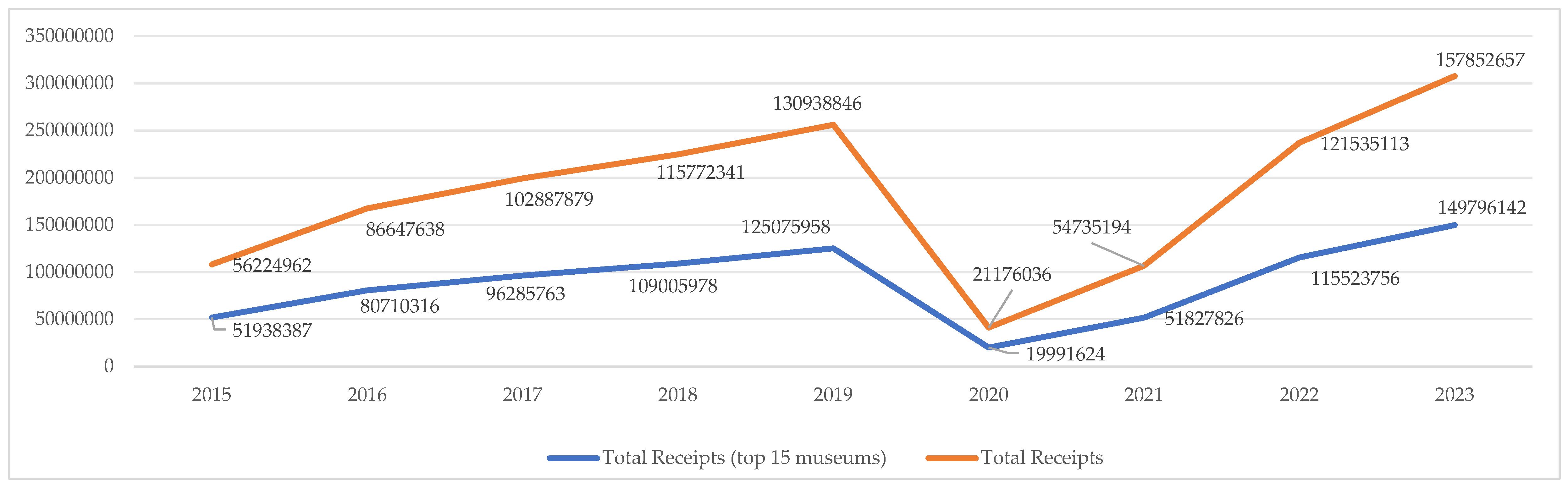
Table 2 presents the top 15 museums and archaeological sites in terms of visitor numbers and revenues, along with the regions in which they are located. Figure A1 and Figure A2 in Appendix A illustrate the visitor and revenue data of these top 15 institutions in comparison to the total figures for all public museums in Greece during the period 2015–2023. These 15 museums accounted for 90.5% of total public museum visits and 94.8% of total public museum revenue in Greece in 2023, clearly reflecting their disproportionate impact within the national cultural landscape. Their inclusion allows for a deeper understanding of the structural inequalities between urban and regional museums, which is further explored in the comparative analysis.
5.3. Methods of Analysis
Analysis of data was conducted with SPSS v.25, JASP, and the Lavaan package. The “lavaan” package is a statistical analysis package in the R programming language that uses SEM and related techniques. Firstly, exploratory factor analysis (EFA) was employed for classifying the marketing policies applied by museums in certain dimensions according to their orientation. The internal consistency of each dimension in EFA was tested with Cronbach A. Secondly, Confirmatory Factor Analysis (CFA) was used for refining and validating the results of the EFA. In particular, reliability and convergent and discriminant validity were tested. In the third stage, Structural Equation Modeling (SEM) was used. Covariance-based SEM was employed, using the maximum likelihood method (ML) for parameter estimation. Missing data were handled by excluding cases listwise. In the last stage of the analysis Independent T-tests were used for identifying differences between museums located in urban (city) areas and those in regional settings in the dimensions derived from EFA and CFA analyses.
6. Analysis
6.1. Exploratory Factor Analysis (EFA)
At the first stage of the analysis, EFA was conducted using the Varimax rotation with the principal component approach (see Table 3). From the EFA analysis three key factors were derived, namely F1: Museum Promotion and Brand visibility, F2: Institutional Extroversion and International Outreach, and F3: Digital and Destination-Oriented Marketing. In particular, F1 includes three sub factors and reflects the strategic efforts of public museums to enhance their institutional image and public presence. F2 includes seven subfactors and reflects the proactive orientation of public museums toward building external visibility and establishing strategic relationships beyond their immediate local context. The term “institutional extroversion” denotes a broader organizational disposition toward outward-facing initiatives, such as cross-border partnerships, international cultural programming, and educational outreach activities. Lastly, F3 includes also three subfactors and reflects the dual emphasis on modern digital promotion tools and strategic alignment with tourism stakeholders. This naming captures the hybrid nature of the factor, which combines technology-driven outreach with place-based promotional strategies, consistent with recent trends in cultural tourism and museum marketing bibliography. KMO value was 0.876, and Bartlett’s Test of Sphericity was statistically significant at 0.000, revealing the suitability of the data for factor analysis [125,126].
6.2. Confirmatory Factor Analysis
CFA was used for testing the validity of EFA, following the paradigm of Lance and Vandenberg [127] who state that CFA is a statistical technique used to test the hypothesized factor structure of a set of observed variables. It is often used after conducting EFA to validate and confirm the factor structure identified in the exploratory phase. Table 4 shows the final measurement model where one factor was removed from the dimension of Institutional Extroversion and International Outreach. Overall, the final measurement model met the criteria mentioned by Hair et al. [128], namely: CFI = 0.957, TLI = 0.945, NFI = 0.940, and GFI = 0.976. In addition, root mean square error of approximation (RMSEA), and standardized root mean square residual (SRMR) were less than 0.08 in both cases (0.071 and 0.058, respectively), following the criteria mentioned by Hooper et al. [129]. Furthermore, composite reliability (CR) in all cases was larger than 0.60, meeting the criterion of Fornell and Larker [130]. The standardized factor loadings ranged from 0.438 to 0.996, with the majority exceeding the recommended threshold of 0.50. In the same length, convergent validity was established since average variance extracted (AVE) was greater than 0.5. Finally, discriminant validity was also ensured since the roots of AVE were greater than the correlations among dimensions (Table 5). Therefore, from the transition from EFA to CFA, the item “Participation in European Cultural Programmes” was excluded from the final model, since its contribution in the CFA phase was limited. Its removal contributed to improved model parsimony and enhanced overall fit, without compromising the integrity of the underlying factor structure.
6.3. Structural Model
To test the hypothesized relationships between the latent constructs, Structural Equation Modeling (SEM) was conducted using the validated measurement model from the prior CFA stage. Figure 1 shows the results of the structural model. In particular, goodness-of-fit criteria revealed that overall, the model had a good fit in the data: CFI = 0.951, TLI=0.937, NNFI = 0.937, GFI = 0.989. Although the RMSEA value slightly exceeds the ideal threshold of 0.08, the combination of high CFI, TLI, and low SRMR supports the adequacy of the model [128]. Table 6 shows the results of the structural relationships. As shown below, the impact of National awareness on International awareness was statistically significant (β = 0.924, p < 0.001), indicating that enhanced national-level awareness of public museums substantially contributes to the development of their international profile. This finding highlights the mediating role of national visibility in global positioning strategies. H2 was also statistically significant (β = 0.455, p < 0.034), suggesting that integrated digital promotion and collaborations with tourism stakeholders contribute meaningfully to public recognition at the national level. Similarly, a very strong and highly significant association was found between Institutional Extroversion and International Outreach (IEIO) and National Awareness (β = 0.900, p < 0.001), confirming that outward-facing actions, international partnerships, and cultural networking directly reinforce domestic visibility of museums. Lastly, the relationship between Museum Promotion and Brand Visibility (MBV) and National Awareness was not statistically significant (β = -0.076, p = 0.0691), indicating that traditional promotional tools and internal branding efforts alone do not significantly drive national recognition in the current context.
6.4. Independent T-Tests
In the last phase of the analysis, Independent T-tests were conducted to identify differences between museums located in urban (city) areas and those in regional settings in the discussed dimensions. As shown in Table 7, statistically significant differences (p < 0.001) were identified across all measured dimensions. More specifically, City-based museums reported higher levels of national awareness (M = 6.44, SD = 0.92) compared to their regional counterparts (M = 3.99, SD = 1.42), (p < 0.001). Similarly, urban museums exhibited greater visibility at both the European (M = 5.64 vs. 2.45) and international levels (M = 5.00 vs. 1.92), indicating a strong disparity in reach and positioning. In terms of strategic practices, urban museums scored significantly higher in all dimensions as well: Museum Promotion and Brand Visibility (M = 5.88 vs. 5.12, p < 0.001), Digital and Destination-Oriented Marketing (M = 6.31 vs. 5.41, p < 0.001), and Institutional Extroversion and International Outreach (M = 6.10 vs. 4.27, p < 0.001). These findings reveal a consistent pattern: urban museums appear better resourced, more strategically integrated, and more externally connected than their regional counterparts. The differences suggest a structural imbalance that may be linked to differences in access to funding, institutional capacity, digital infrastructure, and proximity to policy-making hubs or tourism clusters.
7. Discussion
This study examined the structural relationships between key marketing strategies adopted by public museums, located in urban and regional areas, in Greece and their influence on national and international awareness. First of all, it was found that Institutional Extroversion and International Outreach (IEIO) affects directly and positively awareness of Museums in a national basis. This fact highlights the crucial role that proactive external engagement plays in building visibility. This engagement is reflected in practices that were also mentioned in previous empirical studies such as development of partnerships with foreign museums [97,98,99], international cultural organizations and research centers [100,101,102], participate in international fairs and exhibitions [80,104], achieve visibility through inclusion in international cultural publications, and use coupons, school trips & brochures. Therefore, visibility, networking and legitimacy are increasingly earned through participation in global cultural ecosystems rather than through local promotional efforts alone.
Moreover, it was found that National Awareness is also formulated by Digital and Destination-Oriented Marketing (DDOM), reinforcing the idea that effective museum marketing today must be technologically integrated and tourism-aware. This was also supported by Johanson and Olsen [96]; Deffner et al., [80], Frey [102], Howe [105], Schouten [101], and Halsall [106]. In this context, practices such as promotions via social media and local authorities as well as develop partnerships with tourism agencies gain growing importance. It seems that digital media not only extends reach but enables museums to align themselves with national destination branding strategies, thereby enhancing their visibility beyond traditional cultural audiences.
On the other hand, National awareness is not associated directly with Museum Promotion and Brand Visibility. Probably branding should be built in later stages, ensuring first Institutional Extroversion and International Outreach and Digital and Destination-Oriented Marketing. Traditional branding may no longer be sufficient to establish strong national recognition. One plausible explanation lies in the saturation and fragmentation of media landscapes, which limit the effectiveness of conventional promotion unless complemented by broader strategic partnerships and experiential engagement. This finding challenges conventional marketing paradigms in the cultural sector and calls for a shift toward more relational, experiential, and digitally enabled models of audience development.
Another important finding was the strong relationship between national recognition and international recognition. Therefore, the analysis indicates that for building international awareness, firstly national visibility should be established. Prior domestic recognition is a prerequisite for international standing, probably echoing theories of institutional isomorphism [131,132]. This means that museums must first cultivate recognition and support from stakeholders at the national level before they can effectively position themselves on the international stage.
Finally, the study underscored significant disparities between urban and regional museums in Greece. In particular, museums in urban areas consistently demonstrate higher levels of awareness—national, European, and international—as well as greater adoption of modern and extroverted marketing strategies. There are two consequences of this reality. First, the majority of the strategies that were included in our framework may consist efficient tools mainly for well-established urban museums, reshaping the overall strategies for promoting the city’s image. On the other hand, there are structural imbalances that could perpetuate inequalities in cultural visibility, access to networks, and institutional growth, reflecting the overall inequalities that exist in Greek economy and society in general [133,134].
8. Limitations and Future Research
While this study provides important insights into the marketing strategies of public museums in Greece, several limitations should be acknowledged. First, the research is context-specific, focusing solely on Greek public museums; therefore, the generalizability of the findings to other cultural or geographic contexts may be limited. Second, the data are cross-sectional in nature, capturing perceptions and practices at a single point in time. As such, the dynamic evolution of marketing strategies and their long-term effects on awareness cannot be fully assessed. Third, there are marketing policies mentioned in the literature that were not mentioned in the current paper. Considering the above, future research could adopt a comparative cross-national approach, examining how marketing policies function across different public museum systems, especially in Southern vs. Northern Europe. Furthermore, and as it is stated by Mandic et al. [135], longitudinal studies would also be valuable to capture the progression and impact of strategic changes over time. Additionally, further investigation into visitor perspectives, including audience segmentation and response to specific marketing tactics, could enrich the understanding of effectiveness from a demand-side perspective. Finally, integrating qualitative methods—such as interviews with museum directors or policy-makers—could offer deeper insights into the institutional logic behind marketing decisions.
9. Conclusions
The aim of this study was to examine the role and importance of certain promotional policies in supporting the image of Greek public museums with direct consequences on their visibility and attractiveness at national and global level. It also examines whether the implementation of these policies is directly related to both the dynamics of the museums and the geographical location in which they are located. Emphasis was given to the comparative analysis of the degree of adoption of promotion policies between museums located in the major urban centers of Greece (Athens and Thessaloniki) and those located in the Greek periphery. The results offer a detailed understanding of how marketing policies work in the specific institutional and cultural environment of Greek public museums. They highlight the importance of external orientation, strategic digital engagement, and visibility through networks over traditional marketing tactics. Furthermore, they propose a new model of cultural marketing that is multi-layered and connects the local, national, and international dimensions of audience building and institutional legitimacy. Lastly, results indicated that museums in urban areas consistently demonstrate higher levels of awareness as well as greater adoption of modern and extroverted marketing strategies, revealing that they can be key drivers of urban tourism development, reshaping the way cities develop.
Author Contributions
“Conceptualization, T.M.; methodology, M.N.D. and G.G; validation, M.N.D. and G.G.; formal analysis, G.G.; investigation, T.M.; data curation, G.G.; writing—original draft preparation, T.M and G.G.; writing—review and editing, T.M.; supervision, T.M.; project administration, T.M.
Funding
“This research received no external funding”.
Acknowledgments
This article is devoted to the memory of Prof. Marie Noëlle Duquenne, an excellent academic teacher and a wonderful friend, partner and person.
Conflicts of Interest
“The authors declare no conflicts of interest.”.
Appendix A
Figure A1 and Figure A2: Number of visitors and receipts in top 15 museums related to all museums (2015-2023)
Figure A1.
Number of visitors and receipts in top 15 museums related to all museums (2015-2023).
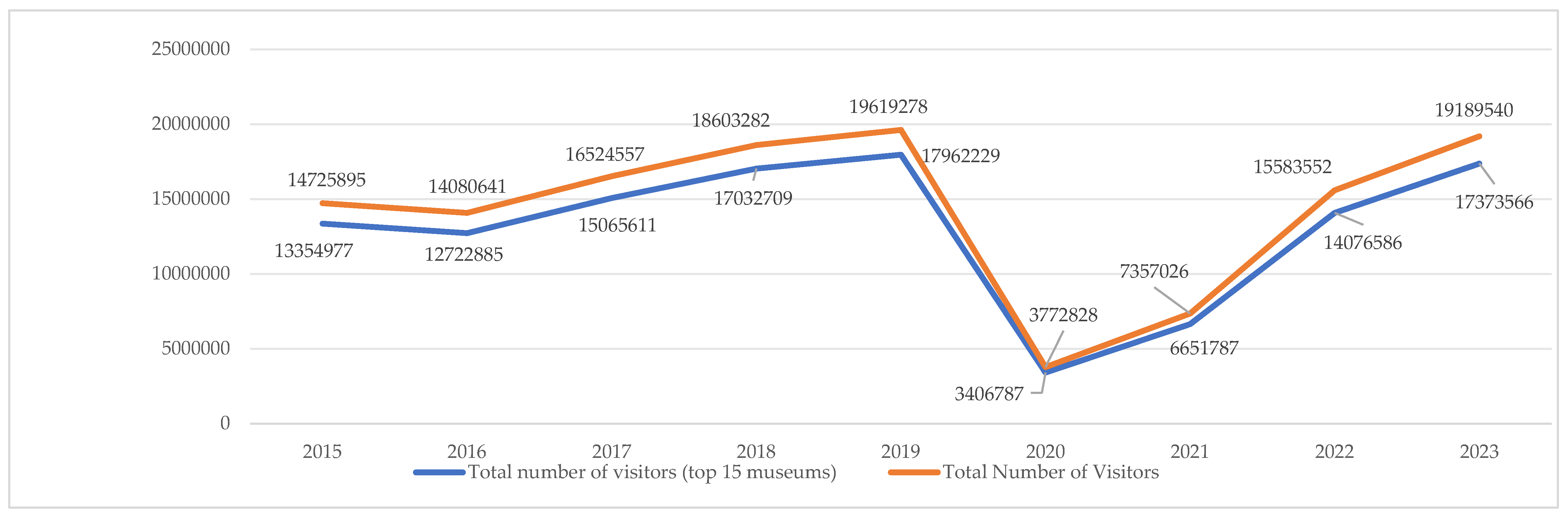
Figure A2.
Number of visitors and receipts in top 15 museums related to all museums (2015-2023). Source: INSETE (2015-2023) https://insete.gr/ [136]- Author/s elaboration.
Figure A2.
Number of visitors and receipts in top 15 museums related to all museums (2015-2023). Source: INSETE (2015-2023) https://insete.gr/ [136]- Author/s elaboration.
References
- Ginsburgh, V. , and Mairesse F. Defining a Museum: Suggestions for an Alternative Approach, Museum Management and Curatorship 1997, 16, 15–33. [Google Scholar] [CrossRef]
- Weil, S.E. , (1990). Rethinking the museum and other Meditations, S: DC.
- Taylor, P. M. Collecting Icons of Power and Identity: Transformation of Indonesian Material Culture in the Museum Context. Cultural Dynamics 1995, 7, 101–124. [Google Scholar] [CrossRef]
- Riegel, H. Into the Heart of Irony: Ethnographic Exhibitions and the Politics of Difference. The Sociological Review 1995, 43 (Suppl. S1), 83–104. [Google Scholar] [CrossRef]
- Ashley, S. State Authority and the Public Sphere: Ideas on the Changing Role of the Museum as a Canadian Social Institution. Museum & Society 2015, 3, 5–17. [Google Scholar] [CrossRef]
- Roberts, P. A. Am I the public I think I am? Understanding the public curriculum of museums as “complicated conversation.” Journal of Museum Education 2006, 31, 105–112. [Google Scholar] [CrossRef]
- Sweetman, R. , Hadfield, A., & O’Connor, A. Material Culture, Museums, and Memory: Experiments in Visitor Recall and Memory. Visitor Studies 2020, 23, 18–45. [Google Scholar] [CrossRef]
- van Aalst, I.; Boogaarts, I. From Museum to Mass Entertainment: The Evolution of the Role of Museums in Cities. Eur. Urban Reg. Stud. 2002, 9, 195–209. [Google Scholar] [CrossRef]
- ICOM. Final Report of the Extraordinary General Assembly, ICOM Approves a New Museum Definition. Prague, Czech Republic, 24 August 2022. Available online: https://icom.museum/wp-content/uploads/2022/07/EN_EGA2022_MuseumDefinition_WDoc_Final-2.pdf (accessed on 30 May 2024).
- Johnson, P. , & Thomas, B. The Economics of Museums: A Research Perspective. Journal of Cultural Economics 1998, 22, 75–85. [Google Scholar]
- Camarero, C. , & Garrido, M.-J. Improving Museums’ Performance Through Custodial, Sales, and Customer Orientations. Nonprofit and Voluntary Sector Quarterly 2008, 38, 846–868. [Google Scholar] [CrossRef]
- Gilmore, A. and Rentschler, R. Changes in Museum Management: A Custodial or Marketing Emphasis? Journal of Management Development 2002, 21, 745–760. [Google Scholar] [CrossRef]
- Bryan, J. , Munday M., Bevins R. Developing a framework for assessing the socioeconomic impacts of museums: The regional value of the ‘flexible museum’. Urban Studies 2012, 49, 133–151. [Google Scholar] [CrossRef]
- Scott, A.J. Cultural-products industries and urban economic development Prospects for Growth and Market Contestation in Global Context. Urban Aff. Rev. 2004, 39, 461–490. [Google Scholar] [CrossRef]
- Deffner, A. and Metaxas, T. In The Interrelationship of Urban Economic and Cultural Development: The Case of Greek Museums. In Proceedings of the 43rd European Congress of the Regional Science Association (ERSA) University of Jyvaskyla, Jyväskylä, Finland, 27–30 August 2003. [Google Scholar]
- Currid, E. How Art and Culture Happen in New York. J. Am. Plan. Assoc. 2007, 73, 454–467. [Google Scholar] [CrossRef]
- Tufts, S. and Milne, S. Museums: A supply side perspective, Ann. Tour. Res. 1999, 26, 613–631. [Google Scholar] [CrossRef]
- Lehman, A.B. , 92001). ‘Cultural Industry as a development chance for Poland’ paper presented at the Conference organized by the Gdansk Institute for Market Economics, Warsaw, Poland, June 13.
- Bonet, L. 92003). “Cultural tourism,” Chapters, in: Ruth Towse (ed.), A Handbook of Cultural Economics, chapter 23, Edward Elgar Publishing.
- Scott, C. Museums: Impact and value. Cultural Trends 2006, 15, 45–75. [Google Scholar] [CrossRef]
- Selwwod, S. Great Expectations: Museums and Regional Economic Development in England. Curator The Museum Journal 2010, 49, 65–80. [Google Scholar] [CrossRef]
- Brown, K. Museums and Local Development: An Introduction to Museums, Sustainability and Well-being. Museum International 2019, 71, 1–13. [Google Scholar] [CrossRef]
- Kinsey, B. ‘The economic impact of museums and cultural attractions: Another benefit for community’. In Proceedings of the paper presented to the Annual Meeting of the American Association of Museums, Dallas, Texas, 14 May 2002. [Google Scholar]
- McLean, F. Services Marketing: The Case of Museums. Serv. Ind. Journal 1994, 14, 190–203. [Google Scholar] [CrossRef]
- Kotler, P.; Asplund, C.; Rein, I.; Haider, H.D. Marketing Places Europe: Attracting Investments, Industries and Visitors to European Cities, Communities, Regions, and Nations; Financial Times/Prentice Hall: Harlow, ND, USA, 1999. [Google Scholar]
- Fuller, P.F. The changing nature of information work in museums. Journal of the American Society for Information Science and Technology 2007, 58, 97–107. [Google Scholar] [CrossRef]
- Grodach, C. Museums as Urban Catalysts: The Role of Urban Design in Flagship Cultural Development. Journal of Urban Design 2008, 13, 195–212. [Google Scholar] [CrossRef]
- Tramposch, J.W. ‘Te Papa: Reinventing the Museum’. Museum Management and Curatorship 1998, 17, 339–350. [Google Scholar] [CrossRef]
- Jansen-Verbeke, M. and van Rekom, J. ‘Scanning museum visitors’. Annals of Tourism Research 1996, 23, 364–375. [Google Scholar] [CrossRef]
- McNeil, D. ‘McGuggenisation? National identity and globalization in the Basque county’ Political Geography 2000, 19, 473–494. [Google Scholar] [CrossRef]
- Plaza, B. 2000; 27. [CrossRef]
- Plaza, B. The Return on Investment of the Guggenheim Museum Bilbao. International Journal of Urban and Regional Research 2006, 30, 452–467. [Google Scholar] [CrossRef]
- Heidenreich, M. , & Plaza, B. Renewal through culture? The role of museums in the renewal of industrial regions in Europe. European Planning Studies 2015, 23, 1441–1455. [Google Scholar] [CrossRef]
- Plaza, B. , González-Casimiro, P., Moral-Zuazo, P., & Waldron, C. Culture-led city brands as economic engines: theory and empirics. The Annals of Regional Science 2015, 54, 179–196. [Google Scholar] [CrossRef]
- Hope, A.C. and Klemm, S. M. ‘Tourism in difficult areas revisited: the case of Bradford’, Tourism Management 2001, 22, 35–47. [Google Scholar] [CrossRef]
- Cochrane, A. and Jonas, A. ‘Reimagining Berlin: World city, national capital or ordinary place?, European Urban and Regional Studies 1999, 6, 145–164. [Google Scholar] [CrossRef]
- Bailey, C. , Miles, S. and Stark, P. Culture-led urban regeneration and the revitalisation of identities in Newcastle, Gateshead and the North East of England, International Journal of Cultural Policy 2004, 10, 47–65. [Google Scholar] [CrossRef]
- Agustí i P., D. Differences in the location of urban museums and their impact on urban areas. International Journal of Cultural Policy 2013, 20, 471–495. [Google Scholar] [CrossRef]
- Yuqin, D. The Role of Natural History Museums in the Promotion of Sustainable Development. Museum International 2008, 60, 20–28. [Google Scholar] [CrossRef]
- Stylianou-Lambert, T. Gazing from home: Cultural tourism and art museums. Ann. Tour. Res. 2011, 38, 403–421. [Google Scholar] [CrossRef]
- Ernst D, Esche C. and Erbslöh U. The art museum as lab to re-calibrate values towards sustainable development, Journal of Cleaner Production 2016, 135, 1446–1460. [CrossRef]
- Azmat, F. & Ferdous, A., Rentschler, R. & Winston, E. Arts-based initiatives in museums: Creating value for sustainable development. Journal of Business Research 2018, 85, 386–395. [Google Scholar] [CrossRef]
- Pop, I. L. , Borza, A., Buiga, A., Ighian, D., & Toader, R. Achieving Cultural Sustainability in Museums: A Step Toward Sustainable Development. Sustainability 2019, 11, 970. [Google Scholar] [CrossRef]
- Wang, S. , Duan Y. , Yang X., Cao C. and Pan S. ‘Smart Museum’ in China: From technology labs to sustainable knowledgescapes, Digital Scholarship in the Humanities 2023, 38, 1340–1358. [Google Scholar] [CrossRef]
- Konsola, D. Cultural Politics and Development; Papazisis: Athens, Greece, 2006. (In Greek) [Google Scholar]
- Lazarinis, F.; Kanellopoulos, D.; Lalos, P. Heuristically Evaluating Greek e-Tourism and e-Museum Websites. Electron. J. Inf. Syst. Eval. 2008, 11, 17–26. [Google Scholar]
- Katsaridou, I. and Biliouri, K. In 2007. ‘Representing Byzantium: the narratives of the Byzantine past in Greek national museums’, in P. Aronsson and M. Hillström (eds) NaMu. In Proceedings of the Making National Museums, Setting the Frames, Norrköping, Sweden 26-27 February.
- Buhalis, D. , & Deimezi, O. E-Tourism Developments in Greece: Information Communication Technologies Adoption for the Strategic Management of the Greek Tourism Industry. Tourism and Hospitality Research 2004, 5, 103–130. [Google Scholar] [CrossRef]
- Arvanitis, K. 2008. 2008, Digital Heritage in the new knowledge environment.: Shared spaces & open paths to cultural content. Hellenic Ministry of Culture, p.
- Zafeiri, K. and Gavalas D. Museums Shops:Experiences gained from developing electronic and mobile commerce solutions. International Scientific Electronic Journal of Museology 2009, 5, 63–82. [Google Scholar]
- Zyglidopoulos, S. , Symeou, P. C., Bantimaroudis, P., & Kampanellou, E. Cultural Agenda Setting: Media Attributes and Public Attention of Greek Museums. Communication Research 2012, 39, 480–498. [Google Scholar] [CrossRef]
- Vassiliadis, C. and, Belenioti Z-C. Museums and cultural heritage via social media: An integrated literature review. Tourismos: An International Multidisciplinary Journal of Tourism 2017, 12, 97–132. [Google Scholar] [CrossRef]
- Amanatidis, D. , Mylona, I., Mamalis, S. & Kamenidou, I. Social media for cultural communication: A critical investigation of museums’ Instagram practices. Journal of Tourism, Heritage & Services Marketing 2020, 6, 38–44. [Google Scholar] [CrossRef]
- Kawashima, N. Knowing the Public. A Review of Museum Marketing Literature and Research. Mus. Manag. Curatorship 1998, 17, 21–39. [Google Scholar] [CrossRef]
- Rentschler, R. Museum and Performing Arts Marketing: The Age of Discovery. The Journal of Arts Management, Law, and Society 2002, 32, 7–14. [Google Scholar] [CrossRef]
- Cole, D. Museum marketing as a tool for survival and creativity: the mining museum perspective. Museum Management and Curatorship 2008, 23, 177–192. [Google Scholar] [CrossRef]
- Siano, A. , Eagle L., Confetto M. G., Siglioccolo M. Destination competitiveness and museum marketing strategies: an emerging issue in the Italian context, Museum management and Curatorship 2010, 25, 259–276. [Google Scholar] [CrossRef]
- Camarero, C. , Garrido M-J. & Vicente E. Does it pay off for museums to foster creativity? The complementary effect of innovative visitor experiences, Journal of Travel & Tourism Marketing 2019, 36, 144–158. [Google Scholar] [CrossRef]
- Kotler, P. , Andersen A. R. (1996). Strategic Marketing for Non-Profit Organizations.
- Rentschler, R. , and Hede A. Museum marketing: Competing in the globalmarketplace; Elsevier: Oxford, UK, 2007. [Google Scholar]
- Héroux, L. and Csipak J. Marketing Strategies of Museums in Quebec and Northeastern United States, Téoros 2008, 27, 35–42. [Google Scholar]
- Tobelem, J. The Marketing Approach in Museums. Museum Management and Curatorship 1997, 16, 337–354. [Google Scholar] [CrossRef]
- Kotler, P. , & Levy, S. J. Broadening the Concept of Marketing. Journal of Marketing 1969, 33, 10–15. [Google Scholar] [CrossRef]
- Deffner, A. and Metaxas T. In Shaping the vision, the identity and cultural image of European places. In Proceedings of the 45th Congress of the European Regional Science Association: “Land Use and Water Management in a Sustainable Network Society”, Amsterdam, The Netherlands, 23-27 August 2005. [Google Scholar]
- Kotler, N. and Kotler, P. (2007). Can museums be all things to all people?: Missions, goals, and marketing’s role. In Museum management and marketing (pp. 313-330). Routledge.
- Stephen, A. The Contemporary Museum and Leisure: Recreation As a Museum Function. Museum Management and Curatorship 2001, 19, 297–308. [Google Scholar] [CrossRef]
- Pusa, S. and Uusitalo, L. Creating brand identity in art museums: A case study. International Journal of Arts Management 2014, 17, 18. [Google Scholar]
- Ambrose, T. 1984; 94. [CrossRef]
- Van den Bosch, A. Professional Artists in Vietnam: Intellectual Property Rights, Economic and Cultural Sustainability. The Journal of Arts Management, Law, and Society 2009, 39, 221–236. [Google Scholar] [CrossRef]
- Le, K.L. Cu Chi tunnels: Vietnamese transmigrant’s perspective. Annals of Tourism Research 2014, 46, 75–88. [Google Scholar] [CrossRef]
- Pusa, S. (2009). Creating Brand Identity in Art Museums – A Case Study on Three Art Museums, Master Thesis, Department of Marketing, Aalto University.
- Munk, J. i: Terezín Memorial, 1998; 17. [CrossRef]
- Mejón, J. C. , Fransi, E. C., & Johansson, A. T. Marketing Management in Cultural Organizations: A Case Study of Catalan Museums. International Journal of Arts Management 2004, 6, 11–22. [Google Scholar]
- Lehman, K. , & Roach, G. The strategic role of electronic marketing in the Australian museum sector. Museum Management and Curatorship 2011, 26, 291–306. [Google Scholar] [CrossRef]
- Vicente, E. , Camarero, C., & Garrido, M. J. Insights into Innovation in European Museums: The impact of cultural policy and museum characteristics. Public Management Review 2012, 14, 649–679. [Google Scholar] [CrossRef]
- Luscombe, A. , Walby, K., & Piché, J. Making Punishment Memorialization Pay? Marketing, Networks, and Souvenirs at Small Penal History Museums in Canada. Journal of Hospitality & Tourism Research 2015, 42, 343–364. [Google Scholar] [CrossRef]
- Apostolakis, A. , & Jaffry, S. A Choice Modeling Application for Greek Heritage Attractions. Journal of Travel Research 2005, 43, 309–318. [Google Scholar] [CrossRef]
- Mavragani, E. Greek Museums and Tourists’ Perceptions: an Empirical Research. J Knowl Econ 2021, 12, 120–133. [Google Scholar] [CrossRef]
- Polyzos, S. , Arabatzis G. and Tsiantikoudis S. The attractiveness of archaeological sites in Greece: a spatial analysis, International Journal of Tourism Policy 2007, 1, 246–266. [Google Scholar] [CrossRef]
- Deffner, A. , Metaxas T. and Syrakoulis K. Museums, Marketing and Tourism Development: The case of Tobacco Museum of Kavala, Tourismos: An International Multidisciplinary Journal of Tourism 2009, 4, 57–76. [Google Scholar] [CrossRef]
- Goulaptsi, I. , and Tsourvakas G. Visitor-oriented strategic museum management for small regional museums. The Greek case of the Ethnological Museum of Thrace. Journal of Regional & Socio-Economic Issues. [CrossRef]
- Alexopoulos, G. , & Fouseki, K. Introduction: Managing Archaeological Sites in Greece. Conservation and Management of Archaeological Sites 2013, 15, 1–12. [Google Scholar] [CrossRef]
- Kavoura, A. and Bitsani, E., Managing the World heritage site of the acropolis, Greece. International Journal of Culture, Tourism and Hospitality Research 2013, 7, 58–67. [Google Scholar] [CrossRef]
- Garezou, M. , & Keramidas, S. Greek Museums at a Crossroads: Continuity and Change. Museum International 2017, 69, 12–25. [Google Scholar] [CrossRef]
- Goodwin, R. B. Personal Relationships and Social Change: The `Realpolitik’ of Cross-Cultural Research in Transient Cultures. Journal of Social and Personal Relationships 1998, 15, 227–247. [Google Scholar] [CrossRef]
- Amenta, C. Exploring Museum Marketing Performance: A Case Study from Italy. International Journal of Marketing Studies 2010, 2, 1, Available at SSRN: https://ssrn. [Google Scholar] [CrossRef]
- Wilson, L. and Boyle, E. The role of partnerships in the delivery of local government museum services: A case study from Northern Ireland”, International Journal of Public Sector Management 2004, 17, 513–533. [Google Scholar] [CrossRef]
- Mather, K.; (2005). ‘Strategic partnerships’, Best Practices module, British Columbia Museums Association. Available online: http://museumsassn.bc.ca/wp-content/uploads/2013/07/BP-8-Strategic-Partnerships.pdf (accessed on day month year).
- Zhang, Y. , & Liu, H. Understanding visitors’ leisure benefits and heritage meaning-making: a case study of Liangzhu Culture Museum. Leisure Studies 2021, 40, 872–887. [Google Scholar] [CrossRef]
- Stojanovic, R. The promotion of cultural tourism on the level of Belgrade as a tourist destination. UTMS Journal of Economics 2010, 1, 99–106. [Google Scholar]
- Caldwell, N.G. The emergence of museum brands. International Journal of Arts Management 2000, 2, 28–34. [Google Scholar]
- Baumgarth, C. Brand orientation of museums: Model and empirical results. International Journal of Arts Management 2009, 11, 30–45. [Google Scholar]
- Pančíková, K. , Veselovský, J., Gergelyová, V. and Dávid, L.D. The importance of exhibitions and organised events of museums and galleries in tourism. Journal of Infrastructure, Policy and Development 2024, 8, 9626. [Google Scholar] [CrossRef]
- Jaremen, D.E. and Rapacz, A. Cultural events as a method for creating a new future for museums. Cultural events as a method for creating a new future for museums. Turyzm 2018, 28, 25–33. [Google Scholar] [CrossRef]
- Bienkowski, P. A: systems in museums, 1994; 13. [CrossRef]
- Johanson, L. B. , & Olsen, K. Alta Museum as a tourist attraction: the importance of location. Journal of Heritage Tourism 2010, 5, 1–16. [Google Scholar] [CrossRef]
- Hughes, H. and Allen, D. Cultural tourism in Central and Eastern Europe: the views of ‘induced image formation agents’. Tourism Management. [CrossRef]
- Xie, P.F. Developing industrial heritage tourism: A case study of the proposed jeep museum in Toledo, Ohio. Tourism management 2006, 27, 1321–1330. [Google Scholar] [CrossRef]
- Deffner, A. and Metaxas, T. The city marketing pilot plan of Nea Ionia, Magnesia, Greece: an exercise in branding. Journal of Town & City Management.
- Rouwendal, J. and Boter, J. (2005). Assessing the Value of Museums with a Combined Discrete Choice/Count Data Model. Tinbergen Institute Discussion Paper No. 2005; /3. [Google Scholar] [CrossRef]
- Schouten, F. Improving visitor care in heritage attractions. Tourism Management 1995, 16, 259–261. [Google Scholar] [CrossRef]
- Frey, B.S. Superstar museums: An economic analysis. Journal of cultural economics, /: 113-125. http, 4181. [Google Scholar]
- Barron, P. , & Leask, A. Visitor engagement at museums: Generation Y and ‘Lates’ events at the National Museum of Scotland. Museum Management and Curatorship 2017, 32, 473–490. [Google Scholar] [CrossRef]
- Kuo, C.W. , J.M., Lin, Q.P. and Chang, M. E-learning: The Strategies of learning culture and arts. In International Conference on Technologies for E-Learning and Digital Entertainment; Springer: Berlin/Heidelberg, Germany, 2009. [Google Scholar]
- Howe, B. State Of The State Of Teaching Public History. Teaching History: A Journal of Methods 1993, 18, 51–58. [Google Scholar] [CrossRef]
- Halsall, D.A. , Railway heritage and the tourist gaze: Stoomtram Hoorn–Medemblik. Journal of Transport Geography 2001, 9, 151–160. [Google Scholar] [CrossRef]
- Chung T-L. , Marcketti S. & Fiore A.M. Use of social networking services for marketing art museums, Museum Management and Curatorship 2014, 29, 188–205. [Google Scholar] [CrossRef]
- Mas, J.M. , Arilla R. & Gómez A. Facebook as a Promotional Tool for Spanish Museums 2016–2020 and COVID Influence, Journal of Promotion Management 2021, 27, 812–831. [Google Scholar] [CrossRef]
- Anderson, M. Towards Cultural Democracy: Museums and their Communities. Museum International 2019, 71, 140–149. [Google Scholar] [CrossRef]
- Gigerl, M. , Sanahuja-Gavaldà J.M., Petrinska-Labudovikj R., Moron-Velasco M., Rojas-Pernia S. and Tragatschnig U. Collaboration between schools and museums for inclusive cultural education: Findings from the INARTdis-project. Front. Educ. 2022, 7, 979260. [Google Scholar] [CrossRef]
- Silberberg, T. 1995; 16. [CrossRef]
- Wallace, M. Museum Branding: How to Create and Maintain Image, Loyalty, and Support, 2nd eds.; Rowman and Littlefield (eds): London, UK, 2016. [Google Scholar]
- Prentice, R. Experiential Cultural Tourism: Museums & the Marketing of the New Romanticism of Evoked Authenticity. Museum Management and Curatorship 2001, 19, 5–26. [Google Scholar] [CrossRef]
- Ababneh, A. Tour guides and heritage interpretation: guides’ interpretation of the past at the archaeological site of Jarash, Jordan. Journal of Heritage Tourism 2018, 13, 257–272. [Google Scholar] [CrossRef]
- Khater, M. e: role of tourism guides in heritage management at archaeological sites, 2025. [CrossRef]
- Robbins, N. 2008; 63. [CrossRef]
- Mottner, S. Retailing and the museum: applying the seven ‘P’s of services marketing to museum stores, in Ruth Rentschler and Anne-Marie Hede. In Museums Marketing, 1st eds.; Routledge: London, UK, 2007. [Google Scholar]
- Metaxas, T. (2013). 4: From city marketing to museum marketing and opposed, MPRA paper, 4696. [Google Scholar]
- Ferreiro-Rosende, É. , Fuentes-Moraleda, L., & Morere-Molinero, N. Artists brands and museums: understanding brand identity. Museum Management and Curatorship 2021, 38, 157–174. [Google Scholar] [CrossRef]
- Mokhtar, M.F. and Kasim, A. Motivations for visiting and not visiting museums among young adults: A case study on UUM students. Journal of global management.
- Silverstone, R. A: and the media, 1988; 7. [CrossRef]
- Xia, X.; et al. , “Cross-Reality Interaction and Collaboration in Museums, Education, and Rehabilitation,” 2023 IEEE International Symposium on Mixed and Augmented Reality Adjunct (ISMAR-Adjunct), Sydney, Australia, 2023, pp. [CrossRef]
- Rentschler, R. Hede, A-M. and Ramsey, T. (2004). Pricing in the museum sector : the need to balance social responsibility and organisational viability. Deakin University. Conference contribution. https://hdl.handle. 1053. [Google Scholar]
- Palumbo, R. , Manna, R. and Cavallone, M. The managerialization of museums and art institutions: perspectives from an empirical analysis. International Journal of Organizational Analysis 2022, 30, 1397–1418. [Google Scholar] [CrossRef]
- Malhotra, N. and Birks, D. Marketing Research: An Applied Approach, 2nd ed.; Pearson Education: Harlow, UK, 2003. [Google Scholar]
- Malhotra, N. and Birks, D. Marketing Research: An Applied Approach, 3rd ed.; Pearson Education: Harlow, UK, 2006. [Google Scholar]
- Lance, C.E. and Vandenberg, R.J. Confirmatory factor analysis. In Measuring and Analyzing Behavior in Organizations: Advances in Measurement and Data Analysis; Drasgow, F., Schmitt, N., Eds.; Wiley: Hoboken, NJ, USA, 2002; pp. 221–254. [Google Scholar]
- Hair Jr, J.F.; Babin, B.J.; Krey, N. Covariance-based structural equation modeling in the Journal of Advertising: Review and recommendations. J. Advert. 2017, 46, 163–177. [Google Scholar] [CrossRef]
- Hooper, D.; Coughlan, J.; Mullen, M. (2008). Evaluating model fit: A synthesis of the structural equation modelling literature. In Proceedings of the 7th European Conference on Research Methodology for Business and Management Studies, London, UK. pp. 195–200.
- Fornell, C. and Larcker, D.F. Evaluating structural equation models with unobservable variables and measurement error. J. Mark. Res. 1981, 18, 39–50. [Google Scholar] [CrossRef]
- DiMaggio, P. J. , & Powell, W. W. The iron cage revisited: Institutional isomorphism and collective rationality in organizational fields. American sociological review 1983, 48, 147–160. [Google Scholar] [CrossRef]
- DiMaggio, P. J. , & Powell, W. W. (2000). The iron cage revisited institutional isomorphism and collective rationality in organizational fields. In Economics meets sociology in strategic management (pp. 143-166). Emerald Group Publishing Limited.
- Petrakos, G. , & Saratsis, Y. Regional inequalities in Greece. Papers in Regional Science 2000, 79, 57–74. [Google Scholar]
- Petrakos, G. , Rontos, K., Vavoura, C., & Vavouras, I. The impact of recent economic crises on income inequality and the risk of poverty in Greece. Economies 2023, 11, 166. [Google Scholar] [CrossRef]
- Mandić, A. , Walia, S. K., & Rasoolimanesh, S. M. Gen Z and the flight shame movement: examining the intersection of emotions, biospheric values, and environmental travel behaviour in an Eastern society. Journal of Sustainable Tourism 2024, 32, 1621–1643. [Google Scholar] [CrossRef]
- INSETE https://insete.
Figure 1.
Results of Structural Model. CFI = 0.951, TLI=0.937, NNFI = 0.937, GFI = 0.989, RMSEA= 0.087 and SRMR=0.064. Statistically significant association ; No significance .
Figure 1.
Results of Structural Model. CFI = 0.951, TLI=0.937, NNFI = 0.937, GFI = 0.989, RMSEA= 0.087 and SRMR=0.064. Statistically significant association ; No significance .
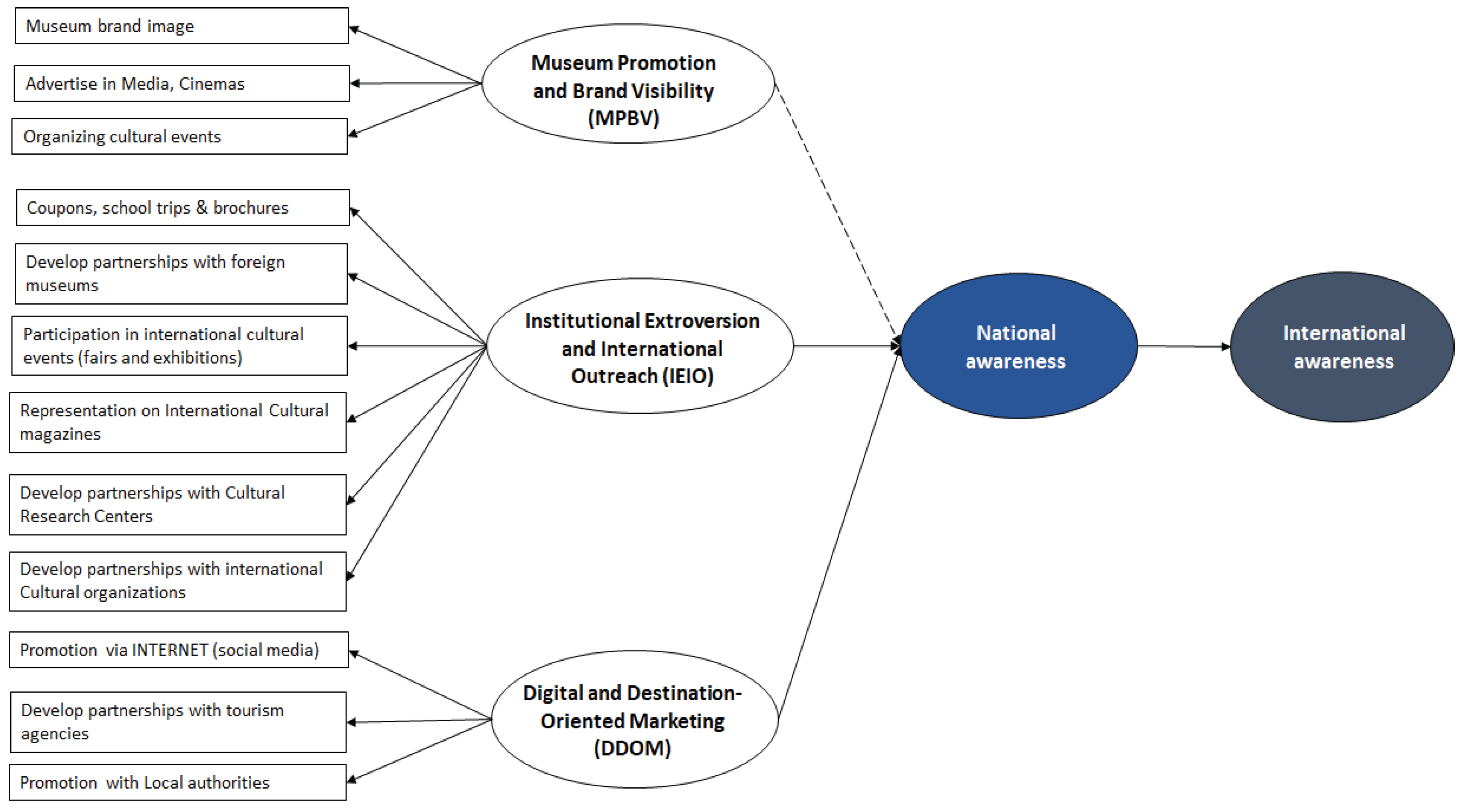

Table 1.
Museum Marketing Policies and Analysis Codes.
| Marketing (Promotional) Policies (MP) | Codes | Some Related studies |
|---|---|---|
| Develop partnerships with tourism agencies | b1 | Deffner et al., [80]; Johanson and Olsen [96] |
| Develop partnerships with foreign museums | b2 | Hughes and Allen [97]; Xie [98]; Deffner and Metaxas [99] |
| Develop partnerships with international Cultural organisations | b3 | Rouwendal and Boter [100]; Schouten [101] |
| Develop partnerships with Local Authorities | b4 | Deffner et al., [80]; Frey [102] |
| Planning and organising cultural events | b5 | Bienkowski [95]; Baron and Leask [103] |
| Participation in international cultural events (fairs and exchbitions) | b6 | Kuo et. al., [104] |
| Promotion via INTERNET (social media) and virtual / digital apps | b7 | Howe [105]; Halsall [106]; Chung et al. [107]; Mas et al., [108] |
| Develop partnerships with Cultural Research Centres | b8 | Anderson [109]; Gigerl et al., [110] |
| Representation on International Cultural magazines | b9 | Silberberg [111]; Wallace [112] |
| Promotion via Cultural and Tourism Guides | b10 | Prentice, [113]; Ababneh [114]; Khater [115] |
| Production of a Cultural-Museum Journal | b11 | Cole [56]; Robbins [116] |
| Existence of Museum’s Marketing Plan | b12 | Mottner [117]; Deffner et al., [80]; Metaxas [118] |
| Develop of Museum Brand Image | b13 | Pusa and Uusitalo [67]; Ferreiro-Rosente et al., [119] |
| Participation in European Cultural Programmes | b14 | Frey [102]; Plaza [31] |
| Promotion via Coupons, school trips, brochures | b15 | Prentice [113]; Mokhtar and Kasim [120] |
| Promotion via MEDIA (TV, cinema et al.) | b16 | Silverstone [121]; Xia et al., [122] |
| Promote attractive pricing policies generally | b17 | Rentschler et al., [123]; Palumpo et al., [124] |
Table 2.
The top 15 public museums in Greece.
| MUSEUMS | REGION |
|---|---|
| Acropolis of Athens*- Acropolis Museum - National Archaeological museum | Attica |
| Mykines* - Mystras - Ancient Olympia - Ancient Korinthos - Epidavros* | Peloponnese |
| Delfi | Central Greece |
| Dilos*- Palace of Great Magistros | South Aegean |
| Iraklio -Knossos | Crete |
| Thessaloniki Archaeological Museum - White Tower Museum | Central Macedonia |
Table 3.
EFA.
| Construct | Items | Factor Loadings | Cronbach A |
|---|---|---|---|
| F1: Museum Promotion and Brand Visibility | Museum brand image | 0.905 | 0.777 |
| Advertise in Media, Cinemas | 0.737 | ||
| Organizing cultural events | 0.519 | ||
| F2: Institutional Extroversion and International Outreach | Coupons, school trips & brochures | 0.597 | 0.880 |
| Develop partnerships with foreign museums | 0.680 | ||
| Participation in international cultural events (fairs and exhibitions) | 0.659 | ||
| Representation on International Cultural magazines | 0.525 | ||
| Develop partnerships with Cultural Research Centres | 0.571 | ||
| Participation in European Cultural Programmes | 0.416 | ||
| Develop partnerships with international Cultural organisations | 0.453 | ||
| F3: Digital and Destination-Oriented Marketing | Promotion via INTERNET (social media) | 0.851 | 0.893 |
| Develop partnerships with tourism agencies | 0.844 | ||
| Promotion with Local authorities | 0.601 | ||
| Kaiser–Meyer–Olkin | 0.876 | ||
| Sig. | 0.000 |
Table 4.
CFA results.
| Factor | Indicator | Loadings | AVE | CR |
|---|---|---|---|---|
| Museum Promotion and Brand Visibility | Museum brand image (b13) | 0.882 | 0.572 | 0.796 |
| (MPBV) | Advertise in Media, Cinemas (b16) | 0.769 | ||
| Organizing cultural events (b5) | 0.588 | |||
| Institutional Extroversion and International Outreach (IEIO) | Coupons, school trips & brochures (b15) | 0.575 | 0.561 | 0.879 |
| Develop partnerships with foreign museums (b2) | 0.829 | |||
| Participation in international cultural events (fairs and exhibitions) (b6) | 0.917 | |||
| Representation on International Cultural magazines (b9) | 0.779 | |||
| Develop partnerships with Cultural Research Centres (b8) | 0.841 | |||
| Develop partnerships with international Cultural organisations (b3) | 0.438 | |||
| Digital and Destination-Oriented Marketing (DDOM) | Promotion via INTERNET (social media) (b7) | 0.962 | 0.765 | #break##break# 0.904#break##break# |
| Develop partnerships with tourism agencies (b1) | 0.996 | |||
| Promotion with Local authorities (b4) | 0.616 |
CFI = 0.970, TLI = 0.961, NFI = 0.917, GFI = 0.993, RMSEA = 0.071, SRMR = 0.058.
Table 5.
Discriminant validity.
| Construct | AVE | CR | MPBV | IEIO | DDOM |
|---|---|---|---|---|---|
| MPBV | 0.572 | 0.796 | 0.756 | ||
| IEIO | 0.561 | 0.879 | 0.599 | 0.748 | |
| DDOM | 0.765 | 0.7904 | 0.492 | 0.681 | 0.874 |
The square root values of AVE are shown on the diagonal.
Table 6.
Regression coefficients.
| Hypotheses | Structural Coefficient | p Value | Status |
|---|---|---|---|
| H4: Impact of MBV on National awareness | -0.076 | 0.0691 | No Association |
| H3: Impact of IEIO on National awareness | 0.900 | <0.001 | Signified association |
| H2: Impact of DDOM on National awareness | 0.455 | <0.034 | Signified association |
| H1: Impact of National awareness on growth International awareness | 0.924 | <0.001 | Signified association |
Table 7.
Independent T-tests results.
| Dimension | Type of Museum | N | Mean | Std. Deviation | P Value |
|---|---|---|---|---|---|
| Awareness on national scale | City | 25 | 6.44 | .91 | .000 |
| Regional | 75 | 3.98 | 1.41 | ||
| Awareness on European scale | City | 25 | 5.64 | 1.38 | .000 |
| Regional | 75 | 2.45 | 1.38 | ||
| Awareness on international scale | City | 25 | 5.00 | 1.65 | .000 |
| Regional | 75 | 1.92 | 1.03 | ||
| Museum Promotion and Brand Visibility | City | 25 | 5.88 | .57 | .000 |
| Regional | 75 | 5.12 | .86 | ||
| Digital and Destination-Oriented Marketing | City | 25 | 6.30 | .49 | .000 |
| Regional | 75 | 5.40 | .83 | ||
| Institutional Extroversion and International Outreach | City | 25 | 6,1000 | .32 | .000 |
| Regional | 75 | 4,2733 | .87 |
Disclaimer/Publisher’s Note: The statements, opinions and data contained in all publications are solely those of the individual author(s) and contributor(s) and not of MDPI and/or the editor(s). MDPI and/or the editor(s) disclaim responsibility for any injury to people or property resulting from any ideas, methods, instructions or products referred to in the content. |
© 2025 by the authors. Licensee MDPI, Basel, Switzerland. This article is an open access article distributed under the terms and conditions of the Creative Commons Attribution (CC BY) license (http://creativecommons.org/licenses/by/4.0/).
Copyright: This open access article is published under a Creative Commons CC BY 4.0 license, which permit the free download, distribution, and reuse, provided that the author and preprint are cited in any reuse.


