

Submitted:
17 July 2025
Posted:
18 July 2025
You are already at the latest version
Abstract
The hypothesis that supernova remnants are key sources of Galactic cosmic rays gains support from evidence that HESS J1731-347 one of the few Galactic objects capable of accelerating hadronic cosmic rays to TeV energies may harbor an exotic strange quark star rather than a conventional neutron star. This conclusion stems from its unusually low mass and compact radius, which challenge standard neutron star models. If confirmed, such a quark star could generate cosmic rays through the transition from the two-flavor color-superconducting (2SC) phase to the color-flavor-locked (CFL) phase, potentially releasing strangelets, hypothetical strange quark matter particles. Detecting these strangelets in cosmic rays would provide groundbreaking evidence for quark matter. The future Cherenkov Telescope Array (CTA), with its unmatched sensitivity and spectral resolution in the very-high-energy (VHE) gamma-ray regime, is uniquely positioned to search for their annihilation or decay signatures. We analyze theoretical predictions for these gamma-ray signals and evaluate CTA's potential to detect or constrain them. Additionally, we present an in-depth assessment of CTA observations of HESS J1731-347, focusing on spectral features that could confirm strangelet production. A positive detection would not only validate the existence of strange quark stars but also establish a direct link between quark matter and cosmic-ray acceleration, reshaping our understanding of compact objects and high-energy astrophysics.
Keywords:
2SC phase
; CFL phase
; strangelet
; quark star
; HESS J1731-347
; Cherenkov Telescope Array (CTA)
1. Introduction
Strange Quark Matter (SQM), often referred to as strangelets or nuclearites, is a hypothetical state of matter composed of roughly equal numbers of up, down, and strange quarks. Numerous theoretical studies and simulations suggest that SQM may represent the fundamental state of matter, potentially more stable than ordinary hadrons such as protons and neutrons. The inclusion of strange quarks introduces a third Fermi energy level, which can lower the energy per nucleon, thereby stabilizing this exotic form of matter. Intriguingly, SQM could account for a portion or even the entirety of the non-baryonic dark matter inferred from cosmological observations, without requiring new fundamental fields beyond the Standard Model of particle physics. Moreover, since SQM would have formed prior to primordial nucleosynthesis, its existence would not disrupt standard cosmological calculations.
If SQM is indeed the ground state of matter, it could profoundly influence the structure of compact astrophysical objects. Stars composed entirely of SQM, novel types of white dwarfs, or neutron stars with complex interiors characterized by diverse hadronic compositions and density profiles might exist. Additionally, strong transient astrophysical emissions could arise from internal phase transitions within these compact objects, offering potential observational signatures.
Recent measurements of the compact object HESS J1731-347, with a mass of and a radius of km, place it among the lightest and smallest compact objects ever observed, pending further validation. These properties suggest that HESS J1731-347 could be an unusually light neutron star, a peculiar quark star, or a hybrid star undergoing an early deconfinement phase transition. Such characteristics raise fundamental questions about its nature and open the door to various theoretical interpretations. The emergence of strange quarks, combined with vector interactions, chiral symmetry restoration, and deconfinement phase transitions, may create a metastable state conducive to strangelet formation.
Should strangelets undergo disintegration or annihilation, they could produce distinctive spectral features in the gamma-ray spectrum. The Cherenkov Telescope Array Observatory (CTA), with its exceptional sensitivity and energy resolution, is ideally suited to search for these signals. As the most advanced facility for gamma-ray astronomy, the CTA is designed to detect very-high-energy (VHE) gamma rays in the energy range of 20 GeV to over 300 TeV. It can probe extreme astrophysical environments, including active galactic nuclei, supernova remnants, and potentially exotic phenomena involving strangelets or dark matter. With superior sensitivity, resolution, and sky coverage compared to existing instruments like MAGIC, VERITAS, and H.E.S.S., the CTA is poised to investigate high-energy astrophysical phenomena, such as possible signatures of strangelets in the context of HESS J1731-347. This document summarizes the theoretical predictions for strangelet-related gamma-ray signatures, their detectability with the CTA, and their implications for constraining the properties of strangelets and HESS J1731-347.
2. Scientific Goals
2.1. Strange Quark Matter and Current Searches
The concept of Strange Quark Matter (SQM) was first proposed in the 1980s as a distinct state of hadronic matter, coexisting alongside conventional nuclear matter [1,2,3]. The mass of strangelets within compact stars can range from a minimum stable mass of approximately [4] to as high as , equivalent to a solar mass of approximately kg [5,6]. SQM could have formed in the early universe shortly after the Big Bang [4], potentially contributing to baryonic dark matter [7]. It may reside within the cores of neutron stars or exist as “strange quark stars,” which could be either purely composed of quarks [5,8] or a mixture of hadrons and quarks [9,10,11]. Strangelets could also be accelerated in the ergosphere of black holes [12] or produced in collisions between binary neutron stars [13,14,15], potentially reaching Earth [16].
Despite extensive searches, no definitive evidence for strangelets has been found, though experimental efforts have established upper limits on their production. The CERN NA52 experiment, which investigated strangelet production in Pb-Pb collisions at 158 GeV/c per nucleon, found no evidence and set upper limits on production yields for strangelets with mass-to-charge ratios up to [17]. Similarly, the PAMELA experiment, which searched for cosmic-ray strangelets from 2006 to 2009, detected no candidates and established an upper limit on the strangelet flux for particles with charges and baryon numbers [18].
2.2. HESS J1731-347 and Strong First-Order (Deconfinement) Phase Transition
The High Energy Stereoscopic System (H.E.S.S.), an array of imaging atmospheric Cherenkov telescopes in Namibia, discovered the very-high-energy (VHE) gamma-ray source HESS J1731-347. Located in the constellation Scorpius near the Galactic plane, it has celestial coordinates of right ascension (RA) 17h 31m, declination (Dec) , and galactic coordinates of longitude (near the galactic center) and latitude (slightly below the galactic plane). Its spatial coincidence with the shell-type supernova remnant (SNR) G353.6-0.7 suggests a potential association. The gamma-ray emission, observed at energies above 100 GeV, may result from accelerated cosmic rays interacting with surrounding material through processes such as pion decay or inverse Compton scattering. While its precise distance remains uncertain, estimates place it at approximately 10,400 light-years (or kiloparsecs) if associated with SNR G353.6-0.7 [19,20,21,22].
The conditions under which quark matter forms and the density at which deconfinement phase transitions occur remain unclear. Combined analyses of multimessenger constraints and elliptic flow in heavy-ion collisions suggest that strongly interacting matter softens at high densities, potentially indicating a transition to quark-gluon plasma [23,24]. By correlating the measured mass, radius, and surface temperature of HESS J1731-347 with theoretical models of strongly interacting matter and color superconductivity at high densities, we can better understand its nature.
Recent evidence challenges the occurrence of a strong first-order deconfinement phase transition in neutron stars, particularly due to nontrivial phenomena associated with such transitions [25,26]. The exceptionally low mass and radius of HESS J1731-347 [27] have sparked skepticism within the neutron star community, as state-of-the-art simulations indicate that the lightest neutron stars formed via supernova explosions have masses of at least . No known scenario explains the existence of a lighter neutron star. For HESS J1731-347 to exhibit such properties, an early deconfinement phase transition would be required, characterized by a large branching ratio of scalar meson decay, , in the color-flavor-locked (CFL) phase of color superconductivity, where , with as the coupling strength in the scalar meson channel and as the coupling strength of a specific decay mode. This condition is necessary to achieve neutron star radii at or below those typical of binary radio pulsars ( km) [28].
Alternatively, HESS J1731-347 could be a hadron star (HS) or strange star (SS) with an early deconfinement phase transition occurring below twice nuclear saturation density. Such a star would possess a significant quark-gluon plasma core, potentially leading to rapid cooling via the direct Urca (DU) process involving active quarks. However, the two-color superconducting (2SC) phase, characterized by the absence of strange quarks and the formation of a u-d diquark condensate in specific color directions, suppresses rapid cooling and aligns with the observed surface temperature, as derived from a self-consistent calculation of the quark pairing gap within a chirally symmetric relativistic density functional (RDF) model [19].
Quark matter can be categorized based on the presence of strange quarks, with the 2SC phase defined by the absence of strange quarks and the CFL phase characterized by Cooper pairs where color and flavor properties are correlated in a one-to-one correspondence among three colors and three flavors [29]. Additional quark pairing configurations, such as gapless 2SC, crystalline color superconductivity, or gapless CFL (gCFL), are also possible [30]. The observed surface temperature of HESS J1731-347 aligns well with the 2SC phase and a first-order deconfinement phase transition, negating the need for the CFL phase, which would further suppress neutrino emission while still fitting the data [31]. However, a hybrid equation of state (EoS) combining the MDI-APR1 (hadronic) and CFL (quark) EoS, with a phase transition modeled via Maxwell construction, can explain HESS J1731-347’s properties using stable CFL quark matter. In contrast, hybrid models incorporating the CFL MIT Bag model fail to account for the masses of the heaviest observed pulsars [32]. Studies further suggest that HESS J1731-347 is either a strange star or a hadron star [33], with comparisons provided in Figures 1 and 2 of [19], Figure 3 of [33], Figure 4 of [31], Figure 5 of [34], and Figure 12 of [28].
2.3. Phase Transitions and Stranglet Formation
Strangelets are stabilized by strong interactions and require a significant population of strange quarks, which may form in high-density environments where the strange quark mass is dynamically reduced. In the 2SC phase, up and down quarks of two colors form a BCS-like condensate with a gap in the quark spectrum, while strange quarks remain unpaired due to their higher mass, making strangelet formation less likely [35,36]. A transition to the CFL phase or unpaired quark matter with a reduced strange quark mass could facilitate strangelet formation. Magnetic fields may also influence phase stability, potentially affecting strangelet production [36].
The CFL phase, occurring at higher densities, involves all three flavors (up, down, and strange) forming a highly symmetric superfluid state where all fermionic modes are gapped. This phase’s flavor-symmetric pairing and lower free energy enhance its stability, making it conducive to strangelet formation [37]. Chiral symmetry restoration at high density reduces the strange quark mass, further promoting strangelet formation within the CFL condensate [38]. Mixed phases between the 2SC and CFL states may serve as nucleation sites for strangelets, though their stability is uncertain due to surface and Coulomb effects [39].
2.4. Stranglet Formation in Astrophysical and Experimental Contexts
In neutron stars, such as HESS J1731-347, the CFL phase’s stability under neutrality constraints supports strangelet formation. In heavy-ion collisions, transient 2SC or CFL phases may produce strangelets, potentially detectable through negative pion radiation or proton excess [32,38]. The CFL phase is more favorable for strangelet formation than the 2SC phase due to its inclusion of strange quarks and lower free energy. However, instabilities in mixed phases and external factors like magnetic fields introduce uncertainties. Observational signatures, such as r-mode damping in neutron stars or particle production in collisions, could provide evidence for strangelets [32,36].
3. Future Experimental Goals
3.1. The Cherenkov Telescope Array Observatory for Strangelet Searches
The Cherenkov Telescope Array (CTA) is a next-generation ground-based observatory designed to detect very-high-energy (VHE) gamma rays from 20 GeV to over 300 TeV, establishing it as the most advanced facility for gamma-ray astronomy [40]. The CTA aims to explore high-energy astrophysical phenomena, including cosmic ray acceleration, dark matter, and exotic particles like strangelets, particularly in the context of HESS J1731-347 within the TeV gamma-ray range (0.1-100 TeV) [41,42]. Unlike optical telescopes, the CTA detects gamma rays indirectly by observing Cherenkov radiation, blue light flashes produced when VHE gamma rays create particle showers in Earth’s atmosphere [43]. Comprising two arrays for full-sky coverage, the Southern Array (CTA-South) at Paranal Observatory, Chile (2,600 m altitude), is optimized for galactic sources. The 1600-hour Galactic Plane Survey (GPS) will map TeV sources, including HESS J1731-347 [44].
3.2. CTA Spectral Line Detection for HESS J1731-347
The CTA offers unparalleled sensitivity to gamma-ray lines in the 0.1-10 TeV range, where its effective area is optimized for detecting the gamma-ray flux of HESS J1731-347. The differential flux at 1 TeV is , with an integral flux above 1 TeV of approximately , roughly 3% of the Crab Nebula’s flux [45,46]. Strangelets from HESS J1731-347 could produce line-like features through interactions with the interstellar medium (ISM) or exotic decay processes [13,47]. With an energy resolution of approximately 10% at 1 TeV, the CTA can detect lines with fluxes as low as /s after 100 hours of observation, compared to H.E.S.S.’s limit of /s [40]. For HESS J1731-347, with a flux of /s at 1 TeV, the CTA can probe contributions below 0.1% of the continuum flux. By fitting the spectrum to a power law () and searching for Gaussian peaks, the strangelet flux can be constrained as follows:
Where is the average column density, is the cross-section, and is the line photon flux. With an angular resolution of approximately 1 arcminute, the CTA can map HESS J1731-347’s morphology, correlating emission with ISM gas or neutron star remnants. Localized excesses could indicate strangelet production [47]. The GPS, with ∼100 hours of observation, achieves sensitivity to faint signals (/s), enabling tests of strangelet stability [44].
3.3. CTA Simulations for HESS J1731-347
No studies have explicitly modeled strangelet spectral lines for the CTA in the context of HESS J1731-347 [47,48], as proton-driven hadronic gamma-ray emission dominates the observed spectrum. However, the CTA’s Key Science Projects (KSPs) for dark matter and axion-like particles provide a framework for simulating strangelet-ISM interactions using the Gamma-ray Astronomy Science Analysis Software (ctools) [49] based on GammaLib (A versatile toolbox for scientific analysis of astronomical gamma-ray data) [], and Gammapy (A Python package for gamma-ray astronomy) [49] to predict spectral signatures [40]. To demonstrate the CTA’s potential, we present a chart illustrating the upper limit on a hypothetical strangelet-induced spectral line flux versus gamma-ray energy (0.1-10 TeV), compared to H.E.S.S. limits and HESS J1731-347’s continuum flux.
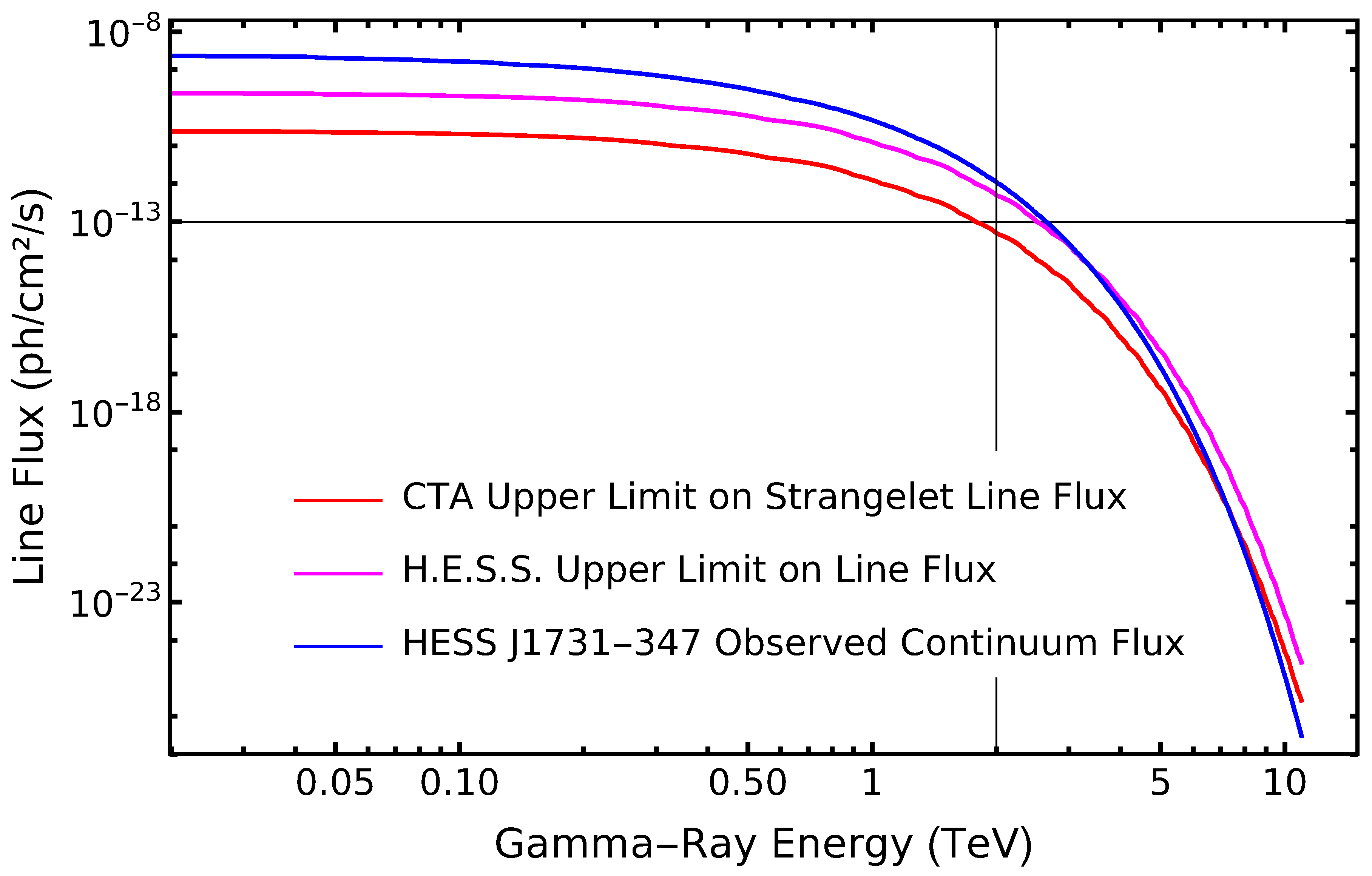
The Figure 1 and Figure 2’s x-axis spans 0.1-10 TeV, where the CTA’s Medium-Sized Telescopes (MSTs) and Small-Sized Telescopes (SSTs) are most sensitive. The y-axis, on a logarithmic scale, represents line flux (/s), with the CTA’s limit at /s, reflecting its tenfold improvement over H.E.S.S.’s /s. The continuum flux follows a power law () [42]. Theoretical constraints indicate a line flux for HESS J1731-347 of /s at 1 TeV, with a strangelet flux of /s/sr. The number density is estimated at for strangelets with a total mass of and a production rate of strangelets/s [48].
4. Conclusions
Strangelet formation is more likely during transitions to the CFL phase than the 2SC phase due to the former’s flavor symmetry and enhanced stability. Mixed phases between the 2SC and CFL states may serve as nucleation sites for strangelets, though their stability is compromised by surface and Coulomb effects. Magnetic fields and chiral symmetry restoration significantly influence phase stability and strangelet production. Observational signatures in neutron stars, such as r-mode damping, and particle production in heavy-ion collisions offer promising avenues for detection.
If HESS J1731-347 contains strange quark matter, as in a strange star scenario, the CTA could detect or constrain monochromatic gamma-ray lines (e.g., from ), yielding limits competitive with dark matter searches due to similar annihilation signatures. The CTA’s advanced sensitivity, resolution, and sky coverage make it an ideal instrument for constraining strangelet spectral lines in HESS J1731-347, potentially setting stringent limits on flux and number density. The Galactic Plane Survey and multi-messenger approaches will further enhance these searches, necessitating new theoretical models to predict specific strangelet signatures and advance our understanding of exotic matter in the universe.
References
- Bodmer, A.R. Collapsed Nuclei. Phys. Rev. D 1971, 4, 1601–1606. [Google Scholar] [CrossRef]
- Witten, E. Cosmic separation of phases. Phys. Rev. D 1984, 30, 272–285. [Google Scholar] [CrossRef]
- Farhi, E.; Jaffe, R.L. Strange matter. Phys. Rev. D 1984, 30, 2379–2390. [Google Scholar] [CrossRef]
- Chodos, A.; Jaffe, R.L.; Johnson, K.; Thorn, C.B.; Weisskopf, V.F. New extended model of hadrons. Phys. Rev. D 1974, 9, 3471–3495. [Google Scholar] [CrossRef]
- Haensel, P.; Zdunik, J.; Schaefer, R. Strange quark stars. Astronomy and Astrophysics 1986, 160, 121–128. [Google Scholar]
- Madsen, J. Strangelet propagation and cosmic ray flux. Phys. Rev. D 2005, 71, 014026. [Google Scholar] [CrossRef]
- Atreya, A.; Sarkar, A.; Srivastava, A.M. Reviving quark nuggets as a candidate for dark matter. Phys. Rev. D 2014, 90, 045010. [Google Scholar] [CrossRef]
- Alcock, C.; Farhi, E.; Olinto, A. Strange stars. Astrophysical Journal, Part 1 1986, 310, 261–272. [Google Scholar] [CrossRef]
- Drago, A.; Lavagno, A.; Pagliara, G.; Pigato, D. The scenario of two families of compact stars: Part 1. Equations of state, mass-radius relations and binary systems. The European Physical Journal A 2016, 52, 40. [Google Scholar] [CrossRef]
- Drago, A.; Pagliara, G. The scenario of two families of compact stars: part 2: transition from hadronic to quark matter and explosive phenomena. The European Physical Journal A 2016, 52, 41. [Google Scholar] [CrossRef]
- Drago, A.; Lavagno, A.; Pagliara, G. Can very compact and very massive neutron stars both exist? Phys. Rev. D 2014, 89, 043014. [Google Scholar] [CrossRef]
- Bianchi, M.; Casolino, M.; Rizzo, G. Accelerating strangelets via Penrose process in non-BPS fuzz-balls. Nuclear Physics B 2020, 954, 115010. [Google Scholar] [CrossRef]
- Bucciantini, N.; Drago, A.; Pagliara, G.; Traversi, S.; Bauswein, A. Formation and evaporation of strangelets during the merger of two compact stars. Phys. Rev. D 2022, 106, 103032. [Google Scholar] [CrossRef]
- Drago, A.; Pagliara, G. Merger of Two Neutron Stars: Predictions from the Two-families Scenario. The Astrophysical Journal Letters 2018, 852, L32. [Google Scholar] [CrossRef]
- Wiktorowicz, G.; Drago, A.; Pagliara, G.; Popov, S.B. Strange Quark Stars in Binaries: Formation Rates, Mergers, and Explosive Phenomena. The Astrophysical Journal 2017, 846, 163. [Google Scholar] [CrossRef]
- De Rújula, A.; Glashow, S.L. Nuclearites—a novel form of cosmic radiation. Nature 1984, 312, 734–737. [Google Scholar] [CrossRef]
- Appelquist, G.; Baglin, C.; Beringer, J.; Bohm, C.; Borer, K.; Bussière, A.; Dittus, F.; Elsener, K.; Frei, D.; Gorodetzky, P.; et al. Strangelet Search in Pb-Pb Interactions at 158 GeV /c per Nucleon. Phys. Rev. Lett. 1996, 76, 3907–3910. [Google Scholar] [CrossRef] [PubMed]
- Lewis, A. Lensed CMB simulation and parameter estimation. Phys. Rev. D 2005, 71, 083008. [Google Scholar] [CrossRef]
- Sagun, V.; Giangrandi, E.; Dietrich, T.; Ivanytskyi, O.; Negreiros, R.; Providência, C. What Is the Nature of the HESS J1731-347 Compact Object? The Astrophysical Journal 2023, 958, 49. [Google Scholar] [CrossRef]
- Horvath, J.; Rocha, L.; de Sá, L.; Moraes, P.; Barão, L.; de Avellar, M.; Bernardo, A.; Bachega, R. A light strange star in the remnant HESS J1731- 347: Minimal consistency checks. Astronomy & Astrophysics 2023, 672, L11. [Google Scholar] [CrossRef]
- Char, P.; Biswas, B. The compact object of HESS J1731-347 and its implication on neutron star matter. arXiv:2408.15220 2024.
- Zhang, S.R.; Hernandez, J.R.; Negreiros, R. Can the central compact object in HESS J1731–347 be indeed the lightest neutron star observed? The Astrophysical Journal 2024, 978, 1. [Google Scholar] [CrossRef]
- Annala, E.; Gorda, T.; Katerini, E.; Kurkela, A.; Nättilä, J.; Paschalidis, V.; Vuorinen, A. Multimessenger constraints for ultradense matter. Physical Review X 2022, 12, 011058. [Google Scholar] [CrossRef]
- Huth, S.; Pang, P.T.; Tews, I.; Dietrich, T.; Le Fèvre, A.; Schwenk, A.; Trautmann, W.; Agarwal, K.; Bulla, M.; Coughlin, M.W.; et al. Constraining neutron-star matter with microscopic and macroscopic collisions. Nature 2022, 606, 276–280. [Google Scholar] [CrossRef] [PubMed]
- Mroczek, D.; Miller, M.C.; Noronha-Hostler, J.; Yunes, N. Nontrivial features in the speed of sound inside neutron stars. Phys. Rev. D 2024, 110, 123009. [Google Scholar] [CrossRef]
- Brandes, L.; Weise, W.; Kaiser, N. Evidence against a strong first-order phase transition in neutron star cores: Impact of new data. Phys. Rev. D 2023, 108, 094014. [Google Scholar] [CrossRef]
- Doroshenko, V.; Suleimanov, V.; Pühlhofer, G.; Santangelo, A. A strangely light neutron star within a supernova remnant. Nature Astronomy 2022, 6, 1444–1451. [Google Scholar] [CrossRef]
- Ayriyan, A.; Blaschke, D.; Carlomagno, J.P.; Contrera, G.A.; Grunfeld, A.G. Bayesian Analysis of Hybrid Neutron Star EOS Constraints Within an Instantaneous Nonlocal Chiral Quark Matter Model. Universe 2025, 11, 141. [Google Scholar] [CrossRef]
- Alford, M.G. Quark matter in neutron stars. Nuclear Physics A 2009, 830, 385c–392c. [Google Scholar] [CrossRef]
- Buballa, M. NJL-model analysis of dense quark matter. Physics Reports 2005, 407, 205–376. [Google Scholar] [CrossRef]
- Klähn, T.; Fischer, T. VECTOR INTERACTION ENHANCED BAG MODEL FOR ASTROPHYSICAL APPLICATIONS. The Astrophysical Journal 2015, 810, 134. [Google Scholar] [CrossRef]
- Kourmpetis, K.; Laskos-Patkos, P.; Moustakidis, C. Constraints on color-flavor locked quark matter in view of the HESS J1731-347 measurement. HNPS Advances in Nuclear Physics 2025, 31, 48–54. [Google Scholar] [CrossRef]
- Rather, I.A.; Panotopoulos, G.; Lopes, I. Quark models and radial oscillations: decoding the HESS J1731-347 compact object’s equation of state. The European Physical Journal C 2023, 83, 1065. [Google Scholar] [CrossRef]
- Brandes, L.; Weise, W. Constraints on Phase Transitions in Neutron Star Matter. Symmetry 2024, 16. [Google Scholar] [CrossRef]
- Mandal, T.; Jaikumar, P. Neutrality of a magnetized two-flavor quark superconductor. Phys. Rev. C 2013, 87, 045208. [Google Scholar] [CrossRef]
- Shovkovy, I.A. Two lectures on color superconductivity. Foundations of Physics 2005, 35, 1309–1358. [Google Scholar] [CrossRef]
- Alford, M.G.; Schmitt, A.; Rajagopal, K.; Schäfer, T. Color superconductivity in dense quark matter. Rev. Mod. Phys. 2008, 80, 1455–1515. [Google Scholar] [CrossRef]
- Rapp, R.; Schäfer, T.; Shuryak, E.V.; Velkovsky, M. Color superconducting quark matter. Ann. Phys. 1998, 280, 35. [Google Scholar] [CrossRef]
- Schmitt, A. Dense matter in neutron stars and heavy-ion collisions. Nucl. Phys. A 2010, 850, 1. [Google Scholar] [CrossRef]
- Abdalla, H.; Abe, H.; Acero, F.; Acharyya, A.; Adam, R.; Agudo, I.; Aguirre-Santaella, A.; Alfaro, R.; Alfaro, J.; Alispach, C.; et al. Sensitivity of the Cherenkov Telescope Array for probing cosmology and fundamental physics with gamma-ray propagation. Journal of Cosmology and Astroparticle Physics 2021, 2021, 048. [Google Scholar] [CrossRef]
- Abramowski, A.; Acero, F.; Aharonian, F.; Akhperjanian, A.; Anton, G.; Balzer, A.; Barnacka, A.; De Almeida, U.B.; Becherini, Y.; Becker, J.; et al. A new SNR with TeV shell-type morphology: HESS J1731-347. Astronomy & Astrophysics 2011, 531, A81. [Google Scholar] [CrossRef]
- Capasso, M.; Condon, B.; Coffaro, M.; Cui, Y.; Gottschall, D.; Klochkov, D.; Marandon, V.; Maxted, N.; Pühlhofer, G.; Rowell, G.; et al. The TeV supernova remnant shell HESS J1731-347 and its surroundings. AIP Conference Proceedings 2017, 1792, 040026. [Google Scholar] [CrossRef]
- Cerenkov, P.; et al. Visible emission of clean liquids by action of γ radiation. In Proceedings of the Dokl. Akad. Nauk SSSR, 1934, Vol. 2, pp. 451–454.
- Sousa, M.; Costa, R.; Coelho, J.G.; Dos Anjos, R. Prospects for gamma-ray emission from magnetar regions in CTAO observations. The Astrophysical Journal 2025, 979, 23. [Google Scholar] [CrossRef]
- Doroshenko, V.; Pühlhofer, G.; Santangelo, A. Expansion and ongoing cosmic ray acceleration in HESS J1731- 347. Astronomy & Astrophysics 2023, 679, A152. [Google Scholar] [CrossRef]
- Guo, X.L.; Xin, Y.L.; Liao, N.H.; Yuan, Q.; Gao, W.H.; Fan, Y.Z. Detection of GeV Gamma-Ray Emission in the Direction of HESS J1731-347 with Fermi-LAT. The Astrophysical Journal 2018, 853, 2. [Google Scholar] [CrossRef]
- Madsen, J. Physics and astrophysics of strange quark matter. In Proceedings of the Hadrons in Dense Matter and Hadrosynthesis; Cleymans, J.; Geyer, H.B.; Scholtz, F.G., Eds., Berlin, Heidelberg, 1999; pp. 162–203.
- Bauswein, A.; Oechslin, R.; Janka, H.T. Discriminating strange star mergers from neutron star mergers by gravitational-wave measurements. Phys. Rev. D 2010, 81, 024012. [Google Scholar] [CrossRef]
- Donath, A.; Terrier, R.; Remy, Q.; Sinha, A.; Nigro, C.; Pintore, F.; Khélifi, B.; Olivera-Nieto, L.; Ruiz, J.E.; Brügge, K.; et al. Gammapy: A Python package for gamma-ray astronomy. Astronomy & Astrophysics 2023, 678, A157. [Google Scholar] [CrossRef]
Figure 1.
CTA limitations for strangelet spectral line flux (0.1-10 TeV). The plot depicts the upper CTA limit of strangelet-induced line flux (red), H.E.S.S. limit (magenta), and observed continuum flux (blue) for HESS J1731-347, with a logarithmic y-axis for flux (/s).
Figure 1.
CTA limitations for strangelet spectral line flux (0.1-10 TeV). The plot depicts the upper CTA limit of strangelet-induced line flux (red), H.E.S.S. limit (magenta), and observed continuum flux (blue) for HESS J1731-347, with a logarithmic y-axis for flux (/s).
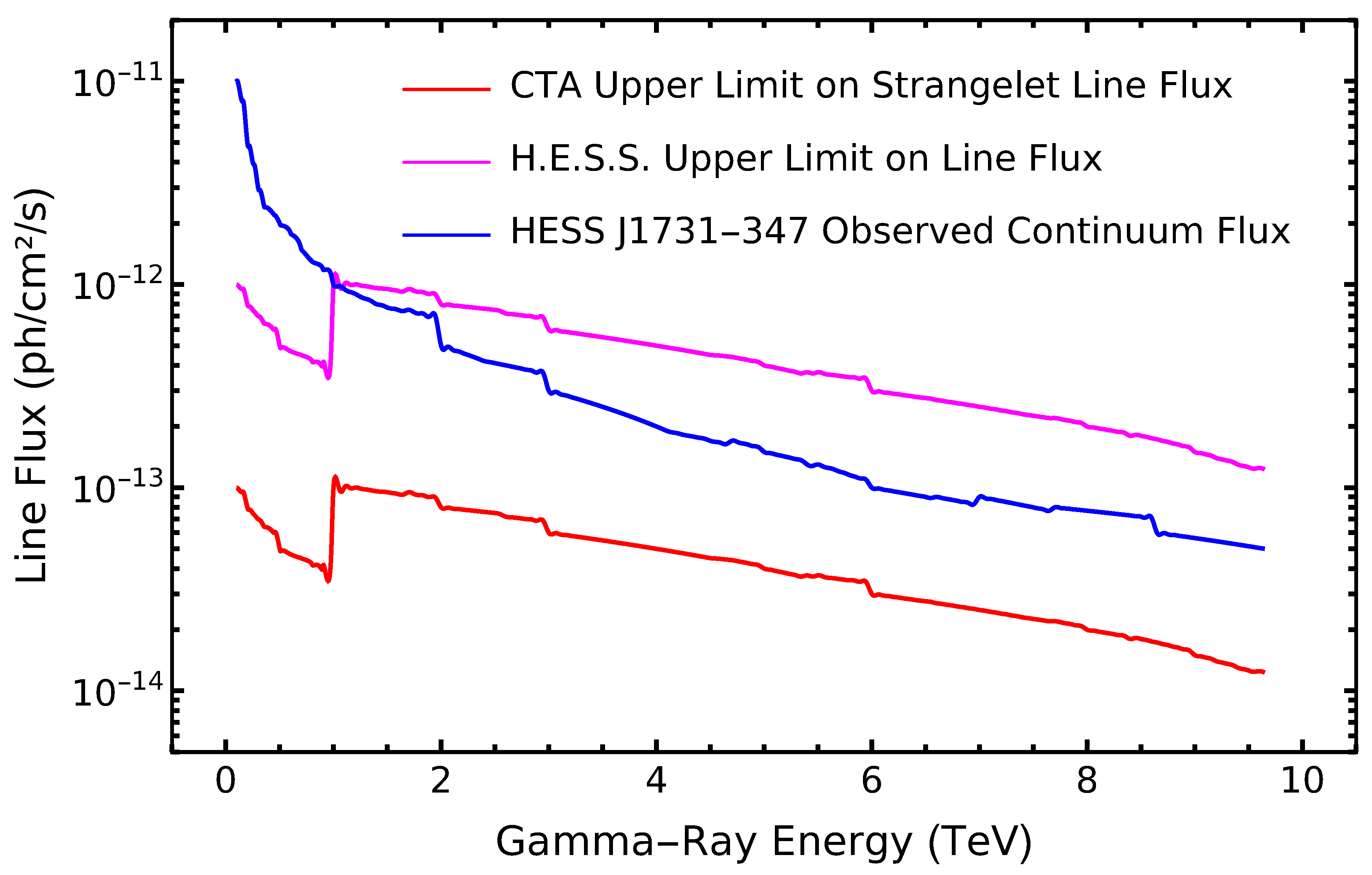
Figure 2.
Similar to Figure 1, with a logarithmic x-axis, the CTA limit line at /s, and enhanced Monte Carlo simulation. Simulation results for CTA limits over /s beyond 2 TeV are unsatisfactory, as the HESS J1731-347 cutoff energy began at about 7-10 TeV.
Figure 2.
Similar to Figure 1, with a logarithmic x-axis, the CTA limit line at /s, and enhanced Monte Carlo simulation. Simulation results for CTA limits over /s beyond 2 TeV are unsatisfactory, as the HESS J1731-347 cutoff energy began at about 7-10 TeV.
Disclaimer/Publisher’s Note: The statements, opinions and data contained in all publications are solely those of the individual author(s) and contributor(s) and not of MDPI and/or the editor(s). MDPI and/or the editor(s) disclaim responsibility for any injury to people or property resulting from any ideas, methods, instructions or products referred to in the content. |
© 2025 by the authors. Licensee MDPI, Basel, Switzerland. This article is an open access article distributed under the terms and conditions of the Creative Commons Attribution (CC BY) license (http://creativecommons.org/licenses/by/4.0/).
Copyright: This open access article is published under a Creative Commons CC BY 4.0 license, which permit the free download, distribution, and reuse, provided that the author and preprint are cited in any reuse.


