

Submitted:
16 July 2025
Posted:
17 July 2025
You are already at the latest version
Abstract
Digital technologies, including artificial intelligence (AI) and machine learning (ML), are reshaping the landscape of athletic training and performance assessment. Despite growing global interest, empirical research on AI adoption in sports remains limited in Central and Eastern Europe. This study investigates how Romanian sports professionals perceive and integrate AI-based applications and digital technologies into their training practices and how these tools influence performance outcomes. Data were collected through a structured questionnaire distributed to 293 athletes, coaches, and sports academics affiliated with Romanian national sports federations. Using Partial Least Squares Structural Equation Modeling (PLS-SEM), we analyzed the relationships between perceived AI benefits, AI application usage (AISportSuite), adoption of digital sports technologies, and reported performance outcomes. The results indicate that perceived AI benefits significantly predict the use of AI applications, positively influencing the adoption of wearable and digital training tools. Moreover, digital technology usage is positively associated with higher self-reported performance levels. Group comparisons show that AI adoption varies significantly by sport and education level, with football professionals and more educated respondents demonstrating higher engagement.These findings contribute to the literature on sports technology adoption by offering one of Eastern Europe's first empirical, model-based studies. The study provides practical insights for coaches, policymakers, and sports technologists aiming to foster AI integration and digital innovation in high-performance athletic environments.
Keywords:
artificial intelligence
; machine learning
; sports technology
; sports performance analysis
; SEM
1. Introduction
In recent years, digital technologies have increasingly transformed the landscape of competitive sports by enhancing training efficiency, recovery processes, and performance monitoring. Artificial intelligence (AI) and machine learning (ML) have emerged as powerful tools that offer real-time feedback, predictive analytics, and individualized training insights for athletes and coaches. These innovations support athlete performance optimization, risk reduction, and talent identification across various sports disciplines [1,2]
Technologies such as heart rate monitors, GPS-enabled wearables, and biomechanical feedback devices are now embedded in high-performance training environments. They enable continuous data capture and provide actionable insights into an athlete’s physical condition, technique, and progress [3,4,5]. Adopting immersive and innovative technologies, such as CoachApps, Cyclocomputers, SensorBalls, and SmartWatches, is becoming increasingly prevalent, offering enhanced interactivity and performance analytics capabilities.
While existing literature has explored the benefits of digital innovation in sports, empirical studies remain lacking in evaluating how AI-driven technologies influence performance outcomes across different sports contexts, particularly in Eastern Europe. This paper addresses this gap by analyzing the adoption and perceived benefits of AI applications (AISportSuite) among Romanian athletes and sports professionals. Specifically, we examine whether integrating AISportSuite and other digital tools correlates with improved training efficiency and competitive performance.
Romania currently occupies an emergent and exploratory stage in adopting artificial intelligence (AI) within the sports domain, characterized by limited data infrastructure, reliance on software-driven tools, and nascent institutional frameworks. In contrast, Western European countries have attained sophisticated AI integration in elite sports, supported by comprehensive biometric monitoring systems and substantial public investment in research and development. In Asia, nations such as Japan and South Korea demonstrate notable leadership in robotics and biomechanics, employing AI technologies for injury prevention and advanced motion capture underpinned by robust public-private partnerships. Meanwhile, the United States maintains a dominant position in the commercial deployment of AI in sports, utilizing full-stack platforms encompassing strategic decision-making, fan engagement, and athlete marketing. However, this widespread adoption is accompanied by challenges related to technological overreliance and complex ethical considerations.
Romania’s academic rigor reflect a foundational readiness to embrace AI-driven innovations. Nevertheless, the country contends with significant barriers, including disparities in digital literacy and uneven adoption across different sports disciplines. Addressing these challenges necessitates targeted investments in digital infrastructure, capacity building, and enhanced international collaboration to bridge the gap between technological potential and athletic performance effectively.
Study Contribution and Novelty
This study, through several novel dimensions, makes an important contribution to the expanding corpus of literature on artificial intelligence (AI) adoption in sports.
Firstly, it constitutes one of the pioneering empirical investigations employing Partial Least Squares Structural Equation Modeling (PLS-SEM) to examine the interplay between perceived AI benefits rigorously, the extent of AI application utilization, and performance outcomes within the specific milieu of Romanian elite and semi-elite sports.
Secondly, the research advances the field by developing and validating a comprehensive, multi-construct measurement model that systematically connects technological perceptions with objective performance indicators, transcending the predominantly descriptive or theoretical frameworks that have characterized prior studies.
Thirdly, the study provides comparative analyses across distinct sporting disciplines - namely football and basketball - thereby elucidating differential patterns and contextual nuances in AI integration and adoption processes.
Finally, the findings yield empirically grounded, actionable recommendations for policymakers, sports federations, and coaching practitioners aiming to foster the implementation of data-driven and AI-enhanced training methodologies, with particular emphasis on addressing the unique challenges and opportunities present in underrepresented Eastern European sporting contexts.
2. State of the Art
Sports specialists are increasingly paying attention to the issues of AI and machine learning. However, there remain areas of interest that allow for an innovative approach, opening new perspectives for applying these digital methods in sports.
2.1. Artificial Intelligence and Machine Learning in Sports Performance
Integrating artificial intelligence (AI) and machine learning (ML) into sports has introduced data-driven methods that enhance performance evaluation, training optimization, and strategic planning. AI systems can identify patterns and relationships within large datasets, enabling personalized feedback and tailored training programs for athletes. [1] ML algorithms, in particular, are instrumental in detecting errors, predicting outcomes, and offering strategic insights based on historical performance data. [2,6]
Real-time performance analysis powered by AI allows for instant corrective feedback on parameters such as technique, movement efficiency, and speed. These insights assist athletes and coaches in addressing performance gaps with greater precision. Furthermore, talent evaluation processes are increasingly supported by AI, with algorithms analyzing multiple performance indicators across competitions to assist in team selection and athlete development. [7]
AI has also proven valuable in injury prevention and rehabilitation. By analyzing biometric and medical data, ML models can identify high-risk patterns and recommend modified training loads to mitigate injury risks. [8] The simulation of game scenarios using AI-based models enables athletes and teams to refine tactics and prepare more effectively for competitive contexts. [9]
However, despite its potential, the adoption of AI technologies in sports is challenged by the complexity of data collection, interpretation, and contextualization, often requiring domain-specific knowledge and interdisciplinary collaboration.
2.2. Digital Innovations and Wearable Technologies in Sports
Digital innovations in sports extend beyond AI to encompass a broad range of innovative and wearable technologies designed to improve training efficiency, athlete comfort, and injury monitoring. Cyclocomputers, power meters, and muscle oxygen trackers are now widely used to monitor workload and optimize performance. [10] Wearables embedded in textile materials offer a lightweight and breathable alternative to traditional monitoring devices, providing continuous physiological feedback without interfering with movement. [3]
In disciplines like swimming, digital systems such as electronic timers, biomechanical analysis software (e.g., Bio Swim Analysis 3.0), and force measurement tools (e.g., SwimOne, EO SwimBetter) support precision training by delivering feedback on stroke mechanics and propulsion force. [11] These technologies are vital for identifying marginal gains in performance, particularly at elite levels.
Human-robot interaction is another emerging field, with prototype systems demonstrating the potential for self-coaching and movement correction in complex motor skills such as volleyball passes. [12] In team sports, video-based AI tools like Catapult, Track160, and Pixellot transform tactical analysis and athlete monitoring through motion capture, performance metrics, and automated highlight generation. [13]
Furthermore, digital applications such as VAR (Video Assistant Referee) are reshaping officiating by reducing human error and enhancing decision accuracy. [14,15] Innovative equipment like SensorBalls, e-bikes, and AI-enhanced apparel contribute to sustainability, rehabilitation, and performance tracking in recreational and elite sports.
Despite these advances, there remains a need to empirically validate the impact of these technologies on measurable performance outcomes and to understand their adoption across different sports and cultural contexts - an objective this study seeks to address.
2.3. Gaps in Existing Research
Despite growing interest in applying AI and digital technologies in sports, several critical gaps remain in literature. First, most existing research is either conceptual or focused on case studies from technologically advanced countries, with limited empirical evidence drawn from Central or Eastern European contexts. As a result, the extent to which AI applications are adopted by athletes in emerging sports ecosystems - such as Romania - remains underexplored.
Secondly, most studies examine isolated technologies or single-sport settings, offering limited insight into how various AI and digital tools interact to influence training outcomes across multiple disciplines. Comparative analyses that examine differential technology adoption and impact between team sports (e.g., football vs. basketball) are scarce, leaving a void in understanding context-specific effectiveness.
Thirdly, while previous research has demonstrated the technical feasibility of wearable sensors, simulation tools, and ML-driven applications, few studies assess the actual impact of these technologies on quantifiable performance metrics. Moreover, the behavioral and perceptual factors that influence technology adoption - such as perceived usefulness, trust in AI systems, and education level of practitioners - are often overlooked in empirical models.
Lastly, advanced statistical methods like structural equation modeling (SEM) are limited in their use to simultaneously assess relationships between multiple constructs, such as perceived AI benefits, technology usage, and performance outcomes. This methodological gap hinders the development of predictive models that can guide evidence-based decision-making for coaches, sports organizations, and policymakers.
This study addresses these gaps by employing an SEM approach to examine how Romanian athletes and sports professionals perceive and utilize AI and digital technologies across different sports disciplines. Doing so contributes to a more nuanced understanding of how technological innovation is reshaping training and performance paradigms in underrepresented regions.
3. Materials and Methods
3.1. Research Objective and Design
The primary aim of this study is to evaluate how artificial intelligence (AI) applications and digital technologies impact athletic training and performance outcomes among Romanian sports professionals. Specifically, the study investigates the relationships between perceived AI benefits, usage of AI-based applications, adoption of digital training tools, and reported performance metrics.
To achieve this objective, a quantitative research design was employed using Partial Least Squares Structural Equation Modeling (PLS-SEM). This approach is particularly suitable for exploration studies involving complex models with both reflective and formative constructs and is robust with smaller sample sizes. [16]
3.2. Instrument Development and Constructs
An online questionnaire was developed, comprising four main sections corresponding to the core constructs of the study:
- Digital Technology Use (DigitalTech): Technologies respondents use in training, including Cyclocomputers, RunningPods, SensorBalls, SmartWatches, Cameras, and VAR systems.
- AI Benefits (AIBenefits): Perceived advantages of AI in training, such as error correction, injury risk mitigation, and strategy optimization.
- AI Applications (AISportSuite): Specific AI-driven apps used in practice, such as AIOfficiate, SmartPlanner, and GamePredictAI.
- Performance: Self-reported competitive performance, including national and international participation and results.
For consistency, all items were measured using a five-point Likert scale except for the performance metrics, which were numeric (e.g., number of national team selections).
3.3. Data Collection Procedure
Data was collected via an online Google Forms survey, with responses gathered between January and March 2024. Respondents were recruited from Romanian National Sports Federations and faculty members at the National University of Physical Education and Sports in Bucharest. Participation was strictly voluntary, with all respondents receiving comprehensive information concerning the study’s aims and procedures and providing informed consent in full compliance with the General Data Protection Regulation (GDPR). The survey was developed based on and adapted from the validated framework proposed by Tedesco et al. (2022) [17].
After a rigorous data-cleaning process, the final dataset consisted of 293 valid responses, excluding incomplete or inconsistent entries.
3.4. Sample Characteristics
Participants were predominantly male (80.75%), from football (213 persons) and basketball (80 persons) areas, reflecting the demographic structure of these two team sports in Romania. In the observed sample, football is most popular among youths aged 14–18 (36.15% of football players), while basketball peaks in the 19–35 age group (37.5% of basketball players). Notably, football participation drastically drops after age 45 (0%), whereas basketball still retains engagement in that age group (7.5%), suggesting a more consistent intergenerational appeal. Overall, younger demographics dominate participation across both sports, highlighting a potential area for targeted engagement strategies among older age brackets. The data reveals a strong gender disparity in sports participation, with males (coded as ‘1’) dominating both football (80.37%) and basketball (72.5%). Females (coded as ‘0’) are underrepresented, particularly in football (only 19.16%). Interestingly, the gender gap is slightly narrower in basketball, suggesting it may offer a more inclusive appeal. Overall, football remains the sport with the largest male engagement, accounting for 78.5% of total football players.
Most respondents held advanced academic qualifications, including bachelor’s (50.23%), master’s (35.21%), and doctoral degrees (4.23%). Respondents were primarily based in urban areas and had professional roles as athletes, coaches, or academic specialists in sports science.
3.5. Statistical Analysis and Model Specification
The hypothesized model included three reflective constructs (AI Benefits, AISportSuite, DigitalTech) and one formative construct (Performance). Structural Equation Modeling was conducted using SmartPLS 3.3.9, a widely adopted software for PLS-SEM analysis.
Model evaluation involved:
- Reliability assessment via Cronbach’s Alpha, Composite Reliability (CR), and rho_A.
- Convergent validity using Average Variance Extracted (AVE).
- Discriminant validity using Fornell-Larcker criteria.
- Path coefficients and bootstrapping (5000 subsamples) to assess the significance of hypothesized relationships.
- Model fit was assessed with SRMR, Chi-square, and d_ULS indicators.
- Variance Inflation Factor (VIF) was checked to assess collinearity among indicators.
3.6. Hypotheses
This study investigates the interrelationships between the perceived benefits of artificial intelligence (AI), the adoption of AI applications (AISportSuite), the usage of digital sports technologies (DigitalTech), and athletic performance outcomes (Performance). Based on the literature and the conceptual framework developed, the following hypotheses are proposed:
- H1: Perceived benefits of AI and machine learning (AI Benefits) positively influence sports professionals’ use of AI-based applications;
- H2: The use of AI-based applications (AISportSuite) is positively associated; with adopting other digital sports technologies (DigitalTech) such as wearables, smart devices, and performance monitoring tools;
- H3: The use of digital sports technologies (DigitalTech) positively affects athletes’ reported performance outcomes;
- H4: Athletes who perceive greater benefits from AI technologies are more likely to integrate a broader range of digital tools into their training routines;
- H5: The adoption rate of AI applications is significantly higher among football professionals compared to basketball professionals due to sport-specific technological integration.
These hypotheses are tested using a structural equation modeling (SEM) approach. Latent constructs are measured via survey responses and evaluated through path analysis using SmartPLS software.
4. Results
4.1. Descriptive Statistics
The final sample consisted of 214 valid responses. Participants’ ages spanned from 19 to 55 years, with the majority concentrated within the 19-25 (29.7%) and 26-35 (17.8%) age brackets. Most respondents were male (80.75%), held academic qualifications (bachelor’s: 50.2%, master’s: 35.2%, PhD: 4.2%), and were based in urban areas. The cohort encompassed a diverse range of professional affiliations, including athletes, coaches, and academic staff associated with Romanian national sports federations.
4.2. Reliability and Validity Assessment
Internal consistency was confirmed through high Cronbach’s Alpha (CA) values across all constructs: AISportSuite (CA = 0.945), AI Benefits (CA = 0.910), DigitalTech (CA = 0.887). Our questionnaire was very thoroughly designed as Cronbach’s Alpha Coefficients have higher values than the threshold (0.7). [16,30]
The loading factors are for most items that form the variable higher than 0.6, reflecting their high impact in the model. Some items form performance variables with less impact. They reflect the performance level that decreased in the last years (Figure 1)
These results exceed the threshold of 0.70, indicating strong construct reliability (Figure 1) Additionally, Composite Reliability (CR) and rho_A values exceeded 0.80 for all reflective constructs, confirming construct robustness. Average Variance Extracted (AVE) values were above 0.50, supporting convergent validity (Figure 2). [16]
Discriminant validity was assessed employing the Fornell-Larcker criterion, whereby the square roots of the Average Variance Extracted (AVE) for each construct exceeded the corresponding inter-construct correlation coefficients. This pattern confirms that each construct accounts for a unique portion of variance, distinct from other constructs. As presented in Table 2, all off-diagonal correlation values were observed to be lower than the respective diagonal AVE square roots. [31]
4.3. Structural Model and Hypothesis Testing
The structural model was evaluated using SmartPLS 3.3.9. Key path coefficients and their statistical significance, based on 5000 bootstrap samples, are summarized below:
- AI benefits → AISportSuite (0.211) in a medium measure. H1: The advantages of integrating machine learning (ML) and artificial intelligence (AI) into sports have a favorable impact on the kinds of AI applications that sports experts employ in their work. T value=3.86 is higher than the threshold and p-value < 0.001, confirm H1.
- AISportSuite → DigitalTech (0.708) in a very high measure. H2: Athletes that practice using AISportSuite also use other digital devices including Watches & Cameras, Cyclocomputers, CoachApps, RunningPods, SensorBalls, and VAR. T value=16.24 is higher than the threshold and p-value < 0.001, confirm H2.
- DigitalTech → Performance (0.268) in a medium measure, H3: Athletes’ usage of digital technologies has a good impact on their training, which enhances performance. T value=4.16 is higher than the threshold and p-value < 0.001, confirm H3.
The forecasts from the bootstrapping subsamples are employed to generate the standard errors for the PLS-SEM findings. SmartPLS software computes t-values, confidence intervals, and standard errors when evaluating the significance of PLS-SEM data. [30] T-values, p-values, and confidence intervals were generated using the aforementioned information to assess the significance of the PLS-SEM results. [31] T-values greater than 1.96 indicate model coherence [31], whilst p-values are smaller than 0.01 (Appendix A, Table 1a). The previously stated requirements have been satisfied. The standard deviations and p-values are minimal, empowering us to affirm that our model is accurate.
In addition, specific indirect effects were observed:
- AI benefits → AISportSuite → DigitalTech (0.149): The benefits of AI are reflected in the type of AISportSuite used by athletes that are also associated with another type of digital technology in the athletes training.
- AISportSuite → DigitalTech → Performance (0.190): The more use AISportSuite and other innovative digital technologies, the better the athletes’ performance.
- AI benefits → AISportSuite → DigitalTech → Performance (0.040) The more benefits AI brings, the more AISportSuite and other innovative digital technologies are used, and the better the athletes’ performance.
These mediated effects further support the hypothesized relationships among constructs.
4.4. Model Fit and Multicollinearity Diagnostics
The SRMR (Saturated=0.076; Estimated=0.079), having a value less than 0.1, explains an outstanding match. [32] To determine the discrepancy based on the eigenvalue value, the parameters d ULS and d G, which represent the squared Euclid distance and the geodesic distance, accordingly, are used. [33] When the models’ estimated and saturated values are compared, the estimations for SRMR, d ULS (Saturated=2.207; Estimated=2.392), and Chi-Square (Saturated=2776.302; Estimated=2780.463), are larger than the saturated model, which represents the threshold (Appendix, Table 2a).
The variance inflation factor (VIF) determines the extent to which the extremely high correlations across variables that predicted increased the variance of the coefficients of regression produced. The VIF is less than the standard threshold of (5), indicating that there is no collinearity between the variables. [30] A summary is provided in (Appendix, Table 3a).
4.5. Group Comparisons by Sport, Gender, and Education
One-way ANOVA (Welch’s test) was performed to assess group-level differences in the means of variables (TechUsed, AISportSuite, TechAdv) across groups (e.g., by sport profession, gender and education) (Table A4, Table A5, Table A6, Table A7 and Table A8)
Significant differences in AI application usage were found between football and basketball: AIOfficiate: F = 8.73, p = 0.004; GamePredictAI: F = 4.37, p = 0.039; AIThinkTank: F = 6.58, p = 0.012 (Table 3).
The descriptive statistics detailed below are presented in (Table A4).
AIOfficiate Football (µ = 0.822, SD = 0.810) has a higher µ score for AIOfficiate, indicating more frequent or significant use of AIOfficiate compared to Basketball (µ = 0.400, SD = 1.176). The lower SD in Football suggests that the use is more consistent compared to Basketball.
SmartPlanner Football (µ = 1.070, SD = 0.830) has a slightly higher µ score than Basketball, indicating a marginally greater application of SmartPlanner (µ = 0.838, SD = 1.061). The narrower SD for Football also shows more uniformity in usage.
TrackIntelli Football (µ = 1.099, SD = 0.838) again exhibits a slightly higher µ usage for TrackIntelli with a lower SD, suggesting greater prevalence and consistency compared to Basketball (µ = 0.850, SD = 1.057).
TalentScoutAI The difference in means is smaller than other categories, indicating similar usage between Basketball (µ = 0.775, SD = 1.091) and Football (µ = 0.915, SD = 0.831). However, the higher SD in Basketball implies greater variability in how scouting is leveraged.
GamePredictAI Football (µ = 0.859, SD = 0.812) has a higher µ, indicating greater use of AI for prediction purposes. However, the higher SD in Basketball (µ = 0.563, SD = 0.1.168), implies greater variability in leveraging scouting.
TicketBot Both sports have similar µ usage scores, indicating nearly equivalent reliance on AI for ticket-related purposes. Basketball: µ = 0.950, SD = 1.042, Football: µ = 0.925, SD = 0.855
MediaAssistAI Football (µ = 0.812, SD = 0.808) has a higher µ for MediaAssistAI, suggesting that AI tools are more prominent in football-related media. Basketball (µ = 0.650, SD = 1.137), however, shows higher variability in use.
AIThinkTank Football (µ = 0.920, SD = 0.840) has a considerably higher µ for AIThinkTank, indicating broader or deeper application of AI concepts compared to Basketball (µ = 0.575, SD = 1.088). The narrower SD for Football points to more consistent deployment.
Football consistently shows higher µ values across most AI applications compared to Basketball, indicating that AI tools are generally more prevalent or impactful in Football. Basketball tends to have higher variability (larger SD) in usage, suggesting inconsistency or diversity in how AI is applied. Notable differences (significant µ gaps) include AIOfficiate, GamePredictAI, and AIThinkTank, which align with the results of the One-Way ANOVA identifying these as statistically significant categories.
AISportSuite (Table 4) The result is statistically significant (p<0.05). There is evidence of significant differences in the use or application of AI applications (AISportSuite) across the groups. This result may align with specific AI categories, such as AIOfficiate, GamePredictAI, or AIThinkTank, already identified as significant in previous analyses. These findings support H5, indicating a higher adoption of specific AI tools in football.
No significant differences were found in AISportSuite usage based on gender (p = 0.090) or profession (p = 0.835). However, educational level was significantly associated with AISportSuite usage (F = 4.45, p = 0.007), supporting the notion that digital competence may influence adoption.
TechUsed The result is not statistically significant (p>0.05). There is no evidence to suggest that the mean use of technology (TechUsed) differs significantly across the groups, by sport, profession and gender. The only difference appears in education criterion (Table 4).
TechAdv The result is statistically significant (F= 5.45) p<0.05). Evidence shows that the perception or advancement of technology (TechAdv) differs significantly across the educational groups being analysed. The differences in this variable may reflect varying levels of technological advancement or adoption rates across the groups with different education (Table 4).
5. Discussion
This study empirically examined how artificial intelligence (AI) and digital technologies influence sports training and self-reported performance among Romanian athletes, coaches, and academics. Through structural equation modeling (PLS-SEM), our findings offer new insights into how AI perceptions and digital tool adoption cascade into performance improvements. The results confirm and extend existing technology adoption theories, highlighting sport-specific and educational disparities in uptake.
5.1. Interpretation of Key Findings
Our findings affirm that the perceived benefits of AI - such as error correction, risk reduction, and strategy optimization—significantly predict the use of AI - based applications (H1). This aspect aligns with the Technology Acceptance Model (TAM) and prior work emphasizing perceived usefulness as a driver of adoption in sports technology contexts. [2,6]
More notably, we observe a strong, direct relationship between AI application use and adopting complementary digital technologies (H2), suggesting a synergistic digital integration effect. This cumulative adoption behavior reflects a maturing digital ecosystem in sports, wherein early exposure to AI tools primes users for broader technological engagement - an essential insight for digital transformation strategies in sports federations.
The positive association between digital tool use and reported performance (H3) validates the role of data-driven feedback, wearable sensors, and smart monitoring in optimizing athlete outcomes. [1,9] While self-reported, the strength of the relationship supports growing evidence that quantified training environments yield measurable competitive advantages.
Furthermore, the observed significant indirect (mediated) effects highlight a sequential and multifaceted adoption process, whereby belief in artificial intelligence (AI) influences AI application usage, facilitating broader adoption of digital technologies and ultimately leading to enhanced performance. This chain reaction supports a perception – adoption - impact framework, which may guide future interventions to boost performance through tech-centric coaching paradigms.
Indirect (mediated) effects. This evidential pathway substantiates a perception - adoption - impact framework, offering a theoretical foundation to inform and guide future interventions to optimize athletic performance through technology - driven coaching methodologies.
5.2. Group Differences and Contextual Insights
Group-level comparisons revealed that football professionals consistently report higher usage of AI tools (AIOfficiate, GamePredictAI, AIThinkTank) than their basketball counterparts (H5). This result likely reflects differing levels of technological investment, commercialization, and institutional readiness between the sports - echoing global trends where football leads in AI-driven scouting, VAR systems, and real-time analytics.
Interestingly, gender and professional role did not significantly influence AI adoption, suggesting a horizontal diffusion of digital technologies across demographic lines. However, the education level did play a significant role, with more educated respondents showing greater engagement with AI tools. This finding reinforces the idea that digital literacy is a critical enabler of tech adoption, supporting calls for curricular integration of digital competence in sport education programs.
5.3. Theoretical Implications
This study contributes to the sports science and technology adoption literature by applying and extending PLS-SEM methodology in an underexplored geographical context. By validating a multi-construct model in Romania, we broaden the theoretical base beyond Western-centric studies and provide evidence for the scalability of TAM-like models in semi-elite and elite sports settings.
Furthermore, our findings support a constructivist view of technological engagement, where adoption is not a one-off event but a process shaped by perceived benefits, peer practices, and environmental readiness. This layered understanding enriches current models of innovation diffusion in high-performance contexts.
5.4. Practical Implications
For practitioners - particularly coaches, sport technologists, and federation leaders - our study provides actionable insights:
- Awareness campaigns emphasizing AI’s tangible benefits (e.g., talent ID, injury prevention) can enhance adoption, especially in less-engaged sports.
- Investments in digital infrastructure should be sport-specific, targeting technologies with the highest potential return based on training needs.
- Professional development and certification programs should incorporate digital literacy modules to bridge gaps in technology readiness, especially among lower-education segments.
Moreover, national sports strategies should consider contextual readiness: AI adoption is about access to tools, belief in their utility, and trust in data-driven decision-making.
6. Conclusions
This research furnishes robust and systematically derived empirical findings on the role of artificial intelligence (AI) and digital technologies in shaping athletic performance and training practices. Using a structural equation modeling approach, we demonstrated that the perceived benefits of AI significantly influence the adoption of AI applications, promoting the broader use of digital technologies and positively impacting athletic performance.
The findings highlight a cascading effect where belief in the utility of AI leads to technology adoption, and technological engagement leads to improved outcomes. The result reinforces the importance of perception as a critical driver of innovation uptake in sports science. Additionally, differences observed between football and basketball regarding AI adoption underscore the need for sport-specific strategies to support digital transformation.
The study contributes to the academic discourse by offering one of the first model-based investigations of AI adoption in Romanian sports. It extends the theoretical framework of technology acceptance into the performance-oriented context of elite and semi-elite athletes, offering a new perspective on how innovation operates across training ecosystems.
From a practical perspective, the findings indicate that augmenting awareness of AI benefits, investing in sport-specific digital infrastructure, and enhancing digital literacy among sports professionals can accelerate technology adoption and performance optimization. These insights hold relevance for policymakers, coaching practitioners, and sports federations endeavoring to promote innovation and technological integration within national sports systems.
7. Limitations and Future Research
While this study offers important insights into the role of AI and digital technologies in athletic training, several limitations must be acknowledged.
Firstly, the performance construct was based on self-reported metrics, which may introduce recall bias or social desirability effects. Although self-assessment is common in exploratory studies, future research should incorporate objective performance data—such as biometric feedback, competition outcomes, or coaching evaluations - to strengthen the validity of performance outcomes.
Secondly, the research design was cross-sectional, limiting our ability to draw causal inferences. While the PLS-SEM model suggests directionality based on theory, longitudinal or experimental studies are needed to track how AI adoption evolves over time and impacts long-term performance trajectories.
Thirdly, although Romania provides a compelling context due to its transitional sport infrastructure, the findings may not be generalizable to other countries with different cultural, economic, or technological ecosystems. Comparative studies across Central, Eastern, and Western Europe, or across developed and emerging economies, would offer a more nuanced picture of global adoption trends.
Fourthly, this study primarily examined functional and perceptual dimensions of AI adoption. However, psychological, cultural, and organizational factors - such as trust in algorithms, resistance to change, or ethical concerns - were outside the study’s scope. Future work should explore these softer dimensions, possibly using mixed method designs or in-depth qualitative interviews.
Lastly, emerging technologies such as generative AI, augmented reality (AR), and virtual coaching systems are beginning to influence sports training but were not captured in our model. These innovations warrant future investigation, particularly regarding their potential to disrupt traditional coach–athlete dynamics.
In conclusion, this study establishes foundational knowledge on AI adoption in athletic contexts. However, ongoing research is imperative to unravel the multifaceted and evolving interplay between AI, digital innovation, and human performance in sports.
Author Contributions
Conceptualization, R.B.M.T., A.T., M.S and L.V.; methodology, R.B.M.T., A.T., M.S and L.V.; validation, R.B.M.T., M.S and L.V.; formal analysis, R.B.M.T., A.T., M.S and L.V.; investigation, R.B.M.T., A.T., M.S and L.V.; resources, R.B.M.T., M.S and L.V; data curation, R.B.M.T., M.S and L.V.; writing—original draft preparation, R.B.M.T., A.T., M.S and L.V.; writing—review and editing, R.B.M.T., A.T., M.S and L.V.; visualization, R.B.M.T., M.S and L.V.; supervision, R.B.M.T., M.S and L.V. All authors have equally contributed, read and agreed to the published version of the manuscript.
Institutional Review Board Statement
The study was conducted in accordance with the Declaration of Helsinki and approved by the Coordination and Ethics Committee of the National University of Physical Education and Sports Bucharest (Approval no.11/06.11.2024) for studies involving humans.
Informed Consent Statement
Informed consent was obtained from all subjects involved in the study.
Data Availability Statement
No new data was created.
Acknowledgments
This research was run within the post-doctoral research stage of the author TA under the supervision of the Coordination and Ethics Committee (whose members are co-authors).
Conflicts of Interest
The authors declare no conflicts of interest.
Appendix A

Table A1.
Bootstrapping results.
| Original Sample (O) | SampleMean (M) | STDEV | TStat | P Values | |
|---|---|---|---|---|---|
| AIBenefits → AISportSuite |
0.211 | ||||
| AISportSuite → DigitalTech |
0.708 | 0.711 | 0.04 | 16.24 | 0.000 |
| DigitalTech → Performance |
0.268 | 0.301 | 0.06 | 4.16 | 0.000 |
Table A2.
Model fit.
| Model fit | Saturated Model | Estimated Model |
|---|---|---|
| SRMR | 0.076 | 0.079 |
| d_ULS | 2.207 | 2.392 |
| Chi-Square | 2776.302 | 2780.463 |
Table A3.
Collinearity Statistics (VIF).
| Item | VIF | Item | VIF | Item | VIF |
|---|---|---|---|---|---|
| AIThinkTank | 2.928 | CoachApps | 1.989 | SensorBall | 2.105 |
| MediaAssistAI | 3.723 | Cyclocomputer | 2.285 | SmartWatch | 1.783 |
| TrackIntelli | 3.260 | ErrCorect | 2.317 | Tactics | 2.834 |
| SmartPlanner | 3.321 | EuropeanLevelBest | 3.086 | TalentEval | 2.027 |
| GamePredictAI | 3.417 | NationalLevelBest | 1.121 | TrainingPlans | 2.696 |
| AIOfficiate | 2.201 | NationalTeam Involvement |
1.406 | Trends | 2.564 |
| TalentScoutAI | 3.470 | RiskFactors | 2.273 | VAR | 2.183 |
| TicketBot | 3.196 | RunningPod | 2.203 | International Selection |
1.138 |
| WorldLevel Bestorm | 1.246 | CapsCount | 1.148 | Club | 1.206 |
Table A4.
Group descriptive AISportSuite by sport.
| Variables | Sport | N | µ | SD | SE |
|---|---|---|---|---|---|
| AIOfficiate | Baschet | 80 | 0.4 | 1.18 | 0.131 |
| Football | 213 | 0.82 | 0.81 | 0.056 | |
| SmartPlanner | Baschet | 80 | 0.84 | 1.06 | 0.119 |
| Football | 213 | 1.07 | 0.83 | 0.057 | |
| TrackIntelli | Baschet | 80 | 0.85 | 1.06 | 0.118 |
| Football | 213 | 1.1 | 0.84 | 0.057 | |
| TalentScoutAI | Baschet | 80 | 0.78 | 1.09 | 0.122 |
| Football | 213 | 0.92 | 0.83 | 0.057 | |
| GamePredictAI | Baschet | 80 | 0.56 | 1.17 | 0.131 |
| Football | 213 | 0.86 | 0.81 | 0.056 | |
| TicketBot | Baschet | 80 | 0.95 | 1.04 | 0.117 |
| Football | 213 | 0.93 | 0.86 | 0.059 | |
| MediaAssistAI | Baschet | 80 | 0.65 | 1.14 | 0.127 |
| Football | 213 | 0.81 | 0.81 | 0.055 | |
| AIThinkTank | Baschet | 80 | 0.58 | 1.09 | 0.122 |
| Football | 213 | 0.92 | 0.84 | 0.058 |
Table A5.
Group descriptive by sport.
| Variables | Sport | N | µ | SD | SE |
|---|---|---|---|---|---|
| TechUsed | Baschet | 80 | 1.131 | 0.726 | 0.0811 |
| Football | 213 | 1.219 | 0.626 | 0.0429 | |
| AISportSuite | Baschet | 80 | 0.7 | 0.905 | 0.1012 |
| Football | 213 | 3.968 | 11.206 | 0.7679 | |
| TechAdv | Baschet | 80 | 1.44 | 0.639 | 0.0715 |
| Football | 213 | 1.513 | 0.517 | 0.0354 |
Table A6.
Group Descriptives by Profession.
| Variables | Profession | N | µ | SD | SE |
|---|---|---|---|---|---|
| TechUsed | 0 | 33 | 0.975 | 0.646 | 0.1124 |
| 1 | 49 | 1.27 | 0.646 | 0.0923 | |
| 2 | 69 | 1.196 | 0.656 | 0.079 | |
| 3 | 85 | 1.245 | 0.61 | 0.0662 | |
| 4 | 57 | 1.184 | 0.722 | 0.0956 | |
| AISportSuite | 0 | 33 | 2.051 | 5.149 | 0.8963 |
| 1 | 49 | 5.255 | 21.646 | 3.0923 | |
| 2 | 69 | 2.523 | 4.21 | 0.5068 | |
| 3 | 85 | 2.852 | 4.102 | 0.4449 | |
| 4 | 57 | 2.8 | 4.34 | 0.5749 | |
| TechAdv | 0 | 33 | 1.454 | 0.455 | 0.0792 |
| 1 | 49 | 1.353 | 0.553 | 0.079 | |
| 2 | 69 | 1.425 | 0.656 | 0.0789 | |
| 3 | 85 | 1.572 | 0.505 | 0.0548 | |
| 4 | 57 | 1.6 | 0.513 | 0.068 |
Table A7.
Group Descriptives by Gender.
| Variables | Gender | N | µ | SD | SE |
|---|---|---|---|---|---|
| TechUsed | 0 | 52 | 1.12 | 0.648 | 0.0898 |
| 1 | 241 | 1.21 | 0.657 | 0.0423 | |
| AIMLSport | 0 | 52 | 1.49 | 0.512 | 0.071 |
| 1 | 241 | 1.35 | 0.584 | 0.0376 | |
| AISportSuite | 0 | 52 | 1.93 | 3.323 | 0.4608 |
| 1 | 241 | 3.32 | 10.54 | 0.679 |
Table A8.
Group Descriptives by Education.
| Variables | Education | N | Mean | SD | SE |
|---|---|---|---|---|---|
| TechUsed | 1 | 22 | 1.28 | 0.51 | 0.1088 |
| 2 | 107 | 1.26 | 0.631 | 0.061 | |
| 3 | 75 | 1.14 | 0.661 | 0.0764 | |
| 4 | 9 | 1.31 | 0.531 | 0.177 | |
| AISportSuite | 1 | 22 | 3.74 | 5.794 | 1.2353 |
| 2 | 107 | 4.53 | 14.973 | 1.4475 | |
| 3 | 75 | 3.56 | 5.228 | 0.6036 | |
| 4 | 9 | 1.21 | 1.385 | 0.4615 | |
| TechAdv | 1 | 22 | 1.45 | 0.54 | 0.1151 |
| 2 | 107 | 1.54 | 0.466 | 0.045 | |
| 3 | 75 | 1.46 | 0.592 | 0.0684 | |
| 4 | 9 | 1.83 | 0.22 | 0.0734 |
References
- Ferreira, N.M.; Torres, J.M.; Surbal, P.; Moreira, R.; Soares, C. Classification of Table Tennis Strokes in Wearable Device using Deep Learning. ICAART: Proceeding of the 14th Int. Conference on Agents and Artificial Intelligence 2022, 3, 629–636. [Google Scholar] [CrossRef]
- Hyun, A. Effect of Real-Time Online High-Intensity Interval Training on Physiological and Physical Parameters for Abdominally Obese Women: A Randomized Pilot Study. Applied Sciences 2021, 11, 12129. [Google Scholar] [CrossRef]
- Skrzetuska, E. ; Szablewsk,a, P. Development of a textronic system by machine embroidery for sportsmen, The Journal of The Textile Institute 2023, 1 - 16. [CrossRef]
- Eager, D.; Ishac, K.; Zhou, S.; Hossain, I. Investigating the Knuckleball Effect in Soccer Using a Smart Ball and Training Machine. Sensors 2022, 22, 3984. [Google Scholar] [CrossRef]
- Gay, A.; Ruiz-Navarro, J.J.; Cuenca-Fernández, F.; López-Belmonte, Ó.; Fernandes, R.J.; Arellano, R. Middle-distance Front Crawl Determinants When Using a Wetsuit. International journal of sports medicine 2023, 44, 280–285. [Google Scholar] [CrossRef]
- Cust, E.E.; Sweeting, A.J.; Ball, K.; Robertson, S. Machine and deep learning for sport-specific movement recognition: a systematic review of model development and performance. Journal of Sports Sciences. [CrossRef]
- Sulaiman, M.; Azaman, A. Machine Learning Classification of Non-Specifically Trained Muscle between Endurance and Power Athletes. 9th International Conference on Biomedical and Bioinformatics Engineering ICBBE 2022, 127–132. [Google Scholar] [CrossRef]
- Amendolara, A.; Pfister, D.; Settelmayer, M.; Shah M, Wu V, Donnelly S, Johnston B, Peterson R, Sant D, Kriak J, Bills, K. An Overview of Machine Learning Applications in Sports Injury Prediction. Cureus 2023, 15, e46170. [Google Scholar] [CrossRef] [PubMed]
- Horvat, T.; Josip, J. The use of machine learning in sport outcome prediction: A review. Wiley Interdisciplinary Reviews: Data Mining and Knowledge Discovery 2020, 10. [Google Scholar] [CrossRef]
- Laser, S. Expenditure on “Strava” and with “Powermeter”: On technologically mediated self-evaluation in cycling and an energetic perspective in sociology. Osterreichische Zeitschrift Fuer Soziologie 2022, 47, 319–332. [Google Scholar] [CrossRef]
- Hermosilla, F.; Corral-Gómez, L. ; González-Ravé,, J.M.; Juárez Santos-García, D.; Rodríguez-Rosa, D.; Juárez-Pérez, S.; Castillo-Garcia, F.J. SwimOne. New Device for Determining Instantaneous Power and Propulsive Forces in Swimming. Sensors, 7169. [Google Scholar] [CrossRef]
- Shigehiro, T.; Ayami, K.; Fujio, I.; Takeshi, Y. Self-Coaching of Forearm Pass with Humanoid Robot. HRI ‘17: Proceedings of the Companion of the 2017 ACM/IEEE International Conference on Human-Robot Interaction 2017, 303–304. [CrossRef]
- Hafeez, A.; Hafeez, U.; Amin, A.; Hasan, S. VAR technology in English football; Implications of intervening in a fast-moving game. International Sports Studies 2022, 44, 80–95. [Google Scholar]
- Zhang, Y. , Li, D., Gómez-Ruano, M.Á., Memmert, D., Li, C., & Fu, M.: The effect of the video assistant referee (VAR) on referees’ decisions at FIFA Women’s World Cups. Frontiers in Psychology 2022, 13, 984367. [Google Scholar] [CrossRef]
- Petersen-Wagner, R.; Ludvigsen, J.A. The video assistant referee (VAR) as neo-coloniality of power? Fan negative reactions to VAR in the 2018 FIFA Men’s World Cup. Sport in Society 2023, 26, 869–883. [Google Scholar] [CrossRef]
- Hair, J.F.; Hult, G.T.M.; Ringle, C.M.; Sarstedt, M. A Primer on Partial Least Squares Structural Equation Modeling (PLS-SEM) (3rd ed.). A Worksbook, Springer Link 2022. [CrossRef]
- Tedesco, S.; Scheurer, S.; Brown, K.N.; Hennessy, L.; O’Flynn, B. A Survey on the Use of Artificial Intelligence for Injury Prediction in Sports. IEEE International Workshop on Sport Technology and Research (STAR), 2022, 127-131. [CrossRef]
- Rennane, A.; Abdelnour, A.; Kaddour, D.; Touhami, R. & Tedjini, S.: Design of passive UHF RFID sensor on flexible foil for sports balls pressure monitoring. IET Microw. Antennas Propag. 2018, 12, 2154–2160. [Google Scholar] [CrossRef]
- Aroganam, G.; Manivannan, N.; Harrison, D. Review on Wearable Technology Sensors Used in Consumer Sport Applications. Sensors 2019, 19, 1983. [Google Scholar] [CrossRef] [PubMed]
- Bernardina, G.R.; Cerveri, P.; Barros, R.M.; Marins, J.C.; Silvatti, A.P. In-air versus underwater comparison of 3D reconstruction accuracy using action sport cameras. Journal of Biomechanics 2017, 51, 77–82. [Google Scholar] [CrossRef]
- Bernardina, G.R.; Cerveri, P.; Barros, R.M.; Marins, J.C.; Silvatti, A.P. Action Sport Cameras as an Instrument to Perform a 3D Underwater Motion Analysis. PloS one 2016, 11, e0160490. [Google Scholar] [CrossRef]
- Ulsamer, S.; Rüst, C.A.; Rosemann, T.; Lepers, R.; Knechtle, B. Swimming performances in long distance open-water events with and without wetsuit. BMC sports science, medicine & rehabilitation. [CrossRef]
- Kwon, Y.H.; Casebolt, J.B. Effects of light refraction on the accuracy of camera calibration and reconstruction in underwater motion analysis. Sports biomechanics 2006, 5, 315–340. [Google Scholar] [CrossRef]
- Ezhov, A.; Zakharova, A.; Kachalov, D. Modern Light Sport Training Systems: Critical Analysis of Their Construction and Performance Features. In: Proceedings of the 9th International Conference on Sport Sciences Research and Technology Support 2021, 1, 123–129. [CrossRef]
- Hoffman, J.R. : Evaluation of a Reactive Agility Assessment Device in Youth Football Players. Journal of Strength and Conditioning Research 2020, 34, 3311–3315. [Google Scholar] [CrossRef]
- Wilk, K.; Thomas, Z.M.; Arrigo, C.A.; Davies, G.J. The Need to Change Return to Play Testing in Athletes Following ACL Injury: A Theoretical Model. International Journal of Sports Physical Therapy 2023, 18, 272–281. [Google Scholar] [CrossRef]
- Lentz-Nielsen, N.; Madeleine, P. Validation of football locomotion categories derived from inertial measurements. Sports Eng 2023, 26. [Google Scholar] [CrossRef]
- Andreea, P. Noile tehnologii utilizate în sport. Știință & Tehnică, /: from https, 9 March 2024. [Google Scholar]
- Li, A.; Huang, W. A comprehensive survey of artificial intelligence and cloud computing applications in the sports industry. Wireless Networks,. [CrossRef]
- Ringle, C.M.; Wende, S.; Becker, J.M. SmartPLS, 2015, 3, SmartPLS GmbH: Boenningstedt, http://www.smartpls.
- Sarstedt, M.; Ringle, C.M.; Hair, J.F. Partial Least Squares Structural Equation Modeling. In: C.; Homburg, M. Klarmann, & A. E. Vomberg (Eds.). Handbook of Market Research, S: Cham.
- Diamantopoulos, A.; Siguaw, J. A formative versus reflective indicators in organisational measure development: A comparison and empirical illustration. British Journal of Management 2006, 17, 263–282. [Google Scholar] [CrossRef]
- Van Laar, S.; Braeken, J. Caught off Base: A Note on the Interpretation of Incremental Fit Indices. Structural Equation Modeling: A Multidisciplinary Journal 2022, 29, 935–943. [Google Scholar] [CrossRef]
Figure 1.
Cronbach’s Alpha analysis and Path coefficients. Source: SmartPLS analysis (reprinted from a free version of SmartPLS software, version 3.3.9, created on 11Aapril 2024) [16].
Figure 1.
Cronbach’s Alpha analysis and Path coefficients. Source: SmartPLS analysis (reprinted from a free version of SmartPLS software, version 3.3.9, created on 11Aapril 2024) [16].

Figure 2.
Construct Reliability and Validity.
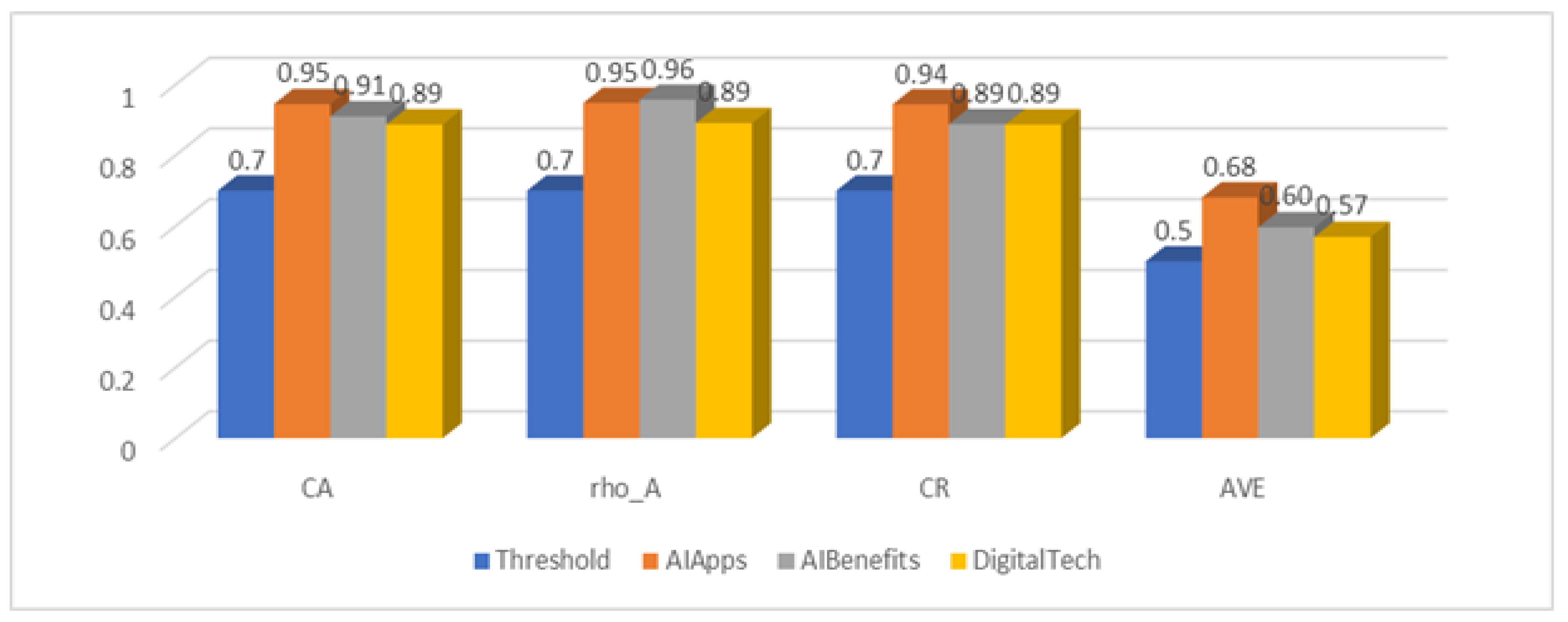
Table 1.
Description of variables.
| Variable/ Construct | Subitems | Description |
|---|---|---|
| Successfully technologies used in sports. | ||
| Digital technology |
Cyclocomputer | Advanced cyclo-computer with GPS, powermeter, muscle oxygen tracker (Laser, 2022).[10] |
| Running pod | Running bridge, pulse belts in athletics (Skrzetuska & Szablewska, 2023).[3] | |
| SensorBall | Smart pedals/balls etc (with sensors) (Eager et al., 2022, Rennane et al., 2018). [4,18] | |
|
Watches & Cameras |
Smart Watches, Training Forearms, Communicator Coach, Neoprene Suit for swimming, Underwater Cameras [5,11,12,19,20,21,22,23](Shigehiro, 2017; Hermosilla et al., 2020, Aroganam și colab., 2019, Bernardina, 2017, Bernardina et al., 2016; Ulsamer & Rust, 2014, Gay, 2023, Kwon & Casebolt, 2006). | |
| VAR | VAR, HawK-Eye, Catalyst, Track160, Playform, Pixellot, BlazePot, Pico [23,24,25,26,27](Kwon & Casebolt, 2006; Hafeez, 2022; Ezhov et al., 2021, Hoffman, 2020, Wilk et al., 2023, Lentz-Nielsen, N. Madeleine, P., 2023) | |
| Coach Apps | Coach Apps [28] (Andreea, 2022) | |
| The benefits of introducing artificial intelligence (AI) and machine learning (ML) to sports | ||
| AI benefits | Trends | Applying ML algorithms, trends and relationships between data collected from sports can be identified [3,4,5,6,29](Skrzetuska & Szablewska, 2023, Eager et al., 2022, Gay, 2023, Cust et al. 2019, Li & Huang) |
| TrainingPlans | Design training plans tailored to each athlete’s needs and goals. [2,9](Horvat & Josip, 2020, Hyun, 2021). | |
| ErrCorect | Real-time performance analysis by monitoring parameters useful for correcting errors [1,2](Ferreira et al., 2022, Hyun, 2021) | |
| TalentEval | Talent assessment through MLalgorithms [7] (Sulaiman & Azaman, 2022) | |
| RiskFactors | Identify risk factors and training patterns to minimize the risk of injury [2,8,17](Hyun, 2021, Amendolara et al., 2023, Tedesco & all, 2022). | |
| Tactics | ML algorithms can help coaches and athletes optimize game strategies [9] (Horvat & Josip, 2020). | |
| Successfully AISportSuite used in Sports. | ||
| AISport Suite |
AIOfficiate (Emphasizes rule enforcement and refereeing decisions via AI), SmartPlanner (Focuses on AI-based individualized training design), TrackIntelli (Captures performance tracking and physiological monitoring), TalentScoutAI (Targets AI-supported talent identification and player analysis), GamePredictAI (Clarifies the predictive analytics for game outcomes), TicketBot (Reflects ticketing, event logistics, or access control automation), MediaAssistAI (Refers to AI use in automated sports journalism or media generation), AIThinkTank (Abstract or strategic AI applications, including simulations or conceptual design) |
|
| Athletes’ Perfor- mance |
National Team Involvement | The athlete’s selection/role within the national team structure / Global-level selection or participation |
| International Selection | ||
| CapsCount | Caps as a player at European level | |
| National Level Best | Athlete’s peak result at the national level | |
| EuropeanLevelBest | Athlete’s peak result at the European level | |
| WorldLevelBest | Highest performance achieved globally (e.g., World Championships or Olympics) | |
Table 2.
Discriminant validity.
| Fornell-Larcker Criterion | AISportSuite | AI benefits | DigitalTech |
|---|---|---|---|
| AISportSuite | 0.825 | ||
| AI benefits | 0.211 | 0.772 | |
| DigitalTech | 0.707 | 0.252 | 0.754 |
| Performance | 0.229 | 0.009 | 0.268 |
Table 3.
One-Way ANOVA (Welch’s) AISPORTSUITE.
| Variable | F | df1 | df2 | p |
|---|---|---|---|---|
| AIOfficiate | 8.7293 | 1 | 108 | 0.004 |
| SmartPlanner | 3.1366 | 1 | 117 | 0.079 |
| TrackIntelli | 3.5817 | 1 | 118 | 0.061 |
| TalentScoutAI | 1.0899 | 1 | 115 | 0.299 |
| GamePredictAI | 4.3708 | 1 | 109 | 0.039 |
| TicketBot | 0.0371 | 1 | 121 | 0.848 |
| MediaAssistAI | 1.3677 | 1 | 110 | 0.245 |
| AIThinkTank | 6.5773 | 1 | 116 | 0.012 |
Table 4.
One-Way ANOVA (Welch’s) by sport, profession, gender and education.
| Football vs Basket | Profession | Gender | Education | |||||||||||||
|---|---|---|---|---|---|---|---|---|---|---|---|---|---|---|---|---|
| Variables | F | df1 | df2 | P | F | df1 | df2 | P | F | df1 | df2 | P | F | df1 | df2 | p |
| TechUsed | 0.918 | 1 | 126 | 0.34 | 1.247 | 4 | 122 | 0.29 | 0.797 | 1 | 75.4 | 0.37 | 0.69 | 3 | 32.4 | 0.56 |
| AISportSuite | 17.80 | 1 | 219 | < .001 | 0.362 | 4 | 116 | 0.83 | 3.347 | 1 | 82.3 | 0.07 | 4.44 | 3 | 61.8 | 0.007 |
| TechAdv | 0.852 | 1 | 120 | 0.358 | 2.114 | 4 | 125 | 0.08 | 2.895 | 1 | 256.2 | 0.09 | 5.49 | 3 | 37.7 | 0.003 |
Disclaimer/Publisher’s Note: The statements, opinions and data contained in all publications are solely those of the individual author(s) and contributor(s) and not of MDPI and/or the editor(s). MDPI and/or the editor(s) disclaim responsibility for any injury to people or property resulting from any ideas, methods, instructions or products referred to in the content. |
© 2025 by the authors. Licensee MDPI, Basel, Switzerland. This article is an open access article distributed under the terms and conditions of the Creative Commons Attribution (CC BY) license (http://creativecommons.org/licenses/by/4.0/).
Copyright: This open access article is published under a Creative Commons CC BY 4.0 license, which permit the free download, distribution, and reuse, provided that the author and preprint are cited in any reuse.


