

Submitted:
15 July 2025
Posted:
16 July 2025
You are already at the latest version
Abstract
New distribution data on Sphagnum species have led to the need for re-evaluation of their conservation status. The article presents the conservation status assessment of Romania’s Sphagnum species, carried out according to the latest IUCN criteria. Based on the analyzed data, 34 Sphagnum species are confirmed for Romania, one species requires confirmation, and 5 species are rejected. Over the past two years, three Sphagnum species were published as new to Romania. The re-evaluation of the conservation status of Sphagnum species in Romania has led to the assessment of eight threatened species, fewer than in the previous assessments.
Keywords:
Sphagnum
; threatened species
; peat bogs
; bryophytes
; biodiversity conservation
; Romania
1. Introduction
The genus Sphagnum has attracted the attention not only of bryologists, but also of all botanists, ecologists, conservationists, palynologists, and climate change researchers. Sphagnum L. species are included in the EU Habitats Directive, Annex V, except for S. pylaesii Brid., which is listed in Annex II (Directive 92/43/CEE) [1].
Comprising over 300 species worldwide, genus Sphagnum represents one of the most significant moss groups in wetland ecosystems and is crucial to the creation and upkeep of peat bogs because it retains water and acidifies the environment, which prevents organic matter from decomposing and encourages the buildup of peat [2,3,4]. Peat bogs store significant amounts of carbon (covering about 3% of the land surface), provide refuge for numerous rare species, and are considered priority ecosystems at the European level [5,6]. However, these habitats face significant threats from drainage, peat extraction, and climate change, all of which adversely impact biodiversity and the ecosystem services they provide. Consequently, as habitat builders, species of the genus Sphagnum have aroused major interest in attempts to combat the effects of climate change through large-scale restoration and reconstruction actions.
The Institute of Biology Bucharest has participated in the restoration of 23 peat bogs in the last ten years, an activity financed by four EEA grants. An additional 23 peat bogs have been restored in Romania by other institutions participating in the national peat bog restoration program, financed by the Ministry of Environment, Waters and Forests through the EEA - Environment Program. Furthermore, ongoing monitoring and adaptive management techniques are necessary due to the dynamic nature of peatland habitats under anthropogenic pressures and climate change.
The International Union for Conservation of Nature`s (IUCN) criteria, which incorporate variables such as population size, demographic trends, distribution region, and particular threats, are used to do the conservative assessment of Sphagnum species [7,8]. The re-evaluation of the conservation status of these species and their habitats has become crucial in recent years due to growing anthropogenic pressures, habitat degradation, and the availability of new dispersion data. This reassessment is critical to ensure the long-term persistence of Sphagnum species within Romania and to inform efficient conservation strategies.
Bryological research in Romania began over 200 years ago, reflecting the log-standing scientific interest in the country`s bryophyte flora. The first book in which Sphagnum species were reported was published in 1846 [9], where Baumgarten J.C.G. cites five species: Sphagnum capillifolium (Ehrh.) Hedw., S. compactum Lam. & DC., S. cuspidatum Ehrh. ex Hoffm., S. palustre L., and S. squarrosum Crome. Since then, over 2,000 articles on bryophyte species in Romania have been published, several hundred of which focus on Sphagnum species. The most comprehensive work appeared in 1998 and describes 32 Sphagnum species from Romania [10] (pp. 30–89).
Over time, 40 Sphagnum species have been published for Romania, of which five have been rejected. The conservation status of Romania’s bryophyte was assessed in 2012 [11], 2019 [7], and 2020 [12], reflecting changes in distribution patterns, habitat conditions, and emerging threats.
In Romania, the Sphagnum species are dominant in the habitats: Active raised bogs (NATURA 2000 code: 7110), Transition mires and quaking bogs (NATURA 2000 code: 7140), Bog woodland (NATURA 2000 code: 91D0), frequent in Depressions on peat substrates of the Rhynchosporion habitat (NATURA 2000 code: 7150), and are pioneer species in Degraded raised bogs still capable of natural regeneration habitat (NATURA 2000 code: 7120) [1]. Also, the Sphagnum species are frequent in mountain forests, especially in spruce fir forests, in subalpine bushes, in subalpine meadows or on mountain wet rocks, up to 2,500 m a.s.l. The Sphagnum species have been reported in Blanket bogs habitat (NATURA 2000 code: 7130) [1], but this type of habitat does not occur in Romania.
In this paper, we present the updated list of Sphagnum species recorded in Romania, accompanied by a reassessment of their conservation status based on the latest IUCN criteria and recent field data, aiming to support ongoing conservation efforts.
2. Materials and Methods
The list of Sphagnum species in Romania was compiled using literature, herbaria, open access databases [13] and field data during the period 2001-2025, especially 2021-2025.
More than 60 peatlands across Romania were investigated, as:
- Maramureș County: Vlășchinescu Peatbog, Hărnicești Peatbog, Tăurile Chendroaiei (Tăul de la Gutâi) Peatbog;
- Suceava County: Lucina-Găina Peatbog, Tinovul de lângă drum - Lucina Peatbog, Lucina Est Peatbog, Lucina Vest Peatbog, Poiana Stampei Peatbog, Pilugani Peatbog, Tinovul cel mare de la Coșna Peatbog, Tinovul Jinului Peatbog, Tinovul Românești Peatbog, Teșna Peatbog, Bahnele Bancului I Peatbog, Bahnele Bancului II Peatbog, Șaru Dornei Peatbog;
- Bistrița-Năsăud County: Drăgoiasa Peatbog, Grădinița Peatbog, Larion Peatbog;
- Călimani Mountains: Iezer Lake Peatbogs;
- Harghita County: Mohoș Peatbog, Sâncrăieni-Sântimbru Peatbogs, Dumbrava Harghitei Peatbog;
- Siriu Mountain: Lacul cu ochi Peatbog;
- Buzău County: Manta Lake Peatbog;
- Prahova County: Bâlbâitoarea Peatbog;
- Bucegi Mountains: Nucet Peatbog, Lăptici Peatbog – Blana Valley, Lăptici II – Scândurilor Valley Peatbog, the peatbogs of Lăptici Valley;
- Ierzer-Păpușa Mountains: Iezer Lake Peatbogs;
- Sibiu County: Mlaca Tătarilor Peatbog, Lacul lui Vizante Peatbog, Avrig Peatbogs;
- Făgăraș Mountains: Zârna Lake Peatbogs, Podragu Lake Peatbogs, Capra Lake Peatbogs, Bâlea Lake Peatbogs, Puha Valley Peatbogs;
- Vâlcea County: Mosoroasa Peatbog;
- Șureanu Mountain: Iezerul Șureanu Peatbog;
- Parâng Mountains: Câlcescu (Gâlcescu) Peatbog, Gaura Valley Peatbogs;
- Hunedoara County: Peșteana Peatbog;
- Retezat Mountains: Bucura Lake Peatbogs, Lia Lake Peatbogs, Galeș Lake Peatbogs; Tăul dintre Brazi Peatbog; Poiana Pelegii Peatbog;
- Țarcu Mountains: Mătania Valley Peatbogs;
- Mehedinți County: Tăul fără fund de la Poiana Mare-Obârșia Peatbog; Mlaștina în trepte din Poiana Mare Obârșia Cloșani Peatbog; Tăul fără fund de la Busești, Gornenți Peatbog;
- Apuseni Mountains: Molhașul cel mare de la Izbuc Peatbog;
- Gilău Mountains: Molhașul de la Călățele Peatbog; Dâmbu Negru-Între Drumuri Peatbog; Negrușul Finciului-Rovina Mare Peatbog.
The RoBioAtlas (2023) web application [14] was used to create the investigated peatlands map (Figure 1). The Web Application uses GPS Coordinates (WGS 84) to generate species / habitats / ecosistems distribution maps for Romania.
The conservative assessment was carried out according to Guidelines for Using the IUCN Red List Categories and Criteria, Version 16 [8]. The assessment of Sphagnum taxa in Romania was carried out at the species level. The Sphagnum species, which in previous assessments [11,12] were included in the categories DD – Data Deficient (three species) and NE – Not Evaluated (one species) were re-evaluated in this study.
In assessing the conservation status of Sphagnum species, the following were also taken into account: peatlands fragmentation in Romania [15] and peatlands current threats to peatlands, including climate change [16].
The Sphagnum species nomenclature is according to Hodgetts et al. (2020) [17].
No generative artificial intelligence (GenAI) has been used in this paper.
3. Results
3.1. Sphagnum Species Rejected to Romania
Over time, five Sphagnum species published for Romania have been rejected: S. annulatum H. Lindb. ex Warnst., S. molle Sull., S. pulchrum (Lindb. ex Braithw.) Warnst., S. pylaesii Brid. [10,18] and S. magellanicum Brid. [19].
Sphagnum annulatum was reported from Poiana Stampei Peatbog, Romania, 25.05.1925, leg. & det. Papp C., and Dofteana Valley, Târgu Ocna, Romania, 6.08.1951, leg. & det. Papp C. [20], rev. Plămadă E., as. S. fallax (H. Klinggr.) H. Klinggr. [10]; from Poiana Stampei Peatbog, 11.05.1957, leg. & det. Papp C. [20], rev. Plămadă E., as. S. flexuosum Dozy & Molk. [10] and from Poiana Stampei Peatbog, 20.05.1957, 15.05.1959, leg. & det. Papp C. [20], rev. Plămadă E., as. S. angustifolium (C.E.O. Jensen ex Russow) C.E.O. Jensen [10]. In the BUCA Herbarium we found Sphagnum annulatum samples from Poiana Stampei Peatbog, Romania, 25.07.1925, leg. & det. Papp C., but are S. angustifolium, rev. Ștefănuț M.-M., 29.02.2025, BUCA B6875.
Sphagnum molle was reported from Poiana Stampei Peatbog, Romania, 23.07.1925, 20.05.1956, 15.05.1959, leg. & det. Papp C. [20], rev. Plămadă E., as. S. fuscum (Schimp.) H. Klinggr. [10]. However, we have not found samples of S. molle by Papp C. in the BUCA Herbarium.
Between 2021 and 2024 we visited the Poiana Stampei Peatbog multiple times (Figure 2), but did not find the two species reported by Papp C., Sphagnum annulatum or S. molle.
Sphagnum pulchrum was reported from Lăptici Peatbog, Bucegi Mountains, Southern Carpathians, Romania, 13.07.1940, leg. Cretzoiu P., det. Papp C., rev. Plămadă E., as S. quinquefarium (Braithw.) Warnst., FRE 2393 [10]. The samples of S. pulchrum from the BUCA herbarium are all S. quinquefarium, rev. Ștefănuț M.-M., 20.05.2025, BUCA B6982-B6985.
We visited Lăptici Peatbog, Bucegi Mountains, in 2022 and 2025 (Figure 3), but did not find Sphagnum pulchrum.
Sphagnum pylaesii was reported in 1972 by Debreczy Z. from the Retezat Mountains at Lia Lake, Ana Lake and Bucura Lake [21]. The samples were revised by Lange B. as S. platyphyllum (Lindb. ex Braithw.) Warnst. [22]. In 1999, Jakab G. reported S. pylaesii from Tăul lui Dumitru Peatbog, Maramureș County, Romania, leg. Jakab G., det. E. Szurdoki [23], later revised by E. Szurdoki as S. platyphyllum.
We visited the peatbogs near Lia Lake and Bucura Lake, Retezat Mountains, in August 2024 (Figure 4), but did not find Sphagnum pylaesii.
Sphagnum magellanicum was previously reported as a common species in Europe, but proved to be restricted only to South America; in Europe, only S. medium Limpr. and S. divinum Flatberg & K. Hassel are present [19].
3.2. Sphagnum Species to Be Confirmed for Romania
The first report of Sphagnum jensenii H. Lindb. was in 1959 from a small peatbog on Sărăcinul Mic Valley, Lotru Mountains, Southern Carpathians, 1260 m a.s.l., leg. Ștefureac T., Lungu L. & Popescu A., 1955-1956, det. Ștefureac T. [24]. Currently, the habitat is covered by water from the Vidra hydropower Lake. For this reason, we can say that this site of S. jensenii is extinct in Romania.
The second report of S. jensenii was in 1973 from Cristișor-Neagra Broștenilor Peatbog, Suceava County, leg. & det. Lungu L. [25].
Other S. jensenii reports have been included as synonyms of S. annulatum, which were later not confirmed or rejected. The presence of the species S. jensenii must be confirmed; until then we will evaluate the species as uncertain to Romania and include it in DD – Data Deficient category.
3.3. Sphagnum Species Confirmed to Romania
Sphagnum affine Renauld & Cardot was reported from Molhașul de la Râșca Peatbog, Văleni, Cluj County, Romania, 920-940 m a.s.l., 25.10.1915, leg. & det. Győrffy I., Péterfi M., as S. imbricatum Hornsch. var. cristatum Warnst. fo. fuscescens Warnst. BP 7450/S, 7451/S [26], rev. Ștefănuț M.-M. [27] (Figure 5). This was first confirmed report of S. affine to Romania. S. imbricatum was reported also from Mohoș Peatbog, Harghita County [28], but we didn’t find herbarium samples for checking. In the old reports of S. imbricatum were included S. affine and S. austinii Sull.
After almost 100 years, S. affine was found in Molhașul de la Râșca Peatbog, 1070 m a.s.l., 46.70849°N, 23.05224°E, 26.07.2013, leg. Sass-Gyarmati A., Jakab G., det. Sass-Gyarmati A., 2014, EGR, CL, published on 30.06.2025 [29], BUCA B12946, conf. Ștefănuț M.-M., 23.06.2025.
3.4. New Sphagnum Species Recently Published for Romania
Sphagnum divinum Flatberg & K. Hassel was reported as new to Romania in 2024 from Tinovul de lângă drum Peatbog, Lucina, Suceava County, 1159 m a.s.l., 19.10.2023, leg. & det. Ștefănuț M.-M., BUCA B12274, B12275 [30] (Figure 7a). This species was found in other peatbogs as well: Tăul Obcioarei Peatbog, Maramureș Mountains, 47.684861°N, 24.536667°E, 1043 m a.s.l., 2014, leg. Goia I., det. Flatberg K.I., TRH B96689/1; Găina-Lucina Peatbogs, Suceava County, 47.647309°N, 25.195054°E, 1164 m a.s.l., 2014, leg. Goia I., det. Flatberg K.I., TRH B96691/1; Corund, Hargita County, 46.504176°N, 25.254747°E, 954 m a.s.l. 7.08.2024, leg. Nagy Z., det. Czołczyński B. [13]; Padiș-molidiș Peatbog, Molhașul cel mare de la Izbuc Peatbog, Molhașul de la Călățele, Mluha Peatbog [29]; Iezerul Șureanu Peatbog, Șureanu Mountains, 45.580971°N, 23.508663°E, 1735 m a.s.l., 29.07.2021, leg. & det. Ștefănuț S., BUCA B12331; Șaru Dornei Peatbog, Suceava County, 47.258928°N, 25.356447°E, 902 m a.s.l., 4.09.2023, leg. & det. Ștefănuț M.-M., BUCA B12294; Teșna Românești Peatbog, Suceava County, 47.365580°N, 25.137234°E, 868 m a.s.l., 5.09.2023, leg. & det. Ștefănuț M.-M., BUCA B12292; Găina-Lucina Peatbogs, Suceava County, 47.647370°N, 25.195349°E, 1163 m a.s.l., 19.10.2023, leg. & det. Ștefănuț M.-M., BUCA B12458; Coșna Peatbog, Suceava County, 47.374197°N, 25.167738°E, 858 m a.s.l., 20.10.2023, leg. & det. Ștefănuț M.-M., BUCA B12282, 19.09.2024, leg. Ștefănuț S., det. Ștefănuț M.-M., BUCA B12326, B12327; Pilugani Peatbog, Suceava County, 47.341472°N, 25.167588°E, 872 m a.s.l., 10.04.2024, leg. & det. Ștefănuț M.-M., BUCA B12308; Tăurile Chendroaiei Peatbog, Gutâi Mountains, 47°42'35.63"N, 23°50'8.50"E, 1057 m a.s.l., 20 April 2024, leg. & det. M-M. Ștefănuț, BUCA B12487; Hărnicești Peatbog, Maramureș County, 47.808603°N, 23.826399°E, 1007 m a.s.l., 21.04.2024, leg. & det. Ștefănuț M.-M., BUCA B12289, B12390, B12391; Peșteana Peatbog, Hunedoara County, 45.543508°N, 22.806266°E, 518 m a.s.l., 24.08.2024, leg. Ștefănuț S., det. Ștefănuț M.-M., BUCA B12357, B12358, B12366, B12368- B12372, 08.05.2025, leg. & det. Ștefănuț M.-M., BUCA B12481; Tăul fără fund de la Poiana Mare-Obârșia Peatbog, Mehedinți County, 45.048267°N, 22.663262°E, 1035 m a.s.l., 06.05.2025, leg. Moroșanu A.-M., Ștefănuț M.-M., det. Ștefănuț M.-M., BUCA B12483-B12486; Bâlbâitoarea Peatbog, Prahova County, 45.389099°N, 26.104811°E, 863 m a.s.l., 26.06.2025, leg. Moroșanu A.-M., Ștefănuț S., det. Ștefănuț M.-M., BUCA B12490; Mlaca Tătarilor Peatbog, Sibiu County, 45.715082°N, 24.650163°E, 541 m a.s.l., 12.03.2025, leg. Moroșanu A.-M., Ștefănuț M.-M., det. Ștefănuț M.-M., BUCA B12347 (Figure 7b).
Sphagnum medium Limpr. was reported as new to Romania in 2024 from Avrig Peatbog, Avrig, Sibiu County, 405 m a.s.l., 12.03.2024, leg. & det. Ștefănuț M.-M., BUCA B12280 (Figure 8a); Tinovul de lângă drum Peatbog, Lucina, Suceava County, 1160 m a.s.l., 19.10.2023, leg. & det. Ștefănuț M.-M., BUCA B12283; Tăul de la Gutâi Peatbog, Gutâi Mountains, Maramureș County, 1057 m a.s.l., 9.10.2023, leg. Moroșanu A.-M., det. Ștefănuț M.-M., BUCA B12293 [31]; Vlășchinescu Peatbog, Maramureș County, Romania, 885 m a.s.l., 19.04.2024, leg. & det. Ștefănuț M.-M. [27]; Molhașurile Căpățînii, Mluha Peatbog [29]. This species was also found in Mohoș Peatbog, Harghita County, 46.136389°N, 25.902778°E, 1051 m a.s.l., 2014, leg. Goia I., det. Flatberg K.I., TRH B96689/1 [13]; Mlaca Tătarilor Peatbog, Sibiu County, 45.715082°N, 24.650163°E, 541 m a.s.l., 29.04.2011, leg. & det. Ștefănuț S., BUCA B4364; Pilugani Peatbog, Suceava County, 47.341555°N, 25.167579°E, 872 m a.s.l., 10.04.2024, leg. & det. Ștefănuț M.-M., BUCA B12418- B12422 (Figure 8b); Peșteana Peatbog, Hunedoara County, 45.543156°N, 22.806419°E, 517 m a.s.l., 24.08.2024, leg. Ștefănuț S., det. Ștefănuț M.-M., BUCA B12373- B12375, B12417, 8.05.2025, leg. Moroșanu A.-M., Ștefănuț M.-M., det. Ștefănuț M.-M., BUCA B12488; Bâlbâitoarea Peatbog, Prahova County, 45.389376°N, 26.105351°E, 863 m a.s.l., 26.06.2025, leg. Moroșanu A.-M., Ștefănuț S., det. Ștefănuț M.-M., BUCA B12491.
3.5. Conservation Status of the Sphagnum Species in Romania
Using literature, herbarium, and field data, we were able to re-evaluate the Sphagnum species in Romania. The evaluation was carried out in accordance with the latest IUCN version of guidelines [8].
For the conservation status assessment of the Sphagnum species in Romania, the extent of occurrence (EOO), area of occurrence (AOO), number of locations, habitat fragmentation, population size, conservation status of peatlands, threats and pressures, age of the reporting data, and the range of the species in Europe and the world were taken into account.
So far, we have identified 34 Sphagnum species with a certain presence in Romania, while one species remains to confirmed and until then, it is included in DD – Data Deficient category.
4. Discussion
Of the 34 Sphagnum species with certain distribution in Romania, eight are endangered at the national level. Among the threatened species category, three are classified as CR – Critically Endangered, four as EN – Endangered and one species as VU – Vulnerable.
The conservation status of the species Sphagnum wulfianum was changed from EN B2b(iii,iv); C1 to CR A1c, due to the fact that, although it has been reported from several bogs in Romania, the data are very old and, the species has not been found in the last 50 years. We have searched for this species in the peat bogs where it was previously reported (Coșna, Poiana Stampei and Drăgoiasa Peatbogs), but have not found it so far. The species is located in Romania at the southernmost limit of its global range. Future research will help clarify the actual conservation status of this species.
The conservation status of Sphagnum papillosum has been changed from CR B1ab(ii,iii)+B2ab(ii,iii) to EN B2ab(ii,iii,iv), as the species has been recorded from three new sites in the last eight years. We believe that the species is much more widespread than currently known and further research could lead to its assessment as vulnerable VU B2ab(ii,iii,iv), NT – Near Threatened or perhaps even LC – Least Concern. A similar situation applies to Sphagnum majus, S. obtusum, and S. tenellum, which, following improved field research, may no longer be included in the threatened categories.
New distribution data for the species Sphagnum auriculatum and S. inundatum have led to their classification in the NT category.
Among all Sphagnum species we have confirmed 30 species in the field, while five species remain to be confirmed in the field: S. affine, S. cuspidatum, S. jensenii, S. obtusum, and S. wulfianum. Of these, S. affine, S. cuspidatum and S. obtusum have been confirmed to Romania based on herbarium samples.
5. Conclusions
The new distribution data makes the assessments of the conservation status of Sphagnum species in Romania constantly changing. The existing information gap due to the limited number of specialists capable of accurately identifying Sphagnum species, the lack of published studies, the extensive work still required, and the large number of peat bogs (over 300), that should be reassessed at the national level.
We hope that, by the end of the doctoral research period, in 2028, a clearer picture of the distribution of Sphagnum species in Romania will emerge, along with improved assessment of them from a conservative point of view. Additionally, we anticipate that new species may be reported to Romania.
Even though Sphagnum species in Romania are included in Annex V of the Habitats Directive and do not require legal protection, we considered that the species assessed here as threatened: Sphagnum affine, S. balticum, S. majus, S. obtusum, S. papillosum, S. subfulvum, S. tenellum, and S. wulfianum should be included on the list of nationally protected species. From these, Sphagnum balticum, S. subfulvum, S. tenellum, and S. wulfianum are priority species.
Supplementary Materials
The following supporting information can be downloaded at the website of this paper posted on Preprints.org, Figure S1: title; Table S1: title.
Author Contributions
Conceptualization, S.Ș., M.-M.Ș.; methodology, M.-M.Ș., S.Ș.; field investigation, M.-M.Ș., S.Ș., A.-M.M.; writing—original draft preparation, M.-M.Ș., S.Ș., A.-M.M.; projects administration, S.Ș. All authors have read and agreed to the published version of the manuscript.
Funding
This research was funded by project no. RO1567-IBB03/2025 through the Institute of Biology Bucharest of Romanian Academy and the EEA Grants: PeatRO2 (RO-ENVIRONMENT-0004), PeatRO3 (RO-ENVIRONMENT-0005) and PeatRO4 (RO-ENVIRONMENT-0014). The contribution of M.-M.Ș. is part of her doctoral thesis founded by the Romanian Academy. Open access funding by the Institute of Biology Bucharest of Romanian Academy.
Data Availability Statement
The data presented in this study are either available in the article, or available on request from the authors.
Acknowledgments
We thank to the Hungarian National Museum Public Collection Centre, Budapest, Hungarian Natural History Museum, Department of Botany, Bryophyte Collection, and to Papp B. for the photos of Sphagnum affine. We fully thank to Flatberg K.I. from Norwegian University of Science and Technology, Trondheim, Norway, for the help provided in identifying and confirming Sphagnum species from Romania.
Conflicts of Interest
The authors declare no conflicts of interest. The funders had no role in the design of the study; in the collection, analyses, or interpretation of data; in the writing of the manuscript; or in the decision to publish the results.
Abbreviations
The following abbreviations are used in this manuscript:
| BP | Hungarian National Museum Public Collection Centre, Budapest, Hungarian Natural History Museum, Hungary; Botanical Department, Bryophyte herbarium, S –Sphagnum collection |
| BUCA | Romanian Academy Herbarium, Institute of Biology Bucharest, Romania; B – Bryophyte herbarium |
| CL | Herbarium of Babeș-Bolyai University in Cluj-Napoca, Romania |
| EGR | Herbarium of Eszterházy Károly Catholic University in Eger, Hungary |
| EU | European Union |
| FRE | Flora Romaniae Exssicata |
| IUCN | The International Union for Conservation of Nature |
| TRH | Trondheim Herbarium, Norwegian University of Science and Technology Museum, Norway; B – Bryophyte herbarium |
References
- EU Habitats Directive. Council Directive 92/43/EEC of 21 May 1992 on the conservation of natural habitats and of wild fauna and flora. Off. J. Eur. Communities 1992, 206, 7–50.
- Shaw A.J., Goffinet, B. Eds. Bryophyte Biology, 2nd ed., Cambridge University Press: Cambridge, 2008; pp. 1–584. [CrossRef]
- Rydin, H.; Jeglum, J.K. The Biology of Peatlands, 2nd ed., Oxford University Press: Oxford, 2013; pp. 1–382. [CrossRef]
- Laine, J.; Flatberg, K.I.; Harju, P.; Timonen, T.; Laine, A.; Tuittila E.S.; Vasander, H.T. Sphagnum Mosses: The Stars of European Mires. Department of Forest Sciences, University of Helsinki, Sphagna Ky: Helsinki, 2018; pp. 1-326.
- Loisel, J.; Gallego-Sala, A.V.; Amesbury, M.J.; Magnan, G.; Anshari, G.; Beilman, D.W.; Benavides, J.C.; Blewett, J.; Camill, P.; Charman, D.J.; Chawchai, S.; Hedgpeth, A.; Kleinen, T.; Korhola, A.; Large, D.; Mansilla, C.A.; Müller, J.; van Bellen, S.; West, J.B.; Yu, Z.; Bubier, J.L.; Garneau, M.; Moore, T.; Sannel, A.B.K.; Page, S.; Väliranta, M.; Bechtold, M.; Brovkin, V.; Cole, L.E.S.; Chanton, J.P.; Christensen, T.R.; Davies, M.A.; De Vleeschouwer, F.; Finkelstein, S.A.; Frolking, S.; Galka, M.; Gandois, L.; Girkin, N.; Harris, L.I.; Heinemeyer, A.; Hoyt, A.M.; Jones, M.C.; Joos, F.; Juutinen, S.; Kaiser, K.; Lacourse, T.; Lamentowicz, M.; Larmola, T.; Leifeld, J.; Lohila, A.; Milner, A.M.; Minkkinen, K.; Moss, P.; Naafs, B.D.A.; Nichols, J.; O'Donnell, J.; Payne, R.; Philben, M.; Piilo, S.; Quillet, A.; Ratnayake, A.S.; Roland, T.P.; Sjögersten, S.; Sonnentag, O.; Swindles, G.T.; Swinnen, W.; Talbot, J.; Treat, C.; Valach, A.C.; Wu, J. Expert assessment of future vulnerability of the global peatland carbon sink. Nat. Clim. Chang. 2021, 11, 70–77. [CrossRef]
- Bonn, A.; Allott, T.; Evans, M.; Joosten, H.; Stoneman, R. Peatland Restoration and Ecosystem Services: Science, Policy and Practice. Cambridge University Press: Cambridge, 2016, pp. 1–510. [CrossRef]
- Hodgetts, N.; Cálix, M.; Englefield, E.; Fettes, N.; García Criado, M.; Patin, L.; Nieto, A.; Bergamini, A.; Bisang, I.; Baisheva, E.; Campisi, P.; Cogoni, A.; Hallingbäck, T.; Konstantinova, N.; Lockhart, N.; Sabovljevic, M.; Schnyder, N.; Schröck, C.; Sérgio, C.; Sim Sim, M.; Vrba, J.; Ferreira, C.C.; Afonina, O.; Blockeel, T.; Blom, H.; Caspari, S.; Gabriel, R.; Garcia, C.; Garilleti, R.; González Mancebo, J.; Goldberg, I.; Hedenäs, L.; Holyoak, D.; Hugonnot, V.; Huttunen, S.; Ignatov, M.; Ignatova, E.; Infante, M.; Juutinen, R.; Kiebacher, T.; Köckinger, H.; Kučera, J.; Lönnell, N.; Lüth, M.; Martins, A.; Maslovsky, O.; Papp, B.; Porley, R.; Rothero, G.; Söderström, L.; Ștefănuț, S.; Syrjänen, K.; Untereiner, A.; Váňa, J.; Vanderpoorten, A.; Vellak, K.; Aleffi, M.; Bates, J.; Bell, N.; Brugués, M.; Cronberg, N.; Denyer, J.; Duckett, J.; During, H.J.; Enroth, J.; Fedosov, V.; Flatberg, K.-I.; Ganeva, A.; Gorski, P.; Gunnarsson, U.; Hassel, K.; Hespanhol, H.; Hill, M.; Hodd, R.; Hylander, K.; Ingerpuu, N.; Laaka-Lindberg, S.; Lara, F.; Mazimpaka, V.; Mežaka, A.; Müller, F.; Orgaz, J.D.; Patiño, J.; Pilkington, S.; Puche, F.; Ros, R.M.; Rumsey, F.; Segarra-Moragues, J.G.; Seneca, A.; Stebel, A.; Virtanen, R.; Weibull, H.; Wilbraham, J.; Żarnowiec, J. A miniature world in decline: European Red List of Mosses, Liverworts and Hornworts. IUCN: Brussels, Belgium, 2019; pp. 1–87. [CrossRef]
- IUCN Standards and Petitions Committee. Guidelines for Using the IUCN Red List Categories and Criteria. Version 16. Prepared by the Standards and Petitions Committee. 2024. Downloadable from https://www.iucnredlist.org/documents/RedListGuidelines.pdf (accessed on 18 June 2025).
- Baumgarten, J.C.G. Enumeratio stirpium magno Transsylvaniae Principatui praeprimis indigenarum in usum nostrum botanophilorum conscripta inque ordinem sexuali-naturalem concinnata, Sibiu, Romania, 1846; pp. 1–236.
- Plămadă, E.. Flora briologică a României. Musci; Presa Universitară Clujeană, Cluj-Napoca, Romania, 1998; Volume 1(1), pp. 1–230.
- Ștefănuț, S.; Goia, I. Checklist and Red List of Bryophytes of Romania. Nova Hedwigia 2012, 95, 59–104. [CrossRef]
- Hodgetts, N.G.; Lockhart, N. Checklist and country status of European bryophytes – update 2020. Irish Wildlife Manuals, No. 123. National Parks and Wildlife Service, Department of Culture, Heritage and the Gaeltacht, Ireland, 2020; pp. 1–214.
- GBIF.org (03 July 2025) GBIF Occurrence Download https://doi.org/10.15468/dl.mpxrr2. [CrossRef]
- RoBioAtlas, 2023. Romanian Atlas Web App for Biology - Open Access. Available online: https://www.teon.ro/robioatlas/index.html (accessed on 2025.7.9).
- Pop, E. Mlaștinile de turbă din Republica Populară Romînă, Editura Academiei Republicii Populare Romîne: Bucharest, Romania, 1960; pp. 1–514.
- Joosten, H.; Tanneberger, F.; Moen, A. Eds. Mires and peatlands of Europe: Status, distribution and conservation, E Schweizerbart'sche Verlagsbuchhandlung: Stuttgart, Germany, 2017; pp. 1–780.
- Hodgetts, N.G.; Söderström, L.; Blockeel, T.L.; Caspari, S.; Ignatov, M.S.; Konstantinova, N.A.; Lockhart, N.; Papp, B.; Schröck, C.; Sim-Sim, M.; Bell, D.; Bell, N.E.; Blom, H.H.; Bruggeman-Nannenga, M.A.; Brugués, M.; Enroth, J.; Flatberg, K.I.; Garilleti, R.; Hedenäs, L.; Holyoak, D.T.; Hugonnot, V.; Kariyawasam, I.; Köckinger, H.; Kučera, J.; Lara, F.; Porley R.D. An annotated checklist of bryophytes of Europe, Macaronesia and Cyprus. J. Bryol. 2020, 42, 1–116. [CrossRef]
- Dihoru, G. Review of the bryophyte research in Romania. Phytol. Balcan. 2004, 10, 167–170.
- Hassel, K.; Kyrkjeeide, M.O.; Yousefi, N.; Prestø, T.; Stenøien, H.K.; Shaw A.J.; Flatberg K.I. Sphagnum divinum (sp. nov.) and S. medium Limpr. and their relationship to S. magellanicum Brid. J. Bryol. 2018, 40, 197–222. [CrossRef]
- Papp, C. Briofitele din Republica Socialistă România (determinator). Anal. Şti. Univ. "Al. I. Cuza" Iaşi Biol. Monogr. 1967, 3, 1–319.
- Debreczy, Z. Az atlanti-boreális Sphagnum pylaesii Brid. a Kárpátokban. Bot. Közlem. 1972, 59, 159–171.
- Lange, B. Additional Notes on the Distribution of Sphagnum pylaesii, The Bryologist 1977, 80, 527–529.
- Jakab, G. Contribution to the knowledge of the Bryophyte Flora of the SE Carpathians (Romania). Stud. Bot. Hung. 1999, 29, 49–57.
- Ștefureac, T.; Lungu, L.; Popescu, A. Specii de Sphagnum din cîteva sfagnete de pe Valea Lotrului. Comunicările Academiei R.P.R. 1959, 9, 39–44.
- Lungu, L. Analiza brioflorei din lunca Borcutului de la Cristişor-Neagra Broştenilor (Carpaţii Orientali). Anal. Univ. București Ser. Biol. Veg. 1973, 22, 69–76.
- Győrffy, I .; Péterfi, M. Schedae et animadversiones diversae ad "Bryophyta regni Hungariae exsiccata, edita a sectione botanica Musei Nationalis Transsilvanici". Tom. II. – III. No. 51–150 (Sphagna). Bot. Múz. Füzetek 1919, 3, 43–74.
- Sabovljević, M.S.; Tomović, G.; Sabovljević, A.D.; Kunev, G.; Palpurina, S.; Kutnar, L.; Ilchev, I.; Assyov, B.; Djordjević, V.; Papp, B.; Dragićević, S.; Szűcs, P.; Stanković, S.; Mežaka, A.; Shivarov, V.V.; Ștefănuț, M.-M. New records and noteworthy data of plants, algae and fungi in SE Europe and adjacent regions, 21. Compr. Pl. Biol. 2025, 49, 131–146. [CrossRef]
- Pop, E. Mlaştinile de turbă din Republica Populară Romînă, Editura Academiei: Bucharest, Romania, 1960; pp. 1–514.
- Sass-Gyarmati, A.; Jakab. G.; Magyari-Sáska, Z.; Frink, J.P. Bryofloristic researches with new records in selected peatlands of the Apuseni Mountains (Western Romanian Carpathians). AgroLife Sci. J. 2025, 14, 172–190. [CrossRef]
- Tomović, G.; Sabovljević, M.S.; Djordjević, V.; Krdžić, S.; Niketić, M.; Šovran, S.; Knežević, A.; Szűcs, P.; Stoykov, D.; Ștefănuț, M.-M.; Vidaković, D.; Krizmanić, J.; Ranimirović, M.; Buzurović, U.; Milivojević, L.; Vukojičić, S.; Kutnar, L.; Kuzmanović, N.; Stevanoski, I.; Trbojević, I.; Šinžar Sekulić, J. New records and noteworthy data of plants, algae and fungi in SE Europe and adjacent regions, 16. Bot. Serbica 2024, 48, 93–104. [CrossRef]
- Tomović, G.; Sabovljević, M.S.; Stoykov, D.; Niketić, M.; Boycheva, P.; Kaschieva, M.; Vidaković, D.; Krizmanić, J.; Djordjević, V.; Krdžić, S.; Škondrić, S.; Knežević, J.; Perić, R.; Assyov, B.; Jenačković Gocić, D.; Raca, I.; Šovran, S.; Popović, S.; Pál Frink, J.; Sass-Gyarmati, A.; Ștefănuț, M.-M.; Sabovljević, A.D. New records and noteworthy data of plants, algae and fungi in SE Europe and adjacent regions, 18. Bot. Serbica 2024, 48, 285–296. [CrossRef]
- Wilbraham, J.; Afanasjeva, L.V.; Ali Sk, N.; Álvaro-Alba, W.R.; Aponte-Rojas, A.M.; Bednarek-Ochyra, H.; Baráth, K.; Bell, N.; Boiko, L.M.; Boiko, M.F.; Cerrato, M.D.; Cimerman, Ž.; Csiky, J.; Cuerdo, M.; Danga, B.Vr.; Enroth, J.; Erzberger, P.,; Flatberg, K.I.; Garilleti, R.; Gil, L.; Gradstein, S.R.; Graulich, A.; Hugonnot, V.; Hsu, Y.-C.; Kariyawasam, I.; Krajewski, Ł.; Kucharzyk, J.; Lara, F.; Majumdar, S.; Mir-Rosselló, P.M.; Paul, M.; Pépin, F.; Porley, R.D.; Potočnik, K.; Raviya, R.D.; Ribas-Serra, A.; Schäfer-Verwimp, A.; Singh, D.; Singh, D.K.; Sipos, A.; Starzomski, B.M.; Ștefănuț, M.-M.; Ștefănuț, S.; Strgulc Krajšek, S.; Tucker, D.B.L.; Tubanova, D.Ya.; Uotila, P.; Vélez-Puerta, J.M.; Vončina, G.; Winter, G.; Yao, K.-Y. New national and regional bryophyte records, 81. J. Bryol. 2025. [CrossRef]
Figure 1.
Mean annul temperature map, Romania: the investigated peatlands (red dotts).
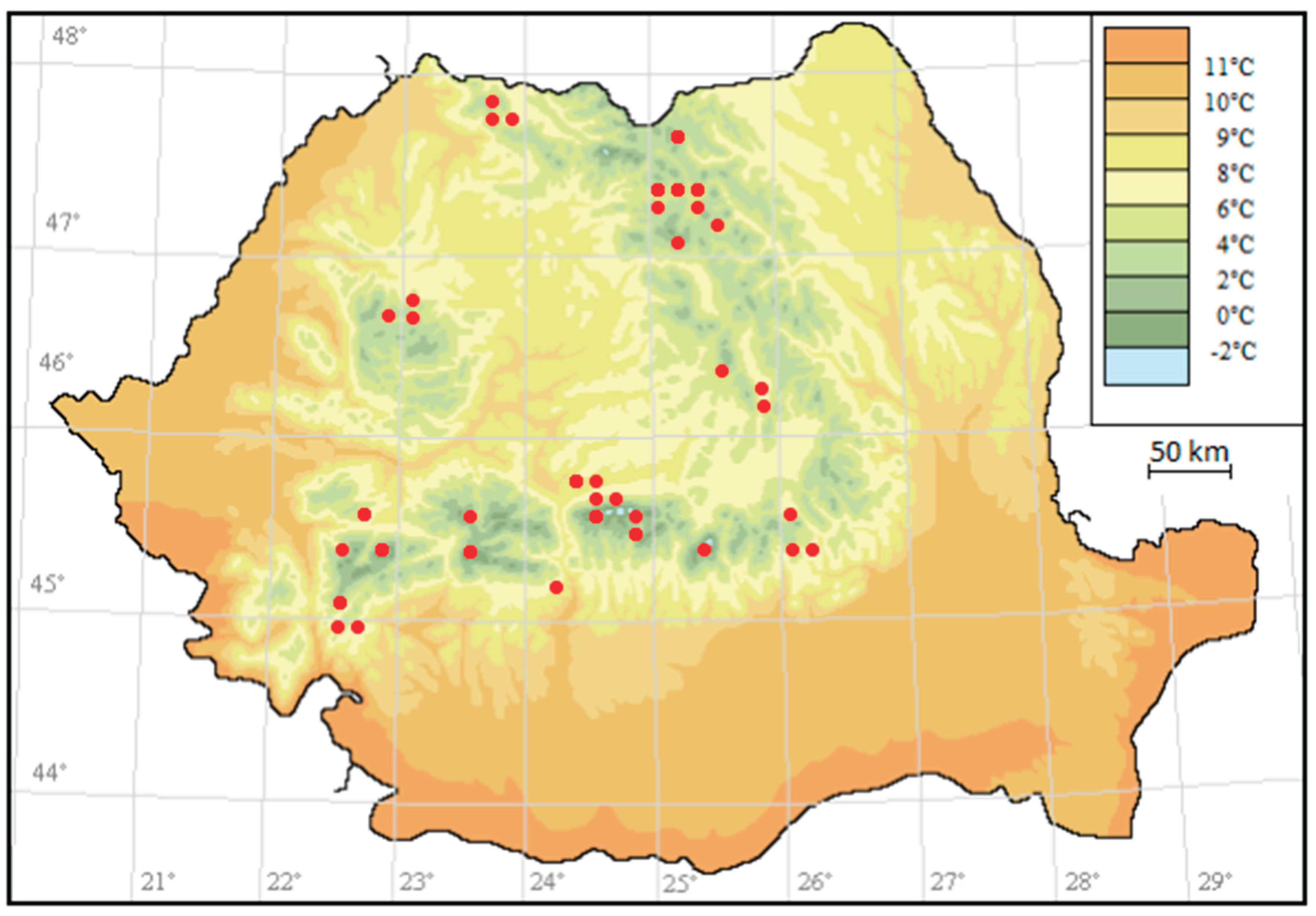
Figure 2.
Poiana Stampei Peatbog, Romania: (a) the wooden bridge, 19.09.2024; (b) Sphagnum area view, 19.09.2024.
Figure 2.
Poiana Stampei Peatbog, Romania: (a) the wooden bridge, 19.09.2024; (b) Sphagnum area view, 19.09.2024.
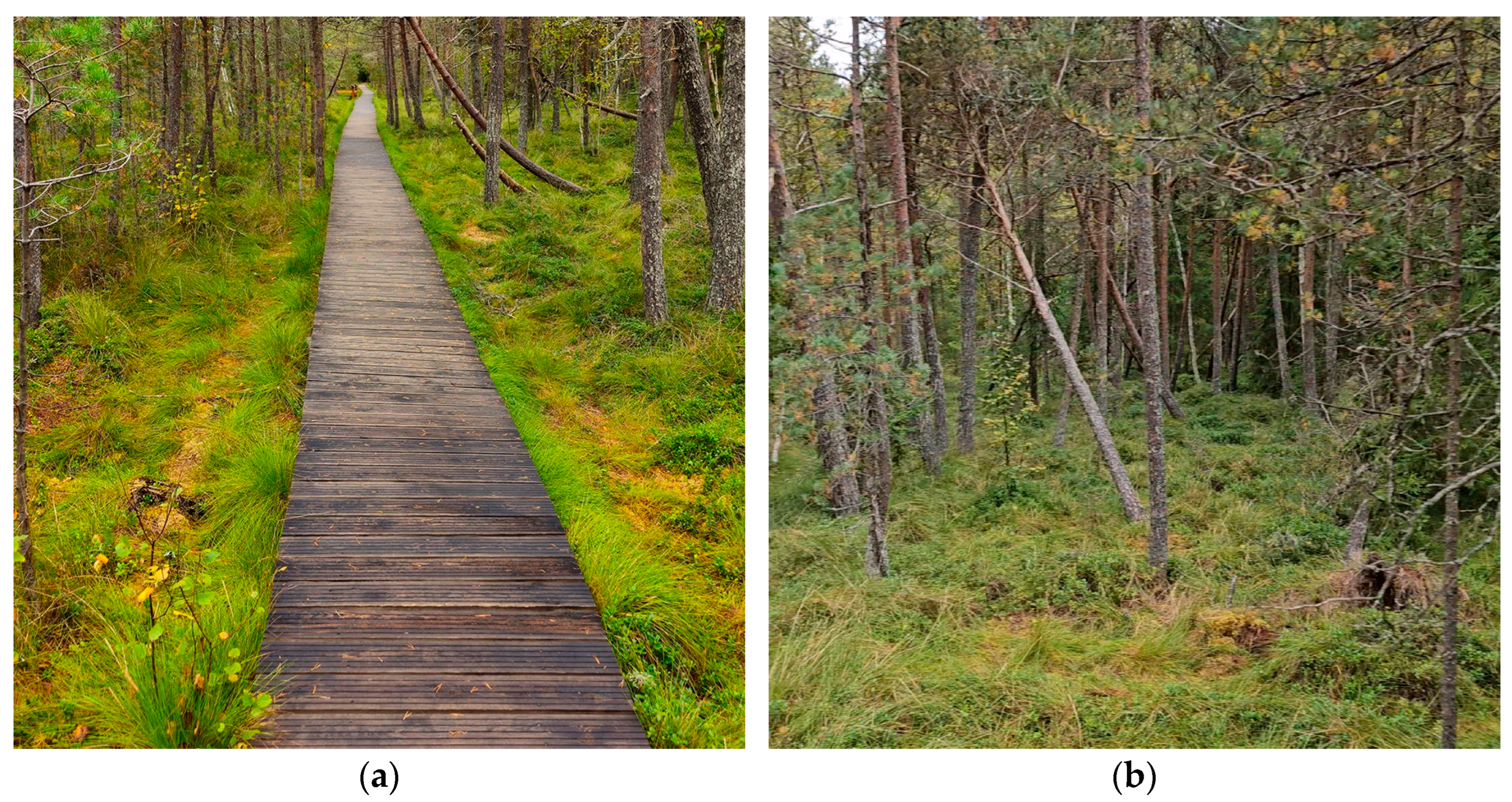
Figure 3.
Lăptici Peatbog, Romania, 12.06.2025: (a) Image from drone; (b) Sphagnum area view, the wooden bridge.
Figure 3.
Lăptici Peatbog, Romania, 12.06.2025: (a) Image from drone; (b) Sphagnum area view, the wooden bridge.
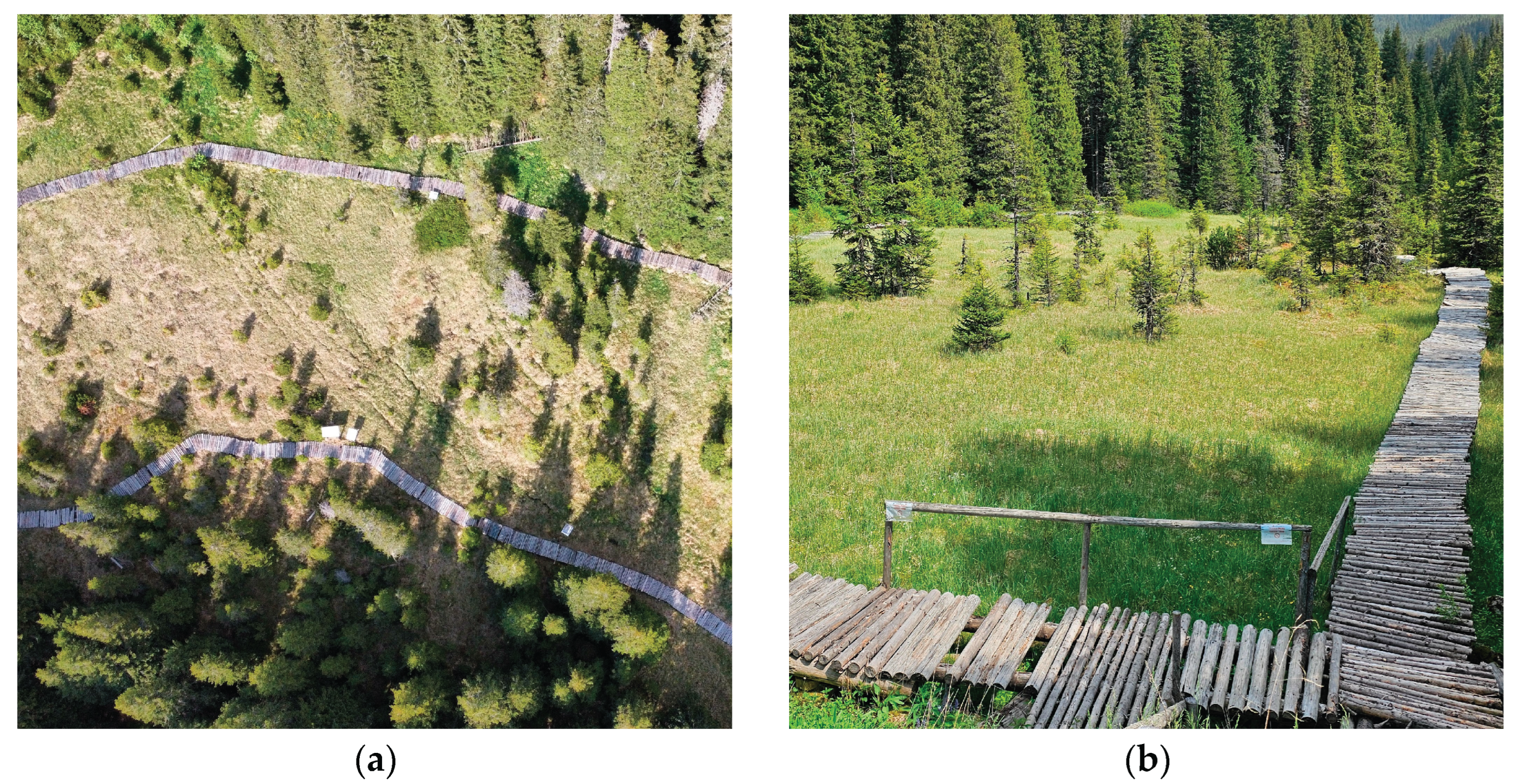
Figure 4.
Retezat Mountains, Romania, 24.08.2024: (a) The peatbog on the edge of Lia Lake; (b) Bucura Lake.
Figure 4.
Retezat Mountains, Romania, 24.08.2024: (a) The peatbog on the edge of Lia Lake; (b) Bucura Lake.
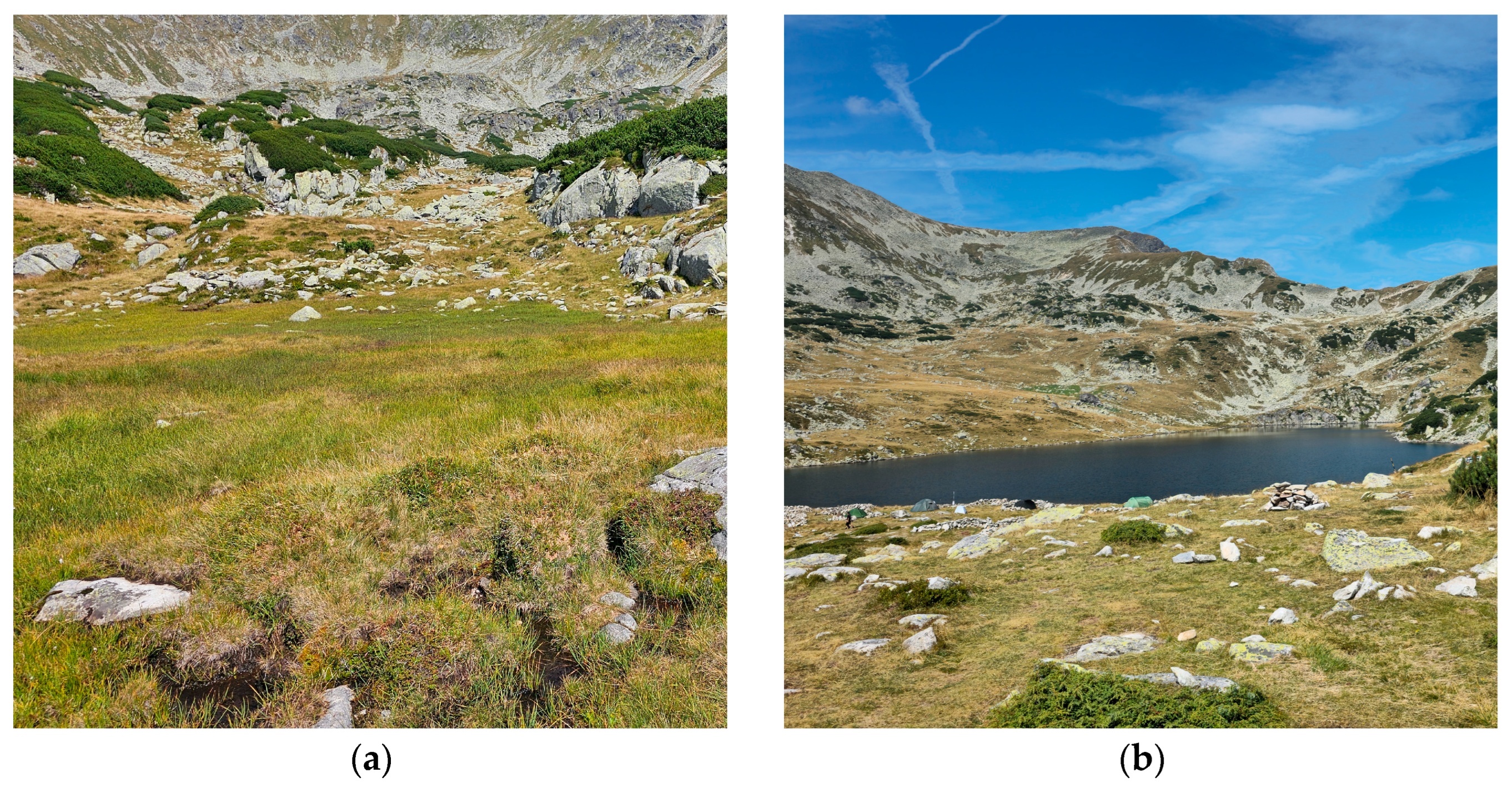
Figure 5.
Sphagnum affine, Romania: (a) S. affine from Văleni, Cluj, County, Romania, 25.10.1915 (photo Papp Beáta); (b) S. affine – transversal section on branch leaf (photo Papp Beáta).
Figure 5.
Sphagnum affine, Romania: (a) S. affine from Văleni, Cluj, County, Romania, 25.10.1915 (photo Papp Beáta); (b) S. affine – transversal section on branch leaf (photo Papp Beáta).
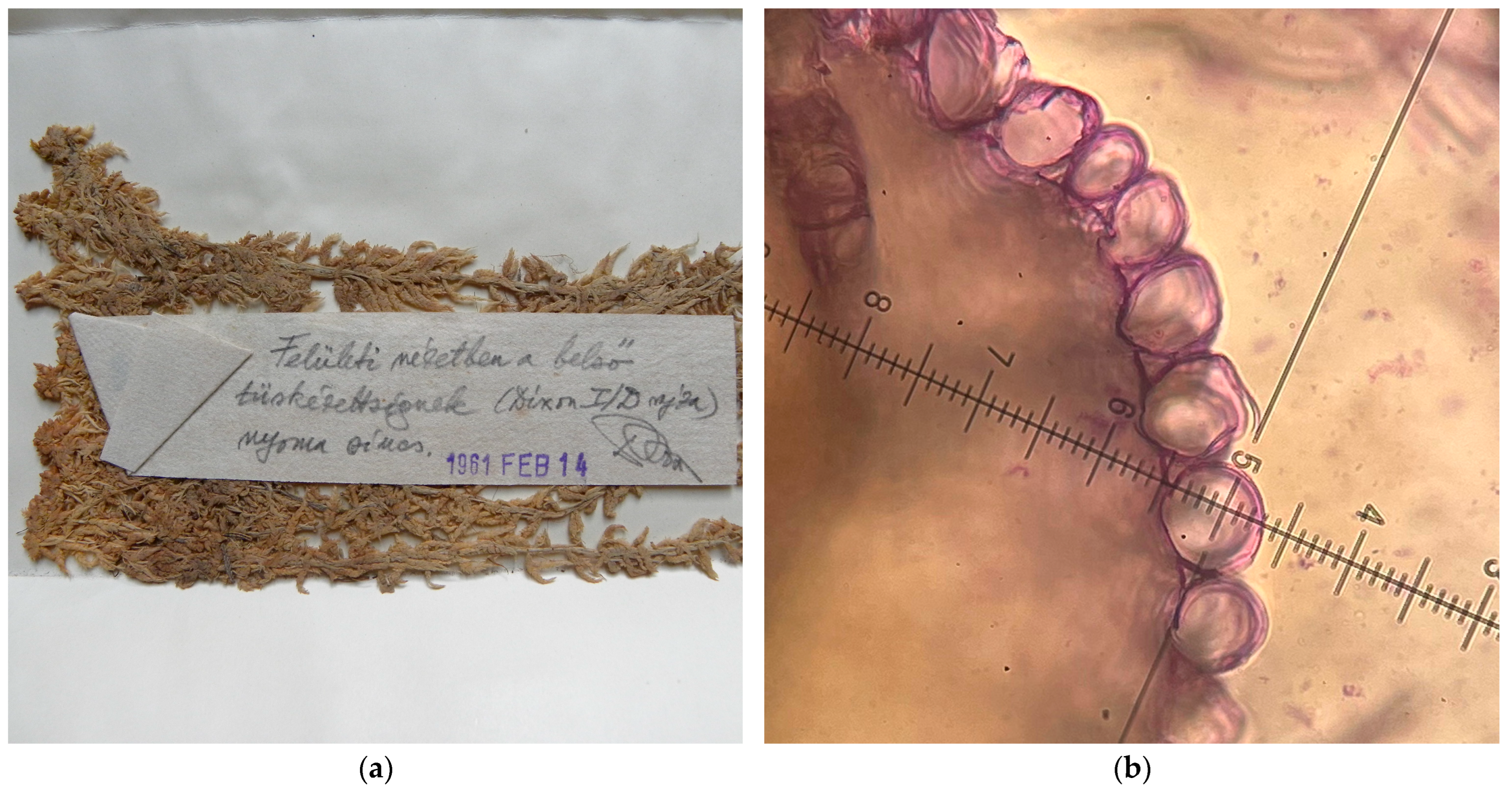
Figure 6.
Sphagnum papillosum in Vlășchinescu Peatbog, Romania, 19.04.2024: (a) Vlășchinescu Peatbog, Romania; (b) S. papillosum from Vlășchinescu Peatbog.
Figure 6.
Sphagnum papillosum in Vlășchinescu Peatbog, Romania, 19.04.2024: (a) Vlășchinescu Peatbog, Romania; (b) S. papillosum from Vlășchinescu Peatbog.
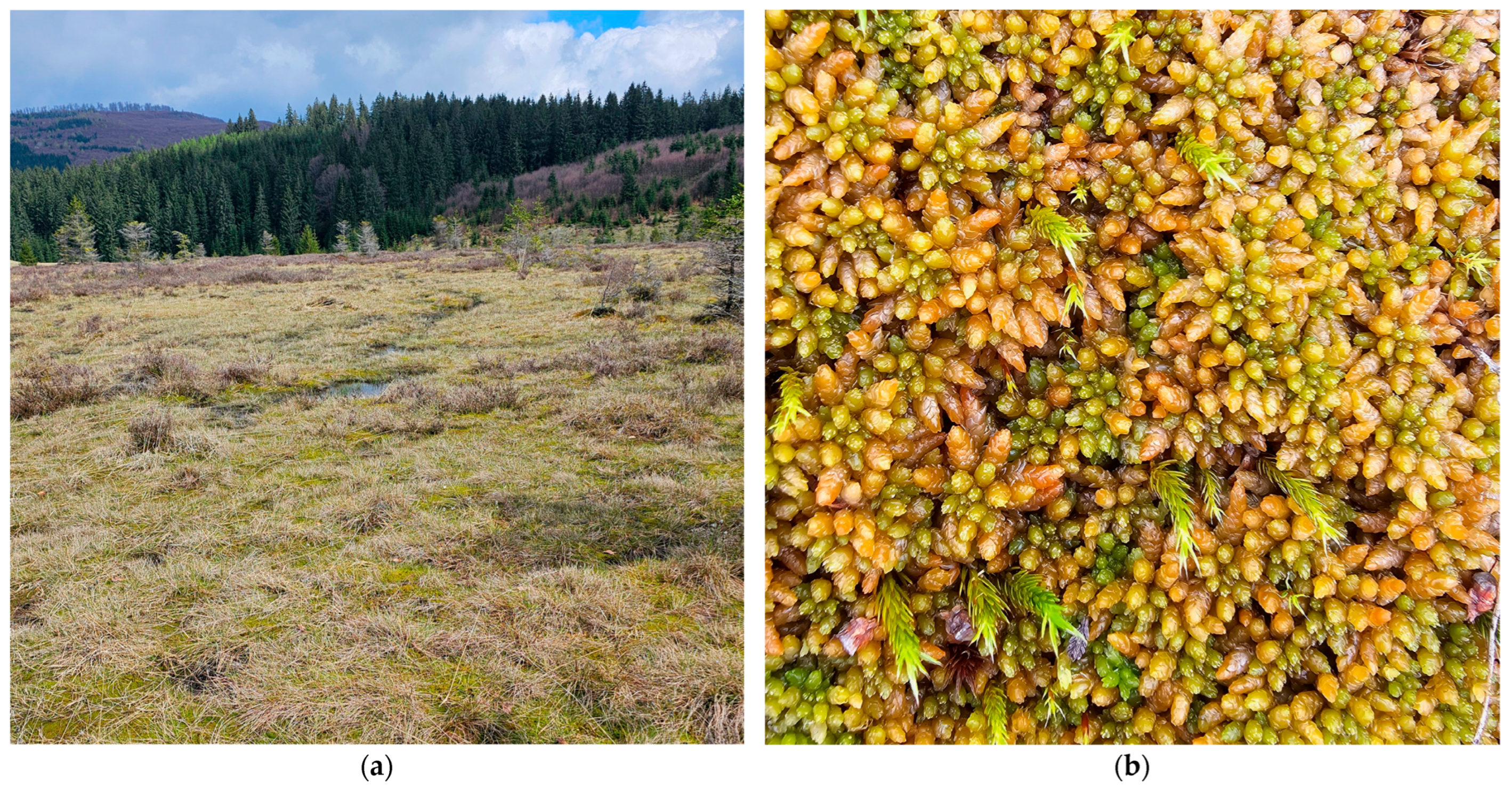
Figure 7.
Sphagnum divinum, Romania: (a) S. divinum, Tinovul de lângă drum Peatbog, Lucina, Suceava County, 19.10.2023; (b) S. divinum, Mlaca Tătarilor Peatbog, Sibiu County, 12.03.2025.
Figure 7.
Sphagnum divinum, Romania: (a) S. divinum, Tinovul de lângă drum Peatbog, Lucina, Suceava County, 19.10.2023; (b) S. divinum, Mlaca Tătarilor Peatbog, Sibiu County, 12.03.2025.
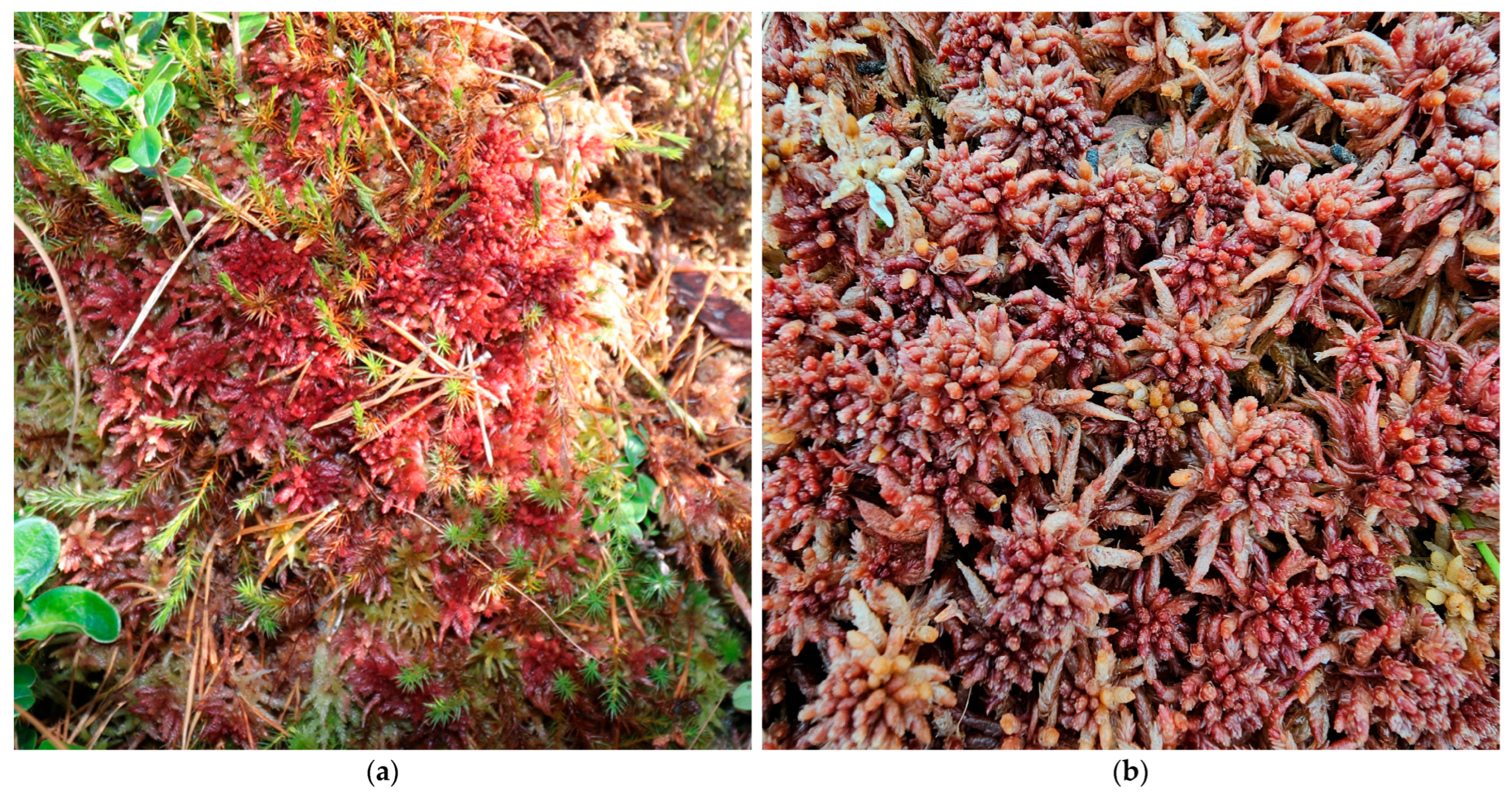
Figure 8.
Sphagnum medium, Romania: (a) S. medium from Avrig Peatbog, 12.03.2024.; (b) S. medium from Pilugani Peatbog, 10.04.2024.
Figure 8.
Sphagnum medium, Romania: (a) S. medium from Avrig Peatbog, 12.03.2024.; (b) S. medium from Pilugani Peatbog, 10.04.2024.
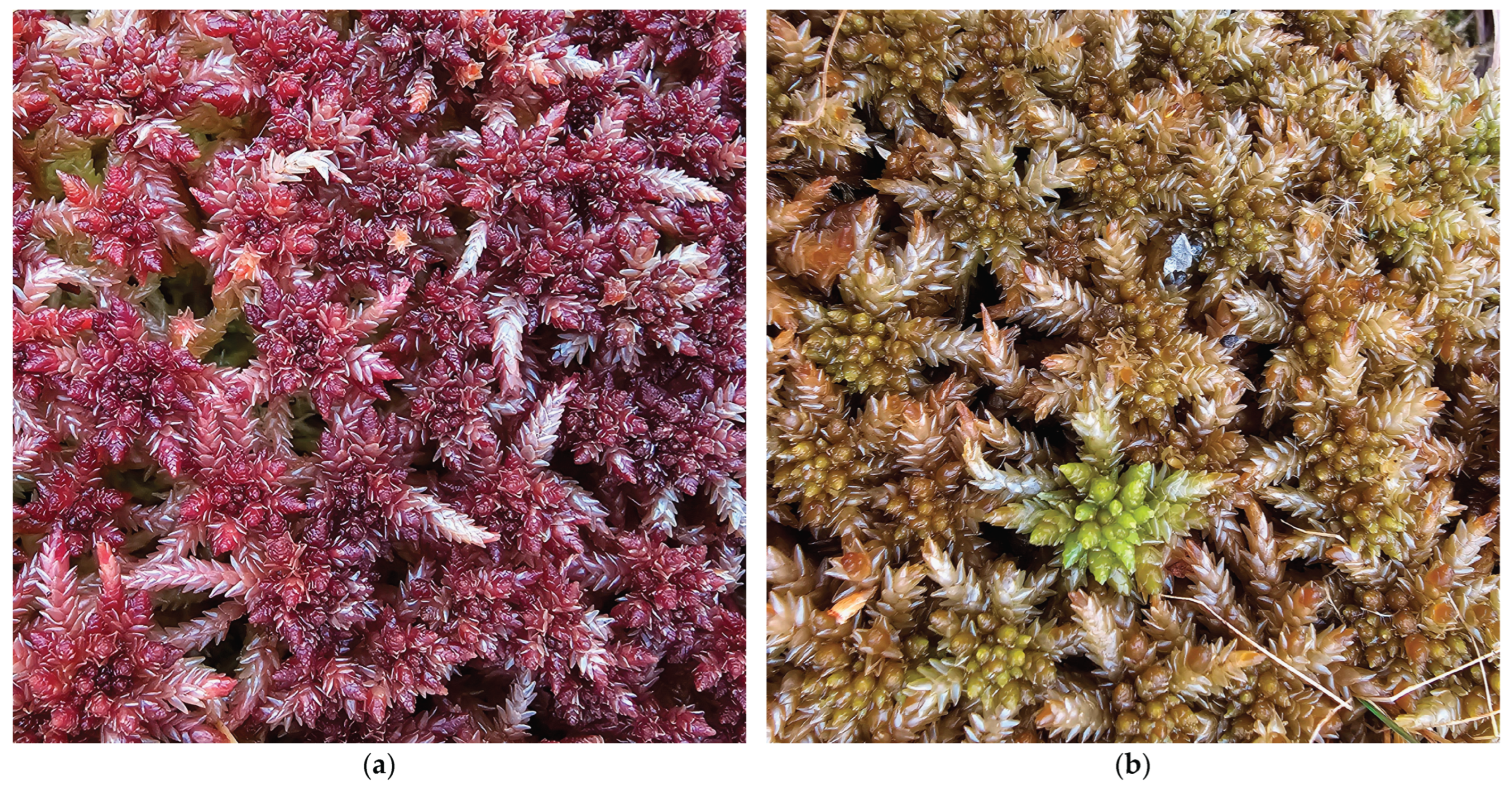
Figure 9.
Sphagnum subfulvum in Tăurile Chendroaiei Peatbog, Gutâi Mountains, Romania, 20.04.2024: (a) S. subfulvum (brown) and S. capillifolium (with red pigmentation); (b) S. subfulvum in front and S. medium in background.
Figure 9.
Sphagnum subfulvum in Tăurile Chendroaiei Peatbog, Gutâi Mountains, Romania, 20.04.2024: (a) S. subfulvum (brown) and S. capillifolium (with red pigmentation); (b) S. subfulvum in front and S. medium in background.
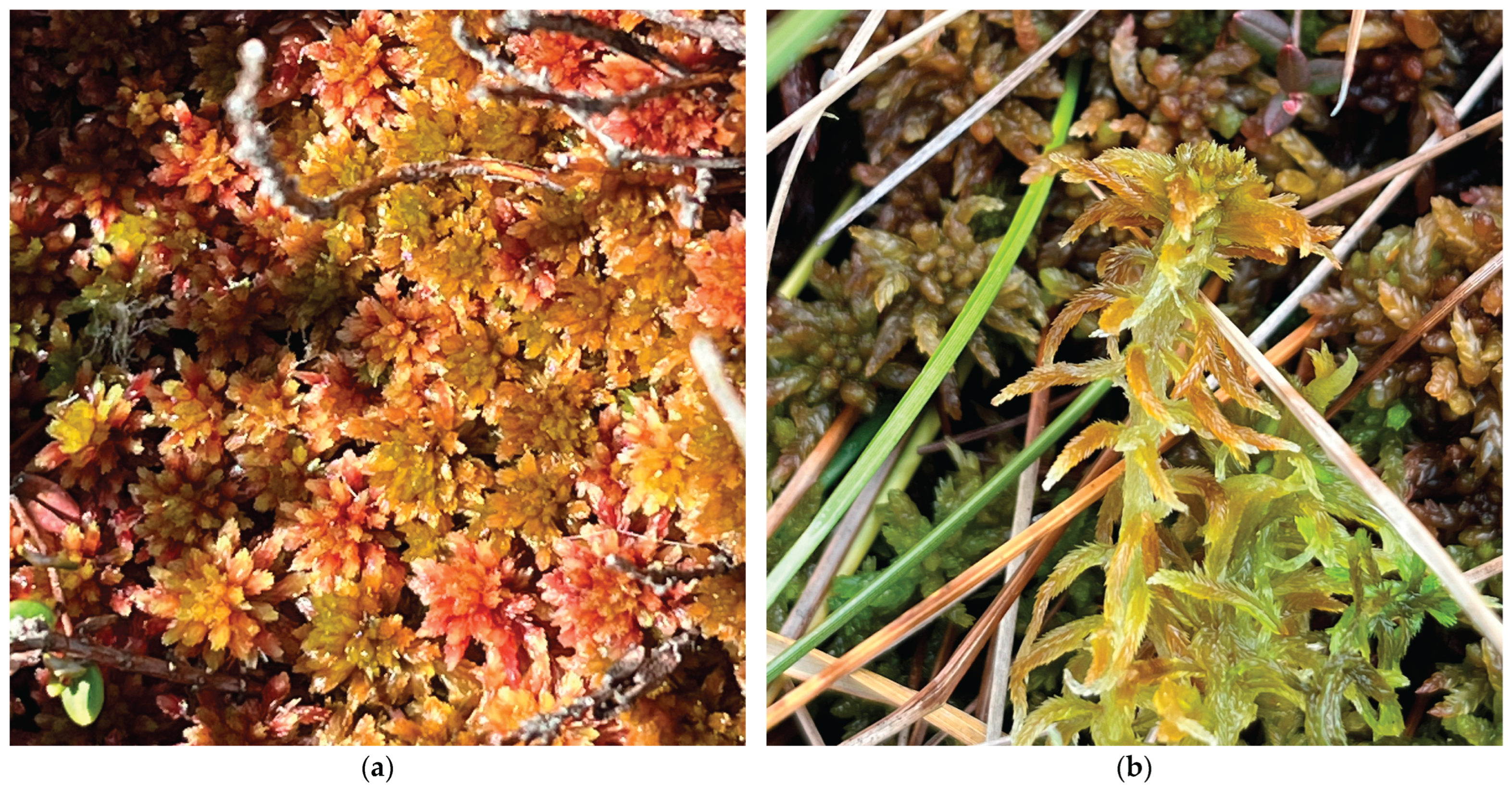

Table 1.
The checklist and red list of Sphagnum species of Romania.
| Taxon | Ștefănuț & Goia, 2012 | Hodgetts & Lockhart, 2020 | Present, 2025 |
| Subgenus Rigida (Lindb.) A. Eddy | |||
| Sphagnum compactum Lam. & DC. | LC | LC | LC |
| Subgenus Sphagnum | |||
| Sphagnum affine Renauld & Cardot | NE | NE | CR B1ab(ii,iii)+B2ab(ii,iii) |
| Sphagnum centrale C.E.O. Jensen | LC | LC | LC |
| Sphagnum divinum Flatberg & Hassel | - | - | LC |
| * Sphagnum magellanicum Brid. | LC | - | - |
| Sphagnum medium Limpr. | - | - | LC |
| Sphagnum palustre L. | LC | LC | LC |
| Sphagnum papillosum Lindb. | CR B1ab(ii,iii)+B2ab(ii,iii) | CR | EN B2ab(ii,iii,iv) |
| Subgenus Acutifolia (Russow) A.J. Shaw | |||
| Section Squarrosa (Russow) Schimp. | |||
| Sphagnum squarrosum Crome | LC | LC | LC |
| Sphagnum teres (Schimp.) Ångstr. | LC | LC | LC |
| Section Polyclada (C.E.O.Jensen) Horrell | |||
| Sphagnum wulfianum Girg. | EN B2b(iii,iv); C1 | EN | CR A1c |
| Section Acutifolia Wilson | |||
| Sphagnum capillifolium (Ehrh.) Hedw. | LC | LC | LC |
| Sphagnum fimbriatum Wilson | LC | LC | LC |
| Sphagnum fuscum (Schimp.) H. Klinggr. | LC | LC | LC |
| Sphagnum girgensohnii Russow | LC | LC | LC |
| * Sphagnum molle Sull. | DD | DD | - |
| Sphagnum quinquefarium (Braithw.) Warnst. | LC | LC | LC |
| Sphagnum rubellum Wilson | LC | LC | LC |
| Sphagnum russowii Warnst. | LC | LC | LC |
| Sphagnum subfulvum Sjörs | - | - | CR B1ab(ii,iii)+B2ab(ii,iii) |
| Sphagnum subnitens Russow & Warnst. | LC | LC | LC |
| Sphagnum warnstorfii Russow | LC | LC | LC |
| Subgenus Subsecunda (Lindb.) A.J. Shaw | |||
| Sphagnum auriculatum Schimp. | VU B2ab(ii,iii,iv) | VU | NT |
| Sphagnum contortum Schultz | LC | LC | LC |
| Sphagnum inundatum Russow | VU B2ab(ii,iii,iv) | VU | NT |
| Sphagnum platyphyllum (Lindb. ex Braithw.) Warnst. | NT | NT | NT |
| * Sphagnum pylaesii Brid. | - | - | - |
| Sphagnum subsecundum Nees | NT | NT | NT |
| Subgenus Cuspidata Lindb. | |||
| Sphagnum angustifolium (C.E.O. Jensen ex Russow) C.E.O. Jensen | LC | LC | LC |
| * Sphagnum annulatum H. Lindb. ex Warnst. | DD | DD | - |
| Sphagnum balticum (Russow) C.E.O. Jensen | EN B2ab(ii,iii,iv) | EN | EN B2ab(ii,iii,iv) |
| Sphagnum cuspidatum Ehrh. ex Hoffm. | LC | LC | LC |
| Sphagnum fallax (H. Klinggr.) H. Klinggr. | LC | LC | LC |
| Sphagnum flexuosum Dozy & Molk. | LC | LC | LC |
| Sphagnum jensenii H. Lindb. | EN B2ab(ii,iii,iv) | EN | DD |
| Sphagnum majus (Russow) C.E.O. Jensen | VU B2ab(ii,iii,iv) | VU | VU B2ab(ii,iii,iv) |
| Sphagnum obtusum Warnst. | EN B2ab(ii,iii,iv) | EN | EN B2ab(ii,iii,iv) |
| * Sphagnum pulchrum (Lindb. ex Braithw.) Warnst. | DD | DD | - |
| Sphagnum riparium Ångstr. | LC | LC | LC |
| Sphagnum tenellum (Brid.) Pers. ex Brid. | EN B2ab(ii,iii,iv) | EN | EN B2ab(ii,iii,iv) |
* Exluded species; CR – Critically Endangered; EN – Endangered; VU – Vulnerable; NT – Near Threatened; LC – Least Concern; DD – Data Deficient; NE – Not Evaluated; B1 – Extent of occurrence (EOO); B2 – Area of occurrence (AOO); a – Severely fragmented OR Number of locations; b – Continuing decline observed, estimated, inferred or projected in any of: (ii) area of occupancy, (iii) area, extent and/or quality of habitat, (iv) number of locations or subpopulations; A1c – Population reduction suspected for a decline in area of occupancy (AOO), extent of occurrence (EOO) and/or habitat quality; C1 – An observed, estimated or projected continuing decline.
Disclaimer/Publisher’s Note: The statements, opinions and data contained in all publications are solely those of the individual author(s) and contributor(s) and not of MDPI and/or the editor(s). MDPI and/or the editor(s) disclaim responsibility for any injury to people or property resulting from any ideas, methods, instructions or products referred to in the content. |
© 2025 by the authors. Licensee MDPI, Basel, Switzerland. This article is an open access article distributed under the terms and conditions of the Creative Commons Attribution (CC BY) license (http://creativecommons.org/licenses/by/4.0/).
Copyright: This open access article is published under a Creative Commons CC BY 4.0 license, which permit the free download, distribution, and reuse, provided that the author and preprint are cited in any reuse.


