

Submitted:
10 July 2025
Posted:
14 July 2025
You are already at the latest version
Abstract
A growing body of research emphasizes the importance of faculty support in shaping international students’ university experiences. However, the mechanisms linking faculty support to students’ sense of belonging remain underexplored. This study aimed to investigate the direct and indirect effects of faculty support on international students’ sense of belonging, focusing on the mediating roles of perceived campus climate and self-efficacy. Using a descriptive-correlational design, 512 international students (180 females, 332 males; M age = 25.28) enrolled in four public universities in Iran completed online questionnaires. Data were analyzed using Model 6 of Hayes' PROCESS macro in SPSS. Results indicated that Faculty support was significantly and positively associated with perceived campus climate, which in turn predicted students’ sense of belonging. However, neither the direct effect of faculty support on belonging nor the indirect effect through self-efficacy alone was significant. Although campus climate was positively related to self-efficacy, the serial mediation pathway through both mediators was not supported. The findings highlight the central role of a supportive campus climate in fostering international students’ belonging, whereas individual beliefs such as self-efficacy may play a less prominent role. The study underscores the importance of institutional and relational factors in enhancing the socio-emotional integration of international students in higher education.
Keywords:
international students
; faculty support
; sense of belonging
; campus climate
; self-efficacy
; higher education
1. Introduction
In recent years, universities around the world have increasingly prioritized internationalization and the recruitment of students from diverse national backgrounds. Iran has played a significant role in this movement, launching a range of initiatives over the past decade to attract international students. According to the Iranian Ministry of Science, Research, and Technology (MSRT), the number of international students enrolled in Iranian universities reached approximately 100,000 during the 2023–2024 academic year. The majority of these students originate from countries such as Iraq, Afghanistan, Pakistan, India, Syria, Lebanon, Yemen, and Palestine (Organization of Student Affairs, 2024).
International students encounter several challenges while studying abroad, including academic, social, and psychological difficulties (Hajar et al., 2025; Tajvar et al., 2024; Xue et al., 2025). Academically, language barriers often hinder their ability to understand and engage with coursework, leading to lower academic performance (Smith, 2020). Socially, adjusting to a new culture and forming new social networks can be daunting, resulting in feelings of isolation and loneliness (Girmay & Singh, 2019). Psychologically, the stress of being away from family and familiar surroundings can lead to anxiety and depression (Lin et al., 2022). Factors influencing these challenges include the degree of cultural distance, language proficiency, and the availability of support services (Smith, 2020). Additionally, the perceived inclusivity of the host institution and the availability of a supportive social network can help buffer the negative effects of these stressors (Smith, 2020).
A sense of belonging to the university is a critical factor that can significantly support international students in adapting to their new academic and social environments while alleviating the challenges they encounter. According to Strayhorn (2018, p. 27), a sense of belonging is defined as students’ perception of social support from the institution. It involves feelings of connection, being valued, accepted, respected, and recognized as integral members of the university community—including faculty, staff, and peers. A robust body of research indicates that students who report a strong sense of belonging tend to exhibit higher academic motivation, greater self-efficacy, increased engagement, enhanced academic performance, and overall psychological well-being (Pedler et al., 2022; Samadieh & Rezaei, 2024; Samadieh & Tanhaye Reshvanloo, 2023; van Kessel et al., 2025).
Given that belonging is a multifaceted, dynamic, and context-sensitive phenomenon, it is essential to examine the diverse factors influencing it across cultural and institutional settings. Previous research has identified the impact of academic variables (e.g., curriculum design, learner-centered activities, and academic engagement), individual factors (e.g., the satisfaction of basic psychological needs), and social dimensions (e.g., interpersonal relationships, social support, and perceptions of the university climate) on shaping students’ sense of belonging in higher education (Ahn & Davis, 2020; Samadieh et al., 2023a, 2023b, 2024a, 2024b; Shalka & Leal, 2022; Yong et al., 2025).
Although previous research has examined various factors associated with university belonging, important gaps remain. Much of the existing literature has focused predominantly on Western higher education contexts, with comparatively less attention given to underrepresented populations, such as racial and ethnic minorities, low-income students, and international students (Strayhorn, 2018). The present study seeks to address this gap by examining both individual and contextual factors that contribute to the university belonging experiences.
1.1. Faculty Support and Belonging to University
Perceived faculty support is a key social factor that influences students’ sense of belonging in higher education (Glass et al., 2015; Kim et al., 2023). Faculty members contribute not only to students’ academic development but also to their personal and emotional growth within the university setting. Beyond their instructional roles, professors often serve as mentors, facilitators, and sources of intellectual and emotional support, which can significantly affect students’ overall well-being (Tinto, 2012). Faculty support encompasses both academic and interpersonal assistance aimed at enhancing students’ educational experiences. Such support may take the form of accessibility, encouragement, constructive feedback, and the recognition of individual needs.
Research suggests that strong faculty–student relationships are associated with increased academic motivation, greater engagement, positive emotional experiences, and higher student retention (Bordbar, 2021; Raboca & Carbunarean, 2024; Reeve & Cheon, 2021). According to Tinto’s (2012) theory of student integration, a sense of belonging reflects students’ feelings of membership within the academic community and is significantly influenced by the degree of support they receive from institutional actors. When students establish meaningful and supportive connections with faculty, they are more likely to persist in their studies and successfully complete their academic programs (Severiens & Schmidt, 2009). Thus, faculty support represents a foundational component in cultivating students’ sense of belonging. As the literature indicates, meaningful faculty interactions can enhance academic success and institutional commitment. Accordingly, the following hypothesis is proposed:
H1.
There is a significant effect of faculty support on belonging to university.
1.2. The Mediating Role of Perceived Campus Climate
Perceived campus climate refers to students’ subjective evaluation of the university environment, including perceptions of inclusivity, institutional support systems, and the overall atmosphere for academic and social engagement (McQueen et al., 2023). Faculty support plays a significant role in shaping this perception, as professors who provide mentorship, accessibility, and encouragement contribute to a more welcoming and inclusive environment. Empirical studies suggest that when students perceive their professors as supportive and engaged, they are more likely to view the campus climate as equitable and conducive to learning, which subsequently enhances their overall university experience (Souza et al., 2019). For international students in particular, this perception is especially salient, as they often encounter challenges related to cultural adaptation and academic integration. In such contexts, institutional and interpersonal support mechanisms are critical for fostering a sense of belonging. A positive campus climate can reduce feelings of isolation, strengthen academic and social connections, and promote meaningful interactions with faculty and peers, ultimately reinforcing students’ attachment to the university community (Jean-Francois, 2019).
Several studies have examined the role of perceived campus climate in relation to important academic and psychological outcomes. For instance, a meta-analysis by Huang and Fan (2024) found a significant positive association between discriminatory campus climates and elevated levels of student stress and anxiety. Similarly, Berhanu and Sewagegn (2024) highlighted the critical influence of campus climate on academic engagement and performance. Moreover, research by Shalka and Leal (2022) demonstrated that students’ perceptions of a positive campus climate significantly predict their sense of belonging within the university context. Collectively, these findings suggest that faculty support affects how students evaluate their campus climate, which, in turn, influences their academic and social integration. Therefore, perceived campus climate may serve as a key mediating factor, linking faculty support to students’ psychological well-being, academic engagement, and sense of belonging. This highlights the importance of fostering inclusive and supportive institutional environments where faculty involvement contributes to positive student experiences and stronger university belonging. Accordingly, the following hypothesis is proposed:
H2
campus climate mediates the relationship between faculty support and belonging.
1.3. The Mediating Role of Self-Efficacy
The positive relationship between faculty support and belonging to university is well-established (Juarez, 2017; Kim et al., 2023); however, the underlying mechanisms of this association remain complex and not fully understood. One potential mediator in this relationship is self-efficacy, which significantly influences students’ confidence in their ability to succeed academically and socially (Çikrıkci, 2017). Drawing on Social Cognitive Theory (Bandura, 1986), self-efficacy is shaped through mastery experiences, vicarious learning, and verbal persuasion—all of which can be enhanced through faculty support (Daliri et al., 2021). When instructors provide mentorship, encouragement, and academic guidance, they offer positive reinforcement that can strengthen students’ belief in their capabilities (Nhien, 2025). In turn, higher levels of self-efficacy may contribute to a stronger sense of university belonging by encouraging greater engagement in academic and social activities, increasing participation in campus life, and reducing experiences of isolation and anxiety. While limited research has directly tested this mediation pathway, existing studies suggest that self-efficacy predicts academic persistence and social integration, supporting its role as a psychological link between faculty support and students’ sense of belonging. Accordingly, the following hypothesis is proposed:
H3
Self-efficacy mediates the relationship between faculty support and belonging to university.
1.4. The Serial Mediating Role of Perceived Campus Climate and Self-Efficacy
Previous studies have explored how school or campus climate influences students' self-efficacy (Museus et al., 2021; Zysberg & Schwabsky, 2021). Students' perception of campus climate plays a significant role in shaping their academic self-efficacy, as a supportive and inclusive environment fosters confidence in their ability to succeed. Evidence suggests that a positive campus climate—characterized by supportive faculty, peer inclusivity, and institutional responsiveness—enhances students’ belief in their academic capabilities (Zysberg & Schwabsky, 2021). According to Social Cognitive Theory, self-efficacy develops through social modeling, verbal persuasion, and emotional states, meaning that when students perceive their campus as welcoming and resourceful, they internalize a stronger sense of competence (Abd-Elmotaleb & Saha, 2013). Additionally, the Study-Demand-Resources (SD-R) model highlights that a favorable campus climate provides essential academic and social resources, reducing stress and reinforcing students' self-efficacy (Berhanu & Sewagegn, 2024).
Building on these theoretical foundations, Social Cognitive Theory (Bandura, 1986) provides a robust framework for understanding how faculty support may shape students’ perceptions of the campus climate, which in turn influences self-efficacy and ultimately contributes to students’ sense of university belonging. Faculty behaviors such as mentorship, accessibility, and encouragement help foster a positive campus environment in which students feel valued and supported (Astin, 1993; Tinto, 1997). This positive perception acts as a motivational asset that enhances self-efficacy by reducing uncertainty and offering mastery experiences (Chemers et al., 2001). Higher self-efficacy, in turn, contributes to a stronger sense of belonging by motivating students to engage more actively in academic and social contexts, seek faculty interactions, and develop meaningful peer relationships (Hausmann et al., 2007). Accordingly, this serial mediation framework posits that the effect of faculty support on university belonging is not necessarily direct but operates through the combined influence of perceived campus climate and self-efficacy. In summary, the following hypothesis is proposed:
H4
Perceived campus climate and self-efficacy serially mediate the effect of faculty support on belonging to the university.
1.5. The Current Study
Given the growing population of international students and the increasing emphasis on inclusive academic environments, understanding the factors that contribute to university belonging is both timely and important. Existing research has underscored the significance of faculty support in shaping students’ academic and emotional outcomes. However, less is known about the mechanisms through which this factor influences international students’ sense of belonging, particularly in non-Western contexts. Addressing this gap, the current study examined a model in which faculty support predicts students’ sense of university belonging, with perceived campus climate and self-efficacy as potential mediators. Figure 1 shows the conceptual model of the present study.
2. Method
2.1. Participants and Procedure
This applied study utilized a descriptive-correlational design. The sample comprised 512 Afghan international students (180 females, 332 males), aged 17 to 50 (M = 25.28, SD = 4.96), enrolled in four public universities across eastern, northeastern, and northern Iran during the 2024–2025 academic year. Regarding marital status, 80.07% (413 individuals) were single, while 19.03% (99 individuals) were married. Educational distribution included 2.7% (14) associate degree students, 49.06% (254) bachelor's students, 29.05% (151) master's students, and 18.01% (93) doctoral candidates. The selection process was conducted through convenience sampling, with inclusion criteria requiring Afghan nationality, active academic enrollment, and informed consent, while exclusion criteria comprised incomplete questionnaires and invalid responses.
Data collection adhered to ethical guidelines, including Checklist for Reporting Results of Internet E-Surveys (CHERRIES) (Sischka et al., 2022; Turk et al., 2018). The questionnaires were developed via the Porsline platform and distributed through social networks, primarily facilitated by student organization representatives and faculty members. Participation was voluntary, with an online invitation outlining research objectives, confidentiality measures, and data usage policies. Informed consent was obtained electronically, and measures such as browser cookies were employed to prevent duplicate submissions and ensure data integrity. The study complied with ethical principles for online research, allowing participants to skip questions and withdraw from the study at any stage.
2.2. Measures
2.2.1. Perceived Faculty Support
To assess international students’ perceptions of faculty support, the Perceived faculty support subscale was employed. This subscale is derived from the instrument developed by Hoffman et al. (2002) to investigate factors influencing student retention and attrition. Comprising six items, the scale uses a five-point Likert format ranging from 1 (strongly disagree) to 5 (strongly agree), with higher scores indicating more favorable perceptions of faculty support. An example item includes: "I feel comfortable asking a professor for help with a personal problem." In Hoffman et al.’s original study (2002), the subscale demonstrated strong internal consistency, with a Cronbach’s alpha of 0.87. In the current study, the reliability of the subscale was similarly high, yielding a Cronbach’s alpha of 0.89.
2.2.2. Students' Perceptions of Atmosphere
To assess students’ perceptions of the university’s educational climate, the Persian version of the Student Perception of the Climate subscale was utilized. This subscale is one of the five dimensions of the Dundee Ready Education Environment Measure (DREEM), originally developed by Roff et al. (1997) to evaluate the educational environment and institutional climate in higher education settings. The subscale includes 12 items rated on a five-point Likert scale ranging from 0 (completely disagree) to 4 (completely agree), with a maximum score of 48. Higher scores indicate a more positive student perception of the educational climate. In the original study by Roff et al. (1997), the overall DREEM instrument demonstrated high internal consistency, with a Cronbach’s alpha of 0.91. The Persian version of the instrument was translated and validated by Fallah Khairy et al. (2012) in a sample of Iranian medical students, yielding a Cronbach’s alpha of 0.93 for the full scale. An example item from the subscale is: "The atmosphere motivates me as a learner." In the current study, the Cronbach’s alpha coefficient for this subscale was 0.78.
2.2.3. The General Self-Efficacy Scale
To assess perceived general self-efficacy in managing everyday challenges, the General Self-Efficacy Scale developed by Jerusalem and Schwarzer (1992) was employed. This unidimensional instrument consists of 10 items, each rated on a four-point Likert scale ranging from 1 (not at all true of me) to 4 (completely true of me), with total scores ranging from 10 to 40. None of the items are reverse-scored. Higher total scores reflect stronger self-efficacy beliefs. The scale has demonstrated strong psychometric properties across diverse populations, with Cronbach’s alpha coefficients ranging from 0.76 to 0.90 in samples from 23 countries. Its criterion validity has been established through consistent positive correlations with optimism and positive emotions, and negative correlations with depression, anxiety, stress, burnout, and physical health complaints. A sample item is: "I can solve most problems if I invest the necessary effort." In the present study, the scale demonstrated excellent internal consistency, with a Cronbach’s alpha coefficient of 0.89.
2.2.4. The Belonging to University Scale
To assess the degree to which university students feel a sense of belonging, the University Belonging Scale developed by Karaman and Cırak (2017) was employed. The Persian version of this scale was translated and psychometrically validated by Samadieh et al. (2023). This version comprises 12 items distributed across three subscales: motivation, expectations, and identification. Responses are recorded on a five-point Likert scale ranging from 1 (never) to 5 (always), resulting in total scores ranging from 12 to 60, with higher scores reflecting a stronger sense of university belonging. The convergent validity of the Persian scale was confirmed through positive and significant correlations between its total score and the subscales (autonomy, competence, and relatedness) as well as the total score of the General Basic Psychological Needs Satisfaction Scale. Reliability analysis in previous studies showed Cronbach's alpha coefficients ranging from 0.58 to 0.67 for the subscales, and total reliability coefficients of 0.80 and 0.76 in two separate samples. A representative item from the scale is: “I feel that I am a valuable person at this university.” In the current study, the total Cronbach’s alpha coefficient for the scale was calculated as 0.60.
Data were analyzed using SPSS version 26.0. Descriptive statistics were calculated to summarize participants’ demographic characteristics. Pearson correlation analysis was conducted to explore the relationships among the primary study variables. To examine the serial mediation effects, Model 6 of the PROCESS macro for SPSS was utilized. The significance of indirect effects was assessed using a bootstrap method with 5,000 resamples, applying a 95% confidence interval to ensure statistical reliability.
3. Results
Initially, the dataset was screened, and missing values were imputed using the mean substitution method. Univariate outliers were assessed through box plot analysis, which indicated the absence of any extreme values. Subsequently, multivariate outliers were evaluated using Mahalanobis distance. This analysis was conducted based on the model’s degrees of freedom (i.e., the number of predictor variables) and assessed using the chi-square (χ²) distribution at a significance threshold of p < 0.001 (Mayers et al., 2016). The findings revealed no evidence of multivariate outliers. The descriptive statistics for the study variables are presented in Table 1.
The results showed significant correlation between all variables. Faculty support was correlated with campus climate (r = 0.540, p < 0.01), and self-efficacy (r = 0.197, p < 0.01). Faculty support was significantly positively correlated with belonging to university (r = 0.333, p < 0.01). Campus climate was significantly positively correlated with self-efficacy (r = 0.257, p < 0.01) and cyberbullying (r = 0.551, p < 0.01). Self-efficacy was significantly and positively correlated to belonging to university (r = 0.109, p < 0.05).
Testing the Serial Mediation Effect
Prior to conducting the mediation analysis, several statistical assumptions were assessed, including univariate and multivariate normality, absence of common method bias, lack of multicollinearity, independence of errors, and homogeneity of variances. Univariate normality was evaluated based on skewness and kurtosis values. Following the criteria of ±2 for skewness and kurtosis (Schumacher & Lomax, 2012), the distribution of all variables fell within acceptable ranges, indicating univariate normality. To assess multivariate normality, standardized residuals were calculated, and their distribution was examined using the one-sample Kolmogorov–Smirnov test. The results indicated that the residuals were normally distributed (Z = 0.04, df = 512, p < 0.05). Common method bias was examined using Harman’s single-factor test. The results indicated that the first factor accounted for 24.431% of the total variance, which is below the 50% threshold, suggesting that common method variance was not a significant concern. Multicollinearity was assessed using tolerance values and variance inflation factors (VIF). Based on the guidelines proposed by Stevens (2002)—tolerance values greater than 0.40 and VIF values below 10—the tolerance coefficients ranged from 0.68 to 0.93 and VIF values ranged from 1.08 to 1.46, confirming the absence of multicollinearity. Finally, the Durbin–Watson statistic was used to test the independence of residuals. A value of 1.83, within the acceptable range of 1.5 to 2.5 (Netter et al., 1996), indicated that the assumption was met.
The serial mediation analysis was carried out using Model 6 of the PROCESS macro in SPSS. As presented in Table 2, the results indicate that perceived faculty support is positively and significantly associated with students' perception of the university climate (β = 0.540, p < 0.001). Furthermore, perceived campus climate emerged as a significant positive predictor of students’ sense of belonging to the university (β = 0.533, p < 0.001), suggesting that individuals who view the university climate more favorably tend to report a stronger sense of belonging. However, the direct effect of faculty support on belonging to university was not statistically significant (β = 0.053, p > 0.05). Similarly, no significant relationship was found between faculty support and self-efficacy beliefs (β = 0.081, p > 0.05), nor between self-efficacy and belonging to university (β = -0.038, p > 0.05). In contrast, campus climate was significantly and positively associated with self-efficacy beliefs (β = 0.213, p < 0.001). The detailed path model is illustrated in Figure 2.
The bootstrap analysis presented in Table 3 suggests that perceived campus climate and self-efficacy do not jointly function as serial mediators in the relationship between faculty support and belonging. More specifically, three indirect pathways were examined: (1) a significant indirect effect of faculty support on university belonging via perceptions of campus climate, (2) a non-significant indirect effect through self-efficacy beliefs alone, and (3) a non-significant serial indirect effect involving both perceptions of university climate and self-efficacy.
4. Discussion
This study aimed to investigate how perceived university climate and self-efficacy beliefs mediate the relationship between faculty support and belonging to university among international students in Iran. The findings yielded a mix of expected and unexpected results.
4.1. Faculty Support and Belonging to University
The findings of the present study indicated that the direct effect of professor support on belonging to university was statistically significant when mediating variables were not included in the model. This suggests that international students who perceive higher levels of support from their professors tend to report a stronger sense of belonging to the university. This result aligns with previous research demonstrating that social support from instructors is a significant predictor of students’ sense of belonging within educational contexts (Kim et al., 2023; Kim & Lundberg, 2016). However, when perceived campus climate and self-efficacy were introduced as mediators, the direct effect of professor support on belonging became non-significant, leading to the rejection of the first hypothesis. This shift highlights the complexity of the relationship between professor support and students’ sense of belonging and points to the potential influence of intermediary mechanisms. According to Pascarella’s (1985) social cohesion theory, students’ positive experiences and success in higher education are shaped by a range of interrelated factors, including individual characteristics, institutional structure, university culture, social interaction patterns, and the quality of student engagement. In light of this, it appears that the influence of faculty-student interactions—particularly the support provided by faculty—may enhance students’ sense of belonging indirectly, by shaping other psychological and environmental factors. A review of the literature revealed that while many studies have explored the direct association between social support and belonging (Kim et al., 2023; Handagoon, 2017), relatively few have investigated the mediating pathways involved. Considering the multifaceted nature of international students’ experiences—marked by linguistic, cultural, and sociopolitical challenges—a more holistic approach is warranted to understand the variables contributing to their sense of university belonging.
4.2. The Mediating Role of Perceived Campus Climate
Faculty support plays a pivotal role in shaping international students’ sense of belonging to the university, and one key mechanism through which this occurs is students’ perception of campus climate. When faculty members provide academic guidance, emotional encouragement, and interpersonal respect, international students are more likely to view the campus as inclusive, welcoming, and responsive to their unique needs (Glass et al., 2015). This positive perception of campus climate, in turn, fosters a deeper sense of psychological and social connection to the institution, ultimately enhancing their belongingness (Strayhorn, 2018). One possible explanation is that faculty interactions often serve as a proxy for the broader institutional culture—supportive faculty signal to students that the university values diversity and inclusion, thereby shaping their broader environmental appraisals (Kim et al., 2023). Theoretically, this relationship can be grounded in Pascarella and Terenzini’s (1985) model of student persistence and social integration, which emphasizes the critical role of interpersonal relationships—particularly with faculty—in promoting students’ social cohesion and institutional commitment. According to this framework, supportive academic interactions help international students integrate both socially and academically, leading to more favorable assessments of campus climate and stronger feelings of belonging. Thus, faculty support does not just function in isolation; it contributes to a chain of perceptions and experiences that significantly influence international students’ successful adaptation to the university environment.
4.3. The Mediating Role of Self-Efficacy
The lack of a significant mediating role of self-efficacy in the relationship between faculty support and international students’ sense of belonging may be attributed to the nature of self-efficacy as an individually based cognitive construct, which might be less immediately influenced by environmental or social cues than more contextually grounded perceptions like campus climate. According to Bandura’s (1997) social cognitive theory, self-efficacy develops gradually through mastery experiences, vicarious learning, social persuasion, and physiological states. While faculty support may contribute to some of these sources (e.g., social encouragement), its impact may not be strong or sustained enough—especially within a limited time frame or in culturally diverse student populations—to produce significant changes in self-efficacy beliefs. In contrast, perceived campus climate is a socially constructed and immediately observable factor shaped by institutional culture, peer interactions, and environmental signals, making it more directly responsive to faculty support (Strayhorn, 2018). Moreover, belongingness is fundamentally an interpersonal construct (Baumeister & Leary, 2017), which may be more sensitive to social-contextual cues (such as supportive faculty behaviors and inclusive campus climates) than to intrapersonal beliefs like self-efficacy. Therefore, while self-efficacy may be important for academic persistence or achievement, its mediating role between faculty support and a socio-emotional outcome like belonging may be limited or overshadowed by more relationally grounded mediators.
4.4. The Serial Mediating Role of Perceived Campus Climate and Self-Efficacy
The non-significant serial mediation effect of perceived campus climate and self-efficacy in the relationship between faculty support and international students’ sense of belonging may reflect the complexity and multidimensionality of belonging as a psychological construct. While the perception of campus climate independently mediated this relationship, the sequential pathway through both perceived climate and self-efficacy beliefs was not significant, suggesting that these variables may not operate in a strict causal chain. According to Strayhorn (2019), sense of belonging in higher education encompasses emotional, social, and academic dimensions, and is influenced by a constellation of relational and contextual cues rather than linear cognitive processes. Although campus climate can shape students’ general impressions of inclusion and support, its influence may not necessarily translate into heightened self-efficacy beliefs, especially among international students whose academic confidence is shaped by broader cultural, linguistic, and structural barriers (Glass et al., 2015). Moreover, self-efficacy, as conceptualized in Bandura’s (1997) social cognitive theory, is a domain-specific and gradually developing belief that may not be sufficiently responsive to environmental perceptions alone. The lack of a significant serial mediation effect may thus reflect the misalignment between the social-relational nature of belonging and the internally regulated, performance-oriented nature of self-efficacy. This finding highlights the importance of treating belonging not merely as an outcome of cognitive mechanisms, but as a dynamic, socially embedded experience shaped directly by relational factors such as faculty support and campus climate.
4.5. Limitation
Despite its valuable contributions, this study has several limitations that should be acknowledged. First, the research employed a descriptive-correlational design, which restricts the ability to infer causal relationships between faculty support, perceived campus climate, self-efficacy, and students’ sense of belonging. Second, the use of convenience sampling and reliance on self-reported data collected via online questionnaires may limit the generalizability of findings beyond the study population and increase the potential for response biases, such as social desirability or self-selection effects. Third, the sample was composed exclusively of Afghan international students enrolled in public universities in specific regions of Iran, which may not reflect the experiences of international students from other nationalities or institutional contexts. Additionally, cultural, linguistic, and sociopolitical factors unique to Afghan students in Iran may have influenced their perceptions and responses in ways that limit broader applicability. Furthermore, while ethical protocols for online surveys—such as those outlined in the CHERRIES checklist (Sischka et al., 2022; Turk et al., 2018)—were rigorously followed to ensure participant autonomy and data integrity, the lack of face-to-face interaction may have limited opportunities to clarify ambiguities or provide support during the survey process. Lastly, the study focused on a limited set of variables within a complex socio-academic experience, suggesting the need for future research to adopt longitudinal or mixed-method designs that capture broader contextual, psychological, and institutional factors influencing international students’ university belonging.
4.6. Implications
4.6.1. Theoretical Implications
The findings of this study contribute to the theoretical understanding of international students’ sense of belonging by integrating faculty support, perceived campus climate, and self-efficacy into a multi-layered framework. Specifically, the significant mediating role of perceived campus climate highlights the centrality of environmental and institutional factors in shaping students’ socio-emotional adjustment. This supports and extends ecological and social integration theories (e.g., Tinto, 1993; Strayhorn, 2018), which emphasize the role of institutional environments in student success and belonging. Conversely, the non-significant mediating role of self-efficacy and the lack of a significant serial mediation effect suggest that cognitive and personal beliefs may not always serve as key intermediaries between faculty support and belonging, especially among culturally and contextually distinct populations such as Afghan international students. These findings underscore the multidimensional and socially embedded nature of university belonging and call for a more nuanced application of social cognitive theory (Bandura, 1997) in cross-cultural higher education contexts.
4.6.2. Practical Implications
Practically, this study underscores the importance of fostering a positive and inclusive campus climate as a pathway through which faculty support can enhance international students’ sense of belonging. University administrators, faculty members, and student affairs professionals should prioritize initiatives that promote inclusive teaching practices, culturally sensitive communication, and a welcoming academic environment. Given that self-efficacy did not significantly mediate the relationship between faculty support and belonging, interventions aimed solely at enhancing students' individual confidence may be less effective than those that target structural and relational aspects of the university experience. Faculty training programs that raise awareness about the challenges faced by international students and encourage proactive engagement can play a crucial role. Additionally, policies that support the visibility, representation, and integration of international students—particularly those from marginalized backgrounds—may strengthen campus climate perceptions and, in turn, foster deeper belonging within the university community.
5. Conclusions
In conclusion, this study provides valuable insights into the complex pathways through which faculty support influences international students’ sense of belonging to the university. The findings reveal that perceived campus climate plays a significant mediating role, highlighting the importance of a supportive and inclusive institutional environment in shaping students’ socio-emotional connection to their academic community. However, the absence of a significant mediating effect for self-efficacy and the non-significance of the serial mediation pathway underscores the nuanced and multidimensional nature of belonging, particularly among international student populations. These results suggest that relational and contextual factors—more than individual cognitive beliefs—serve as critical mechanisms in fostering a sense of belonging. By emphasizing the importance of faculty engagement and positive campus climate, this study contributes to the broader literature on student integration and well-being, offering both theoretical and practical implications for improving the experiences of international students in higher education settings.
Author Contributions
First Author: Conceptualization, Methodology, Formal Analysis, Writing – Original Draft. Second Author: Data Collection, Writing – Review & Editing, Reference Management. Third Author: Data Collection, Writing – Review & Editing, Reference Management. Fourth Author: Data Collection, Writing – Review & Editing, Reference Management. All authors read and approved the final manuscript and contributed equally to the integrity and accuracy of the work.
Funding
This research received no specific grant from any funding agency in the public, commercial, or not-for-profit sectors.
Informed Consent Statement
This study was conducted in accordance with ethical standards for research involving human participants. Ethical approval was obtained from the relevant institutional review board prior to data collection. Participation in the study was entirely voluntary, and all participants provided informed consent electronically before beginning the survey. The study followed the guidelines of the Checklist for Reporting Results of Internet E-Surveys (CHERRIES), and measures were taken to ensure confidentiality, data protection, and the right to withdraw from the study at any time without penalty. No identifying information was collected, and all responses were anonymized.
Data Availability Statement
The data in the present study can be obtained from the corresponding author on reasonable request.
Acknowledgments
The authors would like to express their sincere gratitude to all the international students who participated in this study and generously shared their time and experiences. Special thanks are extended to the student organization representatives and faculty members at the participating universities who facilitated the distribution of the survey.
Conflicts of Interest
The authors declare that there is no conflict of interest.
References
- Abd-Elmotaleb, M., & Saha, S. K. (2013). The Role of Academic Self-Efficacy as a Mediator Variable between Perceived Academic Climate and Academic Performance. Journal of Education and Learning, 2(3), 117-129. [CrossRef]
- Ahn, M. Y., & Davis, H. H. (2020). Four domains of students’ sense of belonging to university. Studies in Higher Education, 45(3), 622-634. [CrossRef]
- Astin, A. W. (1993). Diversity and multiculturalism on the campus: How are students affected? Change: The Magazine of Higher Learning, 25(2), 44-49. [CrossRef]
- Baumeister, R. F., & Leary, M. R. (2017). The need to belong: Desire for interpersonal attachments as a fundamental human motivation. Interpersonal development, 57-89.
- Bandura, A. (1986). The explanatory and predictive scope of self-efficacy theory. Journal of social and clinical psychology, 4(3), 359-373. [CrossRef]
- Bandura, A. (1997). Self-efficacy: The exercise of control (Vol. 11). Freeman.
- Berhanu, K. Z., & Sewagegn, A. A. (2024). The role of perceived campus climate in students’ academic achievements as mediated by students’ engagement in higher education institutions. Cogent Education, 11(1), 2377839. [CrossRef]
- Bordbar, M. (2021). Autonomy-supportive faculty, students' self-system processes, positive academic emotions, and agentic engagement: Adding emotions to self-system model of motivational development. Frontiers in Psychology, 12, 727794. [CrossRef]
- Karaman, O., & Cirak, Y. (2017). The Belonging to the University Scale. Acta Didactica Napocensia, 10(2), 1-20.
- Chemers, M. M., Hu, L. T., & Garcia, B. F. (2001). Academic self-efficacy and first year college student performance and adjustment. Journal of Educational psychology, 93(1), 55. [CrossRef]
- Çikrıkci, Ö. (2017). The Effect of Self-efficacy on Student Achievement. In: Karadag, E. (eds) The Factors Effecting Student Achievement. Springer, Cham. [CrossRef]
- Daliri, E., Zeinaddiny Meymand, Z., Soltani, A., & Hajipour Abaei, N. (2021). Examining the model of academic self-efficacy based on the teacher-student relationship in high school students. Iranian Evolutionary Educational Psychology Journal, 3(3), 247-255. [CrossRef]
- Girmay, M., & Singh, G. K. (2019). Social isolation, loneliness, and mental and emotional well-being among international students in the United States. International Journal of Translational Medical Research and Public Health, 3(2), 1-8. [CrossRef]
- Glass, C. R., Kociolek, E., Wongtrirat, R., Lynch, R. J., & Cong, S. (2015). Uneven Experiences: The Impact of Student-Faculty Interactions on International Students' Sense of Belonging. Journal of International Students, 5(4), 353-367. [CrossRef]
- Hajar, A., Mhamed, A. A. S., & Owusu, E. Y. (2025). African international students’ challenges, investment and identity development at a highly selective EMI university in Kazakhstan. Language and Education, 39(1), 54-71. [CrossRef]
- Handagoon, S. (2017). The influence of social support and student's self-efficacy on academic engagement of undergraduate students mediated by sense of belonging and psychological distress.
- Hoffman, M., Richmond, J., Morrow, J., & Salomone, K. (2002). Investigating “sense of belonging” in first-year college students. Journal of College Student Retention: Research, Theory & Practice, 4(3), 227-256. [CrossRef]
- Huang, X., & Fan, B. (2024). The association between campus climate and the mental health of LGBTQ+ college students: A systematic review and meta-analysis. Sexuality & Culture, 28(4), 1904-1959. [CrossRef]
- Hausmann, L. R., Schofield, J. W., & Woods, R. L. (2007). Sense of belonging as a predictor of intentions to persist among African American and White first-year college students. Research in higher education, 48, 803-839. [CrossRef]
- Jean-Francois, E. (2019). Exploring the perceptions of campus climate and integration strategies used by international students in a US university campus. Studies in Higher Education, 44(6), 1069-1085. [CrossRef]
- Jerusalem, M., & Schwarzer, R. (1992). Self-efficacy as a resource factor in stress appraisal processes. In R. Schwarzer (Ed.), Self-efficacy: Thought control of action (pp. 195-213). Washington, DC: Hemisphere.
- Juarez, D. R. (2017). Creating an environment of success: community college faculty efforts to engage in quality faculty-student interactions to contribute to a first-generation student's perception of belonging. Pepperdine University.
- Kim, Y. K., & Lundberg, C. A. (2016). A structural model of the relationship between student–faculty interaction and cognitive skills development among college students. Research in Higher Education, 57, 288-309. [CrossRef]
- Kim, D., Woo, Y., Song, J., & Son, S. (2023). The relationship between faculty interactions, sense of belonging, and academic stress: a comparative study of the post-COVID-19 college life of Korean and international graduate students in South Korea. Frontiers in Psychiatry, 14, 1169826. [CrossRef]
- Lin, C., Tong, Y., Bai, Y., Zhao, Z., Quan, W., Liu, Z., ... & Dong, W. (2022). Prevalence and correlates of depression and anxiety among Chinese international students in US colleges during the COVID-19 pandemic: A cross-sectional study. Plos one, 17(4), e0267081. [CrossRef]
- Meyers, L. S., Gamst, G., & Guarino, A. J. (2016). Applied multivariate research: Design and interpretation. Sage publications.
- McQueen, C., Thelamour, B., & Daniel, D. K. (2023). The Relationship Between Campus Climate Perceptions, Anxiety, and Academic Competence for College Women. College Student Affairs Journal, 41(1), 138-152. [CrossRef]
- Museus, S. D., Williams, M. S., & Lourdes, A. (2022). Analyzing the relationship between campus environments and academic self-efficacy in college. Journal of Student Affairs Research and Practice, 59(5), 487-501. [CrossRef]
- Neter, J., Kutner, M. H., Nachtsheim, C. J., & Wasserman, W. (1996). Applied linear statistical models (Vol. 4, p. 318). Chicago: Irwin.
- Nhien, C. (2025). How southeast Asian students develop their science self-efficacy during the first year of college. The Journal of Higher Education, 96(2), 251-278. [CrossRef]
- Organization of Student Affairs. (2024, August 4). Measures of the Student Affairs Organization in the field of international students during the 13th Iranian government. Organization of Student Affairs. https://www.saorg.ir/portal/home/?news/235224/235398/354655/.
- Pascarella, E. T. (1985). College environmental influences on learning and cognitive development: A critical review and synthesis. Higher education: Handbook of theory and research, 1(1), 1-61.
- Pedler, M. L., Willis, R., & Nieuwoudt, J. E. (2022). A sense of belonging at university: Student retention, motivation and enjoyment. Journal of Further and Higher Education, 46(3), 397-408. [CrossRef]
- Raboca, H. M., & Carbunarean, F. (2024, July). Faculty support and students’ academic motivation. In Frontiers in Education (Vol. 9, p. 1406611). Frontiers Media SA. [CrossRef]
- Reeve, J., & Cheon, S. H. (2021). Autonomy-supportive teaching: Its malleability, benefits, and potential to improve educational practice. Educational psychologist, 56(1), 54-77. [CrossRef]
- Roff, S. U. E., McAleer, S., Harden, R. M., Al-Qahtani, M., Ahmed, A. U., Deza, H., ... & Primparyon, P. (1997). Development and validation of the Dundee ready education environment measure (DREEM). Medical teacher, 19(4), 295-299. [CrossRef]
- Samadieh, H., Kareshki, H., Aminyazdi, S. A., & Hejazi, E. 92021). The Belonging to the University Scale: Psychometric Properties and Analysis of Current Status in the Context of Higher Education. Learning and Instruction, (12), 2, 1-22.
- Samadieh, H., Kareshki, H., Amin Yazdi, S. A., & Hejazi, E. (2023a). The Dynamics of Students' Sense of Belonging to University: A Phenomenological Study. Rooyesh-e-Ravanshenasi Journal (RRJ), 12(7), 41-52. http://frooyesh.ir/article-1-4706-en.html.
- Samadieh, H., Kareshki, H., Aminyazdi, S. A., & Hejazi, E. (2024a). Development and Validation of the Students' Sense of Belonging to University Scale. Quarterly of Educational Measurement, 14(55), 38-71.
- Samadieh, H., Kareshki, H., Amin Yazdi, S. A., & Hejazi, E. (2024b). Motivational Antecedents of Students' Sense of Belonging to University: The Role of Autonomy, Competence, Relatedness and Individual Interest. Education Strategies in Medical Sciences, 17(1), 33-44. http://edcbmj.ir/article-1-2667-en.html.
- Samadieh, H., & Rezaei, M. (2024). A serial mediation model of sense of belonging to university and life satisfaction: The role of social loneliness and depression. Acta Psychologica, 250, 104562. [CrossRef]
- Samadieh, H., Sadri, M., Heidari Jaghargh, K., Sabeti Baygi, A., & Esfalani, Y. (2023b). The Relationship of Basic Needs Satisfaction in Friendship Relationships to Students' Academic Engagement during COVID-19: The Mediating Role of Sense of Belonging to University. Journal of Research in Behavioural Sciences, 21(2), 410-422. http://rbs.mui.ac.ir/article-1-1593-en.html.
- Samadieh, H., & Tanhaye Reshvanloo, F. (2023). The relationship between sense of belonging and life satisfaction among university students: The mediating role of social isolation and psychological distress. Iranian journal of educational sociology, 6(3), 11-24. [CrossRef]
- Schumacker, R. E., & Lomax, R. G. (2012). A beginner's guide to structural equation modeling. Routledge.
- Severiens, S. E., & Schmidt, H. G. (2009). Academic and social integration and study progress in problem-based learning. Higher education, 58(1), 59-69. [CrossRef]
- Shalka, T. R., & Leal, C. C. (2022). Sense of belonging for college students with PTSD: The role of safety, stigma, and campus climate. Journal of American college health, 70(3), 698-705. [CrossRef]
- Sischka, P. E., Décieux, J. P., Mergener, A., Neufang, K. M., & Schmidt, A. F. (2022). The impact of forced answering and reactance on answering behavior in online surveys. Social Science Computer Review, 40(2), 405-425. [CrossRef]
- Smith, C. (2020). International students and their academic experiences: Student satisfaction, student success challenges, and promising teaching practices. Rethinking education across borders: Emerging issues and critical insights on globally mobile students, 271-287. [CrossRef]
- Souza, S. B. D., Veiga Simão, A. M., & Ferreira, P. D. C. (2019). Campus climate: The role of teacher support and cultural issues. Journal of Further and Higher Education, 43(9), 1196-1211. [CrossRef]
- Stevens, J. (2002). Applied multivariate statistics for the social sciences (Vol. 4). Mahwah, NJ: Lawrence erlbaum associates.
- Strayhorn, T. L. (2018). College students' sense of belonging: A key to educational success for all students. Routledge. [CrossRef]
- Tajvar, M., Ahmadizadeh, E., Sajadi, H. S., & Shaqura, I. I. (2024). Challenges facing international students at Iranian universities: a cross-sectional survey. BMC Medical Education, 24(1), 210. [CrossRef]
- Tinto, V. (1993). Building community. Liberal education, 79(4), 16-21.
- Tinto, V. (1997). Classrooms as communities: Exploring the educational character of student persistence. The Journal of higher education, 68(6), 599-623. [CrossRef]
- Tinto, V. (2012). Leaving college: Rethinking the causes and cures of student attrition. University of Chicago press.
- Turk, T., Elhady, M. T., Rashed, S., Abdelkhalek, M., Nasef, S. A., Khallaf, A. M., ... & Huy, N. T. (2018). Quality of reporting web-based and non-web-based survey studies: What authors, reviewers and consumers should consider. PloS one, 13(6), e0194239. [CrossRef]
- Yong, M. H., Chikwa, G., & Rehman, J. (2025). Factors affecting new students’ sense of belonging and wellbeing at university. Innovations in Education and Teaching International, 1-14. [CrossRef]
- van Kessel, G., Ryan, C., Paras, L., Johnson, N., Zariff, R. Z., & Stallman, H. M. (2025). Relationship between university belonging and student outcomes: A systematic review and meta-analysis. The Australian Educational Researcher, 1-24. [CrossRef]
- Xue, W., & Singh, M. K. M. (2025). Unveiling the academic, sociocultural, and psychological adaptation challenges of Chinese international students in Malaysia: A systematic review. Journal of International Students, 15(2), 69-86. [CrossRef]
- Zysberg, L., & Schwabsky, N. (2021). School climate, academic self-efficacy and student achievement. Educational Psychology, 41(4), 467-482. [CrossRef]
Figure 1.
Hypothesized model.
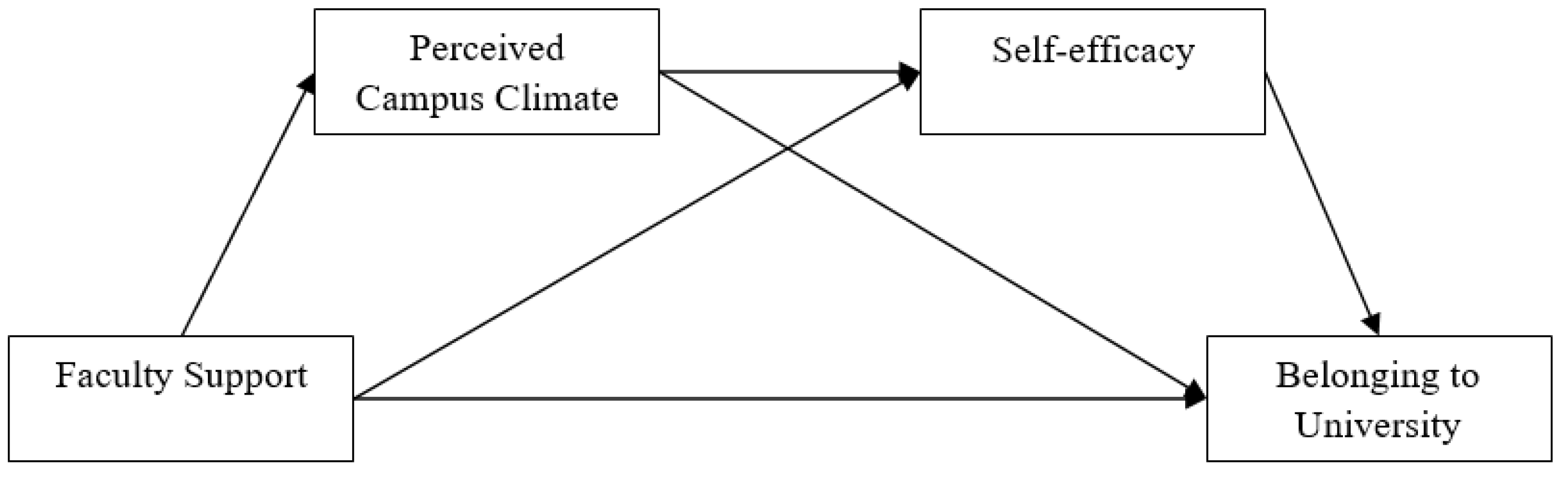
Figure 2.
The serial mediation effects for campus climate and self-efficacy as mediators.
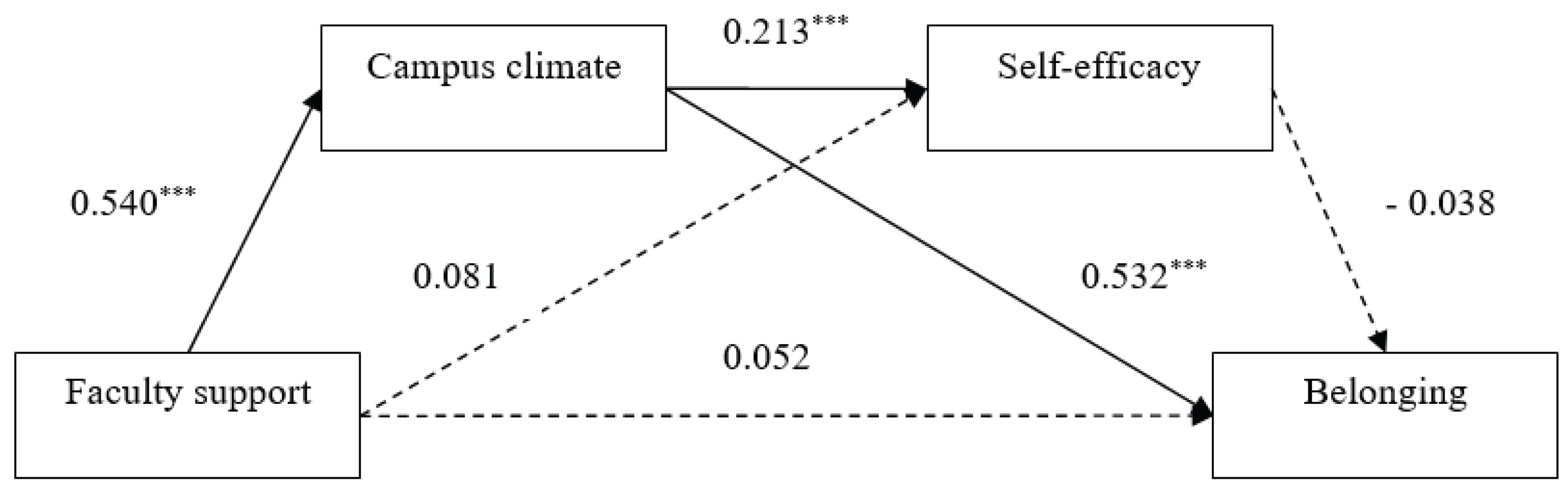

Table 1.
Descriptive statistics and Pearson correlations of the study variables.
| Variable | 1 | 2 | 3 | 4 |
|---|---|---|---|---|
| 1. Faculty Support | 1 | |||
| 2. Campus Climate | 0.540** | 1 | ||
| 3. Self-efficacy | 0.197** | 0.257** | 1 | |
| 4. Belonging to University | 0.333** | 0.551** | 0.109* | 1 |
| M | 19.30 | 25.63 | 27.80 | 36.18 |
| SD | 4.631 | 6.461 | 5.709 | 5.004 |
Note.; M=mean; SD=standard deviation. **p < .01 *p < .05 .
Table 2.
The regression equation of chain mediation.
| Regression equation (N=512) | Fit indicator | Coefficient and significance | ||||
|---|---|---|---|---|---|---|
| Outcome variable | Predictor variable | R | R2 | F | β | t |
| Campus climate | Faculty support | 0.540 | 0.292 | 210.477 | 0.540*** | 14.507 |
| Self-efficacy | Faculty support | 0.266 | 0.071 | 19.447 | 0.081 | 1.611 |
| Campus climate | 0.213*** | 4.197 | ||||
| Belonging | Faculty support | 0.332 | 0.110 | 63.559 | 0.332*** | 7.972 |
| Belonging | Faculty support | 0.554 | 0.307 | 74.997 | 0.052 | 1.194 |
| Campus climate | 0.532*** | 11.930 | ||||
| Self-efficacy | - 0.038 | -1.011 | ||||
Note: The study variables were standardized in the model. *** p < 0.001.
Table 3.
The total, direct, and indirect effect of faculty support on belonging to university.
| Effects | Boot SE | Boot LLCI | Boot ULCI | |
|---|---|---|---|---|
| Total effect | 0.359 | 0.045 | 0.271 | 0.448 |
| Direct effect | 0.056 | 0.047 | - 0.036 | 0.150 |
| Total indirect effect | 0.280 | 0.030 | 0.221 | 0.342 |
| Indirect effect 1 | 0.288 | 0.031 | 0.228 | 0.353 |
| Indirect effect 2 | - 0.003 | 0.004 | - 0.014 | 0.003 |
| Indirect effect 3 | - 0.004 | 0.004 | - 0.014 | 0.005 |
Note: Boot SE, Boot LLCI, and Boot ULCI refer to the standard error and the upper and lower bounds of the 95% confidence intervals of the indirect effects estimated by the bootstrap method, respectively. Indirect effect 1: faculty support → campus climate → belonging; indirect effect 2: faculty support → self-efficacy → belonging; indirect effect 3: faculty support → campus climate → self-efficacy → belonging.
Disclaimer/Publisher’s Note: The statements, opinions and data contained in all publications are solely those of the individual author(s) and contributor(s) and not of MDPI and/or the editor(s). MDPI and/or the editor(s) disclaim responsibility for any injury to people or property resulting from any ideas, methods, instructions or products referred to in the content. |
© 2025 by the authors. Licensee MDPI, Basel, Switzerland. This article is an open access article distributed under the terms and conditions of the Creative Commons Attribution (CC BY) license (http://creativecommons.org/licenses/by/4.0/).
Copyright: This open access article is published under a Creative Commons CC BY 4.0 license, which permit the free download, distribution, and reuse, provided that the author and preprint are cited in any reuse.