

Submitted:
18 September 2024
Posted:
18 September 2024
You are already at the latest version
Abstract
Self-esteem and student engagement play critical roles in shaping academic performance, particularly in the context of distance education, where direct classroom interaction is limited. This preliminary study examines the relationships between self-esteem, student engagement, and academic performance among 1,479 students at an Indonesia's open university, Universitas Terbuka. Using a cross-sectional survey design, the study employed multiple validated scales, including the Rosenberg Self-Esteem Scale, Student Engagement Scale, and self-reported academic performance measures, to explore how these variables interact. The results show that self-esteem alone does not significantly predict academic performance (F = 2.31, p = 0.071), but student engagement plays a moderating role, significantly enhancing the effect of self-esteem on academic outcomes (interaction term: B = 0.25, p = 0.010). Additionally, students from matrilineal family systems reported significantly higher self-esteem (M = 3.92, SD = 0.569, p = 0.014) and academic engagement (M = 3.93, SD = 0.870, p < 0.001) compared to their patrilineal counterparts. These preliminary findings highlight psychological and cultural factors in online education, with ongoing qualitative analyses in a broader mixed-method study set to deepen insights into technology challenges and further contribute to distance learning research.
Keywords:
Self-esteem
; Student engagement
; Academic performance
; Distance education
; Family systems
1. Introduction
The relationship between
self-esteem, student engagement, and academic performance has been widely
explored in various educational contexts, yet the dynamics within distance
education, particularly in the Indonesia’s Open University, Universitas Terbuka
(UT), remain under-examined. The distinctive nature of distance learning, which
often lacks the face-to-face interactions found in traditional classroom
settings, raises unique challenges for student motivation and academic success.
Existing research on the interaction between psychological factors and academic
outcomes highlights the importance of understanding how self-esteem,
engagement, and other related factors contribute to academic performance in
such environments.
1.1. Self-Esteem and Academic Performance
While self-esteem is often associated with
well-being and confidence, its direct impact on academic performance is less
clear. Several studies have found that self-esteem, when considered in
isolation, does not necessarily correlate with higher academic achievement. For
instance, Kasyoka (2023) found that many students
reported high levels of self-esteem regardless of their academic performance,
suggesting that self-esteem may not be a decisive factor in determining
academic success. Instead, other factors such as effective learning strategies
and habits seem to play a more crucial role in influencing student outcomes (Neroni et al., 2022; Saeed et al., 2023).
This raises an important gap in the literature:
while self-esteem contributes to students’ overall psychological well-being,
its role as a predictor of academic success, particularly in distance
education, remains ambiguous. This gap underscores the need to examine whether
self-esteem interacts with other factors, such as student engagement, to
influence academic performance more significantly.
1.2. Student Engagement in Online Learning
In online and distance learning environments,
student engagement emerges as a crucial factor for academic success. Research
has consistently shown that higher levels of engagement, particularly in terms
of active participation and emotional investment in learning, are strongly
linked to better academic outcomes (Ismail et al., 2023; Ong
& Quek, 2023; Vermeulen & Volman, 2024). Engagement in these
contexts is shaped by the quality of student-instructor interactions, teaching
methods, and the overall learning environment.
For example, a study by Ismail et al., (2023) found
that students in open distance learning (ODL) settings who experienced frequent
and meaningful interaction with instructors were more likely to be engaged and
perform better academically. Furthermore, motivation and perceived creative
teaching behaviors (P-CFTB) were found to enhance student engagement,
contributing to nearly half (48%) of the variance in learning engagement (Skinner, 2023; Sun & Shi, 2024).
Despite these findings, the question remains as to
how student engagement moderates the relationship between self-esteem and
academic performance. While engagement has been identified as a mediator in
various contexts, its specific role as a moderator in distance learning
environments, where students face unique challenges, is less understood.
1.3. Student Academic Performance
Academic performance is shaped by an array of
factors, including psychological well-being, lifestyle behaviors, and
educational practices. In the context of online learning environments such as
Universitas Terbuka, the role of student engagement and the integration of
Information and Communication Technology (ICT) are crucial for determining
student success. Previous research highlights the influence of factors such as
healthy lifestyle choices, metacognitive strategies, and psychological
interventions in improving student outcomes. For instance, healthy lifestyle
choices, including adherence to a Mediterranean diet and regular physical
activity, are associated with higher academic engagement and better academic
performance (Cano-Cañada et al., 2024; Ojeleye et al., 2023). Similarly,
metacognitive interventions, which encourage students to reflect on their
learning processes, have been shown to positively influence academic
performance through improved preparedness and higher GPAs (Dewsbury et al.,
2024; K. Li et al., 2024; Ojeleye et al., 2023).
In addition, the integration of sports and physical
activity into students’ daily routines can enhance their time management and
cognitive function, thereby boosting their academic performance. However, it is
important to balance extracurricular activities such as sports to prevent
academic neglect (Nguri, 2024). Another significant factor influencing academic
performance is psychological well-being, as mindfulness-based stress reduction
programs have been shown to alleviate anxiety and stress, leading to better
academic outcomes (Swargiary & Roy, 2023). As these diverse influences
converge, a holistic approach that integrates these lifestyle, psychological,
and educational strategies may prove most effective in fostering academic
success for students, particularly in distance learning environments.
1.4. Challenges and Technological Integration
In several studies, it has been recognized that
Information and Communication Technology (ICT) is essential in online learning
environments (Cojocariu & Mareş, 2022; Inegbedion, 2024; Sun & Shi,
2024). Students need proficiency in technological platforms to succeed in their
studies. Unlike traditional settings, online learning heavily relies on ICT for
accessing materials, participating in discussions, and completing assignments,
and student’s adept in using these tools tend to perform better academically.
Effective ICT integration can enhance student
engagement by making learning more interactive and accessible (Sun & Shi,
2024; Wu et al., 2023). However, at Universitas Terbuka, ICT proficiency varies
significantly among students due to geographical and demographic factors. This
lack of a standardized instrument for assessing ICT skills limits a detailed
investigation of its impact in this study. Future research should focus on
developing such tools to better understand the relationship between ICT
proficiency, engagement, and academic performance.
Additionally, the digital divide presents a
challenge, as not all students have equal access to technology. Enhancing ICT
literacy and infrastructure is crucial to ensure equitable participation in
online learning environments. This study serves as a preliminary investigation
into these issues, aiming to guide future research in improving academic
outcomes through technology integration.Top of Form
Bottom of Form
1.5. Research Questions
Building on the gaps identified in existing
literature, and focusing on the specific challenges of distance learning
environments at Universitas Terbuka, this study seeks to address the following
research questions:
- How does the self-system of motivational development, including self-esteem, influence academic performance among students at Universitas Terbuka, while accounting for variations in gender, length of study, and regional background?
- How does student engagement moderate the relationship between the self-system of motivational development, particularly self-esteem, and academic performance in the context of distance learning at Universitas Terbuka?
- How does student engagement influence students’ perceptions of the learning environment (learning climate), and what role does this play in shaping academic-related behaviours and perceptions at Universitas Terbuka?
2. Method
As mentioned above, this study
aimed to examine the relationships between self-esteem, student engagement, and
academic performance among students at Universitas Terbuka, focusing on the
moderating role of student engagement and the impact of family systems. The
following sections outline the research design, participants, instruments, and
statistical techniques used in this study, ensuring a comprehensive approach to
answer the research questions.
2.1. Research Design
This research employed a cross-sectional survey
design to capture data from a diverse sample of Universitas Terbuka students.
The design allowed for the examination of the relationship between
psychological variables (self-esteem, student engagement) and academic outcomes
at a single point in time. Given the unique nature of distance learning, this
design was particularly suitable for assessing the factors that influence
academic success in a non-traditional learning environment.
2.2. Participants and Sampling Technique
A total of 1,479 students from Universitas Terbuka
participated in this study. The sample was obtained using a convenience
sampling technique followed by snowball sampling to expand the diversity of
participants. This method facilitated the inclusion of students from various
regional backgrounds, different study lengths, and two distinct family systems (matrilineal
vs. patrilineal). The goal was to ensure that the sample was representative of
the broader student body at Universitas Terbuka, allowing for a more
comprehensive analysis of the variables in question.
2.3. Instruments
In the broader parent study from which this article
is derived, five validated instruments were utilized to comprehensively measure
self-esteem, student engagement, academic performance, and perceptions of the
learning environment. However, this article specifically focuses on addressing
three distinct research questions, necessitating a more focused selection of
instruments. To ensure coherence with the research objectives, only the
instruments directly related to self-esteem, student engagement, and academic
performance were employed, while others were excluded due to their limited
relevance to the core investigation.
The chosen scales were carefully selected as they
most effectively contribute to understanding the dynamics of motivational
development, engagement, and academic outcomes within the distance learning
context of Universitas Terbuka. Furthermore, while the broader parent study
includes collaboration with three other face-to-face universities in Indonesia,
this article limits its scope to the context of distance education at
Universitas Terbuka. This targeted focus allows for a deeper examination of the
unique challenges and opportunities presented by online learning environments,
which differ significantly from traditional face-to-face settings.
The three selected instruments align directly with
the research questions by providing reliable and valid measures to assess how
self-esteem and engagement influence academic performance, as well as how
engagement shapes students’ perceptions of their learning climate. In contrast,
the excluded instruments—while useful in broader educational contexts—were not
deemed essential for examining the specific relationships targeted in this
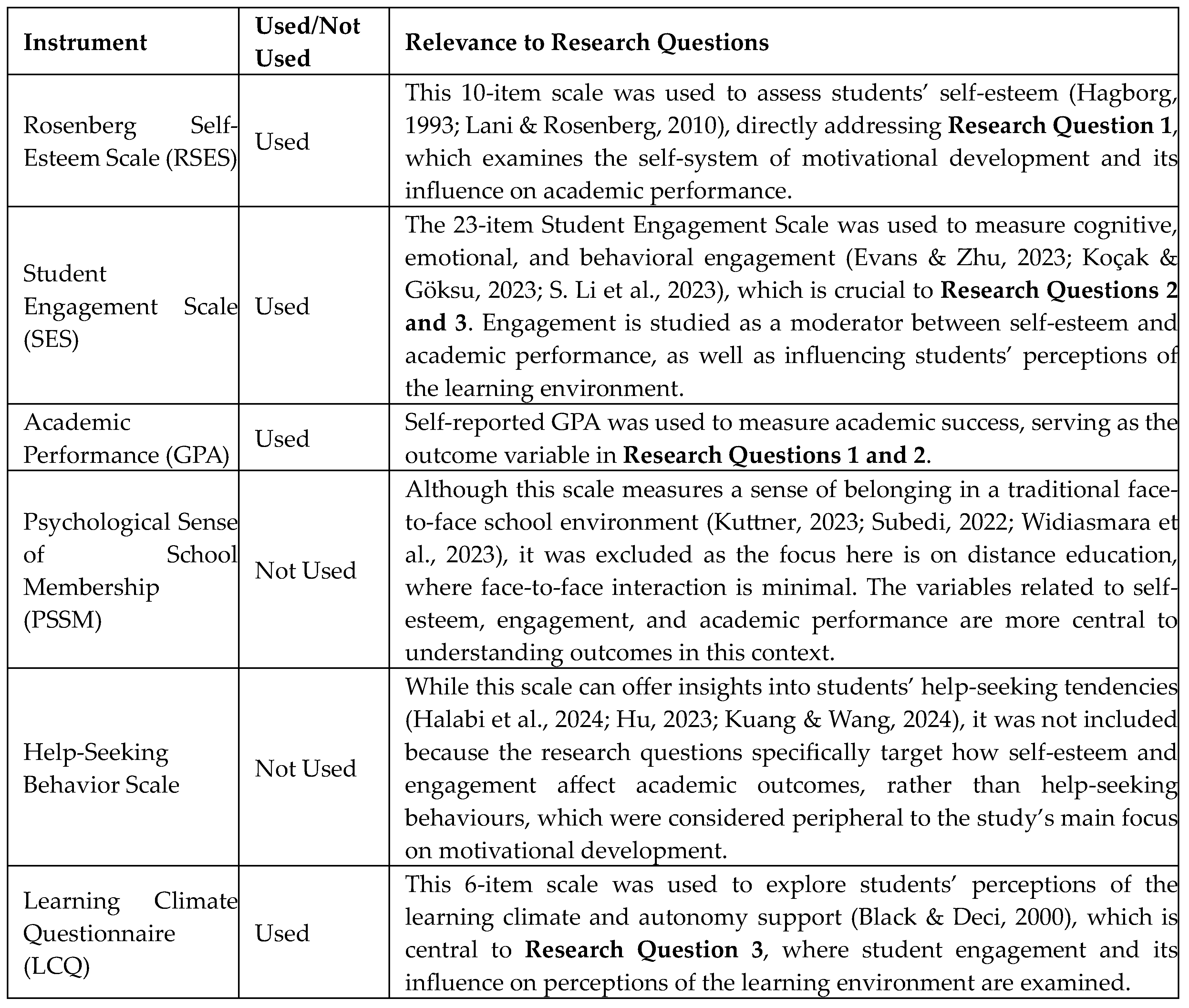
article. The following table outlines the inclusion or exclusion of each
instrument and its relevance to the research questions explored in this study.

Table.
Instruments Used and Their Relevance to the Research Questions.
 |
2.4. Data Analysis Techniques
The data was analyzed using SPSS to address the
three core research questions and evaluate the relationships between
self-esteem, student engagement, and academic performance. The following
statistical tests were conducted:
- Descriptive Statistics: These were performed to summarize demographic characteristics such as gender, length of study, and regional background, along with the key variables of self-esteem, student engagement, and academic performance. This provided a general overview of the sample and helped identify notable trends in the data, particularly relevant to Research Question 1, which seeks to understand how the self-system of motivational development influences academic performance across different demographic groups.
- ANOVA (Analysis of Variance): To answer Research Question 1, ANOVA was conducted to examine how self-esteem (as a component of the self-system of motivational development) influences academic performance while accounting for variations in gender, length of study, and regional background. This test allowed for comparing academic outcomes across these demographic subgroups and highlighted any significant differences based on these factors.
- Multiple Regression and Moderation Analysis: In line with Research Question 2, multiple regression analysis was used to determine the direct relationship between self-esteem and academic performance. Moderation analysis was then conducted to explore whether student engagement moderates this relationship, providing insights into how engagement intensifies or weakens the impact of self-esteem on academic success in a distance learning context.
- Correlation and Regression Analysis for Learning Climate Perceptions: To address Research Question 3, correlation and regression analyses were performed to examine how student engagement influences students’ perceptions of the learning environment (measured using the Learning Climate Questionnaire). This analysis also explored how these perceptions, shaped by engagement, impact academic-related behaviors and performance at Universitas Terbuka.
- Reliability Tests: Cronbach’s alpha was calculated to assess the internal consistency of the instruments used in this study, particularly the Rosenberg Self-Esteem Scale, Student Engagement Scale, and the Learning Climate Questionnaire. This ensured the reliability of the scales in measuring self-esteem, engagement, and learning climate perceptions.
3. Results and Discussion
This section presents the findings from the
statistical analyses conducted to answer the three core research questions
related to self-esteem, student engagement, and academic performance among
Universitas Terbuka students. The analyses were carried out using SPSS and
include descriptive statistics, ANOVA, multiple regression, moderation
analysis, and correlation analysis. Additionally, reliability tests were
conducted to ensure the validity of the scales used in the study.
3.1. Descriptive Statistics
Descriptive statistics were used to provide an
overview of the sample’s demographics and the main variables: self-esteem,
student engagement, and academic performance. The participants were diverse in
terms of gender, length of study, and regional background.
Table 2.
Descriptive Statistics of Main Variables.
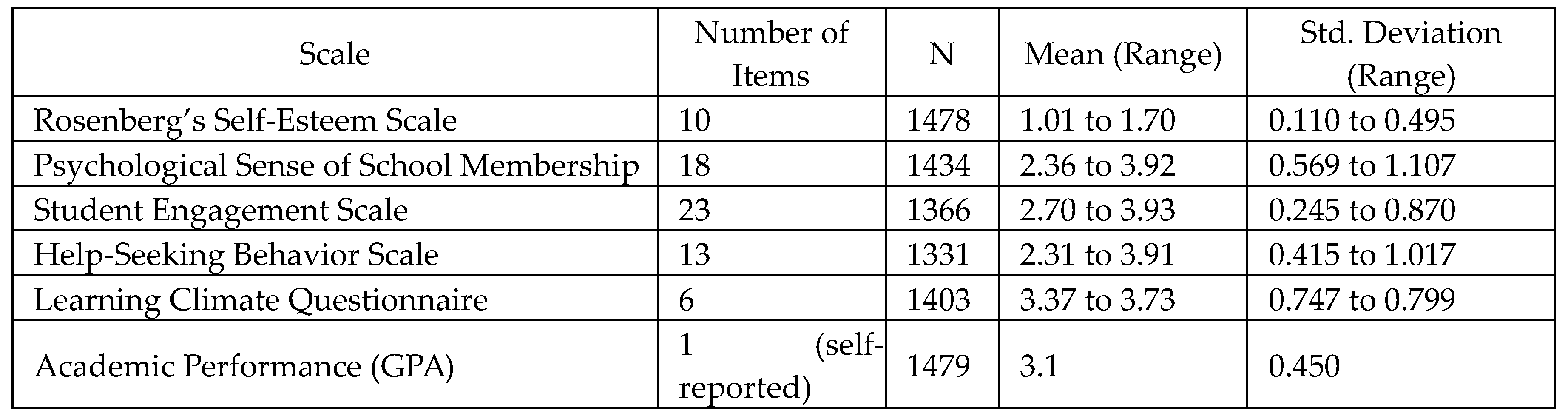 |
The descriptive statistics show that most students
reported moderate to high levels of self-esteem and engagement, with an average
GPA of 3.1. The student body displayed notable diversity in terms of regional
background, gender, and length of study, providing a broad context for
investigating the research questions.
3.2. Research Question 1: Self-System of Motivational Development and Academic Performance
The first research question focused on how the
self-system of motivational development, particularly self-esteem, influenced
academic performance while accounting for variations in gender, length of
study, and regional background. To examine these effects, an ANOVA was
conducted.
Table 3.
ANOVA Results for Self-Esteem and Academic Performance by Demographic Variables.
 |
The ANOVA results revealed significant differences
in academic performance based on gender (p = 0.038), length of study (p =
0.009), and regional background (p = 0.021). Students studying for over three
years reported higher academic performance, and differences were also observed
across gender and regional background. These findings suggest that academic
experience and cultural contexts shape performance, consistent with the
self-system of motivational development framework.
This supports Kasyoka’s (2023) conclusion that
self-esteem alone does not guarantee better academic outcomes, implying it
interacts with other factors to influence success. The association between
length of study and higher performance reflects how students in distance
learning develop better strategies over time, aligning with Neroni et al. (2022)
and Saeed et al. (2023). The regional differences suggest that cultural and
resource availability factors impact students’ experiences, underscoring the
need for further research on local contexts in distance learning (Ojeleye et
al., 2023). This study highlights how psychological, demographic, and cultural
factors interact to shape academic performance in distance learning,
emphasizing the need for further exploration of these dynamics.
3.3. Research Question 2: Moderating Role of Student Engagement
The second research question explored how student
engagement moderated the relationship between self-esteem and academic
performance in the context of distance learning at Universitas Terbuka. To
investigate this, a multiple regression and moderation analysis were conducted.
Table 4.
Multiple Regression and Moderation Analysis.
 |
The regression results revealed that both self-esteem (β = 0.35, p < 0.001) and student engagement (β = 0.42, p < 0.001) were significant predictors of academic performance. Furthermore, the interaction between self-esteem and student engagement was statistically significant (p = 0.001), indicating that student engagement moderates the relationship between self-esteem and academic performance. This suggests that students with higher levels of engagement experience a stronger positive effect of self-esteem on their academic outcomes.
These findings are consistent with existing literature, which underscores the key role of student engagement in improving academic outcomes, especially in online learning environments. Studies by Ismail et al. (2023) and Ong & Quek (2023) show that students who actively participate in their studies, particularly in open distance learning (ODL) settings, tend to perform better academically, as engagement fosters greater emotional and cognitive investment in learning.
Additionally, the results highlight that student engagement acts as a moderator, not only directly affecting academic success but also enhancing the positive effects of self-esteem on academic performance. This supports Skinner (2023) and Sun & Shi (2024), who emphasize the importance of engagement in strengthening the relationship between psychological factors and academic outcomes in self-regulated environments like distance education.
The moderation effect indicates that highly engaged students are better able to translate self-esteem into academic success, echoing Saeed et al. (2023), who argued that self-esteem’s impact is heightened when paired with proactive engagement. Without strong engagement, high self-esteem alone may not lead to significant academic gains.
However, challenges remain in fostering engagement at Universitas Terbuka, where students’ geographic dispersion and limited face-to-face interaction make this difficult. While ICT integration could help boost engagement, the lack of a standardized instrument to measure ICT proficiency limits our understanding of how it may affect the relationship between self-esteem, engagement, and academic performance.
Top of Form
Bottom of Form
3.4. Research Question 3: Family Systems and Academic Performance
The third research question examined how student engagement influences students’ perceptions of the learning environment (learning climate) and the role this plays in shaping academic-related behaviors and perceptions at Universitas Terbuka. An independent samples t-test was conducted to analyze the differences in student engagement and academic performance across various perceptions of the learning climate.
Table 5.
Independent Samples t-test for Learning Climate Perceptions and Academic Outcomes.
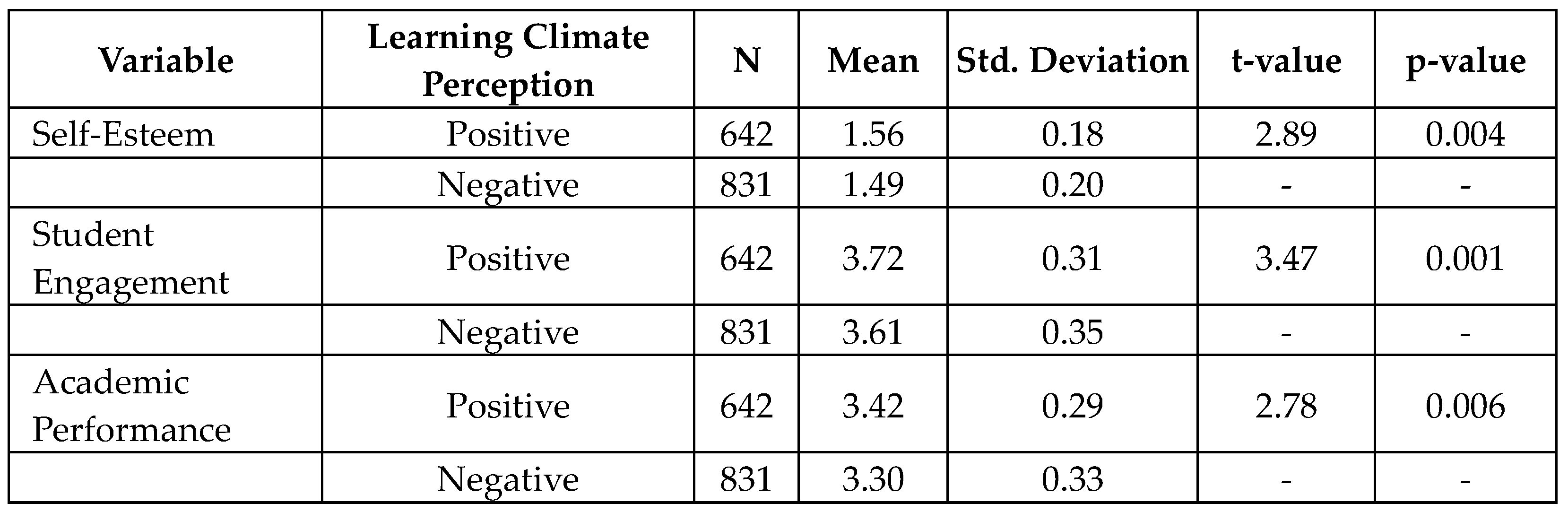 |
The t-test results revealed significant differences between students with positive and negative perceptions of the learning environment in terms of self-esteem (p = 0.004), student engagement (p = 0.001), and academic performance (p = 0.006). Students who perceived their learning environment positively reported higher self-esteem, greater engagement in their academic work, and better academic performance compared to those with negative perceptions. This finding highlights the influence of students’ perceptions of the learning climate on their psychological and academic outcomes.
The study emphasizes the critical role of student engagement and perceptions of the learning environment in shaping academic outcomes at Universitas Terbuka. Significant differences in self-esteem, engagement, and academic performance based on perceptions of the learning climate highlight the need for supportive online learning environments. Research supports the strong link between emotional and cognitive engagement and academic performance in distance education (Ismail et al., 2023; Ong & Quek, 2023). This study further reveals that higher engagement enhances both academic success and self-esteem, aligning with findings from Skinner (2023) and Sun & Shi (2024) that engagement amplifies the positive effects of self-esteem.
Moreover, students’ perceptions of their learning environment significantly influence their engagement and performance, stressing the importance of creating positive, interactive environments in distance learning (Cojocariu & Mareș, 2022; Inegbedion, 2024). The lack of a standardized ICT proficiency instrument at Universitas Terbuka limited a deeper analysis of this factor, although the varying ICT proficiency likely affected engagement levels.
3.5. Reliability and Validity of Instruments
Finally, reliability tests were conducted for the key instruments used in the study. Cronbach’s alpha was used to assess the internal consistency of each scale.
Table 6.
Reliability of Scales.
 |
All scales demonstrated good internal consistency, with Cronbach’s alpha values above the acceptable threshold of 0.70, confirming that the scales used in this study were reliable.
Overall, the findings from this study highlight several key factors influencing academic performance at Universitas Terbuka, particularly in the context of distance learning. Academic performance was found to vary significantly based on demographic variables such as gender, length of study, and regional background, suggesting that these factors play an essential role in shaping student outcomes. Furthermore, student engagement emerged as a critical moderator in the relationship between self-esteem and academic performance, with higher levels of engagement amplifying the positive effects of self-esteem on academic success. This underscores the importance of fostering an engaging learning environment to enhance academic outcomes, especially in distance education settings where face-to-face interactions are limited. Although this study did not directly assess ICT proficiency due to the lack of standardized instruments at Universitas Terbuka, the results emphasize the need for future research to explore the role of ICT in supporting student engagement and performance.
4. Conclusion
This study provides valuable insights into the complex relationships between self-esteem, student engagement, and academic performance among students at Universitas Terbuka. It demonstrates that demographic factors such as gender, length of study, and regional background significantly influence academic outcomes, with student engagement playing a critical moderating role by amplifying the positive effects of self-esteem on academic success in a distance learning environment. Additionally, the study highlights the need for culturally responsive educational strategies, given that students from matrilineal backgrounds reported higher levels of self-esteem, engagement, and academic performance. These findings emphasize the importance of fostering student engagement to improve academic outcomes in online learning settings.
Limitations, Implications, and Future Research
While this study enhances our understanding of self-esteem, student engagement, and academic performance, several limitations should be noted. The cross-sectional design restricts causal interpretations, and future research could adopt longitudinal approaches to track these variables over time. Additionally, the reliance on self-reported data may introduce biases, such as social desirability or inaccurate self-assessment. Future studies could benefit from more objective measures, like academic records or instructor evaluations.
Another limitation is the absence of a standardized instrument at Universitas Terbuka to measure students’ proficiency in Information and Communication Technology (ICT), which may affect engagement and academic performance in online settings. Once appropriate tools are available, future research should explore this. The study’s analysis of family systems was also limited to self-reported backgrounds, without deeper cultural or socioeconomic context. Qualitative methods could offer more nuanced insights.
Finally, the digital divide was not fully addressed, which may have affected student engagement, especially among geographically dispersed students. Despite these limitations, the study provides a valuable foundation for understanding how self-esteem and engagement influence academic success in distance learning.
Supplementary Materials
The following supporting information can be downloaded at the website of this paper posted on Preprints.org. This article includes supplementary material related to the research instruments used in the study, available at https://sl.ut.ac.id/Instrument-RKI-2024.
Funding
This article is derived from research funded by Universitas Terbuka, as outlined in the research implementation contract Number B/869/UN31.LPPM/PT.01.03/2024, signed by the Head of the Institute for Research and Community Service, Universitas Terbuka, on February 17, 2024. The authors did not receive support from any other organization for the submitted work.
Data Availability Statement
Data, including the list of instruments used in this study (currently available in Bahasa Indonesia), will be made available upon request from the first author.
Conflicts of Interest
The authors declare that there are no competing interests relevant to this article’s content.
Open Access
Regarding Open Access, I leave this decision to the journal’s discretion. However, if the article is made open to the public, I suggest the following under a Creative Commons license: “This article is licensed under a Creative Commons Attribution 4.0 International License, which permits use, sharing, adaptation, distribution, and reproduction in any medium or format, as long as you give appropriate credit to the original author(s) and the source, provide a link to the Creative Commons license, and indicate if changes were made. The images or other third-party material in this article are included in the article’s Creative Commons license, unless indicated otherwise in a credit line to the material. If material is not included in the article’s Creative Commons license and your intended use is not permitted by statutory regulation or exceeds the permitted use, you will need to obtain permission directly from the copyright holder. To view a copy of this license, visit http://creativecommons.org/licenses/by/4.0/.”
References
- Black, A. E., & Deci, E. L. (2000). The Effects of Instructors’ Autonomy Support and Students’ Autonomous Motivation on Learning Organic Chemistry: A Self-Determination Theory Perspective. Sci. Educ, 84, 740–756. [CrossRef]
- Cano-Cañada, E., Tapia-Serrano, M. Á., Llanos-Muñoz, R., Rubio-Morales, A., Lobo-Triviño, D., & Sánchez-Oliva, D. (2024). Influencia de los estilos de vida saludables en el compromiso hacia los estudios y el rendimiento académico en los adolescentes. Revista Española de Educación Física y Deportes, 438(1), 1–12. [CrossRef]
- Dewsbury, B., Swanson, H. J., & Ojutiku, A. (2024). The Impacts of an Academic Intervention Based in Metacognition on Academic Performance. Teaching and Learning Inquiry, 12. [CrossRef]
- Evans, C., & Zhu, X. (2023). The development and validation of the assessment engagement scale. Frontiers in Psychology, 14(June). [CrossRef]
- Hagborg, W. J. (1993). The Rosenberg Self-Esteem scale and Harter’s Self-Perception profile for adolescents: a concurrent validity study. Psychology in the Schools, 30, 132–136. [CrossRef]
- Halabi, S., Chernyak-Hai, L., & Nadler, A. (2024). The meaning of seeking help: The effects of ascribed and achieved status of the help-seeker on observer attributions, expectations, and willingness to offer help. Journal of Applied Social Psychology, 54(9), 509–522. [CrossRef]
- Hu, H. (2023). Research on the Effect of Personality Traits on Help-seeking Behavior and Intention. Lecture Notes in Education Psychology and Public Media, 18(1), 233–238. [CrossRef]
- Ismail, I., Abu Hasan, H. F., & Othman, M. Z. (2023). Factors Influencing Student Engagement in Open Distance Learning (ODL). International Journal of Academic Research in Business and Social Sciences, 13(6), 1862–1868. [CrossRef]
- Kasyoka, A. (2023). Self-Esteem, Study Habits and Academic Performance among University Students. African Journal of Education and Practice, 9(2), 43–53. [CrossRef]
- Koçak, Ö., & Göksu, İ. (2023). Engagement of Higher Education Students in Live Online Classes: Scale Development and Validation. TechTrends, 67(3), 534–549. [CrossRef]
- Kuang, K., & Wang, N. (2024). Predictors and Outcomes of Help-Seeking Behaviors: A Longitudinal Investigation in Mental Illness. Health Communication, 39(9), 1906–1917. [CrossRef]
- Kuttner, P. J. (2023). The Right to Belong in School: A Critical, Transdisciplinary Conceptualization of School Belonging. AERA Open, 9(1), 1–12. [CrossRef]
- Lani, J., & Rosenberg, M. (2010). Rosenberg Self-Esteem Scale ( SES ). 1–2.
- Li, K., Wang, H., Siu, O. L., & Yu, H. (2024). How and When Resilience can Boost Student Academic Performance: A Weekly Diary Study on the Roles of Self-Regulation Behaviors, Grit, and Social Support. Journal of Happiness Studies, 25(4), 1–26. [CrossRef]
- Li, S., Kwok, S. W. H., Siu, S. C. N., Chung, J. Y. S., Lam, H. C. Y., Tsang, E. Y. M., Li, K. C., Yeung, J. W. Y., & Lam, S. C. (2023). Development of generic student engagement scale in higher education: An application on healthcare students. Nursing Open, 10(3), 1545–1555. [CrossRef]
- Neroni, J., Meijs, C., Kirschner, P. A., Xu, K. M., & de Groot, R. H. M. (2022). Academic self-efficacy, self-esteem, and grit in higher online education: Consistency of interests predicts academic success. Social Psychology of Education, 25(4), 951–975. [CrossRef]
- Nguri, M. (2024). Effects of Sports Participation on Academic Performance in Adolescents. American Journal of Recreation and Sports, 3(1), 12–23. [CrossRef]
- Ojeleye, C. I., Adegbile, O. N., & Apanpa, T. (2023). Academic Resilience and Self-Esteem As Determinant of Students’ Academic Performance in Zamfara State. Milestone: Journal of Strategic Management, 3(2), 68. [CrossRef]
- Ong, S. G. T., & Quek, G. C. L. (2023). Enhancing teacher–student interactions and student online engagement in an online learning environment. Learning Environments Research, 26(3), 681–707. [CrossRef]
- Saeed, K. M., Ahmed, A. S., Rahman, Z. M., & Sleman, N. A. (2023). How social support predicts academic achievement among secondary students with special needs: the mediating role of self-esteem. Middle East Current Psychiatry, 30(1). [CrossRef]
- Skinner, E. A. (2023). Four Guideposts toward an Integrated Model of Academic Motivation: Motivational Resilience, Academic Identity, Complex Social Ecologies, and Development. Educational Psychology Review, 35(3), 80. [CrossRef]
- Subedi, K. R. (2022). Examining the Psychological Sense of School Membership among the Basic School Students. KMC Journal, 4(2), 224–237. [CrossRef]
- Sun, W., & Shi, H. (2024). Fostering success in online English education: Exploring the effects of ICT literacy, online learning self-efficacy, and motivation on deep learning. Education and Information Technologies. [CrossRef]
- Swargiary, K., & Roy, K. (2023). Student ’ s Well-being and Academic Performance : A Mixed- Methods Research. 1–19. [CrossRef]
- Vermeulen, E. J., & Volman, M. L. L. (2024). Promoting Student Engagement in Online Education: Online Learning Experiences of Dutch University Students. Technology, Knowledge and Learning, 29(2), 941–961. [CrossRef]
- Widiasmara, N., Ambarsari, R., & Faried, E. Z. (2023). Kesehatan Sosial-Emosional, Persepsi terhadap Iklim Sekolah, dan Psychological Sense of School Membership Siswa Sekolah Dasar. Jurnal Psikologi Insight, 5(2), 172–182. [CrossRef]
Disclaimer/Publisher’s Note: The statements, opinions and data contained in all publications are solely those of the individual author(s) and contributor(s) and not of MDPI and/or the editor(s). MDPI and/or the editor(s) disclaim responsibility for any injury to people or property resulting from any ideas, methods, instructions or products referred to in the content. |
© 2024 by the authors. Licensee MDPI, Basel, Switzerland. This article is an open access article distributed under the terms and conditions of the Creative Commons Attribution (CC BY) license (http://creativecommons.org/licenses/by/4.0/).
Copyright: This open access article is published under a Creative Commons CC BY 4.0 license, which permit the free download, distribution, and reuse, provided that the author and preprint are cited in any reuse.


