

Submitted:
09 July 2025
Posted:
11 July 2025
You are already at the latest version
Abstract
The combination of bioremediation and thermal remediation techniques, known as thermally enhanced bioremediation, aims to efficiently remove soil contaminants. However, increasing the temperature in remediation processes can have negative impacts on soil microorganisms. Therefore, we aimed to evaluate the effects of soil heating and naphthalene contamination on soil quality and phytotoxicity variables. To simulate thermally enhanced bioremediation, soil samples were artificially contaminated – with 5 naphthalene concentrations (0, 50, 100, 250 and 500 mg of naphthalene/kg of soil) and incubated at temperatures of 28, 38, 48 and 58 °C. The factors effects were determined using microbiological bioindicators – microbial activity and biomass, metabolic quotient and bacterial count on petri dishes, and phytotoxicity – germination and root length of lettuce seeds, assessed immediately and after 15 and 30 days of contamination. Based on the bioindicators applied, it was found that immediate contamination with naphthalene implied a reduction in biomass and microbial growth associated with greater environmental stress, due to increasing qCO2 values, at high concentrations (250 and 500 mg /kg). The temperature range between 28 and 38 °C stimulated the growth of microbial communities, regardless of concentration. These results indicate that temperature ranges below 40 °C are promising for application in thermally enhanced bioremediation strategies, as they benefit soil microorganisms and potentially favor contaminant degradation.
Keywords:
naphthalene
; bioremediation
; temperature
; bioindicators
1. Introduction
The assessment of sensitive organisms, such as primary producers, detritivores, and microorganisms, can help identify environmental impacts. Therefore, these organisms are considered bioindicators and have potential applications in environmental quality studies [1,2,3]. Microorganisms play an important ecological role in the environment, influencing biogeochemical cycling, decomposition, and transformation of contaminants, and are sensitive to environmental changes [4,5]. Biological analyses enable us to understand direct effects on organisms, while chemical analyses do not provide sufficient information on the bioavailability of contaminants and effects on living organisms [6].
Soil contamination affects the microbial community [7,8], impacts soil organic matter and biological activity [9,10,11] and impairs the quality of life and health of the population [12,13]. Polycyclic aromatic hydrocarbons (PAHs) are considered dangerous and persistent contaminants in the soil [14,15]; naphthalene, for example, is a low molecular weight PAH with only two aromatic rings. As it is a simpler PAH, it can be used as a model for the study of PAHs, due to its lower molecular weight, greater solubility in water compared to other PAHs, and abundance in nature [16,17,18].
Soil contaminated with naphthalene can be remediated by applying bioremediation techniques [11,19,20], with increased removal efficiency associated with temperature variation [19,21,22,23,24]. Thus, thermally enhanced bioremediation can be applied to remove naphthalene, since traditional techniques applied worldwide, such as Pump-and-Treat (P&T) and Multi-Phase Extraction (MPE), are not very effective [25,26]. Thermally enhanced bioremediation combines bioremediation techniques with thermal remediation in order to overcome the limitations of applying these methods in isolation, combining their benefits and increasing the efficiency of the soil decontamination process [22,27,28,29].
Regarding the remediation of soils contaminated with naphthalene, few studies evaluate the impacts of the contaminant using bioindicators directly in the soil [24,30,31,32,33], i.e., most studies isolate microorganisms and study them in lab conditions using culture media. Thus, evaluating bioindicators directly in soil samples would be closer to reality, even on a laboratory scale, prior to in situ testing. Thus, a gap was observed in this type of study for Brazilian tropical soils, making it relevant to investigate the association between temperature variation and its effects on microbiota and phytotoxicity.
Thus, this study aims to investigate the effect of soil heating and naphthalene contamination using microbiological variables of soil quality and phytotoxicity. It also aims to assess the impact of immediate contamination by increasing doses of naphthalene and to determine temperature and concentration ranges with effects on soil quality variables, verifying the applicability of these variables as bioindicators in the thermally enhanced bioremediation of naphthalene-contaminated soils.
2. Materials and Methods
2.1. Soil Sampling
Soil samples were collected at depths of 0 – 10 cm, at coordinates 22°24’19.2”S 45°25’42.5”W, in Itajubá (MG), following the guidelines of Santos et al. (2015) [34]. The sampling area has soils classified as Red-Yellow Argisol (equivalent to Acrisols in the World Reference Base for Soil Resources – WRB classification [35]), which is the predominant class in the municipality of Itajubá [36]. These soils are characterized by the presence of a textural B horizon, with low clay activity, or high activity when combined with low base saturation or aluminum content [37].
The samples were stored in plastic bags and immediately transported to the Microbiology Laboratory of the Center for Environmental Quality Studies (CEQUAM) at Federal University of Itajubá (UNIFEI), where they were stored in a cold room and prepared for the experiments.
2.2. Soil Characterization
Basic chemical analysis of the soil samples was conducted at the Soil Analysis Laboratory of the Federal Institute of Southern Minas Gerais (IFSULDEMINAS) – Inconfidentes Campus. The following were analyzed: pH in water; phosphorus (P); potassium (K); calcium (Ca); magnesium (Mg); H+ aluminum (Al potential acidity); sum of bases (SB); cation exchange capacity (CTC); percentage of saturation by bases (%V); percentage of aluminum saturation (%m); calcium/magnesium ratio (Ca/Mg) and magnesium/potassium ratio (Mg/K); boron (B); zinc (Zn); iron (Fe); manganese (Mn); copper (Cu); organic matter (OM) and remaining phosphorus [38].
Soil texture was analyzed by particle size analysis, using the pipette method, in triplicate. The soil samples collected were initially air-dried and then sieved to obtain air-dried fine soil [38].
2.3. Preparation of Soil Samples
As a first step toward understanding the application of thermally enhanced bioremediation in tropical soils, microcosms replicating field conditions (in situ) were constructed in the laboratory. The treatments were combinations of two factors: temperature variation (28, 38, 48, and 58 °C) and soil contamination of naphthalene at different concentrations (0, 50, 100, 250, and 500 mg/kg). The experiments were performed with three randomly distributed replicates.
The soil samples were sieved through a 2 mm. All material was weighed and contaminated, a process carried out by mixing naphthalene (NAP – C10H8) in its solid, powdered form with the soil. Subsequently, 100 g of contaminated soil were separated into each microcosm assembled in plastic cups sanitized with 70% alcohol and exposed to ultraviolet light, for 15 min. The sample units were covered with plastic film to reduce moisture loss. To simulate thermally enhanced bioremediation, the containers were taken to the incubator with four controlled temperatures, 28, 38, 48, and 58 °C. The moisture content of the samples was maintained at 60% of water retention capacity by maintaining water mass.
2.4. Biological Analysis
The microbiological analyses performed consisted of microbial activity and biomass and metabolic quotient – or specific respiration rate (qCO2) [39,40,41]. In addition, total bacteria counts were performed in Petri dishes, using adapted methodologies [42,43,44]. Furthermore, to assess the effectiveness of thermal bioremediation, soil toxicity was evaluated through the root growth of lettuce seeds (Lactuca sativa) using the methodology recommended by the US EPA (1996) [45] and OECD (2006) [46].
After contamination and preparation of the samples, microbiological and phytotoxicity analyses were performed to verify the effects of the contaminant doses immediately after contamination. To understand how thermal bioremediation influences the microbial community and phytotoxicity, soil samples were incubated for 15 and 30 days. After these periods of thermally enhanced bioremediation simulation, microbiological and phytotoxicity analyses were also performed to observe the possible existence of a trend in the behavior of biological variables over time.
2.4.1. Microbial Activity, Biomass, and Metabolic Quotient
To determine microbial activity and biomass and metabolic quotient, the irradiation-incubation method proposed by Ferreira, Camargo, and Vidor (1999) [40] was used. For this purpose, 40 g of soil were irradiated using a microwave oven to eliminate microorganisms through electromagnetic irradiation, with inoculation of 2 g of unsterilized soil sample. In another jar, 40 g of soil was not irradiated. All samples, as well as the blank, were incubated for 10 days at 28 °C, without light, in order to prevent algae growth.
Microbial activity was determined by titration with 1 mol/L HCl for the non-irradiated samples, whose CO2 was captured by 1 mol/L NaOH solution after the addition of BaCl2 and phenolphthalein [39]. The carbon in the microbial biomass was quantified by the difference in carbon released between irradiated and non-irradiated samples [40]. Thus, qCO2 was calculated as the ratio of microbial activity and biomass [41].
2.4.2. Total Bacteria Count in Petri Dishes
To count bacteria on Petri dishes, 10 g of soil were diluted in 90 ml of saline solution (0.9%). The sample was shaken at 100-150 rpm for approximately 20 min. Successive dilutions were performed from the initial dilution 10-1 (1 mL of sample: 9 mL of 0.9% NaCl) to 10-4. The inoculum of 0.05 mL of the 10-4 dilution (previously verified as the best dilution for counting) was spread with a Drigalski loop on 6 cm diameter Petri dishes containing Plate Count Agar (PCA) medium – specific for bacterial growth and counting, with three replicates [42,43,44]. The cultures were incubated for 3 days at 28 °C, and bacterial growth was subsequently evaluated. The number of Colony Forming Units (CFU) is determined by multiplying the number of colonies present in the Petri dish by the corresponding dilution factor (in this case 10-4) and by the sample volume [42].
2.4.3. Phytotoxicity Test
To evaluate the germination and root length of lettuce seeds, the methodologies described in US EPA (1996) [45] and OECD (2006) [46] were applied. A total of 20 Lactuca sativa L. seeds were placed in Petri dishes with filter paper to enable seed adhesion, and 5 ml of soil extract was added. The extract was obtained using a soil:water ratio of 1:5 with agitation for 24 h and separated by centrifugation for 30 min. The dishes were incubated at 25±1 °C for 120 h. After the incubation period, the number of germinated seeds and root lengths were evaluated. The results are presented in terms of the ratio between the measured length of each sample and the control.
2.4. Statistical Analysis
All analyses were performed with a 95% confidence level using R Studio 2024.12.0 Build 467 software [47], and the following packages: vegan (version 2.6.10), factoextra (version 1.0.7), ggplot2 (version 3.5.1), RColorBrewer (version 1.1-3) [48,49,50,51]. Shapiro-Wilk test was applied to evaluate the normality of the data; however, since the data did not meet the assumption of normal distribution, PERMANOVA (Permutational Multivariate Analysis of Variance), a nonparametric version of the multivariate analysis of variance test, was applied [52]. To understand the distribution of treatments, exploratory multivariate analyses were estimated and evaluated: principal component analysis (PCA).
3. Results
3.1. Physicochemical Characterization of the Soil
The results of the physicochemical analysis of the soil (Table 1) indicate that it is a clayey soil—with a high clay content, acidic due to its low pH in water (5.04), with high potential acidity given by the high H+Al value (8.28), low base sum (SB), and despite being an A horizon, it has a low organic matter content (1.45 dag/dm³). It is also characterized as low-fertility soil, with low concentrations of calcium (Ca) and magnesium (Mg). In contrast, the soil macronutrients are at satisfactory levels, while the micronutrients vary, with adequate levels.
In this context, the soil used simulates a situation of significant environmental stress, with characteristics of Argisols and Cambisols, the predominant classes in the studied region [36]. Furthermore, the area where the soil was collected is not used for agriculture, so it has not undergone management and corrections, which explains its high acidity, low SB, and significant presence of exchangeable aluminum. Thus, the chemical results show that this soil is vulnerable to contamination with HPAs and other contaminants, with a risk of mobility and lower degradation potential. In addition, the content of organic matter (OM) in the soil is related to the degradation of PAHs. Soils with a higher pH and OM content tend to have a lower concentration of these contaminants, as they reduce their availability [53]. Higher percentages of OM in the soil increase the efficiency of hydrocarbon biodegradation in fuel-contaminated soils [54]. Thus, the use of this soil in the study realistically simulates a contamination situation in a typical tropical region soil.
3.2. Results of Biological Analysis
Soil contamination results in immediate and long-term effects, and its influence on microbiological and phytotoxicity variables in tropical soil is assessed immediately. The PERMANOVA analysis (Table 2) showed that, after contamination, the different doses of naphthalene caused statistically significant multivariate changes in the dependent variables (p = 0.001), affecting the microbiota and phytotoxicity—related to the germination and root length of lettuce seeds. It should be noted that, for microbiological variables such as activity, biomass, and qCO₂, the immediate effect considers the 10-day incubation period, due to the methodology employed [40].
In addition to contaminant concentration, temperature is a factor that interacts with microbiological degradation processes, so both factors influence the efficiency of thermal bioremediation. PERMANOVA (Table 2) showed that after 15 days of contamination, there was interaction between temperature and concentration, indicating the multivariate effect of the combination of factors. Individually, the temperature had a significant effect, while concentration did not. The same effects were observed after 30 days of contamination. Thus, the interaction between the factors for 15 and 30 days demonstrates that the efficiency of thermal bioremediation depends on the temperature applied and the concentration of the naphthalene.
The effects of soil contamination and incubation on microbiological and phytotoxicity variables can be complex due to changes and relationships in environmental variables related to the dynamics of the contaminant in the soil. Thus, principal component analysis (PCA) (Figure 1) was applied to simplify the interpretation and relationship between the variables used and the effect of the treatments.
Immediately after contamination (T0), principal component analysis of the effects of soil contamination explained 68.4% of the data by the first two components, with PC1 accounting for 41.6% and PC2 accounting for 26.8% (Figure 1). Principal component 1 was related to microbiological variables (biomass, activity, and metabolic quotient), while PC2 was more closely related to variables related to phytotoxicity (germination and root length of lettuce seeds). The increase in naphthalene concentration resulted in higher activity and qCO2 values, indicating greater stress on the microbial community, while the lower concentrations (0, 50, and 100 mg/kg) are positioned in the first and second quadrants, with higher biomass values, demonstrating greater microbial growth without damage to the microbial community. In the second quadrant, it can be seen that the concentrations of 50 and 100 mg/kg presented values related to lower phytotoxicity with higher germination and lettuce length. As for the phytotoxicity variables, these are inversely proportional to phytotoxicity itself, i.e., high values of germination and root length of lettuce seeds indicate low values of phytotoxicity and vice versa.
The analyses performed immediately after contamination show variations in microbial behavior and phytotoxicity according to the doses of the naphthalene. The different behaviors are associated with the grouping and correlations of microbiological variables related to microbial development (microbial biomass and bacterial count on plates), environmental stress variables (microbial activity and qCO2), and phytotoxicity (germination and root length of lettuce seeds). The immediate effects of naphthalene contamination include increased microbial stress and increased phytotoxicity of the samples.
In thermal bioremediation, the association between temperature and naphthalene concentration resulted in different effects on soil microorganisms, which could be assessed by microbiological and phytotoxicity bioindicators. In order to understand the interaction between the factors, temperature, and concentration, PCA was then applied. When conducting this analysis for T15 (15 days of incubation), we verified the explanation of the microbiological variables by PC1 and phytotoxicity variables associated with PC2 (which follows the same pattern observed immediately after contamination) (Figure 2). In PC1, higher values were found related to the growth and development of microbial communities at lower temperatures (28 and 38°C), with less impact on microbial communities at high concentrations of the naphthalene. For temperatures of 48 and 58°C, there were lower bio and cont values and higher microbial activity and qCO2 values, indicating that at these temperatures, microbial communities experienced greater environmental stress, exceptionally less stress for the 48°C and 500 mg/kg treatment. In general, temperatures between 28 and 38°C positively influenced the growth and development of microbial communities with less stress, which may be beneficial in thermal bioremediation.
In T15, information on phytotoxicity was verified—related to the germination and root length of lettuce seeds in the second principal component (PC2)— there is evidence that the application of temperature resulted in a reduction in naphthalene phytotoxicity, with the highest association of treatments at 38 and 48 °C in the positive direction of PC2, which indicates lower phytotoxicity, given the inverse relationship between the variables lettuce seed germination (germ) and lettuce root length (leng) and phytotoxicity. Some treatments with different naphthalene concentrations varied from this pattern, such as 0 mg/kg at 38 °C, which is negatively positioned in PC2, while 0 and 250 mg/kg at 58 °C have positive values in PC2, indicating that these treatments have lower phytotoxicity, i.e., higher values for germination and lettuce length.
The behavior of phytotoxicity and soil microbiota may be due to the presence of contaminants over time. After 30 days of incubation (T30), a similar relationship to the previous ones (T0 and T15) was found between the main components: PC1 related to microbiological variables and PC2 related to phytotoxicity ones (Figure 2). Treatments allocated in the first and second quadrants are more closely related to biomass, while the third and fourth quadrants are more closely related to microbial activity, metabolic quotient (qCO2), and bacterial plate count.
4. Discussion
Multivariate analysis immediately after contamination (T0) demonstrated increased microbial stress because of increasing naphthalene doses. Studies indicate that increased concentrations of HPAs [55,56,57,58], fossil fuels [56], and pesticides [59] also result in changes in the microbial community. The stress of the soil microbiota in the face of different naphthalene concentrations is mainly indicated by qCO2, which is inversely proportional to biomass and demonstrates how the community is in terms of energy efficiency [60]. Based on these results, it is possible to define contamination limits with less impact on the microbiota.
The factors—temperature and naphthalene concentration—interacted in a complex manner on the variables. For T15, temperature mainly influenced stress and microbial growth; concentration showed greater variability in responses for all variables. The bacterial count on plates and biomass are associated with the growth and reproduction of microorganisms [56], depend on an optimal temperature range [61,62,63], and generally increase at lower contaminant concentrations [33]; while microbial activity and qCO2 are associated, demonstrating the stress caused by the treatments [60]. The effect of temperature on biomass and microbial activity has been verified in previous studies [64,65,66] and influences, above all, the efficiency of bioremediation [67]. The concentration of contaminants is also a factor associated with the variability of microbiological response, which can be harmful [68,69] or a stimulus [57,70]. Thus, in the evaluation of thermal bioremediation, both factors must be considered; further studies may quantify the degradation of the contaminant, which, in addition to being biodegraded, is influenced by temperature, with changes in its physical-chemical characteristics, such as volatility and bioavailability.
The changes presented in the microbiological variables related to changes in temperature and naphthalene concentration can influence the bioremediation of the contaminant. Temperature is a factor that contributes directly to biodegradation. The literature shows the influence of temperature on the bioremediation of contaminants such as HPAs [71,72], heavy metals [73,74], and BTEX [75]. As evaluated by PCA, the following trends were observed in the treatments: at 28 and 38°C, higher biomass and bacterial plate counts, with lower activity and qCO2; for higher temperatures (48 and 58°C), the opposite behavior was observed. This trend indicates the relationship between microbiological variables and the bioremediation of contaminants. The reduction in microbial activity in T15 may be associated with the reduction of HPAs [76]. A study points to a negative correlation between qCO2 and plastic compound mineralization [77], and microbial biomass is indicated as the variable most associated with the degradation of petroleum compounds [78] and the mineralization of heavy metals [79]. Furthermore, enzymatic activity and characterization of the microbial community can be correlated with the degradation of heavy metals [79,80], and there is also a strong correlation between microbial growth and BTEX (benzene, toluene, ethylbenzene, and o, m, and p-xylenes) degradation [75]. These relationships between variables demonstrate that microorganisms are capable of using the contaminant as an energy source, which contributes to the growth, reproduction, and greater stability of microbial communities. Thus, future studies may apply these bioindicators in assessing the effects of contamination and the efficiency of naphthalene and other PAH removal, in addition to evaluating cases of co-contamination.
The phytotoxicity variables showed varying relationships to temperature and concentration treatments. According to the PCA of T15, treatments with better microbial performance have higher phytotoxicity, which may be related to the formation of by-products that are more toxic than the original contamination, a result also found by other researchers [22,81,82] and divergent from other investigations [83,84]. To confirm the phytotoxicity results, it would be appropriate for future studies to apply more than one plant indicator species. In general, the absence of naphthalene (0 mg/kg) resulted in better performance in terms of phytotoxicity, which indicates that the presence of the this contaminant tends to contribute to an increase in toxicity [85,86], with exceptions for treatment with higher concentrations, such as 48°C : 500 (mg/kg) and 38°C :250 (mg/kg), which present toxicity variable values close to the absence of the contaminant.
Thus, over time or 30 days after incubation (T30), there was a higher bacterial plate count, microbiological stress, and higher toxicity at lower temperatures (28°C); while temperatures such as 48 and 58°C showed higher biomass and lower stress, despite having a lower plate count. The high respiration rate (activity) may be related to the use of the naphthalene as an energy source [56], but the association with the increase in qCO2 points to stress due to the presence of the contaminant [87]. Furthermore, soils with higher contamination may have higher microorganism counts and higher activity due to contaminant degradation [88].
Thus, in the lower temperature treatments, there was a higher bacterial count, which may indicate greater competition and consequently greater scarcity of resources, which increased stress in these samples. There may also have been greater growth of bacteria species that provide benefits to others in response to increased stress – commensalism [89,90,91]; while bacteria that resisted temperature and naphthalene contamination conditions showed growth with less stress, which may have occurred due to the selection of specific bacteria for these conditions [92,93]. Furthermore, the change in the plate count ratio and stress variables can be explained by the change in the structure and composition of the microbial community [94], which may be independent of the presence of the contaminant. More studies are necessary to understanding the dynamics of microbial communities and their adaptive mechanisms are recommended, maybe by genetic sequencing or related evaluation.
Regarding phytotoxicity, higher temperatures (48 and 58°C) and lower contaminant concentrations (0 and 50 mg/kg) were associated with higher values of lettuce seed length and germination, indicating lower phytotoxicity. Therefore, increasing temperature may influence the reduction of naphthalene phytotoxicity [95,96]. Therefore, after 30 days of contamination (T30), both microbiological variables and phytotoxicity indicated changes in soil interactions, which may point to the degradation and disappearance or unavailability of the contaminant during the experiment, since naphthalene can become bio available between 25 and 29 mg/kg [76].
The variables evaluated allow us to distinguish moments in the thermal bioremediation process, such as the immediate action of the contaminant, its use as a carbon source, and the possible disappearance of the contaminant. Therefore, for the application of thermal bioremediation, the removal of the contaminant over time should be evaluated—with an indication for shorter time intervals, so that an optimal time for applying the remediation technique can be defined.
According to multivariate analysis, there was a change in the response of microorganisms along with the varied temperature and contaminant doses. Temperatures of 28 and 38 °C, regardless of naphthalene concentration, (favored promoted) the microbial growth, which enhances biodegradation [24,61,62,97,98,99,100]; in contrast, higher temperatures were harmful to microorganisms. Prior studies indicate that temperatures below 40°C are effective in removing naphthalene and promoting microbial growth [20,21,23,98,101,102,103]. Thus, in this work, we confirmed that temperatures between 28 and 38 °C are recommended for the thermal bioremediation of naphthalene-contaminated soils.
5. Conclusions
This study investigated the effects of thermal bioremediation of naphthalene on soil microbial and some phytotoxicity variables related to L. sativa growth. The soil microbial and phytotoxicity variables showed sensitivity to the temperature, incubating period and naphthalene concentrations and are recommended as bioindicators for future applications, with emphasis on the metabolic quotient, microbial biomass, and bacterial count on plates, as they provide a comprehensive overview of the microbial community’s response to environmental changes. Immediately after contamination, milder concentrations (0, 50, and 100 mg of naphthalene/kg of soil) showed benefits to microbial growth; however, there was an increasing stress and a reduction in the microbial community at high concentrations (250 and 500 mg/kg).
The results showed that 48 and 58 °C caused greater negative impacts on the soil microbiota, and temperatures of 28 and 38 °C favored (increased) microbial growth. Thus, for thermal bioremediation of naphthalene-contaminated soils, the application of temperatures below 40 °C is recommended due to the less impact on the microbial community.
Author Contributions
Conceptualization, L.B.L.A., R.M. and E.G.P.M.; methodology, L.B.L.A., R.M., F.S.S. and E.G.P.M.; validation, L.B.L.A. and E.G.P.M.; formal analysis, L.B.L.A., R.M. and E.G.P.M.; investigation, L.B.L.A; writing—original draft preparation, L.B.L.A., R.M. and E.G.P.M.; writing—review and editing, L.B.L.A., R.M., L.L.O.R., J.P. and E.G.P.M.; supervision, E.G.P.M.; project administration, E.G.P.M. All authors have read and agreed to the published version of the manuscript.
Funding
Many thanks to the Coordination of Superior Level Staff Improvement for the scholarship provided for the first author (CAPES, process number 88887.824526/2023-00).
Institutional Review Board Statement
Not applicable.
Informed Consent Statement
Not applicable.
Data Availability Statement
Data are available from the authors upon reasonable request.
Conflicts of Interest
The authors declare no conflicts of interest.
Abbreviations
The following abbreviations are used in this manuscript:
| Activ | Microbial activity |
| Bio | Microbial biomass |
| QCO2 | Metabolic quotient |
| Count | Bacterial count on plate |
| Germ | Germination of lettuce seeds (L. sativa) |
| Leng | Lettuce root length (L. sativa) |
References
- Martins, E. da S.; Gianfredo, G. de M.; Martins, H.L.; Alves, P.L. da C.A. Contagem Microbiana, Atividade de β-Glicosidase e Isolamento de Fungos Termofílicos/Termotolerantes Em Solos Com Cultivo Convencional e Agroecológico. Rev. Geogr. - PPGEO - UFJF 2024, 14, 188–204. [Google Scholar] [CrossRef]
- Pankhurst, C.E.; Hawke, B.G.; McDonald, H.J.; Kirkby, C.A.; Buckerfield, J.C.; Michelsen, P.; O’Brien, K.A.; Gupta, V.V.S.R.; Doube, B.M. Evaluation of Soil Biological Properties as Potential Bioindicators of Soil Health. Aust. J. Exp. Agric. 1995, 35, 1015–1028. [Google Scholar] [CrossRef]
- García-Carmona, M.; Romero-Freire, A.; Sierra Aragón, M.; Martínez Garzón, F.J.; Martín Peinado, F.J. Evaluation of Remediation Techniques in Soils Affected by Residual Contamination with Heavy Metals and Arsenic. J. Environ. Manage. 2017, 191, 228–236. [Google Scholar] [CrossRef] [PubMed]
- Gupta, A.; Gupta, R.; Singh, R.L. Microbes and Environment. In Principles and Applications of Environmental Biotechnology for a Sustainable Future; Singh, R.L., Ed.; Springer Singapore: Singapore, 2017; pp. 43–84. ISBN 978-981-10-1865-7. [Google Scholar]
- Cardoso, E.J.B.N.; Vasconcellos, R.L.F.; Bini, D.; Miyauchi, M.Y.H.; dos Santos, C.A.; Alves, P.R.L.; de Paula, A.M.; Nakatani, A.S.; Pereira, J. de M.; Nogueira, M.A. Soil Health: Looking for Suitable Indicators. What Should Be Considered to Assess the Effects of Use and Management on Soil Health? Sci. Agric. 2013, 70, 274–289. [Google Scholar] [CrossRef]
- Fernández, M.D.; Cagigal, E.; Vega, M.M.; Urzelai, A.; Babín, M.; Pro, J.; Tarazona, J.V. Ecological Risk Assessment of Contaminated Soils through Direct Toxicity Assessment. Ecotoxicol. Environ. Saf. 2005, 62, 174–184. [Google Scholar] [CrossRef] [PubMed]
- Lentendu, G.; Wubet, T.; Chatzinotas, A.; Wilhelm, C.; Buscot, F.; Schlegel, M. Effects of Long-Term Differential Fertilization on Eukaryotic Microbial Communities in an Arable Soil: A Multiple Barcoding Approach. Mol. Ecol. 2014, 23, 3341–3355. [Google Scholar] [CrossRef] [PubMed]
- Stroud, J.L.; Low, A.; Collins, R.N.; Manefield, M. Metal(Loid) Bioaccessibility Dictates Microbial Community Composition in Acid Sulfate Soil Horizons and Sulfidic Drain Sediments. Environ. Sci. Technol. 2014, 48, 8514–8521. [Google Scholar] [CrossRef] [PubMed]
- Zamulina, I. V.; Gorovtsov, A. V.; Minkina, T.M.; Mandzhieva, S.S.; Burachevskaya, M. V.; Bauer, T. V. Soil Organic Matter and Biological Activity under Long-Term Contamination with Copper. Environ. Geochem. Health 2022, 44, 387–398. [Google Scholar] [CrossRef] [PubMed]
- Izmalkova, T.Y.; Sazonova, O.I.; Nagornih, M.O.; Sokolov, S.L.; Kosheleva, I.A.; Boronin, A.M. The Organization of Naphthalene Degradation Genes in Pseudomonas Putida Strain AK5. Res. Microbiol. 2013, 164, 244–253. [Google Scholar] [CrossRef] [PubMed]
- Lee, Y.; Lee, Y.; Jeon, C.O. Biodegradation of Naphthalene, BTEX, and Aliphatic Hydrocarbons by Paraburkholderia Aromaticivorans BN5 Isolated from Petroleum-Contaminated Soil. Sci. Rep. 2019, 9, 24–30. [Google Scholar] [CrossRef] [PubMed]
- de Souza, E.S.; Texeira, R.A.; da Costa, H.S.C.; Oliveira, F.J.; Melo, L.C.A.; do Carmo Freitas Faial, K.; Fernandes, A.R. Assessment of Risk to Human Health from Simultaneous Exposure to Multiple Contaminants in an Artisanal Gold Mine in Serra Pelada, Pará, Brazil. Sci. Total Environ. 2017, 576, 683–695. [Google Scholar] [CrossRef] [PubMed]
- Steffan, J.J.; Brevik, E.C.; Burgess, L.C.; Cerdà, A. The Effect of Soil on Human Health: An Overview. Eur. J. Soil Sci. 2018, 69, 159–171. [Google Scholar] [CrossRef] [PubMed]
- Gundlapalli, M.; Sivagami, K.; Gopalakrishnan, M.; Harshini, P.; Janjaroen, D.; Ganesan, S. Biodegradation of Low Molecular Weight Polycyclic Aromatic Hydrocarbons in Soil: Insights into Bacterial Activities and Bioremediation Techniques. Sustain. Chem. Environ. 2024, 7, 100146. [Google Scholar] [CrossRef]
- Barbosa, F.; Rocha, B.A.; Souza, M.C.O.; Bocato, M.Z.; Azevedo, L.F.; Adeyemi, J.A.; Santana, A.; Campiglia, A.D. Polycyclic Aromatic Hydrocarbons (PAHs): Updated Aspects of Their Determination, Kinetics in the Human Body, and Toxicity. J. Toxicol. Environ. Heal. - Part B Crit. Rev. 2023, 26, 28–65. [Google Scholar] [CrossRef] [PubMed]
- Phale, P.S.; Shah, B.A.; Malhotra, H. Variability in Assembly of Degradation Operons for Naphthalene and Its Derivative, Carbaryl, Suggests Mobilization through Horizontal Gene Transfer. Genes (Basel). 2019, 10. [Google Scholar] [CrossRef] [PubMed]
- Mendes, G.P.; Magalhães, V.M.A.; Soares, L.C.R.; Aranha, R.M.; Nascimento, C.A.O.; Vianna, M.M.G.R.; Chiavone-Filho, O. Treatability Studies of Naphthalene in Soil, Water and Air with Persulfate Activated by Iron(II). J. Environ. Sci. 2020, 90, 67–77. [Google Scholar] [CrossRef] [PubMed]
- Preuss, R.; Angerer, J.; Drexler, H. Naphthalene - an Environmental and Occupational Toxicant. Int. Arch. Occup. Environ. Health 2003, 76, 556–576. [Google Scholar] [CrossRef] [PubMed]
- Tao, W.; Lin, J.; Wang, W.; Huang, H.; Li, S. Biodegradation of Aliphatic and Polycyclic Aromatic Hydrocarbons by the Thermophilic Bioemulsifier-Producing Aeribacillus Pallidus Strain SL-1. Ecotoxicol. Environ. Saf. 2020, 189, 109994. [Google Scholar] [CrossRef] [PubMed]
- Thimmarayan, S.; Mohan, H.; Manasa, G.; Natesan, K.; Mahendran, S.; Muthukumar Sathya, P.; Oh, B.T.; Ravi Kumar, R.; Sigamani Gandhimathi, R.; Jayaprakash, A.; et al. Biodegradation of Naphthalene – Ecofriendly Approach for Soil Pollution Mitigation. Environ. Res. 2024, 240, 117550. [Google Scholar] [CrossRef] [PubMed]
- Kaur, B.; Kaur, J.; Gupta, B. Augmentation of Degradation Prospects of Dioxygenases from the Crude Extract of an Efficient Bacterial Strain, Using Pyrene as Sole Carbon Source. Mater. Today Proc. 2020, 28, 1690–1694. [Google Scholar] [CrossRef]
- Zeng, J.; Wu, R.; Peng, T.; Li, Q.; Wang, Q.; Wu, Y.; Song, X.; Lin, X. Low-Temperature Thermally Enhanced Bioremediation of Polycyclic Aromatic Hydrocarbon-Contaminated Soil: Effects on Fate, Toxicity and Bacterial Communities. Environ. Pollut. 2023, 335, 122247. [Google Scholar] [CrossRef] [PubMed]
- Wang, Z.; Wang, W.; Li, Y.; Yang, Q. Co-Metabolic Degradation of Naphthalene and Pyrene by Acclimated Strain and Competitive Inhibition Kinetics. J. Environ. Sci. Heal. - Part B Pestic. Food Contam. Agric. Wastes 2019, 54, 505–513. [Google Scholar] [CrossRef] [PubMed]
- Gou, Y.; Song, Y.; Yang, S.; Yang, Y.; Cheng, Y.; Wu, X.; Wei, W.; Wang, H. Low-Temperature Thermal-Enhanced Anoxic Biodegradation of Polycyclic Aromatic Hydrocarbons in Aged Subsurface Soil. Chem. Eng. J. 2023, 454, 140143. [Google Scholar] [CrossRef]
- Carroll, K.C.; Brusseau, M.L.; Tick, G.R.; Soltanian, M.R. Rethinking Pump-and-Treat Remediation as Maximizing Contaminated Groundwater. Sci. Total Environ. 2024, 918, 170600. [Google Scholar] [CrossRef] [PubMed]
- Chen, S.; Zhong, M. Bioremediation of Petroleum-Contaminated Soil. In Environmental Chemistry and Recent Pollution Control Approaches; IntechOpen, 2019; Vol. 81, pp. 229–249. [Google Scholar]
- Leite, E.C.P.; Rodrigues, F.M.; Horimouti, T.S.T.; Shinzato, M.C.; Nakayama, C.R.; Freitas, J.G. de Thermally-Induced Changes in Tropical Soils Properties and Potential Implications to Sequential Nature-Based Solutions. J. Contam. Hydrol. 2021, 241. [Google Scholar] [CrossRef] [PubMed]
- Moreira, F.M.S.; Siqueira, J.O. Microbiologia e Bioquímica Do Solo, 2nd ed.; Editora UFLA: Lavras, 2006; ISBN 85-87692-33-x. [Google Scholar]
- Wang, Q.; Guo, S.; Ali, M.; Song, X.; Tang, Z.; Zhang, Z.; Zhang, M.; Luo, Y. Thermally Enhanced Bioremediation: A Review of the Fundamentals and Applications in Soil and Groundwater Remediation. J. Hazard. Mater. 2022, 433, 128749. [Google Scholar] [CrossRef] [PubMed]
- Zeneli, A.; Kastanaki, E.; Simantiraki, F.; Gidarakos, E. Monitoring the Biodegradation of TPH and PAHs in Refinery Solid Waste by Biostimulation and Bioaugmentation. J. Environ. Chem. Eng. 2019, 7, 103054. [Google Scholar] [CrossRef]
- Chen, Z.; Hu, H.; Xu, P.; Tang, H. Soil Bioremediation by Pseudomonas Brassicacearum MPDS and Its Enzyme Involved in Degrading PAHs. Sci. Total Environ. 2022, 813, 152522. [Google Scholar] [CrossRef] [PubMed]
- Gou, Y.; Song, Y.; Li, P.; Wei, W.; Luo, N.; Wang, H. Study on the Accelerated Biodegradation of PAHs in Subsurface Soil via Coupled Low-Temperature Thermally Treatment and Electron Acceptor Stimulation Based on Metagenomic Sequencing. J. Hazard. Mater. 2024, 465, 133265. [Google Scholar] [CrossRef] [PubMed]
- Zhao, Z.; Oury, B.M.; Xia, L.; Qin, Z.; Pan, X.; Qian, J.; Luo, F.; Wu, Y.; Liu, L.; Wang, W. The Ecological Response and Distribution Characteristics of Microorganisms and Polycyclic Aromatic Hydrocarbons in a Retired Coal Gas Plant Post-Thermal Remediation Site. Sci. Total Environ. 2023, 857, 159314. [Google Scholar] [CrossRef] [PubMed]
- Santos, R.D.; et al. Manual de Descrição e Coleta de Solo No Campo, Sociedade Brasileira de Ciência do Solo, Ed., 7th ed.; Sociedade Brasileira de Ciência do Solo: Viçosa, 2015. [Google Scholar]
- Food and agriculture organization of the United Nations (FAO). World Reference Base; FAO: Rome, 2015. [Google Scholar]
- Lima, O. de; Melloni, E.G.P.; Melloni, R.; Barison, M.R.; Curi, N. Soil Catenas in a Pilot Sub-Basin in the Region of Itajubá, Minas Gerais State, Brazil, for Environmental Planning. Semin. Ciências Agrárias 2021, 42, 1511–1528. [Google Scholar] [CrossRef]
- dos Santos, H.G.; Jacomine, P.K.T.; dos Anjos, L.H.C.; de Oliveira, V.Á.; Lumbreras, J.F.; Coelho, M.R.; de Almeida, J.A.; de Araújo Filho, J.C.; Lima, H.N.; Marques, F.A.; et al. Sistema Brasileiro de Classificação de Solos; 6 ed., rev.; Embrapa: Brasília, 2025; ISBN 978-85-7035-198-2. [Google Scholar]
- Teixeira, P.C.; Donagemma, G.K.; Fontana, A.; Teixeira, W.G. Manual de Métodos de Análise de Solo, 3rd ed.Solos, E., Ed.; Brasília, 2017; ISBN 9788570357717. [Google Scholar]
- Anderson, J.P.E. Soil Respiration. In Methods of soil analysis: Chemical and microbiological properties; PAGE, A.L., MILLER, R.H., KEENEY, D.R., Eds.; Soil Science Society of America/American Society of Agronomy: Madison, 1982; pp. 831–845. [Google Scholar]
- Ferreira, A.S.; Camargo, F.A.O.; Vidor, C. Utilização de Microondas Na Avaliação Da Biomassa Microbiana Do Solo. Rev. Bras. Ciência do Solo 1999, 23, 991–996. [Google Scholar] [CrossRef]
- Anderson, T.; Domsch, K. The Metabolic Quotient for CO2 (QCO2) as a Specific Activity Parameter to Assess the Effects of Environmental Conditions, Such as Ph, on the Microbial Biomass of Forest Soils. Soil Biol. Biochem. 1993, 25, 393–395. [Google Scholar] [CrossRef]
- Döbereiner, J.; Baldani, V. L. D.; Baldani, J.I. Como Isolar e Identificar Bactérias Diazotróficas de Plantas Não-Leguminosas; Embrapa, Ed.; CNPAB: Itaguaí, 1995. [Google Scholar]
- Melloni, R.; Nóbrega, R.S.A.; Moreira, F.M.S.; Siqueira, J.O. Densidade e Diversidade Fenotípica de Bactérias Diazotróficas Endofíticas Em Solos de Mineração de Bauxita, Em Reabilitação. Rev. Bras. Ciência do Solo 2004, 28, 85–93. [Google Scholar] [CrossRef]
- Wollum II, A.G. Cultural Methods for Soil Microorganisms. In Methods of Soil Analysis: Part 2 Chemical and Microbiological Properties; American Society of Agronomy, Inc., 1982; pp. 781–802. [Google Scholar]
- US EPA – United States Environmental Protection Agency Ecological Effects Test Guidelines (OPPTS 850.4200): Seed Germination/Root Elongation Toxicity Test 1996, 8.
- OECD – Organisation for Economic Co-operation and Development Test No. 208: Terrestrial Plant Test: Seedling Emergence and Seedling Growth Test 2006, 21.
- R Core Team R: A Language and Environment for Statistical Computing. R Foundation for Statistical Computing 2024.
- Oksanen, J.; Simpson, G.L.; Blanchet, F.G.; Kindt, R.; Legendre, P.; Minchin, P.R.; O’Hara, R.B.; Solymos, P.; Stevens, M.H.H.; Szoecs, E.; et al. Vegan: Community Ecology Package. CRAN Contrib. Packag. 2001. [Google Scholar]
- Kassambara, A.; Mundt, F. Factoextra: Extract and Visualize the Results of Multivariate Data Analyses. CRAN Contrib. Packag. 2016. [Google Scholar]
- Wickham, H.; Chang, W.; Henry, L.; Pedersen, T.L.; Takahashi, K.; Wilke, C.; Woo, K.; Yutani, H.; Dunnington, D.; van den Brand, T. Ggplot2: Create Elegant Data Visualisations Using the Grammar of Graphics. CRAN Contrib. Packag. 2007. [Google Scholar]
- Neuwirth, E. RColorBrewer: ColorBrewer Palettes. CRAN Contrib. Packag. 2002. [Google Scholar]
- Anderson, M.J. Permutational Multivariate Analysis of Variance (PERMANOVA ). In Wiley StatsRef: Statistics Reference Online; Wiley, 2017; pp. 1–15. ISBN 9781118445112. [Google Scholar]
- Du, J.; Liu, J.; Jia, T.; Chai, B. The Relationships between Soil Physicochemical Properties, Bacterial Communities and Polycyclic Aromatic Hydrocarbon Concentrations in Soils Proximal to Coking Plants. Environ. Pollut. 2022, 298, 118823. [Google Scholar] [CrossRef] [PubMed]
- Chen, Y.A.; Grace Liu, P.W.; Whang, L.M.; Wu, Y.J.; Cheng, S.S. Effect of Soil Organic Matter on Petroleum Hydrocarbon Degradation in Diesel/Fuel Oil-Contaminated Soil. J. Biosci. Bioeng. 2020, 129, 603–612. [Google Scholar] [CrossRef] [PubMed]
- Łyszczarz, S.; Lasota, J.; Błońska, E. Polycyclic Aromatic Hydrocarbons Accumulation in Soil Horizons of Different Temperate Forest Stands. L. Degrad. Dev. 2022, 33, 945–959. [Google Scholar] [CrossRef]
- Badzinski, C.; Ferraz Ramos, R.; Godoi, B.; Daroit, D.J. Soil Acidification and Impacts over Microbial Indicators during Attenuation of Soybean Biodiesel (B100) as Compared to a Diesel-Biodiesel Blend (B8). Fuel 2021, 289, 119989. [Google Scholar] [CrossRef]
- Zhao, X.; Fan, F.; Zhou, H.; Zhang, P.; Zhao, G. Microbial Diversity and Activity of an Aged Soil Contaminated by Polycyclic Aromatic Hydrocarbons. Bioprocess Biosyst. Eng. 2018, 41, 871–883. [Google Scholar] [CrossRef] [PubMed]
- Zhang, G.; Guo, X.; Zhu, Y.; Liu, X.; Han, Z.; Sun, K.; Ji, L.; He, Q.; Han, L. The Effects of Different Biochars on Microbial Quantity, Microbial Community Shift, Enzyme Activity, and Biodegradation of Polycyclic Aromatic Hydrocarbons in Soil. Geoderma 2018, 328, 100–108. [Google Scholar] [CrossRef]
- Wołejko, E.; Jabłońska-Trypuć, A.; Wydro, U.; Butarewicz, A.; Łozowicka, B. Soil Biological Activity as an Indicator of Soil Pollution with Pesticides – A Review. Appl. Soil Ecol. 2020, 147, 103356. [Google Scholar] [CrossRef]
- Anderson, T.H.; Domsch, K.H. Soil Microbial Biomass: The Eco-Physiological Approach. Soil Biol. Biochem. 2010, 42, 2039–2043. [Google Scholar] [CrossRef]
- Behdarvandan, P.; Yengejeh, R.J.; Sabzalipour, S.; Roomiani, L.; Payandeh, K. Assessing the Efficiency of Floor Disinfection on Bacterial Decontamination in Sanandaj Governmental Hospitals. J Adv. Env. Heal. Res 2020, 8, 234–241. [Google Scholar] [CrossRef]
- Ravi, A.; Ravuri, M.; Krishnan, R.; Narenkumar, J.; Anu, K.; Alsalhi, M.S.; Devanesan, S.; Kamala-Kannan, S.; Rajasekar, A. Characterization of Petroleum Degrading Bacteria and Its Optimization Conditions on Effective Utilization of Petroleum Hydrocarbons. Microbiol. Res. 2022, 265, 127184. [Google Scholar] [CrossRef] [PubMed]
- Liu, Y.; He, N.; Wen, X.; Xu, L.; Sun, X.; Yu, G.; Liang, L.; Schipper, L.A. The Optimum Temperature of Soil Microbial Respiration: Patterns and Controls. Soil Biol. Biochem. 2018, 121, 35–42. [Google Scholar] [CrossRef]
- Pietikäinen, J.; Pettersson, M.; Bååth, E. Comparison of Temperature Effects on Soil Respiration and Bacterial and Fungal Growth Rates. FEMS Microbiol. Ecol. 2005, 52, 49–58. [Google Scholar] [CrossRef] [PubMed]
- Anderson, T. -H; Domsch, K.H. Carbon Assimilation and Microbial Activity in Soil. Zeitschrift für Pflanzenernährung und Bodenkd. 1986, 149, 457–468. [Google Scholar] [CrossRef]
- Yamazaki, Y.; Hasegawa, A.; Tian, X.; Suzuki, I.; Kobayashi, T.; Shimizu, T.; Inoue, D.; Ike, M. Effect of Elevated Temperature on Cis-1,2-Dichloroethene Dechlorination and Microbial Community Structure in Contaminated Soils—A Biostimulation Approach. J. Environ. Chem. Eng. 2020, 8, 103682. [Google Scholar] [CrossRef]
- Kaur, G.; Krol, M.; Brar, S.K. Geothermal Heating: Is It a Boon or a Bane for Bioremediation? Environ. Pollut. 2021, 287, 117609. [Google Scholar] [CrossRef] [PubMed]
- Łyszczarz, S.; Lasota, J.; Staszel, K.; Błońska, E. Effect of Forest and Agricultural Land Use on the Accumulation of Polycyclic Aromatic Hydrocarbons in Relation to Soil Properties and Possible Pollution Sources. For. Ecol. Manage. 2021, 490, 119105. [Google Scholar] [CrossRef]
- Couto, F.R.; Ferreira, A. de M.; Pontes, P.P.; Marques, A.R. Physical, Chemical and Microbiological Characterization of the Soils Contaminated by Iron Ore Tailing Mud after Fundão Dam Disaster in Brazil. Appl. Soil Ecol. 2021, 158, 103811. [Google Scholar] [CrossRef]
- Lamy, E.; Tran, T.C.; Mottelet, S.; Pauss, A.; Schoefs, O. Relationships of Respiratory Quotient to Microbial Biomass and Hydrocarbon Contaminant Degradation during Soil Bioremediation. Int. Biodeterior. Biodegrad. 2013, 83, 85–91. [Google Scholar] [CrossRef]
- Rabani, M.S.; Sharma, R.; Singh, R.; Gupta, M.K. Characterization and Identification of Naphthalene Degrading Bacteria Isolated from Petroleum Contaminated Sites and Their Possible Use in Bioremediation. Polycycl. Aromat. Compd. 2022, 42, 978–989. [Google Scholar] [CrossRef]
- Ali, M.; Song, X.; Wang, Q.; Zhang, Z.; Zhang, M.; Chen, X.; Tang, Z.; Liu, X. Thermally Enhanced Biodegradation of Benzo[a]Pyrene and Benzene Co-Contaminated Soil: Bioavailability and Generation of ROS. J. Hazard. Mater. 2023, 455, 131494. [Google Scholar] [CrossRef] [PubMed]
- Heidari, P.; Panico, A. Sorption Mechanism and Optimization Study for the Bioremediation of Pb(II) and Cd(II) Contamination by Two Novel Isolated Strains Q3 and Q5 of Bacillus Sp. Int. J. Environ. Res. Public Health 2020, 17, 4059. [Google Scholar] [CrossRef] [PubMed]
- Palanivel, T.M.; Sivakumar, N.; Al-Ansari, A.; Victor, R. Bioremediation of Copper by Active Cells of Pseudomonas Stutzeri LA3 Isolated from an Abandoned Copper Mine Soil. J. Environ. Manage. 2020, 253, 109706. [Google Scholar] [CrossRef] [PubMed]
- Kaur, G.; Lecka, J.; Krol, M.; Brar, S.K. Novel BTEX-Degrading Strains from Subsurface Soil: Isolation, Identification and Growth Evaluation. Environ. Pollut. 2023, 335, 122303. [Google Scholar] [CrossRef] [PubMed]
- Silva, Í.S.; Santos, E. da C. dos; Menezes, C.R. de; Faria, A.F. de; Franciscon, E.; Grossman, M.; Durrant, L.R. Bioremediation of a Polyaromatic Hydrocarbon Contaminated Soil by Native Soil Microbiota and Bioaugmentation with Isolated Microbial Consortia. Bioresour. Technol. 2009, 100, 4669–4675. [Google Scholar] [CrossRef] [PubMed]
- Moreira, A.A.; Mali, S.; Yamashita, F.; Bilck, A.P.; de Paula, M.T.; Merci, A.; Oliveira, A.L.M. de Biodegradable Plastic Designed to Improve the Soil Quality and Microbiological Activity. Polym. Degrad. Stab. 2018, 158, 52–63. [Google Scholar] [CrossRef]
- Onwosi, C.O.; Odimba, J.N.; Igbokwe, V.C.; Nduka, F.O.; Nwagu, T.N.; Aneke, C.J.; Eke, I.E. Principal Component Analysis Reveals Microbial Biomass Carbon as an Effective Bioindicator of Health Status of Petroleum-Polluted Agricultural Soil. Environ. Technol. 2020, 41, 3178–3190. [Google Scholar] [CrossRef] [PubMed]
- Dovletyarova, E.A.; Slukovskaya, M. V.; Ivanova, T.K.; Mosendz, I.A.; Novikov, A.I.; Chaporgina, A.A.; Soshina, A.S.; Myazin, V.A.; Korneykova, M. V.; Ettler, V.; et al. Sensitivity of Microbial Bioindicators in Assessing Metal Immobilization Success in Smelter-Impacted Soils. Chemosphere 2024, 359, 142296. [Google Scholar] [CrossRef] [PubMed]
- Lee, S.; Oh, B.; Kim, J. Effect of Various Amendments on Heavy Mineral Oil Bioremediation and Soil Microbial Activity. Bioresour. Technol. 2008, 99, 2578–2587. [Google Scholar] [CrossRef] [PubMed]
- Chibwe, L.; Geier, M.C.; Nakamura, J.; Tanguay, R.L.; Aitken, M.D.; Simonich, S.L.M. Aerobic Bioremediation of PAH Contaminated Soil Results in Increased Genotoxicity and Developmental Toxicity. Environ. Sci. Technol. 2015, 49, 13889–13898. [Google Scholar] [CrossRef] [PubMed]
- Zeng, J.; Li, Y.; Dai, Y.; Wu, Y.; Lin, X. Effects of Polycyclic Aromatic Hydrocarbon Structure on PAH Mineralization and Toxicity to Soil Microorganisms after Oxidative Bioremediation by Laccase. Environ. Pollut. 2021, 287, 117581. [Google Scholar] [CrossRef] [PubMed]
- Urionabarrenetxea, E.; Garcia-Velasco, N.; Anza, M.; Artetxe, U.; Lacalle, R.; Garbisu, C.; Becerril, T.; Soto, M. Application of in Situ Bioremediation Strategies in Soils Amended with Sewage Sludges. Sci. Total Environ. 2021, 766, 144099. [Google Scholar] [CrossRef] [PubMed]
- Aswani, K.V.; Manu Sankar, V.; Kalamdhad, A.S.; Das, C. Microbial Enrichment-Based Bioremediation of Petroleum Refinery Wastewater- Enhanced Effluent Quality Assessment by Phytotoxicity Studies. Bioresour. Technol. Reports 2025, 29, 102043. [Google Scholar] [CrossRef]
- Hawrot-Paw, M.; Koniuszy, A.; Zając, G.; Szyszlak-Bargłowicz, J. Ecotoxicity of Soil Contaminated with Diesel Fuel and Biodiesel. Sci. Rep. 2020, 10, 1–9. [Google Scholar] [CrossRef] [PubMed]
- Kwak, J. Il; Kim, D.; An, Y.J. Evidence of Soil Particle-Induced Ecotoxicity in Old Abandoned Mining Area. J. Hazard. Mater. 2024, 470, 134163. [Google Scholar] [CrossRef] [PubMed]
- Caravaca, F.; Roldán, A. Assessing Changes in Physical and Biological Properties in a Soil Contaminated by Oil Sludges under Semiarid Mediterranean Conditions. Geoderma 2003, 117, 53–61. [Google Scholar] [CrossRef]
- Zawierucha, I.; Malina, G.; Herman, B.; Rychter, P.; Biczak, R.; Pawlowska, B.; Bandurska, K.; Barczynska, R. Ecotoxicity and Bioremediation Potential Assessment of Soil from Oil Refinery Station Area. J. Environ. Heal. Sci. Eng. 2022, 20, 337–346. [Google Scholar] [CrossRef] [PubMed]
- Hernandez, D.J.; David, A.S.; Menges, E.S.; Searcy, C.A.; Afkhami, M.E. Environmental Stress Destabilizes Microbial Networks. ISME J. 2021, 15, 1722–1734. [Google Scholar] [CrossRef] [PubMed]
- Piccardi, P.; Vessman, B.; Mitri, S. Toxicity Drives Facilitation between 4 Bacterial Species. Proc. Natl. Acad. Sci. U. S. A. 2019, 116, 15979–15984. [Google Scholar] [CrossRef] [PubMed]
- Peng, C.; Wan, X.; Zhang, J.; Zhang, B.; Wang, S.; Ma, T.; Bian, Y.; Wang, W. Bacterial Diversity and Competitors for Degradation of Hazardous Oil Refining Waste under Selective Pressures of Temperature and Oxygen. J. Hazard. Mater. 2022, 427, 128201. [Google Scholar] [CrossRef] [PubMed]
- Jiao, S.; Chen, W.; Wang, E.; Wang, J.; Liu, Z.; Li, Y.; Wei, G. Microbial Succession in Response to Pollutants in Batch-Enrichment Culture. Sci. Rep. 2016, 6, 1–11. [Google Scholar] [CrossRef] [PubMed]
- Hanke, A.; Berg, J.; Hargesheimer, T.; Tegetmeyer, H.E.; Sharp, C.E.; Strous, M. Selective Pressure of Temperature on Competition and Cross-Feeding within Denitrifying and Fermentative Microbial Communities. Front. Microbiol. 2016, 6, 1–14. [Google Scholar] [CrossRef] [PubMed]
- Roy, A.; Dutta, A.; Pal, S.; Gupta, A.; Sarkar, J.; Chatterjee, A.; Saha, A.; Sarkar, P.; Sar, P.; Kazy, S.K. Biostimulation and Bioaugmentation of Native Microbial Community Accelerated Bioremediation of Oil Refinery Sludge. Bioresour. Technol. 2018, 253, 22–32. [Google Scholar] [CrossRef] [PubMed]
- Li, J.; Zhao, Q.; Zhao, Y.; Fu, H.; Li, X.; Huang, J.; Li, Y.; Hu, X.; Tian, S. Remediation of Heavy Metal-Contaminated Mine Soils Using Smoldering Combustion Technology. Environ. Technol. Innov. 2023, 32, 103333. [Google Scholar] [CrossRef]
- Lima, M.P.R.; Cardoso, D.N.; Soares, A.M.V.M.; Loureiro, S. Carbaryl Toxicity Prediction to Soil Organisms under High and Low Temperature Regimes. Ecotoxicol. Environ. Saf. 2015, 114, 263–272. [Google Scholar] [CrossRef] [PubMed]
- Yang, Z.; Hollebone, B.P.; Shah, K.; Yang, C.; Brown, C.E.; Dodard, S.; Sarrazin, M.; Sunahara, G. Biodegradation Potential Assessment by Using Autochthonous Microorganisms from the Sediments from Lac Mégantic (Quebec, Canada) Contaminated with Light Residual Oil. Chemosphere 2020, 239, 124796. [Google Scholar] [CrossRef] [PubMed]
- Patowary, R.; Patowary, K.; Kalita, M.C.; Deka, S.; Borah, J.M.; Joshi, S.J.; Zhang, M.; Peng, W.; Sharma, G.; Rinklebe, J.; et al. Biodegradation of Hazardous Naphthalene and Cleaner Production of Rhamnolipids — Green Approaches of Pollution Mitigation. Environ. Res. 2022, 209. [Google Scholar] [CrossRef] [PubMed]
- Imperato, V.; Portillo-Estrada, M.; McAmmond, B.M.; Douwen, Y.; Van Hamme, J.D.; Gawronski, S.W.; Vangronsveld, J.; Thijs, S. Genomic Diversity of Two Hydrocarbon-Degrading and Plant Growth-Promoting Pseudomonas Species Isolated from the Oil Field of Bóbrka (Poland). Genes (Basel). 2019, 10. [Google Scholar] [CrossRef] [PubMed]
- Elumalai, P.; Parthipan, P.; Huang, M.; Muthukumar, B.; Cheng, L.; Govarthanan, M.; Rajasekar, A. Enhanced Biodegradation of Hydrophobic Organic Pollutants by the Bacterial Consortium: Impact of Enzymes and Biosurfactants. Environ. Pollut. 2021, 289, 117956. [Google Scholar] [CrossRef] [PubMed]
- Kesavan, S.; Gousuddin Inamdar, M.; Muthunarayanan, V. Concentration of Benzene, Toluene, Napthalene and Acenaphthene on Selected Bacterial Species. Mater. Today Proc. 2020, 37, 273–279. [Google Scholar] [CrossRef]
- Liu, Y.; Wang, X.; Nong, S.; Bai, Z.; Han, N.; Wu, Q.; Huang, Z.; Ding, J. Display of a Novel Carboxylesterase CarCby on Escherichia Coli Cell Surface for Carbaryl Pesticide Bioremediation. Microb. Cell Fact. 2022, 21, 1–14. [Google Scholar] [CrossRef] [PubMed]
- Al-Dossary, M.A.; Abood, S.A.; Al-Saad, H.T. Factors Affecting Polycyclic Aromatic Hydrocarbon Biodegradation by Aspergillus Flavus. Remediation 2020, 30, 17–25. [Google Scholar] [CrossRef]
Figure 1.
Principal Component Analysis (PCA) of: (a) immediate contamination data; (b) 15 days of incubation (T15), and (c) 30 days of incubation (T30). Abbreviations: Activ: Microbial activity; Bio: Microbial biomass; QCO2: Metabolic quotient; Count: Bacterial count on plate; Germ: Germination of lettuce seeds (L. sativa); Leng: Lettuce root length (L. sativa).
Figure 1.
Principal Component Analysis (PCA) of: (a) immediate contamination data; (b) 15 days of incubation (T15), and (c) 30 days of incubation (T30). Abbreviations: Activ: Microbial activity; Bio: Microbial biomass; QCO2: Metabolic quotient; Count: Bacterial count on plate; Germ: Germination of lettuce seeds (L. sativa); Leng: Lettuce root length (L. sativa).
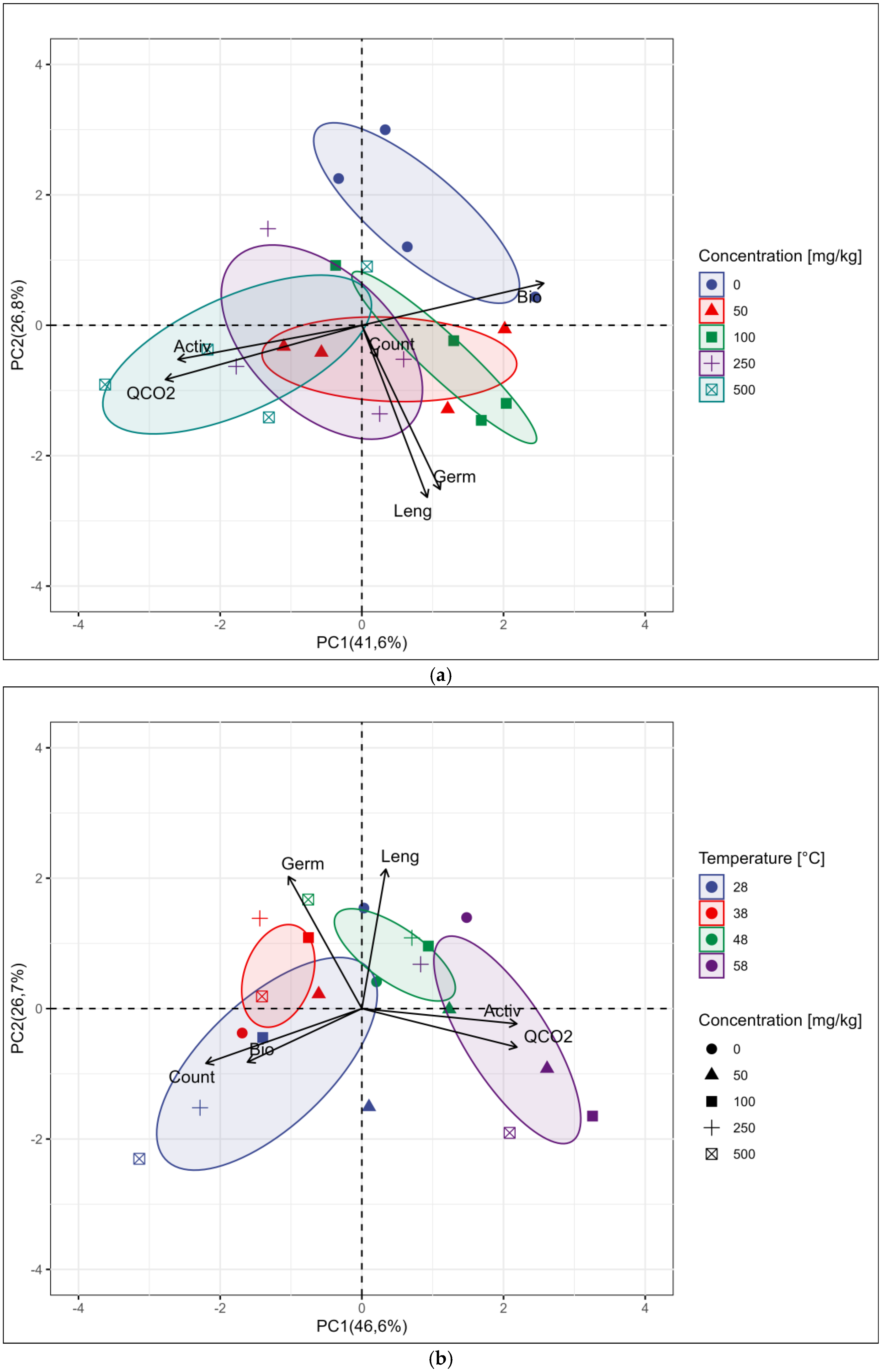
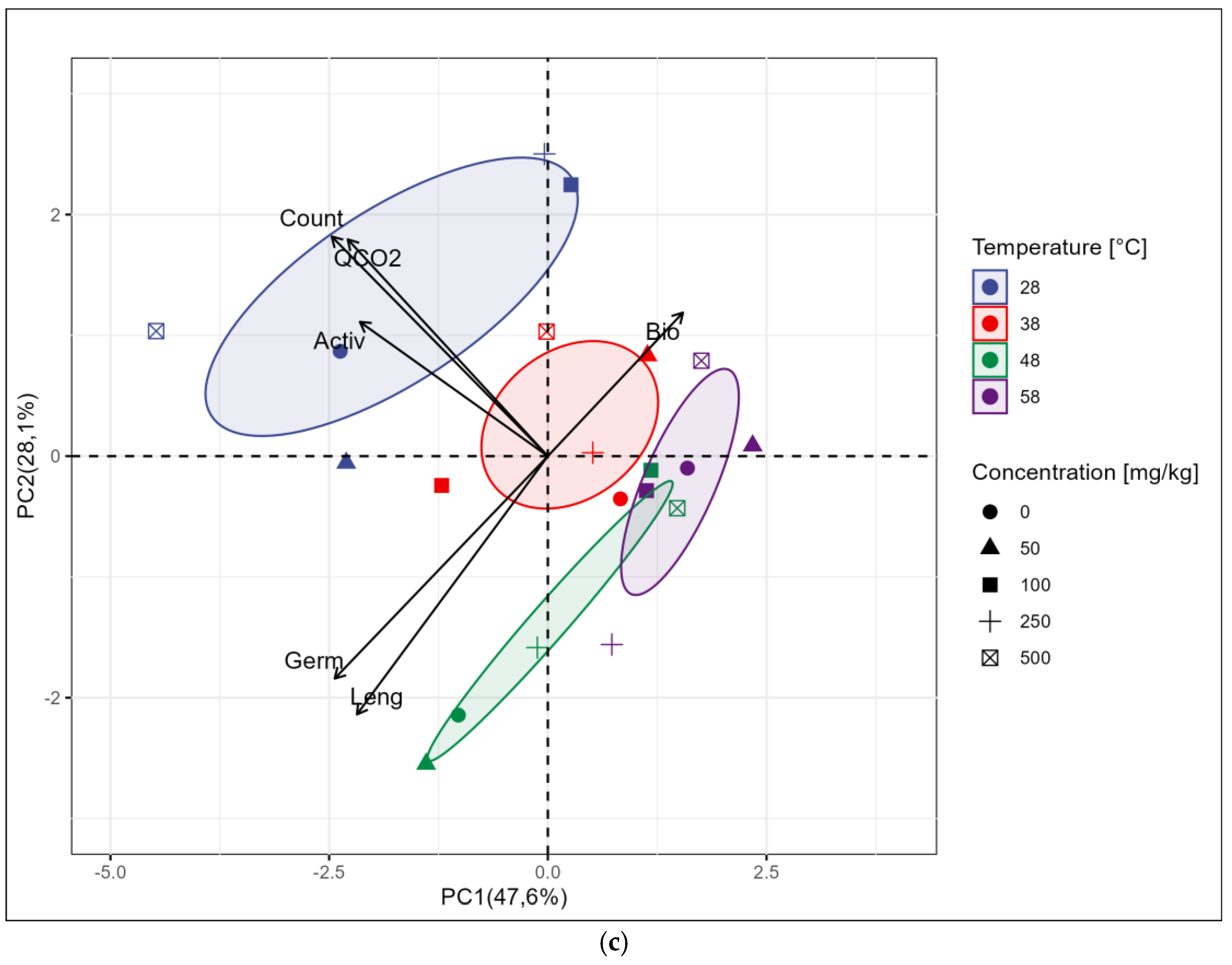

Table 1.
Results of the physicochemical analysis of the soil.
| Parameter | Unit | Result |
| Clay | % | 47,00 |
| Silt | % | 11,64 |
| Total sand | % | 41,36 |
| Organic Matter | dag/dm³ | 1,45 |
| pH | - | 5,04 |
| P | mg/dm³ | 32,6 |
| K | mg/dm³ | 233,6 |
| Ca | cmol/dm³ | 0,4 |
| Mg | cmol/dm³ | 0,17 |
| Al | cmol/dm³ | 0,9 |
| H+Al1 | cmol/dm³ | 8,28 |
| SB2 | cmol/dm³ | 1,2 |
| Ca/Mg | 2,49 | |
| Mg/K | 0,29 | |
| V3 | % | 12,66 |
| m4 | % | 42,86 |
| T5 | cmol/dm³ | 9,48 |
| Zn | mg/dm³ | 2,3 |
| Fe | mg/dm³ | 66,9 |
| Mn | mg/dm³ | 14,2 |
| Cu | mg/dm³ | 1,6 |
| B | mg/dm³ | 0,2 |
| S | mg/dm³ | -- |
1 Potential acidity (H+Al). 2 Base sum (SB). 3 Base saturation (V%). 4 Aluminum saturation (m%). 5 Total cation exchange capacity (T).
Table 2.
PERMANOVA Test with 1 × 10³ permutations for experimental factors.
| Time (Days) | p Value | ||
| Interaction | Temperature | Concentration | |
| T0 | - | - | 0,001* |
| T15 T30 |
0,001* | 0,001* | 0,078 |
| 0,001* | 0,001* | 0,1 | |
* Asterisk indicates statistically significant difference in p values at 95% confidence levels.
Disclaimer/Publisher’s Note: The statements, opinions and data contained in all publications are solely those of the individual author(s) and contributor(s) and not of MDPI and/or the editor(s). MDPI and/or the editor(s) disclaim responsibility for any injury to people or property resulting from any ideas, methods, instructions or products referred to in the content. |
© 2025 by the authors. Licensee MDPI, Basel, Switzerland. This article is an open access article distributed under the terms and conditions of the Creative Commons Attribution (CC BY) license (http://creativecommons.org/licenses/by/4.0/).
Copyright: This open access article is published under a Creative Commons CC BY 4.0 license, which permit the free download, distribution, and reuse, provided that the author and preprint are cited in any reuse.


