

Submitted:
09 July 2025
Posted:
10 July 2025
You are already at the latest version
Abstract
Leucine (Leu) is an amino acid which is considered to be an important compound in health matters and lately is recognized as an indicator of carbon storage. For the first time, an interaction between the amino acid leucine and thermally denatured single stranded (ss) DNA has been demonstrated by applying voltammetry. As a result of interaction the characteristic peak of ssDNA, due to the oxidation of guanine residues, decreased. The interaction behaviour between leucine and ssDNA was studied with UV-vis spectrophotometry, the obtained results are in good agreement. The results of the interaction study were exploited in order to develop a SWV method for the determination of leucine at the ssDNA modified carbon paste electrode (CPE). Different parameters were tested to optimize the conditions of the determination. The peak of guanine was at around +0.86 V. Linearity was observed in the range of 1,4.10-9 - 3,5.10-8 mol/L( r= 0,9990 ) while LOD equals 4,9.10-10 mol/L. The method was applied in spiked soil sample and gave satisfactory results.
Keywords:
Leucine
; square wave voltammetry
; ssDNA
; carbon paste electrode
; electrochemical biosensor
; soil
1. Introduction
Amino acids are essential for plants since they help them withstand a range of stresses, both biotic and abiotic [1]. They might be able to support the plant under extreme conditions including high concentrations of potentially toxic elements as well as extremely high or low temperatures [2], or high concentrations of salts and severe water shortages occur in the soil environment [3,4,5] where leucine's role was investigated in the growth of peach trees cultivated in soils with high Cu concentrations.
Leucine applied exogenously appeared to improve the horticultural characteristics of the trees by increasing chlorophyll levels as well as the rate of photosynthesis. Leucine also has the potential to limit oxidative damage by regulating the antioxidant system of the plant [6] in their study on in Panax notoginseng. It was found out [7] that leucine among several other amino acids resulted in an increase in the activity of appropriate enzymes activating the nitrogen cycle in soils, while in [8] it was concluded the significant effect of leucine on plant nitrogen metabolism. This property is particularly important, as the enhancement of nitrogen metabolism subsequently led to an increase in plant resistance to stress from high Cu concentrations ([5].
Leucine is also used as an indicator of the stress a plant organism undergoes when stressed by extreme toxicity conditions, as in the case of emerging pollutants and environmental hazards or where an amendment has been used in the soil tested [9].
Variations in organic matter amount contained in soils provide valuable information on possible scenarios of land use, fertility levels, the percentage of the land area under cultivation, as well as the cultivation method [10]. The percentage of soil organic carbon can also lead to conclusions regarding their origin or creation, and may lead to a distinction between soils originating from urban or agricultural environments. Agricultural soils usually contain higher amounts of organic matter, as they either contain manure or other organic soil amendments [11]. In urban soils, the organic matter is usually oxidized and the amounts are low [12]. Besides, the land in the green areas of the cities is relatively barren and therefore needs special care from the municipal services of the cities.
Considering the foregoing, the presence of high leucine levels may be an indicator of urban or rural origin of the soil samples. High concentrations of leucine indicate agricultural soil and low concentrations indicate urban soil and less fertile soil. Therefore, the analytical method we propose could help a traceability tool of the soil samples analyzed being a measure of fertility and or urban or agricultural origin.
Soil, which serves as a carbon store, plays an important role in reducing the carbon footprint by storing and sequestering carbon dioxide from the atmosphere. A healthy and fertile soil can increase its carbon storage capacity, helping to reduce emissions [13]. Therefore, the existence of leucine could also lead to conclusions regarding soil health.
Other researchers [14] concluded that leucine presence in soils and its level variation provides a satisfactory assessment of the soil's ability to retain soluble carbon compounds easily degradable. Furthermore, it provides an indirect estimation regarding the effects of the dynamics of land use changes on carbon sequestration capacity and the way such changes are relevant to the biodiversity of soil micro-organisms [15] In other words, it can be an indicator about the changes the climate crisis may induce in soils, affecting the microbiota and the rate of carbon sequestration [16].
Due to these important properties of leucine, research on its determination in both soil and plant is valuable. The extractant used depends on the soil fraction and the type of plant in which the concentration of leucine should be determined.
Leucine, like many other amino acids, can be isolated in the exchangeable soil fraction and in clay minerals, as it can be bound to them [14] . In such applications, leucine is determined in the aqueous extract of CH3COONH4 0.1M (pH = 7). More often experiments involve the addition of quantities of the amino acid, followed by incubation for a specific period of time and under specific conditions, and then determination of the remaining amount of amino acid.
The method commonly used is based on the colorimetric determination after ninhydrin reaction at pH of 5.0 [17] . However, this method's main problem is that the soil extracts must be adjusted to pH=5 and this may modulate significant parameters in the remaining components of the soil extract, resulting in fluctuations in the amount of amino acid that is actually free (rather than bound) in order to be quantified [14] .
Therefore, a method that could be carried out at pH values ranged between 5-8 would be more preferable. For the quantitative determination of leucine in soil samples, an HPLC method in combination with mass spectrometry was developed by the researchers [18] using 6-aminoquinolyl-N-hydroxysuccinyl imidyl carbamate (AQC).Linearity was observed in the range 50-800 mol L-1 . Detection limits were 0.20-0.60 pmol μL-1 in the column and 0.07-0.24 μg g-1 soil.
Aminoacids, in free or polymeric, they contribute significantly to most ecosystems' nitrogen levels and so play an important role in the soil nitrogen cycle. Some plants' ability to absorb amino acids straight from the soil may provide a competitive advantage, particularly in nitrogen-limited situations. While inorganic N concentrations (NH4 and NO3-) are regularly measured in either soil solutions or soil water/KCl extracts, a supplementary technique is required to estimate free amino acids and all plant-available pools.
The purpose of this research is to create and evaluate a procedure for rapidly and sensitively determining total free amino acids in soil solutions and soil extracts (water or 2 M KCl), as well as to compare it to Moore and Stein's (1954) standard approach. The spectrofluorometric technique is based on the reaction of free amino acids with o-phthaldialdehyde and b-mercaptoethanol. The fluorometric method is substantially more sensitive (working range 0.1-50 mM) than standard spectrophotometric analysis procedures for free amino acids, which use the ninhydrin reagent (10–500 mM). Furthermore, the method requires only tiny sample quantities, is quick, easy to use, and linearity in the range 0.1-100 mM. Free amino acid concentrations were determined in a variety of ecosystems (upland and lowland grasses, forests, heathlands, and coastal saltmarsh). Overall, the concentration of free amino acids in soil solution was low and generally unaffected by soil type. Free amino acids typically account for 10-40% of total soluble N in soil solutions, making up a large soluble N and plant accessible pool in soil.
In the last decades, extensive research in electrochemistry has advanced the detection of biological molecules. Among these, amino acids (AAs) have garnered significant interest from scientists and researchers. Electrochemical sensors and biosensors are simple to use, while present high selectivity, sensitivity, and timesaving.
Regarding analytical methods for the determination of leucine an important comparison of analytical methodologies is being discussed in [19]
In Table 1 are being compared the analytical characteristics of the already established methods with the proposed work.

Table 1.
Comparison of the analytical characteristics of the already established methods with the proposed work.
Table 1.
Comparison of the analytical characteristics of the already established methods with the proposed work.
| Electrode | Linearity mol/L |
LOD mol/L |
Application | Ref. |
|---|---|---|---|---|
| α-CD/ZnO/nanoC | 10−11 - 10−8 | 3 × 10⁻¹² | Blood | [20] |
| v-NiNWs | 25-700x10−6 | 8× 10⁻¹⁶ | [21] | |
| SrO NR | 0,1-100x10−9 | 37.5 ± 0.2 10−12 | spiked urine, milk and serum | [22] |
| Diamond paste | - | [23] | ||
| Amperometric bienzyme ScPE | 10 - 600 x10−6 | 2 x10⁻⁶ | - | [24] |
| MWNTs | 9.0 × 10⁻⁶ − 5 × 10⁻³ | 3.0 × 10⁻⁶ | blood, urine samples | [25] |
| CPE/MnCO3@OAm/ssDNA | 1,4.10-9 - 3,5.10-8 | 4,9.10-10 | spiked soil | This work |
The immobilization of DNA at electrode surfaces has been recognized as an excellent strategy for forming a conductive thin layer with nanostructures, hence increasing the electrode's surface area for the future construction of efficient biosensors. Furthermore, this method can produce thin coatings with negative charges on the electrode surface, enabling for the adsorption of positive-charged target molecules while limiting undesired adsorption on the substrate. Typically, DNA is deposited at the surface of conductive materials to form a bilayer modified electrode. The application of conductive materials to the electrode can increase its surface area and interfacial conductivity. These bi-layer modified electrodes are capable of sensitively detecting tiny compounds, including medicines, carcinogens, and pollutants, that interact with DNA.
A rare metabolic disease caused by large amounts of branched-chain amino acids (b AAs) i.e., leucine, isoleucine, and valine, and reported MSUD and b AAs was studied as an assay based on electrochemical (bio)sensing [26].
The interaction study between leucine and DNA can be the main trend in the detection of amino acids with electrochemical (bio)-sensors is the use of biomolecules. In general, all electrochemical approaches in both simple electrodes and advanced biosensors may be suitable for the electrochemical detection of amino acids, due to the low detection limit required.
However, simple electrodes are probably not the most suitable solution in the analysis of complicated samples, since biomolecules improve the selectivity, sensitivity and reproducibility of the analysis. In this sense, the damage resistance of biomolecule modified electrodes is particularly important, since they are able to perform various analyzes without altering their analytical characteristics.
In the literature DNA interaction studies along with leucine were realized in the following studies where is being concluded that aliphatic amino acids alanine, isoleucine, leucine, and valine show low propensity in both binding specificity groups [27,28,29]
While leucine interaction with DNA is due to the shortness of its side chain. [27]
Another review discusses the structure and function of single-stranded DNA (ssDNA) binding proteins (SSBs), as well as the structural characteristics that determine SSB binding selectivity. Machine learning-based approaches to predicting SSBs from double-stranded DNA (dsDNA) binding proteins (DSBs) are extensively studied. [28]
Comparing the interactions with dsDNA and ssDNA showed that, with the exception of positively charged side chains,
All forms of amino acid side chains interact more favorably with ssDNA, with the exception of positively charged side chains, with aromatic and aliphatic side chains intercalating particularly well. While positively charged side chains and sodium ions preferentially bind to cytosine in ssDNA and negatively charged side chains and chloride ions preferentially bind to guanine. In the study is shown the intercalation of a leucine side chain between bases [29].
Aliphatic amino acids alanine (A), isoleucine (I), leucine (L), and valine (V), the negatively charged glutamate (E) and cysteine (C) show low tendency in both specific binding (SP) and non specific binding (NS) groups in [30].
The conclusions of the above mentioned studies showed that exist important findings that in favour ssDNA-leucine interactions.
The objective of the proposed study is the development of an electrochemical DNA biosensor for the detection of leucine. In particular, in this study, the methodology of preparation, their voltammetric behavior, the conditions of DNA immobilization and the analytical characteristics of the sensor were studied.
2. Materials and Methods
2.1. Chemicals and Reagents for the Development of DNA Biosensor
Double-stranded deoxyribonucleic acid (dsDNA) from fish sperm was supplied from Sigma-Aldrich as a lyophilized powder. Single stranded deoxyribonucleic acid (ssDNA) was prepared by thermal denaturation. dsDNA (1000mgL-1) was heated in 10mM Tris-HCl (8) at 100°C for 15 min and was immediately placed in iced bath for cooling for 20 min. In this work, ultra-pure water (18 Ω) was used for the preparation of all solutions (Elgastat, England), and the chemicals used were of analytical grade. Experiments were performed in room temperature (22.0–25.0 °C)
2.2. Solutions
Double-stranded deoxyribonucleic acid (dsDNA) from fish sperm was supplied from Sigma-Aldrich as a lyophilized powder. Single stranded deoxyribonucleic acid (ssDNA) was prepared by thermal denaturation. dsDNA (1000mgL-1) was heated in 10mM Tris-HCl (pH = 8) at 100°C for 15 min and was immediately placed in iced bath for cooling for 20 min. In this work, ultra-pure water (18 Ω) was used for the preparation of all solutions (Elgastat, England), and the chemicals used were of analytical grade. The stock solution of DNA gave a ratio of UV absorbance at 260 nm of ~1.90 absorbance, indicating that the DNA was sufficiently free of protein contamination. Experiments were performed in room temperature (22.0–25.0 °C).
Solvents, acids, bases, and standard solutions were all analytical grade and unless noted otherwise/if the contrary is not stated, they were used as received. Sodium hydroxide (NaOH), acetic acid (CH3COOH) and potassium dihydrogen phosphate (KH2PO4) tris hydroxymethyl amino-methane (Tris 99.8%, ACS) and hydrogen chloride (HCl) were supplied from Merck (Darmstadt, Germany). Potassium chloride (KCl), potassium iodide (KI), potassium fluoride (KF), sodium chloride (NaCl) and sodium fluoride (NaF). Amino acids L-leucine (leu), L-isoleucine (ile), L-valine (val), and L-methionine (met) CELLPURE® ≥99 % were purchased from Carl ROTH GmbH + Co. KG (Karlsruhe, Germany), while L-phenylalanine (phe) ≥98 % was from Tokyo Chemical Industry Co., Ltd. (TCI, Japan). All aqueous solutions were prepared with deionized water. A magnetic stirring bar of 8 × 3 mm, PTFE (HEINZ HERENZ HAMBURG, Hamburg, Germany), was also used.
2.3. Apparatus
The voltammetric analysis was conducted using a PalmSens potentiostat/galvanostat from Echo Chemie, based in the Netherlands . The electrochemical cell employed in the experiment consisted CPE which was used as a “working electrode” A Rotring pencil (Germany) was used as a holder for the graphite lead. Electrical contact with the lead was obtained by soldering a metallic wire to the metallic part. An Ag/AgCl reference electrode (RE) saturated with 3 mol·L−1 KCl, and a platinum wire counter electrode (CE) (Metrohm, Switzerland). All weighings were performed using Sartorius-type scales (Kernew 220-30014 and Denver Instrument XE-310), with procedures conducted at ambient temperature and solution pH measured using a Consort C830 pH meter. The electrochemical cells (with a 25 mm diameter) were washed and rinsed with deionized water and cleaned with dilute nitric acid.
2.4. UV-vis Study of ssDNA Along with Leucine
Absorption titrations were performed by using a fixed Leucine concentration to which increments of the DNA stock solution were added. Leu-DNA solutions were allowed to incubate for 15 min before the absorption spectra were recorded with the UV region from 220 to 450 nm. Absorption titrations were carried out by employing the Wolfe–Shimmer equation [31]: [DNA]/(|ɛA-ɛF|)=[DNA]/(|ɛB-ɛF|)+1/{Kb (|ɛB−ɛF|)}, where [DNA] is the concentration of DNA in base pairs; ɛA, ɛF, and ɛB correspond to Aobsd/[compound], the extinction coefficient of the free Leucine and the extinction coefficient of the compound in the fully bound form, respectively. In the plot of [DNA]/(|ɛA−ɛF|) versus [DNA], the intrinsic binding constant Kb is then given by the ratio of the slope to the intercept.
3. Procedures
Interaction of Surface-Confined DNA with Leu at the CPE Surface
The procedure consists of: a) ssDNA immobilization at the CPE electrode surface b) interaction of Leu, with CPE/ssDNA based biosensor and c) transduction by transfer voltammetry using square wave voltammetry as stripping mode. Prior to each medium exchange, the electrode was rinsed carefully with water for 5 s. After the modification of the CPE, 100 μL ssDNA was transferred to the stirred sample solution (analyte plus 0.2 M acetate buffer solution pH 5.0) for 60 s at + 0.5 V and allowed to interact with leucine for 60s in Tris-HCl 0,1M+0,008 M NaCl, pH=8 solution. The transduction was performed in 0.1 M acetate buffer solution pH 5.0
In both procedures the transduction was performed in the blank acetate buffer solution and square wave voltammetry (SWV) was applied under the following conditions; Estep = 0.005 V, Epulse = 0.015 V and frequency 12 Hz (if not stated otherwise). The studied potential range varied between 0 to 1.3 V. Native ssDNA yielded in this medium two positive peaks, the first within 0.82 and 0.86 V where guanine [G] residues are being oxidised and the second between 1.05 and 1.15 V was attributed to adenine [A] residues.
4. Results and Discussion
In order to favor the performance of the biosensor, various factors influencing the response of the biosensor, as ssDNA concentration, concentration of salts, applied potential and accumulation time, were investigated.
The current height of the oxidation peak of guanine and adenine residues increases with increasing ssDNA concentration up to 190 mg L-1. Above this value, saturation of the CPE surface is observed and the current stabilizes. Thus, the concentration of 190 mg L-1 is chosen as the most appropriate for the following studies, since the electrode coverage is complete.
Different salts were studied like NaCl, NaF, KI, KF, KCl The effect of ionic strength was also studied as a parameter influencing the electrochemical behaviour of ssDNA and a concntration of 0,005 M NaCl was found to be ideal.
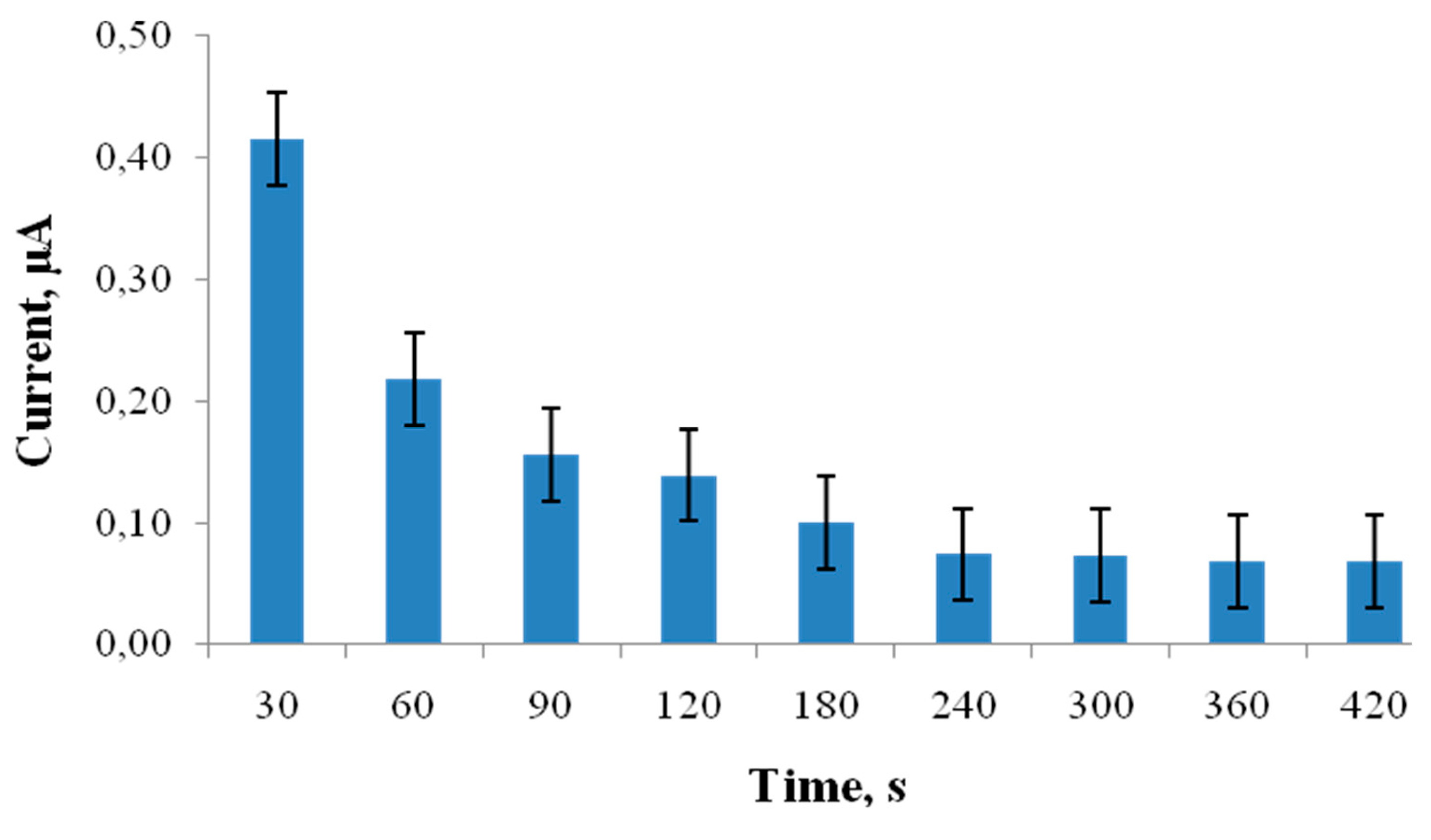
The interaction time have a profound effect upon the SWV response.The selection of the interaction time was done according to the potential changes to the characteristic oxidation peak of guanine in ssDNA. Optimum interaction time was found to be 60 s.
By increasing the interaction time of the leucine with ssDNA, which is a relaxed and more accessible form of DNA, changes in the current height of the characteristic oxidation peak of the guanine and adenine residues of DNA were observed. These changes are directly related to the steric changes in the DNA backbone and its ability to adhere to the hard surface of the carbon paste.It should be noted that the adenine oxidation peak is not reproducible and for this reason only guanine residues were selected for study.
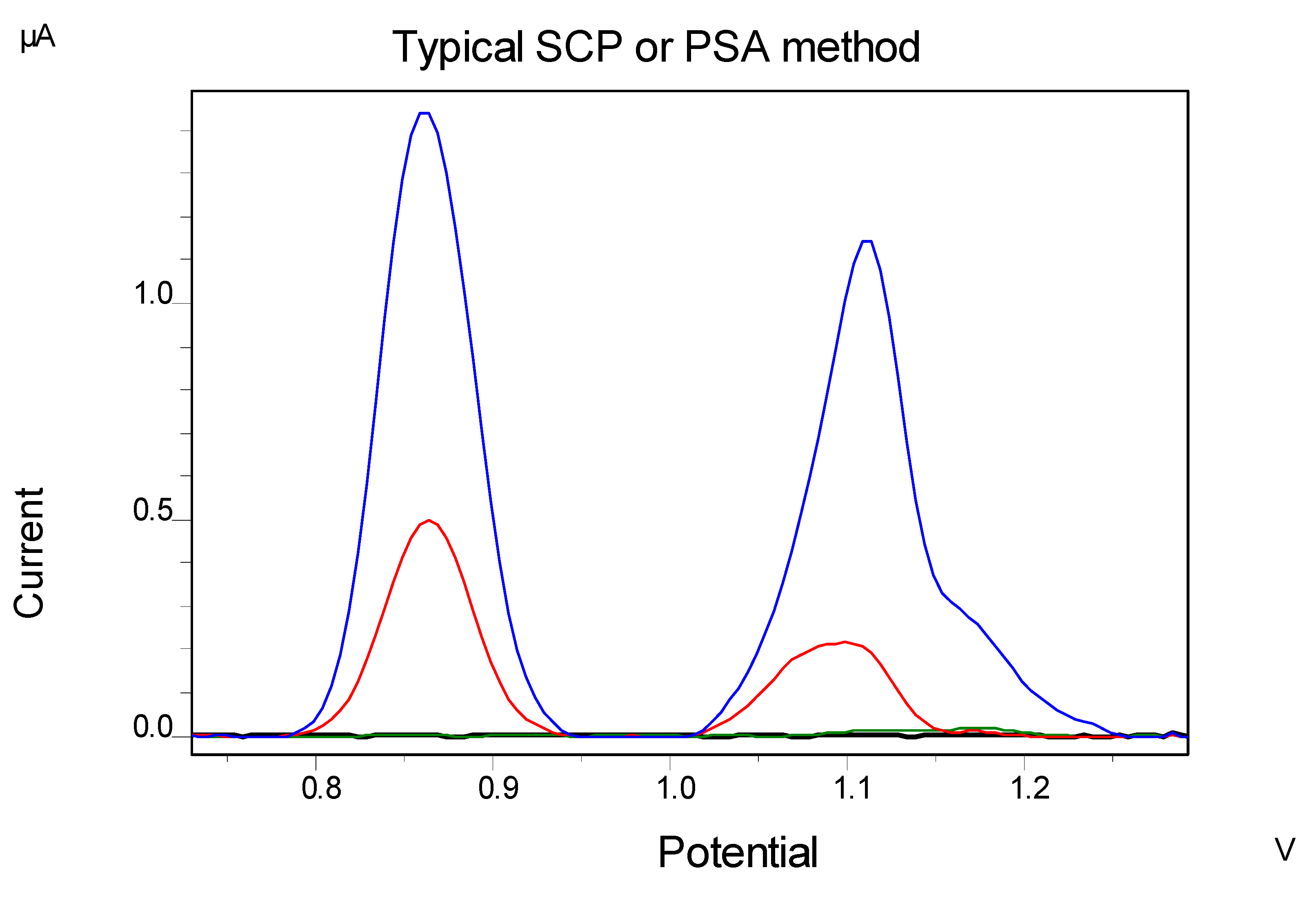
The decrease in the peak current intensity of oxidation of guanine residues may be due either to some kind of equilibrium between the free and ssDNA-bound complex or to steric changes in the ssDNA structure which lead the electroactive groups of ssDNA to unfavorable positions for oxidation on the electrode surface a fact that means that the binding reaction of leucine with ssDNA reaches equilibrium This behavior cannot be attributed to electrostatic interactions phenomena as leucine is a neutral molecule it is the result of the binding of Leu to the immobilised ssDNA which resulted in the the decrease of both characteristic oxidation peaks of ssDNA [32,33,34]. In Figure 1 is shown the SWV voltammogram of the oxidation peks of guanine (0.85 V) and adenine (1.1V)
Figure 1.
Bare CPE (black line), bare CPE +leucine (green line), CPE/ssDNA (blue line), CPE/ssDNA +leucine (red line).
Figure 1.
Bare CPE (black line), bare CPE +leucine (green line), CPE/ssDNA (blue line), CPE/ssDNA +leucine (red line).
In Figure 2 is shown the dependence of the oxidation of guanine peak current upon interaction time with Leu.
Figure 2.
Dependence of the oxidation of guanine peak current upon interaction time with Leu.
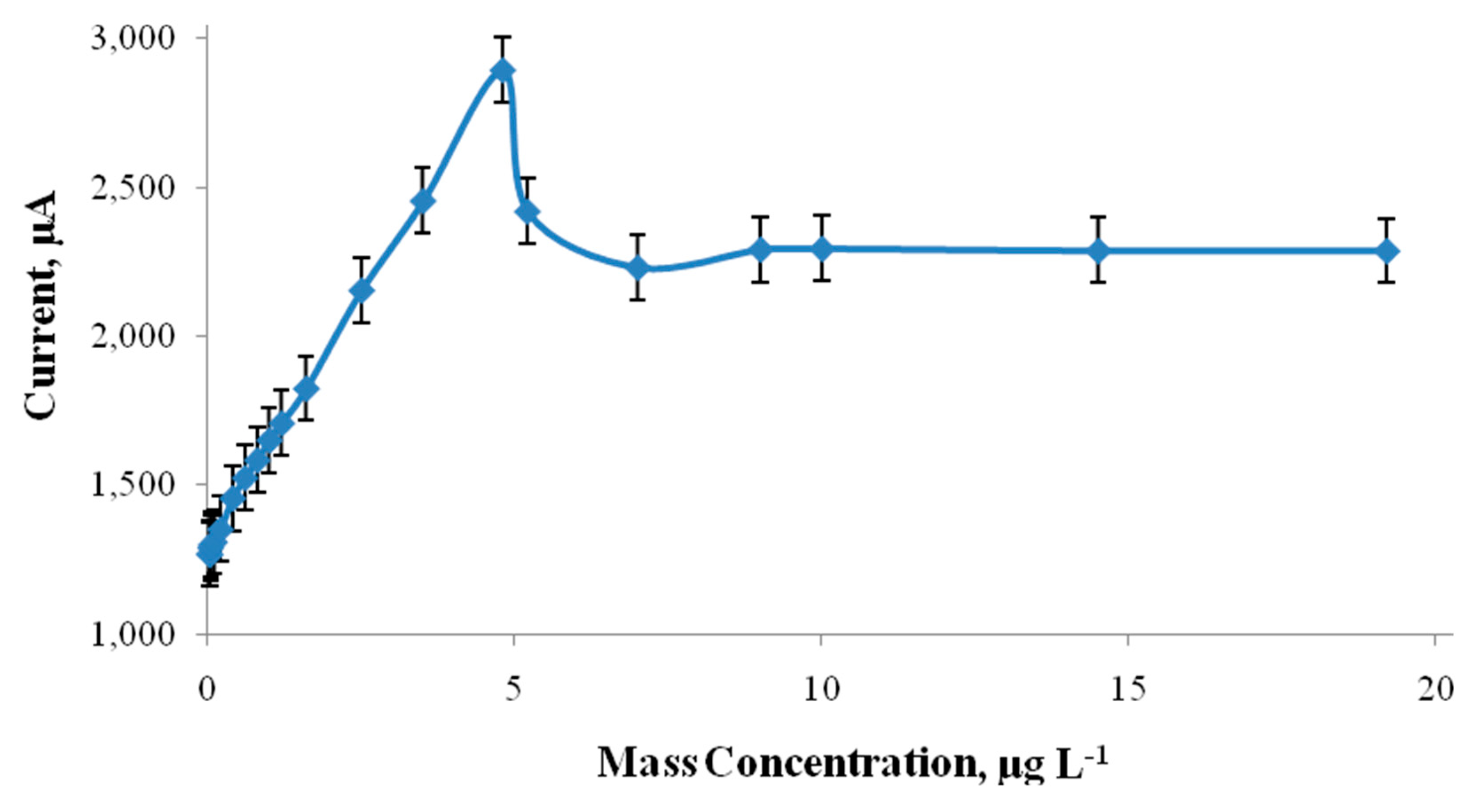
Another result of the binding of Leucine to ssDNA is the increase of the characteristic oxidation peak of guanine with increasing concentrations of leucine, which is probably due to a bending of the DNA molecule and its ability to adhere to the CPE surface. In Figure 3 is shown the dependence of the characteristic oxidation peak of guanine with increasing concentrations of leucine.
Figure 3.
Dependence of the characteristic oxidation peak of guanine with increasing concentrations of leucine.
Figure 3.
Dependence of the characteristic oxidation peak of guanine with increasing concentrations of leucine.
Additionally, UV-vis interaction study between ssDNA and leucine and the results obtained [35] are in good agreement with the performed voltammetric interaction study and the results presented so far in literature [29,30]
After the optimisation of the biosensor main parameters calibration curve is plotted.Linearity was observed in the concentration range 1,4.10-9 - 3,5.10-8 mol/L (r= 0,9990 ) while LOD equals 4,9.10-10 mol/L and the regression equation: y=0,3371x+1,2913 (R2=0,9980)
4.1. Interferences' Study
There is always the possibility of the interference of other amino acids to the detection of leucine. Aminoacids like Isoleucine, valine , phenylalanine, methionine were study as interferents. Therefore, the effect of foreign substances to the current response of the modified electrode was tested as shown in Table 2. The interfering effect of the studied amino acids was evaluated related to recovery, R%.
Table 2.
Interference study mass ratio100:1.
| Interfering aminoacid | Recovery, R% |
| Leucine | 100,00 |
| Isoleucine | 108,75 |
| Valine | 100,95 |
| Phenylalanine | 102,4 |
| Methionine | 97,63 |
4.2. Application in Soil Sample
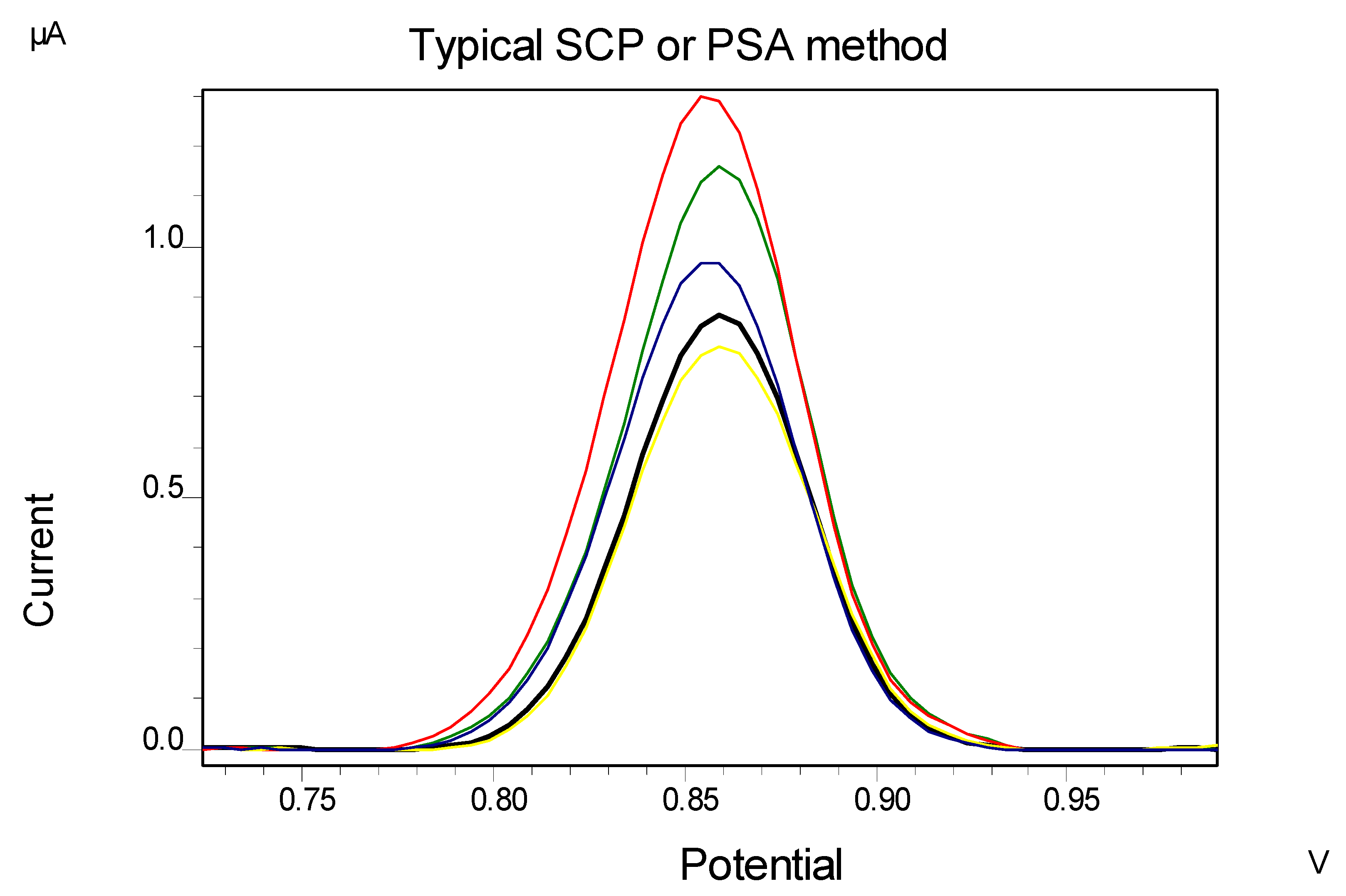
Leucine was determined in the aqueous extract CH3COONH4 0.1M (pH = 7), of spiked soil sample after 1:100 dilution with d.H2O A recovery of 98,7% was obtained by the proposed method using the standard addition method.
CPE/ssDNA based biosensor was transferred to the stirred sample solution (analyte plus 0.2 M acetate buffer solution pH 5.0) for 60 s at + 0.5 V and allowed to interact with leucine for 60s in Tris-HCl 0,1M+0,008 M NaCl, pH=8 solution. The transduction was performed in 0.1 M acetate buffer solution pH 5.0. A recovery of 98,7% was obtained by the proposed method using the standard addition method a regression equation:y=0,03591x+0,7211 (R2=0,9994)
Figure 4.
Overlay of standard additions in the soil sample;.
5. Conclusions
Regarding the novelty of the present study lies in the fact that it is the first attempt to determine leucine using square wave voltammetry (SWV) applying a CPE/ssDNA biosensor. Furthermore, the proposed electrochemical sensor was shown to be very sensitive, with a lower detection limit than other techniques published in the literature. Furthermore, the proposed approach was successfully performed to a spiked soil sample, demonstrating the sensor's potential relevance to real-world sample analysis. Furthermore, the usage of a simple, cost-effective, and environmentally friendly ssDNA biosensor is being demonstrated, and it has been successfully used in the creation of an electrochemical sensor that detects leucine selectively and sensitively in buffer solution and real samples.
References
- Haghighi, M.; Barzegar Sadeghabad, A.; Abolghasemi, R. Effect of exogenous amino acids application on the biochemical, antioxidant, and nutritional value of some leafy cabbage cultivars. Sci. Rep. 2022, 12, 17720. [Google Scholar] [CrossRef] [PubMed]
- Hasanuzzaman, M.; Nahar, K.; Alam, M.M.; Roychowdhury, R.; Fujita, M. . Physiological, biochemical, and molecular mechanisms of heat stress tolerance in plants. Int. J. Mol. Sci. 2013, 14, 9643–9684. [Google Scholar] [CrossRef] [PubMed]
- Shan, Y.; Ren, X.N.; Li, X.M. . Research progress on the effects of abiotic stress on plant carbohydrates and related enzymes in their metabolism. J. Anhui Agr. Sci. 2021, 49, 6–9. [Google Scholar] [CrossRef]
- Feng D, Gao Q, Liu J, Tang J, Hua Z, Sun X, Categories of exogenous substances and their effect on alleviation of plant salt stress. European Journal of Agronomy 2023, 142, 126656. [CrossRef]
- Sun, M.; Li, S.; Gong, Q.; Xiao, Y.; Peng, F. Leucine Contributes to Copper Stress Tolerance in Peach (Prunus persica) Seedlings by Enhancing Photosynthesis and the Antioxidant Defense System. Antioxidants. 2022, 11, 2455. [Google Scholar] [CrossRef]
- Liu H, Su Y, Fan Y, Zuo D, Xu J, Liu Y, Mei X, Huang H, Yang M and Zhu S Exogenous leucine alleviates heat stress and improves saponin synthesis in Panax notoginseng by improving antioxidant capacity and maintaining metabolic homeostasis. Front. Plant Sci. 2023, 14, 1175878. [CrossRef]
- Bayranvand, M.; Akbarinia, M.; Salehi Jouzani, G.; Gharechahi, J.; Baldrian, P. Distribution of Soil Extracellular Enzymatic, Microbial, and Biological Functions in the C and N-Cycle Pathways Along a Forest Altitudinal Gradient. Front Microbiol. 2021, 12, 660603. [Google Scholar] [CrossRef]
- Garlick PJ, The Role of Leucine in the Regulation of Protein Metabolism11, The Journal of Nutrition 2005, 135, 1553S–1556S. [CrossRef]
- Golia EE, Aslanidis PS, Papadimou SG, Kantzou OD, Chartodiplomenou MA, Lakiotis K, Androudi M, Tsiropoulos. Assessment of remediation of soils, moderately contaminated by potentially toxic metals, using different forms of carbon (charcoal, biochar, activated carbon). Impacts on contamination, metals availability and soil indices. Sustainable Chemistry and Pharmacy 2022, 28, 100724. [Google Scholar] [CrossRef]
- Kgathi, D.; Sekhwela, M.; Almendros, G. Changes in Soil Organic Matter Associated with Land Use of Arenosols from Southern Botswana. Agronomy 2024, 14, 1869. [Google Scholar] [CrossRef]
- Matisic, M.; Dugan, I.; Bogunovic, I. Challenges in Sustainable Agriculture—The Role of Organic Amendments. Agriculture 2024, 14, 643. [Google Scholar] [CrossRef]
- Igalavithana, A.D.; Lee, S.S.; Niazi, N.K.; Lee, Y.-H.; Kim, K.H.; Park, J.-H.; Moon, D.H.; Ok, Y.S. Assessment of Soil Health in Urban Agriculture: Soil Enzymes and Microbial Properties. Sustainability 2017, 9, 310. [Google Scholar] [CrossRef]
- Feliziani, G.; Bordoni, L.; Gabbianelli, R. Regenerative Organic Agriculture and Human Health: The Interconnection Between Soil, Food Quality, and Nutrition. Antioxidants 2025, 14, 530. [Google Scholar] [CrossRef] [PubMed]
- Clunes JPinochet, D. Leucine retention by the clay-sized mineral fraction. An indicator of C storage, Agro Sur 2020, 48, 37–46. [Google Scholar] [CrossRef]
- D’Alò, F.; Odriozola, I.; Baldrian, P.; Zucconi, L.; Ripa, C.; Cannone, N.; et al. Microbial activity in alpine soils under climate change. Sci. Total Environ. 2021, 783, 147012–10.1016. [Google Scholar] [CrossRef]
- Sierra, J.; Causeret, F. . Changes in soil carbon inputs and outputs along a tropical altitudinal gradient of volcanic soils under intensive agriculture. Geoderma 2018, 320, 95–104. [Google Scholar] [CrossRef]
- Sparks, D.L. , 1996. Methods of soil analysis part 3-chemical methods. Soil Science Society of America book series: 5. Wisconsin, U.S.A.
- Hou, S.; He, H.; Zhang, W.; Xie, H.; Zhang, X. . Determination of soil amino acids by high performance liquid chromatography-electro spray ionization-mass spectrometry derivatized with 6-aminoquinolyl-N-hydroxysuccinimidyl carbamate. Talanta, 2009, 80, 440–447. [Google Scholar] [CrossRef]
- Jones, D.L.; Owen, A.G.; Farrar, J.F. . Simple method to enable the high resolution determination of total free amino acids in soil solutions and soil extracts. Soil Biology and Biochemistry 2002, 34, 1893–1902. [Google Scholar] [CrossRef]
- Ionela Raluca Comnea-Stancu, I.R.; Stefan-van Staden, R.I.; van Staden, J.K.F. Enantioanalysis of Leucine and Arginine: A Key Factor in Lung Cancer Metabolomics. Journal of The Electrochemical Society 2024, 171, 067513. [Google Scholar] [CrossRef]
- García-Carmona, L.; González, M.C.; Escarpa, A. Electrochemical On-site Amino Acids Detection of Maple Syrup Urine Disease Using Vertically Aligned Nickel Nanowires. Electroanalysis 2018, 30, 1505–1510. [Google Scholar] [CrossRef]
- Hussain, M.M.; Rahman, M.M.; Asiri, A.M. . Sensitive L-leucine sensor based on a glassy carbon electrode modified with SrO nanorods. Microchimica Acta 2016, 183, 3265–3273. [Google Scholar] [CrossRef]
- Stefan-van Staden, R.I.; Shirley Muvhulawa, L. . Determination of L-and D-Enantiomers of Leucine Using Amperometric Biosensors Based on Diamond Paste. Instrumentation Science and Technology 2006, 34, 475–481. [Google Scholar] [CrossRef]
- Labroo, P.; Cui, Y. Amperometric bienzyme screen-printed biosensor for the determination of leucine. Analytical and bioanalytical chemistry 2014, 406, 367–372. [Google Scholar] [CrossRef] [PubMed]
- Rezaei, B.; Zare, Z.M. . Modified glassy carbon electrode with multiwall carbon nanotubes as a voltammetric sensor for determination of leucine in biological and pharmaceutical samples. Analytical letters 2008, 41, 2267–2286. [Google Scholar] [CrossRef]
- Karastogianni, S.; Girousi, S. Electrochemical (Bio)Sensing of Maple Syrup Urine Disease Biomarkers Pointing to Early Diagnosis: A Review. Appl. Sci. 2020, 10, 7023. [Google Scholar] [CrossRef]
- Luscombe, N.M.; Laskowski, R.A.; Thornton, J.M. Amino acid–base interactions: a three-dimensional analysis of protein–DNA interactions at an atomic level. Nucleic acids research 2001, 29, 2860–2874. [Google Scholar] [CrossRef]
- Guo, J.-T.; Malik, F. Single-Stranded DNA Binding Proteins and Their Identification Using Machine Learning-Based Approaches. Biomolecules 2022, 12, 1187. [Google Scholar] [CrossRef]
- Andrews, C.T.; Campbell, B.A.; Elcock, A.H. Direct comparison of amino acid and salt interactions with double-stranded and single-stranded DNA from explicit-solvent molecular dynamics simulations. Journal of chemical theory and computation 2017, 13, 1794–1811. [Google Scholar] [CrossRef]
- Lin, M.; Malik, F.K.; Guo, J.T. A comparative study of protein–ssDNA interactions. NAR genomics and bioinformatics 2021, 3, lqab006. [Google Scholar] [CrossRef]
- Wolfe, A.; Shimer, G.; Jr Meehan, T. Polycyclic aromatic hydrocarbons physically intercalaye into duplex regions of denaturated DNA. Biochemistry 1987, 26, 6392–6396. [Google Scholar] [CrossRef]
- Gherghi ICh Girousi STh Pantazaki, A.A.; Voulgaropoulos, A.N.; Tzimou-Tsitouridou, R. Electrochemical DNA biosensors applicable to the study of interactions between DNA and DNA intercalators. International Journal of Environmental Analytical Chemistry 2003, 83, 693–700. [Google Scholar]
- IChGherghi STh Girousi, A.N. Voulgaropoulos, R.Tzimou-Tsitouridou Interaction of the mutagen ethidium bromide (EB) with DNA, using a carbon paste electrode (CPE) and a Hanging mercury drop electrode (HMDE). Analytica chimica Acta 2004, 505, 135–144. [Google Scholar] [CrossRef]
- IChGherghi; ST Girousi, A.N. Voulgaropoulos, R.TTzimou-Tsitouridou Adsorptive transfer stripping voltammetry applied to the study of the interaction between DNA and actinomycin D. International Journal of Environmental Analytical Chemistry 2004, 84, 865–874. [CrossRef]
- Wen Li, Yuan Yuan Ji, Jian Wen Wang, Yong Ming Zhu Cytotoxic Activities and DNA Binding Properties of 1-Methyl-7H-indeno [1,2-b]Quinolinium-7-(4-dimethylamino). Benzylidene Triflate DNA Cell Biol 2012, 31, 1046–1053. [CrossRef] [PubMed]
Disclaimer/Publisher’s Note: The statements, opinions and data contained in all publications are solely those of the individual author(s) and contributor(s) and not of MDPI and/or the editor(s). MDPI and/or the editor(s) disclaim responsibility for any injury to people or property resulting from any ideas, methods, instructions or products referred to in the content. |
© 2025 by the authors. Licensee MDPI, Basel, Switzerland. This article is an open access article distributed under the terms and conditions of the Creative Commons Attribution (CC BY) license (https://creativecommons.org/licenses/by/4.0/).
Copyright: This open access article is published under a Creative Commons CC BY 4.0 license, which permit the free download, distribution, and reuse, provided that the author and preprint are cited in any reuse.


