

Submitted:
12 January 2025
Posted:
13 January 2025
You are already at the latest version
Abstract
A simple and easily applicable analytical method for the simultaneous determination of Cd2+, Pb2+, Zn2+, Cu2+, and Cl- applying a modified with saffron-conjugated silver nanoparticles (AgNPs@Sa) is being presented. The modified CPE was then used for the simultaneous determination of Cd2+, Pb2+, Zn2+, and Cu2+ as well as chloride ions in soil and plants. The comparative analysis demonstrated a significant enhancement in the applicability of the modified electrode through the incorporation of silver nanoparticles (AgNPs) at the carbon paste electrode (CPE) surface, leading to the development of a poly-Sa-CPE. This newly proposed method offers notably superior qualitative performance compared to other metal nanoparticle-based modifications reported in the literature. The accordingly modified electrode was successfully applied in the development of a chloride ion. A novel sensor, is being proposed, that makes possible the determination of heavy metals and chorides in the same solution, in soil and plant samples.
The enhanced sensitivity and selectivity of the poly-Sa-CPE system highlights its potential as a more effective alternative for heavy metal and chloride analysis, further demonstrating its advantages in electrochemical applications.
Keywords:
Heavy metals
; Chloride ion
; Silver nanoparticles
; Modified carbon paste electrode
; soil
; plants
1. Introduction
Heavy metals, usually naturally occurring elements with densities exceeding 5 g.cm−3 and atomic weights ranging from 63.5 to 200.6 g.mol−1, are known to pose substantial environmental and health hazards [1]. They consist prevalent pollutants found in air, water, and soil, commonly affecting both urban and rural areas, as well as terrestrial and marine ecosystems. Due to their resistance to degradation and their ability to persist over extended periods, these metals pose significant environmental challenges through bioaccumulation.
While trace amounts of metals like copper (Cu) and zinc (Zn) are crucial for the proper growth and reproduction of living organisms, these metals can become dangerous when they accumulate to toxic levels [2,3]. Other metals, such as cadmium (Cd) and lead (Pb) [4], offer no benefits to living organisms and can be harmful even in minimal amounts [3,4]. The primary concern with heavy metals lies in their persistence in the environment, leading to their bioaccumulation in both non-living and living systems, potentially resulting in serious health issues including neurological disorders, cancer, and even death [5,6].The detection and quantification of heavy metals require a structured and systematic approach to ensure accuracy and reliability. Regular monitoring is crucial, particularly to account for seasonal fluctuations in metal concentrations, enabling the identification of long-term trends and environmental impacts. Such monitoring is essential for assessing the influence of environmental changes and human activities on heavy metal levels.
Soil pollution from heavy metals and metalloids (HMs) has become a major concern today, as it can hinder plant growth, reduce crop production, and introduce risks into the food web, ultimately threatening human health. Even a single heavy metal in the soil has the potential to cause widespread contamination of groundwater supplies [7,8]. The sources of heavy metal contamination are varied, stemming from both natural and human activities [9,10]. Natural processes like weathering, volcanic activity, and forest fires release heavy metals, while human activities such as mining, smelting, and industrial practices amplify their presence in the environment [1]. Urban areas face additional challenges from heavy metal pollution due to emissions from vehicle exhaust and the burning of heating fuels [11]. In addition, the uncontrolled application of fertilizers and plant protection agents, as well as the use of sewage sludge, can introduce heavy metals into the soil, which in turn will pass to the plants [1]. Given their persistent nature and the risk of long-term environmental pollution, continuous monitoring of heavy metal concentrations, especially in soils, is crucial to mitigating their adverse effects.
For any heavy metal, especially those considered toxic, several carriers such as the World Health Organization (WHO), Food and Drug Administration (FDA), and the United States Environmental Protection Agency (US EPA) have set guideline values for the allowable intake and exposure of humans to these heavy metals [12]. For example, lead due to its acute toxicity imposed a maximum acceptable concentration in drinking water from 10 to 15 ppb [13]. This has led to the widespread use of these advanced techniques to monitor lead levels in contaminated water.
While traditional spectrometric methods such as ICP-OES/MS (Inductively Coupled Plasma-Mass Spectrometry/Optical Emission Spectrometry) [14] and AAS (spectroscopy atomic absorption spectrometry) as well as HPLC (High-Performance Liquid) [15], have been used for the detection of heavy metal ions (HMIs) in soil, plants, and water samples due to their high accuracy and sensitivity, they present significant limitations [16], including high cost, the need for specialized operation, and their limitation in use off site [17]. These methods are also time-consuming and lack the capability for on-site analysis. Consequently, the selection of a detection method often hinges on factors like precision, sensitivity, cost, and the feasibility of on-site application [18].
To further overcome challenges associated with traditional methods, electrochemical techniques like voltammetry, have gained considerable attention. These methods offer several advantages, including lower costs, ease of use, rapid analysis, portability, and suitability for field monitoring. Despite their straightforward design, they maintain high sensitivity and selectivity, making them an excellent alternative for on-site detection of heavy metals in environmental samples [19,20,21,22]. The advancement of new materials has greatly improved electrode fabrication, enhancing both the sensitivity and selectivity of these methods. Nanostructured and advanced materials demonstrate catalytic properties that significantly boost analyte detection. For example, carbon paste electrodes have been effectively used for the trace detection of Pb(II) and Cd(II) [4].
Over the last few years, modified electrodes have been effective in a range of electroanalytical techniques, including amperometry and voltammetry, and can detect HMs. Nanoparticles (NPs), specifically metal nanoparticles exhibit an exceptionally high surface area-to-volume ratio, which significantly boosts their reactivity and enables them to interact with biological systems and the environment in distinctive ways [22]. Their capability to traverse biological membranes and barriers has garnered significant interest across various fields, including medicine, environmental science, and engineering. NPs have been extensively utilized for the simultaneous detection of heavy metals such as cadmium (Cd), lead (Pb) [23], zinc (Zn), and copper (Cu) [24], due to their unique optical, electrical, and magnetic characteristics [6].
Heavy metals are widely known to pose concerns for human health as they can be part of the food chain [25]. In addition, they can cause adverse effects on the quality of cultivated plants, as they can easily migrate between the soil they are grown in and the different parts of the plants [26,27]. Chloride, on the other hand, is a macroelement for plants and the main ways of uptake are from soil and irrigation water [28]. In saline soils, chloride ions may be present in high concentrations, which may create toxic conditions for sensitive plants, while in soils there are potential risks due to changes in the values of various physico-chemical parameters [29]. When there is a combination of the presence of heavy metals and high concentrations of chlorides in soils, the conditions are more unfavorable and the mechanisms of changes in soil properties and plant physiology are more complex [30,31].
Therefore, it is important to know the levels of certain heavy metals, such as the toxic Cd and Pb, the trace elements Cu and Zn, and chloride ions, both in soils and in plant extracts [32], as we can identify their sources and achieve possible pollution reduction. The present method is an innovative concept that is particularly useful in monitoring pollution or potentially problematic conditions that may prevail in a soil environment as well as in plant tissues [33,34]. Traditionally, the quantification of metal ions in water, as well as in soil or plant extracts, is carried out using Atomic Absorption Spectroscopy (AAS) or Atomic Emission Spectroscopy (ICP-OES), while chlorine ions are determined using ion chromatography or titrimetry [32,35]. Simultaneous determination facilitates the required chemical pre-treatment, as no extraction is required, which is different in the case of determination of total or available concentrations of metals in soils, in the case of plants, and completely distinct in the case of determination of chloride in soils and plants.
For determining the presence of halide ions in the environment or physiological systems, several analytical techniques have been put forth, such as spectrometry, coulometric titrations, and ion chromatography. Another advantageous technique for identifying halide ions in biological materials is electrochemical analysis, while ion-selective electrode-based potentiometric techniques were the most widely employed [36].
As previously discussed, heavy metal pollution is a pressing concern, and the incorporation of nanoparticles (NPs) into electrochemical sensors has emerged as an important and innovative approach for the detection of heavy metals (HMs). Nanomaterials have demonstrated excellent properties, making them highly effective as sensing platforms. Over the years, various modification techniques have been explored [37]. In particular, the unique properties presented by metal NPs, in combination with their high surface-to-volume ratio, sensitivity, and selectivity, make them valuable tools for the determination of HMs [38].
Various researchers have demonstrated significant results from the use of AgNPs as electrode modifiers for the detection of heavy metal ions, such as Cd(ΙΙ), Cu(ΙΙ). These nanoparticles have received considerable attention due to some characteristics they present, such as good electrical conductivity, high specific area, and easy synthesis methods [39,40]. The applications of silver nanoparticle-modified electrodes for electroanalysis are being thoroughly reviewed [41]. The present work aims to introduce a straightforward and easily applicable analytical method for the sensitive and selective simultaneous voltammetric detection of total concentrations of Cd2+, Pb2+, Cu2+, Zn2+, and chloride ions [42] applying square wave voltammetry (SWV).
The present study concerns the development of a chemosensor that can be used both for determination of metals as well as chloride anions, in environmental samples. An already established procedure for the synthesis of Ag nanoparticles invented by the authors, previously published and focused in the determination of organic compounds was incorporated in a procedure of carbon paste electrode modification. This electrode is being further applied in determination of several ions of environmental importance in real-world samples. The proposed modifications of the electrode, as well as application of the method, seem to be very promising [43].
2. Experimental
2.1. Materials
All reagents were of analytical grade and used as received. The supporting electrolyte for anodic stripping voltammetry (ASV) was a 0.1 mol L−1 acetate buffer at pH 4.7, prepared from acetic acid and sodium hydroxide (CH3COOH/CH3COONa) (ACS reagent, Darmstadt, Germany) supplied by Merck. Standard solutions of cadmium (Cd), lead (Pb), copper (Cu), and zinc (Zn) were sourced from Sigma-Aldrich (Darmstadt, Germany) NaCl and KNO3 were purchased from Merck. Saffron, was commercially available from the local market, while silver nitrate was bought by Ducela Biochemie (The Netherlands). All solvents, acids, bases, and standard solutions were pro-analysis grade. All aqueous solutions were prepared with deionized water. A magnetic stirring bar 8 × 3 mm, PTFE (HEINZ HERENZ HAMBURG) was also used.
2.2. Apparatus
The voltammetric analysis was conducted using a PalmSens Model 1 potenti-ostat/galvanostat from Echo Chemie, based in the Netherlands. An ultrasonic bath (TRANSONIC 460/H) was also used to dissolve nanoparticles and buffers. The electrochemical cell employed in the experiment consisted of a carbon paste working electrode (CPE) with a 3 mm inner and 9 mm outer diameter of the PTFE sleeve , an Ag/AgCl reference electrode (RE) saturated with 3 mol·L−1 KCl, and a platinum wire counter electrode (CE) (Metrohm, Switzerland). The electrodes were used for the electropolymerization [44] of silver nanoparticles and the simultaneous determination of Cd, Pb, Zn, and Cu. All weightings were performed using Sartorius-type scales (Kernew 220-30014 and Denver Instrument XE-310), with procedures conducted at ambient temperature and solution pH measured using a Consort C830 pH meter. The electrochemical cells (with a 25 mm diameter) were washed and rinsed with deionized water and cleaned with dilute nitric acid.
Initially, cyclic voltammetry was applied in oredr to modify the CPΕ working electrode and then square wave anodic stripping voltammetry was applied in the determination of heavy metals in 0.1 mol L-1 acetate (pH 4.7) buffer solution, in a working potential range from −1.4 V to +0.2 V (vs.Ag/AgCl).
Determination of chloride ions was performed by applying square wave voltammetry (SWV) working potential from -0.10 V to +0.60 V (vs.Ag/AgCl) and KNO3 0.01M as a supporting electrolyte.
2.3. Preparation of NPs-Modified Electrodes
2.3.1. Synthesis of Saffron-Conjugated Silver Nanoparticles (AgNPs@Sa)
Silver nanoparticles were synthesized by our research group, applying an environmentally friendly method [45] that employed saffron as a stabilizing and reducing agent [46]. In a 25 ml volumetric flask, saffron and silver nitrate (AgNO3) were combined in a 1:1 weight ratio. Each mixture added a specific amount of sodium hydroxide (NaOH) to adjust the pH to 10 [47]. Deionized water was then added to bring the solution up to the 25 ml mark, followed by 5 minutes of stirring using a Vortex mixer. The solutions were allowed to stand for about 15 minutes, during which the color changed from red-orange to brownish-yellow. Afterward, the mixtures were filtered, and the precipitate was thoroughly washed with deionized water before being left to dry at room temperature for 24 hours. After obtaining the saffron-conjugated silver nanoparticles through the drying process, an amount of 0.01 g of the solid nanoparticles was weighed and added to a 5 ml volumetric flask with deionized water for a final concentration of 2 g L−1 and subjected to ultrasonic treatment for 15 minutes to prepare it for use.
2.3.2. Preparation of Modified, with Silver Nanoparticles (AgNPs@Sa), Carbon Paste Electrode Surface
In this study, a carbon paste electrode (CPE) was utilized as the working electrode, modified with silver nanoparticles (AgNPs@Sa) by depositing the electropolymerized silver nanoparticles at the surface of CPE (poly- AgNPs@Sa-CPE).
A bare carbon paste electrode (CPE) was made by mixing mineral oil with graphite powder in an agate mortar until a homogeneous paste was obtained and then pressing the paste onto a carbon paste electrode and sanding on parchment paper to obtain a uniform surface. Graphite powder (50870, p.a. purity 99. 9%, and particle size <0.1 mm) was purchased from Fluka, and mineral oil from Aldrich. The CPE did not require any pretreatment but was reloaded with carbon paste after each nanoparticle modification. The modification of the CPE involved the electropolymerization [44] of Sa@AgNPs via cyclic voltammetry, which resulted in the deposition of poly-Sa@AgNPs on the electrode surface, creating a poly-Sa@AgNPs-CPE. The electropolymerization was performed using a solution of AgNPs@Sa in 0.1 mol L−1 acetate buffer (pH 4.7, containing 2 g L−1 Sa@AgNPs), with the potential swept from -0.300 to +1.300 V for one scan cycle, a potential step of 0.005 V, and a scan rate of 0.025 V s−1, resulting in the deposition of poly-AgNPs@Sa onto the CPE surface. The modified CPE was then used for the simultaneous detection of heavy metals (Cd, Pb, Zn, and Cu) and the determination of chloride ions in both standard solutions with known concentrations and real samples.
2.3.3. Sample Preparation
Heavy metals in soil and plant samples
Total metal concentrations in soil and plant samples were determined after extraction using Aqua Regia (HCl:HNO3, 3:1) [48]
In order, to determine the concentrations of metal ions, 1 g of sample and 12 mL aqua regia (9 mL HCl + 3 mL HNO3) were added to the appropriate autoclave device with a Teflon bomb (Labter, Ecopre Series, AHF, Germany), and extraction was carried out using the aqua regia methodThe system followed a digestion program in which the temperature gradually reached 180 °C and the total digestion time was 4.5 h. Then, in the extracts, the pseudo-total concentrations of the metals were determined using an atomic absorption spectrophotometer (Shimadzu, AA-6600, Duisburg, Germany) with flame and graphite furnace equipment.
For the voltammetric measurements, the digested samples were further diluted with deionized water (1:5).The concentration of chloride was compared with the value obtained after titration with AgNO3.
Chloride in soil and plant samples
10 g of soil sample (grain diameter <2 mm) was mixed with 25 mL of distilled water and shaken for 30 minutes. The mixture was then centrifuged and the liquid was separated from the solid. The concentration of chloride was quantified in the aqueous extract.
2.4. Analytical Determination
Simultaneous determination of Cd²⁺, Pb²⁺, Zn²⁺, and Cu²⁺
The simultaneous determination of HMs (Cd, Pb, Zn, and Cu) was done using standard solutions of known mass concentration of HMs, using the square wave voltammetry technique. Initially, the carbon paste electrode was shaped by silver nanoparticles with saffron (AgNPs@Sa) by applying cyclic voltammetry so that the NPs were immobilized on the surface of the CPE. The procedure was conducted as follows: In an acetate buffer solution with a pH of 4.7, a specified amount of AgNPs@Sa (2 g L−1) and sodium nitrate (0.01 mol L−1 NaNO3) were added. The polymer film was then deposited at the surface of the carbon paste electrode (CPE) applying cyclic voltammetry. The working electrode potential was scanned between -1.00 V and +1.00 V, with a scan rate of 0.025 V s⁻¹ and a potential step of 0.005 V, over a single scan cycle.
Crocin as a primary component of saffron act as reducing factor of Ag⁺ to Ag0. The electropymerization of AgNPs@Sa starts with the electrooxidation where the first oxidation peak of polyAgNPs@Sa may be attributed to the formation of the free radical species, probably [AgNPs-crocin -Sa]. Afterward, coupling occurs between [AgNPs-crocin. -Sa] and the [AgNPs-crocin2+-Sa], formed from the subsequent oxidation of [AgNPs-crocin.] [44]. Then, termination of the polymerization happens and polyAgNPs-[crocin]n-Sa is formed. In our previous studies [44] it was found that the formatted film was stable after two weeks in the air or after multiple cycles (up to 15 scans)
Following the deposition of silver nanoparticles, the modified CPE with the polymer film (poly-AgNPs@Sa-CPE) was thoroughly washed with deionized water. Subsequently, the nanoparticle-patterned electrode was rinsed with deionized water and re-immersed in a 0.1 mol L⁻¹ acetate buffer solution at pH 4.7, along with a heavy metal solution of a specified concentration. Signal conversion was then carried out using square wave voltammetry (SWV). The potential was swept between -0.300 V and +1.400 V, with a potential step of 0.005 V, a pulse potential of 0.015 V, and a frequency of 10 Hz.
3. Results and Discussion
3.1. Comparison of Bare CPE Electrode with Modified AgNPs@Sa-CPE Electrode
The comparative analysis between the bare carbon paste electrode (CPE) and the AgNPs@Sa-modified CPE reveals significant findings. Initially, cyclic voltammetry performed with the unmodified CPE fails to produce a distinct electrochemical signal.
Furthermore, comparing peak profiles during the simultaneous detection of metals under both conditions—using the bare CPE and AgNPs@Sa-modified CPE-yields noteworthy observations. When utilizing the unmodified CPE, the peaks observed tained with the nanoparticle AgNPs@Sa-modified CPE electrode. This comparative analysis underscores the substantial impact of AgNPs@Sa modification on the electrochemical performance of the CPE, emphasizing its enhanced applicability for the simultaneous detection of Cd²⁺, Pb²⁺, Zn²⁺, and Cu²⁺.
3.2. Development of Analytical Methodology
3.2.1. Simultaneous Determination of Cd²⁺, Pb²⁺, Zn²⁺, and Cu²⁺
In Figure 1 is being illustrated the SWASV responses obtained using the AgNPs@Sa-CPE electrode and bare CPE for the simultaneous determination of Cd²⁺, Pb²⁺, Zn2+, and Cu²⁺. The measurements were conducted in a CH₃COOH/CH₃COONa buffer solution (pH 4.7) at −1.4 V for 60 seconds. Furthermore, many analytical techniques face challenges distinguishing between multiple analytes, especially those with similar chemical properties, which can compromise the accuracy and precision of detection at lower concentrations. In addition, matrix effects, where the surrounding chemical environment has a different concentration of cadmium, lead, zinc, and copper can further change the sensitivity of the method, leading to an increase in the limit of detection during simultaneous analysis. Occasionally, the formation of intermetallic compounds, such as Cd-Cu [50] and Pb-Cu [51], can occur during the deposition process. This may result in the suppression of peak intensities corresponding to the individual metals, namely Cd²⁺, Pb²⁺, and Cu²⁺.
Analytical methods developed so far along with their analytical figures of merit are being compared with previously reported results for electrodes modified with various materials, including tin nanoparticles (SnNPs), gold nanoparticles (AuNPs), bismuth nanoparticles (BiNPs), and manganese oxide nanoparticles (MnCo2O4NPs). bismuth (Bi). This comparison is summarized in Table 1.
Table 1 provides a comparative analysis of various nanoparticles (NPs) used for the detection of heavy metals, specifically cadmium (Cd), lead (Pb), zinc (Zn), and copper (Cu). The table outlines the detection limits (LODs) alongside their respective relative standard deviations (RSD's) expressed as percentages. The table highlights the performance of each nanoparticle type in terms of detection sensitivity and precision for different metals. The AgNPs@Sa and BiNPs stand out for their high sensitivity, while the AuNPs demonstrate improved precision with lower relative standard deviations. Jafarzadeh et al. also report that gold nanoparticles (Au(NP)/TCODS/BN/GCE) are an effective material for the detection of Pb²⁺ even in the presence of other metal ions such as zinc or cadmium [56]. Each type of nanoparticle offers unique advantages, making them suitable for specific metal detection applications depending on the required sensitivity and reliability.
The LODs of Cd2+, Pb2+, Zn2+, and Cu2+ obtained for their simultaneous determination are about 0.19 mg/L, 0.22 mg/L, 0.36 mg/L, and 0.21 mg/L respectively with comparably high relative standard deviations of about 6.1%, 5.4%, 3.3% and 6.6%, respectively. The formation of the intermetallic compounds severely affects the stability and reproducibility of the electrode. The correlation coefficients for Cd2+, Pb2+, Zn2+, and Cu2+ are 0.9803, 0.9731, 0.933 and, 0.9755, respectively, while linearity was observed in the concentration range of 0 -100 μg/L
The proposed method, which utilizes a carbon paste electrode modified with saffron-conjugated silver nanoparticles (AgNPs@Sa-CPE), demonstrates markedly superior qualitative performance compared to our previously reported method employing a glassy carbon electrode modified with bismuth (Bi-GCE) for the simultaneous determination of Cd2+, Pb2+, Zn2+, and Cu2+ [57] . The CPE modified with AgNPs@Sa displayed enhanced performance with detection limits of 0.19 mg/L for Cd, 0.22 mg/L for Pb, 0.36 mg/L for Zn, and 0.21 mg/L for Cu, along with relative standard deviations of 6.1%, 5.4%, 3.3%, and 6.6%, respectively. These findings indicate that the nanoparticle-modified carbon paste electrode, AgNPs@Sa-CPE, offers improved precision and lower detection limits compared to the bismuth-plated glassy carbon electrode.
3.2.2. Determination of Chloride
The presence of AgNPs on the working electrode surface is very useful for determining halides because the oxidation of AgNPs can be used to generate silver halides on the electrode surface as is shown elsewhere [42,58,59,60].The proposed methodology proved to possess a comparable high sensitivity with the already proposed analytical methodologies developped so far while makes possible, for the first time, the determination of heavy metals, in the same solution, in soil and plant samples. The determination of chloride was possible by applying square wave voltammetry and AgNPs@Sa-modified CPE in NaNO3 0,01M as supporting electrolyte in the potential range (-0.10)- (0.60) V.
The presence of chloride ions in the solution results in the appearance of an additional signal at 0.24 V, is shown in Figure 2 which is related to the oxidation of silver-to-silver chloride. This signal has a peak height that correlates linearly with the concentration of chloride ions in the concentration range 0.71 -70.9 μg/L (R2=0.996) when the electrochemical experiments are performed at AgNPs@Sa-CPE. LOD was calculated to be 0.11 μg/L. A relative standard deviation of 5.1% (n=3) at the concentration level of 10.0 μg/L.
3.3. Analytical Applications
Validation of the analytical methodology was performed by comparison of well established analytical methodologies with the proposed analytical methodology; a) in the case of heavy metals both by applying AAS technique and SWASV, and b) the concentration of chloride ions both by applying SWASV and titrimetry. The results were in good agreement (ANOVA, Student's test, 95 % confidence level). This indicates that the method is unbiased and proves its validity and versatility. The results are shown in Figure 3.
4. Conclusions
A novel carbon paste electrode surface modified with saffron-conjugated silver nanoparticles (AgNPs@Sa) has been developed for the simultaneous determination of Cd2+, Pb2+, Zn2+, and Cu2+ along with chloride ions. The modified CPE was successfully applied to the simultaneous determination of Cd2+, Pb2+, Zn2+, and Cu2+ and chloride ions in soils and plants. Key advantages of this approach include:
The combination of AgNPs with saffron offers several notable advantages. First, their enhanced sensitivity and selectivity result from the unique properties of AgNPs, amplified by the synergistic effects of saffron, enabling improved detection limits and minimizing interference. Additionally, the method stands out for its simplicity and cost-effectiveness, as it is straightforward to implement and requires minimal sample preparation, making it highly suitable for routine analytical applications. Furthermore, the approach is environmentally friendly, utilizing saffron as a natural reducing and stabilizing agent, which aligns with eco-conscious nanoparticle synthesis practices. Lastly, this method holds significant potential for real-world applications, particularly in monitoring heavy metal and chloride ion levels in various environmental samples, including soil, water, and biological tissues.
The analytical methodology developped for the determination of heavy metal levels and chloride ions in soil and plant samples demonstrated satisfactory accuracy and precision. Validation of the analytical methodology was performed by comparison: a) the concentration of heavy was determined both by applying AAS technique and SWASV, and b) the concentration of chloride ions was determined both by applying SWASV and titrimetry.
The lower limits of detection and higher precision achieved with this method make it a suitable choice for the analysis of trace metal concentrations in environmental samples.
Future research directions may involve further optimization of the electrode modification process, reviewed in our previous work [62], exploring the application of the method to a wider range of analytes, and developing portable devices for on-site monitoring.
Author Contributions
Conceptualization, S.G.; methodology, S.G.; software, S.G., V.K. and I.P.; validation, S.G; formal analysis, V.K and I.P;investigation, S.G;resources, S.G;data curation, S.G , E.G and S.K; writing – original draft preparation, S.G.,V.K.,I.P., E.G. and S.K; writing – review & editing, S.G.,V.K., E.G. and S.K; visualization, S.G, V.K. and I.P; supervision, S.G; Project administration, S.G. All authors have read and agreed to the published version of the manuscript.
Funding
This research no external funding.
Data Availability Statement
Data will be made available on request.
Conflicts of Interest
The authors declare no conflicts of interest.
References
- Sawan, S.; Maalouf, R.; Errachid, A.; Jaffrezic-Renault, N. Metal and metal oxide nanoparticles in the voltammetric detection of heavy metals: A review. Trends in Analytical Chemistry. 2020, 131, 116014. [Google Scholar] [CrossRef]
- Kumar, P.; Kim, K.H.; Bansal, V.; Lazarides, T.; Kumar, N. Progress in the sensing techniques for heavy metal ions using nanomaterials. J. Ind. Eng. Chem. 2017, 30–43. [Google Scholar] [CrossRef]
- Jafarzadeh, N.; Heidari, K.; Meshkinian, A.; Kamani, H.; Mohammadi, A.A.; Conti, G.O. Non-carcinogenic risk assessment of exposure to heavy metals in underground water resources in Saraven, Iran: Spatial distribution, monte-carlo simulation, sensitive analysis. Environ. Res. 2022, 204, 112002. [Google Scholar] [CrossRef]
- Vasseghian, Y.; Rad, S.S.; Vilas–Boas, J.A.; Khataee, A. A global systematic review, meta-analysis, and risk assessment of the concentration of vanadium in drinking water resources. Chemosphere. 2020, 267, 128904. [Google Scholar] [CrossRef] [PubMed]
- Cui, L.; Wu, J.; Ju, H. Electrochemical sensing of heavy metal ions with inorganic, organic, and bio-materials. Biosens. Bioelectron. 2015, 63, 276–286. [Google Scholar] [CrossRef] [PubMed]
- Hyder, A.; Buledi, J.A.; Nawaz, M.; Rajpar, D.B.; Shah, Z.H.; Orooji, Y.; Yola, M.L.; Karimi-Maleh, H.; Lin, H.; Solangi, A.R. Identification of heavy metal ions from aqueous environment through gold, silver and copper nanoparticles: An excellent colorimetric approach. Environ. Res. 2022, 205, 112475. [Google Scholar] [CrossRef] [PubMed]
- Barton, J.; García, M.B.G.; Santos, D.H.; Fanjul-Bolado, P.; Ribotti, A.; McCaul, M.; Magni, P. Screen-printed electrodes for environmental monitoring of heavy metal ions: a review. Microchim. Acta. 2016, 183, 503–517. [Google Scholar] [CrossRef]
- Emamverdian, A.; Ghorbani, A.; Li, Y.; Pehlivan, N.; Barker, J.; Ding, Y.; Liu, G.; Zargar, M. Responsible mechanisms for the restriction of heavy metal toxicity in plants via the co-foliar spraying of nanoparticles. Agronomy. 2023, 13, 1748. [Google Scholar] [CrossRef]
- Lehmann, A.; Stahr, K. Nature and significance of anthropogenic urban soils. J. Soils Sediments 2007, 7, 247–260. [Google Scholar] [CrossRef]
- Mónok, D.; Kardos, L.; Pabar, S.A.; Kotroczó, Z.; Tóth, E.; Végvári, G. Comparison of soil properties in urban and non-urban grasslands in Budapest area. Soil Use Manag. 2021, 37, 790–801. [Google Scholar] [CrossRef]
- Ariño, C.; Serrano, N.; Díaz-Cruz, J.M.; Esteban, M. Voltammetric determination of metal ions beyond mercury electrodes: A review. Anal. Chim. Acta 2017, 990, 11–53. [Google Scholar] [CrossRef] [PubMed]
- Verma, N.; Singh, M. Biosensors for heavy metals. Biometals 2005, 18, 121–129. [Google Scholar] [CrossRef]
- Hakonen, A.; Strömberg, N. Fluorescence and naked-eye detection of Pb²⁺ in drinking water using a low-cost ionophore-based sensing scheme. Chemosensors 2018, 6, 51. [Google Scholar] [CrossRef]
- Massadeh, A.M.; Alomary, A.A.; Mir, S.; Momani, F.A.; Haddad, H.I.; Hadad, Y.A. Analysis of Zn, Cd, As, Cu, Pb, and Fe in snails as bioindicators and soil samples near traffic road by ICP-OES. Environ. Sci. Pollut. Res. 2016, 23, 13424–13431. [Google Scholar] [CrossRef] [PubMed]
- Corr, J.J.; Larsen, E.H. Arsenic speciation by liquid chromatography coupled with ionspray tandem mass spectrometry. J. Anal. At. Spectrom. 1996, 11, 1215. [Google Scholar] [CrossRef]
- Pohl, P. Determination of metal content in honey by atomic absorption and emission spectrometries. Trends Anal. Chem. 2009, 28, 117–128. [Google Scholar] [CrossRef]
- Buffle, J.; Tercier-Waeber, M.L. Voltammetric environmental trace-metal analysis and speciation: From laboratory to in situ measurements. Trends Anal. Chem. 2005, 24, 172–191. [Google Scholar] [CrossRef]
- Chen, S.H.; Li, Y.Z.; Li, P.H.; Xiao, X.Y.; Jiang, M.; Li, S.S.; Liu, W.Q. Electrochemical spectral methods for trace detection of heavy metals: a review. Trends Anal. Chem. 2018, 106, 139–150. [Google Scholar] [CrossRef]
- Zhou, L.; Sekar, S.; Chen, J.; Lee, S.; Kim, D.Y.; Manikandan, R. A polyrutin/AgNPs coated GCE for simultaneous anodic stripping voltammetric determination of Pb(II) and Cd(II) ions in environmental samples. Colloids Surf. A Physicochem. Eng. Asp. 2022, 648, 129082. [Google Scholar]
- Lu, Y.; Liang, X.; Niyungeko, C.; Zhou, J.; Xu, J.; Tian, G. A review of the identification and detection of heavy metal ions in the environment by voltammetry. Talanta 2018, 178, 324–338. [Google Scholar] [CrossRef] [PubMed]
- Zhang, L.; Fang, M. Nanomaterials in pollution trace detection and environmental improvement. Nano Today 2010, 5, 128–142. [Google Scholar] [CrossRef]
- Aragay, G.; Merkoçi, A. Nanomaterials application in electrochemical detection of heavy metals. Electrochim. Acta 2012, 84, 49–61. [Google Scholar] [CrossRef]
- Li, G.; Qi, X.; Zhang, G.; Wang, S.; Li, K.; Wu, J.; Wan, X.; Liu, Y.; Li, Q. Low-cost voltammetric sensors for robust determination of toxic Cd(II) and Pb(II) in environment and food based on shuttle-like α-Fe₂O₃ nanoparticles decorated β-Bi₂O₃ microspheres. Microchem. J. 2022, 179, 107515. [Google Scholar] [CrossRef]
- Sharma, P.; Ganguly, M.; Doi, A.; Sahu, M. Recent advances in the application of copper nanocluster and copper nanoparticle in water for heavy metals detection: A review. Environ. Nanotechnol. Monit. Manag. 2024, 22, 100970. [Google Scholar] [CrossRef]
- Kumar, S.; Prasad, S.; Yadav, K.K.; Shrivastava, M.; Gupta, N.; Nagar, S.; Bach, Q.V.; Kamyab, H.; Khan, S.A.; Yadav, S.; Malav, L.C. Hazardous heavy metals contamination of vegetables and food chain: Role of sustainable remediation approaches - A review. Environ. Res. 2019, 179, 108792. [Google Scholar] [CrossRef] [PubMed]
- Goyal, D.; Yadav, A.; Prasad, M.; Singh, T.B.; Shrivastav, P.; Ali, A.; Dantu, P.K.; Mishra, S. Effect of heavy metals on plant growth: an overview. Contaminants in Agriculture: Sources, Impacts and Management, 2020; 79–101. [Google Scholar]
- Ghori, N.H.; Ghori, T.; Hayat, M.Q.; Imadi, S.R.; Gul, A.; Altay, V.; Ozturk, M. Heavy metal stress and responses in plants. Int. J. Environ. Sci. Technol. 2019, 16, 1807–1828. [Google Scholar] [CrossRef]
- Colmenero-Flores, J.M.; Franco-Navarro, J.D.; Cubero-Font, P.; Peinado-Torrubia, P.; Rosales, M.A. Chloride as a beneficial macronutrient in higher plants: new roles and regulation. Int. J. Mol. Sci. 2019, 20, 4686. [Google Scholar] [CrossRef]
- Geilfus, C.M. Chloride in soil: From nutrient to soil pollutant. Environ. Exp. Bot. 2019, 157, 299–309. [Google Scholar] [CrossRef]
- Liu, J.; Zha, F.; Xu, L.; Yang, C.; Chu, C.; Tan, X. Effect of chloride attack on strength and leaching properties of solidified/stabilized heavy metal contaminated soils. Eng. Geol. 2018, 246, 28–35. [Google Scholar] [CrossRef]
- Mohamed, E.; Ren, J.; Tao, L.; Mala, A. Effectiveness of attapulgite modified by chlorides on speciation and environmental risk of heavy metals in soil. Int. J. Environ. Sci. Technol. 2024, 21, 6713–6732. [Google Scholar] [CrossRef]
- Golia, E.E.; Dimirkou, A.; Floras, S.A. Spatial monitoring of arsenic and heavy metals in the Almyros area, Central Greece. Statistical approach for assessing the sources of contamination. Environ. Monit. Assess. 2015, 187, 399. [Google Scholar] [CrossRef]
- Golia, E.E.; Aslanidis, P.-S.C.; Papadimou, S.G.; Androudi, M.; Tsiropoulos, N.G. Assessment of remediation of soils, moderately contaminated by potentially toxic metals, using different forms of carbon (charcoal, biochar, activated carbon). Impacts on contamination, metals availability and soil indices. Sustainable Chem. Pharm. 2022, 28, 100724. [Google Scholar] [CrossRef]
- Papadimou, S.G.; Barbayiannis, N.; Golia, E.E. Preliminary investigation of the use of Silybum marianum (L.) Gaertn. as a Cd accumulator in contaminated Mediterranean soils: the relationships among cadmium (Cd) soil fractions and plant Cd content. Euro-Mediterr. J. Environ. Integr. 2024, 9, 405–417. [Google Scholar] [CrossRef]
- Huang, Z.; Sun, M.; Zheng, Y.; Han, Y.; Liu, H.; Shen, J. A micro sample pretreatment technique combined with ion chromatography and its application in the determination of polyvinyl chloride. J. Chromatogr. A 2023, 1690, 463778. [Google Scholar] [CrossRef] [PubMed]
- Bujes-Garrido, J.; Izquierdo-Bote, D.; Heras, A.; Colina, A.; Arcos-Martínez, M.J. Determination of halides using Ag nanoparticles-modified disposable electrodes. A first approach to a wearable sensor for quantification of chloride ions. Anal. Chim. Acta 2018, 1012, 42–48. [Google Scholar] [CrossRef] [PubMed]
- Hassan, M.H.; Khan, R.; Andreescu, S. Advances in Electrochemical Detection Methods for Measuring Contaminants of Emerging Concerns. Electrochem. Sci. Adv. 2021, 2, e2100184. [Google Scholar] [CrossRef]
- Ali, Z.; Ullah, R.; Tuzen, M.; Ullah, S.; Rahim, A.; Saleh, T.A. Colorimetric sensing of heavy metals on metal doped metal oxide nanocomposites: A review. Trends Environ. Anal. Chem. 2023, 37, e00187. [Google Scholar] [CrossRef]
- Zhang, K.; Zhang, N.; Zhang, L.; Xu, J.; Wang, H.; Wang, C.; Geng, T. Amperometric sensing of hydrogen peroxide using a glassy carbon electrode modified with silver nanoparticles on poly(alizarin yellow R). Microchim. Acta 2011, 173, 135–141. [Google Scholar] [CrossRef]
- Hassan, K.M.; Elhaddad, G.M.; AbdelAzzem, M. Voltammetric determination of cadmium(II), lead(II) and copper(II) with a glassy carbon electrode modified with silver nanoparticles deposited on poly(1,8-diaminonaphthalene). Microchim. Acta 2019, 186, 440. [Google Scholar] [CrossRef] [PubMed]
- Abbas, A.; Amin, H.M.A. Silver nanoparticles modified electrodes for electroanalysis: An updated review and a perspective. Microchem. J. 2022, 175, 107166. [Google Scholar] [CrossRef]
- Bujes-Garrido, J.; Arcos-Martínez, M.J. Disposable sensor for electrochemical determination of chloride ions. Talanta 2016, 155, 153–157. [Google Scholar] [CrossRef] [PubMed]
- Papaioannou, G.C.; Karastogianni, S.; Girousi, S. Development of an Electrochemical Sensor Using a Modified Carbon Paste Electrode with Silver Nanoparticles Capped with Saffron for Monitoring Mephedrone. Sensors 2022, 22, 1625. [Google Scholar] [CrossRef] [PubMed]
- Karastogianni, S.; Paraschi, I.; Girousi, S. Electrochemical sensing of the maple syrup urine disease biomarker valine, using saffron-silver nanoparticles. Biosens. Bioelectron: X 2022, 12, 100275. [Google Scholar] [CrossRef]
- Karastogianni, S.; Girousi, S. A novel electrochemical bioimprinted sensor of butyl paraben on a modified carbon paste electrode with safranine-o capped to silver nanoparticles. Int. J. Curr. Res. 2017, 9, 61118–61124. [Google Scholar]
- Abd El-Aziz, A.R.M.; Gurusamy, A.; Alothman, M.R.; Shehata, S.M.; Hisham, S.M.; Alobathani, A.A. Silver nanoparticles biosynthesis using Saussurea costus root aqueous extract and catalytic degradation efficacy of safranin dye. Saudi J. Biol. Sci. 2021, 28, 1093–1099. [Google Scholar] [CrossRef] [PubMed]
- Sarakatsanou, C.; Karastogianni, S.; Girousi, S. Preparation of a glassy carbon electrode modified with saffron conjugated silver nanoparticles for the sensitive and selective electroanalytical determination of amoxicillin in urine samples. Anal. Methods 2023, 15, 4572–4581. [Google Scholar] [CrossRef] [PubMed]
- ISO/DIS 11466. Environment Soil Quality, ISO Standards Compendium, Geneva, Switzerland, 1994; replaced by ISO/DIS 11465:2020, Sludge, treated biowaste, soil and waste—Determination of dry residue or water content and calculation of the dry matter fraction on a mass basis.
- Geilfus, C.M.; Ludwig-Müller, J.; Bárdos, G.; Zörb, C. Early response to salt ions in maize (Zea mays L.). J. Plant Physiol. 2018, 220, 173–180. [Google Scholar] [CrossRef]
- Grim, R.J. Catalytic Activity of an Intermetallic Compound of Cadmium and Copper in the Vapor-phase Reduction of Nitrobenzene. J. Phys. Chem. 1942, 46, 464–469. [Google Scholar] [CrossRef]
- Tibbetts, D.F.; Davis, J.; Compton, R.G. Sonoelectroanalytical detection of lead at a bare copper electrode. Fresenius’ J. Anal. Chem. 2000, 368, 412–414. [Google Scholar] [CrossRef]
- Lahari, S.A.; Amreen, K.; Dubey, S.K.; Ponnalagu, R.N.; Goel, S. Optimized porous carbon-fibre microelectrode for multiplexed, highly reproducible and repeatable detection of heavy metals ions in real water samples. Environ. Res. 2023, 220, 115192. [Google Scholar] [CrossRef]
- Lee, P.M.; Chen, Z.; Li, L.L.; Liu, E. Reduced graphene oxide decorated with tin nanoparticles through electrodeposition for simultaneous determination of trace heavy metals. Electrochim. Acta 2015, 174, 207–214. [Google Scholar] [CrossRef]
- Yıldız, C.; Bayraktepe, D.E.; Yazan, Z.; Önal, M. Bismuth nanoparticles decorated on Na-montmorillonite-multiwall carbon nanotube for simultaneous determination of heavy metal ions-electrochemical methods. J. Electroanal. Chem. 2022, 910, 116205. [Google Scholar] [CrossRef]
- Antunović, V.; Ilić, M.; Baošić, R.; Jelić, D.; Lolić, A. Synthesis of MnCo₂O₄ nanoparticles as modifiers for simultaneous determination of Pb(II) and Cd(II). PLoS ONE 2019, 14, e0210904. [Google Scholar] [CrossRef]
- Lalmalsawmi, J.; Zirlianngura, T.; Tiwari, D.; Lee, S.M.; Kim, D.J. Indigenously synthesized nanocomposite materials: Use of nanocomposite as novel sensing platform for trace detection of Pb⁺. J. Electroanal. Chem. 2021, 897, 115578. [Google Scholar] [CrossRef]
- Keramari, V.; Papadimou, S.G.; Golia, G.G.; Girousi, S. Bismuth Film along with dsDNA-Modified Electrode Surfaces as Promising (bio)Sensors in the Analysis of Heavy Metals in Soils. Biosensors 2024, 14, 310. [Google Scholar] [CrossRef] [PubMed]
- Cinti, S.; Fiore, L.; Massoud, R.; Cortese, C.; Moscone, D.; Palleschi, G.; Arduini, F. Low-cost and reagent-free paper-based device to detect chloride ions in serum and sweat. Talanta 2018, 179, 186–192. [Google Scholar] [CrossRef] [PubMed]
- Wan, Y.; Hua, Y.; Liu, M.; Li, S.; Yin, M.; Lv, X.; Wang, H. Highly selective electroanalysis for chloride ions by conductance signal outputs of solid-state AgCl electrochemistry using silver-melamine nanowires. Sens. Actuators B: Chem. 2019, 300, 127058. [Google Scholar] [CrossRef]
- Abbas A; Amin HM. Silver nanoparticles modified electrodes for electroanalysis: An updated review and a perspective. Microchemical Journal 2022, 175, 107166.
- Chatziathanasiou, E.; Liava, V.; Golia, E.E.; Girousi, S. Analytical Applications of Voltammetry in the Determination of Heavy Metals in Soils, Plant Tissues, and Water—Prospects and Limitations in the Co-Identification of Metal Cations in Environmental Samples. Analytica 2024, 5, 358–383. [Google Scholar] [CrossRef]
Figure 1.
Comparison of bare (1) and AgNPs@Sa modified (2) CPE electrodes for Cd, Pb, Zn & Cu determination. 10 μg/L preconcentration at −1.4 V for 60 s, scanning from −1.4 V (Ebegin) to +0.2 V (Eend), buffer CH3COOH/CH3COONa (pH = 4.7), 10 Hz (SW frequency), 0.005 V (Estep), 0.015 V (Epulse).
Figure 1.
Comparison of bare (1) and AgNPs@Sa modified (2) CPE electrodes for Cd, Pb, Zn & Cu determination. 10 μg/L preconcentration at −1.4 V for 60 s, scanning from −1.4 V (Ebegin) to +0.2 V (Eend), buffer CH3COOH/CH3COONa (pH = 4.7), 10 Hz (SW frequency), 0.005 V (Estep), 0.015 V (Epulse).
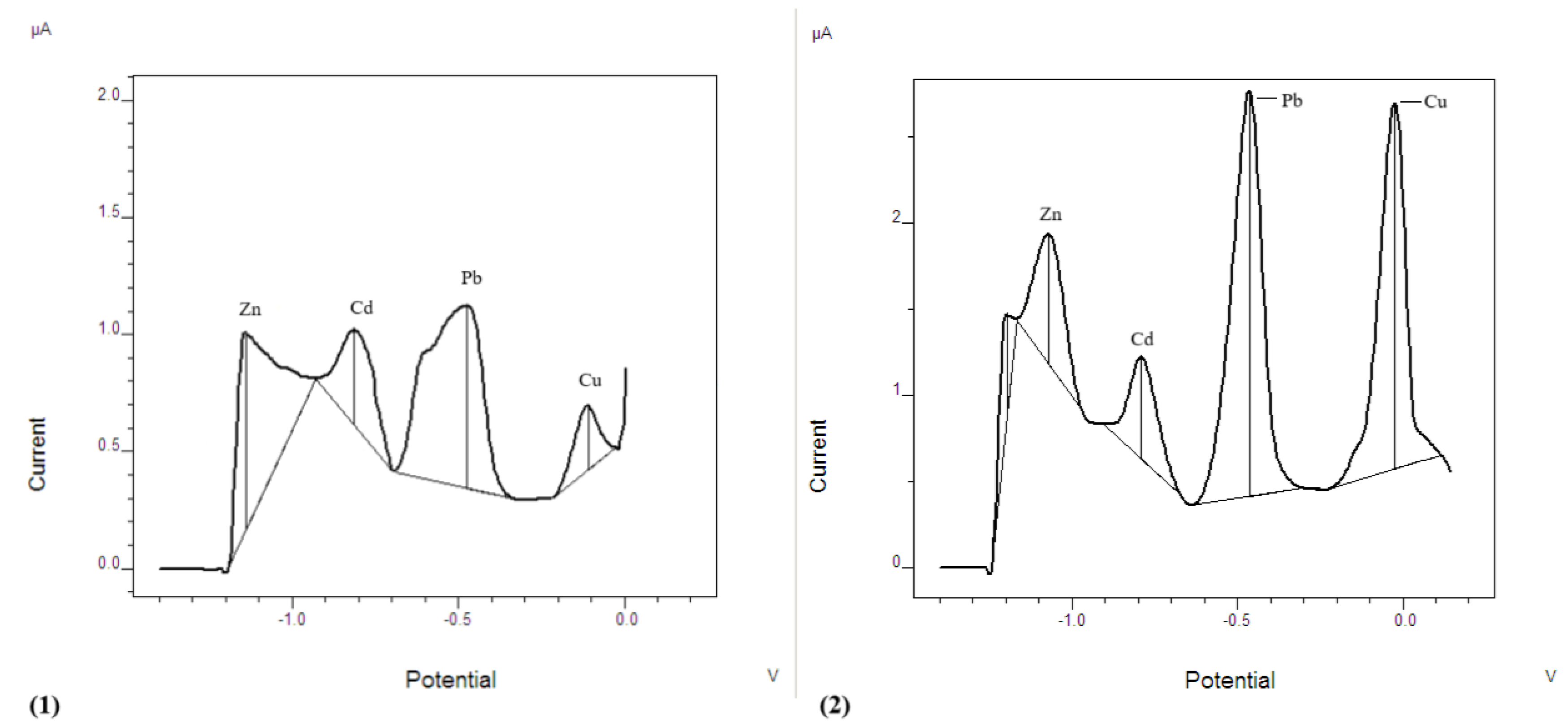
Figure 2.
Square wave voltammogram of chloride ions at AgNPs@Sa-CPE, with incereasing concentrations After optimization of chemical or instrumental parameters affecting the recorded signals.
Figure 2.
Square wave voltammogram of chloride ions at AgNPs@Sa-CPE, with incereasing concentrations After optimization of chemical or instrumental parameters affecting the recorded signals.
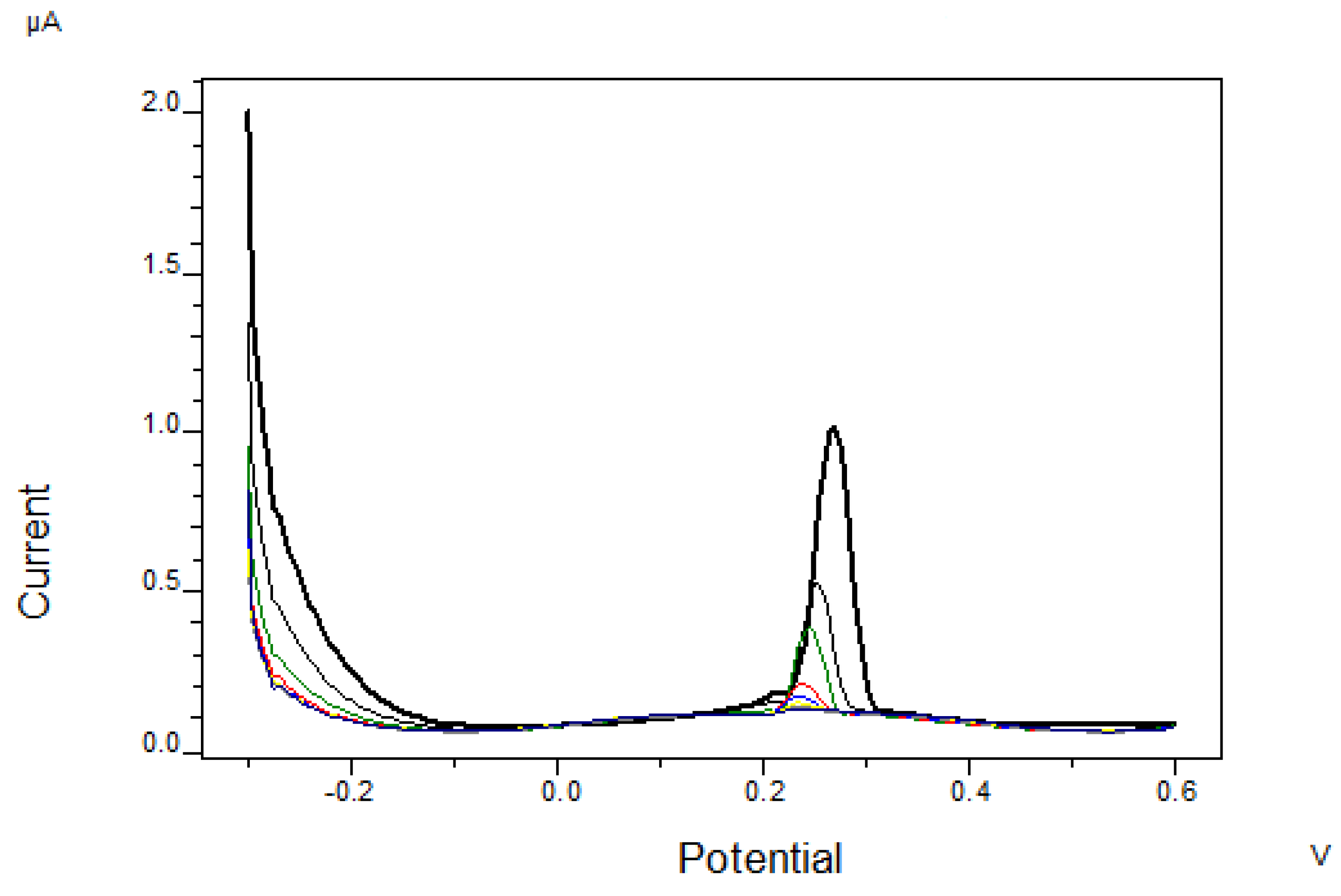
Figure 3.
Comparison of the proposed analytical methodology with already established methodologies;(a) regarding Cd; (b) regarding Cu; (c) regarding Cl; (d) regarding Pb; (e) regarding Zn.
Figure 3.
Comparison of the proposed analytical methodology with already established methodologies;(a) regarding Cd; (b) regarding Cu; (c) regarding Cl; (d) regarding Pb; (e) regarding Zn.
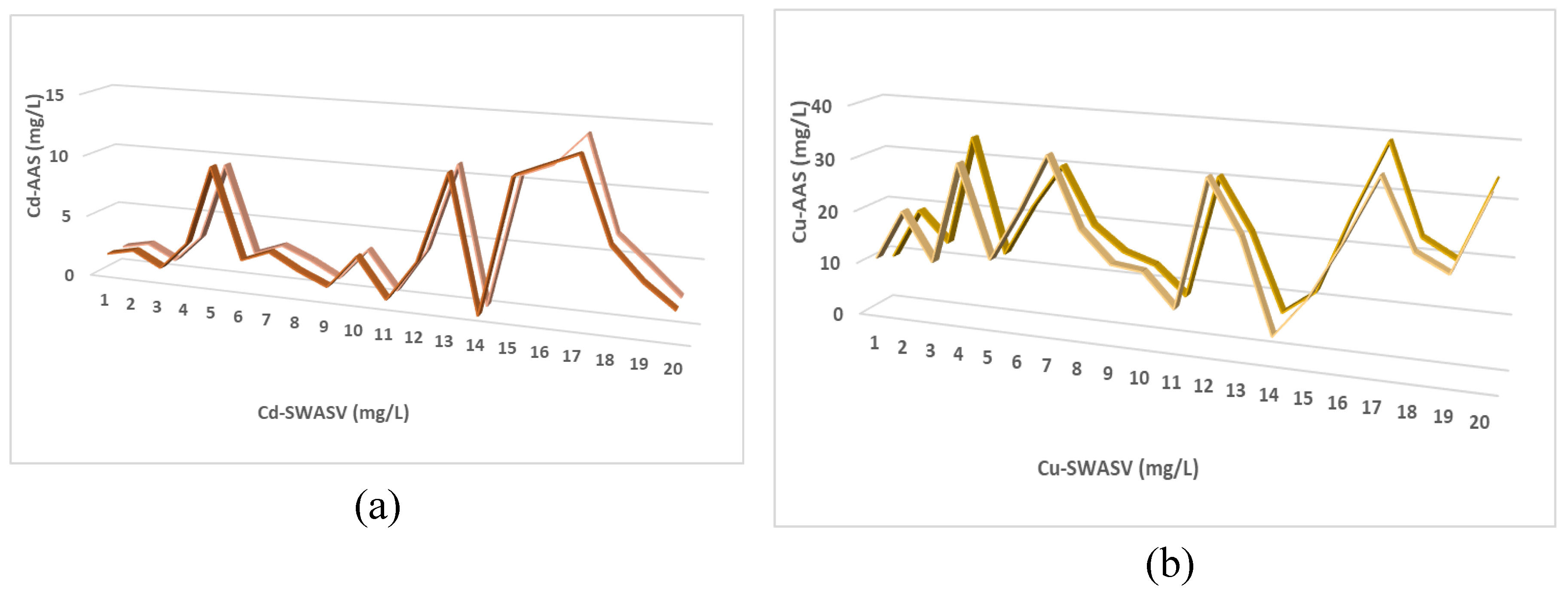
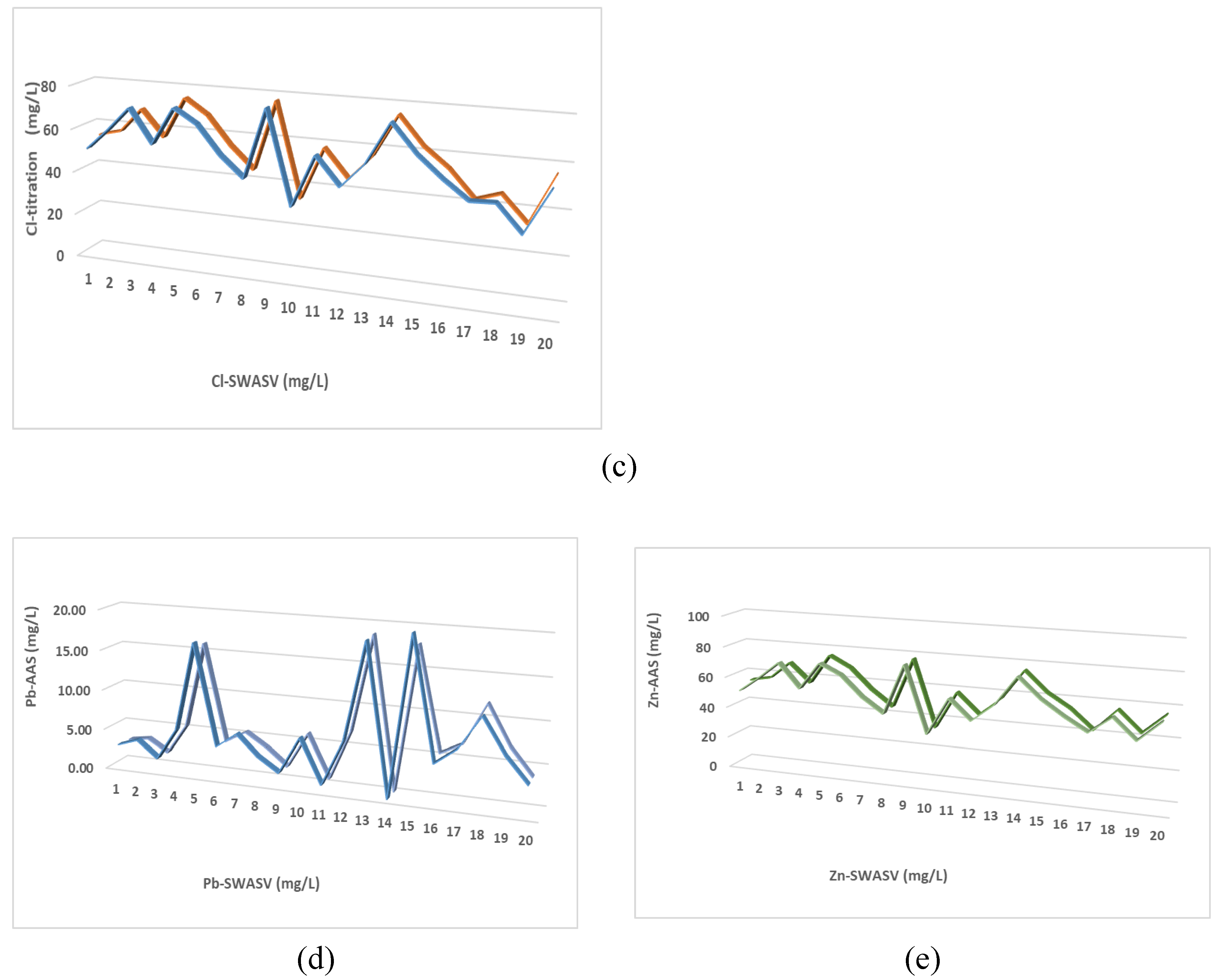

Table 1.
Comparison of the proposed NPs (AgNPs@Sa) with already established NPs.
|
Detection limit (mg L-1) |
Metals for detection | ||||||
| R.S.D.s (%) | Cd | Pb | Zn | Cu | |||
| Nanoparticles (NPs) | Ref. | AgNPs@Sa | LOD | 0.191 | 0.223 | 0.361 | 0.213 |
| sr % | 6.1 | 5.4 | 3.3 | 6.6 | |||
| [52] | AuNPs | LOD | 1.126 | 1.419 | - | 0.966 | |
| sr % | 2.69 | 1.79 | - | 1.22 | |||
| [53] | SnNPs | LOD | 0.63 | 0.60 | - | 0.52 | |
| sr % | 6.1 | 7.4 | - | 2.5 | |||
| [54] | BiNPs | LOD | 0.097 | 0.008 | 0.707 | 0.157 | |
| sr % | 5.76 | 2.07 | 7.89 | 0.43 | |||
| [55] | MnCO2O4NPs | LOD | 0.79 | 1.67 | - | - | |
| sr % | 3.46 | 7.68 | - | - | |||
Disclaimer/Publisher’s Note: The statements, opinions and data contained in all publications are solely those of the individual author(s) and contributor(s) and not of MDPI and/or the editor(s). MDPI and/or the editor(s) disclaim responsibility for any injury to people or property resulting from any ideas, methods, instructions or products referred to in the content. |
© 2025 by the authors. Licensee MDPI, Basel, Switzerland. This article is an open access article distributed under the terms and conditions of the Creative Commons Attribution (CC BY) license (http://creativecommons.org/licenses/by/4.0/).
Copyright: This open access article is published under a Creative Commons CC BY 4.0 license, which permit the free download, distribution, and reuse, provided that the author and preprint are cited in any reuse.


