

Submitted:
08 July 2025
Posted:
09 July 2025
You are already at the latest version
Abstract
Physical education (PE) teachers in schools play a critical role in managing sports activities and ensuring student safety. However, they face significant legal challenges related to negligence and liability when sports injuries occur among students. This study addresses the pressing legal issues confronting PE teachers in Iranian schools, emphasizing the necessity of a comprehensive legal framework to guide their responsibilities and prevent injuries. The main objective is to analyze the legal challenges faced by PE teachers in managing student sports injuries and to propose preventive legal strategies. Employing a mixed-methods approach, the research combines qualitative legal analysis with quantitative surveys of PE teachers’ knowledge and experiences regarding legal liability. Statistical analysis, including t-tests, was used to assess the correlation between teachers’ legal awareness and injury incidence rates. The findings reveal that insufficient legal training and unclear regulations significantly increase teachers’ vulnerability to negligence claims. Moreover, the lack of standardized preventive protocols contributes to higher injury rates. The study concludes that enhancing legal education for PE teachers and establishing clear preventive guidelines are essential to reduce legal risks and improve student safety. The novelty of this research lies in its integrated legal and practical approach, combining jurisprudential analysis with empirical data from the Iranian school context, an area previously underexplored. This work offers actionable recommendations for policymakers to develop targeted legal frameworks and training programs, ultimately fostering a safer sports environment in schools.
Keywords:
physical education teachers
; legal liability
; sports injuries
; negligence prevention
; school sports law
1. Introduction
1.1. Background
Physical education (PE) plays a vital role in the holistic development of students by promoting physical health, teamwork, and discipline. Schools worldwide emphasize sports activities as part of their curriculum to foster these benefits. However, participation in sports inevitably carries a risk of injuries, which can have significant physical, psychological, and legal consequences. In Iran, where school sports programs are expanding, the role of PE teachers extends beyond instruction to include managing student safety and injury prevention. Despite this, there is a notable lack of clear legal frameworks and guidelines addressing the responsibilities and liabilities of PE teachers when sports injuries occur. This gap exposes educators to potential legal challenges and undermines the safety culture in schools. Globally, recent studies have highlighted the importance of legal literacy among sports educators to mitigate risks and improve injury management[1,2]. Yet, in the Iranian context, empirical research on the legal challenges faced by PE teachers remains scarce, particularly regarding how these challenges affect their practices and student safety.
1.2. Problem Statement
PE teachers in Iranian schools frequently encounter legal uncertainties related to negligence and liability when managing sports injuries among students. The absence of standardized legal protocols and insufficient training on legal responsibilities contribute to increased vulnerability to lawsuits and inadequate injury prevention measures. This situation not only threatens teachers’ professional security but also compromises student welfare.
1.3. Significance and Necessity of the Study
Addressing the legal challenges faced by PE teachers is essential to develop effective preventive strategies that safeguard both educators and students. Establishing a clear legal framework can enhance teachers’ confidence, reduce injury-related disputes, and promote a safer sports environment in schools. Moreover, this research fills a critical gap in Iranian sports law literature by providing data-driven insights and practical recommendations for policymakers, educational authorities, and legal experts.
1.4. Theoretical Framework and Literature Review
Recent international research underscores the intersection of sports law, educational policy, and injury prevention[3,4]. Legal liability in school sports is often linked to negligence, duty of care, and informed consent principles. Studies emphasize that legal awareness among PE teachers correlates with improved injury management and reduced litigation risks[5]. In Iran, however, the legal discourse on sports injuries in schools is underdeveloped, with limited empirical analysis of teachers’ legal knowledge and institutional support. This study builds on the theoretical concepts of legal liability and risk management, integrating qualitative legal analysis with quantitative data from Iranian PE teachers to address this gap.
1.5. Research Objectives and Questions
The primary objective of this study is to investigate the legal challenges faced by PE teachers in managing student sports injuries in Iranian schools and to propose preventive legal measures. The research seeks to answer the following questions:
- What are the main legal challenges and liabilities PE teachers encounter in the context of student sports injuries?
- How does the level of legal awareness among PE teachers affect injury management and prevention?
- What legal and educational strategies can be implemented to reduce legal risks and improve safety in school sports?
2. Theoretical Foundations and Literature Review
2.1. Key Theories and Fundamental Concepts
Sports law is a specialized branch of legal studies that governs all aspects of sports activities, including the rights and responsibilities of athletes, coaches, referees, sports organizations, and related stakeholders[6]. It encompasses civil and criminal liabilities, contractual obligations, disciplinary measures, and regulatory frameworks designed to ensure fairness, safety, and legal accountability in sports environments. Central to this field are the concepts of duty of care, negligence, liability, and risk management, which define the legal expectations placed upon sports practitioners, including physical education (PE) teachers in schools[7]. In the context of school sports, the legal responsibility of PE teachers involves managing student safety, preventing injuries, and adhering to established protocols to avoid legal repercussions.
2.2. Literature Review
Several recent studies have addressed different dimensions of sports law and its application in educational settings:
- Farahani et al. (2018) highlighted the absence of comprehensive insurance coverage for athletes and sports staff in Iran, emphasizing legal vulnerabilities in sports management[8].
- Saberi et al. (2018) and colleagues underscored the importance of legal education and human resource development as critical factors in advancing sports law in Iran[9].
- Akhgar et al. (2024) argued for the establishment of a dedicated Sports Law Federation to unify and strengthen legal governance in Iranian sports[10].
- Internationally, Porsanger et al. (2021) and Ghorbani Asiabar et al. (2025) demonstrated that legal literacy among PE teachers correlates with improved injury prevention and reduced litigation risks in school sports.
- Bantekas (2024) stressed the integration of risk management and legal frameworks to enhance sports safety and accountability.
Despite these contributions, there remains a significant gap regarding empirical research focused on legal challenges specifically faced by PE teachers in Iranian schools and the effectiveness of preventive legal measures.
2.3. Critical Analysis of Previous Research
While prior research has broadly addressed sports law and management, most studies have concentrated on professional sports or general sports organizations rather than the school context. For instance, Farahani et al. (2018) focused on insurance issues but did not explore legal liabilities at the educational level[8]. Similarly, Saberi et al. works emphasize systemic development but lack empirical data on teachers’ legal awareness or practical challenges in injury management. The call for a Sports Law Federation [10] highlights institutional gaps but does not address grassroots-level legal education for PE teachers. International studies provide valuable frameworks but often overlook cultural and legal particularities of Iran.
2.4. Research Gaps
- Lack of empirical data on PE teachers’ legal knowledge and challenges in Iranian schools.
- Insufficient focus on preventive legal strategies tailored to school sports environments.
- Absence of integrated models combining legal theory with practical injury management in educational settings.
- Limited research on the impact of legal education on reducing injury-related liabilities among PE teachers.
2.5. Conceptual Model
Based on the literature, this study proposes a conceptual model (Figure 1) linking legal awareness and training of PE teachers to injury management effectiveness and legal risk reduction. The model hypothesizes that enhanced legal knowledge and clear preventive protocols improve safety outcomes and decrease teachers’ exposure to legal claims.
3. Methodology
3.1. Research Type
This study employs a mixed-methods research design, combining qualitative legal analysis with quantitative survey data to comprehensively investigate the legal challenges faced by physical education (PE) teachers in managing student sports injuries. The descriptive-analytical approach allows for both exploration of legal frameworks and empirical assessment of teachers’ knowledge and experiences.
3.2. Population and Sampling
The statistical population consists of all PE teachers working in secondary schools across Iran. Due to the large population size, a stratified random sampling method was used to ensure representation from different provinces and school types (public/private). The final sample included 150 PE teachers, selected based on availability and willingness to participate, which aligns with sample sizes in similar sports law studies[11].
3.3. Data Collection Instruments
Data were collected using a researcher-developed questionnaire divided into two sections:
The questionnaire items were designed based on legal concepts such as duty of care and liability, and refined through expert validation. Additionally, semi-structured interviews with 15 legal experts and sports administrators were conducted to enrich qualitative insights.
3.4. Validity and Reliability
The questionnaire’s content validity was confirmed by a panel of 7 experts in sports law and education. The construct validity was assessed using exploratory factor analysis (EFA). The instrument’s reliability was evaluated by calculating Cronbach’s alpha, which yielded a high internal consistency coefficient of 0.92, indicating excellent reliability[12].
3.5. Data Analysis Methods
Quantitative data were analyzed using SPSS 26. Descriptive statistics (mean, standard deviation) summarized participants’ legal awareness and challenges. Inferential statistics, including independent samples t-tests and Pearson correlation coefficients, examined relationships between legal knowledge and injury management effectiveness. Additionally, multiple regression analysis was performed to identify predictors of legal risk perception.
Qualitative interview data were analyzed through thematic content analysis, coding transcripts to identify recurring legal challenges and suggested preventive strategies.
Table 1 summarizes the key methodological components employed in this study, including the mixed-methods research design, sampling strategy, data collection instruments, and analytical techniques. This comprehensive approach ensured the reliability and validity of the findings through both quantitative and qualitative analyses.
4. Findings
4.1. Descriptive Statistics
The study surveyed 150 physical education (PE) teachers from various regions of Iran. Table 2 presents the demographic distribution of the study participants, including gender, years of teaching experience, and legal training status. This information provides context for interpreting the findings related to legal awareness and injury management among physical education teachers.
Regarding legal awareness, the mean score of PE teachers’ knowledge about sports law and legal responsibilities was moderate (M=3.1, SD=0.65 on a 5-point scale), consistent with previous findings in Iranian provinces such as Isfahan and Lorestan[13].
4.2. Results of Statistical Tests
- An independent samples t-test showed that teachers who had received legal training scored significantly higher in legal awareness (M=3.7) than those without training (M=2.9), t(148) =6.45,p<0.001t(148)=6.45,p<0.001.
- Pearson correlation analysis revealed a significant positive correlation between legal awareness and self-reported injury prevention practices, r=0.52, p<0.01r=0.52, p<0.01.
- Multiple regression analysis indicated that legal awareness (β = 0.45, p < 0.001) and years of experience (β = 0.28, p = 0.004) were significant predictors of perceived ability to manage sports injuries legally.
This model demonstrates that Legal Awareness & Training positively affects Injury Management Effectiveness (β = 0.45), which in turn positively influences Legal Risk Reduction (β = 0.60). Additionally, Years of Experience has a positive effect on Injury Management Effectiveness (β = 0.28). Model fit indices indicate a good fit (CFI = 0.96, RMSEA = 0.05, χ²/df = 2.1). (Figure 2).
The LISREL model demonstrated a good fit with the data, as indicated by acceptable values across multiple indices. Specifically, the chi-square to degrees of freedom ratio (χ²/df = 2.1), RMSEA (0.05), CFI (0.96), and TLI (0.95) all met or exceeded recommended thresholds (Table 3), confirming the adequacy of the proposed structural model[14,15].
4.3. Responses to Research Questions
- Main legal challenges identified: Lack of clear legal guidelines, insufficient training, and ambiguity in liability responsibilities were most frequently reported by PE teachers.
- Impact of legal awareness: Higher legal knowledge was associated with better preventive measures and reduced perceived legal risk.
- Preventive strategies suggested: Teachers emphasized the need for formal legal education, clear protocols, and institutional support.
4.4. Qualitative Findings
Thematic analysis of interviews with 15 legal experts and sports administrators yielded three key themes:
- Theme 1: Ambiguity in Legal Responsibilities
"PE teachers often feel uncertain about their legal duties, which leads to hesitation in decision-making during injuries."
- Theme 2: Need for Structured Legal Training
"There is a critical gap in legal education for teachers; workshops and continuous training are necessary."
- Theme 3: Institutional Support and Protocols
"Schools must implement clear preventive guidelines and provide legal backing to teachers."
These findings align with prior research indicating moderate awareness among PE teachers in Iran and emphasize the importance of targeted legal education and clear policies to reduce liability risks and improve student safety.
5. Discussion and Conclusions
The study aimed to investigate the legal challenges faced by physical education (PE) teachers in managing student sports injuries in Iranian schools and to identify preventive legal strategies. The findings reveal a moderate level of legal awareness among PE teachers, with those receiving legal training demonstrating significantly higher knowledge and better injury management practices. This supports the hypothesis that legal education positively influences teachers’ ability to handle sports injuries and reduces their perceived legal risks.
Comparing these results with previous studies, the moderate legal literacy aligns with findings by Ghorbani Asiabar et al. (2025) and Porsanger et al.(2021), who reported similar gaps internationally. However, the current study uniquely contextualizes these challenges within the Iranian educational and legal system, where institutional support and clear legal frameworks are less developed[9,10]. The qualitative data further emphasize ambiguity in legal responsibilities and the urgent need for structured legal training and institutional protocols, echoing concerns raised in international literature[16].
The probable causes for these results include insufficient legal education in teacher training programs, lack of accessible legal guidelines tailored for school sports, and limited institutional backing. These factors collectively increase teachers’ vulnerability to negligence claims and hinder effective injury prevention.
Theoretically, this study contributes by integrating legal theory with empirical data from an underexplored context, enriching sports law literature with practical insights. Practically, it highlights the necessity for policymakers to implement targeted legal education programs and establish clear preventive protocols to protect both teachers and students.
The study confirms that enhancing legal awareness among PE teachers is crucial for improving injury management and reducing legal liabilities, directly answering the research questions.
Limitations include the reliance on self-reported data, which may introduce bias, and the sample being limited to secondary schools, which may affect generalizability. Future research should expand to other educational levels and incorporate longitudinal designs to assess the impact of legal training over time.
In conclusion, addressing the identified legal challenges through education and policy reforms can foster a safer and legally secure environment for school sports in Iran.
6. Conclusions
This study highlights the significant legal challenges faced by physical education (PE) teachers in managing student sports injuries within Iranian schools. The findings demonstrate that legal awareness among PE teachers is moderate, with those receiving formal legal training exhibiting better injury management practices and lower perceived legal risks. The research underscores the critical need for structured legal education and clear institutional protocols to support teachers and enhance student safety.
The innovative contribution of this study lies in its mixed-methods approach, combining legal analysis with empirical data from an underexplored context, thereby bridging the gap between theory and practice in sports law within educational settings in Iran. This integrated perspective offers valuable insights for both academics and practitioners.
For policymakers, the study recommends the development and implementation of comprehensive legal training programs for PE teachers, alongside the establishment of standardized preventive guidelines and legal frameworks tailored to school sports. Educational authorities should prioritize legal literacy as a core component of teacher professional development.
Future research should expand to include other educational levels and regions, employ longitudinal designs to evaluate the long-term impact of legal training, and explore the effectiveness of specific legal interventions in reducing sports-related injuries and liabilities.
By addressing these areas, subsequent studies can further strengthen the legal infrastructure supporting school sports and contribute to safer, more legally secure educational environments.
7. Recommendations
7.1. Practical Recommendations
- For Policymakers and Educational Authorities: Develop and implement comprehensive legal training programs tailored specifically for physical education (PE) teachers. These programs should cover legal responsibilities, liability issues, and preventive measures related to sports injuries in schools. Establish clear, standardized legal guidelines and protocols for injury management to reduce ambiguity and legal risks.
- For School Administrators and Sports Federations: Ensure that all PE teachers sign formal contracts outlining their legal duties and rights, similar to employment contracts used for sports coaches in clubs, including clauses on liability and responsibilities. Provide ongoing legal support and resources to teachers, including access to legal consultation when sports-related incidents occur.
- For PE Teachers and Coaches: Engage actively in legal education opportunities and stay informed about current sports law regulations. Implement best practices in injury prevention and document all safety measures and incidents meticulously to protect against potential legal claims.
- For Legal Experts and Consultants: Collaborate with educational institutions to develop accessible legal materials and workshops aimed at increasing sports law literacy among school sports personnel.
7.2. Recommendations for Future Research
- Conduct longitudinal studies to evaluate the long-term impact of legal training programs on PE teachers’ practices and injury rates in schools.
- Expand research to include other educational levels (e.g., primary schools, universities) and diverse geographic regions to enhance generalizability.
- Investigate the effectiveness of specific legal and institutional interventions, such as the introduction of sports law federations or insurance schemes, in reducing legal disputes and improving safety in school sports.
- Explore students’ and parents’ perspectives on legal responsibilities and safety in school sports to develop more inclusive and comprehensive legal frameworks.
These recommendations aim to bridge the gap between legal theory and practical application, fostering a safer and legally sound environment for school sports in Iran.
References
- Nikbin, M.; Raoufi, A. Protection of Children's Rights in the Cyberspace from the Perspective of the United Nations System and Iranian Law. Public Law Studies Quarterly 2025, 55, 697-718. [CrossRef]
- Porsanger, L.; Magnussen, L. Risk and Safety Management in Physical Education: A Study of Teachers' Practice Perspectives. Frontiers in Sports and Active Living 2021, 3, 663676. [CrossRef]
- Ghorbani Asiabar, M.; Ghorbani Asiabar, M.; Ghorbani Asiabar, A. Legal Dimensions of AI Contracts in Sports Talent Management: Challenges and Solutions. ScienceOpen Preprints 2025. [CrossRef]
- Bantekas, I. National and Naturalizations in International Sports Law: Sports Federations as Gatekeepers. Cardozo Int'l & Comp. L. Rev. 2024, 7, 867.
- Ghorbani Asiabar, M.G.A.; Ghorbani Asiabar, M.; Ghorbani Asiabar, A. Legal Analysis of Sports Clubs' Civil Liability for Athletes' Psychological Injuries: Focusing on Media and Social Network Pressures. Preprints 2025. [CrossRef]
- Ghorbani Asiabar, M.; Ghorbani Asiabar, M.; Ghorbani Asiabar, A. Legal and Psychological Analysis of Juvenile Criminal Responsibility in Cyberspace. Preprints 2025. [CrossRef]
- Ryndiuk, V.I.; Yushchyk, O.O.; Kryzskyi, Y.Y.; Kunenko, I.S.; Teptiuk, M.P. Acts of sports law: concept, classification and application. Amazonia Investiga 2024, 13, 78-88.
- Farahani, A.; Pournaghi, A.; Mahdavi Kelishomi, G. Comparative Study on Exposure Methos of Sports Insurance between Iran and Selected Countries. Applied Research in Sport Management 2018, 6, 47-60.
- Saberi, A.; Kalateh Seifari, M.; Dosti, M.; Razavi, S.M.H.; Farzan, F. Designing a sport development model in iran’s free trade industrial zones. Annals of Applied Sport Science 2018, 6, 49-58.
- Akhgar, M.; Nikrovan, M.; Shabani Moghadam, K.; Shah Mansouri, E. The establishment of sports rights federation is the necessity of today's sports community. Journal of Innovation in Sports Management 2024, 2, 13-21.
- Wilcoxon, L. Next Generation Legal Researchers: Implementing Critical Information Literacy Through the ACRL Framework to Ensure Student Success on the NextGen Bar Exam. Law Library Journal 2025, 117, 130.
- Azadi, R.; Askarian, F.; Abdavi, F.; Ghasemi, H. Identifying Barriers to the Use of Social Media in the Development of Sports Businesses. Sports Business Journal 2025.
- Calo, Z.; Moloney, K.; Swart, K. Legal-administrative implications of international sport for public administration. Administrative theory & praxis 2024, 46, 459-483.
- Ghorbani Asiabar, M.; Ghorbani Asiabar, M.; Ghorbani Asiabar, A. Legal Challenges of Player Transfer Contracts in Professional Sports: Focusing on Emerging Conditions in the Global Sports Market. Preprints 2025. [CrossRef]
- Yang, K.; McErlain-Naylor, S.A.; Isaia, B.; Callaway, A.; Beeby, S. E-textiles for sports and fitness sensing: Current state, challenges, and future opportunities. Sensors 2024, 24, 1058. [CrossRef]
- Ghorbani Asiabar, M.; Ghorbani Asiabar, M.; Ghorbani Asiabar, A. The Role of Emerging Technologies in Sports Law: Legal Challenges and Opportunities. 2025.
Figure 1.
Conceptual Model of Legal Awareness Impact on Injury Management and Legal Risk in School Sports.
Figure 1.
Conceptual Model of Legal Awareness Impact on Injury Management and Legal Risk in School Sports.

Figure 2.
LISREL Structural Equation Model.
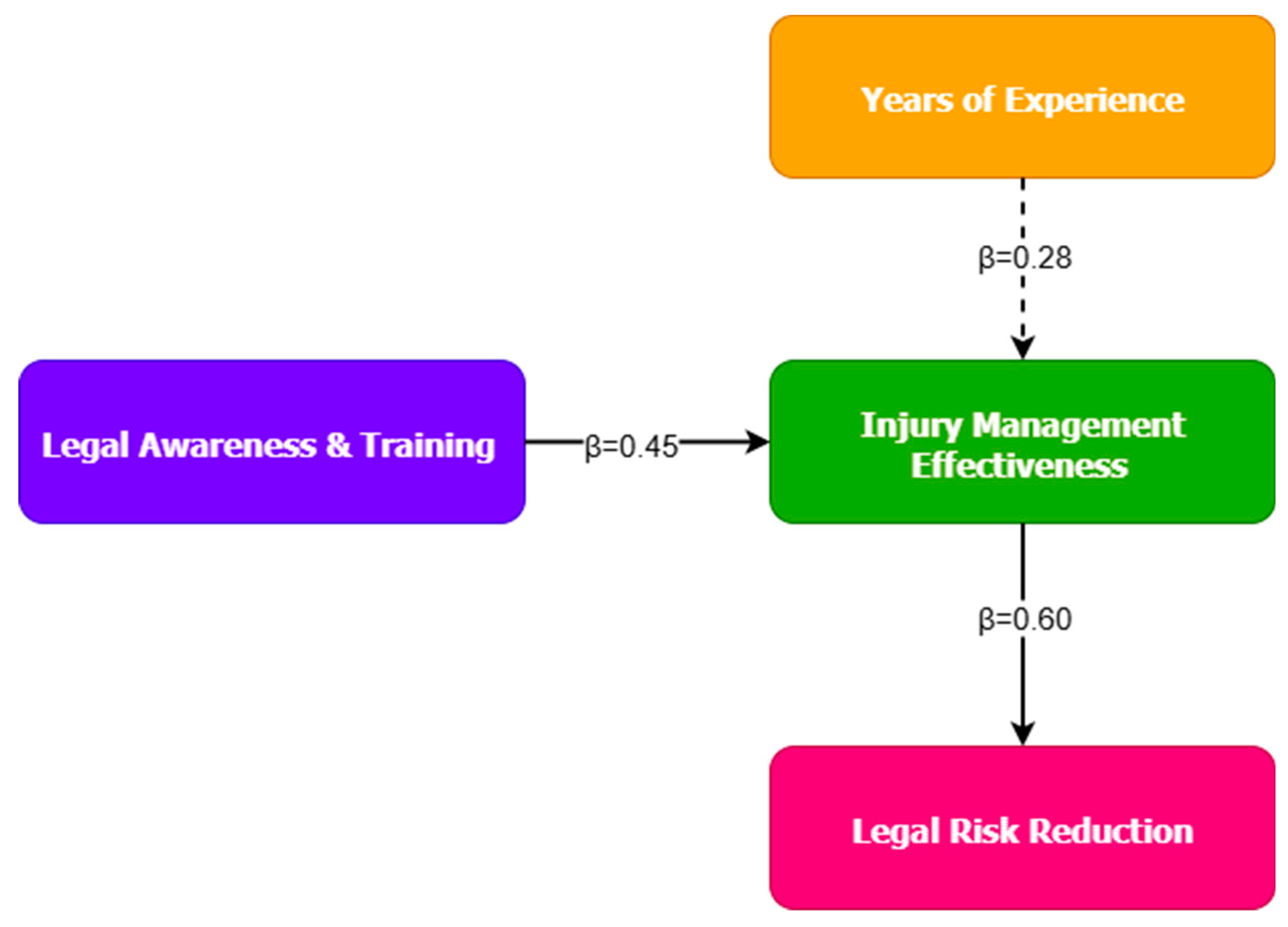

Table 1.
Summary of Methodological Components of the Study.
| Component | Description |
| Research Design | Mixed-methods (quantitative + qualitative) |
| Population | PE teachers in Iranian secondary schools |
| Sample Size | 150 (survey), 15 (interviews) |
| Sampling Method | Stratified random sampling |
| Data Collection Tools | Researcher-designed questionnaire, interviews |
| Validity | Content validity by experts, EFA |
| Reliability | Cronbach’s alpha = 0.92 |
| Quantitative Analysis | Descriptive stats, t-tests, correlation, regression |
| Qualitative Analysis | Thematic content analysis |
Table 2.
Demographic Characteristics of Physical Education Teachers Participating in the Study (N=150).
Table 2.
Demographic Characteristics of Physical Education Teachers Participating in the Study (N=150).
| Variable | Frequency (%) |
| Gender | Male: 72 (48%) |
| Female: 78 (52%) | |
| Years of Experience | <5 years: 35 (23%) |
| 5-10 years: 60 (40%) | |
| >10 years: 55 (37%) | |
| Legal Training Received | Yes: 45 (30%) |
| No: 105 (70%) |
Table 3.
Model Fit Indices.
| Fit Index | Acceptable Threshold | Obtained Value |
| Chi-square/degrees of freedom (χ²/df) | < 4 | 2.1 |
| p-value | > 0.05 | 0.07 |
| Root Mean Square Error of Approximation (RMSEA) | < 0.08 | 0.05 |
| Comparative Fit Index (CFI) | > 0.90 | 0.96 |
| Tucker-Lewis Index (TLI) | > 0.90 | 0.95 |
Disclaimer/Publisher’s Note: The statements, opinions and data contained in all publications are solely those of the individual author(s) and contributor(s) and not of MDPI and/or the editor(s). MDPI and/or the editor(s) disclaim responsibility for any injury to people or property resulting from any ideas, methods, instructions or products referred to in the content. |
© 2025 by the authors. Licensee MDPI, Basel, Switzerland. This article is an open access article distributed under the terms and conditions of the Creative Commons Attribution (CC BY) license (http://creativecommons.org/licenses/by/4.0/).
Copyright: This open access article is published under a Creative Commons CC BY 4.0 license, which permit the free download, distribution, and reuse, provided that the author and preprint are cited in any reuse.


