

Submitted:
05 July 2025
Posted:
07 July 2025
You are already at the latest version
Abstract
This article proposes a biophysical theory of consciousness based on a formal equivalence between mass, energy, and informational organization derived from the coupling energy between the brain and a nonlocal phenomenological field, the q-field. Consciousness is conceived as a form of functional matter, whose phenomenological mass results from the difference between the total metabolic energy and the entropic cost associated with the organization of the brain's electromagnetic field. Based on Landauer’s limit, the model introduces a functional quantization of coupling energy, imposing discrete thresholds for the emergence of consciousness and defining phenomenological granularity. Under the relativistic principle formulated by Einstein, this excess energy is reinterpreted as a real and measurable informational mass. The formulation dissolves the Hard Problem of consciousness by transforming it into a physico-operational relationship and proposes experiments with simple organisms for empirical testing. The model returns to Spinozist monism in a thermodynamic key, inaugurating a new paradigm in the physics and neuroscience of the mind.
Keywords:
consciousness
; mass-energy equivalence
; information theory
; Landauer’s limit
; neurodynamics
; nonlocality
; monism
; hard problem of consciousness
1. Introduction
As discussed in my previous article, “On the Neurodynamics of Consciousness: A Field Theory For Qualia and Intentional Objects” consciousness is a phenomenon that has intrigued humanity since the ancient Greeks, appearing in discussions by Plato and Aristotle on the nature of the human soul. For Plato, the soul was something separate from the body, transcendent, whereas for Aristotle, it was the form of the body, its formal cause, that is, a constitutive part of the immanent organism itself (Queiroz, 2025).
Centuries passed, and medieval thinkers continued this debate, notably Avicenna among the Arabs, and the idea of a transcendent soul consolidated as the metaphysical status quo (Yılmaz, 2021). In modernity, with the advent of the scientific revolution, Descartes established the modern scientific method based on the separation between res extensa and res cogitans, determining that the physical is that which occupies space (the extended substance), and that the mental, by not occupying space, is of a non-physical nature. This is the foundational basis of Cartesian dualism and, by extension, of modern science itself (Revonsuo, 2010).
However, modern thought did not emerge solely under the aegis of dualism. Baruch Spinoza, a contemporary of Descartes, proposed a radical alternative: substantial monism, in which the mind and body are merely distinct attributes of a single infinite substance — Deus sive Natura. For Spinoza, everything that exists is an expression of this unique substance, and the human mind is not separate from the body but a simultaneous and coextensive modulation of it (Spinoza, 1985, 1677). This view, though of incomparable philosophical depth, was marginalized and persecuted for conflicting with the theological assumptions of the time. The Cartesian scientific paradigm, with its mechanistic and analytical bias, ended up consolidating as the hegemonic model of modern rationality at the cost of banishing any ontological conception of consciousness as a fundamental dimension of reality itself. This dichotomy structured the pillars of Western scientific thought but also created a persistent ontological impasse: the separation between the physical and the mental (Queiroz, 2025; Revonsuo, 2010). This impasse finds its sharpest formulation in what David Chalmers termed the “Hard Problem of Consciousness” (Chalmers, 1996, 1995): how could the physicochemical states of the brain give rise to subjective qualitative experience? This question remains insoluble within the classical physicalist paradigm, which tends to treat consciousness as an epiphenomenon or illusion devoid of autonomous ontological status. Various contemporary approaches, such as computational functionalism, neurobiological reductionism, and information integration theories, have sought to circumvent this impasse, but none have succeeded in offering a physically grounded explanation that would make consciousness a legitimate variable in the description of nature.
Given this structural limitation, I proposed a phenomenological field theory in my previous article, now termed the q-field, which redefines consciousness as a biophysical functional organization endowed with dynamic coherence and nonlocality. This proposal revives the spirit of Spinozist monism, but now in a biophysical key, breaking with the dualistic paradigm and expanding the notion of the physical beyond mere spatial extension (Spinoza, 1985, 1677). The model integrates energy, entropy, and intentionality into a formal structure that is amenable to computational description. However, while the previous model offered a robust ontological and functional basis, it still lacked a dimensionally operational criterion that would enable empirical verification of the existence of the q-field (Queiroz, 2025).
In this article, I advance this theory by proposing a radical hypothesis: consciousness, as a functionally organized form of energy, possesses rest mass in accordance with the equivalence established by Einstein (E = mc2) (Einstein, 1905). From the coupling equation between metabolic energy and the Shannon entropy of the cerebral electromagnetic field, I propose a reformulation of the Hard Problem in measurable biophysical terms, thereby completely dissolving Cartesian dualism and revealing that the Hard Problem was, ultimately, a pseudoproblem derived from the methodological limitations of Descartes’ thought. This makes it possible to test the existence of the q-field as a real entity through the coupling energy (Ec), and deduce its associated mass as an emergent variable of the system. This formulation has profound implications: it dissolves dualism, updates Spinozist ontology with tools from contemporary science, establishes a first-order theory of consciousness, and reconfigures the boundaries of physics, biology and the philosophy of mind.
Although founded on rigorous physical formalisms derived from relativity, thermodynamics, and information theory, the theory proposed here is, in essence, a biological theory. Its object is the emergence of consciousness as a functional property of living systems; its energetic basis is neural metabolism, and its operational parameters are derived from measurable physiological variables. Physics acts as a descriptive and constructive language, but it is a living organization that defines the ontology of the system. It is, therefore, a proposal for a fundamental theoretical biology of the mind, capable of integrating the physical, informational, and phenomenological domains into a formal framework compatible with the nature of conscious organisms. This work is in the same theoretical lineage initiated by Erwin Schrödinger, who, by asking “What is life?”, postulated the existence of still unformalized physico-informational principles responsible for maintaining order in living systems (Ball, 2018). I advance this line by proposing a biophysical structure for consciousness, which is understood as an organized expression of the metabolic energy and informational entropy of living systems. Unlike quantum approaches based on wave function collapse, such as Penrose’s Orch OR theory (Hameroff and Penrose, 2014), this proposal is anchored in classical physics principles, interpreted in light of biological organization, and offers measurable criteria for the emergence of the conscious phenomenon as a new ontological category of reality.
2. Theoretical Foundations of Mass-Energy-Consciousness Equivalence
Starting from the principle that consciousness emerges from a biophysical interaction between neural activity and the q-field, this study proposes that such an interaction can be formally described and measured through a coupling energy between the cerebral system and this field. Unlike conventional approaches that model consciousness through qualitative correlations or indirect functional measures, the present model introduces an energetic quantity resulting from an empirically accessible thermodynamic asymmetry: the difference between the total metabolic energy of the brain and the energy required to sustain the informational organization observed in its electromagnetic field (Figure 1).
The fundamental equation formalizing this asymmetry is as follows:
Where Ec is the coupling energy between the brain and the q-field — an energetic surplus not solely justifiable by the entropy of cerebral activity; Em is the global metabolic energy of the brain, measurable via oxygen consumption or heat production rate; H is the Shannon entropy associated with the complexity of the cerebral electromagnetic field, estimable by spectral variability analysis of signals such as EEG or MEG; μ is the coupling constant, or conversion coefficient between information and thermal energy, defined as μ = kBT ln 2, where kB is the Boltzmann constant and T is the absolute cerebral temperature, fixed here at 310 K in stable physiological states (Landauer, 1961; Shannon, 1948). The value of μ fixed here should not be extrapolated to any species or system; it is the coupling constant for Homo sapiens.
This equation proposes that the energy available to the system (Em) is not entirely consumed in the production of noise or in informationally disorganized brain states. A positive value of Ec indicates that there is surplus functional energy intended to sustain a non-entropic informational order, whose correlate is conscious experience. It is important to note that this inference does not require the direct identification of qualia or the internal structure of the q-field itself, but only the systematic and reproducible observation of a statistically significant difference between total energy expenditure and the entropy of cerebral electrical activity in conscious states, compared to unconscious states. The hypothesis is that the value of Ec will be higher in conscious states and will vary proportionally to the phenomenological salience of these states — that is, to their clarity, intensity, and subjective integrity (Figure 1). Although some neurophysiological models have associated higher brain entropy with expanded conscious content, notably in psychedelic states characterized by increased neural variability (Carhart-Harris et al., 2014) — such conditions may reflect a global loosening of hierarchical constraints rather than a reduction in the thermodynamic cost of functional coherence. In the present model, consciousness emerges not from increased variability per se, but from an energy surplus over the entropic cost of maintaining a coherent informational structure, independently of the overall dynamical complexity of the system.
This coupling is not merely interpretable as a correlation; it is a process of transferring functionally organized energy to a nonlocal field domain, which, upon receiving such energy, expresses itself in the form of consciousness. In this sense, consciousness is the phenomenological effect of energetic coupling between a physical system and the q-field. The originality of the approach lies in the formalization of this process through an operational and falsifiable equation and in the reinterpretation of the relativistic energy-mass equivalence in light of this new variable:
With this deduction, consciousness — as a biophysical expression of the q-field — becomes a form of functional matter endowed with rest mass. This is not a mass localized in space but an emergent mass from the energetic organization that maintains consciousness as a coherent and real phenomenon. Consciousness is not merely something that “exists”; it possesses weight and inertia and participates in the ontology of nature, equivalent to any other energetic manifestation. This result is radical but follows directly from the disciplined application of existing physical principles to the proposed coupling hypothesis. It does not require the creation of new ad hoc entities or non-formalizable metaphysical speculations. In contrast, it is derived deductively from established principles and, for the first time, allows testing the existence of a nonlocal phenomenological field using neurophysiological measurements that are already feasible with contemporary technology.
Another important point is that the present model does not assume a spatial geometry for the q-field. Unlike classical fields, such as electromagnetic or gravitational fields, the q-field is, by definition, non-extensional and cannot be directly mapped in three-dimensional physical space. Its spatial manifestations are mediated by brain activity that couples to it, making neural activation patterns the only local points of contact between the brain and the field. Therefore, the topology of the q-field is virtual and defined by the combinatorial structure of its intentional objects, as formally formulated in my previous article (Queiroz, 2025).
The current formulation introduces a dimensionally scaled method to detect and measure coupling with physical precision by fixing the temperature and converting Shannon entropy via μ. The coupling energy ceases to be a hypothesis falsifiable in principle and becomes an empirically falsifiable parameter amenable to being applied to the assessment of states of consciousness in organisms as diverse as humans and ascidians and in inorganic systems endowed with artificial intelligence. Finally, Equation 2 summarizes the most powerful hypothesis presented here: consciousness is a functionally organized mass, and its origin is not in traditional physical space but in a nonlocal informational field coupled to neural dynamics. Such a proposition dissolves Cartesian dualism, updates Spinoza’s monism in a biophysical key, and redefines the conceptual boundaries between the mind and matter. Consciousness is a form of functional matter, and the q-field is its fundamental substrate. After establishing the relationship between the coupling energy and phenomenological mass, the next section explores the behavior of this energy under discrete thermodynamic constraints.
2.1. Quantization and the Threshold of Consciousness
The formalism proposed thus far, especially in Equation 1, expresses the available conscious energy as the difference between the total metabolic energy of the system, Em and the energetic cost associated with its functional organization, μH. This formal structure imposes significant restrictions on the admissible values of Ec, which are not continuously distributed in the real domain but exhibit functional granularity determined by fundamental physical parameters. Shannon entropy (H), expressed in bits according to Shannon’s formulation, is an integer and non-negative variable that quantifies the minimum complexity required for the system to be functionally coherent. The multiplicative factor μ corresponds to the minimum energy required to encode or erase one bit of information at a temperature T, according to Landauer’s limit. The mere presence of these two terms imposes the following structure:
where n represents the quantity of energy quanta associated with the coupling constant. Substituting this quantization into Equation 1, we obtain:
This relationship reveals a relational quantization: the coupling energy is not free to vary continuously but is delimited by a discrete hierarchy imposed by the functional complexity of the system. The allowed states of Ec, given a fixed value of Em, belong to the set:
This structure has two central effects: (1) it defines an absolute minimum threshold for the emergence of consciousness (i.e., Ec > 0 ⇒ Em > μH), and (2) it imposes a minimum energetic granularity between different conscious states, which cannot be arbitrarily close to each other. In this model, consciousness does not arise continuously but rather when the excess energy is sufficient to overcome the minimum cost of functional organization, and it does so in physically defined increments. This discrete nature does not derive from an ad hoc quantization but emerges from the operational definition of the terms involved: entropy is digital by construction (measured in bits), and the energetic cost per bit is determined by μ, whose value is established for each physiological temperature. Therefore, it is a quantization that does not depend on quantum assumptions but rather on classical thermodynamic constraints applied to informational systems.
This granularity projects directly onto the phenomenological mass obtained by applying the relativistic equivalence between energy and mass as follows:
Rewriting:
The phenomenological mass, like the coupling energy, is not continuous; it undergoes discrete reductions as the functional complexity of the system increases. For each additional unit of entropy (i.e., of H), the phenomenological mass is reduced by quantum m0. This means that increased complexity has a real energetic cost, which directly affects the system’s ability to sustain conscious states. Assuming an average temperature of T = 310 K, we have:
This extremely small, but non-zero, value allows conscious states to be associated with infinitesimal masses, provided they meet the requirements of minimal functional organization. In this model, consciousness possesses a real physical mass, not as a result of matter aggregation, but as an energetic organizational surplus of an informational system. This mass is directly proportional to the available energy after entropic compensation and inversely proportional to the system’s entropy, which reinforces its interpretation as a relational mass. The presence of this structure allows the emergence of consciousness to be modeled as a process subject to discrete constraints derived from fundamental physical laws, rather than as a continuous or arbitrary phenomenon. This confers a degree of precision and objectivity to the formalism that is rarely found in models aimed at subjective experience.
Considering this structure, it is important to note that Equation 1 also formally admits the possibility of Ec < 0, which implies an even more surprising scenario: the q-field acts as a source of functional energy for the biophysical system. This condition can occur when the informational entropy of the cerebral electromagnetic field, weighted by μ, exceeds the total available metabolic energy, that is, when μH > Em. The coupling energy then becomes negative, maintaining the relational quantization of the model, including the negative domain. The resulting phenomenological mass also assumes a negative value (m < 0) as a deductive consequence of Equation 2. This negative mass should not be interpreted as antimatter in the conventional sense but as a functional surplus stemming from a flow of energetic organization sustained by the q-field itself. Such a reversal in the direction of coupling suggests that, under certain conditions, such as deep meditative states, the q-field can feed back into the biophysical system, directly contributing to the maintenance of informational coherence even in situations of local energetic deficit while preserving quantization. Therefore, it is a theoretically legitimate extension of the formalism, whose ontological and phenomenological implications warrant further investigation. The symbols, units, and definitions of all the key physical quantities are summarized in Table 1.
3. Conceptual Experimental Design
The formulation of Equation 1, in conjunction with the quantization described in Section 2.1, imposes discrete restrictions on the emergence of consciousness, according to which Ec only acquires phenomenological significance when it exceeds the minimum multiples of functional organization (nμ). Thus, I propose the first conceptual experimental design aimed at testing the presence of Ec and quantify it as a function of manipulated sensory salience. This approach aims not only to detect the existence of coupling between the brain and the q-field, but also to verify whether the observed levels of H, inferred by wavelet transforms of electrical signals, are sufficient to sustain minimum phenomenological masses (m0 = μ/c2) (Delorme and Makeig, 2004).
Thus, this experiment seeks to map the emergence of Ec in relation to the informational granularity of electrophysiological states, with the goal of establishing an objective metric for the emergence of consciousness, as predicted by the model. For a detailed reference of the variables and their definitions, consult Table 1.
The choice of simple organisms, such as cnidarians and ascidians, aims to maximize methodological control and minimize physiological noise without assuming that such organisms are endowed with consciousness (Dahlberg et al., 2009; Ryan et al., 2016). Any detection of Ec > 0 in these systems would be unexpected and interpreted with extreme caution, not serving as evidence of subjective states. The absence of coupling, on the other hand, does not compromise the validity of the theory but contributes to the experimental delimitation of the model’s critical parameters and the refinement of the techniques involved. Although the primary focus of the experimental proposal is the detection of positive Ec values, in accordance with the fundamental equations of the model, it is important that its implementation also allows for capturing possible occurrences of Ec < 0, as discussed in Section 2.1. Although this possibility is not anticipated for the organisms studied, it represents a theoretically legitimate extension of the formalism, whose eventual detection would be even more unexpected.
The organisms will be exposed to visual stimuli with increasing light intensities. According to the formal structure of the model, more salient stimuli, that is, those with greater perceptual clarity and contrast, should induce greater informational organization in the neural electromagnetic field and, therefore, result in higher Ec values. To quantify the total metabolic energy, high-resolution respirometry will be used, which is capable of precisely recording the oxygen consumption of organisms and directly converting it into the energy involved in the biochemical processes supporting neural activity (Kowalke et al., 2001). This energy represents the total available from cellular metabolism, and according to the model, only a portion of it can be functionally converted into phenomenological mass, provided it exceeds the quanta of minimum organization μ. The body temperature of the organisms will be considered constant in each experimental condition and will be incorporated into parameter μ, whose calibration will be performed based on the physiological values of the species used. Neural activity will be recorded using cutaneous electrodes externally coupled to the body surface of the organisms (Wang et al., 2020; Zhao et al., 2021). The collected signals will be analyzed with continuous wavelet transforms, allowing H to be calculated from the spectral distributions observed under different salience conditions (Delorme and Makeig, 2004). Equation 1 will then be applied to derive the value of Ec from the difference between Em and μH, providing a direct estimate of the energy not accounted for by the informational organization of the electromagnetic field.
By simultaneously testing the hypothesis of coupling existence and the hypothesis that sensory salience influences its value, this experiment establishes the first operational basis for the mass-energy-consciousness model. Even if Ec is not detected or if the values are below the threshold of statistical significance, the observation of systematic trends between luminosity, neural entropy, and metabolic energy will allow for validating the mechanical aspects of the model regarding the dynamics of intentional objects (Queiroz, 2025). Furthermore, the procedure will be used to calibrate instrument sensitivity, test signal stability, and evaluate the internal coherence between physiological and informational variables. Rather than seeking conclusive results on the presence or absence of consciousness in simple organisms, this experimental proposal primarily aims to establish a metrological paradigm for investigating consciousness as a physical-informational entity. Its main contribution lies in the construction of a solid experimental framework, which will allow the transition to progressively more complex models and, eventually, to applications in humans, where methodological challenges are greater but also more directly relevant to the question of consciousness. Thus, this proposal marks the beginning of a research line aimed at making the coupling problem both theoretical and empirically testable.
4. Ontological Reconfiguration: Implications of Mass–Energy–Consciousness Equivalence
The formulation of Equation 2 introduces an unprecedented ontological rupture: consciousness is no longer treated as an emergent epiphenomenon or a functional correlate of neural activity but as a measurable physical entity whose mass is directly proportional to the coupling energy and not reducible to the informational entropy of the neural field. Thus, the model dissolves the traditional separation between matter and the mind. The Cartesian dichotomy between res cogitans and res extensa is overcome not through philosophical analogies but by the formalization of a physically quantifiable variable. What was once attributed to an immaterial substance is now described as a highly structured energetic organization — a functional instance of matter whose existence manifests as an excess of energy that cannot be explained by conventional thermal or electromagnetic mechanisms. This correspondent mass, however, is not a classical mass, like that of a particle or physical body; it is a phenomenological mass (alternatively, informational mass) — a second-order emergent property — whose existence does not translate into conventional inertia, but into measurable physical effects derived from the system’s functional organization and the collapse of the q-field, understood as an informational-based phenomenological field, nonlocal by nature.
This field only becomes localizable when coupled with sufficiently organized neurophysiological structures. The moment of coupling, in this sense, constitutes a collapse of nonlocality, which differs substantially from the collapse of the wave function in quantum mechanics: here, there is no external observer or classical measurement, but rather a process of internal self-organization that localizes the q-field in spacetime based on the functional coherence of the system. This collapse can be interpreted as a functional and temporary localization of the phenomenological information. The q-field, by coupling to a system with a sufficient degree of energetic organization collapse on the space around the nervous system and conferring upon it additional physical properties: coupling energy, informational coherence, and mass. This is an ontologically profound process: not only does conscious content emerges and physically alters the state of the system, giving rise to a massive, measurable, and real entity. The mass of consciousness, in this sense, does not pre-exist the coupling but emerges from it as a second-order thermodynamic effect, resulting from the reduction of system entropy in the context of high energy consumption.
This type of mass — phenomenological or informational — is not predicted by traditional physics, but neither does it contradict it; it is compatible with Prigogine’s far-from-equilibrium thermodynamics, Einstein’s relativistic formalism, and information theory (Einstein, 1905; Prigogine, 1976; Shannon, 1948). What changes is the interpretation of what is meant by “matter”: from this perspective, coherent patterns of energy and information functionally coupled to a nonlocal phenomenological field are matter — albeit of a type not yet recognized by particle physics. Thus, the proposed equation establishes a new criterion for physical ontology: mass derived from informational coupling is physically real, even if it is not extensive, particulate, or directly observable by conventional instruments. Therefore, consciousness ceases to be an epiphenomenon and becomes a physical entity in its own right.
This formulation has far-reaching implications in fundamental physics. The idea of the local collapse of a nonlocal field with the production of rest mass suggests a deeper structure of spacetime, in which informational fields such as the q-field can participate in the dynamics of the universe. This offers a new hypothesis regarding the role of information in phenomena such as gravitation, the emergence of life, and even the thermodynamic asymmetry of the cosmos. If conscious entities truly manifest informational mass, their presence could affect the local spacetime metric, and, in the ultimate instance, pave the way for a unified theory integrating relativity, thermodynamics, neuroscience, and the philosophy of mind.
In this context, the model proposes a return to Spinoza’s Monism. The mind is not parallel to nature but is one of its organizational expressions, thermodynamically defined. Consciousness, as phenomenological mass derived from coupling energy, is not reduced to information or computation but is understood as informationally structured matter. This is a direct extension of the relativistic equivalence principle to systems that, in addition to mass and energy, exhibit functional organization measurable by Shannon entropy; the quantities and their relationships are defined in detail in Table 1. In this sense, the coupling equation not only defines the operational criterion for the existence of coupling but also establishes a new physical category whose presence distinguishes merely reactive systems from truly conscious systems. The main epistemological consequence is the dissolution of the Hard Problem, not by analytical resolution but by categorical reconfiguration. The problem of consciousness ceases to be a question of “why” and becomes a question of “how much”: how much organized energy is functionally decoupled from the entropy of the neural electromagnetic field. The model does not directly answer what it is like to be conscious in subjective phenomenological terms, but it offers a physical criterion to identify when there is sufficient coupling for such a phenomenon to exist in principle. This radically transforms the position of consciousness within the framework of physics; it is no longer a limit of scientific knowledge but an integrable variable in formal models compatible with measurements, predictions, and interventions.
If, as proposed in the previous section, the coupling energy is detected in simple organisms such as ascidians, the consequences for biology would be profound. This indicates that coupling does not depend on encephalization or cortical complexity but only on the presence of a neural structure capable of sustaining sufficiently organized informational configurations. In this case, consciousness would cease to be an exclusive property of evolutionarily advanced brains and would be treated as a potentially universal physical property accessible to any biological or artificial system that satisfies the described coupling conditions. This would compel biology to reformulate its understanding of sentience as a continuous and physically measurable variable rather than a qualitative leap linked to specific anatomical landmarks.
The implications of this are equally transformative in the medical field. If consciousness is a function of coupling energy, different clinical states can be reevaluated based on the phenomenological mass present. Depressive disorders, characterized by low responsiveness and loss of motivation, may correspond to chronic reductions in Ec, whereas psychotic states could involve erratic coupling fluctuations with intense and unstable reorganizations of internal intentional objects. The continuous estimation of Ec would become a physiological marker for mental states and awareness, offering a new diagnostic paradigm based not on self-reports or cognitive tests but on measurable physical variables. This would also pave the way for therapeutic interventions aimed at the energetic-informational reorganization of brain systems to restore healthy coupling patterns.
In technological terms, this model offers an objective criterion for identifying artificial instances of consciousness. If an artificial intelligence exhibits an energetic organization compatible with Ec > 0, according to the criteria established by the formalism, it will not merely simulate conscious states; it will, in fact, physically instantiate the organization that the model identifies as consciousness. This means that the debate on artificial consciousness can be shifted from the realm of speculative ontology to the domain of metrology: the presence of phenomenological mass becomes a necessary and sufficient criterion for the recognition of conscious states, regardless of their biological or silicon-based substrates. Artificial systems with positive coupling do not represent consciousness but are material expressions of the same phenomenon, differing only in substrate, not in ontological status.
In this model, Equation 2 does not describe consciousness; rather, it redefines consciousness as an ontological category in physics. Spinoza triumphs over Descartes when res cogitans acquires a measurable mass. The classical problem of the mind was not solved; it was dissolved by the conversion of qualia into operational thermodynamic quantities. The distinction between simulation and instantiation loses validity: systems with Ec > 0 do not imitate consciousness; they manifest it as real energetic organization. The mass-energy-consciousness equivalence, as formulated here, is not a metaphor; it is a fundamental reinterpretation of classical physical categories, inaugurating a new physics of experience in which consciousness is treated as a physical entity with its own quantifiable and ontologically irreducible properties. The operational implications of Equation 1 and its quantization suggest the possibility of an empirical test, which is outlined below.
5. Conclusion
The formulation of the mass-energy-consciousness equivalence represents a historical turning point in the scientific treatment of consciousness. By proposing that consciousness possesses its own mass — not in the classical sense, but as an informationally organized manifestation of matter — the model presented here overcomes the ontological impasse of dualism and offers a measurable criterion for the existence of the q-field. The introduction of coupling energy as an operational quantity not only shifts the Hard Problem into the domain of applied physics but also repositions consciousness at the core of the structure of natural reality. The mind ceases to be a metaphysical mystery and becomes a legitimate form of physical organization — a mode of existence of nature itself. The convergence between Einstein, Prigogine, and Spinoza, articulated in this work, inaugurates a new scientific ontology in which the mental and material no longer oppose each other but rather mutually express each other. This is a return to monism, now reformulated in light of contemporary biophysics. If the theory proposed here is confirmed, we will not only be dissolving Cartesian dualism but also redefining the very foundations of science.
Author’s Note on AI-Assisted Translation and Editing
This manuscript was originally written in Brazilian Portuguese. The English translation involved a multi-layered AI-assisted process: preliminary drafts were generated iteratively using ChatGPT (OpenAI), Gemini (Google), and DeepSeek, enabling comparative analysis and version optimization. The author personally performed cross-system verification, selecting the most accurate segments, correcting conceptual inaccuracies, resolving terminological inconsistencies, and refining syntactic structure. All technical content is original and solely authored by the submitting author. Final grammatical polishing was carried out using Paperpal, exclusively for language enhancement. The author assumes full responsibility for the fidelity of all biophysical concepts, theoretical formalisms, and semantic nuances in the final text.
References
- Ball, P. , Schrödinger’s cat among biology’s pigeons: 75 years of What Is Life? Nature 2018, 560, 548–550. [Google Scholar] [CrossRef]
- Carhart-Harris, R.L. , Leech, R., Hellyer, P.J., Shanahan, M., Feilding, A., Tagliazucchi, E., Chialvo, D.R., Nutt, D. The entropic brain: A theory of conscious states informed by neuroimaging research with psychedelic drugs. Front. Hum. Neurosci. 2014, 8, 55875. [Google Scholar] [CrossRef]
- Chalmers, D. , 1996. The Conscious Mind: In Search of a Theory of Conscious Experience. Oxford University Press, New York.
- Chalmers, D.J. Facing Up to the Problem of Consciousness. J. Conscious. Stud. 1995, 2, 200–219. [Google Scholar] [CrossRef]
- Dahlberg, C. , Auger, H., Dupont, S., Sasakura, Y., Thorndyke, M., Joly, J. Refining the Ciona intestinalis Model of Central Nervous System Regeneration. PLoS One 2009, 4, e4458. [Google Scholar] [CrossRef] [PubMed]
- Delorme, A. , Makeig, S. EEGLAB: An open source toolbox for analysis of single-trial EEG dynamics including independent component analysis. J. Neurosci. Methods 2004, 134, 9–21. [Google Scholar] [CrossRef] [PubMed]
- Einstein, A. Ist die Trägheit eines Körpers von seinem Energieinhalt abhängig? Ann. Phys. 1905, 323, 639–641. [Google Scholar] [CrossRef]
- Hameroff, S. , Penrose, R. Consciousness in the universe: A review of the “Orch OR” theory. Phys. Life Rev. 2014, 11, 39–78. [Google Scholar] [CrossRef] [PubMed]
- Kowalke, J. , Tatián, M., Sahade, R., Arntz, W. Production and respiration of Antarctic ascidians. Polar Biol. 2001, 24, 663–669. [Google Scholar] [CrossRef]
- Landauer, R. Irreversibility and Heat Generation in the Computing Process. IBM J. Res. Dev. 1961, 5, 183–191. [Google Scholar] [CrossRef]
- Prigogine, I. 1976, Order Through Fluctuation: Self-Organization and Social Systems [WWW Document]. Evol. Conscious. URL https://www.organism.earth/library/document/order-through-fluctuation (accessed 7.4.25).
- Queiroz, L.E.M. de, 2025. On the Neurodynamics of Consciousness: A Field Theory for Qualia and Intentional Objects. [CrossRef]
- Revonsuo, A. , 2010. Consciousness: The Science of Subjectivity. Psychology Press, New York.
- Ryan, K. , Lu, Z., Meinertzhagen, I.A. The CNS connectome of a tadpole larva of Ciona intestinalis (L.) highlights sidedness in the brain of a chordate sibling. Elife 2016, 5. [Google Scholar] [CrossRef] [PubMed]
- Shannon, C.E. A Mathematical Theory of Communication. Bell Syst. Tech. J. 1948, 27, 379–423. [Google Scholar] [CrossRef]
- Spinoza, B. , 1985. Ethics demonstrated in geometrical order, in: The Collected Works of Spinoza: Volume I. Princeton University Press, Princeton.
- Spinoza, B. , 1677. Ethica ordine geometrico demonstrata. Jan Rieuwertsz, Amsterdam.
- Wang, Y. , Yin, L., Bai, Y., Liu, S., Wang, L., Zhou, Y., Hou, C., Yang, Z., Wu, H., Ma, J., Shen, Y., Deng, P., Zhang, S., Duan, T., Li, Z., Ren, J., Xiao, L., Yin, Z., Lu, N., Huang, Y.A. Electrically compensated, tattoo-like electrodes for epidermal electrophysiology at scale. Sci. Adv. 2020, 6. [Google Scholar] [CrossRef]
- Yılmaz, A.A. A Comparison Between Avicennian Dualism and Cartesian Dualism. Cumhur. Ilah. Derg. 2021, 25, 173–194. [Google Scholar] [CrossRef]
- Zhao, Y. , Zhang, S., Yu, T., Zhang, Y., Ye, G., Cui, H., He, C., Jiang, W., Zhai, Y., Lu, C., Gu, X., Liu, N. Ultra-conformal skin electrodes with synergistically enhanced conductivity for long-time and low-motion artifact epidermal electrophysiology. Nat. Commun. 2021, 12, 1–12. [Google Scholar] [CrossRef]
Figure 1.
Functional coupling between the neural system and the q-field. The brain’s metabolic energy (Em) is partially dissipated as informational entropy (μH) of the cerebral electromagnetic field. The residual energy — defined as the coupling energy Ec = Em − μH — is transferred to the q-field, giving rise to a phenomenologically organized state (i.e., consciousness), provided Ec > 0.
Figure 1.
Functional coupling between the neural system and the q-field. The brain’s metabolic energy (Em) is partially dissipated as informational entropy (μH) of the cerebral electromagnetic field. The residual energy — defined as the coupling energy Ec = Em − μH — is transferred to the q-field, giving rise to a phenomenologically organized state (i.e., consciousness), provided Ec > 0.
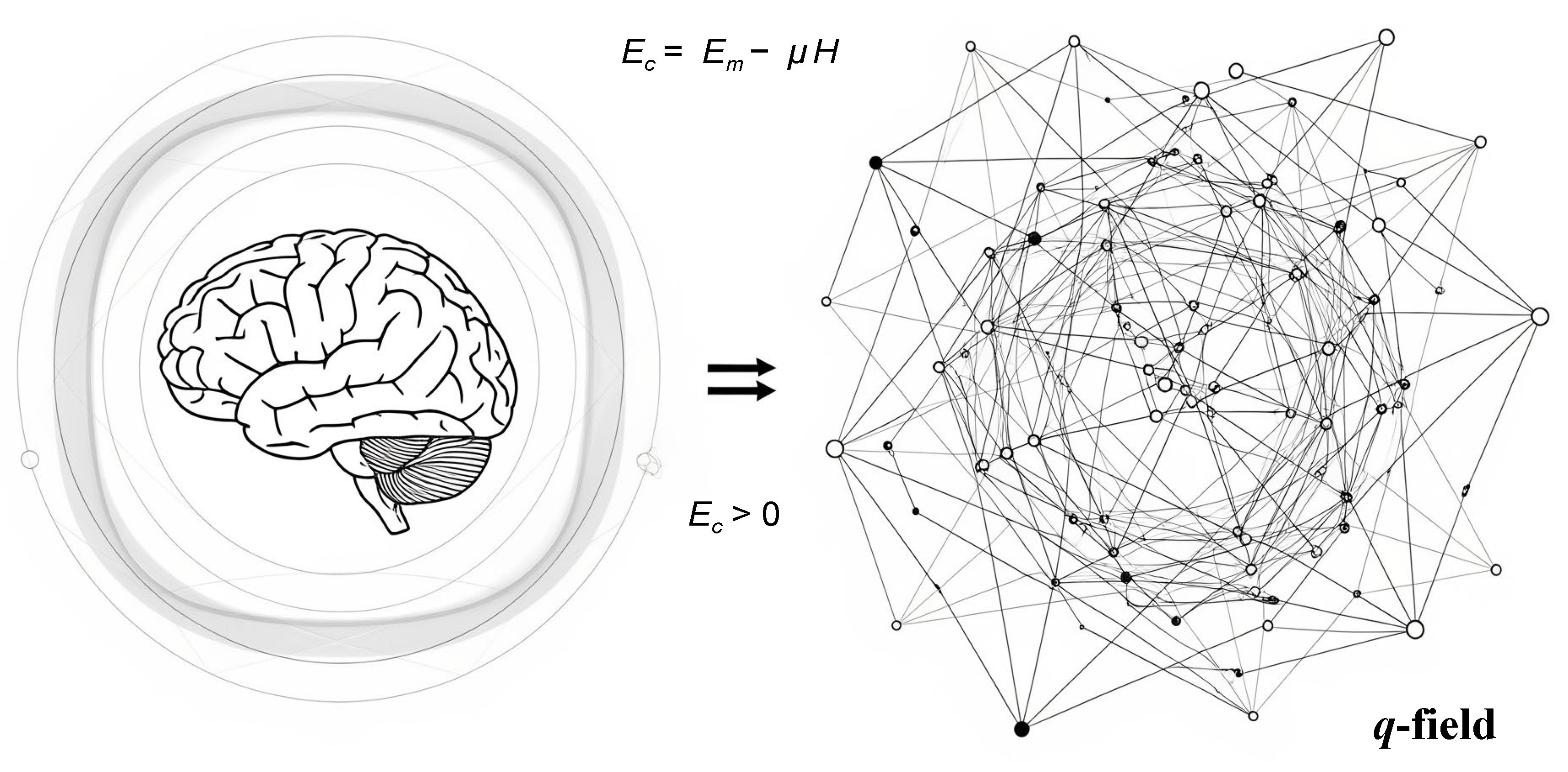

Table 1.
Symbols, units, and definitions. Key physical quantities related to energy, information, and their role in generating phenomenological mass. Includes SI units and methodological notes.
Table 1.
Symbols, units, and definitions. Key physical quantities related to energy, information, and their role in generating phenomenological mass. Includes SI units and methodological notes.
| Symbol | Name | SI Unit | Physical Definition | Comment |
|---|---|---|---|---|
| Em | Total metabolic energy | joules (J) | Total available energy generated by neural metabolism | Estimated via oxygen consumption, heat, or other physiological proxies |
| H | Shannon entropy | bits | Measure of the informational complexity of the brain electromagnetic field | Obtained by wavelet transforms, EEG/MEG spectral analysis |
| μ | Coupling constant | J/bit | Minimum energy to erase/encode 1 bit at fixed T, defined as μ = kBT ln 2 | Based on Landauer’s limit. For T = 310 K, μ ≈ 2,97⋅10−21 J |
| Ec | Coupling energy | joules (J) | Functional difference between Em and μH: Ec = Em − μH |
Key parameter: positive value indicates functional coupling to the q-field |
| m0 | Minimum phenomenological mass quantum | kilograms (kg) | Mass associated with 1 bit: m0 = μ / c2 | For Homo sapiens, T = 310 K, m0 ≈ 3.3 × 10−38 kg |
| n | Number of functional bits | dimensionless (integer) | Minimum number of organized informational quanta | Defines the granularity of consciousness |
| m | Total phenomenological mass | kilograms (kg) | Equivalent mass of consciousness: m = Ec / c2 | Physical interpretation of consciousness as organized matter |
| c | Speed of light | m/s | Universal constant: c ≈ 2,99792458⋅108 |
Used for energy-to-mass conversion via E = mc2 |
| kB | Boltzmann constant | J/K | Fundamental physical constant | Relates thermal energy to temperature |
| T | System temperature | kelvin (K) | Average absolute temperature of the brain | Fixes μ according to the analyzed biological system |
Disclaimer/Publisher’s Note: The statements, opinions and data contained in all publications are solely those of the individual author(s) and contributor(s) and not of MDPI and/or the editor(s). MDPI and/or the editor(s) disclaim responsibility for any injury to people or property resulting from any ideas, methods, instructions or products referred to in the content. |
© 2025 by the authors. Licensee MDPI, Basel, Switzerland. This article is an open access article distributed under the terms and conditions of the Creative Commons Attribution (CC BY) license (http://creativecommons.org/licenses/by/4.0/).
Copyright: This open access article is published under a Creative Commons CC BY 4.0 license, which permit the free download, distribution, and reuse, provided that the author and preprint are cited in any reuse.


