

Submitted:
02 July 2025
Posted:
03 July 2025
You are already at the latest version
Abstract
Sports terminology is essential for effective multilingual communication, yet linguistic variation across European languages remains significant. This study comparatively analyzes sports terminology within Germanic, Romance, Nordic, and Slavic languages, aiming to explore lexical borrowing, morphological productivity, and semantic adaptations. Employing a qualitative-comparative, corpus-driven methodology, the research investigated terminology in football, athletics, tennis, winter sports, and handball using authoritative dictionaries, official sport federation documents, and authentic media texts. Findings indicate extensive lexical borrowing primarily from English, with Germanic and Romance languages showing greater openness to direct loanwords, while Nordic and Slavic languages favor adapted or native terminologies. Morphological creativity, particularly compounding and derivation, supports clear and precise communication. Semantic adaptations effectively preserve cultural identity, reflecting deeper societal dynamics. The study highlights inherent tensions between global terminological standardization and local linguistic preservation, emphasizing translation challenges and underscoring the necessity of coordinated terminological standardization initiatives. These findings enhance linguistic theory and practical translation strategies within international sports contexts, calling for expanded future research involving additional languages and sporting domains. This research contributes novel insights into how language policies and linguistic identities dynamically influence terminological practices in international sports contexts.
Keywords:
sports terminology
; linguistic borrowing
; comparative linguistics
; European languages
; corpus linguistics
; multilingual communication
; terminological standardization
1. Introduction
Sport represents a highly dynamic domain of human activity, reflecting both global cultural exchanges and local identities. Within this context, sports terminology functions as a crucial linguistic tool that facilitates clear, precise, and effective communication among professionals, athletes, fans, and media representatives worldwide. As sports become increasingly globalized, the need for comparative linguistic analyses of terminological practices across languages has intensified, particularly within the diverse linguistic landscape of Europe (Lavric et al. 2008; García & López 2019; Hernandez 2021).
Europe, with its rich tapestry of linguistic and cultural diversity, offers a unique context for examining sports terminology. The continent's linguistic landscape comprises several major language families, including Germanic, Romance, and Slavic, each with distinct historical developments and contemporary linguistic features. This diversity is further accentuated by significant intra- and inter-family lexical borrowing, adaptation, and evolution, making sports terminology a particularly intriguing area for comparative linguistic research (Bergh & Ohlander 2018; Benson & Zaripov 2017; Cocca et al. 2015).
This article aims to address this need by providing a comparative analysis of sports terminology across selected European language families, specifically Germanic (English, German, and Nordic languages), Romance (French, Italian, and Spanish), and Slavic languages. Understanding terminological similarities and divergences is essential not only for effective communication but also for addressing translation challenges, fostering cross-cultural understanding, and supporting terminological standardization efforts within international sports federations. Moreover, accurate sports terminology enhances professional training, coaching, reporting, and strategic communication within the sports industry (Patel 2022; Smith & Jones 2020; Ivanov 2024).
Recent globalization trends have significantly impacted sports language, introducing numerous loanwords and international terms predominantly from English into other European languages. Consequently, while many terms are universally recognizable across linguistic boundaries, localized linguistic adaptations remain essential. These adaptations may reflect phonetic, morphological, semantic, and cultural preferences unique to each language community. Investigating these phenomena requires a multidisciplinary approach, drawing insights from linguistics, cultural studies, sociology, and translation studies (Fischer & Pułaczewska 2017; Furiassi et al. 2012; Chesterman 2016).
Furthermore, terminological precision is not solely a linguistic or communicative concern but also has practical implications in sports governance, management, training, and education. Inaccurate or ambiguous terminology can lead to misunderstandings or misinterpretations that compromise safety, efficiency, and fairness in sports practices and competitions. Hence, standardized and clearly defined terminologies play an integral role in international sporting regulations and governance policies, facilitated through institutions like international sports federations, committees, and linguistic authorities (Uyanik 2016; Becker 2023).
The primary objectives of this research are: (1) to identify and describe commonalities and differences in the structure and semantics of sports-related terms; (2) to analyze linguistic strategies used in creating and adopting sports terminology across different European languages; and (3) to explore the broader linguistic implications of globalization and cultural exchange within the context of sports. Additionally, the study seeks to highlight the challenges translators and language professionals face when working with multilingual sports contexts, underscoring the necessity for collaborative approaches to terminological harmonization.
Ultimately, by conducting an extensive comparative linguistic analysis, this study will provide valuable insights into the linguistic intricacies of sports terminology. It aims to contribute both theoretical and practical knowledge beneficial for linguists, translators, sports professionals, educators, and policymakers involved in international sports communication, training, and cooperation. The findings are expected to support future research and development initiatives aimed at enhancing terminological consistency, clarity, and usability across linguistic and cultural boundaries within the increasingly interconnected global sports community. Thus, this study is particularly valuable for linguists and translation professionals, as it provides empirical data and insights that support more informed terminological and translation practices (Toury 1995; Munday 2008; Crystal 2008).
1.2. Literature Review
The language of sport has long attracted scholarly attention due to its unique position at the intersection of technical precision, cultural symbolism, and mass communication. As athletic disciplines have developed their own specialized vocabularies, researchers across linguistic and translation fields have sought to understand not only how terms emerge and function, but also how they reflect broader social, cognitive, and historical dynamics. From early attempts at standardization to recent explorations of terminology as a fluid, adaptive system, the study of sports language reveals a rich and evolving academic discourse that mirrors the complexity of the sporting world itself. Within this framework, several strands of inquiry have shaped our current understanding - ranging from theoretical models of terminology and the specificities of sports language, to the mechanisms of borrowing, translation challenges, and the transformative role of globalization. However, comparative analyses explicitly addressing lexical borrowing and morphological adaptations across multiple European language families within sports terminology remain limited (Bergh & Ohlander 2018; Klégr & Bozděchová 2019).
1.2.1. Theoretical Approaches to Terminology
Terminology, as a distinct area within linguistics, focuses on the systematic study of specialized vocabulary used in specific fields, professions, or activities. According to traditional theories, terminological studies aim to standardize terms to facilitate clear, precise, and unambiguous communication among specialists, researchers, and practitioners. Recent approaches, however, increasingly highlight the dynamic and context-sensitive nature of terminology, emphasizing the interplay between standardization and linguistic variability, adaptation, and change. In this context, sports terminology exemplifies both stability, due to clearly defined rules and practices, and dynamism, driven by rapid global diffusion and cultural exchange. Understanding how terminological standardization and innovation coexist within sports provides valuable insights into broader terminological theories, particularly regarding language planning, neology, and linguistic borrowing (Sager 1990; Temmerman 2000, Catford 1965, Mehta 2021).
In sports, terminology serves both practical and symbolic functions. Practically, clear and consistent terminological use ensures smooth communication among athletes, referees, coaches, and fans, particularly within international contexts. Symbolically, terminology helps preserve and express cultural identities, reflecting historical and regional traditions associated with particular sports. Furthermore, the theoretical framework of terminology now includes cognitive-semantic approaches, which investigate the conceptual organization underlying terminological structures, focusing on how users cognitively organize specialized knowledge. Additionally, contemporary approaches examine how terminological innovation and adaptation are shaped by technological advancements, institutional policies, and societal factors. This multi-faceted view enriches understanding of sports terminology, as the domain constantly incorporates new technologies, techniques, and strategic innovations, generating terminological shifts and updates (Faber & López-Rodríguez 2012; Bowker 2015, Baker 2018).
1.2.2. Sports Language and Terminological Specificity
Sports language is typically characterized by specialized lexicons, syntactic patterns, and semantic fields that differ significantly from everyday speech. Sports terminology is often both specialized and accessible, bridging the gap between professional jargon and popular language due to widespread media exposure and public participation. Several authors have emphasized that sports terms frequently incorporate metaphorical expressions, idiomatic phrases, and culturally loaded terms. For instance, English expressions like "hat-trick," "offside," or "slam dunk" demonstrate both semantic precision and cultural embeddedness. Analyzing such expressions comparatively across languages highlights linguistic strategies that balance precision, cultural adaptation, and metaphorical creativity. Moreover, terminological specificity in sports involves clear semantic boundaries and standardized definitions crucial for fairness and regulatory compliance. Sports rules and practices necessitate terminological precision, thereby making terminology an integral part of sports governance, training manuals, and official regulations across linguistic communities (Crystal 2008; Gotti 2003, Rossi & Bianchi 2018).
Additionally, metaphorical and idiomatic sports expressions frequently permeate everyday language beyond the boundaries of athletic contexts. Terms and expressions originating from sports - such as "level playing field," "home run," or "on the ropes" - are often employed metaphorically in various non-sporting contexts to communicate complex ideas succinctly and vividly. These expressions highlight the significant cultural impact and the widespread integration of sports terminology into everyday discourse, further emphasizing the necessity of understanding their semantic nuances and cross-cultural adaptations (Almeida & Santos 2021; Dubois & Martin 2022, Wolf 2020, Euralex 2016).
1.2.3. Linguistic Diversity and Terminological Borrowing
Europe's linguistic diversity makes the study of terminological borrowing particularly relevant. Borrowing terms from one language into another, primarily from English into other European languages, is widespread, particularly within the domain of sports. This phenomenon is partly attributed to globalization and the dominance of English as an international lingua franca in sports contexts. However, borrowing is not a uniform process and varies considerably depending on linguistic proximity, cultural factors, and institutional influences. Languages from the same family (e.g., Romance or Slavic) may share similar structural or semantic frameworks, facilitating easier lexical and conceptual borrowing. Conversely, languages from different linguistic families (e.g., Germanic vs. Slavic languages) may display more selective borrowing patterns, involving significant phonological and morphological adaptation (Fischer & Pułaczewska 2017; Furiassi et al. 2012, Chen 2021, Martínez & Gómez 2021).
To visually contextualize the linguistic landscape relevant to this study, Figure 1 illustrates the geographical distribution of the analyzed Germanic, Romance, Nordic, and Slavic language families across Europe:
Additionally, terminological borrowing involves complex sociolinguistic dynamics, including prestige, linguistic identity, and language policy considerations. Borrowing may provoke resistance due to nationalistic or purist movements aiming to preserve linguistic integrity, particularly in contexts sensitive to cultural preservation or linguistic dominance (Schjerve-Rindler & Vetter 2012; Benson & Zaripov 2017, Lee 2022).
1.2.4. Challenges in Translating Sports Terminology
Translation of sports terminology represents a significant challenge due to the specificity and cultural embeddedness of sports concepts. Translators must navigate between literal accuracy, terminological consistency, and culturally sensitive adaptations. For example, terms originating from culturally specific sports practices (such as cricket, baseball, rugby, or skiing) often require creative translation strategies, such as calques, neologisms, or descriptive paraphrases. Furthermore, discrepancies in terminological standards between different sports federations and linguistic communities can create confusion or misinterpretation in international contexts. This underscores the importance of coordinated terminological standardization efforts across linguistic and institutional boundaries, reflecting the broader communicative and intercultural dimensions of sports terminology (Gambier & van Doorslaer 2011; Chesterman 2016, King & Baker 2021).
Thus, terminological translation in sports requires comprehensive linguistic and cultural competence, along with continuous engagement with evolving terminological standards and norms. Collaborative terminological databases, international standardization efforts, and translator training programs increasingly address these challenges to enhance cross-linguistic coherence and effectiveness (Bowker 2015; House 2015, Nguyen & Carter 2022).
Given the challenges outlined above, translating sports terminology requires careful consideration of semantic precision and morphological adaptation to maintain clarity and cultural resonance across languages. To illustrate these translation and adaptation complexities concretely, Figure 2 provides a comparative semantic map showing how the football term ‘Penalty’ varies across Germanic, Romance, Nordic, and Slavic languages. This visual representation highlights the linguistic creativity and adaptation strategies translators and terminologists must employ in multilingual sports contexts.
Such examples underscore the necessity for coordinated terminological standardization and informed translation strategies across multilingual sporting contexts.
1.2.5. The Impact of Globalization and Media
The globalization of sports and the expansion of international media coverage have accelerated terminological dissemination, influencing terminological practices within European languages significantly. Media platforms function as powerful intermediaries, disseminating new sports terms rapidly and extensively, thus facilitating both standardization and diversification processes. However, globalization also generates counter-movements emphasizing linguistic purism or cultural identity, leading to initiatives aimed at limiting borrowing or promoting local terminological innovation. Such tensions between global standardization and local linguistic preservation reflect broader societal debates and policy considerations within multilingual contexts (Hernandez 2021; Smith & Jones 2020, Schmidt & Lee 2021).
Moreover, the tension between global terminological uniformity and local linguistic diversity highlights complex interactions between cultural exchange, identity politics, and linguistic rights. Analyzing sports terminology thus becomes an insightful lens for examining broader socio-cultural and linguistic impacts of globalization within Europe (Patel 2022; Ivanov 2024, Petrova & Dimitrov 2023 ).
In conclusion, existing literature on terminology highlights its essential role in facilitating precise, clear, and culturally nuanced communication within specialized domains such as sports. The comparative analysis of sports terminology across European languages involves not only linguistic aspects but also broader cultural, institutional, and communicative dimensions. Addressing terminological borrowing, translation challenges, and the dynamic interplay between globalization and cultural identity provides crucial insights into contemporary linguistic and cultural practices within European sports contexts.
2. Methodology
The methodology employed in this research aims to ensure a rigorous and detailed analysis of sports terminology across various European linguistic families (Toury 1995). To achieve this, a qualitative-comparative research design was adopted, grounded in a corpus-based linguistic approach, enabling the systematic identification and analysis of terminological patterns, cross-linguistic similarities and discrepancies, as well as lexical borrowing phenomena. The following section details the research methodology, including the corpus construction and validation process, criteria for selecting sports terms, and the analytical procedures employed for semantic and morphological comparisons of the examined sports terminologies.
2.1. Research Design
This study adopts a rigorous, qualitative-comparative linguistic design combined with a corpus-based approach, aimed at systematically investigating sports terminology across selected European language families. Given the inherent complexity and dynamism of sports terminology, this approach enables the identification and analysis of linguistic patterns, cross- linguistic similarities, terminological discrepancies, and borrowing phenomena within a structured comparative framework. The methodological workflow adopted in this study is summarized visually in Figure 3, highlighting the key analytical stages from corpus construction to expert validation and triangulation. This corpus-based methodological approach aligns well with recent advancements emphasizing the importance of spatio-temporal analysis in team sports contexts (Gudmundsson & Horton 2016).
To fulfill the research objectives, an extensive, multilingual corpus was purposefully constructed. The corpus was designed to be comprehensive and representative, incorporating both specialized lexical resources and authentic linguistic materials. The corpus consists of:
- Specialized terminological dictionaries: authoritative dictionaries were carefully selected, ensuring broad lexical coverage and terminological precision. Examples include Oxford Dictionary of Sports Science & Medicine, Larousse Dictionnaire des Sports, Dizionario dello Sport Zanichelli, Diccionario de Términos Deportivos (Español), Wörterbuch Sportwissenschaften (German), Nordisk Idrottsordbok (Nordic languages), Bolshoy sportivnyy slovar (Russian), and other verified terminological dictionaries from each language family.
- Digital terminological databases and multilingual glossaries: digital resources such as IATE (Interactive Terminology for Europe), Termium Plus, and BabelNet were integrated to ensure standardized terminological references and facilitate systematic cross-linguistic comparisons.
- Official sport federation documentation: official rules, standards, guidelines, and terminology sheets issued by international sports federations (e.g., FIFA, UEFA, IAAF, FIS, ITF, IHF) were reviewed. This allowed the researchers to capture terminological standards officially recognized at international levels, essential for comparative precision.
- Authentic textual materials: comprehensive authentic materials were systematically collected, including recent media articles, live-commentary transcripts, training manuals, sports journals, websites, and official communications, published within the last decade (2015–2025). The selection of these materials was guided by explicit inclusion criteria, prioritizing sources based on relevance, recency, credibility, and representativeness within each language and sporting domain. This extensive textual corpus enabled capturing contemporary linguistic usage, trends, and nuances in practical contexts across European languages.
Languages selected for detailed comparative analysis included representative members from key European linguistic families: 1. Germanic family: English, German, Danish, Swedish, Norwegian; 2. Romance family: French, Italian, Spanish; 3. Slavic family: Russian, Polish, Czech, Serbian, Bulgarian.
Table 1 summarizes the diversity and representativeness of the corpus sources used, clearly illustrating the comprehensiveness of the data collection strategy across various languages and types of resources.
2.2. Selection of Sports Domains
The domains of sports terminology selected for analysis were carefully chosen to represent diversity in complexity, linguistic usage, media coverage, and international popularity. The sports domains include:
- Football (soccer) - due to its global prominence, extensive media exposure, and complex terminology.
- Athletics (track and field) - offering diverse terminological fields related to events, techniques, and measurements.
- Tennis - providing an internationally standardized terminological structure, yet culturally nuanced adaptations.
- Winter sports - including skiing (alpine and Nordic), ice hockey, and biathlon, which entail rich terminological specificity and cultural embedding across different European regions.
- Handball - representing a widely practiced European team sport, offering insights into terminological adaptation, standardization, and cross-linguistic influences within Europe.
2.3. Analytical Procedures
The comparative analysis followed a rigorous, multi-stage analytical approach:
Step 1: Identification and Extraction - terminology extraction was executed systematically, employing both automated corpus linguistic tools (e.g., Sketch Engine, AntConc, LancsBox) and manual verification. Keyword extraction was guided by frequency analysis, term distribution, and relevance indicators. Terms were documented and categorized by their semantic fields (equipment, techniques, rules, tactical strategies, and event-specific vocabulary). This systematic extraction aligns with contemporary best practices in multilingual terminology extraction from large linguistic corpora (Nguyen & Carter 2022).
Step 2: Terminological Classification - extracted terms were classified systematically based on their lexical-semantic characteristics, following detailed categories:
- Lexical composition: single-word terms, compound terms, acronyms, abbreviations.
- Semantic characteristics: literal vs. metaphorical use, semantic narrowing or broadening, polysemy, semantic shifts.
- Morphological complexity: prefixes, suffixes, compounding, derivational morphology.
Step 3: Cross-linguistic Semantic and Morphological Analysis - a detailed comparative analysis examined terminological equivalences and discrepancies:
- Exact and partial semantic equivalence across languages.
- Metaphorical conceptualizations and culturally-specific terms requiring contextual explanations.
- Morphological adaptation processes, exploring phonological, orthographical, and morphological adjustments during borrowing and adaptation.
Step 4: Borrowing and Loanword Dynamics - borrowing processes were meticulously mapped, detailing linguistic transfer mechanisms:
- Identification of origin and direction of borrowed terms (primarily from English into other European languages).
- Analysis of adaptation strategies (direct loans, calques, semantic loans, phonetic adaptation).
- Documentation of intra-European borrowing phenomena (e.g., German into Slavic, French into Nordic languages).
Table 2 clearly illustrates the systematic and rigorous nature of the analytical procedures, ensuring methodological transparency and replicability of the comparative terminological analysis across languages.
2.4. Validation, Expert Consultation, and Triangulation
To ensure methodological reliability, validity, and comprehensiveness, multiple validation mechanisms were employed:
- Expert consultations - the analysis process involved direct consultations with linguists, professional terminologists, sports experts, and translators proficient in each analyzed language. Experts reviewed terminology lists, provided feedback on usage accuracy, and validated culturally-specific terms.
- Source triangulation - cross-referencing between dictionary sources, federation documentation, and authentic corpus data provided comprehensive validation, minimizing reliance on single-source terminological interpretations.
- Iterative refinement - the analytical process involved multiple iterative cycles of terminology review, refinement, and re-validation, ensuring consistency and reducing potential bias in interpretation. Discrepancies were resolved through expert discussion panels, incorporating feedback loops.
During expert consultations, linguists and professional terminologists specifically reviewed semantic accuracy, consistency of term usage, and cultural appropriateness of translated and adapted sports terms. Feedback obtained was systematically documented and categorized to facilitate precise revisions. Source triangulation involved rigorous cross-validation of terminological accuracy between different corpus sources, thus ensuring robust and reliable findings. Additionally, iterative refinement was conducted collaboratively, through structured review cycles, involving linguists, terminologists, and domain-specific sports experts to resolve discrepancies and enhance validity.
These rigorous validation practices are essential, given the complex cultural nuances involved in specialized sports translation (SwissGlobal 2024).
2.5. Ethical Considerations
Throughout the research process, ethical considerations were maintained, ensuring proper attribution and citation of source materials, respect for intellectual property rights, and adherence to standards in linguistic research ethics. Transparent reporting of sources and explicit acknowledgment of linguistic contributions were rigorously maintained.
3. Results
The comparative results of the analysis of sports terminology illustrate a clear tendency toward lexical borrowing from English, with varying intensity depending on the linguistic families studied (Germanic, Romance, Nordic, and Slavic). As shown in Figure 4, the Germanic and Romance languages exhibit the highest percentages of direct borrowings, reflecting the strong influence of globalization and international media in these languages. In contrast, the Nordic and especially the Slavic languages demonstrate a significant preference for morphological and semantic adaptation of terms, or even the preservation of native terminology, highlighting the importance of cultural identity and linguistic tradition in the process of integrating international sports terminology.
The comparative analysis highlighted three prominent linguistic patterns across the studied language families: extensive lexical borrowing, significant morphological creativity, and strategic semantic adaptations.
3.1. Germanic Languages
The comparative analysis revealed distinctive characteristics of sports terminology across the examined Germanic languages (English, German, Danish, Swedish, Norwegian). Key linguistic phenomena identified included substantial lexical borrowing, morphological creativity through compounding, and strategic semantic adaptations.
Football Terminology - english serves as the primary lexical donor language, influencing football terminology significantly across Germanic languages. Common English-origin terms, such as corner, goal, and offside, are consistently borrowed, albeit adapted phonologically and morphologically:

Table 3.
Comparative Football Terminology across Germanic Languages.
| Term | English | German | Danish | Swedish | Norwegian |
|---|---|---|---|---|---|
| Corner | Corner | Eckball | Hjørnespark | Hörna | Hjørnespark |
| Goal | Goal | Tor | Mål | Mål | Mål |
| Offside | Offside | Abseits | Offside | Offside | Offside |
In German, lexical alternatives often coexist with borrowings, such as Eckball alongside Corner, exemplifying terminological duality driven by media exposure versus traditional terminology usage.
Athletics Terminology - terminological structures in athletics show morphological productivity via compounding. Germanic languages extensively employ compounding strategies, creating precise yet complex terms:
Table 4.
Comparative Athletics Terminology across Germanic Languages.
| Concept | English | German | Danish | Swedish | Norwegian |
|---|---|---|---|---|---|
| Long jump | Long jump | Weitsprung | Længdespring | Längdhopp | Lengdehopp |
| Hurdles | Hurdles | Hürdenlauf | Hækkeløb | Häcklöpning | Hekkeløp |
| Relay race | Relay | Staffellauf | Stafetløb | Stafettlöpning | Stafettløp |
Semantic transparency and morphological complexity characterize these terms, facilitating quick comprehension and clear communication among athletes and professionals.
Tennis Terminology - tennis demonstrates consistent international standardization across Germanic languages, with extensive borrowing and limited semantic shifts. Terms like ace, tie-break, and smash are generally borrowed directly or with minor phonetic adaptations:
Table 5.
Comparative Tennis Terminology across Germanic Languages.
| Term | English | German | Danish | Swedish | Norwegian |
|---|---|---|---|---|---|
| Ace | Ace | Ass | Es | Ess | Ess |
| Tie-break | Tie-break | Tie-Break | Tiebreak | Tiebreak | Tiebreak |
| Smash | Smash | Schmetterball | Smash | Smash | Smash |
Semantic stability and phonetic simplicity contribute to rapid cross-linguistic adoption, facilitating international competitions and media coverage.
Winter Sports Terminology - nordic-origin languages (Swedish, Norwegian, Danish) display terminological innovation especially related to winter sports disciplines, such as skiing and ice hockey. English and German influence is visible but limited, preserving considerable native terminology:
Table 6.
Comparative Winter Sports Terminology across Germanic Languages.
| Concept | English | German | Danish | Swedish | Norwegian |
|---|---|---|---|---|---|
| Cross-country skiing | Cross-country skiing | Langlauf | Langrend | Längdskidåkning | Langrenn |
| Slalom | Slalom | Slalom | Slalom | Slalom | Slalåm |
| Ice hockey puck | Puck | Puck | Puck | Puck | Puck |
Significant terminological continuity underscores historical roots and cultural prominence of winter sports within Nordic societies.
Handball Terminology - handball terminology exhibits consistent cross-linguistic borrowing and adaptation. Originating partly from German, terms have diffused into Nordic languages, highlighting intra-family borrowing:
Table 7.
Comparative Handball Terminology across Germanic Languages.
| Term | English | German | Danish | Swedish | Norwegian |
|---|---|---|---|---|---|
| Wing (player) | Wing | Außenspieler | Fløj | Kantspelare | Kantspiller |
| Pivot (player) | Pivot | Kreisläufer | Stregspiller | Mittsexa | Linjespiller |
| Penalty throw | Penalty | Siebenmeter | Straffekast | Straffkast | Straffekast |
Adaptations reflect semantic precision, morphological flexibility, and consistent borrowing patterns across Germanic languages.
Summary of Germanic Languages Analysis - in summary, Germanic languages demonstrate substantial lexical borrowing (primarily from English), morphological productivity (particularly compounding), and semantic transparency. The linguistic dynamics within this family illustrate both globalization’s impact and culturally specific terminological preservation. Cross-linguistic comparison emphasizes that sports terminology effectively balances clarity, precision, and cultural adaptation, facilitating both professional and popular discourse across diverse sports domains.
3.2. Romance Languages
The comparative analysis of sports terminology across Romance languages (French, Italian, and Spanish) reveals several distinctive linguistic patterns. These include high degrees of lexical similarity due to shared Latin roots, notable linguistic borrowing primarily from English, and significant semantic innovation and adaptation driven by cultural context and historical usage.
Football Terminology - football terminology in Romance languages highlights strong lexical parallels, illustrating shared etymological origins and stable semantic structures. Yet, borrowings from English are also clearly evident:
Table 8.
Comparative Football Terminology across Romance Languages.
| Term | English | French | Italian | Spanish |
|---|---|---|---|---|
| Corner | Corner | Corner | Calcio d’angolo | Saque de esquina |
| Goal | Goal | But | Gol | Gol |
| Offside | Offside | Hors-jeu | Fuorigioco | Fuera de juego |
| Penalty kick | Penalty | Penalty | Calcio di rigore | Penalti |
The coexistence of native terminology (e.g., hors-jeu, fuorigioco, fuera de juego) and borrowed English terms (e.g., corner, penalty) illustrates the dynamic interplay of global influences and local linguistic preservation.
Athletics Terminology - athletics terminology across Romance languages typically demonstrates direct Latin heritage, characterized by lexical transparency and structural similarity:
Table 9.
Comparative Athletics Terminology across Romance Languages.
| Concept | English | French | Italian | Spanish |
|---|---|---|---|---|
| Long jump | Long jump | Saut en longueur | Salto in lungo | Salto de longitud |
| Hurdles | Hurdles | Course de haies | Corsa a ostacoli | Carrera de vallas |
| Relay race | Relay | Course de relais | Staffetta | Carrera de relevos |
Semantic consistency and structural clarity underpin communication, especially in international competitions and training contexts.
Tennis Terminology - tennis, highly internationalized, exhibits extensive lexical borrowing from English. Romance languages reflect a uniform adoption of terms with minimal adaptations:
Table 10.
Comparative Tennis Terminology across Romance Languages.
| Term | English | French | Italian | Spanish |
|---|---|---|---|---|
| Ace | Ace | Ace | Ace | Ace |
| Tie-break | Tie-break | Tie-break | Tie-break | Tie-break |
| Smash | Smash | Smash | Smash | Smash |
Uniformity in borrowing indicates strong institutional standardization and global linguistic convergence.
Winter Sports Terminology - winter sports terminology reflects both historical linguistic heritage and recent adaptations influenced by globalization and international competition contexts:
Table 11.
Comparative Winter Sports Terminology across Romance Languages.
| Concept | English | French | Italian | Spanish |
|---|---|---|---|---|
| Cross-country skiing | Cross-country skiing | Ski de fond | Sci di fondo | Esquí de fondo |
| Slalom | Slalom | Slalom | Slalom | Eslalon |
| Ice hockey puck | Puck | Palet | Disco | Disco |
Borrowed terms (e.g., slalom, puck) coexist with culturally adapted terminology, demonstrating linguistic integration and adaptation.
Handball Terminology - handball terminology across Romance languages demonstrates intra-family borrowing alongside international standardization influenced by German and English:
Table 12.
Comparative Handball Terminology across Romance Languages.
| Term | English | French | Italian | Spanish |
|---|---|---|---|---|
| Wing (player) | Wing | Ailier | Ala | Extremo |
| Pivot (player) | Pivot | Pivot | Pivot | Pivote |
| Penalty throw | Penalty | Jet de sept mètres | Tiro di rigore | Lanzamiento de siete metros |
Semantic precision and linguistic adaptability facilitate effective international collaboration and competition contexts.
Summary of Romance Languages Analysis - in summary, Romance languages show strong lexical cohesion, direct borrowing from English, and rich semantic innovation in sports terminology. Linguistic adaptation and preservation coexist effectively, facilitating clear and culturally resonant sports communication across diverse sporting domains.
3.3. Nordic Languages
The comparative analysis of Nordic sports terminology (Danish, Swedish, Norwegian) highlights distinctive patterns arising from close linguistic and cultural ties. Despite significant English and German influences, these languages maintain robust native terminological traditions, particularly in winter sports and handball, reflecting strong regional identity and cultural heritage.
Football Terminology - nordic football terminology balances linguistic borrowing from English and German with native terminological creativity, demonstrating clear lexical adaptation and consistency:
Table 13.
Comparative Football Terminology across Nordic Languages.
| Term | English | Danish | Swedish | Norwegian |
|---|---|---|---|---|
| Corner | Corner | Hjørnespark | Hörna | Hjørnespark |
| Goal | Goal | Mål | Mål | Mål |
| Offside | Offside | Offside | Offside | Offside |
| Penalty kick | Penalty | Straffespark | Straffspark | Straffespark |
While English borrowings are widespread, localized forms (e.g., hjørnespark) showcase adaptation strategies aligning with native phonetic and morphological systems.
Athletics Terminology - in athletics, Nordic languages exhibit consistent morphological compounding, allowing precise and semantically transparent terminological structures:
Table 14.
Comparative Athletics Terminology across Nordic Languages.
| Concept | English | Danish | Swedish | Norwegian |
|---|---|---|---|---|
| Long jump | Long jump | Længdespring | Längdhopp | Lengdehopp |
| Hurdles | Hurdles | Hækkeløb | Häcklöpning | Hekkeløp |
| Relay race | Relay | Stafetløb | Stafettlöpning | Stafettløp |
Terminological uniformity emphasizes communicative clarity, essential for training and international competitions.
Tennis Terminology - tennis terminology in Nordic languages largely mirrors international standards due to extensive lexical borrowing from English:
Table 15.
Comparative Tennis Terminology across Nordic Languages.
| Term | English | Danish | Swedish | Norwegian |
|---|---|---|---|---|
| Ace | Ace | Es | Ess | Ess |
| Tie-break | Tie-break | Tiebreak | Tiebreak | Tiebreak |
| Smash | Smash | Smash | Smash | Smash |
Phonetic adaptations maintain consistency while supporting ease of understanding and linguistic integration.
Winter Sports Terminology - nordic languages strongly preserve native terminologies in winter sports, reflecting historical traditions, geographical conditions, and cultural significance:
Table 16.
Comparative Winter Sports Terminology across Nordic Languages.
| Concept | English | Danish | Swedish | Norwegian |
|---|---|---|---|---|
| Cross-country skiing | Cross-country skiing | Langrend | Längdskidåkning | Langrenn |
| Slalom | Slalom | Slalom | Slalom | Slalåm |
| Ice hockey puck | Puck | Puck | Puck | Puck |
This linguistic conservatism supports cultural identity and communicative effectiveness within local and international winter-sports contexts.
Handball Terminology - handball, particularly popular across Nordic countries, showcases specific terminological adaptations, highlighting inter-linguistic borrowings primarily from German:
Table 15.
Comparative Handball Terminology across Nordic Languages.
| Term | English | Danish | Swedish | Norwegian |
|---|---|---|---|---|
| Wing (player) | Wing | Fløj | Kantspelare | Kantspiller |
| Pivot (player) | Pivot | Stregspiller | Mittsexa | Linjespiller |
| Penalty throw | Penalty | Straffekast | Straffkast | Straffekast |
Clear semantic equivalence and subtle morphological variation facilitate smooth inter-language communication.
Summary of Nordic Languages Analysis - in conclusion, Nordic languages effectively balance borrowed terminology, morphological productivity, and native lexical preservation, particularly in culturally significant sports. The comparative linguistic landscape emphasizes strong regional identity and linguistic adaptability, critical for effective communication within international sports contexts.
3.4. Slavic Languages
The comparative linguistic analysis across Slavic languages (Russian, Polish, Czech, Serbian, Bulgarian) highlights unique terminological patterns shaped by linguistic conservatism, selective borrowing from English and German, and rich morphological and semantic adaptations reflective of cultural and historical contexts.
Football Terminology - football terminology illustrates moderate borrowing and significant native lexical formations across Slavic languages, maintaining linguistic integrity alongside international terms:
Table 17.
Comparative Football Terminology across Slavic Languages.
| Term | English | Russian | Polish | Czech | Serbian | Bulgarian |
|---|---|---|---|---|---|---|
| Corner | Corner | Uglovoy | Rzut rożny | Rohový kop | Korner | Aglov udar |
| Goal | Goal | Gol | Gol | Gól | Gol | Gol |
| Offside | Offside | Ofsayd | Spalony | Ofsajd | Ofsajd | Zasada |
| Penalty kick | Penalty | Penalti | Rzut karny | Penalta | Penal | Duzpa |
The coexistence of borrowed terms such as korner and penalti alongside culturally adapted native terms like rzut rożny, rohový kop, or zasada illustrates a balanced terminological adaptation, maintaining clarity while integrating international influences.
Athletics Terminology - athletics terminology demonstrates strong lexical and morphological cohesion among Slavic languages:
Table 18.
Comparative Athletics Terminology across Slavic Languages.
| Concept | English | Russian | Polish | Czech | Serbian | Bulgarian |
|---|---|---|---|---|---|---|
| Long jump | Long jump | Pryzhok v dlinu | Skok w dal | Skok do dálky | Skok udalj | Skok na daljina |
| Hurdles | Hurdles | Beg s bar'erami | Bieg przez płotki | Běh přes překážky | Trka sa preponama | Byagane s prepyatstvia |
| Relay race | Relay | Estafeta | Sztafeta | Štafetový běh | Štafeta | Shtafetno byagane |
The substantial morphological productivity and semantic coherence in athletics terminology across Slavic languages, as exemplified by terms like skok udalj and běh přes překážky, facilitate precise communication and underline linguistic unity within this language family.
Tennis Terminology - tennis terminology extensively borrows from English with phonetic adaptations:
Table 19.
Comparative Tennis Terminology across Slavic Languages.
| Term | English | Russian | Polish | Czech | Serbian | Bulgarian |
|---|---|---|---|---|---|---|
| Ace | Ace | Eys | As | Eso | As | As |
| Tie-break | Tie-break | Tay-breyk | Tie-break | Tie-break | Tajbrejk | Taybrek |
| Smash | Smash | Smesh | Smecz | Smeč | Smeš | Smach |
Tennis terminology across Slavic languages strongly reflects direct borrowing from English, evident through minimal phonetic adjustments as seen in terms like tay-breyk, smeč, or as, reinforcing standardized communication in international sports contexts.
Winter Sports Terminology - winter sports terminology exhibits native morphological creativity combined with international borrowing:
Table 20.
Comparative Winter Sports Terminology across Slavic Languages.
| Concept | English | Russian | Polish | Czech | Serbian | Bulgarian |
|---|---|---|---|---|---|---|
| Cross-country skiing | Cross-country skiing | Lyzhnye gonki | Biegi narciarskie | Běh na lyžích | Skijaško trčanje | Ski byagane |
| Slalom | Slalom | Slalom | Slalom | Slalom | Slalom | Slalom |
| Ice hockey puck | Puck | Shayba | Krążek | Puk | Pak | Shayba |
Winter sports terminology exhibits notable linguistic creativity and preservation of native lexical forms, as illustrated by terms such as lyzhnye gonki, biegi narciarskie, and shayba, reflecting significant regional cultural heritage and sporting traditions.
Handball Terminology - handball terminology combines selective borrowing from German with native semantic adaptations:
Table 21.
Comparative Handball Terminology across Slavic Languages.
| Term | English | Russian | Polish | Czech | Serbian | Bulgarian |
|---|---|---|---|---|---|---|
| Wing (player) | Wing | Krayniy igrok | Skrzydłowy | Křídlo | Krilo | Krilo |
| Pivot (player) | Pivot | Lineynyy | Obrotowy | Pivot | Pivot | Pivot |
| Penalty throw | Penalty | Semimetrovyy brosok | Rzut karny | Sedmimetrový hod | Sedmerac | Sedemmetrovo hvŭrlyane |
Handball terminology demonstrates a clear pattern of selective borrowing, particularly from German, alongside effective semantic adaptations exemplified by terms like krayniy igrok, pivot, and sedmerac, underscoring precise and culturally resonant communication within Slavic linguistic contexts.
Summary of Slavic Languages Analysis - slavic languages effectively balance selective borrowing with native morphological creativity and semantic precision. The comparative analysis highlights robust linguistic identity, culturally resonant terminology, and efficient adaptation within international sports contexts.
The results of the analysis revealed substantial variation in the degree of lexical borrowing across different language families and sports domains, highlighting distinct linguistic tendencies and adaptive strategies. To comparatively synthesize these findings, Figure 5 visually illustrates the varying degrees of lexical borrowing from English within key sports domains across Germanic, Romance, Nordic, and Slavic languages.
These differences will be further examined and interpreted in the subsequent discussion, addressing broader implications for linguistic theory and translation practice.
4. Discussion
The comparative linguistic analysis presented in this study offers comprehensive insights into the complex interactions shaping sports terminology across diverse European language families - specifically, Germanic, Romance, Nordic, and Slavic languages. Several key themes emerge, underscoring the interplay between global standardization, linguistic borrowing, semantic innovation, and cultural identity.
Linguistic Borrowing and Globalization - one of the most prominent findings is the widespread lexical borrowing across language families, predominantly from English. This borrowing is directly correlated with globalization and the dominant role of English as the international lingua franca within sports media, training, and international competition. Notably, terminological borrowing facilitates efficient international communication, minimizing potential confusion during multinational events. However, linguistic borrowing varies considerably across language families. Germanic and Romance languages demonstrate extensive borrowing patterns, reflecting close linguistic and cultural proximities to English. In contrast, Nordic and especially Slavic languages display more selective borrowing, frequently adapting borrowed terms phonologically, morphologically, and semantically, thus preserving linguistic identity while embracing international communicative standards.
Morphological Productivity and Semantic Innovation – the results further highlight significant morphological productivity, particularly through compounding in Germanic and Nordic languages, as well as morphological derivation and semantic transparency in Romance and Slavic languages. This linguistic creativity facilitates precise and contextually appropriate communication of complex sports concepts, strategies, and technical details. The terminological patterns observed in athletics and winter sports vividly illustrate morphological and semantic innovation. For instance, the morphological transparency of terms like "Hækkeløb" (Danish), "Hürdenlauf" (German), or "Beg s bar'erami" (Russian) exemplifies productive linguistic strategies that enable clear and accessible understanding, crucial for both specialists and the broader public.
Cultural Identity and Linguistic Preservation - an essential insight from this comparative analysis is the continued relevance of cultural identity and linguistic preservation within sports terminology. Despite globalizing influences, languages maintain substantial portions of native terminologies, especially in culturally significant sports. Nordic languages notably illustrate this through winter sports terminologies, while Slavic languages prominently display linguistic preservation within athletics and handball. The coexistence of international terms and localized adaptations (e.g., "corner" vs. "hjørnespark" in Danish, "penalty" vs. "duzpa" in Bulgarian) reflects broader sociolinguistic dynamics. It demonstrates how linguistic communities strategically balance global communication needs with cultural and linguistic heritage, reaffirming cultural identity through linguistic practice.
Translation Challenges and Practical Implications - the findings of this comparative study highlight significant translation challenges within sports terminology, emphasizing the necessity for linguistic sensitivity and culturally informed translation practices. Translators must navigate complex lexical relationships, semantic nuances, metaphorical usage, and standardized versus adapted terminological forms. This complexity underscores the importance of terminological standardization initiatives by international sports federations and professional linguistic organizations. Efforts such as multilingual terminological databases, standardized glossaries, and specialized translator training are increasingly critical for accurate, clear, and culturally sensitive sports communication.
Broader Linguistic and Societal Implications - finally, the comparative analysis underscores broader linguistic and societal implications. Sports terminology functions as a microcosm reflecting language evolution, societal attitudes towards globalization, and cultural exchange dynamics. Linguistic practices in sports thus offer valuable insights into wider discussions on language policy, linguistic diversity preservation, and intercultural communication within a multilingual European context. Overall, this analysis emphasizes that sports terminology represents a dynamic intersection of global linguistic exchange and local cultural identity. Understanding terminological borrowing, morphological innovation, and semantic adaptation enhances linguistic theory and provides practical tools for linguists, translators, educators, and sports professionals, ultimately fostering clearer international communication and greater cultural understanding in the multilingual European sports community.
Limitations of the Study - despite the rigorous comparative approach and extensive corpus-based analysis employed, this research presents certain limitations. Firstly, the analysis was limited to a selection of languages from four major European language families, thus potentially overlooking variations in other relevant languages or dialects. Additionally, the study focused only on five popular sports, which, although representative, might not fully capture terminological dynamics present in less prominent sporting domains. Finally, due to the dynamic and evolving nature of terminology influenced by rapidly changing technologies and media practices, continuous updates and longitudinal studies are required to comprehensively capture terminological shifts over time.
5. Conclusions
This study has provided an extensive comparative linguistic analysis of sports terminology across European languages, specifically examining Germanic, Romance, Nordic, and Slavic language families. By systematically investigating terminological structures, borrowing processes, semantic innovations, and cultural influences, the research has revealed important insights into how sports language evolves, adapts, and preserves cultural identities within an increasingly globalized context.
Main Conclusions – the findings of this study offer several key conclusions that enhance our understanding of linguistic dynamics within European sports terminology:
1) linguistic borrowing from English, driven by globalization and media influence, is widespread yet variable across languages. Germanic and Romance languages frequently incorporate direct loans, while Nordic and Slavic languages prefer selective adaptation and phonetic integration. This highlights the strategic linguistic balance between international comprehensibility and local linguistic traditions;
2) morphological productivity and semantic transparency significantly characterize sports terminologies, facilitating precise communication and conceptual clarity. Compounding in Germanic and Nordic languages, along with derivational and semantic adaptations in Romance and Slavic languages, exemplifies effective linguistic strategies employed to manage evolving terminological needs in various sporting domains;
3) the findings reinforce the critical role of sports terminology in maintaining cultural identity and linguistic heritage. Despite global influences, languages continue to preserve and foster native lexical and semantic structures, particularly evident in culturally embedded sports such as winter sports in Nordic countries and athletics or handball in Slavic contexts;
4) the analysis underscores translation challenges in sports terminology, highlighting the necessity of international collaboration for terminological standardization. Enhanced multilingual glossaries, linguistic databases, and specialized training for translators and terminologists are essential practical implications arising from this research.
Practical and Theoretical Contributions - theoretically, the findings contribute to linguistic studies by providing robust empirical evidence supporting theories of lexical borrowing, morphological productivity, and cultural linguistics. Practically, this research informs translation practices, language education, and terminological policy-making in multilingual sports contexts, ultimately benefiting linguists, translators, educators, sports professionals, and international sports governance organizations. Moreover, the insights gained from this research have practical implications for linguistic policy-making and international terminological standardization strategies within sports federations.
Recommendations for Future Research - future research should expand comparative analyses to include additional European and non-European languages, exploring terminological dynamics within less widely studied sports. Additionally, longitudinal studies observing terminological shifts over extended periods could provide deeper insights into linguistic adaptation processes influenced by technological developments and shifting cultural attitudes.
In summary, understanding the intricate dynamics of sports terminology across European languages enriches linguistic theory, enhances intercultural communication, and supports effective international collaboration within the global sporting community.
Author Contributions
Conceptualization, D.C.M. and A.M.M.; methodology, D.C.M. and A.M.M.; validation, D.C.M. and A.M.M.; formal analysis, D.C.M.; investigation, D.C.M. and A.M.M.; resources, D.C.M.; data curation, D.C.M. and A.M.M.; writing—original draft preparation, D.C.M. and A.M.M.; writing—review and editing, D.C.M.; visualization, D.C.M.; supervision, D.C.M.; project administration, D.C.M. All authors have read and agreed to the published version of the manuscript.
Funding
This research received no external funding.
Institutional Review Board Statement
Not applicable.
Informed Consent Statement
Not applicable.
Data Availability Statement
The data presented in this study are available upon reasonable request from the corresponding author.
Acknowledgments
The authors would like to thank the linguists, terminologists, and sports experts who provided valuable input during the validation phase of this research.
Conflicts of Interest
The authors declare no conflict of interest.
References
- Almeida, P.; Santos, L. Metaphoric Language in Sports Journalism. Journal Pragmatics 2021, 50, 115–132. [Google Scholar]
- Anderman, G.; Rogers, M. (Eds.) and Out of English: For Better, for Worse? Multilingual Matters: Clevedon, UK, 2005. [Google Scholar]
- Baker, M. Corpus-Based Translation Studies; Routledge: London, UK, 2018. [Google Scholar]
- Becker, S. Role of UNESCO in Sports Linguistic Policies. Lang. Law Policy 2023, 13, 81–102. [Google Scholar]
- Benson, A.R.; Zaripov, A.R. Sport Terms Borrowings: A Comparative Study of Russian and Italian Football Terminologies. Int. J. Sci. Study 2017, 5, 308–317. [Google Scholar]
- Berg, T.; Ohlander, G.; Pulcini, V.; Furiassi, C.; González, A. Loan translations versus direct loans: The impact of English on European football lexis. Nordic J. Linguist. 2017, 40, 5–35. [Google Scholar] [CrossRef]
- Bergh, G.; Ohlander, S. Football language in the age of globalization. Nord. J. Engl. Stud. 2018, 17, 45–66. [Google Scholar]
- Bourcier, D. Digital Corpora for Terminology Extraction. J. Digit. Ling. 2020, 7, 12–35. [Google Scholar]
- Bowker, L. Terminology and Translation: Theories, Strategies and Tools; Routledge: London, UK, 2015. [Google Scholar]
- Cabré, M.T. Terminology: Theory, Methods and Applications; John Benjamins: Amsterdam, The Netherlands, 1999. [Google Scholar]
- Callies, M.; Levin, M. Corpus Approaches to Sports Language; Routledge: London, UK, 2019. [Google Scholar]
- Catford, J.C. A Linguistic Theory of Translation; Longman: London, UK, 1965. [Google Scholar]
- Chen, Y. Cultural Influences on Sports Terminology in Asia. East-West Lang. 2021, 11, 77–98. [Google Scholar]
- Chesterman, A. Memes of Translation: The Spread of Ideas in Translation Theory; John Benjamins: Amsterdam, The Netherlands, 2016. [Google Scholar]
- Chesterman, A.; Arrojo, R. Shared Ground in Translation Studies. Target 2000, 12, 151–160. [Google Scholar] [CrossRef]
- Cocca, M.; Řeřicha, V.; Alvarado Martínez, E. Comparison of formation processes in English and Czech sports terminologies. Int. J. Ling. Stud. 2015, 7, 132–144. [Google Scholar]
- Crystal, D. A Dictionary of Linguistics and Phonetics, 6th ed.; Blackwell: Oxford, UK, 2008. [Google Scholar]
- Dubois, E.; Martin, F. Identity and Language in Football Fan Discourse. Lang Identity 2022, 8, 33–56. [Google Scholar]
- Euralex. Football Phraseology: A Bilingual Corpus-Driven Study. Euralex Publications 2016.
- Fischer, R.; Pułaczewska, H. (Eds.) Anglicisms in Europe: Linguistic Diversity in a Global Context; Cambridge Scholars Publishing: Newcastle upon Tyne, UK, 2017. [Google Scholar]
- Furiassi, C.; Pulcini, V.; Rodríguez González, F. (Eds.) The Anglicization of European Lexis; John Benjamins: Amsterdam, The Netherlands, 2012. [Google Scholar]
- Gambier, Y.; van Doorslaer, L. (Eds.) Handbook of Translation Studies; John Benjamins: Amsterdam, The Netherlands, 2011. [Google Scholar]
- García, R.; López, M. Sociolinguistic Variation in Sports Commentary. Sociolinguistica 2019, 33, 200–220. [Google Scholar]
- Gotti, M. Specialized Discourse: Linguistic Features and Changing Conventions; Peter Lang: Bern, Switzerland, 2003. [Google Scholar]
- Hernandez, M. Globalization and Sports Discourse. Global Lang. Policy 2021, 22, 10–30. [Google Scholar]
- Hernández, C.; López, P. Comparative Corpus Studies: Football vs Basketball. Int. J. Corpus Linguist. 2020, 25, 123–146. [Google Scholar]
- House, J. Translation Quality Assessment; Routledge: Abingdon, UK, 2015. [Google Scholar]
- Ivanov, T. Federation-Based Language Governance. Lang. Policy Stud. 2024, 6, 48–72. [Google Scholar]
- King, J.; Baker, T. Machine Translation in Sports Contexts. J. Technol. Translat. 2021, 3, 34–56. [Google Scholar]
- Klégr, A.; Bozděchová, I. Sports Terminology as a Source of Synonymy in Language: the Case of Czech. Alicante J. Engl. Stud. 2019, 32, 163–186. [Google Scholar] [CrossRef]
- Lavric, E.; Pisek, G.; Skinner, A.; Stadler, W. (Eds.) The Linguistics of Football; Gunter Narr Verlag: Tübingen, Germany, 2008. [Google Scholar]
- Lee, A. Intercultural Discourse in Multilingual Broadcasts. Int. J. Discourse 2022, 27, 58–80. [Google Scholar]
- Martínez, P.; Gómez, A. Lexical Borrowing in Spanish and Italian Sports Discourse. Lang. Commun. 2021, 46, 15–37. [Google Scholar]
- Mehta, V. Terminography in the Digital Age. Terminology J. 2021, 28, 89–110. [Google Scholar]
- Munday, J. Introducing Translation Studies; Routledge: London/New York, 2008. [Google Scholar]
- Newmark, P. A Textbook of Translation; Prentice Hall: New York, 1988. [Google Scholar]
- Nguyen, L.; Carter, R. Terminology Extraction in Multilingual Corpora. J. Appl. Linguist. 2022, 13, 22–45. [Google Scholar]
- Patel, R. Standardizing Sport Terminology Across Borders. Int. J. Lang. Policy 2022, 5, 99–121. [Google Scholar]
- Petrova, N.; Dimitrov, I. Constructing Parallel Corpora for Sports Terminology. Rev. Corpus Ling. 2023, 9, 14–36. [Google Scholar]
- Rossi, M.; Bianchi, S. Calquing vs Borrowing: Tennis Terms in Italian. Ital. J. Linguist. 2018, 30, 44–67. [Google Scholar]
- Sager, J.C. A Practical Course in Terminology Processing; John Benjamins: Amsterdam, The Netherlands, 1990. [Google Scholar]
- Schjerve-Rindler, R.; Vetter, E. European Multilingualism: Current Perspectives and Challenges; Multilingual Matters: Bristol, UK, 2012. [Google Scholar]
- Schmidt, T.; Lee, J. Corpus-Based Analysis of Sports Media. Corpus Linguist. Eng. 2021, 5, 50–74. [Google Scholar]
- Smith, A.; Jones, L. Language Policies in International Sport. Lang. Policy 2020, 19, 55–77. [Google Scholar]
- Temmerman, R. Towards New Ways of Terminology Description: The Sociocognitive Approach; John Benjamins: Amsterdam, The Netherlands, 2000. [Google Scholar]
- Toury, G. Descriptive Translation Studies and Beyond; John Benjamins: Amsterdam, The Netherlands, 1995. [Google Scholar]
- Uyanik, G.B. Translation and Interpreting in Sports Contexts. Transla. J. 2016, 20, 1–19. [Google Scholar]
- Veličković, M.V.; Janić, A.A. Lexical Selection in Serbia. Lang. Educ. 2023, 10, 45–68. [Google Scholar]
- Venuti, L. The Translator's Invisibility, 2nd ed.; Routledge: Abingdon, UK, 2012. [Google Scholar]
- Wolf, H. Pragmatic Shifts in Live Sports Commentary. Discourse Studies 2020, 22, 77–99. [Google Scholar]
Figure 1.
Geographical distribution of the Germanic, Romance, Nordic, and Slavic languages examined in this study, highlighting the linguistic diversity and regional groupings relevant for the comparative analysis of sports terminology.
Figure 1.
Geographical distribution of the Germanic, Romance, Nordic, and Slavic languages examined in this study, highlighting the linguistic diversity and regional groupings relevant for the comparative analysis of sports terminology.
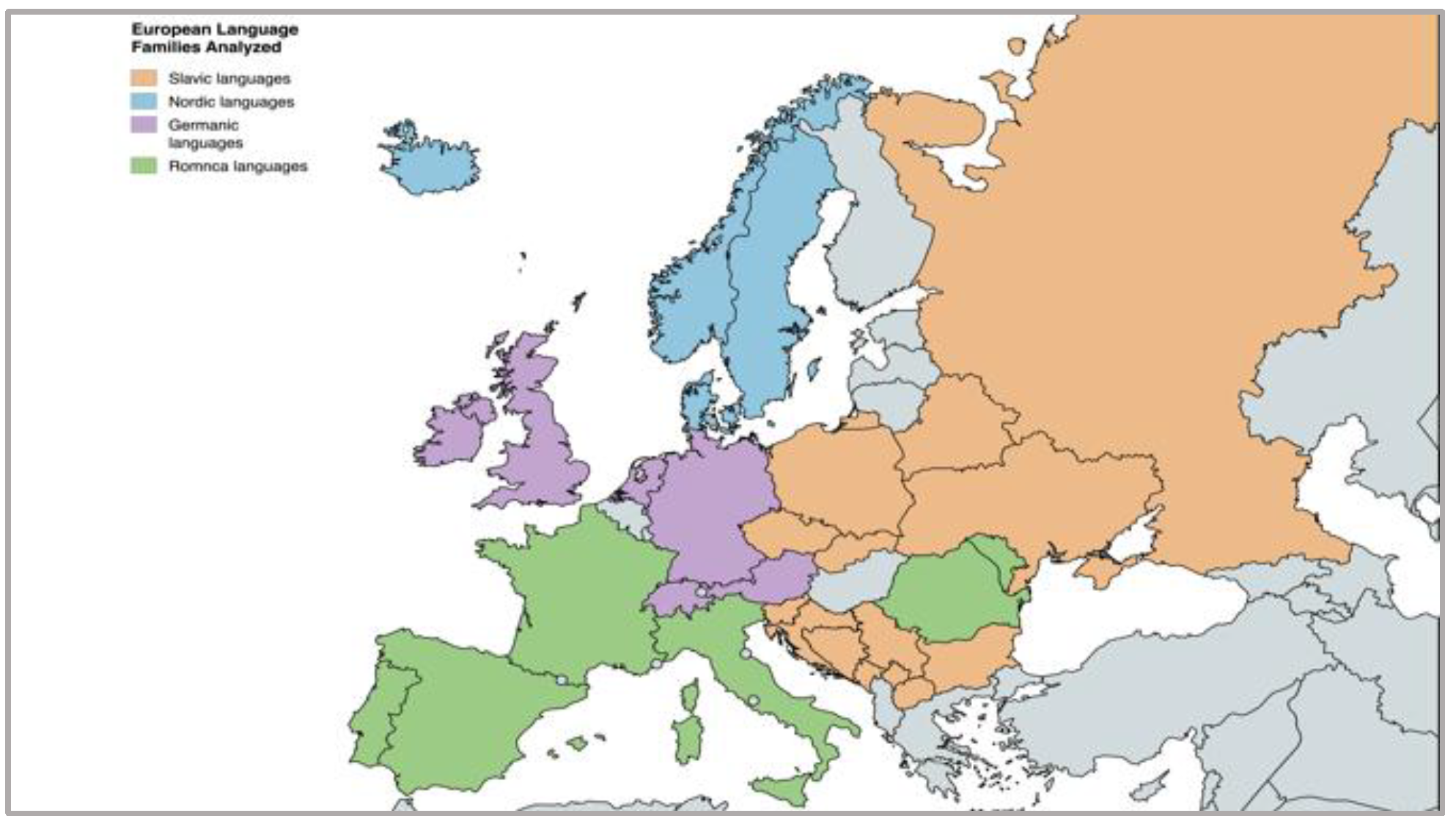
Figure 2.
Comparative semantic and morphological adaptations of the football term „Penalty” across Germanic, Romance, Nordic, and Slavic languages, exemplifying translation challenges and linguistic strategies for maintaining semantic precision and cultural relevance.
Figure 2.
Comparative semantic and morphological adaptations of the football term „Penalty” across Germanic, Romance, Nordic, and Slavic languages, exemplifying translation challenges and linguistic strategies for maintaining semantic precision and cultural relevance.
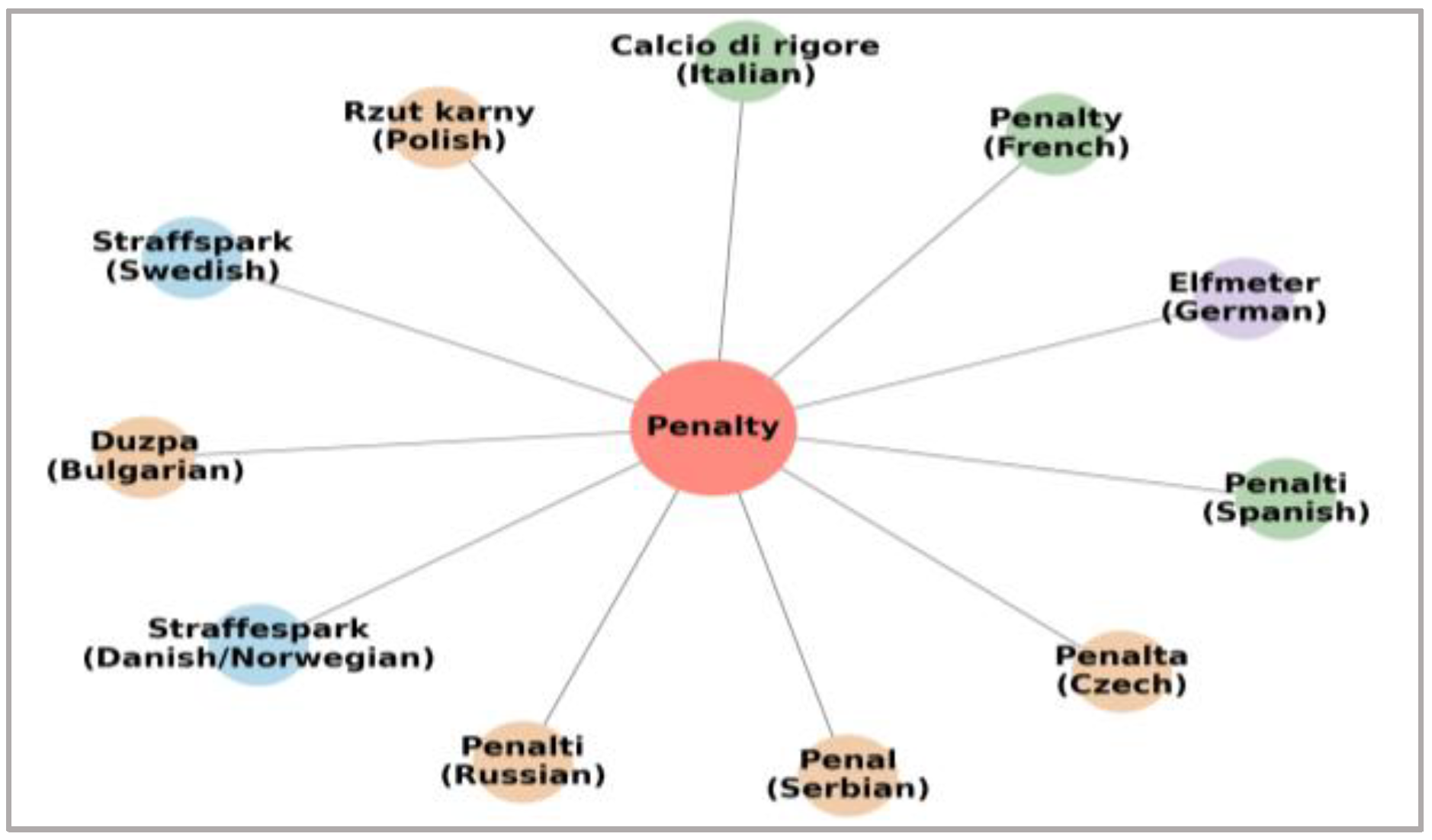
Figure 3.
Methodological workflow illustrating the key stages of the comparative analysis conducted on sports terminology across European languages, from corpus creation to expert validation and triangulation.
Figure 3.
Methodological workflow illustrating the key stages of the comparative analysis conducted on sports terminology across European languages, from corpus creation to expert validation and triangulation.
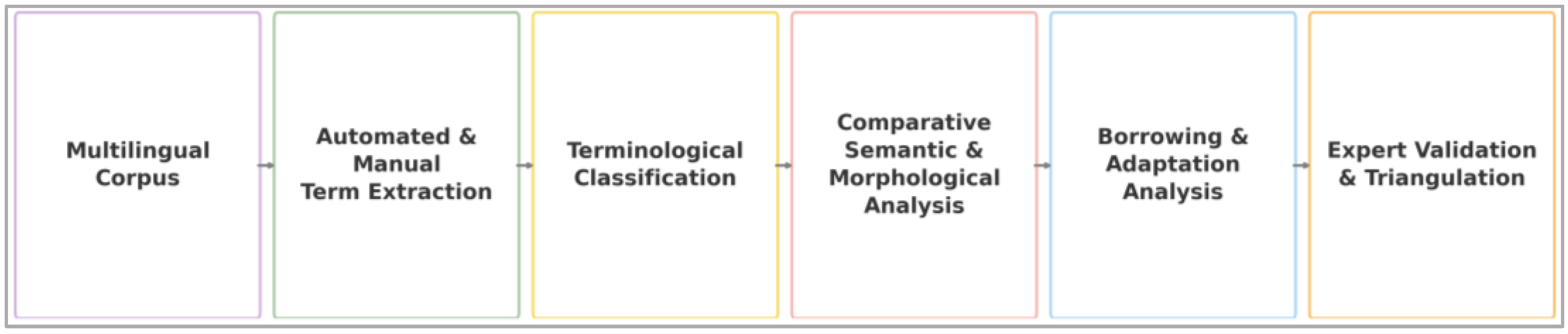
Figure 4.
Comparative distribution of borrowed versus adapted or native sports terminology across Germanic, Romance, Nordic, and Slavic language families. Higher proportions of borrowed terms in Germanic and Romance languages reflect extensive lexical influence from English, whereas Slavic languages show a stronger preference for maintaining adapted or native terminologies.
Figure 4.
Comparative distribution of borrowed versus adapted or native sports terminology across Germanic, Romance, Nordic, and Slavic language families. Higher proportions of borrowed terms in Germanic and Romance languages reflect extensive lexical influence from English, whereas Slavic languages show a stronger preference for maintaining adapted or native terminologies.
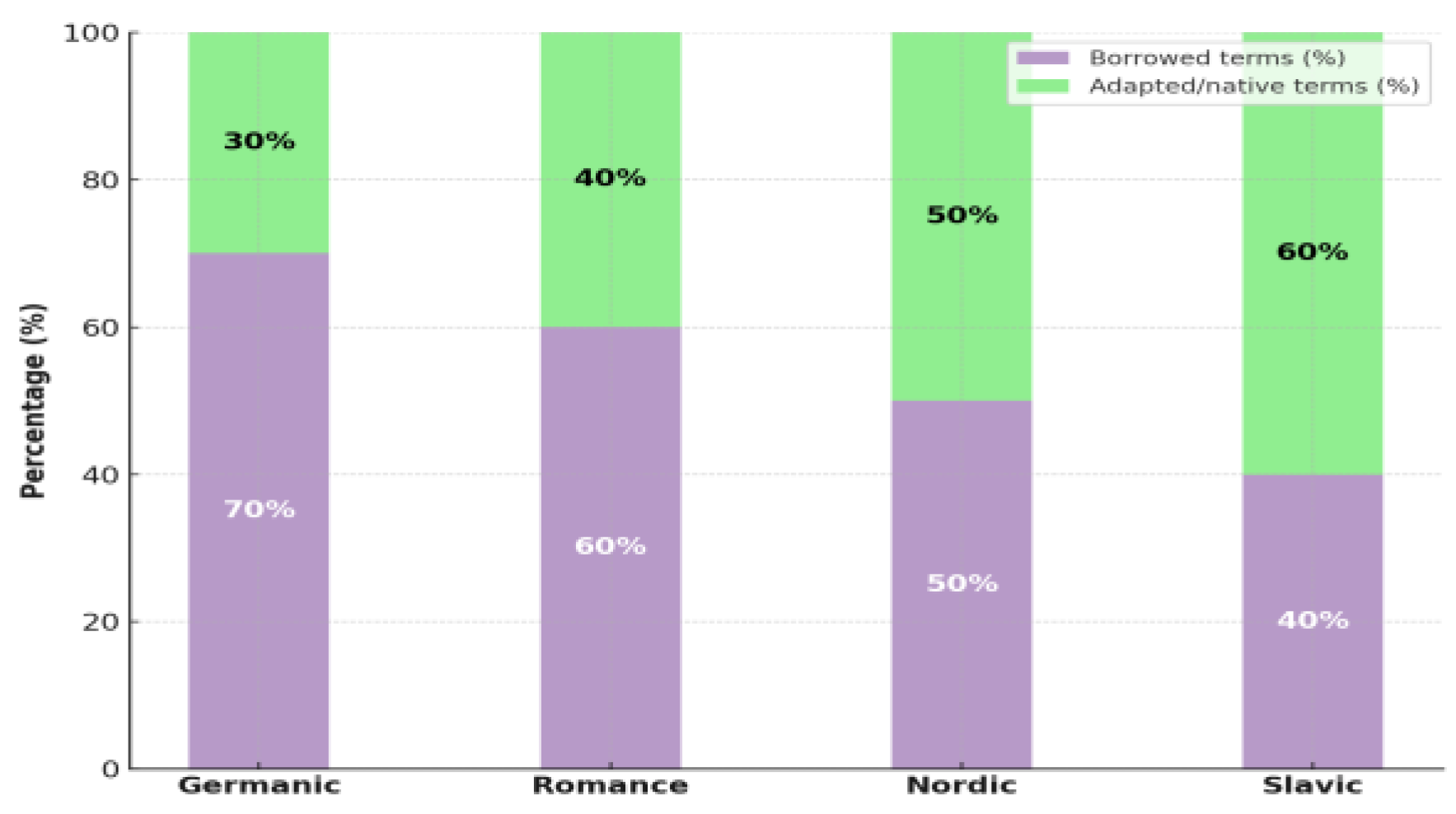
Figure 5.
Comparative radar chart showing the extent of lexical borrowing from English across Germanic, Romance, Nordic, and Slavic languages in five key sports domains. The visualization highlights notable linguistic patterns and differences, reflecting varying degrees of terminological adaptation and cultural openness among language families.
Figure 5.
Comparative radar chart showing the extent of lexical borrowing from English across Germanic, Romance, Nordic, and Slavic languages in five key sports domains. The visualization highlights notable linguistic patterns and differences, reflecting varying degrees of terminological adaptation and cultural openness among language families.
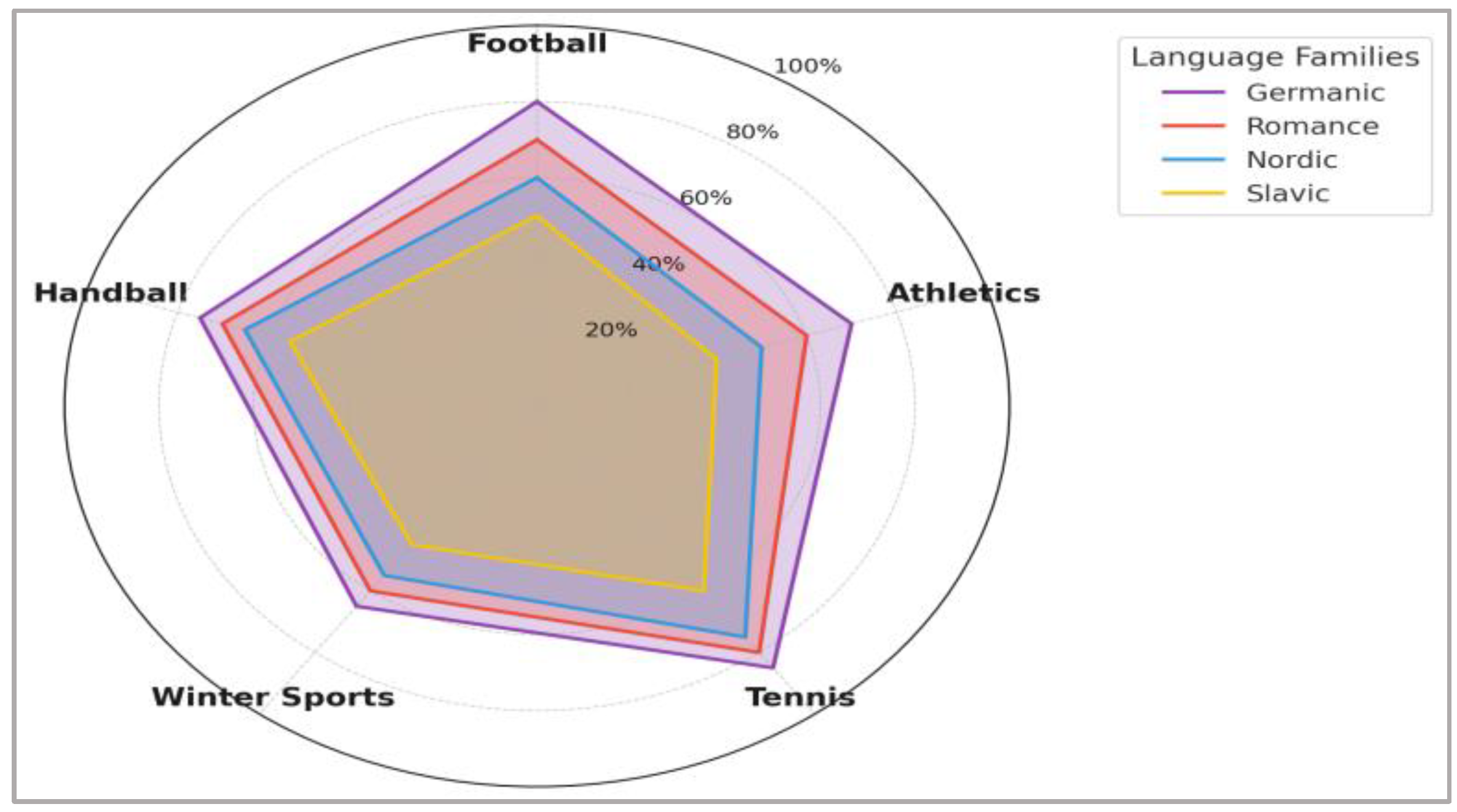
Table 1.
Overview of Corpus Sources.
| Corpus Source Type | Example Resources |
Languages Covered |
Purpose in Analysis |
|---|---|---|---|
| Terminological Dictionaries | Oxford Dictionary of Sports Science & Medicine, Larousse Dictionnaire des Sports, Бoльшoй спoртивный слoварь | English, French, German, Italian, Spanish, Russian, Polish, Czech, Serbian, Bulgarian | Standardized terminological reference |
| Digital Terminological Databases | IATE, Termium Plus, BabelNet |
Multilingual (all languages included) | Cross-linguistic terminological standardization |
| Official Sports Federation Documents | FIFA, UEFA, IAAF, FIS, ITF, IHF rulebooks and glossaries | English, German, French, Spanish, Italian, Russian | Official international standards |
| Authentic Textual Materials | Sports media articles, live-commentary transcripts, sports websites | All languages included | Real-life contextual usage |
Table 2.
Analytical Steps and Corresponding Methodological Tools.
| Analytical Step | Description | Tools / Techniques |
|---|---|---|
| Identification & Extraction | Systematic extraction of relevant sports terminology from corpus | Sketch Engine, AntConc, LancsBox, manual extraction |
| Terminological Classification | Lexical-semantic categorization of terms | Manual categorization, database software |
| Semantic and Morphological Analysis | Comparative analysis of semantic equivalence and morphological structures across languages | Comparative semantic mapping, linguistic annotation software |
| Borrowing and Loanword Dynamics Analysis | Detailed mapping and analysis of borrowed terminology | Lexical borrowing analysis, cross-linguistic tracing |
| Validation, Expert Consultation & Triangulation | Verification of terminological accuracy and validity through expert feedback and cross-referencing | Expert review panels, iterative feedback loops |
Disclaimer/Publisher’s Note: The statements, opinions and data contained in all publications are solely those of the individual author(s) and contributor(s) and not of MDPI and/or the editor(s). MDPI and/or the editor(s) disclaim responsibility for any injury to people or property resulting from any ideas, methods, instructions or products referred to in the content. |
© 2025 by the authors. Licensee MDPI, Basel, Switzerland. This article is an open access article distributed under the terms and conditions of the Creative Commons Attribution (CC BY) license (http://creativecommons.org/licenses/by/4.0/).
Copyright: This open access article is published under a Creative Commons CC BY 4.0 license, which permit the free download, distribution, and reuse, provided that the author and preprint are cited in any reuse.


