

Submitted:
02 July 2025
Posted:
03 July 2025
You are already at the latest version
Abstract
The aim of this paper was to prevent the development of microorganisms in the refrigerated storage of tench by releasing allyl isothiocyanate (AITC) produced by black mustard seeds. Tench reared in an aquaculture center was sacrificed and the fillets were separated. Different amounts of defatted mustard seed (300, 400 and 500 mg) were added to hermetic polypropylene trays. Microbiological, sensory and gas chromatography with MS detection analysis were done. AITC release increased progressively until three days of storage, delaying the development of microorganisms. The tasting panel detected positive aromas at the beginning of the study, and these decrease and negative aromas appeared. Mustard seed treatment showed a higher positive aroma at the end of the storage. A total of 31 volatile compounds were detected and grouped into hydrocarbon, alcohol, benzenoid, isothiocyanate, ketone, acetate, aldehyde, and others. Butylated hydroxytoluene, an indicator of bacterial contamination, was the major aromatic compound found during storage. The release of AITC resulted in fewer organic compounds with negative aromas appearing during storage. PCA analysis allowed to classify the assays during storage according to their volatile profile. Thus, adding mustard seed to fish packaging could be a viable alternative to extending the product's shelf life and ensuring food safety.
Keywords:
Tinca tinca
; allyl isothiocyanate
; volatile organic compounds
; storage
; sensory analysis
1. Introduction
Fish is a very important food in the human diet since it is an excellent source of proteins, long unsaturated chains of omega-3 fatty acids, and vitamin D [1]. However, due to a growing consumer demand for the health benefits associated with their consumption, there is currently a depletion of marine water fish populations, making it necessary to promote the production of inland water fish from governments, as a role important in food security [2]. For all these reasons, one of the fastest growing productive sectors currently is aquaculture, mainly due to the application of new knowledge and technologies in intensive production [3]. Aquaculture contributes 49.2% in the total global fisheries production indented for human consumption [4]. In Europe, Spain, France, Italy and Greece are the main producers, representing almost 1.2% of total world aquaculture production [5].
The tench (Tinca tinca) is a freshwater fish species endemic from Europe [6], which is currently found in freshwater regions around the world, including temperate and tropical areas [7] due to its adaptability to environments with high temperatures and even limited availability of oxygen [8]. The tench is a fish rich in protein (17.7%) and poor in carbohydrates (3.3%) and fat (4.3%) with linoleic, oleic and palmitic acid, among others, minerals (potassium, phosphorus, sodium, calcium, magnesium, and iron) and vitamins (A, niacin, C, riboflavin, and thiamine) [9]. The live in lentic or slow-flowing waters plays an important role in the environment as it prevents the proliferation of algae and recirculates minerals and nutrients that are deposited at the bottom of lakes and streams in search of food, which helps reduce eutrophication. In several European countries, tench have been bred in agricultural ponds, as ornamental fish and for recreational purposes. However, although tench has great potential for aquaculture [10], its cultivation is mostly managed extensively, which makes it difficult to compete with other intensive crops. In the Iberian Peninsula, tench is raised in the channels of the Tajo and Guadiana. The southwest of Spain is the main extensive producer of tench due to the existence of the pasture, where the animals drink in ponds and these are repopulated with tench due to its high adaptability. The use of intensive or semi-intensive environmentally friendly technologies, and tench products valorisation could greatly increase consumer demand for this species [11].
In general, fish and its products are highly perishable foods owing to the easy growth of spoilage microorganisms and their limited shelf life [12]. For fresh marketing, traditional methods such as refrigeration at low temperature have been used. Other more recent methods such as the use of antimicrobial chemical agents can be used to improve stability, quality, and shelf life, as well as reduce the microbial load, and associated economic losses [13]. However, adverse effects of these chemical preservatives, such as allergenicity and carcinogenicity, on human health have been confirmed [13]. Therefore, natural alternatives for fish conservation replace the use of synthetic chemical additives [14]. In this sense, the allyl isothiocyanate (AITC) generated from the hydrolysis, by the myrosinase enzyme, of glucosinolate compounds [15] present in plants belonging to the Cruciferae family, including black mustard (Brassica nigra) [16], shows strong antimicrobial and antifungal activity [17]. Furthermore, the Regulation CE 872/2012 support the release of AITC in food preservation as an authorized GRAS (Generally Recognised As Safe) due to the harmlessness of this substance and its strong activity in the gas phase. In fact, other authors have already demonstrated the inhibitory effect of AITC, and the increase in the shelf life of fish fillets [18,19].
Therefore, the aim of this paper was to prevent the development of indicator microorganisms in tench by releasing AITC produced by mustard seeds, during the storage time of this product at refrigerate temperature. Microbiological, sensory and gas chromatography with MS detection analysis were used to validate the results and PCA analysis was used to discriminate between the aromatic profile of fresh and unfresh tench.
2. Materials and Methods
2.1. Raw Material
The raw material was taken at the Las Vegas del Guadiana Aquaculture Center located in Villafranco del Guadiana (Badajoz, Spain). Tench had been reared for two years in 1500 m2 earthen bottom ponds at the aquaculture center. At the end of this period, 62 tench (Tinca tinca) were submitted to a depuration pond with a clean water for 24 h.
2.2. Experimental Design
After the tench were harvested, fish were previously stunned by immersion in ice-water slurry. Next, the fish were killed by a blunt blow to the head [20]. The total average weight of the fish was 91.5±15.5 g. After sacrificed, the fish were gutted, and the skins of the tench were removed. Loins were separated from each skinned tench and placed into polypropylene tray (4 units per trays).
Four different assays were carried out to find out the antimicrobial effect of AITC release: i) C: tench without mustard seeds; ii) T1: tench with the presence of 300 mg of mustard seeds; iii) T2: tench with the presence of 400 mg of mustard seeds, and vi) T3: tench with the presence of 500 mg of mustard seeds. The mustard seeds (Merck KGaA, Germany) were previously defatted by Soxhlet system with hexane dissolvent. After that, the seeds were ground and placed in a substance weighing pan inside of each trays studied. These trays were closed with 40 mm anti-fog film using a heat-sealing machine (Profi-3, ORVED, Spain). The trays from the different assays done were subsequently stored at 4 ± 0.5 ºC placed in the pilot plant facilities. The microbiological, sensory analysis, and volatile compounds measurements per treatment were carried out at 0-day (Day 0), and after four (Day 4), twelve (Day 12), and eighteen (Day 18) days of refrigerated storage. The experiments were performed in triplicate.
2.3. Analyses
2.3.1. Microbiological Analysis
For microbiological analysis, 10 g fish fillets were transferred aseptically in a stomacher bag (VMR Blender bag, lateral filter, AVANTAR), containing 90 mL of peptone water (OXOID, CM0009). Serial 10-fold dilutions were prepared with the same diluent, and duplicate 0,1 mL portions of the appropriate dilutions were spread on the following media: Plate count agar (VWR Chemicals) for the enumeration of mesophilic aerobic microorganisms, incubated at 30 °C for 3d and Violet Red Bile agar (OXOID, CM 0107) for coliforms covering the solidified agar with 5 mL of medium, incubated at 37 °C for 2 days. In this agar, colonies can be round, purple-pink may be surrounded by purple haloes being lactose-positive organisms or pale with greenish haloes in lactose-negative organisms. Colonies are enumerated on the surface of the membrane. Total microbial count per ml of sample is calculated by multiplying the average number of colonies per membrane by the inverse dilution factor.
2.3.2. Sensory Analysis
A sensory panel with trained tasters belonging to CICYTEX research center (Extremadura, Spain) carried out evaluations to analyze the aromatic profile of the tench fillets subjected to the different experimental assays. The sensory evaluation was carried out in standard tasting booths located at the CICYTEX facilities. The cooling trays corresponding to each experiment were removed, opened, and presented to each taster at room temperature for sensory evaluation. All tasters evaluated the olfactory profile on the same samples. The aromatic intensity of the attributed assessed (fresh fish, rotten fish, river, sulphur, ammonia, pungent odour) was filled on a tasting sheet with an unstructured scale of 10 cm (0: non detected to 10: highest intensity) for each attribute [21]. The intensity of olfactory attributes was evaluated for each treatment and sampling date. The results of the sensory analysis were expressed as median values for each attribute. The results were considered valid when CV (coefficient of variation) < 20%. The tasters were informed of the analysis assay through a structured document prior to the tasting evaluation to accomplish with the Ethics Committee for research involving human beings.
2.3.3. Volatile Organic Compound Identification
Volatile organic compounds of samples were analyzed using solid phase microextraction (SPME). A quantity of 2 g of the sample was weighed into 5 ml capacity vials. A fused silica SPME covered with polydimethylsiloxane/divinylbenzene (PDMS/DVB) StableFlex fiber (65 μm, Supelco) was used. The fiber was manually introduced into the hole of the lid of the glass jar that was stored at 25 °C for 30 min for headspace removal. Subsequently, the fiber was introduced into the injection port of the Bruker Scion 456-GC triple quadrupole gas chromatograph equipped with a capillary column (DB WAXETR, 60 m x 0.25 mm inner diameter x 0.25 μm) [22] at 250 ºC for 40 min to desorb the compounds into the equipment. The compounds were identified by comparison of their mass spectra and linear retention indexes (LRI) with standards (Sigma-Aldrich, USA), mass spectra included in the NIST standard reference database and/or LRI reported in the literature (Linstrom and Mallard, 2021). Finally, an internal standard (2-octanol) was used to quantify the detected compounds. The volatiles were expressed in μg g-1.
2.3.4. Allyl-Isothiocyanate Quantification
The released of AITC from 300, 400, and 500 mg of mustard seeds introduced into the trays with tench samples was studied. For it, samples were taken by solid phase microextraction (SPME) [23] for 17 days and continuously analyzed using an Agilent CP3800-GC ion trap (Saturn 2200, Varian) gas chromatograph equipped with a capillary column (HP-FFAP, 30 m x 0.25 mm inner diameter x 0.25 μm). Prior analysis, an AITC calibration curve was recorded by depositing known amounts of AITC (Merck, Germany) into the airtight trays and analyzed in the same way as the samples. All experiments were performed in triplicate.
2.3. Statistical Analysis
A one-way ANOVA was used to find statistically significant differences between each treatment on each sampling date. Normality was checked prior to ANOVA analysis by applying the Shapiro-Wilk test, and homoscedasticity was checked using the Levene test. For multiple comparisons, Tukey’s post hoc test was used when data showed normal distribution and homoscedasticity. A Kruskal Wallis test by ranks was performed when data did not present a normal distribution, and a Welch ANOVA test followed by a Games-Howell post-hoc test was performed when variances were not equal, both, at a probability level (p < 0.05). These analyses were accomplished using the XLSTAT-Pro 201,610 (Addinsoft 2009, París, France) statistical software package.
On the other hand, the same statistical package was used to perform a Principal Component Analysis (PCA) to discriminate the samples based on the volatile olfactory profile.
3. Results and Discussion
3.1. Evaluation of the Antimicrobial Activity of AITC
Due to fish is a highly perishable food that is very prone to microbial deterioration [24], the evaluation of antimicrobial efficacy of AITC against aerobic mesophilic microorganisms (AMMs), and total coliform microorganisms (TCMs) in tench fillets refrigerated were done (Figure 1A and 1B). The initial count of AMMs (Day 0) in control tench samples was less than 4 log CFU/g (Figure 1A), which is satisfactory for acceptable quality tench meat [25]. On the next sampling date (Day 4), tench subjected to T2 and T3 treatments (containing 400 and 500 mg of defatted mustard seeds, respectively) showed AMMs counts of 2.66±0.69 and 2.17±1.88 log CFU/g, respectively, lower than C (3.26±0.69 log CFU/g) and T1 (3.38±0.69 log CFU/g) treatments, although statistics showed no difference between treatments (p > 0.05). However, on Day 12 there is an increase in AMMs counts, although the T3 treatment showed the lowest content with respect to C treatment (p < 0.05). This indicates that the higher mustard seed content added to the containers was able to reduce the development of AMMs up to 12 days of storage. The highest microbial load was found at the end of storage (Day 18), although we can note that T2 and T3 treatments showed significantly lower contents than C treatment (p < 0.05). During storage, the autolysis process promoted by proteolytic and lipolytic enzymes, which hydrolyze fish proteins and lipids [26] can produce free peptides and amino acids, promoting microbial growth and the production of biogenic amines. The rate of degradation depends on the species and storage conditions [27]. Although bacteria increased gradually in untreated and treated samples, the tench with AITC maintained microbial populations at a significantly lower level during storage compared with C treatment. Thus, the combined used of low temperatures (2 °C) and AITC release from seed can be an effective preservation alternative that prolongs the quality and safety of stored fish. The antimicrobial effect of AITC has also been demonstrated in other foods such as chicken meat where it resulted in some inhibition of aerobic mesophilic counts such as Listeria monocytogenes, Salmonella Typhimurium and Pseudomonas lundensis [28]. In fact, four times the minimum inhibitory concentration of AITC provoked a reduction of 2.3 log L. monocytogenes compared to the inoculated C treatment [29]. Furthermore, 1000 ppm of AITC reduced the growth of Staphylococcus aureus and Bacillus cereus and resulted in a reduction of 3 log CFU/g in AMMs [30]. In the case of TCMs (Figure 1B), the initial content was 2.69 CFU/g (Day 0). The lowest count of TCMs occurs on Day 4 in samples treated with different concentration of AITC. Thus, T1, T2, and T3 treatments showed significantly lower values (2.31±0.12, 1.34±1.27 and 1.13±0.98 log CFU/g of TCMs, respectively), than C treatment (3.19±0.05 log CFU/g) (p < 0.05). At the end of storage (Day 18), all treatments with AITC showed a significantly lower content of TCMs compared to C, although significant differences were only found in T3 treatment compared to C (p < 0.05). Thus, the maximum reduction was 4.50 log CFU/g in T3 compared with C. This could be since they contain the highest amount of AITC released from mustard seed. The data indicated that AITC showed a higher inhibitory effect against TCMs and lower inhibitory effect against AMMs. The reduction of these microorganisms during the storage guarantees microbiological shelf-life extensions.
The inhibitory effect of AITC has been evaluated against TCMs in sausage batters (17.6% beef, 60.7% pork and 17.6% lard) stored at 13 °C for 25 days. AITC at 750 and 1000 ppm was able to reduce the number of Escherichia coli O157 by 6.5 log CFU/g after processing for 21 and 16 days [31]. In other study, using AITC with high-pressure processing in raw ground chicken meat, a reduction of 5 log was observed in Salmonella survivals submitted to conservation treatment at 350 MPa for 4 min combined with 0.05% AITC in the packaging [32]. In fish, fillets of Gilthead Sea Bream (Sparus aurata) treated with 3.35 and 6.70 mg/l of AITC had lower counts of sulphite non-producing bacteria (6.55±0.12 and 6.04±0.05 log CFU/g, respectively) after 14 days of storage than the C sample (8.00±0.05 log CFU/g). In the case of sulphite-producing bacteria, with the addition of AITC, the bacteria load never exceeded 3.5 log CFU/g until the end of storage [18]. The major effectiveness of AITC was observed on the growth of sulphite-producing bacteria that represent the predominant microbial spoilage gracing in fish stored under refrigerated conditions [33].
3.2. Allyl-Isothiocyanate Released from Mustard Seeds
The concentration of AITC released on the different sampling dates is showed in Figure 2. The identification and quantification of this compound was done independently of the other tench aromatic organic compounds present in the polypropylene trays. As can be seen in the Figure 2, the release of AITC occurs at the beginning of the study since the moisture in the fish activates the seed immediately. From this date on, AITC release progressively increased, reaching the maximum amount of this compound after three days of storage in all treatments studied. From this point on, AITC content progressively decreased until the end of the study. The treatments that showed the highest concentrations of AITC were T2 and T3 containing 400 and 500 mg of mustard seed, respectively. At the beginning of the study, AITC values were more widely separated; however, at the day 5 of storage, the contents were quite similar. From day 10 of storage onward, no substantial differences were seen between the different treatments studied. These results agree with those found by Barea-Ramos et al. [34] for AITC released from mustard seeds in airtight containers with tomato samples, who obtained a maximum value of AITC at three days of storage. In this sense, when comparing the maximum AITC concentrations obtained, we observed that this value coincides with the lowest microbial counts (Figure 1). Thus, the maximum amount of AITC release was able to reduces the microbial load (due to its fungicidal or bactericidal effect) on Day 4. Other researchers have been studied the effectiveness of regulation of certain microorganism such as A. flavus in Brazil nuts [35] or Aspergillus parasiticus in sliced bread [36] at a concentration of AITC ranged between 0.8 to 5 ppm.
3.3. Sensory Aroma of Tench During Storage Time
Organoleptic evaluation is a very important tool in assessing the freshness of farmed fish [37]. Thus, a descriptive olfactory sensory analysis was carried out on the tench samples to establish differences between the treatments tested on the different sampling dates (Table 1). Aromas related to the fish freshness (fresh fish), rearing ponds (river), microbiological spoilage (rotten fish, sulphur, and ammonium), and AITC preservative (sulphur and pungent) included in treatments T1, T2, and T3 were evaluated. The maximum aromatic intensity for fresh fish packaging at the beginning of the storage (Day 0) was 7.4. Also, the river odour was identified by the tasters (6.2). However, the other odours resulting from degradation were not detected at Day 0. As is well known, odour is considered one of the most significant characteristics of volatile compounds, which can be used to assess the fish freshness [38]. From the following sampling date (Day 4, 12, and 18), the different treatments were compared to evaluate the effect of the different concentrations of AITC release by mustard seed. Thus, in Day 4 the fresh fish and river aromas were equal between treatments (p < 0.05), and slightly lower than Day 0. After 12 days of storage (Day 12), C treatment retained the fresh fish odour compared to Day 4 (p > 0.05), however the fresh odour was lower compared to Day 0. In T1, T2, and T3 treatments there was a loss of fresh fish odour compared to Day 4 (p < 0.05). However, when comparing freshness between treatments no differences were found by Day 12 (p > 0.05). Likewise, the river odour remained constant in all treatments compared to Day 4 (p > 0.05). However, for the same sampling date (Day 12), the treatments containing higher amounts of AITC (T2 and T3) showed a lower river odour than the C treatment (p < 0.05). Other aromas corresponding to microbiological spoilage of fish (rotten and ammonia) or derived from AITC (sulphur and pungent) were not detected on Day 4 and 12. At the end of storage (Day 18) a loss of fresh fish odour was observed in the control and T1 treatments (p < 0.05), however T2 and T3 treatments maintained the fresh odour compared to day 12 (p > 0.05). This is consistent with a lower total coliform microorganism (Figure 1B) in the treatments containing more mustard seed. On the other hand, rotten fish odour was detected in all treatments at the end of storage, with no significant differences between treatments (p > 0.05). River odour was slightly lower at Day 18 compared to other sampling dates for the control treatment (p < 0.05), probably due to the appearance of other negative odours such as rotten fish. However, no differences were found for T1, T2, and T3 treatments compared to the other sampling dates (p > 0.05). An ammonia odour from microbial spoilage was detected only at the end of storage in C treatment and was not detected in the treatments including mustard seed. However, the characteristic pungent odour of AITC was found at the end of storage although without differences between treatments (p > 0.05). As just shown, initially, the fish evaluated by tasting panel is characterised by high freshness which is gradually lost through autolytic reactions and bacterial spoilage [39], resulting in an unpleasant odour with the production of ammonia and sulphuric chemicals [40]. Muscolino et al. [18] evaluated sensory attributes in sea bream fillets packaging with and without addition of AITC showing results like those found in our work. These authors demonstrated that the addition of AITC did not affect the natural odour of the fish. A higher concentration of AITC showed a marked AITC odor in the fish, but a few seconds after opening the package, the odor disappeared.
3.4. Volatile Compound Aroma of Tench During Storage Time
Flavors of freshwater fish, such as earthy/muddy, fishy, and grassy, come from multiple sources [41]. Therefore, the analysis of volatile compounds is a useful tool to determine the freshness status or spoilage of fish. A total of 31 volatile compounds were detected in the samples at different storage date (Table 2). The compounds were divided into 8 types of functional groups including hydrocarbon, alcohol, benzenoid, isothiocyanate, ketone, acetate, aldehyde, and other compounds. Most of these volatile compounds have been previously detected in other fish species [42]. In the same line, different researchers have been indicated that volatile compound that contribute to fish odor can be generally divided into three groups: 1) that of fresh fish odour, mainly related to C6-C9 alcohols and carbonyl compounds, although the existence of fish odour could reduce acceptability; 2) volatile compounds related to microbial spoilage, mainly ammonia, trimethylamine, hydrogen sulfide, and methylmercaptan; 3) lipid oxidation odour, mainly related to hexaldehyde and 2, 4, 7-decatrienal [38].
In the fresh unpackaged samples (Day 0), hydrocarbons, alcohols, and benzenoids were the predominant group compounds (74.3, 72.7, and 28.6 μg g-1 of the total volatile compounds, respectively). Aldehydes were also found in smaller concentration (20.7 μg/g), although they represent a significant fraction due to their low detection thresholds [43]. Benzenoid compounds, including benzene, toluene, and derived compounds, are generally produced by lipid oxidation, catabolism of aromatic amino acids, such as tryptophan, phenyl alanine and tyrosine [44], or brought by the environment, which may cause an unpleasant odour [45]. However, benzenoid compounds may also be related to floral, paint, and mothball odours [41,46]. In our study, the relatively high amount of benzenoid compounds might be partly attributed to the local pond culture conditions of the tench [46]. Furthermore, ten aromatic compounds, some of which are present in other aquatic products such as silver carp [46], have been found. Among all detected compounds, the toluene derivative butylated hydroxytoluene (BHT) was the major aromatic compound found during storage. Zhang et al. [47] reported an increase of BHT in farmed sturgeon (Acipenser baerii) fillets inoculated with Shewanella putrefaciens. The presence of this compound may be an indicator of bacterial contamination. It can be observed that a high significant proportion of BHT in C treatment at Day 12 and Day 18 of storage, with respect to the treatments including mustard seed (T1, T2, and T3). On Day 12, the proportion of BHT decreases significantly with increasing amount of mustard seeds, indicating that the AITC generated in the container has retarded the development of microorganisms. This agrees with the TCMs (Figure 1B) performed on the samples on Day 12, where coliform counts were lower for T1, T2, and T3 treatments, with T3 being significantly lower. On Day 18, T3 treatment showed the lowest BHT content, with clear differences between T1 and T2 treatments. Other benzenoid compounds like ethylbenzene, p-xylene, and o-xylene, present in our study in small proportions, were also detected in other fish species (Coilia ectenes) [48]. 1,3-dimethyl benzene was detected after 12 days of storage with no differences between treatments. Thus, the effect of microbial activity and endogenous enzyme decomposition of endogenous enzymes can generate volatile compounds related to nitrogen, amines, ammonia, alcohols, sulfur-containing compounds, and others [37].
On the other hand, hydrocarbon compounds were found in a high proportion at the beginning of the study. These compounds may be related to a positive aroma derived from the oxidation and degradation of fatty acids [49]. 3-Methyl-hexane was the principal hydrocarbon compound detected and presented the highest concentration in the C treatment (Day 0). T1 treatment (Day 4) also showed a high amount of this compound, however, it was not found in the rest of the treatments (T2 and T3) during storage.
Volatile compounds derived from alcohols such as 3-methyl-1-butanol and 1-octen-3-ol have also been proposed as indicators for bacterial species. Thus, Zhang et al. [47] reported that the spoilage characteristics of Pseudomonas mandelii could be related to unsaturated alcohols, which considers to be derived from the oxidation of unsaturated fatty acids. Similarly, other studies used 1-octen-3-ol and (z)-2-penten-1-ol as the potential markers for spoilage of other aquatic products [50]. In our study, these compounds were detected in trace amounts at the end of storage, except for 3-methyl-1-butanol which gives the fish a fermented or rancid characteristics [51], which was found in significant concentration (64.6 μg/g) in C treatment at the end of storage. Other alcoholic compounds detected in higher concentration in C treatment were 2-ethyl-1-hexanol, and 2,6-bis(1,1-dimethylethyl)-4-(1-oxopropyl) phenol that are responsible for the off-odors in the water and fish [52]. Therefore, these changes in the alcoholic compounds were generally associated with a gradual deterioration in the flavor of the fish, manifesting as increased staleness, spoilage, or off-flavors.
On the other hand, aldehydes are very important compounds in fish odor due to their low detection thresholds. Several authors identified nonanal, among others, as contributors to the fishy odors in fish products [43,53]. Likewise, Zhou et al. [41] found nonanal as well as benzaldehyde and benzaldehyde derivatives, among others, in white meat of silver carp. In our study, 2,5-bis[(trimethylsilyl)oxy] benzaldehyde (bitter and almond odor description) [54] was the main aldehyde compound found, followed by nonanal (green odor description) [54]. C treatments showed a lower total aldehyde content compared to the rest of treatments during storage. Similarly, Zhang et al. [47] found a decrease of most of the aldehydes in all spoiled samples of farmed sturgeon fillets compared with the control.
Other compounds belonging to the ketone family appeared after 12 days of storage. These compounds do not contribute significantly to the fishy odor owing to their high odor thresholds [54]. The major ketone compound found was 2-dodecanone, which was present in a high proportion in C treatments that provides a woody smell [55]. 2-heptanone, related to a moldy aroma [56], appeared in the small proportion in T1, T2, and T3 treatments.
On the other hand, sulfur-containing compounds could induce a foul sulfurous odour characteristic of fish flesh [57]. In our study, dimethyl trisulphide was found at the end of storage (C1, Day 18) probably originating from sulphur-containing amino acids. However, the main sulphur compound present in this study was allyl isothiocyanate (T1, T2, and T3 treatment), originating from the hydrolysis of sinigrin glucosinolate present in mustard seed. The highest concentrations of this substance were observed on Day 4. From this point on, the concentration progressively decreases during storage. The higher the concentration of seed added to the container with the tench, the higher the AITC content. This demonstrates that the release of this substance occurs exponentially at the beginning of seed activation, at which point the release progressively decreases. Finally, the volatile limonene is responsible for positive citrus aroma and his presence was at the beginning of the study (Day 0). This molecule is no longer present, or its concentration decreases during storage time, being detected only at T3 Day 18.
All these results validated the sensory evaluation described in section 3.4, where a loss of fresh fish odour and the appearance of rotten fish odour at the end of storage were observed.
3.5. Principal Component Analysis (PCA)
To assess the differences in the volatile profile during storage, a principal component analysis (PCA) was carried out at different sampling dates (4, 12, and 18 days) to reduce the number of dimensions to two principal components, which were plotted graphically based on the treatments applied (Figure 3). The results showed that the volatile compounds analysed were able to differentiate the samples according to the specific treatment on each sample date during the storage time. The two components explained 82.5 – 90.6% of the total variance. The various classification groups of the samples are shown in the different quadrants from left to right. After four days of tench storage in refrigeration chambers, the C treatment was completely separated from treatments T1, T2, and T3. Furthermore, treatments with the highest amount of AITC (T2 and T3) showed very close clusters and separated from T1 treatment. This indicates that T2 and T3 treatments presented similar volatile profiles after four days of storage, with differences with respect to T1, and in turn, T1 was different from C. As expected, this analysis was able to establish differences between treatments, however, the sensory analysis showed no differences on the fourth day between treatments in the different attributes evaluated. On the second sampling date (day 12), the aromatic profile again clearly separated treatment C from T1, T2, and T3 treatments, and in addition, T2 and T3 treatments were separated from each other with respect to day 4 of storage. Although the groups were separated from each other on the third sampling date (Day 18), T1 and T2 treatments were closer to each other, and separated from T3. This is consistent with a lower content of benzenoid compounds such as BHT produced by bacterial [47], alcoholic compounds indicative of fish odour [52] and ketone compounds associated with the development of fish spoiled odour [56], in T3 treatment. In addition, only the volatile limonene was found to be responsible for positive odours in T3. All this suggests that the high concentration of AITC in the T3 treatment controlled the microorganisms development and the discrimination of this group.
This classification obtained by PCA analysis indicates that the samples had different characteristic aromatic profiles that allowed their classification. Other authors have already used a combination of headspace gas chromatography technology and principal component analysis to evaluate changes of volatile flavour compounds in large yellow croaker (Larimichthys crocea) during storage [57]. More recently, Bi et al. [56] elucidated changes in the volatile profile by PCA analysis of norther pike (Esox lucius) during refrigeration.
4. Conclusions
Microbial growth during storage was significantly reduced in samples with higher mustard seed contents, which had caused the release of high concentrations of AITC from the start of the study. The results of the sensory evaluation indicate that the AITC generated in the packages was able to control microbial growth by improving the perception of fresh odour and reducing rotten and ammonia odours. Volatile aromatic compounds are also indicators of microbial preservation or deterioration developed in the packaging after storage. Significant changes were observed in the volatile organic compounds present in the tench samples during storage for periods of up to 18 days. PCA analysis corroborated the differences observed in the volatile profile between treatments during storage and allowed their classification. Thus, adding defatted mustard seed to fish packaging could be a viable alternative to extending the product’s shelf life and ensuring food safety due to the reduction in some microorganisms.
Author Contributions
Rodríguez Gómez, M.J.: Investigation, Methodology, Validation, Writing-Original Draft, Writing-Review & Editing; Project administration; Alejo Martínez, M.: Investigation, Methodology, Validation; Manzano Durán, R.: Methodology, Validation; Martín-Vertedor, D.: Methodology, Validation, Writing-Original Draft. Calvo Magro, P.: Conceptualization, Investigation, Methodology, Supervision, Validation, Writing-Original Draft, Writing-Review & Editing, Funding acquisition.
Funding
This work was supported by the European FEDER Fund and Junta de Extremadura (TENCAEX II (Expte Nº: 2522999FP001) and the GR21193 (AGA002)).
Institutional Review Board Statement
This study was carried out under the 148b/2020 authorization of the project “Comparative study of the growth and other biometric aspects and susceptibility to parasites in mixed and monosex culture of tench”.
Informed Consent Statement
Informed consent was obtained from all subjects (tasters) involved in the study.
Data Availability Statement
The original contributions presented in the study are included in the article; futher inquiries can be directed to the corresponding author.
Acknowledgments
The authors are grateful for the technical support of the TENCAEX II project staff, specially to Cesar J. Fallola Sánchez-Herrera and Juan Carlos Ramírez López from Aquaculture Centre of Vegas del Guadiana.
Conflicts of Interest
The authors declare no conflicts of interest.
Abbreviations
The following abbreviations are used in this manuscript:
| AITC | Allyl Isothiocyanate |
| AMMS | Aerobic Mesophilic Microorganisms |
| BHT | Butylated Hydroxytoluene |
| PCA | Principal Component Analysis |
| TCMs | Total Coliform Microorganisms |
References
- Cantillo, J.; Martín, J.; Román, C. Determinants of fishery and aquaculture products consumption at home in the EU28. Food Qual. Prefer. 2021, 88, 104085. [Google Scholar] [CrossRef]
- Cooke, S.J.; Allison, E.H.; Beard, T.D.; Arlinghaus, R.; Arthington, A.H.; Bartley, D.M.; Cowx, I.G.; Fuentevilla, C.; Leonard, N.J.; Lorenzen, K.; Lynch, A.J.; Nguyen, V.M.; Young, S-J.; Taylor, W.W. On the sustainability of inland fisheries: finding a future for the forgotten. Ambio 2016, 45, 753–764. [Google Scholar] [CrossRef] [PubMed]
- Nielsen, R.; Guillen, J.; García, I.L.; Asche, F.; Garlock, T.; Kreiss, C. M…., Tveteras, R. An analysis of the European aquaculture industry using the aquaculture performance indicators. Aquac. Econ. Mgmt 2025, 29, 253–274. [Google Scholar] [CrossRef]
- FAO, 2022. The State of World Fisheries and Aquaculture. Rome, Italy. ISBN:978-92-5-136364-5.
- CFP, 2022. Common fisheries policy, European Commission. https://oceans-and-fisheries.ec.europa.eu/policy/common-fisheries-policy-cfp_en.
- Kottelat, M.; Freyhof, J. Handbook of European freshwater fishes 2007. ISBN 978-2-8399-0298-4.
- Karaiskou, N.; Gkagkavouzis, K.; Minoudi, S.; Botskaris, D.; Markou, K.; Kalafatakis, S.; Antonopoulou, E.; Triantafyllidis, A. Genetic structure and divergence of Tinca tinca European populations. J. Fish Biol. 2020, 97, 10. [Google Scholar] [CrossRef]
- Al Fatle, F.A.; Meleg, E.E.; Sallai, Z.; Szabó, G.; Várkonyi, E.; Urbányi, B.; Kovács, B.; Molnár, T.; Lehoczky, I. Genetic structure and diversity of native tench (Tinca tinca L. 1758) populations in Hungary - Establishment of basic knowledge base for a breeding program. Diversity 2022, 14. [Google Scholar] [CrossRef]
- AESAN/BEDCA, 2010. Base de Datos Española de Composición de Alimentos. https://www.bedca.net/bdpub/.
- Kolek, L.; Inglot, M. Integrated cage-pond carp farming for increased aquaculture production. Fish. Aquat. Life 2023, 31, 87–94. [Google Scholar] [CrossRef]
- Rodríguez Gómez, M.J.; Barea-Ramos, J.D.; Ruiz-Canales, A.; Martín-Vertedor, D. A circular economy framework for Tinca tinca valorization for stuffed Spanish-style table olive. J. Food Compos. Anal. 2025, 142, 107486. [Google Scholar] [CrossRef]
- El-Ghareeb, W.R.; Elhelaly, A.E.; Abdallah, D.; El-Sherbiny, H.; Darwish, W. Formation of biogenic amines in fish: dietary intakes and health risk assessment. Food Sci. Nutr. 2021, 9, 3123–3129. [Google Scholar] [CrossRef]
- Delfino, L.; Mattie, L.; Silva, M.; Araujo, M.; Tormen, L.; Bainy, E. Evaluation of moringa and Lavandula extracts as natural antioxidants in tilapia fish burger. J. Culin. Sci. Technol. 2023, 21, 36–51. [Google Scholar] [CrossRef]
- Farnejad, S.; Nouri, M.; Safari, D.S. Obtaining of chickpea protein isolate and its application as coating enriched with essential oils from Satureja Hortensis and Satureja Mutica in egg at room temperature. Int. J. Food Sci. Technol. 2022, 57, 400–407. [Google Scholar] [CrossRef]
- Hansche, F.S.; Kühn, C.; Nickel, M.; Rohn, S.; Dekker, M. Leaching and degradation kinetics of glucosinolates during boiling of Brassica oleracea vegetables and the formation of their breakdown products. Food Chem. 2018, 15, 240–250. [Google Scholar] [CrossRef] [PubMed]
- Dai, R.; Lim, L.T. Release of allyl isothiocyanate from mustard seed meal powder. J. Food Sci. 2014, 79, 47–53. [Google Scholar] [CrossRef] [PubMed]
- Kurek, M.; Laridon, Y.; Torrieri, E.; Guillard, V.; Pant, A.; Stramm, C.; Gontard, N.; Guillaume, C. A mathematical model for tailoring antimicrobial packaging material containing encapsulated volatile compounds. IFSET 2017, 42, 64–72. [Google Scholar] [CrossRef]
- Muscolino, D.; Giarratana, F.; Beninati, C.; Ziino, G.; Giuffrida, A.; Panebianco, A. Effects of allyl isothiocyanate on the shelf-life of Gilthead Sea Bream (Sparus aurata) fillets. Czech J. Food Sci. 2016, 34, 160–165. [Google Scholar] [CrossRef]
- Böhme, K.; Fernández-No, I.C.; Barros-Velázquez, J.; Gallardo, J.M.; Calo-Mata, P.; Cañas, B. Species differentiation of seafood spoilage and pathogenic gram-negative bacteria by MALDI-TOF mass fingerprinting. J. Proteome Res. 2010, 9, 3169–3183. [Google Scholar] [CrossRef]
- Royal Decree 53/2013. Normas básicas aplicables para la protección de los animales utilizados en experimentación y otros fines científicos, incluyendo la docencia.
- Villanueva, N.D.M.; Petenate, A.J.; Silva, M.A.A.P. Performance of the hybrid hedonic scale as compared to the traditional hedonic, self-adjusting and ranking scales. Food Qual. Prefer. 2005, 16, 691–703. [Google Scholar] [CrossRef]
- Sánchez, R.; Martín-Tornero, E.; Lozano, J.; Boselli, E.; Arroyo, P.; Meléndez, F.; Martín-Vertedor, D. E-Nose discrimination of abnormal fermentations in Spanish-Style Green Olives. Molecules 2021, 26. [Google Scholar] [CrossRef]
- Morra, M.J.; Kirkegaard, J.A. Isothiocyanate release from soil-incorporated Brassica tissues. Soil Biol. Biochem. 2002, 34, 1683–1690. [Google Scholar] [CrossRef]
- Walayat, N.; Tang, W.; Wang, X.; Yi, M.; Guo, L.; Ding, Y.; Liu, J.; Ahmad, I.; Ranjha, M.M.A.N. Quality evaluation of frozen and chilled fish: a review. eFood 2023, 4. [Google Scholar] [CrossRef]
- Sousa, C. L.; Freitas, J. A.; Lourenço, L. F.; Araujo, E. A.; Joele, M. R. S. P. Microbiological contamination of surfaces in fish industry. Afr. J. Microbiol. Res. 2014, 8, 425–43. [Google Scholar]
- Bahurmiz, O.M.; Ahmad, R.; Ismail, N.; Adzitey, F.; Sulaiman, S.F. Antimicrobial activity of selected essential oils on Pseudomonas species associated with spoilage of fish with emphasis on cinnamon essential oil. J. Aquat. Food Prod. Technol. 2020, 29, 789–800. [Google Scholar] [CrossRef]
- Zhuang, S.; Hong, H.; Zhang, L.; Luo, Y. Spoilage-related microbiota in fish and crustaceans during storage: research progress and future trends. Compr. Rev. Food Sci. Food Saf. 2021, 20, 252–288. [Google Scholar] [CrossRef] [PubMed]
- Hussein, K.; Friedrich, L.; Dalmadi, I.; Kisko, G. Evaluation of In Vitro Antimicrobial Activity of Bioactive Compounds and the Effect of Allyl-Isothiocyanate on Chicken Meat Quality under Refrigerated Conditions. App. Sci. 2023, 13, 10953. [Google Scholar] [CrossRef]
- Olaimat, A. N.; Holley, R. A. Inhibition of Listeria monocytogenes on Cooked Cured Chicken Breasts by Acidified Coating Containing Allyl Isothiocyanate or Deodorized Oriental Mustard Extract. Food Microbiol. 2016, 57, 90–95. [Google Scholar] [CrossRef]
- Hussein, K.; Friedrich, L.; Kisko, G.; Ayari, E.; Nemeth, C.; Dalmadi, I. Use of allyl-Isothiocyanate and carvacrol to preserve fresh chicken meat during chilling storage. Czech J. Food Sci. 2019, 37, 417–424. [Google Scholar] [CrossRef]
- Chacon, P. A.; Muthukumarasamy, P.; Holley, R. A. Elimination of Escherichia coli O157:H7 from Fermented Dry Sausages at an Organoleptically Acceptable Level of Microencapsulated Allyl Isothiocyanate. Appl. Environ. Microbiol. 2006, 72, 3096–3102. [Google Scholar] [CrossRef]
- Chai, H. E.; Sheen, S. Effect of High-Pressure Processing Allyl Isothiocyanate, and Acetic Acid Stresses on Salmonella Survivals, Storage, and Appearance Color in Raw Ground Chicken Meat. Food Control 2021, 123, 1007784. [Google Scholar] [CrossRef]
- Giuffrida, A.; Valenti, D.; Giarratana, F.; Ziino, G.; Panebianco, A. A new approach to modelling the shelf-life of Gilthead seabream (Sparus aurata). Int. J. Food Sci. Technol. 2013, 48, 1235–1242. [Google Scholar] [CrossRef]
- Barea-Ramos, J.D.; Rodríguez, M.J.; Calvo, P.; Meléndez, F.; Lozano, J.; Martín-Vertedor, D. Inhibition of Botrytis cinerea in tomatoes by allyl-isothiocyanate release from black mustard (Brassica nigra) seeds and detection by E-nose. Food Chem. 2024, 432, 137222. [Google Scholar] [CrossRef]
- Lopes, L. F.; Bordin, K.; de Lara, G. H. C.; Saladino, F.; Quiles, J. M.; Meca, G.; Luciano, F. B. Fumigation of Brazil nuts with allyl isothiocyanate to inhibit the growth of Aspergillus parasiticus and aflatoxin production. J. Sci. Food Agric. 2018, 98, 792–798. [Google Scholar] [CrossRef]
- Saladino, F.; Quiles, J. M.; Luciano F., B.; Manes, J.; Fernández-Franzón, M.; Meca, G. Shelf life improvement of the loaf bread using allyl, phenyl and benzyl isothiocyanates against Aspergillus parasiticus. LWT - Food Sci Technol 2017, 78, 208–214. [Google Scholar] [CrossRef]
- Cheng, J-H.; Sun, D-W.; Zeng, X-A.; Liu, D. Recent advances in methods and techniques for freshness quality determination and evaluation of fish and fish fillets: a review. Crit. Rev. Food Sci.Nutr. 2015, 55, 1012-1225.
- Olafsdottir, G.; Nesvadba, P.; Di Natale, C.; Careche, M.; Oehlenschläger, J.; Tryggvadóttir, S.; Schubring, R.; Kroeger, M.; Heia, K.; Esaiassen, M.; Macagnano, A.; Jorgensen, B.M. Multisensor for fish quality determination. Trends Food Sci. Technol. 2004, 15, 86–93. [Google Scholar] [CrossRef]
- Walayat, N.; Liu, J.; Nawaz, A.; Aadil, R.M.; López-Pedrouso, M.; Lorenzo, J.M. Role of food hydrocolloids as antioxidants along with modern processing techniques on the surimi protein gel textural properties, developments, limitation and future perspectives. Antioxidants 2022, 11. [Google Scholar] [CrossRef] [PubMed]
- Tian, J.; Walayat, N.; Ding, Y.; Liu, J. The role of trifunctional cryoprotectans in the frozen storage of aquatic foods: Recent developments and future recommendations. Compr. Rev. Food Sci. Food Saf. 2022, 21, 321–339. [Google Scholar] [CrossRef] [PubMed]
- Zhou, X.X.; Chong, Y.Q.; Ding, Y.T.; Gu, S.Q.; Liu, L. Determination of the effects of different washing processes on aroma characteristics in silver carp mince by MMSE-GC-MS, e-nose and sensory evaluation. Food Chem. 2016, 207, 205–213. [Google Scholar] [CrossRef]
- An, Y.; Qian, Y.L.; Magana, A.A.; Xiong, S.; Quian, M.C. Comparative characterization of aroma compounds in silver carp (Hypophthalmichthys molitrix), pacific whiting (Merluccius productus), and Alaska pollock (Theragra chalcogramma) surimi by aroma extract dilution analysis, odor activity value, and aroma recombination studies. J. Agric. Food Chem. 2020, 68, 10403–10413. [Google Scholar]
- Varlet, V.; Knockaert, C.; Prost, C.; Serot, T. Comparison of odor-active volatile compounds of fresh and smoked salmon. J. Agric. Food Chem. 2006, 54, 3391–3401. [Google Scholar] [CrossRef]
- Vivekanandan-Giri, A.; Byun, J.; Pennathur, S. Quantitative analysis of amino acid oxidation markers by tandem mass spectrometry. Methods in Enzymology 2011, 491, 73–89. [Google Scholar]
- Cheng, H.; Mei, J.; Xie, J. Analysis of key volatile compounds and quality properties of tilapia (Oreochromis mossambicus) fillets during cold storage: based on thermal desorption coupled with gas chromatography-mass spectrometry (TD-GC-MS). LWT-Food Sci. Technol. 2023, 184, 115051. [Google Scholar] [CrossRef]
- Barros-Castillo, J.C.; Calderón-Santoyo, M.; Cuevas-Glory, L.F.; Calderón-Chiu, C.; Ragazzo-Sánchez, J.A. Contribution of glycosidically bound compounds to aroma potential of jackfruit (Artocarpus heterophyllus lam). Flavour and Fragrance Journal 2023, 38, 193–203. [Google Scholar] [CrossRef]
- Zhang, Z.; Wu, R.; Gui, M.; Jiang, Z.; Li, P. Identification of the specific spoilage organism in farmed sturgeon (Acipenser baerii) fillets and its associated quality and flavour change during ice storage. Foods 2021, 10, 2021. [Google Scholar] [CrossRef] [PubMed]
- Zhao, L-m.; Wu, W.; Tao, N-p.; Li, Y-q.; Wu, N.; Qin, X. Characterization of important odorants in four steamed Coilia ectenes from China by gas chromatography-mass spectrometry-olfactometry. Fish Sci. 2015, 81, 947-957.
- Li, Y.; Yuan, L.; Liu, H.; Liu, H.; Zhou, Y.; Li, M.; Gao, R. Analysis of the changes of volatile flavor compounds in a traditional Chinese shrimp paste during fermentation based on electronic nose, SPME-GC-MS and HS-GC-IMS. FSHW 2023, 12, 173–182. [Google Scholar] [CrossRef]
- Zhang, Z.; Li, G.; Luo, L.; Chen, G. Study on seafood volatile profile characteristics during storage and its potential use for freshness evaluation by headspace solid phase microextraction coupled with gas chromatography-mass spectrometry. Anal. Chim. Acta 2010, 659, 151–158. [Google Scholar] [CrossRef] [PubMed]
- Chen, S.N.; Zhang, S.; Li, L.; Laghari, Z.A.; Nie, P. Molecular and functional characterization of zinc finger aspartate-histidine-cysteine (DHHC)-type containing 1, ZDHHC1 in Chinese perch Siniperca chuatsi. Fish & Shellfish Immunol. 2022, 130, 215–222. [Google Scholar]
- Cengiz, N.; Guclu, G.; Kelebek, H.; Mazi, H.; Selli, S. Characterization of volatile compounds in the water samples from rainbow trout aquaculture ponds eliciting off-odors: understanding locational and seasonal effects. Environ. Sci Pollut Res Int. 2024, 1–16. [Google Scholar] [CrossRef]
- Guan, W.; Ren, X.; Li, Y.; Mao, L. The beneficial effects of grape seed, sage and oregano extracts on the quality and volatile flavor component of hairtail fish balls during cold storage at 4 ºC. LWT-Food Science and Technology 2019, 101, 25–31. [Google Scholar] [CrossRef]
- Huan, P.; Wang, Z.; Shi, Y.; Zhang, R.; Feng, X.; Kan, J. Deodorizing effects of rosemary extract on silver carp (Hypophthalmichthys molitrix) and determination of its deodorizing components. J. Food Sci. 2021, 87, 636–650. [Google Scholar] [CrossRef]
- Zhang, L.; Mi, S.; Liu, R. B.; Sang, Y. X.; Wang, X. H. Evaluation of volatile compounds during the fermentation process of yogurts by Streptococcus thermophilus based on odor activity value and heat map analysis. Int. J. Anal. Chem. 2020, 2020. [Google Scholar] [CrossRef]
- Bi, S.; Gong, G.; Li, N.; Gao, P.; Hou, T.; Zhu, J.; Abulikemu, B. Mechanism of flavor changes in Northern Pike (Esox lucius) during refrigeration revealed by UHPLC-MS metabolomics and GC-IMS. Food Biosci. 2025, 60, 106557. [Google Scholar] [CrossRef]
- Zhao, T.; Benjakul, S.; Sanmartin, C.; Ying, X.; Ma, L.; Xiao, G.; Yu, J.; Liu, G.; Deng, S. Changes of volatile flavor compounds in large yellow croaker (Larimichthys crocea) during storage, as evaluated by headspace gas chromatography-Ion mobility spectrometry and principal component analysis. Foods 2021, 10, 2917. [Google Scholar] [CrossRef]
Figure 1.
Effect of various AITC concentrations on A) aerobic mesophilic, and B) total coliform microorganism counts of tench meat kept for up to 18 days at 4 °C. C: tench without mustard seeds; T1: 300 mg, T2: 400 mg, and T3: 500 mg of mustard seeds. Different letters indicate significant differences between the sampling date. Multiple comparisons were analyzed following a Kruscal-Wallis (p < 0.05).
Figure 1.
Effect of various AITC concentrations on A) aerobic mesophilic, and B) total coliform microorganism counts of tench meat kept for up to 18 days at 4 °C. C: tench without mustard seeds; T1: 300 mg, T2: 400 mg, and T3: 500 mg of mustard seeds. Different letters indicate significant differences between the sampling date. Multiple comparisons were analyzed following a Kruscal-Wallis (p < 0.05).
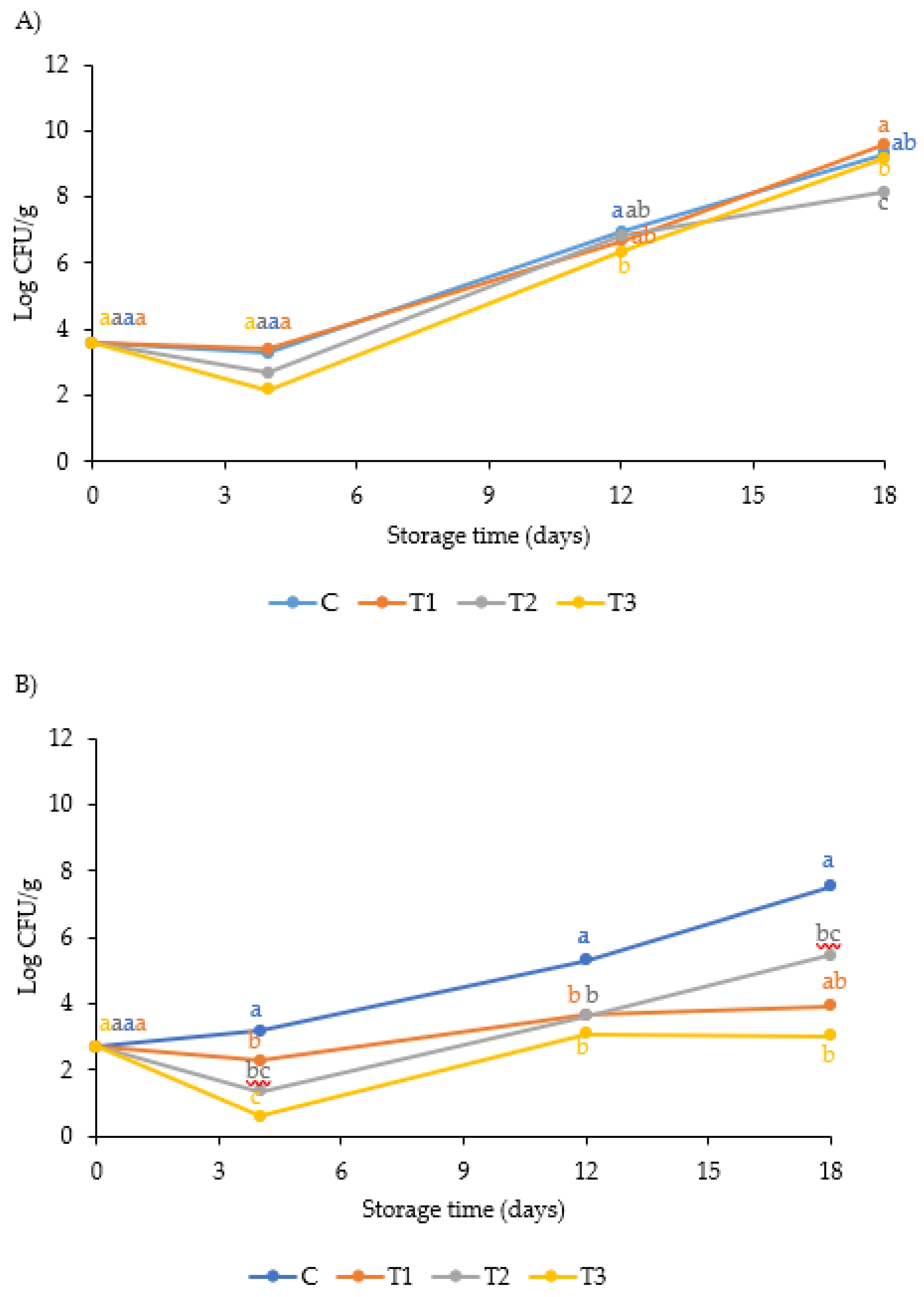
Figure 2.
Release of allyl-isothiocyanate from mustard seed.
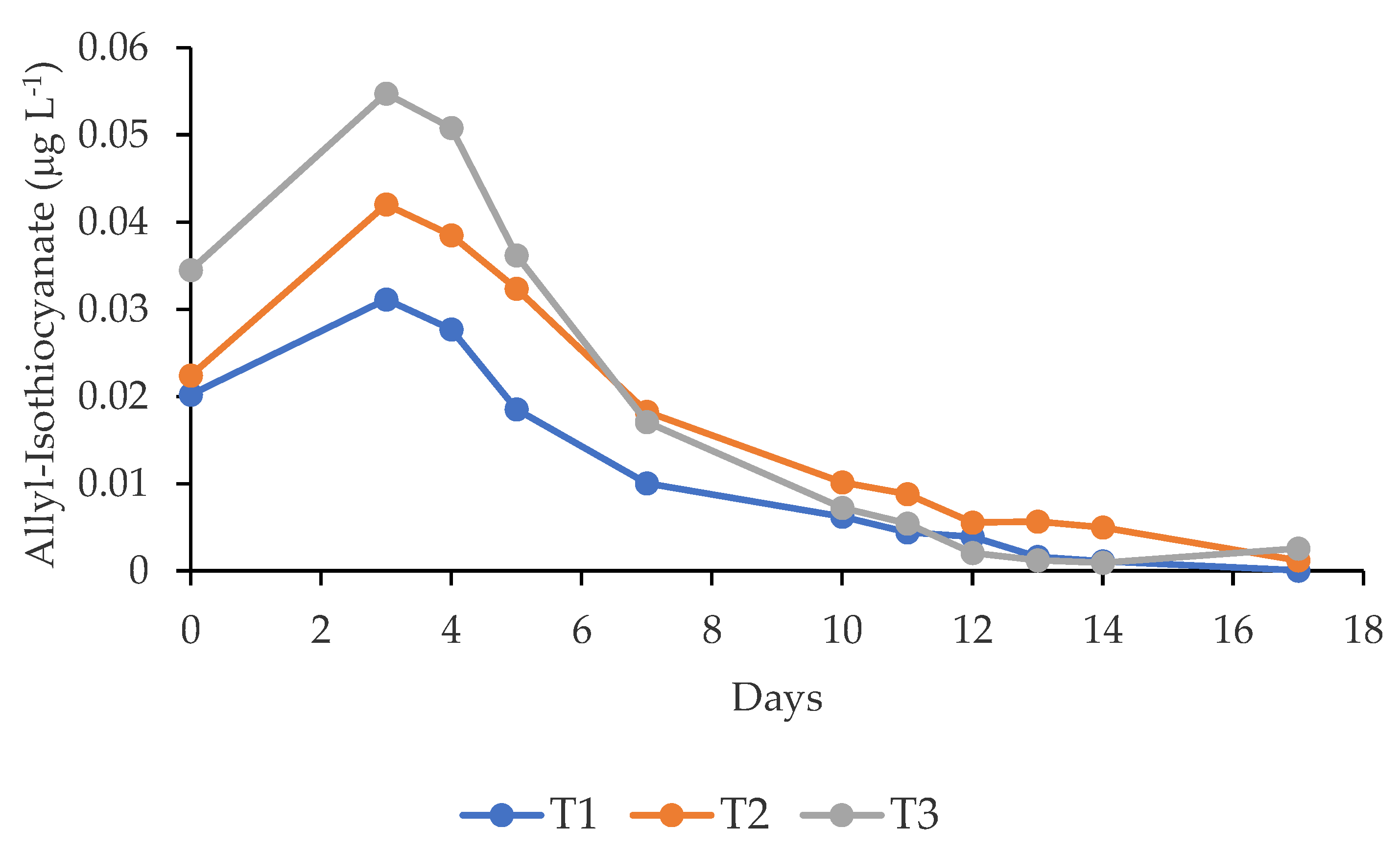
Figure 3.
Score plot of the principal component analysis (PCA) analysis of tenchs during its shelf-life.
Figure 3.
Score plot of the principal component analysis (PCA) analysis of tenchs during its shelf-life.
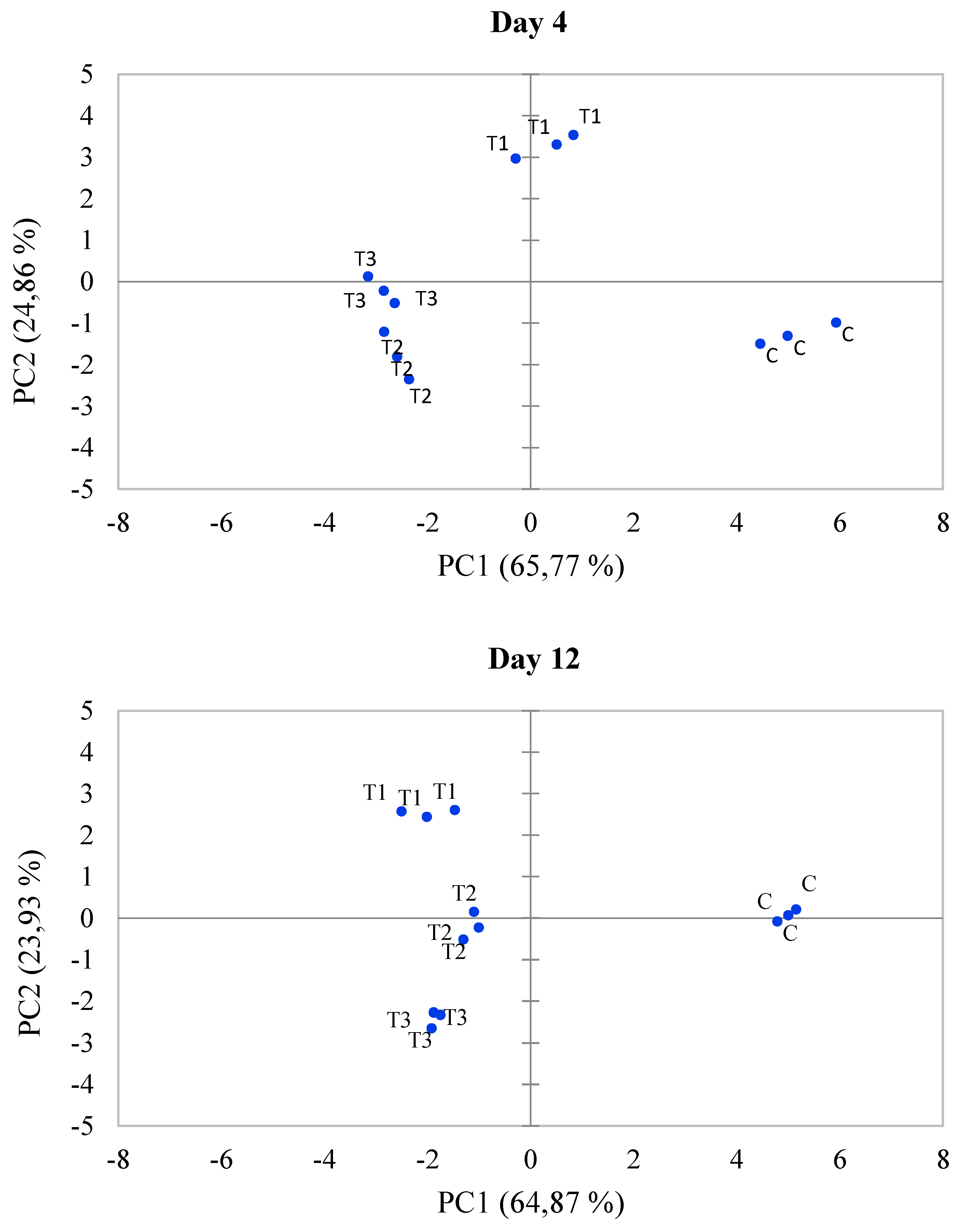
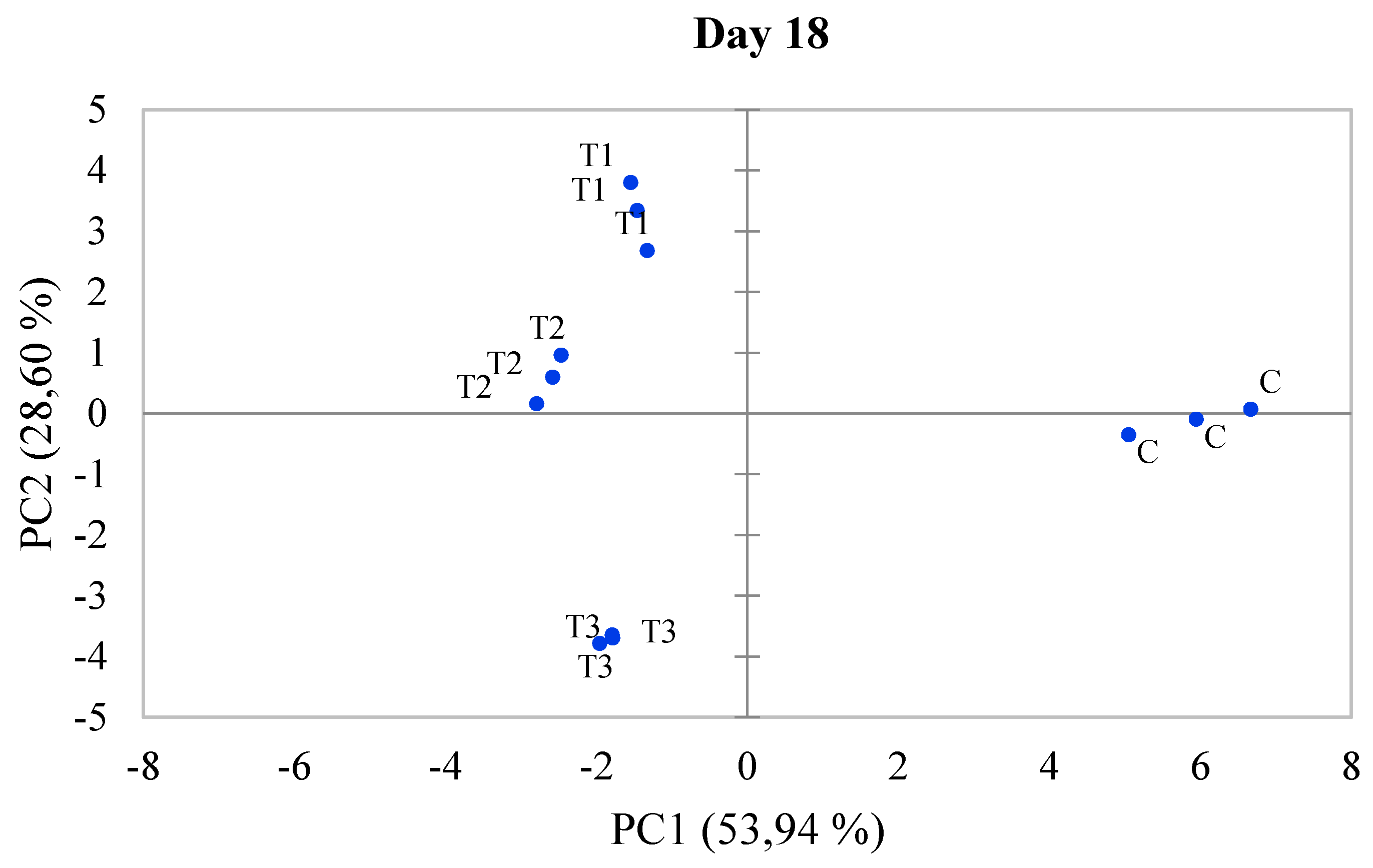

Table 1.
Descriptive sensory olfactory evaluation of tenchs during shelf-life. Results are expressed as mean ± SD of three samples replicates.
Table 1.
Descriptive sensory olfactory evaluation of tenchs during shelf-life. Results are expressed as mean ± SD of three samples replicates.
| Treatments | Fresh fish | Rotten fish | River | |||||||||
| Day 0 | Day 4 | Day 12 | Day 18 | Day 0 | Day 4 | Day 12 | Day 18 | Day 0 | Day 4 | Day 12 | Day 18 | |
| C | 7.4 ± 1.1A | 6.6 ± 0.9aAB | 6.1 ± 1.7aB | 1.6 ± 1.1bC | nd | nd | nd | 3.8 ± 1.7a | 6.2 ± 0.8A | 5.0 ± 2.9aAB | 5.5 ± 1.7aAB | 3.5 ± 2.1aB |
| T1 | 6.9 ± 1.0aA | 5.1 ± 1.5abB | 1.2 ± 0.7bC | nd | nd | 2.5 ± 1.4a | 4.8 ± 2.0aA | 4.4 ± 1.4abA | 2.7 ± 1.9aA | |||
| T2 | 6.7 ± 1.1aA | 3.6 ± 0.9bB | 2.9 ± 1.2bB | nd | nd | 2.5 ± 1.5a | 4.9 ± 1.9ªA | 3.1 ± 1.6bA | 3.3 ± 1.1aA | |||
| T3 | 6.6 ± 1.5aA | 3.8 ± 1.4bB | 2.8 ± 1.4aB | nd | nd | 2.1 ± 1.3a | 4.6 ± 1.2aA | 3.1 ± 1.5bA | 2.7 ± 1.3aA | |||
| Treatments | Sulphur | Ammonia | Pungent | |||||||||
| Day 0 | Day 4 | Day 12 | Day 18 | Day 0 | Day 4 | Day 12 | Day 18 | Day 0 | Day 4 | Day 12 | Day 18 | |
| C | nd | nd | nd | nd | nd | nd | nd | 1.3 ± 0.9 | nd | nd | nd | 1.4 ± 1.0a |
| T1 | nd | nd | nd | nd | nd | nd | nd | nd | 1.0 ± 0.5a | |||
| T2 | nd | nd | nd | nd | nd | nd | nd | nd | 1.1 ± 0.8a | |||
| T3 | nd | nd | nd | nd | nd | nd | nd | nd | 1.2 ± 1.0a | |||
Values lower than 1 are considered as non-detected (nd). Different lower-case letters in the same column indicate significant differences among treatments. Multiple comparisons were analyzed following a Conover-Iman test (p < 0.05) for fresh fish (day 18), river (day 4), and pungent (day 18), and a Tukey test (p < 0.05) for fresh fish (days 4 and 12), rotten fish (day 18), and river (days 12 and 18). Different capital letters in the same row indicate significant differences among sampling dates. Multiple comparisons were analyzed following a Conover-Iman test (p < 0.05) for Control (fresh fish), T1 (fresh fish), and Control (river), and a Tukey test (p < 0.05) for T2 and T3 (fresh fish), and T1, T2 and T3 (river).
Table 2.
Quantification of volatile organic compounds (μg/g) obtained by GC-MS in tench samples during its shelf-life.
Table 2.
Quantification of volatile organic compounds (μg/g) obtained by GC-MS in tench samples during its shelf-life.
| LRI | VOCs | Day 0 | Day 4 | Day 12 | Day 18 | |||||||||
| C | C | T1 | T2 | T3 | C | T1 | T2 | T3 | C | T1 | T2 | T3 | ||
| Hydrocarbons | ||||||||||||||
| 731.0 | Hexane, 3-methyl- | 73.2 | 238.2 | 147.2 | nd | nd | nd | nd | nd | nd | nd | nd | nd | nd |
| 890.5 | Hexane, 2,4-dimethyl- | 1.1 | 1.0 | nd | nd | nd | nd | nd | nd | nd | nd | nd | nd | nd |
| 957.7 | 1,3-cyclohexadiene | nd | nd | nd | nd | nd | nd | nd | nd | nd | 2.3 | nd | nd | nd |
| 967.1 | 3,5,5-trimethyl-1-hexene | nd | nd | nd | nd | nd | nd | nd | nd | nd | 1.4 | nd | nd | nd |
| TOTAL | 74.3 | 239.2 | 147.2 | nd | nd | nd | nd | nd | nd | 3.7 | nd | nd | nd | |
| Alcohols | ||||||||||||||
| 748.1 | 3-methyl-1-butanol | nd | nd | nd | nd | nd | nd | nd | nd | nd | nd | nd | 11.9 | nd |
| 862.9 | 1-hexanol | nd | nd | nd | nd | nd | nd | nd | nd | nd | nd | nd | nd | nd |
| 972.8 | 1-octen-3-ol | nd | nd | nd | nd | nd | nd | nd | nd | nd | 0.9 | nd | 0.9 | nd |
| 1022 | 2-ethyl-1-hexanol | 7.7 | 26.6 | 23.2 | 7.5 | nd | 38.0 | 30.3 | 22.4 | 13.9 | 33.0 | 26.0 | 23.4 | nd |
| 1626 | 2,6-bis(1,1-dimethylethyl)-4-(1- oxopropyl) phenol |
65.0 | 21.5 | 9.4 | nd | nd | 15.1 | 10.0 | 9.6 | 8.0 | 14.4 | 10.4 | 5.3 | nd |
| TOTAL | 72.7 | 48.1 | 32.6 | 7.5 | nd | 53.0 | 40.3 | 31.9 | 21.9 | 115.7 | 37.4 | 47.1 | nd | |
| Benzenoids | ||||||||||||||
| 765 | Toluene | 6.0 | 7.6 | 5.0 | nd | nd | nd | nd | nd | nd | nd | nd | nd | nd |
| 848 | Ethylbenzene | 1.6 | 1.7 | 1.5 | nd | nd | nd | 1.7 | 1.1 | 1.1 | nd | nd | nd | nd |
| 857 | Benzene, 1,3-dimethyl | nd | nd | nd | nd | nd | 1.4 | 7.8 | 5.1 | 6.2 | 5.6 | 6.0 | 4.8 | nd |
| 863 | o-xylene | 6.3 | nd | 6.3 | nd | nd | nd | nd | nd | nd | nd | nd | nd | nd |
| 880 | p-xylene | 2.5 | 2.8 | nd | nd | nd | nd | nd | nd | nd | nd | nd | nd | nd |
| 950 | Benzene-1-ethyl-4-methyl | 2.7 | 3.5 | 3.0 | nd | nd | nd | 2.5 | 1.9 | nd | nd | nd | nd | nd |
| 980 | Benzene, 1,2,3-trimethyl- | 3.5 | 4.4 | 6.5 | nd | nd | nd | 6.5 | 2.3 | 3.1 | 4.1 | nd | nd | 1.6 |
| 1279 | Butylated hydroxytoluene | 4.2 | 6.7 | nd | nd | nd | 40.7 | 31.7 | 28.9 | 26.6 | 152.2 | 103.2 | 64.0 | 47.4 |
| 1361 | Benzene, hexamethyl | nd | nd | nd | nd | nd | nd | nd | nd | nd | nd | 7.7 | 4.0 | nd |
| 1300 | Indole | nd | nd | nd | nd | nd | nd | nd | nd | nd | nd | nd | nd | 10.7 |
| TOTAL | 28.6 | 27.5 | 23.4 | nd | nd | 42.1 | 50.3 | 39.4 | 37.0 | 162.0 | 116.8 | 72.8 | 47.4 | |
| LRI | VOCs | Day 0 | Day 4 | Day 9 | Day 18 | |||||||||
| C | C | T1 | T2 | T3 | C | T1 | T2 | T3 | C | T1 | T2 | T3 | ||
| Isothiocyanate | ||||||||||||||
| 873 | Allyl isothiocyanate | nd | nd | 19.4 | 16.3 | 24.5 | nd | 6.0 | 9.9 | 13.9 | nd | 2.3 | 4.5 | 5.4 |
| 922 | 1-Isothiocyanatobutane | nd | nd | 5.8 | 3.4 | 4.3 | nd | 5.2 | 13.2 | 10.2 | nd | nd | nd | nd |
| TOTAL | nd | nd | 25.2 | 19.7 | 28.9 | nd | 11.2 | 23.1 | 24.1 | nd | 2.3 | 4.5 | nd | |
| Ketones | ||||||||||||||
| 882 | 2-heptanone | nd | nd | nd | nd | nd | nd | nd | nd | nd | 18.8 | 10.4 | 5.5 | 5.9 |
| 1082 | 2-dodecanone | nd | nd | nd | nd | nd | 18.2 | 5.2 | 4.4 | 5.7 | 44.9 | 35.1 | 10.3 | 8.6 |
| TOTAL | nd | nd | nd | nd | nd | 18.2 | 5.2 | 4.4 | 5.7 | 63.7 | 45.5 | 15.7 | 14.6 | |
| Acetates | ||||||||||||||
| 742 | Acetic acid | nd | nd | nd | nd | nd | nd | nd | nd | nd | nd | 188.3 | 193.3 | nd |
| 1072 | 4-hexen-1-ol, acetate | nd | nd | nd | nd | nd | nd | nd | nd | nd | nd | 12.4 | nd | nd |
| 1266 | 11-tetradecen-1-ol, acetate | nd | nd | nd | nd | nd | nd | nd | nd | nd | nd | 77.2 | nd | nd |
| TOTAL | nd | nd | nd | nd | nd | nd | nd | nd | nd | nd | 277.8 | 193.3 | nd | |
| Aldehydes | ||||||||||||||
| 1094 | Nonanal | 10.9 | 3.0 | 6.3 | nd | 4.3 | 2.4 | 7.2 | 6.3 | 6.9 | nd | 8.1 | 8.0 | 9.1 |
| 1118 | 2,5-bis[(trimethylsilyl)oxy]benzaldehyde | 9.8 | 6.3 | 8.6 | 7.0 | 8.7 | 5.0 | 5.7 | 5.5 | 8.7 | 7.7 | 10.3 | 9.7 | 6.2 |
| TOTAL | 20.7 | 9.4 | 15.0 | 7.0 | 13.0 | 7.4 | 12.9 | 11.8 | 15.6 | 7.7 | 18.4 | 17.7 | nd | |
| Others | ||||||||||||||
| 954 | Dimethyl trisulfide | nd | nd | nd | nd | nd | nd | nd | nd | nd | 5.6 | nd | nd | nd |
| 871 | Butanoic acid, 3-methyl- | nd | nd | nd | nd | nd | nd | nd | nd | nd | 17.2 | nd | nd | nd |
| 1017 | D-limonene | 2.2 | 1.9 | 1.5 | 1.3 | 1.2 | nd | nd | 2.2 | 1.6 | nd | nd | nd | 2.6 |
| TOTAL | 2.2 | 1.9 | 1.5 | nd | nd | nd | nd | 2.2 | 1.6 | 22.9 | nd | nd | 2.6 | |
LRI: Lineal Retention Index; nd: non detected.
Disclaimer/Publisher’s Note: The statements, opinions and data contained in all publications are solely those of the individual author(s) and contributor(s) and not of MDPI and/or the editor(s). MDPI and/or the editor(s) disclaim responsibility for any injury to people or property resulting from any ideas, methods, instructions or products referred to in the content. |
© 2025 by the authors. Licensee MDPI, Basel, Switzerland. This article is an open access article distributed under the terms and conditions of the Creative Commons Attribution (CC BY) license (http://creativecommons.org/licenses/by/4.0/).
Copyright: This open access article is published under a Creative Commons CC BY 4.0 license, which permit the free download, distribution, and reuse, provided that the author and preprint are cited in any reuse.


