
Submitted:
18 August 2025
Posted:
19 August 2025
You are already at the latest version
Abstract
In Nigeria, agriculture plays a vibrant role in supporting the economy, contributing significantly to food security, employment, and national development. However, despite its potential, the sector faces persistent challenges such as low productivity, poor infrastructure, limited access to modern technologies, and weak policy implementation. This study evaluates the production potential and productivity of agriculture in Nigeria by examining how factors of production such as land, labour, capital, and technology are used and how their efficient utilization can improve the sector’s performance. The study adopts a descriptive and analytical approach, using secondary data from reputable sources including the Central Bank of Nigeria (CBN), National Bureau of Statistics (NBS), FAOSTAT, World Bank, and key government policy documents. It explores both theoretical and empirical perspectives of productivity and production potential, while highlighting the roles of historical context, gender, youth participation, and regional distribution of major agricultural products. The study also analyses trends in agricultural productivity, structural constraints, and the effects of environmental and climatic factors. Findings show that while Nigeria has vast agricultural resources, productivity remains suboptimal due to poor resource utilization, climate variability, and limited investment in infrastructure and technology. Nonetheless, opportunities exist through innovative farming practices, policy reforms, youth and women empowerment, and value addition to agricultural products. The study concludes with practical recommendations aimed at boosting productivity, strengthening rural livelihoods, and enhancing the sector’s contribution to sustainable economic growth. By addressing existing barriers, Nigeria’s agricultural sector holds strong potential to drive inclusive development and national food security.
Keywords:
food security
; sustainable agriculture
; productivity
; production potential
; economic development
; Nigeria
1. Introduction
Agriculture being one of the key sectors in Nigeria, plays a crucial role in national development through the production of food, employment generation, rural livelihood support, and economic diversification. Before the discovery of oil, agriculture was the primary driver of Nigeria’s exports and rural livelihoods. Even today, it remains a major contributor to GDP and employs a large portion of the population, particularly in rural areas. However, the sector’s full potential has yet to be realized due to persistent challenges such as low productivity, limited access to improved technologies, inadequate infrastructure, poor funding, environmental degradation, and inconsistent government policies.
This study aims to assess the production potential and productivity of agriculture in Nigeria by examining how production factors, including land, labor, capital, and technology, are utilized and how their effectiveness can be enhanced. It draws attention to how structural issues, institutional gaps, and socio-economic barriers, particularly among smallholder farmers, women, and youth, impact agricultural performance. The study also considers how climate change, environmental degradation, and unsustainable practices threaten long-term agricultural productivity. Additionally, government interventions, private sector investments, and donor-supported programmes are examined to understand their role in enhancing the sector’s development.
2. Materials and Method
This study adopts a descriptive and analytical research design based on secondary data sources. It combines theoretical review with empirical analysis to explore the economic potential and productivity of Nigeria’s agricultural sector.
Data Sources: Data were drawn from key institutions such as the Central Bank of Nigeria (CBN) Statistical Bulletin, National Bureau of Statistics (NBS), World Bank Development Indicators, FAOSTAT, and peer-reviewed literature to examine agricultural trends. It also draws from relevant government policy documents such as the Agricultural Transformation Agenda, Green Alternative, and Anchor Borrowers’ Programme reports.
Method of Analysis: Quantitative data are used to analyze trends in agricultural GDP, employment, land use, productivity ratios, and investment patterns. Figures and tables support the discussion of productivity measures, production input efficiency, and output indicators such as the Gross Production Index Number (GPIN).
Comparative and Sectoral Analysis: The study examines different agricultural zones in Nigeria and compares trends across crop and livestock production.
2.1. Objectives
The main objective of this study is to examine the potential and productivity of agriculture in Nigeria, with a focus on how various factors such as land, labour, capital, technology, and government policy influence the sector’s performance. Specifically, the study aims to:
- Evaluate the theoretical and practical concepts of production potential and productivity in agricultural economics.
- Analyze the historical development and current status of Nigeria’s agricultural sector and its importance to the national economy.
- Identify the key production resources available in Nigeria and assess their effectiveness and utilization in agricultural development.
- Assess productivity trends and measures across Nigeria’s agricultural zones, focusing on the comparative performance of land, labour, capital, and entrepreneurship.
- Examine major agricultural products, their regional distribution, levels of self-sufficiency, and export potential.
2.2. Scope
This study focuses on the agricultural sector of Nigeria from both a historical and current perspective. It evaluates the sector’s structural dynamics, productivity patterns, and production potential through an economic lens. The research:
- Covers all subsectors of agriculture including crop production, livestock, and agro-processing.
- Considers the roles of gender, youth, and smallholder farmers in agricultural productivity.
- Analyses national agricultural data from major institutions like the Central Bank of Nigeria (CBN), National Bureau of Statistics (NBS), World Bank, FAOSTAT, and the Food and Agriculture Organization (FAO).
- Reviews policy frameworks such as the Agricultural Transformation Agenda (ATA), Green Alternative, and Anchor Borrowers’ Programme.
- Integrates environmental sustainability, infrastructure challenges, technological adoption, and market accessibility as cross-cutting themes influencing productivity.
3. The Idea of Production Potential and Productivity in Economic Theory
3.1. The Concept of Production Potential and Productivity
Production potential and productivity are broad concepts with many facets, and several factors affect how they are measured and utilized. According to Silver (1986), “Potential productivity is the variation between real and optimal productivity”. At the large-scale level, it is an important concept in economics. “The production potential of a sector refers to how effectively it can deliver goods or services. This capacity depends on the availability and quality of resources like labor, technology, and how well these components are coordinated” (Fedrets et al., 2022).
Production potential is not just about the physical production capacity. It is a multifaceted socio-economic concept encompassing resource potential, the process of production, and the end product; it also indicates a measure of the efficiency of the socio-economy (Forteza et al., 2017). According to McConnell et al. (1992), “production potential is the total output a region could achieve if it used all its resources efficiently”. This definition emphasizes the importance of optimizing resource utilization to maximize output. The concept of production potential emphasizes the importance of resource and process optimization to achieve sustainable growth and competitive advantage in the market, making it a crucial consideration for businesses across various industries.
“The potential for the production of agriculture and the corresponding agricultural entities, or farms, is the combination of natural resources, agricultural practices, environmental factors, labour force, technological resources, and basic economic conditions” (Siudek and Zawojska, 2014; Kreneva et al., 2015). In simple terms, production potential is the highest level of output or productivity that farms in a certain area or country can accomplish. Several factors, including the quantity and quality of natural resources, labour, technological capabilities, economic situations, and utilization strategies influence it. The ability of farms to produce agricultural goods and support the agricultural industry as a whole is referred to as their production potential. The success of agricultural businesses heavily depends on how effectively they utilize financial, technical, material, and informational resources to reach their organizational objectives, underscoring the significance of a well-organized management framework (Fedrets et al., 2022).
The production potential represents the ability to generate a specific quantity of output within a given timeframe. It also highlights how effectively a region can transform its resources into useful products while sustaining its economy and society. The potential of an area is impacted by a number of elements, including natural resources, financial, stock, labour, information potentials, scientific, organizational, and communication potentials (Boguslavskay, 2020). It is an important aspect of economic growth. The requirement for a methodical approach to production potential management highlights the role that potential plays in economic success. Afanasiev (2006) provides a methodology for estimating production potential and emphasizes the relevance of controlled sources of inefficiency. These outcomes imply that managing production potential and related factors requires a comprehensive strategy, which has significant consequences for economic policy.
According to Barthelemy and David (2001) and Pawlewicz and Pawlewicz (2018), the availability of production resources is evidence of agriculture's production potential and capability. As a result, the capacity to maximize potential and build optimal relationships between production elements influences the efficiency of the manufacturing process and work efficiency. Aside from the economic and social structure and economic policy, the main determinants of the competitiveness of a given economy and its sectors are the quality, size, and organization of production resources and their effective utilization (Latruffe 2010; Matyja 2016; Pawlewicz and Pawlewicz 2018).
Hnatkivskyi (2021) examines the capability of economic development in agribusiness, examining it from the perspectives of productive forces, social requirements, and business opportunity identification. Together, these studies highlight how essential it is to have a solid theoretical grasp of agriculture's output potential and how it contributes to economic growth.
The agriculture sector's production potential, and consequently its ability to compete, is influenced not just by its production factors but by their quality and the relationships among its production elements. Understanding the agricultural production potential is crucial since it assists in determining the agricultural sector development strategy's directions for a given nation or region (Nowak & Różańska-Boczula, 2019).
Within the realm of economics, the production function emerges as a cornerstone concept that serves to visually depict the intricate interplay between inputs and outputs, with various well-known functions such as the Cobb-Douglas and CES functions having played historical and influential roles in shaping economic thought, as noted by Gordon and Vaughan (2011). It is evident that visual models play a crucial role in the pedagogy of production theory, serving as valuable tools in elucidating the technical constraints that underlie scenarios related to cost-minimization and profit-maximization, a point underscored by the research of Naumenko and Moosavian (2016).
Production potential assumes a critical and pivotal role within the realm of economic policies as it exerts its influence on a multitude of facets pertaining to economic decision-making processes. The existence of discrepancies between actual production levels and the hypothetical potential output can have significant implications on the efficacy and functionality of conventional policy tools and instruments, underscoring the critical nature of bridging this divergence through strategic interventions aimed at rejuvenating and stimulating economies via targeted investments in both innovation initiatives and the accumulation of human capital, as noted by Creel and Iacopetta (2015).
In essence, the determination and realization of production potential exert a profound influence on the formulation of policies at various scales, encompassing both the micro and macro levels of economic planning and governance, thereby guiding the development of comprehensive strategies designed to optimize productivity levels and foster sustained economic growth and development.
Different researchers explain productivity in different ways. While some focus on outputs per unit of input, others consider the quality and efficiency of how resources are used. As elucidated by L. Nanda Kumar, the concept of productivity encapsulates the adept and proficient attainment of objectives devoid of squandering valuable resources; in contrast, productiveness encompasses ethical considerations and the generation of value through laborious endeavours (Kumar, 2017). Furthermore, Wikeu Tsnia Fariati underscores that “productivity can be interpreted as the intricate interplay between the resultant output and the input deployed in the process, which is intricately intertwined with a multitude of variables including but not limited to the efficiency of management, the rigor of discipline instilled, and the level of motivation engendered” (Fariati, 2022).
Saul Eslake in his analysis, provides a simplified definition of “productivity as the efficient utilization of resources in the creation of goods and services that hold value, a concept often quantified through metrics like output per unit of input across various levels, encompassing dimensions such as labour productivity and multifactor productivity” (Eslake, 2011).
Productivity in agriculture is a multifaceted phrase with a range of definitions and factors. Wang (2015) emphasizes the function of overall output for each unit of input, especially land and labour, whereas Darku (2013) highlights the significance of research and development and technological advancement in fostering productivity development. By incorporating intermediate inputs into agricultural production accounting, Ball et al. (1997) broaden the concept even further and emphasize the critical role that productivity increase plays in economic expansion. When taken as a whole, these studies highlight how complex agricultural production is and how important it is to assess and improve it holistically.
“Labour productivity measures how much work is done by each worker. It’s important for business growth and efficiency” (Novichenko, 2022). This fundamental concept represents a quantifiable metric of how effectively human labour is harnessed to yield desired outcomes, thus exerting a direct influence on the economic efficacy of production processes and the optimal utilization of fixed assets, as highlighted by Evteev (2023). Various approaches such as cost, in-kind, and labour methodologies are employed to gauge labour productivity, involving intricate direct and inverse calculations. The economic evaluation of labour productivity provides a foundational information framework essential for managerial decision-making processes geared towards enhancing the utilization of labour resources to ensure the seamless execution of the enterprise's production agenda (Novichenko, 2022).
Labour productivity interpretation assumes vital importance in clarifying its implications for socio-economic advancement and its implications on the comprehensive efficiency of production efficiency (Shcherbakov, 2022). It is significant to note that intellectual labour productivity uniquely differs from physical labour productivity, demanding the application of specialized methodologies for its meticulous evaluation and analysis (Cretu & Lupu, 2020).
Capital productivity as defined by Fabina & Wright (2013), is the efficiency exhibited in the utilization of capital inputs to generate output within an economy. This concept serves as a fundamental metric for assessing economic growth, serving as a reflection of a country's capacity to enhance living standards through the effective conversion of capital resources into valuable goods and services, as outlined by Paris (2010). The significance of capital productivity lies in its essential role in driving overall productivity, a critical determinant of economic progress. Research findings indicate a notable correlation between the growth of physical and human capital and the increase in output per worker, underscoring the pivotal contribution of capital productivity towards overall output expansion (Baier et al., 2002). By actively monitoring and enhancing capital productivity levels, nations can optimize the allocation of resources, stimulate technological progress, and ultimately propel economic prosperity and advancement.
Land productivity is a metric that evaluates the efficiency with which a nation utilizes its resources, specifically land, to generate valued goods and services (Fabina & Wright, 2013). This factor is essential for economic growth because it generates an economic surplus for capital creation and reallocates labour to non-agricultural sectors, so contributing to national progress and revenue growth (Christensen & Yee, 1964). Research has demonstrated that the Caloric Suitability Index (CSI) surpasses traditional agricultural suitability indices as a more effective gauge of land productivity, as it more accurately assesses the potential caloric output of land resources and its influence on the density of the pre-colonial populace and succeeding economic progress (Galor & Özak, 2015). Fluctuations in the enhancement of agricultural productivity may prompt an escalation in land conversion for agricultural utilization as a proactive strategy against production deficiencies, thus potentially affecting optimum consumption behaviours and demographic trajectories (Lanz et al., 2018). Essentially, the productivity of land is essential for maintaining population expansion and guiding long-term economic growth.
3.1.1. Historical Evolution of the Concepts
Classical economists including Adam Smith and David Ricardo have made a significant impact on the early stages of economic thought regarding productivity and production potential. Adam Smith, in his examination of mercantilism and physiocracy, acclaimed the latter as the dominant system of political economy, stressing the significance of factors such as surplus value and land rent (Billault, 2023; Maklakova & Sysoev, 2022). Conversely, David Ricardo, a well-known figure in classical political economy, not only expanded upon the labour theory of value but also delved deeply into income distribution among various societal classes, advocating for liberal trade policies in the realm of international trade (Chyrak, 2022). Moreover, while Thomas Malthus diverged from Ricardo on certain foundational perspectives, his disagreement on Ricardo's standpoint on aggregate demand underscored the diverse viewpoints within classical economics (Kurz, 2022). These economic scholars laid the foundational groundwork for comprehending production potential, productivity, and the distribution of wealth, significantly influencing the trajectory of economic theory and analysis.
There were significant changes in the way that productivity was conceptualized throughout the Industrial Revolution. Initially, the integration of new technologies like the cotton spinning machine in France led to a gradual diffusion of technology and a dispersed distribution of productivity among adopters, underscoring the evolutionary progression of technological advancements (Juhász et al., 2020). The Industrial Revolution indicated a transformation in growth rates of economy-wide productivity, witnessing a rapid increase in the efficiency growth rates within a short timeframe, thereby challenging conventional economic theories and models (Clark, 2014). As time progressed, manufacturing sectors amassed considerable expertise in developing various machines and systems, culminating in heightened productivity rates and the generation of high-quality products (Usubamatov, 2018). The ongoing fourth industrial revolution is categorized by pioneering inventions like 3D printing, artificial intelligence, automation, propelling digitalization, and autonomy in industrial production processes to boost speed, cost-effectiveness and flexibility (Rymarczyk, 2022). Furthermore, the sluggish pace of total factor productivity growth just before the conclusion of the British industrial revolution hinted at restricted technological capabilities, regardless of the steady quickening in productivity growth (Crafts, 2021).
Economists such as Paul Romer and Robert Solow have made major contributions to our knowledge of the complexities of economic growth and productivity in the twenty-first century. Solow's clarification of the vital role of technological advancement in propelling sustained economic growth through the Solow Growth Model, likewise Romer's focus on the importance of ideas, human capital and innovation in promoting economic development have played a pivotal part in modelling modern economic ideologies (Bergeaud et al., 2017; Crafts & O’Rourke, 2014). Modern productivity study continues to delve into various dimensions, encompassing inquiries into the influence of managerial practices on productivity, the dispersion of productivity, environmental considerations in gauging productivity, resource reallocation, and the connection between productivity and the financial performance of enterprises (Lovell, 2016). Ongoing discussions revolve around the causal factors behind the recent deceleration in productivity, especially noticeable in the UK, with deliberations on aspects such as total factor productivity (TFP) growth, weaknesses in labour productivity, and their consequence on macroeconomic governance and household income (Mahtaney, 2021).
3.1.2. Importance in Economic Analysis
Productivity plays an integral and indispensable role within economic growth frameworks such as the renowned Solow Growth Model and the intricate endogenous growth theories that have been developed over time. The Solow model, first introduced in the scholarly realm in the year 1956, places significant emphasis on the concept of total factor productivity as a pivotal determinant influencing the trajectory of economic growth (Dykas et al., 2023). Several empirical examinations conducted on the complex landscape of the Brazilian economy have unveiled compelling evidence indicating that total factor productivity exerts a positive and discernible impact on the overall economic growth trajectory over extended periods, although the magnitude of this influence may be characterized as somewhat restrained (Souza et al., 2020). Furthermore, a noteworthy advancement in economic thought has been the reformulation of the Solow-Swan growth model to accommodate endogenous population dynamics, a development which sheds light on the intricate interplay between population growth rates that are intricately linked with per capita consumption levels, thereby influencing the steady state of the capital-labour ratio and, by extension, the overarching pattern of economic growth (Cayssials & Picasso 2020). Moreover, the body of research focusing on economies in the process of development posits that productivity, in conjunction with labour force dynamics, capital accumulation, and technological advancements, represents foundational pillars that propel the engine of economic growth forward, with theoretical frameworks that encapsulate both exogenous and endogenous technological changes being meticulously crafted to provide a comprehensive elucidation of the complex dynamics underpinning the growth trajectory of these economies (Pérez & Ortega 2021).
As many research studies have shown, productivity analysis is essential for comprehending and evaluating the performance of numerous economic sectors, especially agriculture. Research that highlights the assessment of agricultural performance across states and union territories indicates the fluctuations in productivity and efficiency over time (Chaubey et al., 2022). Furthermore, Letseku and Grové's (2022) study highlights the significance of rational resource allocation for profit maximization in agriculture and the influence of economic decision-making on agricultural water productivity and applied water productivity. Additionally, Ivanova and Chatzouz's (2019) research highlights the need for customized strategies to improve productivity in various economic domains by highlighting the significance of sector-specific innovation policies in influencing productivity growth across various economic sectors. In general, productivity analysis guides decision-making, offers insights into sectoral performance, and pinpoints areas for focused interventions to boost overall economic development and efficiency.
In many nations and areas, an increase in productivity has played a major role in propelling economic expansion. Studies conducted on a few nations, such as the UK, Japan, India, China, Korea Republic, and the USA, have demonstrated that labour productivity growth and productivity expansion in general particularly in the manufacturing sector have positively influenced GDP growth (Bag et al., 2021). In the context of the COVID-19 crisis, productivity is particularly important for economic growth. Digitalization can increase productivity and support sustainable growth in this regard (OECD/APO, 2022). In addition, productivity growth in the Republic of North Macedonia emphasizes the importance of innovation, investments in human and physical resources, and raising enterprise productivity as means of promoting economic growth. These illustrations show how productivity gains are essential for stimulating economic expansion and promoting sustainable development across a range of nations and areas (Djambaska et al., 2022).
3.1.3. Measurement and Indicators
A key indicator of economic growth is total factor productivity (TFP), which shows how well resources are allocated and how far technology has advanced in a given country. The weighted average of all inputs, including labour and capital, is divided by total output to get total factor productivity (TFP). It has a major impact on how well economic development and growth are going (Šlander et al., 2023).
An increase in TFP is linked to improvements in a nation's capacity for innovation, the growth of its human capital, and the proportion of international commerce in its GDP, all of which raise productivity levels.
In addition, total factor productivity is impacted by environmental factors, institutional indicators, and the human development index, which makes it a complete measure for assessing sustainability and economic performance. Total factor productivity has a significant role in influencing policy decisions and promoting innovation for long-term economic development since it may increase a nation's GDP and labour factor productivity. Partial productivity measures focus on the contribution of individual factors to output growth. Labour productivity, a common measure, assesses output per unit of labour input, often expressed as person-hours in manufacturing and services. Land productivity, typically used in agriculture, evaluates output per unit of land utilized. Capital productivity, another vital measure, examines output per unit of capital input, reflecting the efficiency of capital allocation and utilization. These measures offer insights into the efficiency and effectiveness of specific inputs in the production process, aiding firms in optimizing resource allocation and enhancing overall productivity performance (Eslake, 2011; Murray & Sharpe, 2016).
Productivity at the national and sectoral levels is evaluated primarily via the use of productivity indicators. There is a growing interest in more comprehensive approaches like the multi-factor productivity (MFP) indexes, which take into account factors other than just labour and capital, such as energy, materials, and services, despite the widespread use of traditional measures like the labour productivity index (Gandy & Mulhearn, 2021). The utilization of data science approaches is on the rise in the development of productivity measuring procedures, providing novel perspectives and avenues for advancement (Shi et al., 2021). To create productivity indexes, National Statistical Offices use index number methodologies, notwithstanding the difficulties in precisely quantifying capital, labour, and output (Diewert & Fox, 2019). Estimating productivity in agricultural regions is made feasible by using geographic data on climate and vegetation, including vegetation indices generated from satellite imagery. This helps identify hotspots for deterioration and informs policy actions aimed at increasing production and lowering migration (Tramutoli et al., 2023).
3.2. Resources of Production Factors
3.2.1. Land, Natural Resources and Technology
Natural resources, including soil and water, are fundamental to agricultural sustainability, with their conservation being essential for maintaining ecosystem integrity and ensuring food security (Nalluri & Karri, 2023). Modern technological advancements, such as the Internet of Things (IoT), artificial intelligence (AI), and machine learning (ML), have significantly impacted agriculture by enhancing productivity and resource efficiency, particularly in addressing water scarcity and pest issues (Shanmugasundaram et al., 2023). Factors influencing the adoption of new agricultural technologies include access to credit, extension services, and training on natural resource management, all of which positively affect productivity and efficiency in crop production (Kumar et al., 2022). According to Stanton and Caiazza (2023), innovation in agriculture is essential for sustainable productivity growth, with new technologies adapting practices to environmental changes, improving product quality, and ensuring environmental integrity. By integrating natural resources and technological advancements, while considering factors influencing their adoption, agriculture can advance towards more efficient and sustainable production systems.
Agricultural land exhibits diverse characteristics and uses across various regions. According to Marks-Bielska (2022), agricultural land holds multifunctional value, acting as a unique public good that supports both food producers and society as a whole. Efficient management of this land involves strategic agricultural zoning based on regional crops, crop rotation practices, and ecological considerations. This approach enhances productivity and sustainability, ultimately contributing to the competitiveness of agricultural producers (Koshkalda et al., 2023). Additionally, Uçak, Çelik, and Kurt (2023) highlight the strategic importance of agricultural land, noting the causal nexus between a country's agricultural land resources and its agricultural exports, which drives agricultural trade.
Effective land utilization involves strategies such as repurposing unused agricultural lands for productive uses, thereby creating models for efficient farm operations (Özgül & Çomakli, 2023). According to Poltavets (2022), sustainable land management practices aim to achieve sustainable development goals by effectively using land resources at agrarian enterprises, taking into account social needs and internal development potential. Evaluating the efficiency of agricultural land use is crucial for ensuring national food security and preserving agroecosystems (Bagin, 2022). Poltavets (2022) also highlights that sustainable land management techniques include combating erosion, utilizing organic fertilizers, and implementing land reclamation measures to improve the condition of land resources at agricultural enterprises. By integrating these strategies and practices, organizations can optimize land use, maximize economic efficiency, and minimize environmental impact, thereby contributing to balanced development and effective land resource management.
3.2.2. Labour and Entrepreneurship
The agricultural labour force is characterized by diverse demographics, education levels, and skill sets. According to Castro et al. (2020), in Brazil, a significant portion of the agribusiness labour force comprises unskilled or semi-skilled workers with low levels of education, many of whom are informally employed, resulting in lower average incomes compared to other sectors. In Poland, rural workforce education levels have improved over the years, with a higher concentration of well-educated individuals in areas closer to urban centers and non-agricultural functions (Kamińska, 2016). An and Reimer (2021) note that changes in the agricultural labour supply in the United States are influenced by factors such as legality, education, experience, and gender, with varying responses to wage increases observed over time. These findings underscore the complexity and variability of demographics, education levels, and skill sets within the agricultural labour force across different countries.
Labour productivity across various industries, including construction and manufacturing, is significantly influenced by factors such as training, health, and working conditions (Usman Latief et al., 2023; Sahudin & Subramaniam, 2023). Training improves skills, while good health and favourable working conditions boost efficiency and motivation, leading to higher productivity. Additionally, seasonal labour dynamics are crucial for labour availability and productivity, particularly in industries affected by seasonal changes like construction and agriculture. Understanding and managing these dynamics is essential for optimizing productivity year-round, ensuring efficient resource use, and maintaining market competitiveness. By addressing training, health, and working conditions along with seasonal labour variations, industries can enhance overall productivity and performance.
Entrepreneurial activities significantly enhance agricultural productivity by introducing innovations, fostering risk-taking behaviours, and utilizing diverse skills (Graskemper, 2021). According to Graskemper (2021), entrepreneurial characteristics such as creativity, risk attitude, and family support are crucial in shaping strategic choices within agriculture, leading to diversification, expansion, and productivity gains. Research by Peter and Brownson (2022) also highlights the positive relationship between innovative behaviour, risk-taking, and the development of small and medium enterprises (SMEs) among agricultural entrepreneurs, emphasizing the importance of nurturing innovative behaviours to drive entrepreneurial development in agriculture. Additionally, the adoption of new technologies such as artificial intelligence and machine learning by agricultural entrepreneurs has been shown to promote agribusinesses, demonstrating how entrepreneurship can leverage technological advancements to boost productivity and economic growth in the agricultural sector (Secinaro et al., 2022).
3.2.3. Capital
Physical capital, such as machinery and infrastructure, is essential for economic growth (Higham, 2023; Gangotena & Safner, 2021). Human capital, characterized by education and skills, plays a pivotal role in fostering innovation and long-term growth (Higham, 2023). Financial capital, including investments and credit, is critical for sustaining operations and driving economic development (Dziurakh, 2022). The interplay of these three types of capital forms the foundation of a nation's economic structure: physical capital supports production processes, human capital drives innovation and productivity, and financial capital enables investment and growth opportunities. Understanding and effectively utilizing these forms of capital is vital for policymakers and businesses aiming to enhance economic performance and foster sustainable development over time.
Capital investment is crucial for enhancing productivity in agriculture by providing necessary resources for growth and development. Studies indicate that capital investments positively impact agricultural productivity by enabling the acquisition of essential production factors (Okunola, 2017). To promote capital accumulation in agriculture, establishing reliable financing sources and implementing long-term investment policies tailored to the sector's specific needs is essential (Lemishko, 2022). Factors such as income levels, equity capital, and financial performance of enterprises significantly influence investment volume, underscoring the importance of internal factors in driving capital accumulation in agricultural enterprises (Titenko, 2023). Additionally, selecting appropriate long-term capital investment strategies, considering equity ratios, economies of scale, and tangible assets, can substantially enhance firm performance in the agriculture sector (Dang et al., 2023).
3.3. Relations Between Production Factors
The relationship among land, labour, capital, and entrepreneurship is characterized by their complementarity, which plays a crucial role in enhancing overall productivity levels. Research has pointed out that in the context of Africa, there exists a synergistic-complementarity relationship between agricultural resources and entrepreneurship, where the resources from agriculture complement entrepreneurial activities to boost national productivity (Maryam et al., 2021). In addition, research has shown that the integration of complementary management strategies, such as Human Resource Management practices and Operations Management, is associated with improved productivity levels in organizations, emphasizing the significance of jointly implementing these practices (Siebers et al., 2008). Moreover, an examination of Turkish manufacturing plants has revealed the presence of capital-skill complementarity, with skilled labour being linked to increased machinery intensity and computer usage, thereby emphasizing the synergistic relationship between labour and capital elements that contribute significantly to productivity enhancement (Yasar & Paul, 2008). These discoveries emphasize the importance of comprehending how entrepreneurship, land, labour, and capital harmoniously interact to motivate productivity advancements across diverse settings.
In the agricultural sector, using resource-saving technologies has proven to boost efficiency and cut costs, especially in crop production, by replacing factors such as labour-intensive practices with more sustainable alternatives (Gallardo & Sauer, 2018). Moreover, studies examining China's technological advancements have revealed dynamic shifts in factor substitution patterns, with labour and capital effectively replacing traditional energy sources, thereby driving a transition toward cleaner energy alternatives (Li et al., 2023). Additionally, research on Spanish regions using nonlinear models of production supports the notion of labour-saving innovations, revealing varying rates of factor-augmenting technical progress and their impact on factor substitution (Cutanda, 2022).
Trade-off Analysis (TOA) is crucial for understanding how to substitute different production factors for sustainable development (Tiwari, 2023; Breure et al., 2024). This process involves a methodical examination of peer-reviewed literature to see how trade-off analyses (TOAs) are applied in the realm of agriculture, emphasizing the importance of considering environmental and socioeconomic impacts, stakeholder engagement, recognizing the variability outcomes and risks linked with TOA results (Breure et al., 2024). Moreover, the integration of practical, science-based tools is important for farmers to effectively manage the trade-offs between agricultural productivity and ecosystem functions. There is a call for closer cooperation among practitioners, development entities, and scientific communities to devise tools for sustainable strategies and balance ecosystem services (Sanou et al., 2023).
The efficient utilization of the factors of production is crucial for maximizing agricultural output. Studies from different regions such as Central Kalimantan Province (Pratama et al., 2023), the Telaga district in Gorontalo regency (Imran et al., 2023), Penggaron Kidul village in Pedurungan (Lubis et al., 2021), and research on potato farming (Yan et al., 2022) underline the importance of optimizing factors including labour, pesticides, capital, fertilizers, land, and seeds.
Improving productivity can be realized through various methodologies encompassing work-study techniques, optimizing delivery schedules, automating personnel allocation to projects, and implementing dynamic contracts for resource allocation. For instance, work-study techniques as examined by Nnanna & Arua (2022), concentrated on reducing non-value-added or unnecessary operations and embracing new processes to enhance productivity. Optimizing delivery schedules as elaborated by Abdelsadek & Kacem (2022), has the potential to yield up to a 10% enhancement in productivity by better managing resources. Automating personnel automation to projects as detailed by Pettersson (2024), involves a continuous update of a personnel database through machine-learning algorithms to optimize allocation based on acquired data. Dynamic contracts for the distribution of resources, investigated by Liang et al. (2022) aim to motivate agents to exert effort and minimize negative outcomes, resulting in contracts that are both efficient and incentive-compatible, thereby maximizing profits. These methodologies collectively illustrate how effective resource allocation can significantly improve productivity across various industries.
3.3.1. Economic Models and Theories
Production functions such as the Cobb-Douglas model are essential for improving the understanding of agricultural production processes in economics. The Cobb-Douglas production function is considered a widely used model in economic analysis because it effectively measures productivity and economic advancement at an aggregate level (Mejía-Matute et al., 2023). The Cobb-Douglas production function has key attributes that contribute to its significance; these attributes encompass a two-factor structure involving labour and capital, thereby allowing a detailed analysis of production processes (Pratiknyo et al., 2023; Botnaryuk & Ksenzova, 2023). This model is especially useful for examining the production and economic operations of diverse entities, including seaports, by establishing the correlation between production quantities and factors like fixed assets and labour resources (Botnaryuk & Ksenzova, 2023). The utility of the Cobb-Douglas Production Function extends to enabling hypostudy testing and confidence interval computations to evaluate the reliability of estimates. In agriculture, it has been employed to analyse production by incorporating inputs such as land, labour, and capital with crop production as the output. Research indicates that factors like the utilization of fertilizers, irrigation, and household consumption positively affect crop production, while land and labour have shown a negative correlation (Sinha, 2023). Additionally, this model has been used to study the production and economic operation of seaports, illustrating the relationship between fixed assets, production volumes, and labour resources (Botnaryuk & Ksenzova, 2023). Overall, production functions like Cobb-Douglas provide valuable insights into agricultural and industrial production process dynamics.
Various growth models are crucial for explaining the complex relationship between production factors and economic progression. These models offer a spectrum of analytical tools and range from traditional logistic growth to more complex variations such as Gompertz growth, generalized charged capacitor growth, and their combinations (Wang & Hausken, 2023). The implementation of growth models has also been explored by analysing import-adjusted growth contributions arising from consumption, government expenditures, investment, and exports across various countries, highlighting the prevalence of patterns of export-driven or domestic demand-led growth (Baccaro & Hadziabdic, 2024). Additionally, the politics around growth models stress the idea of 'growth coalitions,' which are sustained by key sectors and this influences policy decisions, showing the evolution and interaction of these coalitions with electoral pressures during stable and crisis periods (Baccaro & Pontusson, 2023; 2022). These models and frameworks offer valuable insights for policymakers, researchers, and investors who seek to understand and predict the dynamics of economic growth.
3.3.2. Policy Implications
Government agricultural policies are essential because they determine how production factors are allocated and how productive they are in the agricultural sector. Research indicates that policies such as subsidies, technical assistance, input supports, and output supports, significantly influence production levels, income generation, and various other outcomes (Lencucha et al., 2020). Policies that encourage changes in production intensity, land use decisions, and the provision of environmental services can also impact the environmental sustainability and productivity of agriculture (DeBoe, 2020). Aside from this, macroeconomic policies like monetary, financial, and fiscal policies, along with factors like climate conditions, land use patterns, and the use of modern input, play a significant role in agricultural production (Bozkurt & Kaya, 2021).
One crucial policy area that directly affects the interaction between production factors is investment in agricultural infrastructure. Infrastructure policies shape how efficiently land, labor, and capital are used.
Although agriculture is central to Nigeria’s economy, inadequate infrastructure and low funding hinder its growth. Government initiatives like the National Agricultural Policy, Green Alternative, and Agricultural Transformation Agenda aim to boost productivity and food security. However, implementation suffers from weak funding. Between 2017 and 2024, agriculture received only 1–2% of the national budget annually, far below the Comprehensive Africa Agriculture Development Programme (CAADP) target of 10% (ActionAid, 2023; See Figure 1). These underfunding delays key projects like rural roads and irrigation, which are crucial for crops such as rice and maize.
Programs like the Anchor Borrowers' Programme (ABP) provide credit and inputs to smallholder farmers. While thousands benefit, issues such as poor logistics, weak storage, and unreliable transport limit the programme’s full impact (CBN, 2021).
Public-Private Partnerships (PPPs), such as the NIRSAL initiative, support rural infrastructure development by providing access to credit and reducing risk. However, challenges such as poor planning and weak political commitment have slowed implementation. These policy shortcomings affect how well production factors interact, reducing overall efficiency.
Hence, it is obvious that government policies play a complex role in shaping the allocation and productivity of production factors in the agricultural sector, highlighting the need for well-crafted and supportive policy frameworks to improve agricultural outcomes.
Regulatory frameworks are crucial for ensuring the efficient use of resources in agriculture. Federal agencies like the Food and Drug Administration (FDA), the United States Department of Agriculture (USDA), and the Environmental Protection Agency (EPA) play vital roles in overseeing biotechnology products, this was outlined in the work of Stasi & Tan (2023) where they underscore the role of federal bodies. With the advent of new breeding techniques (NBTs) and genome editing (GEd), regulators need to keep pace with technological advancements (Mbaya et al., 2022). Furthermore, factors such as the innovative capacity of the sector, measures for environmental protection, and the increasing chemicalization of agriculture, as identified by Belokopytov and colleagues (2022) in their research show the significant impact of the regulations of land management practices and resource use. The optimization of strategies for resource management is crucial to meet the problems posed by a growing population and environmental impacts, thereby fostering sustainable agricultural practices within regulatory frameworks (Pereira et al., 2019).
To boost productivity through enhanced management of the factors of production, policies should address several key areas. Firstly, removing distortions in competition within market products to encourage more productive firms to develop, restructuring business support policies to focus more on firm productivity, encouraging foreign direct investment inflows into non-extractive sectors to enhance productivity spill-overs, and promoting the investment in research and development (R&D) and innovation are vital steps (Iootty et al., 2022). Additionally, the alignment of economic strategies with priorities for water security, the adaptation of vocational education and training programs to meet the demands of the labour market, and the strengthening of collaborations between enterprises and research institutions to disseminate digital technologies throughout the economy are crucial for improving productivity levels and enhancing the efficiency of resource allocation (UNCTAD, 2022; Yun, 2022). These policy recommendations have the potential to significantly improve productivity and economic expansion by addressing key factors that impact production efficiency.
4. Productivity of Production Factors
4.1. Productivity Measures
Agricultural productivity refers to the measurement of output per unit of input such as labour, land, or capital. It helps to assess how efficiently resources are being used in agricultural production. In Nigeria, productivity can be measured using indicators like Gross Production Value (GPV) and Gross Value Added (GVA), which provide a quantitative basis for assessing performance per person, per hectare, and per farm. This section discusses various economic indicators that help to evaluate how efficiently labour, land, and capital are used across farms in Nigeria. They also allow for international comparisons and the tracking of economic growth within the sector over time.
Gross Production Value per Agricultural Worker (GPV/AWU) – This indicator shows the economic value of output produced per person employed in agriculture. An analysis of the Gross Production Value per Agricultural Worker (GPV/AWU) in Nigeria in Figure 2 shows that from 2012 to 2022 reveals a concerning downward trend in labour productivity within the sector. In 2012, the value stood at approximately USD 2,873.7, indicating the average economic output generated by a single agricultural worker. Although a slight improvement was recorded in 2014, with the value rising to USD 3,516.8, this gain was short-lived. From 2015 onwards, the sector witnessed a steady decline, reaching a low of USD 1,644.7 by 2022. This reflects an overall decrease of about 42.8% over the ten years.
The steady decline in GPV/AWU could be linked to several challenges, including limited access to modern farming technologies, poor rural infrastructure, weak extension services, insecurity, and climate-related issues. The migration of youth away from agriculture and inconsistent policy support have also contributed to low labour efficiency. Addressing these issues through targeted investment, training, and improved access to inputs is crucial to reviving productivity in the sector.
Gross Production Value per Hectare (GPV/ha) – Indicates the value of output per hectare of cultivated land, highlighting land-use efficiency. The Gross Production Value per hectare (GPV/ha) of agricultural land in Nigeria experienced a major decline of 31.6% over ten years from its initial value of 923.3 USD in 2012 down to 631.7 USD in 2022 (Figure 3).
The maximum value of 1,138.5 USD/ha occurred in 2014 before lands started showing a continuous decline. The value of agricultural production per hectare in 2015 stood at 941.2 USD, which declined to 794.2 USD in 2016 and continued dropping throughout the following years before a slight increase from 605.9 USD in 2021 to 631.7 USD in 2022.
This persistent decrease in land productivity suggests structural challenges in Nigeria’s agricultural system. Factors such as declining soil fertility, land overuse, inadequate investment in soil and water management, and limited adoption of precision agriculture likely contributed to the declining returns from each hectare of cultivated land. Climate-related disruptions, including irregular rainfall and increased temperature variability, may also have played a role.
Gross Production Value per Farm (GPV/Farm) – Represents average production value per farm unit. The GPV per farm in Nigeria displayed significant variations throughout 2012 to 2022. The value reached peak levels at around 1,707 USD in 2014 but subsequently dropped steeply before settling at 909 USD in 2021, before expanding slightly to 947.5 USD in 2022. The variations in production measures are influenced by fundamental structures and environmental elements that impact farm productivity (Figure 4).
Multiple related elements provide understanding for this observed trend. Government agricultural policies that affect productivity through budget allocations and tax measures, including VAT, have played a vital role in infrastructure and service investment (Ahungwa et al., 2014; Mohammed et al., 2024). The rise of urbanization leads to reduced usable agricultural land, which restricts farm output possibilities (Chukwunweike, 2023). Farming cycles and yields experience significant disruption because of climate variations, which repeatedly show irregular rainfall patterns and shifting temperatures, following Zhao et al. (2024). The combination of these contributing factors leads to GPV reduction, yet research demonstrates that proper support for improved practices and innovation could enable a mild recovery trajectory.
Gross Value Added per Agricultural Worker (GVA/AWU) – Reflects the value generated per person after subtracting intermediate inputs. It is evident from Figure 5 that throughout 2012 to 2022 Nigeria experienced alternating conditions regarding Gross Value Added per Agricultural Worker (GVA/AWU) measurement. The data indicates higher worker productivity because the indicator rose from USD 4,642 in 2012 to USD 5,216 in 2014. The economic situation in the sector appears to have worsened in 2016 because the value of GVA per worker fell to USD 3,722. Worker productivity began to rise through subsequent years after reaching its lowest point. The GVA output per worker increased to USD 4,217 by 2019 and showed an additional slight growth to USD 4,198 in 2022. The data demonstrates mixed results regarding recovery in the agricultural sector because value-added worker productivity trends show inconsistent growth patterns. The observed curve demonstrates why the agricultural sector requires reliable funding to build worker training together with machinery and better market connections which will boost farm productivity and rural earnings.
GVA per ha of Agricultural Land (USD/ha) - shows the value created per hectare of agricultural land. The Gross Value Added per Hectare of Agricultural Land (GVA/ha) in Nigeria is shown in Figure 6. It exhibited substantial variations between 2012 and 2022, which demonstrated inconsistent land productivity in this period. The data shows that the land productivity reached a high of USD 1,688.4 during 2014 after beginning at USD 1,491.5 in 2012. A decrease in value occurred in 2017 as the metric reached USD 1,153.9, possibly because of unfavourable weather events combined with declining production resources and inadequate infrastructure. The recovery of GVA/ha started in 2018 by reaching USD 1,520.7 during 2019, then showing little alterations. In 2022, the land productivity reached USD 1,612.3 after experiencing a slight downturn from its peak value of USD 1,688.4 in 2014. The observed land productivity increase demonstrates that recent farm input supports, along with mechanization and improved crop varieties, have proven effective, but structural policies focused on land resources remain crucial for the sustained enhancement of farming land efficiency.
Gross Value Added per Farm (GVA/Farm) – Measures net value created at the farm level. The Gross Value Added per Farm (GVA/Farm) in Nigeria experienced irregular changes from 2012 until 2022. During 2012 to 2014, the farm-level efficiency and returns improved as demonstrated by the increase of GVA/Farm from USD 2,237.3 to USD 2,532.7 (Figure 7).
During the period of 2014 to 2017, GVA per farm decreased to USD 1,730.8 due to possible cost escalations and restricted access to enhanced inputs, and market instability. The GVA per farm has shown a steady increase since 2018, reaching USD 2,418.4 by the end of 2022. The rising data demonstrates improved agricultural productive performance at the farm scale that seems to be enhanced by government programs in addition to restricted technology levels and improved farming methods.
4.2. Trends in Agricultural Productivity in Nigeria
The agricultural industry depends heavily on productivity measurements as they reflect its operational efficiency alongside growth prospects. The important indicator of agricultural efficiency is labour productivity which is defined as output per worker or per working hour. Most youth in Nigeria's rural employment sector work in farming because labour remains the main factor in agriculture although only a limited number work in non-farm areas or small and medium-scale enterprises that connect to the agricultural industry (Timmer & Akkus, 2008; Adesugba & Mavrotas, 2016; Ogunniyi et al., 2020; Robinson & Petrick, 2021).
The Nigerian agricultural sector faces various obstacles because farmers lack access to contemporary farming technology and need better training while mainly relying on human labour. Rural farmers cannot grow large enough to reduce costs because they mainly perform operations with basic farm tools such as hoes and cutlasses. The agricultural sector of Nigeria shows lower productivity growth when contrasted with worldwide benchmarks. Researchers have observed modest improvement in recent times yet statistics demonstrate Nigerian agricultural labour productivity stands much lower than worldwide developed economies. The growth in productivity of African labour force stems from structural shifts toward improved non-agricultural industrial activities according to McMillan & Harttgen (2014) and McMillan et al (2014) who conducted comparative research on the subject. The full use of modern equipment and tools of agricultural practices remains essential to raise within-sector productivity given that Nigeria’s agricultural workforce primarily depends on this method for growth.
The main limitation comes from older farmers who dominate rural areas. Young people prefer to move toward cities because of enhanced economic possibilities which results in farming communities facing a deficient young population unable to sustain hard farm work. FAO (2022) reports that the average Nigerian farmer is over 45 years old. Older labourers in the workforce intensify farming-related employee shortages which limits agricultural expansion potential.
Access to mechanized tools serves as an effective way to increase agricultural labour productivity at a substantial level. The use of tractors and machines in specific regions has demonstrated effectiveness in lowering agricultural worker needs while simultaneously improving land production output. Farmers who receive training and education in addition to vocational training will boost their productivity according to new policies. Agricultural development is possible through the implementation of information and communication technologies (ICT) in farming practices, including mobile apps which provide market data and weather forecasts. Labour efficiency standards receive significant improvement through the combination of digital extension services with accurate farm planning tools and mobile financial solutions.
The improvement of labour productivity must merge human workers with modern technological systems, specifically in manual tasks that can be done with machines. Through cooperative ownership arrangements, farmers get access to costly machines which improves their opportunities as smallholders.
The efficiency of farming methods becomes more understandable through farmer yield analysis which allows them to measure how well they work and how they affect the environment. Traditional and modern farming styles exist in Nigeria alongside each other, although they present separate benefits and obstacles during agricultural activities.
The farming practice in Nigeria bases their methods on traditional native knowledge and natural resources while using limited machinery. The sustainable and cost-efficient traditional practices yield lower amounts of produce than contemporary methods.
Regional environments suit traditional approaches which create high attraction among users. Two common and effective agricultural techniques that farmers commonly employ include intercropping and organic manure application to both boost soil fertility levels and minimize pest problems. The methods require excessive manual labour while being hard to expand which makes them unfit to fulfil Nigeria's advancing food requirements for its citizens.
The adoption of modern farming standards allows agricultural producers to use state-of-the-art technology alongside improved seeds and fertilizers and pesticides while utilizing advanced irrigation methods. The production methods were specifically designed for maximum output stability. Farmers who implement mechanized ploughing and planting approaches get better yields through improved agricultural procedures and time-sensitive planting practices. Farmers who implement current agricultural methods in Nigeria generate crop outputs that exceed those achieved by traditional farming approaches by 30% according to Wossen et al. 2017.
The financial pressure on farmers increases in modern farming systems because they need large sums to sustain their equipment and agricultural supplies and to train their employees. Such agricultural practices have negative effects on environmental preservation because they result in soil degradation and water contamination which threatens sustainability.
Organic farming practices rise in popularity because they abstain from using artificial chemicals such as fertilizers and pesticides while benefitting the environment. The relative crop yields between organic farming and conventional farming differ based on the specific crops and geographical zone. Nigerian farmers who practice organic farming start with smaller harvest sizes but build equivalent or better yields via their soil improvement during the time period.
4.3. Opportunities for Youth and Women in Agriculture
A growing number of young people live in Nigeria while gender disparities persist in agricultural work and duties. Young people who reside in urban areas demonstrate growing agricultural interest but women retain central functions within traditional as well as modern farming practices. These demographic patterns give clear directions for how Nigeria can maximize the advantages of its two core groups.
Over half of Nigeria’s population belongs to the youth segment which ranges from ages 18 through 35. Agricultural youth participation in Ibadan shows that 70.1% of involved youth fall within the age range of 21 to 30 years old according to Obayelu et al. (2023). Women participate as primary labourers in the Nigerian agricultural sector amounting to 60 to 80% of the total workforce. Avocado farming by women remains prevalent in subsistence farming but is marred by major discrepancies regarding appreciation and aid and authority positions (Ogunlela et al., 2009; Adenugba & Raji-Mustapha, 2013). Meals are secured both for homes and for the nation through their essential agricultural activities.
The agricultural involvement of young people throughout Nigeria shows increasing trends because 38.8% of urban youth now take part in farm activities (Obayelu et al., 2023). Women and young adults play substantial roles in diverse farming operations across the region. Rural women lead agricultural labour force operations by creating 80% of what local communities eat after farming activities. Urban youth are actively participating in urban farming operations while breaking traditional notions about farming activity valuations (Adenugba & Raji-Mustapha, 2013; Obayelu et al., 2023). The agricultural industrial sector experiences how women farmers alongside urban youth are changing conventional agricultural activities which leads to a transformation of labour dynamics.
Youth and women dominate crop farming as well as poultry production alongside urban agriculture tasks. Women participate mainly in food processing and market distribution activities after harvest since modern urban farming systems enable youth to establish lucrative income-producing enterprises that simultaneously provide food to increasing urban residents (Obayelu et al., 2023, Dutse et al., 2024).
Young people along with women encounter multiple barriers which prevent them from achieving full participation within agricultural activities even though their activity levels show positive signs. Rainfed farming needs such fundamental elements like land access combined with financial services and agricultural inputs for farmers to achieve success. Female youth experience additional barriers to involvement because patriarchal traditions alongside cultural beliefs create extra limitations to their attendance in agricultural sectors. Barriers to agricultural involvement combined with restricted access to farming tools and leadership power exist for both female and young individuals (Okojie, 1991; Kuye et al., 2008; Agbor & Eteng, 2018; Ayodeji et al., 2021; Dutse et al., 2024). Such barriers prevent young women from making substantial contributions towards national food security while limiting their capability to enhance their financial situation. Unresolved problems will prevent the nation from reaching its full production potential because of an extensive portion of its human capital. Agricultural output improvement and sustainable economic development demands the release of this potential.
Many women along with young people fail to understand the agribusiness programmes which exist or how to use them effectively. The absence of knowledge about available agribusiness opportunities stops these individuals from joining successful farming ventures. A lack of digital skills exists among numerous women and youth despite their critical role in today's farming sector. The existing knowledge deficiency prevents them from utilizing modern agricultural technology and digital platforms properly (Okojie 1991).
Various government-led and institutional programmes have emerged since the onset of these setbacks. N-Power Agro and Women in Agriculture represent initiatives that deliver combined education with agricultural tools for building youth and women farmers agricultural skills. Organizations today launch various skill-development programmes which assist young adults and female individuals in acquiring entrepreneurial competence for this sector (Kuye et al., 2008). Smallholder farmers can overcome their financial problems through the Anchor Borrowers’ Programme which serves as a financing mechanism that provides both loans and affordable inputs (Ayodeji et al., 2021).
Young people and women have started to search for potential business opportunities within the Agro-processing field. The production process enables them to improve the value of agricultural raw materials which leads to increased earnings (Okojie, 1991). People throughout cities are implementing urban farming and climate-smart practices since urban land is limited. The methods provide innovative methods to fulfil food requirements in a sustainable manner.
Despite these improvements, challenges remain. Women and youth face barriers in agricultural participation because of social traditions alongside inadequate access to property resources. Constructing a balanced agricultural system needs additional ongoing efforts to support and provide value to every community member. Education proves crucial in developing capabilities for men and youth who receive money and technical assistance.
The development of Nigerian agriculture depends heavily on education and capacity building which includes vocational training and both TVET programmes and university-based training. These platforms fulfil dual objectives by providing necessary skills to youth and women and simultaneously developing entrepreneurial strength and improving community-wide food security. A vital effort involves reestablishing TVET programmes with agriculture as their central emphasis. The implementation of agriculture content into vocational programmes holds tremendous promise to enhance national economic standards and decrease poverty rates within the territory (Alhaji, 2008). The inclusion of agripreneurship education across the educational spectrum from primary to university levels generates stronger agricultural production and enhanced food reserves in the country (Uneze, 2013).
Training under mentorship stands as a tested practice to develop both abilities and self-confidence in students who study agriculture. Conceptual training programmes developed by experienced agribusiness owners provide beginners with useful knowledge which motivates them to pursue modern agricultural enterprises (Uneze, 2013). Young people who take part in agricultural extension services simultaneously help decrease unemployment rates and advance yield improvements and enhanced farming practices throughout different regions (Samuel 2021).
Current successful programmes showcase the benefits that arise from the effective integration of education with agriculture. The Integrated Youth Training Farm project located in Kwara State trained large numbers of youth who now operate as commercial farmers according to Latopa and Rashid (2015). Female leadership in agribusinesses showcases to women across the country that agricultural career paths lead to personal empowerment while advancing national economic development (Egun, 2009).
To sustain this positive direction extra strategic policy implementation should be developed. Development plans must actively seek participation from both young adults and female residents since their contributions to agricultural development deserve proper attention (Alhaji, 2008). The improvement of funding resources along with reduced obstacles will enable broader agricultural participation and higher agricultural productivity rates (Uneze, 2013). Education and training progress makes no difference toward solving ongoing challenges caused by poor infrastructure and restricted markets. The agricultural transformation of Nigeria depends on youth and women having access to skills resources and decision-making powers to produce food for coming generations.
4.4. Innovative Farming Techniques
The agricultural sector of Nigeria implements modern farming methods which include precision agriculture and hydroponics alongside aquaponics, vertical farming and greenhouse cultivation. The approaches focus on productivity improvement and sustainable operation along with food safety for a nation that continues to expand its population and struggles with environmental issues.
Farming technology combines GPS and GIS features to optimize farming resources through specific application learning according to variable field requirements (Adekunle, 2013; Mahanto et al., 2024). The technique enhances agricultural outcomes and lowers operational expenses alongside diminished ecological stress factors which specifically benefits Nigerian smallholder farmers (Abdulwaheed, 2019). Precision agriculture adoption remains limited because Nigerian farms are generally small and receive insufficient political backing, even though it could help achieve food security targets (Adekunle, 2013).
The soil-less hydroponic system provides effective water management and works effectively within fast-expanding urban locations across Nigerian cities. The combination of hydroponic-fish farming in aquaponics establishes sustainable food systems by optimizing resource efficiency and establishing functional food production locations. Through vertical farming techniques, crops are stacked in layers to generate better yield density while minimizing water needs and decreasing the needed land area (Abdurakhmonov, 2025). The limited urban space benefits from this method while lowering food delivery expenses thus promoting food security. Greenhouse farms establish safe growing zones where plants gain protection from unfavourable climate occurrences alongside protection against harmful pests. The cultivation method enables farmers to grow crops throughout the entire year while delivering top-quality results, thus becoming an essential agricultural approach for Nigerian farmers.
The economic barriers toward implementing new agricultural technologies face challenges because of compatibility issues when adopting modern technology systems for implementation. Modern farming systems in Nigeria need these challenges to be addressed for the successful implementation of new agricultural solutions.
Mechanized farming systems installed with intelligent agricultural technologies operate as essential elements for raising farming production efficiency and productivity levels. The delivery of climate-smart agricultural practices depends heavily on smart agricultural tools because they perform vital roles in this system. Commercial farming uses drones equipped with GPS systems alongside high-tech machinery and sensing equipment and mobile applications which enhance operational efficiency so farmers can modify their management practices to accommodate climate variations. Through AI combined with the IoT and machine learning the agricultural sector achieves better yields by cutting down operational costs and resource requirements (Xiang, 2024). The combination of GPS and drone technology allows farmers to conduct precise crop observations and distribution of input materials thus promoting sustainable farming practices. The availability of real-time weather forecasts alongside market data through mobile applications aids business decision-making processes thus improving the profitability according to Otitoju et al. (2023).
The adoption of climate-smart agricultural practices continues to increase across Nigeria due to its fight against climate change impacts. Harvesting of improved soil quality happens when farmers adopt minimal tillage systems and crop rotation practices in conservation agriculture programmes (Fawole & Aderinoye-Abdulwahab, 2021.
Modern crop varieties that enhance production levels demonstrate both technological advancement and their effectiveness in increasing agricultural output. NERICA rice and improved rice varieties have generated substantial yield improvements in the farms of Nigerian farmers according to Dontsop Nguezet et al. (2012). Technological progress acts as the essential driving force to convert basic agricultural systems into commercially oriented agricultural operations. Akwa Ibom State has experienced significant production enhancements through a farming system that unites cassava and maize with organic nutrients while training farmers. The observed agricultural growth exemplifies how uniting modern technology with conventional farming practices leads to sustainable development (Iniodu, 2002).
New agricultural practices in Nigeria create opportunities to boost productivity but various obstacles still need resolution to fulfil their potential. The improvement of agricultural innovations through the Nigerian agricultural sector needs precise energy investments and development policies to lower costs and bridge knowledge gaps while improving infrastructure for renewable energy systems and rural development.
4.5. The Role of ICT in Modernizing Agriculture
Information and Communication Technologies have emerged as vital tools which enable agricultural practice modernization throughout Nigerian agricultural spaces. ICT describes digital instruments which enable collectors and processors and distributors of agricultural knowledge. ICT tools serve as tools of modern agriculture since they enhance operational effectiveness while improving resource management and also providing instant information access. The usage of Information and Communication Technologies (ICT) leads to resolving major rural issues such as food shortages and poverty (Zahedi & Zahedi, 2012; Bhuvana et al., 2024).
Mobile phones function as the main information and communications technology tools that Nigerian farmers regularly utilize. The mobile phone functions as an accessible communications tool that enables customers to get market information along with agricultural assistance. Connectivity at this level enables farmers to make better decisions and respond instantly to market changes stemming from Sørensen et al.'s (2017) research. Internet-based platforms which include websites and social media now contribute to delivering pest control and weather forecast information together with farming techniques to users. Agricultural experts via these platforms can easily share knowledge with farmers leading to improved learning and innovative capabilities among farming groups (Sarap, 2020). The rapid advancement in internet access in Nigeria has significantly contributed to the modernization of agricultural practices. The Nigerian Communications Commission (NCC, 2023) reports that internet usage in Nigeria extended enormously from 48.4 million users in 2013 to 163.8 million users in 2023 (Figure 8). During the same period, the internet accessibility within the population expanded from 28.4% to 76.2% from 2013 to 2023. This upward trend shows an increasing digital inclusion that facilitates the adoption of ICT tools in agriculture. The rise of internet connectivity enables farmers to utilize mobile apps and agricultural websites and social media as effective platforms to receive real-time knowledge together with best practices, weather forecasts, and market information.
Through remote sensing technology combined with Geographic Information Systems farmers obtain superior farm mapping services to perform field evaluations and soil studies. These modern technologies optimize resource consumption for more productive farming through accurate farming methods (Bhuvana et al., 2024). Weather forecasting tools give farmers access to current climate data that enables the correct planning of planting and harvesting operations. The implementation of these tools decreases the amount of agricultural damage suffered when unexpected weather conditions occur (Sørensen et al., 2017).
The market offers mobile applications that allow farmers to identify pests and track crops along with connecting them to market deals. The apps give farmers access to up-to-date and useful information which enables them to boost productivity levels and profits (Zahedi & Zahedi, 2012). Multiple digital innovations have brought various benefits but they are limited by rural area infrastructure problems and insufficient digital tool availability which hinders their widespread impact (Sobalaje & Adigun, 2013).
The adoption of information communication technology directly enhances agricultural productivity throughout Nigeria. The utilized tools assist in decision-making while raising production levels and reducing crop losses and providing farmers with better market entry opportunities. ICT technologies give farmers immediate access to climate data and price data and farming method information to help with better decision-making. A local information access centre in Oyo State enabled farmers to reach essential services for enhanced productivity and better income generation (Adekunle & Alluri, 2006). An investigation into Delta State farming revealed that 82.9% of the farmers acknowledged ICT advantages and their production needed this support (Ikoyo-Eweto, 2022).
Risk management processes benefit from ICT tools through their capability to trigger prompt alerts that warn farmers about pests and minimize damage from extreme weather incidents (Naik & Navaneetham, 2024). The accessibility enabled by digital systems grants farmers access to both financial insurance programmes and credit services (Okoh & Oladokun, 2024) which helps them manage risks effectively and boost investments in their farms. Through these technologies farmers receive direct access to their customers without middlemen which boosts their selling prices.
The Nigerian government and related institutions promote ICT usage in agriculture to address existing challenges. The government has developed national policies to facilitate digital tool implementation in farming with the dual purpose of increasing food production and securing food availability. These government policies work to establish conditions which will enable farmers to easily use technology. Agricultural extension services advance the process through the integration of Information and Communication Technology within their programme operations. Extension programmes deliver training to workers through digital tools which minimizes their communication challenges with farming community members (Orikpe & Orikpe, 2013; Mohammed, 2024).
The delivery of farmer subsidies now occurs through e-wallet systems. Through this method farmers receive immediate access to critical farm inputs while increasing financial access which reduces corruption risk (Bamigboye & Ademola 2019). The reach of ICT services expands widely through technology company partnerships which focus on rural areas. The joint efforts between organizations result in creating digital solutions which respond to farmers' particular requirements (George et al., 2011).
The modernization of ICT use in Nigerian agriculture requires public investments in rural digital infrastructure and farmer digital skills education along with startup support from youths in Agro-technology sector. Such initiatives possess the capacity to enhance agricultural sustainability together with performance across Nigeria. For complete success in obtaining these advantages, the Nigerian agricultural sector needs to solve both connectivity issues and digital competency limitations (Williams & Agbo, 2013; Mohammed, 2024).
4.6. Socioeconomic Barriers to Agricultural Productivity
Nigeria's large farming territory remains obstructed by multiple economic and social limitations which limit its progress from small-scale agricultural practices into commercial agricultural operations. The three main barriers to agricultural progress in Nigeria stem from restricted credit opportunities and inadequate standards of infrastructure coupled with insufficient trade equity policies. Affordable access to financial services by farmers enables them to buy better agricultural inputs while implementing modern farm techniques as well as protect themselves from weather risks and market variations.
The financial credit system offers limited support to small-scale farming operations in Nigeria. A. Udoh (2005) report shows formal credit institutions provide financial assistance to a small number of farmers because their primary funding comes from local moneylenders and friends and family (2005). Farmers whose operations stay within subsistence limits avoid official financial channels because of high interest rates which formal loans deliver.
Challenges Facing Farmers in Accessing Credit:
- Bureaucratic Loan Processes: Financial institutions demand stringent requirements from borrowers which include asking for collateral objects and detailed financial documentation and heavy paperwork demands. A combination of demands which exceeds what smallholder farmers possess prevents them from completing official loan applications since many lack basic education and formal land titles.
- Limited Financial Inclusion in Rural Areas: Financial inclusion programmes fail to reach their full potential since formal banks rarely extend their services to rural areas of Nigeria. Farmer populations located in distant locations encounter major obstacles when trying to reach financial institutions because the travel distances prolong the process and create high costs for borrowing.
- High Risk Perception: Poor agricultural investments scare financial institutions because unpredictable weather patterns, pest outbreaks and price fluctuations make farming a high-risk industry. The assessment of high risk within agriculture prevents banks from providing credit to farmers especially those practicing rain-fed agriculture.
Likewise, land ownership remains fundamental for farmers to obtain agricultural credit and financing opportunities. Different groups of farmers within Nigeria do not have the same distribution of land rights. Gaddis Lahoti and Li (2018) in their study document that sole land ownership exists in less than 8.2% of Nigerian adult females yet it reaches 34.2% among the adult male population. Action should be taken to address land ownership inequality between genders by implementing joint land rights systems and female farmer assistance programmes that will enhance agricultural output and social equality.
5. Production of Main Agricultural Products
5.1. Major Agricultural Products and Their Regional Distribution
Nigeria’s agricultural output is shaped by its six geopolitical zones, each with distinct ecological and climatic conditions. These regional differences influence the types of crops and livestock that farmers raise (see Figure 9). Crop farming remains the main driver of agricultural production and employment, with output growth depending largely on a mix of staple and cash crops. Livestock production continues to grow, but at a slower pace. Across the zones, farming patterns shift based on weather, soil quality, and how close farms are to major markets.
Farmers rely on long sunshine hours in the wide northern savannah to grow sorghum, millet, maize, and irrigated rice. Sorghum still covers the most land, with millet, rice, and maize not far behind (Iye & Bilsborrow, 2013; Ismaila et al., 2010). Pulses, mainly cowpea, fit into the same fields, improve soil nitrogen, and travel quickly to Kano and Kaduna grain markets. Groundnuts thrive on the well-drained soils of Katsina and Jigawa, where small shelling plants feed Kano’s oil mills, while sesame offers a high-value export option (Igwe, 2015). The North-Central belt enjoys milder rains and deeper soils, so smallholders mix yam, cassava, maize, rice, and beni-seed on the same ridges. Many intercrop maize with yam or cassava for food and steady cash. Moving into the rain-forest South-West, regular rainfall and rich forest soils support maize, cassava, yam, cocoa, and oil palm. Improved cocoa hybrids and short truck runs to Lagos port keep export income strong here (Igwe, 2015; Gidanmana, 2020).
The South-East is known for its production of yam, cassava, cocoyam, oil palm, and leafy vegetables like fluted pumpkin and okra. The South-South zone, with its abundant rainfall and swampy terrain, is ideal for crops such as plantain, cassava, oil palm, rubber, and various vegetables. In addition to crop farming, fishing is a vital activity in the riverine areas of the South-South. Industrial crops follow their own rules. Sugar-cane estates cluster in areas with a pronounced dry season that makes irrigation management easier, such as parts of Adamawa and Kwara States (Igwe, 2015). Vegetable farming now stretches nationwide: Kano’s irrigated plains ship tomatoes, Kebbi supplies dry-season onions, and new greenhouse tunnels near Abuja raise okra and other greens. Since 2010, solar pumps and simple drip lines have increased harvested area and yields (Akinborode & Olaoye, 2024).
To see how the nation’s farming landscape is shifting, it is necessary to start with the staples that anchor each zone’s food supply and cash income. Trends in rice, maize, sorghum, millet, cassava, yam, groundnut, sesame, and cowpea together sketch a clear picture of where production is growing fastest and where challenges remain.
There are notable regional differences in rice productivity across Nigeria’s six geopolitical zones in 2020 and 2021. During the period, the North-West and North-Central zones recorded the highest total productivity, followed closely by the South-West. The South-East and North-East zones had the lowest yields in both years. Although the total national rice yield dropped slightly from 71.73 tons per hectare in 2020 to 71.27 tons per hectare in 2021, most zones maintained a relatively stable output. This pattern suggests that while rice production remains strong in the northern zones, especially in the North-West, there is still room for improvement in the southern and eastern zones (See Figure 10).
Maize is one of the most widely cultivated crops across all six geopolitical zones of Nigeria. In 2020 and 2021, production outputs and yield levels varied significantly across regions. The North-West and North-Central zones recorded higher output volumes, largely due to the expansive land areas cultivated and relatively better yield per hectare. Southern zones such as the South-East and South-South had smaller production volumes, reflecting the smaller farm sizes and limited availability of arable land. However, some states in these regions still maintained stable productivity levels. Across both years, slight yield improvements were observed in several states, though a few experienced marginal declines (See Figure 11).
Sorghum is predominantly produced in the northern regions of Nigeria, particularly in the North-West and North-East zones, where large land areas are allocated to the crop. In both 2020 and 2021, these zones recorded the highest production volumes and cultivated land. The North-Central zone also maintained significant production levels, supported by relatively higher yields per hectare in some states such as Nasarawa and Plateau. While states in the South had minimal contributions to national sorghum output, those like Oyo and Enugu still showed stable yield performance. Overall, there was slight variation in yield across the zones, with some states recording small improvements while others had minor declines (See Figure 12).
Millet cultivation in Nigeria is mainly concentrated in the northern regions. The North-West zone recorded the highest total yield of millet in both 2020 and 2021, followed by the North-Central and North-East zones. The North-West had a combined yield of 9.63 tons per hectare in 2020 and 9.69 tons per hectare in 2021. In the North-Central zone, total yield slightly increased from 6.76 tons per hectare in 2020 to 6.84 tons per hectare in 2021. Similarly, the North-East zone recorded a yield of 5.98 tons per hectare in 2020 and 6.05 tons per hectare in 2021. Millet production was not recorded in the southern zones during the period under review (See Figure 13).
The distribution of cowpea productivity across Nigeria’s geopolitical zones shows that the North-East recorded the highest yield totals for both 2020 and 2021, followed closely by the North-West and North-Central zones. These three zones combined accounted for the majority of the national cowpea yield, confirming the dominance of northern states in cowpea production. In contrast, the South-West, South-East, and South-South zones recorded lower total yields. Despite slight fluctuations in individual state performance, overall yield figures remained relatively stable across the two years, with a slight national increase from 32.53 in 2020 to 32.77 in 2021. This trend reflects both regional production patterns and the continued significance of cowpea as a staple legume crop in northern Nigeria (See Figure 14).
Groundnut production in Nigeria is heavily concentrated in the northern zones. In both 2020 and 2021, the North-Central, North-East, and North-West zones recorded the highest total yields, reflecting their role as the country’s main groundnut-producing areas. The southern zones, particularly the South-East and South-South, contributed minimally, while the South-West had moderate output. This regional distribution highlights the dominance of the North in groundnut cultivation due to favourable climate and land availability (See Figure 15).
Beniseed (sesame) production in Nigeria is concentrated entirely in the northern regions, with no recorded output in the southern zones. The North-Central zone contributed the highest cumulative yield in both 2020 and 2021, followed by the North-West and North-East. This pattern highlights the crop’s regional suitability and reflects the dominance of northern states in sesame cultivation (See Figure 16).
Yam productivity in Nigeria shows widespread regional distribution, with all six geopolitical zones actively involved. The North-Central zone recorded the highest cumulative yield in both 2020 and 2021, driven by states like Niger, Nasarawa, and Benue. The South-West and South-East also contributed significantly to yam yields, confirming the crop’s adaptability across diverse agro-ecological zones. While the North-East had the lowest total, the overall national yield slightly increased in 2021, reflecting steady improvement in yam cultivation practices nationwide (See Figure 17).
Cassava is widely cultivated across all six geopolitical zones of Nigeria, with notable differences in yield levels. The South-West recorded the highest cumulative yield in both 2020 and 2021, totalling over 58 tons per hectare each year, driven by states like Ondo, Ogun, and Osun. This was followed by the North-Central and North-West zones. The South-East and South-South also showed strong cassava production performance, while the North-East had the lowest yield figures (See Figure 18).
Cotton production in Nigeria is concentrated in the northern regions, especially in the North-West, which recorded the highest total yield, over 6.7 tons per hectare in 2021. This was largely due to contributions from states like Kano, Katsina, and Kaduna. The North-East and North-Central zones followed with modest outputs, while the South-West contributed minimally, with cotton cultivation only reported in Oyo State. The regional distribution reflects the crop’s reliance on the climatic conditions and farming systems prevalent in northern Nigeria (See Figure 19).
Ginger cultivation in Nigeria is primarily concentrated in the North-Central zone, which accounted for the highest yield in 2021 with a total of 19.04 tons per hectare. Kaduna State was the largest contributor, followed by Benue and Nasarawa. Bauchi in the North-East also contributed moderately. The distribution highlights North-Central Nigeria as the dominant ginger-producing region, supported by favourable agro-climatic conditions and farming practices (See Figure 20).
Tomato production in Nigeria is widely distributed, with the North-East leading in total yield, recording a combined 34.77 tons per hectare in 2021. Borno and Gombe States were major contributors. The North-Central and North-West zones also recorded substantial yields, driven by Kaduna, Plateau, and Kano. While southern regions such as the South-West and South-South had lower cumulative yields, states like Ogun showed notable improvement. This distribution underscores the northern zones as the primary hubs for tomato cultivation due to their favourable agro-climatic conditions (See Figure 21).
Onion cultivation in Nigeria is heavily concentrated in the northern zones, especially the North-West, which recorded a combined yield of 26.09 tons per hectare in 2021. Key contributors include Sokoto, Kebbi, Zamfara, and Kaduna. The North-East also maintained significant outputs, with Yobe and Borno playing major roles. In contrast, the southern regions, including Lagos in the South-West, had much lower yields. This regional pattern reflects the dominance of the northern belt in onion farming, largely due to favourable dry season conditions and irrigation practices (See Figure 22).
Plantain and banana production is predominantly found in the southern regions of Nigeria. The South-South zone led with the highest yield sums, particularly driven by Akwa Ibom and Bayelsa. In 2021, the South-East also showed significant growth due to Ebonyi’s sudden rise in output. The South-West and North-Central contributed modestly to national production. This distribution highlights the preference of plantain and banana crops for the humid, tropical conditions common in southern Nigeria (See Figure 23).
Livestock production also plays an important role in Nigeria’s agricultural economy. It contributes to food security, provides employment opportunities, and supports rural livelihoods nationwide. A closer look at livestock population data from 2020 and 2021 across the six geopolitical zones reveals key trends in animal husbandry and the influence of regional practices and conditions.
In the northern region, livestock production is most prominent, with the North-West leading in numbers across all animal types. In 2020, the North-West recorded 10.79 million cattle, 28.18 million sheep, 29.37 million goats, and 67.46 million chickens. By 2021, these numbers increased to 10.88 million cattle, 28.88 million sheep, 30.11 million goats, and 72.52 million chickens. This continued growth reflects the region’s strong livestock culture, supported by vast grazing lands, favourable climate, and established markets for live animals and animal products (See Figure 24).
The North-East and North-Central zones also showed large livestock populations. The North-East had 5.33 million cattle and 6.87 million sheep in 2020, which grew slightly to 5.37 million and 7.05 million respectively in 2021. The North-Central zone followed closely, with 4.14 million cattle and 8.12 million sheep in 2020, increasing to 4.18 million and 8.32 million in 2021. These zones also reported high numbers of goats, pigs, and chickens, highlighting their mixed farming systems and the role of livestock in household nutrition and income.
The southern zones had fewer cattle and sheep but recorded significant populations of goats, pigs, and poultry. In 2021, the South-West had about 150,881 cattle but over 12.95 million goats and 35.64 million chickens. The South-East and South-South zones recorded just above 17,000 and 165,000 cattle respectively, but both had large goat and poultry populations. The South-East had 5.63 million goats and 33.25 million chickens, while the South-South had 8.36 million goats and 17.32 million chickens.
Across all zones, livestock numbers increased slightly from 2020 to 2021. This general growth could be linked to improved production practices, rising demand for animal protein, and population growth. Livestock such as cattle, goats, and sheep are more concentrated in the North, where the open grasslands favours grazing. The Fulani herders, for instance, move cattle across long distances through states like Kano, Borno, and Adamawa. These animals provide beef, milk, and hides for both local use and trade (Igwe, 2015). Goats and sheep are also popular in the Middle Belt and the North. Small-scale farmers favours them for their ability to survive harsh conditions, feed on crop residues, and reproduce quickly. States like Sokoto, Bauchi, and Kaduna are known for their large flocks and vibrant animal trade networks. Unlike cattle and sheep, poultry farming is spread across all zones. In both rural homes and commercial farms, chickens are raised for meat and eggs. States such as Oyo, Ogun, and the outskirts of Lagos are home to many poultry farms, supplying affordable protein to nearby markets and cities. Pig farming is more common in the South. Many small-scale pig farmers are found in Oyo, Delta, and Enugu. Pigs are chosen for their rapid growth and income potential, with fresh pork sold in urban markets and processing plants. Overall, livestock production in Nigeria remains regionally diverse and vital to the country’s food and economic systems.
5.2. Self-Sufficiency Indicators
The term self-sufficiency describes an economy that produces most of its agricultural needs locally instead of depending heavily on imports. It helps to show how stable the supply of key crops is and how strong the farming sector is. In Nigeria, improving self-sufficiency in major crops like rice, maize, sorghum, yam, and cassava is important to reduce imports and support local farmers and agribusinesses. The Self-Sufficiency Ratio (SSR) shows how much of a product the country can produce compared to how much it needs. It is calculated using the formula:
SSR (%) = (Domestic Production / Domestic Consumption) × 100
Domestic consumption is estimated by multiplying the average amount one person consumes (per-capita consumption) by the total population. This gives a rough estimate of how much of the product is needed in the country each year.
The Table 1 below illustrates the Self-Sufficiency Ratios for major agricultural products in Nigeria with their percentage change from 2012 to 2022.
The self-sufficiency ratio for rice in Nigeria generally rose from 64.9% in 2012 to 115.5% in 2022, reflecting the positive impact of targeted government policies and investments aimed at reducing rice imports. Key contributors to this growth include the Central Bank of Nigeria’s Anchor Borrowers’ Programme (ABP), launched in 2015, which provided smallholder rice farmers with credit and input support, thereby boosting local production (The Guardian, 2015). Additionally, the 2019–2020 land border closure curbed rice smuggling and further incentivized domestic production. However, setbacks such as the 2019 floods in rice-producing states like Kebbi and Delta caused a temporary drop in SSR due to widespread crop damage (ACAPS, 2019). According to Johnson et al. (2013), policy restrictions work best when paired with direct farmer support, which explains the success of these interventions. Furthermore, technical assistance from the FAO, particularly in northern Nigeria, helped improve cultivation techniques, highlighting the critical role of institutional support in achieving self-sufficiency.
Maize consistently recorded high self-sufficiency levels from 2012 to 2022, increasing from 159.1% to 187.7%. This reflects strong domestic production, underpinned by widespread cultivation across agro-ecological zones and high demand for both food and animal feed. Government initiatives, notably the ABP, also contributed significantly. Temporary fluctuations in 2013, 2015, and 2020 were likely caused by climate variability (e.g., droughts), pest outbreaks such as fall armyworm, and rising input costs, which impacted yields and farmer productivity (Ibrahim et al., 2025). Despite these challenges, the overall upward trend demonstrates the effectiveness of sustained policy interventions and improved farming practices.
The millet SSR in Nigeria showed considerable fluctuations between 2012 and 2022, shaped by environmental, socio-economic, and security-related factors. A notable 65.3% increase in 2014 was linked to the Agricultural Transformation Agenda (ATA), especially the Growth Enhancement Support Scheme (GESS), which boosted access to quality seeds and fertilizers (Uduji et al., 2019). Further increases, such as 7.1% in 2017 and 10.9% in 2019, reflect the continued impact of policy support and improved practices. From 2020 to 2022, the SSR stabilized around 114%, suggesting resilience despite insecurity and climate-related stress. Conversely, the 19.9% decline in 2013 coincides with Boko Haram insurgency in northern millet-producing states like Borno and Yobe (International Crisis Group, 2014). Additional declines in 2015 (–7.7%) and 2016 (–21.3%) were likely due to irregular rainfall, soil nutrient depletion, and limited access to finance and inputs. Taken together, this trend underscores the importance of consistent policy implementation, enhanced rural security, and climate-smart agricultural practices to improve millet production and food security in Nigeria.
The Self-Sufficiency Ratio for sorghum also fluctuated during the same period, ranging from 97.1% to 120.4%, influenced by a combination of environmental, security, and policy-related factors. Significant gains, including the 19.8% increase in 2014 and 3.2% in 2016, were likely driven by favourable rainfall and the GESS initiative, which improved input access (Uduji et al., 2019). In contrast, a 13.2% drop in 2013 is linked to insecurity from Boko Haram, disrupting farming in states such as Borno. Additional declines in 2017 (–4.0%), 2018 (–0.8%), and 2019 (–2.3%) were likely due to drought, input cost increases, and rural banditry. Modest gains in 2020 (0.8%) and 2021 (1.8%) suggest some recovery and stabilization, with the SSR remaining at 114.9% in 2022. Overall, the trend reflects resilience but emphasizes the need for sustained policy support to address ongoing volatility.
Cassava, despite being one of Nigeria’s strongest crops in terms of absolute production, experienced a significant drop in its self-sufficiency ratio from 246.1% in 2012 to 169.2% in 2022. This decline suggests that domestic consumption is rising faster than production or that a large portion of the harvest is lost due to post-harvest issues. Cassava’s perishable nature and poor rural infrastructure contribute to post-harvest losses and low processing efficiency (Anyoha et al., 2023). Although several government and donor-backed programs, such as the Cassava Transformation Agenda, sought to increase yields and promote industrial use, challenges with land access, processing facilities, and poor rural roads remain unresolved (Ayoade & Adeola, 2008). Data from the FAO and Nigeria’s Federal Ministry of Agriculture highlight these constraints as key bottlenecks limiting cassava’s performance despite high production capacity.
Yam demonstrated consistently high self-sufficiency, with a notable increase from 155.4% in 2012 to a peak of 296.5% in 2020 before slightly falling to 293.3% in 2022. This performance confirms Nigeria’s global position as the leading yam producer (Ojadi, 2022). The increase over time can be attributed to yams’ deep cultural significance, favourable climatic conditions in the middle belt and southeastern regions, and steady expansion of cultivated areas. The temporary decline after 2020 could be linked to transportation challenges, especially during the COVID-19 pandemic, and increased urban demand outpacing the rate of production growth. Additionally, constraints in storage and post-harvest handling contribute to seasonal losses that affect market availability despite the high volume of harvests (Adisa et al., 2015).
Overall, the data reflect progress in improving self-sufficiency for most major crops in Nigeria, especially rice and maize. However, the fluctuations in certain crops such as millet and cassava show that sustained progress requires continued investment in infrastructure, climate-resilient farming, and post-harvest systems. Factors such as government intervention, climate variability, population growth, and access to inputs all play critical roles in influencing the level of self-sufficiency over time. These findings are consistent with reports from the FAO, the National Bureau of Statistics (NBS), and the Federal Ministry of Agriculture, which emphasize the importance of coordinated policy, access to credit, and improved technology adoption in driving food self-reliance in Nigeria.
As shown in Table 2, Goat self-sufficiency in Nigeria showed gradual improvement over the period, rising from 57.8% in 2012 to 63.1% in 2022. This overall growth, though modest, reflects slight progress in local goat production compared to the increasing domestic demand. Notably, the sharp drop in 2014 to 49.3% could be due to disease outbreaks, insecurity in rural areas, and disruptions in traditional grazing systems (Ojumu et al., 2023). However, the rebound from 2015 onwards, particularly the 24.7% increase in 2015, suggests efforts to rebuild herds and improve animal health services. Programs under the Federal Ministry of Agriculture and Rural Development, including support for small-scale livestock farmers and enhanced veterinary services, may have contributed to this recovery. The stability observed from 2016 to 2022 indicates that while goat production is slowly catching up with consumption, challenges such as feed shortages, conflicts between herders and farmers, and limited modern breeding still constrain further growth.
The self-sufficiency ratio for sheep followed a similar trend to that of goats, beginning at 32.8% in 2012 and ending slightly higher at 35.5% in 2022. The figures reveal very low domestic supply relative to demand, which highlights a significant deficit in sheep production. A sharp decline to 28.1% in 2014 aligns with the same factors affecting goat herds, particularly insecurity in northern Nigeria where most sheep are reared. The slight recovery in subsequent years, with a notable increase in 2015, was likely supported by community-based animal health initiatives and herd recovery strategies. Nevertheless, the overall performance remained relatively flat after 2016, indicating that despite some progress, Nigeria still heavily depends on imports or alternative meat sources to meet local sheep consumption. The low productivity of local breeds and limited investment in intensive sheep farming systems continue to be major barriers to improved self-sufficiency (Nuhu & Kawu, 2024).
Pig self-sufficiency remained relatively high compared to other livestock types, starting at 96.1% in 2012 and ending at 95.7% in 2022. This stability suggests that pig production in Nigeria is generally able to meet domestic demand (Adesehinwa et al., 2024). The drop to 88.2% in 2014 and to 94.8% in 2021 could be associated with health crises such as African swine fever, limited access to veterinary care, and the rising cost of feed, especially maize (Oyegbami, A. B., Idowu, A. B., et al. 2024). However, production consistently recovered after each decline, pointing to the resilience of smallholder pig farmers and the increasing popularity of pig farming in Nigeria’s south-western and middle-belt zones. FAO reports indicate that pigs are among the fastest-growing livestock due to their short reproduction cycle and adaptability, and these factors help maintain their high self-sufficiency levels even with limited government intervention.
For cattle, the self-sufficiency ratio fluctuated widely over the years, starting at 109.3% in 2012, dropping significantly to 74.9% in 2014, then climbing again to 128.3% in 2020 before falling to 97.8% in 2022. These movements reflect both the vulnerability and potential of Nigeria’s cattle sector. The drastic drop between 2012 and 2014 could be attributed to security challenges, especially in the north where herds are concentrated, and the disruption of pastoral routes due to armed conflict and land-use conflicts (Muhammed & Baba, 2018). The recovery observed from 2015 onwards, particularly the sharp increases in 2019 and 2020, could be linked to private sector investments in ranching and commercial dairy farms, as well as government-led grazing reserves and livestock transformation plans (Ojo et al., 2023). The decline again in 2021, however, suggests ongoing pressure from herder-farmer clashes, rising production costs, and weak infrastructure for animal transportation and veterinary care. These issues continue to affect both production capacity and the ability to meet rising consumption needs, particularly in urban centres.
Across all livestock types, the data clearly shows that self-sufficiency in animal products remains unstable and far below optimal levels, especially for sheep and goats. While pig and cattle production show higher ratios, challenges such as disease control, feed availability, land conflicts, and low investment in commercial livestock systems still affect productivity. The FAO and Nigeria’s National Livestock Transformation Plan (NLTP) consistently highlight the importance of developing pasture systems, access to veterinary care, and modernization of livestock value chains to close the self-sufficiency gap in animal-based foods. Without tackling these structural challenges, improvements will remain modest and fragile.
5.3. Potential for Export and Economic Diversification
During 1940s to the early 1970s, agriculture formed the base of Nigeria’s export economy, with products like cocoa, groundnuts, coffee, palm oil, and rubber leading trade. However, the discovery of petroleum shifted national focus to oil revenue, leading to a steady decline in the share of agricultural exports. Recent efforts to revive the sector have yielded limited impact.
Food exports remain low, rising from 1.8% in 2011 to 5.4% in 2012. Still, food exports made up just 3.8% of total exports in 2023 (Figure 25). While food imports declined from 30.6% to 10.7% during the same period, the export share remains weak.
The decline in food imports could be due to improved local food production supported by better farming practices and government policies. Economic issues after 2011, including currency devaluation and higher import costs made imports less affordable. Global food supply disruptions likely encouraged a shift toward domestic production. The consistently low level of food exports suggests that this trend is driven by internal production rather than export growth.
The low contribution of agriculture to total exports highlights a missed opportunity. Nigeria has the land, climate, and workforce to boost agricultural trade. However, challenges like poor infrastructure, weak processing capacity, and inconsistent policies hinder growth. To improve, Nigeria must invest in agro-processing, support farmers, enforce export standards, and strengthen trade logistics. Increasing agricultural exports is crucial to reducing oil dependence and achieving real economic diversification.
Table 3 shows the share of main agricultural products in total agricultural exports. It is evident from the table that from 2012 to 2023, cashew nuts accounted for the highest share of Nigeria’s agricultural export value. Although they peaked at 28.2% in 2012, their share declined unevenly over time, reaching just 4.3% in 2023.
This drop may be due to unstable production, limited processing, or changes in international demand. Cocoa beans, despite Nigeria’s large-scale production, made up only 0.03% to 0.05% of total exports throughout the period.
Nigeria’s agricultural export performance remains weak despite its high production capacity. The country is the world’s largest producer of yams and ranks second and third globally in the production of sorghum and sweet potatoes, respectively. It also leads in Africa in the production of yam, oil palm, rice, sorghum, and cereals. However, these crops contribute very little to export (Oyaniran, 2020), reflecting a significant gap between production and export potential. Crops such as ginger, sesame seed, and soybeans, despite their global demand, account for less than 0.02% of Nigeria’s total exports.
This highlights Nigeria’s weak competitiveness in global markets and points to deeper issues such as limited processing capacity, poorly developed value chains, and restricted access to export markets. To close this gap, there is a clear need to diversify the country’s agricultural exports and build stronger, more efficient value chains that can support international trade.
Export per hectare is a useful indicator that helps to assess how much value is generated from each hectare of land used for export crop cultivation. In Nigeria, export per hectare varies across different crops and years, reflecting differences in market demand, productivity, and international prices. Among the major export crops, cashew nuts consistently generated the highest export value per hectare in most years. Notably, in 2017 and 2018, the export value per hectare for cashew nuts reached $2,369.2 and $2,143.3 respectively, indicating strong international demand (Figure 26). However, by 2023, this dropped to $481.5, showing price fluctuations and possible changes in production or trade patterns. Cocoa beans, another key export product, had a relatively stable performance, with export values per hectare ranging from around $338.8 in 2013 to $787.7 in 2021. Despite being Nigeria's top traditional export crop, cocoa export value per hectare remains moderate compared to cashew, which shows the need for increased investment in quality improvement and value addition.
For ginger, the export value per hectare peaked at $678.3 in 2014 and showed resilience in later years, maintaining values above $500/ha in 2020, 2021, and 2023. This reflects the growing global demand for Nigerian ginger, especially in the food and pharmaceutical industries. Sesame seed showed significant growth in recent years. After low figures between 2016 and 2018, the export per hectare rose to $961.8 in 2020 and further to $973.4 in 2022. This growth points to improved market linkages and export competitiveness. In contrast, soya beans maintained very low export values per hectare across most years, with figures often below $10/ha, except in 2017 ($42.0) and 2023 ($45.9). This may be due to low export volumes and limited processing for international markets.
Overall, this analysis shows that cashew nuts, sesame seeds, ginger, and cocoa beans are Nigeria’s most promising crops in terms of export value per hectare. Enhancing yields, improving post-harvest handling, and expanding access to premium markets can further increase export returns per hectare, contributing to both rural incomes and national export earnings.
Examining the share of major trading partners over time provides insight into market performance, regional strengths, and areas of underutilization. It also highlights trends that can inform future trade policy and economic diversification efforts.
Table 4 shows Nigeria's Export Product Share in percentage for food products in all regions between 2012 and 2022. It is evident from the table that between 2012 and 2022, Nigeria’s share of global food product exports declined notably, falling from 3.40% in 2012 to 1.52% in 2022. This downward trend highlights the country’s underperformance in the international agricultural market despite its vast resource endowment and export potential. Although some regional markets showed signs of improvement, Nigeria’s overall participation in global food exports remained limited and inconsistent. Sub-Saharan Africa emerged as the most stable and promising destination, with export shares reaching a peak of 3.8% in 2016 and maintaining a relatively strong position at 2.8% in 2022. This reflects the significance of regional trade, facilitated by shared borders, cultural ties, and lower logistics barriers. East Asia and the Pacific also recorded considerable growth, with Nigeria’s export share increasing from 0.38% in 2015 to 3.2% in 2021 before slightly dropping to 2.1% in 2022. This positive trend points to rising demand for Nigerian export commodities such as sesame seeds, ginger, and cashew nuts, and presents opportunities for market expansion if supported by adequate trade policies and export promotion strategies.
However, exports to Europe and Central Asia, which were relatively strong in earlier years (4.7% in 2013), weakened over time, ending at 1.9% in 2022. This decline could be linked to stringent food quality and safety standards, inadequate certification processes, and limited value addition. Similarly, food exports to North America fell from 3.3% in 2012 to 0.69% in 2022, suggesting poor market penetration and competitiveness in that region. The Middle East and North Africa region, which showed a sharp rise to 9.6% in 2013, experienced erratic performance and a steep decline to 0.8% by 2022, indicating unstable trade relations or inconsistency in supply. Trade with Latin America and South Asia remained marginal throughout the period, pointing to untapped opportunities that require deliberate policy attention and strategic market entry planning.
Figure 27 shows that Côte d'Ivoire, Kenya, and Ghana are among the top African countries where food exports make up a large share of total exports, indicating a strong focus on agriculture for export. Nigeria and Angola, despite being large economies, have very low shares of food exports, suggesting their export bases are highly concentrated in non-food commodities like oil and gas. Nigeria’s low share (2%) also reinforces the earlier point that the country’s agricultural production does not effectively translate into exports, revealing significant untapped potential.
These trends reveal that while Nigeria has the agricultural capacity and regional strength to expand its exports, structural challenges such as poor infrastructure, lack of value chain development, inadequate storage and transport systems, and weak market intelligence continue to limit performance. To improve its share in global food markets, Nigeria needs to invest in product standardization, processing, and packaging, while also building trade partnerships and improving export readiness. Expanding into high-potential but underutilized markets and strengthening existing regional trade can play a key role in driving export-led growth and achieving meaningful economic diversification.
Agriculture remains a key sector for Nigeria’s economic diversification because it has the potential to create many jobs and drive development in rural areas, where most Nigerians live. A large part of the population depends on farming for their livelihood. When the agricultural value chain is strengthened through better access to quality seeds, fertilizers, machinery, and improved land use. Agricultural productivity rises, which supports overall economic growth. For instance, Adesoye et al. (2018) found that investments in agricultural inputs and machinery significantly increase crop production. Growth in agriculture not only improves food security but also creates related opportunities in the processing, transportation, and marketing of agricultural products. This helps spread income and reduce poverty in rural communities.
Agricultural exports are also important for Nigeria’s economic growth and diversification. Osabohien et al. (2019) showed that a 1% increase in agricultural exports can lead to about a 25% increase in Nigeria’s economic growth. This clearly shows the untapped potential of agriculture to earn foreign exchange beyond oil exports. Expanding agricultural exports can improve Nigeria’s trade balance and strengthen rural economies by encouraging industries that add value to raw farm products, such as food processing. However, realizing this potential requires targeted policies to improve infrastructure like roads and storage facilities, enhance product quality, and open new export markets.
Despite these opportunities, Musa (2021) highlights important challenges that slow down Nigeria’s efforts to diversify its economy through agriculture. While increased use of fertilizers and government spending help improve export diversification, weak institutions and inconsistent government policies remain big obstacles. These problems make it difficult for farmers and exporters to succeed and discourage investors from putting money into the agricultural sector. Musa’s research shows that Nigeria needs to strengthen its institutions, ensure stable and clear policies, and invest in better infrastructure such as roads, storage, and transport facilities. These improvements will make agricultural production more efficient and exports more competitive. Without addressing these issues, the country will struggle to fully realize the benefits of economic diversification through agriculture. Overall, increasing agricultural productivity and exports is a practical and sustainable way for Nigeria to build a more diversified and resilient economy.
6. Conclusions
The agricultural sector in Nigeria remains a vital contributor to food security, employment generation, and national development, yet it continues to face systemic challenges that undermine its full potential. This study has offered an in-depth examination of the productivity and potential of Nigerian agriculture, shedding light on the complex dynamics that shape its performance and opportunities for transformation.
Key Findings:
- Nigeria has vast areas of arable land and a climate that supports the production of a wide variety of crops. However, poor land management, weak irrigation systems, land degradation, and growing desertification in northern regions have reduced productivity. Most smallholder farmers still rely on rain-fed farming, making them vulnerable to unpredictable weather.
- The regional analysis of agricultural productivity demonstrated strong geographic specialization. Northern Nigeria leads in cereals and legume production, while the southern regions dominate in tubers, oil crops, and vegetables. Ginger, yam, cassava, tomatoes, and cotton all showed impressive regional productivity improvements in recent years, indicating a positive government response and private interventions in select zones. However, national-level constraints like limited mechanization, inadequate access to improved seeds, and insufficient extension services still hinder wider growth
- The sector's mixed performance in achieving self-sufficiency, with crops like rice, maize, and yam demonstrating significant gains over the past decade, while cassava, millet, and animal products show wide fluctuations. The self-sufficiency ratio for rice rose impressively from 64.9% in 2012 to 115.5% in 2022, highlighting the positive effect of targeted policies such as the Anchor Borrowers’ Programme and border restrictions. Conversely, crops like cassava saw a drop from 246.1% to 169.2% within the same period, reflecting rising demand and post-harvest losses due to poor infrastructure and limited processing capacity.
- On the export front, Nigeria continues to underperform despite having vast potential. Agricultural exports accounted for only 3.8% of total exports in 2023, with cashew nuts as the leading contributor. However, the export share of cashew also declined from 28.2% in 2012 to 4.3% in 2023, indicating instability in production and a lack of value addition. Products like cocoa, sesame, and ginger contributed minimally to the national export portfolio despite their global market demand. These findings reveal that export potential remains largely untapped due to weak agro-processing, poor market access, and inconsistent trade policies.
- Furthermore, the analysis identified several critical challenges affecting productivity: lack of infrastructure, limited credit access, gender disparities in land ownership, and environmental threats such as climate change and deforestation. While public-private partnerships and programs like the Green Alternative and Agricultural Transformation Agenda show promise, gaps in funding, implementation, and monitoring limit their long-term impact.
In conclusion, the future of agriculture in Nigeria lies in strategic reform and balanced investment. To build a productive, inclusive, and climate-resilient agricultural sector, efforts must be focused on closing regional gaps, investing in storage and processing infrastructure, improving rural finance access, strengthening institutional support, and scaling up innovation. If implemented correctly, these strategies will not only raise productivity but also diversify the economy, reduce poverty, and make Nigeria less dependent on food imports and oil exports.
Recommendations
Based on the findings of this study, the following recommendations are proposed to improve agricultural productivity and unlock the full potential of the sector:
- Improve Resource Utilization and Technology Adoption – There is a need to promote better use of land, labour, and capital through the adoption of modern technologies like mechanization, ICT, and precision agriculture. Training and extension services should be increased for farmers.
- Strengthen Infrastructure and Investment – Investment in rural infrastructure such as irrigation, storage, and processing facilities should be prioritized. Government support through increased budget allocation, public-private partnerships, and credit schemes will help boost productivity and reduce post-harvest losses.
- Address Policy and Regulatory Barriers – Agricultural policies should be well-implemented and consistent to encourage private sector participation. Trade policies must also support agricultural exports by removing unnecessary barriers and creating an enabling environment for growth.
- Support Youth and Women Participation in Agriculture – Programs that offer access to land, training, and finance should be expanded to empower youth and women. Encouraging agripreneurship will improve productivity and reduce unemployment in rural areas.
- Boost Value Addition and Trade Opportunities – To achieve self-sufficiency, especially in regional production, targeted support such as improved seeds in the North and better storage in the South should be encouraged. Nigeria must also invest more in agro-processing and improve product standards to meet export requirements in order to reduce imports. Strengthening regional trade hubs and promoting exportable crops will enhance the country’s trade performance and economic diversification.
References
- Abdelsadek, Y., & Kacem, I. (2022). Productivity improvement based on a decision support tool for optimization of constrained delivery problem with time windows. Computers & Industrial Engineering, 165, 107876. [CrossRef]
- Abdulai, S., Zakariah, A., &Donkoh, S. A. (2018b). Adoption of rice cultivation technologies and its effect on technical efficiency in Sagnarigu District of Ghana. Cogent Food & Agriculture, 4(1): 1424296. [CrossRef]
- Abdullah, R., Najim, M., & Esham, M. (2024). Agriculture for Sustainable Development to Empower Smallholder Farming Communities. Journal of Agricultural Sciences, 19(3), 462–474. [CrossRef]
- Abdulwaheed, A. (2019). Benefits of Precision Agriculture in Nigeria. London Journal of Research in Science: Natural and Formal, 19(2), 29-34. https://www.journalspress.com/LJRS_Volume19/507_Benefits-of-Precision-Agriculture-in-Nigeria.pdf.
- Abdurakhmonov, B. I. (2025). Perspective Chapter: Vertical Farming Innovations – A Brief Overview. In Greenhouses - Cultivation Strategies for the Future [Working title]. IntechOpen. [CrossRef]
- Abobatta, W. F. & Fouad, F. W. (2024). Sustainable Agricultural Development: Introduction and Overview. In W. Abobatta & W. Hussain (Eds.), Achieving Food Security Through Sustainable Agriculture (pp. 1-28). IGI Global Scientific Publishing. [CrossRef]
- Abubakar, I. R. (2021). Predictors of inequalities in land ownership among Nigerian households: Implications for sustainable development. Land Use Policy, 101, 105194. [CrossRef]
- ACAPS. (2019, October 17). Floods in Borno, Delta, Kebbi, and Kogi states: Briefing note [Briefing note]. https://reliefweb.int/attachments/bd692958-0034-3f20-99da-fee212d0990b/20191017_acaps_start_briefing_note_nigeria_floods.pdf.
- Actionaid, (2023). Analysis of the 2024 proposed agriculture budget. Retrieved 5th January, 2025 from https://nigeria.actionaid.org/publications/2023/analysis-2024-proposed-agriculture-budget.
- Adebunmi, A. O., Ajala, A. K., & Ganiyu, M. O. (2024). Farm mechanization innovation capacity and rice productivity: Evidence from small scale rice farmers in Kwara State, Nigeria. International Journal of Innovative Science and Research Technology, 9(9), 2102-2107. [CrossRef]
- Adegbaju, M. S., Ajose, T., Adegbaju, I. E., Omosebi, T., Ajenifujah-Solebo, S. O., Falana, O. Y., Shittu, O. B., Adetunji, C. O., & Akinbo, O. (2024). Genetic engineering and genome editing technologies as catalyst for Africa’s food security: the case of plant biotechnology in Nigeria. Frontiers in Genome Editing, 6:1398813. [CrossRef]
- Adekunle, A., & Alluri, K. (2006). Using ODL aided by ICT and internet to increase agricultural productivity in rural Nigeria. The Fourth Pan-Commonwealth Forum on Open Learning (PCF4). Commonwealth of Learning and the Caribbean Consortium. http://pcf4.dec.uwi.edu/viewpaper.php?id=148.
- Adekunle, I. O. (2013). Precision Agriculture: Applicability and Opportunities for Nigerian Agriculture. Middle-East Journal of Scientific Research, 13(9), 1230-1237 http://www.idosi.org/mejsr/mejsr13(9)13/16.pdf.
- Adenugba, A. O., & Raji-Mustapha, N. O. (2013). The role of women in promoting agricultural productivity and developing skills for improved quality of life in rural areas. IOSR Journal of Engineering (IOSRJEN), 3(8, V5), 51–58. https://www.iosrjen.org/Papers/vol3_issue8%20(part-5)/H03855158.pdf.
- Adesehinwa, A. O., Boladuro, B. A., Dunmade, A. S., Idowu, A. B., Moreki, J. C., & Wachira, A. M. (2024). Pig production in Africa: current status, challenges, prospects and opportunities. Animal Bioscience, 37(4), 730.
- Adesoye, A., Akinola, O., & Akinbobola, T. (2018). Impact of Agricultural Inputs on Agricultural Productivity and Economic Growth in Nigeria. Asian Journal of Agricultural Extension, Economics & Sociology, 27(3), 1-10. (Available at: https://www.ajol.info/index.php/ajer/article/view/166028).
- Adesugba, M.; Mavrotas, G. Youth Employment, Agricultural Transformation and Rural Labour Dynamics; International Food Policy Research Institute (IFPRI): Washington, DC, USA, 2016; Available online: https://www.ifpri.org/publication/youth-employment-agricultural-transformation-and-rural-labour-dynamics-nigeria (accessed on 15 July 2021).
- Adetunbi, S. I., & Olayemi, A. W. (2024). Awareness Level of Farmers on Agricultural Related Softwares for Improved Agricultural Production: Panacea for Food Insecurity in Iseyin Local Government Area of Oyo State. American Journal of Agriculture, 6(3), 48–57. [CrossRef]
- Adewuyi, S. A., Tolorunju, E. T., Olusanya, I. O., & Abdulazeez, O. A. (2024). Determinants and Constraints of Access to Credit by Poultry Egg Farmers in Ogun State Nigeria. Asian Journal of Agricultural Extension, Economics and Sociology, 42(11), 357–365. [CrossRef]
- Adeyolanu, D. T., & Okelola, O. E. (2024). Irrigation Water Management and Food Security in Nigeria. African Journal of Agriculture and Food Science, 7(4), 117–132. [CrossRef]
- Adisa, R. S., Adefalu, L. L., Olatinwo, L. K., Balogun, K. S., & Ogunmadeko, O. O. (2015). Determinants of post-harvest losses of yam among yam farmers in Ekiti State, Nigeria. Bulletin of the Institute of Tropical Agriculture, Kyushu University, 38(1), 073-078.
- Afanasiev, M.M. (2006). A Model of the Production Potential with Managed Factors of Inefficiency. Applied Econometrics, 4, 74-89.
- Agber, T., Iortima, P.I., Imbur, E.N. (2013) Lessons from implementation of Nigeria’s past national agricultural programs for the transformation agenda. American Journal of Research Communication, 1(10): 238-253. http://www.usa-journals.com/wp-content/uploads/2013/09/Agber1_Vol110.pdf.
- Agbola, T., 2004. Readings in Urban and Regional Planning. Macmillan Nigeria Limited, Ibadan, Oyo State, Nigeria, pp. 179.
- Agbor, U. I., & Eteng, F. O. (2018). Challenges of rural women in agricultural production and food sufficiency in Cross River State, Nigeria. Advances in Social Sciences Research Journal, 5(12), 385–400. [CrossRef]
- AgroCares. (2023). Understanding the role of soil testing in modern agriculture. Retrieved from https://agrocares.com/understanding-the-role-of-soil-testing-in-modern-agriculture/.
- Ahungwa, G. T., Haruna, U., & Abdusalam, R. Y. (2014). Trend Analysis of the Contribution of Agriculture to the Gross Domestic Product of Nigeria (1960 - 2012). IOSR Journal of Agriculture and Veterinary Science, 7(1), 50–55. [CrossRef]
- Ajie, E. N., & Uche, C. (2025). Climate Smart Agriculture in Food Insecurity Mitigation in Nigeria: A Conceptual Evaluation. Asian Journal of Agricultural Extension, Economics and Sociology, 43(1), 63–71. [CrossRef]
- Akinbode, S. O., Folorunso, O., Olutoberu, T. S., Olowokere, F. A., Adebayo, M., Azeez, S. O., Hammed, S. G., & Busari, M. A. (2024). Farmers’ perception and practice of soil fertility management and conservation in the era of digital soil information systems in Southwest Nigeria. Agriculture, 14(7), 1182. [CrossRef]
- Akinborode, T. I., & Olaoye, F. L. (2024). Vegetable production in Nigeria: the growth and limiting factors. [CrossRef]
- Akinkuolie, T. A., Ogunbode, T. O., & Adekiya, A. O. (2025). Resilience to climate-induced food insecurity in Nigeria: a systematic review of the role of adaptation strategies in flood and drought mitigation. Frontiers in Sustainable Food Systems, 8. [CrossRef]
- Akinnagbe, O. M. (2023). Use of Conservation Practices among Arable Crop Farmers in Oyo State, Nigeria. The Journal of Agricultural Extension, 27(2), 104–113. [CrossRef]
- Akpan, S. B., Udoh, E. J., Nkanta, V. S., Patrick, I.-m. V. (2025). The Impact of Credit Policy Environment on Agricultural Output in Nigeria. Research in Agricultural Sciences, 56(1), 39-49. [CrossRef]
- Alhaji, I. H. (2008). Revitalizing Technical and Vocational Education Training for Poverty Eradication and Sustainable Development Through Agricultural Education. African Research Review, 2(1), 152–161. [CrossRef]
- Ammani, A. A. (2012). An Investigation into the Relationship between Agricultural Production and Formal Credit Supply in Nigeria. International Journal of Agriculture and Forestry, 2(1), 46–52. [CrossRef]
- An, L., & Reimer, J. J. (2021). The US market for agricultural labor: Evidence from the National Agricultural Workers Survey. Applied Economic Perspectives and Policy, 43(3), 1125-1139. [CrossRef]
- Anigbogu, T. U., Agbasi, O. E., & Okoli, I. (2015). Socioeconomic Factors Influencing Agricultural Production among Cooperative Farmers in Anambra State, Nigeria. International Journal of Academic Research in Economics and Management Sciences, 4(3), 43–58. [CrossRef]
- Anyichie-Odis, A. I. (2023). Commentary: Highlighting the need for pesticides safety training in Nigeria: A survey of farm households in Rivers State. Frontiers in Public Health. Retrieved from https://www.frontiersin.org/journals/public-health/articles/10.3389/fpubh.2022.988855/full.
- Anyiro, C. O., Emerole, C. O., Osondu, C. K., Udah, S. C., & Ugorji, S. E. (2013). Labour-use efficiency by smallholder yam farmers in abia state nigeria: a labour-use requirement frontier approach. International Journal of Food and Agricultural Economics (IJFAEC), 1(1), 151–163. [CrossRef]
- Anyoha, N. P. O., Udemba, C., Ogbonnaya, A., & Okoroma, E. (2023). Causes of cassava post-harvest losses among farmers in Imo State, Nigeria. Journal of Agricultural Extension, 27(2), 73-79.
- Ashiegbu, G., Man, N., Sharifuddin, J., Buda, M., & Adesope, O. M. (2024). Impacts of Climate Variability on Agricultural Activities and Availability of Agroforestry Practices in Southeast Nigeria. Journal of Global Innovations in Agricultural Sciences, 613–623. [CrossRef]
- Asiegbu, O. V., Ezekwe, I. C., & Raimi, M. O. (2022). Assessing pesticides residue in water and fish and its health implications in the Ivo river basin of South-eastern Nigeria. MOJ Public Health, 11(2), 136–142. [CrossRef]
- Aspects of integrated pest management. (2024). Indian Scientific Journal of Research in Engineering and Management, 08(06), 1–5. [CrossRef]
- Ayoade, J. A., & Adeola, A. O. (2008). Constraints to domestic industrialization of cassava in Osun State, southwestern Nigeria. Journal of Food, Agriculture & Environment, 6(2–3), 158–161.
- Ayodeji, A. O., Rauf, A. J., Joshua, Y., Fapojuwo, O. E., & Alabi, S. O. (2021). Constraints to women’s empowerment in agriculture in rural farming areas in Oyo State, Nigeria. Journal of Agricultural Extension, 26(1), 86-91. [CrossRef]
- Baccaro, L., & Hadziabdic, S. (2024). Operationalizing growth models. Quality & Quantity, 58(2), 1325-1360. [CrossRef]
- Baccaro, L., & Pontusson, J. (2022). The politics of growth models. Review of Keynesian Economics, 10(2), 204-221. [CrossRef]
- Baccaro, L., & Pontusson, J. (2023). The politics of growth models. In Varieties of Capitalism (pp. 76-93). Edward Elgar Publishing. [CrossRef]
- Bag, A., Ray, S., & Pal, M. K. (2021). Is productivity growth in the manufacturing sector a driving force toward mitigating global recession? A cross-country explanation from panel data: 1990–2018. In A. Bag, S. Ray, & M. K. Pal (Eds.), Productivity Growth in the Manufacturing Sector: Mitigating Global Recession (pp. 3-15). Emerald Publishing Limited. [CrossRef]
- Bagin, M. (2022). Theoretical and methodological principles of evaluating the efficiency of agricultural land use. Innovation and Sustainability, 4, 180-185. [CrossRef]
- Baier, S. L., Dwyer, G. P., Jr., & Tamura, R. (2002). How important are capital and total factor productivity for economic growth? (Working Paper No. 2002-2a). Federal Reserve Bank of Atlanta, Atlanta, GA. [CrossRef]
- Balana, Bedru B.; and Fasoranti, Adetunji S. (2022). A historical review of fertilizer policies in Nigeria. IFPRI Discussion Paper 2145. Washington, DC: International Food Policy Research Institute (IFPRI). [CrossRef]
- Ball, V. E., Bureau, J.-C., Nehring, R., & Somwaru, A. (1997). Agricultural productivity revisited. American Journal of Agricultural Economics, 79(4), 1045-1063. [CrossRef]
- Bamigboye, F. O., & Ademola, E. O. (2019). Internet of Things: The present status, future impacts and challenges in Nigerian agriculture. In L. Strous & V. Cerf (Eds.), Internet of things: Information processing in an increasingly connected world (IFIPIoT 2018, IFIP Advances in Information and Communication Technology, Vol. 548, pp. 211–217). Springer. [CrossRef]
- Barthelemy D., David J. (eds) (2001): Production Rights in European Agriculture. INRA Editions, Elsevier, Amsterdam: 197.
- Begho, T., & Ogisi, O. D. (2014). Bayes Approach to the Estimation of Technical Efficiency and Returns to Scale in Agriculture: A Case of Nigeria. Asian Journal of Agricultural Extension, Economics and Sociology, 3(4), 275–284. [CrossRef]
- Belokopytov, A. V., Moskaleva, N. V., Matveeva, E., & Shevtsova, T. (2022). Management and rational use of land resources in agriculture. IOP Conference Series: Earth and Environmental Science, 979(1), 012022-012022. [CrossRef]
- Benjamin, E. O., Ola, O., Lang, H., & Buchenrieder, G. (2021). Public-private cooperation and agricultural development in Sub-Saharan Africa: a review of Nigerian growth enhancement scheme and e-voucher program. Food Security, 13(1), 129–140. [CrossRef]
- Bergeaud, A., Cette, G., & Lecat, R. (2017). Total factor productivity in advanced countries: A long-term perspective. International Productivity Monitor, (32), 6-24.
- Bhuvana, N., Srinivasa, A. K., & Shankara, M. H. (2024). Information and communication technology in agriculture. In Futuristic Trends in Social Sciences (Vol. 3, Book 7, pp. 1–15). IIP Series. [CrossRef]
- Billault, A. (2023). Adam Smith as a historian of economic thought. Proceedings of the International Conference on Economic History, 35-47. [CrossRef]
- Boguslavskay, S. (2020). Structure of production and economic potential of the region. Economics, Finance and Management Review, 2, 16–22. [CrossRef]
- Botnaryuk, M. V., & Ksenzova, N. N. (2023). Cobb-Douglas production function for evaluating seaport activity. Scientific Problems of Water Transport, (74), 85-95. [CrossRef]
- Bozkurt, İ., & Kaya, M. V. (2021). Agricultural production index: International comparison. Agricultural Economics-Zemedelska Ekonomika, 67(6), 236-245. [CrossRef]
- Breure, T. S., Estrada-Carmona, N., Petsakos, A., Gotor, E., Jansen, B. R., & Groot, J. (2024). A systematic review of the methodology of trade-off analysis in agriculture. Nature Food, 5, 211-220. [CrossRef]
- Building Nigeria’s Response to Climate Change (BNRCC) Project. (2011). National adaptation strategy and plan of action on climate change for Nigeria (NASPA-CCN). Federal Ministry of Environment, Special Climate Change Unit. Retrieved from https://faolex.fao.org/docs/pdf/nig211219.pdf.
- Castro, N. R., Barros, G. S. C., Almeida, A. N., Gilio, L., & Morais, A. C. P. (2020). The Brazilian agribusiness labor market: Measurement, characterization and analysis of income differentials. Revista de Economia e Sociologia Rural, 58(1), e192298. [CrossRef]
- Cayssials, G., & Picasso, S. (2020). The Solow-Swan model with endogenous population growth. Journal of Dynamics and Games, 7(3), 197-208. [CrossRef]
- CBN (2010). Central Bank of Nigeria: Statistical Bulletin, 2010 Edition.
- Central Bank of Nigeria. (2016, December). Anchor Borrowers’ Programme guidelines. Development Finance Department. Retrieved from https://www.cbn.gov.ng/out/2017/dfd/anchor%20borrowers%20programme%20guidelines%20-dec%20%202016.pdf .
- CGIAR. (2023). Seed Equal Initiative. Retrieved from https://www.cgiar.org/initiative/seed-equal/.
- Chaubey, V., Sharanappa, D. S., Mohanta, K. K., Mishra, V. N., & Mishra, L. N. (2022). Efficiency and productivity analysis of the Indian agriculture sector based on the Malmquist-DEA technique. Universal Journal of Agricultural Research, 10(4), 331-343. [CrossRef]
- Christensen, R. P., & Yee, Y. (1964). The mechanics of agricultural productivity and economic growth. Journal of Farm Economics, 46(5), 1051-1061.
- Chukwunweike, A. B. (2023). Critical analysis of factors affecting land use allocation in delta state, Nigeria 2012-2022. International Journal of Science and Research Archive, 10(1), 941-950. [CrossRef]
- Chyrak, I. (2022). David Ricardo – recognized leader in classical political economy (to the 250th anniversary of his birth). The Herald of Economics, 1, 171-190. [CrossRef]
- Clark, G. (2014). The Industrial Revolution. Research Papers in Economics, 2, 217-262. [CrossRef]
- CNBC Africa. (2024). Will Nigeria’s high interest rate impact investment in agriculture sector?. Retrieved from https://www.cnbcafrica.com/media/6349873096112/will-nigerias-high-interest-rate-impact-investment-in-agriculture-sector/.
- Crafts, N. (2021). Understanding productivity growth in the Industrial Revolution. The Economic History Review, 74(2), 309-338. [CrossRef]
- Crafts, N., & O’Rourke, K. H. (2014). Twentieth Century Growth. In P. Aghion & S. N. Durlauf (Eds.), Handbook of Economic Growth (Vol. 2, pp. 263-346). Elsevier. [CrossRef]
- Creel, J., & Iacopetta, M. (2015). Macroeconomic policy and potential growth. Sciences Po publications, 1-32.
- Cretu, S., & Lupu, M. L. (2020). Opportunities for the development of public administration by measuring labor productivity. In S. L. Fotea, I. Ş. Fotea, & S. A. Văduva (Eds.), Challenges and opportunities to develop organizations through creativity, technology and ethics (pp. 135-142). Springer. [CrossRef]
- Crush, J., 2013. Linking food security, migration and development. International Migration, 51(5), 61-75. [CrossRef]
- Cutanda, A. (2022). The elasticity of substitution and labor-saving innovations in the Spanish regions. Estudios de Economía, 49(2), 123-144. [CrossRef]
- Dahiru, M., & Ayiwulu, E. (2025). Sustainable Land Management for Enhanced Environmental Sustainability and Productivity amongst Resource-Poor Farmers in Nigeria. African Journal of Environment and Natural Science Research, 8(1), 1–12. [CrossRef]
- Dang, T. N. Y., Nguyen, T. H., & Dao, T. T. A. (2023). The impact of capital investments on firm financial performance – Empirical evidence from the listed food and agriculture companies in Vietnam. Vietnam Journal of Agricultural Sciences, 6(1), 1735-1744. [CrossRef]
- Darku, A. B., Malla, S., & Tran, K. C. (2013). Historical review of agricultural productivity studies (pp. 1-51). Technical Report. Department of Economics, University of Lethbridge, Alberta, Canada. Retrieved from https://doi.org/10.13140/RG.2.1.3522.4803.
- David, B. C., Tutuwa, J. A., Tadawu, R. H., Jesse, P. S., Ogu, E. O., Sunday, O. G., Nuhu, I., & Haruna, P. G. (2023). Investigation of Organochlorines Residue in Stored Cereals from Some Selected Markets in Jalingo, Nigeria. International Journal of Education, Culture, and Society, 2(1), 1-14. [CrossRef]
- DeBoe, G. (2020). Impacts of agricultural policies on productivity and sustainability performance in agriculture: A literature review. OECD Food, Agriculture and Fisheries Papers, No. 141. OECD Publishing. [CrossRef]
- DeVries, J., & Toenniessen, G. (2001). Securing the harvest: Biotechnology, breeding, and seed systems for African crops. CABI Publishing. https://books.google.pl/books?id=b5iL6da4QmcC.
- Diewert, W. E., & Fox, K. J. (2019). Productivity indexes and national statistics: Theory, methods and challenges. Research Papers in Economics, 707-759. [CrossRef]
- Djambaska, E., Lozanoska, A., & Piperkova, I. (2022). Productivity as a source of economic growth - current situation and prospect in the Republic of North Macedonia. Economic Development, 24(2), 31-45. [CrossRef]
- Dontsop Nguezet, P. M., Okoruwa, V. O., Adeoti, A. I., & Adenegan, K. O. (2012). Productivity Impact Differential of Improved Rice Technology Adoption Among Rice Farming Households in Nigeria. Journal of Crop Improvement, 26(1), 1–21. [CrossRef]
- Dorosh, P. A., & Malek, M. (2016). Rice imports, prices, and challenges for trade policy. In P. A. Dorosh & M. Malek (Eds.), The Nigerian rice economy (Chapter 7). Philadelphia: University of Pennsylvania Press.
- Dutse, F., Egwuma, H., Dodo, E. Y., Danladi, E. B., & Iliya, D. (2024). Assessment of female youth participation in agricultural livelihood generating activities in Gwagwalada Area Council, Abuja, Nigeria. Journal of Agricultural Economics, Environment and Social Science, 10(2), 169–179. [CrossRef]
- Dykas, P., Tokarski, T., & Wisła, R. (2023). The Solow model of economic growth: Application to contemporary macroeconomic issues. Routledge. [CrossRef]
- Dziurakh, Y. (2022). Essence and classification of investments as a financial and economic category. Наукoві записки (Scientific Notes), 1(25(53)), 87-94. [CrossRef]
- Effiong, M. O. (2010). Variability of climate parameters and food crop yields in Nigeria: A statistical analysis (2010–2023). Journal of Infrastructure, Policy and Development, 8(16), 9321. [CrossRef]
- Egun, A. C. (2009). Focusing Agricultural Education for Better Productivity in Nigeria in the 21st Century. International Journal of Embedded Systems, 1(2), 87–90. https://citeseerx.ist.psu.edu/document?repid=rep1&type=pdf&doi=cdb702d2c2e630f5d7d8c8b2240cdb760c88cb87.
- Eheazu, C. L. (2023). Promoting Conservation Agriculture in Rural Nigeria: Relevance of Environmental Literacy Education. International Journal of Agricultural Extension and Rural Development Studies, 10(1), 16–37. [CrossRef]
- Ekakitie, G. W., & Enakireru, E. O. (2024). Redressing the challenges of unsustainable utilization of forestry resources in nigeria. Journal of Law and Sustainable Development, 12(12), e4234. [CrossRef]
- Eneji, R. I., & Akwaji, F. (2018). Evolution, Strategies and Problems of Poverty-Alleviating Agricultural Policies and Programmes in Nigeria. Advances in Applied Sociology, 8(12), 699–720. [CrossRef]
- Erondu, C. I., & Nwakanma, E. (2025). Human Security and Environmental Crisis in Nigeria: Addressing Interconnected Threats to Sustainable Development. African Journal of Social Sciences and Humanities Research, 8(1), 85–96. [CrossRef]
- Eslake, S. (2011). Productivity: The lost decade [Paper presentation]. Reserve Bank of Australia Annual Policy Conference, HC Coombs Conference Centre, Kirribilli, Sydney.
- Evteev, S. R. (2023). On the issue of evaluation and analysis of labor productivity. Učenye zapiski Rossijskoj Akademii predprinimatelʹstva. Rolʹ i mesto predprinimatelʹstva v èkonomike Rossii, 22(1), 9-14. [CrossRef]
- Fabbe, K., Khanna, T., Elkins, C. M., Gillman, Z., Kyrkopoulou, E., & Teodorovicz, T. (2021). Babban Gona: Great Farm (Revised December 2022). Harvard Business School Case 722-027. https://www.hbs.edu/faculty/Pages/item.aspx?num=61490.
- Fabina, J., & Wright, M. L. J. (2013). Where has all the productivity growth gone? Chicago Fed Letter, No. 306, January 2013. Federal Reserve Bank of Chicago. Retrieved from https://ideas.repec.org/a/fip/fedhle/y2013ijann306.html.
- FAO. (2016). AQUASTAT Country Profile – Nigeria (p. 10). Food and Agriculture Organization of the United Nations (FAO). Rome, Italy.
- FAO. (2018). Nigeria: Small family farms country factsheet. Retrieved from https://openknowledge.fao.org/server/api/core/bitstreams/8ce31a78-2848-4388-87a9-a3b1abb73e40/content.
- FAO. (2020). World Food and Agriculture - Statistical Yearbook 2020. Rome. [CrossRef]
- FAO. (2022). RuLIS – Rural Livelihoods Information System. In: FAO. Rome. Cited March 2022. https://www.fao.org/in-action/rural-livelihoods-dataset-rulis/data-application/data/by-indicator/en.
- FAO. (2023). Capital stock. In: FAOSTAT. Rome. [Cited December 2023]. https://www.fao.org/faostat/en/#data/CS.
- FAO. (2025). Climate-smart agriculture. Food and Agriculture Organization of the United Nations. Retrieved from https://www.fao.org/climate-smart-agriculture/en/.
- FAOSTAT (2019): Food and Agriculture Organization of the United Nations. Retrieved from http://faostat.fao.org/site/567/defult.aspx//ancor.
- Fariati, W.T. (2022). Pengaruh pengawasan, disiplin, dan motivasi kerja terhadap produktivitas kerja pegawai Toserba Yogya Sukabumi. Jurnal Bisnis & Birokrasi: Jurnal Ilmu Administrasi dan Organisasi, 5(2), 97-116. [CrossRef]
- Fawole, B. E., & Aderinoye-Abdulwahab, S. A. (2021). Farmers’ adoption of climate smart practices for increased productivity in Nigeria. In N. Oguge, D. Ayal, L. Adeleke, & I. da Silva (Eds.), African handbook of climate change adaptation (pp. 495–508). Springer, Cham. [CrossRef]
- Fayaz, S., Kanth, R. H., Singh, P., & Baba, Z. A. (2024). Conservation Agriculture is a Sustainable Approach for Future. Asian Journal of Agricultural Extension, Economics and Sociology, 42(7), 33–38. [CrossRef]
- Fedrets, O. V., Stovba, V. O., & Solodchuk, T. V. (2022). The essence and features of formation of the management system of production capacity of the enterprise. Economics and Management of Enterprises, 1(13), 74-79. [CrossRef]
- FMARD (Federal Ministry of Agriculture and Rural Development). 2010. “ECOWAP/CAADP Process: National Agricultural Investment Plan (NAIP) 2010–2013.” http://www.inter-reseaux.org/IMG/pdf_NATIONAL_AGRIC-_INVEST-_PLAN_FINAL_AUG17.pdf.
- Food and Agriculture Organization (FAO). (2025). Smallholders Data Portrait. Family Farming Knowledge Platform. Retrieved from http://www.fao.org/family-farming/data-sources/dataportrait/farm-size/en.
- Food and Agriculture Organization of the United Nations (FAO). (2020). Time to scale up and support Africa’s Great Green Wall. Retrieved from https://www.fao.org/newsroom/detail/Time-to-scale-up-and-support-Africa-s-Great-Green-Wall/en.
- Food and Agriculture Organization of the United Nations (FAO). (2019). FAO trains farmers on use and handling of agrochemicals. Retrieved from https://www.fao.org/nigeria/news/detail-events/en/c/1234859/.
- Food and Agriculture Organization of the United Nations. (2019). Integrated pest management. In Pest and pesticide management. FAO. Retrieved from https://www.fao.org/pest-and-pesticide-management/ipm/integrated-pest-management/en/.
- Food and Agriculture Organization of the United Nations. (2023). Agricultural investments and capital stock 2012–2022: Global and regional trends (FAOSTAT Analytical Brief 75). Rome: FAO. [CrossRef]
- Food and Agriculture Organization of the United Nations. (2024, May 28). FAO conducted training on reducing pesticide use and related risks. FAO. Retrieved from https://www.fao.org/countryprofiles/news-archive/detail-news/en/c/1697497/ .
- Forteza, F. J., Carretero-Gómez, J. M., & Sesé, A. (2017). Effects of organizational complexity and resources on construction site risk. Journal of Safety Research, 62, 185–198. [CrossRef]
- Gaddis, Isis, Rahul Lahoti, and Wenjie Li. (2018). “Gender Gaps in Property Ownership in Sub-Saharan Africa.” Policy Research Working Paper 8573, World Bank, Washington, DC.
- Gallardo, R. K., & Sauer, J. (2018). Adoption of labor-saving technologies in agriculture. Annual Review of Resource Economics, 10(1), 185-206. [CrossRef]
- Galor, O., & Özak, Ö. (2015). Land productivity and economic development: Caloric suitability vs. agricultural suitability. Anthropology of Agriculture & Nutrition eJournal. [CrossRef]
- Gandy, R., & Mulhearn, C. (2021). Allowing for unemployment in productivity measurement. SN Business & Economics, 1(1), 10-38. [CrossRef]
- Gangotena, S. J., & Safner, R. (2021). A tale of two capitals: Modeling the interaction between ideas, physical capital, and growth. Social Science Research Network. [CrossRef]
- Gensch, L., Jantke, K., Rasche, L., & Schneider, U. A. (2024). Pesticide risk assessment in European agriculture: Distribution patterns, ban-substitution effects and regulatory implications. Environmental Pollution, 348, 123836. [CrossRef]
- George, T., Bagazonzya, H. K., Ballantyne, P. G., Belden, C., Birner, R., Castello, R. del, Castren, T., Choudhary, V., Dixie, G., Donovan, K., Edge, P., Hani, M., Harrod, J., Jamsen, P., Jantunen, T., Jayaraman, N., Maru, A., Majumdar, S., Manfre, C., … Treinen, S. (2011). ICT in agriculture: Connecting smallholders to knowledge, networks, and institutions (pp. 1–428). Washington, DC: World Bank. http://documents.worldbank.org/curated/en/455701468340165132.
- Gidanmana, U. P. (2020). Transforming Nigeria’s Agricultural Value Chain. World Journal of Innovative Research (WJIR), 9(3),6-12. [CrossRef]
- Gidanmana, U. P. (2020). Transforming Nigeria's agricultural value chain. World Journal of Innovative Research (WJIR), 9(3), 6–12. [CrossRef]
- Gordon, D., & Vaughan, R. (2011). The historical role of the production function in economics and business. American Journal of Business Education, 4(4), 25-30. [CrossRef]
- Graskemper, V. (2021). Entrepreneurship in agriculture – Farmer typology, determinants and values (Doctoral dissertation, Faculty of Agricultural Sciences, Georg-August-Universität Göttingen). [CrossRef]
- Gu, S., Zheng, L., & Yi, S. (2007). Problems of rural migrant workers and policies in the new period of urbanization. China Population, Resources and Environment, 17(1), 1–6. [CrossRef]
- Gulaiya, S., Singh, S., Kaur, R., Joshi, M., Gautam, K. K. S., Adhikari, A. V., Yadav, K., Goyal, S., Kumar, R., & Kakkar, P. H. (2025). A Review on Conservation Agriculture: Challenges, Opportunities and Pathways to Sustainable Farming. Journal of Scientific Research and Reports, 31(1), 97–107. [CrossRef]
- Hamzat, L. (2019, June 19). Great Green Wall: Key to Nigeria’s greatness. EnviroNews Nigeria. Retrieved January 11, 2025, from https://www.environewsnigeria.com/great-green-wall-key-to-nigerias-greatness/.
- Hatzenbuehler, P. L., Mavrotas, G., & Amare, M. (2023). Differences in peri-urban and rural farm production decisions amid policy change in Nigeria. World Development Perspectives, 32, 100541. [CrossRef]
- Higham, C. F. W. (2023). The impact of physical capital and human capital (level of education) on growth in Indonesia. Jurnal Ekonomi dan Pembangunan, 30(2), 115-130. [CrossRef]
- Hnatkivskyi, B. M. (2021). Theoretical approaches to understanding the potential of economic growth of agricultural business entities. Ukrainian Journal of Applied Economics, 6(1), 400-406. [CrossRef]
- Ibrahim, E. S., Nendel, C., Ajayi, A. E., Berg-Mohnicke, M., & Schulz, S. (2025). Simulating and mapping the risks and impact of fall armyworm (Spodoptera frugiperda) and white grub (Holotrichia serrata) in maize production outlooks for Nigeria under climate change. Agriculture, Ecosystems and Environment, 385, 109534. [CrossRef]
- Ibrahim, H. K., Hendriks, S. L., & Schönfeldt, H. C. (2023). The effect of land tenure across food security outcomes among smallholder farmers using a flexible conditional difference-in-difference approach. International Journal of Agricultural Sustainability, 21(1). [CrossRef]
- Ibrahim, S. S., & Aliero, H. M. (2012). An analysis of farmers’ access to formal credit in the rural areas of Nigeria. African Journal of Agricultural Research, 7(47), 6249-6253. [CrossRef]
- Igwe, C. F. (2015). Observations on the Spatial Patterns of Agricultural Production in Nigeria. Journal of Biology, Agriculture and Healthcare, 5(10), 42–45. https://core.ac.uk/download/pdf/234661033.pdf.
- Ikenwa, K. O., Sulaimon, A.-H. A., & Kuye, O. L. (2017). Transforming the Nigerian Agricultural Sector into an Agribusiness Model – the Role of Government, Business, and Society. Acta Universitatis Sapientiae: Economics and Business, 5(1), 71–115. [CrossRef]
- Ikoyo-Eweto, G. O. (2022). Adoption of information and communication technologies in enhancing food security among small-scale farmers in Delta State, Nigeria. Journal of Agripreneurship and Sustainable Development, 5(3), 141–151. [CrossRef]
- Ilesanmi, J. O., Bello, T. O., Oladoyin, O. P., & Akinbola, A. E. (2024). Evaluating the Effect of Microcredit on Rural Livelihoods: A Case Study of Farming Households in Southwest Nigeria. International Journal of Economic, Finance and Business Statistics, 2(5), 289–302. [CrossRef]
- Imoloame, E. O., Yusuf, O. J., Abdulra’uf, L. B., & Aliyu, T. H. (2024). Integrated pest management practices and pesticide residue in okra among farmers in Kwara State. [CrossRef]
- Imran, S., Salim, S. V., & Adam, E. (2023). Optimization the use of production factors and rice farming income. Jambura Agribusiness Journal, 4(2), 48-58. [CrossRef]
- Iniodu, P. U. (2002). Appropriate technology for sustainable agriculture in Akwa Ibom State, Nigeria. Discovery and Innovation, 14 (1), 119–129. https://www.ajol.info/index.php/dai/article/view/15432.
- International Crisis Group. (2014, April 3). Curbing violence in Nigeria (II): The Boko Haram insurgency (Africa Report No. 216). https://www.crisisgroup.org/africa/west-africa/nigeria/curbing-violence-nigeria-ii-boko-haram-insurgency.
- International Fertilizer Organization (IFA). (2022). Precision Agriculture - Improving nutrient use efficiency with precision agriculture. Retrieved from https://www.fertilizer.org/science/innovation/precision-agriculture/.
- Iootty, M., Bizhan, A., & Correa, P. G. (2022). Policy Diagnosis and Recommendations. In M. Iootty, A. Bizhan, & P. G. Correa (Eds.), Boosting Productivity in Kazakhstan with Micro-Level Tools: Analysis and Policy Lessons (pp. 23-60). International Development in Focus. Washington, DC: World Bank. doi:10.1596/978-1-4648-1910-0_ch3.
- Ismaila, U., Gana, A. S., Tswanya, N. M., & Dogara, D. (2010). Cereals production in Nigeria: Problems, constraints and opportunities for betterment. African Journal of Agricultural Research, 5(12), 1341–1350. https://academicjournals.org/journal/AJAR/article-full-text-pdf/89BF94F35305.pdf.
- Ivanova, O., & Chatzouz, M. (2019). Sectoral productivity growth and innovation policies. Research Papers in Economics. University Library of Munich, Germany. Available online: https://mpra.ub.uni-muenchen.de/93488/1/MPRA_paper_93488.pdf (accessed on 07 July 2024).
- Iye, E. L., & Bilsborrow, P. E. (2013). Assessment of the availability of agricultural residues on a zonal basis for medium- to large-scale bioenergy production in Nigeria. Biomass & Bioenergy, 48, 66–74. [CrossRef]
- Jauhari, S., Minarsih, S., Hindarwati, Y., Pramono, J., Susila, A., Sudarto, S., Basuki, S., Hariyanto, W., Utomo, B., Suhendrata, T., Oelviani, R., Arianti, F. D., Supriyo, A., Aristya, V. E., & Samijan, S. (2025). Rice yield enhancement and environmental sustainability with precision nutrient management. Global Journal of Environmental Science and Management, 11(1), 77-92. [CrossRef]
- Johnson, M. E., Takeshima, H., Gyimah-Brempong, K., & Kuku-Shittu, O. (2013). Policy options for accelerated growth and competitiveness of the domestic rice economy in Nigeria (NSSP Policy Note 35). International Food Policy Research Institute (IFPRI). https://hdl.handle.net/10568/153649.
- Juhász, R., Juhász, R., Juhász, R., Squicciarini, M. P., Voigtländer, N., Voigtländer, N., & Voigtländer, N. (2020). Technology adoption and productivity growth: Evidence from industrialization in France. NBER Working Paper Series. Working Paper 27503. National Bureau of Economic Research. Retrieved July 9, 2020, from Social Science Research Network website: https://doi.org/10.3386/W27503.
- Kakwagh V.V.; Aderonmu J.A. & Ikwuba A. (2011). Land Fragmentation and Agricultural Development in Tivland of Benue State, Nigeria. Current Research Journal of Social Sciences, 3(2), pp. 54-58.
- Kamińska, W. (2016). Poziom wykształcenia zasobów wiejskiej siły roboczej w Polsce. Analiza przestrzenna. Studia Obszarów Wiejskich, 41, 9-30. [CrossRef]
- Kareem, F. O., Martínez-Zarzoso, I., & Brümmer, B. (2022). What drives Africa’s inability to comply with EU standards? Insights from Africa’s institution and trade facilitation measures. European Journal of Development Research, 35(4), 938–973. [CrossRef]
- Kareem, R. O. (2015). Agricultural Development and Political Economy: A Review of the Nigerian Experience.
- Kareem, R. O., Bakare, H. A., Raheem, K. A., Ologunla, S. E., Alawode, O. O., Ademoyewa, G. R., & Bakare, R. O. (2013). Analysis of factors influencing agricultural output in Nigeria: Macro-economics perspectives. 1(1), 9.
- Kareska, K. (2025). Challenges and Strategic Solutions for Sustainable Agriculture. Social Science Research Network. [CrossRef]
- Koshkalda, I., Iukhno, A., Stupen, N., Dorozhko, Y., & Muzyka, N. (2023). Management of land resources with consideration of agricultural land zoning indices. Review of Economics and Finance, 21, 343-350. [CrossRef]
- Kreneva S., Halturina E., Larionova T., Shvetsov M., Tereshina V. (2015): Influence of factors of production on efficiency of production systems. Mediterranean Journal of Social Sciences, 6: 411–418.
- Kumar, A., Vikanksha, Singh, J. (2025). Integrated pest management through biological control. In The role of entomopathogenic fungi in agriculture (1st ed., pp. 54–76). CRC Press. [CrossRef]
- Kumar, L. (2017). Productiveness vs productivity. Management Dynamics, 17(2), 70-79. Article 7. [CrossRef]
- Kumar, R., Tiwari, P., Daniel, S., Kumar, K. R., Mishra, I., KS, A., & Shah, D. G. (2024). Agroforestry Systems: A Pathway to Resilient and Productive Landscapes. International Journal of Enviornment and Climate Change, 14(12), 177–193. [CrossRef]
- Kumar, S., Singh, D. R., Singh, N. P., Jha, G. K., & Kumar, S. (2022). Impact of natural resource conservation technology on productivity and technical efficiency in rainfed areas of Southern India. Journal of Environmental Planning and Management, 67(2), 356–377. [CrossRef]
- Kurz, H. (2022). Malthus and the Classics (Not Walras and the Marginalists) as the major inspiring source in the history of economic thought. In The Principle of Effective Demand and Classical Economics (pp. 50-78). [CrossRef]
- Kuye, O. O., James, E. U., & Oniah, M. O. (2008). Policy Priorities in Rural Women Empowerment Sustainability, Poverty and Food Security in Nigeria. Journal of Agriculture, Forestry and the Social Sciences, 6(1). [CrossRef]
- Lanz, B., Dietz, S., & Swanson, T. (2018). Global economic growth and agricultural land conversion under uncertain productivity improvements in agriculture. American Journal of Agricultural Economics, 100(2), 545-569. [CrossRef]
- Latopa, A.-L. A., & Rashid, S. N. S. A. (2015). The Impacts of Integrated Youth Training Farm as a Capacity Building Center for Youth Agricultural Empowerment in Kwara State, Nigeria. Mediterranean Journal of Social Sciences, 6(5), 524. [CrossRef]
- Latruffe L. (2010): Competitiveness, productivity and efficiency in the agricultural and agri-food sectors. OECD Food, Agriculture and Fisheries Working Papers, No. 30. OECD Publishing.
- Lemishko, O. O. (2022). Eculiarities of capital formation process in agriculture. Conference Proceedings “Competitiveness and Sustainable Development”, 185. [CrossRef]
- Lencucha, R., Pal, N. E., Appau, A., Thow, A. M., & Drope, J. (2020). Government policy and agricultural production: A scoping review to inform research and policy on healthy agricultural commodities. Globalization and Health, 16(1), 1-15. [CrossRef]
- Letseku, V., & Grové, B. (2022). Crop water productivity, applied water productivity and economic decision making. Water, 14(10), 1598. [CrossRef]
- Li, L.-h., Xiong, W., Duan, W., & Xiong, Y. (2023). Evaluation on substitution of energy transition—An empirical analysis based on factor elasticity. Frontiers in Energy Research, 10. [CrossRef]
- Liang, Y., Sun, P., Tang, R., & Zhang, C. (2022). Efficient resource allocation contracts to reduce adverse events. Operations Research. Advance online publication. [CrossRef]
- Lichtenberg, E. (2025). Economics of pesticide use and regulation. In T. Lundgren, M. Bostian, & S. Managi (Eds.), Encyclopedia of Energy, Natural Resource, and Environmental Economics (Second Edition) (Vol. 3, pp. 59-73). Elsevier. [CrossRef]
- Liverpool-Tasie, L. S. O., Omonona, B. T., Sanou, A., & Ogunleye, W. (2016). Fertilizer use and farmer productivity in Nigeria: The way forward – A reflection piece [Guiding Investments in Sustainable Agricultural Intensification in Africa (GISAIA)]. AgEcon Search. Retrieved from https://ageconsearch.umn.edu/record/234952/files/Reflection_piece_NigeriaFINAL.pdf.
- Lovell, C. A. K. (2016). Recent developments in productivity analysis. Pacific Economic Review, 21(4), 417-444. [CrossRef]
- Lubis, A. Z., Setiawan, B. M., & Prasetyo, E. (2021). Analysis of efficiency of use of production factors in rice farming polluted and unpolluted by slaughterhouses waste in Penggaron Kidul Semarang. HABITAT, 32(1), 17–25. [CrossRef]
- Macrotrends. (2025). Nigeria arable land 1961-2025. Retrieved 03/19/2025, from https://www.macrotrends.net/global-metrics/countries/nga/nigeria/arable-land.
- Mahanto, S., Chattopadhyay, R., Kundu, S., & Kanthal, S. (2024). Precision farming: Innovations, techniques and sustainability. International Journal of Agriculture Extension and Social Development, 7(4), 42-47 https://doi.org/10.33545/26180723.2024.v7.i4a.513.
- Mahtaney, P. (2021). The link between productivity and economic progress: Issues and insights. In Structural Transformation (pp. 17-37). Palgrave Macmillan, Singapore. [CrossRef]
- Maklakova, E., Sysoev, M. (2022). Comparison of views of Adam Smith, Alfred Marshall, David Ricardo. In Materials of the International Scientific and Practical Forum "Manager of the Year" (pp. 157-161). [CrossRef]
- Marks-Bielska, R. (2022). Agricultural land as a public good. Scientific Papers of SGGW, European Policies, Finance and Marketing, 28(77), 119-128. [CrossRef]
- Martins, G., Ehinmentan, B., Mafimisebi, P., America, A., & Gbadero, G. (2024). Sustainable water resource management in nigeria: challenges, integrated water resource management implementation, and national development. International Journal of Trendy Rresearch in Engineering and Technology, 09(01), 08–16. [CrossRef]
- Maryam, K., Gladys, A. A., Nabieu, D. O.-S., & Baah, A. K. (2021). Entrepreneurship and agriculture resources on national productivity in Africa: Exploring for complementarities, synergies and thresholds. Journal of Enterprising Communities: People and Places in the Global Economy, 15(5), 643-664. [CrossRef]
- Matyja M. (2016): Resources based factors of competitiveness of agricultural enterprises. Management, 20: 368–381.
- Mbaya, H., Lillico, S. G., Kemp, S., Simm, G., & Raybould, A. (2022). Regulatory frameworks can facilitate or hinder the potential for genome editing to contribute to sustainable agricultural development. Frontiers in Bioengineering and Biotechnology, 10. [CrossRef]
- McConnell, K. R., Bru, S. L. (1992). Economics: Principles, industry, and politics. Republic of Moscow.
- McMillan, M. S., Harttgen, K. (2014). What is driving the 'African Growth Miracle'? (No. w20077). National Bureau of Economic Research.
- McMillan, M., Rodrik, D., Verduzco-Gallo, Í. (2014). Globalization, structural change, and productivity growth, with an update on Africa. World development, 63, 11-32.
- Mejía-Matute, S. R., Pinos-Luzuriaga, L. G., Tonon-Ordóñez, L. B. (2023). Función de producción Cobb-Douglas: Una revisión bibliográfica. Revista Economía y Negocios (UTE - En línea), 14(2), 74-95. [CrossRef]
- Mohammed, N. (2024). Assessment of the Use of Information and Communication Technologies (ICT) in Agricultural Extension Service Delivery among Farmers in Yobe State, Nigeria. International Journal of Smart Agriculture, 2(1), 11–19. [CrossRef]
- Mohammed, S. D., Suleiman, N. A., Olamide, B. S., Olamide, K. M., & Yusuf, M. O. (2024). The Contribution of Value Added Tax to Federally Collected Revenue in Nigeria: A trend Analysis 1994-2022. PREPRINT (Version 1) available at Research Square, pp 1-21. [CrossRef]
- Muhammed, A., & Baba, Y. T. (2018). Herdsmen-farmers’ conflicts and rising security threats in Nigeria. Studies in Politics and Society (Thematic Edition), 7(1), 1-20.
- Murray, A., & Sharpe, A. (2016). Partial versus total factor productivity: Assessing resource use in natural resource industries in Canada (No. 2016-20). Centre for the Study of Living Standards. Prepared for the Smart Prosperity Institute.
- Musa, H. A. (2021). Economic Diversification and Export Growth: The Role of Agriculture in Nigeria. Journal of Economics and Allied Research, 3(2), 12-25.(Available at: https://jearecons.com/index.php/jearecons/article/view/156).
- Naik, I. G., & Navaneetham, B. (2024). Impact of ICT on Productivity, Market Access, and Risk Management in Agriculture. Educational Administration: Theory and Practice, 30(5), 2264–2271. [CrossRef]
- Nalluri, N., & Karri, V. R. (2023). Superior effect of nature based solutions in soil and water management for sustainable agriculture. Plant Science Today. [CrossRef]
- Nara, B. B., Lengoiboni, M., & Zevenbergen, J. A. (2021). Testing a fit-for-purpose (FFP) model for strengthening customary land rights and tenure to improve household food security in Northwest Ghana. Land use policy, 109, 105646.
- Naswem, A. A., Okwoche, V. A., & Age, A. I. (2016). Mainstreaming sustainability in the Nigerian agricultural transformation agenda. World, 3(1), 054-059. http://premierpublishers.org/wrjas/180420161152.
- National Emergency Management Agency. (2024). 2024 Floods National Emergency Operations Center (NEOC) National Secretariat situation report: No. 4 (as at 22nd October, 2024). Retrieved from https://nema.gov.ng/wp-content/uploads/2024/10/SitRep-No-4-221024.pdf.
- Naumenko, A., & Moosavian, S. A. Z. N. (2016). Clarifying theoretical intricacies through the use of conceptual visualization: Case of production theory in advanced microeconomics. Applied Economics and Finance, 3(4), 103-122. [CrossRef]
- Nnanna, I., & Arua, J. E. (2022). Productivity improvement through work study techniques: A case of a modern rice mill in Ikwo, Ebonyi State. Journal of Engineering Research and Reports, 23(12), 193-203. [CrossRef]
- Novichenko, L. (2022). Labor productivity: Analysis of indicators and increase reserves. International Scientific Journal "Internauka," Series: "Economic Sciences," 3(59). [CrossRef]
- Nowak, A., & Różańska-Boczula, M. (2019). Differentiation in the production potential and efficiency of farms in the member states of the European Union. Agricultural Economics – Czech, 65(9), 395–403. [CrossRef]
- Nuhu, T., & Kawu, Y. U. (2024). Assessment of sheep production practices and constraints in Yobe State, Nigeria. Nigerian Journal of Animal Production, 51(1), 85–94.
- Nura, A.Y. (2022). Spatial technology adoption amongst African Development Bank community based agriculture and rural development programme beneficiaries in Nigeria. Nigerian Journal of Agriculture and Agricultural Technology, 2(1), 78–92. [CrossRef]
- Nwanojuo, M. A., Anumudu, C. K., & Onyeaka, H. (2025). Impact of Controlled Environment Agriculture (CEA) in Nigeria, a Review of the Future of Farming in Africa. Agriculture, 15(2), 117. [CrossRef]
- Nwoko, C. O., Umeohana, S., Anyanwu, J., Izunobi, L., & Peter-Onoh, C. A. (2024). Carbon Stock Assessment of Four Selected Agroforestry Systems in Owerri-West Local Government Area, Nigeria. International Journal of Enviornment and Climate Change, 14(3), 207–216. [CrossRef]
- Nyambo, P., Malobane, M. E., Nciizah, A. D., & Mupambwa, H. A. (2024). Strengthening Crop Production in Marginal Lands Through Conservation Agriculture: Insights from Sub-Saharan Africa Research (pp. 97–111). [CrossRef]
- Nyanda, S. S., & Gbigbi, T. M. (2024). Unlocking the Potential of Agriculture through Land Tenure Security: Lessons from Delta State, Nigeria. 3(1), 90–104. [CrossRef]
- Obayelu, A. E., Moncho, C. M. D., & Diai, C. C. (2016). Technical efficiency of production of quality protein maize between adopters and nonadopters, and the determinants in Oyo State, Nigeria. Review of Agricultural and Applied Economics, XIX (Number 2, 2016): 29–38.http://roaae.org/wpcontent/uploads/2016/10/RAAE_2_2016_Obayelu_et_al.pdf.
- Obayelu, O. A., Ajibobare, A. O., Adepoju, A. O., & Ayanboye, A. O. (2023). Youths’ Participation in Urban Agriculture in Ibadan Metropolis, Nigeria (pp. 28–40). CABI. [CrossRef]
- OECD/APO. (2022). Preface by the Organisation for Economic Co-operation and Development. In Identifying the Main Drivers of Productivity Growth: A Literature Review. OECD Publishing, Paris. [CrossRef]
- Ogundari, K. (2009, August 16–22). A meta-analysis of technical efficiency in Nigerian agriculture [Conference paper]. International Association of Agricultural Economists (IAAE) 2009 Conference, Beijing, China. [CrossRef]
- Ogundari, K., Amos, T. T., & Okoruwa, V. O. (2012). A Review of Nigerian Agricultural Efficiency Literature, 1999–2011: What Does One Learn from Frontier Studies? African Development Review, 24(1), 93–106. [CrossRef]
- Ogunlela, Y. I., Mukhtar, A. A. (2009). Gender issues in agriculture and rural development in Nigeria: The role of women. Humanity & Social Sciences Journal, 4(1), 19–30. IDOSI Publications. https://www.idosi.org/hssj/hssj4(1)09/3.pdf.
- Ogunmola, O. O., Afolabi, C. O., Adesina, C. A., & IleChukwu, K. A. (2021). A comparative analysis of the profitability and technical efficiency of vegetable production under two farming systems in Nigeria. Journal of Agricultural Sciences (Belgrade), 66(1), 87-104.
- Ogunniyi, A.; Babu, S.C.; Balana, B.; Andam, K.S. National Extension Policy and State-Level Implementation: The Case of Cross River State, Nigeria; International Food Policy Research Institute: Washington, DC, USA, 2020; Volume 1951, Available online: https://www.ifpri.org/publication/national-extension-policy-and-state-level-implementation-case-cross-river-state-nigeria (accessed on 5 July 2021).
- Ohikere, J. Z., & Ejeh, A. F. (2012). The potentials of agricultural biotechnology for food security and economic empowerment in Nigeria. Archives of Applied Science Research, 4(2), 906–913. https://www.scholarsresearchlibrary.com/articles/the-potentials-of-agricultural-biotechnology-for-food-security-and-economic-empowerment-in-nigeria.pdf.
- Ojadi, F. I. (2022). Global agricultural value chains: The case of yam export from Nigeria. In Africa and Sustainable Global Value Chains (pp. 169-193). Cham: Springer International Publishing.
- Ojo, A., Adeyemi, O., Kayode, F., Oyebamiji, O., Onabolu, A., Grema, A., .. & Ajieroh, V. (2023). Evidence-based design process for nutrition-sensitive agriculture interventions: a case study of the advancing local dairy development programme in Nigeria. Food and Nutrition Bulletin, 44(1_suppl), S27-S40.
- Ojonye, S. M., Nuga, K. A., Omotola, A. A., Philips, S. A., & Esho, O. (2019). Agricultural production and economic growth in Nigeria: A VAR approach. Journal of Economics and Sustainable Development, 10(6), 53–65. [CrossRef]
- Ojumu, F. O., Aminu, O. O., & Oyesola, O. B. (2023). Constraints to Livestock Production among Rural Households in Southwest Nigeria. Journal of Agricultural Extension, 28(1), 68-77.
- Okafor, C., Udobi, N. A. (2024). An Analysis of the Difference Between Traditional Land Tenure Systems and the Land Use Act, No 6 of 1978, Nigeria. 4(3), 90–103. [CrossRef]
- OKOH, P. A., Oladokun, A. (2024). Using digital resources in agriculture as a strategy for curbing hunger crisis in Nigeria. Nigeria Journal of Home Economics (ISSN: 2782-8131), 12(10), 116–123. [CrossRef]
- Okojie, C. E. E. (1991). Achieving Selfreliance in Food Production in Nigeria: Maximising the Contribution of Rural Women. Journal of Social Development in Africa, 6(2), 33–52. https://archive.lib.msu.edu/DMC/African%20Journals/pdfs/social%20development/vol6no2/jsda006002007.pdf.
- Okompu, D. A., Ofiaju, J. A., Dennis, A., & Otunaruke, P. E. (2025). Credit Access among Arable Crop Farmers in Ondo State, Nigeria. Implication for Agricultural Productivity Enhancement. Journal of Economics and Trade, 10(1), 1–9. [CrossRef]
- Okunola, A. M. (2017). Capital investment: lubricant of the engine of production process in agricultural sector – evidence from Nigeria. Agricultural and Resource Economics: International Scientific E-Journal, 3(4), 20–32. https://ideas.repec.org/a/ags/areint/267892.html.
- Olomola, A. S. (2020). Evaluating the impact of agricultural input subsidy scheme on farmers' productivity, food security, and nutrition outcomes in the Northcentral and Southwest regions of Nigeria (AERC Working Paper No. BMGF-001). African Economic Research Consortium.
- Olotuah, A.O., 2005. Urbanisation, urban poverty, and housing inadequacy. In: Proceedings of Africa Union of Architects Congress, Abuja, Nigeria, pp. 185–199.
- Olu-Adeyemi, L. (2017). Federalism in Nigeria: Problems, prospects and the imperative of restructuring. International Journal of Advances in Social Science and Humanities, 5(8), 40–52. Available at https://www.ijassh.com/index.php/IJASSH/article/view/33.
- Olubunmi-Ajayi, T. S., Akinrinola, O. O., Ibrahim, A. T., & Adeyemi, I. O. (2025). Assessing Technical, Economic, and Allocative Efficiencies of Maize-Rice-Based Farmers Across Scale Economies in Southwest Nigeria. Agriculture Archives, 4(1), 01–09. [CrossRef]
- Oluwambe, T. M., & Oludaunsi, S. A. (2017). Agricultural biotechnology, the solution to food crisis in Nigeria. Advances in Plants and Agriculture Research, 6(4), 1–2. [CrossRef]
- Omokaro, G. O., Idama, V., Airueghian, E. O., & Michael, I. (2024). Water Resources, Pollution, Integrated Management and Practices in Nigeria – An Overview. American Journal of Environmental Economics, 3(1), 5–18. [CrossRef]
- Omoregje, A. U. (1990). Problems of food storage and preservation in Nigeria: An overview. Tropicultura, 8(2), 55–58.
- Onokerhoraye, A. G. (1976). The pattern of housing, Benin, Nigeria. Ekistics, 41 (No), 242.
- Orikpe, E. A., & Orikpe, G. O. (2013). Information and Communication Technology and Enhancement of Agricultural Extension Services in the New Millennium. Journal of Educational and Social Research, 3(4), 155. [CrossRef]
- Osabohien, R., Osabuohien, E., & Urhie, E. (2019). Agricultural Export and Economic Growth in Nigeria: An ARDL Approach. IOP Conference Series: Earth and Environmental Science, 331, 012002. (Available at: https://iopscience.iop.org/article/10.1088/1755-1315/331/1/012002). [CrossRef]
- Oshatunberu, M. A., Oladimeji, A., Sawyerr, H. O., Afolabi, O. O., Raimi, M. O. (2023). Concentrations of Pesticides Residues in Grain Sold at Selected Markets of Southwest Nigeria. Natural Resources for Human Health, 3(4), 387-402. [CrossRef]
- Osuji, E. E., Anosike, F. C., Obasi, I. O., Nwachukwu, E. U., Obi, J. N., Orji, J. E., Inyang, P., Chinaka, I. C., Osang, E. A., Iroegbu, C. S., Nzeakor, F. C., & Onu, S. E. (2023). Integration of climate smart agro-technologies and efficient post-harvest operations in changing weather conditions in Nigeria. Journal of Agriculture and Crops, 9, 281–292. [CrossRef]
- Otitoju, M. A., & Ochimana, D. D. (2016). Determinants of farmers’ access to fertilizer under fertilizer task force distribution system in Kogi State, Nigeria. Cogent Economics & Finance, 4(1), 1225347. [CrossRef]
- Otitoju, M. A., Fidelis, E. S., Otene, E. O., & Anigoro, D. O. (2023). Review of Climate Smart Agricultural Technologies Adoption and Use in Nigeria. International Journal of Research and Innovation in Social Science, 7(8), 827-838. [CrossRef]
- Oyaniran, T. (2020, September). AfCFTA: Opportunities in Africa agricultural products and markets [Workshop presentation]. PwC Nigeria. https://www.pwc.com/ng/en/assets/pdf/afcfta-agribusiness-agricultural-products-and-markets.pdf.
- Oyebanjo, O., Ologbon, O. A. C., Osinowo, O. H. & Ogunaike, M. G. (2022). Labour Production Efficiency among Arable Crop Farm Households in Southwest Nigeria FUW Trends in Science and Technology Journal, 7(2), pp. 1073-1079.
- Oyegbami, A. B., Idowu, A. B., et al. (2024). Knowledge and Economic Loss of Pig Farmers to African Swine–Fever in Lagos State, Nigeria. Journal of Applied Sciences & Environmental Management, 28(10). https://www.fao.org/nigeria/news/detail-events/en/c/1329363/.
- Oyewo, I. O., Adeoye, A. S., Adesope, A. A., Adisa, A. S., Oke, O. S., Farayola, C. O., Elesho, R. O., & Aluko, A. K. (2023). Contributive effect of land management indicators to farmers’ farmland conservation in Oyo State, Nigeria. NIU Journal of Social Sciences, 9(3), 169–176. [CrossRef]
- Özgül, M., & Çomakli, E. (2023). The strategy of utilizing unused lands for production purposes in Turkey. Turkish Journal of Range and Forage Science, 4(1), 1-12. [CrossRef]
- Paris, A. (2010). The evolution of capital productivity in Greek manufacturing. Global Business and Management Research: An International Journal, 2(2&3), 141-161.
- Pawlewicz A., Pawlewicz K. (2018): Regional differences in agricultural production potential in the European Union Member States. In: Proceedings of the 2018 International Conference Economic Science for Rural Development, No. 47, Jelgava, LLU ESAF, May 9–11, 2018: 483–489.
- Pereira, F. L., Pena, I., & Silva, G. N. (2019). A framework for the sustainable control and optimization of resources in agriculture. In 2019 IEEE 58th Conference on Decision and Control (CDC) (pp. 2344-2349). [CrossRef]
- Pérez, H. G. de J., & Ortega, M. V. (2021). Mathematical economics in the explanation of economic growth in economies with endogenous and exogenous technological change. Revista Brasileira de Risco e Seguro, 10(5), 101-109. [CrossRef]
- Peter, B. I., & Brownson, C. D. (2022). Innovative entrepreneurship and development of SME opportunities among agricultural entrepreneurs in Akwa Ibom State, Nigeria. The International Journal of Business and Management, 10(6). [CrossRef]
- Pettersson, E. (2024). Exploring the synergy between lean management and the Nordic welfare state ethos: Case study of HUS (Master’s study). Aalto University. Retrieved from https://urn.fi/URN:NBN:fi:aalto-202406234824.
- Poltavets, A. M. (2022). Strategic principles of land resources management in main activities of agrarian enterprises. Ukraïnsʹkij žurnal prikladnoï ekonomìki, 7(3), 180-185. [CrossRef]
- Poltavets, A. M. (2022). The establishment of a system of sustainable land use as a key factor of effective land resource management in the management system of agricultural enterprises. Bulletin of Khmelnytskyi National University, 312(6(2)), 278-282. [CrossRef]
- Pratama, R., Siang, I. S., & Sabirin, S. (2023). Plantation sector in Central Kalimantan Province: Optimization of production factor use. Journal Magister Ilmu Ekonomi Universitas Palangka Raya: GROWTH, 9(1), 20-27. [CrossRef]
- Pratiknyo, Y., Bangun, W., Hidayah, Z., & Kambara, R. (2023). Cobb-Douglas production in the Volterra integral equation. Asian Journal of Entrepreneurship and Family Business (AJEFB), 7(1), 11-24. [CrossRef]
- Raufu, M., Fajobi, D. T., Dlamini-Mazibuko, B. P., Miftaudeen-Raufu, A., & Olalere, J. O. (2025). Agricultural Credit Guarantee Scheme Funds and Agricultural Performance in Nigeria. International Journal of Multidisciplinary Approach Research and Science, 3(01), 1–13. [CrossRef]
- Robinson, S.; Petrick, M. Trade-Offs among Sustainability Goals in the Central Asian Livestock Sector: A Research Review; Justus-Liebig Universitat: Giessen, Germany, 2021; pp. 1–149. [Google Scholar].
- Rymarczyk, J. (2022). The change in the traditional paradigm of production under the influence of Industrial Revolution 4.0. Businesses, 2(2), 188-200. [CrossRef]
- Sahudin, Z., & Subramaniam, G. (2023). The effects of health, labor, and capital towards labor productivity in manufacturing industries. Information Management and Business Review, 15(1(I)SI), 121-130. [CrossRef]
- Salman, K. K. (2015). Political Economy of Fertilizer Subsidy Implementation Process in Nigeria. International Journal of Innovation and Scientific Research, 19(2), 347–363. https://www.ijisr.issr-journals.org/abstract.php?article=IJISR-15-065-05.
- Samuel, S. D. (2021). Enhancement of youth involvement in agricultural extension advisory services through capacity building: a solution to unemployment in Nigeria. American International Journal of Agricultural Studies, 5(1), 22-30. [CrossRef]
- Sanou, J., Tengberg, A., Bazié, H. R., & Ostwald, M. (2023). Assessing trade-offs between agricultural productivity and ecosystem functions: A review of science-based tools? Land, 12(7), 1329. [CrossRef]
- Sarap, N. S. (2020). Use of information and communication technology in agriculture development. International Journal of Applied Research, 6(5), 462–464. https://www.allresearchjournal.com/archives/?year=2020&vol=6&issue=5&part=G&ArticleId=7801.
- Secinaro, S., Dal Mas, F., Massaro, M., & Calandra, D. (2022). Exploring agricultural entrepreneurship and new technologies: Academic and practitioners' views. British Food Journal, 124(7), 2096-2113. [CrossRef]
- Shaibu, U. (2024). Agricultural Sector Policy Periods and Growth Pattern in Nigeria (1960–2020): Implications on Agricultural Performance. IntechOpen eBooks. [CrossRef]
- Shanmugasundaram, N., Sankaralingam, S., & Vishal, S. (2023). Smart agriculture using modern technologies. In Proceedings of the 2023 9th International Conference on Advanced Computing and Communication Systems (ICACCS) (pp. 2025-2030). IEEE. [CrossRef]
- Sharma, S. (2023). Cultivating sustainable solutions: Integrated pest management (IPM) for safer and greener agronomy. Corporate Sustainable Management Journal, 1(2), 103-108. [CrossRef]
- Shcherbakov, A. I. (2022). Labor productivity as an economic category and a generalized indicator of efficiency. Social’no-trudovye issledovaniya, 48(3), 27-34. [CrossRef]
- Shi, Y., Zhu, J., & Charles, V. (2021). Data science and productivity: A bibliometric review of data science applications and approaches in productivity evaluations. Journal of the Operational Research Society, 72(5), 975-988. [CrossRef]
- Siebers, P.-O., Aickelin, U., Battisti, G., Celia, H., Clegg, C., Fu, X., De Hoyos, R. E., Iona, A., Petrescu, A. I., & Peixoto, A. (2008). Enhancing productivity: The role of management practices. Advanced Institute of Management Research Paper No. 065. Available at SSRN: https://ssrn.com/abstract=1309605 or http://dx.doi.org/10.2139/ssrn.1309605.
- Silver, M., & Bennett, A. (1986). Potential productivity: Concepts and application. Omega-international Journal of Management Science, 14, 443-452.
- Singh, R. (2024). Assessing the Impact of Sustainable Agriculture Practices on Biodiversity Conservation. Journal of Sustainable Solutions, 1(3), 1–5. [CrossRef]
- Sinha, J. K. (2023). Economies of the factors affecting crop production in India: Analysis based on Cobb-Douglas production function. Sumerianz Journal of Economics and Finance, 6(1), 10-18. [CrossRef]
- Sithole, A., & Olorunfemi, O. (2024). Sustainable Agricultural Practices in Sub-Saharan Africa: A Review of Adoption Trends, Impacts, and Challenges Among Smallholder Farmers. Sustainability, 16(22), 9766. [CrossRef]
- Siudek T., Zawojska A. (2014): Competitiveness in the economic concepts, theories and empirical research. Acta Scientiarum Polonorum, Oeconomia, 13: 91–108.
- Šlander Wostner, S., Križanič, F., Brezovnik, B., & Vojinović, B. (2023). Total factor productivity and the significance of the public sector. Transylvanian Review of Administrative Sciences, 69 E(2023), 118-132. [CrossRef]
- Sobalaje, A. J., & Adigun, G. O. (2013). Use of Information and Communication Technologies (ICTs) by Yam Farmers in Boluwaduro Local Government Area of Osun State, Nigeria. Library Philosophy and Practice (e-journal), 1018. University of Nebraska - Lincoln. https://digitalcommons.unl.edu/cgi/viewcontent.cgi?article=2457&context=libphilprac.
- Sørensen, C.A.G., Kateris, D., & Bochtis, D. (2019). ICT innovations and smart farming. In M. Salampasis & T. Bournaris (Eds.), Information and communication technologies in modern agricultural development: HAICTA 2017 (Vol. 953, pp. 1–19). Communications in Computer and Information Science. Springer. [CrossRef]
- Souza, T. A. A. de, Santos, H. C. Z. A., & Cunha, M. S. da. (2020). Panorama de longo prazo entre crescimento e produtividade no Brasil (1980-2014). Revista de Desenvolvimento Econômico, 1(45).
- Srinatha, T. N., Abhishek, G. J., Kumar, P., Aravinda, B. J., Baruah, D., Gireesh, S., Thakur, N., & Perumal, A. (2024). Agricultural Policy Reforms and their Effects on Smallholder Farmers: A Comprehensive Review. Archives of Current Research International, 24(6), 467–474. [CrossRef]
- Stanton, J., & Caiazza, R. (2023). Trends shaping the future of agrifood. In Agricultural Value Chains - Some Selected Issues. IntechOpen. [CrossRef]
- Stasi, A., & Tan, W. C. D. (2023). The regulatory framework. In An introduction to legal, regulatory and intellectual property rights issues in biotechnology (pp. 24-39). [CrossRef]
- Statista. (2023). Consumption of fertilizer per area of arable land worldwide from 1966 to 2021 (in kilograms per hectare). Retrieved from https://www.statista.com/statistics/1287873/global-consumption-of-fertilizer-per-area/.
- The Guardian. (2015, November 25). Anchor Borrowers’ Scheme raising stake in agric financing. The Guardian Nigeria. https://guardian.ng/business-services/money/anchor-borrowers-scheme-raising-stake-in-agric-financing.
- Timmer, C.P.; Akkus, S. The structural transformation as a pathway out of poverty: Analytics, empirics and politics. Cent. Glob. Dev. Work. Pap. 2008, pp. 1–60. Available online: https://www.files.ethz.ch/isn/91306/wp150.pdf (accessed on 18 October 2021).
- Titenko, Z. (2023). Modeling the impact of capital investments on the financial security of agrarian enterprises. Bìoekonomìka ta agrarnij bìznes, 14(1). [CrossRef]
- Tiwari, H., & Tiwari, H. (2023). Analyzing Development Induced Trade-Offs: A Case Study of Loktak Multipurpose Project (LMP) in Manipur. In Sustainable Development Goals in Northeast India: Challenges and Achievements (pp. 571-585). Singapore: Springer Nature Singapore. [CrossRef]
- Tramutoli, V., Samela, C., Coluzzi, R., Chavarriga Améstica, D. F., (2023). Development of algorithms based on the integration of meteorological data and remote sensing indices for the identification of low-productivity agricultural areas. EGU General Assembly Conference Abstracts, EGU-12958. [CrossRef]
- Tugga, S. E., Hassan, A. A., & Ojeleye, O. A. (2023). Profitability analysis of sorghum small-scale farmers in selected local government areas of Gombe State, Nigeria. Journal of Agripreneurship and Sustainable Development, 6(1), 47–55.
- Uçak, H., Çelik, S. & Kurt H. (2023). Land resources and agricultural exports nexus. Folia Oeconomica Stetinensia, 23(1), 284-300. [CrossRef]
- Udoh, E. J. (2005). Demand and control of credit from informal sources by rice producing females of Akwa Ibom State, Nigeria. Journal of Agriculture and Social Sciences, 1(2), 152-155.
- Udondian, N. S., & Robinson, E. J. Z. (2018). Exploring Agricultural Intensification: A Case Study of Nigerian Government Rice and Cassava Initiatives. International Journal of Agricultural Economics, 3(5), 118-128. [CrossRef]
- Uduji, J. I., Okolo-Obasi, E. N., & Asongu, S. A. (2019). Farmers’ food price volatility and Nigeria’s Growth Enhancement Support Scheme. African Governance and Development Institute Working Paper, 19/075. https://ideas.repec.org/p/agd/wpaper/19-075.html.
- Umar, M. L., Mohammed, S. B., Ishiyaku, M. F., Adamu, R. S., Utono, I. M., Addae, P. C., Kollo, A. I., Nwankwo, O. F., & Bolarinwa, O. (2022). Development and Commercialization of Bt-Cowpea in Nigeria: Implication for National Development. In Agricultural Biotechnology, Biodiversity and Bioresources Conservation and Utilization (pp. 69-78). CRC Press. [CrossRef]
- Uneze, C. (2013). Adopting Agripreneurship Education for Nigeria’s Quest for Food Security in Vision 20:2020. Greener Journal of Educational Research, 3(9), 411–415. [CrossRef]
- United Nations Collabourative Programme on Reducing Emissions from Deforestation and Forest Degradation (UN-REDD). (2024). Q&A: Nigeria's forests are fast disappearing. Steps are needed to protect their benefits to the economy and environment. Retrieved from https://phys.org/news/2024-03-qa-nigeria-forests-fast-benefits.html.
- United Nations Conference on Trade and Development. (2022). Policy recommendations. In Aligning Economic Development and Water Policies in Small Island Developing States (SIDS) (pp. 43-47). [CrossRef]
- United Nations Nigeria. (2022). Common country analysis 2022. United Nations. https://nigeria.un.org/sites/default/files/2022-07/Common%20Country%20Analysis%202022_Nigeria.pdf.
- Usman L., R., Anditiaman, N. M., Rahim, I., Arifuddin, R., & Tumpu, M. (2023). Labor productivity study in construction projects viewed from influence factors. Civil Engineering Journal, 9(3), 583-595. [CrossRef]
- Usman, H. I. (2021). Nigeria Pesticides Consumption Profile. Journal of Research in Weed Science, 4(4), 257-263. doi:10.26655/JRWEEDSCI.2021.4.1.
- Usubamatov, R. (2018). Productivity Theory for Industrial Engineering (1st ed.). CRC Press. [CrossRef]
- Wahab, K., Adedokun, L. A., & Onibokun, A. G. (1990). Urban housing conditions. In: Onibokun, A.G. (Ed.), Urban Housing in Nigeria. Nigeria Institute of Social and Economic Research Ibadan. 144-173.
- Wang, G., Hausken, K. (2023). Comparing growth models with other investment methods. Journal of Finance and Investment Analysis, 12(1), 1-9. [CrossRef]
- Wang, S. L., Heisey, P., Schimmelpfennig, D., & Ball, E. (2015). U.S. Agricultural Productivity Growth: The Past, Challenges, and the Future. Amber Waves: The Economics of Food, Farming, Natural Resources, and Rural America, 2015(8), 1. [CrossRef]
- Williams, E., & Agbo, S. (2013). Evaluation of the Use of Ict in Agricultural Technology Delivery to Farmers in Ebonyi State, Nigeria. Journal of Information Engineering and Applications, 3(10), 18–26. https://www.iiste.org/Journals/index.php/JIEA/article/download/7632/8050.
- Wood, A. L., Ansah, P., Rivers III, L., & Ligmann-Zielinska, A. (2021). Examining climate change and food security in Ghana through an intersectional framework. The Journal of Peasant Studies, 48(2), 329-348. [CrossRef]
- World Bank Group. (2021). Climate risk country profile: Nigeria. World Bank. https://climateknowledgeportal.worldbank.org/sites/default/files/2021-07/15918-WB_Nigeria%20Country%20Profile-WEB.pdf.
- World Bank Group. 2014. Agribusiness Indicators: Nigeria. © World Bank, Washington, DC. http://hdl.handle.net/10986/21723 License: CC BY 3.0 IGO.
- World Bank. (2014, June 19). Nigeria: World Bank supports more irrigation and farm services to boost food, jobs, and incomes in northern Nigeria [Press release]. https://www.worldbank.org/en/news/press-release/2014/06/19/nigeria-world-bank-supports-irrigation-farm-services-boost-food-jobs-incomes-northern-nigeria.
- World Bank. (2020). Nigeria rural access and agricultural marketing project: Project appraisal document (Report No. PAD2555). International Development Association. https://documents1.worldbank.org/curated/en/420261582340546033/pdf/Nigeria-Rural-Access-and-Agricultural-Marketing-Project.pdf.
- World Bank. (2020). World Development Indicators. Retrieved from https://databank.worldbank.org/source/world-development-indicators.
- World Seed. (2024). Seeds for a Resilient Future. International Seed Federation (ISF). Retrieved from https://worldseed.org/wp-content/uploads/2024/11/Seeds-for-a-Resilient-Future.pdf.
- Wossen, T., Alene, A., Abdoulaye, T., Feleke, S., Rabbi, I.Y., Manyong, V. Poverty reduction effects of agricultural technology adoption: The case of improved cassava varieties in Nigeria. J. Agric. Econ. 2017, 70, 392–407. [CrossRef]
- Xiang, W. (2024). Intelligent agricultural mechanization: A new era engine for agricultural development. Applied and Computational Engineering, 102(1), 55–60. [CrossRef]
- Yahyah, H., Kameri-Mbote, P., & Kibugi, R. (2024). Implications of Pesticide Use Regulation on Soil Sustainability in Uganda. Soil Security, 16, 100133. [CrossRef]
- Yan, F., Nainggolan, S., & Ulma, R. O. (2022). Optimization model of use of production in order to increase production and efficiency of potato business in Kerinci District, Jambi Province. International Journal of Horticulture, Agriculture and Food Science, 6(5), 18-26. [CrossRef]
- Yasar, M., & Paul, C. J. M. (2008). Capital-skill complementarity, productivity and wages: Evidence from plant-level data for a developing country. Labour Economics, 15(1), 1-17. [CrossRef]
- Yekimov, S. V., Tkachenko, V. A., Voit, S. N., Zavgorodniy, K. V., & Zayats, O. І. (2021). Increasing the production potential of an agricultural enterprise by increasing the motivation of its employees. SHS Web of Conferences, 93, 04001. [CrossRef]
- You, L., Takeshima, H., & Xie, H. (2018, January 3). Cultivating growth in Nigerian agriculture with small-scale irrigation. IFPRI. https://www.ifpri.org/blog/cultivating-growth-nigerian-agriculture-small-scale-irrigation.
- Yun, S.-J. (2022). Policy measures to improve the productivity of Latvian economy. Korea Association for International Commerce and Information, 24(1), 45-57. [CrossRef]
- Zahedi, S. R., & Zahedi, S. M. (2012). Role of Information and Communication Technologies in modern agriculture. International Journal of Agriculture and Crop Sciences (IJACS), 4(23), 1725–1728. https://www.cabidigitallibrary.org/doi/full/10.5555/20133031547.
- Zhao, Y., Wang, L., Jiang, Q., & Wang, Z. (2024). Sensitivity of gross primary production to precipitation and the driving factors in China’s agricultural ecosystems. Science of The Total Environment, 948, 174938. [CrossRef]
Figure 1.
Percentage of Agriculture Sector Allocation of Total FGN Budget 2017-2024. Source: Actionaid (2023). 2023.
Figure 1.
Percentage of Agriculture Sector Allocation of Total FGN Budget 2017-2024. Source: Actionaid (2023). 2023.
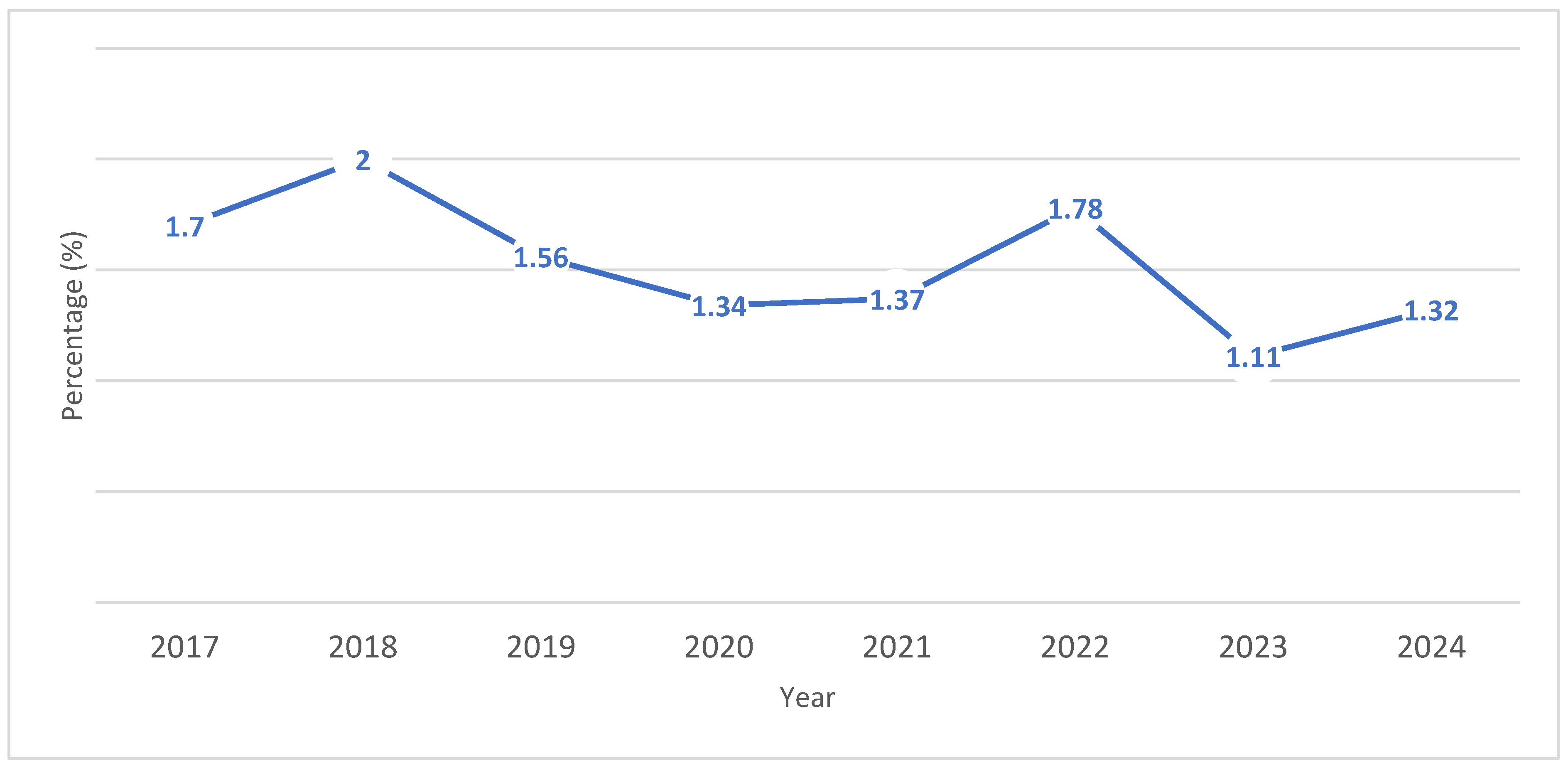
Figure 2.
Gross Production Value per Agricultural Worker in Nigeria from 2012 to 2022. Source: Authors' Elaboration based on FAOSTAT 2025.
Figure 2.
Gross Production Value per Agricultural Worker in Nigeria from 2012 to 2022. Source: Authors' Elaboration based on FAOSTAT 2025.
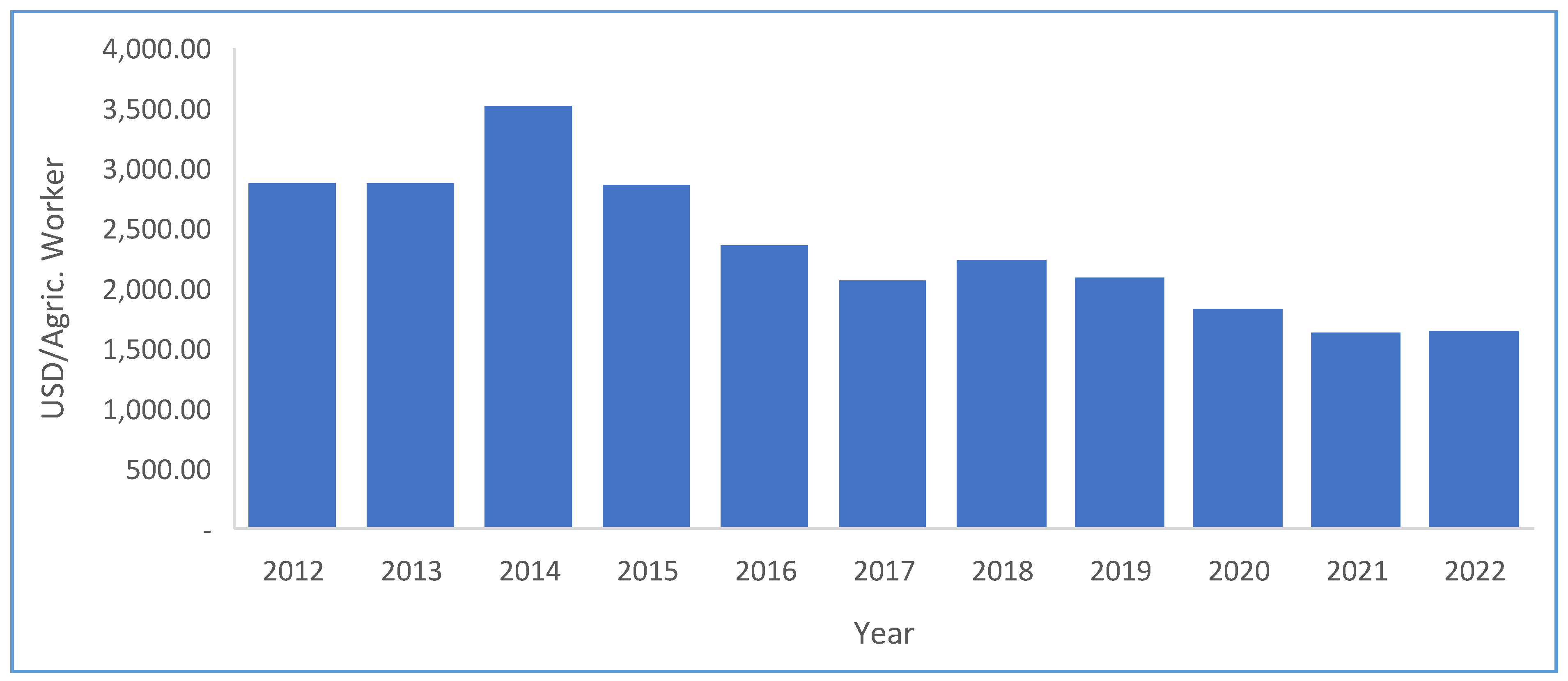
Figure 3.
Gross Production Value per Hectare of Agricultural Land in Nigeria from 2012 to 2022. Source: Authors' Elaboration based on FAOSTAT 2025.
Figure 3.
Gross Production Value per Hectare of Agricultural Land in Nigeria from 2012 to 2022. Source: Authors' Elaboration based on FAOSTAT 2025.
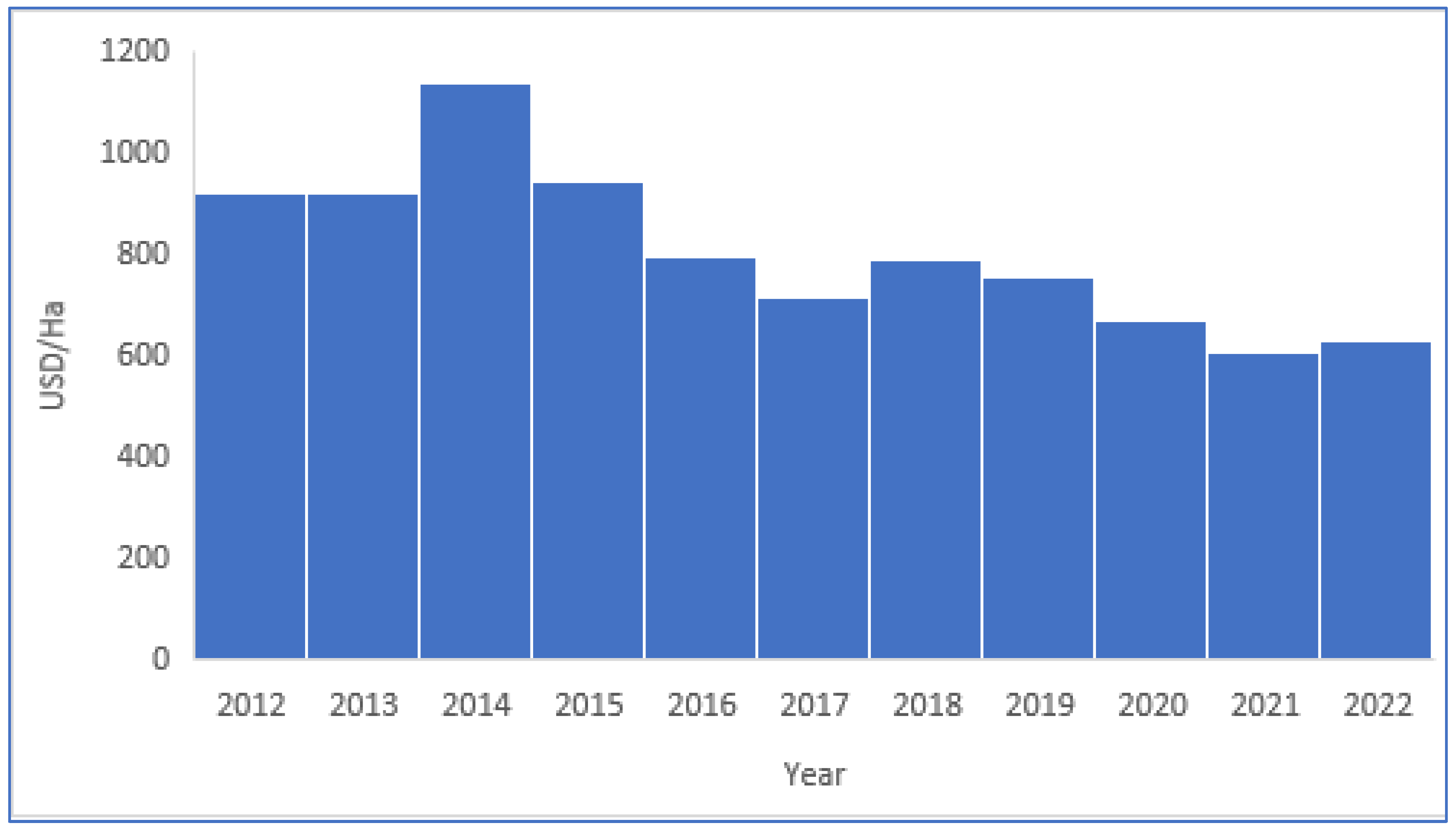
Figure 4.
Gross Production Value per Farm in Nigeria from 2012 to 2022. Source: Authors' Elaboration based on FAOSTAT 2025.
Figure 4.
Gross Production Value per Farm in Nigeria from 2012 to 2022. Source: Authors' Elaboration based on FAOSTAT 2025.
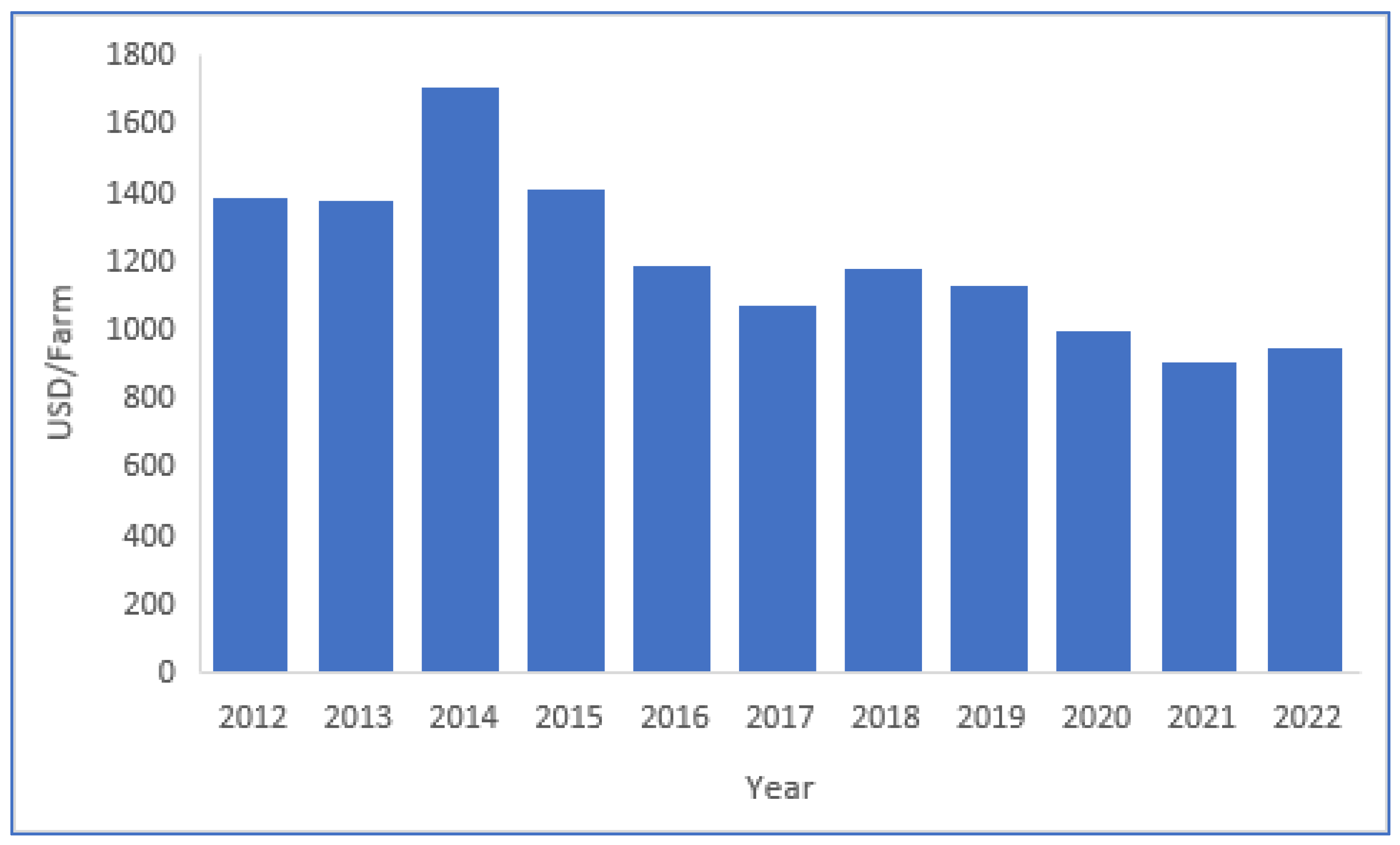
Figure 5.
Gross Value Added per Agricultural Worker in Nigeria from 2012 to 2022. Source: Authors' Elaboration based on FAOSTAT 2025.
Figure 5.
Gross Value Added per Agricultural Worker in Nigeria from 2012 to 2022. Source: Authors' Elaboration based on FAOSTAT 2025.
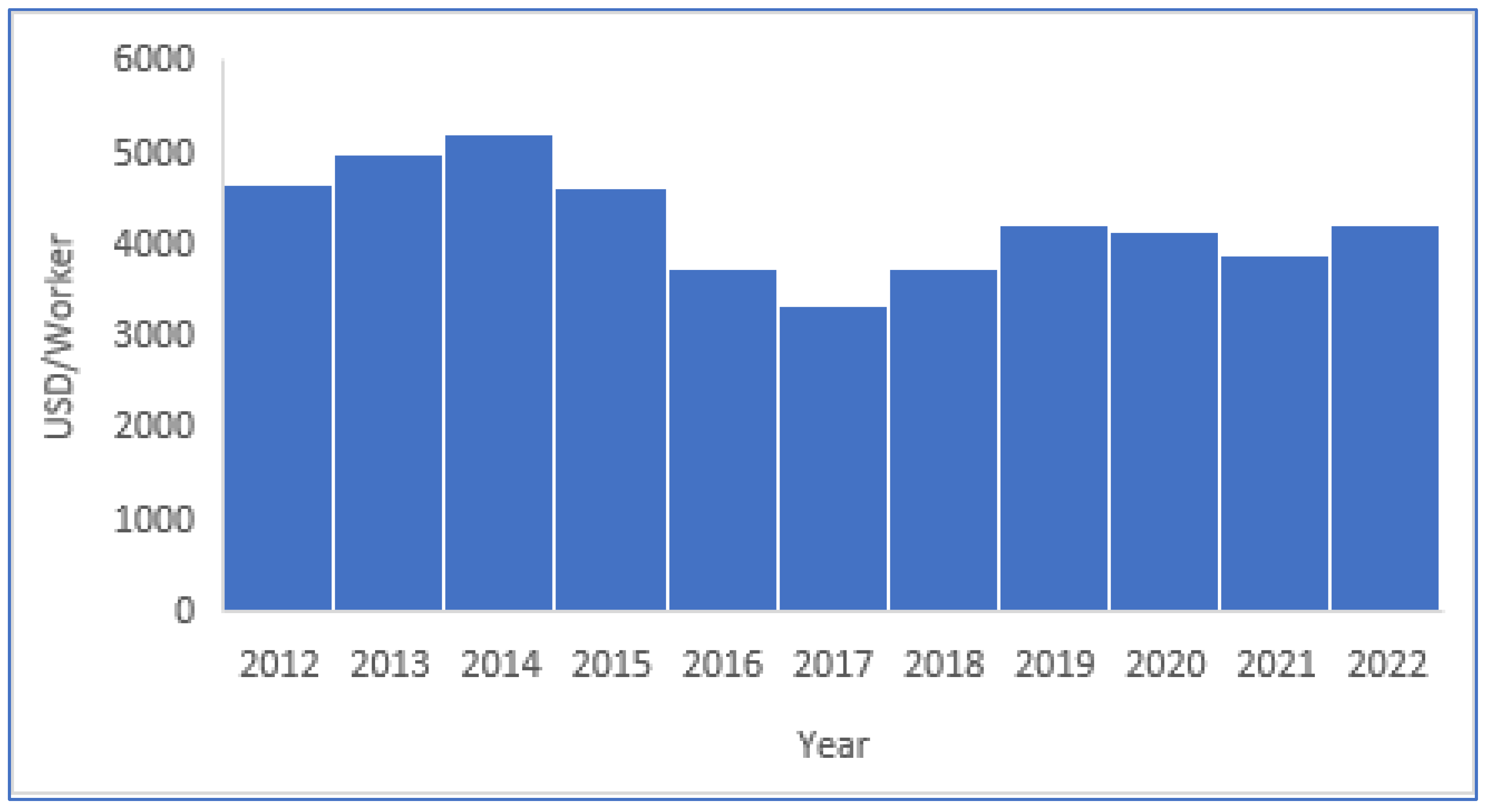
Figure 6.
Gross Value Added per Agricultural Land in Nigeria from 2012 to 2022. Source: Authors' Elaboration based on FAOSTAT 2025.
Figure 6.
Gross Value Added per Agricultural Land in Nigeria from 2012 to 2022. Source: Authors' Elaboration based on FAOSTAT 2025.
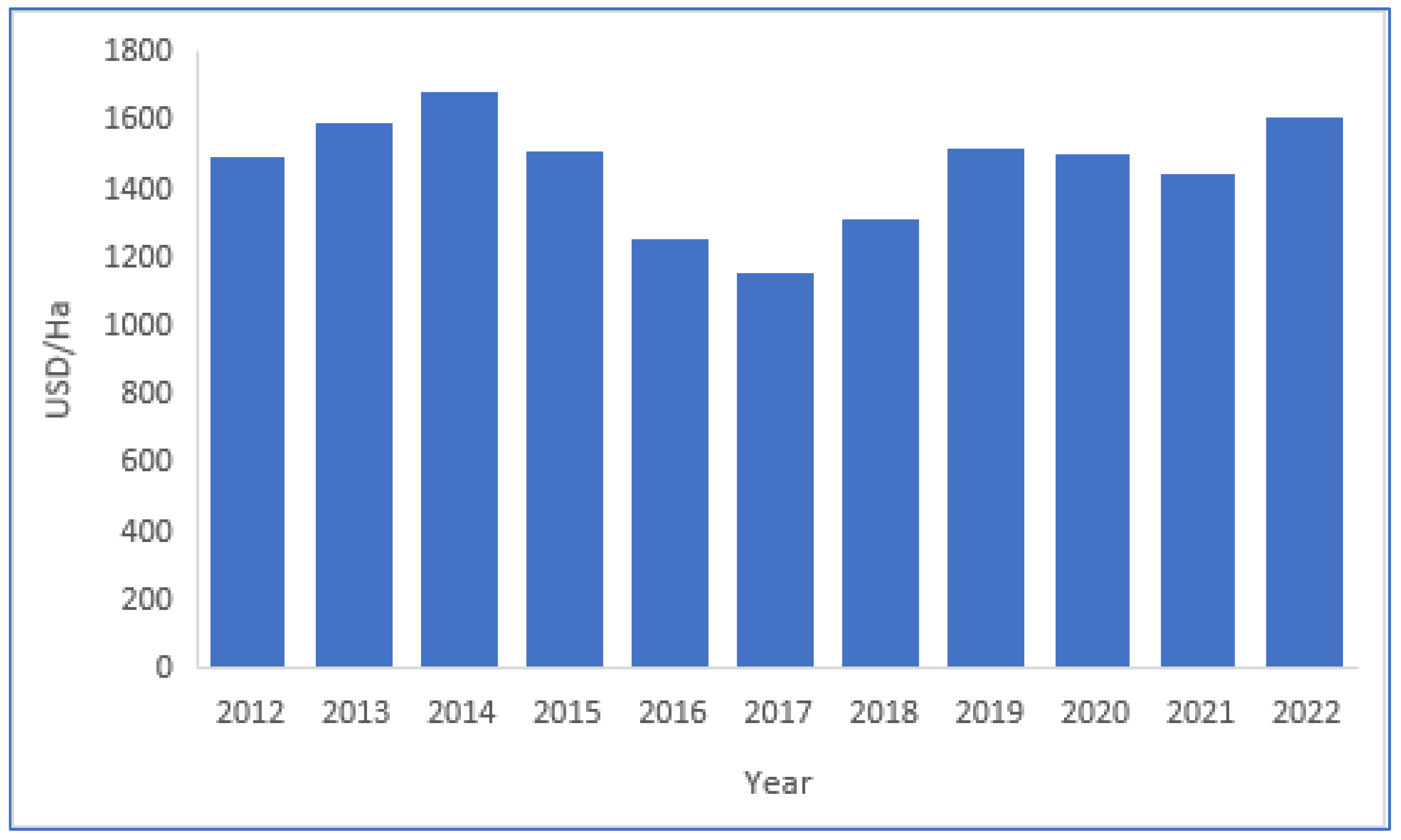
Figure 7.
Gross Value Added per Farm in Nigeria from 2012 to 2022. Source: Authors' Elaboration based on FAOSTAT 2025.
Figure 7.
Gross Value Added per Farm in Nigeria from 2012 to 2022. Source: Authors' Elaboration based on FAOSTAT 2025.
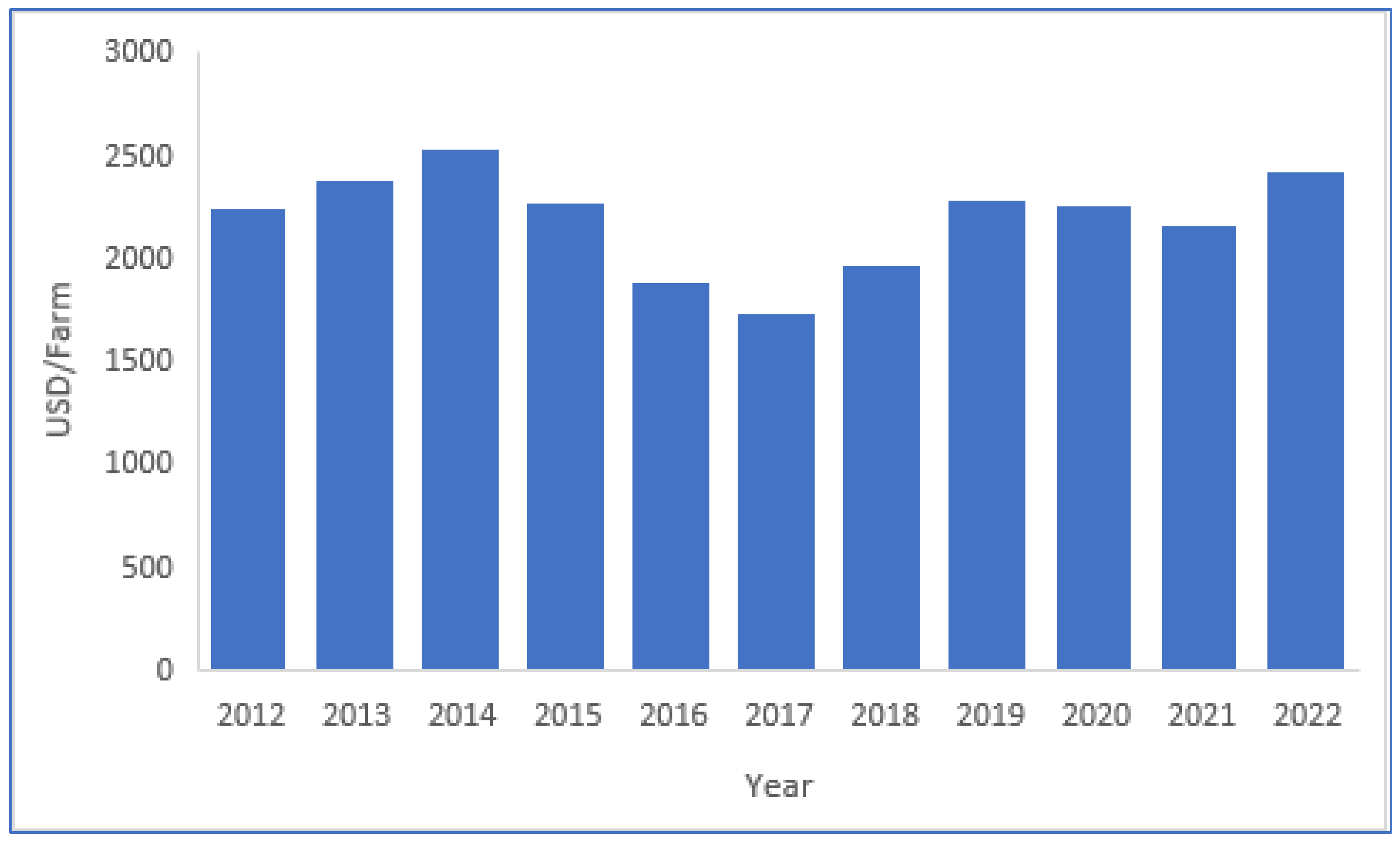
Figure 8.
Data on Internet Access in Nigeria, 2013-2023. Source: Nigerian Communications Commission (NCC), 2023.
Figure 8.
Data on Internet Access in Nigeria, 2013-2023. Source: Nigerian Communications Commission (NCC), 2023.
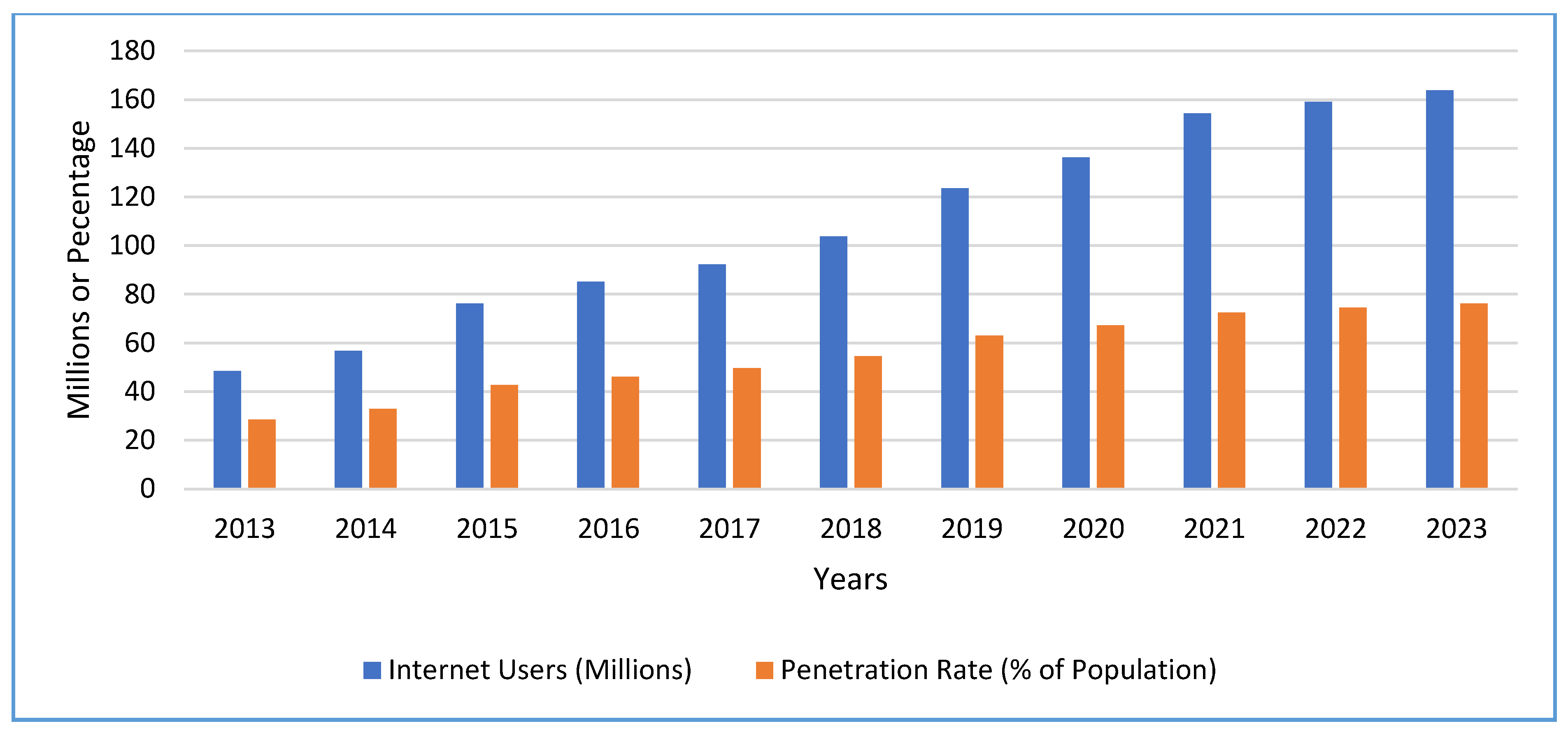
Figure 9.
Geopolitical Zone in Nigeria. Source: Olu-Adeyemi, 2017.

Figure 10.
Rice Productivity (Ton/Ha) by Regions in Nigeria for 2020-2021. Source: NAERLS and FMARD (2021). National Report of Wet Season Agricultural Performance in Nigeria.
Figure 10.
Rice Productivity (Ton/Ha) by Regions in Nigeria for 2020-2021. Source: NAERLS and FMARD (2021). National Report of Wet Season Agricultural Performance in Nigeria.
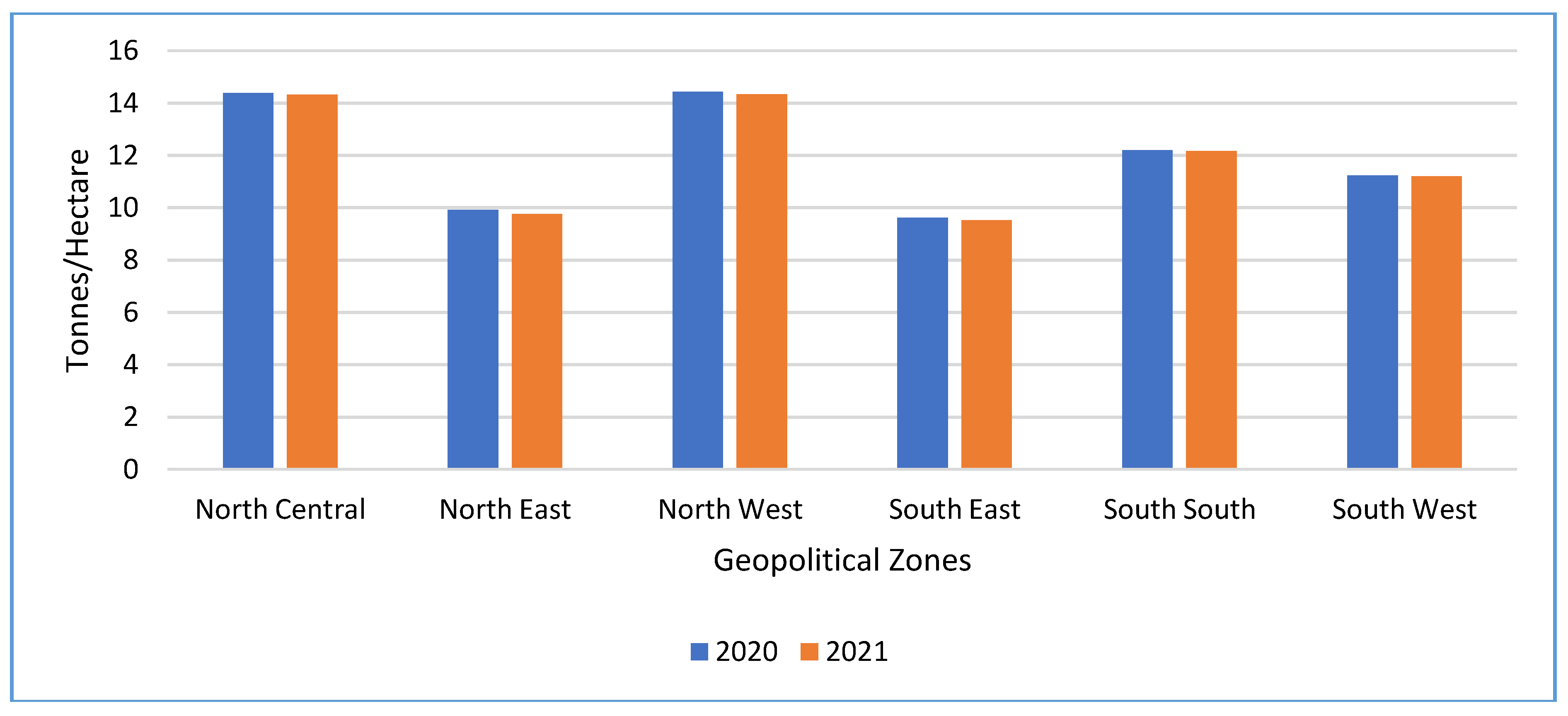
Figure 11.
Maize Productivity (Ton/Ha) by Regions in Nigeria for 2020-2021. Source: NAERLS and FMARD (2021). National Report of Wet Season Agricultural Performance in Nigeria.
Figure 11.
Maize Productivity (Ton/Ha) by Regions in Nigeria for 2020-2021. Source: NAERLS and FMARD (2021). National Report of Wet Season Agricultural Performance in Nigeria.
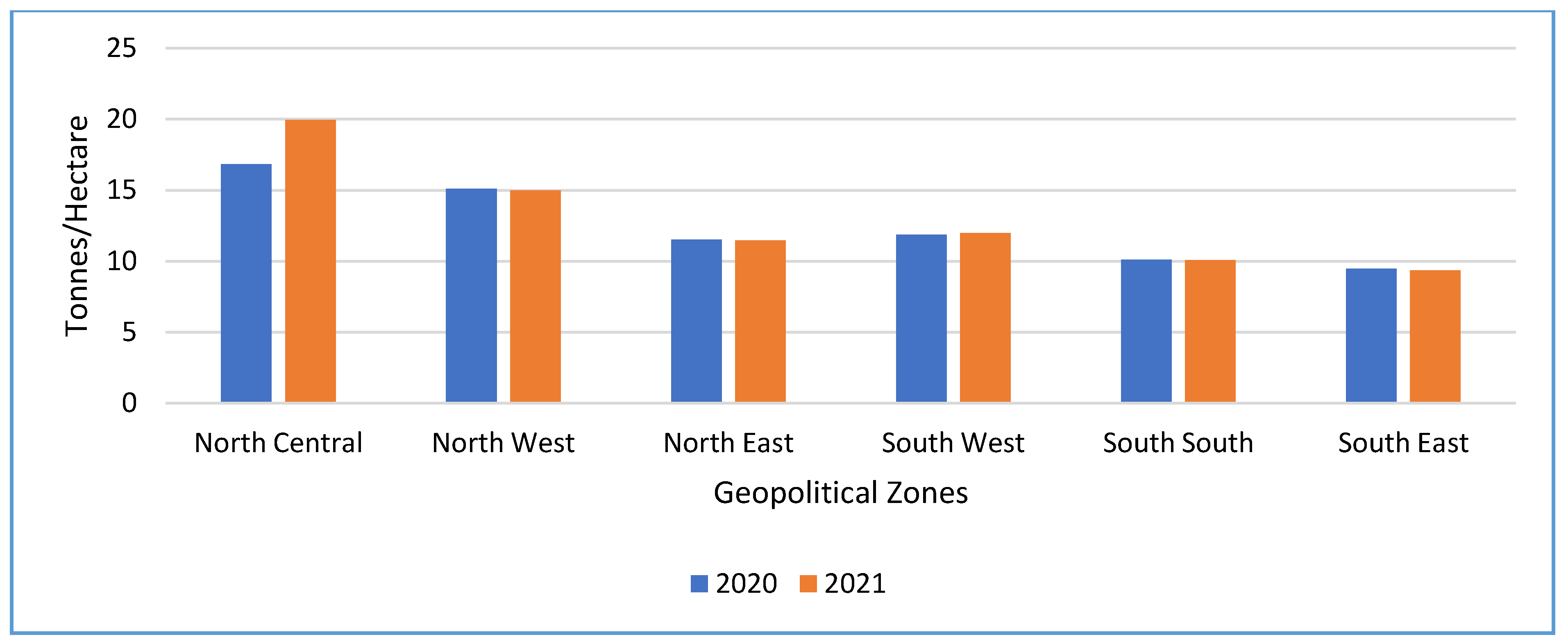
Figure 12.
Sorghum Productivity (Ton/Ha) by Regions in Nigeria for 2020-2021. Source: NAERLS and FMARD (2021). National Report of Wet Season Agricultural Performance in Nigeria.
Figure 12.
Sorghum Productivity (Ton/Ha) by Regions in Nigeria for 2020-2021. Source: NAERLS and FMARD (2021). National Report of Wet Season Agricultural Performance in Nigeria.
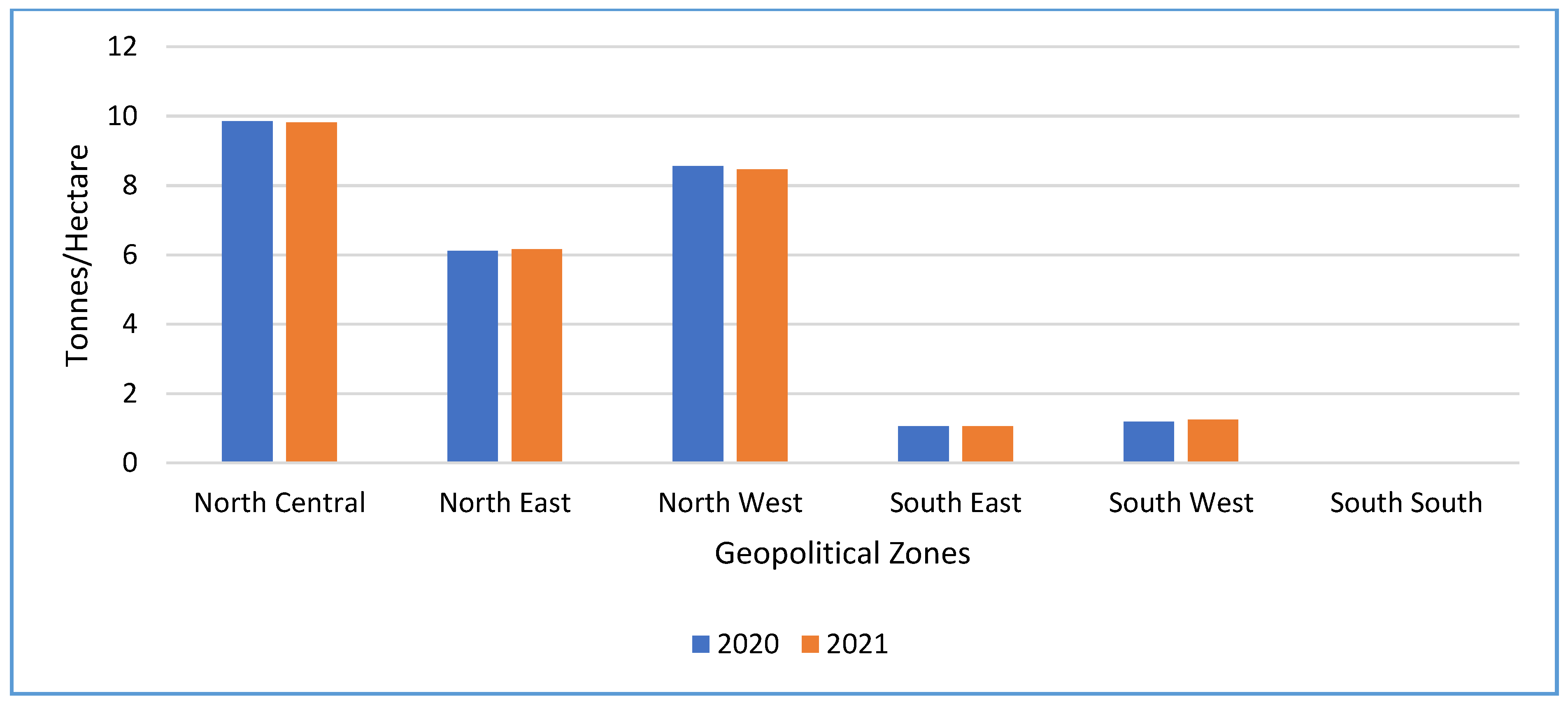
Figure 13.
Millet Productivity by Regions in Nigeria for 2020-2021. Source: NAERLS and FMARD (2021). National Report of Wet Season Agricultural Performance in Nigeria.
Figure 13.
Millet Productivity by Regions in Nigeria for 2020-2021. Source: NAERLS and FMARD (2021). National Report of Wet Season Agricultural Performance in Nigeria.
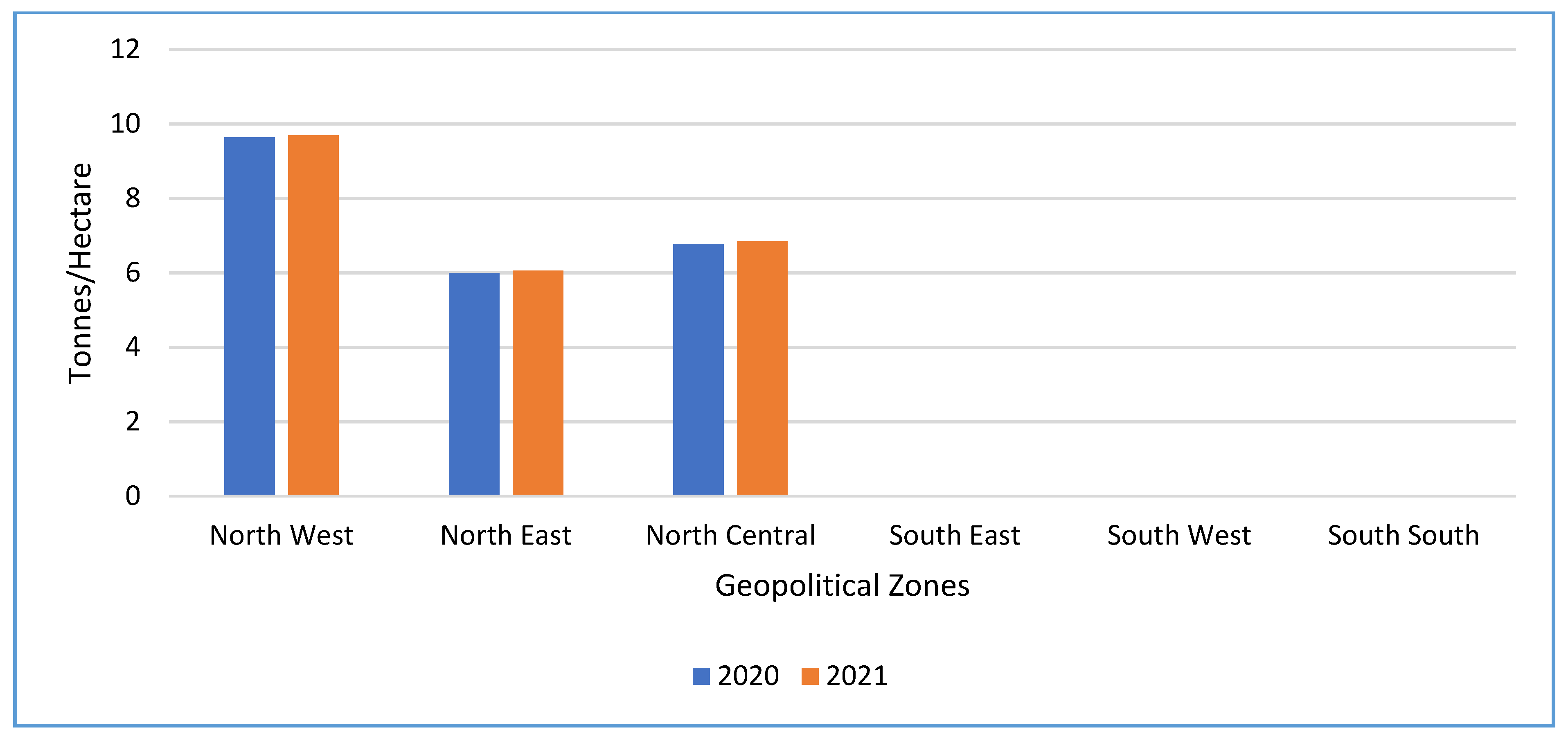
Figure 14.
Cowpea Productivity by Regions in Nigeria for 2020-2021. Source: NAERLS and FMARD (2021). National Report of Wet Season Agricultural Performance in Nigeria.
Figure 14.
Cowpea Productivity by Regions in Nigeria for 2020-2021. Source: NAERLS and FMARD (2021). National Report of Wet Season Agricultural Performance in Nigeria.
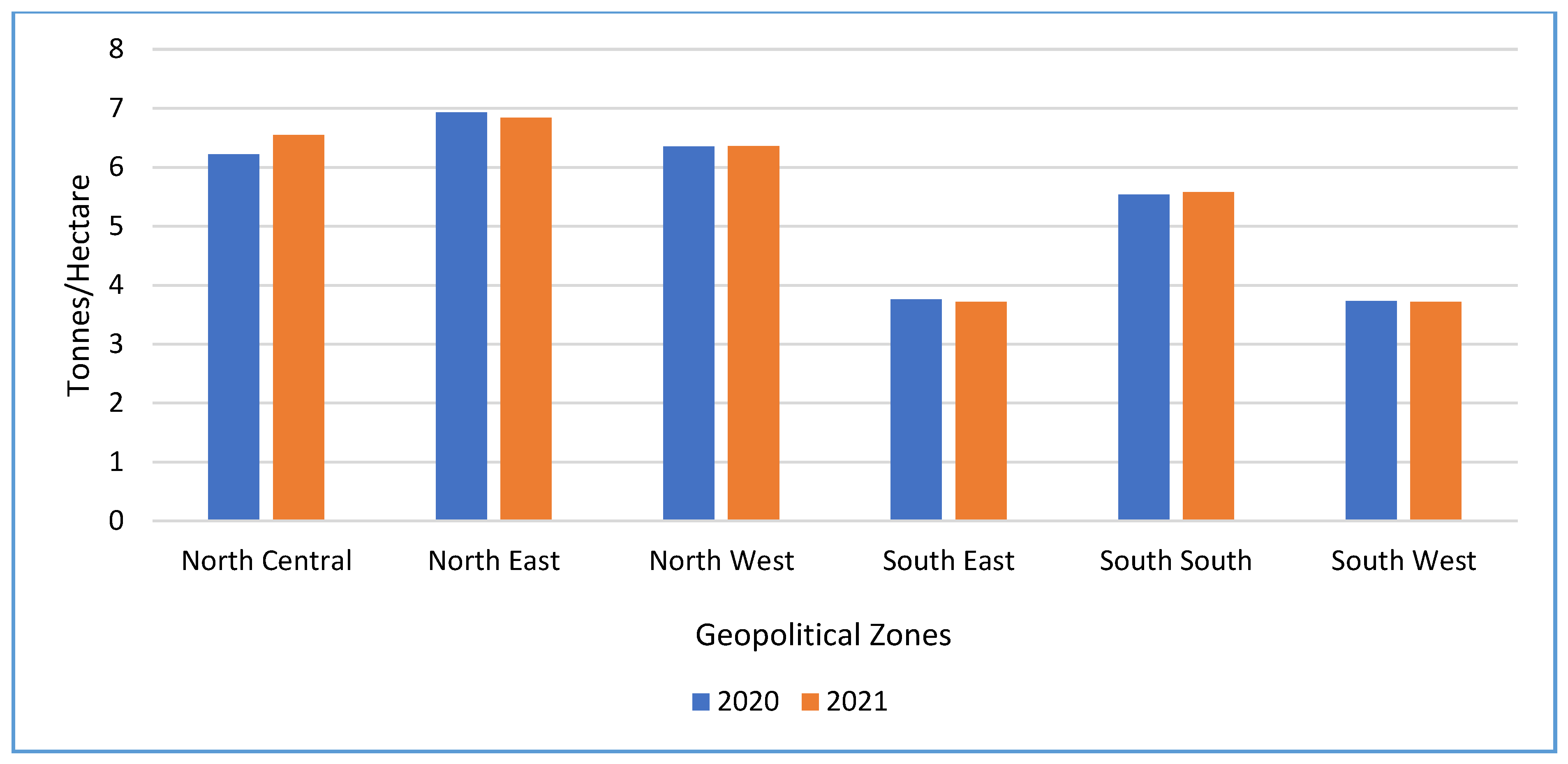
Figure 15.
Groundnut Productivity by Regions in Nigeria for 2020-2021. Source: NAERLS and FMARD (2021). National Report of Wet Season Agricultural Performance in Nigeria.
Figure 15.
Groundnut Productivity by Regions in Nigeria for 2020-2021. Source: NAERLS and FMARD (2021). National Report of Wet Season Agricultural Performance in Nigeria.
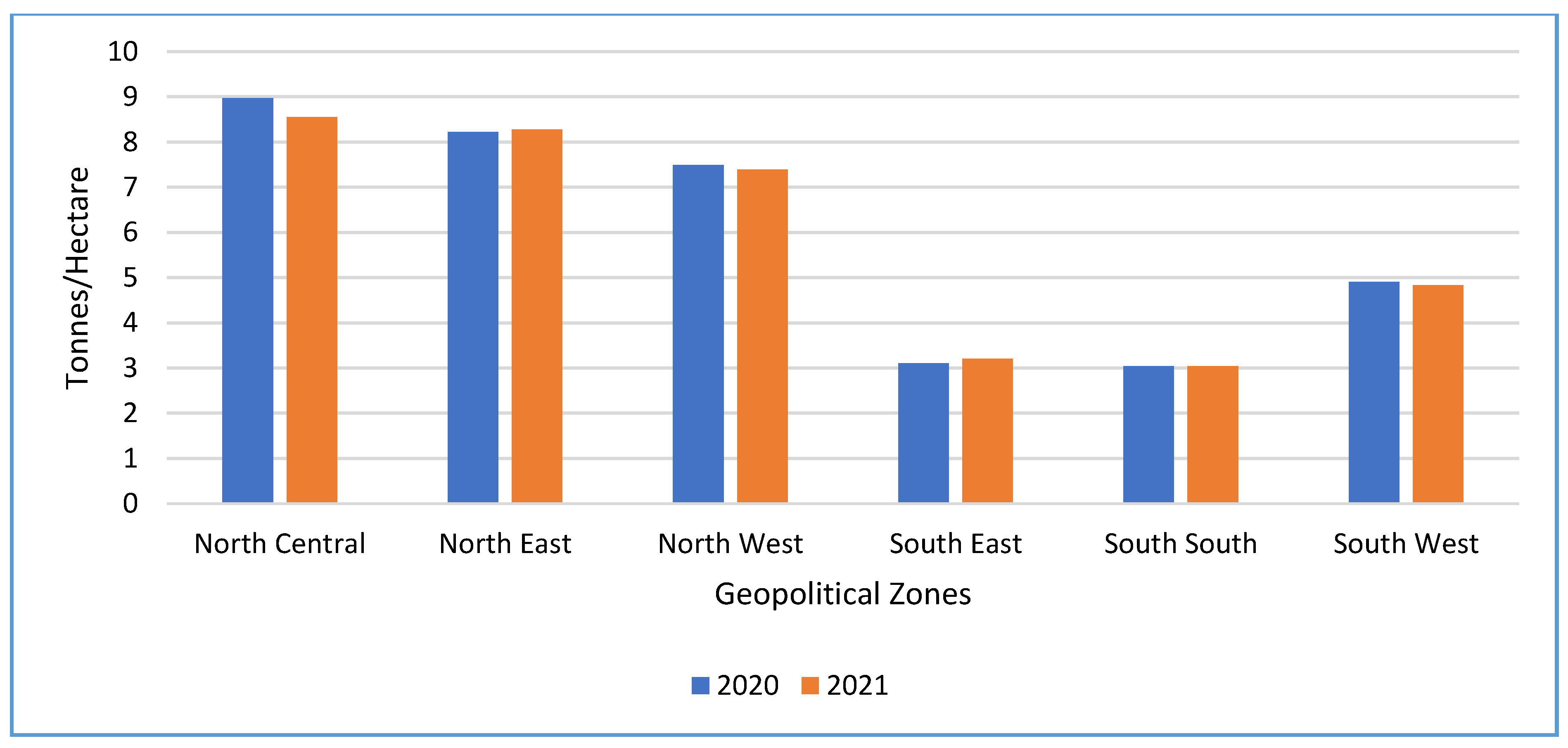
Figure 16.
Beniseed Productivity by Regions in Nigeria for 2020-2021. Source: NAERLS and FMARD (2021). National Report of Wet Season Agricultural Performance in Nigeria.
Figure 16.
Beniseed Productivity by Regions in Nigeria for 2020-2021. Source: NAERLS and FMARD (2021). National Report of Wet Season Agricultural Performance in Nigeria.
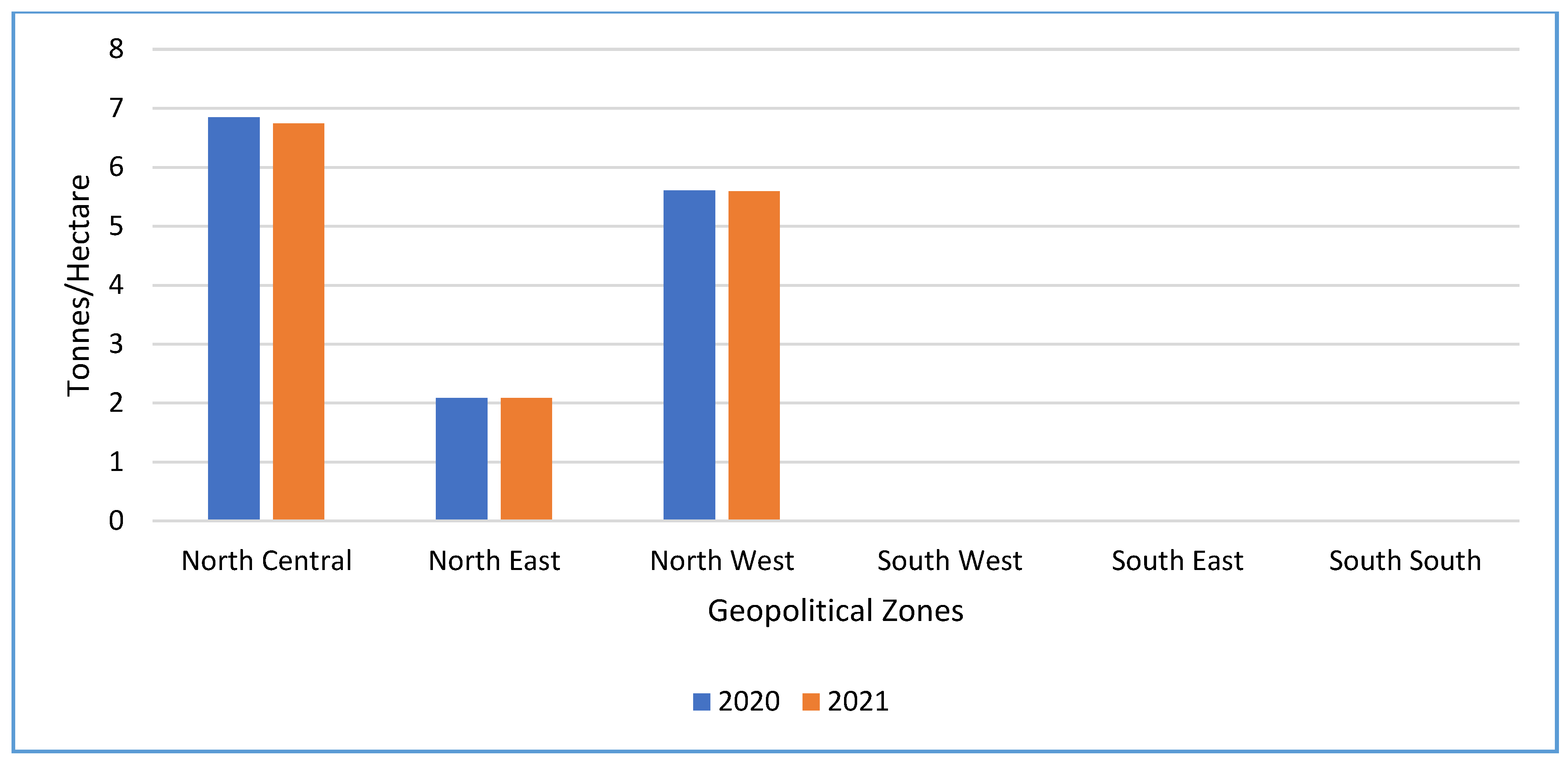
Figure 17.
Yam Productivity by Regions in Nigeria for 2020-2021. Source: NAERLS and FMARD (2021). National Report of Wet Season Agricultural Performance in Nigeria.
Figure 17.
Yam Productivity by Regions in Nigeria for 2020-2021. Source: NAERLS and FMARD (2021). National Report of Wet Season Agricultural Performance in Nigeria.
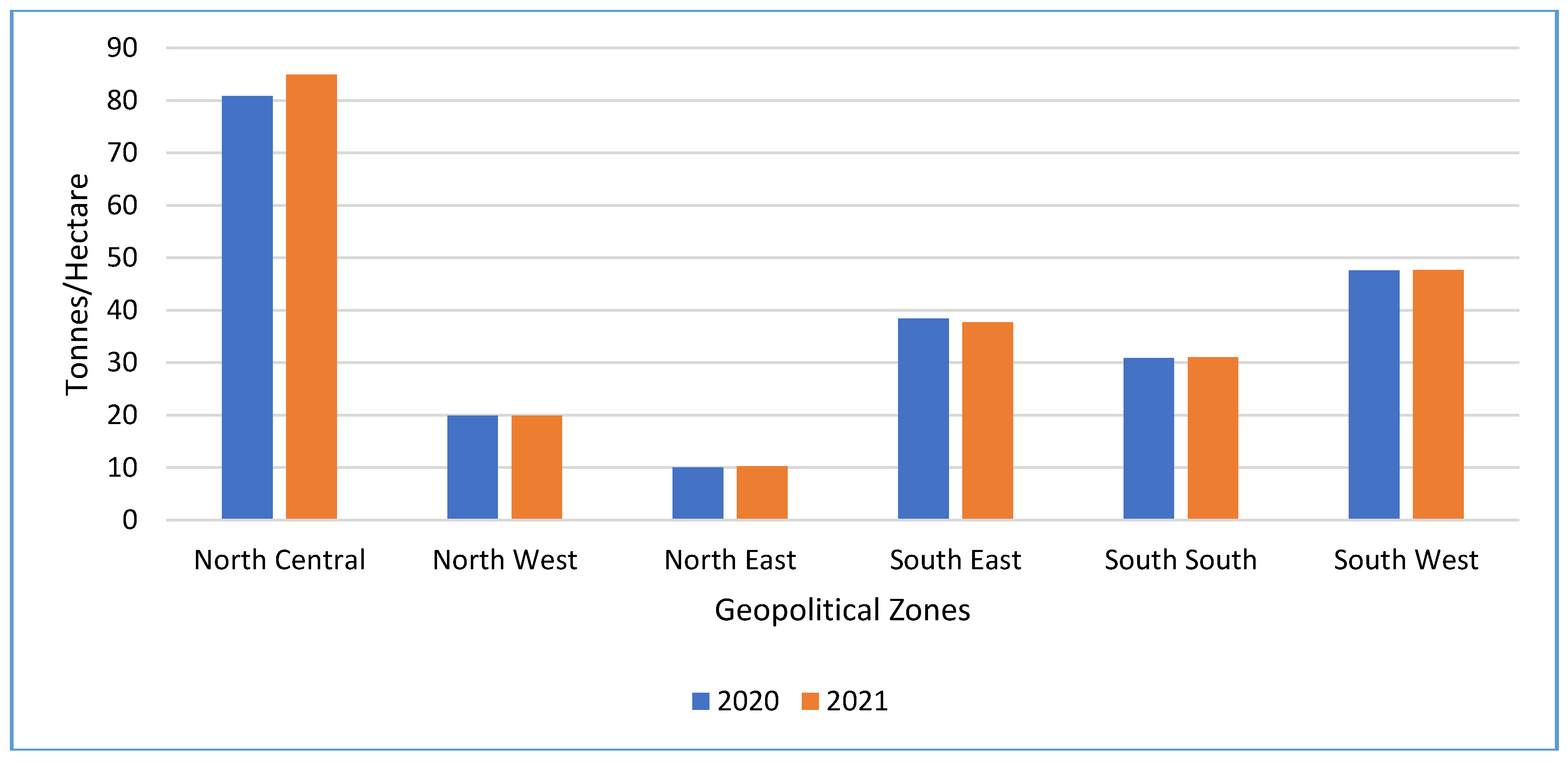
Figure 18.
Cassava Productivity by Regions in Nigeria for 2020-2021. Source: NAERLS and FMARD (2021). National Report of Wet Season Agricultural Performance in Nigeria.
Figure 18.
Cassava Productivity by Regions in Nigeria for 2020-2021. Source: NAERLS and FMARD (2021). National Report of Wet Season Agricultural Performance in Nigeria.

Figure 19.
Cotton Productivity by Regions in Nigeria for 2020-2021. Source: NAERLS and FMARD (2021). National Report of Wet Season Agricultural Performance in Nigeria.
Figure 19.
Cotton Productivity by Regions in Nigeria for 2020-2021. Source: NAERLS and FMARD (2021). National Report of Wet Season Agricultural Performance in Nigeria.
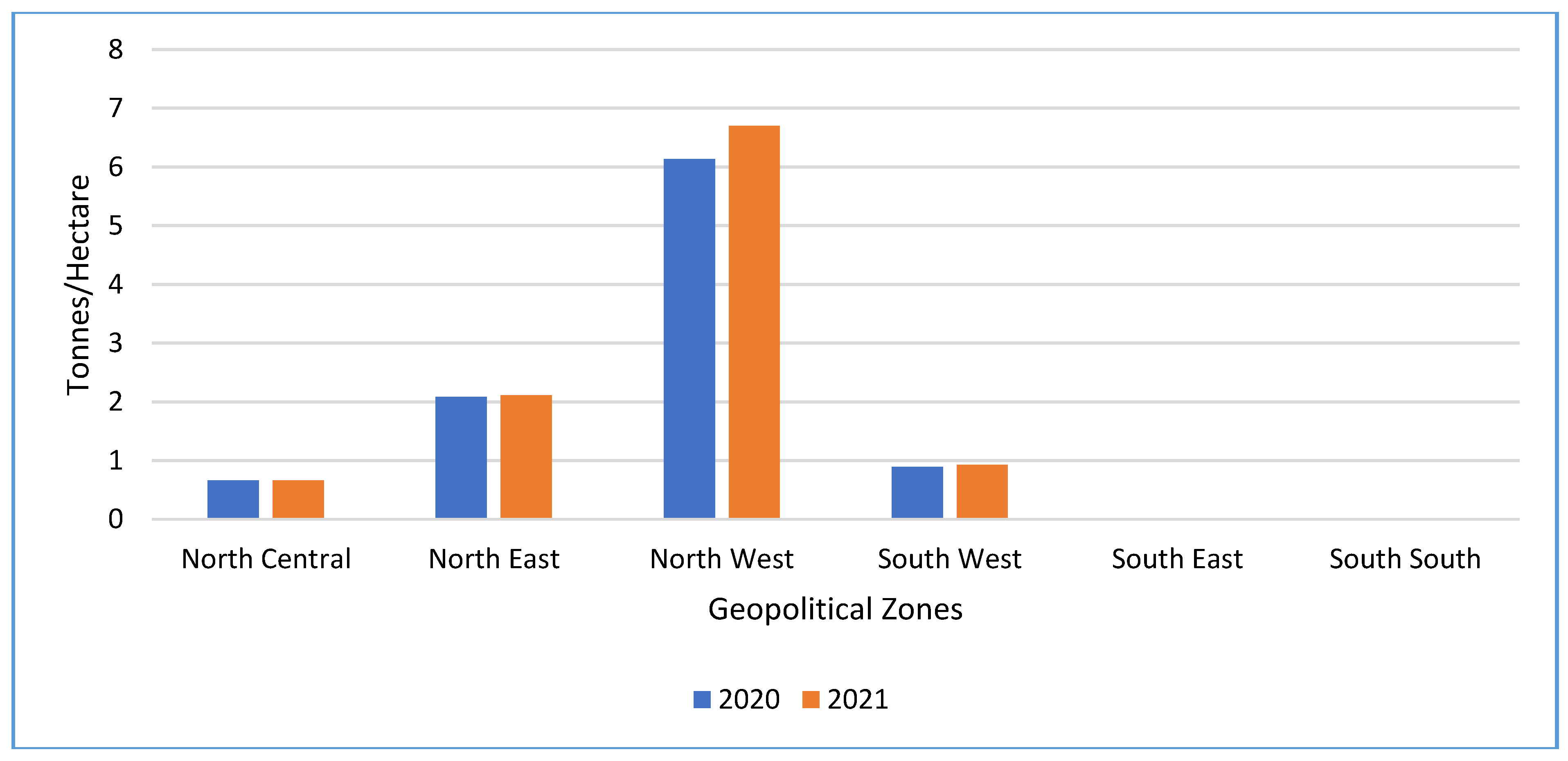
Figure 20.
Ginger Productivity by Regions in Nigeria for 2020-2021. Source: NAERLS and FMARD (2021). National Report of Wet Season Agricultural Performance in Nigeria.
Figure 20.
Ginger Productivity by Regions in Nigeria for 2020-2021. Source: NAERLS and FMARD (2021). National Report of Wet Season Agricultural Performance in Nigeria.
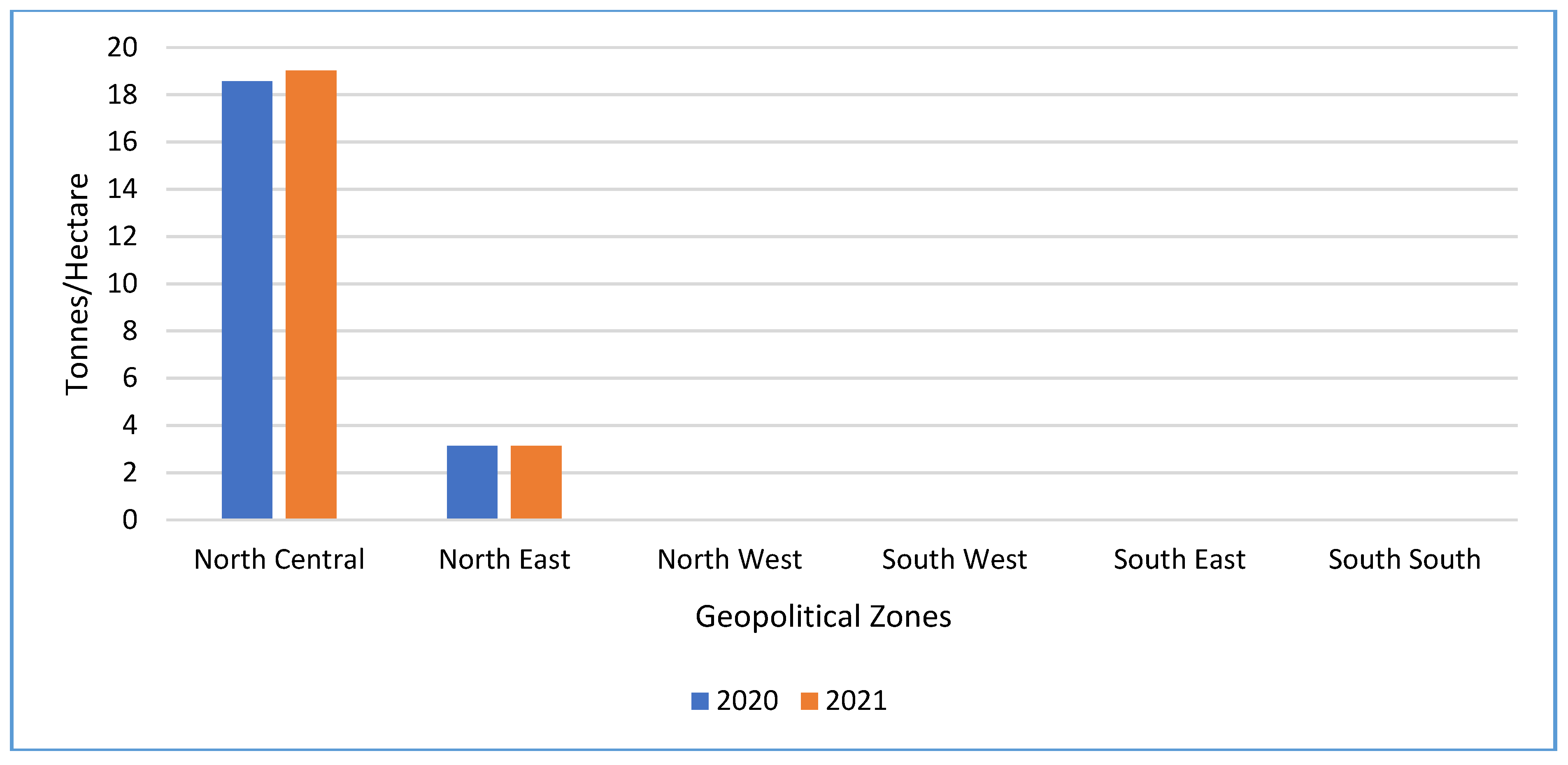
Figure 21.
Tomato Productivity by Regions in Nigeria for 2020-2021. Source: NAERLS and FMARD (2021). National Report of Wet Season Agricultural Performance in Nigeria.
Figure 21.
Tomato Productivity by Regions in Nigeria for 2020-2021. Source: NAERLS and FMARD (2021). National Report of Wet Season Agricultural Performance in Nigeria.
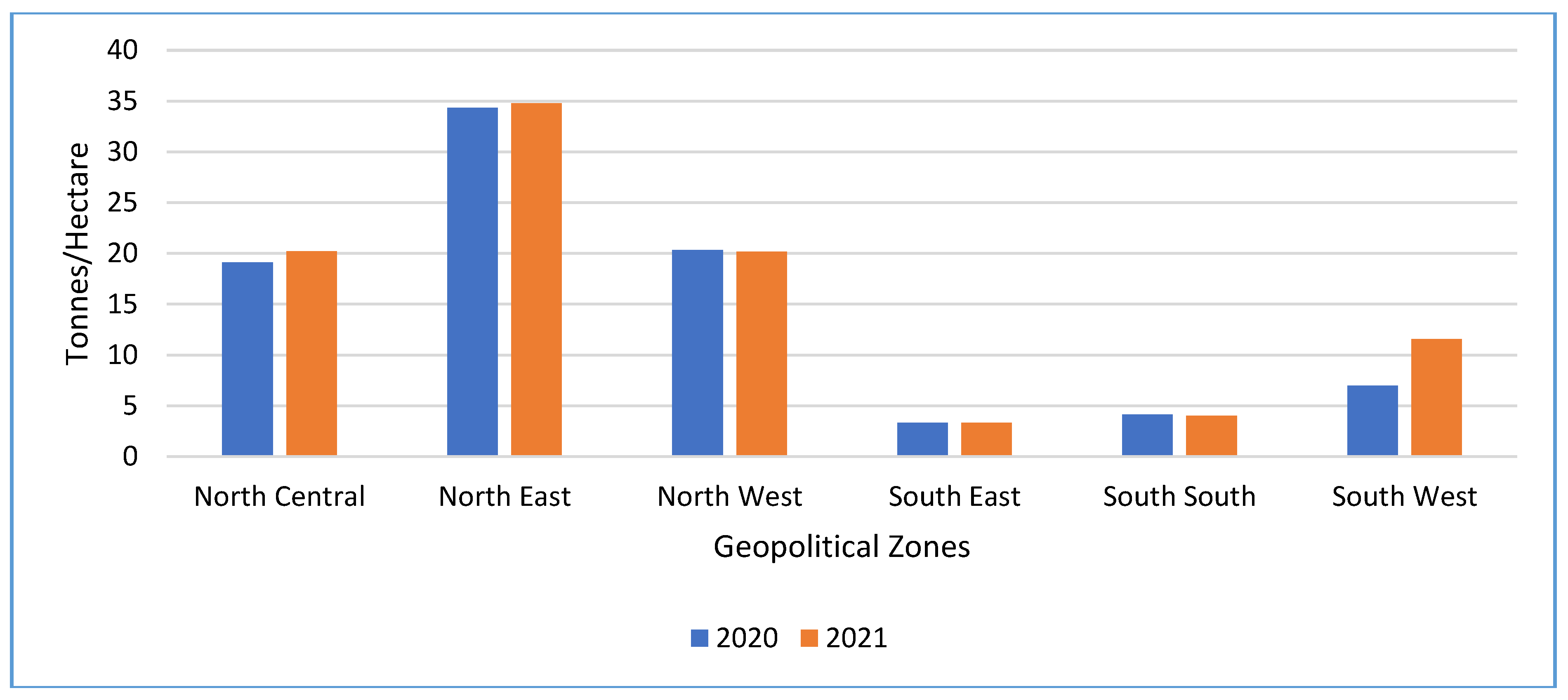
Figure 22.
Onion Productivity by Regions in Nigeria for 2020-2021. Source: NAERLS and FMARD (2021). National Report of Wet Season Agricultural Performance in Nigeria.
Figure 22.
Onion Productivity by Regions in Nigeria for 2020-2021. Source: NAERLS and FMARD (2021). National Report of Wet Season Agricultural Performance in Nigeria.
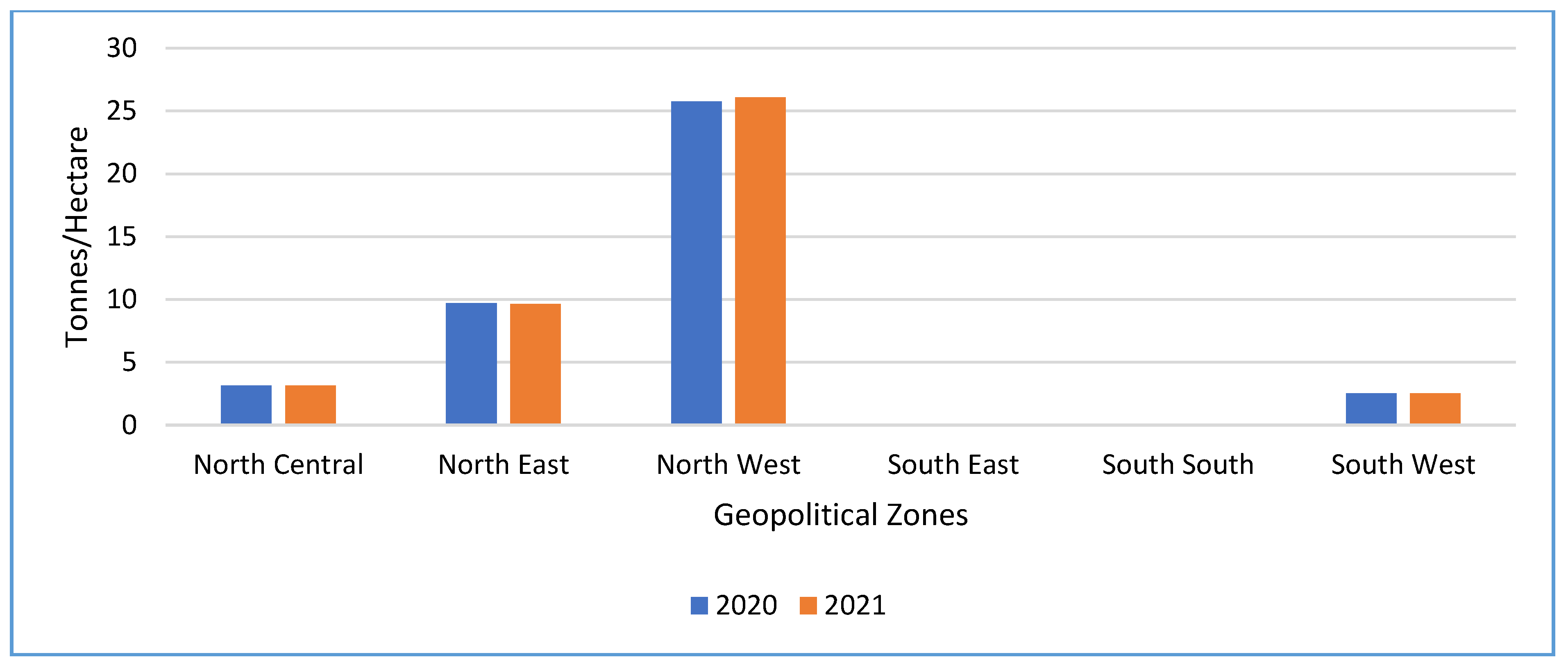
Figure 23.
Plantain and banana Productivity by Regions in Nigeria for 2020-2021. Source: NAERLS and FMARD (2021). National Report of Wet Season Agricultural Performance in Nigeria.
Figure 23.
Plantain and banana Productivity by Regions in Nigeria for 2020-2021. Source: NAERLS and FMARD (2021). National Report of Wet Season Agricultural Performance in Nigeria.
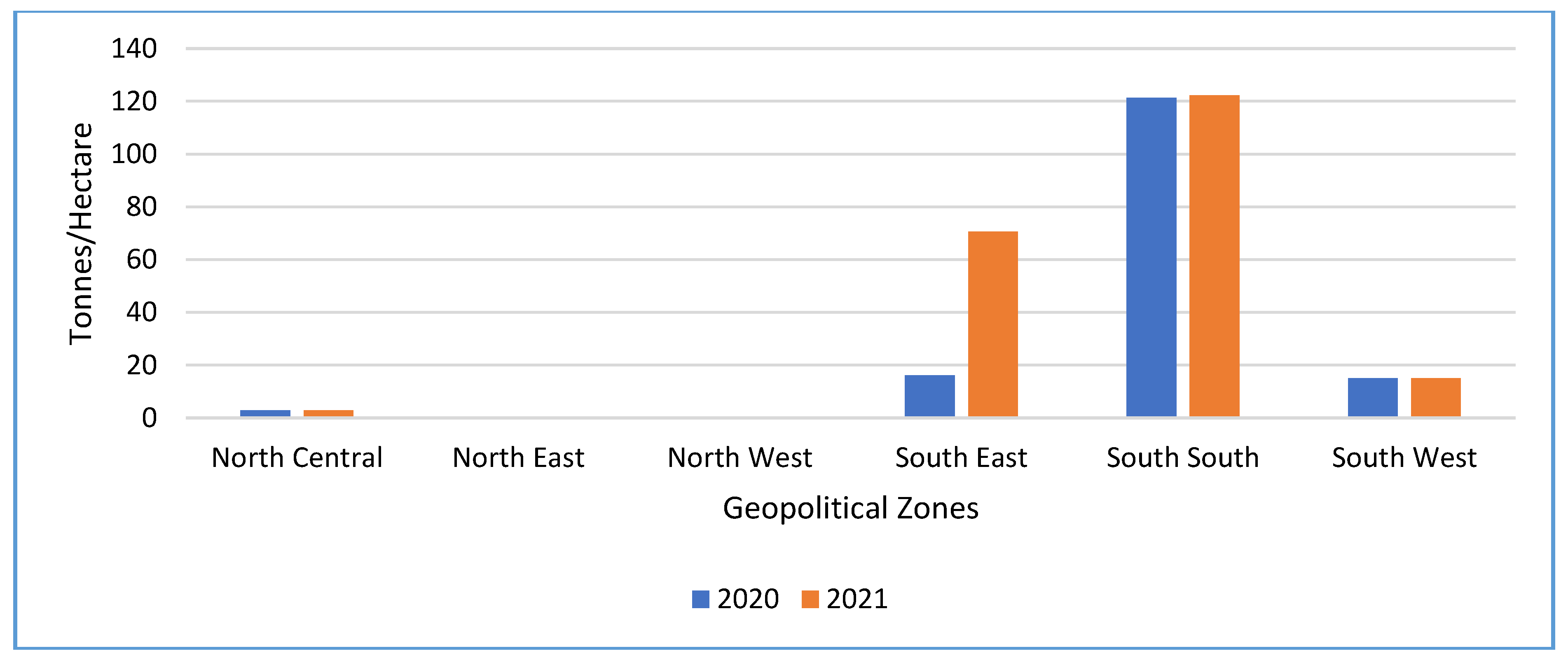
Figure 24.
Livestock Population by Regions in Nigeria for 2020-2021. Source: NAERLS and FMARD (2021). National Report of Wet Season Agricultural Performance in Nigeria.
Figure 24.
Livestock Population by Regions in Nigeria for 2020-2021. Source: NAERLS and FMARD (2021). National Report of Wet Season Agricultural Performance in Nigeria.
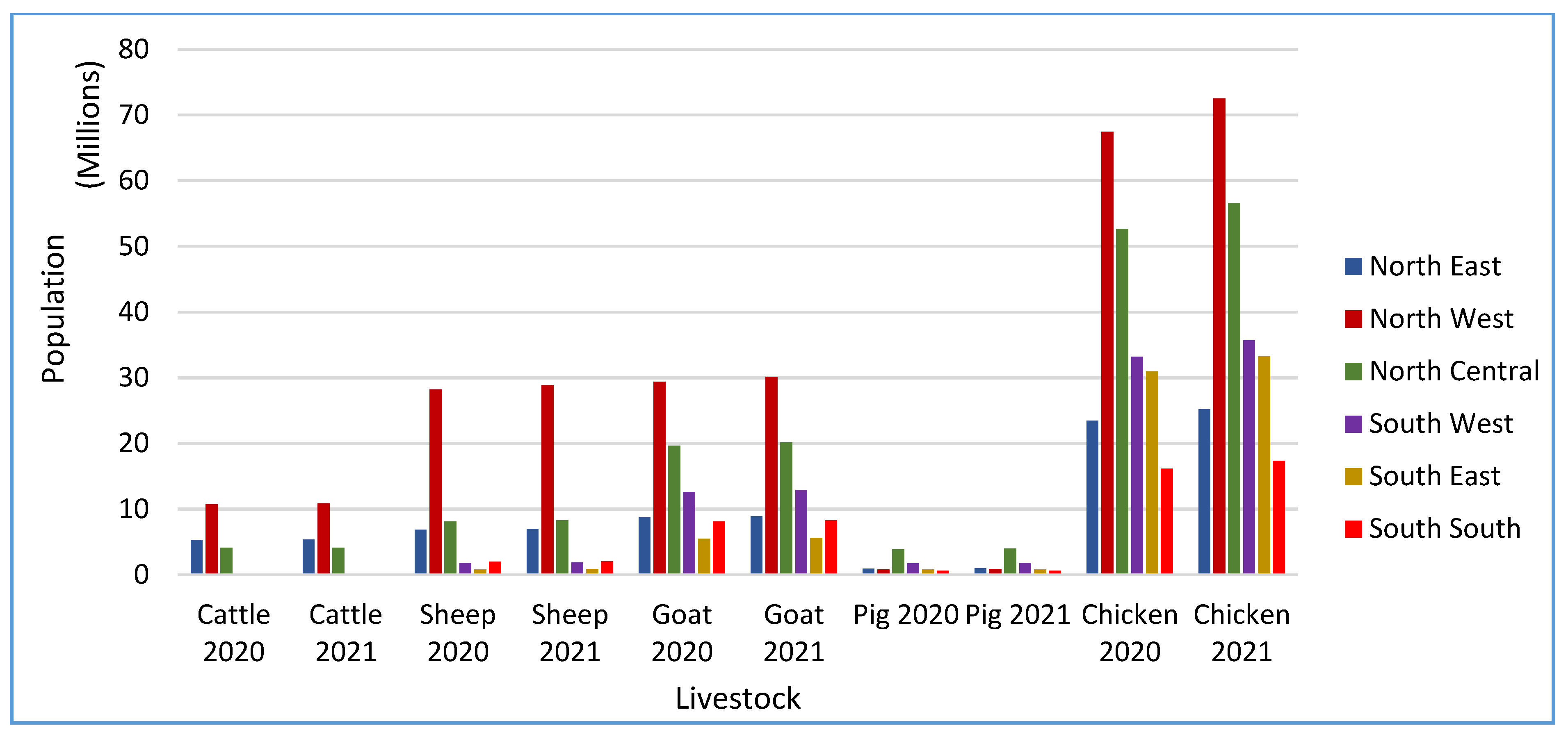
Figure 25.
Nigeria Food Exports/Imports (% of Merchandise Exports/Imports) from 2011 to 2023. Source: FAOSTAT 2025.
Figure 25.
Nigeria Food Exports/Imports (% of Merchandise Exports/Imports) from 2011 to 2023. Source: FAOSTAT 2025.
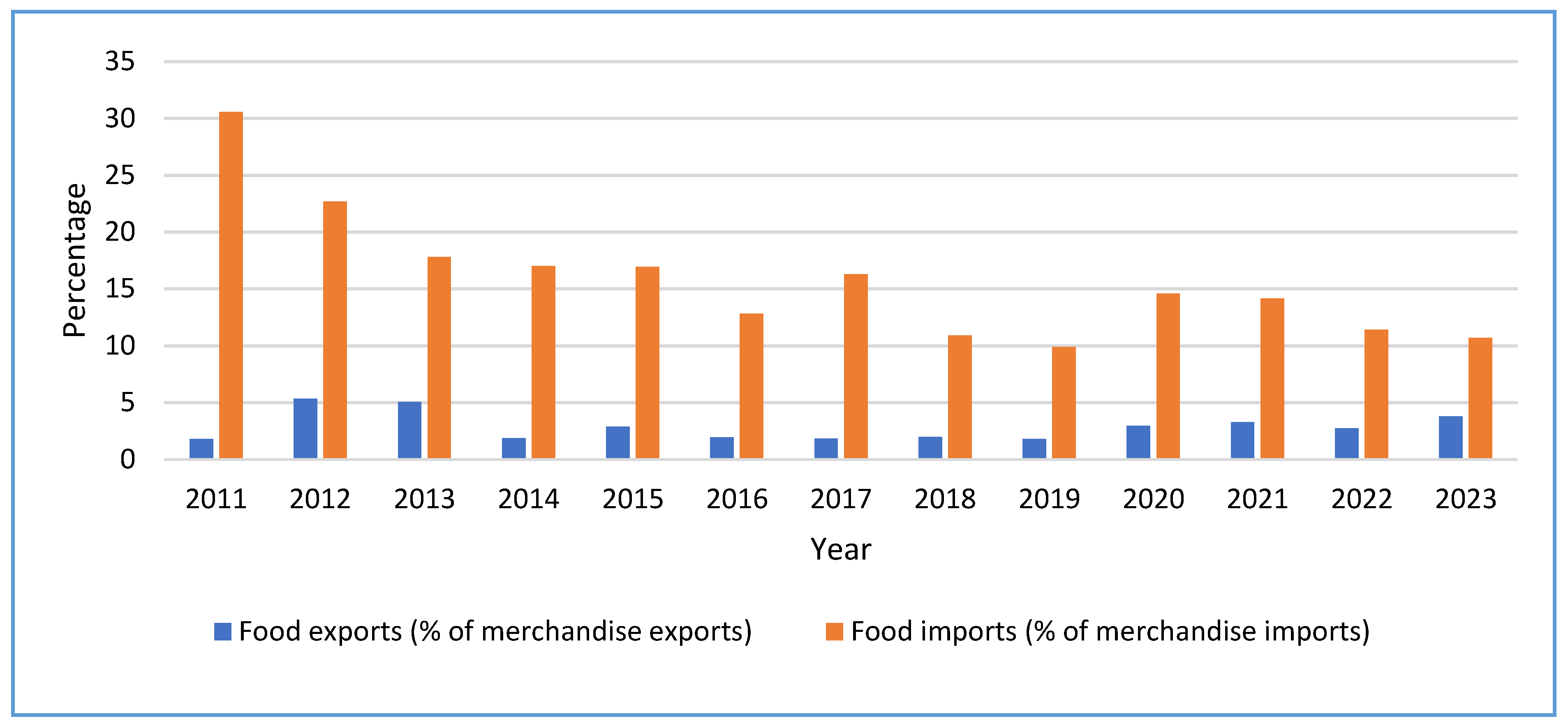
Figure 26.
Export per Hectare of Main Agriculture Products ($/ha). Source: Authors' Elaboration Based on FAOSTAT 2025.
Figure 26.
Export per Hectare of Main Agriculture Products ($/ha). Source: Authors' Elaboration Based on FAOSTAT 2025.
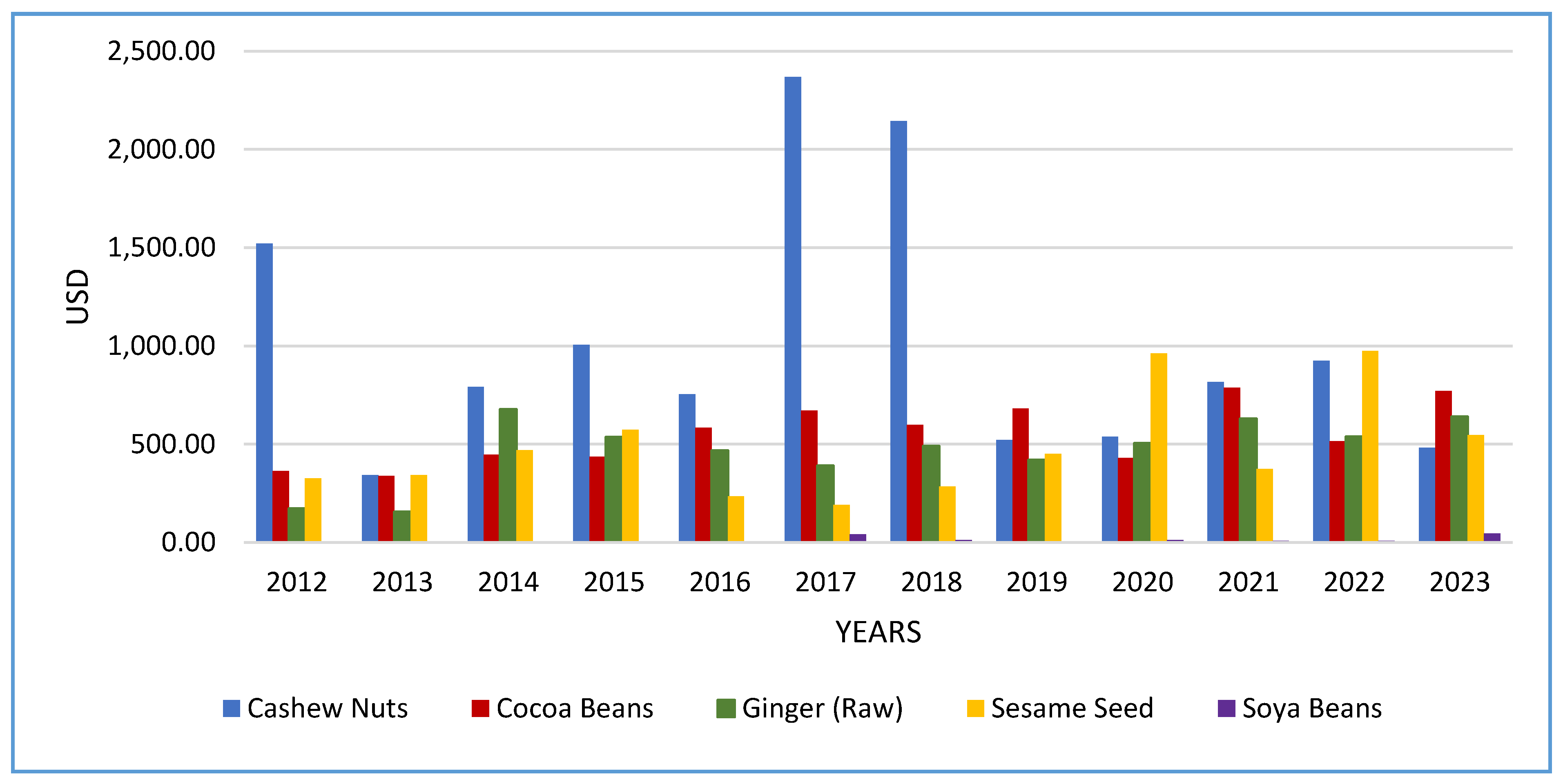
Figure 27.
Share of Food Exports in Total Merchandise Export Across Selected African Countries (%), 2018. Source: World Bank Data 2018.
Figure 27.
Share of Food Exports in Total Merchandise Export Across Selected African Countries (%), 2018. Source: World Bank Data 2018.
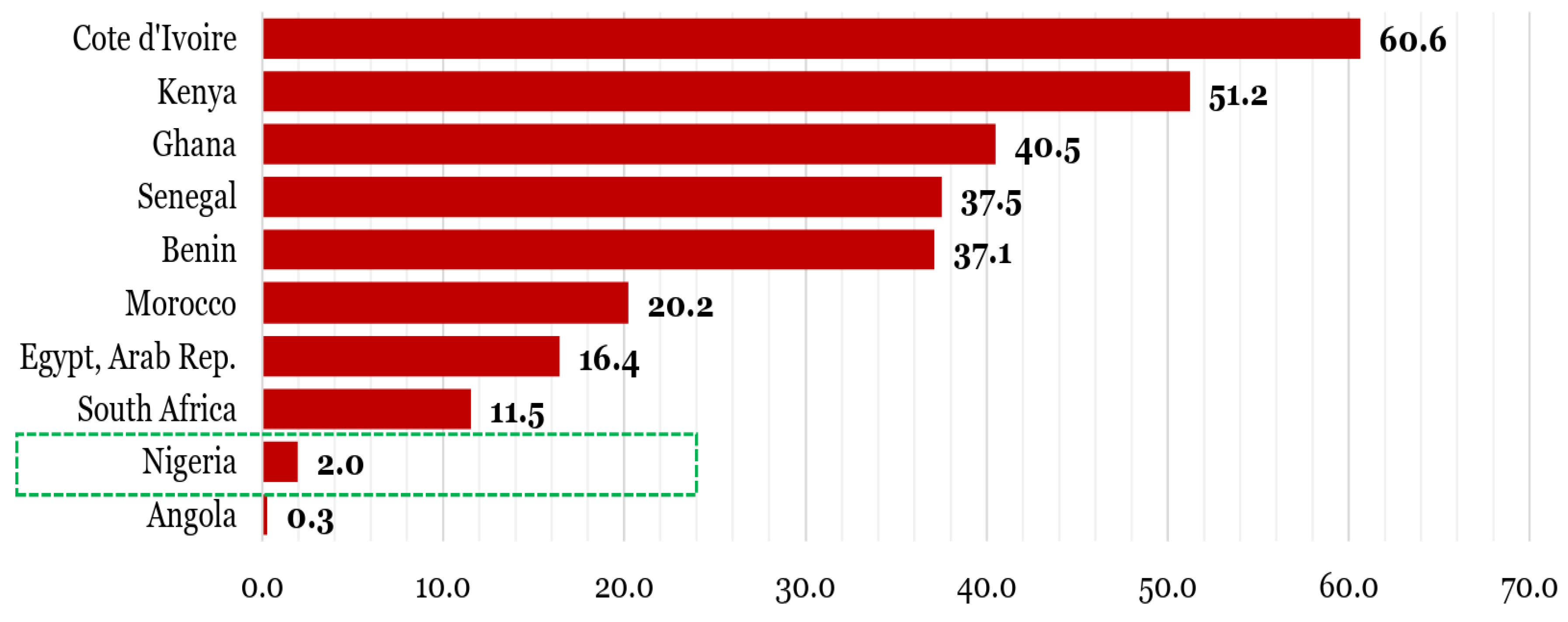

Table 1.
Self-Sufficiency Ratio for Major Crops in Nigeria and their percentage change from 2012 to 2022.
Table 1.
Self-Sufficiency Ratio for Major Crops in Nigeria and their percentage change from 2012 to 2022.
| Years | Rice (SSR) (%) | Percentage Change (%) | Maize (SSR) (%) | Percentage Change (%) | Millet (SSR) (%) | Percentage Change (%) | Sorghum (SSR) (%) | Percentage Change (%) | Cassava (SSR) (%) | Percentage Change (%) | Yam (SSR) (%) | Percentage Change (%) |
|---|---|---|---|---|---|---|---|---|---|---|---|---|
| 2012 | 64.93 | – | 159.13 | – | 117.23 | – | 111.88 | – | 246.12 | – | 155.42 | – |
| 2013 | 71.38 | 9.94 | 141.49 | -11.09 | 93.90 | -19.90 | 97.13 | -13.18 | 237.16 | -3.64 | 163.69 | 5.32 |
| 2014 | 96.35 | 34.98 | 178.16 | 25.92 | 155.18 | 65.25 | 116.33 | 19.77 | 217.05 | -8.48 | 214.10 | 30.80 |
| 2015 | 101.64 | 5.48 | 155.34 | -12.81 | 143.22 | -7.70 | 116.70 | 0.32 | 224.16 | 3.28 | 202.67 | -5.34 |
| 2016 | 107.16 | 5.44 | 166.48 | 7.17 | 112.73 | -21.29 | 120.44 | 3.20 | 228.80 | 2.07 | 214.92 | 6.05 |
| 2017 | 106.52 | -0.60 | 163.87 | -1.57 | 120.75 | 7.11 | 115.58 | -4.03 | 251.03 | 9.72 | 208.03 | -3.21 |
| 2018 | 112.59 | 5.69 | 164.52 | 0.40 | 105.28 | -12.81 | 114.61 | -0.84 | 264.43 | 5.34 | 228.07 | 9.64 |
| 2019 | 100.54 | -10.70 | 187.18 | 13.78 | 116.77 | 10.91 | 112.03 | -2.26 | 216.73 | -18.04 | 207.08 | -9.20 |
| 2020 | 113.85 | 13.24 | 169.62 | -9.38 | 113.86 | -2.49 | 112.89 | 0.77 | 160.74 | -25.83 | 296.51 | 43.19 |
| 2021 | 114.50 | 0.56 | 186.09 | 9.70 | 114.07 | 0.18 | 114.97 | 1.83 | 163.24 | 1.56 | 292.39 | -1.39 |
| 2022 | 115.45 | 0.84 | 187.67 | 0.85 | 114.46 | 0.34 | 114.97 | 0.00 | 169.23 | 3.67 | 293.25 | 0.29 |
Source: Authors' Elaboration based on FAOSTAT and World Bank Data 2025.
Table 2.
Self-Sufficiency Ratio for Major Livestock in Nigeria from 2012 to 2022.
| Years | Goat (SSR) (%) | % Change | Sheep (SSR) (%) | % Change | Pig (SSR) (%) | % Change | Poultry (SSR) (%) | % Change |
|---|---|---|---|---|---|---|---|---|
| 2012 | 57.77 | – | 32.75 | – | 96.08 | – | 109.28 | – |
| 2013 | 59.63 | 3.22 | 34.01 | 3.84 | 95.53 | -0.57 | 87.45 | -19.98 |
| 2014 | 49.28 | -17.37 | 28.10 | -17.37 | 88.23 | -7.65 | 74.91 | -14.34 |
| 2015 | 61.44 | 24.69 | 35.04 | 24.68 | 90.86 | 2.98 | 94.04 | 25.54 |
| 2016 | 61.44 | -0.01 | 35.04 | 0.00 | 95.63 | 5.25 | 96.74 | 2.87 |
| 2017 | 61.46 | 0.04 | 35.05 | 0.04 | 95.32 | -0.32 | 91.28 | -5.65 |
| 2018 | 62.94 | 2.40 | 35.12 | 0.21 | 97.49 | 2.27 | 95.77 | 4.92 |
| 2019 | 65.27 | 3.71 | 35.48 | 1.01 | 100.91 | 3.51 | 112.79 | 17.78 |
| 2020 | 64.96 | -0.48 | 36.55 | 3.02 | 105.39 | 4.44 | 128.32 | 13.77 |
| 2021 | 63.06 | -2.92 | 35.40 | -3.14 | 94.83 | -10.02 | 97.30 | -24.18 |
| 2022 | 63.07 | 0.01 | 35.51 | 0.30 | 95.69 | 0.91 | 97.76 | 0.47 |
Source: Authors’ Elaboration based on FAOSTAT and World Bank Data 2025.
Table 3.
Share of Main Agricultural Product in Total Agricultural Exports (%).
| Year | Cashew Nuts (%) | Cocoa Beans (%) | Sesame Seed (%) |
|---|---|---|---|
| 2012 | 28.21 | 0.03 | 0.01 |
| 2013 | 4.74 | 0.03 | 0.01 |
| 2014 | 7.07 | 0.04 | 0.02 |
| 2015 | 10.11 | 0.04 | 0.02 |
| 2016 | 7.02 | 0.04 | 0.02 |
| 2017 | 18.69 | 0.03 | 0.01 |
| 2018 | 17.31 | 0.03 | 0.01 |
| 2019 | 4.64 | 0.04 | 0.02 |
| 2020 | 6.10 | 0.03 | 0.02 |
| 2021 | 7.96 | 0.05 | 0.01 |
| 2022 | 9.65 | 0.03 | 0.02 |
| 2023 | 4.27 | 0.04 | 0.01 |
Source: Authors' Elaboration based on FAOSTAT 2025.
Table 4.
Nigeria's Food Export Product Share as a Percentage of Total Exports from all Regions between 2012 and 2022.
Table 4.
Nigeria's Food Export Product Share as a Percentage of Total Exports from all Regions between 2012 and 2022.
| Partner Name | 2012 | 2013 | 2014 | 2015 | 2016 | 2017 | 2018 | 2019 | 2020 | 2021 | 2022 |
|---|---|---|---|---|---|---|---|---|---|---|---|
| World | 3.40 | 2.76 | 1.08 | 1.74 | 1.48 | 1.04 | 0.94 | 0.91 | 1.35 | 1.85 | 1.52 |
| East Asia & Pacific | 1.02 | 1.06 | 0.31 | 0.38 | 1.60 | 1.46 | 1.37 | 0.95 | 1.15 | 3.19 | 2.14 |
| Europe & Central Asia | 3.81 | 4.73 | 1.55 | 3.03 | 2.07 | 1.13 | 1.06 | 1.17 | 1.88 | 2.21 | 1.93 |
| Latin America & Caribbean | 7.06 | 0.02 | 0.01 | 0.08 | 0.41 | 0.06 | 0.02 | 0.05 | 0.09 | 0.04 | 0.03 |
| Middle East & North Africa | 2.75 | 9.55 | 3.21 | 3.18 | 1.39 | 1.45 | 2.81 | 1.99 | 4.10 | 3.05 | 0.80 |
| North America | 3.32 | 1.26 | 3.05 | 0.47 | 0.20 | 0.37 | 0.14 | 0.25 | 1.22 | 1.66 | 0.69 |
| South Asia | 1.84 | 0.03 | 0.03 | 0.04 | - | 0.00 | 0.01 | 0.01 | 0.02 | 0.08 | 0.02 |
| Sub-Saharan Africa | 2.22 | 3.26 | 1.94 | 2.88 | 3.78 | 3.23 | 2.17 | 1.34 | 1.61 | 2.26 | 2.81 |
Source: World Integrated Trade Solution 2025.
Disclaimer/Publisher’s Note: The statements, opinions and data contained in all publications are solely those of the individual author(s) and contributor(s) and not of MDPI and/or the editor(s). MDPI and/or the editor(s) disclaim responsibility for any injury to people or property resulting from any ideas, methods, instructions or products referred to in the content. |
© 2025 by the authors. Licensee MDPI, Basel, Switzerland. This article is an open access article distributed under the terms and conditions of the Creative Commons Attribution (CC BY) license (http://creativecommons.org/licenses/by/4.0/).
Copyright: This open access article is published under a Creative Commons CC BY 4.0 license, which permit the free download, distribution, and reuse, provided that the author and preprint are cited in any reuse.


