

Submitted:
13 June 2025
Posted:
02 July 2025
You are already at the latest version
Abstract
Continue cropping of high yielding crops is often constrained by the emergence of specialising pests and declining soil fertility. What if we propose introducing plants from different families each year for intercropping (i.e., endogenous rotation) into a continuous cropping system of the main crop? To test our theory, a stationary field experiment was carried out at the Experimental Station of Vytautas Magnus University, Lithuania in 2023–2024. In the first year, maize was intercropped with Fabaceae and in the second year with Poaceae crops. Inter-row loosening and mulching with emerged weeds were applied as control treatments. The results showed that intercropping had a lower impact on soil stability than the meteorological conditions, except for the blue-flowered al-falfa-oats rotation, which was the only one that conservated soil structure. After two years of the study, the rotation did not result in a significant reduction of nutrients in the soil, however there was some competition for nutrients between crops due to the lack fertilisation. The complex assessment of the results showed that weed mulching in maize inter-rows had one of the highest positive effects on soil quality parameters. To support soil structure, intercrops should be sown earlier to promote faster germination and ensure adequate coverage of maize rows. It is recommended that future research expand the endogenous rotation to include a broader range of crop families and species. It is recommended that the research be extended including more families and species in the endogenous rotation.
Keywords:
Zea mays
; Fabaceae and Poaceae intercrops
; inner rotations
; soil stability
; soil chemical composition
; comprehensive evaluation
1. Introduction
Technological advances in the agricultural sector in recent decades have contributed significantly to the ability to meet the food and feed needs of the world’s growing population [1]. In the modern context, ensuring the sustainable productivity of agricultural crops is becoming increasingly challenging, particularly due to accelerating soil degradation and the impact of intensive urbanization [2]. Intensive farming practices—especially the widespread use of mineral fertilizers and pesticides—have significant negative effects on the environment, biodiversity, and human health [3]. Key factors contributing to biodiversity loss and soil degradation include homogeneous (monoculture) cropping systems, intensive cereal production, and reduced plant species diversity [4].
Maize (Zea mays L.) has a wide range of applications across various sectors, serving as an important raw material for food and feed production, the chemical industry, and biofuel manufacturing [5]. From an environmental perspective, maize is also notable for its ability to absorb more carbon dioxide (CO₂) than it emits over the course of its growth cycle [6]. This trait is attributed to its classification as a C₄ plant, which is characterized by a more efficient photosynthetic pathway. Consequently, maize exhibits a lower respiration rate and can accumulate greater amounts of dry matter, even under high temperatures and limited moisture conditions [7].
Soil quality has been steadily declining in recent years, largely due to the intensification of agricultural technologies. These practices increase the risk of soil erosion and compaction and contribute to the depletion of soil organic carbon and essential nutrients [8]. Considering these negative trends, there is a growing need to develop sustainable agricultural practices that enable the cultivation of desirable crop species while minimizing harm to natural resources [9].
As crop rotation diversity declines, soil nutrient deficiencies are becoming increasingly prevalent, posing a significant challenge to the long-term sustainability of agricultural systems. One of the effective strategies is to mitigate this issue is the incorporation of intercropping mixtures into crop rotations, which can enhance soil nutrient availability [10]. Intercropping also contributes to an increase in soil humus content. The humic acids present in humus interact with Ca²⁺ and Mg²⁺ ions to form stable chemical compounds that bind soil particles into larger aggregates. Although this process occurs gradually, the reduction in dust fraction improves soil structure and lowers the risk of erosion [11]. Additionally, it enhances the stability of the soil structure, as the resulting aggregates exhibit greater stability under environmental and mechanical stresses, such as excessive moisture or tillage [12,13].
Plant species with short growing seasons, rapid early-stage growth, and low nutrient requirements are particularly well-suited for intercropping, as they can be efficiently integrated between the growth cycles of primary crops with minimal competition for resources. Studies have demonstrated that root interactions between intercropped plant species and staple crops—especially legumes—can enhance nutrient uptake efficiency [14]. Furthermore, incorporating Pocacea crops into mixed cropping systems fosters stronger symbiosis between leguminous plants and nitrogen-fixing microorganisms, thereby improving both the extent and efficiency of atmospheric nitrogen fixation [15]. For example, triticale with intercropped red clover have shown to nearly double organic carbon accumulation in the rhizosphere compared to monoculture systems. As carbon is a principal component of soil humus, this effect substantially contributes to the enhancement of soil quality [16]. Additionally, buckwheat, when used as a catch crop, effectively enriches the soil with key macronutrients such as phosphorus and potassium, which are essential for plant growth and productivity.
Studies have also demonstrated that intercropping significantly influences the structure and functioning of soil microbial communities, particularly in terms of enzyme activity, which is closely associated with the biological activity and stability of soil ecosystems [17]. In this context, we propose an approach based on endogenous (internal) rotation, wherein the staple crop species remain constant across years while the companion crop is rotated annually. Therefore, the aim of this study is to evaluate the effects of intercropping and its rotation within a maize production system on soil structural and chemical properties, to mitigate the adverse impacts of intensive monoculture on soil quality.
2. Materials and Methods
2.1. Experiment Location, Time, Treatments
A stationary field experiment was carried out at the Experimental Station of Vytautas Magnus University (54°53′N, 23°50′E) during 2023–2024.
In the first year of the experiment, maize (Zea mays L.) (Pioneer hybrid P7034) was grown in combination with plant species from the Fabaceae family: field beans (Vicia faba L., cultivar ‘Trumpet‘), crimson clover (Trifolium incarnatum L., cultivar ‘Kardinal’), Persian clover (Triffolium resupinatum L., cultivar ‘Rusty’), and blue-flowered alfalfa (Medicago sativa L., cultivar ‘Giulia’) (Table 1). In the second year of the experiment, maize (Zea mays L.) was intercropped with species from the Poaceae family: winter rye (Secale cereale L., cultivar ‘Elias’), spring barley (Hordeum vulgare L., cultivar ‘Prospect’), annual ryegrass (Lolium multiflorum L., cultivar ‘Mowestra C’), and oats (Avena sativa L., cultivar ‘Delfin’).
The field experiment was conducted in four replicates using a randomized design. The initial plot size was 16.4 m², with a reference area of 16.0 m². A total of 24 plots were established. The experiment was established in a field following a period of bare fallow. In each year of the trial, maize was re-sown, and different companion crops were intercropped between the maize rows.
2.2. Experimental Conditions
2.2.1. Soil Characteristics
The experimental field is a light loam (Endohypogleyic-Eutric) Planosol [18]. The soil has a pHHCl ranging from 7.3 to 7.8, a total nitrogen content – 0.08–0.13%, and a humus content – 1.5–1.7%, available phosphorus – 189–280 mg kg⁻¹; available potassium – 97–118 mg kg⁻¹; available sulphur – 1.2–2.6 mg kg⁻¹; and magnesium – 436–790 mg kg⁻¹. The water regime is controlled by subsurface (tile) drainage, and the micro-relief was levelled. The topsoil layer is 27–30 cm thick.
2.2.2. Agrotechnics
In spring, after the soil had attained physical maturity, it was shallowly loosened to a depth of 3–4 cm using a compound cultivator. On the same day, mineral fertilizer NPK (5:15:29) was applied at a rate of 300 kg·ha⁻¹ (equivalent to 240 g per plot). Maize was sown using a pneumatic-mechanical drill with a row spacing of 45 cm and an intra-row seed spacing of 21 cm. After maize germination, inter-row cultivation was performed, and the intercrops were sown using a 4-row seed drill. The edge rows of the intercrops were positioned 1–2 cm from the maize rows. No pesticides were used during the growing period. Biomass was harvested at the end of the maize growing season, when the grains had reached the early hard dough stage.
2.2.3. Meteorological Conditions
In Lithuania, the growing season lasts approximately 180 days, with total precipitation ranging from 250 to 330 mm. January is typically the coldest month, while July is both the warmest and wettest. During the 2023 and 2024 growing seasons, meteorological conditions were generally unfavourable for maize cultivation (Table 2). In 2023, low soil moisture at the beginning of the season hindered the early development of maize and intercropped plants, limiting root system establishment and plant anchorage. The drought persisted through most of the season, adversely affecting nutrient uptake. In 2024, total rainfall was comparable to 2023; however, its uneven distribution further its uneven distribution further reduced plant overall productivity. Although precipitation was higher in July, it did not compensate for the drought damage caused in the preceding months.
The length of the maize growing season was 135 days in 2023 and 122 days in 2024 (from germination at BBCH 09-10 to harvest at BBCH 86-88), due to the dry and excessively warm weather in 2024.
2.3. Methods and Analysis
Soil aggregate stability samples were taken after sowing, before loosening inter-rows and at the end of the growing season in a 0-25 cm deep soil layer at least 4–5 locations per field. Composite samples were taken. The stability of the soil aggregates (wet sieving) was determined with a “Retsch” wet sieving unit from a previously sieved dry soil fraction of 1–2 mm.
The first soil samples for agrochemical analyses were collected at the time of experiment establishment, prior to the application of mineral fertilizers. Subsequent samples were taken at the end of each growing season. Soil samples were collected from the 0–25 cm depth layer at a minimum of 10 locations within the experimental field, and a composite sample was prepared by averaging these subsamples. Laboratory analyses included determination of soil pH, humus content, and concentrations of major macronutrients N, P, K, Mg. Analytical methods were as follows: pH (HCl) – ISO 10390 (potentiometric); available phosphorus (P₂O₅) and potassium (K₂O) – AL method with spectrometric determination for P and atomic emission spectrometry for K; available magnesium (MgO) – LVP D-13:2016, 2nd edition; total nitrogen (Nₛᵤₘ) – Kjeldahl method following ISO 11261. Humus content was determined using the I. Thiurin method (ISO 10694:1995) [19]. All analyses were conducted at the Agrochemical Research Laboratory of the Lithuanian Agrarian and Forest Science Centre, Kaunas
2.3. Statistical Analysis and Calculations
Experimental data were analysed using one-factor analysis of variance (ANOVA), with treatment effects evaluated by the F test and least significant difference (LSD) method. Correlation analysis was conducted to assess relationships between soil structure and stability parameters, including total nitrogen, available phosphorus, potassium, and magnesium. Statistical analyses were performed using SELEKCIJA software (version 5.00; Dr. Pavelas Tarakanovas, Lithuanian Institute of Agriculture, Akademija, Kėdainių r., Lithuania), ANOVA (version 4.0), and STAT_ENG (version 1.55).
The complex assessment of the combined effects of endogenous maize and intercropped plant rotations was conducted following the methodologies proposed by G. Lohmann [20] and K. U. Heyland [21]. The evaluation involved the following steps: (1) determination of the values for various indicators; (2) transformation of the actual values of each indicator onto a unified nine-point scale, where 1 corresponds to the minimum value and 9 to the maximum value. Intermediate values were assigned scores according to the following formula:
where VBi is the score for a given indicator value, Xi is the expression for a given value, Xmin is the minimum value, Xmax is the maximum value for a given indicator. (3) The indicators converted into scores are presented in grid diagrams with a radius from 1 to 9; (4) the scale also displays the average value of the individual indicators - the score threshold - which is equal to five points, and which distinguishes between the high and the low score. The efficiency of a measurement is indicated by the area bounded by the scores of all its indicators. (5) The calculation of the complex (comprehensive) assessment index (CSI), which consists of the mean of the scores, the standard deviation of the scores and the standard deviation of the mean of the scores below the cut-off point, has been carried out [22].
VBi = (Xi − Xmin)/(Xmax − Xmin)−1 × 8 + 1
3. Results and Discussion
3.1. Soil Structural Stability
Soil structure durability, as assessed in this study, refers to the ability of soil aggregates to resist disintegration in water and maintain their structural integrity. This is a complex property influenced by multiple factors. Soil particles are bound into aggregates of various sizes through mechanisms such as microbial exudates and organic matter compounds [23]. The stability of these aggregates provides important insights into soil functioning and is a key indicator of soil quality and health in agroecosystems [24]. Stable aggregates are more resilient to environmental stress, reduce erosion, improve the protective function of organic matter [25], and increase the soil’s resistance to climate change.
In the first year of the experiment, at the beginning of the growing season, soil structural stability did not differ significantly across the studied treatments and ranged from 28.6% to 39% (Table 3).
When assessing the change in structural stability over time, it was observed that in almost all treatment plots, this indicator decreased by approximately 20 percentage points. The smallest decline in structural stability was recorded in the plots where Persian clover and blue-flowered alfalfa were used as intercrops, with a negative change of about 14–15 percentage points. This may be attributed to the fact that, in these plots, both the intercrops and weeds likely covered the soil surface more rapidly at the beginning of the growing period, thereby providing better protection of the soil against adverse meteorological conditions.
Analysis of the second year of the experiment revealed that soil structural stability in most of the studied treatments remained like that observed in spring 2023. This suggests that the soil structure did not recover over the winter period. During the 2024 growing season, structural stability improved in all examined soils by 10–20 percentage points, indicating that meteorological conditions may have been more favourable. Notably, common oats used as an intercrop had the most positive effect on improving this indicator, with structural stability increasing by nearly 20 percentage points. Since soil structure is closely linked to soil organic carbon content, these results may be explained by the fact that oats are known to accumulate relatively high levels of organic carbon. Previous studies have shown that common oats can accumulate almost twice as much organic carbon as weeds [26].
After two years of experimentation, only minor changes in soil structural stability were observed. The most pronounced positive effect was recorded in the treatment where blue-flowered alfalfa was intercropped in the first year and common oat in the second. In this treatment, aggregate stability increased by 3.6 percentage points. In contrast, all other treatments showed a decline in soil structural stability, ranging from 2.2 to 9.3 percentage points. These results suggest that maintaining or enhancing soil structure and its stability requires rapid germination and early canopy development of intercrops, to cover the inter-row zones. This vegetation would act as a protective layer, mitigating the effects of adverse meteorological conditions. Supporting findings from other studies confirm this trend. Gentsch et al. [27] demonstrated that intercropping with clover and phacelia significantly increased soil aggregate stability compared to a bare fallow control. Dai et al. [28] reported that the presence of peas in the rotation increased the proportion of water-stable aggregates by 68.61% relative to plots without cover crops. Seidel et al. [29] investigated maize-bean intercrops, also observed a significant improvement in aggregate stability compared to maize monocultures. Mendis et al. [30] found that an intercrop mixture of rye (Secale cereale L.), crimson clover (Trifolium incarnatum L.), and daikon radish (Raphanus sativus L. var. longipinnatus) improved soil moisture retention and increased organic matter content, both contributing positively to soil structural stability in maize agroecosystems.
Nitrogen is one of the most essential macronutrients required by plants in substantial quantities. It plays a critical role in numerous physiological and biochemical processes, including the synthesis of amino acids and proteins (which serve structural functions), nutrient transport, and more. Nitrogen has a particularly significant influence on both crop yield and quality [31]. Scientific studies have demonstrated a strong correlation between total soil nitrogen and soil organic carbon content. The biomass of soil microorganisms is also strongly affected by both indicators. These findings highlight total nitrogen as a key indicator of soil quality, with its depletion closely associated with processes of soil degradation [32].
In the spring of the first experimental year (2023), total nitrogen content in the soil ranged from 0.11% to 0.13% (Table 4). By autumn 2023, the lowest total nitrogen level (0.12%) was recorded in the first control treatment, where only inter-row loosening was applied. This reduction may be attributed to nitrogen leaching or volatilization during the growing season, as the inter-row spaces were not protected by vegetation or crop residues. According to Porwollik et al. [33], the use of cover crops in combination with tillage can reduce annual nitrogen leaching by an average of 39%. In contrast, all other treatments exhibited higher total nitrogen levels, ranging from 0.13% to 0.14%.
In the second year of the experiment (2024), at the beginning of the growing season, the total nitrogen (Ntot.) content in all studied soils showed minimal variation, ranging from 0.11% to 0.12%. By the end of the growing season, a slight increase was observed, with SUM-N levels rising to 0.13–0.14%. Although the change was not statistically significant, it may be attributed to the mineralisation of nitrogen from the crop residues remaining from the previous season (2023).
The change in total nitrogen after two years of the experiment was negligible, with the maximum difference reaching only 0.01 percentage points. This suggests that, in most cases, endogenous crop rotations did not negatively impact total nitrogen levels in the soil. The results indicate that the inclusion of intercropping may have positive impact to the increase of this indicator.
The cultivation of maize contributed to the stabilisation of total nitrogen levels in the soil. In some cases, slight positive changes in this indicator were also observed; however, further investigation is required to confirm these trends. These results may appear somewhat unexpected, given that no mono-nitrogen fertilisers were applied during the experiment. Nitrogen availability was limited to the amount present in the complex fertiliser used for starter fertilisation. Moreover, both maize and intercropped plants compete for nitrogen. Under such conditions, a decline in total nitrogen content would typically be anticipated over a two-year period. Nevertheless, the findings suggest that growing leguminous cover crops for at least one season may be sufficient to maintain a favourable soil nitrogen balance over two years.
According to Chai et al. [34], cereal–legume mixed cropping systems offer more efficient utilisation of synthetic nitrogen compared to non-legume monocultures. This efficiency arises from interspecific competition and the ability of legumes to biologically fix atmospheric nitrogen, which can then be partially transferred to adjacent cereal crops. Furthermore, Liu et al. [35] reported that total soil nitrogen content was statistically significantly higher—ranging from 4.4% to 14.3%—in mixed intercropping systems at all stages of maize growth compared to monoculture systems.
For example, Fan et al. [36] demonstrated that peas grown in mixed cropping systems can achieve biological nitrogen fixation rates ranging from 119 to 238 kg ha⁻¹ and the mineral nitrogen concentration in the topsoil at the rows of maize was found to be up to 33% higher compared to maize grown in monoculture. In such intercropping systems, species like common vetch (Vicia sativa L.) and pea (Pisum sativum L.) have proven particularly effective when combined with maize (Zea mays L.). This approach not only enhances maize yields but also improves resource use efficiency and supports agricultural sustainability [37].
The integration of legumes into cropping systems contributes significantly to soil fertility by serving as a natural nitrogen source, thereby reducing the dependence on synthetic nitrogen fertilisers, and by enhancing soil organic carbon sequestration [38]. Legume-based intercropping systems promote symbiotic nitrogen fixation, enabling a reduction in mineral nitrogen input by up to 26% without compromising crop yields [39]. Moreover, Li et al. [40] highlight that efficient mixed cropping systems enhance not only symbiotic but also non-symbiotic nitrogen fixation, further supporting the sustainable management of nitrogen in agroecosystems.
3.3. Soil Mobile Phosphorus
Phosphorus is a macronutrient and one of the key limiting factors for plant productivity. It plays a crucial role in essential physiological processes, including photosynthesis, respiration, and energy transfer [41]. In addition, phosphorus significantly influences root system development. The relationship between the root system, soil microorganisms, and phosphorus compounds is highly interdependent. The uptake of phosphorus, along with other nutrients, is often mediated by microbial activity. Soil microorganisms can convert insoluble forms of phosphorus into plant-available forms or stimulate root growth, thereby enhancing the root surface area and improving nutrient acquisition efficiency [42]. However, with the intensification of agriculture, phosphorus unavailability is becoming an increasing issue. In many cases, suboptimal soil pH leads to the transformation of phosphorus into insoluble forms that are inaccessible to plants. As a result, even soils with adequate total phosphorus content may still fail to meet the phosphorus requirements of crops, leading to nutrient deficiencies [43].
In the spring of the first year of the experiment (2023), the mobile phosphorus content of the fields varied between 227 and 250 mg kg-1 (Table 5).
Autumn agrochemical analyses indicated that the mobile phosphorus content in the soil did not change significantly during the first growing season, remaining within the range of 225 to 270 mg kg⁻¹. The highest, though not statistically significant, level of mobile phosphorus (270 mg kg⁻¹) was recorded in the second control treatment, where maize inter-rows were mulched with weed biomass. Data from the second year of the experiment (2024) revealed an overall increase in mobile phosphorus content at the end of the growing season across all tested treatments. The most pronounced increases were observed in the soils of the first and second control treatments, where inter-row loosening and weed mulching practices were applied, respectively.
The analysis of mobile phosphorus dynamics over the two-year period (2023–2024) revealed a consistent increasing trend across all treatments’ soils. The most notable increases in mobile phosphorus were observed in the soils where maize experienced the least competition from other plants. These findings suggest that the use of endogenous crop rotation sequences does not adversely affect mobile phosphorus availability in the soil. Although Sun et al. [44] reported that alfalfa exhibited 3.0–5.7 times greater competitive ability than maize when co-cultivated, resulting in a 17–36% reduction in maize root growth, a 24% decrease in phosphorus uptake, and a 12% decline in yield. So, the current study did not observe similar negative outcomes under the implemented rotation systems.
In conclusion, intercropping did not have a detrimental effect on mobile phosphorus content. This finding is particularly noteworthy, as it might initially be assumed that higher plant density—resulting from the presence of both maize and intercropped plants—would lead to increased phosphorus uptake and subsequent depletion. While this was partly reflected in the slightly lower mobile phosphorus levels observed in intercropped treatments compared to maize-only controls, a positive overall trend was evident across all treatments. These results indicate that intercropping can be implemented without compromising soil phosphorus availability.
According to Zhu et al. [45], legume and cereal crops have developed various strategies to regulate phosphorus availability within plant-soil systems. Research conducted in northwestern China demonstrated that reducing phosphorus fertilizer rates from 150 to 75 kg ha⁻¹ in a mixed maize-bean cropping system stimulated bean plants to enhance the dissolution of phosphorus-related cations and the formation of complex compounds [46]. Furthermore, Wu et al. [47] reported that intercropping legumes with maize improved soil phosphorus availability, positively influencing maize growth. Similarly, Li et al. [48] found that intercropping wheat, maize, and soybean resulted in significantly higher phosphorus uptake per unit area compared to monocultures, directly contributing to increased yields.
Researchers have found that the intercropped blue-flowered alfalfa increased the uptake of phosphorus from the soil compared to a monocrop of maize [49]. According to a study by Wang et al. [50], the interaction between the roots of maize and alfalfa is crucial to improve the phosphorus use efficiency and the productivity of intercropping. These results were also obtained in this experiment. Research data show that the ability of plants to uptake and efficiently utilise phosphorus in response to the crop type depends on their physiological and metabolic characteristics, as well as on the environmental conditions [51,52]. With minimal yet balanced fertilization, endogenous rotational chains do not have a negative impact on the amount of mobile phosphorus present in the soil, and the change remains positive.
3.4. Soil Mobile Potassium
When plants have a balanced uptake of potassium fertilizer, they are less adversely affected by frost, drought, pests, and diseases. This results in higher yields, healthier plants, and improved produce quality [53]. Unfortunately, intensive farming systems often rely on excessive nitrogen fertilizers, leading to nutrient imbalances in the soil.
In the first year of the experiment (2023), the mobile potassium content in the soil ranged from 103 to 122 mg kg⁻¹ (Table 6). In 2024, a general upward trend in mobile potassium levels was observed across all treatments. The highest concentration was recorded in the soil of the second control treatment, where weed mulch was applied (208 mg kg⁻¹). Notably, in both years of the experiment, the mobile potassium content in nearly all soil samples remained stable, showing no depletion in values between the beginning and the end of the growing season. However, it is noteworthy that in the second year of the experiment, the lowest mobile potassium content—though not statistically significant—was observed in the soil of the treatment where spring barley was intercropped with maize, showing a decrease of 23 mg kg⁻¹, or 20.2%. This decline may be attributed to the relatively high potassium requirements of both maize and spring barley. Therefore, nutrient uptake should be carefully considered when using spring barley in intercropping systems. Interestingly, Mariscal-Sancho et al. [54] reported contrasting findings, showing that intercropping spring barley with maize had the most beneficial effect on soil microbial activity and nutrient availability, resulting in the highest maize biomass and nutrient status. In contrast, barley performed poorly when intercropped to wheat, highlighting the potential drawbacks of multicropping two plants from the same botanical genus.
An analysis of changes in mobile potassium over the two-year experiment revealed that, in most cases, soil potassium content decreased by 0.5 to 14.0 mg kg⁻¹. However, the rotation involving blue-flowered alfalfa intercropped in the first year and oats in the second year, had the most positive outcome, with an increase of 7.0 mg kg⁻¹ in mobile potassium. Although an overall decline in potassium was observed after two years, it is noteworthy that this reduction did not occur immediately after the growing season in autumn but rather following the winter period. This suggests that the loss of mobile potassium may be attributed to leaching or transformation into forms less available to plants during winter. These data suggest that mobile potassium was lost through leaching or converted into forms unavailable to plants during the winter period. We can conclude that intercropping did not have a significant negative impact on the mobile potassium content of the soil. Although maize has a relatively high potassium requirement, it might initially be assumed that maize would compete with intercrops for nutrients, potentially leading to a decline in soil potassium levels. However, this was not observed. In the first year of the experiment, it can be observed that the intercropped leguminous (Crimson clover, Persian clover, blue-flowered alfalfa) increased the mobile potassium content of the soil during the growing season. Very similar findings are reported by other researchers who have also observed an increase in soil-mobile potassium when using leguminous crops [55]. However, there is a tendency for the content of this element to decrease quite sharply after winter, which could be due to leaching.
3.5. Soil Mobile Magnesium
Magnesium is the macronutrient that is most associated with photosynthesis in plants, as it is the element that constitutes chlorophyll [56]. Although it is less required by plants compared to the main macronutrients, i.e., nitrogen, phosphorus and potassium, the importance of magnesium for plants is undeniable, as a higher level of mobile magnesium in the soil results in a higher level of chlorophyll in the leaves of the plant, with a direct impact on the intensity of photosynthesis and plant yield [57].
In the spring of the first year of the experiment (2023), the amount of mobile magnesium in the soil varied between 560 and 791 mg kg-1. At the end of the growing season, it can be observed that the content of this element remained similar in most of the soils of the treatments. The highest mobile magnesium (not statistically significant) content was found in the second control treatment with weed mulch. Harasim The comparison of the values at the beginning and at the end of the growing season in the soil of this treatment, it was found that the mobile magnesium content increased by 152 mg kg-1 or 25.0%. Similar findings were noted by Harasim et al. [58], who discovered that mulching with rye and white mustard increased the phosphorus and magnesium content of the soil. In the second year of the experiment, the mobile magnesium content of the soil varied between 504 and 707 mg kg-1. In this year, the highest positive change (169 mg kg-1) was observed in the soil of the first control, where the inter-rows were loosened. In all the other treatments, the content of this element did not change significantly when comparing the results at the beginning and end of the growing season. However, the soils of all treatments are classified as soils with high mobile magnesium content, so even a light decrease in this element in some of the treatments will not adversely affect soil quality.
An analysis of the change in mobile magnesium between 2023 and 2024 shows that after the two years of the study, the most significant decreases in mobile magnesium are observed in most of the soils of the investigated treatments. Partly, these results can be explained by the fact, that the amount of this element decreased mainly in the soils of the treatments where maize was intercropped with other plants. However, very similar results were obtained in the soil of the first treatment, with a decrease of 84 mg kg-1 in mobile magnesium after two years.
In conclusion, the multi-cropping did not have a significant effect on the mobile magnesium content of the soil in most cases. The two years of data do not show a clear trend, as the results are quite different in the first and second year. The fact that the cultivation of cover crops does not have a significant effect on the mobile magnesium content of the soil has also been found by other researchers [59]. The magnesium content of the soil is closely related to soil pH and should therefore be considered in a comprehensive manner. Although there is a trend towards a decrease in mobile magnesium content in some treatments, there is no significant change in pH after two years. It can therefore be concluded that the application of endogenous rotations does not have a significant impact on the mobile magnesium content.
3.6. Interaction of Chemical and Physical Soil Properties
A correlation analysis of soil agrochemical and physical properties showed that as the total nitrogen content of the soil increased, so did the soil structural stability (Table 8). In 2023 there was a strong correlation (r=0.786) and in 2024 there was a reliably strong correlation (r=0.836*) between these indicators. Other researchers have found that soil structure is most influenced by the amount of soil organic matter [Jastrow, Miller, 2018]. Most of the soil nitrogen (approximately 90%) is contained in organic matter, which explains the strong relationship between soil structural stability and total nitrogen content [60]. A strong correlation between these two factors has also been found by other foreign researchers [61]. According to Zang et al. [62], oat and soybean root exudates increased soil carbon and nitrogen content, which may have a positive effect on soil fertility and structure. Thus, this analysis showed that all the mobile chemical elements studied (i.e., mobile phosphorus, potassium and magnesium) are in most cases quite strongly correlated with each other. In 2023, mobile phosphorus levels correlated strongly (moderately in 2024) with mobile magnesium levels in the soil. There was also a reliably strong correlation between mobile phosphorus and mobile potassium in soil (r=0.970**). Scientists have determined that maintaining a specific nutrient ratio is essential for achieving optimal crop productivity. For example, maize grains (e.g., 1 kg) can contain between 0.6 and 5.2 g of phosphorus and 1.0–9.7 g of potassium. From these data, it can be estimated that the ratio of phosphorus to potassium in cereals is about 1:1.8 [63]. The interlinkages of the different nutrient elements are also demonstrated by Lybig’s law of the minimum, which reveals that the yield depends on the factor that is most deficient [64]. However, in 2024, these trends have not always been confirmed at the experiment. This may have been due to different meteorological conditions, which also had a significant impact on the uptake of nutrients from the soil throughout the growing season.
In the second year of the study, a significant positive correlation was observed between mobile magnesium content and soil pH, indicating that as mobile magnesium levels increased, the soil became more alkaline (r = 0.860). This finding supports the role of magnesium as a key element influencing soil pH, as confirmed by previous studies [65]. The increase in mobile magnesium contributes to soil neutralisation reactions, resulting in pH changes [66]. In 2023, a strong correlation was also identified between soil pH and soil structural stability (r = 0.763). Previous research has shown that calcium and magnesium ions interact with soil clay particles, enhancing the formation of stable soil aggregates [67]. However, this trend was not observed in the 2024 data of the experiment.
3.7. Complex Evaluation
We found that the most important indicators used to assess endogenous systems are soil stability, total nitrogen, mobile phosphorus, mobile potassium and magnesium. These key indicators, which reflect the levels of endogenous rotations, also interact with other indicators of the system. We have carried out an integrated assessment of the chemical and physical properties of the soil based on the description of the system levels and the internal interactions (Figure 1 and Figure 2).
In 2023, weed mulching had the highest overall CEI value (6.79). The most noteworthy parameter is the mobile phosphorus content in the soil. In addition to a high CEI value, the purple clover intercropped in maize had a very good balance between phosphorus and nitrogen parameters. In a complex assessment, intercropped crimson clover and blue-flowered alfalfa were mostly within the CEI assessment threshold.
In 2024, inter-row loosening in maize mono-crop treatment had the highest CEI value. This treatment significantly exceeded the assessment threshold for nitrogen, stable aggregates and mobile phosphorus (Figure 2). Mulching of inter-rows with weeds (CEI = 4.77) also exceeded the assessment thresholds, especially for total nitrogen and potassium in the soil. Nevertheless, the agronomic practices of this treatment maintained a balanced impact to the soil, which may be favourable for long-term sustainability.
The results of the complex assessment for intercropped common oats (CA) and spring barley (SB) fell within acceptable evaluation thresholds. Ryegrass (AR) demonstrated better outcomes in terms of nitrogen and potassium levels, although deficiencies in phosphorus and magnesium were noted. In contrast, the spring barley (SB) and common oat (CA) treatments showed only marginal improvements in nitrogen content or soil structural stability, with an overall limited impact on key agrochemical soil parameters. According to Masson et al. [68], intercropped plants significantly influence the soil nutriment web conditions by providing additional soil organic matter (SOM) and nutrient inputs to the soil.
4. Conclusions
Intercropping had a comparatively lower influence on soil structural stability than the continuously fluctuating meteorological conditions, which led to a decline in structural stability by 2.2% to 9.3% over the two-year period. Notably, the only exception was observed in rotation of maize with intercropped blue-flowered alfalfa-common oats, which positively impacted soil structural stability. Overall, the use of endogenous (intercropped) rotations did not impact significantly the agrochemical properties of the soil in most cases. Over the course of the two-year experiment, total nitrogen content in the soil changes were minimal, ranging from 0.00 to 0.01 percentage points. In contrast, mobile phosphorus content showed a consistent upward trend, increasing by 20.5% to 45.2% across all soil treatments, while mobile potassium levels either remained stable or decreased by up to 11.5%.
The results of the complex evaluation showed that maize inter-rows mulching with weeds had one of the highest positive effects on soil quality parameters, especially on phosphorus and nitrogen levels and on structural stability. Other intercropped plants may have required additional measures to improve soil properties.
To summarise, the transition from intercropped Fabaceae species to Poaceae family species in maize cultivation over the two-year study did not result in a significant reduction in soil nutrient levels. However, some competition for resources among the intercropped species was observed, likely due to limited fertilizer input. To support soil structure conservation, it may be beneficial to sow the intercropped plants earlier to optimize soil moisture use, promote faster germination, and achieve better coverage of the maize inter-rows. Further research is recommended to expand the range of tested plant families and species to fully evaluate the potential of diverse intercropping systems.
Author Contributions
Conceptualization, K.R.; methodology, K.R. and A.Š.; software, A.S., U.G., J.B. and A.Š.; validation, A.Š., U.G.; formal analysis, U.G., J.B., A.S. and A.Š..; investigation, A.Š., J.B., A.S. K.R., R.K. and U.G.; resources, U.G., A.Š., J.B., K.R., R.K., R.A. and L.J.; data curation, A.Š., K.R. and U.G.; writing—original draft preparation, U.G., A.Š., L.J., K.R. and A.S.; writing—review and editing, L.J., K.R., U.G., R.A. and A.Š.; visualization, U.G. and A.Š.; supervision, K.R.; project administration, K.R. and R. K. All authors have read and agreed to the published version of the manuscript.
Funding
This study was partly funded by the Ministry of Agriculture of the Republic of Lithuania, grant “Application of the allelopathic effect in crop agrotechnologies for the implementation of environmental protection and climate change goals”, No. MTE-23-3.
Institutional Review Board Statement
Not applicable.
Informed Consent Statement
Not applicable.
Data Availability Statement
All data generated or analysed during this study are included in the present article.
Conflicts of Interest
The authors declare no conflict of interest.
References
- Hemathilake, D.M.K.S.; Gunathilake, D.M.C.C. Agricultural productivity and food supply to meet increased demands. In Future Foods; Academic Press: Cambridge, MA, USA, 2022, 539–553. [CrossRef]
- Arora, N.K.; Fatima, T.; Mishra, I.; Verma, M.; Mishra, J.; Mishra, V. Environmental sustainability: Challenges and viable solutions. Environ. Sustain. 2018, 1, 309–340. [CrossRef]
- Husaini, A. M.; Sohail, M. Robotics-assisted, organic agricultural-biotechnology based environment-friendly healthy food option: Beyond the binary of GM versus Organic crops. J. Biotech. 2023, 361, 41-48. [CrossRef]
- Gasiev, V.; Khokhoeva, N.; Mamiev, D. Biological features of formation of perennial binary grass crops. Agron. Res. 2019, 17(5), 1891–1897. [CrossRef]
- García-Lara, S.; Serna-Saldivar, S. O. Corn history and culture. Corn. 2019, 1-18. [CrossRef]
- Béziat, P.; Ceschia, E.; Dedieu, G. Carbon balance of a three-crop succession over two cropland sites in South West France. Agric. For. Meteorol. 2009, 149(10), 1628-1645. [CrossRef]
- Wang, L.; Czedik-Eysenberg, A.; Mertz, R. A.; Si, Y.; Tohge, T.; Nunes-Nesi, A.; Brutnell, T. P. Comparative analyses of C4 and C3 photosynthesis in developing leaves of maize and rice. Nat. biotechnol. 2014, 32(11), 1158-1165. [CrossRef]
- Liu, X. B.; Zhang, X. Y.; Wang, Y. X.; Sui, Y. Y.; Zhang, S. L.; Herbert, S. J.; Ding, G. Soil degradation: a problem threatening the sustainable development of agriculture in Northeast China. Plant soil environ. 2010, 56(2), 87-97. Available online: https://pse.agriculturejournals.cz/pdfs/pse/2010/02/06.pdf (accessed on 29 May 2025).
- Huss, C. P.; Holmes, K. D.; Blubaugh, C. K. Benefits and risks of intercropping for crop resilience and pest management. J. Econ. Entomol. 2022, 115(5), 1350-1362. [CrossRef]
- Murungu, F. S.; Chiduza, C.; Muchaonyerwa, P.; Mnkeni, P. N. S. Decomposition, nitrogen and phosphorus mineralization from winter-grown cover crop residues and suitability for a smallholder farming system in South Africa. Nutr. Cycl. Agroecosystems. 2011, 89, 115-123. [CrossRef]
- Fell, V.; Matter, A.; Keller, T.; Boivin, P. Patterns and factors of soil structure recovery as revealed from a tillage and cover-crop experiment in a compacted orchard. Front. environ. sci. 2018, 6, 134. [CrossRef]
- Bronick, C. J.; Lal, R. Soil structure and management: a review. Geoderma. 2005, 124(1-2), 3-22. [CrossRef]
- Barel, J. M.; Kuyper, T. W.; Paul, J.; de Boer, W.; Cornelissen, J. H.; De Deyn, G. B. Winter cover crop legacy effects on litter decomposition act through litter quality and microbial community changes. J. Appl. Ecol. 2019. 56(1), 132-143. [CrossRef]
- Contreras, F.; Díaz, J.; Rombolà, A. D.; de la Luz Mora, M. Prospecting intercropping between subterranean clover and grapevine as potential strategy for improving grapevine performance. Curr. Plant Biol. 2019, 19, 100110. [CrossRef]
- Mamine, F.; Farès, M. H. Barriers and levers to developing wheat–pea intercropping in Europe: A review. Sustainability. 2020, 12(17), 6962. [CrossRef]
- Amsili, J. P.; Kaye, J. P. Root traits of cover crops and carbon inputs in an organic grain rotation. Renew. Agr. and Food Syst. 2021, 36(2), 182-191. [CrossRef]
- Nannipieri, P.; Trasar-Cepeda, C.; Dick, R. P. Soil enzyme activity: a brief history and biochemistry as a basis for appropriate interpretations and meta-analysis. Biol. Fertil. Soils. 2018, 54, 11-19. [CrossRef]
- IUSS Working Group WRB. World Reference Base for Soil Resources. International soil classification system for naming soils and creating legends for soil maps. 4th edition. International Union of Soil Sciences (IUSS). 2022,Vienna, Austria.
- Šlepetienė, A.; Liaudanskienė, I.; Šlepetys, J. Dirvožemio organinės medžiagos ir humuso nustatymo metodai. Žemdirbystė. 2006, 93(2), 25–39. Available online: https://zemdirbyste-agriculture.lt/93(2)tomasINTERN_santr.htm (accessed on 29 May 2025) (In Lithuanian).
- Lohmann, G. Entwicklung Eines Bewertungsverfahrens für Anbausysteme mit Differenzierten Aufwandmengen Ertragssteigernder und Ertragssichernder Betriebsmittel. Dissertation, Institut für Pflanzenbau der Rheinischen Friedrich-Wilhelms-Universität Bonn, Bonn, Germany, 1994. (In German).
- Heyland, K.U. Zur methodik einer integrierten darstellung und bewertung der produktionsverfahren im pflanzenbau. Pflanzenbauwissenschaften 1998, 2, 145–159. (In German).
- Rudinskienė, A. Caraway (Carum carvi L.) in Multifunctional Crops Agroecosystems and Their Impact on the Agroecosystem. Ph.D. Thesis, Vytautas Magnus University, Kaunas-Akademija, Lithuania, 2022.
- Jastrow, J.D.; Miller, R.M. Soil aggregate stabilization and carbon sequestration: feedbacks through organomineral associations. In Soil Processes and the Carbon Cycle; Lal, R., Kimble, J.M., Follett, R.F., Stewart, B.A., Eds.; CRC Press: Boca Raton, FL, USA, 2018; pp. 207–223. Available online: https://www.taylorfrancis.com/chapters/edit/10.1201/9780203739273-15 (accessed on 29 May 2025).
- Lehmann, A.; Zheng, W.; Ryo, M.; Soutschek, K.; Roy, J.; Rongstock, R.; Rillig, M. C. Fungal traits important for soil aggregation. Front. microbiol. 2020, 10, 2904. [CrossRef]
- Six, J.; Paustian, K. Aggregate-associated soil organic matter as an ecosystem property and a measurement tool. Soil Biol. Biochem. 2014, 68, A4-A9. [CrossRef]
- Mukumbareza, C.; Muchaonyerwa, P.; Chiduza, C. Bicultures of oat (Avena sativa L.) and grazing vetch (Vicia dasycarpa L.) cover crops increase contents of carbon pools and activities of selected enzymes in a loam soil under warm temperate conditions. Soil Sci. Plant Nutr. 2016, 62(5–6), 447–455. [CrossRef]
- Gentsch, N.; Riechers, F. L.; Boy, J.; Schweneker, D.; Feuerstein, U.; Heuermann, D.; Guggenberger, G. Cover crops improve soil structure and change organic carbon distribution in macroaggregate fractions. Soil. 2024, 10(1), 139-150. [CrossRef]
- Dai, W.; Feng, G.; Huang, Y.; Adeli, A.; Jenkins, J. N. Influence of cover crops on soil aggregate stability, size distribution and related factors in a no-till field. Soil Tillage Res. 2024, 244, 106197. [CrossRef]
- Seidel, E. P.; dos Reis, W.; Mottin, M. C.; Fey, E.; Schneider, A. P. R.; Sustakowski, M. C. Evaluation of aggregate distribution and selected soil physical properties under maizejack bean intercropping and gypsum rates. Afr. J. Agric. Res. 2017, 12(14), 1209-1216. [CrossRef]
- Mendis, S.S.; Udawatta, R.P.; Anderson, S.H.; Nelson, K.A.; Cordsiemon, R.L. Effects of cover crops on soil moisture dynamics of a corn cropping system. Soil. Sec. 2022, 8, 100072. [CrossRef]
- Leghari, S.J.; Wahocho, N.A.; Laghari, G.M.; Hafeezlaghari, A.; Mustafabhabhan, G.; Hussaintalpur, K.; Lashari, A.A. Role of nitrogen for plant growth and development: A review. Adv. Environ. Biol. 2016, 10(9), 209–219. Available online: https://go.gale.com/ps/i.do?id=GALE%7CA472372583 (accessed on 29 May 2025).
- Adebove, M.K.A.; Bala, A.; Osunde, A.O.; Uzoma, A.O.; Odofin, A.J.; Lawal, B.A. Assessment of soil quality using soil organic carbon and total nitrogen and microbial properties in tropical agroecosystems. Agric. Sci. 2011, 2(1), 34–40. [CrossRef]
- Porwollik, V.; Rolinski, S.; Heinke, J.; von Bloh, W.; Schaphoff, S.; Müller, C. The role of cover crops for cropland soil carbon, nitrogen leaching, and agricultural yields – a global simulation study with LPJmL (V. 5.0-tillage-cc). Biogeosciences. 2022, 19, 957–977. [CrossRef]
- Chai, Q.; Nemecek, T.; Liang, C.; Zhao, C.; Yu, A.; Coulter, J. A.; Gan, Y. Integrated farming with intercropping increases food production while reducing environmental footprint. Proc. Natl. Acad. Sci. 2021, 118(38), e2106382118. [CrossRef]
- Liu, R.; Yang, L.; Zhang, J.; Zhou, G.; Chang, D.; Chai, Q.; Cao, W. Maize and legume intercropping enhanced crop growth and soil carbon and nutrient cycling through regulating soil enzyme activities. Eur. J. Agron. 2024, 159, 127237. [CrossRef]
- Fan, Z.; Zhao, Y.; Chai, Q.; Zhao, C.; Yu, A.; Coulter, J. A.; Cao, W. Synchrony of nitrogen supply and crop demand are driven via high maize density in maize/pea strip intercropping. Sci. Rep. 2019, 9(1), 10954. [CrossRef]
- Yang, Z.; Zhang, Y.; Wang, Y.; Zhang, H.; Zhu, Q.; Yan, B.; Luo, G. Intercropping regulation of soil phosphorus composition and microbially-driven dynamics facilitates maize phosphorus uptake and productivity improvement. Field Crops Res. 2022, 287, 108666. [CrossRef]
- Liu, C.; Feng, X.; Xu, Y.; Kumar, A.; Yan, Z.; Zhou, J.; Zang, H. Legume-based rotation enhances subsequent wheat yield and maintains soil carbon storage. Agron. Sustain. Dev. 2023, 43(5), 64. [CrossRef]
- Jensen, E. S.; Carlsson, G.; Hauggaard-Nielsen, H. Intercropping of grain legumes and cereals improves the use of soil N resources and reduces the requirement for synthetic fertilizer N: A global-scale analysis. Agron. Sustain. Dev. 2020, 40(1), 5. [CrossRef]
- Li, Y.; Gu, X.; Yong, T.; Yang, W. A global synthesis reveals additive density design drives intercropping effects on soil N-cycling variables. Soil Biol. Biochem, 2024, 191, 109318. [CrossRef]
- Malhotra, H.; Sharma, S.; Pandey, R. Phosphorus nutrition: plant growth in response to deficiency and excess. In Plant Nutrients and Abiotic Stress Tolerance; Rakshit, A., Singh, H.B., Eds.; Springer: Singapore, 2018; pp. 171–190. [CrossRef]
- Richardson, A.E.; Barea, J.M.; McNeill, A.M.; Prigent-Combaret, C. Acquisition of phosphorus and nitrogen in the rhizosphere and plant growth promotion by microorganisms. Plant Soil 2009, 321, 305–339. [CrossRef]
- Raghothama, K.G. Phosphorus and plant nutrition: an overview. In Phosphorus: Agriculture and the Environment; Sims, J.T., Sharpley, A.N., Eds.; ASA, CSSA, and SSSA: Madison, WI, USA, 2005; Volume 46, pp. 353–378. [CrossRef]
- Sun, B.; Gao, Y.; Yang, H.; Zhang, W.; Li, Z. Performance of alfalfa rather than maize stimulates system phosphorus uptake and overyielding of maize/alfalfa intercropping via changes in soil water balance and root morphology and distribution in a light chernozemic soil. Plant Soil. 2018, 439, 145–161. [CrossRef]
- Zhu, S. G.; Zhu, H.; Cheng, Z. G.; Zhou, R.; Yang, Y. M.; Wang, J.; Xiong, Y. C. Soil water and phosphorus availability determines plant-plant facilitation in maize-grass pea intercropping system. Plant and Soil. 2023, 482(1), 451-467. [CrossRef]
- Li, L.; Li, S. M.; Sun, J. H.; Zhou, L. L.; Bao, X. G.; Zhang, H. G.; Zhang, F. S. Diversity enhances agricultural productivity via rhizosphere phosphorus facilitation on phosphorus-deficient soils. Proc. Natl. Acad. Sci. 2007, 104(27), 11192-11196. [CrossRef]
- Wu, X.; Li, C.; Liu, M.; Li, M.; Tang, Y. Influence of pre-crops on growth and phosphorus uptake of maize and wheat in relay strip intercropping. Eur. J. Agron. 2021, 127, 126292. [CrossRef]
- Li, L.; Sun, J.; Zhang, F.; Li, X.; Yang, S.; Rengel, Z. Wheat/maize or wheat/soybean strip intercropping: I. Yield advantage and interspecific interactions on nutrients. Field crops Res. 2001, 71(2), 123-137. [CrossRef]
- Ma, H.; Yu, X.; Yu, Q.; Wu, H.; Zhang, H.; Pang, J.; Gao, Y. Maize/alfalfa intercropping enhances yield and phosphorus acquisition. Field Crops Res. 2023, 303, 109136. [CrossRef]
- Wang, L.; Hou, B.; Zhang, D.; Lyu, Y.; Li, H.; Rengel, Z.; Shen, J. The niche complementarity driven by rhizosphere interactions enhances phosphorus-use efficiency in maize/alfalfa mixture. Food Energy Secur. 2020, 9(4), e252. [CrossRef]
- Bi, Y.; Zhou, P.; Li, S.; Wei, Y.; Xiong, X.; Shi, Y.; Zhang, Y. Interspecific interactions contribute to higher forage yield and are affected by phosphorus application in a fully-mixed perennial legume and grass intercropping system. Field crops Res. 2019, 244, 107636. [CrossRef]
- Yang, L.; Luo, Y.; Lu, B.; Zhou, G.; Chang, D.; Gao, S.; Cao, W. Long-term maize and pea intercropping improved subsoil carbon storage while reduced greenhouse gas emissions. Agric. Ecosyst. Environ. 2023, 349, 108444. [CrossRef]
- Wang, M.; Zheng, Q.; Shen, Q.; Guo, S. The critical role of potassium in plant stress response. Int. J. Mol. Sci. 2013, 14(4), 7370–7390. [CrossRef]
- Mariscal-Sancho, I.; Hontoria, Ch.; Centurion, N.; Navas, M.; Moliner, A.; Peregrina, F.; Ulcuango K. Maize and Wheat Responses to the Legacies of Different Cover Crops under Warm Conditions. Agron. 2023, 13(7), 1721. [CrossRef]
- Dahmardeh, M.; Ghanbari, A.; Syahsar, B.A.; Ramrodi, M. The role of intercropping maize (Zea mays L.) and cowpea (Vigna unguiculata L.) on yield and soil chemical properties. Afr. J. Agric. Res. 2010, 5(8), 631–636. [CrossRef]
- Cakmak, I.; Yazici, A.M. Magnesium: a forgotten element in crop production. Better Crops 2010, 94(2), 23–25. Available online: https://www.ks-minerals-and-agriculture.com/en/pdf-articles/article-201006-better-crops-magnesium.pdf (accessed on 29 May 2025).
- Ciecko, Z.; Zołnowski, A.; Mierzejewska, A. Impact of foliar nitrogen and magnesium fertilization on concentration of chlorophyll in potato leaves. Ecol. Chem. Eng. A 2012, 19, 525–535. [CrossRef]
- Harasim, E.; Gawęda, D.; Wesołowski, M.; Kwiatkowski, M.; Gocół, M. Cover cropping influences physico-chemical soil properties under direct drilling soybean. Soil Plant Sci. 2015, 66, 85–94. [CrossRef]
- Nasar, J.; Shao, Z.; Gao, Q.; Zhou, X.; Fahad, S.; Liu, S.; Dawar, K.M. Maize-alfalfa intercropping induced changes in plant and soil nutrient status under nitrogen application. Arch. Agron. Soil Sci. 2022, 68(2), 151–165. [CrossRef]
- Senesi, N.; Loffredo, E. The chemistry of soil organic matter. In Soil Physical Chemistry, 2nd ed.; Sparks, D.L., Ed.; CRC Press: Boca Raton, FL, USA, 2018; pp. 239–370. Available online: https://www.taylorfrancis.com/chapters/edit/10.1201/9780203739280-6 (accessed on 13 March 2025).
- Adebove, M.K.A.; Bala, A.; Osunde, A.O.; Uzoma, A.O.; Odofin, A.J.; Lawal, B.A. Assessment of soil quality using soil organic carbon and total nitrogen and microbial properties in tropical agroecosystems. Agric. Sci. 2011, 2(1), 34–40. [CrossRef]
- Zang, H.; Qian, X.; Hu, Y.; Ren, C.; Zeng, Z.; Guo, L.; Wang, C. Contrasting carbon and nitrogen rhizodeposition patterns of soya bean (Glycine max L.) and oat (Avena nuda L.). Eur. J. Soil Sci. 2018, 69(4), 625–633. [CrossRef]
- Setiyono, T.D.; Walters, D.T.; Cassman, K.G.; Witt, C.; Dobermann, A. Estimating maize nutrient uptake requirements. Field Crops Res. 2010, 118(2), 158–168. [CrossRef]
- Tang, J.; Riley, W.J. Finding Liebig’s law of the minimum. Ecol. Appl. 2021, 31(8), e02458. [CrossRef]
- Wang, Z.; Hassan, M.U.; Nadeem, F.; Wu, L.; Zhang, F.; Li, X. Magnesium fertilization improves crop yield in most production systems: A meta-analysis. Front. Plant Sci. 2020, 10, 495191. [CrossRef]
- Ano, A.O.; Ubochi, C.I. Neutralization of soil acidity by animal manures: mechanism of reaction. Afr. J. Biotechnol. 2007, 6(4). Available online: https://www.ajol.info/index.php/ajb/article/view/56212 (accessed on 29 May 2025).
- Zhang, X.C.; Norton, L.D. Effect of Exchangeable Mg on Saturated Hydraulic Conductivity, Disaggregation and Clay Dispersion of Disturbed Soils. J. Hydrol. 2002, 260, 194–205. [CrossRef]
- Masson, A. S; Vermeire, M. L.; Leng, V.; Simonin, M.; Tivet, F.; Thi, H. N.; Bellafiore, S. Enrichment in biodiversity and maturation of the soil food web under conservation agriculture is associated with suppression of rice-parasitic nematodes. Agr. Ecosyst. Environ. 2022, 331, 107913.
Figure 1.
The complex effect of endogenous maize and intercrops rotations, 2023. Note: C1 – inter-row loosening (control 1), C2 – inter-row mulching with weeds (control 2), FB – intercropped faba bean, CC – intercropped crimson clover, PC – intercropped Persian clover, AA – intercropped blue-flowered alfalfa. CEI—complex evaluation index, *—average of evaluation points (EPs), **—standard deviation of EPs, ***—standard deviation of the average of the EPs below the evaluation threshold.
Figure 1.
The complex effect of endogenous maize and intercrops rotations, 2023. Note: C1 – inter-row loosening (control 1), C2 – inter-row mulching with weeds (control 2), FB – intercropped faba bean, CC – intercropped crimson clover, PC – intercropped Persian clover, AA – intercropped blue-flowered alfalfa. CEI—complex evaluation index, *—average of evaluation points (EPs), **—standard deviation of EPs, ***—standard deviation of the average of the EPs below the evaluation threshold.
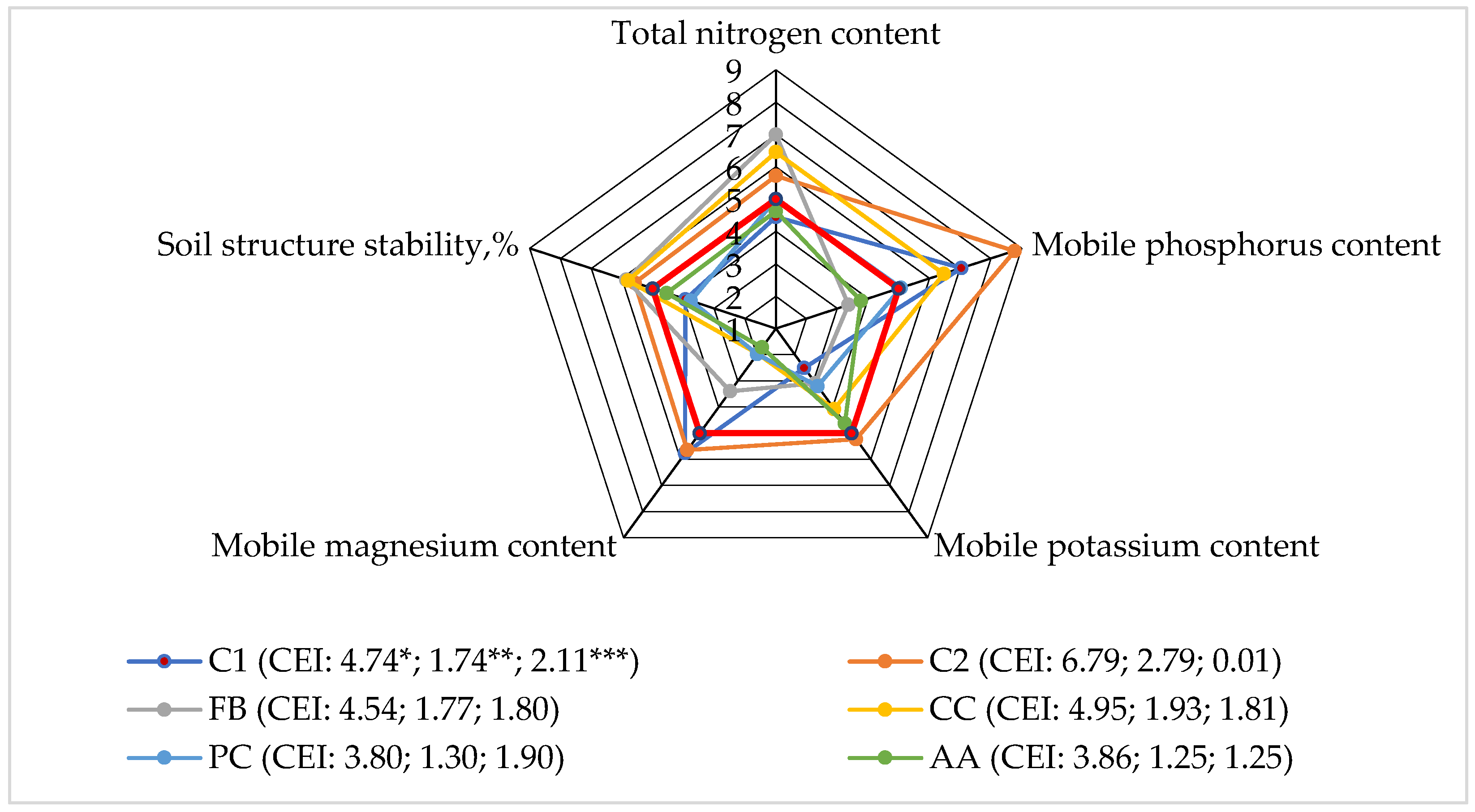
Figure 2.
The complex effect of endogenous maize and intercrops rotations, 2024. Note: C1 – inter-row loosening (control 1), C2 – inter-row mulching with weeds (control 2), WR – intercropped winter rye, AR – intercropped annual ryegrass, SB – intercropped spring barley, CA – intercropped common oat.
Figure 2.
The complex effect of endogenous maize and intercrops rotations, 2024. Note: C1 – inter-row loosening (control 1), C2 – inter-row mulching with weeds (control 2), WR – intercropped winter rye, AR – intercropped annual ryegrass, SB – intercropped spring barley, CA – intercropped common oat.
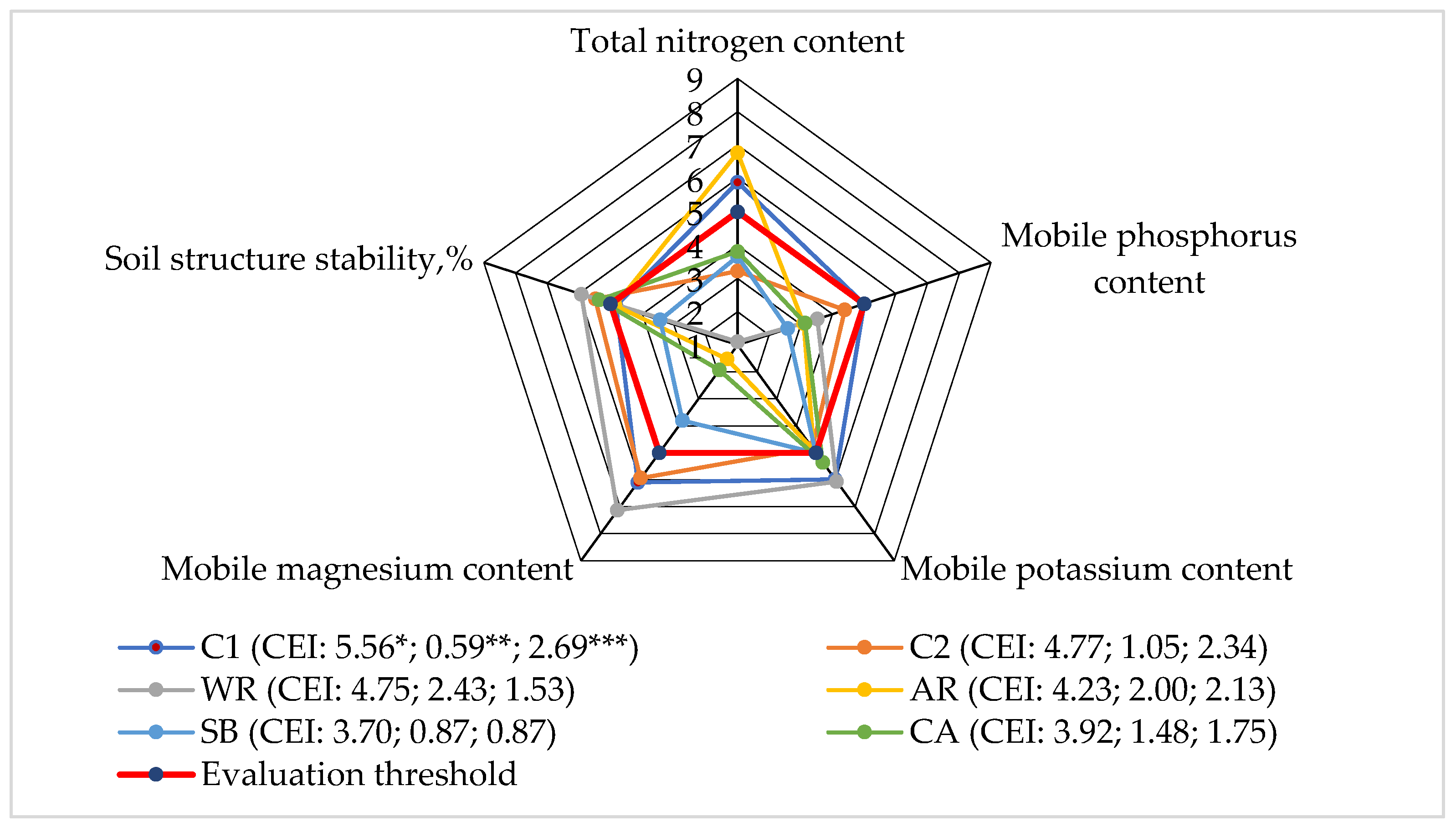

Table 1.
Multi-cropping diversity.
| Years | Treatment No. | Biodiversity level | Treatments | Abbreviation |
|---|---|---|---|---|
| 2023–2024 | 1 | Single crop | Inter–row loosening | C1 |
| 2 | Inter–row mulching with weed biomass | C2 | ||
| 2023 | 3 | Binary crop | Faba bean | FB |
| 4 | Crimson clover | CC | ||
| 5 | Persian clover | PC | ||
| 6 | Blue-flowered alfalfa | AA | ||
| 2024 | 3 | Binary crop | Winter rye | WR |
| 4 | Annual ryegrass | AR | ||
| 5 | Spring barley | SB | ||
| 6 | Common oat | CA |
Table 2.
Average air temperature and rainfall during vegetative seasons. Kaunas meteorological station.
Table 2.
Average air temperature and rainfall during vegetative seasons. Kaunas meteorological station.
| Months | 2023 | 2024 | Long-term (since 1974) average |
| Air temperature °C | |||
| April | 8.5 | 9.1 | 6.9 |
| May | 12.6 | 15.6 | 13.2 |
| June | 17.3 | 17.8 | 16.1 |
| July | 18.0 | 20.1 | 18.7 |
| August | 20.2 | 19.7 | 17.3 |
| September | 17.1 | 17.3 | 12.6 |
| Rainfall mm | |||
| April | 26.7 | 63.0 | 41.3 |
| May | 14.3 | 25.1 | 61.7 |
| June | 64.0 | 36.8 | 76.9 |
| July | 36.8 | 109.4 | 96.6 |
| August | 96.2 | 40.9 | 88.9 |
| September | 11.6 | 52.6 | 60.0 |
Table 3.
Impact of intercrops rotation on soil structural stability (%), 2023–2024.
| Treatment | Beginning of vegetative season | End of vegetative season | Difference |
| 2023 | |||
| C1 | 31.7a | 11.7ab | -20.0 |
| C2 | 37.7a | 17.0ab | -20.7 |
| FB | 39.0a | 17.6a | -21.4 |
| CC | 38.9a | 17.3ab | -21.5 |
| PC | 28.6a | 13.6b | -15.1 |
| AA | 30.8a | 16.8ab | -14.0 |
| 2024 | |||
| C1 | 17.2b | 29.5ab | 12.2 |
| C2 | 17.9ab | 32.3ab | 14.4 |
| WR | 21.2a | 31.3ab | 10.1 |
| AR | 17.3a | 29.5ab | 12.2 |
| SB | 13.2ab | 26.1a | 12.9 |
| CA | 15.1ab | 34.4b | 19.3 |
| 2023–2024 | |||
| C1 | 31.7a | 29.5ab | -2.2 |
| C2 | 37.7a | 32.3ab | -5.4 |
| FB/WR | 39.0a | 31.3ab | -7.7 |
| CC/AR | 38.9a | 29.5ab | -9.3 |
| PC/SB | 28.6a | 26.1a | -2.5 |
| AA/CA | 30.8a | 34.4b | 3.6 |
Notes: C1 – loosening of inter-rows (control 1), C2 – mulching of inter-rows with weed biomass (control 2), FB – intercropped field beans, CC – intercropped Crimson clover, PC – intercropped Persian clover, AA – intercropped blue-flowered alfalfa, WR – intercropped winter rye, AR – intercropped annual ryegrass, SB – intercropped spring barley, CA – intercropped common oat. Different letters (a, b) within columns mean significant difference between treatments at p ≤ 0.05.
Table 4.
Impact of intercrops rotation on soil total nitrogen (%), 2023–2024.
| Treatment | Beginning of vegetative season | End of vegetative season | Difference |
| 2023 | |||
| C1 | 0.129a | 0.118b | -0.012 |
| C2 | 0.124a | 0.130ab | 0.006 |
| FB | 0.129a | 0.132ab | 0.003 |
| CC | 0.130a | 0.128ab | -0.003 |
| PC | 0.114c | 0.136a | 0.022 |
| AA | 0.116b | 0.132ab | 0.017 |
| 2024 | |||
| C1 | 0.119a | 0.132a | 0.013 |
| C2 | 0.109a | 0.124a | 0.015 |
| WR | 0.118a | 0.126a | 0.009 |
| AR | 0.121a | 0.136a | 0.015 |
| SB | 0.110a | 0.126a | 0.016 |
| CA | 0.109a | 0.128a | 0.019 |
| 2023–2024 | |||
| C1 | 0.129a | 0.132a | 0.003 |
| C2 | 0.124a | 0.124a | 0.000 |
| FB/WR | 0.129a | 0.126a | -0.003 |
| CC/AR | 0.130a | 0.136a | 0.006 |
| PC/SB | 0.114c | 0.126a | 0.012 |
| AA/CA | 0.116b | 0.128a | 0.012 |
Notes: the same as above.
Table 5.
Impact of intercrops rotation on soil mobile phosphorus (mg kg-1), 2023–2024.
| Treatment | Beginning of vegetative season | End of vegetative season | Difference |
| 2023 | |||
| C1 | 250a | 238a | -12 |
| C2 | 246a | 270a | 24 |
| FB | 240a | 225a | -15 |
| CC | 239a | 245a | 7 |
| PC | 232a | 243a | 11 |
| AA | 227a | 241a | 14 |
| 2024 | |||
| C1 | 243a | 363a | 120 |
| C2 | 253a | 332a | 80 |
| WR | 268a | 294a | 26 |
| AR | 261a | 288a | 27 |
| SB | 243a | 291a | 48 |
| CA | 247a | 304a | 57 |
| 2023–2024 | |||
| C1 | 250a | 363a | 113 |
| C2 | 246a | 332a | 86 |
| FB/WR | 240a | 294a | 54 |
| CC/AR | 239a | 288a | 49 |
| PC/SB | 232a | 291a | 59 |
| AA/CA | 227a | 304a | 77 |
Notes: the same as above.
Table 6.
Impact of intercrops rotation on soil mobile potassium (mg kg-1), 2023–2024.
| Treatment | Beginning of vegetative season | End of vegetative season | Difference |
| 2023 | |||
| C1 | 112ab | 133b | 22 |
| C2 | 109ab | 208a | 99 |
| FB | 122a | 139ab | 17 |
| CC | 116ab | 170ab | 54 |
| PC | 103b | 161ab | 58 |
| AA | 106b | 195ab | 89 |
| 2024 | |||
| C1 | 99a | 111a | 12 |
| C2 | 102a | 102a | 1 |
| WR | 103a | 108a | 5 |
| AR | 97a | 108a | 11 |
| SB | 114a | 91a | -23 |
| CA | 94a | 113a | 20 |
| 2023–2024 | |||
| C1 | 112ab | 111a | -1 |
| C2 | 109ab | 102a | -7 |
| FB/WR | 122a | 108a | -14 |
| CC/AR | 116ab | 108a | -9 |
| PC/SB | 103b | 91a | -12 |
| AA/CA | 106b | 113a | 7 |
Notes: the same as above.
Table 7.
Impact of intercrops rotation on soil mobile potassium (mg kg-1), 2023–2024.
| Treatment | Beginning of vegetative season | End of vegetative season | Difference |
| 2023 | |||
| C1 | 791a | 587a | -204 |
| C2 | 609ab | 761a | 152 |
| FB | 638ab | 590a | -48 |
| CC | 569ab | 568a | -1 |
| PC | 560b | 578a | 18 |
| AA | 584ab | 538a | -46 |
| 2024 | |||
| C1 | 538a | 707a | 169 |
| C2 | 623a | 613a | -10 |
| WR | 645a | 660a | 15 |
| AR | 504a | 474a | -30 |
| SB | 579a | 532a | -47 |
| CA | 512a | 490a | -22 |
| 2023–2024 | |||
| C1 | 791a | 707a | -84 |
| C2 | 609ab | 613a | 4 |
| FB/WR | 638ab | 660a | 22 |
| CC/AR | 569ab | 474a | -95 |
| PC/SB | 560b | 532a | -28 |
| AA/CA | 584ab | 490a | -94 |
Notes: the same as above.
Table 8.
Interactions between soil properties, 2023–2024.
| Indices | Ntotal % | P2O5, mg kg-1 | K2O, mg kg-1 | MgO, mg kg-1 | pH | Sstab., % |
| 2023 | ||||||
| Ntotal % | 1.0 | 0.573 | 0.540 | 0.490 | 0.599 | 0.786 |
| P2O5, mg kg-1 | - | 1.0 | 0.970** | 0.795 | n | n |
| K2O, mg kg-1 | - | - | 1.0 | 0.725 | n | 0.400 |
| MgO, mg kg-1 | - | - | - | 1.0 | n | n |
| pH | - | - | - | - | 1.0 | 0.763 |
| 2024 | ||||||
| Ntotal % | 1.0 | n | N | N | -0.681 | 0.836* |
| P2O5, mg kg-1 | - | 1.0 | N | 0.779 | 0.607 | n |
| K2O, mg kg-1 | - | - | 1.0 | N | n | n |
| MgO, mg kg-1 | - | - | - | 1.0 | 0.860* | n |
| pH | - | - | - | - | 1.0 | n |
Notes: n – weak correlation; * – correlation is significant at 95% probability level; ** – correlation is significant at 99% probability level. “-“designates, that the correlation is presented here above. 1.0 – correlation is not evaluated between the same indices. Sstab. - soil structural stability.
Disclaimer/Publisher’s Note: The statements, opinions and data contained in all publications are solely those of the individual author(s) and contributor(s) and not of MDPI and/or the editor(s). MDPI and/or the editor(s) disclaim responsibility for any injury to people or property resulting from any ideas, methods, instructions or products referred to in the content. |
© 2025 by the authors. Licensee MDPI, Basel, Switzerland. This article is an open access article distributed under the terms and conditions of the Creative Commons Attribution (CC BY) license (https://creativecommons.org/licenses/by/4.0/).
Copyright: This open access article is published under a Creative Commons CC BY 4.0 license, which permit the free download, distribution, and reuse, provided that the author and preprint are cited in any reuse.


